Economic Evaluations of New Vaccine Introduction in Middle-Income Countries in the Middle East and North Africa Region: A Systematic Review

Abstract
1. Introduction
- Identify economic evaluations that assess the costs and benefits of introducing HPVs, PCVs, and RVs into National Immunisation Plans in MENA MICs eligible under the Gavi 5.0 framework.
- Synthesise existing economic evaluations of HPVs, PCVs, and RVs to inform policymaking on the economic feasibility and sustainability of vaccine uptake.
- Highlight evidence gaps and priority areas for further research.
2. Materials and Methods
2.1. Protocol and Registration
2.2. Data Sources and Searches
2.3. Study Selection
2.4. Data Extraction and Analysis
2.5. Quality Assessment of Included Studies
3. Results
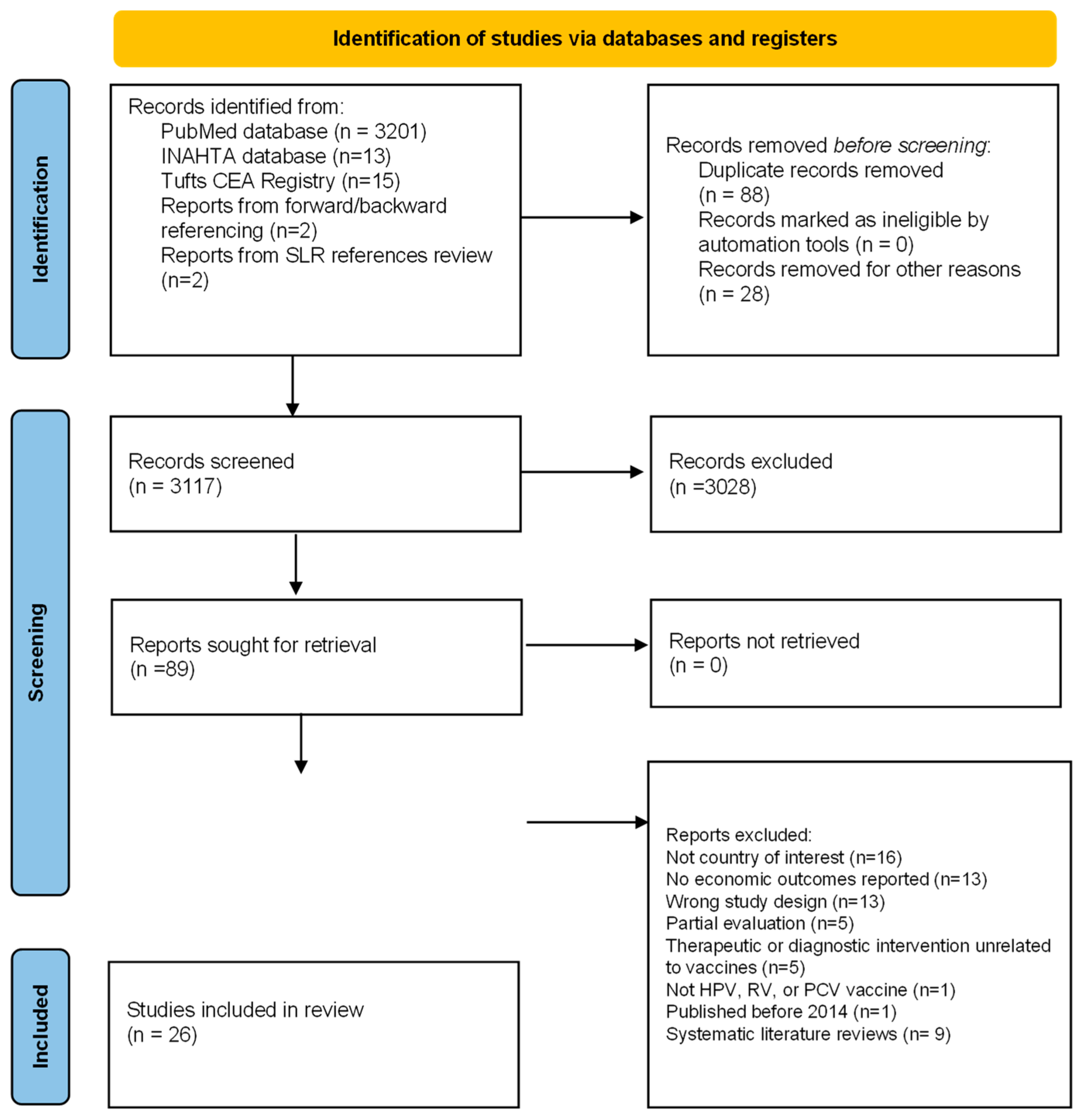
3.1. Literature Screening
3.2. Overview of Included Studies
3.3. Findings by Vaccine
3.3.1. HPV
3.3.2. PCV
3.3.3. RV
3.4. Quality Assessment
4. Discussion
5. Conclusions
- Use pooled procurement and MIC financing—leverage UNICEF Supply Division, regional pooled purchasing, and the UNICEF MIC Financing Facility to counter the higher prices non-Gavi MENA MICs pay.
- Collect local cost data—generate country-specific delivery, wastage, and cold-chain cost data to ground affordability and budget impact estimates.
- Pair CEA with budget impact analysis—require affordability and budget impact evidence, not cost–effectiveness ratios alone, in introduction decisions.
Supplementary Materials
Author Contributions
Funding
Data Availability Statement
Acknowledgments
Conflicts of Interest
Abbreviations
| MENA | Middle East and North Africa |
| MICs | Middle-Income Countries |
| HPV | Human Papillomavirus Vaccine |
| PCV | Pneumococcal Conjugate Vaccine |
| RV | Rotavirus Vaccine |
| LMICs | Low- and Middle-Income Countries |
| CEA | Cost–Effectiveness Analysis |
| INAHTA | International Health Technology Assessment |
| QALY | Quality-Adjusted Life Year |
| DALY | Disability-Adjusted Life Year |
| GDP | Gross Domestic Product |
| JBI | Joanna Briggs Institute |
| CHEERS | Consolidated Health Economic Evaluation Reporting Standards |
| PRISMA | Preferred Reporting Items for Systematic Reviews and Meta-Analyses |
| CBA | Cost–Benefit Analysis |
| CUA | Cost–Utility Analysis |
| ICER | Incremental Cost–Effectiveness Ratio |
| PhiD-CV | 10-Valent Pneumococcal Non-Typeable Haemophilus Influenzae Protein D Conjugate Vaccine |
| USD | United States Dollar |
Appendix A
Appendix A.1. New Vaccine Dosing Schedules for PCV (WHO 2025 Guidelines)
- Schedule—the World Health Organization (WHO) recommends a three-dose schedule for PCVs. This can be given as either:
- ⚬
- Two primary doses + one booster (2p + 1).
- ⚬
- Three primary doses with no booster (3p + 0).
- ⚬
- Starting age—vaccination can start as early as 6 weeks of age.
- ⚬
- Available vaccines—there are three WHO prequalified PCVs available, targeting either 10 or 13 common serotypes. The manufacturers and details are listed in Table A1.

| Manufacturer | Vaccine | PQ Year | Presentation | Dose/Course |
|---|---|---|---|---|
| GSK (London, UK) | PCV10 | 2017 | 4-dose vial | 3 |
| Serum Institute of India (SII) (Pune, India) | PCV10 | 2019 | 1-dose vial | 3 |
| PCV10 | 2019 | 5-dose vial | 3 | |
| Pfizer (New York, NY, USA) | PCV13 | 2010 | 1-dose vial | 3 |
| PCV13 | 2016 | 4-dose vial | 3 |
Appendix A.2. New Vaccine Dosing Schedules for HPV Vaccine (WHO 2025 Guidelines)
- As of 2025, WHO recommends:
- ⚬
- A one- or two-dose schedule for girls aged 9–14 years and women aged 15–20 years.
- ⚬
- Two doses with a 6-month interval for women older than 21 years.
- There are four available WHO prequalified HPVs (Table A2).
| Manufacturer | Vaccine | PQ Year | Presentation | Dose/Course |
|---|---|---|---|---|
| GSK | Bivalent | 2009 | 2-dose vial | 1 or 2 dose |
| Merck & Co./MSD | Quadrivalent | 2009 | 1-dose vial | 1 or 2 dose |
| Nonavalent | 2018 | 1-dose vial | 1 or 2 dose | |
| Xiamen Innovax | Bivalent | 2021 | 1-dose vial | 1 or 2 dose |
Appendix A.3. New Vaccine Dosing Schedules for RV Vaccine (WHO 2025 Guidelines)
- Rotarix (GSK): Monovalent, single dose presentation
- RotaTeq (Merck & Co./MSD): Pentavalent, single dose and two-dose presentation
- Rotavac (Bharat Biotech (Telangana, India)): Monovalent, five-dose or 10-dose presentation
- RotaSiil (Serum Institute of India): Pentavalent, single dose and two-dose presentation
Appendix B
Definition and Description of MENA Middle-Income Countries
- Egypt.
- Jordan.
- Lebanon.
- Morocco.
- Palestine.
- Tunisia.
- Algeria.
- Iran (Islamic Republic of).
Appendix C
Appendix C.1. PICOTS Framework
| PICOTS | Characteristic/s |
|---|---|
| Population(s) |
|
| Interventions |
|
| Comparator | No vaccination |
| Outcomes |
|
| Timing | Studies published in the last 10 years (2014–2024) |
| Setting | Middle-income countries in the MENA region, namely Algeria, Egypt, Iran, Jordan, Lebanon, Morocco, Palestine, and Tunisia |
Appendix C.2. Inclusion and Exclusion Criteria
| Inclusion Criteria | Exclusion Criteria |
|---|---|
|
|
|
|
|
|
|
|
|
|
|
|
|
|
|
References
- World Bank Group. Middle Income Countries. Available online: https://www.worldbank.org/ext/en/region/mic#:~:text=The%20world’s%20Middle%20Income%20Countries,exchange%20and%20South%2DSouth%20cooperation (accessed on 6 February 2026).
- Zhu, J.; Cole, C.B.; Fihman, J.; Adjagba, A.; Dasic, M.; Cernuschi, T. Opportunities to accelerate immunization progress in middle-income countries. Vaccine 2024, 42, S98–S106. [Google Scholar] [CrossRef] [PubMed]
- DeJong, J.; Bashour, H. UNFPA Regional Report Sexual and Reproductive Health Laws and Policies in Selected Arab Countries; UNFPA Regional Office for Arab States: Cairo, Egypt, 2016. [Google Scholar]
- GAVI the Vaccine Alliance. Gavi’s Approach to Engaging with Middle-Income Countries; GAVI the Vaccine Alliance: Geneva, Switzerland, 2025. [Google Scholar]
- Brisson, M.; Kim, J.J.; Canfell, K.; Drolet, M.; Gingras, G.; Burger, E.A.; Martin, D.; Simms, K.T.; Bénard, É.; Boily, M.-C.; et al. Impact of HPV vaccination and cervical screening on cervical cancer elimination: A comparative modelling analysis in 78 low-income and lower-middle-income countries. Lancet 2020, 395, 575–590. [Google Scholar] [CrossRef] [PubMed]
- Levy, J.; DeAntonio, R.; Sáez-Llorens, X. Effectiveness of pneumococcal conjugate 13-valent vaccine against severe pneumonia in Panama: A matched case-control study. J. Pediatr. 2025, 101, 601–607. [Google Scholar] [CrossRef] [PubMed]
- Soares-Weiser, K.; Bergman, H.; Henschke, N.; Pitan, F.; Cunliffe, N. Vaccines for preventing rotavirus diarrhoea: Vaccines in use. Cochrane Database Syst. Rev. 2019, 11, CD008521. [Google Scholar] [CrossRef] [PubMed]
- Mavundza, E.J.; Jaca, A.; Cooper, S.; Ndwandwe, D.E.; Wiysonge, C.S. Factors associated with HPV vaccine acceptance and hesitancy in Africa: A systematic review protocol. BMJ Open 2024, 14, e082592. [Google Scholar] [CrossRef] [PubMed]
- Karami, M.; Berangi, Z. The Need for Rotavirus Vaccine Introduction in the National Immunization Program of More Than 100 Countries around the World. Infect. Control Hosp. Epidemiol. 2018, 39, 124–125. [Google Scholar] [CrossRef] [PubMed]
- World Health Organization. Introduction of PCV (Pneumococcal Conjugate Vaccine). Available online: https://immunizationdata.who.int/global/wiise-detail-page/introduction-of-pcv-(pneumococcal-conjugate-vaccine)?ISO_3_CODE=&CODE=Middle%20East%20and%20North%20Africa&YEAR= (accessed on 5 February 2026).
- Bishop, C.; Parashar, D.; Kizza, D.; Abeshu, M.; Kaddar, M.; Bchir, A.; El Maghraby, A.; Schirrmacher, H.; Wang, Z.; Griffiths, U.; et al. New Vaccine Introduction in Middle-Income Countries Across the Middle East and North Africa—Progress and Challenges. Vaccines 2025, 13, 860. [Google Scholar] [CrossRef] [PubMed]
- Nagi, M.A.; Luangsinsiri, C.; Thavorncharoensap, M. A systematic review of economic evaluations of vaccines in Middle East and North Africa countries: Is existing evidence good enough to support policy decision-making? Expert Rev. Pharmacoecon. Outcomes Res. 2021, 21, 1159–1178. [Google Scholar] [CrossRef] [PubMed]
- Laraj, O.; Benzina, B.; Gzara, A.; Kebir, A.; Abbas, K.; Miled, S.B. Human papillomavirus vaccination at the national level in Tunisia: A cost-effectiveness analysis using a comparative modeling study. medRxiv 2024, 24313756. [Google Scholar] [CrossRef]
- Khiari, H.; Makni, K.; Meddeb, K.; Jaidane, O.; Hsairi, M. Cost-effectiveness of human papillomavirus (HPV) vaccination in Tunisia: A modelling study. BMJ Open 2024, 14, e085462. [Google Scholar] [CrossRef] [PubMed]
- Mohy, A.; Lagoubi, Y.; Gomez, J.A.; Amadou, B.; Bouskraoui, M. Health economic evaluation of 2-dose and 3-dose rotavirus vaccines in children below 5 years of age in Morocco. Hum. Vaccines Immunother. 2024, 20, 2353480. [Google Scholar] [CrossRef] [PubMed]
- Hagens, A.; Sloof, A.C.; Janghorban, R. Using a Dynamic Model to Estimate the Cost-Effectiveness of HPV Vaccination in Iran. Vaccines 2024, 12, 438. [Google Scholar] [CrossRef] [PubMed]
- PRISMA. PRISMA 2020 Checklist [Internet]. Available online: https://www.prisma-statement.org/prisma-2020-checklist (accessed on 23 June 2026).
- The World Bank Group. The World Bank Atlas Method-Detailed Methodology; The World Bank Group: Washington, DC, USA, 2025; Available online: https://datahelpdesk.worldbank.org/knowledgebase/articles/378832-what-is-the-world-bank-atlas-method (accessed on 6 February 2026).
- World Bank Group. GDP per Capita (Current US$). Available online: https://data.worldbank.org/indicator/NY.GDP.PCAP.CD (accessed on 13 February 2026).
- World Bank Group. Official Exchange Rate (LCU Per US$, Period Average). Available online: https://data.worldbank.org/indicator/PA.NUS.FCRF (accessed on 13 February 2026).
- World Bank Group. Current Health Expenditure Per Capita (Current US$). Available online: https://data.worldbank.org/indicator/SH.XPD.CHEX.PC.CD (accessed on 13 February 2026).
- Husereau, D.; Drummond, M.; Augustovski, F.; de Bekker-Grob, E.; Briggs, A.H.; Carswell, C.; Caulley, L.; Chaiyakunapruk, N.; Greenberg, D.; Loder, E.; et al. Consolidated Health Economic Evaluation Reporting Standards 2022 (CHEERS 2022) statement: Updated reporting guidance for health economic evaluations. BMJ 2022, 376, e067975. [Google Scholar] [CrossRef] [PubMed]
- Syeed, M.S.; Ghule, P.; Le, L.M.; Veettil, S.K.; Horn, E.K.; Perdrizet, J.; Wasserman, M.; Thakkinstian, A.; Chaiyakunapruk, N. Pneumococcal Vaccination in Children: A Systematic Review and Meta-Analysis of Cost-Effectiveness Studies. Value Health 2023, 26, 598–611. [Google Scholar] [CrossRef] [PubMed]
- Sriudomporn, S.; Watts, E.; Sim, S.Y.; Hutubessy, R.; Patenaude, B. Achieving immunization agenda 2030 coverage targets for 14 pathogens: Projected product and immunization delivery costs for 194 Countries, 2021–2030. Vaccine X 2023, 13, 100256. [Google Scholar] [CrossRef] [PubMed]
- Lahdhiri, A.; Benzina, B.; Ennaifer, E.; Tounsi, H.; Gzara, A.; Rammeh-Rommani, S.; Laraj, O.; Arfaoui, H.; Stuart, R.; Kebir, A.; et al. HPV DNA screening and vaccination strategies in Tunisia. Sci. Rep. 2025, 15, 27916. [Google Scholar] [CrossRef] [PubMed]
- Jit, M. Informing Global Cost-Effectiveness Thresholds Using Country Investment Decisions: Human Papillomavirus Vaccine Introductions in 2006–2018. Value Health 2021, 24, 61–66. [Google Scholar] [CrossRef] [PubMed]
- Chen, C.; Liceras, F.C.; Flasche, S.; Sidharta, S.; Yoong, J.; Sundaram, N.; Jit, M. Effect and cost-effectiveness of pneumococcal conjugate vaccination: A global modelling analysis. Lancet Glob. Health 2019, 7, e58–e67. [Google Scholar] [CrossRef] [PubMed]
- Chen, C.; Ang, G.; Akksilp, K.; Koh, J.; Scott, J.A.G.; Clark, A.; Jit, M. Re-evaluating the impact and cost-effectiveness of pneumococcal conjugate vaccine introduction in 112 low-income and middle-income countries in children younger than 5 years: A modelling study. Lancet Glob. Health 2024, 12, e1485–e1497. [Google Scholar] [CrossRef] [PubMed]
- Bencina, G.; Ugrekhelidze, D.; Shoel, H.; Oliver, E.; Meiwald, A.; Hughes, R.; Eiden, A.; Weston, G. The indirect costs of vaccine-preventable cancer mortality in the Middle East and North Africa (MENA). J. Med. Econ. 2024, 27, 1036–1045. [Google Scholar] [CrossRef] [PubMed]
- Janko, M.M.; Joffe, J.; Michael, D.; Earl, L.; Rosettie, K.L.; Sparks, G.W.; Albertson, S.B.; Compton, K.; Velandia, P.P.; Stafford, L.; et al. Cost-effectiveness of rotavirus vaccination in children under five years of age in 195 countries: A meta-regression analysis. Vaccine 2022, 40, 3903–3917. [Google Scholar] [CrossRef] [PubMed]
- Bahr, S.; Bzieh, R.; El Hayek, G.Y.; Adib, S. Cost–benefit analysis of a projected national human papilloma virus vaccination programme in Lebanon. East. Mediterr. Health J. 2019, 25, 715–721. [Google Scholar] [CrossRef] [PubMed]
- Bashari, N.; Davari, M.; Akbarisari, A.; Khorasani, E.; Daroudi, R. Cost-effectiveness analysis of different types of human papillomavirus vaccination to prevent cervical cancer in Iran. BMC Public Health 2025, 25, 3927. [Google Scholar] [CrossRef] [PubMed]
- Gamaoun, R. National cervical cancer prevention program in the Arab States: Strategies and cost-minimization study of the Tunisian case. Vaccine 2018, 36, 5091–5096. [Google Scholar] [CrossRef] [PubMed]
- Jit, M.; Brisson, M.; Portnoy, A.; Hutubessy, R. Cost-effectiveness of female human papillomavirus vaccination in 179 countries: A PRIME modelling study. Lancet Glob. Health 2014, 2, e406–e414. [Google Scholar] [CrossRef] [PubMed]
- Khatibi, M.; Rasekh, H.R.; Shahverdi, Z.; Jamshidi, H.R. Cost-Effectiveness Evaluation of Quadrivalent Human Papilloma Virus Vaccine for HPV-Related Disease in Iran. Iran. J. Pharm. Res. IJPR 2014, 13, 225–234. [Google Scholar] [PubMed]
- Laraj, O.; Benzina, B.; Gzara, A.; Kebir, A.; Abbas, K.; BenMiled, S. Potential health impact and cost-effectiveness of human papillomavirus vaccination in Tunisia: A comparative modeling study. Vaccine X 2025, 27, 100712. [Google Scholar] [CrossRef]
- Messoudi, W.; Elmahi, T.; Nejjari, C.; Tachfouti, N.; Zidouh, A.; Saadani, G.; Moriña, D.; Diaz, M. Cervical cancer prevention in Morocco: A model-based cost-effectiveness analysis. J. Med. Econ. 2019, 22, 1153–1159. [Google Scholar] [CrossRef] [PubMed]
- Rosettie, K.L.; Joffe, J.N.; Sparks, G.W.; Aravkin, A.; Chen, S.; Compton, K.; Ewald, S.B.; Mathew, E.B.; Michael, D.; Velandia, P.P.; et al. Cost-effectiveness of HPV vaccination in 195 countries: A meta-regression analysis. PLoS ONE 2021, 16, e0260808. [Google Scholar] [CrossRef] [PubMed]
- Sargazi, N.; Takian, A.; Daroudi, R.; Nahvijou, A.; Yaseri, M.; Motlagh, A.G.; Zendehdel, K. Cost–Benefit Analysis of Human Papillomavirus Vaccine in Iran. J. Prev. 2022, 43, 841–857. [Google Scholar] [CrossRef] [PubMed]
- Yaghoubi, M.; Nojomi, M.; Vaezi, A.; Erfani, V.; Mahmoudi, S.; Ezoji, K.; Zahraei, S.M.; Chaudhri, I.; Moradi-Lakeh, M. Cost-Effectiveness Analysis of the Introduction of HPV Vaccination of 9-Year-Old-Girls in Iran. Value Health Reg. Issues 2018, 15, 112–119. [Google Scholar] [CrossRef] [PubMed]
- Ezoji, K.; Yaghoubi, M.; Nojomi, M.; Mahmoody, S.; Zahraie, S.M.; Lakeh, M.M.; Tabatabaei, E.R.; Karimi, A. Cost-effectiveness of introducing the pneumococcal conjugate vaccine for children under 5 years in the Islamic Republic of Iran. East. Mediterr. Health J. 2019, 25, 686–697. [Google Scholar] [CrossRef] [PubMed]
- Lagoubi, Y.; Sfar, M.T.; Gomez, J.A. A cost-effectiveness analysis of PHiD-CV compared to PCV13 in a national immunization program setting in Tunisia. Hum. Vaccines Immunother. 2022, 18, 2079305. [Google Scholar] [CrossRef] [PubMed]
- Pugh, S.J.; Fletcher, M.A.; Charos, A.; Imekraz, L.; Wasserman, M.; Farkouh, R. Cost-Effectiveness of the Pneumococcal Conjugate Vaccine (10- or 13-Valent) Versus No Vaccination for a National Immunization Program in Tunisia or Algeria. Infect. Dis. Ther. 2019, 8, 63–74. [Google Scholar] [CrossRef] [PubMed]
- Sevilla, J.; Burnes, D.; El Saie, R.Z.; Haridy, H.; Wasserman, M.; Pugh, S.; Perdrizet, J.; Bloom, D. Cost-utility and cost-benefit analysis of pediatric PCV programs in Egypt. Hum. Vaccines Immunother. 2022, 18, 2114252. [Google Scholar] [CrossRef] [PubMed]
- Sibak, M.; Moussa, I.; El-Tantawy, N.; Badr, S.; Chaudhri, I.; Allam, E.; Baxter, L.; Freikha, S.A.; Hoestlandt, C.; Lara, C.; et al. Cost-effectiveness analysis of the introduction of the pneumococcal conjugate vaccine (PCV-13) in the Egyptian national immunization program, 2013. Vaccine 2015, 33, A182–A191. [Google Scholar] [CrossRef] [PubMed]
- Azad, Z.; Teimouri, F.; Akbarisari, A.; Esteghamati, A.; Nikfar, S. Budget Impact Analysis of Rotavirus Vaccine Adoption in the Childhood Immunization Schedule of Iran. Value Health Reg. Issues 2019, 18, 91–96. [Google Scholar] [CrossRef] [PubMed]
- Debellut, F.; Jaber, S.; Bouzya, Y.; Sabbah, J.; Barham, M.; Abu-Awwad, F.; Hjaija, D.; Ramlawi, A.; Pecenka, C.; Clark, A.; et al. Introduction of rotavirus vaccination in Palestine: An evaluation of the costs, impact, and cost-effectiveness of ROTARIX and ROTAVAC. PLoS ONE 2020, 15, e0228506. [Google Scholar] [CrossRef] [PubMed]
- Debellut, F.; Clark, A.; Pecenka, C.; Tate, J.; Baral, R.; Sanderson, C.; Parashar, U.; Atherly, D. Evaluating the potential economic and health impact of rotavirus vaccination in 63 middle-income countries not eligible for Gavi funding: A modelling study. Lancet Glob. Health 2021, 9, e942–e956. [Google Scholar] [CrossRef] [PubMed]
- Debellut, F.; Pecenka, C.; Hausdorff, W.P.; Clark, A. Potential impact and cost-effectiveness of injectable next-generation rotavirus vaccines in 137 LMICs: A modelling study. Hum. Vaccines Immunother. 2022, 18, 2040329. [Google Scholar] [CrossRef] [PubMed]
- Javanbakht, M.; Moradi-Lakeh, M.; Yaghoubi, M.; Esteghamati, A.; Ghanaie, R.M.; Mahmoudi, S.; Shamshiri, A.-R.; Zahraei, S.M.; Baxter, L.; Shakerian, S.; et al. Cost-effectiveness analysis of the introduction of rotavirus vaccine in Iran. Vaccine 2015, 33, A192–A200. [Google Scholar] [CrossRef] [PubMed]
- Jarrahi, Y.M.; Zahraei, S.M.; Sadigh, N.; Langeroudy, K.E.; Khodadost, M.; Ranjbaran, M.; Moghaddam, A.S.; Besharat, M.; Jarrahi, A.M. The cost effectiveness of rotavirus vaccination in Iran. Hum. Vaccines Immunother. 2016, 12, 794–800. [Google Scholar] [CrossRef] [PubMed][Green Version]
- Paternina-Caicedo, A.M.; De la Hoz-Restrepo, F.; Alvis-Guzmán, N. Epidemiological and Economic Impact of Monovalent and Pentavalent Rotavirus Vaccines in Low and Middle Income Countries. Pediatr. Infect. Dis. J. 2015, 34, e176–e184. [Google Scholar] [CrossRef] [PubMed]
- Shakerian, S.; Lakeh, M.M.; Esteghamati, A.; Zahraei, M.; Yaghoubi, M. Cost-Effectiveness of Rotavirus Vaccination for Under-Five Children in Iran. Iran. J. Pediatr. 2015, 25, e2766. [Google Scholar] [CrossRef] [PubMed]
- Shen, K.; Wasserman, M.; Liu, D.; Yang, Y.-H.; Yang, J.; Guzauskas, G.F.; Wang, B.C.M.; Hilton, B.; Farkouh, R. Estimating the cost-effectiveness of an infant 13-valent pneumococcal conjugate vaccine national immunization program in China. PLoS ONE 2018, 13, e0201245. [Google Scholar] [CrossRef] [PubMed]
- Ozawa, S.; Chen, H.-H.; Rao, G.G.; Eguale, T.; Stringer, A. Value of pneumococcal vaccination in controlling the development of antimicrobial resistance (AMR): Case study using DREAMR in Ethiopia. Vaccine 2021, 39, 6700–6711. [Google Scholar] [CrossRef] [PubMed]
- Luo, Q.; Ni, Q. Gender-neutral human papillomavirus vaccination: An equitable and cost-effective public health investment. Front. Public Health 2026, 13, 1725127. [Google Scholar] [CrossRef]
- Al-Eitan, L.N.; Almahdawi, D.L.; Abu Khiarah, R.A.; Alghamdi, M.A. Bridging Gaps in Vaccine Access and Equity: A Middle Eastern Perspective. Vaccines 2025, 13, 806. [Google Scholar] [CrossRef] [PubMed]
- Vande Maele, N.; Bourgoin, B. Unequal Access to Immunization in Middle-Income Countries Immunization Agenda 2030: In-Depth Review; Immunization Agenda 2030 Working Group on Middle-Income Countries/World Health Organization: Geneva, Switzerland, 2024. [Google Scholar]
- World Health Organization. MI4A Vaccine Purchase Data; World Health Organization: Geneva, Switzerland, 2025; Available online: https://www.who.int/teams/immunization-vaccines-and-biologicals/vaccine-access/mi4a/mi4a-vaccine-purchase-data (accessed on 18 February 2026).
- Gavi the Vaccine Alliance. Gavi MICs Approach-Considerations on Access to Sustainable Supply and Affordable Pricing; Gavi the Vaccine Alliance: Geneva, Switzerland, 2025; Available online: https://www.gavi.org/programmes-impact/programmatic-policies/eligibility-co-financing-policies/considerations-access-sustainable-supply-affordable-pricing (accessed on 18 February 2026).
- World Health Organization. Sustainable Access to Vaccines in Middle-Income Countries (MICs): A Shared Partner Strategy Report of the WHO-Convened MIC Task Force; World Health Organization: Geneva, Switzerland, 2015. [Google Scholar]
- UNICEF Supply Division. Middle-Income Countries’ Financing Facility Closing the Gap on Global Health Inequity to Ensure the Survival and Development of Every Child. Available online: https://www.unicef.org/supply/middle-income-countries-financing-facility (accessed on 18 February 2026).
- Leech, A.A.; Kim, D.D.; Cohen, J.T.; Neumann, P.J. Use and Misuse of Cost-Effectiveness Analysis Thresholds in Low- and Middle-Income Countries: Trends in Cost-per-DALY Studies. Value Health 2018, 21, 759–761. [Google Scholar] [CrossRef] [PubMed]
- Pichon-Riviere, A.; Drummond, M.; Palacios, A.; Garcia-Marti, S.; Augustovski, F. Determining the efficiency path to universal health coverage: Cost-effectiveness thresholds for 174 countries based on growth in life expectancy and health expenditures. Lancet Glob. Health 2023, 11, e833–e842. [Google Scholar] [CrossRef] [PubMed]
- Watkins, D.A.; Twea, P.D.; Gaudin, S.; Stenberg, K. Analytical Methods and Tools Used for Priority Setting and Costing for Health Benefits Packages in Low-and Lower-Middle-Income Countries. In Country-Led Priority Setting for Health; The World Bank Group: Washington, DC, USA, 2025. [Google Scholar]
- Sume, G.E.; Quamrul, H.; Sharifuzzaman; Kissa, J.; Hutin, Y. National immunization technical advisory groups (NITAGs) in the WHO Eastern Mediterranean Region (EMR): A decade of shaping immunization policies, 2010–2021. Vaccine 2024, 42, 629–635. [Google Scholar] [CrossRef] [PubMed]
- Sume, G.E.; Hasan, Q.; Shefer, A.; Henaff, L.; Cavallaro, K.F.; Tencza, C.B.; Hadler, S.C.; Sidy, N.; Sardar, P.; Kagina, B.M.; et al. Region-wide assessment of National Immunization Technical Advisory Groups (NITAGs) using the NITAG Maturity Assessment Tool (NMAT)–Experience from the Eastern Mediterranean Region of the World Health Organization, 2023. Vaccine 2024, 42, 2239–2245. [Google Scholar] [CrossRef] [PubMed]
- Ma, S.; Lavelle, T.A.; Ollendorf, D.A.; Lin, P.-J. Herd Immunity Effects in Cost-Effectiveness Analyses among Low- and Middle-Income Countries. Appl. Health Econ. Health Policy 2022, 20, 395–404. [Google Scholar] [CrossRef] [PubMed]
- World Health Organization. Immunization, Vaccines and Biologicals [Internet]. 2025. Available online: https://www.who.int/teams/immunization-vaccines-and-biologicals/policies/who-recommendations-for-routine-immunization---summary-tables (accessed on 23 June 2026).

| Author | Year Published | Study Type | Country | Vaccine | Intervention and Comparator | Perspective | Model Type and Time Horizon | Health Outcome | Main Findings (ICER) | Cost–Effectiveness Threshold | Main Conclusions |
|---|---|---|---|---|---|---|---|---|---|---|---|
| Human Papillomavirus Vaccine (HPV) | |||||||||||
| Bahr et al. [31] | 2019 | CBA | Lebanon | Cervarix™ | HPV vaccination campaign vs. no vaccination | Implied: governmental and payer (National Treasury) | Static (no time horizon reported) | No health outcome | USD 5,407,790 to vaccinate 38,083 11-year-old girls | N/A | HPV vaccination would not be cost-beneficial under the circumstances existing in 2016. |
| Bashari et al. [32] | 2025 | CEA | Iran | Bivalent, quadrivalent, and nine-valent HPV | HPV vaccination vs. no vaccination | Payer | Static (80 years) | QALYs gained, cervical cancer death reduction, cervical cancer cases reduction | 2 doses: Bivalent = USD 33,179/QALY Quadrivalent = USD 45.088/QALY Nine-valent = USD 50.067/QALY 3 doses: Bivalent = USD 50,264/QALY Quadrivalent = USD 69.384/QALY Nine-valent = USD 76.778/QALY | 1× GDP per capita as threshold, based on World Bank data | None of the vaccination strategies were considered cost-effective. |
| Gamaoun, R. [33] | 2018 | CMA | Tunisia | Bivalent HPV | National HPV vaccination programme vs. cervical cancer screening using the Pap smear test | Implied: health system | Static (1 year) | Cervical cancer cases avoided | Ascending incremental costs by avoided cervical cancer case: 1—the national vaccination programme through GAVI support (USD 1803); 2—the cervical cancer screening according to 10-year periodicity (USD 8219); 3—the cervical cancer screening according to 5-year periodicity (USD 14,567); 4—the cervical cancer screening according to 3-year periodicity (USD 20,479); and 5—the national vaccination programme according to the manufacturer marketed price (USD 36,854) | N/A | HPV national vaccination programme combined with cervical cancer screening according to 5-year periodicity present the best cost-effective strategy for cervical cancer prevention. |
| Hagens et al. [16] | 2024 | CEA | Iran | HPV | HPV vaccination vs. no vaccination | Healthcare system | Dynamic (70 years) | QALYs gained, deaths averted | Vaccinating boys and girls: USD 7916/QALY Vaccinating only girls: USD 4949/QALY Vaccinating only boys: USD 15,529/QALY | ICER below 1× GDP per capita | Vaccinating only girls was found to be cost-effective, with an ICER close to the GDP per capita. Vaccinating both sexes was shown to be less cost-effective compared to girls only, and vaccinating boys only was not found to be cost-effective, with an ICER between one and three times, and greater than three times the GDP per capita. |
| Jit et al. [34] | 2014 | CEA | 179 countries, including Algeria, Egypt, Iran, Jordan, Lebanon, Morocco, and Tunisia | HPV 16/18 | HPV16/18 versus no further vaccine introductions; HPV16/18 versus increased vaccine introductions in 2012–2032 | Implied: healthcare or purchaser | Static (1 year) | Deaths prevented, cancers prevented, DALYs averted | Cost per life year saved: Algeria: USD 4250 Egypt: USD 13,900 Iran: USD 10,800 Jordan: USD 11,700 Lebanon: USD 6760 Morocco: USD 1700 Tunisia: USD 6500 Cost per DALY prevented: Algeria: USD 3830 Egypt: USD 12,600 Iran: USD 9940 Jordan: USD 10,800 Lebanon: USD 6180 Morocco: USD 1560 Tunisia: USD 5970 | GDP per capita | HPV vaccination is likely to be very cost-effective in most countries and cost-effective in almost every country in the world. |
| Khatibi et al. [35] | 2014 | CEA | Iran | HPV 16/18 (Gardasil®) | HPV vaccination vs. no vaccination | Governmental | Static (59 years) | QALYs gained | IRR 439,092,468/QALY | ICER below 3× GDP per capita | Quadrivalent HPV (Gardasil®) is not cost-effective in Iran based on the base case parameters value. |
| Khiari et al. [14] | 2024 | CEA | Tunisia | HPV 16/18 | HPV 16/18 vaccination vs. no vaccination; combined HPV vaccination and screening vs. screening alone | Not reported | Dynamic (no time horizon reported) | QALYs gained | Combined vaccine and screening strategy vs. no intervention: USD 966.5/QALY Combined vaccine and screening strategy vs. screening alone: USD 2293.3/QALY | ICER less than the country’s GDP per capita | Compared with screening alone, the implementation of HPV vaccination in addition to the current cytology screening programme in Tunisia would be considered cost-effective on the basis of the threshold GDP per capita. |
| Laraj et al. [13] | 2025 | CEA | Tunisia | Cecolin®, Cervarix™, Gardasil-4™, Gardasil-9® | HPV vaccination vs. no vaccination | Governmental and societal | Static (lifetime) | DALYs averted, deaths averted, cases averted | Cecolin® PRIME model: Government perspective: USD 162/DALY Societal perspective: USD 34/DALY UNIVAC model: Government perspective: USD 121/DALY Societal perspective: USD 13/DALY Cervarix™ PRIME model: Government perspective: USD 845/DALY Societal perspective: USD 718/DALY UNIVAC model: Government perspective: USD 625/DALY Societal perspective: USD 516/DALY Gardasil-4™ PRIME model: Government perspective: USD 1266/DALY Societal perspective: USD 1139/DALY UNIVAC model: Government perspective: USD 935/DALY Societal perspective: USD 827/DALY Gardasil-9® PRIME model: Government perspective: USD 1845/DALY Societal perspective: USD 1718/DALY UNIVAC model: Government perspective: USD 1362/DALY Societal perspective: USD 1253/DALY Cecolin® (cross-protection) PRIME model: Government perspective: USD 151/DALY Societal perspective: USD 24/DALY UNIVAC model: Government perspective: USD 113/DALY Societal perspective: USD 5/DALY Cervarix™ (cross-protection) PRIME model: Government perspective: USD 686/DALY Societal perspective: USD 559/DALY UNIVAC model: Government perspective: USD 507/DALY Societal perspective: USD 399/DALY | A range of alternative possible WTP thresholds up to 0.3 times the national GDP per capita | The four HPVs (Cecolin®, Cervarix®, Gardasil-4®, and Gardasil-9®,) were cost-effective in the Tunisian context. |
| Messoudi et al. [37] | 2019 | CEA | Morocco | HPV 16/18 | Three strategies modelled: (1) Screening women (30–49 years old) versus no intervention (2) HPV16/18 vaccination of girls at least 14 years old versus no intervention (3) Combined vaccination and screening versus screening alone | Healthcare system | Static (lifetime) | Years of life saved (YLS) | Strategy: Visual inspection with acetic acid 5% ICER for vaccinating 14-year-old girls: dominated ICER for vaccination + screening: USD 2327/YLS Strategy: Visual inspection with acetic acid 15% ICER for vaccinating 14-year-old girls: dominated ICER for vaccination + screening: USD 2911/YLS Strategy: Visual inspection with acetic acid 20% ICER for vaccinating 14-year-old girls: USD 1150/YLS ICER for vaccination + screening: USD 3743/YLS Strategy: Visual inspection with acetic acid 30% ICER for vaccinating 14-year-old girls: USD 1150/YLS ICER for vaccination + screening: USD 5308/YLS Strategy: Visual inspection with acetic acid 50% ICER for vaccinating 14-year-old girls: USD 1150/YLS ICER for vaccination + screening: USD 10,712/YLS Strategy: Visual inspection with acetic acid 70% ICER for vaccinating 14-year-old girls: USD 1150/YLS ICER for vaccination + screening: USD 14,170/YLS Strategy: Visual inspection with acetic acid 100% ICER for vaccinating 14-year-old girls: USD 1150/YLS ICER for vaccination + screening: USD 20,167/YLS | ICER below 3× GDP per capita | HPV vaccination could be highly effective and cost-effective in Morocco. Current screening would be good value for money compared with no intervention, but scaling up screening coverage would make it inefficient compared with vaccination. |
| Rosettie et al. [38] | 2021 | Cost–effectiveness and meta-regression analyses | 195 countries, including Iran and Egypt | HPV quadrivalent and bivalent vaccines | HPV vaccination vs. no vaccination | Healthcare payer | Static (lifetime) | DALYs averted | Algeria: USD 6369 (1169 to 20,202)/DALY averted Egypt: USD 10,057 (1854 to 31,337)/DALY averted Iran: USD 9222 (1683 to 28,936)/DALY averted Jordan: USD 10,438 (1921 to 32,502)/DALY averted Lebanon: USD 4196 (1246 to 15,793)/DALY averted Morocco: USD 5317 (979 to 16,942)/DALY averted Palestine: USD 9632 (1773 to 30,034)/DALY averted | 0.5, 1, and 3× GDP per capita | The authors concluded that their results identified countries where the HPV had good value, but whether the vaccine is cost-effective based on country-specific predicted ICERs and cost–effectiveness thresholds is not reported. |
| Sargazi et al. [39] | 2022 | CBA | Iran | HPV bivalent and quadrivalent vaccine | HPV vaccination vs. no vaccination | Societal | Not reported (lifetime) | Net benefit | Cost–benefit ratio (willingness to pay approach): Bivalent: −USD 15.11 Quadrivalent: USD 2.51 Cost–benefit ratio (cost of illness approach): Bivalent: USD 258.12 Quadrivalent: USD 43.51 | N/A | This study confirmed the benefits of the national bivalent and quadrivalent vaccination programmes. Specifically, the bivalent vaccine’s benefit is higher than its cost under the cost-of-illness method; the quadrivalent vaccine’s benefit is higher than its cost under both evaluation methods (cost-of-illness and willingness to pay). |
| Yaghoubi et al. [40] | 2018 | CEA | Iran | HPV 16/18 (Gardasil®) | HPV vaccination vs. no vaccination | Governmental and societal | Dynamic (10 years) | DALYs averted, cases averted, deaths averted | Governmental: USD 15,205/DALY Societal: USD 14,999/DALY | Threshold using GDP per capita, using the WHO definition | Introducing a three-dose HPV vaccination programme is currently not cost-effective in Iran. |
| Pneumococcal Vaccine (PCV) | |||||||||||
| Ezoji et al. [41] | 2019 | CEA | Iran | PCV13 | PCV vaccination vs. no vaccination | Governmental and societal | Static (10 years) | DALYs averted, cases averted, deaths averted, hospital admissions averted, outpatient visits averted | Governmental perspective: USD 1890/DALY Societal perspective: USD 1538/DALY | 1 and 3× GDP per capita (2012) | Introduction of PCV-13 for children under 5 years in the Islamic Republic of Iran would be cost-effective. |
| Lagoubi et al. [42] | 2022 | CEA | Tunisia | PCV13 or PhiD-CV | PCV vaccination vs. no vaccination | Payer | Dynamic (lifetime) | QALYs gained, deaths averted, cases averted, medical visits averted, hospitalisations averted | PCV13: dominated PhiD-CV: USD 484/QALY | GDP per capita | PCVs are a cost-effective strategy to relieve the burden associated with diseases caused by S. pneumoniae and NTHi in Tunisia. PHiD-CV is more cost-effective than PCV13, generating similar health benefits at a reduced net cost of almost $1 million USD per vaccinated cohort. |
| Pugh et al. [43] | 2018 | CEA | Algeria, Tunisia | PCV10, PCV13 | PCV13 or PCV10 vs. no vaccination | Payer | Static (1 year) | QALYs gained, deaths averted, cases averted | PCV13 in Tunisia: USD 848/QALY PCV10 in Tunisia: USD 1366/QALY PCV13 in Algeria: USD 308/QALY PCV10 in Algeria: USD 731/QALY | If the vaccines averted 1 QALY less than 3× GDP per capita, they are cost-effective. They are highly cost-effective if they are below 1× GDP per capita | PCV NIPs are highly cost-effective and highly impactful public health interventions. |
| Sevilla et a [44] | 2022 | CUA and CBA | Egypt | PCV10 (Synflorix™), PCV13 (Prevenar13®) | PCV13 or PCV10 vs. no vaccination; PCV13 vs. PCV10 | Societal (CBA) and payer (CUA) | Static (100 years) | QALYs gained, deaths averted, cases averted, hospitalisations averted | PCV13 vs. no programme: USD 925.6 (512.08–1734.9)/QALY PCV10 vs. no programme: USD 1984.41 (1186.32–3804.67)/QALY PCV13 vs. PCV10: USD 173.98 (87.59–331.23)/QALY | 1 to 3 × GDP per capita | A universal paediatric PCV13 programme represents good value for money for policymakers in Egypt. |
| Sibak et al. [45] | 2015 | CEA | Egypt | PCV13 | PCV vaccination vs. no vaccination | Governmental | Static (10 years) | DALYs averted, deaths averted, cases averted, inpatient admissions averted, outpatient visits averted | USD 3916/DALY | 1× GDP per capita for highly cost-effective 3× GDP per capita for cost-effective | PCVs would be cost-effective from a governmental perspective. |
| Rotavirus Vaccine (RV) | |||||||||||
| Azad et al. [46] | 2019 | BIA | Iran | RotaTeq® (RV5) | RotaTeq® vs. no immunisation | Health system | Static (5 years) | Outpatient cases averted, inpatient cases averted | Incremental cost during 5 years of immunisation: USD 131,450,210 | Not applicable | The inclusion of rotavirus vaccine in the national vaccination programme would have a significant effect on health budgets and would raise government expenditure. |
| Debellut et al. [47] | 2020 | CEA | Palestine | Rotarix®, Rotavac® | Rotarix® vs. no vaccination; Rotavac® vs. no vaccination; Rotavac® vs. Rotarix | Health system and societal | Static (10 years) | DALYs averted, cases averted, deaths averted, outpatient visits averted, hospitalisations averted | Rotarix® compared to no vaccine (health system perspective): USD 1254/DALY Rotarix® compared to no vaccine (societal perspective): Cost-saving (−USD 794/DALY) Rotavac® compared to no vaccine (health system perspective): USD 353/DALY Rotavac® compared to no vaccine (societal perspective): Cost-saving (−USD 1695/DALY) Rotavac® compared to Rotarix® (health system perspective): Cost-saving (−USD 901/DALY) Rotavac® compared to Rotarix® (societal perspective): Cost-saving (−USD 901/DALY) | 1× GDP per capita | From the health system perspective, rotavirus vaccination with either Rotarix® or Rotavac® is a cost-effective intervention in Palestine compared to no vaccination. When accounting for averted healthcare-related costs for households, using either vaccine is a cost-saving intervention. When evaluating the switch, Rotavac® presents an economic advantage over Rotarix® and shifting from Rotarix® to Rotavac® was a cost-saving option from both health system and societal perspectives. |
| Debellut et al. [48] | 2021 | CEA and benefit-risk analysis | 63 MICs, including Algeria, Egypt, Iran, Jordan, Lebanon, Morocco, Palestine, and Tunisia | Rotarix®, Rotavac®, Rotasiil®, and next-generation rotavirus vaccines (NGRVs) | Current rotavirus vaccines vs. no vaccination; NGRVs vs. current rotavirus vaccines | Governmental and societal | Static (10 years) | DALYs averted, cases averted, deaths averted, outpatient visits averted, hospitalisations averted | Governmental perspective: Rotarix®: Algeria: USD 8332 (3520–15,992)/DALY Egypt: USD 2936 (2081–3872)/DALY Iran: USD 6669 (3839–9417)/DALY Jordan: USD 9497 (5799–14,016)/DALY Lebanon: USD 6374 (2052–10,352)/DALY Morocco: USD 3502 (2271–4970)/DALY Palestine: USD 10,171 (5609–16,294)/DALY Tunisia: USD 11,335 (6271–17,834)/DALY Rotavac®: Algeria: USD 2781 (1024–5418)/DALY Egypt: USD 1048 (657–1370)/DALY Iran: USD 1625 (0–2767)/DALY Jordan: USD 3318 (1671–5003)/DALY Lebanon: CS (CS–1690)/DALY Morocco: USD 1140 (643–1637)/DALY Palestine: USD 3604 (1803–5835)/DALY Tunisia: 3324 (1298–5587)/DALY Rotasiil®: Algeria: USD 2278 (789–4530)/DALY Egypt: USD 871 (511–1160)/DALY Iran: USD 1198 (0–2257)/DALY Jordan: USD 2701 (1223–4195)/DALY Lebanon: CS (CS–1029)/DALY Morocco: USD 937 (491–1361)/DALY Palestine: USD 2986 (1430–4927)/DALY Tunisia: USD 2636 (841–4626)/DALY Societal perspective: Rotarix®: Algeria: USD 8071/DALY Egypt: USD 2869/DALY Iran: USD 6172/DALY Jordan: USD 9106/DALY Lebanon: USD 4905/DALY Morocco: USD 3410/DALY Palestine: USD 9893/DALY Tunisia: USD 10,842/DALY Rotavac®: Algeria: USD 2520/DALY Egypt: USD 982/DALY Iran: USD 1128/DALY Jordan: USD 2927/DALY Lebanon: Cost-saving Morocco: USD 1048/DALY Palestine: USD 3326/DALY Tunisia: USD 2831/DALY Rotasiil®: Algeria: USD 2017/DALY Egypt: USD 805/DALY Iran: USD 701/DALY Jordan: USD 2310/DALY Lebanon: Cost-saving Morocco: USD 845/DALY Palestine: USD 2708/DALY Tunisia: USD 2143/DALY | 0.5× GDP per capita of each country | In most MICs not eligible for Gavi funding, rotavirus vaccination has a high probability to be cost-effective with a favourable benefit–risk profile. |
| Debellut et al. [49] | 2022 | CEA | 137 LMICs, including Iran, Egypt, Algeria, Tunisia, Jordan, Lebanon, Morocco, and Palestine | Licenced vaccines: Rotavac®, Rotasiil®, Rotarix® Other vaccines: RV3-BB, trivalent P2-VP8, trivalent P2-VP8 comprising part of a DTP-containing combination vaccine | Vaccines were compared to no vaccination and to each other | Societal | Static (10 years) | DALYs averted, cases averted, deaths averted, outpatient visits averted, hospitalisations averted | Rotavac® Algeria: USD 2662/DALY Egypt: USD 1093/DALY Iran: USD 1400/DALY Lebanon: Cost-saving Morocco: USD 1271/DALY Palestine: USD 3385/DALY Tunisia: USD 3286/DALY Jordan: USD 3138/DALY Rotasiil® Algeria: USD 3011/DALY Egypt: USD 1221/DALY Iran: USD 1725/DALY Lebanon: Cost-saving Morocco: USD 1429/DALY Palestine: USD 3795/DALY Tunisia: USD 3790/DALY Jordan: 3566/DALY Rotarix® Algeria: USD 12,148/DALY Egypt: USD 4507/DALY Iran: USD 10,063/DALY Lebanon: USD 8802/DALY Morocco: USD 5498/DALY Palestine: USD 14,395/DALY Tunisia: USD 16,788/DALY Jordan: USD 14,647/DALY | 0.25 to 1× GDP per capita for each country | The results show that while currently available live oral rotavirus vaccines (LORVs) remain a good investment for countries and donors today, an injectable next-generation rotavirus vaccine (iNGRV) with comparable or superior efficacy to LORVs is likely to be cost-effective in the majority of LMICs. |
| Javanbakht et al. [50] | 2015 | CEA | Iran | RotaTeq® (RV5) | Rotavirus vaccination vs. no vaccination | Health system and societal | Static (10 years) | DALYs averted, cases averted, deaths averted, outpatient visits averted, inpatient admissions averted | Governmental perspective: USD 2868/DALY Society perspective: USD 382/DALY | 1× GDP per capita (2013) for highly cost-effective 3× GDP per capita (2013) for cost-effective | Introduction of rotavirus vaccine is a highly cost-effective strategy from the government perspective. |
| Mohy et al. [15] | 2024 | CEA | Morocco | HRV, HBRV, BRV-PV | Rotavirus vaccination vs. no vaccination | Country payer and societal | Static (no time horizon reported) | QALYs gained | Base case ICER (HRV as the reference) country payer perspective HBRV: HRV is dominant BRV-PV: USD 328,376 Base case ICER (HRV as the reference) societal perspective HBRV: HRV is dominant BRV-PV: HRV is dominant | USD 3500 per QALY | HRV was associated with lower costs versus HBRV from both country payer (−$1.8 M) and societal (−$4.1 M) perspectives, and versus BRV-PV 1-dose vial from the societal perspective (−$187,000), dominating those options in the cost–effectiveness analysis. However, costs of BRV-PV 1-dose vials were lower than HRVs from the payer perspective, resulting in an ICER of approximately $328,376 per QALY, above the assumed cost–effectiveness threshold of $3500. Vaccination with a 2-dose schedule of HRV may be a cost-saving option and could lead to better health outcomes for children in Morocco versus 3-dose schedule rotavirus vaccines. |
| Mousavi Jarrahi et al. [51] | 2015 | CEA | Iran | Rotarix® | Rotavirus vaccination vs. no vaccination | Healthcare and societal | Static (5 years) | DALYs averted, deaths averted, outpatient visits averted, hospitalisations averted | A cost of 19 USD for each DALY averted from the healthcare system perspective A saving of 278 USD for each DALY averted from the societal perspective | 1× GDP per capita | Introducing rotavirus vaccine into EPI programme would be highly cost-effective public health intervention in Iran. |
| Paternina-Caicedo et al. [52] | 2015 | CEA | LMICs, including Algeria, Egypt, Jordan, Morocco, and Tunisia | RV1, RV5 | RV1 or RV5 vaccination vs. no vaccination | Healthcare | Static (1 year) | DALYs averted, deaths averted | Not reported by country | Below 1× GDP per capita and between 1× and 3× GDP per capita | Rotavirus vaccine is cost-effective in most analysed countries. |
| Shakerian et al. [53] | 2015 | CEA | Iran | RotaTeq®, Rotarix® | RotaTeq® vs. no vaccination; Rotarix® vs. no vaccination | Healthcare | Static | DALYs averted, cases averted | RotaTeq®: 3672 episodes per 100,000 with USD 10 price in base year = USD 16,186/DALY 6243 episodes per 100,000 with SD10 price in base year = USD 15,376/DALY 36,000 episodes per 100,000 with USD 10 price in base year = USD 9582/DALY 108,000 episodes per 100,000 with USD 10 price in base year = USD 3701/DALY 3672 episodes per 100,000 with USD 15 price in base year = USD 23,380/DALY 6243 episodes per 100,000 with USD 15 price in base year = USD 22,278/DALY 36,000 episodes per 100,000 with USD 15 price in base year = USD 14,443/DALY 108,000 episodes per 100,000 with USD 15 price in base year = USD 6444/DALY Rotarix®: 3672 episodes per 100,000 with USD 10 price in base year = USD 9402/DALY 6243 episodes per 100,000 with USD 10 price in base year = USD 8868/DALY 36,000 episodes per 100,000 with USD 10 price in base year = USD 5000/DALY 108,000 episodes per 100,000 with USD 10 price in base year = USD 1115/DALY 3672 episodes per 100,000 with USD 15 price in base year = USD 13,599/DALY 6243 episodes per 100,000 with USD 15 price in base year = USD 12,895/DALY 36,000 episodes per 100,000 with USD 15 price in base year = USD 7835/DALY 108,000 episodes per 100,000 with USD 15 price in base year = USD 2715/DALY | WHO threshold rate (specific threshold rates were not mentioned) | Assuming that the illness episodes are 100% and 300% for Rotarix® and 300% for RotaTeq®, the ratio of cost per DALY averted is highly cost-effective. |
| Study | JBI | CHEERS |
|---|---|---|
| Bahr et al. [31] | 14 | 21 |
| Bashari et al. [32] | 24 | 29 |
| Gamaoun, R [33] | 21 | 24 |
| Hagens et al. [16] | 20 | 32 |
| Jit et al. [34] | 24 | 32 |
| Khatibi et al. [35] | 23 | 32 |
| Khiari et al. [14] | 23 | 26 |
| Laraj et al. [36] | 24 | 34 |
| Messoudi et al. [37] | 23 | 32 |
| Rosettie et al. [38] | 22 | 30 |
| Sargazi et al. [39] | 17 | 26 |
| Yaghoubi et al. [40] | 23 | 32 |
| Ezoji et al. [41] | 22 | 31 |
| Lagoubi et al. [42] | 24 | 31 |
| Pugh et al. [43] | 23 | 31 |
| Sevilla et al. [44] | 24 | 34 |
| Sibak et al. [45] | 23 | 31 |
| Azad et al. [46] | 23 | 30 |
| Debellut, 2020 [47] | 23 | 30 |
| Debellut, 2021 [48] | 24 | 32 |
| Debellut, 2022 [49] | 24 | 29 |
| Javanbakht et al. [50] | 23 | 32 |
| Mohy et al. [15] | 24 | 30 |
| Mousavi Jarrahi et al. [51] | 23 | 30 |
| Paternina-Caicerdo et al. [52] | 24 | 32 |
| Shakerian et al. [53] | 20 | 29 |
Disclaimer/Publisher’s Note: The statements, opinions and data contained in all publications are solely those of the individual author(s) and contributor(s) and not of MDPI and/or the editor(s). MDPI and/or the editor(s) disclaim responsibility for any injury to people or property resulting from any ideas, methods, instructions or products referred to in the content. |
© 2026 by the authors. Licensee MDPI, Basel, Switzerland. This article is an open access article distributed under the terms and conditions of the Creative Commons Attribution (CC BY) license.
Share and Cite
Bishop, C.; Politopoulou, K.; Bermudez, M.; Rodriguez-Cairoli, F.; Abeshu, M.; Kadandale, S.; Oyatoye, I.; Farrukh, S. Economic Evaluations of New Vaccine Introduction in Middle-Income Countries in the Middle East and North Africa Region: A Systematic Review. Vaccines 2026, 14, 591. https://doi.org/10.3390/vaccines14070591
Bishop C, Politopoulou K, Bermudez M, Rodriguez-Cairoli F, Abeshu M, Kadandale S, Oyatoye I, Farrukh S. Economic Evaluations of New Vaccine Introduction in Middle-Income Countries in the Middle East and North Africa Region: A Systematic Review. Vaccines. 2026; 14(7):591. https://doi.org/10.3390/vaccines14070591
Chicago/Turabian StyleBishop, Chrissy, Konstantina Politopoulou, Maria Bermudez, Federico Rodriguez-Cairoli, Motuma Abeshu, Sowmya Kadandale, Ibironke Oyatoye, and Saadia Farrukh. 2026. "Economic Evaluations of New Vaccine Introduction in Middle-Income Countries in the Middle East and North Africa Region: A Systematic Review" Vaccines 14, no. 7: 591. https://doi.org/10.3390/vaccines14070591
APA StyleBishop, C., Politopoulou, K., Bermudez, M., Rodriguez-Cairoli, F., Abeshu, M., Kadandale, S., Oyatoye, I., & Farrukh, S. (2026). Economic Evaluations of New Vaccine Introduction in Middle-Income Countries in the Middle East and North Africa Region: A Systematic Review. Vaccines, 14(7), 591. https://doi.org/10.3390/vaccines14070591