1. Introduction
High pathogenicity avian influenza (HPAI) continues to pose a global threat to the poultry industry, causing rapid mortality and substantial economic loss. According to the World Organisation for Animal Health (WOAH), from 2005 to 2024, HPAI resulted in the death of more than 663 million poultry worldwide, including infected and exposed birds, peaking at 146 million birds in 2022 [
1]. Avian influenza viruses (AIVs) are classified into two pathotypes based on their pathogenicity in chickens, namely low pathogenicity AIV and high pathogenicity AIV (HPAIV), with the latter being the causative agent of HPAI [
2]. AIVs possess two surface glycoproteins—hemagglutinin (HA) and neuraminidase (NA)—which are classified into 16 HA (H1–H16) and 9 NA (N1–N9) subtypes, respectively, based on their antiserum reactivity [
2]. HPAIVs are limited to H5 or H7 subtypes [
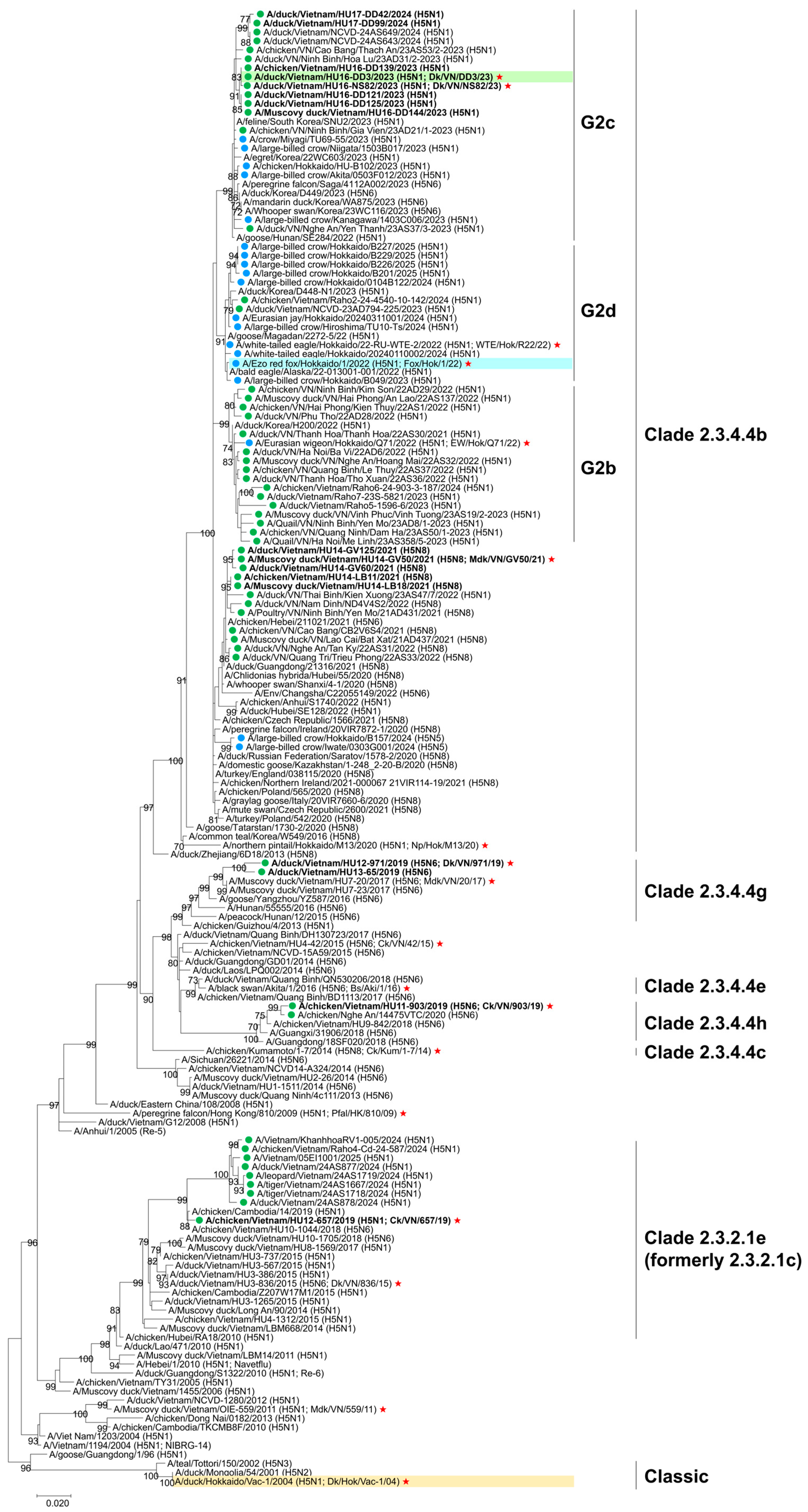
2]. Since the 2000s, H5 HPAIVs, particularly those derived from the A/goose/Guangdong/1/1996 (H5N1) lineage, have been prevalent for more than 20 years with substantial genetic diversity. Notably, H5 HPAI clade 2.3.4.4b strains have circulated mainly in Europe and Asia since 2016 [
3] and have recently become a global concern [
4].
Although strict biosecurity and stamping out are primary HPAI control measures, vaccination in poultry serves as a useful optional measure for reducing mortality, virus shedding, and virus spreading [
5]. The WOAH also limits the use of vaccination to contexts where appropriate surveillance systems are implemented [
2]. Given that HPAI control strategies vary widely across countries, including non-endemic and endemic countries, an ideal vaccine must be effective for both emergency deployment and routine protection. To support regional control of influenza outbreaks in animal health, the establishment of an influenza virus library through continuous surveillance has been proposed as an ideal preparedness measure for future control measures. One practical use of such a library is to provide virus strains for biologics development. For example, a Japanese stockpiled vaccine against H5 HPAIV for emergency use was prepared using this scheme. This vaccine comprises a non-pathogenic AIV, A/duck/Hokkaido/Vac-1/2004 (Dk/Hok/Vac-1/04; H5N1), and induces sufficient immunity in chickens to prevent mortality and clinical signs, although complete prevention of challenge-virus shedding was not achieved [
6,
7]. However, the antigenic drift in recently circulating H5 HPAIVs poses a significant risk of reduced protective efficacy for this traditional vaccine. Since 2020, clade 2.3.4.4b H5 HPAIVs have caused outbreaks across Europe and Asia [
8,
9,
10]. H5N1 HPAIVs of this clade, isolated in Japan and the Republic of Korea during the winter of 2022–2023, were classified into subgroups G2b, G2c, and G2d within genotype group 2 [
11]. Although the antigenic characteristics of these subgroups were similar to each other and to previous clade 2.3.4.4b viruses, they were antigenically distinct from the stockpiled vaccine strain Dk/Hok/Vac-1/04 (H5N1) [
12]. This antigenic mismatch poses a challenge to maintaining vaccine effectiveness.
A vaccine derived from an endemic strain should provide high protective efficacy against currently circulating field strains. Therefore, updating vaccine strains to ensure antigenic matching with circulating strains is essential for preparedness against HPAI outbreaks in Asia. This study aimed to establish a candidate vaccine strain through several steps, including enrichment of the AIV library by field surveillance, analysis of the genetic and antigenic characteristics of HPAIVs, and evaluation of vaccine protective efficacy. Protective efficacy was assessed using a challenge study with a clade 2.3.4.4b HPAIV, A/Ezo red fox/Hokkaido/1/2022 (Fox/Hok/1/22; H5N1) [
13]. Additionally, an inactivated vaccine derived from a recombinant strain carrying the HA and NA genes of Fox/Hok/1/22 (H5N1) with a modified HA cleavage site, designated NIID-002 (A/Ezo red fox/Hokkaido/1/2022) (NIID-002; H5N1) [
14], and an inactivated vaccine derived from Dk/Hok/Vac-1/04 (H5N1) virus [
6] were included for comparative evaluation of protective efficacy. Given the need to evaluate the candidate vaccine for both routine protection and emergency deployment, three independent animal experiments were conducted. First, to simulate routine vaccination programs in HPAI-endemic countries, protective efficacy was assessed in juvenile chickens, the primary target population for routine vaccination. Second, to evaluate suitability for emergency deployment, particularly for rapid containment during widespread outbreaks, the earliest onset of protective immunity was determined in juvenile chickens. Third, given that emergency vaccination should apply to all poultry populations, including juvenile and adult birds, the study was extended to evaluate vaccine efficacy in approximately 40-week-old laying hens. This assessment included initial single-dose testing followed by optimization using a double-volume simultaneous regimen. Overall, these findings contribute to a deeper understanding of the efficacy and limitations of the oil-adjuvanted vaccine in both juvenile and adult birds and support improved HPAI control strategies using inactivated vaccines.
2. Materials and Methods
2.1. Sample Collection, Virus Isolation, and Sequencing
To collect HPAIVs circulating in the field, AIV surveillance was conducted in northern Vietnam in 2019, 2021, 2023, and 2024, and in southern Vietnam in 2019 and 2021. Oropharyngeal and cloacal swabs from live poultry, including chickens, ducks, and Muscovy ducks, and environmental swabs from floors or water containers were collected at live bird markets, farms, and poultry transport stations. Samples were preserved in viral transport medium prepared in-house at the National Center of Veterinary Diagnostics, Hanoi, Vietnam, using minimum essential medium (MEM; Gibco, Thermo Fisher Scientific, Waltham, MA, USA), penicillin–streptomycin (10,000 IU/mL; Gibco), HEPES buffer (Sartorius, Göttingen, Germany), and 35% bovine serum albumin (Sigma-Aldrich, St. Louis, MO, USA).
To detect AIV genes, 10 individual swab samples were pooled and screened via reverse transcription quantitative polymerase chain reaction (RT-qPCR) targeting the M gene, following WOAH guidelines [
2], at the National Center of Veterinary Diagnostics, Hanoi, Vietnam. Samples positive on RT-qPCR were inoculated into 10-day-old embryonated chicken eggs for virus isolation in the Biosafety Level 3 (BSL-3) facility at the Laboratory of Microbiology, Faculty of Veterinary Medicine, Hokkaido University, Hokkaido, Japan.
From the isolated H5 HPAIVs, representative H5 HPAIVs were selected for whole-genome sequencing using next-generation sequencing based on geographic region and isolation year. For Oxford Nanopore sequencing, libraries were generated using the NEB Ultra II End Repair/dA-Tailing Module (New England Biolabs, Ipswich, MA, USA). The prepared libraries were subsequently sequenced on a Flongle flow cell using either the Direct cDNA Sequencing Kit (Oxford Nanopore Technologies, Oxford, UK) or the Ligation Sequencing Kit V14 (Oxford Nanopore Technologies). Raw reads were processed, mapped, and assembled using FluGAS v2 (World Fusion, Tokyo, Japan). The sequence profiles of the H5 HPAIVs were registered in the Global Initiative on Sharing All Influenza Data (GISAID).
2.2. Phylogenetic Analysis
The nucleotide sequences of the representative isolates, along with reference H5 HPAIV sequences obtained from the GISAID database, were analyzed phylogenetically by MEGA 7 (version 7.0.26) [
15]. Phylogenetic trees were constructed using the maximum likelihood method with the Tamura–Nei nucleotide substitution model. Rate heterogeneity among sites was modeled using a gamma distribution with four discrete categories, and branch support was evaluated using 1000 bootstrap replicates.
2.3. Hemagglutination Inhibition (HI) Test
Sera were heat-inactivated at 56 °C for 30 min and subsequently adsorbed with chicken red blood cells (cRBCs) following the Japanese standards for veterinary biological products. Sera were mixed with 10% cRBCs at a 1:3 ratio (1 volume serum and 3 volumes of 10% cRBCs), incubated at 4 °C overnight, and centrifuged (1000×
g, 5 min). The supernatant was collected as a fourfold diluted serum. The HI test was performed according to the WOAH guidelines, and HI titers were defined as the highest serum dilution that completely inhibited four hemagglutination (HA) units of antigen [
2].
2.4. Antigenic Analysis
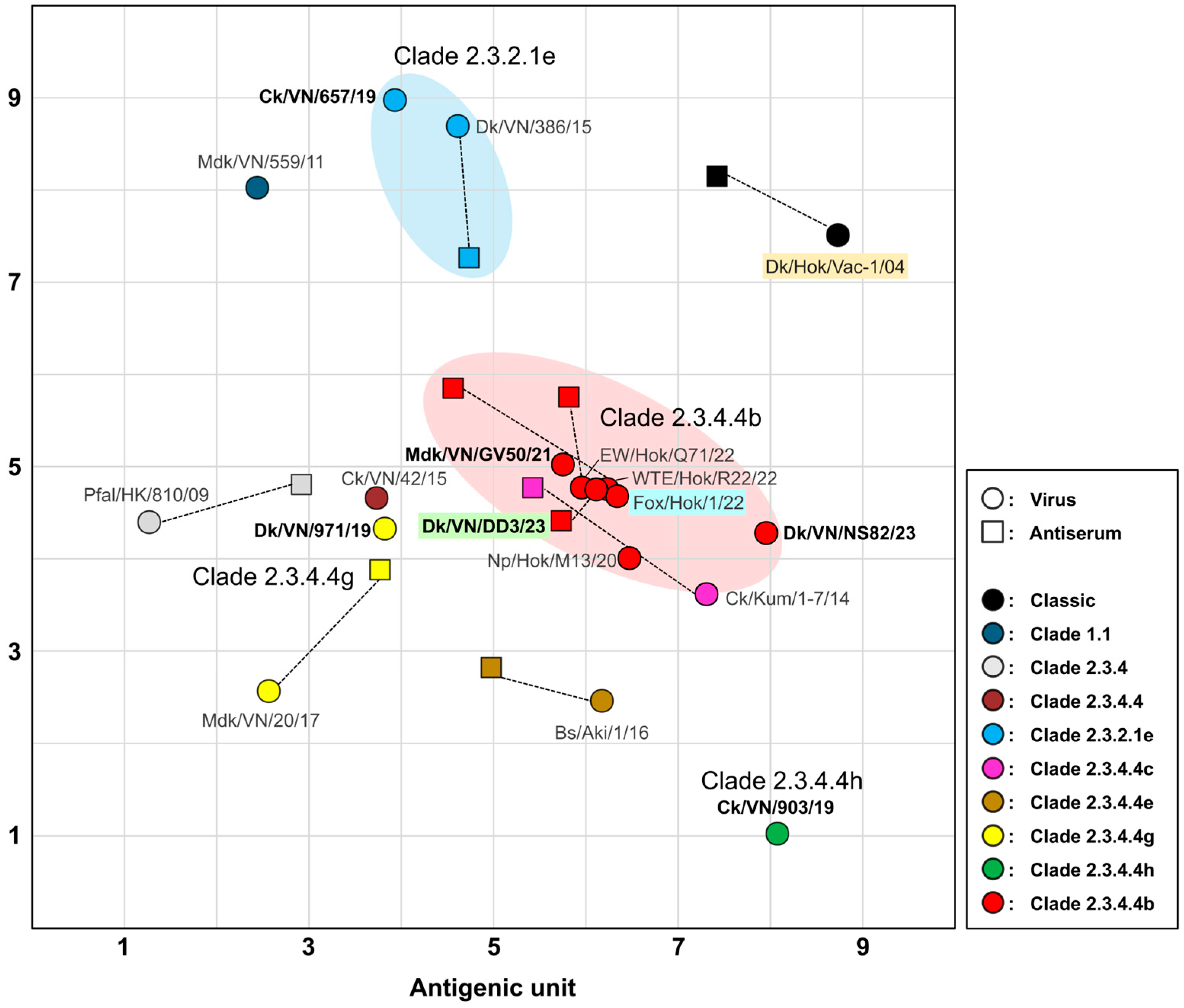
The antigenic characteristics of the representative viruses were evaluated by a cross-HI test with chicken hyperimmune antisera, as previously described [
16]. The antigen panel included the following antigens: A/duck/Vietnam/HU16-DD3/2023 (Dk/VN/DD3/23; H5N1), A/duck/Vietnam/HU16-NS82/2023 (Dk/VN/NS82/23; H5N1), A/Muscovy duck/Vietnam/HU14-GV50/2021 (Mdk/VN/GV50/21; H5N8), A/chicken/Vietnam/HU11-903/2019 (Ck/VN/903/19; H5N6), A/duck/Vietnam/HU12-971/2019 (Dk/VN/971/19; H5N6), and A/chicken/Vietnam/HU12-657/2019 (Ck/VN/657/19; H5N1), which were isolated in this study. Reference antigens from other H5 clades were also analyzed. Viruses from clade 2.3.4.4b included A/Eurasian wigeon/Hokkaido/Q71/2022 (EW/Hok/Q71/22; H5N1), A/white-tailed eagle/Hokkaido/22-RU-WTE-2/2022 (WTE/Hok/R22/22; H5N1), Fox/Hok/1/22 (H5N1), and A/northern pintail/Hokkaido/M13/2020 (Np/Hok/M13/20; H5N1). Clade 2.3.4.4c was represented by A/chicken/Kumamoto/1-7/2014 (Ck/Kum/1-7/14; H5N8). Clade 2.3.4.4e was represented by A/black swan/Akita/1/2016 (Bs/Aki/1/16; H5N6). Clade 2.3.4.4 was represented by A/chicken/Vietnam/HU4-42/2015 (Ck/VN/42/15; H5N6). Clade 2.3.4.4g was represented by A/Muscovy duck/Vietnam/HU7-20/2017 (Mdk/VN/20/17; H5N6). Clade 2.3.4 was represented by A/peregrine falcon/Hong Kong/810/2009 (Pfal/HK/810/09; H5N1). Clade 2.3.2.1e, formerly 2.3.2.1c [
17], was represented by A/duck/Vietnam/HU3-836/2015 (Dk/VN/386/15; H5N1). Clade 1.1 was represented by A/Muscovy duck/Vietnam/OIE-559/2011 (Mdk/VN/559/11; H5N1). The stockpiled strain Dk/Hok/Vac-1/04 (H5N1) was included as a reference. The antisera panel included EW/Hok/Q71/22, WTE/Hok/R22/22, Bs/Akita/1/16, Ck/Kum/1-7/14, Dk/VN/20/17, Dk/VN/386/15, and Pfal/HK/810/09. Hyperimmune serum against the Dk/VN/DD3/23 (H5N1) strain was prepared according to Kida and Yanagawa [
16]. Based on the cross-HI test results, antigenic cartography was generated using the Racmac application in the R program (version 4.4.2) [
18]. HI titers were transformed to a log
2 scale to calculate antigenic distances, where each twofold change in titer corresponded to one unit of antigenic distance. Antigens and antisera were positioned in two-dimensional space using multidimensional scaling.
2.5. Animals, Cells, and Viruses
White Leghorn chickens were home-bred from embryonated eggs and raised to 7 weeks old at the Experimental Animal Facility, Faculty of Veterinary Medicine, Hokkaido University. Chickens were then transferred to self-contained isolator units (Tokiwa Kagaku Kikai, Tokyo, Japan) at the BSL-3 facility, Faculty of Veterinary Medicine, Hokkaido University. Additionally, 40-week-old White Leghorn laying hens were obtained from Hokuryo, Hokkaido, Japan. The hens were individually housed in the same type of self-contained isolator units within the BSL-3 facility. Environmental enrichment was achieved by installing stainless steel mirrors in each isolator to reduce stress. All chickens used in this study had no prior vaccination history and lacked maternally derived antibodies, because vaccination against AIVs is not implemented in Japan.
Madin–Darby canine kidney (MDCK) cells were cultured at 37 °C in MEM (Shimadzu Diagnostics Corporation, Tokyo, Japan) supplemented with 0.3 mg/mL L-glutamine (Nacalai Tesque, Kyoto, Japan), 100 U/mL penicillin G, 0.1 mg/mL streptomycin (both from Meiji Seika Pharma, Tokyo, Japan), 8 µg/mL gentamicin (Takata Pharmaceutical, Saitama, Japan), and 10% fetal bovine serum (Merck KGaA, Darmstadt, Germany). Human embryonic kidney 293T (HEK293T) cells were maintained at 37 °C in a humidified atmosphere containing 5% CO2 in pyruvate-free Dulbecco’s modified Eagle’s medium (Gibco), supplemented with the same antibiotics and 10% fetal bovine serum (Nichirei Biosciences, Tokyo, Japan).
The Fox/Hok/1/22 (H5N1) virus, previously isolated from a deceased Ezo red fox (
Vulpes vulpes schrencki) [
13], served as the challenge strain. For comparison, the NIID-002 (H5N1) virus [
14], provided by the National Institute of Infectious Diseases, Japan, served as the vaccine strain. The Dk/VN/DD3/23 (H5N1) virus, isolated from an apparently healthy duck at a live bird market in northern Vietnam, served as the parental strain for establishing the candidate vaccine strain. All three viruses were propagated in 10-day-old embryonated chicken eggs. Viral presence in allantoic fluid was confirmed using the HA test, and the 50% egg infectious dose (EID
50) was determined for each strain. Additionally, the 50% chicken lethal dose (CLD
50) was determined for the challenge strain Fox/Hok/1/22 (H5N1).
2.6. Generation and Evaluation of Vaccine Strain
Reverse genetics was used to generate a recombinant virus incorporating H5 HA and N1 NA from the representative field strain with the internal genes derived from A/Puerto Rico/8/1934 (PR8; H1N1). To reduce virulence, the HA gene was cloned into the pGEM-T Easy vector (Promega, Madison, WI, USA) and mutated at the HA cleavage site. Polybasic amino acids (EKRRKR|GLF) were mutated to the monobasic amino acid threonine (ETR|GLF) using the KOD-Plus Mutagenesis Kit (TOYOBO, Osaka, Japan). The modified HA gene was subcloned, and the NA gene was directly cloned into the pHW2000 vector [
19]. Plasmids containing the PR8-derived internal genes were utilized. The eight pHW2000 plasmids were transfected into the co-cultured MDCK and HEK293T cells. At 72 h post-transfection, the supernatant was collected and inoculated into 10-day-old embryonated chicken eggs for virus propagation.
To assess growth kinetics, the vaccine strains were inoculated into 10-day-old embryonated chicken eggs at doses of 2.0 and 4.0 log10 EID50/0.1 mL per egg. Eggs were collected at 12, 24, 36, 48, 60, and 72 h post-inoculation to measure viral titers (expressed as EID50).
To confirm the low pathogenicity of the vaccine strains, the intravenous pathogenicity index (IVPI) was determined following the WOAH guidelines [
2]. Briefly, 6-week-old White Leghorn chickens (
n = 8 per vaccine strain) were intravenously inoculated via the wing vein with 0.1 mL of a 1:10 dilution of infective allantoic fluid. The chickens were observed daily for 10 days, and clinical signs were scored as follows: 0 for no sign (normal); 1 for a single sign (respiratory symptom, depression, diarrhea, cyanosis, edema, or nervous symptom; sick); 2 for multiple signs (seriously sick); and 3 for death. Birds reaching humane endpoints, such as severe clinical signs or inability to eat or drink, were euthanized to prevent distress; death was confirmed before disposal. The IVPI was calculated as the mean score per chicken, with an index score > 1.2 used as the threshold for classifying viruses as HPAIV.
To evaluate genetic stability, recombinant vaccine strains were serially passaged five times in 10-day-old embryonated chicken eggs. HA-positive allantoic fluid from each round was used to inoculate the subsequent passage. Viral RNA was extracted from harvested allantoic fluid and subjected to next-generation sequencing to assess potential nucleotide mutations across the viral genome. Growth stability was further evaluated by determining viral titers in embryonated chicken eggs, expressed as EID50. The geometric means of the EID50 before and after serial passages were compared to assess growth stability.
2.7. Vaccine Preparation
Whole harvested allantoic fluid containing each vaccine strain was inactivated by incubation with formalin at a final concentration of 0.2% for 3 days at 4 °C. Three successive serial passages in 10-day-old embryonated chicken eggs were performed to confirm virus inactivation. Trial vaccines were produced by mixing with an oil adjuvant, as previously described [
6]. Based on HA titers, the inactivated virus suspension was diluted with sterile phosphate-buffered saline (PBS) to obtain a final concentration of 633.5 HA units/0.5 mL. The suspensions were then mixed with an oil adjuvant. Using an ultra-homomixer (PRIMIX, Osaka, Japan), the emulsion was homogenized to produce a water-in-oil vaccine.
2.8. Assessment of Vaccine Protective Capacity in Juvenile Chickens
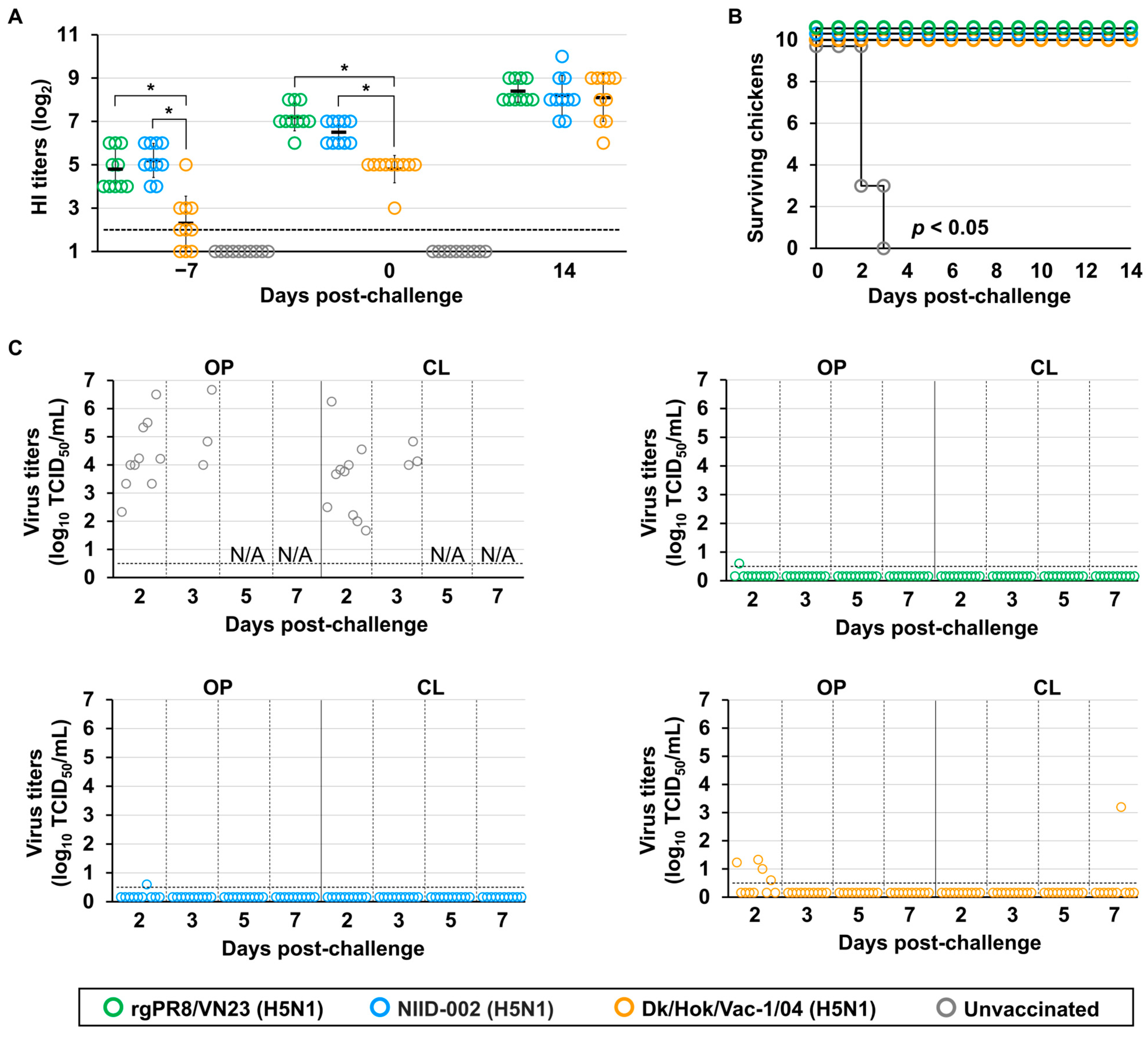
Forty 4-week-old White Leghorn chickens were randomly divided into 4 groups of 10 chickens each, including three vaccinated groups and one unvaccinated group. Chickens were intramuscularly vaccinated with the vaccine developed in this study, the NIID-002 (H5N1) vaccine, or the Dk/Hok/Vac-1/04 (H5N1) vaccine at a single dose of 633.5 HA units/0.5 mL. Blood was collected weekly to monitor the antibody responses. At 21 days post-vaccination (dpv) (7-week-old), all chickens were intranasally challenged with 100 CLD50 of Fox/Hok/1/22 (H5N1), equivalent to 6.2 log10 EID50/0.1 mL. Clinical signs and mortality were monitored daily until 14 days post-challenge (dpc). Birds reaching humane endpoints, such as severe clinical signs or inability to eat or drink, were euthanized to prevent distress; death was confirmed before disposal. Oropharyngeal and cloacal swab samples were collected at 2, 3, 5, and 7 dpc to assess viral shedding.
2.9. RT-qPCR
A subset of oropharyngeal and cloacal swab samples was obtained from chickens vaccinated with the vaccine developed in this study, the Dk/Hok/Vac-1/04 (H5N1) vaccine, and unvaccinated chickens (5 chickens per group). Viral RNA was extracted using the MagMAX-96 Total RNA Isolation Kit (Thermo Fisher Scientific, Waltham, MA, USA), according to the manufacturer’s instructions. RT-qPCR was performed using the Thunderbird Probe One-Step qRT-PCR Kit (TOYOBO), and each sample was analyzed in duplicate according to the manufacturer’s instructions. The RT-qPCR assay targeted the M gene using the primer and probe sequences shown in
Table S1.
2.10. Determination of the Earliest Onset of Protective Immunity in Juvenile Chickens
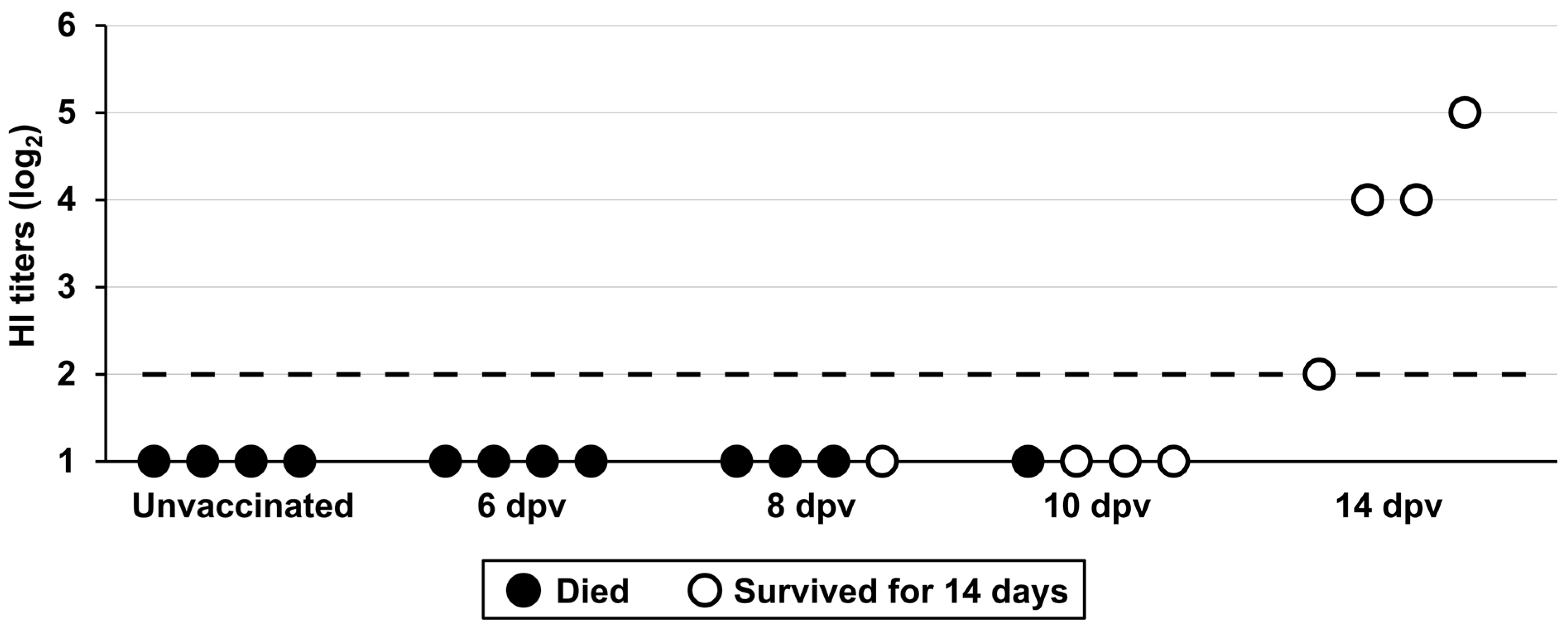
Twenty 35-day-old White Leghorn chickens were randomly divided into 5 groups of 4 chickens each. Four groups were intramuscularly vaccinated with a single dose of the vaccine developed in this study at 35, 39, 41, and 43 days of age, corresponding to 14, 10, 8, and 6 days before the challenge. The remaining chickens constituted the unvaccinated group. All chickens were bled at 49 days of age (7-week-old) to evaluate antibody responses immediately before the challenge and were subsequently intranasally inoculated with 100 CLD50/0.1 mL of Fox/Hok/1/22 (H5N1). Clinical signs and mortality were monitored daily for 14 days. Birds reaching humane endpoints, such as severe clinical signs or inability to eat or drink, were euthanized to prevent distress; death was confirmed before disposal. Oropharyngeal and cloacal swab samples were collected at 2, 3, 5, and 7 dpc to assess viral shedding.
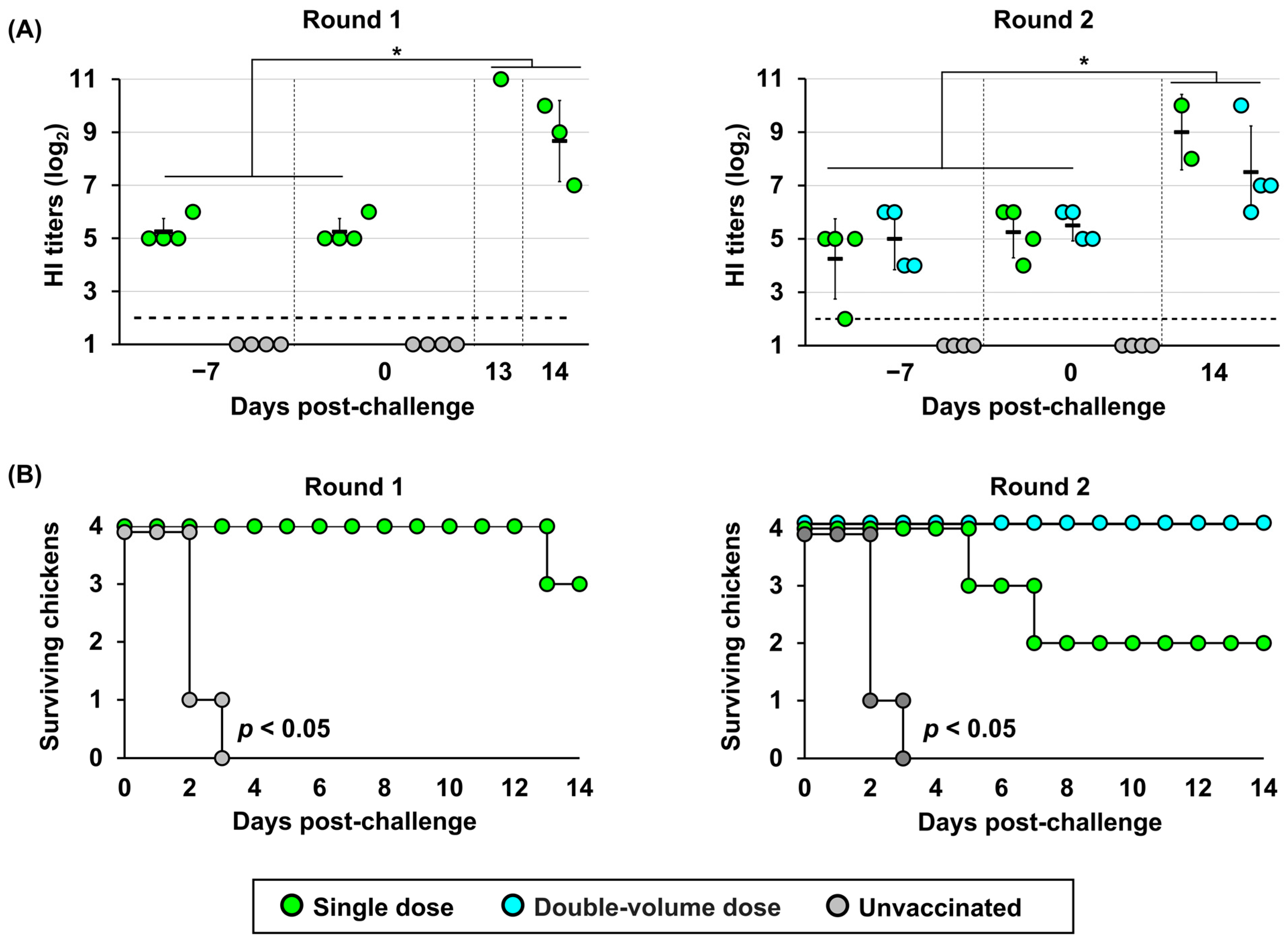
2.11. Evaluation of Vaccine Efficacy in the Laying Hens
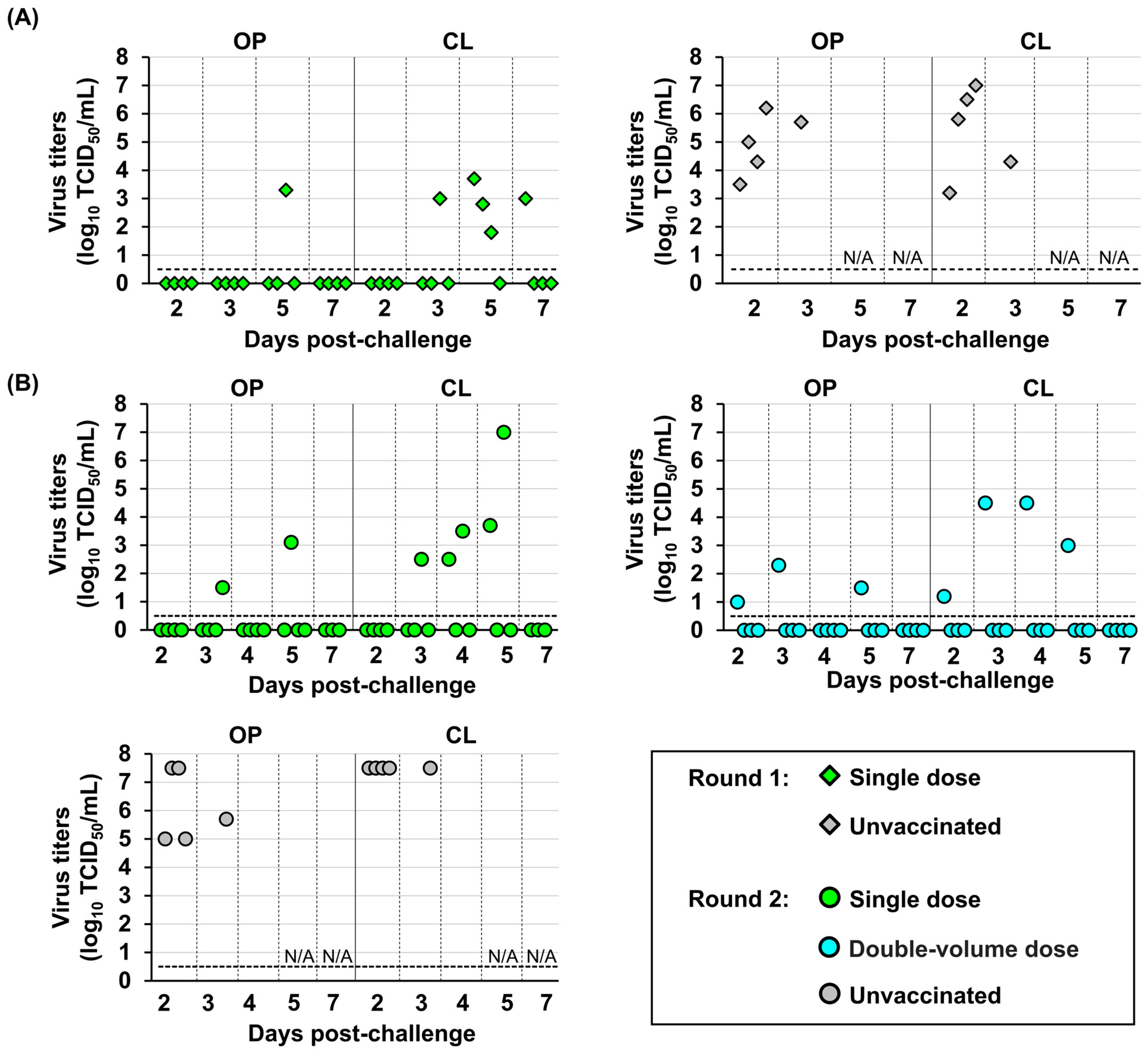
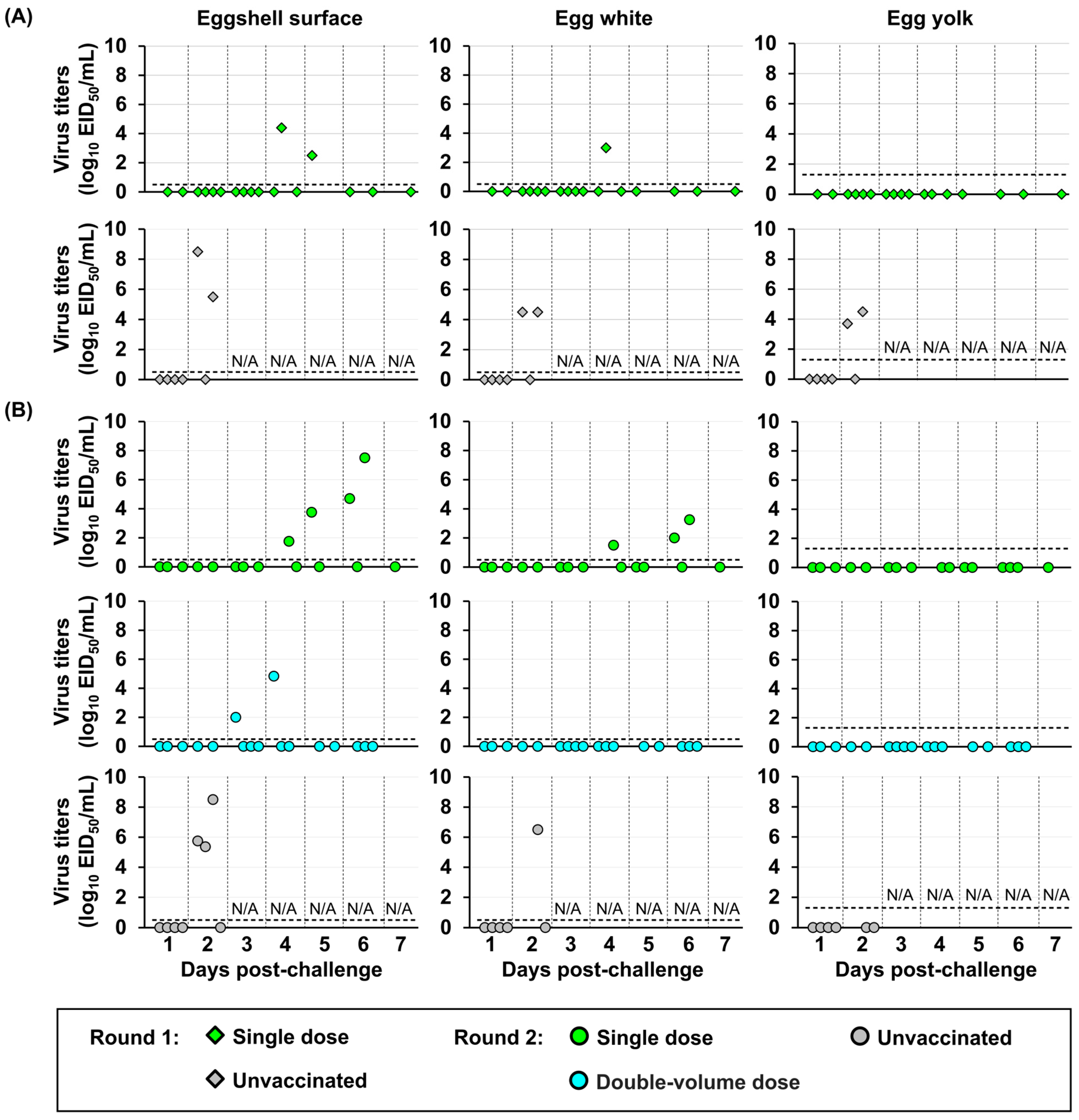
Two independent experimental rounds were conducted to evaluate vaccination regimens in 40-week-old White Leghorn hens. Both rounds included unvaccinated and vaccinated groups, with 4 hens per group. In round 1 (n = 8), the efficacy of a single vaccine dose (633.5 HA units/0.5 mL) was assessed. In round 2 (n = 12), simultaneous vaccinations with a single- and double-volume dose (2 × 0.5 mL total) were compared. The hens were intramuscularly vaccinated, and blood samples were collected weekly to monitor antibody responses. All hens were intranasally challenged with 100 CLD50/0.1 mL of Fox/Hok/1/22 (H5N1) at 21 dpv. Clinical signs and mortality were monitored daily. Birds reaching humane endpoints, such as severe clinical signs or inability to eat or drink, were euthanized to prevent distress; death was confirmed before disposal. Oropharyngeal and cloacal swab samples were collected at 2, 3, 5, and 7 dpc in round 1 and at 2, 3, 4, 5, and 7 dpc in round 2. Eggs laid by hens were also collected daily from 1 to 7 dpc to detect H5 HPAIV contamination. Eggshells were wiped with cotton swabs soaked in viral transport medium. Egg yolks and egg whites were collected separately.
2.12. Virus Titration
Oropharyngeal and cloacal swab samples were serially diluted 10-fold in MEM. Confluent MDCK cell monolayers were incubated with the diluted swab samples for 1 h at 35 °C. The inoculum was discarded, and cells were washed with sterile PBS. The cultures were then maintained in serum-free MEM supplemented with 1.0 µg/mL acetylated trypsin (Merck KGaA) at 35 °C for 72 h. Cytopathic effects were observed and recorded to calculate the 50% tissue culture infectious dose (TCID50).
Eggshell swab and egg white samples were serially diluted 10-fold in sterile PBS. Egg yolk was prediluted 1:2 in sterile PBS before performing serial 10-fold dilutions because of its high viscosity. The diluted egg-derived samples were then inoculated into 10-day-old embryonated chicken eggs. After incubation at 35 °C for 48 h, allantoic fluid was harvested, and the HA test was performed to calculate EID
50 values. All viral titers were calculated using the Reed and Muench method [
20].
2.13. Statistical Analysis
GraphPad Prism version 10.1.2 (GraphPad Software, San Diego, CA, USA) was used for statistical analysis. Viral growth stability was analyzed using the Wilcoxon signed-rank test. Antibody titers across groups were compared using one-way analysis of variance (ANOVA), followed by Tukey’s honestly significant difference post hoc test for pairwise comparisons. Data obtained from two groups were analyzed using Student’s t-test. Survival rates were analyzed using the log-rank test. A p-value of <0.05 was considered statistically significant.
4. Discussion
In this study, a new candidate vaccine derived from a representative field strain was established. Its protective efficacy was evaluated in comparison with an antigenically homologous vaccine to the challenge strain and a Japanese stockpiled vaccine. Multiple trials were also conducted to determine the earliest time point at which protection could be achieved after vaccination and to assess vaccine efficacy in laying hens, aiming to improve field control strategies for HPAI. The findings underscore differential protective outcomes depending on both antigenic relatedness and host age. First, under the degree of genetic and antigenic divergence evaluated, the stockpiled vaccine completely protected juvenile chickens against mortality, although limited and transient viral shedding was observed. Second, despite antigenic matching between vaccine and challenge strains, vaccinated laying hens were not fully protected against morbidity and mortality, even when HI antibody titers against the challenge strain reached the required protective levels. These results suggest that although a certain degree of antigenic divergence may still permit protection against mortality in juvenile chickens, optimal and consistent protection requires antigenic matching. Importantly, the low efficacy observed in laying hens despite antigenic compatibility further indicates that effective emergency vaccination depends on appropriate strain selection and on vaccination strategies capable of ensuring sufficient protection in adult birds.
Interestingly, although the antigenic distance among AIVs is generally thought to increase proportionally with their genetic distance [
21], a divergence from this pattern was observed in this study. Specifically, although clade 2.3.4, 2.3.4.4e, 2.3.4.4g, and 2.3.4.4h viruses were antigenically distant from classic viruses, the circulating clade 2.3.4.4b viruses appeared to revert antigenically toward the classic group despite accumulating further genetic distance. These findings suggest that the viruses were selected under immune pressures favoring antigenic structures similar to the classic group rather than simply exhibiting novel antigenic properties. This phenomenon may be explained by the fact that genetic changes in the HA gene do not uniformly affect key epitopes involved in immune recognition. Antigenicity can depend on a limited number of key amino acid residues near the receptor binding site [
22]. Amino acid position 158 on HA may represent a key residue, as it can serve as a potential glycosylation site that obscures antigenic epitopes and allows viruses to evade antibody recognition. However, none of the clade 2.3.4.4b viruses used in this study possessed the glycosylation site within the 158–160 region. Therefore, the efficacy of available or candidate vaccines against field viruses, identified through routine monitoring, should be evaluated based on both genetic and antigenic analyses rather than genetic analysis alone.
According to the WOAH requirements, HI titers must be at least 32 (5 log
2) to confer protection from mortality or more than 128 (7 log
2) to reduce recovery of the challenge virus [
2]. Although the HI titers of some vaccinated juvenile chickens immediately before challenge were lower than these thresholds, all vaccinated juvenile chickens survived for 14 days after HPAIV challenge. A high level of near-sterile protection was confirmed in both the rgPR8/VN23 (H5N1) and NIID-002 (H5N1) vaccine groups, with no detectable virus shedding in 9 of 10 chickens. This robust protection, despite suboptimal antibody levels immediately before challenge, may be correlated with ongoing immunity development, as the antibody response had not yet peaked at 21 dpv. In a previous study, the antibody titers induced by stockpiled vaccine peaked at 6–7 weeks post-vaccination and remained high for extended periods [
6]. Infectious viruses were detectable in the 4 chickens vaccinated with the Dk/Hok/Vac-1/04 (H5N1) vaccine, suggesting partial protection resulting from an antigenic gap between the vaccine and challenge strains. Although antigenic matching is critical for vaccine efficacy, NA-specific immunity can also contribute to protection against HPAIV infection. NA promotes the release of newly formed virions by hydrolyzing sialylated glycans, and antibodies against NA can limit this process [
23]. Although NA was not genetically and antigenically analyzed in this study, the origins of NA in the vaccine strains allow for the consideration of its potential contribution to protection. rgPR8/VN23 (H5N1) and NIID-002 (H5N1) vaccine strains both contain NA derived from representative HPAIV field strains, whereas the Dk/Hok/Vac-1/04 (H5N1) vaccine strain possesses NA from a non-pathogenic AIV [
6]. These different NA origins may cause minor genetic and antigenic differences. Based on NA sequence information, Dk/Hok/Vac-1/04 (H5N1) and Fox/Hok/1/22 (H5N1) strains shared similar amino acids located in the NA active site or the conserved epitope at positions 222–230 [
23]. This conservation suggests that NA antibodies may have contributed to the reduced viral shedding and survival observed in chickens vaccinated with Dk/Hok/Vac-1/04 (H5N1). In addition, the degree of protection can vary depending on the NA subtype. A previous study reported that chickens vaccinated with an H5N1 inactivated vaccine survived challenges with heterologous H5Nx HPAIVs within clade 2.3.4.4, including H5N2, H5N6, and H5N8, although viral shedding occurred in vaccinated chickens challenged with H5N6 and H5N8 but not with H5N2 [
24]. Therefore, both HA antigenic matching and NA-specific immunity likely influenced vaccine protection, including the reduction in viral shedding.
The early-protection experiment demonstrated that a protective effect of the vaccine against mortality was observable as early as 8 dpv, with one of the four chickens surviving despite the absence of detectable antibodies immediately before challenge. This finding is consistent with a previous study in Hong Kong in which vaccination was implemented as an outbreak response, showing that vaccinated chickens experienced reduced mortality 9–18 days after vaccination, even though HI antibody titers had not fully developed [
25]. These observations support the notion that inactivated H5 vaccines can confer early clinical protection before peak humoral responses. Although cell-mediated and innate immune responses were not evaluated in this study, the protection prior to detectable HI antibody responses may represent emerging immunity during the early phase of immune development. Furthermore, complete suppression of viral shedding in vaccinated chickens is required to prevent virus spread within flocks, mitigating the risk of antigenic variant generation through continuous circulation. The infectious dose of AIVs varies significantly across bird species. Previous studies have reported that at least 3.4 log
10 EID
50 viruses are required to infect chickens, whereas fewer than 1.0 log
10 EID
50 viruses can infect ducks [
26]. These results highlight the concern that HPAIV circulation at low titers promotes the emergence of antigenic variants through continuous infections in flocks highly sensitive to HPAIV. Therefore, effective post-vaccination surveillance strategies are indispensable in countries employing routine immunization programs.
Independent experiments in vaccinating laying hens revealed limitations of the standard single-dose regimen. Although the antibody titers immediately before challenge met the WOAH requirement of 32 HI (5 log
2), a single dose was insufficient to fully protect the hens in this study. This finding aligns with a previous finding in hens, where a single dose induced a mean titer of 45 HI but failed to provide complete protection against virus contamination in egg products despite antigenic matching between vaccine and challenge strains [
27]. Additionally, antibody kinetics after vaccination differed between juvenile chickens and laying hens in this study. Whereas juvenile chickens showed a significant increase in HI titers between 2 and 3 weeks post-vaccination, hens exhibited a comparatively stable antibody profile during the same interval, suggesting age-related differences in vaccine-induced humoral responses. Consistent with a previous study, antibody levels in vaccinated 76-week-old chickens were similar at 3 and 8 weeks post-vaccination, whereas a marked increase in antibodies was observed in vaccinated 4-week-old specific pathogen-free chickens [
28]. The lower vaccine efficacy observed in 40-week-old hens compared with 4-week-old chickens may be related to the immune system’s development and function, particularly B cells that differentiate in the bursa of Fabricius. In hens, the bursa of Fabricius undergoes physiological involution beginning approximately at 10–16 weeks of age and is nearly complete at 24 weeks, resulting in a reduced capacity for the generation of new B cells [
29,
30]. Although data on B-cell activity, lymphocyte counts, and innate immunity were not collected in the present study, these physiological factors provide a plausible explanation for the lower vaccine efficacy observed in the 40-week-old hens. Previous studies have often focused on booster regimens to achieve high antibody titers and protection [
27,
31], which may limit rapid implementation during emergency vaccination. In this study, a single-dose regimen consistent with emergency-use policy was applied to evaluate vaccine efficacy under conditions where booster administration is not required. Relative vaccine dosage per body weight may influence the serological response in birds, as supported by a previous study in zoo birds [
32]. Thus, the true effective dose administered to hens should be reconsidered relative to that used in juvenile chickens. To test this hypothesis, a double-volume dose was administered to hens. Notably, the double-volume dose did not significantly alter HI antibody titers compared with the single dose. However, the double-volume dose group demonstrated improved clinical protection and substantially reduced viral shedding and virus contamination in egg products. In a previous study, booster vaccination achieved the HI levels required for reducing virus recovery (GMT of 330 ± 101), yet virus contamination was still detected in all egg contents [
31]. In contrast, the present study observed an effective reduction in virus contamination in egg white and yolk with only 5 log
2 (32 HI). The virus was detected only on the eggshell surface of eggs from one hen, likely due to virus shedding in the cloacal tract. These findings indicate that HI titers alone may not fully reflect vaccine-mediated protective effects of inactivated vaccines. Although HI titers are widely used as a correlate of protective efficacy, they primarily reflect the ability of humoral immunity to inhibit hemagglutinin-mediated viral attachment. Given that mechanistic immune responses were beyond the scope of the present study, the immunological basis of this observation should be determined. Collectively, these findings indicate that even an antigenically matched vaccine cannot fully confer protective immunity to adult laying hens under a single-dose regimen. HPAI vaccination policies vary between countries that permit routine vaccination and those that restrict vaccines to emergency use only. The optimized single-dose approach evaluated in this study provides practical insights for improving vaccine efficacy under urgent field conditions, representing an advantage relative to previous reports [
27,
31]. Consequently, the limited protective efficacy observed in 40-week-old laying hens after a single dose reflects the practical limitations of the emergency-use framework in field settings. Given these constraints, vaccination-based control strategies should prioritize optimizing the timing—preferably administering vaccines before 16 weeks of age—for routine use in countries that permit vaccination. In countries adopting an emergency-only vaccination policy, including Japan, a relative vaccine dosage according to body weight should be considered.
RT-qPCR is a highly sensitive tool for identifying H5 HPAIV in disease-free areas or during early outbreak stages. However, under vaccination or endemic settings, interpreting positive RT-qPCR results becomes more complex. In this study, positive Ct values were obtained from samples of vaccinated chickens, although infectious viruses were not recovered from the same samples. This discrepancy arises because viral RNA may persist long after virus clearance following vaccination or recovery, leading to positive PCR results even in protected animals. Consequently, positive PCR results may lead to misinterpretation of infection status. Differentiating vaccinated, infected, and uninfected individuals based solely on Ct values remains challenging, given the principles of gene-detection diagnostics. Therefore, in post-vaccination monitoring contexts, positive qPCR results must be interpreted cautiously, and virus isolation remains the gold standard for confirming active infectious virus shedding and accurately assessing vaccine efficacy in the field.



 ,
, 
 ), and isolates from this study are shown in bold. Japanese isolates from the 2022–2023, 2023–2024, and 2024–2025 seasons are marked with blue circles (
 ). Strains highlighted in green, blue, and orange represent the selected strains of the new vaccine candidate, challenge, and stock vaccine strains, respectively. Isolates selected for antigenic analysis are marked with red stars (
 ).
).