
What Form of RSV Protection Do Women Prefer: Maternal Vaccination or Infant Immunisation? A Cross-Sectional Survey in Europe


Abstract
1. Introduction
2. Methods
2.1. Study Design and Variables
2.2. Study Participants
2.3. Ethics
2.4. Data Analysis
3. Results
3.1. Demographics
3.2. Awareness and Knowledge of RSV
3.3. Likelihood to Initiate Conversations About RSV Immunisation
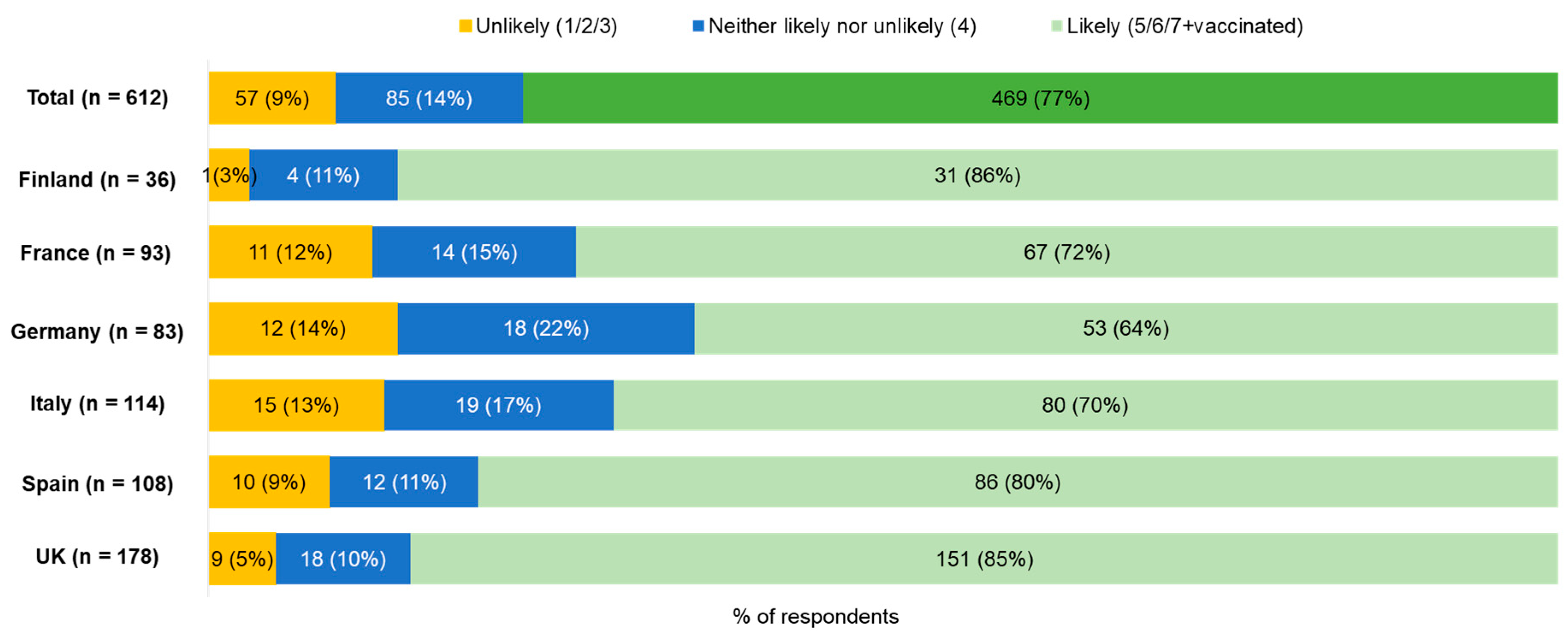
3.4. Likelihood to Accept Maternal RSV Vaccination
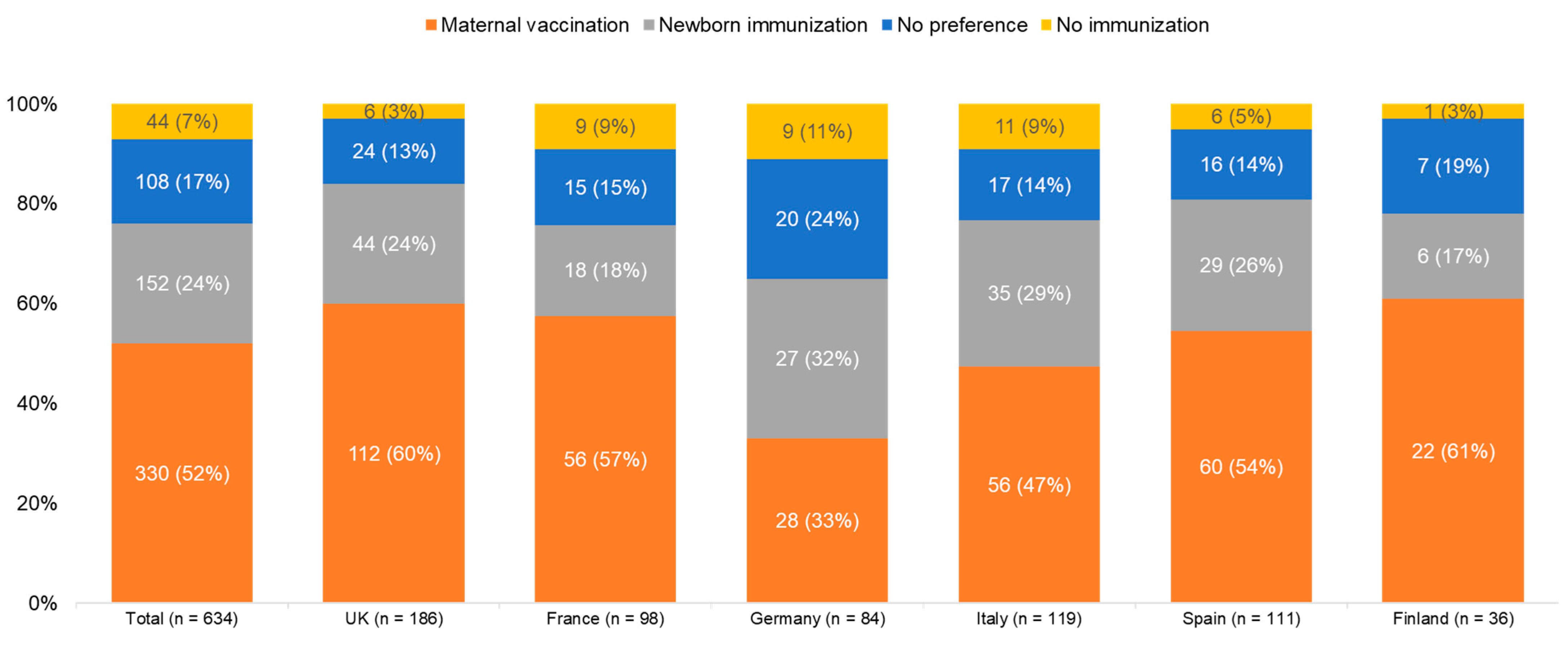
3.5. Preferences for Method of Immunisation
3.6. Factors Influencing Acceptance of Maternal Vaccination During Pregnancy
3.7. Factors Influencing Hesitancy Around Maternal Vaccination During Pregnancy
4. Discussion
Strengths and Limitations
5. Conclusions
Supplementary Materials
Author Contributions
Funding
Institutional Review Board Statement
Informed Consent Statement
Data Availability Statement
Acknowledgments
Conflicts of Interest
References
- Del Riccio, M.; Spreeuwenberg, P.; Osei-Yeboah, R.; Johannesen, C.K.; Fernandez, L.V.; Teirlinck, A.C.; Wang, X.; Heikkinen, T.; Bangert, M.; Caini, S.; et al. Burden of Respiratory Syncytial Virus in the European Union: Estimation of RSV-Associated Hospitalizations in Children under 5 Years. J. Infect. Dis. 2023, 228, 1528–1538. [Google Scholar] [CrossRef] [Scilit] [PubMed]
- Du, Y.; Yan, R.; Wu, X.; Zhang, X.; Chen, C.; Jiang, D.; Yang, M.; Cao, K.; Chen, M.; You, Y.; et al. Global Burden and Trends of Respiratory Syncytial Virus Infection across Different Age Groups from 1990 to 2019: A Systematic Analysis of the Global Burden of Disease 2019 Study. Int. J. Infect. Dis. 2023, 135, 70–76. [Google Scholar] [CrossRef] [Scilit]
- Li, Y.; Wang, X.; Blau, D.M.; Caballero, M.T.; Feikin, D.R.; Gill, C.J.; Madhi, S.A.; Omer, S.B.; Simes, E.A.F.; Campbell, H.; et al. Global, regional, and national disease burden estimates of acute lower respiratory infections due to respiratory syncytial virus in children younger than 5 years in 2019: A systematic analysis. Lancet 2022, 399, 2047–2064. [Google Scholar] [CrossRef] [Scilit]
- Hall, C.B.; Weinberg, G.A.; Iwane, M.K.; Blumkin, A.K.; Edwards, K.M.; Staat, M.A.; Auinger, P.; Griffin, M.R.; Poehling, K.A.; Erdman, D.; et al. The burden of respiratory syncytial virus infection in young children. N. Engl. J. Med. 2009, 360, 588–598. [Google Scholar] [CrossRef] [Scilit] [PubMed]
- Binns, E.; Tuckerman, J.; Licciardi, P.V.; Wurzel, D. Respiratory syncytial virus, recurrent wheeze and asthma: A narrative review of pathophysiology, prevention and future directions. J. Paediatr. Child. Health 2022, 58, 1741–1746. [Google Scholar] [CrossRef] [Scilit]
- Sommer, C.; Resch, B.; Simões, E.A. Risk factors for severe respiratory syncytial virus lower respiratory tract infection. Open Microbiol. J. 2011, 5, 144–154. [Google Scholar] [CrossRef] [Scilit]
- García, C.G.; Bhore, R.; Soriano-Fallas, A.; Trost, M.; Chason, R.; Ramilo, O.; Mejias, A. Risk factors in children hospitalized with RSV bronchiolitis versus non-RSV bronchiolitis. Pediatrics 2010, 126, e1453–e1460. [Google Scholar] [CrossRef] [Scilit]
- Heemskerk, S.; Baliatsas, C.; Stelma, F.; Nair, H.; Paget, J.; Spreeuwenberg, P. Assessing the Impact of Non-Pharmaceutical Interventions During the COVID-19 Pandemic on RSV Seasonality in Europe. Influenza Other Respir. Viruses 2025, 19, e70066. [Google Scholar] [CrossRef] [Scilit]
- Meslé, M.M.I.; Sinnathamby, M.; Mook, P.; The WHO European Region Respiratory Network Group; Pebody, R. Seasonal and Inter-seasonal RSV Activity in the European Region during the COVID-19 Pandemic from Autumn 2020 to Summer 2022. Influenza Other Respir. Viruses 2023, 17, e13219. [Google Scholar] [CrossRef] [Scilit] [PubMed]
- Kampmann, B.; Madhi, S.A.; Munjal, I.; Simões, E.A.F.; Pahud, B.A.; Llapur, C.; Baker, J.; Pérez Marc, G.; Radley, D.; Shittu, E.; et al. Bivalent Prefusion F Vaccine in Pregnancy to Prevent RSV Illness in Infants. N. Engl. J. Med. 2023, 388, 1451–1464. [Google Scholar] [CrossRef] [Scilit]
- Simões, E.A.F.; Pahud, B.A.; Madhi, S.A.; Kampmann, B.; Shittu, E.; Radley, D.; Llapur, C.; Baker, J.; Pérez Marc, G.; Barnabas, S.L.; et al. Efficacy, Safety, and Immunogenicity of the MATISSE (Maternal Immunization Study for Safety and Efficacy) Maternal Respiratory Syncytial Virus Prefusion F Protein Vaccine Trial. Obstet. Gynecol. 2025, 145, 157–167. [Google Scholar] [CrossRef] [Scilit]
- European Medicines Agency (EMA). Available online: https://www.ema.europa.eu/en/medicines/human/EPAR/abrysvo (accessed on 21 November 2025).
- Munro, A.P.S.; Drysdale, S.; Cathie, K.; Flamein, F.; Knuf, M.; Collins, A.M.; Hill, H.; Kaiser, F.; Cohen, R.; Pinquier, D.; et al. 180-day efficacy of nirsevimab against hospitalisation for respiratory syncytial virus lower respiratory tract infections in infants (HARMONIE): A randomised, controlled, phase 3b trial. Lancet Child Adolesc. Health 2025, 9, 404–412. [Google Scholar] [CrossRef] [Scilit]
- Drysdale, S.B.; Cathie, K.; Flamein, F.; Knuf, M.; Collins, A.M.; Hill, H.C.; Kaiser, F.; Cohen, R.; Pinquier, D.; Felter, C.T.; et al. Nirsevimab for Prevention of Hospitalizations Due to RSV in Infants. N. Engl. J. Med. 2023, 389, 2425–2435. [Google Scholar] [CrossRef] [Scilit] [PubMed]
- Campbell, G.; Mallett, P.; O’Hagan, S. Respiratory Syncytial Virus (RSV): Recent Advances in Preventative Strategies and Visions for the Future. Paediatr. Child. Health 2025, 35, 341–346. [Google Scholar] [CrossRef] [Scilit]
- Respiratory Syncytial Virus (RSV) Immunisation Programme: JCVI Advice, 7 June 2023-GOV.UK. Available online: https://www.gov.uk/government/publications/rsv-immunisation-programme-jcvi-advice-7-june-2023/respiratory-syncytial-virus-rsv-immunisation-programme-jcvi-advice-7-june-2023 (accessed on 8 December 2025).
- RSV Injection Rijksvaccinatieprogramma.Nl. Available online: https://rijksvaccinatieprogramma.nl/en/vaccinations/RSV-injection (accessed on 8 December 2025).
- Vaccine Scheduler ECDC. Available online: https://vaccine-schedule.ecdc.europa.eu/Scheduler/ByDisease?SelectedDiseaseId=53&SelectedCountryIdByDisease=-1 (accessed on 8 December 2025).
- Robert Koch Institute. Recommendations by the Standing Committee on Vaccination (STIKO) at the Robert Koch Institute; Robert Koch Institute: Berlin, Germany, 2025; Available online: https://www.rki.de/EN/Topics/Infectious-diseases/Immunisation/STIKO/STIKO-recommendations/Downloads/04_25_english.pdf?__blob=publicationFile&v=2 (accessed on 8 December 2025).
- New Immunisation to Protect Newborns and Young Children Against Bronchiolitis-The Luxembourg Government. Available online: https://gouvernement.lu/en/actualites/toutes_actualites/communiques/2023/09-septembre/22-immunisation-bronchiolite-nourrissons.html (accessed on 8 December 2025).
- European Centre for Disease Prevention and Control. Rapid Scientific Advice on Protecting Infants Against Respiratory Syncytial Virus Disease for The European 2025/26 Winter Season; European Centre for Disease Prevention and Control: Stockholm, Sweden, 2025. [Google Scholar] [CrossRef]
- Giersing, B.K.; Karron, R.A.; Vekemans, J.; Kaslow, D.C.; Moorthy, V.S. Meeting Report: WHO Consultation on Respiratory Syncytial Virus (RSV) Vaccine Development, Geneva, 25–26 April 2016. Vaccine 2019, 37, 7355–7362. [Google Scholar] [CrossRef] [Scilit]
- Razai, M.S.; Mansour, R.; Ravindran, P.; Freeman, S.; Mason-Apps, C.; Morris, J.; Majeed, A.; Ussher, M.; Hargreaves, S.; Oakeshott, P. Facilitators and Barriers to Vaccination Uptake in Pregnancy: A Qualitative Systematic Review. PLoS ONE 2024, 19, e0298407. [Google Scholar] [CrossRef] [Scilit] [PubMed]
- Pavlovic, D.; Sahoo, P.; Larson, H.J.; Karafillakis, E. Factors Influencing Healthcare Professionals’ Confidence in Vaccination in Europe: A Literature Review. Hum. Vaccines Immunother. 2022, 18, 2041360. [Google Scholar] [CrossRef] [Scilit]
- Sanni, A.; Ibrahim, N.; Tilley, D.; Bontha, S.; McMorrow, A.; Philip, R.K. Maternal Vaccination as an Integral Part of Life-Course Immunization: A Scoping Review of Uptake, Barriers, Facilitators, and Vaccine Hesitancy for Antenatal Vaccination in Ireland. Vaccines 2025, 13, 557. [Google Scholar] [CrossRef] [Scilit]
- Harteveld, L.M.; Van Leeuwen, L.M.; Euser, S.M.; Smit, L.J.; Vollebregt, K.C.; Bogaert, D.; Van Houten, M.A. Respiratory Syncytial Virus (RSV) Prevention: Perception and Willingness of Expectant Parents in the Netherlands. Vaccine 2025, 44, 126541. [Google Scholar] [CrossRef] [Scilit] [PubMed]
- Broad, J.; Letley, L.; Adair, G.; Walker, J.; Benzaken, T.; Saliba, V.; Ramsay, M.E.; Watson, C.H.; Campbell, H. An England-Wide Survey on Attitudes towards Antenatal and Infant Immunisation against Respiratory Syncytial Virus amongst Pregnant and Post-Partum Women. Vaccine 2025, 62, 127482. [Google Scholar] [CrossRef] [Scilit] [PubMed]
- McCormack, S.; Thompson, C.; Nolan, M.; Imcha, M.; Dee, A.; Saunders, J.; Philip, R.K. Maternal Awareness, Acceptability and Willingness towards Respiratory Syncytial Virus (RSV) Vaccination during Pregnancy in Ireland. Immun. Inflamm. Dis. 2024, 12, e1257. [Google Scholar] [CrossRef] [Scilit]
- Williams, T.C.; Marlow, R.; Cunningham, S.; Drysdale, S.B.; Groves, H.; Iskander, D.; Liu, X.; Lyttle, M.D.; Mpamhanga, C.D.; O’Hagan, S.; et al. Maternal Views on RSV Vaccination during the First Season of Implementation in England and Scotland. Lancet Infect. Dis. 2025, 25, e135–e136. [Google Scholar] [CrossRef] [Scilit]
- Langedijk, A.C.; Van Den Dungen, F.; Harteveld, L.; Van Leeuwen, L.; Smit, L.; Van Den Boer, J.; Mendes, D.; Verhage, M.C.; Kocks, E.; Van Houten, M. Preferences of Dutch Parents and Expectant Parents for Respiratory Syncytial Virus Prevention Strategies: A Discrete Choice Experiment. Infect. Dis. Ther. 2025, 14, 2583–2603. [Google Scholar] [CrossRef] [Scilit]
- Paulson, S.; Munro, A.P.S.; Cathie, K.; Bedford, H.; Jones, C.E. Protecting Against Respiratory Syncytial Virus: An Online Questionnaire Study Exploring UK Parents’ Acceptability of Vaccination in Pregnancy or Monoclonal Antibody Administration for Infants. Pediatr. Infect. Dis. J. 2025, 44, S158–S161. [Google Scholar] [CrossRef] [Scilit]
- Holland, C.; Baker, M.; Bates, A.; Hughes, C.; Richmond, P.C.; Carlson, S.; Moore, H.C. Parental Awareness and Attitudes towards Prevention of Respiratory Syncytial Virus in Infants and Young Children in Australia 2023. Acta Paediatr. 2024, 113, 786–794. [Google Scholar] [CrossRef] [Scilit] [PubMed]
- Maculaitis, M.C.; Hauber, B.; Beusterien, K.M.; Will, O.; Kopenhafer, L.; Law, A.W.; Vietri, J.T.; Cappelleri, J.C.; Coulter, J.R.; Pugh, S.; et al. A Latent Class Analysis of Factors Influencing Preferences for Infant Respiratory Syncytial Virus (RSV) Preventives among Pregnant People in the United States. Hum. Vaccines Immunother. 2024, 20, 2358566. [Google Scholar] [CrossRef] [Scilit]
- Beusterien, K.M.; Law, A.W.; Maculaitis, M.C.; Will, O.; Kopenhafer, L.; Olsen, P.; Hauber, B.; Vietri, J.T.; Cappelleri, J.C.; Coulter, J.R.; et al. Healthcare Providers’ and Pregnant People’s Preferences for a Preventive to Protect Infants from Serious Illness Due to Respiratory Syncytial Virus. Vaccines 2024, 12, 560. [Google Scholar] [CrossRef] [Scilit]
- Gagnon, D.; Gubany, C.; Ouakki, M.; Malo, B.; Paquette, M.; Brousseau, N.; Papenburg, J.; Dubé, E. Factors Influencing Acceptance of RSV Immunization for Newborns among Pregnant Individuals: A Mixed-Methods Study. Vaccine 2025, 55, 127062. [Google Scholar] [CrossRef] [Scilit] [PubMed]



| Total (n = 740) | Finland (n = 47) | France (n = 116) | Germany (n = 100) | Italy (n = 144) | Spain (n = 126) | UK (n = 207) | |
|---|---|---|---|---|---|---|---|
| Age | |||||||
| Mean | 33 | 30 | 34 | 32 | 35 | 34 | 31 |
| 18–29 | 222 (30%) | 20 (43%) | 32 (28%) | 31 (31%) | 24 (17%) | 27 (21%) | 87 (42%) |
| 30–39 | 385 (52%) | 26 (55%) | 55 (47%) | 56 (56%) | 84 (58%) | 69 (55%) | 89 (43%) |
| 40+ | 133 (18%) | 1 (2%) | 29 (25%) | 13 (13%) | 36 (25%) | 30 (24%) | 31 (15%) |
| Pregnancy Status | |||||||
| Currently pregnant | 411 (56%) | 20 (43%) | 60 (52%) | 60 (60%) | 60 (42%) | 61 (48%) | 150 (73%) |
| Trying to conceive | 223 (30%) | 16 (34%) | 38 (33%) | 24 (24%) | 59 (41%) | 50 (40%) | 36 (17%) |
| Pregnant in past 12 months | 106 (14%) | 11 (23%) | 18 (16%) | 16 (16%) | 25 (17%) | 15 (12%) | 21 (10%) |
| Parental Status | |||||||
| Parent | 525 (71%) | 34 (72%) | 87 (75%) | 67 (67%) | 98 (68%) | 91 (72%) | 151 (73%) |
| Non-parent | 215 (29%) | 13 (28%) | 29 (25%) | 33 (33%) | 46 (32%) | 35 (28%) | 56 (27%) |
| Vaccines received in the last 12 months | |||||||
| Influenza | 407 (55%) | 24 (51%) | 51 (44%) | 58 (58%) | 79 (55%) | 78 (62%) | 128 (62%) |
| Tdap | 229 (31%) | 15 (32%) | 35 (30%) | 34 (34%) | 37 (26%) | 37 (29%) | 77 (37%) |
| COVID-19 | 348 (47%) | 16 (34%) | 53 (46%) | 44 (44%) | 60 (42%) | 71 (56%) | 118 (57%) |
| Education Status | |||||||
| University Graduate | 456 (62%) | 29 (62%) | 77 (66%) | 50 (50%) | 91 (63%) | 69 (55%) | 153 (74%) |
| Country | Number of respondents, n (%) | ||||||
|---|---|---|---|---|---|---|---|
| Total | Finland | France | Germany | Italy | Spain | UK | |
| Self-Reported Familiarity (n = 740) | |||||||
| RSV | 333 (45%) | 25 (53%) | 26 (22%) | 56 (56%) | 58 (40%) | 54 (43%) | 118 (57%) |
| COVID-19 | 636 (86%) | 41 (87%) | 90 (78%) | 85 (85%) | 132 (92%) | 101 (80%) | 193 (93%) |
| Influenza | 629 (85%) | 40 (85%) | 88 (76%) | 86 (86%) | 131 (91%) | 98 (78%) | 190 (92%) |
| Pneumonia | 474 (64%) | 33 (71%) | 58 (50%) | 71 (71%) | 76 (53%) | 79 (63%) | 153 (74%) |
| Bronchiolitis | 429 (58%) | 15 (32%) | 71 (61%) | 60 (60%) | 104 (72%) | 81 (64%) | 124 (60%) |
| Knowledge on RSV risk factors (n = 660) | |||||||
| Weakened immune system | 296 (45%) | 20 (50%) | 44 (42%) | 35 (38%) | 46 (38%) | 46 (43%) | 115 (58%) |
| Premature birth (before 32 weeks) | 240 (36%) | 13 (33%) | 40 (38%) | 36 (39%) | 31 (26%) | 37 (35%) | 93 (47%) |
| Age 6 months or younger | 223 (34%) | 20 (50%) | 26 (25%) | 34 (37%) | 37 (31%) | 27 (25%) | 69 (35%) |
| Children with chronic lung disease | 195 (30%) | 12 (30%) | 40 (38%) | 25 (27%) | 25 (21%) | 27 (25%) | 71 (36%) |
| Children with heart disease (present at birth) | 195 (30%) | 12 (30%) | 35 (34%) | 19 (21%) | 36 (30%) | 28 (26%) | 71 (36%) |
| Children who have neuromuscular disorders | 149 (23%) | 10 (25%) | 24 (23%) | 12 (13%) | 22 (18%) | 25 (24%) | 63 (32%) |
| Children exposed in daycare or to sick adults | 260 (39%) | 23 (58%) | 32 (31%) | 31 (34%) | 42 (35%) | 42 (40%) | 75 (38%) |
| Child with a genetic disorder | 128 (19%) | 7 (18%) | 21 (20%) | 17 (18%) | 18 (15%) | 21 (20%) | 50 (25%) |
| I don’t know | 106 (16%) | 3 (8%) | 23 (22%) | 14 (15%) | 23 (19%) | 19 (18%) | 28 (14%) |
| Factor | Number of Respondents, n (%) by Country | ||||||
|---|---|---|---|---|---|---|---|
| Total (n = 578) | Finland (n =35) | France (n = 86) | Germany (n = 73) | Italy (n = 105) | Spain (n = 102) | UK (n = 177) | |
| Safety * | 377 (65%) | 28 (80%) | 53 (62%) | 41 (56%) | 69 (66%) | 61 (60%) | 119 (67%) |
| Safe for baby | 261 (45%) | 22 (63%) | 38 (44%) | 25 (34%) | 46 (44%) | 38 (37%) | 87 (49%) |
| Safe during pregnancy | 252 (44%) | 19 (54%) | 30 (35%) | 28 (38%) | 44 (42%) | 44 (43%) | 89 (50%) |
| Safe for me | 210 (36%) | 15 (43%) | 33 (38%) | 20 (27%) | 38 (36%) | 36 (35%) | 69 (39%) |
| Efficacy ** | 353 (61%) | 26 (74%) | 55 (64%) | 42 (58%) | 53 (50%) | 54 (53%) | 119 (67%) |
| Vaccine protects baby immediately at birth | 230 (40%) | 18 (51%) | 29 (34%) | 27 (37%) | 35 (33%) | 42 (41%) | 76 (43%) |
| Prevents serious complications/symptoms | 230 (40%) | 18 (51%) | 34 (40%) | 24 (33%) | 36 (34%) | 38 (37%) | 78 (44%) |
| Prevents hospitalizations | 173 (30%) | 17 (49%) | 23 (27%) | 17 (23%) | 24 (23%) | 29 (28%) | 53 (30%) |
| Prevents transmission to others | 148 (26%) | 12 (34%) | 19 (22%) | 22 (30%) | 20 (19%) | 20 (20%) | 51 (29%) |
| Others | |||||||
| Recommendation from healthcare provider | 211 (37%) | 15 (43%) | 22 (26%) | 18 (25%) | 41 (39%) | 36 (35%) | 90 (51%) |
| Multi-year protection | 145 (25%) | 12 (34%) | 22 (26%) | 17 (23%) | 22 (21%) | 27 (26%) | 35 (20%) |
| Advice from government bodies | 137 (24%) | 9 (26%) | 10 (12%) | 27 (37%) | 27 (26%) | 16 (16%) | 44 (25%) |
| Advice from pregnancy support groups | 124 (22%) | 8 (23%) | 12 (14%) | 23 (32%) | 17 (16%) | 17 (17%) | 48 (27%) |
| Insurance covers cost | 108 (19%) | — | 16 (19%) | 21 (29%) | 13 (12%) | 12 (12%) | 37 (21%) |
| Believe baby will be at risk for RSV | 100 (17%) | 7 (20%) | 14 (16%) | 16 (22%) | 11 (10%) | 16 (16%) | 35 (20%) |
| Advice from friends/family | 87 (15%) | 6 (17%) | 10 (12%) | 11 (15%) | 7 (7%) | 18 (18%) | 37 (21%) |
| Nothing would influence decision | 22 (4%) | — | 5 (6%) | 3 (4%) | 2 (2%) | 3 (3%) | 7 (4%) |
| Country | Number of Respondents, n (%) | ||||||
|---|---|---|---|---|---|---|---|
| Total (n = 78) | Finland (n = 1) | France (n = 17) | Germany (n = 12) | Italy (n = 19) | Spain (n = 12) | UK (n = 17) | |
| Safety and Side Effects * | 37 (47%) | - | 6 (35%) | 9 (75%) | 12 (63%) | 3 (25%) | 6 (35%) |
| I think the vaccine could harm my baby | 21 (27%) | - | 4 (24%) | 6 (50%) | 8 (42%) | 1 (8%) | 2 (12%) |
| I think the vaccine could harm me | 15 (19%) | - | 1 (6%) | 4 (33%) | 6 (32%) | 1 (8%) | 3 (18%) |
| I think the vaccine could put my pregnancy at risk | 21 (27%) | - | 3 (18%) | 6 (50%) | 6 (32%) | 2 (17%) | 3 (18%) |
| I am worried about the long-term side effects with the vaccine | 29 (37%) | 1 (100%) | 4 (24%) | 4 (33%) | 5 (26%) | 3 (25%) | 2 (12%) |
| I am worried about the short-term side effects with the vaccine | 14 (18%) | - | 2 (12%) | 4 (33%) | 4 (21%) | 1 (8%) | 3 (18%) |
| Lack of knowledge ** | 24 (31%) | - | 7 (41%) | 4 (33%) | 7 (37%) | 2 (17%) | 5 (29%) |
| I do not know enough about RSV vaccine(s) | 21 (27%) | - | 6 (35%) | 4 (33%) | 4 (21%) | 2 (17%) | 5 (29%) |
| I do not know enough about RSV as an illness | 14 (18%) | - | 2 (12%) | 2 (17%) | 5 (26%) | - | - |
| Concerns on Efficacy *** | 13 (17%) | - | 1 (6%) | 1 (8%) | 5 (26%) | 3 (25%) | 3 (18%) |
| I am concerned that the vaccine(s) will not offer protection for a long enough period of time | 6 (8%) | - | 1 (6%) | 1 (8%) | 1 (5%) | - | 2 (12%) |
| I am concerned about how well the vaccine works | 10 (13%) | - | 1 (6%) | 1 (8%) | 4 (21%) | 3 (25%) | 1 (6%) |
| Others | |||||||
| I don’t believe my baby is at risk for RSV | 9 (11%) | - | 2 (12%) | 2 (17%) | 1 (5%) | - | - |
| It has not been recommended by my healthcare provider (HCP)/pharmacist | 17 (21%) | - | 3 (18%) | 4 (33%) | 4 (21%) | 2 (17%) | 3 (18%) |
| I am focused on getting other vaccines right now | 7 (9%) | - | 1 (6%) | 1 (8%) | - | 1 (8%) | 2 (12%) |
| I am tired of receiving vaccinations | 7 (8%) | - | 1 (6%) | 1 (8%) | 2 (11%) | - | - |
| I am against vaccinations in general | 7 (9%) | - | 3 (18%) | 1 (8%) | 1 (5%) | - | 1 (6%) |
| I am concerned about cost / affordability of a vaccine | 8 (10%) | - | 1 (6%) | 1 (8%) | 1 (5%) | 2 (17%) | 2 (12%) |
| I am concerned because the vaccine(s) are new | 15 (19%) | - | 5 (29%) | - | 3 (16%) | 1 (8%) | 4 (24%) |
Disclaimer/Publisher’s Note: The statements, opinions and data contained in all publications are solely those of the individual author(s) and contributor(s) and not of MDPI and/or the editor(s). MDPI and/or the editor(s) disclaim responsibility for any injury to people or property resulting from any ideas, methods, instructions or products referred to in the content. |
© 2026 by the authors. Licensee MDPI, Basel, Switzerland. This article is an open access article distributed under the terms and conditions of the Creative Commons Attribution (CC BY) license.
Share and Cite
Mendes, D.; Kang, M.; Law, A. What Form of RSV Protection Do Women Prefer: Maternal Vaccination or Infant Immunisation? A Cross-Sectional Survey in Europe. Vaccines 2026, 14, 238. https://doi.org/10.3390/vaccines14030238
Mendes D, Kang M, Law A. What Form of RSV Protection Do Women Prefer: Maternal Vaccination or Infant Immunisation? A Cross-Sectional Survey in Europe. Vaccines. 2026; 14(3):238. https://doi.org/10.3390/vaccines14030238
Chicago/Turabian StyleMendes, Diana, Malvin Kang, and Amy Law. 2026. "What Form of RSV Protection Do Women Prefer: Maternal Vaccination or Infant Immunisation? A Cross-Sectional Survey in Europe" Vaccines 14, no. 3: 238. https://doi.org/10.3390/vaccines14030238
APA StyleMendes, D., Kang, M., & Law, A. (2026). What Form of RSV Protection Do Women Prefer: Maternal Vaccination or Infant Immunisation? A Cross-Sectional Survey in Europe. Vaccines, 14(3), 238. https://doi.org/10.3390/vaccines14030238