
StealthX: A Versatile and Potent Exosome-Based Vaccine Platform for the Next Pandemic

Abstract
1. Introduction
2. Exosome Biology and Vaccine Mechanisms
2.1. Overview of Exosomes
2.2. Mechanistic Basis for Exosome-Based Vaccines
2.3. Advantages over Conventional Vaccine Platforms
2.4. Multivalent Delivery and “Mix-and-Match” Potential
3. StealthX Platform: Design and Engineering
3.1. Overview of the StealthX Platform
3.2. Antigen Incorporation Strategies
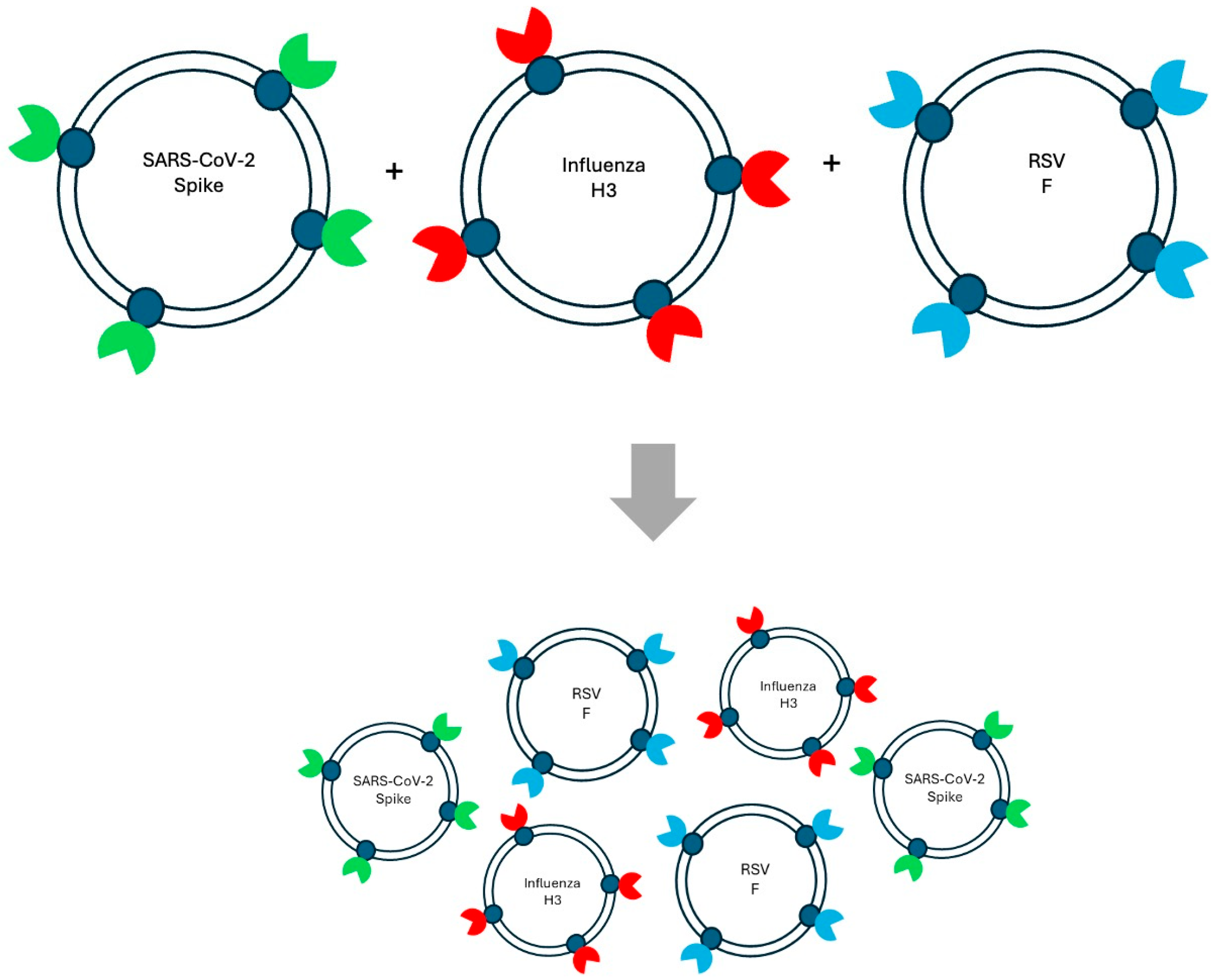
3.3. Multivalent and Mix-and-Match Design
3.4. Preclinical Characterization
3.5. Manufacturing Considerations
3.6. Advantages of StealthX Engineering
- Enhanced antigen presentation: Surface display ensures antigens are accessible to B cells and APCs, promoting both humoral and cellular responses.
- Multivalent flexibility: Ability to carry multiple antigens facilitates broad immune coverage and rapid adaptation to emerging pathogens [17].
- Natural biocompatibility: Derived from mammalian cells, exosomes are inherently well-tolerated, reducing inflammatory responses compared with synthetic nanoparticles [13].
- Scalable and stable: Production in cell culture systems with standard storage requirements supports global deployment [45].
4. Immunogenicity and Preclinical Efficacy
4.1. Overview of Preclinical Models
4.2. Humoral Immune Responses
4.3. Cellular Immune Responses
4.4. Low Dosage and Multivalent Immunity
5. Multivalent and “Mix-and-Match” Approaches
5.1. Rationale for Multivalent Vaccine Design
5.2. Implementation of Multivalent StealthX Vaccines
5.3. Mix-and-Match Flexibility
5.4. Comparative Immunogenicity of Multivalent Formulations
5.5. Cross-Variant and Cross-Pathogen Protection
5.6. Manufacturing and Quality Control Considerations
5.7. Broader Applications and Future Prospects
5.8. Summary of Multivalent Advantages
- Antigenic breadth: Enables co-display of multiple viral proteins, enhancing cross-protection.
- Immune balance: Promotes coordinated humoral and cellular responses without antigen interference.
- Rapid adaptability: Facilitates quick updates for emerging variants or pathogens.
- Manufacturing flexibility: Compatible with scalable bioprocesses and modular design.
6. Safety, Stability, and Translational Considerations
6.1. Preclinical Safety Profile
6.2. Absence of Exogenous Adjuvants
6.3. Biodistribution and Clearance
6.4. Stability and Cold-Chain Considerations
7. Challenges, Limitations, and Future Directions
7.1. Overview
7.2. Manufacturing and Scale-Up Challenges
7.3. Antigen Loading and Display Efficiency
7.4. Heterogeneity and Biological Complexity
7.5. Immunological Uncertainties and Autoimmunity Risk
7.6. Cost, Infrastructure, and Global Access
7.7. Future Directions
8. Conclusions
Author Contributions
Funding
Institutional Review Board Statement
Data Availability Statement
Conflicts of Interest
References
- Krammer, F. SARS-CoV-2 vaccines in development. Nature 2020, 586, 516–527. [Google Scholar] [CrossRef]
- Pollard, A.J.; Bijker, E.M. A guide to vaccinology: From basic principles to new developments. Nat. Rev. Immunol. 2021, 21, 83–100. [Google Scholar] [CrossRef]
- Kis, Z.; Kontoravdi, C.; Shattock, R.; Shah, N. Resources, production scales and time required for producing RNA vaccines for the global pandemic demand. Vaccines 2020, 9, 3. [Google Scholar] [CrossRef]
- Rauch, S.; Jasny, E.; Schmidt, K.E.; Petsch, B. New Vaccine Technologies to Combat Outbreak Situations. Front. Immunol. 2018, 9, 1963. [Google Scholar] [CrossRef]
- Wang, W.; Sayedahmed, E.; Mittal, S.K. Significance of preexisting vector immunity and activation of innate responses for adenoviral vector based therapy. Viruses 2022, 14, 2727. [Google Scholar] [CrossRef] [PubMed]
- Pardi, N.; Hogan, M.J.; Porter, F.W.; Weissman, D. mRNA vaccines—A new era in vaccinology. Nat. Rev. Drug Discov. 2018, 17, 261–279. [Google Scholar] [CrossRef] [PubMed]
- Schoenmaker, L.; Witzigmann, D.; Kulkarni, J.A.; Verbeke, R.; Kersten, G.; Jiskoot, W.; Crommelin, D.J.A. mRNA-lipid nanoparticle COVID-19 vaccines: Structure, function, and stability. Int. J. Pharm. 2021, 601, 120586. [Google Scholar] [CrossRef]
- Levin, E.G.; Lustig, Y.; Cohen, C.; Fluss, R.; Indenbaum, V.; Amit, S.; Doolman, R.; Asraf, K.; Mendelson, E.; Ziv, A.; et al. Waning Immune Humoral Response to BNT162b2 Covid-19 Vaccine over 6 Months. N. Engl. J. Med. 2021, 385, e84. [Google Scholar] [CrossRef] [PubMed]
- Ndeupen, S.; Qin, Z.; Jacobsen, S.; Bouteau, A.; Estanbouli, H.; Lgyarto, B.Z. The mRNA-LNP platform’s lipid nanoparticle component used in preclinical vaccine studies is highly inflammatory. iScience 2021, 24, 103479. [Google Scholar] [CrossRef]
- Zhang, B.; Sim, W.K.; Sheng, T.; Lim, S.K. Engineered EVs with pathogen proteins: Promising vaccine alternatives to LNP-mRNA vaccines. J. Biomed. Sci. 2024, 31, 9. [Google Scholar] [CrossRef]
- Kalluri, R.; LeBleu, V.S. The biology, function, and biomedical applications of exosomes. Science 2020, 367, eaau6977. [Google Scholar] [CrossRef]
- Mathieu, M.; Martin-Jaular, L.; Lavieu, G.; Théry, C. Specificities of secretion and uptake of exosomes and other extracellular vesicles for cell-to-cell communication. Nat. Cell Biol. 2019, 21, 9–17. [Google Scholar] [CrossRef]
- Elsharkasy, O.M.; Nordin, J.Z.; Hagey, D.W.; De Jong, O.G.; Schiffelers, R.M.; Andaloussi, S.E.; Vader, P. Extracellular vesicles as drug delivery systems: Why and how? Adv. Drug Deliv. Rev. 2020, 159, 332–343. [Google Scholar] [CrossRef]
- Robbins, P.D.; Morelli, A.E. Regulation of immune responses by extracellular vesicles. Nat. Rev. Immunol. 2014, 14, 195–208. [Google Scholar] [CrossRef]
- Cacciottolo, M.; Nice, J.B.; Li, Y.; LeClaire, M.J.; Twaddle, R.; Mora, C.L.; Adachi, S.Y.; Chin, E.R.; Young, M.; Angeles, J.; et al. Exosome-based vaccine: Achieving potent immunization, broadened reactivity and strong T cell responses with nanograms of proteins. Microbiol. Spectr. 2023, 11, e0050323. [Google Scholar] [CrossRef] [PubMed]
- Cacciottolo, M.; Li, Y.; Nice, J.B.; LeClaire, M.J.; Twaddle, R.; Mora, C.L.; Adachi, S.Y.; Young, M.; Angeles, J.; Elliott, K.; et al. Nanograms of SARS-CoV-2 spike protein delivered by exosomes induce potent neutralization of both delta and omicron variants. PLoS ONE 2023, 18, e0290046. [Google Scholar] [CrossRef]
- Cacciottolo, M.; Hsieh, L.-E.; Li, Y.; LeClaire, M.J.; Mora, C.L.; Lau, C.; Dwyer, C.; Elliott, K.; Sun, M. Multivalent Exosome-Based protein Vaccine: A “mix and match” approach to epidemic viruses’ challenges. Vaccines 2025, 12, 258. [Google Scholar] [CrossRef] [PubMed]
- Pulendran, B.; Arunachalam, P.S.; O’Hagan, D.T. Emerging concepts in the science of vaccine adjuvants. Nat. Rev. Drug Discov. 2021, 20, 454–475. [Google Scholar] [CrossRef]
- van der Pol, E.; Böing, A.N.; Harrison, P.; Sturk, A.; Nieuwland, R. Classification, functions, and clinical relevance of extracellular vesicles. Pharmacol. Rev. 2012, 64, 676–705. [Google Scholar] [CrossRef] [PubMed]
- Valadi, H.; Ekström, K.; Bossios, A.; Sjöstrand, M.; Lee, J.J.; Lötvall, J.O. Exosome-mediated transfer of mRNAs and microRNAs is a novel mechanism of genetic exchange between cells. Nat. Cell Biol. 2007, 9, 654–659. [Google Scholar] [CrossRef]
- Hessvik, N.P.; Llorente, A. Current knowledge on exosome biogenesis and release. Cell. Mol. Life Sci. 2018, 75, 193–208. [Google Scholar] [CrossRef]
- Pegtel, D.M.; Gould, S.J. Exosomes. Annu. Rev. Biochem. 2019, 88, 487–514. [Google Scholar] [CrossRef]
- Greening, D.W.; Gopal, S.K.; Xu, R.; Simpson, R.J.; Chen, W. Exosomes and their roles in immune regulation and cancer. Semin. Cell Dev. Biol. 2015, 40, 72–81. [Google Scholar] [CrossRef] [PubMed]
- Théry, C.; Duban, L.; Segura, E.; Véron, P.; Lantz, O.; Amigorena, S. Indirect activation of naïve CD4+ T cells by dendritic cell-derived exosomes. Nat. Immunol. 2002, 3, 1156–1162. [Google Scholar] [CrossRef]
- Zitvogel, L.; Regnault, A.; Lozier, A.; Wolfers, J.; Flament, C.; Tenza, D.; Ricciardi-Castagnoli, P.; Raposo, G.; Amigorena, S. Eradication of established murine tumors using a novel cell-free vacci2ne: Dendritic cell-derived exosomes. Nat. Med. 1998, 4, 594–600. [Google Scholar] [CrossRef] [PubMed]
- Hoshino, A.; Costa-Silva, B.; Shen, T.L.; Rodrigues, G.; Hashimoto, A.; Mark, M.T.; Molina, H.; Kohsaka, S.; Di Giannatale, A.; Ceder, S.; et al. Tumor exosome integrins determine organotropic metastasis. Nature 2015, 527, 329–335. [Google Scholar] [CrossRef] [PubMed]
- Liang, Y.; Duan, L.; Lu, J.; Xia, J. Engineering exosomes for targeted drug delivery. Theranostics 2021, 11, 3183–3195. [Google Scholar] [CrossRef]
- He, J.; Ren, W.; Wang, W.; Han, W.; Jiang, L.; Zhang, D.; Guo, M. Exosomal targeting and its potential clinical application. Expert Opin. Drug Deliv. Transl. Res. 2022, 12, 2385–2402. [Google Scholar] [CrossRef]
- Shenoda, B.B.; Ajit, S.K. Modulation of immune responses by exosomes derived from antigen-presenting cells. Clin. Med. Insights Pathol. 2016, 9, 1–8. [Google Scholar] [CrossRef]
- Safadi, D.E.; Mokhtari, A.; Krejbich, M.; Lagrave, A.; Hirigoyen, U.; Lebeau, G.; Viranaicken, W.; Krejbich-Trotot, P. Exosome-mediated antigen delivery: Unveiling novel strategies in viral infection control and vaccine design. Vaccines. 2024, 12, 280. [Google Scholar] [CrossRef]
- Xu, M.; Yang, Q.; Sun, X.; Wang, Y. Recent advancements in the loading and modification of therapeutic exosomes. Front. Bioeng. Biotechnol. 2020, 8, 586130. [Google Scholar] [CrossRef] [PubMed]
- Wiklander, O.P.B.; Nordin, J.Z.; O’Loughlin, A.; Gustafsson, Y.; Corso, G.; Mäger, I.; Vader, P.; Lee, Y.; Sork, H.; Seow, Y.; et al. Extracellular vesicle in vivo biodistribution is determined by cell source, route of administration and targeting. J. Extracell. Vesicles 2015, 4, 26316. [Google Scholar] [CrossRef] [PubMed]
- Sun, L.; Su, Y.; Jiao, A.; Wang, X.; Zhang, B. T cells in health and disease. Signal Transduct. Target. Ther. 2023, 8, 235. [Google Scholar] [CrossRef]
- Bachmann, M.F.; Zinkernagel, R.M. Neutralizing antiviral B cell responses. Annu. Rev. Immunol. 1997, 15, 235–270. [Google Scholar] [CrossRef]
- Andersen, M.H.; Schrama, D.; Thor Straten, P.; Becker, J.C. Cytotoxic T cells. J. Investig. Dermatol. 2006, 126, 32–41. [Google Scholar] [CrossRef] [PubMed]
- Luckheeram, R.V.; Zhou, R.; Verma, A.D.; Xia, B. CD4+ cells: Differentiation and functions. Clin. Dev. Immunol. 2012, 2012, 925135. [Google Scholar] [CrossRef]
- Blakney, A.K.; McKay, P.F.; Yus, B.I.; Aldon, Y.; Shattock, R.J. Inside out: Optimization of lipid nanoparticle formulations for exterior complexation and systemic delivery of saRNA. Gene Ther. 2019, 26, 363–372. [Google Scholar] [CrossRef]
- Mercado, N.B.; Zahn, R.; Wegmann, F.; Loos, C.; Chandrashekar, A.; Yu, J.; Liu, J.; Peter, L.; Mcmahan, K.; Tostanoski, L.H.; et al. Single-shot Ad26 vaccine protects against SARS-CoV-2 in rhesus macaques. Nature 2020, 586, 583–588. [Google Scholar] [CrossRef]
- Choi, S.; Yang, Z.; Wang, Q.; Qiao, Z.; Sun, M.; Wiggins, J.; Xiang, S.-H.; Lu, Q. Displaying and delivering viral membrane antigens via WW domain activated extracellular vesicles. Sci. Adv. 2023, 9, eade2708. [Google Scholar] [CrossRef]
- Théry, C.; Witwer, K.W.; Aikawa, E.; Alcaraz, M.J.; Anderson, J.D.; Andriantsitohaina, R.; Antoniou, A.; Arab, T.; Archer, F.; Atkin-Smith, G.K.; et al. Minimal information for studies of extracellular vesicles 2018 (MISEV2018): A position statement of the International Society for Extracellular Vesicles and update of the MISEV2014 guidelines. J. Extracell. Vesicles 2018, 7, 1535750. [Google Scholar] [CrossRef] [PubMed]
- Gardiner, C.; Di Vizio, D.; Sahoo, S.; Théry, C.; Witwer, K.W.; Wauben, M.; Hill, A.F. Techniques used for the isolation and characterization of extracellular vesicles: Results of a worldwide survey. J. Extracell. Vesicles 2016, 5, 32945. [Google Scholar] [CrossRef]
- Hartjes, T.A.; Mytnyk, S.; Jenster, G.W.; van Steijn, V.; van Royen, M.E. Extracellular Vesicle quantification and characterization: Common methods and emerging approaches. Bioengineering 2019, 6, 7. [Google Scholar] [CrossRef] [PubMed]
- Busatto, S.; Vilanilam, G.; Ticer, T.; Lin, W.-L.; Dickson, D.W.; Shapiro, S.; Bergese, P.; Wolfram, J. Tangential flow filtration for highly efficient concentration of extracellular vesicles from large volumes of fluid. Cells 2018, 7, 273. [Google Scholar] [CrossRef]
- Visan, K.S.; Lobb, R.J.; Ham, S.; Lima, L.G.; Palma, C.; Edna, C.P.Z.; Wu, L.; Gowda, H.; Datta, K.K.; Hartel, G.; et al. Comparative analysis of tangential flow filtration and ultracentrifugation, both combined with subsequent size exclusion chromatography, for the isolation of small extracellular vesicles. J. Extracell. Vesicles 2022, 11, 12266. [Google Scholar] [CrossRef]
- Colao, I.L.; Corteling, R.; Bracewell, D.; Wall, I. Manufacturing Exosomes: A Promising Therapeutic Platform. Trends Mol. Med. 2018, 24, 242–256. [Google Scholar] [CrossRef]
- Watson, D.C.; Yung, B.C.; Bergamaschi, C.; Chowdhury, B.; Bear, J.; Stellas, D.; Morales-Kastresana, A.; Jones, J.C.; Felber, B.K.; Chen, X.; et al. Scalable, cGMP-compatible purification of extracellular vesicles carrying bioactive human terodimeric IL-15/Lactadherin complexes. J. Extracell. Vesicles 2018, 7, 1442088. [Google Scholar] [CrossRef]
- Mosmann, T.R.; Coffman, R.L. TH1 and TH2 cells: Different patterns of lymphokine secretion lead to different functional properties. Annu. Rev. Immunol. 1989, 7, 145–173. [Google Scholar] [CrossRef]
- Schorey, J.S.; Cheng, Y.; Singh, P.P.; Smith, V.L. Exosomes and other extracellular vesicles in host-pathogen interactions. EMBO Rep. 2015, 16, 24–43. [Google Scholar] [CrossRef] [PubMed]
- Abbas, A.K.; Murphy, K.M.; Sher, A. Functional diversity of helper T lymphocytes. Nature 1996, 383, 787–793. [Google Scholar] [CrossRef] [PubMed]
- Lauring, A.S.; Hodcroft, E.B. Genetic Variants of SARS-CoV-2—What Do They Mean? JAMA 2021, 325, 529–531. [Google Scholar] [CrossRef]
- Grifoni, A.; Weiskopf, D.; Ramirez, S.I.; Mateus, J.; Dan, J.M.; Moderbacher, C.R.; Rawlings, S.A.; Sutherland, A.; Premkumar, L.; Jadi, R.S.; et al. Targets of T Cell Responses to SARS-CoV-2 Coronavirus in Humans with COVID-19 Disease and Unexposed Individuals. Cell 2020, 181, 1489–1501.e15. [Google Scholar] [CrossRef]
- Harvey, W.T.; Carabelli, A.M.; Jackson, B.; Gupta, R.K.; Thomson, E.C.; Harrison, E.M.; Ludden, C.; Reeve, R.; Rambaut, A.; Consortium, C.-G.U.; et al. SARS-CoV-2 variants, spike mutations and immune escape. Nat. Rev. Microbiol. 2021, 19, 409–424. [Google Scholar] [CrossRef]
- Kastenmüller, W.; Gasteiger, G.; Gronau, J.H.; Baier, R.; Ljapoci, R.; Busch, D.H.; Drexler, I. Cross-competition of CD8+ T cells shapes the immunodominance hierarchy during boost vaccination. J. Exp. Med. 2007, 204, 2187–2198. [Google Scholar] [CrossRef] [PubMed]
- Cao, M.; Li, Y.; Song, X.; Lu, Z.; Zhai, H.; Qiu, H.-J.; Sun, Y. Broad spectrum vaccines against various and evolving viruses: From antigen design to nanoparticle delivery. J. Virol. 2025, 99, e00997-25. [Google Scholar] [CrossRef] [PubMed]
- Martínez-Flores, D.; Zepeda-Cervantes, J.; Cruz-Reséndiz, A.; Aguirre-Sampieri, S.; Sampieri, A.; Vaca, L. SARS-CoV-2 vaccines based on the spike glycoprotein and implications of new viral variants. Front. Immunol. 2021, 12, 701501. [Google Scholar] [CrossRef] [PubMed]
- Barros-Martins, J.; Hammerschmidt, S.I.; Cossmann, A.; Odak, I.; Stankov, M.V.; Ramos, G.M.; Dopfer-Jablonka, A.; Heidemann, A.; Ritter, C.; Friedrichsen, M.; et al. Immune responses against SARS-CoV-2 variants after heterologous and homologous ChAdOx1 nCoV-19/BNT162b2 vaccination. Nat. Med. 2021, 27, 1525–1529. [Google Scholar] [CrossRef] [PubMed]
- Liu, X.; Shaw, R.H.; Stuart, A.S.V.; Greenland, M.; Aley, P.K.; Andrews, N.J.; Cameron, J.C.; Charlton, S.; A Clutterbuck, E.; Collins, A.M.; et al. Safety and immunogenicity of heterologous versus homologous prime-boost schedules with an adenoviral vectored and mRNA COVID-19 vaccine (Com-COV): A single-blind, randomised, non-inferiority trial. Lancet 2021, 398, 856–869. [Google Scholar] [CrossRef]
- National Institute of Allergy and Infectious Diseases (NIAID). Safety, Reactogenicity, and Immunogenicity of Trial of STX-S SARS-CoV-2 Vaccine in Adults. ClinicalTrials.gov Identifier: NCT07095231. Available online: https://clinicaltrials.gov/study/NCT07095231 (accessed on 8 December 2025).
- Cao, Y.; Wang, J.; Jian, F.; Xiao, T.; Song, W.; Yisimayi, A.; Huang, W.; Li, Q.; Wang, P.; An, R.; et al. Omicron escapes the majority of existing SARS-CoV-2 neutralizing antibodies. Nature 2022, 602, 657–663. [Google Scholar] [CrossRef]
- Omer, S.B.; Benjamin, R.M.; Brewer, N.T.; Buttenheim, A.M.; Callaghan, T.; Caplan, A.; Carpiano, R.M.; Clinton, C.; DiResta, R.; A Elharake, J.; et al. Promoting COVID-19 vaccine acceptance: Recommendations from the Lancet Commission on Vaccine Refusal, Acceptance, and Demand in the USA. Lancet 2021, 398, 2186–2192. [Google Scholar] [CrossRef]
- Xu, Z.; Zeng, S.; Gong, Z.; Yan, Y. Exosome-based immunotherapy: A promising approach for cancer treatment. Mol. Cancer 2020, 19, 160. [Google Scholar] [CrossRef]
- Mendt, M.; Kamerkar, S.; Sugimoto, H.; McAndrews, K.M.; Wu, C.C.; Gagea, M.; Yang, S.; Blanko, E.V.R.; Peng, Q.; Ma, X.; et al. Generation and testing of clinical-grade exosomes for cancer therapy. JCI Insight. 2018, 3, e99263. [Google Scholar] [CrossRef]
- Aldous, A.R.; Dong, J.Z. Personalized neoantigen vaccines: A new approach to cancer immunotherapy. Bioorg. Med. Chem. 2018, 26, 2842–2849. [Google Scholar] [CrossRef]
- Clapp, T.; Sky, M.; Booy, R.; Molinaro, M. vaccines with aluminum containing adjuvants. J. Pharm. Sci. 2018, 100, 2079–2092. [Google Scholar]
- Gangadaran, P.; Madhyastha, H.; Madhyastha, R.; Rajendran, R.L.; Nakajima, Y.; Watanabe, N.; Velikkakath, A.K.G.; Hong, C.M.; Gopi, R.V.; Muthukalianan, G.K.; et al. the emerging role of exosomes in innate immunity, diagnosis and therapy. Front. Immunol. 2023, 13, 1085057. [Google Scholar] [CrossRef]
- Huang, X.; Zhang, F.; Zhu, L.; Choi, K.Y.; Guo, N.; Guo, J.; Tackett, K.; Anilkumar, P.; Liu, G.; Quan, Q.; et al. The effect of injection routes on the biodistribution, clearance and tumor uptake of carbon dots. CS Nano 2013, 7, 5684–5693. [Google Scholar] [CrossRef] [PubMed]
- Song, C.; Hu, J.; Liu, Y.; Tian, Y.; Zhu, Y.; Xi, J.; Cui, M.; Wang, X.; Zhang, B.-Z.; Fan, L.; et al. Vaccination-route-dependent adjuvanticity of antigen-carrying nanoparticles for enhanced vaccine efficacy. Vaccines 2024, 12, 125. [Google Scholar] [CrossRef]
- Skotland, T.; Sandvig, K.; Llorente, A.; Geisler, M. Biodistribution, pharmacokinetics and excretion studies of extracellular vesicles and nanoparticles. Int. J. Pharm. 2022, 633, 122469. [Google Scholar]
- Akinc, A.; Maier, M.A.; Manoharan, M.; Fitzgerald, K.; Jayaraman, M.; Barros, S.; Ansell, S.; Du, X.; Hope, M.J.; Madden, T.D.; et al. The Onpattro story and the clinical translation of nanomedicines. Nat. Nanotechnol. 2019, 14, 1084–1087. [Google Scholar] [CrossRef]
- Montaner-Tarbes, S.; Fraile, L.; Montoya, M.; Portillo, A.D. Exosome-based vaccines: Pros and Cons in the world of animal health. Viruses 2021, 13, 1499. [Google Scholar] [CrossRef]
- Nieuwland, R.; Siljander, P.R.M.; Falcon-Perez, J.M.; Witwer, K.W. reproducibility of extracellular vesicle research. Eur. J. Cell Biol. 2022, 101, 3. [Google Scholar] [CrossRef]
- Delcayre, A.; Le Pecq, J.B. Exosomes as novel therapeutic nanodevices. Curr. Opin. Mol. Ther. 2006, 8, 31–38. [Google Scholar]
- Alvarez-Erviti, L.; Seow, Y.; Yin, H.; Betts, C.; Lakhal, S.; Wood, M.J.A. Delivery of siRNA to the mouse brain by systemic injection of targeted exosomes. Nat. Biotechnol. 2011, 29, 341–345. [Google Scholar] [CrossRef]
- Ohno, S.I.; Takanashi, M.; Sudo, K.; Ueda, S.; Ishikawa, A.; Matsuyama, N.; Fujita, K.; Mizutani, T.; Ohgi, T.; Ochiya, T.; et al. Systemically injected exosomes targeted to EGFR deliver antitumor microRNA to breast cancer cells. Mol. Ther. 2012, 21, 185–191. [Google Scholar] [CrossRef] [PubMed]
- Wang, X.; Li, A.; Wang, A.; He, M.; Zeng, Y.; Li, D.; Rong, R.; Liu, J. Exosome based vaccines: Pioneering new frontiers in combating infectious diseases and cancer. Small Methods 2025, 9, e2402222. [Google Scholar] [CrossRef]
- Luan, X.; Sansanaphongpricha, K.; Myers, I.; Chen, H.; Yuan, H.; Sun, D. Engineering exosomes as refined nanoplatforms for drug delivery. Acta Pharmacol. Sin. 2017, 38, 754–763. [Google Scholar] [CrossRef]


| Category | Assay | Description |
|---|---|---|
| Particle Size and Concentration | Nanoparticle Tracking Analysis (NTA) | Tracks Brownian motion of particles in liquid to determine size distribution and concentration (~50–200 nm typical for exosomes). |
| Dynamic Light Scattering (DLS) | Measures fluctuations in light scattering to estimate average particle size and polydispersity; less precise for heterogeneous samples. | |
| Tunable Resistive Pulse Sensing (TRPS) | Measures electrical resistance changes as particles pass through a nanopore, providing accurate size and concentration distribution. | |
| Morphology and Structure | Transmission Electron Microscopy (TEM) | Visualizes exosome morphology at nanometer resolution; confirms cup-shaped vesicles. |
| Cryo-Electron Microscopy (Cryo-EM) | Preserves vesicle structure in near-native hydrated state for more accurate morphology assessment. | |
| Atomic Force Microscopy (AFM) | Scans surface topology and mechanical properties of individual exosomes on a substrate. | |
| Marker Protein Identification | Western blot (WB) | Detects key exosomal markers (e.g., CD9, CD63, CD81, TSG101, Alix) and negative markers (e.g., Calnexin). |
| Flow Cytometry (Conventional or Nano-FACS) | Measures surface protein expression on single exosomes or bead-coupled exosomes using fluorescent antibodies. | |
| ELISA (Enzyme-Linked Immunosorbent Assay) | Quantifies specific exosomal proteins in bulk samples. | |
| Mass Spectrometry (Proteomics) | Provides a global proteome profile of exosomal proteins for biomarker discovery. | |
| Nucleic Acid Content | qPCR/RT-qPCR | Detects and quantifies exosomal RNA (miRNA, mRNA, lncRNA). |
| RNA-seq | Provides comprehensive profiling of RNA species within exosomes. | |
| Bioanalyzer or TapeStation | Determines RNA size distribution and integrity (typically short RNAs for exosomes). | |
| Purity and Composition | Protein-to-Particle Ratio (via BCA + NTA) | Compares total protein to vesicle count; higher ratio suggests protein contamination. |
| Density Gradient Ultracentrifugation | Separates exosomes from protein aggregates and other EVs based on buoyant density (1.13–1.19 g/mL typical). | |
| Immunoaffinity Capture | Uses antibodies to isolate vesicles expressing specific exosomal markers for purity assessment. | |
| Functional and Uptake Studies | Cell Uptake Assay (Fluorescent Labeling) | Labels exosomes (e.g., PKH26, DiO) to track their internalization by recipient cells using fluorescence microscopy or flow cytometry. |
| Reporter Assays | Uses reporter genes or fluorescent cargo to confirm functional delivery of exosomal contents. | |
| In Vitro Functional Assays | Measures biological outcomes such as proliferation, migration, or immune modulation in target cells after exosome treatment. |
Disclaimer/Publisher’s Note: The statements, opinions and data contained in all publications are solely those of the individual author(s) and contributor(s) and not of MDPI and/or the editor(s). MDPI and/or the editor(s) disclaim responsibility for any injury to people or property resulting from any ideas, methods, instructions or products referred to in the content. |
© 2025 by the authors. Licensee MDPI, Basel, Switzerland. This article is an open access article distributed under the terms and conditions of the Creative Commons Attribution (CC BY) license (https://creativecommons.org/licenses/by/4.0/).
Share and Cite
Sun, M.; Elliott, K. StealthX: A Versatile and Potent Exosome-Based Vaccine Platform for the Next Pandemic. Vaccines 2025, 13, 1239. https://doi.org/10.3390/vaccines13121239
Sun M, Elliott K. StealthX: A Versatile and Potent Exosome-Based Vaccine Platform for the Next Pandemic. Vaccines. 2025; 13(12):1239. https://doi.org/10.3390/vaccines13121239
Chicago/Turabian StyleSun, Minghao, and Kristi Elliott. 2025. "StealthX: A Versatile and Potent Exosome-Based Vaccine Platform for the Next Pandemic" Vaccines 13, no. 12: 1239. https://doi.org/10.3390/vaccines13121239
APA StyleSun, M., & Elliott, K. (2025). StealthX: A Versatile and Potent Exosome-Based Vaccine Platform for the Next Pandemic. Vaccines, 13(12), 1239. https://doi.org/10.3390/vaccines13121239