Abstract
A cross-sectional survey between 29 January 2022 and 3 February 2022 was conducted to understand the public rationale for accepting or rejecting the use of COVID-19 immunity certificates and to identify the psychosocial factors that mostly predict the positive/negative individuals’ perceptions of this measure. One thousand twenty-two Italian adults were recruited by a professional panel provider by employing a stratified sampling strategy controlled for gender, age, geographical area of residence, size of the urban centre of residence, employment, and wage. Eight Welch’s ANOVAs were then carried out to compare the perception of benefits and the perception of harms among different population groups. Multiple linear regression was carried out to measure the explained variance of benefits perception and harms perception by age, trust in institutions, and concern for health emergencies. The results shows that age, trust in institution, and concern for the COVID-19 emergency explain more variance of perceived benefits than of perceived harms of COVID-19 immunity certificates but the opposite regarding political orientation which explains perceived harms better than perceived benefits. The need for policy improvements is pressing because a large share of the world’s population remains unvaccinated. Moreover, our results can serve as vital information for similar health crises that may occur in the future. In addition, our results are expected to offer useful insights into public feelings around the use of digital health information tools.
1. Introduction
The global COVID-19 pandemic hit the world in early 2020. This led to worldwide restrictions on social life and freedom of traveling, while also damaging the global economy. In response to the widespread impact of the COVID-19 pandemic, countries across the world have proposed and implemented health certification policies (the so-called COVID-19 immunity certificates) that allow waivers on several restrictions (e.g., ability to travel, ability to access social venues, etc.) based on individuals’ infection/vaccination status or potential immunity. The purpose of such certifications was twofold: to restrict the access to social venues and high-risk situations (such as going to a restaurant or boarding an airplane) only to those individuals with a likely immunity to the virus and to promote the vaccination as well by giving an incentive to immunized persons. Most discussions around immunity- or infection-based documentation policies have focused on scientific plausibility, economic benefit, and challenges relating to ethics and equity. As COVID-19 vaccines are rolled out, attention has turned to confirmation of immunity and how documentation such as immunity passports can be implemented. However, the socio-cultural variability interacting with the implementation of COVID-19-related policies may hinder a one-size-fits-all approach [1]. Social science literature on policy implementation, discussing how health policies and guidelines unfold and are carried out in practice, highlights that this is not a straightforward undertaking that happens the same way everywhere for everyone [2,3]. Indeed, a relevant consideration for governments in deciding how to intervene to change people’s behavior is the attitude of the public towards such interventions and the extent to which any interventions are likely to be deemed as acceptable. This matters not only because levels of acceptability may critically affect the effectiveness of the health policy measure but also because accountable governments need to be aware of public attitudes if they want to act in a way that takes into consideration the population’s doubts and feelings. Indeed, the public following or adhering to health policies or guidelines does not imply an automatic process of acceptance; on the contrary, according to other studies in this field, people’s adoption of public health measures is intertwined with individuals’ characteristics—such as socio-demographics [4,5,6,7,8,9,10,11], COVID-19-related health status [6,8], attitudes towards vaccination [12], political orientation [4,6,13], health risk perception [7], and trust in institutions [8,14]—and attitudes towards such mandates in terms of potential perceived benefits or harms that they may provide them.
Previous studies on the public perception of COVID-19 immunity certifications [4,9,14,15,16] showed that reasons in favor of this measure were related to some individual and collective perceived benefits they could provide (i.e., infection reduction, vulnerable people’s health protection, safer access to public venues, public health safeguarding, and economy protection) [4,8,13,15,16]. On the other hand, research also showed some perceived harms and concerns related to this measure (i.e., privacy and freedom violation and inequality increase) [4,9,15,16].
Based on these premises, this study aimed at investigating the citizens’ reasons for accepting or rejecting the use of COVID-19 immunity certificates and at identifying the psychosocial factors that most predict the positive/negative individuals’ perceptions of this measure.
2. Materials and Methods
2.1. Sample and Procedure
One thousand twenty-two Italian adults aged between 20 and 72 years old were recruited by a professional panel provider (Norstat Italia srl) by employing a stratified sampling strategy controlled for gender, age, geographical area of residence, size of the urban centre of the residence, employment, and wage. After providing their informed consent, the participants were asked to fill out an online survey (using a CAWI methodology); this study is part of a broader project (“Italian Citizens’ Food Habits Monitoring from a Consumer Psychology Perspective) aimed at monitoring Italian citizens’ habits. The study was designed as a cross-sectional survey, and data were collected between 29 January 2022 and 3 February 2022. At the time of data collection, in Italy, it was mandatory to show COVID-19 immunity certificates to join almost all social activities, including going to work, going to a bar or a restaurant, traveling by public transportation, and many others.
2.2. Measures
The participants were asked questions regarding:
- Socio-demographic questions such as gender, age, monthly family wage, and level of education. Education was recorded in 3 categories (1 = middle school or lower, 2 = secondary school, and 3 = degree or more);
- One question about whether they have ever contracted COVID-19 or not (proved by test);
- One question regarding their political orientation on a scale from 1 (far left-wing) to 10 (far right-wing) plus the option “I don’t take a position, I don’t care”. Answers were then recoded it into 4 categories (“left-wing”, “right-wing”, “center”, and no “political orientation”);
- One question assessing their level of trust in institutions on a 5-step Likert-type scale, where higher numbers corresponded to higher levels of trust;
- A question assessing their level of concern about the health emergency by asking them to indicate how concerned they are about the emergency from COVID-19 on a scale of 1 to 10;
- One question assessing their level of confidence about the effectiveness of vaccines in preventing infectious diseases;
- Eleven questions regarding their opinions on the COVID-19 immunity certificate policy measure, which stressed both potential benefits (7 items) and harms of this certification (4 items). Opinions were assessed on a 5-step Likert-type scale, where higher numbers corresponded to higher levels of agreement. Items were assigned to benefits or to harms according to whether they investigate the limitations or the advantages in a similar way to Lewandowsky [8].
The whole survey administered to participants is reported in Appendix A.
2.3. Analyses
One index of perceived benefits and one index of perceived harms of COVID-19 immunity certificates was made by calculating the mean of the answers to the relative items.
Then, Cronbach’s Alpha was calculated to test the internal consistency of the two indices, and we considered a good value if >0.60 [17].
Univariate outlier detection was then carried out with the MAD function [18,19], checking the z-scores, and displaying the data with boxplots (available in the Appendix B).
After testing the assumptions of normality with the Shapiro–Wilk test and the QQ-plot and the homoscedasticity with Levene’s Test, eight Welch’s ANOVAs [20] were then carried out to compare the perception of benefits and the perception of harms amongst males and females, those who had COVID-19 and those who had not, three groups with different education levels, and four groups with different political orientation. Then, Games–Howell post-hoc tests were run where relevant. The Eta-Squared index (η2) was calculated for each of the Welch’s ANOVAs to measure the effect size, considering values as recommended by Cohen [21].
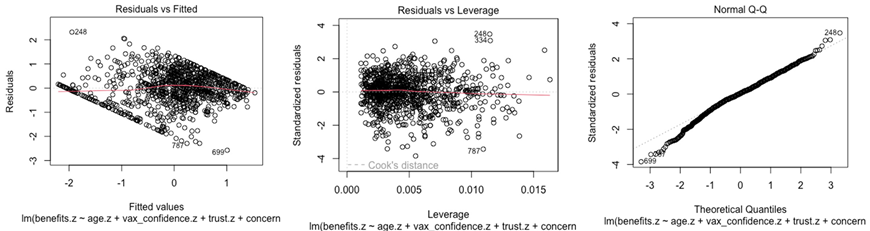
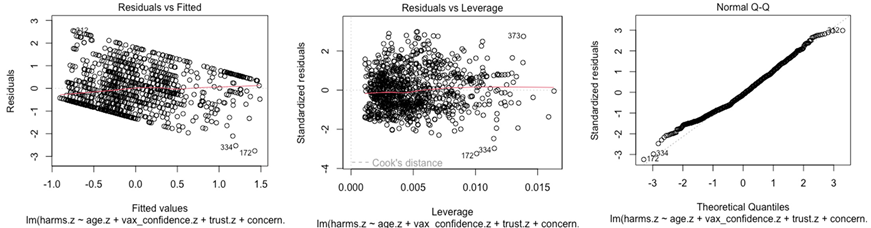
Finally, two multiple linear regressions with the entering method were carried out to measure the explained variance of benefits perception and harms perception by the age, the trust in the institution, the concern for health emergencies, and the confidence level in effectiveness of vaccines to prevent infective disease. Residuals vs. fitted and residuals vs. leverage plots were made for diagnostic analysis and can be viewed in the Appendix C.
All the analyses were carried out using R in the R Studio environment; the script can be found in the attached material. Some minor variables required recodification and labelling with SPSS software (IBM SPSS Statistics 27.0.1.0, Armonk, New York, NY USA).
3. Results
3.1. Descriptive Statistics
Overall, the sample included 1022 Italian citizens (50.7% female) aged between 18 and 70 years old (mean 46.9 with a standard deviation of 13.8). Table 1 shows the socio-demographic characteristics of the whole sample.
Table 1.
Sample characteristics.
Cronbach’s α for the seven items related to the potential benefits of COVID-19 immunity certificates was 0.956, while for the four items related to the potential harms of COVID-19 immunity certificates was 0.902; items and their descriptive statistics are displayed in Table 2. No outliers were detected with z-scores; a few were found by displaying the data with boxplots—available in Appendix B—in the case of the variable “confidence level in vaccine efficacy”, and also a few in the case of the variable “concern for the COVID-19 emergency” were found using the MAD function [18,19]. Since none of these outliers were consistent in more than one of these three methods, we decided to not remove any of them.
Table 2.
Survey items assessing perceived harms and benefits of the immunity certification implementation.
3.2. Difference between Groups
All diagnostic plots show no issues with the regression models, so we have proceeded to the results’ production and interpretation.
Independence of the observations was guaranteed by the panel provider, while the homoscedasticity was violated just in two cases out of eight, i.e., benefits perception of COVID-19 immunity certificates on political groups and harms perception of COVID-19 immunity certificates on gender, and for this reason, Welch’s test was chosen instead of the standard ANOVA test. On the other hand, the Shapiro–Wilk test and the QQ-plots show that normality was violated in each of the eight cases; nevertheless, we considered this violation as not a serious threat to the reliability of our results because of ANOVA’s robustness to the violation of this assumption [22,23,24] and in light of a comparison showing no difference in the significance of the p-value with its nonparametric counterpart, i.e., the Kruskal–Wallis test, which, however, would have caused us to suffer a loss of the ability to interpret the results (results of this test can be found in the Appendix B).
Welch’s ANOVAs show a significant main effect of the political orientation both on benefits perceptions with a small effect size [F(3, 493) =14.47; p < 0.001; η2 = 0.04] and on harms perceptions with a medium effect size [F(3, 497) = 26.94; p < 0.001; η2 = 0.07]. In particular, post hoc comparisons show that the harms perception of COVID-19 immunity certificates is significantly lower (p < 0.001) for left-oriented people (M = 2.12, SD = 1.18) and higher (p < 0.001) for right-oriented people (M = 3.17, SD = 1.26); vice versa, the benefits perception of COVID-19 immunity certificates is higher (p < 0.001) for left-wing people (M = 3.79, SD = 1.05) and lower for right-wing people (M = 3.19, SD = 1.23).
In addition, Welch’s ANOVAs show a significant main effect of having contracted COVID-19 both on benefits perceptions with a small effect size [F(1, 341.66) = 29.42; p < 0.001; η2 = 0.28] and on harms perceptions [F(1, 351) = 30.23; p < 0.001, η2 = 0.27]. The results show a statistically significant difference with p < 0.05, with higher benefits perceptions of COVID-19 immunity certificates for those who have contracted COVID-19 (M = 3.52, SD = 1.17) and lower for those who have not contracted it (M = 3.03, SD = 1.17); on the other hand, concerning the harms perception of COVID-19 immunity certificates, the results show a statistically significant difference with p < 0.05, with a lower rate for those who have contracted COVID-19 (M = 2.59, SD = 1.28) and higher for those who have not contracted it (M = 3.11, SD = 1.21).
Finally, results show no significant effects of the education on benefits perceptions (p = 0.081) nor harms perceptions (p = 0.166) and no significant effects of the gender on benefits perceptions (p = 0.361) nor harms perceptions (p = 0.296).
3.3. Multiple Linear Regression Models
The multiple linear regression with age, trust in institution, concern for the sanitary emergency, and confidence level for efficiency of vaccines to prevent infective disease as independent variables and perceived benefits as the dependent variable returned a significative model that explains benefits perceptions [F(4, 1017) = 313.00, p < 0.001] with an R2 of 0.552. All the independent variables had a significative effect on the dependent variable (p < 0.001) and predicted that a benefits perception of the COVID-19 immunity certificate was equal to 2.74 + 0.55 (confidence level in vaccine efficiency to prevent infective disease) 0.37 (trust in institution) + 0.12 (age) + 0.10 (concern for the COVID-19 emergency).
Then, the multiple linear regression with age, trust in institution, concern for the sanitary emergency, and confidence level for efficiency of vaccines to prevent infective disease as independent variables and perceived harms as the dependent variable returned a significative model that explains harms perceptions, but with a lower amount of variance explained [F(4, 1017) = 97.23, p < 0.001] with an R2 of 0.277. Neither trust in institution (p = 0.25) nor concern for the COVID-19 emergency (p = 0.06) have a significant effect on the dependent variable harms perception, while age and confidence level for efficiency of vaccines to prevent infective disease do have a significant effect (p < 0.001). The predicted harms perception of the COVID-19 immunity certificate was equal to 2.88–0.61 (confidence level for efficiency of vaccines to prevent infective disease) and 0.16 (age).
4. Discussion
In this study, we indicate details that could be useful to develop better communication strategies to engage people to better accept restrictive measures for the sake of a common good. Those details, hence, can be considered to envision specific targets to propose-tailored communications that are more relevant and therefore more effective [25].
In fact, considering perceived benefits separately from perceived harms has shown how there are variables that influence one more than the other. Firstly, results show that considering the multiple linear regression model with age, confidence level for efficiency of vaccines to prevent infective disease, trust in institution, and concern for the COVID-19 emergency, the latter two significatively explain the variance in the perceived benefits while not in the perceived harms of COVID-19 immunity certificates, but the opposite regarding political orientation, which explains perceived harms better than perceived benefits.
However, these results show that an initial classification of targets by their demographic variables such as gender or education is not too effective in skimming for perceptions of harms and benefits. In fact, neither gender nor education turn out to have a significant effect in perceptions of benefits or harms. This result is apparently in contrast with previous studies [9,10,26], but while those studies investigated opinions regarding a hypothetical immunity certificate, in our study, such a system was already valid at the time of the survey.
However, the results show age as a significant sociodemographic explanatory variable for benefits perceptions, which increases with age. This is consistent with previous studies that show a better acceptance for older people [5,10] and could be a relevant result to set up more communication strategies specific for younger people, for example, using infographic messages [27].
Then, it might be expected that having had the disease—and having experienced firsthand the risk and the discomfort—should increase the perceived benefits and reduce the perceived potential harms of the COVID-19 immunity certificate that, in fact, is a measure to solve the emergency, but looking at the results, it is clear that those who have contracted COVID-19 perceive more of the harms and less of the benefits compared to those who have not. Indeed, this result is in line with a previous study and could be due to the fear of being isolated for a period of time because of this certification system, especially from those who are most likely to be temporarily immune [28]; in any case, it could be worthwhile to better investigate the reason for this with further studies.
Instead, it seems more intuitive that perceived benefits increase as concern about the health emergency increases, but interestingly, it is not as effective at influencing perceptions of harms. This, since the percentage of the population concerned changes over time depending on events [29], may imply that during the most worrisome periods it is easier to introduce restrictive measures.
Regarding political orientation, it turns out that right-wing people perceive more of the harms and less of the benefits of the green pass compared to left-wing people. In another study, it was found that more conservatives scientists would accept the introduction of an immunity passport better [4]; this difference could be addressed to the special kind of population and the fact that people of right-wing orientation could not be the same [30]. Although predictable, trust in institutions turns out to be a good predictor of the perceived benefits of the green pass and, therefore, of a restrictive measure for the common good, which is why it may be important to monitor an index of trust toward institutions, such as with a social media analysis [14], and improve this condition [31] to increase acceptance of policies for the good of the community [8,32]. However, it is interesting that the perceived harms of such a measure are not addressed, so it might be interesting to investigate the profile of those who perceive more harms than benefits in more depth. Finally, the results of the model clearly show the role of the confidence level for efficiency of vaccines to prevent infectious disease; this, in addition to finding confirmation with very recent studies also in the Italian context [33], brings to attention the importance of continuing in the effort to reduce vaccine hesitancy by listening to their doubt and by creating space for dialogues with the citizens that can provoke their engagement with the health and social system. The need for policy improvements is pressing because a large share of the world’s population remains unvaccinated, and recent scientific evidence showed a waning of the immune response over time. Moreover, even beyond the current pandemic, our results can serve as vital information for similar health crises that may occur in the future. In addition, our results are expected to offer useful insights into public feelings around the use of digital health information tools.
5. Limitations
This study has some limitations that should be considered. The data presented in this study are self-reported and are partly dependent on the participants’ honesty and recall ability; thus, they might be prone to recall, declaration, or desirability biases. Secondly, the sample was limited to the Italian context, and therefore, the collected responses might not be generalizable to other countries. Future research should consider the results of this study with different populations.
Author Contributions
Conceptualization: S.B., M.P. and L.P.; data curation: M.P. and L.P.; formal analysis: M.P.; methodology: G.G., S.B., L.P., M.A. and M.P.; project administration: G.G.; supervision: S.B.; writing—original draft: M.P., M.A., L.P. and S.B.; writing—review and editing: G.G., S.B., L.P., M.A. and M.P. All authors have read and agreed to the published version of the manuscript.
Funding
This study was conducted within the CRAFT project, funded by Fondazione Cariplo and Regione Lombardia. The authors declare that the funders had no role in the study design, in interpretation of the results, or in the decision to publish the results.
Institutional Review Board Statement
This study has been performed in accordance with the Declaration of Helsinki and has been approved by an independent ethics commission of the Department of Psychology of Università Cattolica del Sacro Cuore in Milan (CERPS).
Informed Consent Statement
Informed consent was obtained from all subjects involved in the study.
Data Availability Statement
The dataset used for the analysis in this paper is available by emailing the corresponding author (michele.paleologo@unicatt.it). The R-script can be found in the attached materials.
Acknowledgments
The authors wish to thank the study participants for their contribution to the research.
Conflicts of Interest
The authors declare no conflict of interest.
Appendix A
Table A1.
Survey administered to the study participants.
Table A1.
Survey administered to the study participants.
| Variable Name | Answer Scale/Categories | Item Description |
|---|---|---|
| Gender | Male Female | To begin, we ask you some information about you—Gender |
| Politic | Centre left Centre Centre Right No Politic Orientation | Given your political views, where would you be? |
| Education | Middle school or lower Secondary education Degree or more | To begin, we ask you some information about you—Level of education |
| Contraction of the COVID-19 Disease | Yes No | Have you contracted COVID-19 (confirmed diagnosis by molecular or antigenic)? |
| Age | Birth year in number | To begin, we ask you some information about you—How old are you? |
| Trust in Istitution | 5-step Likert-type scale | With reference to the emergency situation from COVID-19 that we are experiencing, answer the following questions by indicating how much you agree with the following statements—I have full confidence in the institutions. |
| Concern about COVID-19 | 5-step Likert-type scale | How concerned would you say you are about the COVID-19 emergency? |
| Confidence Level on Vaccine Efficacy to Prevent Infective Disease | 5-step Likert-type scale | I am confident in the effectiveness of vaccines in preventing infectious diseases. |
| Benefits Perception 1 | 5-step Likert-type scale | I think Green Pass is an effective measure to reduce contagions. |
| Benefits Perception 2 | 5-step Likert-type scale | I think Green Pass is important to protect the health of the most. |
| Benefits Perception 3 | 5-step Likert-type scale | Since Green Pass has existed, I feel safer going to public places. |
| Benefits Perception 4 | 5-step Likert-type scale | I think Green Pass is important to protect public health. |
| Benefits Perception 5 | 5-step Likert-type scale | I think it is right to prevent those who do not have the Green Pass from entering workplaces. |
| Benefits Perception 6 | 5-step Likert-type scale | I think the Green Pass is important to protect the economy. |
| Benefits Perception 7 | 5-step Likert-type scale | I think it is right to prevent access to recreational and social gathering places such as restaurants, nightclubs, and stadiums for those who do not have the Green Pass. |
| Harms Perception 1 | 5-step Likert-type scale | The green pass is a violation of privacy. |
| Harms Perception 2 | 5-step Likert-type scale | I think the green pass is a way for the government to control citizens. |
| Harms Perception 3 | 5-steps Likert-type scale | The green pass greatly infringes on personal freedom. |
| Harms Perception 4 | 5-steps Likert-type scale | I think the green pass only increases inequality. |
Appendix B
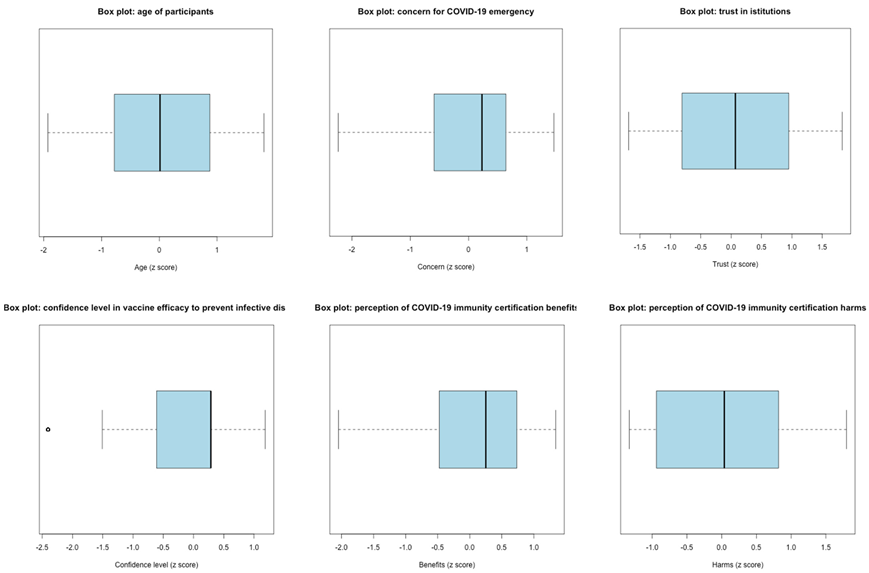
Boxplots of age, concern about the COVID-19 emergency, trust in institutions, confidence level of vaccine efficiency to prevent infective disease, benefits perceptions of COVID-19 immunity certificates, and harms perceptions of COVID-19 immunity certificates.

Appendix C
Diagnostic plots of the benefits perception multiple linear regression model.

Diagnostic plots of the harms perception multiple linear regression model.

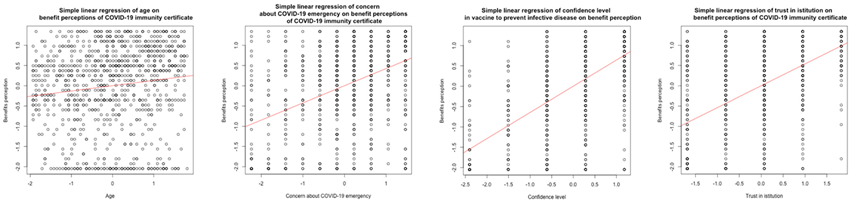
Scatter plots of each simple linear regressions of the variables included in the model on benefits perception.

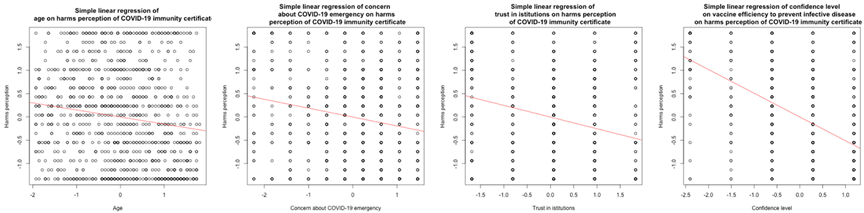
Scatter plots of each simple linear regressions of the variables included in the model on benefits perception.

References
- Dada, S.; Battles, H.; Pilbeam, C.; Singh, B.; Solomon, T.; Gobat, N. Learning from the Past and Present: Social Science Implications for COVID-19 Immunity-Based Documentation. Humanit Soc. Sci. Commun. 2021, 8, 219. [Google Scholar] [CrossRef]
- Diepeveen, S.; Ling, T.; Suhrcke, M.; Roland, M.; Marteau, T.M. Public Acceptability of Government Intervention to Change Health-Related Behaviours: A Systematic Review and Narrative Synthesis. BMC Public Health 2013, 13, 756. [Google Scholar] [CrossRef] [PubMed]
- Greenhalgh, T.; Wherton, J.; Papoutsi, C.; Lynch, J.; Hughes, G.; A’Court, C.; Hinder, S.; Fahy, N.; Procter, R.; Shaw, S. Beyond Adoption: A New Framework for Theorizing and Evaluating Nonadoption, Abandonment, and Challenges to the Scale-Up, Spread, and Sustainability of Health and Care Technologies. J. Med. Internet. Res. 2017, 19, e367. [Google Scholar] [CrossRef] [PubMed]
- Aranzales, I.; Chan, H.F.; Eichenberger, R.; Hegselmann, R.; Stadelmann, D.; Torgler, B. Scientists Have Favorable Opinions on Immunity Certifcates but Raise Concerns Regarding Fairness and Inequality. Sci. Rep. 2021, 11, 14016. [Google Scholar] [CrossRef]
- de Figueiredo, A.; Larson, H.; Reicher, S. The Potential Impact of Vaccine Passports on Inclination to Accept COVID-19 Vaccinations in the United Kingdom: Evidence from a Large Cross-Sectional Survey and Modeling Study. Eclinicalmedicine 2021, 40, 101109. [Google Scholar] [CrossRef]
- Garrett, P.M.; White, J.P.; Dennis, S.; Lewandowsky, S.; Yang, C.-T.; Okan, Y.; Perfors, A.; Little, D.R.; Kozyreva, A.; Lorenz-Spreen, P.; et al. Papers Please—Predictive Factors of National and International Attitudes Toward Immunity and Vaccination Passports: Online Representative Surveys. JMIR Public Health Surveill. 2022, 8, e32969. [Google Scholar] [CrossRef]
- Hall, M.; Studdert, D. Public Views about COVID-19 “Immunity Passports”. J. Law Biosci. 2021, 8, lsab016. [Google Scholar] [CrossRef]
- Lewandowsky, S.; Dennis, S.; Perfors, A.; Kashima, Y.; White, J.P.; Garrett, P.; Little, D.; Yesilada, M. Public acceptance of privacy-encroaching policies to address the COVID-19 pandemic in the United Kingdom. PLoS ONE 2021, 16, e0245740. [Google Scholar] [CrossRef]
- Mayssam, N.; Silvia, S.; Idris, G.; SEROCoV-POP Study Team. Perceptions of Immunity and Vaccination Certificates among the General Population: A Nested Study within a Serosurvey of Anti-SARS-CoV-2 Antibodies (SEROCoV-POP). Swiss Med. Wkly. 2020, 150, w20398. [Google Scholar] [CrossRef]
- Nehme, M.; Baysson, H.; Pullen, N.; Wisniak, A.; Pennacchio, F.; Zaballa, M.-E.; Fargnoli, V.; Kaiser, L.; Hurst, S.; Burton-Jeangros, C.; et al. Perceptions of Vaccination Certificates among the General Population in Geneva, Switzerland. Swiss Med Wkly 2021, 151, w30079. [Google Scholar] [CrossRef]
- Niculaescu, C.-E.; Sassoon, I.K.; Landa-Avila, I.C.; Colak, O.; Jun, G.T.; Balatsoukas, P. Why “One Size Fits All” Is Not Enough When Designing COVID-19 Immunity Certificates for Domestic Use: A UK Wide Cross-Sectional Online Survey. BMJ Open 2022, 12, e058317. [Google Scholar] [CrossRef] [PubMed]
- Kc, S.; Faradiba, D.; Sittimart, M.; Isaranuwatchai, W.; Ananthakrishnan, A.; Rachatan, C.; Dabak, S.; Shafie, A.A.; Guerrero, A.M.; Suwantika, A.; et al. Factors Associated with the Opposition to COVID-19 Vaccination Certificates: A Multi-Country Observational Study from Asia. Travel Med. Infect. Dis. 2022, 48, 102358. [Google Scholar] [CrossRef]
- Hu, M.; Jia, H.; Xie, Y. Passport to a Mighty Nation: Exploring Sociocultural Foundation of Chinese Public’s Attitude to COVID-19 Vaccine Certificates. Int. J. Environ. Res. Public Health 2021, 18, 439. [Google Scholar] [CrossRef]
- Khan, M.L.; Malik, A.; Ruhi, U.; Al-Busaidi, A. Conflicting Attitudes: Analyzing Social Media Data to Understand the Early Discourse on COVID-19 Passports. Technol. Soc. 2022, 68, 101830. [Google Scholar] [CrossRef] [PubMed]
- Fargnoli, V.; Nehme, M.; Guessous, I.; Burton-Jeangros, C. Acceptability of COVID-19 Certificates: A Qualitative Study in Geneva, Switzerland, in 2020. Front. Public Health 2021, 9, 682365. [Google Scholar] [CrossRef]
- Spitale, G.; Biller-Andorno, N.; Germani, F. The anti-Green Pass rhetoric in Italy is shaped by anti-vaccine views and focuses on limitations of personal freedom: A social listening analysis on Telegram chats (Preprint). J. Med. Internet. Res. 2021. [Google Scholar] [CrossRef]
- Gliem, J.A.; Gliem, R.R. Calculating, Interpreting, and Reporting Cronbach’s Alpha Reliability Coefficient For Likert-Type Scales. 2003. Available online: https://scholarworks.iupui.edu/handle/1805/344 (accessed on 2 May 2022).
- Leys, C.; Ley, C.; Klein, O.; Bernard, P.; Licata, L. Detecting Outliers: Do Not Use Standard Deviation around the Mean, Use Absolute Deviation around the Median. J. Exp. Soc. Psychol. 2013, 49, 764–766. [Google Scholar] [CrossRef]
- Leys, C.; Delacre, M.; Mora, Y.L.; Lakens, D.; Ley, C. How to Classify, Detect, and Manage Univariate and Multivariate Outliers, with Emphasis on Pre-Registration. Int. Rev. Soc. Psychol. 2019, 32, 5. [Google Scholar] [CrossRef]
- Delacre, M.; Leys, C.; Mora, Y.L.; Lakens, D. Taking Parametric Assumptions Seriously: Arguments for the Use of Welch’s F-Test Instead of the Classical F-Test in One-Way ANOVA. Int. Rev. Soc. Psychol. 2019, 32, 13. [Google Scholar] [CrossRef]
- Cohen, J. Statistical Power Analysis for the Behavioral Sciences, 2nd ed; Routledge: London, UK, 1988; ISBN 978-0-203-77158-7. [Google Scholar]
- Blanca, M.J.; Alarcón, R.; Arnau, J. Non-Normal Data: Is ANOVA Still a Valid Option? Psicothema 2017, 29, 552–557. [Google Scholar] [CrossRef]
- Knief, U.; Forstmeier, W. Violating the Normality Assumption May Be the Lesser of Two Evils. Behav. Res. 2021, 53, 2576–2590. [Google Scholar] [CrossRef] [PubMed]
- Schmider, E.; Ziegler, M.; Danay, E.; Beyer, L.; Bühner, M. Is It Really Robust? Reinvestigating the Robustness of ANOVA against Violations of the Normal Distribution Assumption. Methodol. Eur. J. Res. Methods Behav. Soc. Sci. 2010, 6, 147–151. [Google Scholar] [CrossRef]
- Kreuter, M.W.; Wray, R.J. Tailored and Targeted Health Communication: Strategies for Enhancing Information Relevance. Am. J. Health Behav. 2003, 27, S227–S232. [Google Scholar] [CrossRef] [PubMed]
- Nurgalieva, L.; Ryan, S.; Balaskas, A.; Lindqvist, J.; Doherty, G. Public Views on Digital COVID-19 Certificates: A Mixed Methods User Study. In Proceedings of the CHI Conference on Human Factors in Computing Systems, New Orleans, LA, USA, USA 29 April–5 May 2022; pp. 1–28. [Google Scholar] [CrossRef]
- Bol, N.; van Weert, J.C.M.; Loos, E.F.; Romano Bergstrom, J.C.; Bolle, S.; Smets, E.M.A. How Are Online Health Messages Processed? Using Eye Tracking to Predict Recall of Information in Younger and Older Adults. J. Health Commun. 2016, 21, 387–396. [Google Scholar] [CrossRef] [PubMed]
- Bachtiger, P.; Adamson, A.; Quint, J.K.; Peters, N.S. Belief of Having Had Unconfirmed Covid-19 Infection Reduces Willingness to Participate in App-Based Contact Tracing. NPJ Digit. Med. 2020, 3, 146. [Google Scholar] [CrossRef]
- Graffigna, G.; Palamenghi, L.; Savarese, M.; Castellini, G.; Barello, S. Effects of the COVID-19 Emergency and National Lockdown on Italian Citizens’ Economic Concerns, Government Trust, and Health Engagement: Evidence From a Two-Wave Panel Study. Milbank Q. 2021, 99, 369–392. [Google Scholar] [CrossRef]
- Zagórski, P.; Rama, J.; Cordero, G. Young and Temporary: Youth Employment Insecurity and Support for Right-Wing Populist Parties in Europe. Gov. Oppos. 2021, 56, 405–426. [Google Scholar] [CrossRef]
- Scherer, L.D.; Shaffer, V.A.; Patel, N.; Zikmund-Fisher, B.J. Can the Vaccine Adverse Event Reporting System Be Used to Increase Vaccine Acceptance and Trust? Vaccine 2016, 34, 2424–2429. [Google Scholar] [CrossRef]
- Ryu, Y.; Kim, S.; Kim, S. Does Trust Matter? Analyzing the Impact of Trust on the Perceived Risk and Acceptance of Nuclear Power Energy. Sustainability 2018, 10, 758. [Google Scholar] [CrossRef] [Green Version]
- Caserotti, M.; Gavaruzzi, T.; Girardi, P.; Sellaro, R.; Rubaltelli, E.; Tasso, A.; Lotto, L. People’s Perspectives about COVID-19 Vaccination Certificate: Findings from a Representative Italian Sample. Vaccine 2022, in press. [Google Scholar] [CrossRef]
Publisher’s Note: MDPI stays neutral with regard to jurisdictional claims in published maps and institutional affiliations. |
© 2022 by the authors. Licensee MDPI, Basel, Switzerland. This article is an open access article distributed under the terms and conditions of the Creative Commons Attribution (CC BY) license (https://creativecommons.org/licenses/by/4.0/).