

Effectiveness of Inactivated COVID-19 Vaccines against COVID-19 Caused by the SARS-CoV-2 Delta and Omicron Variants: A Retrospective Cohort Study
Abstract
1. Introduction
2. Methods
2.1. Study Design and Participants
2.2. Diagnostic Criteria and Definitions
2.3. Vaccination Status
2.4. Information Collection
2.5. Statistical Analysis
2.6. Sensitivity Analyses
3. Results
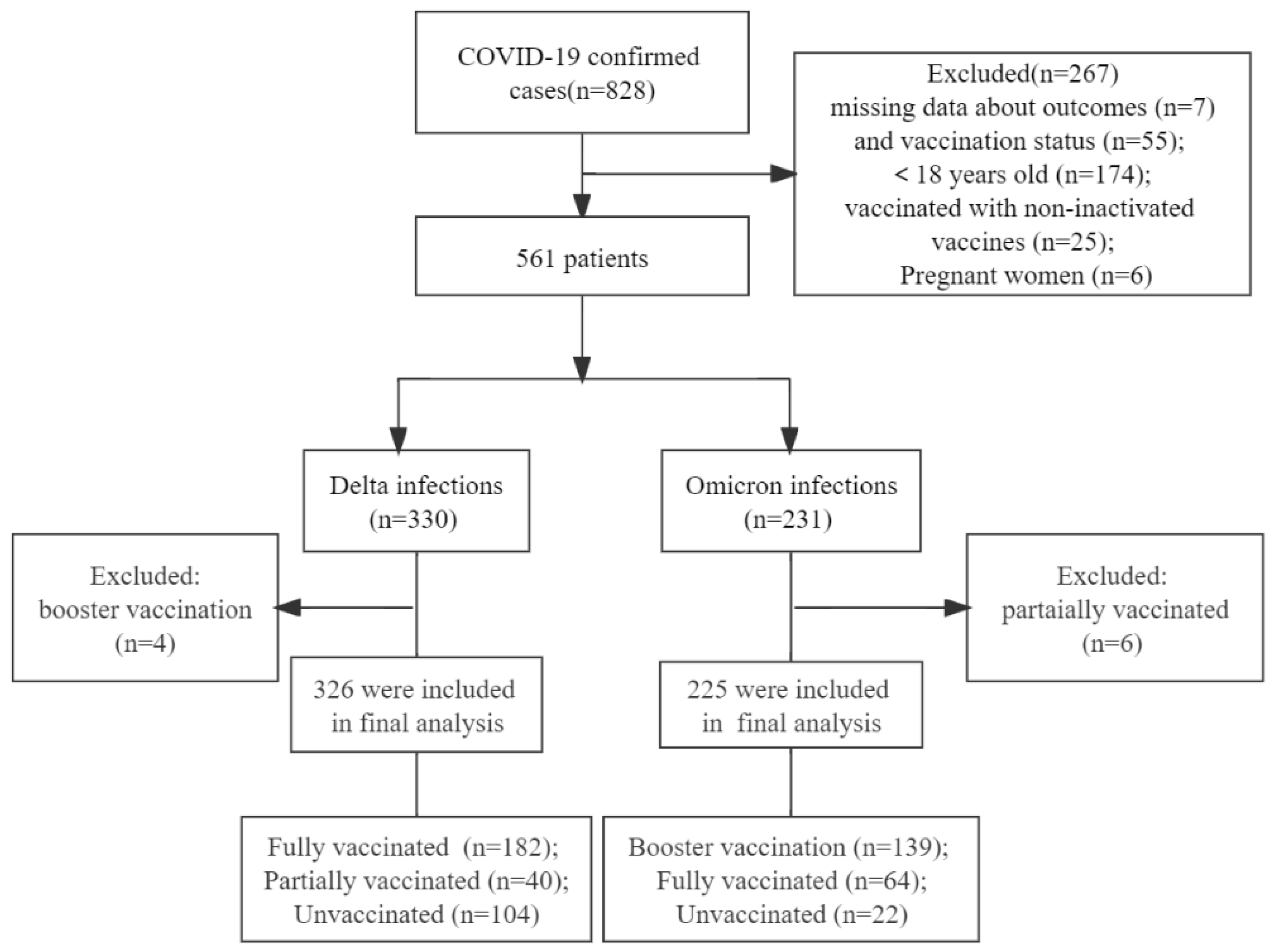
3.1. Study Population
3.2. Characteristics of Participants
3.3. Antibodies and Viral Loads among Different Groups
3.4. Outcomes among Different Groups
3.5. Vaccine Effectiveness
3.6. Sensitivity Analysis
4. Discussion
5. Conclusions
Supplementary Materials
Author Contributions
Funding
Institutional Review Board Statement
Informed Consent Statement
Data Availability Statement
Conflicts of Interest
References
- Ranzani, O.T.; Hitchings, M.D.T.; Dorion, M.; D’Agostini, T.L.; de Paula, R.C.; de Paula, O.F.P.; Villela, E.F.d.; Torres, M.S.S.; de Oliveira, S.B.; Schulz, W.; et al. Effectiveness of the CoronaVac vaccine in older adults during a gamma variant associated epidemic of covid-19 in Brazil: Test negative case-control study. BMJ 2021, 374, n2015. [Google Scholar] [CrossRef] [PubMed]
- Jara, A.; Undurraga, E.A.; González, C.; Paredes, F.; Fontecilla, T.; Jara, G.; Pizarro, A.; Acevedo, J.; Leo, K.; Leon, F.; et al. Effectiveness of an Inactivated SARS-CoV-2 Vaccine in Chile. N. Engl. J. Med. 2021, 385, 875–884. [Google Scholar] [CrossRef] [PubMed]
- Huang, Z.; Su, Y.; Zhang, T.; Xia, N. A review of the safety and efficacy of current COVID-19 vaccines. Front. Med. 2022, 16, 39–55. [Google Scholar] [CrossRef] [PubMed]
- COVID-19 Vaccination Doses (Up to September 6) Service Information Chinese Government Website. Available online: http://www.gov.cn/xinwen/2022-09/07/content_5708742.htm (accessed on 7 September 2022).
- al Kaabi, N.; Zhang, Y.; Xia, S.; Yang, Y.; al Qahtani, M.M.; Abdulrazzaq, N.; al Nusair, M.; Hassany, M.; Jawad, J.S.; Abdalla, J.; et al. Effect of 2 Inactivated SARS-CoV-2 Vaccines on Symptomatic COVID-19 Infection in Adults: A Randomized Clinical Trial. JAMA 2021, 326, 35–45. [Google Scholar] [CrossRef]
- Evidence Assessment: Sinovac/CoronaVac COVID-19 Vaccine. Available online: https://cdn.who.int/media/docs/default-source/immunization/sage/2021/april/5_sage29apr2021_critical-evidence_sinovac.pdf?sfvrsn=2488098d_5 (accessed on 12 September 2022).
- Tanriover, M.D.; Doğanay, H.L.; Akova, M.; Güner, H.R.; Azap, A.; Akhan, S.; Köse, Ş.; Erdinç, F.Ş.; Akalın, E.H.; Tabak, Ö.F.; et al. Efficacy and safety of an inactivated whole-virion SARS-CoV-2 vaccine (CoronaVac): Interim results of a double-blind, randomised, placebo-controlled, phase 3 trial in Turkey. Lancet 2021, 398, 213–222. [Google Scholar] [CrossRef]
- Palacios, R.; Batista, A.P.; Albuquerque, C.S.N.; Patiño, E.G.; Santos JD, P.; Tilli Reis Pessoa Conde, M.; Roberta de Oliveira Piorelli, L.C.P.J. Efficacy and Safety of a COVID-19 Inactivated Vaccine in Healthcare Professionals in Brazil: The Profiscov Study. 2021. Available online: http://dx.doi.org/10.2139/ssrn.3822780 (accessed on 12 September 2022).
- Ang, M.M.; Yi, M.Y.; Li, Y.; Sun, B.L.; Deng, M.A.; Hu, M.T.; Zhang, M.J.; Liu, M.J.; Cheng, M.M.; Xie, M.S.; et al. Effectiveness of Inactivated COVID-19 Vaccines Against Illness Caused by the B.1.617.2 (Delta) Variant During an Outbreak in Guangdong, China. Ann. Intern. Med. 2022, 175, 533–540. [Google Scholar]
- Hu, Z.; Tao, B.; Li, Z.; Song, Y.; Yi, C.; Li, J.; Zhu, M.; Yi, Y.; Huang, P.; Wang, J. Effectiveness of inactivated COVID-19 vaccines against severe illness in B.1.617.2 (Delta) variant–infected patients in Jiangsu, China. Int. J. Infect. Dis. 2022, 116, 204–209. [Google Scholar] [CrossRef]
- Li, M.; Liu, Q.; Wu, D.; Tang, L.; Wang, X.; Yan, T.; An, Z.; Yin, Z.; Gao, G.F.; Wang, F. Association of COVID-19 Vaccination and Clinical Severity of Patients Infected with Delta or Omicron Variants—China, May 21, 2021–February 28, 2022. China CDC Wkly 2022, 4, 293–297. [Google Scholar] [CrossRef]
- Cosar, B.; Karagulleoglu, Z.Y.; Unal, S.; Ince, A.T.; Uncuoglu, D.B.; Tuncer, G.; Demir-Dora, D. SARS-CoV-2 Mutations and their Viral Variants. Cytokine Growth Factor Rev. 2022, 63, 10–22. [Google Scholar] [CrossRef]
- Yu, X.; Qi, X.; Cao, Y.; Li, P.; Lu, L.; Wang, P.; Feng, Y.; Yang, J.; Wei, H.; Guo, L.; et al. Three doses of an inactivation-based COVID-19 vaccine induces cross-neutralizing immunity against the SARS CoV-2 Omicron variant. Emerg. Microbes Infect. 2022, 11, 749–752. [Google Scholar] [CrossRef]
- Xie, T.; Lu, S.; He, Z.; Liu, H.; Wang, J.; Tang, C.; Yang, T.; Yu, W.; Li, H.; Yang, Y.; et al. Three doses of prototypic SARS-CoV-2 inactivated vaccine induce cross-protection against its variants of concern. Signal Transduct. Target Ther. 2022, 7, 61. [Google Scholar] [CrossRef] [PubMed]
- McMenamin, M.E.; Nealon, J.; Lin, Y.; Wong, J.Y.; Cheung, J.K.; Lau, E.H.Y.; Wu, P.; Leung, G.M.; Cowling, B.J. Vaccine effectiveness of one, two, and three doses of BNT162b2 and CoronaVac against COVID-19 in Hong Kong: A population-based observational study. Lancet Infect. Dis. 2022, 22, 1435–1443. [Google Scholar] [CrossRef]
- National Health Commission of the People’s Republic of China. The Diagnosis and Treatment Protocol of COVID-19 (Trial version 8). Inter. J. Epidemiol. Infect. Dis. 2020, 13, 321–328. (In Chinese) [Google Scholar]
- National Health Commission of the People’s Republic of China. The Diagnosis and Treatment Protocol of COVID-19 (Trial version 9). Inter. J. Epidemiol. Infect. Dis. 2022, 49, 73–80. (In Chinese) [Google Scholar]
- Zou, G. A Modified Poisson Regression Approach to Prospective Studies with Binary Data. Am. J. Epidemiol. 2004, 159, 702–706. [Google Scholar] [CrossRef]
- VanderWeele, T.J.; Ding, P. Sensitivity Analysis in Observational Research: Introducing the E-Value. Ann. Intern. Med. 2017, 167, 268–274. [Google Scholar] [CrossRef] [PubMed]
- Wu, D.; Ye, Y.; Tang, L.; Wang, A.; Zhang, R.; Qian, Z.; Wang, F.; Zheng, H.; Huang, C.; Lv, X.; et al. A case-case study on the effect of primary and booster immunization with China-produced COVID-19 vaccines on prevention of pneumonia and viral load among vaccinated persons infected by Delta and Omicron variants. Emerg. Microbes Infect. 2022, 11, 1950–1958. [Google Scholar] [CrossRef]
- Suzuki, K.; Ichikawa, T.; Suzuki, S.; Tanino, Y.; Kakinoki, Y. Clinical characteristics of the severe acute respiratory syndrome coronavirus 2 omicron variant compared with the delta variant: A retrospective case-control study of 318 outpatients from a single sight institute in Japan. PeerJ 2022, 10, e13762. [Google Scholar] [CrossRef]
- Li, X.; Huang, Y.; Wang, W.; Jing, Q.; Zhang, C.; Qin, P.; Guan, W.; Gan, L.; Li, Y.; Liu, W.; et al. Effectiveness of inactivated SARS-CoV-2 vaccines against the Delta variant infection in Guangzhou: A test-negative case–control real-world study. Emerg. Microbes. Infect. 2021, 10, 1751–1759. [Google Scholar] [CrossRef]
- Hu, Z.; Yin, Y.; Wang, K.; Xu, M.; Ding, C.; Song, Y.; Yi, C.; Li, J.; Yi, Y.; Peng, Z. Impact of inactivated COVID-19 vaccines on viral shedding in B.1.617.2 (Delta) variant-infected patients. Sci. China Life Sci. 2022, 14, 1–4. [Google Scholar] [CrossRef]
- Tseng, H.F.; Ackerson, B.K.; Luo, Y.; Sy, L.S.; Talarico, C.A.; Tian, Y.; Bruxvoort, K.J.; Tubert, J.E.; Florea, A.; Ku, J.H.; et al. Effectiveness of mRNA-1273 against SARS-CoV-2 Omicron and Delta variants. Nat. Med. 2022, 28, 1063–1071. [Google Scholar] [CrossRef] [PubMed]
- Accorsi, E.K.; Britton, A.; Fleming-Dutra, K.E.; Smith, Z.R.; Shang, N.; Derado, G.; Miller, J.; Schrag, S.J.; Verani, J.R. Association Between 3 Doses of mRNA COVID-19 Vaccine and Symptomatic Infection Caused by the SARS-CoV-2 Omicron and Delta Variants. JAMA 2022, 327, 639–651. [Google Scholar] [CrossRef] [PubMed]
- Zheng, Z.; Peng, F.; Xu, B.; Zhao, J.; Liu, H.; Peng, J.; Li, Q.; Jiang, C.; Zhou, Y.; Liu, S.; et al. Risk factors of critical & mortal COVID-19 cases: A systematic literature review and meta-analysis. J. Infect. 2020, 81, e16–e25. [Google Scholar] [CrossRef] [PubMed]
- Ferdinands, J.M.; Thompson, M.G.; Blanton, L.; Spencer, S.; Grant, L.; Fry, A.M. Does influenza vaccination attenuate the severity of breakthrough infections? A narrative review and recommendations for further research. Vaccine 2021, 39, 3678–3695. [Google Scholar] [CrossRef]
- Préziosi, M.; Halloran, M.E. Effects of Pertussis Vaccination on Disease: Vaccine Efficacy in Reducing Clinical Severity. Clin. Infect. Dis. 2003, 37, 772–779. [Google Scholar] [CrossRef]
- Hickman, C.J.; Hyde, T.B.; Sowers, S.B.; Mercader, S.; McGrew, M.; Williams, N.J.; Beeler, J.A.; Audet, S.; Kiehl, B.; Nandy, R.; et al. Laboratory Characterization of Measles Virus Infection in Previously Vaccinated and Unvaccinated Individuals. J. Infect. Dis. 2011, 204 (Suppl. 1), S549–S558. [Google Scholar] [CrossRef]
- Marin, M.; Yawn, B.P.; Hales, C.M.; Wollan, P.C.; Bialek, S.R.; Zhang, J.; Kurland, M.J.; Harpaz, R. Herpes zoster vaccine effectiveness and manifestations of herpes zoster and associated pain by vaccination status. Hum. Vaccin. Immunother. 2015, 11, 1157–1164. [Google Scholar] [CrossRef]
- Zmievskaya, E.; Valiullina, A.; Ganeeva, I.; Petukhov, A.; Rizvanov, A.; Bulatov, E. Application of CAR-T Cell Therapy beyond Oncology: Autoimmune Diseases and Viral Infections. Biomedicines 2021, 9, 59. [Google Scholar] [CrossRef] [PubMed]
- Li, D.; Li, A.-E.; Li, Z.-Q.; Bao, Y.; Liu, T.; Qin, X.-R.; Yu, X.-J. SARS-CoV-2 Delta Variant in Jingmen City, Hubei Province, China, 2021: Children Susceptible and Vaccination Breakthrough Infection. Front. Microbiol. 2022, 13, 856757. [Google Scholar] [CrossRef]
- Evans, J.P.; Zeng, C.; Carlin, C.; Lozanski, G.; Saif, L.J.; Oltz, E.M.; Gumina, R.J.; Liu, S.-L. Neutralizing antibody responses elicited by SARS-CoV-2 mRNA vaccination wane over time and are boosted by breakthrough infection. Sci. Transl. Med. 2022, 14, eabn8057. [Google Scholar] [CrossRef]
- Feikin, D.R.; Higdon, M.M.; Abu-Raddad, L.J.; Andrews, N.; Araos, R.; Goldberg, Y.; Groome, M.J.; Huppert, A.; O’Brien, K.L.; Smith, P.G.; et al. Duration of effectiveness of vaccines against SARS-CoV-2 infection and COVID-19 disease: Results of a systematic review and meta-regression. Lancet 2022, 399, 924–944. [Google Scholar] [CrossRef]



| Variables | Total (n = 551) | Delta Infections (n = 326) | Omicron Infections (n = 225) | p |
|---|---|---|---|---|
| Gender, n (%) | 0.108 | |||
| Male | 238 (43.2) | 150 (46.0) | 88 (39.1) | |
| Female | 313 (56.8) | 176 (54.0) | 137 (60.9) | |
| Age, (years old) | 44.0 (35.0, 56.0) | 45.0 (36.0, 58.0) | 42.0 (33.0, 55.0) | 0.029 |
| Age < 60, n (%) | 451 (81.9) | 258 (79.1) | 193 (85.8) | 0.047 |
| Age ≥ 60, n (%) | 100 (18.1) | 68 (20.9) | 32 (14.2) | |
| Comorbidities, n (%) | 163 (29.6) | 135 (41.4) | 28 (12.4) | <0.001 |
| Hypertension, n (%) | 70 (12.7) | 53 (16.3) | 17 (7.6) | 0.003 |
| Diabetes, n (%) | 23 (4.2) | 18 (5.5) | 5 (2.2) | 0.057 |
| Chronic lung disease, n (%) | 38 (6.9) | 37 (11.3) | 1 (0.4) | <0.001 |
| Uncured cancer, n (%) | 8 (1.5) | 5 (1.5) | 3 (1.3) | 1.000 a |
| Cardiovascular disease, n (%) | 16 (2.9) | 11 (3.4) | 5 (2.2) | 0.429 |
| Cerebrovascular disease, n (%) | 5 (0.9) | 5 (1.5) | 0 (0.0) | 0.083 a |
| Chronic liver disease, n (%) | 20 (3.6) | 20 (6.1) | 0 (0.0) | <0.001 |
| Chronic kidney disease, n (%) | 6 (1.1) | 6 (1.8) | 0 (0.0) | 0.086 |
| Immune compromised b, n (%) | 3 (0.5) | 3 (0.9) | 0 (0.0) | 0.274 a |
| Vaccination status, n (%) | <0.001 | |||
| Unvaccinated (0 dose) | 126 (22.9) | 104 (31.9) | 22 (9.8) | |
| Partially vaccinated (1 dose) | 40 (7.3) | 40 (12.3) | 0 (0.0) | |
| Fully vaccinated (2 doses) | 246 (44.6) | 182 (55.8) | 64 (28.4) | |
| Booster-vaccinated (3 doses) | 139 (25.2) | 0 (0.0) | 139 (61.8) | |
| Median days from last vaccination shot to symptom onset, (IQR) | 93.5 (42.0, 188.5) | 52.0 (30.2, 92.0) | 197.0 (143.5, 276.0) | <0.001 |
| Pneumonia, n (%) | 211 (38.3) | 184 (56.4) | 27 (12.0) | <0.001 |
| Clinical severity, n (%) | <0.001 | |||
| Asymptomatic | 71 (12.9) | 10 (3.1) | 61 (27.1) | |
| Non-severe c | 431 (78.2) | 267 (81.9) | 164 (72.9) | |
| Severe d | 49 (8.9) | 49 (15.0) | 0 (0.0) | |
| The duration of viral shedding, (days, IQR) | 13.0 (10.0, 18.0) | 16.5 (11.0, 22.0) | 11.0 (9.0, 13.0) | <0.001 |
| The highest temperature, n (%) | <0.001 | |||
| <37.3 °C | 226 (41.0) | 97 (29.8) | 129 (57.3) | |
| 37.3–38 °C | 128 (23.2) | 66 (20.2) | 62 (27.6) | |
| 38.1–39 °C | 130 (23.6) | 100 (30.7) | 30 (13.3) | |
| ≥39.1 °C | 67 (12.2) | 63 (19.3) | 4 (1.8) |
| Variables | Delta Variant | Omicron Variant | ||||||
|---|---|---|---|---|---|---|---|---|
| Unvaccinated (n = 104) | Partially Vaccinated (n = 40) | Fully Vaccinated (n = 182) | p | Unvaccinated (n = 22) | Fully Vaccinated (n = 64) | Booster Vaccination (n = 139) | p | |
| IgG-48h a | 0.0 (0.0, 0.1) | 0.6 (0.1, 3.3) | 15.3 (3.5, 52.4) | <0.001 | 0.1 (0.1, 0.4) | 1.3 (0.4, 4.9) | 7.8 (3.1, 18.9) | <0.001 |
| IgM-48h a | 0.0 (0.0, 0.1) | 0.1 (0.1, 0.2) | 0.4 (0.1, 1.6) | <0.001 | 0.1 (0.1, 0.3) | 0.3 (0.1, 0.7) | 0.2 (0.1, 0.6) | 0.082 |
| IgG max b | 10.4 (2.7, 25.7) | 19.0 (3.4, 71.4) | 7.4 (2.4, 25.2) | 0.292 | 0.2 (0.1, 0.5) | 2.8 (0.8, 52.2) | 19.9 (5.9, 82.2) | <0.001 |
| IgM max | 168.3 (15.8, 448.4) | 169.0 (39.1, 344.6) | 330.8 (254.4, 386.3) | 0.295 | 0.1 (0.1, 0.3) | 0.4 (0.1, 1.1) | 0.3 (0.2, 0.9) | 0.068 |
| Viral load (Ct value c, within 48 h of admission) | ||||||||
| ORF1ab target | 26.0 ± 6.1 | 26.9 ± 6.9 | 23.8 ± 6.0 | 0.387 | 26.0 (22.0, 33.0) | 29.0 (24.5, 32.0) | 27.0 (22.0, 31.0) | 0.382 |
| n target | 23.7 (19.6, 29.9) | 26.3 (19.6, 30.1) | 22.4 (20.0, 26.1) | 0.671 | 28.0 (23.0, 33.0) | 29.0 (26.0, 32.0) | 28.0 (22.0, 31.0) | 0.150 |
| Viral load (lowest Ct value) | ||||||||
| ORF1ab target | 21.9 (19.3, 25.1) | 20.7 (18.2, 24.3) | 19.5 (18.4, 22.6) | 0.239 | 26.0 (22.0, 32.0) | 27.0 (23.0, 30.0) | 26.0 (21.0, 30.0) | 0.179 |
| n target | 20.5 (17.9, 23.7) | 19.0 (17.1, 22.0) | 18.1 (16.5, 20.9) | 0.203 | 27.0 (23.0, 31.0) | 27.0 (23.2, 31.0) | 26.0 (22.0, 30.0) | 0.092 |
| Variables | Delta Variant | Omicron Variant | ||||||
|---|---|---|---|---|---|---|---|---|
| Unvaccinated (n = 104) | Partially Vaccinated (n = 40) | Fully Vaccinated (n = 182) | p | Unvaccinated (n = 22) | Fully Vaccinated (n = 64) | Booster-Vaccinated (n = 139) | p | |
| Pneumonia | 90 (86.5) | 27 (67.5) | 67 (36.8) | <0.001 | 7 (31.8) | 10 (15.6) | 10 (7.2) | 0.005 |
| Severe COVID-19 a | 34 (32.7) | 5 (12.5) | 10 (5.5) | <0.001 | 0 (0.0) | 0 (0.0) | 0 (0.0) | - |
| Duration of viral shedding | 20.1 ± 6.0 | 17.9 ± 6.8 | 14.4 ± 8.7 | <0.001 | 11.0 (8.0, 13.0) | 10.0 (9.0, 12.0) | 11.0 (9.0, 13.0) | 0.847 |
| The highest temperature | 38.7 (38.0, 39.2) | 38.5 (37.9, 39.0) | 37.6 (37.0, 38.5) | <0.001 | 37.0 (36.2, 38.0) | 36.7 (36.4, 37.7) | 36.9 (36.4, 37.5) | 0.96 |
| The interval from last vaccination shot to symptom onset | - | 29.0 (18.8, 43.5) | 61.0 (35.0, 97.0) | <0.001 | - | 320.0 (285.0, 376.0) | 182.6 (130.9, 199.0) | <0.001 |
| ≤180 days, n (%) | - | 40 (100) | 179 (98.4) | <0.001 | - | 7 (10.9) | 73 (52.5) | <0.001 |
| >180 days, n (%) | - | 0 (0.0) | 3 (1.4) | - | 57 (89.1) | 66 (47.5) | ||
| a. VE against Pneumonia and Disease Progression in Delta and Omicron Cases | ||||||||||
|---|---|---|---|---|---|---|---|---|---|---|
| Outcomes | Delta Infection | Omicron Infection | ||||||||
| Events/ Cases (%) | Unadjusted VE (95% CI) | p Value | Adjusted VE (95% CI)a | p Value | Events/ Cases (%) | Unadjusted VE (95% CI) | p Value | Adjusted VE (95% CI)a | p Value | |
| Pneumonia | ||||||||||
| Unvaccinated | 90/104 (86.5) | Reference | Reference | 7/22 (31.8) | Reference | Reference | ||||
| Partially vaccinated | 27/40 (67.5) | 22% (−4%, 41%) | 0.089 | 12% (−21%, 35%) | 0.442 | - | - | - | ||
| Fully vaccinated | 67/182 (36.8) | 57% (48%, 66%) | <0.001 | 52% (39%, 63%) | <0.001 | 10/64 (15.6) | 51% (−22%, 80%) | 0.128 | 32% (−70%, 73%) | 0.408 |
| Booster-vaccinated | - | - | - | 10/139 (7.2) | 77% (44%, 91%) | 0.002 | 68% (18%, 88%) | 0.019 | ||
| Severe or critical | ||||||||||
| Unvaccinated | 34/104 (32.7) | Reference | Reference | 0/22 | Reference | Reference | ||||
| Partially vaccinated | 5/40 (12.5) | 62% (9%, 84%) | 0.031 | 8% (−141%,65%) | 0.863 | - | - | - | ||
| Fully vaccinated | 10/182 (5.5) | 83% (68%, 91%) | <0.001 | 61% (15%, 82%) | 0.018 | 0/64 | - | - | ||
| Booster-vaccinated | - | - | - | 0/139 | - | - | ||||
| b. VE in Shorting Duration of Viral Shedding in Delta and Omicron Cases | ||||||||||
| Vaccination Status | Delta Infection | Omicron Infection | ||||||||
| Duration of Viral Shedding (days) | Unadjusted β (95% CI) | p Value | Adjusted β (95% CI) a | p Value | Duration of Viral Shedding (days) | Unadjusted β (95% CI) | p Value | Adjusted β (95% CI) b | p Value | |
| Unvaccinated | 20.1 ± 6.0 | Reference | Reference | 11.1 ± 3.3 | Reference | Reference | ||||
| Partially vaccinated | 17.9 ± 6.8 | −2.21 (−5.03, 0.62) | 0.127 | −1.18 (−4.21~1.84) | 0.444 | - | - | - | ||
| Fully vaccinated | 14.4 ± 8.7 | −5.69 (−7.56, −3.82) | <0.001 | −4.68 (−6.89, −2.46) | <0.001 | 10.9 ± 2.8 | −0.21 (−1.55, 1.14) | 0.762 | 0.02 (−1.33, 1.36) | 0.982 |
| Booster-vaccinated | - | - | - | 11.1 ± 2.6 | −0.03 (−1.27, 1.22) | 0.966 | −0.01 (−1.26, 1.24) | 0.986 | ||
Publisher’s Note: MDPI stays neutral with regard to jurisdictional claims in published maps and institutional affiliations. |
© 2022 by the authors. Licensee MDPI, Basel, Switzerland. This article is an open access article distributed under the terms and conditions of the Creative Commons Attribution (CC BY) license (https://creativecommons.org/licenses/by/4.0/).
Share and Cite
Hua, Q.; Zheng, D.; Yu, B.; Tan, X.; Chen, Q.; Wang, L.; Zhang, J.; Liu, Y.; Weng, H.; Cai, Y.; et al. Effectiveness of Inactivated COVID-19 Vaccines against COVID-19 Caused by the SARS-CoV-2 Delta and Omicron Variants: A Retrospective Cohort Study. Vaccines 2022, 10, 1753. https://doi.org/10.3390/vaccines10101753
Hua Q, Zheng D, Yu B, Tan X, Chen Q, Wang L, Zhang J, Liu Y, Weng H, Cai Y, et al. Effectiveness of Inactivated COVID-19 Vaccines against COVID-19 Caused by the SARS-CoV-2 Delta and Omicron Variants: A Retrospective Cohort Study. Vaccines. 2022; 10(10):1753. https://doi.org/10.3390/vaccines10101753
Chicago/Turabian StyleHua, Qiaoli, Danwen Zheng, Bo Yu, Xinghua Tan, Qiumin Chen, Longde Wang, Jing Zhang, Yuntao Liu, Heng Weng, Yihang Cai, and et al. 2022. "Effectiveness of Inactivated COVID-19 Vaccines against COVID-19 Caused by the SARS-CoV-2 Delta and Omicron Variants: A Retrospective Cohort Study" Vaccines 10, no. 10: 1753. https://doi.org/10.3390/vaccines10101753
APA StyleHua, Q., Zheng, D., Yu, B., Tan, X., Chen, Q., Wang, L., Zhang, J., Liu, Y., Weng, H., Cai, Y., Xu, X., Feng, B., Zheng, G., Ding, B., Guo, J., & Zhang, Z. (2022). Effectiveness of Inactivated COVID-19 Vaccines against COVID-19 Caused by the SARS-CoV-2 Delta and Omicron Variants: A Retrospective Cohort Study. Vaccines, 10(10), 1753. https://doi.org/10.3390/vaccines10101753