ROS–SUMO Crosstalk in Oxidative Stress: Disease Mechanisms and Reproductive Health




Abstract
1. Introduction
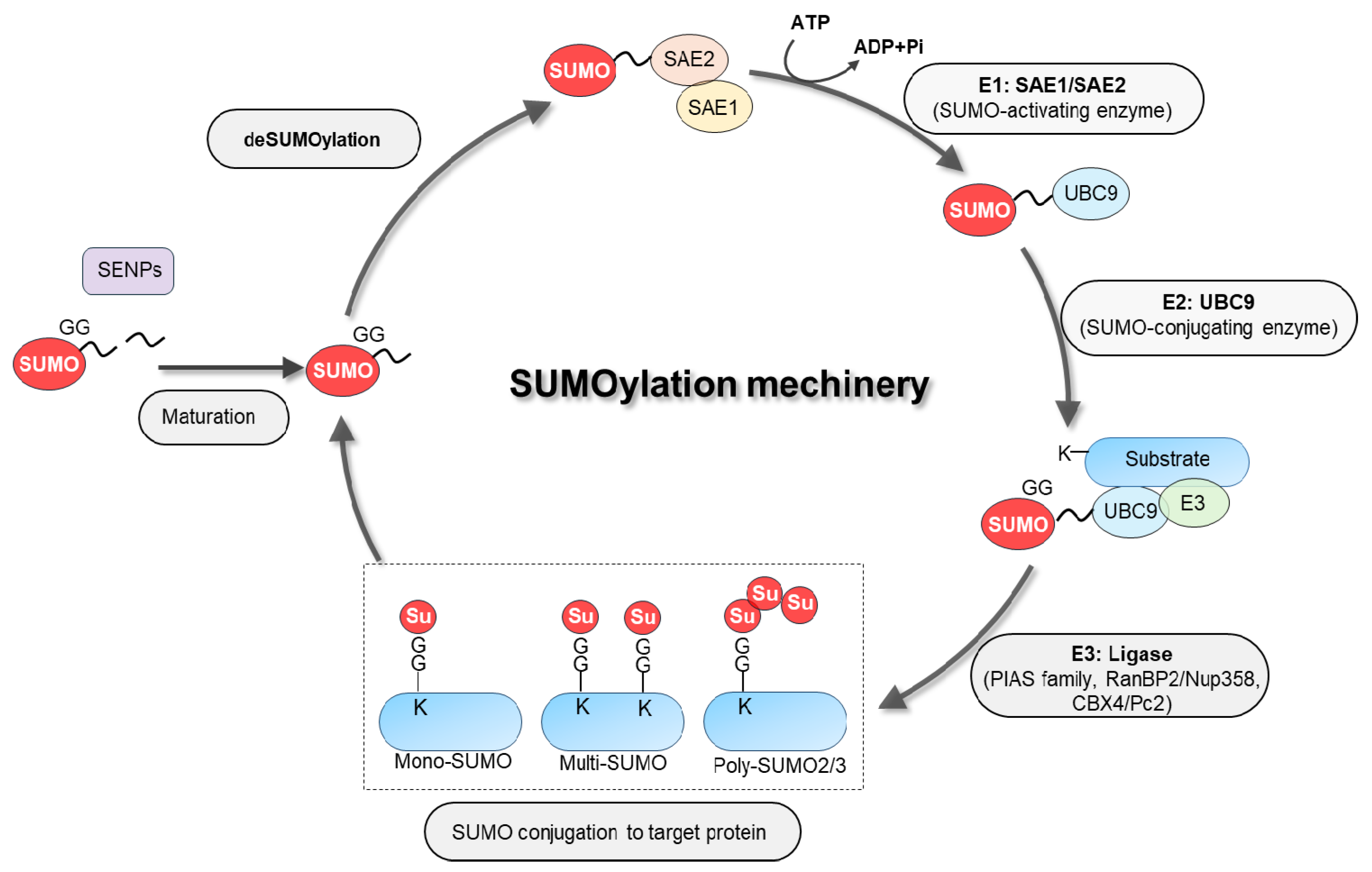
2. The SUMOylation Machinery
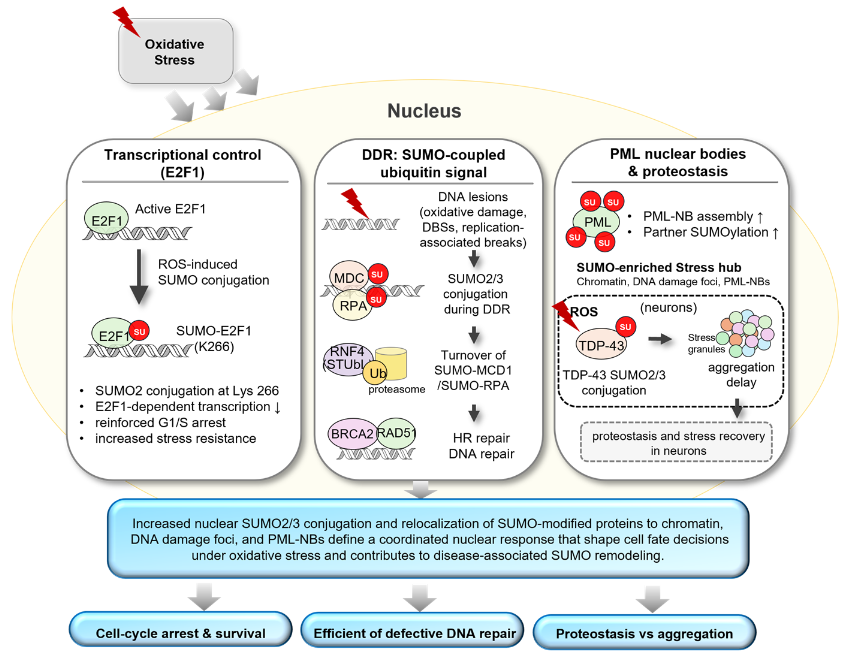
3. SUMOylation Responses to Cellular Oxidative Stress
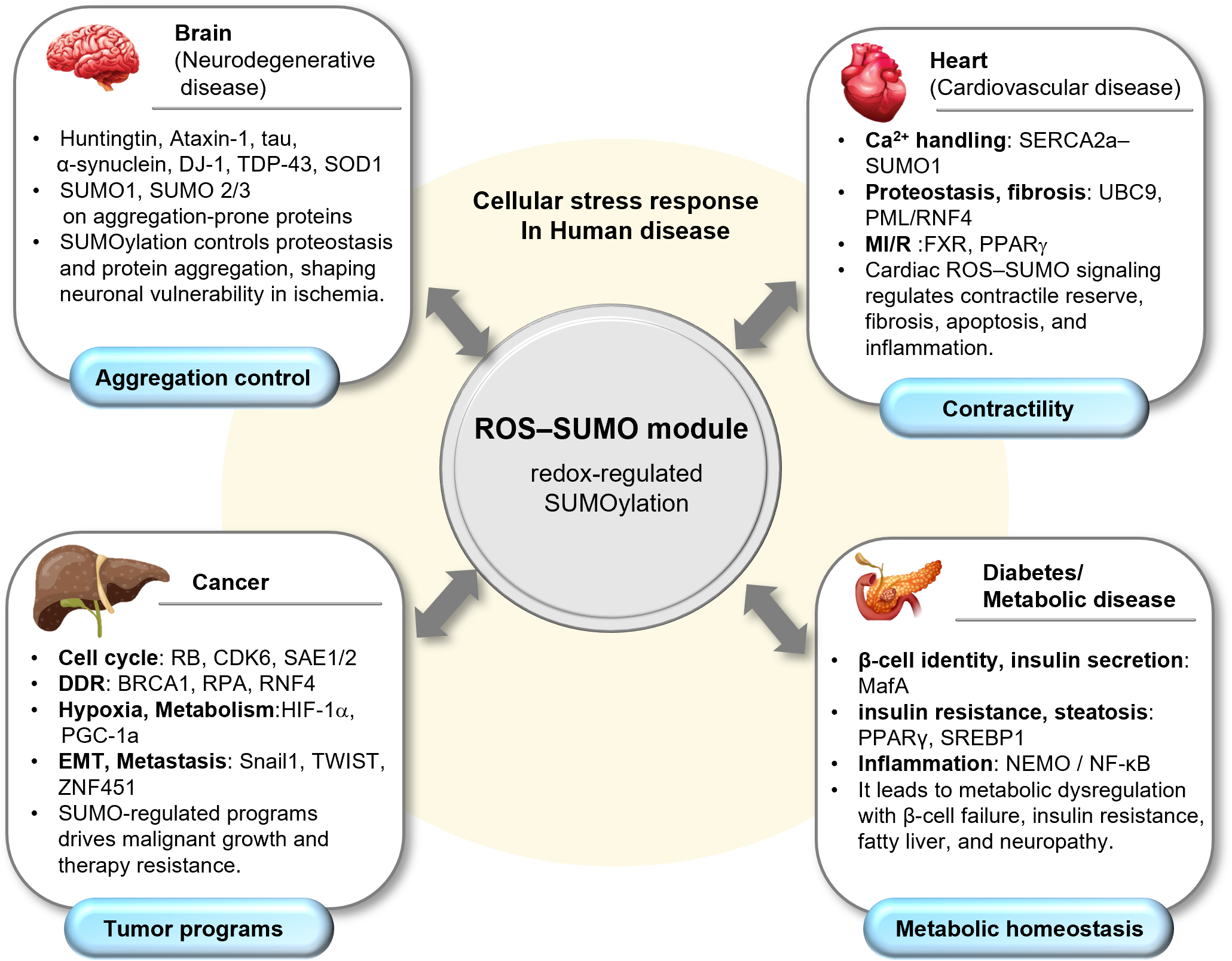
4. SUMOylation and Human Disease
4.1. Neurodegenerative Diseases
4.1.1. Ischemic Neuronal Injury
4.1.2. Polyglutamine Diseases: Huntingtin and Ataxin-1
4.1.3. AD and PD: Tau, α-Synuclein, DJ-1
4.1.4. ALS: TDP-43 and SOD1
4.2. Cardiovascular Disease
4.2.1. SUMO1–SERCA2a in Heart Failure and Hypertrophy
4.2.2. UBC9-Dependent SUMOylation in Proteotoxic Cardiomyopathy
4.2.3. PML/RNF4 Axis in Cardiac Fibrosis
4.2.4. SUMO-Modified Nuclear Receptors in MI/R
4.3. Cancer
4.3.1. Cell-Cycle Control and Proliferation
4.3.2. DNA Damage Response and Genome Stability
4.3.3. Hypoxia Adaptation and Metabolic Reprogramming
4.3.4. Invasion, Metastasis, and EMT
4.3.5. Cancer Stem Cells and Tumor Microenvironment
4.4. Diabetes and Metabolic Disease
4.4.1. SUMO-Modified MafA and β-Cell Fate
4.4.2. PPARγ, SREBP1, and NEMO in Insulin Resistance and Inflammation
4.4.3. Neuronal and Vascular SUMOylation in Diabetic Complications
4.4.4. SUMO–NF κB Crosstalk in Inflammatory Metabolic Stress
4.5. Reproduction and Fertility

| Tissue | Gene | Protein Pathway | SUMO-Dependent Effect | References |
|---|---|---|---|---|
| β-cell/islet | MafA | β-cell transcription factor |
| [108] |
| NRF2 | Antioxidant transcription factor |
| [119] | |
| PDIA3 | ER chaperone (PDI) |
| [120] | |
| Ubc9 | E2 conjugating enzyme |
| [119] | |
| Liver | HNF4α | Hepatocyte nuclear factor |
| [121] |
| FXR | Nuclear receptor |
| [122,123] | |
| Liver/mitochondria | Sirt3 | Mitochondrial deacetylase |
| [124] |
| Adipose tissue | PPARγ (K107) | Nuclear receptor |
| [110] |
| SREBP1c | Lipogenic transcription factor |
| [111] | |
| C/EBPβ | Adipogenic/browning regulators |
| [125] | |
| Adipose/immune | NEMO (IKKγ) | NF-κB adaptor |
| [83] |
| Immune/ T-cell | c-Maf | Th/Tfh transcription factor |
| [126] |
| Intestine | Ubc9, SUMO2/3 | SUMO machinery in intestinal epithelium |
| [127,128] |
| Innate immunity/inflammasome | NLRP3, MAPL, SENP6/7 | Inflammasome, E3, deSUMOylase |
| [129] |
4.5.1. Gametogenesis and Germ-Cell Quality Control
4.5.2. Oocyte Maturation and Meiotic Chromosome Control
4.5.3. Embryonic Development and Developmental Competence
4.5.4. Early Pregnancy and Hormonal Regulation
5. Pharmacological Modulation of SUMOylation: Translational and Clinical Perspectives
6. Future Perspectives and Conclusions
Author Contributions
Funding
Institutional Review Board Statement
Informed Consent Statement
Data Availability Statement
Conflicts of Interest
Abbreviations
| PTMs | post-translational modifications |
| ROS | reactive oxygen species |
| SUMO | small ubiquitin-like modifier |
| OGD | oxygen–glucose deprivation |
| DDR | DNA damage response |
| DSBs | double-strand breaks |
| HR | homologous recombination |
| E2F1 | E2F transcription factor 1 |
| MDC1 | mediator of DNA damage checkpoint 1 |
| RPA | replication protein A |
| RNF4 | RING finger protein 4 |
| PML | promyelocytic leukemia protein |
| PML-NBs | PML nuclear bodies |
| TDP-43 | TAR DNA-binding protein 43 |
| JNK | c-Jun N-terminal kinase |
| PIAS1 | protein inhibitor of activated STAT 1 |
| PIAS4 | protein inhibitor of activated STAT 4 |
| SERCA2a | sarcoplasmic reticulum Ca2+ ATPase |
| TAC | transverse aortic constriction |
| DRM | desmin related cardiomyopathy |
| CryABR120G | mutant αB crystallin |
| MI/R | myocardial ischemia–reperfusion |
| FXR | farnesoid X receptor |
| PPARγ | peroxisome proliferator-activated receptor γ |
| IUI | intrauterine insemination |
| DGC | density gradient centrifugation |
| DMBA | 7,12-dimethylbenz[a]anthracene |
| LC–MS/MS | liquid chromatography–tandem mass spectrometry |
| IVF | in vitro fertilization |
| ART | assisted reproductive technology |
| CSC | cancer stem cell |
References
- Binek, A.; Castans, C.; Jorge, I.; Bagwan, N.; Rodríguez, J.M.; Fernández-Jiménez, R.; Galán-Arriola, C.; Oliver, E.; Gómez, M.; Clemente-Moragón, A.; et al. Oxidative Post-translational Protein Modifications upon Ischemia/Reperfusion Injury. Antioxidants 2024, 13, 106. [Google Scholar] [CrossRef] [PubMed]
- Chahla, C.; Kovacic, H.; Ferhat, L.; Leloup, L. Pathological Impact of Redox Post-Translational Modifications. Antioxid. Redox Signal. 2024, 41, 152–180. [Google Scholar] [CrossRef]
- Dikalov, S. Cross talk between mitochondria and NADPH oxidases. Free Radic. Biol. Med. 2011, 51, 1289–1301. [Google Scholar] [CrossRef]
- Feligioni, M.; Nisticò, R. SUMO: A (oxidative) stressed protein. Neuromol. Med. 2013, 15, 707–719. [Google Scholar] [CrossRef]
- Birben, E.; Sahiner, U.M.; Sackesen, C.; Erzurum, S.; Kalayci, O. Oxidative stress and antioxidant defense. World Allergy Organ. J. 2012, 5, 9–19. [Google Scholar] [CrossRef]
- Tomin, T.; Schittmayer, M.; Honeder, S.; Heininger, C.; Birner-Gruenberger, R. Irreversible oxidative post-translational modifications in heart disease. Expert Rev. Proteom. 2019, 16, 681–693. [Google Scholar] [CrossRef]
- Ryu, H.-Y.; Ahn, S.H.; Hochstrasser, M. SUMO and cellular adaptive mechanisms. Exp. Mol. Med. 2020, 52, 931–939. [Google Scholar] [CrossRef]
- Patra, U.; Müller, S. A Tale of Usurpation and Subversion: SUMO-Dependent Integrity of Promyelocytic Leukemia Nuclear Bodies at the Crossroad of Infection and Immunity. Front. Cell Dev. Biol. 2021, 9, 696234. [Google Scholar] [CrossRef] [PubMed]
- Liang, Y.-C.; Lee, C.-C.; Yao, Y.-L.; Lai, C.-C.; Schmitz, M.L.; Yang, W.-M. SUMO5, a Novel Poly-SUMO Isoform, Regulates PML Nuclear Bodies. Sci. Rep. 2016, 6, 26509. [Google Scholar] [CrossRef]
- Flotho, A.; Melchior, F. Sumoylation: A regulatory protein modification in health and disease. Annu. Rev. Biochem. 2013, 82, 357–385. [Google Scholar] [CrossRef] [PubMed]
- Ryu, H.Y.; Hochstrasser, M. Histone sumoylation and chromatin dynamics. Nucleic Acids Res. 2021, 49, 6043–6052. [Google Scholar] [CrossRef] [PubMed]
- Gärtner, A.; Wagner, K.; Hölper, S.; Kunz, K.; Rodriguez, M.S.; Müller, S. Acetylation of SUMO2 at lysine 11 favors the formation of non-canonical SUMO chains. EMBO Rep. 2018, 19, EMBR201846117. [Google Scholar] [CrossRef] [PubMed]
- Jansen, N.S.; Vertegaal, A.C.O. A Chain of Events: Regulating Target Proteins by SUMO Polymers. Trends Biochem. Sci. 2021, 46, 113–123. [Google Scholar] [CrossRef]
- Manza, L.L.; Codreanu, S.G.; Stamer, S.L.; Smith, D.L.; Wells, K.S.; Roberts, R.L.; Liebler, D.C. Global shifts in protein sumoylation in response to electrophile and oxidative stress. Chem. Res. Toxicol. 2004, 17, 1706–1715. [Google Scholar] [CrossRef]
- Stankovic-Valentin, N.; Drzewicka, K.; König, C.; Schiebel, E.; Melchior, F. Redox regulation of SUMO enzymes is required for ATM activity and survival in oxidative stress. EMBO J. 2016, 35, 1312–1329. [Google Scholar] [CrossRef]
- Reichmann, D.; Voth, W.; Jakob, U. Maintaining a Healthy Proteome during Oxidative Stress. Mol. Cell 2018, 69, 203–213. [Google Scholar] [CrossRef]
- Yin, J.; Duan, J.; Cui, Z.; Ren, W.; Li, T.; Yin, Y. Hydrogen peroxide-induced oxidative stress activates NF-κB and Nrf2/Keap1 signals and triggers autophagy in piglets. RSC Adv. 2015, 5, 15479–15486. [Google Scholar] [CrossRef]
- Bellezza, I.; Giambanco, I.; Minelli, A.; Donato, R. Nrf2-Keap1 signaling in oxidative and reductive stress. Biochim. Biophys. Acta Mol. Cell Res. 2018, 1865, 721–733. [Google Scholar] [CrossRef]
- Bossis, G.; Melchior, F. Regulation of SUMOylation by reversible oxidation of SUMO conjugating enzymes. Mol. Cell 2006, 21, 349–357. [Google Scholar] [CrossRef] [PubMed]
- Chang, H.M.; Yeh, E.T.H. SUMO: From Bench to Bedside. Physiol. Rev. 2020, 100, 1599–1619. [Google Scholar] [CrossRef]
- Mandel, N.; Agarwal, N. Role of SUMOylation in Neurodegenerative Diseases. Cells 2022, 11, 3395. [Google Scholar] [CrossRef]
- Mendler, L.; Braun, T.; Müller, S. The Ubiquitin-Like SUMO System and Heart Function: From Development to Disease. Circ. Res. 2016, 118, 132–144. [Google Scholar] [CrossRef]
- Han, Z.J.; Feng, Y.H.; Gu, B.H.; Li, Y.M.; Chen, H. The post-translational modification, SUMOylation, and cancer (Review). Int. J. Oncol. 2018, 52, 1081–1094. [Google Scholar] [CrossRef]
- Xie, H.; Liu, X.; Li, S.; Wang, M.; Li, Y.; Chen, T.; Li, L.; Wang, F.; Xiao, X. Tissue adaptation to metabolic stress: Insights from SUMOylation. Front. Endocrinol. 2024, 15, 1434338. [Google Scholar] [CrossRef]
- Zhou, Y.; Zhang, H.; Yan, H.; Han, P.; Zhang, J.; Liu, Y. Deciphering the Role of Oxidative Stress in Male Infertility: Insights from Reactive Oxygen Species to Antioxidant Therapeutics. Front. Biosci. Landmark Ed. 2025, 30, 27046. [Google Scholar] [CrossRef]
- Enserink, J.M. Sumo and the cellular stress response. Cell Div. 2015, 10, 4. [Google Scholar] [CrossRef]
- Graves, J.D.; Lee, Y.J.; Liu, K.; Li, G.; Lin, F.T.; Lin, W.C. E2F1 sumoylation as a protective cellular mechanism in oxidative stress response. Proc. Natl. Acad. Sci. USA 2020, 117, 14958–14969. [Google Scholar] [CrossRef]
- Salmon, T.B.; Evert, B.A.; Song, B.; Doetsch, P.W. Biological consequences of oxidative stress-induced DNA damage in Saccharomyces cerevisiae. Nucleic Acids Res. 2004, 32, 3712–3723. [Google Scholar] [CrossRef] [PubMed]
- Srinivas, U.S.; Tan, B.W.Q.; Vellayappan, B.A.; Jeyasekharan, A.D. ROS and the DNA damage response in cancer. Redox Biol. 2019, 25, 101084. [Google Scholar] [CrossRef] [PubMed]
- Luo, K.; Zhang, H.; Wang, L.; Yuan, J.; Lou, Z. Sumoylation of MDC1 is important for proper DNA damage response. EMBO J. 2012, 31, 3008–3019. [Google Scholar] [CrossRef] [PubMed]
- Yin, Y.; Seifert, A.; Chua, J.S.; Maure, J.F.; Golebiowski, F.; Hay, R.T. SUMO-targeted ubiquitin E3 ligase RNF4 is required for the response of human cells to DNA damage. Genes Dev. 2012, 26, 1196–1208. [Google Scholar] [CrossRef]
- Datwyler, A.L.; Lättig-Tünnemann, G.; Yang, W.; Paschen, W.; Lee, S.L.; Dirnagl, U.; Endres, M.; Harms, C. SUMO2/3 conjugation is an endogenous neuroprotective mechanism. J. Cereb. Blood Flow Metab. 2011, 31, 2152–2159. [Google Scholar] [CrossRef] [PubMed]
- Wagner, K.; Kunz, K.; Piller, T.; Tascher, G.; Hölper, S.; Stehmeier, P.; Keiten-Schmitz, J.; Schick, M.; Keller, U.; Müller, S. The SUMO Isopeptidase SENP6 Functions as a Rheostat of Chromatin Residency in Genome Maintenance and Chromosome Dynamics. Cell Rep. 2019, 29, 480–494.e485. [Google Scholar] [CrossRef]
- Soria-Bretones, I.; Cepeda-García, C.; Checa-Rodriguez, C.; Heyer, V.; Reina-San-Martin, B.; Soutoglou, E.; Huertas, P. DNA end resection requires constitutive sumoylation of CtIP by CBX4. Nat. Commun. 2017, 8, 113. [Google Scholar] [CrossRef] [PubMed]
- Huang, C.H.; Yang, T.T.; Lin, K.I. Mechanisms and functions of SUMOylation in health and disease: A review focusing on immune cells. J. Biomed. Sci. 2024, 31, 16. [Google Scholar] [CrossRef] [PubMed]
- Jeong, D.W.; Lee, D.Y.; Kim, S.Y.; Jeoung, S.W.; Zhao, D.; Knight, J.; Lam, T.T.; Jin, J.H.; Lee, H.S.; Hochstrasser, M.; et al. Auto-sumoylation of the yeast Ubc9 E2 SUMO-conjugating enzyme extends cellular lifespan. Nat. Commun. 2025, 16, 3735. [Google Scholar] [CrossRef]
- Galanty, Y.; Belotserkovskaya, R.; Coates, J.; Jackson, S.P. RNF4, a SUMO-targeted ubiquitin E3 ligase, promotes DNA double-strand break repair. Genes Dev. 2012, 26, 1179–1195. [Google Scholar] [CrossRef]
- Suk, T.R.; Part, C.E.; Zhang, J.L.; Nguyen, T.T.; Heer, M.M.; Caballero-Gómez, A.; Grybas, V.S.; McKeever, P.M.; Nguyen, B.; Ali, T.; et al. A stress-dependent TDP-43 SUMOylation program preserves neuronal function. Mol. Neurodegener. 2025, 20, 38. [Google Scholar] [CrossRef]
- Verde, E.M.; Antoniani, F.; Mediani, L.; Secco, V.; Crotti, S.; Ferrara, M.C.; Vinet, J.; Sergeeva, A.; Yan, X.; Hoege, C.; et al. SUMO2/3 conjugation of TDP-43 protects against aggregation. Sci. Adv. 2025, 11, eadq2475. [Google Scholar] [CrossRef]
- Guo, C.; Hildick, K.L.; Luo, J.; Dearden, L.; Wilkinson, K.A.; Henley, J.M. SENP3-mediated deSUMOylation of dynamin-related protein 1 promotes cell death following ischaemia. EMBO J. 2013, 32, 1514–1528. [Google Scholar] [CrossRef]
- Steffan, J.S.; Agrawal, N.; Pallos, J.; Rockabrand, E.; Trotman, L.C.; Slepko, N.; Illes, K.; Lukacsovich, T.; Zhu, Y.Z.; Cattaneo, E.; et al. SUMO modification of Huntingtin and Huntington’s disease pathology. Science 2004, 304, 100–104. [Google Scholar] [CrossRef]
- O’Rourke, J.G.; Gareau, J.R.; Ochaba, J.; Song, W.; Raskó, T.; Reverter, D.; Lee, J.; Monteys, A.M.; Pallos, J.; Mee, L.; et al. SUMO-2 and PIAS1 modulate insoluble mutant huntingtin protein accumulation. Cell Rep. 2013, 4, 362–375. [Google Scholar] [CrossRef]
- Ryu, J.; Cho, S.; Park, B.C.; Lee, D.H. Oxidative stress-enhanced SUMOylation and aggregation of ataxin-1: Implication of JNK pathway. Biochem. Biophys. Res. Commun. 2010, 393, 280–285. [Google Scholar] [CrossRef]
- Dorval, V.; Fraser, P.E. Small Ubiquitin-like Modifier (SUMO) Modification of Natively Unfolded Proteins Tau and α-Synuclein*. J. Biol. Chem. 2006, 281, 9919–9924. [Google Scholar] [CrossRef] [PubMed]
- Krumova, P.; Meulmeester, E.; Garrido, M.; Tirard, M.; Hsiao, H.H.; Bossis, G.; Urlaub, H.; Zweckstetter, M.; Kügler, S.; Melchior, F.; et al. Sumoylation inhibits alpha-synuclein aggregation and toxicity. J. Cell Biol. 2011, 194, 49–60. [Google Scholar] [CrossRef] [PubMed]
- Rott, R.; Szargel, R.; Shani, V.; Hamza, H.; Savyon, M.; Abd Elghani, F.; Bandopadhyay, R.; Engelender, S. SUMOylation and ubiquitination reciprocally regulate α-synuclein degradation and pathological aggregation. Proc. Natl. Acad. Sci. USA 2017, 114, 13176–13181. [Google Scholar] [CrossRef] [PubMed]
- Shinbo, Y.; Niki, T.; Taira, T.; Ooe, H.; Takahashi-Niki, K.; Maita, C.; Seino, C.; Iguchi-Ariga, S.M.; Ariga, H. Proper SUMO-1 conjugation is essential to DJ-1 to exert its full activities. Cell Death Differ. 2006, 13, 96–108. [Google Scholar] [CrossRef]
- Fan, J.; Ren, H.; Fei, E.; Jia, N.; Ying, Z.; Jiang, P.; Wu, M.; Wang, G. Sumoylation is critical for DJ-1 to repress p53 transcriptional activity. FEBS Lett. 2008, 582, 1151–1156. [Google Scholar] [CrossRef]
- Niikura, T.; Kita, Y.; Abe, Y. SUMO3 modification accelerates the aggregation of ALS-linked SOD1 mutants. PLoS ONE 2014, 9, e101080. [Google Scholar] [CrossRef]
- Wada, H.; Suzuki, D.; Niikura, T. Regulation of ALS-Associated SOD1 Mutant SUMOylation and Aggregation by SENP and PIAS Family Proteins. J. Mol. Neurosci. 2020, 70, 2007–2014. [Google Scholar] [CrossRef]
- Kho, C.; Lee, A.; Jeong, D.; Oh, J.G.; Chaanine, A.H.; Kizana, E.; Park, W.J.; Hajjar, R.J. SUMO1-dependent modulation of SERCA2a in heart failure. Nature 2011, 477, 601–605. [Google Scholar] [CrossRef] [PubMed]
- Liu, Z.; Bian, X.; Gao, W.; Su, J.; Ma, C.; Xiao, X.; Yu, T.; Zhang, H.; Liu, X.; Fan, G. Rg3 promotes the SUMOylation of SERCA2a and corrects cardiac dysfunction in heart failure. Pharmacol. Res. 2021, 172, 105843. [Google Scholar] [CrossRef] [PubMed]
- Gupta, M.K.; McLendon, P.M.; Gulick, J.; James, J.; Khalili, K.; Robbins, J. UBC9-Mediated Sumoylation Favorably Impacts Cardiac Function in Compromised Hearts. Circ. Res. 2016, 118, 1894–1905. [Google Scholar] [CrossRef]
- Gupta, M.K.; Gulick, J.; Liu, R.; Wang, X.; Molkentin, J.D.; Robbins, J. Sumo E2 enzyme UBC9 is required for efficient protein quality control in cardiomyocytes. Circ. Res. 2014, 115, 721–729. [Google Scholar] [CrossRef]
- Liu, Y.; Zhao, D.; Qiu, F.; Zhang, L.L.; Liu, S.K.; Li, Y.Y.; Liu, M.T.; Wu, D.; Wang, J.X.; Ding, X.Q.; et al. Manipulating PML SUMOylation via Silencing UBC9 and RNF4 Regulates Cardiac Fibrosis. Mol. Ther. 2017, 25, 666–678. [Google Scholar] [CrossRef] [PubMed]
- Hausenloy, D.J.; Yellon, D.M. Myocardial ischemia-reperfusion injury: A neglected therapeutic target. J. Clin. Investig. 2013, 123, 92–100. [Google Scholar] [CrossRef]
- Zhao, W.; Zhang, X.; Rong, J. SUMOylation as a Therapeutic Target for Myocardial Infarction. Front. Cardiovasc. Med. 2021, 8, 701583. [Google Scholar] [CrossRef]
- Gao, Y.; Zhao, Y.; Yuan, A.; Xu, L.; Huang, X.; Su, Y.; Gao, L.; Ji, Q.; Pu, J.; He, B. Effects of farnesoid-X-receptor SUMOylation mutation on myocardial ischemia/reperfusion injury in mice. Exp. Cell Res. 2018, 371, 301–310. [Google Scholar] [CrossRef]
- Xie, B.; Liu, X.; Yang, J.; Cheng, J.; Gu, J.; Xue, S. PIAS1 protects against myocardial ischemia-reperfusion injury by stimulating PPARγ SUMOylation. BMC Cell Biol. 2018, 19, 24. [Google Scholar] [CrossRef]
- Pascual, G.; Fong, A.L.; Ogawa, S.; Gamliel, A.; Li, A.C.; Perissi, V.; Rose, D.W.; Willson, T.M.; Rosenfeld, M.G.; Glass, C.K. A SUMOylation-dependent pathway mediates transrepression of inflammatory response genes by PPAR-gamma. Nature 2005, 437, 759–763. [Google Scholar] [CrossRef]
- Zhao, Q.; Ma, Y.; Li, Z.; Zhang, K.; Zheng, M.; Zhang, S. The Function of SUMOylation and Its Role in the Development of Cancer Cells under Stress Conditions: A Systematic Review. Stem Cells Int. 2020, 2020, 8835714. [Google Scholar] [CrossRef]
- Xie, M.; Yu, J.; Ge, S.; Huang, J.; Fan, X. SUMOylation homeostasis in tumorigenesis. Cancer Lett. 2020, 469, 301–309. [Google Scholar] [CrossRef]
- Eifler, K.; Vertegaal, A.C.O. SUMOylation-Mediated Regulation of Cell Cycle Progression and Cancer. Trends Biochem. Sci. 2015, 40, 779–793. [Google Scholar] [CrossRef]
- Huh, H.D.; Park, H.W. Emerging paradigms in cancer cell plasticity. BMB Rep. 2024, 57, 273–280. [Google Scholar] [CrossRef]
- Chen, X.; Smaldone, G.; Piccaluga, P.P.; Qi, Y. Editorial: Role of the SUMOylation in cancer regulation. Front. Mol. Biosci. 2023, 10, 1236230. [Google Scholar] [CrossRef]
- Wu, G.; Xu, Y.; Ruan, N.; Li, J.; Lv, Q.; Zhang, Q.; Chen, Y.; Wang, Q.; Xia, Q.; Li, Q. Genetic alteration and clinical significance of SUMOylation regulators in multiple cancer types. J. Cancer 2020, 11, 6823–6833. [Google Scholar] [CrossRef]
- Sheng, H.; Hao, Z.; Zhu, L.; Zeng, Y.; He, J. Construction and validation of a two-gene signature based on SUMOylation regulatory genes in non-small cell lung cancer patients. BMC Cancer 2022, 22, 572. [Google Scholar] [CrossRef] [PubMed]
- Xia, Q.D.; Sun, J.X.; Xun, Y.; Xiao, J.; Liu, C.Q.; Xu, J.Z.; An, Y.; Xu, M.Y.; Liu, Z.; Wang, S.G.; et al. SUMOylation Pattern Predicts Prognosis and Indicates Tumor Microenvironment Infiltration Characterization in Bladder Cancer. Front. Immunol. 2022, 13, 864156. [Google Scholar] [CrossRef] [PubMed]
- Sentis, S.; Le Romancer, M.; Bianchin, C.; Rostan, M.-C.; Corbo, L. Sumoylation of the Estrogen Receptor α Hinge Region Regulates Its Transcriptional Activity. Mol. Endocrinol. 2005, 19, 2671–2684. [Google Scholar] [CrossRef] [PubMed]
- Daniel, A.R.; Faivre, E.J.; Lange, C.A. Phosphorylation-Dependent Antagonism of Sumoylation Derepresses Progesterone Receptor Action in Breast Cancer Cells. Mol. Endocrinol. 2007, 21, 2890–2906. [Google Scholar] [CrossRef]
- Picard, N.; Caron, V.; Bilodeau, S.; Sanchez, M.; Mascle, X.; Aubry, M.; Tremblay, A. Identification of Estrogen Receptor β as a SUMO-1 Target Reveals a Novel Phosphorylated Sumoylation Motif and Regulation by Glycogen Synthase Kinase 3β. Mol. Cell. Biol. 2012, 32, 2709–2721. [Google Scholar] [CrossRef] [PubMed]
- Gong, L.; Ji, W.-K.; Hu, X.-H.; Hu, W.-F.; Tang, X.-C.; Huang, Z.-X.; Li, L.; Liu, M.; Xiang, S.-H.; Wu, E.; et al. Sumoylation differentially regulates Sp1 to control cell differentiation. Proc. Natl. Acad. Sci. USA 2014, 111, 5574–5579. [Google Scholar] [CrossRef]
- Poukka, H.; Karvonen, U.; Jänne, O.A.; Palvimo, J.J. Covalent modification of the androgen receptor by small ubiquitin-like modifier 1 (SUMO-1). Proc. Natl. Acad. Sci. USA 2000, 97, 14145–14150. [Google Scholar] [CrossRef]
- Zheng, Z.; Cai, C.; Omwancha, J.; Chen, S.-Y.; Baslan, T.; Shemshedini, L. SUMO-3 Enhances Androgen Receptor Transcriptional Activity through a Sumoylation-independent Mechanism in Prostate Cancer Cells*. J. Biol. Chem. 2006, 281, 4002–4012. [Google Scholar] [CrossRef]
- Bawa-Khalfe, T.; Cheng, J.; Wang, Z.; Yeh, E.T.H. Induction of the SUMO-specific Protease 1 Transcription by the Androgen Receptor in Prostate Cancer Cells*. J. Biol. Chem. 2007, 282, 37341–37349. [Google Scholar] [CrossRef]
- Schimmel, J.; Eifler, K.; Sigurðsson, J.O.; Cuijpers, S.A.G.; Hendriks, I.A.; Verlaan-de Vries, M.; Kelstrup, C.D.; Francavilla, C.; Medema, R.H.; Olsen, J.V.; et al. Uncovering SUMOylation Dynamics during Cell-Cycle Progression Reveals FoxM1 as a Key Mitotic SUMO Target Protein. Mol. Cell 2014, 53, 1053–1066. [Google Scholar] [CrossRef]
- Chun, T.-H.; Itoh, H.; Subramanian, L.; Iñiguez-Lluhí, J.A.; Nakao, K. Modification of GATA-2 Transcriptional Activity in Endothelial Cells by the SUMO E3 Ligase PIASy. Circ. Res. 2003, 92, 1201–1208. [Google Scholar] [CrossRef]
- Kim, J.; Cantwell, C.A.; Johnson, P.F.; Pfarr, C.M.; Williams, S.C. Transcriptional Activity of CCAAT/Enhancer-binding Proteins Is Controlled by a Conserved Inhibitory Domain That Is a Target for Sumoylation*. J. Biol. Chem. 2002, 277, 38037–38044. [Google Scholar] [CrossRef] [PubMed]
- Nakagawa, K.; Yokosawa, H. PIAS3 induces SUMO-1 modification and transcriptional repression of IRF-1. FEBS Lett. 2002, 530, 204–208. [Google Scholar] [CrossRef]
- Desterro, J.M.; Rodriguez, M.S.; Hay, R.T. SUMO-1 modification of IkappaBalpha inhibits NF-kappaB activation. Mol. Cell 1998, 2, 233–239. [Google Scholar] [CrossRef]
- Lee, P.S.W.; Chang, C.; Liu, D.; Derynck, R. Sumoylation of Smad4, the Common Smad Mediator of Transforming Growth Factor-β Family Signaling*. J. Biol. Chem. 2003, 278, 27853–27863. [Google Scholar] [CrossRef]
- Imoto, S.; Ohbayashi, N.; Ikeda, O.; Kamitani, S.; Muromoto, R.; Sekine, Y.; Matsuda, T. Sumoylation of Smad3 stimulates its nuclear export during PIASy-mediated suppression of TGF-β signaling. Biochem. Biophys. Res. Commun. 2008, 370, 359–365. [Google Scholar] [CrossRef]
- Shao, L.; Zhou, H.J.; Zhang, H.; Qin, L.; Hwa, J.; Yun, Z.; Ji, W.; Min, W. SENP1-mediated NEMO deSUMOylation in adipocytes limits inflammatory responses and type-1 diabetes progression. Nat. Commun. 2025, 16, 5366. [Google Scholar] [CrossRef]
- Goodson, M.L.; Hong, Y.; Rogers, R.; Matunis, M.J.; Park-Sarge, O.-K.; Sarge, K.D. SUMO-1 Modification Regulates the DNA Binding Activity of Heat Shock Transcription Factor 2, a Promyelocytic Leukemia Nuclear Body Associated Transcription Factor*. J. Biol. Chem. 2001, 276, 18513–18518. [Google Scholar] [CrossRef]
- Berta, M.A.; Mazure, N.; Hattab, M.; Pouysségur, J.; Brahimi-Horn, M.C. SUMOylation of hypoxia-inducible factor-1α reduces its transcriptional activity. Biochem. Biophys. Res. Commun. 2007, 360, 646–652. [Google Scholar] [CrossRef]
- Matsuzaki, K.; Minami, T.; Tojo, M.; Honda, Y.; Uchimura, Y.; Saitoh, H.; Yasuda, H.; Nagahiro, S.; Saya, H.; Nakao, M. Serum response factor is modulated by the SUMO-1 conjugation system. Biochem. Biophys. Res. Commun. 2003, 306, 32–38. [Google Scholar] [CrossRef] [PubMed]
- Jacobs, A.M.; Nicol, S.M.; Hislop, R.G.; Jaffray, E.G.; Hay, R.T.; Fuller-Pace, F.V. SUMO modification of the DEAD box protein p68 modulates its transcriptional activity and promotes its interaction with HDAC1. Oncogene 2007, 26, 5866–5876. [Google Scholar] [CrossRef]
- Astrom, A.; D’Amore, E.S.; Sainati, L.; Panarello, C.; Morerio, C.; Mark, J.; Stenman, G. Evidence of involvement of the PLAG1 gene in lipoblastomas. Int. J. Oncol. 2000, 16, 1107–1110. [Google Scholar] [CrossRef]
- Yu, J.; de Belle, I.; Liang, H.; Adamson, E.D. Coactivating Factors p300 and CBP Are Transcriptionally Crossregulated by Egr1 in Prostate Cells, Leading to Divergent Responses. Mol. Cell 2004, 15, 83–94. [Google Scholar] [CrossRef]
- Sapetschnig, A.; Rischitor, G.; Braun, H.; Doll, A.; Schergaut, M.; Melchior, F.; Suske, G. Transcription factor Sp3 is silenced through SUMO modification by PIAS1. EMBO J. 2002, 21, 5206–5215. [Google Scholar] [CrossRef]
- Meng, F.; Qian, J.; Yue, H.; Li, X.; Xue, K. SUMOylation of Rb enhances its binding with CDK2 and phosphorylation at early G1 phase. Cell Cycle 2016, 15, 1724–1732. [Google Scholar] [CrossRef]
- Bellail, A.C.; Olson, J.J.; Hao, C. SUMO1 modification stabilizes CDK6 protein and drives the cell cycle and glioblastoma progression. Nat. Commun. 2014, 5, 4234. [Google Scholar] [CrossRef]
- Kessler, J.D.; Kahle, K.T.; Sun, T.; Meerbrey, K.L.; Schlabach, M.R.; Schmitt, E.M.; Skinner, S.O.; Xu, Q.; Li, M.Z.; Hartman, Z.C.; et al. A SUMOylation-dependent transcriptional subprogram is required for Myc-driven tumorigenesis. Science 2012, 335, 348–353. [Google Scholar] [CrossRef]
- Myatt, S.S.; Kongsema, M.; Man, C.W.; Kelly, D.J.; Gomes, A.R.; Khongkow, P.; Karunarathna, U.; Zona, S.; Langer, J.K.; Dunsby, C.W.; et al. SUMOylation inhibits FOXM1 activity and delays mitotic transition. Oncogene 2014, 33, 4316–4329. [Google Scholar] [CrossRef] [PubMed]
- Morris, J.R.; Boutell, C.; Keppler, M.; Densham, R.; Weekes, D.; Alamshah, A.; Butler, L.; Galanty, Y.; Pangon, L.; Kiuchi, T.; et al. The SUMO modification pathway is involved in the BRCA1 response to genotoxic stress. Nature 2009, 462, 886–890. [Google Scholar] [CrossRef]
- Dou, H.; Huang, C.; Singh, M.; Carpenter, P.B.; Yeh, E.T. Regulation of DNA repair through deSUMOylation and SUMOylation of replication protein A complex. Mol. Cell 2010, 39, 333–345. [Google Scholar] [CrossRef]
- Kang, X.; Li, J.; Zou, Y.; Yi, J.; Zhang, H.; Cao, M.; Yeh, E.T.; Cheng, J. PIASy stimulates HIF1α SUMOylation and negatively regulates HIF1α activity in response to hypoxia. Oncogene 2010, 29, 5568–5578. [Google Scholar] [CrossRef] [PubMed]
- Bae, S.H.; Jeong, J.W.; Park, J.A.; Kim, S.H.; Bae, M.K.; Choi, S.J.; Kim, K.W. Sumoylation increases HIF-1alpha stability and its transcriptional activity. Biochem. Biophys. Res. Commun. 2004, 324, 394–400. [Google Scholar] [CrossRef]
- Rytinki, M.M.; Palvimo, J.J. SUMOylation attenuates the function of PGC-1alpha. J. Biol. Chem. 2009, 284, 26184–26193. [Google Scholar] [CrossRef] [PubMed]
- Gudey, S.K.; Sundar, R.; Heldin, C.H.; Bergh, A.; Landström, M. Pro-invasive properties of Snail1 are regulated by sumoylation in response to TGFβ stimulation in cancer. Oncotarget 2017, 8, 97703–97726. [Google Scholar] [CrossRef]
- Zeng, W.; Gu, S.; Yu, Y.; Feng, Y.; Xiao, M.; Feng, X.H. ZNF451 stabilizes TWIST2 through SUMOylation and promotes epithelial-mesenchymal transition. Am. J. Cancer Res. 2021, 11, 898–915. [Google Scholar]
- Sabatini, M.E.; Compagnoni, M.; Maffini, F.; Miccolo, C.; Pagni, F.; Lombardi, M.; Brambilla, V.; Lepanto, D.; Tagliabue, M.; Ansarin, M.; et al. The UBC9/SUMO pathway affects E-cadherin cleavage in HPV-positive head and neck cancer. Front. Mol. Biosci. 2022, 9, 940449. [Google Scholar] [CrossRef]
- Du, L.; Li, Y.-J.; Fakih, M.; Wiatrek, R.L.; Duldulao, M.; Chen, Z.; Chu, P.; Garcia-Aguilar, J.; Chen, Y. Role of SUMO activating enzyme in cancer stem cell maintenance and self-renewal. Nat. Commun. 2016, 7, 12326. [Google Scholar] [CrossRef]
- Benoit, Y.D.; Mitchell, R.R.; Wang, W.; Orlando, L.; Boyd, A.L.; Tanasijevic, B.; Aslostovar, L.; Shapovalova, Z.; Doyle, M.; Bergin, C.J.; et al. Targeting SUMOylation dependency in human cancer stem cells through a unique SAE2 motif revealed by chemical genomics. Cell Chem. Biol. 2021, 28, 1394–1406.e1310. [Google Scholar] [CrossRef]
- Demel, U.M.; Böger, M.; Yousefian, S.; Grunert, C.; Zhang, L.; Hotz, P.W.; Gottschlich, A.; Köse, H.; Isaakidis, K.; Vonficht, D.; et al. Activated SUMOylation restricts MHC class I antigen presentation to confer immune evasion in cancer. J. Clin. Investig. 2022, 132, e152383. [Google Scholar] [CrossRef]
- Kamynina, E.; Stover, P.J. The Roles of SUMO in Metabolic Regulation. Adv. Exp. Med. Biol. 2017, 963, 143–168. [Google Scholar] [CrossRef]
- Rho, H.; Kim, U.; Song, J. Ubiquitination and ubiquitin-like modifications in metabolic dysfunction-associated steatotic liver disease: Mechanisms and implications. BMB Rep. 2025, 58, 371–388. [Google Scholar] [CrossRef] [PubMed]
- Shao, C.; Cobb, M.H. Sumoylation regulates the transcriptional activity of MafA in pancreatic beta cells. J. Biol. Chem. 2009, 284, 3117–3124. [Google Scholar] [CrossRef] [PubMed]
- Mandel, N.; Büttner, M.; Poschet, G.; Kuner, R.; Agarwal, N. SUMOylation Modulates Reactive Oxygen Species (ROS) Levels and Acts as a Protective Mechanism in the Type 2 Model of Diabetic Peripheral Neuropathy. Cells 2023, 12, 2511. [Google Scholar] [CrossRef]
- Katafuchi, T.; Holland, W.L.; Kollipara, R.K.; Kittler, R.; Mangelsdorf, D.J.; Kliewer, S.A. PPARγ-K107 SUMOylation regulates insulin sensitivity but not adiposity in mice. Proc. Natl. Acad. Sci. USA 2018, 115, 12102–12111. [Google Scholar] [CrossRef]
- Lee, G.Y.; Jang, H.; Lee, J.H.; Huh, J.Y.; Choi, S.; Chung, J.; Kim, J.B. PIASy-mediated sumoylation of SREBP1c regulates hepatic lipid metabolism upon fasting signaling. Mol. Cell Biol. 2014, 34, 926–938. [Google Scholar] [CrossRef]
- Agarwal, A.; Virk, G.; Ong, C.; du Plessis, S.S. Effect of oxidative stress on male reproduction. World J. Mens. Health 2014, 32, 1–17. [Google Scholar] [CrossRef] [PubMed]
- Alahmar, A.T. Role of Oxidative Stress in Male Infertility: An Updated Review. J. Hum. Reprod. Sci. 2019, 12, 4–18. [Google Scholar] [CrossRef]
- Voros, C.; Athanasiou, D.; Papapanagiotou, I.; Mavrogianni, D.; Varthaliti, A.; Bananis, K.; Athanasiou, A.; Athanasiou, A.; Papadimas, G.; Gkirgkinoudis, A.; et al. Cracking the Code of Oocyte Quality: The Oxidative Stress Link to IVF Success. Int. J. Mol. Sci. 2025, 26, 6377. [Google Scholar] [CrossRef]
- Begum, I.A. Oxidative stress: Oocyte quality and infertility. Reprod. Toxicol. 2025, 137, 109011. [Google Scholar] [CrossRef]
- Huang, M.C.; Tzeng, S.L.; Chen, W.J.; Chen, S.L.; Ding, Y.R.; Lee, C.I.; Lee, M.S.; Lee, T.H. SUMO1 and Defective Spermatozoa Correlate with Endogenous Hydrogen Peroxide and Live Birth Outcome in Intrauterine Insemination Cycles for Unexplained Infertility. Int. J. Mol. Sci. 2023, 24, 12775. [Google Scholar] [CrossRef]
- Aitken, R.J. Reactive oxygen species as mediators of sperm capacitation and pathological damage. Mol. Reprod. Dev. 2017, 84, 1039–1052. [Google Scholar] [CrossRef]
- Patton, B.K.; Madadi, S.; Briley, S.M.; Ahmed, A.A.; Pangas, S.A. Sumoylation regulates functional properties of the oocyte transcription factors SOHLH1 and NOBOX. FASEB J. 2023, 37, e22747. [Google Scholar] [CrossRef] [PubMed]
- He, X.; Lai, Q.; Chen, C.; Li, N.; Sun, F.; Huang, W.; Zhang, S.; Yu, Q.; Yang, P.; Xiong, F.; et al. Both conditional ablation and overexpression of E2 SUMO-conjugating enzyme (UBC9) in mouse pancreatic beta cells result in impaired beta cell function. Diabetologia 2018, 61, 881–895. [Google Scholar] [CrossRef] [PubMed]
- Li, N.; Luo, X.; Yu, Q.; Yang, P.; Chen, Z.; Wang, X.; Jiang, J.; Xu, J.; Gong, Q.; Eizirik, D.L.; et al. SUMOylation of Pdia3 exacerbates proinsulin misfolding and ER stress in pancreatic beta cells. J. Mol. Med. 2020, 98, 1795–1807. [Google Scholar] [CrossRef]
- Zhou, W.; Hannoun, Z.; Jaffray, E.; Medine, C.N.; Black, J.R.; Greenhough, S.; Zhu, L.; Ross, J.A.; Forbes, S.; Wilmut, I.; et al. SUMOylation of HNF4α regulates protein stability and hepatocyte function. J. Cell Sci. 2012, 125, 3630–3635. [Google Scholar] [CrossRef]
- Kim, D.H.; Xiao, Z.; Kwon, S.; Sun, X.; Ryerson, D.; Tkac, D.; Ma, P.; Wu, S.Y.; Chiang, C.M.; Zhou, E.; et al. A dysregulated acetyl/SUMO switch of FXR promotes hepatic inflammation in obesity. EMBO J. 2015, 34, 184–199. [Google Scholar] [CrossRef]
- Balasubramaniyan, N.; Luo, Y.; Sun, A.-Q.; Suchy, F.J. SUMOylation of the Farnesoid X Receptor (FXR) Regulates the Expression of FXR Target Genes*. J. Biol. Chem. 2013, 288, 13850–13862. [Google Scholar] [CrossRef]
- Xia, K.; Guo, J.; Yu, B.; Wang, T.; Qiu, Q.; Chen, Q.; Qiu, T.; Zhou, J.; Zheng, S. Sentrin-specific protease 1 maintains mitochondrial homeostasis through targeting the deSUMOylation of sirtuin-3 to alleviate oxidative damage induced by hepatic ischemia/reperfusion. Free Radic. Biol. Med. 2024, 210, 378–389. [Google Scholar] [CrossRef] [PubMed]
- Lee, J.S.; Chae, S.; Nan, J.; Koo, Y.D.; Lee, S.-A.; Park, Y.J.; Hwang, D.; Han, W.; Lee, D.-S.; Kim, Y.-B.; et al. SENP2 suppresses browning of white adipose tissues by de-conjugating SUMO from C/EBPβ. Cell Rep. 2022, 38, 110408. [Google Scholar] [CrossRef] [PubMed]
- Hsu, C.Y.; Yeh, L.T.; Fu, S.H.; Chien, M.W.; Liu, Y.W.; Miaw, S.C.; Chang, D.M.; Sytwu, H.K. SUMO-defective c-Maf preferentially transactivates Il21 to exacerbate autoimmune diabetes. J. Clin. Investig. 2018, 128, 3779–3793. [Google Scholar] [CrossRef] [PubMed]
- Demarque, M.D.; Nacerddine, K.; Neyret-Kahn, H.; Andrieux, A.; Danenberg, E.; Jouvion, G.; Bomme, P.; Hamard, G.; Romagnolo, B.; Terris, B.; et al. Sumoylation by Ubc9 regulates the stem cell compartment and structure and function of the intestinal epithelium in mice. Gastroenterology 2011, 140, 286–296. [Google Scholar] [CrossRef]
- Karhausen, J.; Bernstock, J.D.; Johnson, K.R.; Sheng, H.; Ma, Q.; Shen, Y.; Yang, W.; Hallenbeck, J.M.; Paschen, W. Ubc9 overexpression and SUMO1 deficiency blunt inflammation after intestinal ischemia/reperfusion. Lab. Investig. 2018, 98, 799–813. [Google Scholar] [CrossRef]
- Barry, R.; John, S.W.; Liccardi, G.; Tenev, T.; Jaco, I.; Chen, C.-H.; Choi, J.; Kasperkiewicz, P.; Fernandes-Alnemri, T.; Alnemri, E.; et al. SUMO-mediated regulation of NLRP3 modulates inflammasome activity. Nat. Commun. 2018, 9, 3001. [Google Scholar] [CrossRef]
- Marchiani, S.; Tamburrino, L.; Ricci, B.; Nosi, D.; Cambi, M.; Piomboni, P.; Belmonte, G.; Forti, G.; Muratori, M.; Baldi, E. SUMO1 in human sperm: New targets, role in motility and morphology and relationship with DNA damage. Reproduction 2014, 148, 453–467. [Google Scholar] [CrossRef]
- Rodriguez, A.; Briley, S.M.; Patton, B.K.; Tripurani, S.K.; Rajapakshe, K.; Coarfa, C.; Rajkovic, A.; Andrieux, A.; Dejean, A.; Pangas, S.A. Loss of the E2 SUMO-conjugating enzyme Ube2i in oocytes during ovarian folliculogenesis causes infertility in mice. Development 2019, 146, dev176701. [Google Scholar] [CrossRef]
- Rishi, J.K.; Montes, C.; Walley, J.W.; Keating, A.F. Ovarian SUMO-2/3 targets and their differential response to genotoxic stress induced by 7,12-dimethylbenz(a) anthracene exposure in lean and obese female mice†. Biol. Reprod. 2025, 113, 962–976. [Google Scholar] [CrossRef]
- Feitosa, W.B.; Hwang, K.; Morris, P.L. Temporal and SUMO-specific SUMOylation contribute to the dynamics of Polo-like kinase 1 (PLK1) and spindle integrity during mouse oocyte meiosis. Dev. Biol. 2018, 434, 278–291. [Google Scholar] [CrossRef]
- Chen, S.-S.; Li, L.; Yao, B.; Guo, J.-L.; Lu, P.-S.; Zhang, H.-L.; Zhang, K.-H.; Zou, Y.-J.; Luo, N.-J.; Sun, S.-C.; et al. Mutation of the SUMOylation site of Aurora-B disrupts spindle formation and chromosome alignment in oocytes. Cell Death Discov. 2024, 10, 447. [Google Scholar] [CrossRef] [PubMed]
- Briley, S.M.; Ahmed, A.A.; Steenwinkel, T.E.; Jiang, P.; Hartig, S.M.; Schindler, K.; Pangas, S.A. Global SUMOylation in mouse oocytes maintains oocyte identity and regulates chromatin remodeling and transcriptional silencing at the end of folliculogenesis. Development 2023, 150, dev201535. [Google Scholar] [CrossRef]
- Yang, Y.; Zhang, Y.; Qiao, P.; Yang, B.; Jia, H.; Zhang, Y.; Zhang, J.; Su, J. SUMO2, a small ubiquitin-like modifier, is essential for development of murine preimplantation embryos. Theriogenology 2021, 166, 29–37. [Google Scholar] [CrossRef] [PubMed]
- Jones, M.C.; Fusi, L.; Higham, J.H.; Abdel-Hafiz, H.; Horwitz, K.B.; Lam, E.W.; Brosens, J.J. Regulation of the SUMO pathway sensitizes differentiating human endometrial stromal cells to progesterone. Proc. Natl. Acad. Sci. USA 2006, 103, 16272–16277. [Google Scholar] [CrossRef] [PubMed]
- Leitao, B.; Jones, M.C.; Fusi, L.; Higham, J.; Lee, Y.; Takano, M.; Goto, T.; Christian, M.; Lam, E.W.; Brosens, J.J. Silencing of the JNK pathway maintains progesterone receptor activity in decidualizing human endometrial stromal cells exposed to oxidative stress signals. FASEB J. 2010, 24, 1541–1551. [Google Scholar] [CrossRef]
- Leitao, B.B.; Jones, M.C.; Brosens, J.J. The SUMO E3-ligase PIAS1 couples reactive oxygen species-dependent JNK activation to oxidative cell death. FASEB J. 2011, 25, 3416–3425. [Google Scholar] [CrossRef]
- Zhang, H.; Kong, L.; Cao, Z.; Zhu, Y.; Jiang, Y.; Wang, X.; Jiang, R.; Liu, Y.; Zhou, J.; Kang, Y.; et al. EHD1 impaired decidualization of endometrial stromal cells in recurrent implantation failure: Role of SENP1 in modulating progesterone receptor signalling†. Biol. Reprod. 2024, 110, 536–547. [Google Scholar] [CrossRef]
- Yin, M.; Zhou, H.J.; Lin, C.; Long, L.; Yang, X.; Zhang, H.; Taylor, H.; Min, W. CD34(+)KLF4(+) Stromal Stem Cells Contribute to Endometrial Regeneration and Repair. Cell Rep. 2019, 27, 2709–2724.e2703. [Google Scholar] [CrossRef]
- Fukuda, I.; Ito, A.; Hirai, G.; Nishimura, S.; Kawasaki, H.; Saitoh, H.; Kimura, K.; Sodeoka, M.; Yoshida, M. Ginkgolic acid inhibits protein SUMOylation by blocking formation of the E1-SUMO intermediate. Chem. Biol. 2009, 16, 133–140. [Google Scholar] [CrossRef]
- Hirohama, M.; Kumar, A.; Fukuda, I.; Matsuoka, S.; Igarashi, Y.; Saitoh, H.; Takagi, M.; Shin-ya, K.; Honda, K.; Kondoh, Y.; et al. Spectomycin B1 as a novel SUMOylation inhibitor that directly binds to SUMO E2. ACS Chem. Biol. 2013, 8, 2635–2642. [Google Scholar] [CrossRef]
- Kim, Y.S.; Keyser, S.G.; Schneekloth, J.S., Jr. Synthesis of 2′,3′,4′-trihydroxyflavone (2-D08), an inhibitor of protein sumoylation. Bioorg. Med. Chem. Lett. 2014, 24, 1094–1097. [Google Scholar] [CrossRef]
- Langston, S.P.; Grossman, S.; England, D.; Afroze, R.; Bence, N.; Bowman, D.; Bump, N.; Chau, R.; Chuang, B.C.; Claiborne, C.; et al. Discovery of TAK-981, a First-in-Class Inhibitor of SUMO-Activating Enzyme for the Treatment of Cancer. J. Med. Chem. 2021, 64, 2501–2520. [Google Scholar] [CrossRef]
- Juric, D.; Anderson, D.; Dowlati, A.; Rodon, J.; Lugowska, I.; Mańdziuk, S.; Song, Y.; Woei, A.J.F.; André, M.; Tybor, J.G.; et al. A First-In-Human Study of the SUMOylation Inhibitor Subasumstat in Patients with Advanced/Metastatic Solid Tumors or Relapsed/Refractory Hematologic Malignancies. Cancer Res. Commun. 2025, 5, 2025–2038. [Google Scholar] [CrossRef]
- Assouline, S.E.; Mehta, A.; Hanel, W.; Doucet, S.; Johnston, P.B.; Danilov, A.; Cooper, B.W.; Chudnovsky, A.; Ding, J.; Long, T.; et al. Phase I/II Study of Subasumstat (TAK-981) in Combination with Rituximab in Relapsed/Refractory Non-Hodgkin Lymphoma. Clin. Lymphoma Myeloma Leuk. 2025, 25, 788–799.e711. [Google Scholar] [CrossRef]
- Lightcap, E.S.; Yu, P.; Grossman, S.; Song, K.; Khattar, M.; Xega, K.; He, X.; Gavin, J.M.; Imaichi, H.; Garnsey, J.J.; et al. A small-molecule SUMOylation inhibitor activates antitumor immune responses and potentiates immune therapies in preclinical models. Sci. Transl. Med. 2021, 13, eaba7791. [Google Scholar] [CrossRef] [PubMed]
- Nakamura, A.; Grossman, S.; Song, K.; Xega, K.; Zhang, Y.; Cvet, D.; Berger, A.; Shapiro, G.; Huszar, D. The SUMOylation inhibitor subasumstat potentiates rituximab activity by IFN1-dependent macrophage and NK cell stimulation. Blood 2022, 139, 2770–2781. [Google Scholar] [CrossRef] [PubMed]
- Lim, S.A. Metabolic reprogramming of the tumor microenvironment to enhance immunotherapy. BMB Rep. 2024, 57, 388–399. [Google Scholar] [CrossRef] [PubMed]
- Wu, J.; Lei, H.; Zhang, J.; Chen, X.; Tang, C.; Wang, W.; Xu, H.; Xiao, W.; Gu, W.; Wu, Y. Momordin Ic, a new natural SENP1 inhibitor, inhibits prostate cancer cell proliferation. Oncotarget 2016, 7, 58995–59005. [Google Scholar] [CrossRef]
- Fang, Y.; Gu, Y.; Xu, T.; Wang, P.; Wu, X.; Shen, H.; Xu, Y.; Xu, Z.; Cao, L.; Li, X.; et al. SENP1 drives glycolysis and cisplatin resistance in gastric cancer via desumoylating ENO1. J. Exp. Clin. Cancer Res. 2025, 44, 285. [Google Scholar] [CrossRef] [PubMed]
- Li, J.; Wu, R.; Yung, M.M.H.; Sun, J.; Li, Z.; Yang, H.; Zhang, Y.; Liu, S.S.; Cheung, A.N.Y.; Ngan, H.Y.S.; et al. SENP1-mediated deSUMOylation of JAK2 regulates its kinase activity and platinum drug resistance. Cell Death Dis. 2021, 12, 341. [Google Scholar] [CrossRef] [PubMed]
- Sarge, K.D.; Park-Sarge, O.K. Sumoylation and human disease pathogenesis. Trends Biochem. Sci. 2009, 34, 200–205. [Google Scholar] [CrossRef] [PubMed]
- Jaffray, E.G.; Tatham, M.H.; Mojsa, B.; Plechanovová, A.; Rojas-Fernandez, A.; Liu, J.C.Y.; Mailand, N.; Ibrahim, A.F.M.; Ball, G.; Porter, I.M.; et al. PML mutants from arsenic-resistant patients reveal SUMO1-TOPORS and SUMO2/3-RNF4 degradation pathways. J. Cell Biol. 2025, 224, e202407133. [Google Scholar] [CrossRef]
- Geoffroy, M.C.; Jaffray, E.G.; Walker, K.J.; Hay, R.T. Arsenic-induced SUMO-dependent recruitment of RNF4 into PML nuclear bodies. Mol. Biol. Cell 2010, 21, 4227–4239. [Google Scholar] [CrossRef]
- Kho, C.; Lee, A.; Jeong, D.; Oh, J.G.; Gorski, P.A.; Fish, K.; Sanchez, R.; DeVita, R.J.; Christensen, G.; Dahl, R.; et al. Small-molecule activation of SERCA2a SUMOylation for the treatment of heart failure. Nat. Commun. 2015, 6, 7229. [Google Scholar] [CrossRef]


| Cancer Type/Tissue | SUMO-Regulated Regulators | SUMO-Dependent Effects on Function | References |
|---|---|---|---|
| Breast cancer | ESR1, PGR, ESR2, TFAP2C, MYB, MTA1, SP1 |
| [69,70,71,72] |
| Prostate cancer | AR, FOXM1, EGR1, SP1 |
| [72,73,74,75,76] |
| Hematologic malignancies (leukemia, lymphoma) | GATA2, CEBPA/B/E, MYB, IRF1, IκBα |
| [77,78,79,80] |
| TGF-β/EMT-linked cancers (various) | SMAD4, SMAD3, CTBP |
| [81,82,83] |
| Solid tumors (lung, colon and others) | HIF1A, HSF1/HSF2, SRF, PLAG1, ELK1, DDX5 |
| [84,85,86,87,88] |
| various cancers | EGR1, SP3, SP1 |
| [72,89,90] |
Disclaimer/Publisher’s Note: The statements, opinions and data contained in all publications are solely those of the individual author(s) and contributor(s) and not of MDPI and/or the editor(s). MDPI and/or the editor(s) disclaim responsibility for any injury to people or property resulting from any ideas, methods, instructions or products referred to in the content. |
© 2026 by the authors. Licensee MDPI, Basel, Switzerland. This article is an open access article distributed under the terms and conditions of the Creative Commons Attribution (CC BY) license.
Share and Cite
Na, A.-Y.; Lee, H.-S.; Ryu, H.-Y. ROS–SUMO Crosstalk in Oxidative Stress: Disease Mechanisms and Reproductive Health. Antioxidants 2026, 15, 453. https://doi.org/10.3390/antiox15040453
Na A-Y, Lee H-S, Ryu H-Y. ROS–SUMO Crosstalk in Oxidative Stress: Disease Mechanisms and Reproductive Health. Antioxidants. 2026; 15(4):453. https://doi.org/10.3390/antiox15040453
Chicago/Turabian StyleNa, Ann-Yae, Hyun-Shik Lee, and Hong-Yeoul Ryu. 2026. "ROS–SUMO Crosstalk in Oxidative Stress: Disease Mechanisms and Reproductive Health" Antioxidants 15, no. 4: 453. https://doi.org/10.3390/antiox15040453
APA StyleNa, A.-Y., Lee, H.-S., & Ryu, H.-Y. (2026). ROS–SUMO Crosstalk in Oxidative Stress: Disease Mechanisms and Reproductive Health. Antioxidants, 15(4), 453. https://doi.org/10.3390/antiox15040453