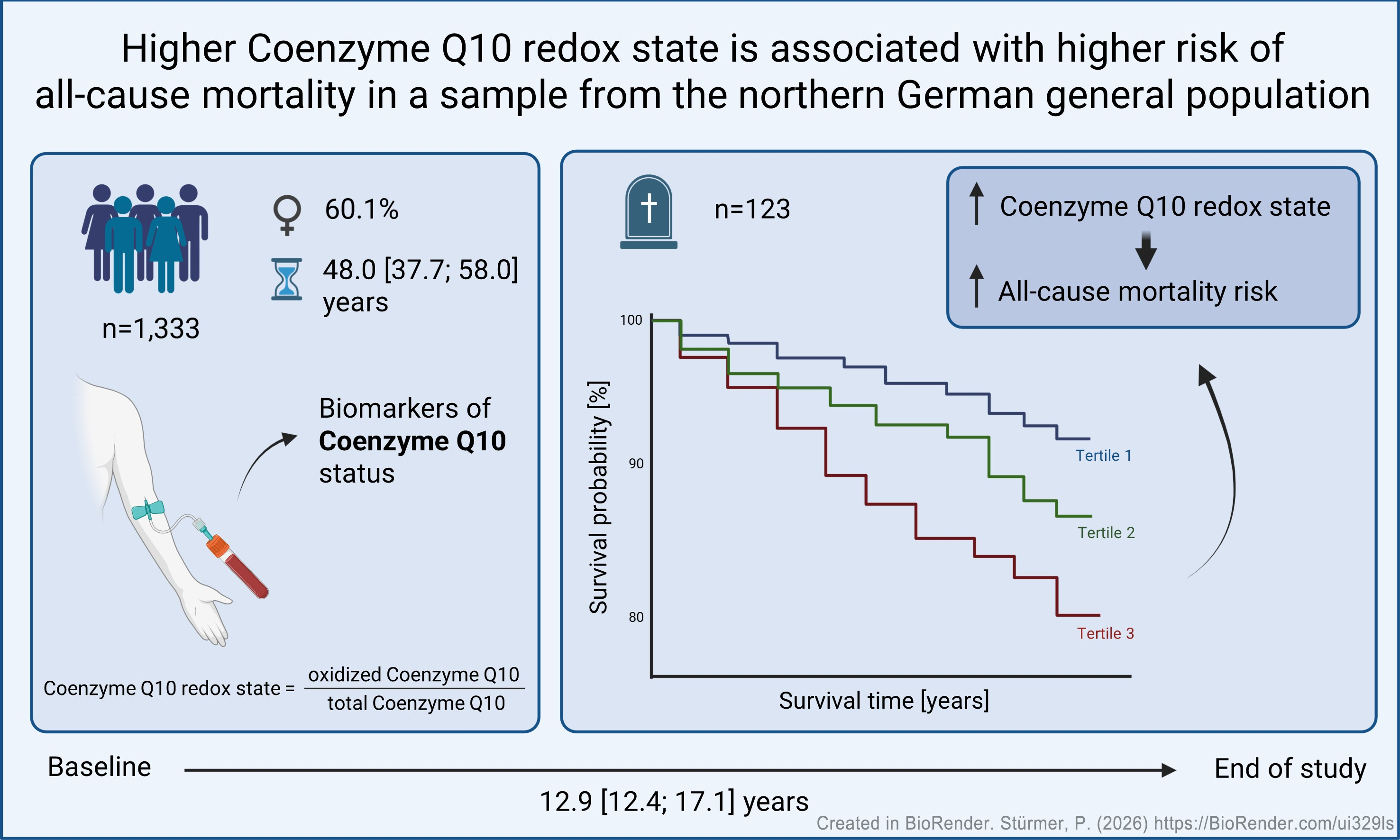
Higher Redox State of Coenzyme Q10 Is Associated with Higher Risk of All-Cause Mortality in a Sample from the Northern German General Population

 , , , , ,
Abstract
1. Introduction
2. Materials and Methods
2.1. Study Sample
2.2. Ascertainment of Vital Status
2.3. Covariate Assessment
2.4. Coenzyme Q10 Measurement
2.5. Statistical Analyses
3. Results
3.1. Characterization of the Study Sample
3.2. Association of Coenzyme Q10 with All-Cause Mortality
3.3. Sensitivity Analyses
4. Discussion
4.1. In the Context of the Published Literature
4.2. Strengths and Limitations
5. Conclusions
Supplementary Materials
Author Contributions
Funding
Institutional Review Board Statement
Informed Consent Statement
Data Availability Statement
Conflicts of Interest
References
- Bentinger, M.; Brismar, K.; Dallner, G. The antioxidant role of coenzyme Q. Mitochondrion 2007, 7, S41–S50. [Google Scholar] [CrossRef] [Scilit]
- Crane, F.L. Biochemical functions of coenzyme Q10. J. Am. Coll. Nutr. 2001, 20, 591–598. [Google Scholar] [CrossRef] [Scilit]
- Cirilli, I.; Damiani, E.; Dludla, P.V.; Hargreaves, I.; Marcheggiani, F.; Millichap, L.E.; Orlando, P.; Silvestri, S.; Tiano, L. Role of Coenzyme Q10 in Health and Disease: An Update on the Last 10 Years (2010–2020). Antioxidants 2021, 10, 1325. [Google Scholar] [CrossRef] [Scilit] [PubMed]
- Dabbaghi Varnousfaderani, S.; Musazadeh, V.; Ghalichi, F.; Kavyani, Z.; Razmjouei, S.; Faghfouri, A.H.; Ahrabi, S.S.; Seyyed Shoura, S.M.; Dehghan, P. Alleviating effects of coenzyme Q10 supplements on biomarkers of inflammation and oxidative stress: Results from an umbrella meta-analysis. Front. Pharmacol. 2023, 14, 1191290. [Google Scholar] [CrossRef] [Scilit] [PubMed]
- Hou, S.; Tian, Z.; Zhao, D.; Liang, Y.; Dai, S.; Ji, Q.; Fan, Z.; Liu, Z.; Liu, M.; Yang, Y. Efficacy and Optimal Dose of Coenzyme Q10 Supplementation on Inflammation-Related Biomarkers: A GRADE-Assessed Systematic Review and Updated Meta-Analysis of Randomized Controlled Trials. Mol. Nutr. Food Res. 2023, 67, 2200800. [Google Scholar] [CrossRef] [Scilit] [PubMed]
- Hernández-Camacho, J.D.; García-Corzo, L.; Fernández-Ayala, D.J.M.; Navas, P.; López-Lluch, G. Coenzyme Q at the Hinge of Health and Metabolic Diseases. Antioxidants 2021, 10, 1785. [Google Scholar] [CrossRef] [Scilit]
- Littarru, G.P.; Tiano, L. Clinical aspects of coenzyme Q10: An update. Nutrition 2010, 26, 250–254. [Google Scholar] [CrossRef] [Scilit]
- Zozina, V.I.; Covantev, S.; Goroshko, O.A.; Krasnykh, L.M.; Kukes, V.G. Coenzyme Q10 in Cardiovascular and Metabolic Diseases: Current State of the Problem. Curr. Cardiol. Rev. 2018, 14, 164–174. [Google Scholar] [CrossRef] [Scilit]
- Mantle, D.; Hargreaves, I. Coenzyme Q10 and Degenerative Disorders Affecting Longevity: An Overview. Antioxidants 2019, 8, 44. [Google Scholar] [CrossRef] [Scilit]
- Molyneux, S.L.; Florkowski, C.M.; George, P.M.; Pilbrow, A.P.; Frampton, C.M.; Lever, M.; Richards, A.M. Coenzyme Q10: An independent predictor of mortality in chronic heart failure. J. Am. Coll. Cardiol. 2008, 52, 1435–1441. [Google Scholar] [CrossRef] [Scilit]
- Alarcón-Vieco, E.; Martínez-García, I.; Sequí-Domínguez, I.; Rodríguez-Gutiérrez, E.; Moreno-Herráiz, N.; Pascual-Morena, C. Effect of coenzyme Q10 on cardiac function and survival in heart failure: An overview of systematic reviews and meta-analyses. Food Funct. 2023, 14, 6302–6311. [Google Scholar] [CrossRef] [Scilit]
- Mortensen, S.A.; Rosenfeldt, F.; Kumar, A.; Dolliner, P.; Filipiak, K.J.; Pella, D.; Alehagen, U.; Steurer, G.; Littarru, G.P. The effect of coenzyme Q10 on morbidity and mortality in chronic heart failure: Results from Q-SYMBIO: A randomized double-blind trial. JACC Heart Fail. 2014, 2, 641–649. [Google Scholar] [CrossRef] [Scilit]
- Liang, L.; Zhong, Z.; Tian, Z.; Liu, Z.; Kuang, H.; He, F.; Wang, R.; Hou, S.; Yang, Y. Trends in Coenzyme Q10 Supplement Use and Associations With All-Cause and Cardiovascular Mortality: A Population-Based Cohort Study. Mol. Nutr. Food Res. 2025, 69, e70019. [Google Scholar] [CrossRef] [Scilit] [PubMed]
- Alehagen, U.; Lindahl, T.L.; Aaseth, J.; Svensson, E.; Johansson, P. Levels of sP-selectin and hs-CRP Decrease with Dietary Intervention with Selenium and Coenzyme Q10 Combined: A Secondary Analysis of a Randomized Clinical Trial. PLoS ONE 2015, 10, e0137680. [Google Scholar] [CrossRef] [Scilit] [PubMed]
- Alehagen, U.; Aaseth, J.; Alexander, J.; Johansson, P. Still reduced cardiovascular mortality 12 years after supplementation with selenium and coenzyme Q10 for four years: A validation of previous 10-year follow-up results of a prospective randomized double-blind placebo-controlled trial in elderly. PLoS ONE 2018, 13, e0193120. [Google Scholar] [CrossRef] [Scilit] [PubMed]
- Nöthlings, U.; Krawczak, M. PopGen. Eine populationsbasierte Biobank mit Langzeitverfolgung der Kontrollkohorte. Bundesgesundheitsblatt 2012, 55, 831–835. [Google Scholar] [CrossRef] [Scilit]
- Geisler, C.; Schlicht, K.; Knappe, C.; Rohmann, N.; Hartmann, K.; Türk, K.; Settgast, U.; Schulte, D.M.; Demetrowitsch, T.; Jensen-Kroll, J.; et al. Cohort profile: The Food Chain Plus (FoCus) cohort. Eur. J. Epidemiol. 2022, 37, 1087–1105. [Google Scholar] [CrossRef] [Scilit]
- Menke, T.; Niklowitz, P.; Adam, S.; Weber, M.; Schlüter, B.; Andler, W. Simultaneous detection of ubiquinol-10, ubiquinone-10, and tocopherols in human plasma microsamples and macrosamples as a marker of oxidative damage in neonates and infants. Anal. Biochem. 2000, 282, 209–217. [Google Scholar] [CrossRef] [Scilit]
- Niklowitz, P.; Onur, S.; Fischer, A.; Laudes, M.; Palussen, M.; Menke, T.; Döring, F. Coenzyme Q10 serum concentration and redox status in European adults: Influence of age, sex, and lipoprotein concentration. J. Clin. Biochem. Nutr. 2016, 58, 240–245. [Google Scholar] [CrossRef] [Scilit]
- Fischer, A.; Onur, S.; Niklowitz, P.; Menke, T.; Laudes, M.; Döring, F. Coenzyme Q10 redox state predicts the concentration of c-reactive protein in a large caucasian cohort. Biofactors 2016, 42, 268–276. [Google Scholar] [CrossRef] [Scilit]
- Huo, R. PlotRCS: Plot Resctricted Cubic Splines Curves. 2025. Available online: https://github.com/kunhuo/plotRCS (accessed on 25 January 2026).
- Onur, S.; Niklowitz, P.; Fischer, A.; Jacobs, G.; Lieb, W.; Laudes, M.; Menke, T.; Döring, F. Determination of the coenzyme Q10 status in a large Caucasian study population. Biofactors 2015, 41, 211–221. [Google Scholar] [CrossRef] [Scilit] [PubMed]
- Cocchi, M.N.; Giberson, B.; Berg, K.; Salciccioli, J.D.; Naini, A.; Buettner, C.; Akuthota, P.; Gautam, S.; Donnino, M.W. Coenzyme Q10 levels are low and associated with increased mortality in post-cardiac arrest patients. Resuscitation 2012, 83, 991–995. [Google Scholar] [CrossRef] [Scilit]
- López-Lluch, G. Coenzyme Q homeostasis in aging: Response to non-genetic interventions. Free Radic. Biol. Med. 2021, 164, 285–302. [Google Scholar] [CrossRef] [Scilit] [PubMed]
- Sohmiya, M.; Tanaka, M.; Tak, N.W.; Yanagisawa, M.; Tanino, Y.; Suzuki, Y.; Okamoto, K.; Yamamoto, Y. Redox status of plasma coenzyme Q10 indicates elevated systemic oxidative stress in Parkinson’s disease. J. Neurol. Sci. 2004, 223, 161–166. [Google Scholar] [CrossRef] [Scilit] [PubMed]
- Littarru, G.P.; Tiano, L. Bioenergetic and Antioxidant Properties of Coenzyme Q10: Recent Developments. Mol. Biotechnol. 2007, 37, 31–37. [Google Scholar] [CrossRef] [Scilit]
- Meisinger, C.; Baumert, J.; Khuseyinova, N.; Loewel, H.; Koenig, W. Plasma oxidized low-density lipoprotein, a strong predictor for acute coronary heart disease events in apparently healthy, middle-aged men from the general population. Circulation 2005, 112, 651–657. [Google Scholar] [CrossRef] [Scilit]
- Daiber, A.; Hahad, O.; Andreadou, I.; Steven, S.; Daub, S.; Münzel, T. Redox-related biomarkers in human cardiovascular disease—Classical footprints and beyond. Redox Biol. 2021, 42, 101875. [Google Scholar] [CrossRef] [Scilit]
- Naghavi, M.; Ong, K.L.; Aali, A.; Ababneh, H.S.; Abate, Y.H.; Abbafati, C.; Abbasgholizadeh, R.; Abbasian, M.; Abbasi-Kangevari, M.; Abbastabar, H.; et al. Global burden of 288 causes of death and life expectancy decomposition in 204 countries and territories and 811 subnational locations, 1990–2021: A systematic analysis for the Global Burden of Disease Study 2021. Lancet 2024, 403, 2100–2132. [Google Scholar] [CrossRef] [Scilit]
- Dunning, B.J.; Bourgonje, A.R.; Bulthuis, M.L.C.; Alexander, J.; Aaseth, J.O.; Larsson, A.; van Goor, H.; Alehagen, U. Selenium and coenzyme Q10 improve the systemic redox status while reducing cardiovascular mortality in elderly population-based individuals. Free Radic. Biol. Med. 2023, 204, 207–214. [Google Scholar] [CrossRef] [Scilit]
- Schöttker, B.; Brenner, H.; Jansen, E.H.J.M.; Gardiner, J.; Peasey, A.; Kubínová, R.; Pająk, A.; Topor-Madry, R.; Tamosiunas, A.; Saum, K.-U.; et al. Evidence for the free radical/oxidative stress theory of ageing from the CHANCES consortium: A meta-analysis of individual participant data. BMC Med. 2015, 13, 300. [Google Scholar] [CrossRef] [Scilit]
- Miles, M.V.; Morrison, J.A.; Horn, P.S.; Tang, P.H.; Pesce, A.J. Coenzyme Q10 changes are associated with metabolic syndrome. Clin. Chim. Acta 2004, 344, 173–179. [Google Scholar] [CrossRef]



| Overall Sample (n = 1333) | Alive a (n = 1210) | Deceased a (n = 123) | |
|---|---|---|---|
| Female sex, n (%) | 801 (60.1%) | 748 (61.8%) | 53 (43.1%) |
| Age [years] | 48.0 [37.7; 58.0] | 47.0 [36.6; 56.0] | 61.0 [50.8; 69.5] |
| Survival time a [years] | 12.9 [12.4; 17.1] | 13.0 [12.5; 17.2] | 8.5 [4.8; 10.8] |
| Total Coenzyme Q10 [µmol/L] | 0.82 [0.64; 1.03] | 0.82 [0.64; 1.02] | 0.90 [0.63; 1.09] |
| Ubiquinol [µmol/L] | 0.71 [0.55; 0.89] | 0.71 [0.55; 0.88] | 0.76 [0.54; 0.94] |
| Ubiquinone [µmol/L] | 0.11 [0.08; 0.13] | 0.11 [0.08; 0.13] | 0.12 [0.09; 0.14] |
| Coenzyme Q10 redox state b [%] | 13.0 [11.8; 14.4] | 12.9 [11.7; 14.3] | 13.5 [12.4; 14.9] |
| Height [cm] | 173 [167; 180] | 172 [167; 180] | 175 [166; 182] |
| Weight [kg] | 85.0 [70.5; 103.5] | 84.5 [70.0; 102.9] | 93.9 [77.0; 119.7] |
| Body mass index [kg/m2] | 27.5 [23.6; 34.8] | 27.2 [23.5; 33.8] | 30.5 [25.4; 40.5] |
| Systolic blood pressure [mmHg] | 130 [120; 140] | 130 [120; 140] | 135 [130; 140] |
| Diastolic blood pressure [mmHg] | 80 [75; 85] | 80 [75; 85] | 80 [80; 90] |
| C-reactive protein [mg/L] | 1.7 [0.8; 4.5] | 1.6 [0.8; 4.2] | 3.0 [1.1; 7.2] |
| Total cholesterol [mmol/L] | 4.7 [4.1; 5.3] | 4.7 [4.1; 5.3] | 4.7 [4.0; 5.3] |
| Glucose [mg/dL] | 93 [87; 103] | 93 [87; 101] | 104 [93; 122] |
| Diabetes, n (%) | 176 (13.2%) | 131 (10.8%) | 45 (36.6%) |
| Smoking habits | |||
| Never smoked, n (%) | 551 (41.3%) | 510 (42.1%) | 41 (33.3%) |
| Current smokers, n (%) | 782 (58.7%) | 700 (57.9%) | 82 (66.7%) |
| Overall Sample (n = 1333) | Tertile 1 (n = 445) | Tertile 2 (n = 444) | Tertile 3 (n = 444) | |
|---|---|---|---|---|
| Total Coenzyme Q10 [µmol/L] | 0.82 [0.64; 1.03] | 0.57 [0.48; 0.64] | 0.82 [0.76; 0.88] | 1.12 [1.03; 1.27] |
| Deceased, n (%) | 123 (9.2%) | 41 (9.2%) | 31 (7.0%) | 51 (11.5%) |
| Hazard Ratio and 95% Confidence Interval | ||||
| Model 1 | 1.09 [0.92–1.29] | Reference | 0.74 [0.46–1.17] | 1.21 [0.80–1.83] |
| Model 2 | 0.98 [0.82–1.17] | Reference | 0.56 [0.35–0.89] | 0.92 [0.60–1.38] |
| Model 3 | 0.91 [0.73–1.14] | Reference | 0.52 [0.32–0.85] | 0.81 [0.49–1.33] |
| Model 4 | 0.92 [0.73–1.15] | Reference | 0.51 [0.31–0.83] | 0.81 [0.49–1.32] |
| Ubiquinol [µmol/L] | 0.71 [0.55; 0.89] | 0.50 [0.42; 0.55] | 0.71 [0.66; 0.76] | 0.97 [0.89; 1.12] |
| Deceased, n (%) | 123 (9.2%) | 41 (9.2%) | 32 (7.2%) | 50 (11.3%) |
| Hazard Ratio and 95% Confidence Interval | ||||
| Model 1 | 1.07 [0.90–1.26] | Reference | 0.77 [0.48–1.22] | 1.19 [0.79–1.80] |
| Model 2 | 0.96 [0.80–1.15] | Reference | 0.60 [0.37–0.95] | 0.90 [0.59–1.36] |
| Model 3 | 0.89 [0.71–1.12] | Reference | 0.57 [0.35– 0.92] | 0.78 [0.48–1.29] |
| Model 4 | 0.90 [0.72–1.12] | Reference | 0.55 [0.34–0.90] | 0.78 [0.48–1.28] |
| Ubiquinone [µmol/L] | 0.11 [0.08; 0.13] | 0.07 [0.06; 0.08] | 0.11 [0.10; 0.12] | 0.15 [0.13; 0.17] |
| Deceased, n (%) | 123 (9.2%) | 33 (7.4%) | 34 (7.7%) | 56 (12.6%) |
| Hazard Ratio and 95% Confidence Interval | ||||
| Model 1 | 1.23 [1.05–1.43] | Reference | 1.03 [0.64–1.66] | 1.70 [1.10–2.61] |
| Model 2 | 1.10 [0.93–1.31] | Reference | 0.81 [0.50–1.31] | 1.19 [0.77–1.83] |
| Model 3 | 1.07 [0.86–1.32] | Reference | 0.77 [0.47–1.27] | 1.12 [0.67–1.85] |
| Model 4 | 1.06 [0.86–1.32] | Reference | 0.75 [0.45–1.23] | 1.09 [0.66–1.81] |
| Coenzyme Q10 redox state a (%) | 13.0 [11.8; 14.4] | 11.2 [10.5; 11.8] | 13.0 [12.6; 13.3] | 15.0 [14.4; 16.4] |
| Deceased, n (%) | 123 (9.2%) | 23 (5.2%) | 46 (10.4%) | 54 (12.2%) |
| Hazard Ratio and 95% Confidence Interval | ||||
| Model 1 | 1.28 [1.13–1.46] | Reference | 2.13 [1.29–3.52] | 2.57 [1.58–4.19] |
| Model 2 | 1.24 [1.07–1.43] | Reference | 1.89 [1.14–3.13] | 2.11 [1.28–3.46] |
| Model 3 | 1.19 [1.03–1.38] | Reference | 1.81 [1.09–3.00] | 1.95 [1.18–3.21] |
| Model 4 | 1.19 [1.03–1.37] | Reference | 1.78 [1.07–2.96] | 1.91 [1.15–3.15] |
| Model 5 | 1.18 [1.02–1.38] | Reference | 1.77 [1.07–2.95] | 1.88 [1.13–3.14] |
Disclaimer/Publisher’s Note: The statements, opinions and data contained in all publications are solely those of the individual author(s) and contributor(s) and not of MDPI and/or the editor(s). MDPI and/or the editor(s) disclaim responsibility for any injury to people or property resulting from any ideas, methods, instructions or products referred to in the content. |
© 2026 by the authors. Licensee MDPI, Basel, Switzerland. This article is an open access article distributed under the terms and conditions of the Creative Commons Attribution (CC BY) license.
Share and Cite
Stürmer, P.; Weber, K.S.; Strathmann, E.A.; Övermöhle, C.; Voran, J.C.; Döring, F.; Laudes, M.; Lieb, W. Higher Redox State of Coenzyme Q10 Is Associated with Higher Risk of All-Cause Mortality in a Sample from the Northern German General Population. Antioxidants 2026, 15, 343. https://doi.org/10.3390/antiox15030343
Stürmer P, Weber KS, Strathmann EA, Övermöhle C, Voran JC, Döring F, Laudes M, Lieb W. Higher Redox State of Coenzyme Q10 Is Associated with Higher Risk of All-Cause Mortality in a Sample from the Northern German General Population. Antioxidants. 2026; 15(3):343. https://doi.org/10.3390/antiox15030343
Chicago/Turabian StyleStürmer, Paula, Katharina S. Weber, Eike A. Strathmann, Cara Övermöhle, Jakob C. Voran, Frank Döring, Matthias Laudes, and Wolfgang Lieb. 2026. "Higher Redox State of Coenzyme Q10 Is Associated with Higher Risk of All-Cause Mortality in a Sample from the Northern German General Population" Antioxidants 15, no. 3: 343. https://doi.org/10.3390/antiox15030343
APA StyleStürmer, P., Weber, K. S., Strathmann, E. A., Övermöhle, C., Voran, J. C., Döring, F., Laudes, M., & Lieb, W. (2026). Higher Redox State of Coenzyme Q10 Is Associated with Higher Risk of All-Cause Mortality in a Sample from the Northern German General Population. Antioxidants, 15(3), 343. https://doi.org/10.3390/antiox15030343