


Inducing Ferroptosis: Sensitization Strategy for Radiotherapy and Its Application




Abstract
1. Introduction
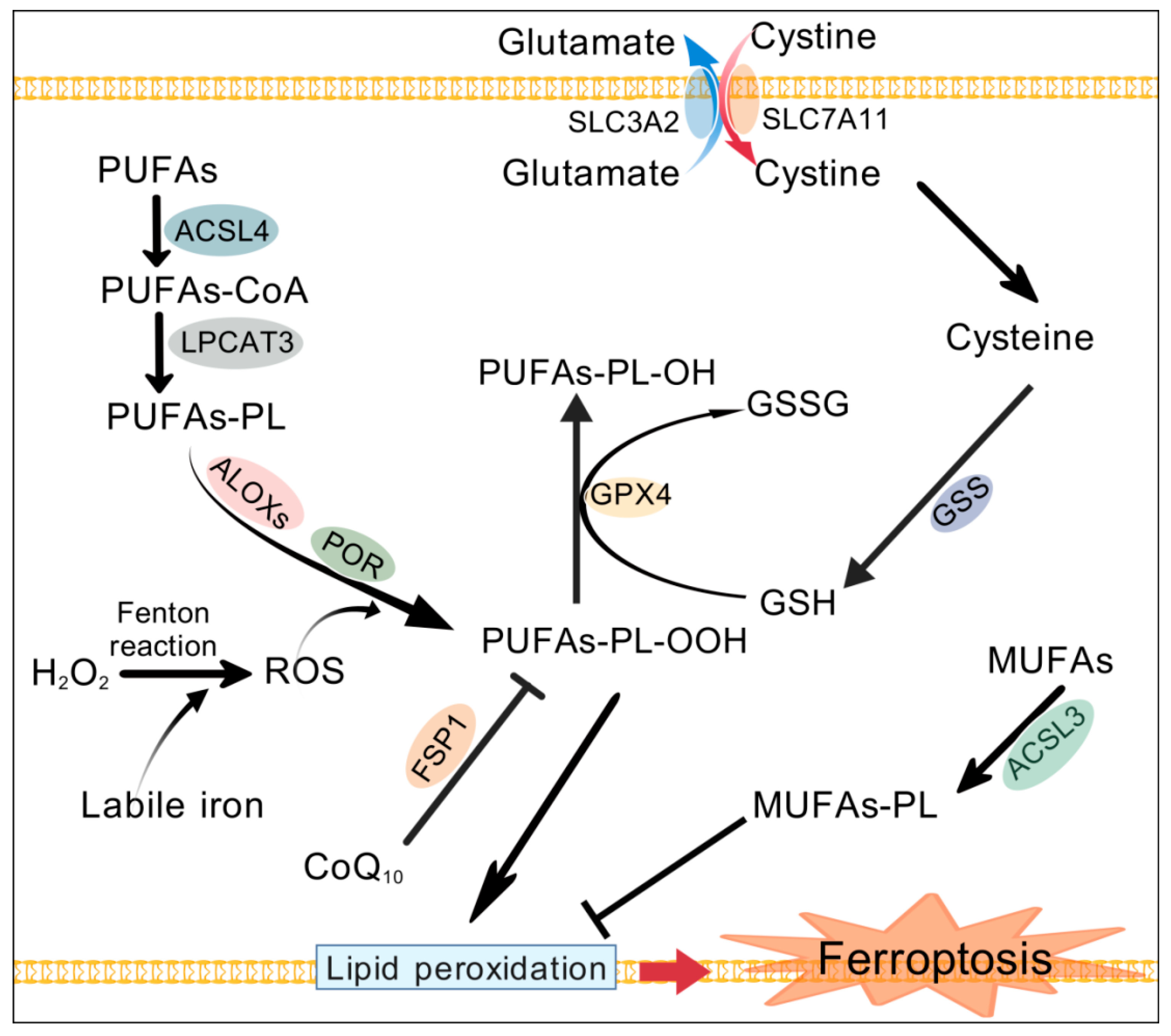
2. Mechanism and Regulation of Ferroptosis

3. Radiotherapy-Induced Ferroptosis in Tumor Cells
3.1. Ionizing Radiation-Induced Ferroptotic Cell Death
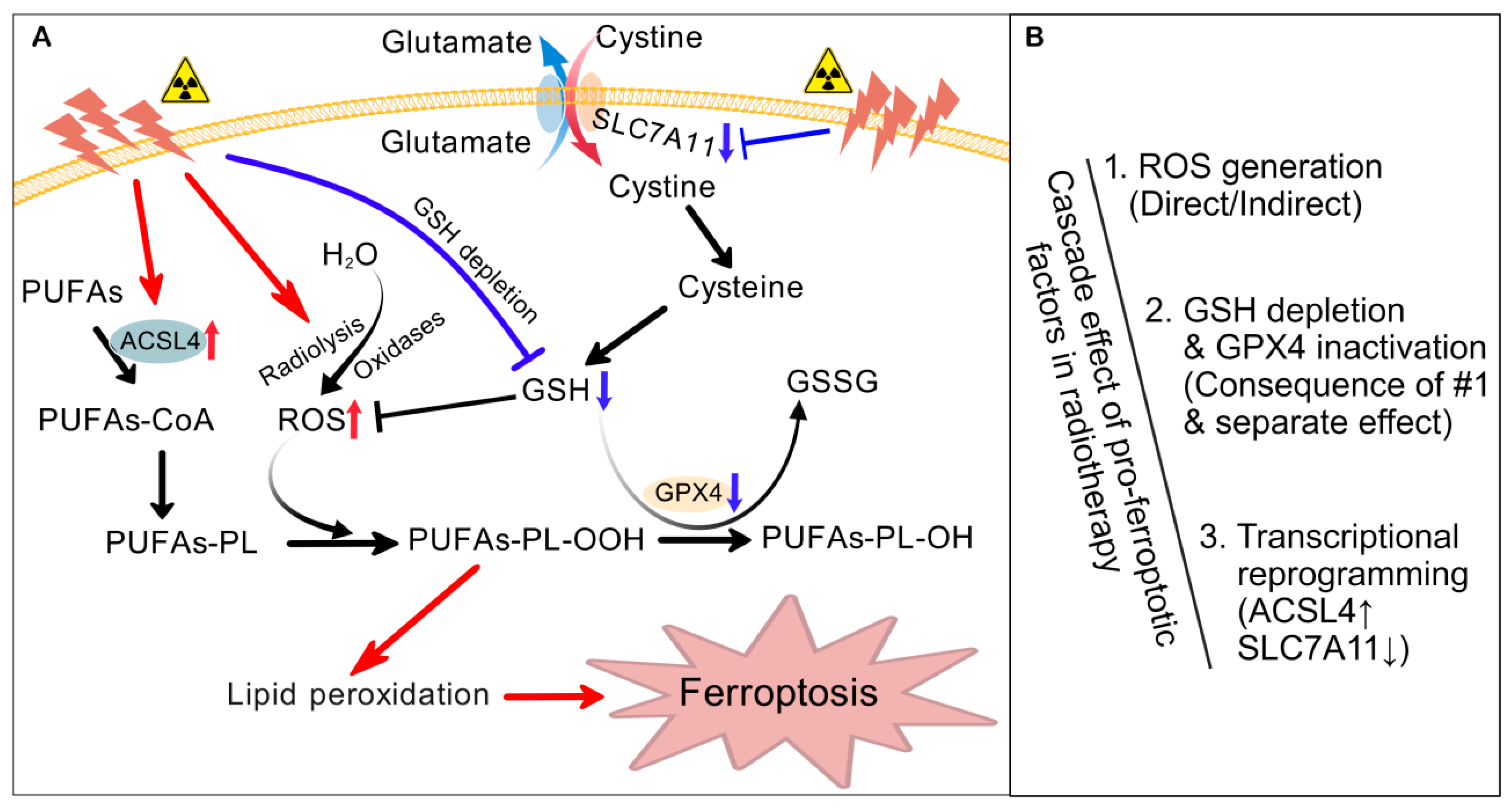
3.2. Mechanism of Radiotherapy-Induced Ferroptosis
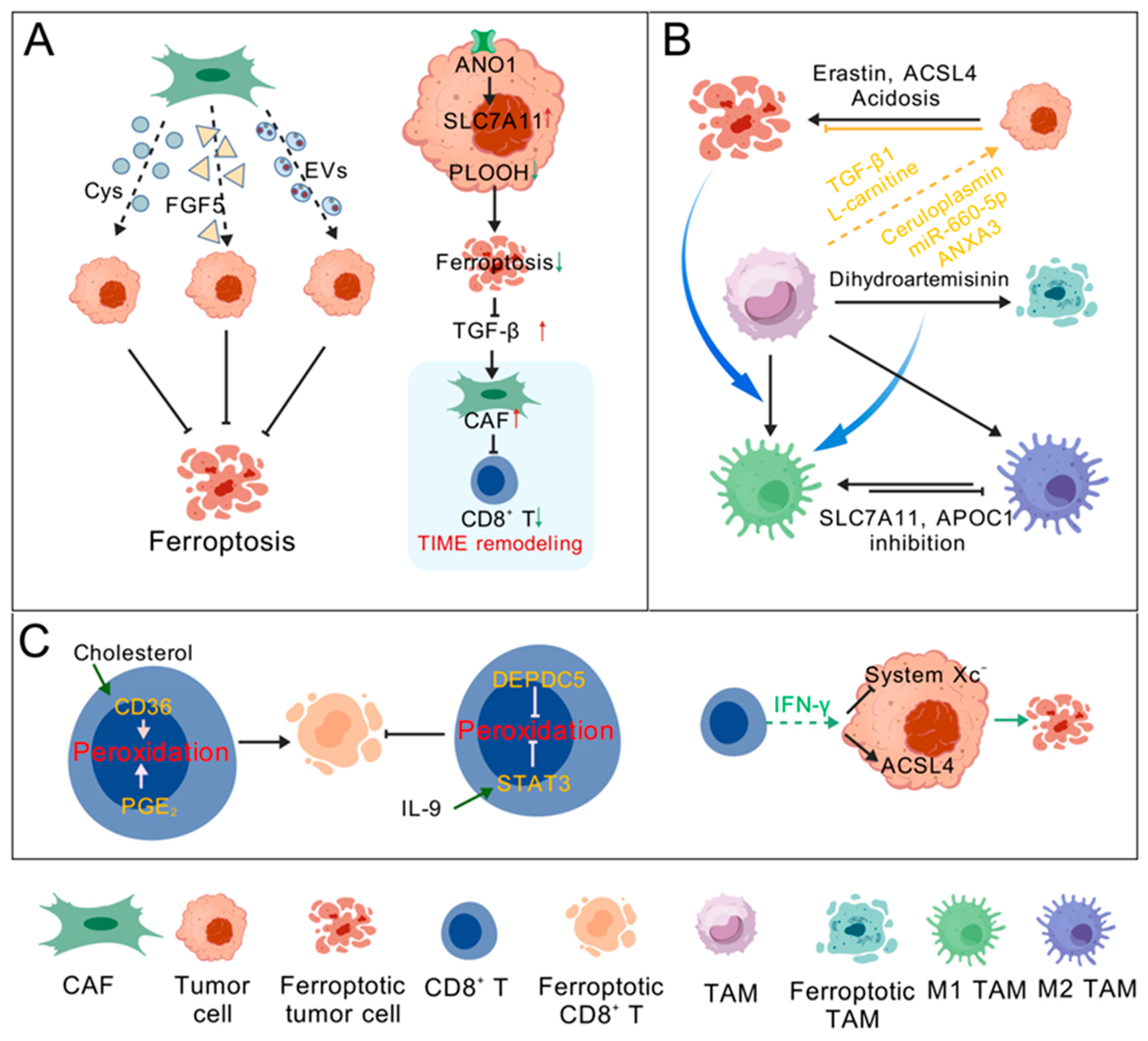
4. Radiotherapy-Induced Ferroptosis in the TME
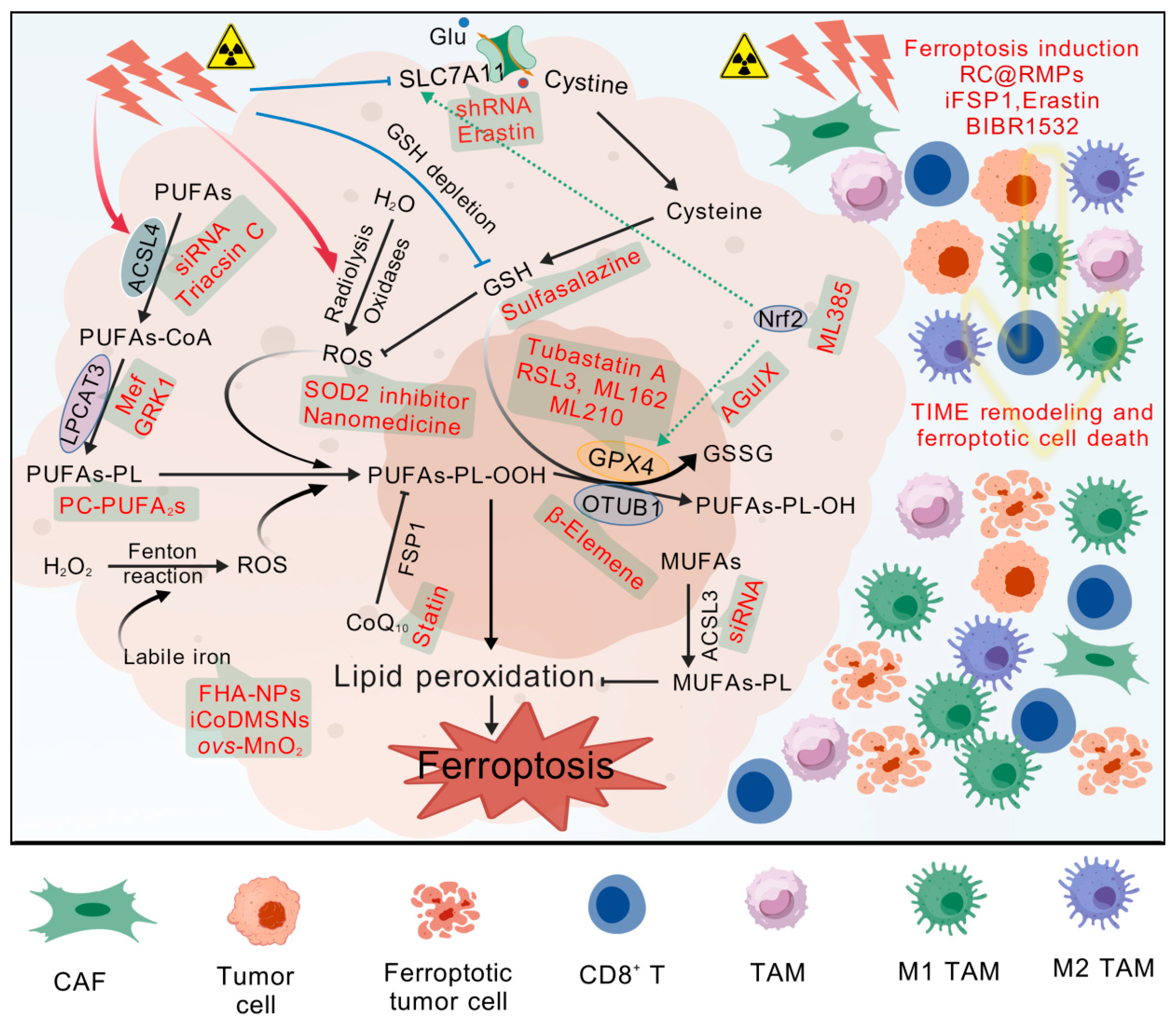
5. Inducing Ferroptosis for Radiosensitization

| Targets | Mediators | Application | References |
|---|---|---|---|
| SLC7A11, GPX4 | Erastin, sulfasalazine, RSL3, liproxstatin-1, ML162, FIN56 | Radioresistant lung cancer cells, CDX, PDX; esophageal cancer patients | Lei G et al. [8] |
| system Xc− | Imidazole ketone erastin, sorafenib | CDX of sarcoma, PDX of lung adenocarcinoma and glioma | Ye LF et al. [7] |
| SLC7A11 | Knockdown | NPC cells | Yang F et al. [11] |
| SLC7A11 | p53 | Cancer cells and patients | Lei G et al. [99] |
| SLC7A11 | Nrf2, ML385 | ESCC | Feng L et al. [52]; Yan L et al. [100] |
| GPX4 | Knockdown, RSL3 | CDX of ESCC | Chen C et al. [12] |
| GPX4 | RSL3 | Radioresistant NSCLC cells | Ma Y et al. [101] |
| GPX4 | Erastin | Radioresistant NSCLC cells | Pan X et al. [94] |
| GPX4 | β-Elemene | Radioresistant gastric cancer cells | He J et al. [102] |
| GPX4 | HMGA2 | Pancreatic cancer cells | Luo Z et al. [103] |
| GPX4 | lncRNA OTUD6B-AS1 | Radioresistant colorectal cancer cells | Zhang Z et al. [104] |
| GPX4 | Tubastatin A | Breast cancer cells | Liu S et al. [105] |
| GPX4 | Nanomaterial AGuIX | Triple-negative breast cancer cells | Sun H et al. [106] |
| GPX4 | RRM1 | Cancer cells | Gao Y et al. [107] |
| FSP1 | Statin, CoQ | Radioresistant cells | Lin X et al. [108] |
| ACSL3 | shRNA | Radioresistant cells | Cao Y et al. [109] |
| ACSL4 | ASCL4 siRNA | Breast cancer cells | Kwon YS et al. [95] |
| ACSL4 | METTL14 | ESCC | Jin Y et al. [110] |
| ACSL4 | LncRNA-RRFERV | NPC patients | Xu Q et al. [111] |
| ACSL4 | PCK2 | Tumor-repopulating cells, NPC patients | Li Z et al. [112] |
| ROS and GSH | Superoxide dismutase 2 | NPC cells | Amos A et al. [96] |
| ROS and GSH | Nanomaterial | Melanoma cells and CDX | Lin Y et al. [98] |
| ROS and GSH | Nanomaterial | Breast cancer and solid tumor | Shi J et al. [113]; Song H et al. [114]; Wei M et al. [115] |
| ROS and GSH | Sulfasalazine | Colorectal cancer cells | Kerkhove L et al. [116] |
| ROS and GSH | Nanomaterial | Breast cancer cells and CDX | Liu Y et al. [97] |
| Multi-targets | Multifunctional nanomaterial | Triple-negative breast cancer | Zeng L et al. [117] |
5.1. Targeting Key Molecules That Inhibit Ferroptosis
5.2. PUFA Metabolism-Mediated Promotion of Ferroptosis
5.3. Interference with ROS Production and GSH Depletion
5.4. Radiosensitization Strategies for Inducing Ferroptosis by Targeting TME
5.5. Adoption of New Technology
6. Main Challenges and Solutions
7. Conclusions
Author Contributions
Funding
Institutional Review Board Statement
Informed Consent Statement
Data Availability Statement
Conflicts of Interest
References
- Dixon, S.J.; Lemberg, K.M.; Lamprecht, M.R.; Skouta, R.; Zaitsev, E.M.; Gleason, C.E.; Patel, D.N.; Bauer, A.J.; Cantley, A.M.; Yang, W.S.; et al. Ferroptosis: An iron-dependent form of nonapoptotic cell death. Cell 2012, 149, 1060–1072. [Google Scholar] [CrossRef] [PubMed]
- Zhou, Q.; Meng, Y.; Li, D.; Yao, L.; Le, J.; Liu, Y.; Sun, Y.; Zeng, F.; Chen, X.; Deng, G. Ferroptosis in cancer: From molecular mechanisms to therapeutic strategies. Signal Transduct. Target. Ther. 2024, 9, 55. [Google Scholar] [CrossRef] [PubMed]
- Cao, J.Y.; Dixon, S.J. Mechanisms of ferroptosis. Cell Mol. Life Sci. 2016, 73, 2195–2209. [Google Scholar] [CrossRef]
- Dixon, S.J.; Winter, G.E.; Musavi, L.S.; Lee, E.D.; Snijder, B.; Rebsamen, M.; Superti-Furga, G.; Stockwell, B.R. Human Haploid Cell Genetics Reveals Roles for Lipid Metabolism Genes in Nonapoptotic Cell Death. ACS Chem. Biol. 2015, 10, 1604–1609. [Google Scholar] [CrossRef]
- Zheng, Z.; Su, J.; Bao, X.; Wang, H.; Bian, C.; Zhao, Q.; Jiang, X. Mechanisms and applications of radiation-induced oxidative stress in regulating cancer immunotherapy. Front. Immunol. 2023, 14, 1247268. [Google Scholar] [CrossRef]
- Lang, X.; Green, M.D.; Wang, W.; Yu, J.; Choi, J.E.; Jiang, L.; Liao, P.; Zhou, J.; Zhang, Q.; Dow, A.; et al. Radiotherapy and Immunotherapy Promote Tumoral Lipid Oxidation and Ferroptosis via Synergistic Repression of SLC7A11. Cancer Discov. 2019, 9, 1673–1685. [Google Scholar] [CrossRef]
- Ye, L.F.; Chaudhary, K.R.; Zandkarimi, F.; Harken, A.D.; Kinslow, C.J.; Upadhyayula, P.S.; Dovas, A.; Higgins, D.M.; Tan, H.; Zhang, Y.; et al. Radiation-Induced Lipid Peroxidation Triggers Ferroptosis and Synergizes with Ferroptosis Inducers. ACS Chem. Biol. 2020, 15, 469–484. [Google Scholar] [CrossRef]
- Lei, G.; Zhang, Y.; Koppula, P.; Liu, X.; Zhang, J.; Lin, S.H.; Ajani, J.A.; Xiao, Q.; Liao, Z.; Wang, H.; et al. The role of ferroptosis in ionizing radiation-induced cell death and tumor suppression. Cell Res. 2020, 30, 146–162. [Google Scholar] [CrossRef]
- Song, A.; Wu, L.; Zhang, B.X.; Yang, Q.C.; Liu, Y.T.; Li, H.; Mao, L.; Xiong, D.; Yu, H.J.; Sun, Z.J. Glutamine inhibition combined with CD47 blockade enhances radiotherapy-induced ferroptosis in head and neck squamous cell carcinoma. Cancer Lett. 2024, 588, 216727. [Google Scholar] [CrossRef]
- Yuan, Z.; Liu, T.; Huo, X.; Wang, H.; Wang, J.; Xue, L. Glutamine Transporter SLC1A5 Regulates Ionizing Radiation-Derived Oxidative Damage and Ferroptosis. Oxid. Med. Cell Longev. 2022, 2022, 3403009. [Google Scholar] [CrossRef] [PubMed]
- Yang, F.; Gong, H.; Chen, S.; Li, J.; Huang, N.; Wang, M. Depletion of SLC7A11 Sensitizes Nasopharyngeal Carcinoma Cells to Ionizing Radiation. Protein Pept. Lett. 2024, 31, 323–331. [Google Scholar] [CrossRef] [PubMed]
- Chen, C.; Gu, W.; Shao, Y.; Zheng, P.; Jiang, J. Expression of Glutathione Peroxidase4 in Patients with Esophageal Squamous Carcinoma and Its Impact on the Radiosensitivity of Esophageal Squamous Carcinoma. Ann. Clin. Lab. Sci. 2024, 54, 160–169. [Google Scholar]
- Lei, G.; Zhuang, L.; Gan, B. The roles of ferroptosis in cancer: Tumor suppression, tumor microenvironment, and therapeutic interventions. Cancer Cell. 2024, 42, 513–534. [Google Scholar] [CrossRef]
- Zefrei, F.J.; Shormij, M.; Dastranj, L.; Alvandi, M.; Shaghaghi, Z.; Farzipour, S.; Zarei-Polgardani, N. Ferroptosis Inducers as Promising Radiosensitizer Agents in Cancer Radiotherapy. Curr. Radiopharm. 2024, 17, 14–29. [Google Scholar] [CrossRef]
- Qian, J.Y.; Lou, C.Y.; Chen, Y.L.; Ma, L.F.; Hou, W.; Zhan, Z.J. A prospective therapeutic strategy: GPX4-targeted ferroptosis mediators. Eur. J. Med. Chem. 2024, 281, 117015. [Google Scholar] [CrossRef]
- Jiang, X.; Stockwell, B.R.; Conrad, M. Ferroptosis: Mechanisms, biology and role in disease. Nat. Rev. Mol. Cell Biol. 2021, 22, 266–282. [Google Scholar] [CrossRef] [PubMed]
- Qiu, B.; Zandkarimi, F.; Bezjian, C.T.; Reznik, E.; Soni, R.K.; Gu, W.; Jiang, X.; Stockwell, B.R. Phospholipids with two polyunsaturated fatty acyl tails promote ferroptosis. Cell 2024, 187, 1177–1190.e18. [Google Scholar] [CrossRef] [PubMed]
- Chu, B.; Kon, N.; Chen, D.; Li, T.; Liu, T.; Jiang, L.; Song, S.; Tavana, O.; Gu, W. ALOX12 is required for p53-mediated tumour suppression through a distinct ferroptosis pathway. Nat. Cell Biol. 2019, 21, 579–591. [Google Scholar] [CrossRef] [PubMed]
- Yan, B.; Ai, Y.; Sun, Q.; Ma, Y.; Cao, Y.; Wang, J.; Zhang, Z.; Wang, X. Membrane Damage during Ferroptosis Is Caused by Oxidation of Phospholipids Catalyzed by the Oxidoreductases POR and CYB5R1. Mol. Cell 2021, 81, 355–369.e10. [Google Scholar] [CrossRef]
- Zou, Y.; Li, H.; Graham, E.T.; Deik, A.A.; Eaton, J.K.; Wang, W.; Sandoval-Gomez, G.; Clish, C.B.; Doench, J.G.; Schreiber, S.L. Cytochrome P450 oxidoreductase contributes to phospholipid peroxidation in ferroptosis. Nat. Chem. Biol. 2020, 16, 302–309. [Google Scholar] [CrossRef]
- Huang, Y.; Sarkhel, S.; Roy, A.; Mohan, A. Interrelationship of lipid aldehydes (MDA, 4-HNE, and 4-ONE) mediated protein oxidation in muscle foods. Crit. Rev. Food Sci. Nutr. 2024, 64, 11809–11825. [Google Scholar] [CrossRef] [PubMed]
- Pedrera, L.; Espiritu, R.A.; Ros, U.; Weber, J.; Schmitt, A.; Stroh, J.; Hailfinger, S.; von Karstedt, S.; Garcia-Saez, A.J. Ferroptotic pores induce Ca2+ fluxes and ESCRT-III activation to modulate cell death kinetics. Cell Death Differ. 2021, 28, 1644–1657. [Google Scholar] [CrossRef] [PubMed]
- Balakrishnan, M.; Kenworthy, A.K. Lipid Peroxidation Drives Liquid-Liquid Phase Separation and Disrupts Raft Protein Partitioning in Biological Membranes. J. Am. Chem. Soc. 2024, 146, 1374–1387. [Google Scholar] [CrossRef]
- Jiang, S.; Li, H.; Zhang, L.; Mu, W.; Zhang, Y.; Chen, T.; Wu, J.; Tang, H.; Zheng, S.; Liu, Y.; et al. Generic Diagramming Platform (GDP): A comprehensive database of high-quality biomedical graphics. Nucleic Acids Res. 2025, 53, D1670–D1676. [Google Scholar] [CrossRef]
- Diao, J.; Jia, Y.; Dai, E.; Liu, J.; Kang, R.; Tang, D.; Han, L.; Zhong, Y.; Meng, L. Ferroptotic therapy in cancer: Benefits, side effects, and risks. Mol. Cancer 2024, 23, 89. [Google Scholar] [CrossRef]
- Kagan, V.E.; Mao, G.; Qu, F.; Angeli, J.P.; Doll, S.; Croix, C.S.; Dar, H.H.; Liu, B.; Tyurin, V.A.; Ritov, V.B.; et al. Oxidized arachidonic and adrenic PEs navigate cells to ferroptosis. Nat. Chem. Biol. 2017, 13, 81–90. [Google Scholar] [CrossRef]
- Samovich, S.N.; Mikulska-Ruminska, K.; Dar, H.H.; Tyurina, Y.Y.; Tyurin, V.A.; Souryavong, A.B.; Kapralov, A.A.; Amoscato, A.A.; Beharier, O.; Karumanchi, S.A.; et al. Strikingly High Activity of 15-Lipoxygenase Towards Di-Polyunsaturated Arachidonoyl/Adrenoyl-Phosphatidylethanolamines Generates Peroxidation Signals of Ferroptotic Cell Death. Angew. Chem. Int. Ed. Engl. 2024, 63, e202314710. [Google Scholar] [CrossRef]
- Doll, S.; Proneth, B.; Tyurina, Y.Y.; Panzilius, E.; Kobayashi, S.; Ingold, I.; Irmler, M.; Beckers, J.; Aichler, M.; Walch, A.; et al. ACSL4 dictates ferroptosis sensitivity by shaping cellular lipid composition. Nat. Chem. Biol. 2017, 13, 91–98. [Google Scholar] [CrossRef]
- Lei, G.; Zhuang, L.; Gan, B. Targeting ferroptosis as a vulnerability in cancer. Nat. Rev. Cancer 2022, 22, 381–396. [Google Scholar] [CrossRef]
- He, Y.; Zhao, G.; Ouyang, X.; Wang, S.; Chen, Y.; Li, C.; He, Y.; Gao, J.; Han, S.; Zhao, J.; et al. Creatine-mediated ferroptosis inhibition is involved in the intestinal radioprotection of daytime-restricted feeding. Gut Microbes 2025, 17, 2489072. [Google Scholar] [CrossRef] [PubMed]
- Han, Z.; Han, S.; Fang, X.; Lu, M.; Mao, Y.; Shi, L.; Song, J.; Wang, T.; Xiao, J.; Xiang, L.; et al. Acetyl-CoA carboxylase activation disrupts iron homeostasis to drive ferroptosis. Free. Radic. Biol. Med. 2025, 237, 110–130. [Google Scholar] [CrossRef]
- Jiang, M.; Xu, L.; Lin, W.; Liu, W.; Zhang, Y.; Wang, H.; Zhao, L. LncRNA CRCMSL interferes in phospholipid unsaturation to suppress colorectal cancer progression via reducing membrane fluidity. J. Adv. Res. 2025, 78, 325–337. [Google Scholar] [CrossRef]
- Sun, Y.; Fan, Y.; Xu, A.; Chen, C.; Lu, Y.; Li, Q.; Ge, W. Advanced glycation end products exacerbate lipopolysaccharide-induced acute lung injury with diabetes by promoting ferroptosis via AMP-activated protein kinase/acetyl-CoA carboxylase signaling. Sci. Rep. 2025, 15, 43755. [Google Scholar] [CrossRef]
- Yang, W.S.; Kim, K.J.; Gaschler, M.M.; Patel, M.; Shchepinov, M.S.; Stockwell, B.R. Peroxidation of polyunsaturated fatty acids by lipoxygenases drives ferroptosis. Proc. Natl. Acad. Sci. USA 2016, 113, E4966–E4975. [Google Scholar] [CrossRef]
- Zheng, X.; Jin, X.; Ye, F.; Liu, X.; Yu, B.; Li, Z.; Zhao, T.; Chen, W.; Liu, X.; Di, C.; et al. Ferroptosis: A novel regulated cell death participating in cellular stress response, radiotherapy, and immunotherapy. Exp. Hematol. Oncol. 2023, 12, 65. [Google Scholar] [CrossRef]
- Fang, X.; Ardehali, H.; Min, J.; Wang, F. The molecular and metabolic landscape of iron and ferroptosis in cardiovascular disease. Nat. Rev. Cardiol. 2023, 20, 7–23. [Google Scholar] [CrossRef] [PubMed]
- Shah, R.; Shchepinov, M.S.; Pratt, D.A. Resolving the Role of Lipoxygenases in the Initiation and Execution of Ferroptosis. ACS Cent. Sci. 2018, 4, 387–396. [Google Scholar] [CrossRef] [PubMed]
- Stockwell, B.R. Ferroptosis turns 10: Emerging mechanisms, physiological functions, and therapeutic applications. Cell 2022, 185, 2401–2421. [Google Scholar] [CrossRef] [PubMed]
- Gao, M.; Monian, P.; Pan, Q.; Zhang, W.; Xiang, J.; Jiang, X. Ferroptosis is an autophagic cell death process. Cell Res. 2016, 26, 1021–1032. [Google Scholar] [CrossRef]
- Zhang, X.D.; Liu, Z.Y.; Wang, M.S.; Guo, Y.X.; Wang, X.K.; Luo, K.; Huang, S.; Li, R.F. Mechanisms and regulations of ferroptosis. Front. Immunol. 2023, 14, 1269451. [Google Scholar] [CrossRef]
- Jiang, Y.; Sun, M. SLC7A11: The Achilles heel of tumor? Front. Immunol. 2024, 15, 1438807. [Google Scholar]
- Doll, S.; Freitas, F.P.; Shah, R.; Aldrovandi, M.; da Silva, M.C.; Ingold, I.; Goya Grocin, A.; Xavier da Silva, T.N.; Panzilius, E.; Scheel, C.H.; et al. FSP1 is a glutathione-independent ferroptosis suppressor. Nature 2019, 575, 693–698. [Google Scholar] [CrossRef]
- Lv, Y.; Liang, C.; Sun, Q.; Zhu, J.; Xu, H.; Li, X.; Li, Y.Y.; Wang, Q.; Yuan, H.; Chu, B.; et al. Structural insights into FSP1 catalysis and ferroptosis inhibition. Nat. Commun. 2023, 14, 5933. [Google Scholar] [CrossRef]
- Li, Y.; Ran, Q.; Duan, Q.; Jin, J.; Wang, Y.; Yu, L.; Wang, C.; Zhu, Z.; Chen, X.; Weng, L.; et al. 7-Dehydrocholesterol dictates ferroptosis sensitivity. Nature 2024, 626, 411–418. [Google Scholar] [CrossRef]
- Magtanong, L.; Ko, P.J.; To, M.; Cao, J.Y.; Forcina, G.C.; Tarangelo, A.; Ward, C.C.; Cho, K.; Patti, G.J.; Nomura, D.K.; et al. Exogenous Monounsaturated Fatty Acids Promote a Ferroptosis-Resistant Cell State. Cell Chem. Biol. 2019, 26, 420–432e9. [Google Scholar] [CrossRef] [PubMed]
- Tesfay, L.; Paul, B.T.; Konstorum, A.; Deng, Z.; Cox, A.O.; Lee, J.; Furdui, C.M.; Hegde, P.; Torti, F.M.; Torti, S.V. Stearoyl-CoA Desaturase 1 Protects Ovarian Cancer Cells from Ferroptotic Cell Death. Cancer Res. 2019, 79, 5355–5366. [Google Scholar] [CrossRef] [PubMed]
- Klasson, T.D.; LaGory, E.L.; Zhao, H.; Huynh, S.K.; Papandreou, I.; Moon, E.J.; Giaccia, A.J. ACSL3 regulates lipid droplet biogenesis and ferroptosis sensitivity in clear cell renal cell carcinoma. Cancer Metab. 2022, 10, 14. [Google Scholar] [CrossRef] [PubMed]
- Ma, M.; Kong, P.; Huang, Y.; Wang, J.; Liu, X.; Hu, Y.; Chen, X.; Du, C.; Yang, H. Activation of MAT2A-ACSL3 pathway protects cells from ferroptosis in gastric cancer. Free Radic. Biol. Med. 2022, 181, 288–299. [Google Scholar] [CrossRef]
- Luo, Y.; Bai, X.Y.; Zhang, L.; Hu, Q.Q.; Zhang, N.; Cheng, J.Z.; Hou, M.Z.; Liu, X.L. Ferroptosis in Cancer Therapy: Mechanisms, Small Molecule Inducers, and Novel Approaches. Drug Des. Devel Ther. 2024, 18, 2485–2529. [Google Scholar] [CrossRef]
- Song, Y.; Qu, Y.; Mao, C.; Zhang, R.; Jiang, D.; Sun, X. Post-translational modifications of Keap1: The state of the art. Front. Cell Dev. Biol. 2023, 11, 1332049. [Google Scholar] [CrossRef]
- Adinolfi, S.; Patinen, T.; Jawahar Deen, A.; Pitkanen, S.; Harkonen, J.; Kansanen, E.; Kublbeck, J.; Levonen, A.L. The KEAP1-NRF2 pathway: Targets for therapy and role in cancer. Redox Biol. 2023, 63, 102726. [Google Scholar] [CrossRef] [PubMed]
- Feng, L.; Zhao, K.; Sun, L.; Yin, X.; Zhang, J.; Liu, C.; Li, B. SLC7A11 regulated by NRF2 modulates esophageal squamous cell carcinoma radiosensitivity by inhibiting ferroptosis. J. Transl. Med. 2021, 19, 367. [Google Scholar] [CrossRef]
- Zhao, C.; Yu, Y.; Yin, G.; Xu, C.; Wang, J.; Wang, L.; Zhao, G.; Ni, S.; Zhang, H.; Zhou, B.; et al. Sulfasalazine promotes ferroptosis through AKT-ERK1/2 and P53-SLC7A11 in rheumatoid arthritis. Inflammopharmacology 2024, 32, 1277–1294. [Google Scholar] [CrossRef] [PubMed]
- Wang, Y.; Wang, Y.; Pan, J.; Gan, L.; Xue, J. Ferroptosis, necroptosis, and pyroptosis in cancer: Crucial cell death types in radiotherapy and post-radiotherapy immune activation. Radiother. Oncol. 2023, 184, 109689. [Google Scholar] [CrossRef]
- Azzam, E.I.; Jay-Gerin, J.P.; Pain, D. Ionizing radiation-induced metabolic oxidative stress and prolonged cell injury. Cancer Lett. 2012, 327, 48–60. [Google Scholar] [CrossRef]
- Lei, G.; Mao, C.; Yan, Y.; Zhuang, L.; Gan, B. Ferroptosis, radiotherapy, and combination therapeutic strategies. Protein Cell 2021, 12, 836–857. [Google Scholar] [CrossRef]
- Pearson, A.N.; Carmicheal, J.; Jiang, L.; Lei, Y.L.; Green, M.D. Contribution of Lipid Oxidation and Ferroptosis to Radiotherapy Efficacy. Int. J. Mol. Sci. 2021, 22, 12603. [Google Scholar] [CrossRef]
- Chen, X.; Kang, R.; Kroemer, G.; Tang, D. Broadening horizons: The role of ferroptosis in cancer. Nat. Rev. Clin. Oncol. 2021, 18, 280–296. [Google Scholar] [CrossRef] [PubMed]
- Huang, W.; He, Y.; Yang, S.; Xue, X.; Qin, H.; Sun, T.; Yang, W. CA9 knockdown enhanced ionizing radiation-induced ferroptosis and radiosensitivity of hypoxic glioma cells. Int. J. Radiat. Biol. 2023, 99, 1908–1924. [Google Scholar] [CrossRef] [PubMed]
- Chen, Q.; Zheng, W.; Guan, J.; Liu, H.; Dan, Y.; Zhu, L.; Song, Y.; Zhou, Y.; Zhao, X.; Zhang, Y.; et al. SOCS2-enhanced ubiquitination of SLC7A11 promotes ferroptosis and radiosensitization in hepatocellular carcinoma. Cell Death Differ. 2023, 30, 137–151. [Google Scholar] [CrossRef]
- Chen, Y.; Feng, Y.; Lin, Y.; Zhou, X.; Wang, L.; Zhou, Y.; Lin, K.; Cai, L. GSTM3 enhances radiosensitivity of nasopharyngeal carcinoma by promoting radiation-induced ferroptosis through USP14/FASN axis and GPX4. Br. J. Cancer 2024, 130, 755–768. [Google Scholar] [CrossRef] [PubMed]
- Yang, P.; Luo, X.; Li, J.; Zhang, T.; Gao, X.; Hua, J.; Li, Y.; Ding, N.; He, J.; Zhang, Y.; et al. Ionizing Radiation Upregulates Glutamine Metabolism and Induces Cell Death via Accumulation of Reactive Oxygen Species. Oxid. Med. Cell Longev. 2021, 2021, 5826932. [Google Scholar] [CrossRef]
- Saadat, I.; Shakibaie, M.; Jomehzadeh, A.; Salimi, A.; Rahimi, H.R.; Torabizadeh, S.A. Radioprotective Effect of Zinc Nanoparticles on Ionizing Radiation-induced Nephrotoxicity in Mice. Pharmacology 2023, 108, 101–110. [Google Scholar] [CrossRef]
- Zhou, H.; Zhou, Y.L.; Mao, J.A.; Tang, L.F.; Xu, J.; Wang, Z.X.; He, Y.; Li, M. NCOA4-mediated ferritinophagy is involved in ionizing radiation-induced ferroptosis of intestinal epithelial cells. Redox Biol. 2022, 55, 102413. [Google Scholar] [CrossRef]
- Li, L.; Liu, X.; Han, C.; Tian, L.; Wang, Y.; Han, B. Ferroptosis in radiation-induced brain injury: Roles and clinical implications. Biomed. Eng. Online 2024, 23, 93. [Google Scholar] [CrossRef]
- El-Benhawy, S.A.; Elblehi, S.S.; Hammoury, S.I.; El-Soud, A.A.A. Studying ferroptosis and pyroptosis as new cell death mechanisms induced by ionizing radiation in Ehrlich solid tumor-bearing mice. Cancer Treat. Res. Commun. 2022, 31, 100545. [Google Scholar] [CrossRef] [PubMed]
- Du, Y.; Shuai, Y.; Liu, Z.; Li, H.; Yin, Y. Astaxanthin Synergizes with Ionizing Radiation (IR) in Oral Squamous Cell Carcinoma (OSCC). Mol. Biotechnol. 2024, 66, 1220–1228. [Google Scholar] [CrossRef] [PubMed]
- Zhu, Y.; Chen, Y.; Wang, Y.; Zhu, Y.; Wang, H.; Zuo, M.; Wang, J.; Li, Y.; Chen, X. Glutathione S-transferase-Pi 1 protects cells from irradiation-induced death by inhibiting ferroptosis in pancreatic cancer. FASEB J. 2024, 38, e70033. [Google Scholar] [CrossRef]
- Jin, X.; Zeng, X.; Yang, D.; Yi, L.; Wu, W.; Chen, X.; Luo, X.; Xu, P.; Zhang, S.; Zhang, S.; et al. High-dose ionizing radiation-induced ferroptosis leads to radiotherapy sensitization of nasopharyngeal carcinoma. Radiother. Oncol. 2025, 213, 111166. [Google Scholar] [CrossRef]
- Kerkhove, L.; Geirnaert, F.; Coppens, J.; Gutierrez, A.; Vandenplas, H.; Gevaert, T.; Dufait, I.; De Ridder, M. Ferroptosis is a Pivotal Player in Radiation-induced Cell Death of Colorectal Cancer Cells. Radiat. Res. 2025. Online ahead of print. [Google Scholar] [CrossRef]
- Cui, K.; Wang, K.; Huang, Z. Ferroptosis and the tumor microenvironment. J. Exp. Clin. Cancer Res. 2024, 43, 315. [Google Scholar] [CrossRef] [PubMed]
- Zhu, Y.; Fang, S.; Fan, B.; Xu, K.; Xu, L.; Wang, L.; Zhu, L.; Chen, C.; Wu, R.; Ni, J.; et al. Cancer-associated fibroblasts reprogram cysteine metabolism to increase tumor resistance to ferroptosis in pancreatic cancer. Theranostics 2024, 14, 1683–1700. [Google Scholar] [CrossRef]
- Liu, F.; Tang, L.; Liu, H.; Chen, Y.; Xiao, T.; Gu, W.; Yang, H.; Wang, H.; Chen, P. Cancer-associated fibroblasts secrete FGF5 to inhibit ferroptosis to decrease cisplatin sensitivity in nasopharyngeal carcinoma through binding to FGFR2. Cell Death Dis. 2024, 15, 279. [Google Scholar] [CrossRef] [PubMed]
- Qi, R.; Bai, Y.; Li, K.; Liu, N.; Xu, Y.; Dal, E.; Wang, Y.; Lin, R.; Wang, H.; Liu, Z.; et al. Cancer-associated fibroblasts suppress ferroptosis and induce gemcitabine resistance in pancreatic cancer cells by secreting exosome-derived ACSL4-targeting miRNAs. Drug Resist. Updat. 2023, 68, 100960. [Google Scholar] [CrossRef]
- Zhang, H.; Deng, T.; Liu, R.; Ning, T.; Yang, H.; Liu, D.; Zhang, Q.; Lin, D.; Ge, S.; Bai, M.; et al. CAF secreted miR-522 suppresses ferroptosis and promotes acquired chemo-resistance in gastric cancer. Mol. Cancer 2020, 19, 43. [Google Scholar] [CrossRef]
- Zhao, J.; Shen, J.; Mao, L.; Yang, T.; Liu, J.; Hongbin, S. Cancer associated fibroblast secreted miR-432-5p targets CHAC1 to inhibit ferroptosis and promote acquired chemoresistance in prostate cancer. Oncogene 2024, 43, 2104–2114. [Google Scholar] [CrossRef]
- Jiang, F.; Jia, K.; Chen, Y.; Ji, C.; Chong, X.; Li, Z.; Zhao, F.; Bai, Y.; Ge, S.; Gao, J.; et al. ANO1-Mediated Inhibition of Cancer Ferroptosis Confers Immunotherapeutic Resistance through Recruiting Cancer-Associated Fibroblasts. Adv. Sci. 2023, 10, e2300881. [Google Scholar] [CrossRef] [PubMed]
- Chen, P.; Wang, D.; Xiao, T.; Gu, W.; Yang, H.; Yang, M.; Wang, H. ACSL4 promotes ferroptosis and M1 macrophage polarization to regulate the tumorigenesis of nasopharyngeal carcinoma. Int. Immunopharmacol. 2023, 122, 110629. [Google Scholar] [CrossRef] [PubMed]
- Xiong, H.; Zhai, Y.; Meng, Y.; Wu, Z.; Qiu, A.; Cai, Y.; Wang, G.; Yang, L. Acidosis activates breast cancer ferroptosis through ZFAND5/SLC3A2 signaling axis and elicits M1 macrophage polarization. Cancer Lett. 2024, 587, 216732. [Google Scholar] [CrossRef]
- Li, L.G.; Peng, X.C.; Yu, T.T.; Xu, H.Z.; Han, N.; Yang, X.X.; Li, Q.R.; Hu, J.; Liu, B.; Yang, Z.Y.; et al. Dihydroartemisinin remodels macrophage into an M1 phenotype via ferroptosis-mediated DNA damage. Front. Pharmacol. 2022, 13, 949835. [Google Scholar] [CrossRef]
- Hao, X.; Zheng, Z.; Liu, H.; Zhang, Y.; Kang, J.; Kong, X.; Rong, D.; Sun, G.; Sun, G.; Liu, L.; et al. Inhibition of APOC1 promotes the transformation of M2 into M1 macrophages via the ferroptosis pathway and enhances anti-PD1 immunotherapy in hepatocellular carcinoma based on single-cell RNA sequencing. Redox Biol. 2022, 56, 102463. [Google Scholar] [CrossRef]
- Tang, B.; Zhu, J.; Wang, Y.; Chen, W.; Fang, S.; Mao, W.; Xu, Z.; Yang, Y.; Weng, Q.; Zhao, Z.; et al. Targeted xCT-mediated Ferroptosis and Protumoral Polarization of Macrophages Is Effective against HCC and Enhances the Efficacy of the Anti-PD-1/L1 Response. Adv. Sci. 2023, 10, e2203973. [Google Scholar] [CrossRef]
- Mu, M.; Huang, C.X.; Qu, C.; Li, P.L.; Wu, X.N.; Yao, W.; Shen, C.; Huang, R.; Wan, C.C.; Jian, Z.W.; et al. Targeting Ferroptosis-Elicited Inflammation Suppresses Hepatocellular Carcinoma Metastasis and Enhances Sorafenib Efficacy. Cancer Res. 2024, 84, 841–854. [Google Scholar] [CrossRef]
- Su, W.; Gao, W.; Zhang, R.; Wang, Q.; Li, L.; Bu, Q.; Xu, Z.; Liu, Z.; Wang, M.; Zhu, Y.; et al. TAK1 deficiency promotes liver injury and tumorigenesis via ferroptosis and macrophage cGAS-STING signalling. JHEP Rep. 2023, 5, 100695. [Google Scholar] [CrossRef] [PubMed]
- Li, H.; Yang, P.; Wang, J.; Zhang, J.; Ma, Q.; Jiang, Y.; Wu, Y.; Han, T.; Xiang, D. HLF regulates ferroptosis, development and chemoresistance of triple-negative breast cancer by activating tumor cell-macrophage crosstalk. J. Hematol. Oncol. 2022, 15, 2. [Google Scholar] [CrossRef] [PubMed]
- Ma, L.; Chen, C.; Zhao, C.; Li, T.; Ma, L.; Jiang, J.; Duan, Z.; Si, Q.; Chuang, T.H.; Xiang, R.; et al. Targeting carnitine palmitoyl transferase 1A (CPT1A) induces ferroptosis and synergizes with immunotherapy in lung cancer. Signal Transduct. Target. Ther. 2024, 9, 64. [Google Scholar] [CrossRef] [PubMed]
- Ma, X.; Xiao, L.; Liu, L.; Ye, L.; Su, P.; Bi, E.; Wang, Q.; Yang, M.; Qian, J.; Yi, Q. CD36-mediated ferroptosis dampens intratumoral CD8+ T cell effector function and impairs their antitumor ability. Cell Metab. 2021, 33, 1001–1012e5. [Google Scholar] [CrossRef]
- Han, C.; Ge, M.; Xing, P.; Xia, T.; Zhang, C.; Ma, K.; Ma, Y.; Li, S.; Li, W.; Liu, X.; et al. Cystine deprivation triggers CD36-mediated ferroptosis and dysfunction of tumor infiltrating CD8+ T cells. Cell Death Dis. 2024, 15, 145. [Google Scholar] [CrossRef]
- Wang, W.; Green, M.; Choi, J.E.; Gijon, M.; Kennedy, P.D.; Johnson, J.K.; Liao, P.; Lang, X.; Kryczek, I.; Sell, A.; et al. CD8+ T cells regulate tumor ferroptosis during cancer immunotherapy. Nature 2019, 569, 270–274. [Google Scholar] [CrossRef]
- Wang, L.; Lynch, C.; Pitroda, S.P.; Piffko, A.; Yang, K.; Huser, A.K.; Liang, H.L.; Weichselbaum, R.R. Radiotherapy and immunology. J. Exp. Med. 2024, 221, e20232101. [Google Scholar] [CrossRef]
- Wan, C.; Sun, Y.; Tian, Y.; Lu, L.; Dai, X.; Meng, J.; Huang, J.; He, Q.; Wu, B.; Zhang, Z.; et al. Irradiated tumor cell-derived microparticles mediate tumor eradication via cell killing and immune reprogramming. Sci. Adv. 2020, 6, eaay9789. [Google Scholar] [CrossRef]
- Liao, P.; Wang, W.; Wang, W.; Kryczek, I.; Li, X.; Bian, Y.; Sell, A.; Wei, S.; Grove, S.; Johnson, J.K.; et al. CD8+ T cells and fatty acids orchestrate tumor ferroptosis and immunity via ACSL4. Cancer Cell 2022, 40, 365–378e6. [Google Scholar] [CrossRef]
- Zhou, T.; Zhang, L.Y.; He, J.Z.; Miao, Z.M.; Li, Y.Y.; Zhang, Y.M.; Liu, Z.W.; Zhang, S.Z.; Chen, Y.; Zhou, G.C.; et al. Review: Mechanisms and perspective treatment of radioresistance in non-small cell lung cancer. Front. Immunol. 2023, 14, 1133899. [Google Scholar] [CrossRef]
- Pan, X.; Lin, Z.; Jiang, D.; Yu, Y.; Yang, D.; Zhou, H.; Zhan, D.; Liu, S.; Peng, G.; Chen, Z.; et al. Erastin decreases radioresistance of NSCLC cells partially by inducing GPX4-mediated ferroptosis. Oncol. Lett. 2019, 17, 3001–3008. [Google Scholar] [CrossRef]
- Kwon, Y.S.; Lee, M.G.; Baek, J.; Kim, N.Y.; Jang, H.; Kim, S. Acyl-CoA synthetase-4 mediates radioresistance of breast cancer cells by regulating FOXM1. Biochem. Pharmacol. 2021, 192, 114718. [Google Scholar] [CrossRef] [PubMed]
- Amos, A.; Jiang, N.; Zong, D.; Gu, J.; Zhou, J.; Yin, L.; He, X.; Xu, Y.; Wu, L. Depletion of SOD2 enhances nasopharyngeal carcinoma cell radiosensitivity via ferroptosis induction modulated by DHODH inhibition. BMC Cancer 2023, 23, 117. [Google Scholar] [PubMed]
- Liu, Y.; Pi, F.; He, L.; Yang, F.; Chen, T. Oxygen Vacancy-Rich Manganese Nanoflowers as Ferroptosis Inducers for Tumor Radiotherapy. Small 2024, 20, e2310118. [Google Scholar] [CrossRef] [PubMed]
- Lin, Y.; Chen, X.; Yu, C.; Xu, G.; Nie, X.; Cheng, Y.; Luan, Y.; Song, Q. Radiotherapy-mediated redox homeostasis-controllable nanomedicine for enhanced ferroptosis sensitivity in tumor therapy. Acta Biomater. 2023, 159, 300–311. [Google Scholar] [CrossRef]
- Lei, G.; Zhang, Y.; Hong, T.; Zhang, X.; Liu, X.; Mao, C.; Yan, Y.; Koppula, P.; Cheng, W.; Sood, A.K.; et al. Ferroptosis as a mechanism to mediate p53 function in tumor radiosensitivity. Oncogene 2021, 40, 3533–3547. [Google Scholar] [CrossRef]
- Yan, L.; Hu, H.; Feng, L.; Li, Z.; Zheng, C.; Zhang, J.; Yin, X.; Li, B. ML385 promotes ferroptosis and radiotherapy sensitivity by inhibiting the NRF2-SLC7A11 pathway in esophageal squamous cell carcinoma. Med. Oncol. 2024, 41, 309. [Google Scholar] [CrossRef]
- Ma, Y.; Peng, Y.; Cheng, S.; Jin, L. Targeting MGST1 Makes Non-Small Cell Lung Cancer Cells Sensitive to Radiotherapy by Epigenetically Enhancing ALOX15-Mediated Ferroptosis. Curr. Cancer Drug Targets 2024. Online ahead of print. [Google Scholar] [CrossRef]
- He, J.; Li, M.; Bao, J.; Peng, Y.; Xue, W.; Chen, J.; Zhao, J. beta-Elemene promotes ferroptosis and reverses radioresistance in gastric cancer by inhibiting the OTUB1-GPX4 interaction. Front. Pharmacol. 2024, 15, 1469180. [Google Scholar] [CrossRef]
- Luo, Z.; Zheng, Q.; Ye, S.; Li, Y.; Chen, J.; Fan, C.; Chen, J.; Lei, Y.; Liao, Q.; Xi, Y. HMGA2 alleviates ferroptosis by promoting GPX4 expression in pancreatic cancer cells. Cell Death Dis. 2024, 15, 220. [Google Scholar] [CrossRef]
- Zhang, Z.; Ye, B.; Lin, Y.; Liu, W.; Deng, J.; Ji, W. LncRNA OTUD6B-AS1 overexpression promoted GPX4-mediated ferroptosis to suppress radioresistance in colorectal cancer. Clin. Transl. Oncol. 2023, 25, 3217–3229. [Google Scholar] [CrossRef]
- Liu, S.; Zhang, H.L.; Li, J.; Ye, Z.P.; Du, T.; Li, L.C.; Guo, Y.Q.; Yang, D.; Li, Z.L.; Cao, J.H.; et al. Tubastatin A potently inhibits GPX4 activity to potentiate cancer radiotherapy through boosting ferroptosis. Redox Biol. 2023, 62, 102677. [Google Scholar] [CrossRef]
- Sun, H.; Cai, H.; Xu, C.; Zhai, H.; Lux, F.; Xie, Y.; Feng, L.; Du, L.; Liu, Y.; Sun, X.; et al. AGuIX nanoparticles enhance ionizing radiation-induced ferroptosis on tumor cells by targeting the NRF2-GPX4 signaling pathway. J. Nanobiotechnol. 2022, 20, 449. [Google Scholar] [CrossRef]
- Gao, Y.; Chen, B.; Wang, R.; Xu, A.; Wu, L.; Lu, H.; Zhao, G. Knockdown of RRM1 in tumor cells promotes radio-/chemotherapy induced ferroptosis by regulating p53 ubiquitination and p21-GPX4 signaling axis. Cell Death Discov. 2022, 8, 343. [Google Scholar] [CrossRef] [PubMed]
- Lin, X.; Zhang, Q.; Li, Q.; Deng, J.; Shen, S.; Tang, M.; Ye, X.; Ji, C.; Yang, Y.; Chen, Y.; et al. Upregulation of CoQ shifts ferroptosis dependence from GPX4 to FSP1 in acquired radioresistance. Drug Resist. Updat. 2024, 73, 101032. [Google Scholar] [CrossRef] [PubMed]
- Cao, Y.; Li, J.; Chen, Y.; Wang, Y.; Liu, Z.; Huang, L.; Liu, B.; Feng, Y.; Yao, S.; Zhou, L.; et al. Monounsaturated fatty acids promote cancer radioresistance by inhibiting ferroptosis through ACSL3. Cell Death Dis. 2025, 16, 184. [Google Scholar] [CrossRef] [PubMed]
- Jin, Y.; Pan, S.; Wang, M.; Huang, S.; Ke, Y.; Li, D.; Luo, H.; Kou, Z.; Shi, D.; Kou, W.; et al. The m6A modification of ACSL4 mRNA sensitized esophageal squamous cell carcinoma to irradiation via accelerating ferroptosis. Cell Biol. Int. 2024, 48, 1877–1890. [Google Scholar] [CrossRef]
- Xu, Q.; Wen, X.; Huang, C.; Lin, Z.; Xu, Z.; Sun, C.; Li, L.; Zhang, S.; Song, S.; Lou, J.; et al. RRFERV stabilizes TEAD1 expression to mediate nasopharyngeal cancer radiation resistance rendering tumor cells vulnerable to ferroptosis. Int. J. Surg. 2025, 111, 450–466. [Google Scholar] [CrossRef]
- Li, Z.; Xu, Z.M.; Chen, W.P.; Du, X.J.; Ou, C.X.; Luo, Z.K.; Wang, R.; Zhang, C.Q.; Ge, C.D.; Han, M.; et al. Tumor-repopulating cells evade ferroptosis via PCK2-dependent phospholipid remodeling. Nat. Chem. Biol. 2024, 20, 1341–1352. [Google Scholar] [CrossRef]
- Shi, J.; Cui, G.; Jin, Y.; Mi, B.; Liu, K.; Zhao, L.; Bao, K.; Lu, Z.; Liu, J.; Wang, Y.; et al. Glutathione-Depleted Photodynamic Nanoadjuvant for Triggering Nonferrous Ferroptosis to Amplify Radiotherapy of Breast Cancer. Adv. Healthc. Mater. 2024, 13, e2402474. [Google Scholar] [CrossRef]
- Song, H.; Sun, H.; He, N.; Xu, C.; Du, L.; Ji, K.; Wang, J.; Zhang, M.; Gu, Y.; Wang, Y.; et al. Glutathione Depletion-Induced Versatile Nanomedicine for Potentiating the Ferroptosis to Overcome Solid Tumor Radioresistance and Enhance Immunotherapy. Adv. Healthc. Mater. 2024, 13, e2303412. [Google Scholar] [CrossRef]
- Wei, M.; Bai, J.; Shen, X.; Lou, K.; Gao, Y.; Lv, R.; Wang, P.; Liu, X.; Zhang, G. Glutathione-Exhausting Nanoprobes for NIR-II Fluorescence Imaging-Guided Surgery and Boosting Radiation Therapy Efficacy via Ferroptosis in Breast Cancer. ACS Nano 2023, 17, 11345–11361. [Google Scholar] [CrossRef]
- Kerkhove, L.; Geirnaert, F.; Rifi, A.L.; Law, K.L.; Gutierrez, A.; Oudaert, I.; Corbet, C.; Gevaert, T.; Dufait, I.; De Ridder, M. Repurposing Sulfasalazine as a Radiosensitizer in Hypoxic Human Colorectal Cancer. Cancers 2023, 15, 2363. [Google Scholar] [CrossRef]
- Zeng, L.; Ding, S.; Cao, Y.; Li, C.; Zhao, B.; Ma, Z.; Zhou, J.; Hu, Y.; Zhang, X.; Yang, Y.; et al. A MOF-Based Potent Ferroptosis Inducer for Enhanced Radiotherapy of Triple Negative Breast Cancer. ACS Nano 2023, 17, 13195–13210. [Google Scholar] [CrossRef]
- Hu, N.; Hu, W.H.; Zhou, S.L.; Yang, Z.; Liang, W.L.; Yang, R.Y.; Li, M.H.; Jing, Z.; Li, Z.A.; Fu, X.D.; et al. SLC7A11 negatively associates with mismatch repair gene expression and endows glioblastoma cells sensitive to radiation under low glucose conditions. Neoplasma 2021, 68, 1147–1156. [Google Scholar] [CrossRef]
- Yan, Y.; Teng, H.; Hang, Q.; Kondiparthi, L.; Lei, G.; Horbath, A.; Liu, X.; Mao, C.; Wu, S.; Zhuang, L.; et al. SLC7A11 expression level dictates differential responses to oxidative stress in cancer cells. Nat. Commun. 2023, 14, 3673. [Google Scholar] [CrossRef] [PubMed]
- Yang, F.; Xiao, Y.; Ding, J.H.; Jin, X.; Ma, D.; Li, D.Q.; Shi, J.X.; Huang, W.; Wang, Y.P.; Jiang, Y.Z.; et al. Ferroptosis heterogeneity in triple-negative breast cancer reveals an innovative immunotherapy combination strategy. Cell Metab. 2023, 35, 84–100 e8. [Google Scholar] [CrossRef] [PubMed]
- Wei, S.; Yu, Z.; Shi, R.; An, L.; Zhang, Q.; Zhang, Q.; Zhang, T.; Zhang, J.; Wang, H. GPX4 suppresses ferroptosis to promote malignant progression of endometrial carcinoma via transcriptional activation by ELK1. BMC Cancer 2022, 22, 881. [Google Scholar] [CrossRef] [PubMed]
- Zhang, W.; Sun, Y.; Bai, L.; Zhi, L.; Yang, Y.; Zhao, Q.; Chen, C.; Qi, Y.; Gao, W.; He, W.; et al. RBMS1 regulates lung cancer ferroptosis through translational control of SLC7A11. J. Clin. Investig. 2021, 131, e152067. [Google Scholar] [CrossRef]
- Cheff, D.M.; Huang, C.; Scholzen, K.C.; Gencheva, R.; Ronzetti, M.H.; Cheng, Q.; Hall, M.D.; Arner, E.S.J. The ferroptosis inducing compounds RSL3 and ML162 are not direct inhibitors of GPX4 but of TXNRD1. Redox Biol. 2023, 62, 102703. [Google Scholar] [CrossRef]
- Wang, X.; Shi, W.; Li, M.; Xin, Y.; Jiang, X. RSL3 sensitizes glioma cells to ionizing radiation by suppressing TGM2-dependent DNA damage repair and epithelial-mesenchymal transition. Redox Biol. 2024, 78, 103438. [Google Scholar] [CrossRef]
- Gao, Z.; Du, J. Erastin-induced multi-pathway cell death in endometriosis: A mechanistic and translational narrative review. Front. Med. 2025, 12, 1594702. [Google Scholar] [CrossRef]
- Kim, R.; Hashimoto, A.; Markosyan, N.; Tyurin, V.A.; Tyurina, Y.Y.; Kar, G.; Fu, S.; Sehgal, M.; Garcia-Gerique, L.; Kossenkov, A.; et al. Ferroptosis of tumour neutrophils causes immune suppression in cancer. Nature 2022, 612, 338–346. [Google Scholar] [CrossRef]
- Perez, M.A.; Magtanong, L.; Dixon, S.J.; Watts, J.L. Dietary Lipids Induce Ferroptosis in Caenorhabditiselegans and Human Cancer Cells. Dev. Cell 2020, 54, 447–454e4. [Google Scholar] [CrossRef] [PubMed]
- Lu, C.; Zhou, X.; Zhang, L. Phospholipids with two polyunsaturated fatty acyl tails: An important driver of ferroptosis. MedComm 2024, 5, e606. [Google Scholar] [CrossRef] [PubMed]
- Tao, Q.; Liu, N.; Wu, J.; Chen, J.; Chen, X.; Peng, C. Mefloquine enhances the efficacy of anti-PD-1 immunotherapy via IFN-gamma-STAT1-IRF1-LPCAT3-induced ferroptosis in tumors. J. Immunother. Cancer 2024, 12, e008554. [Google Scholar] [CrossRef]
- Xia, Z.; Wang, Y.; Zhao, Q.; Deng, M.; Li, C.; Zeng, Y.; Xu, J.; Ying, H.; Zhu, D.; Zhang, X.; et al. Ginsenoside RK1 Promotes Hepatic Stellate Cell Glycolysis-Mediated Ferroptosis by Activating the HK2/ACSL4/LPCAT3/ALOX5 Signaling Pathway. J. Agric. Food Chem. 2025, 73, 17205–17218. [Google Scholar] [CrossRef]
- Deng, Z.; Li, B.; Yang, M.; Lu, L.; Shi, X.; Lovell, J.F.; Zeng, X.; Hu, W.; Jin, H. Irradiated microparticles suppress prostate cancer by tumor microenvironment reprogramming and ferroptosis. J. Nanobiotechnol. 2024, 22, 225. [Google Scholar] [CrossRef] [PubMed]
- Cheu, J.W.; Lee, D.; Li, Q.; Goh, C.C.; Bao, M.H.; Yuen, V.W.; Zhang, M.S.; Yang, C.; Chan, C.Y.; Tse, A.P.; et al. Ferroptosis Suppressor Protein 1 Inhibition Promotes Tumor Ferroptosis and Anti-tumor Immune Responses in Liver Cancer. Cell Mol. Gastroenterol. Hepatol. 2023, 16, 133–159. [Google Scholar] [CrossRef]
- Tang, B.; Wang, Y.; Xu, W.; Zhu, J.; Weng, Q.; Chen, W.; Fang, S.; Yang, Y.; Qiu, R.; Chen, M.; et al. Macrophage xCT deficiency drives immune activation and boosts responses to immune checkpoint blockade in lung cancer. Cancer Lett. 2023, 554, 216021. [Google Scholar] [CrossRef] [PubMed]
- Bao, Y.; Pan, Z.; Zhao, L.; Qiu, J.; Cheng, J.; Liu, L.; Qian, D. BIBR1532 combined with radiotherapy induces ferroptosis in NSCLC cells and activates cGAS-STING pathway to promote anti-tumor immunity. J. Transl. Med. 2024, 22, 519. [Google Scholar] [CrossRef]
- Zhao, J.; Chen, Y.; Xiong, T.; Han, S.; Li, C.; He, Y.; He, Y.; Zhao, G.; Wang, T.; Wang, L.; et al. Clustered Cobalt Nanodots Initiate Ferroptosis by Upregulating Heme Oxygenase 1 for Radiotherapy Sensitization. Small 2023, 19, e2206415. [Google Scholar] [CrossRef]
- Bae, C.; Hernandez Millares, R.; Ryu, S.; Moon, H.; Kim, D.; Lee, G.; Jiang, Z.; Park, M.H.; Kim, K.H.; Koom, W.S.; et al. Synergistic Effect of Ferroptosis-Inducing Nanoparticles and X-Ray Irradiation Combination Therapy. Small 2024, 20, e2310873. [Google Scholar] [CrossRef]
- Bai, Y.T.; Chang, R.; Wang, H.; Xiao, F.J.; Ge, R.L.; Wang, L.S. ENPP2 protects cardiomyocytes from erastin-induced ferroptosis. Biochem. Biophys. Res. Commun. 2018, 499, 44–51. [Google Scholar] [CrossRef]
- Zhao, J.; Xu, B.; Xiong, Q.; Feng, Y.; Du, H. Erastin-induced ferroptosis causes physiological and pathological changes in healthy tissues of mice. Mol. Med. Rep. 2021, 24, 713. [Google Scholar] [CrossRef] [PubMed]
- Li, X.; Zhuang, X.; Qiao, T. Role of ferroptosis in the process of acute radiation-induced lung injury in mice. Biochem. Biophys. Res. Commun. 2019, 519, 240–245. [Google Scholar] [CrossRef]
- Berry, C.E.; Kendig, C.B.; An, N.; Fazilat, A.Z.; Churukian, A.A.; Griffin, M.; Pan, P.M.; Longaker, M.T.; Dixon, S.J.; Wan, D.C. Role of ferroptosis in radiation-induced soft tissue injury. Cell Death Discov. 2024, 10, 313. [Google Scholar] [CrossRef]
- Su, J.; Bian, C.; Zheng, Z.; Wang, H.; Meng, L.; Xin, Y.; Jiang, X. Cooperation effects of radiation and ferroptosis on tumor suppression and radiation injury. Front. Cell Dev. Biol. 2022, 10, 951116. [Google Scholar] [CrossRef] [PubMed]
- Wang, M.E.; Chen, J.; Lu, Y.; Bawcom, A.R.; Wu, J.; Ou, J.; Asara, J.M.; Armstrong, A.J.; Wang, Q.; Li, L.; et al. RB1-deficient prostate tumor growth and metastasis are vulnerable to ferroptosis induction via the E2F/ACSL4 axis. J. Clin. Investig. 2023, 133, e166647. [Google Scholar] [CrossRef]
- Miess, H.; Dankworth, B.; Gouw, A.M.; Rosenfeldt, M.; Schmitz, W.; Jiang, M.; Saunders, B.; Howell, M.; Downward, J.; Felsher, D.W.; et al. The glutathione redox system is essential to prevent ferroptosis caused by impaired lipid metabolism in clear cell renal cell carcinoma. Oncogene 2018, 37, 5435–5450. [Google Scholar] [CrossRef]
- Brashears, C.B.; Prudner, B.C.; Rathore, R.; Caldwell, K.E.; Dehner, C.A.; Buchanan, J.L.; Lange, S.E.S.; Poulin, N.; Sehn, J.K.; Roszik, J.; et al. Malic Enzyme 1 Absence in Synovial Sarcoma Shifts Antioxidant System Dependence and Increases Sensitivity to Ferroptosis Induction with ACXT-3102. Clin. Cancer Res. 2022, 28, 3573–3589. [Google Scholar] [CrossRef] [PubMed]
- Poursaitidis, I.; Wang, X.; Crighton, T.; Labuschagne, C.; Mason, D.; Cramer, S.L.; Triplett, K.; Roy, R.; Pardo, O.E.; Seckl, M.J.; et al. Oncogene-Selective Sensitivity to Synchronous Cell Death following Modulation of the Amino Acid Nutrient Cystine. Cell Rep. 2017, 18, 2547–2556. [Google Scholar] [CrossRef]
- Wang, T.X.; Liang, J.Y.; Zhang, C.; Xiong, Y.; Guan, K.L.; Yuan, H.X. The oncometabolite 2-hydroxyglutarate produced by mutant IDH1 sensitizes cells to ferroptosis. Cell Death Dis. 2019, 10, 755. [Google Scholar] [CrossRef] [PubMed]
- Viswanathan, V.S.; Ryan, M.J.; Dhruv, H.D.; Gill, S.; Eichhoff, O.M.; Seashore-Ludlow, B.; Kaffenberger, S.D.; Eaton, J.K.; Shimada, K.; Aguirre, A.J.; et al. Dependency of a therapy-resistant state of cancer cells on a lipid peroxidase pathway. Nature 2017, 547, 453–457. [Google Scholar] [CrossRef]
- Lee, J.Y.; Nam, M.; Son, H.Y.; Hyun, K.; Jang, S.Y.; Kim, J.W.; Kim, M.W.; Jung, Y.; Jang, E.; Yoon, S.J.; et al. Polyunsaturated fatty acid biosynthesis pathway determines ferroptosis sensitivity in gastric cancer. Proc. Natl. Acad. Sci. USA 2020, 117, 32433–32442. [Google Scholar] [CrossRef] [PubMed]
- Hangauer, M.J.; Viswanathan, V.S.; Ryan, M.J.; Bole, D.; Eaton, J.K.; Matov, A.; Galeas, J.; Dhruv, H.D.; Berens, M.E.; Schreiber, S.L.; et al. Drug-tolerant persister cancer cells are vulnerable to GPX4 inhibition. Nature 2017, 551, 247–250. [Google Scholar] [CrossRef]
- Scarmelotto, A.; Delprat, V.; Michiels, C.; Lucas, S.; Heuskin, A.C. The oxygen puzzle in FLASH radiotherapy: A comprehensive review and experimental outlook. Clin. Transl. Radiat. Oncol. 2024, 49, 100860. [Google Scholar] [CrossRef]
- Zhu, H.; Xie, D.; Yang, Y.; Huang, S.; Gao, X.; Peng, Y.; Wang, B.; Wang, J.; Xiao, D.; Wu, D.; et al. Radioprotective effect of X-ray abdominal FLASH irradiation: Adaptation to oxidative damage and inflammatory response may be benefiting factors. Med. Phys. 2022, 49, 4812–4822. [Google Scholar] [CrossRef] [PubMed]
- Vilaplana-Lopera, N.; Kim, J.; Nam, G.; Tullis, I.D.C.; Paillas, S.; Ruan, J.L.; Lee, P.J.; Jiang, Y.; Park, S.; Hou, T.; et al. Tissue-specific iron levels modulate lipid peroxidation and the FLASH radiotherapy effect. Cell Death Dis. 2025, 16, 668. [Google Scholar] [CrossRef]
- Wang, H.; Lu, C.; Zhou, H.; Zhao, X.; Huang, C.; Cheng, Z.; Liu, G.; You, X. Synergistic effects of dihydroartemisinin and cisplatin on inducing ferroptosis in gastric cancer through GPX4 inhibition. Gastric Cancer 2025, 28, 187–210. [Google Scholar] [CrossRef] [PubMed]
- Louandre, C.; Ezzoukhry, Z.; Godin, C.; Barbare, J.C.; Maziere, J.C.; Chauffert, B.; Galmiche, A. Iron-dependent cell death of hepatocellular carcinoma cells exposed to sorafenib. Int. J. Cancer 2013, 133, 1732–1742. [Google Scholar] [CrossRef]
- Chen, Y.S.; Lee, C.H.; Hsieh, Y.H.; Chiou, H.L.; Hung, M.C.; Lee, H.L. Sorafenib, a Tyrosine Kinase Inhibitor, Synergistically Enhances the Ferroptosis Effects of Asiatic Acid in Hepatocellular Carcinoma Cells. Environ. Toxicol. 2025, 40, 79–87. [Google Scholar] [CrossRef]
- Hao, J.; Zhang, W.; Huang, Z. Bupivacaine modulates the apoptosis and ferroptosis in bladder cancer via phosphatidylinositol 3-kinase (PI3K)/AKT pathway. Bioengineered 2022, 13, 6794–6806. [Google Scholar] [CrossRef]
- He, G.N.; Bao, N.R.; Wang, S.; Xi, M.; Zhang, T.H.; Chen, F.S. Ketamine Induces Ferroptosis of Liver Cancer Cells by Targeting lncRNA PVT1/miR-214-3p/GPX4. Drug Des. Devel Ther. 2021, 15, 3965–3978. [Google Scholar] [CrossRef] [PubMed]
- Koppula, P.; Lei, G.; Zhang, Y.; Yan, Y.; Mao, C.; Kondiparthi, L.; Shi, J.; Liu, X.; Horbath, A.; Das, M.; et al. A targetable CoQ-FSP1 axis drives ferroptosis- and radiation-resistance in KEAP1 inactive lung cancers. Nat. Commun. 2022, 13, 2206. [Google Scholar] [CrossRef] [PubMed]


Disclaimer/Publisher’s Note: The statements, opinions and data contained in all publications are solely those of the individual author(s) and contributor(s) and not of MDPI and/or the editor(s). MDPI and/or the editor(s) disclaim responsibility for any injury to people or property resulting from any ideas, methods, instructions or products referred to in the content. |
© 2026 by the authors. Licensee MDPI, Basel, Switzerland. This article is an open access article distributed under the terms and conditions of the Creative Commons Attribution (CC BY) license.
Share and Cite
Chen, X.; Chen, S.; Yu, D.; Zhao, W. Inducing Ferroptosis: Sensitization Strategy for Radiotherapy and Its Application. Antioxidants 2026, 15, 237. https://doi.org/10.3390/antiox15020237
Chen X, Chen S, Yu D, Zhao W. Inducing Ferroptosis: Sensitization Strategy for Radiotherapy and Its Application. Antioxidants. 2026; 15(2):237. https://doi.org/10.3390/antiox15020237
Chicago/Turabian StyleChen, Xun, Shangwu Chen, Dongsheng Yu, and Wei Zhao. 2026. "Inducing Ferroptosis: Sensitization Strategy for Radiotherapy and Its Application" Antioxidants 15, no. 2: 237. https://doi.org/10.3390/antiox15020237
APA StyleChen, X., Chen, S., Yu, D., & Zhao, W. (2026). Inducing Ferroptosis: Sensitization Strategy for Radiotherapy and Its Application. Antioxidants, 15(2), 237. https://doi.org/10.3390/antiox15020237