Review

Advances and Perspectives in Curcumin Regulation of Systemic Metabolism: A Focus on Multi-Organ Mechanisms

1
Department of Pharmacology, Xiangya School of Pharmaceutical Sciences, Central South University, Changsha 410083, China
2
Department of Pharmaceutical Engineering, College of Chemistry and Chemical Engineering, Central South University, Changsha 410083, China
3
Hunan Provincial Key Laboratory of the Research and Development of Novel Pharmaceutical Preparations, College of Pharmacy, Changsha Medical University, Changsha 410219, China
*
Authors to whom correspondence should be addressed.
Antioxidants 2026, 15(1), 109; https://doi.org/10.3390/antiox15010109
Submission received: 8 December 2025 / Revised: 8 January 2026 / Accepted: 9 January 2026 / Published: 14 January 2026
(This article belongs to the Section Health Outcomes of Antioxidants and Oxidative Stress)

Abstract

Curcumin, a natural polyphenol derived from turmeric, functions as a potent exogenous antioxidant and exhibits a range of benefits in the prevention and management of metabolic diseases. Despite its extremely low systemic bioavailability, curcumin demonstrates significant bioactivity in vivo, a phenomenon likely attributable to its accumulation in the intestines and subsequent modulation of systemic oxidative stress and inflammation. This article systematically reviews the comprehensive regulatory effects of curcumin on systemic metabolic networks—including glucose metabolism, amino acid metabolism, lipid metabolism, and mitochondrial metabolism—and explores their molecular basis, particularly how curcumin facilitates systemic metabolic improvements by alleviating oxidative stress and interacting with inflammation. Preclinical studies indicate that curcumin accumulates in the intestines, where it remodels the microbiota through prebiotic effects, enhances barrier integrity, and reduces endotoxin influx—all of which are critical drivers of systemic oxidative stress and inflammation. Consequently, curcumin improves insulin resistance, hyperglycemia, and dyslipidemia across multiple organs (liver, muscle, adipose) by activating antioxidant defense systems (e.g., Nrf2), enhancing mitochondrial respiratory function (via PGC-1α/AMPK), and suppressing pro-inflammatory pathways (e.g., NF-κB). Clinical trials have corroborated these effects, demonstrating that curcumin supplementation significantly enhances glycemic control, lipid profiles, adipokine levels, and markers of oxidative stress and inflammation in patients with obesity, type 2 diabetes, and non-alcoholic fatty liver disease. Therefore, curcumin emerges as a promising multi-target therapeutic agent against metabolic diseases through its systemic antioxidant and anti-inflammatory networks. Future research should prioritize addressing its bioavailability limitations and validating its efficacy through large-scale trials to translate this natural antioxidant into a precision medicine strategy for metabolic disorders.

1. Introduction

Curcumin ((1E,6E)-1,7-bis(4-hydroxy-3-methoxyphenyl)hepta-1,6-diene-3,5-dione) is a natural lipophilic polyphenolic compound extracted from the rhizomes of turmeric. As an active ingredient utilized in traditional Chinese and Indian medicine for centuries, its modern pharmacological value has been progressively unveiled since its isolation in 1815. Studies have demonstrated that curcumin exhibits a broad spectrum of biological activities, including antioxidant, anti-inflammatory, antibacterial, antitumor, and neuroprotective effects, by modulating multiple targets such as protein kinases, growth factors, transcription factors, and chemokines [1]. As a dietary supplement recognized by the U.S. FDA as “Generally Recognized As Safe” (GRAS) [2], curcumin has attracted significant attention in the field of metabolic disease research in recent years due to its capacity to maintain energy homeostasis by targeting key nodes in metabolism.
Metabolic disorders, characterized by abnormal glucose and lipid metabolism in various tissues and organs, pose a significant global public health challenge. These disorders are closely linked to energy surplus resulting from high-calorie diets and the prevalence of obesity, which directly contribute to the development of conditions such as metabolic syndrome, insulin resistance (IR), non-alcoholic fatty liver disease (NAFLD), and type 2 diabetes mellitus (T2DM) [3,4]. Taking T2DM as a case in point, its typical pathological features encompass excessive hepatic glucose production, impaired insulin secretion, and reduced insulin sensitivity across multiple tissues and organs [5,6]. Current treatment strategies primarily emphasize single-target interventions, which often struggle to effectively address the intricate network of metabolic diseases.
Curcumin has demonstrated significant potential in the prevention and treatment of obesity, IR, T2DM, and metabolic syndrome. Despite its extremely low oral bioavailability, extensive research has confirmed that its systemic beneficial effects are not solely dependent on the absorption of the prototype drug; rather, they arise from a ‘multi-node, multi-organ’ systemic regulatory mode [1]. Clinical metabolomics analysis provides direct evidence for this assertion: a randomized controlled trial revealed that curcumin intervention can significantly regulate numerous key metabolites in patients related to amino acid metabolism, the tricarboxylic acid (TCA) cycle, bile acid metabolism, and gut microbiota [7], thereby systematically confirming its potent ability to remodel the systemic metabolic network. This regulation is based on several key aspects: first, after oral administration, curcumin preferentially accumulates in the intestine, where it significantly influences host metabolism through bidirectional interactions with the gut microbiota. Specifically, gut microbes metabolize curcumin into active compounds, while curcumin reshapes microbial composition. For instance, it can be metabolized by NADPH-dependent enzymes within the gut microbiota into active metabolites such as dihydrocurcumin and tetrahydrocurcumin (THC) [8]. These metabolites not only retain but often enhance the anti-inflammatory and antioxidant activities of the parent compound, serving as crucial molecular mediators of its systemic effects [8]. Furthermore, curcumin selectively promotes the proliferation of beneficial bacteria such as Akkermansia muciniphila, Lactobacillus, and Bifidobacterium, while inhibiting the growth of opportunistic pathogens [9,10,11]. This process optimizes the gut microbiota structure, enhances intestinal barrier function, and increases short-chain fatty acid production. Thus, this bidirectional ‘metabolism-remodeling’ loop constitutes the microbiota-dependent mechanism underlying curcumin’s ‘low absorption, high activity’ properties, serving as a crucial foundation for its cross-organ metabolic regulatory effects [12]. Second, curcumin directly regulates glucose and lipid metabolism in peripheral tissues, including the liver, muscle, and adipose tissue, by activating essential signaling pathways such as AMP-activated protein kinase (AMPK) [7,13]. Third, it enhances cellular energy metabolism efficiency by promoting mitochondrial biogenesis and improving respiratory function [14]. Finally, curcumin mitigates the primary drivers of IR through its potent anti-inflammatory and antioxidant properties [15]. Furthermore, curcumin’s influence on amino acid and protein metabolism offers new insights into addressing metabolic complications, such as sarcopenia [16].
In current clinical applications and research, curcumin is widely utilized in various formulations, which primarily include traditional powders, standardized extracts, phospholipid complexes (such as Meriva®), nanoformulations (including nanoparticles, liposomes, and micelles), and combinations with bioavailability enhancers like piperine (e.g., Bioperine®) [17,18,19]. Commercially available products encompass a broad dosage range, from 80 mg/day of nano-curcumin to 2000 mg of standardized extracts [20,21]. In the studies covered by this review, curcumin was administered in various forms, including conventional powder, nanocapsules, and phospholipid complexes, with doses ranging from 80 to 2000 mg/day, depending on the disease model and formulation type. These variations in dosage forms and amounts directly impact its bioavailability and efficacy, serving as critical factors that necessitate systematic evaluation during its transition from a dietary supplement to a clinical treatment strategy.
This article systematically reviews the latest research advances regarding curcumin’s regulation of systemic metabolic functions, positioning its antioxidant and anti-inflammatory properties as central mechanisms underlying its multi-organ benefits. It provides an in-depth analysis of how curcumin enhances glucose homeostasis, lipid metabolism, and insulin sensitivity, while examining its role in coordinating systemic reductions in oxidative stress and inflammation from its intestinal site of action. By providing insights into gut microbiota modulation, enhanced mitochondrial respiration, and cellular signaling pathways, we underscore curcumin’s unique value as a multi-target therapeutic agent and discuss the challenges and future directions for its transition from a traditional natural product to clinical applications in metabolic disease management.

2. Methods

This study employed a narrative literature review approach, which involved the integration of relevant evidence through three distinct stages: systematic literature search, literature screening and inclusion, and evidence synthesis and narrative analysis.
A systematic literature search was conducted from October 2024 to October 2025 to comprehensively collect relevant studies up to October 2025. The search was performed in the PubMed and Web of Science databases, utilizing key search terms including curcumin, glucose metabolism, lipid metabolism, mitochondrial function, gut microbiota, insulin resistance, T2DM, obesity, NAFLD, and their related term variants. To ensure comprehensive coverage of curcumin’s multidimensional metabolic research, we conducted paired searches of core terms, such as ‘curcumin’ with ‘insulin resistance,’ ‘T2DM,’ and ‘NAFLD,’ among others. Additionally, we manually screened the reference lists of the included review articles to supplement important literature that may have been overlooked by electronic searches.
Subsequently, literature screening and inclusion were conducted according to predefined criteria. The types of studies included encompassed in vitro cell experiments, animal model studies, epidemiological investigations, and human clinical trials. The publication timeframe spanned from 1990 to October 2025. This study aimed to provide a comprehensive review of relevant mechanisms and evidence; therefore, no strict restrictions were imposed on study designs. However, particular emphasis was placed on including studies that elucidate molecular pathways or provide clinical efficacy data, with only published and full-text accessible articles considered. The screening process involved an initial selection based on titles and abstracts, followed by a full-text evaluation of potentially relevant studies.
A comprehensive narrative analysis was conducted on the included evidence. Due to the high heterogeneity among the included studies regarding experimental design, model systems, and outcome measures, this study did not perform a quantitative meta-analysis; instead, it adopted a narrative synthesis approach for qualitative integration. The information extracted from each study encompassed the authors, publication year, research model, curcumin intervention protocol, main findings, and associated molecular mechanisms. Based on the core scientific questions, the evidence was synthesized into several thematic discussions, including the pharmacokinetic characteristics of curcumin, its regulation of systemic and organ-specific glucose and lipid metabolism, effects on amino acid/protein metabolism and muscle function, modulation of mitochondrial function across multiple organs, mechanisms of influencing metabolism through gut microbiota and barrier function, and evidence for improving insulin resistance via anti-inflammatory and antioxidant effects. The research findings and discussions are systematically presented in subsequent sections, along with a summary of the clinical evidence for curcumin’s application in metabolic disorders.

3. Pharmacokinetics of Curcumin

The primary obstacle hindering the widespread clinical application of curcumin is its extremely low oral bioavailability, which is characterized by poor water solubility, a low gastrointestinal absorption rate, rapid metabolic clearance, and a significant first-pass effect [22,23].
Studies have demonstrated that following oral administration, curcumin preferentially distributes and accumulates in the intestines, with blood concentrations peaking within 1 to 2 h and gradually decreasing over the following 12 h [24]. Animal experiments indicate that curcumin predominantly accumulates in the gastrointestinal tract after oral intake. For instance, 30 min after rats ingested 400 mg of curcumin, 90% was found in the stomach and small intestine, while only trace amounts (less than 5 μg/mL) remained in the portal vein blood after 24 h. After this period, 38% of the ingested curcumin was retained in the cecum and large intestine [25]. When rats received a dose of 1000 mg/kg, nearly 75% of the curcumin was excreted in feces, with very low levels detected in urine [26]. In another study, after oral administration of curcumin at a dose of 0.1 g/kg in mice, the peak plasma concentration of free curcumin reached only 2.25 μg/mL within 15 min [27]. One hour post-administration, the organ concentrations displayed a gradient distribution (intestine 177.04 μg/g > spleen 26.06 μg/g ≈ liver 26.90 μg/g > kidney 7.51 μg/g > brain 0.41 μg/g), with only trace amounts present in the brain [27] (In the animal studies cited in this section, the term ‘curcumin’ typically denotes its pure form, specifically standard curcumin powder or extract, unless stated otherwise.). Curcumin, when administered via intravenous or intraperitoneal injection, is primarily metabolized in vivo into glucuronide conjugates, including tetrahydrocurcumin glucuronoside, hexahydrocurcumin glucuronoside, dihydrocurcumin glucuronoside, and curcumin glucuronoside itself. These conjugates represent the principal circulating and excretory forms of curcumin within bodily fluids, organs, and cells, with biliary excretion serving as the primary elimination pathway [27,28].
Human trial data further corroborate the absorption limitations of curcumin. Clinical trials indicate that after healthy subjects ingested 10 g of curcumin, only curcumin glucuronide/sulfate conjugates were detectable in the blood, with peak plasma concentrations ranging from 0.71 to 7.04 μg/mL and a half-life of 3.19 to 14.46 h. Free curcumin was nearly undetectable [29]. One hour following the oral administration of a 3.6 g dose of curcumin, the peak plasma concentration was measured at a low 11.1 nmol/L [30]. Similarly, after administering doses ranging from 4000 mg to 8000 mg per day, the mean peak serum concentration was only between 0.51 and 1.77 μM, with no curcumin detected in the urine [24]. Even at an oral dose of 8 g/day, intact curcumin remains barely detectable in plasma, with peak plasma concentrations only reaching 22 to 41 ng/mL [31]. Dose-escalation studies (500 mg to 12,000 mg) revealed that trace amounts of curcumin were only detected in subjects who consumed higher doses of 10,000 mg and 12,000 mg [32].
To address this limitation, various delivery systems—such as liposomes, polymeric micelles, nanoemulsions, and biopolymer nanoparticles—have been developed [18]. However, despite the implementation of these advanced drug delivery systems, the plasma concentration of curcumin typically remains below the effective in vitro dose of 5 μM [17,19]. As a result, most animal and human studies conducted to date still necessitate high-dose curcumin administration protocols [21,33,34,35]. Furthermore, the clinical dosage of curcumin must be tailored to accommodate different disease types [15,34,35]; for instance, a dosage ranging from 90 to 2000 mg/day has demonstrated significant therapeutic effects on oxidative stress and inflammation in patients [20,21,36,37]. It is important to note that the bioavailability of fresh or powdered curcumin within food matrices is higher compared to that of supplements, potentially due to the synergistic effects of curcuminoids or matrix interactions [38].
As previously noted, curcumin preferentially accumulates in the gastrointestinal tract following oral or intraperitoneal administration [23,25]. This accumulation allows curcumin to directly modulate the abundance, diversity, and composition of the gut microbiota, thereby influencing intestinal barrier function and associated signaling pathways [12,39,40]. Specific mechanisms will be elaborated upon in subsequent chapters.
It is noteworthy that the gut microbiota can not only be regulated by curcumin but also transform it into various active metabolites, thereby generating multiple pharmacological activities. Consequently, the gut microbiota modulated by curcumin can, in turn, influence the absorption, metabolism, and overall therapeutic potential of curcumin, demonstrating its prebiotic properties [9,41]. Studies have confirmed that only 5–10% of the prototype curcumin is absorbed by the small intestine after ingestion, while 90–95% is metabolized by the gut microbiota into absorbable active products [42]. This indicates that the gut microbiota is a key regulator determining the pharmacological activity of curcumin, providing a basis for explaining the paradox between its low bioavailability and extensive pharmacological benefits, as well as significant clinical effects [9,12,39,41]. Notably, conventional assays often overlook the analysis of curcumin derivatives, potentially leading to an underestimation of the absorption level of curcumin.
In summary, the low systemic bioavailability of curcumin represents a significant challenge for its clinical translation. To address this issue, various delivery strategies—including liposomes, nanoparticles, and phospholipid complexes—have been developed and shown potential in enhancing plasma concentrations [18]. However, even with advanced delivery systems, the plasma levels achieved often remain below the effective concentrations observed in vitro, exhibiting considerable inter-individual variability [17,19]. This phenomenon has led researchers to reevaluate the paradigm of curcumin’s action: its broad-spectrum systemic metabolic benefits may not primarily depend on high circulating levels of the parent compound, but rather arise from its localized high-concentration accumulation in the intestinal tract, microbial transformation into active metabolites [12,39,41], and subsequent initiation of systemic regulation through the ‘gut-organ axis.’ Therefore, the low bioavailability of curcumin and its unique ‘multi-organ, multi-target’ mode of action constitute a seemingly paradoxical yet intrinsically unified characteristic. Understanding and leveraging this property—such as by designing strategies targeting the gut or combining curcumin with prebiotics—rather than merely pursuing higher plasma concentrations, may offer more promising avenues for developing precision metabolic interventions based on curcumin. The following sections will systematically elucidate how curcumin regulates systemic metabolism through a multi-organ integrated network under this ‘low absorption, high activity’ paradigm.

4. Curcumin Regulation of Glucose Metabolism

4.1. Overall Improvement in Glucose Homeostasis by Curcumin

Elevated fasting blood glucose levels are primarily driven by enhanced hepatic gluconeogenesis, which reflects impaired glucose regulation within the body. Increased hepatic glucose production (HGP) is a significant contributor to fasting hyperglycemia in patients with type 2 diabetes [43,44]. Specifically, fasting blood glucose levels arise from endogenous glucose production, and pyruvate, a key substrate for gluconeogenesis, serves as an indicator of hepatic gluconeogenic capacity through its tolerance assessment. Studies have demonstrated that curcumin can reverse abnormal pyruvate tolerance in mice subjected to a high-fat diet (HFD) and mitigate hyperglycemic responses induced by glucagon in healthy mice. This indicates curcumin’s potential effectiveness in alleviating hyperglycemia by inhibiting hepatic gluconeogenesis [45,46]. Curcumin significantly reduces hyperglycemia and glycated hemoglobin (HbA1C) levels in diabetic animal models induced by an HFD by inhibiting the activity of key rate-limiting enzymes in hepatic gluconeogenesis, specifically glucose-6-phosphatase (G6Pase) and phosphoenolpyruvate carboxykinase (PEPCK). Additionally, curcumin enhances hepatic glucokinase activity, thereby improving glucose tolerance and insulin sensitivity [47,48,49]. Clinical evidence further supports its hypoglycemic effects; for instance, a double-blind randomized trial demonstrated that type 2 diabetes patients who took 80 mg of nano-curcumin capsules for three consecutive months experienced significant reductions in fasting blood glucose and HbA1C levels [50]. Furthermore, multiple trials have confirmed its efficacy in treating patients with T2DM [5,51] (Table 1).
Insulin resistance is a key factor contributing to elevated blood glucose levels in patients with obesity and T2DM. Improving IR can significantly delay disease progression. Clinical studies have demonstrated that curcumin effectively reduces fasting blood glucose, HbA1c, and the IR index in overweight and obese patients with T2DM [5,6,52], while also enhancing glucose and lipid metabolism and insulin sensitivity [6]. Notably, curcumin does not exhibit a significant effect on fasting blood glucose levels in healthy individuals [53]. Numerous studies have confirmed curcumin’s regulatory effect on IR [52,54,55], and meta-analyses further illustrate that curcumin can systematically lower fasting blood glucose, HbA1c, and homeostatic model assessment of insulin resistance (HOMA-IR) in patients with metabolic diseases [56,57]. These findings underscore the substantial clinical value of curcumin in improving glucose homeostasis and mitigating IR.

4.2. Core Mechanisms Regulating Hepatic Glucose Metabolism

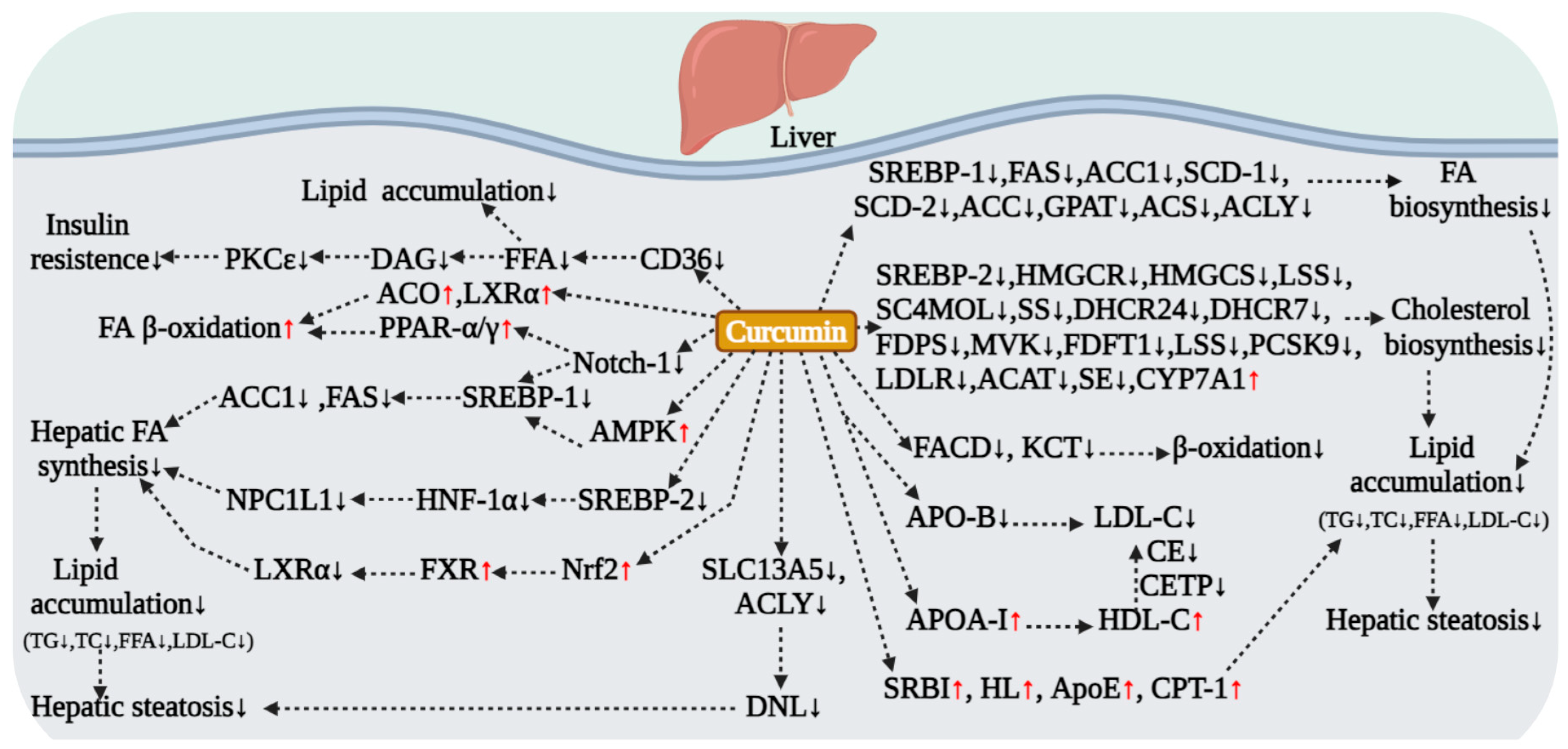
Curcumin profoundly regulates glucose metabolism by targeting critical steps in hepatic gluconeogenesis and glycogen synthesis (Figure 1). A central mechanism of its action is the activation of the AMPK signaling pathway. Studies have demonstrated that curcumin reduces glucose production in primary hepatocytes in vitro through an insulin-independent mechanism, which involves the activation of AMPK and the inhibition of key rate-limiting enzymes for gluconeogenesis, specifically G6Pase and PEPCK. This process significantly decreases both gluconeogenesis and glycogenolysis [58]. Furthermore, this effect has been substantiated in whole-animal experiments: curcumin can reverse abnormal pyruvate tolerance—pyruvate being a key substrate for gluconeogenesis—in mice fed an HFD and alleviate hyperglycemia induced by glucagon, thereby confirming its potent ability to inhibit hepatic glucose output [45,46].
While effectively suppressing gluconeogenesis, curcumin also promotes hepatic glycogen synthesis, thereby bidirectionally regulating glucose balance in the liver. In rat models of obesity and type 2 diabetes, curcumin treatment significantly increased hepatic glycogen levels that had been reduced due to abnormal blood sugar [59]. Further mechanistic studies revealed that curcumin could enhance hepatic glycogen synthesis in fasting mice by inhibiting the expression of glycogen synthase kinase (GSK3-β) [59]. Collectively, these findings indicate that through the activation of AMPK signaling, curcumin can simultaneously inhibit hepatic glucose production and promote hepatic glycogen storage, thereby playing a central role in regulating glucose homeostasis at the hepatic level (Figure 1).

4.3. Improving Hepatic Glucose Metabolism by Intervening in Glucose-Lipid Metabolic Crosstalk

The imbalance between hepatic gluconeogenesis and lipid metabolism disorders is intricately intertwined, collectively promoting the progression of metabolic diseases [60]. Research indicates that curcumin intervenes in this complex pathological process through multiple mechanisms (Figure 1). Firstly, in palmitic acid-stimulated primary hepatocytes, curcumin reverses the glucagon-mediated activation of the cAMP/PKA pathway, thereby suppressing endogenous glucose production. This suggests that modulating cAMP homeostasis may serve as an upstream target for inhibiting gluconeogenesis [46]. In an HFD mouse model, curcumin maintains hepatic PDE4B activity (which is responsible for cAMP degradation) in an AMPK-dependent manner, reduces cAMP accumulation, and blocks PKA activation. Additionally, it suppresses the expression of PGC-1α and its downstream gluconeogenic enzymes, PEPCK and G6Pase, thereby decreasing hepatic glucose production (HGP) through the inactivation of CREB via dephosphorylation [46].
Curcumin plays a significant role in the gluconeogenesis pathway driven by acetyl-CoA derived from fatty acid oxidation. It reduces the accumulation of acetyl-CoA and its activating effect on pyruvate carboxylase (PC) by inhibiting the expression of pyruvate dehydrogenase kinase 4 (PDK4) and preserving the activity of pyruvate dehydrogenase (PDH). This action effectively obstructs the hepatic gluconeogenesis process that is initiated by pyruvate carboxylation. Additionally, this mechanism is linked to a reduction in hepatic fatty acid oxidation and a decrease in the activity of mitochondrial complex I [46]. It is important to note that excessive free fatty acids (FFAs) in circulation serve not only as critical substrates for stimulating hepatic glucose production but also contribute to the worsening of systemic IR. Curcumin plays a crucial role in this process. In an HFD-induced obese mouse model, treatment with curcumin not only improved glucose tolerance but also reduced circulating free fatty acid (FFA) levels by inhibiting the breakdown of adipose tissue [46]. Additionally, by downregulating the expression of the fatty acid transporter protein CD36 on hepatocyte membranes, curcumin blocked the intrahepatic transport of FFAs, thereby alleviating ectopic lipid deposition in the liver [45]. Furthermore, curcumin restored the normal inhibitory effect of insulin on hepatic gluconeogenesis by reducing hepatic diacylglycerol (DAG) deposition and inhibiting the translocation of protein kinase C epsilon (PKCε), thereby enhancing hepatic insulin sensitivity at multiple levels [45]. Notably, the association between DAG deposition in muscle tissue and IR has also been observed in patients with obesity and T2DM [61].
Moreover, the beneficial effects of curcumin extend to the process of hepatic fibrosis, which is closely linked to glycolipid metabolic disorders. Activated hepatic stellate cells (HSCs) play a central role in hepatic fibrosis and rely heavily on glycolytic metabolism to sustain their activated phenotype. Research has demonstrated that curcumin activates the AMPK signaling pathway, which targets and inhibits the expression of hexokinase (HK), 6-phosphofructo-2-kinase (PFK2), and glucose transporter (GLUT4) in HSCs. This inhibition of glycolytic metabolism leads to a reduction in intracellular glucose levels and lactate production, ultimately contributing to its anti-fibrotic effects [62].
From a broader perspective of systemic energy metabolism, curcumin exhibits a remarkable capacity for remodeling. Under pathological conditions such as hyperlipidemia, the activation of glycolysis and gluconeogenesis results in an excessive accumulation of acetyl-CoA, which inhibits the TCA cycle and forces energy metabolism to shift towards lipid oxidation. Metabolomic analyses of mouse models on an HFD have shown that curcumin treatment significantly increases the levels of TCA cycle metabolites, including citrate, succinate, and cis-aconitate, while simultaneously reducing the concentrations of pyruvate, lactate, and glucose. This confirms curcumin’s ability to inhibit abnormal glycolysis and gluconeogenesis pathways, effectively redirecting energy metabolism towards a normal oxidative metabolic pattern [63]. Clinical trials have demonstrated that curcumin significantly reduces the levels of TCA cycle intermediates in patients’ serum, including succinate, citrate, and α-ketoglutarate. This reduction indicates curcumin’s ability to optimize TCA cycle function and fundamentally improve glucose metabolism disorders [7]. Collectively, these findings illustrate that curcumin, by regulating core metabolic nodes in the liver, exerts systemic beneficial effects by integrating the glycolipid metabolic network and reshaping whole-body energy homeostasis (Figure 1).

4.4. Curcumin Regulation and Improvement in Muscle Metabolic Function

Skeletal muscle plays a crucial role in glucose metabolism within the body, and its dysfunction can directly contribute to systemic IR. In animal models of obesity and diabetes, the expression levels of the glucose transporter GLUT4 and glycogen content in skeletal muscle are significantly diminished [59,64,65,66]. Similarly, in the brain tissues of animals with diabetes induced by an HFD or streptozotocin (STZ), the expression of GLUT1 and GLUT3 also exhibits a downward trend, which is a characteristic pathological feature of chronic hyperglycemia [67,68]. This suppression of glucose transporter expression is regarded as an adaptive protective mechanism by the body in response to persistent hyperglycemia, as it limits excessive glucose influx to prevent glucotoxicity damage.
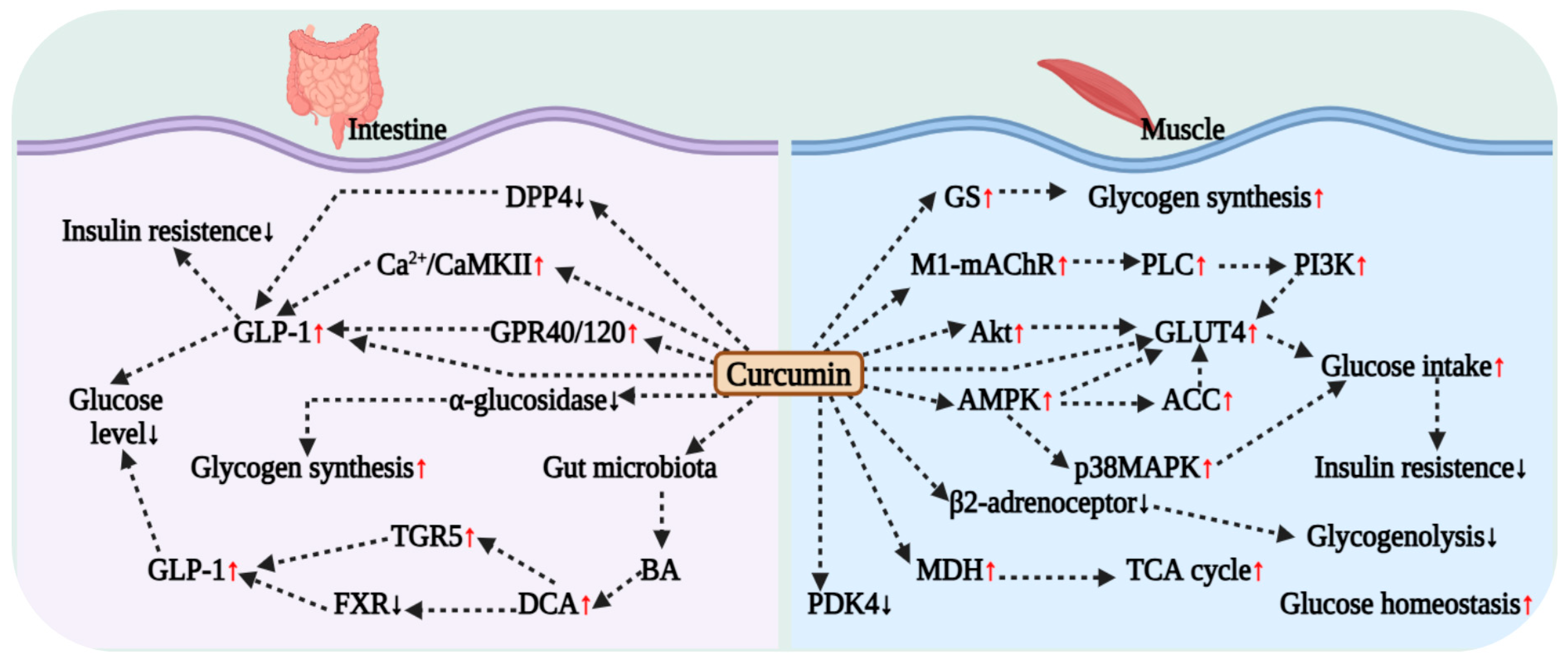
Curcumin enhances glucose uptake by activating the AMPK and Akt signaling pathways (Figure 2). In C2C12 myocytes, curcumin stimulates AMPK-ACC and Akt signaling, promoting GLUT4 translocation to the plasma membrane and thereby facilitating glucose uptake [69]. Na et al. demonstrated that curcumin reverses palmitate-induced impairment of glucose uptake in L6 myotubes in a dose-dependent manner, a mechanism that involves AMPK-mediated upregulation of GLUT4 membrane expression [70]. Furthermore, Deng et al. found that curcumin improves insulin sensitivity by restoring IRS-1 expression, stimulating Akt phosphorylation, and activating MAPK signaling in palmitate-treated C2C12 cells [71]. Additional animal studies have confirmed that curcumin activates the AMPK-p38MAPK signaling pathway, promoting glucose uptake in mouse skeletal muscle [71].
Furthermore, curcumin has been shown to regulate muscle glucose metabolism through various mechanisms. Cheng et al. reported that curcumin enhances GLUT4 membrane localization in rat skeletal muscle by activating the M1-mAChR-PLC-PI3K pathway, which subsequently promotes glucose uptake [72]. In diabetic animal models, curcumin treatment upregulates GLUT4 expression in skeletal muscle, leading to significant improvements in blood glucose levels and body weight [59]. Additionally, curcumin treatment has been observed to increase GLUT4 expression in white adipose tissue in obese mice [12]. Moreover, curcumin effectively maintains glucose homeostasis by inhibiting β(2)-adrenergic receptor-mediated glycogenolysis and restoring mitochondrial malate dehydrogenase (MDH) activity in the skeletal muscle of diabetic rats [73,74].
Curcumin also exerts regulatory effects on glycogen synthesis and PDK4 expression. In diabetic rat skeletal muscle and insulin-resistant L6 myotube cells, curcumin significantly enhances glucose metabolic activity in skeletal muscle by inhibiting PDK4 expression and reducing the phosphorylation level of glycogen synthase (GS), thereby promoting glycogen synthesis. Interestingly, Lakshmanan et al. found that curcumin treatment reversed the compensatory elevation of GLUT4 expression in the brains of diabetic encephalopathy rats. This may be related to the inhibition of AMPK activation-mediated enhancement of GLUT4 expression. However, the significant reduction in blood glucose levels after treatment fully confirms the overall hypoglycemic efficacy of curcumin [70,75]. In summary, curcumin exerts its hypoglycemic effect by regulating muscle glucose metabolism activity through multiple targets, although the detailed mechanisms still require further elucidation (Figure 2).

4.5. Effect of Curcumin on Intestinal Glucose Metabolism

Curcumin enhances GLP-1 secretion through various pathways, thereby improving glucose metabolism. In turn, GLP-1 synergistically alleviates hyperglycemia and IR by increasing the glucose sensitivity of pancreatic β cells, promoting insulin secretion, and inhibiting glucagon release (Figure 2).
In both cellular and animal models, curcumin has been demonstrated to directly stimulate the secretion of GLP-1 and elucidate its underlying mechanisms. Studies indicate that curcumin enhances GLP-1 secretion in a dose-dependent manner in mouse STC-1 cells, which are representative of enteroendocrine L cells [13]. Takikawa et al. confirmed that curcumin also promotes GLP-1 secretion in the mouse enteroendocrine L cell line (GLUTag cells) by activating the Ca2+/CaMKII signaling pathway [76,77]. In animal models, curcumin has been shown to increase plasma GLP-1 and insulin levels in rats with impaired glucose tolerance by activating GPR40/120 receptors, leading to significant improvements in glucose tolerance and blood sugar control [77]. More importantly, in obesity models, curcumin restores the abundance of intestinal L-cells and promotes GLP-1 secretion through the gut microbiota-bile acid-TGR5/FXR axis, markedly ameliorating the obesity phenotype. This mechanism may be central to its regulation of GLP-1 levels [78]. Furthermore, randomized clinical trials have confirmed the enhancing effect of curcumin on human GLP-1 levels. Studies indicate that 24 weeks of curcumin supplementation significantly increases serum GLP-1 levels in patients [40], providing direct human data to support its clinical application (Table 1).
In addition to promoting GLP-1 secretion, curcumin may also regulate intestinal glucose metabolism by inhibiting the activity of related enzymes. In vitro studies have confirmed that curcumin can act as a potential inhibitor of α-glucosidase and dipeptidyl peptidase-4 (DPP-4, which causes rapid degradation and inactivation of endogenous GLP-1). However, in vivo experiments indicate that its enzyme inhibitory effects may differ due to bioavailability limitations [79,80,81]. In a mouse model of obesity induced by a high-fat, high-sugar diet, curcumin achieved blood glucose control by inhibiting small intestinal α-glucosidase activity and promoting glycogen synthesis in the liver and muscles. Nevertheless, its inhibitory effect on DPP-4 was limited [81], potentially related to its low bioavailability characteristics in vivo [82]. In summary, curcumin regulates intestinal glucose metabolism through a synergistic multi-pathway strategy that primarily promotes GLP-1 secretion while secondarily inhibiting intestinal sugar-digesting enzymes, presenting a potential therapeutic strategy for blood glucose management in obese and type 2 diabetic patients (Figure 2).

5. Curcumin Regulates Lipid Metabolism

5.1. Effect of Curcumin on Blood Lipid Metabolism

Blood lipid levels, including total cholesterol (TC), low-density lipoprotein cholesterol (LDL-C), high-density lipoprotein cholesterol (HDL-C), and triglycerides (TG), serve as fundamental indicators for evaluating metabolic health in humans. Disorders in lipid metabolism are notably prevalent among individuals with obesity and related metabolic diseases. Clinical studies have demonstrated that curcumin can enhance lipid metabolic homeostasis by targeting multiple pathways, leading to a significant reduction in dyslipidemia levels in patients suffering from obesity, T2DM, NAFLD, and metabolic syndrome (Table 1).
In populations characterized by obesity and overweight, several randomized controlled trials have substantiated the lipid-modulating effects of curcumin (Table 1). One study demonstrated that overweight or obese patients with NAFLD who consumed nanocapsules of curcumin (80 mg/day) for three consecutive months experienced significant reductions in fasting blood glucose (FBG), glycated hemoglobin (HbA1C), insulin resistance index (HOMA-IR), TG, TC, and LDL-C levels. In contrast, HDL-C and the quantitative insulin sensitivity index (QUICKI) showed marked improvements [83]. Another randomized controlled trial indicated that continuous intake of 1 g/day of curcumin for 30 days led to a significant decrease in plasma TG levels among obese patients [84]. Furthermore, after 8 weeks of supplementation with plant-based curcumin tablets (800 mg/day), overweight subjects exhibited a significant reduction in plasma triglyceride (TG) and HDL-C levels. Additionally, notable improvements were observed from baseline in fasting plasma insulin (FPI), HOMA index, waist circumference, blood pressure, liver enzymes (transaminases and gamma-glutamyl transferase (γ-GT)), hepatic steatosis index, and serum cortisol levels [85].
Curcumin has been shown to have significant intervention effects in patients with T2DM, who frequently present with concurrent hyperlipidemia (Table 1). Clinical trials indicate that daily doses of curcumin at 1500 mg and 1000 mg can significantly reduce serum TG, lipoprotein(a) [LP(a)], and non-LDL cholesterol levels in T2DM patients, while simultaneously increasing HDL-C levels [86]. Additionally, another study demonstrated that a daily intake of 80 mg of nano-curcumin capsules over 12 weeks led to significant reductions in TG, TC, LDL-C, very-low-density lipoprotein cholesterol (VLDL-C), and the TC/HDL-C ratio [51]. The mechanism underlying these effects is partially attributed to the activation of lipoprotein lipase (LPL), as increased LPL activity enhances the hydrolysis of TG. Furthermore, a double-blind, placebo-controlled trial revealed that daily supplementation with 300 mg of curcumin for three months significantly reduced serum free fatty acids (FFAs) and TG levels in overweight and obese T2DM subjects, which was accompanied by an increase in LPL activity and an overall improvement in lipid metabolism disorders [51,52].
In patients with NAFLD, curcumin has been shown to exert beneficial effects on dyslipidemia (Table 1). For example, a study found that after NAFLD patients were administered 500 mg/d of curcumin for 8 consecutive weeks, their serum triglyceride (TG), TC, and LDL-C levels were significantly lower compared to those in the placebo group [87]. Furthermore, research conducted by Panahi et al. indicated that a dosage of 1000 mg/d of curcumin over 8 weeks led to a significant reduction in liver fat content, as well as levels of LDL-C, TG, TC, and non-high-density lipoprotein cholesterol (non-HDL-C) in NAFLD patients [88]. Additionally, dose–response studies have demonstrated that administering 250 mg/d of phosphatidyl curcumin capsules for 8 weeks significantly increased HDL-C levels in NAFLD patients [89]. Increasing the dosage to 1500 mg/d further reduced serum levels of TC, LDL-C, HDL-C, TG, and non-HDL-C while improving the hepatic lipid index [90].
It is noteworthy that the lipid-regulating effects of curcumin are associated with the modulation of adipokines. Adiponectin, a crucial factor that enhances insulin sensitivity and inhibits fatty acid synthase activity, plays a pivotal role in ameliorating insulin resistance and remodeling glucose and lipid metabolic homeostasis. Clinical studies have confirmed that curcumin intervention significantly elevates serum adiponectin levels while reducing leptin levels in patients, thereby synergistically improving symptoms of lipid metabolism disorders [54,89,91].

5.2. Curcumin Regulation of Hepatic Lipid Metabolism

5.2.1. Core Regulatory Strategies: Inhibiting Lipogenesis and Promoting Lipolysis

The liver serves as the central regulator of lipid metabolism and is subject to functional disturbances that result in abnormal lipid accumulation. Curcumin has been shown to effectively reverse hepatic and circulatory lipid metabolic disorders induced by dietary obesity (Figure 3). In animal models of dietary obesity, curcumin significantly reduces hepatic lipid content, inhibits lipid droplet formation, and ameliorates steatosis [45,46,92]. This is achieved by suppressing the activities of fatty acid synthase (FAS), the rate-limiting enzyme for cholesterol synthesis (HMGCR), and acyl-CoA cholesterol acyltransferase (ACAT), while simultaneously activating hepatic fatty acid β-oxidation. This mechanism synergistically reduces hepatic lipid peroxidation by inhibiting fatty acid and cholesterol biosynthesis, as evidenced by significant reductions in hepatic cholesterol and triglyceride levels [92]. For instance, in an HFD mouse model, curcumin reduces the accumulation of acetyl-CoA (the end product of β-oxidation) in the liver by downregulating the expression of fatty acyl-CoA dehydrogenase (FACD) and 3-ketoacyl-CoA thiolase (KCT), thereby inhibiting fatty acid oxidation [46].

5.2.2. Inhibiting Lipogenesis via the AMPK/SREBP Signaling Axis

Extensive research has confirmed that the activation of AMPK signaling represents the primary mechanism through which curcumin multi-dimensionally regulates hepatic lipid metabolism (Figure 3). Both pharmacological and clinical doses of curcumin significantly inhibit the activity of hepatic lipid synthesis genes induced by an HFD [47,93], thereby suppressing de novo fatty acid synthesis and lipid accumulation [94,95,96]. Studies conducted at the cellular level have demonstrated that in Huh-7/SRE-Luc cells, curcumin broadly inhibits the transcription of SREBP target genes, including nine fatty acid and triglyceride synthesis genes (such as SREBP-1, FAS, ACC1, and SCD-1) as well as eleven cholesterol synthesis-related genes (including SREBP-2, HMGCR, HMGCS, and MVK), resulting in a marked reduction in cholesterol and triglyceride levels [93]. Further investigations using animal models have revealed that in HFD-induced obese mice, curcumin downregulates the expression of hepatic cholesterol biosynthesis genes (such as HMGCR, FDPS, DHCR24) and fatty acid metabolism genes (including ACC1, FAS, and SCD-1) at the mRNA level, while simultaneously upregulating the expression of SRBI, HL, and ApoE to accelerate lipolysis. This indicates that curcumin reduces hepatic lipid synthesis and promotes decomposition by inhibiting the SREBP-1 and SREBP-2 pathways [93,95]. Additionally, curcumin effectively reverses HFD-induced hepatic steatosis by activating AMPK signaling and downregulating SREBP-1 along with its downstream target genes, ACC1 and FAS [94].

5.2.3. Regulating Fatty Acid Transport and Alleviating Lipotoxicity

Curcumin effectively alleviates hepatic lipotoxicity by modulating the transport and metabolism of fatty acids. The fatty acid transporter CD36 plays a critical role in mediating hepatic lipid accumulation. Curcumin reduces circulating lipid levels and diminishes their transport into the liver by inhibiting the expression of CD36 in the liver of HFD-induced obese mouse models, consequently decreasing ectopic lipid deposition [45]. Additionally, curcumin activates AMPK to inhibit the cAMP/PKA signaling pathway in adipose tissue, thereby suppressing lipid breakdown in the adipose tissue of HFD-fed mice. This mechanism synergistically downregulates the expression of hepatic CD36, leading to a reduction in the influx of free fatty acids (FFAs) into the liver, which alleviates lipid deposition and insulin resistance [45]. Clinical trials have further validated the efficacy of curcumin in reducing serum TG, free fatty acids (FFAs), fasting blood glucose, and HbA1c levels in patients with non-alcoholic simple fatty liver (NASFL). These findings suggest that the inhibition of hepatic DNL may be a crucial mechanism through which curcumin ameliorates fatty liver disease [40] (Figure 3).

5.2.4. Regulation of Lipid Metabolism via Multiple AMPK-Independent Pathways

Curcumin exerts lipid-regulating effects through several AMPK-independent pathways (Figure 3). In an HFD mouse model, curcumin enhances the expression of hepatic PPARα and LXRα, thereby activating the transcription of genes involved in fatty acid oxidation and cholesterol transport. This is evidenced by the upregulation of APOA-I and the downregulation of HMGR and APO-B, which significantly reduces hepatic cholesterol and triglyceride accumulation [97]. Additionally, by inhibiting the activity of cholesteryl ester transfer protein (CETP), curcumin prevents the transfer of cholesteryl esters and TG between HDL and LDL, reduces VLDL production, and enhances LDL clearance, ultimately leading to increased HDL-C levels [97]. Zhao et al. discovered that curcumin downregulates SREBP-1 expression by inhibiting the Notch-1 signaling pathway, which suppresses hepatic lipogenic genes (FAS, ACC) while promoting the expression of lipolytic genes (PPAR-α, PPAR-γ, CPT-1), thereby improving lipid metabolism in the livers of HFD-fed rats [98]. Curcumin has been shown to influence the metabolism of bile acids and the excretion of cholesterol. It promotes the catabolism of fatty acids in the liver of HFD rats by activating the rate-limiting enzyme of fatty acid β-oxidation, acyl-CoA oxidase (ACO), which subsequently reduces hepatic triglyceride (TG) and plasma very-low-density lipoprotein triglyceride (VLDL-TG) levels [99]. Further research conducted by Babu et al. indicates that curcumin enhances cholesterol catabolism by activating cholesterol 7α-hydroxylase (CYP7A1), leading to decreased circulating lipid levels [100]. Additionally, curcumin accelerates the conversion of cholesterol to bile acids by upregulating hepatic cholesterol 7α-hydroxylase (CYP7A1), which results in lower serum levels of TC, TG, and LDL-C, while increasing the excretion of TG and TC in feces [101]. Furthermore, curcumin downregulates the expression of Niemann-Pick C1-like 1 (NPC1L1) in both the intestine and liver by inhibiting the SREBP-2/HNF1α signaling pathway, thereby reducing the reabsorption of biliary cholesterol and promoting the excretion of neutral cholesterol in feces, effectively reversing hepatic cholesterol accumulation [102]. Clinical studies have also confirmed that curcumin intervention can lower serum levels of bile acids, including taurocholic acid, chenodeoxycholic acid, and lithocholic acid, thereby regulating bile acid metabolism [7].

5.2.5. Validation in NAFLD and Diabetic Models

The beneficial effects of curcumin on hepatic lipid metabolism have been validated across various disease models, indicating its potential for clinical application. In diabetic models, animal studies demonstrate that curcumin significantly reduces plasma levels of free fatty acids (FFAs), TC, and TG by inhibiting the activities of hepatic fatty acid synthase (FAS), carnitine palmitoyltransferase (CPT), 3-hydroxy-3-methylglutaryl-CoA reductase (HMGCR), and acyl-CoA cholesterol acyltransferase (ACAT), while simultaneously decreasing β-oxidation activity [47]. In streptozotocin (STZ)-induced type 1 diabetes models, curcumin mitigates renal lipid accumulation by activating the renal AMPK signaling pathway, which suppresses the expression of sterol regulatory element-binding protein 1c (SREBP-1c) and its downstream genes, including adipose differentiation-related protein (ADRP), acetyl-CoA carboxylase (ACC), and FAS [103]. In NAFLD and non-alcoholic steatohepatitis (NASH) models, curcumin treatment significantly reduces hepatic levels of TC, TG, and non-esterified fatty acids (NEFAs), and inhibits the expression of SREBP-1c, FAS, and CD36 by activating the nuclear factor erythroid 2-related factor 2 (Nrf2)/farnesoid X receptor (FXR)/liver X receptor alpha (LXRα) signaling axis, thereby decreasing hepatic lipid droplet accumulation [104]. In vitro studies have shown that curcumin can inhibit the abnormal elevation of SLC13A5 and ATP citrate lyase (ACLY) induced by oleic acid/palmitic acid (OPA) in primary hepatocytes, thereby reducing intracellular triglyceride (TG) accumulation. Subsequent in vivo studies have confirmed that curcumin restores citrate homeostasis in hepatocytes by inhibiting the SLC13A5 and ACLY signaling pathways, which synergistically reduce de novo lipogenesis (DNL) and ameliorate steatosis [105]. These multifaceted mechanisms of action have been partially validated in clinical trials of curcumin treatment [7,88,90], suggesting that curcumin may be a promising strategy for improving lipid metabolism disorders associated with obesity, T2DM, and NAFLD (Table 1).

5.3. Curcumin Regulation of Adipocyte Lipid Metabolism

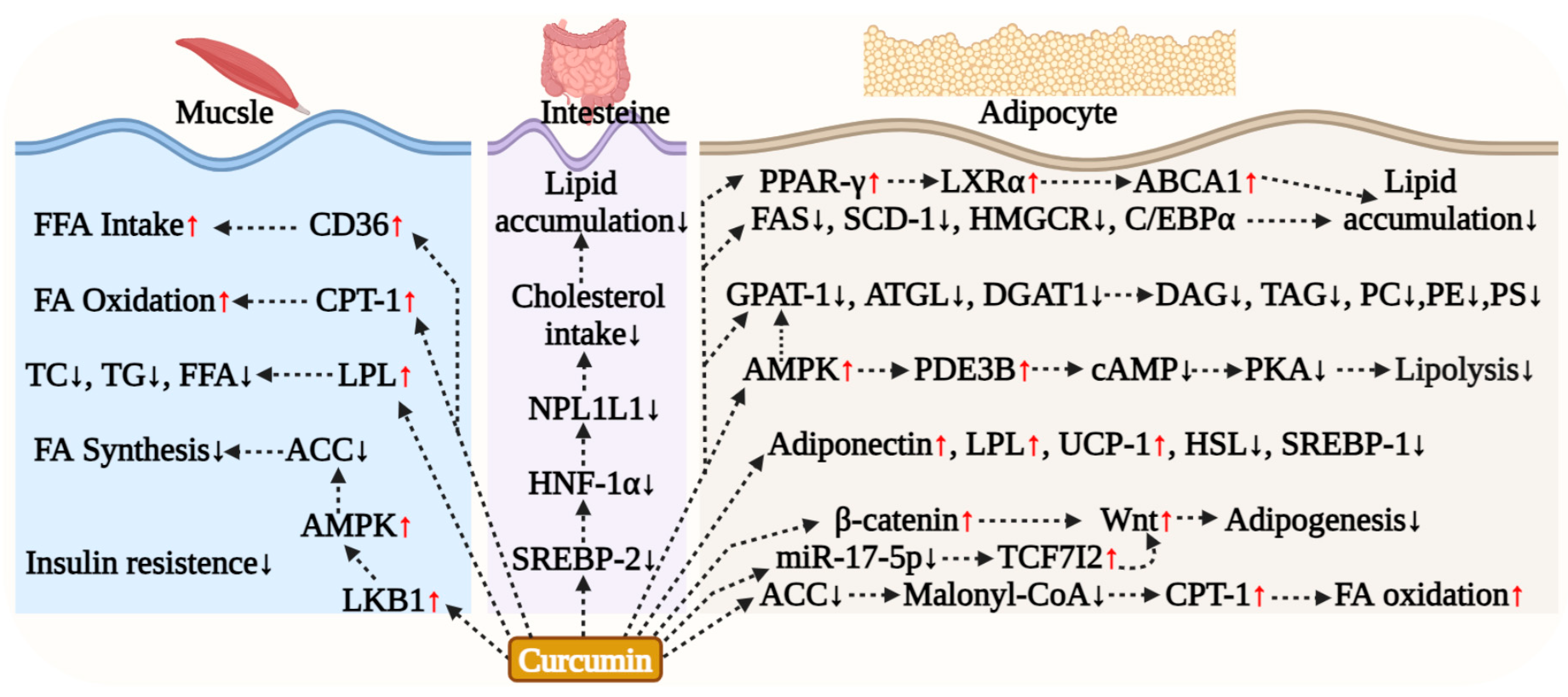
The ameliorative effect of curcumin on systemic lipid metabolism is closely linked to its direct regulation of adipocyte function. Its effects are primarily evident in the inhibition of adipogenesis, the promotion of lipolysis and oxidation, and the induction of adipose browning (Figure 4).
Curcumin effectively inhibits adipogenesis and regulates adipocyte differentiation. In animal models, curcumin treatment significantly reduces serum TC, TG, and LDL-C levels in HFD mice while also decreasing epididymal fat weight and adipocyte diameter [93]. Similar studies have demonstrated that curcumin inhibits lipid deposition in the epididymal fat of HFD rats [99], further corroborating its effects at the cellular level by significantly reducing fat weight. At the cellular level, curcumin inhibits the differentiation of mouse 3T3-L1 preadipocytes into mature adipocytes in a dose-dependent manner [106,107]. The underlying mechanisms involve multiple aspects: specifically, curcumin downregulates the expression of fatty acid synthase (FAS), thereby inhibiting the differentiation process and lipid accumulation [107]. It also promotes β-catenin signaling and inhibits miR-17–5p, which enhances Tcf7L2 expression, subsequently synergistically increasing Wnt signaling activity and suppressing adipogenesis [108]. In the epididymal white adipose tissue (eWAT), curcumin inhibits the expression of key enzymes involved in triglyceride synthesis, including GPAT1, ATGL, and DGAT1, which reduces the levels of DAG and its derivatives (such as triacylglycerol (TAG), phosphatidylcholine (PC), and phosphatidylethanolamine (PE)) [109]. Additionally, curcumin downregulates stearoyl-CoA desaturase 1 (SCD1), leading to a decrease in the content of palmitoleic acid and oleic acid. Furthermore, curcumin can promote cholesterol efflux in adipocytes in a dose-dependent manner through the PPARγ-LXRα-ABCA1 axis, which further reduces lipid accumulation [110].
The AMPK signaling pathway plays a crucial role in the regulation of lipid metabolism by curcumin. Research has demonstrated that curcumin decreases intracellular lipid accumulation by activating AMPK activity in 3T3-L1 adipocytes, which inhibits the expression of acetyl-CoA carboxylase (ACC) and reduces the conversion of acetyl-CoA to malonyl-CoA. Additionally, curcumin dose-dependently upregulates carnitine palmitoyltransferase-1 (CPT-1), thereby promoting fatty acid oxidation, while simultaneously downregulating GPAT1 to inhibit fatty acid esterification. This effect has been confirmed in HFD mouse models [106]. Moreover, curcumin treatment significantly lowers the expression of key adipogenic transcription factors, including PPARγ and C/EBPα, in subcutaneous adipose tissue, while concurrently reducing serum cholesterol, TG, free fatty acids, body weight, and body fat content [106]. Mechanistic expansion studies have further elucidated that curcumin inhibits cAMP/PKA signaling through the activation of AMPK, while simultaneously restoring the activity of phosphodiesterase 3B (PDE3B) to enhance cAMP degradation. This dual action synergistically increases AMP levels in adipose tissue and decreases cAMP accumulation, ultimately leading to the inhibition of lipolysis [45]. In the HFD mouse model, curcumin also specifically suppressed the transcriptional activity of SREBP-1c and the activation of hormone-sensitive lipase (HSL) in adipose tissue, resulting in a significant reduction in the release of glycerol and free fatty acids (FFAs) [45].
Furthermore, curcumin promotes the beneficial remodeling of adipocytes, including the induction of white fat browning. Studies conducted by Ding et al. demonstrate that curcumin enhances the expression of uncoupling protein 1 (UCP-1), lipoprotein lipase (LPL), and adiponectin in both brown adipose tissue (BAT) and white adipose tissue (WAT), while simultaneously reducing the expression of fatty acid synthase (FAS), stearoyl-CoA desaturase-1 (SCD-1), and 3-hydroxy-3-methyl-glutaryl-CoA reductase (HMGCR). This modulation contributes to improved fatty acid oxidation metabolism in adipocytes [93].
In summary, curcumin exerts a multidimensional influence on adipocyte function through a regulatory network that encompasses various pathways involved in both fat synthesis and decomposition. This provides a significant mechanistic foundation for the prevention and treatment of obesity and related metabolic diseases (Figure 4).

5.4. Curcumin Effect on Muscle Lipid Metabolism

Research has demonstrated that curcumin can significantly alleviate muscle insulin resistance by enhancing lipid oxidation and energy conversion in skeletal muscle. In both diabetic rat skeletal muscle and L6 myotube cells, curcumin activates the LKB1-AMPK signaling pathway, inhibits the activity of acetyl-CoA carboxylase (ACC) to decrease fatty acid synthesis, and upregulates the expression of the fatty acid transporter CD36 and carnitine palmitoyltransferase-1 (CPT-1), thereby promoting the uptake and oxidation of free fatty acids [70]. This effect has also been corroborated in C2C12 mouse skeletal muscle cells [71]. Furthermore, animal studies have shown that curcumin treatment not only significantly increases hepatic glycogen reserves and skeletal muscle lipoprotein lipase (LPL) activity in diabetic mice but also concurrently reduces plasma levels of free fatty acids, cholesterol, and TG [47]. Collectively, this evidence suggests that curcumin is an effective intervention for improving disorders of lipid metabolism in skeletal muscle (Figure 4).

5.5. Curcumin Effect on Intestinal Lipid Metabolism

Curcumin’s cholesterol-lowering effect is attributed to its dual inhibition of hepatic synthesis and intestinal absorption, with the latter likely playing a more pivotal role. Due to curcumin’s extremely low bioavailability following oral administration, its high local concentration in the intestine allows it to directly target cholesterol absorption pathways. Specifically, curcumin significantly downregulates the expression of Niemann-Pick C1-Like 1 (NPC1L1), a key transporter involved in intestinal cholesterol absorption, by inhibiting the SREBP-2/HNF1α signaling pathway. This action reduces cholesterol absorption and alleviates hepatic lipid accumulation [102,111,112,113]. This mechanism has been validated in both HFD mice [113,114,115] and ApoE−/− mouse models [116], where curcumin treatment decreases the saturation of bile cholesterol in the intestine, reduces cholesterol absorption in the small intestine, and promotes the excretion of neutral sterols in feces, ultimately leading to a significant reduction in serum and liver cholesterol levels. Therefore, the targeted inhibition of the intestinal cholesterol absorption pathway may represent the primary mechanism through which curcumin exerts its cholesterol-lowering effects (Figure 4).

6. Curcumin Modulation of Amino Acid and Protein Metabolism

6.1. Multi-Target Regulation of Amino Acid and Protein Metabolism by Curcumin

Amino acids serve not only as the fundamental units of protein biosynthesis but also play a crucial role in regulating various physiological functions. They are involved in hormone synthesis, neurotransmitter production, signal transduction, and energy metabolism [117]. The health and disease states of an organism are fundamentally determined by the dynamic balance within the network of signaling molecules. These molecules maintain physiological homeostasis by precisely regulating cell proliferation, differentiation, and responses to environmental stimuli. An imbalance in their expression directly drives the pathological processes of specific diseases through abnormal signal cascade reactions, leading to cellular dysfunction and tissue-specific damage [117].
Metabolic diseases characterized by complex network dysregulation often pose significant challenges to current therapeutic strategies, which typically focus on single-target interventions. These approaches frequently prove inadequate when addressing the multi-pathway and multi-organ pathological mechanisms inherent in these conditions. In contrast, curcumin, a natural bioactive compound, exhibits multi-target regulatory properties that may offer a more effective therapeutic approach, can extensively modulate the activities of various signaling molecules through multimodal molecular interactions, including covalent modification, hydrophobic interactions, and hydrogen bonding [118]. It exhibits significant potential in regulating amino acid metabolism, modifying protein synthesis, and facilitating catabolism. Preclinical and clinical studies have demonstrated that curcumin significantly influences the levels of branched-chain amino acids (leucine, isoleucine, valine) and functional amino acids (arginine, glycine, alanine) in the body through various metabolic pathways [7,63,119]. Clinical research has also shown that curcumin can notably reduce the levels of branched-chain amino acids and their metabolites, including 3-methyl-2-oxovaleric acid, 3-hydroxyisobutyric acid, and kynurenine, in the serum of patients with obesity or NAFLD [7]. Furthermore, due to its unique chemical structure and molecular conformation, curcumin can directly target and bind to a variety of functional proteins, including inflammatory mediators (such as NF-κB), epigenetic modifying enzymes (such as histone acetyltransferases (HATs) and histone deacetylases (HDACs)), kinases, metabolic enzymes (including glyoxalase I (GLOI) and sarco/endoplasmic reticulum Ca2+-ATPase (SERCA)), proteasomes, carrier proteins, and nucleic acid molecules (such as DNA and RNA) [118]. Despite the low bioavailability of curcumin, which limits its therapeutic efficacy, its solubility can be enhanced to some extent by utilizing its binding capacity with carrier proteins. It is important to note that curcumin’s role in amino acid and protein metabolism is not an isolated phenomenon; rather, it exemplifies its systemic and multi-target regulatory capabilities. Extensive research has demonstrated that curcumin significantly influences a variety of functional molecules—such as transcription factors, enzymes, receptors, cell cycle proteins, and inflammatory mediators—through both direct and indirect mechanisms, thereby reshaping cellular signaling networks [7,118,119]. This fundamental characteristic enables curcumin to exert precise integrative regulatory effects in critical biological processes, including amino acid metabolism and protein synthesis and degradation, further underscoring its unique value as a systemic metabolic modulator.

6.2. Regulatory Role and Evidence of Curcumin in Muscle Protein Metabolism

Protein serves as the primary component of muscle and is essential for both muscle growth and maintenance. The process of muscle growth is governed by the balance between muscle protein synthesis (MPS) and muscle protein breakdown (MPB), with a direct positive correlation existing between the levels of protein synthesis and muscle mass [120]. Sarcopenia represents a significant pathological factor contributing to frailty and mobility impairments in the elderly population, characterized by a progressive decline in skeletal muscle mass, muscle strength, and physical function [121]. This condition is frequently associated with various diseases, including osteoporosis, obesity, and type 2 diabetes [16,122].
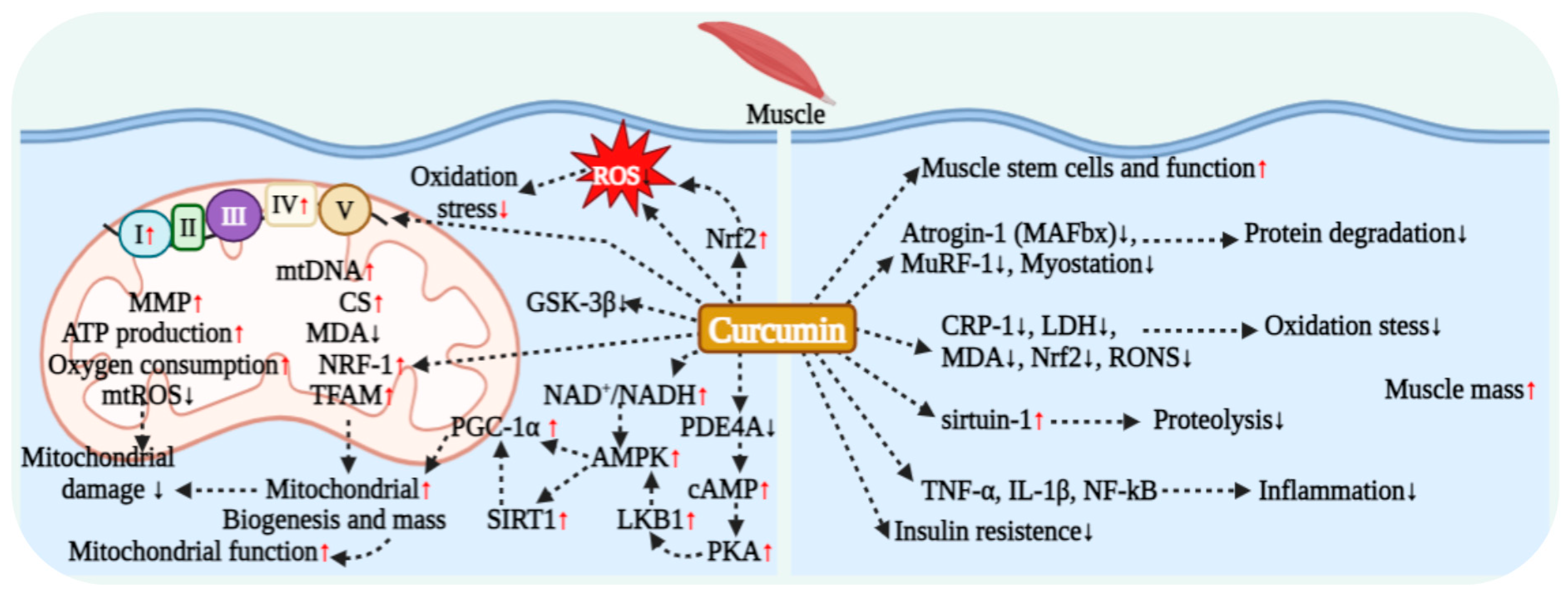
Recent research has demonstrated that curcumin has considerable potential in enhancing muscle protein metabolism (Figure 5). In a mouse model of diabetic skeletal muscle atrophy, curcumin treatment significantly reduced protein ubiquitination levels in skeletal muscle tissue. It specifically inhibited the expression of ubiquitin E3 ligases Atrogin-1 (also known as MAFbx) and MuRF1 genes, while simultaneously decreasing levels of inflammatory factors such as TNF-α and IL-1β, thereby alleviating oxidative stress. These effects ultimately lead to a significant mitigation of skeletal muscle atrophy symptoms [123]. Additionally, Receno et al. showed in an aged rat model that long-term dietary supplementation with curcumin markedly enhances skeletal muscle mass and motor function [120]. Furthermore, in a mouse model of contusion-induced muscle injury, curcumin effectively increased muscle mass by promoting the synthesis of specific proteins and accelerating the muscle regeneration process [124]. In a rat model of sarcopenia, treatment with curcumin significantly improved muscle endurance, grip strength, and the fat-to-lean mass ratio [125]. Studies examining chronic forced exercise-induced sarcopenia in mice revealed that curcumin treatment markedly increased the weights of the gastrocnemius and soleus muscles, as well as significantly enhanced calf circumference, strength, and total body protein content. This improvement was attributed to the upregulation of genes associated with muscle growth and protein synthesis, alongside the downregulation of genes related to degradation [121]. Research conducted by García et al. confirmed that curcumin effectively mitigated muscle degradation and loss induced by heavy loads in mice by activating the sirtuin-1 (SIRT1) signaling pathway, which in turn attenuated muscle protein hydrolysis and reduced the expression of signaling molecules associated with muscle atrophy [16]. This demonstrates that curcumin precisely integrates amino acid metabolism and protein turnover through its multi-level, multi-target direct and indirect effects, thereby fully revealing its unique value as a systemic metabolic regulator in maintaining protein homeostasis.

6.3. Antioxidant and Molecular Mechanisms of Curcumin’s Muscle Protective Effects

The decline of the skeletal muscle oxidative defense system, accompanied by excessive accumulation of reactive oxygen and nitrogen species (RONS) leading to oxidative stress, has been confirmed as a key pathological mechanism responsible for muscle mass loss and motor dysfunction [126] (Figure 5). Antioxidant and mitochondrial protection represent crucial mechanisms underlying curcumin’s muscle-protective effects. Curcumin, a potent antioxidant substantiated by multiple studies, demonstrates multi-target regulatory effects in a sarcopenia model mouse [17]. In a chronic forced exercise-induced sarcopenia model, curcumin treatment significantly alleviated lipid peroxidation, inflammation, and oxidative stress levels in the body while enhancing muscle weight and strength [121]. Treatment with the aqueous extract significantly downregulated the levels of myostatin, MuRF-1, and Atrogin-1, while increasing the activity of muscle antioxidant enzymes and reducing malondialdehyde (MDA) levels, thereby markedly alleviating symptoms of muscle atrophy [127]. Curcumin preserves muscle tissue health by modulating the body’s oxidative stress levels through the activation of the Nrf2 signaling pathway, which serves as a critical regulatory hub for cellular antioxidant defenses [120,128,129]. Furthermore, curcumin indirectly facilitates muscle mass improvement by sustaining the quantity and functional activity of muscle stem cells [130], safeguarding mitochondrial function, and inhibiting chronic low-grade inflammation [131,132,133]. Importantly, insulin, a fundamental hormone in regulating protein metabolism, demonstrates significant anti-proteolytic effects within muscle tissue. The enhancement of the insulin signaling pathway in skeletal muscle by curcumin may further augment its protective effects on muscle mass by promoting protein synthesis pathways [47,70,123].

6.4. Clinical Research Evidence

Clinical studies have shown that the curcumin formulation Meriva®, whether used alone or in combination with other nutritional supplements, can significantly enhance strength and physical performance in elderly subjects, reducing the risk of sarcopenia [134]. A double-blind, randomized controlled trial evaluated the impact of curcumin supplementation on exercise-induced injuries in moderately active women. The results demonstrated that oral administration of 500 mg/d curcumin for 8 consecutive weeks significantly reduced serum levels of C-reactive protein (CRP), lactate dehydrogenase (LDH), and malondialdehyde (MDA), indicating an improvement in exercise-induced oxidative stress status [135]. Skeletal muscle, recognized as the primary organ for glucose consumption in the body, exhibits a significant negative correlation between its mass and the risk of developing type 2 diabetes. This finding indicates that curcumin therapy, by preserving or enhancing muscle mass, may serve as an important intervention strategy for improving glucose metabolic disorders in patients with T2DM. However, the evidence supporting curcumin’s efficacy primarily derives from in vitro experiments and animal models. Given the positive outcomes demonstrated in existing research, we recommend advancing clinical translational studies to thoroughly investigate the potential benefits of curcumin on human health through systematic human trials.

7. Curcumin Regulation of Mitochondrial Respiration

Patients with obesity and related metabolic diseases frequently exhibit oxidative stress and mitochondrial dysfunction in various tissues and organs [136]. The underlying pathology involves defects in mitochondrial biogenesis and damage to the respiratory chain. Mitochondrial biogenesis is the regulatory process through which cells increase both the number and functionality of healthy mitochondria, encompassing proliferation, mtDNA replication, and protein assembly. This process is essential for compensating for functional defects, meeting energy demands, and responding to stress. Cellular respiration, the accompanying energy production process, is primarily governed by the interaction between PGC-1α and NRF1/2, which constitutes the core regulatory pathway. This interaction drives mitochondrial gene transcription and facilitates the synthesis, modification, and repair of mtDNA-related proteins via the activation of mitochondrial transcription factor A (TFAM) [136].
Mitochondria, as the central hub of energy metabolism, serve not only as the primary source of ROS but also as critical targets for their actions [137]. Physiological fluctuations in ROS levels are essential for redox signaling transduction; however, when ROS levels exceed a certain threshold, they can disrupt redox homeostasis, damage respiratory chain complexes, and subsequently trigger mitochondrial metabolic disorders and dysfunction. This cascade of events leads to the accumulation of oxidative damage, ultimately accelerating disease progression [138]. Research indicates that curcumin exerts protective effects through multiple mechanisms, including the regulation of mitochondrial biogenesis, the promotion of mitochondrial dynamic balance (fusion/fission), and the enhancement of metabolic substrate utilization, thereby demonstrating significant potential in the treatment of mitochondrial-related diseases.

7.1. Curcumin Regulation of Hepatocyte Mitochondrial Respiration

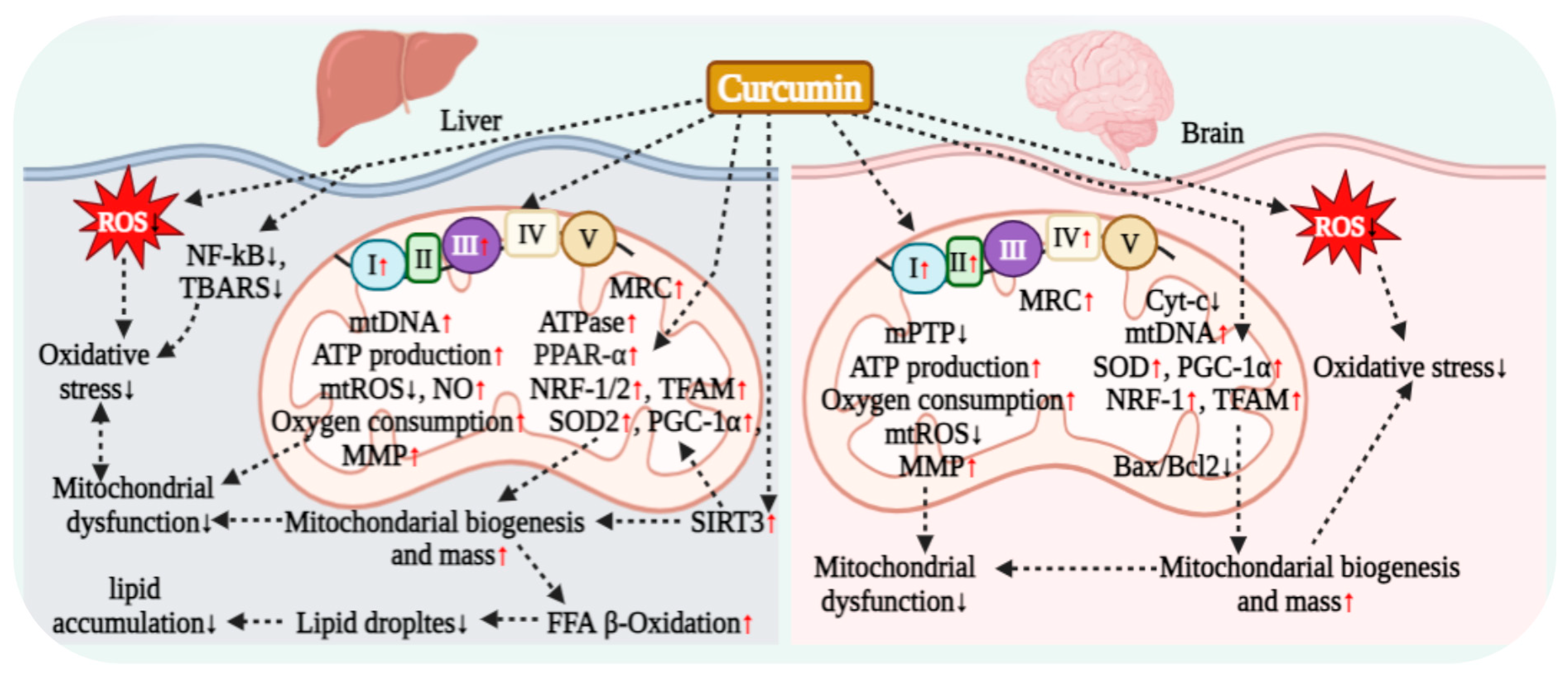
Free fatty acids (FFAs) are primarily transported via the bloodstream to the liver for metabolism, where mitochondria serve as the central site for fatty acid oxidation. In the pathological state of obesity, elevated circulating FFA enhances the liver’s capacity to uptake lipids, thereby directly inducing IR. Concurrently, the resulting hepatic lipid accumulation leads to an overload that triggers abnormal ROS generation. This process, through oxidative stress, impairs mitochondrial biogenesis and induces dysfunction [14,139]. Research indicates that curcumin can ameliorate this pathological process through multiple target mechanisms (Figure 6).
Bing et al. confirmed that in an FFA-induced hepatocyte model, pharmacological concentrations of curcumin significantly enhanced the activities of mitochondrial respiratory chain complexes I and III. This effect reversed the inhibition of mitochondrial respiratory chain (MRC) function and activated the expression of regulatory genes involved in mitochondrial biogenesis, specifically PGC-1α, NRF-1, and TFAM. Additionally, curcumin promoted mtDNA replication, thereby restoring the mitochondrial membrane potential (MMP), increasing ATP levels, and alleviating dysfunction [140]. Further studies demonstrated that in FFA-exposed hepatocytes, curcumin treatment simultaneously reduced intracellular lipid accumulation and mitochondrial ROS levels, restored the mRNA levels of SOD2, NRF1/2, and PGC-1α, and significantly increased mtDNA copy number and ATP production [14]. Notably, this process was accompanied by a reduction in the volume of lipid droplets in hepatocytes, suggesting that curcumin may facilitate metabolic remodeling by enhancing the capacity for fatty acid β-oxidation and improving mitochondrial biogenesis efficiency [14].
In the mouse model of obesity-associated hepatic steatosis (C57BL/6J ob/ob mice), treatment with curcumin significantly restored the function of liver mitochondrial respiratory chain complex I and enhanced ATP production efficiency [96]. This treatment concurrently normalized mitochondrial DNA (mtDNA) copy number and the expression levels of nuclear respiratory factor 1 (NRF1) and mitochondrial transcription factor A (TFAM), while also reducing NF-kB inflammatory signaling and oxidative stress markers such as thiobarbituric acid reactive substances (TBARS) [96]. These effects collectively improved mitochondrial function across multiple dimensions. Furthermore, studies on animal models of chronic kidney disease (5/6 nephrectomy model) have demonstrated that curcumin, by increasing the expression of hepatic mitochondrial PGC-1α and PPARα proteins, not only reverses abnormal mitochondrial membrane potential but also ameliorates mitochondrial metabolic disorders by inhibiting hepatic lipogenesis [141]. In a rat model of overnutrition (postnatal overfed rats), curcumin enhances hepatic mitochondrial biogenesis and the activity of the antioxidant enzyme superoxide dismutase (SOD) by activating the SIRT3 signaling pathway. This activation strengthens the antioxidant defense system and effectively alleviates hepatic steatosis [14]. Furthermore, studies conducted in a diabetic mouse model reveal that curcumin treatment reverses hyperglycemia-induced abnormalities in hepatic lipid oxidation and mitochondrial dysfunction by increasing ATPase activity and restoring the hepatic mitochondrial oxygen consumption rate and nitric oxide (NO) production to normal levels [142]. Collectively, these multi-model evidences demonstrate that curcumin can synergistically reverse the pathophysiology of hepatic steatosis by regulating mitochondrial biogenesis, improving respiratory chain function, and remodeling the redox balance (Figure 6).

7.2. Curcumin Regulation of Renal Cell Mitochondrial Respiration

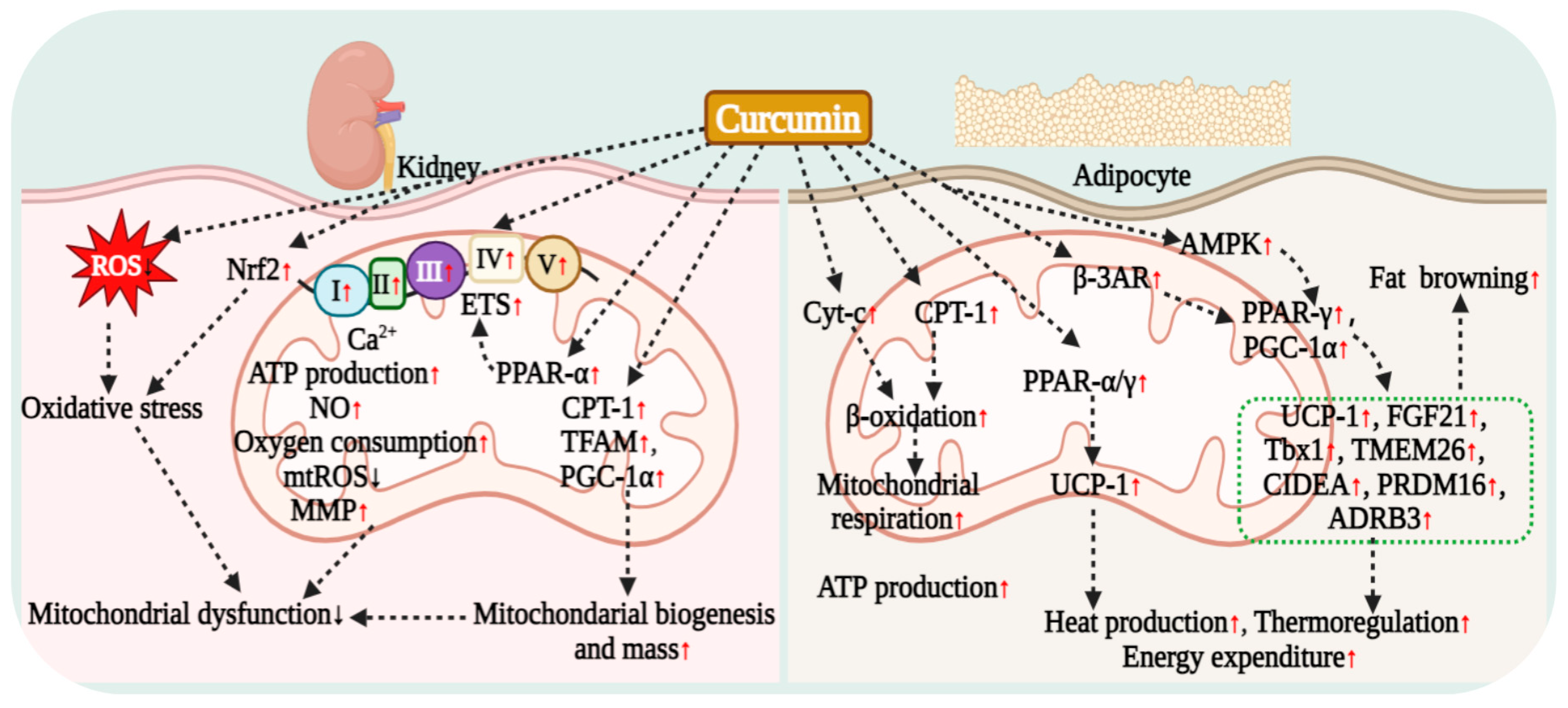
Research indicates that mitochondrial damage is a significant driver of renal inflammation and redox imbalance. In animal models, curcumin has been demonstrated to restore the abnormal respiratory functions of mitochondrial complexes I, II, III, and V, which are induced by renal oxidative stress. This restoration ameliorates mitochondrial dysfunction by enhancing oxygen consumption, ATP production efficiency, Ca2+ homeostasis, and transmembrane potential [143]. Similarly, Rojas et al. found that curcumin treatment mitigates mitochondrial dysfunction by stimulating mitochondrial biogenesis, as evidenced by increased levels of PGC-1α and TFAM, thereby reducing renal oxidative damage [144] (Figure 7).
In a diabetic nephropathy model, curcumin significantly reversed renal lipid peroxidation and mitochondrial dysfunction by restoring mitochondrial oxygen consumption and modulating nitric oxide (NO) synthesis. In a mouse model of chronic kidney disease, curcumin treatment partially restored the function of the mitochondrial electron transport system (ETS) by upregulating the expression of PPARα and CPT1, which improved mitochondrial respiration and alleviated β-oxidation impairment. This intervention significantly reduced renal lipid accumulation, mitigated oxidative stress, and alleviated tissue damage [141]. In a mouse model of acute kidney injury, curcumin treatment reduced mitochondrial reactive oxygen species (mtROS) generation and mitochondrial fission through its anti-inflammatory and antioxidant properties, while enhancing mitochondrial biogenesis and ATP synthesis, thereby alleviating mitochondrial damage and exerting protective effects on the kidneys [145].
Additionally, curcumin has been shown to mitigate gentamicin-induced nephrotoxicity in rats by restoring the activities of mitochondrial complexes I and IV, delaying calcium overload-induced mitochondrial permeability transition (MPT), and preventing the collapse of mitochondrial membrane potential (MMP) [146]. Furthermore, cellular experiments indicate that curcumin can inhibit gentamicin-induced renal cell damage by activating the PGC-1α and Nrf2 signaling pathways [146]. These findings suggest that curcumin exerts renal protective effects through a synergistic enhancement of mitochondrial function and promotion of biogenesis (Figure 7).

7.3. Curcumin Regulation of Adipocyte Mitochondrial Respiration

Inducing the formation of brown-like adipocytes may serve as a potential strategy for treating obesity and T2DM, primarily through the mechanism of excess energy consumption via thermogenesis. Brown adipose tissue (BAT) exhibits high thermogenic efficiency due to its abundant mitochondrial content, while the key characteristics of white adipose tissue (WAT) browning include an increase in mitochondrial quantity and the ectopic expression of BAT marker proteins.
At the cellular level, curcumin promotes the browning of 3T3-L1 cells and rat primary white adipocytes by activating the AMPK signaling pathway. It upregulates the expression of key browning regulatory factors, such as PPARγ and PGC-1α, as well as brown adipose tissue (BAT) characteristic genes, including UCP1, FGF21, Tbx1, TMEM26, CIDEA, and PRDM16. Furthermore, curcumin significantly increases the number and biogenesis of mitochondria [147]. Additionally, it enhances fatty acid oxidation metabolism in cells by inducing the expression of mitochondrial proteins CPT-1 and cytochrome c in BAT [147] (Figure 7). Zhao et al. reported that curcumin significantly enhances mitochondrial respiratory chain activity and ATP synthesis efficiency by upregulating PPARγ and PGC-1α signaling in 3T3-L1 cells [148]. Notably, curcumin exhibits a concentration-dependent regulation of adipocyte mitochondrial respiration. At low concentrations (10 μM), curcumin markedly improves mitochondrial respiratory function and fuel utilization in 3T3-L1 adipocytes. In contrast, high concentrations (20 μM and 35 μM) inhibit respiratory function due to the disruption of mitochondrial cristae structure and membrane permeability [148].
In animal models, curcumin treatment significantly upregulates the expression of UCP-1, a key thermogenic protein in brown adipose tissue (BAT), through the synergistic activation of peroxisome proliferator-activated receptor alpha (PPARα) and peroxisome proliferator-activated receptor gamma (PPARγ) signaling pathways. This process markedly enhances cold-induced thermogenesis and energy expenditure in HFD mice [149]. Further studies revealed that curcumin also synchronously upregulates the expression levels of PPARγ, peroxisome proliferator-activated receptor gamma coactivator 1-alpha (PGC-1α), and UCP-1 in both white adipose tissue (WAT) and BAT of HFD mice, while inducing the transcriptional activation of PRDM16, a core regulatory molecule involved in WAT browning, thereby significantly improving mitochondrial function in adipocytes [148]. The study conducted by Wang et al. demonstrated that curcumin significantly upregulates the expression levels of PGC-1α and UCP-1, as well as the mitochondrial DNA copy number in the inguinal white adipose tissue (iWAT) of mice, by activating the norepinephrine β3-adrenergic receptor (β3-AR) signaling pathway. Additionally, curcumin promotes the elevated expression of brown adipose tissue (BAT) characteristic genes, including ADRB3, CIDEA, and PRDM16, thereby inducing the transformation of iWAT into a brown-like adipose phenotype [150,151].
Mechanistic studies have demonstrated that curcumin significantly inhibits body weight gain and fat accumulation in HFD mice without altering food intake, while also enhancing their cold tolerance. This effect is likely attributed to the increased activity of brown adipose tissue, the upregulation of thermogenic gene expression in inguinal white adipose tissue (iWAT), and a significant increase in mitochondrial biogenesis, all of which collectively drive the remodeling of adipose tissue energy metabolism [150]. Furthermore, multiple independent studies have corroborated that curcumin markedly improves adipose tissue energy metabolism by upregulating the expression of core thermogenic regulatory factors in adipocytes [152,153,154,155] (Figure 7).

7.4. Curcumin Regulation of Muscle Cell Mitochondrial Respiration

Oxidative stress-induced mitochondrial dysfunction in skeletal muscle is a significant contributor to muscle injury [133]. Exercise, as a physiological stimulus, effectively promotes mitochondrial biogenesis in skeletal muscle, thereby enhancing mitochondrial respiratory function. The study conducted by Hamidie et al. demonstrated a synergistic effect between curcumin and exercise intervention. In the gastrocnemius (Gas) and soleus (Sol) muscles of rats, curcumin treatment elevated the NAD+/NADH ratio and significantly upregulated indicators related to mitochondrial biogenesis through the activation of the AMPK/SIRT1/PGC-1α signaling pathway. This effect was specifically evidenced by the upregulation of cytochrome c oxidase subunit (COX-IV) protein expression, an increase in mtDNA copy number, enhanced synthesis of OXPHOS subunits, and elevated activity of citrate synthase (CS). The enhancing effect becomes more pronounced when combined with endurance training [131].
Similarly, Ronald et al. reported that curcumin significantly enhances intracellular cAMP levels by increasing the expression of cytochrome c oxidase subunit (COX-IV) and citrate synthase (CS), as well as by improving the activity of mitochondrial complex I. Additionally, curcumin targets the inhibition of phosphodiesterase 4A (PDE4A)-mediated cAMP hydrolysis. This mechanism activates the PKA/LKB-1/AMPK/PGC-1α signaling pathway, systematically enhancing the capacity for mitochondrial biogenesis in the skeletal muscle of exercised rats [156]. These findings indicate that exercise can synergistically amplify the regulatory effects of curcumin on mitochondrial biogenesis (Figure 5).
Under conditions of oxidative stress, curcumin demonstrates distinct regulatory effects on skeletal muscle mitochondria across various pathological models. In the context of HFD-induced metabolic disorders, curcumin specifically reduces the accumulation of ROS and malondialdehyde (MDA) in skeletal muscle mitochondria by activating the Nrf2 signaling pathway, which effectively alleviates muscle oxidative stress [128]. In a chronic kidney disease model, curcumin treatment promotes mitochondrial biogenesis by inhibiting the activity of glycogen synthase kinase 3 beta (GSK-3β) and upregulating the expression of peroxisome proliferator-activated receptor gamma coactivator 1-alpha (PGC-1α), nuclear respiratory factor 1 (NRF-1), and mitochondrial transcription factor A (TFAM). Furthermore, it synergistically restores the activity of mitochondrial respiratory chain complexes and maintains mitochondrial membrane potential homeostasis, thereby effectively mitigating oxidative damage and dysfunction in muscle mitochondria [133].
C2C12 myoblast experiments demonstrated that pharmacological concentrations of curcumin induce moderate ROS production through the induction of NADPH oxidase expression. This process promotes a shift in mitochondrial dynamics towards fusion, which is accompanied by the upregulation of PGC-1α and AMPKα1 protein expression, leading to improvements in mitochondrial quality and the restoration of membrane potential. Consequently, this effectively enhances mitochondrial biological function and alleviates cellular damage induced by heat stress [19]. This phenomenon was further confirmed in animal models, where curcumin treatment significantly ameliorated heat stress-induced pathological damage in skeletal muscle by restoring the structural and functional integrity of mitochondria [19] (Figure 5).

7.5. Curcumin Regulation of Neuronal Mitochondrial Respiration

Studies have demonstrated that the distinctive antioxidant properties of curcumin may aid in the prevention or treatment of oxidative stress-induced mitochondrial dysfunction and oxidative damage in neuronal cells [157,158]. This mechanism is associated with curcumin’s capacity to preserve mitochondrial membrane integrity [159], alleviate respiratory dysfunction [33], and promote mitochondrial biogenesis [160] (Figure 6). Research conducted by Stephanie et al. revealed that in vitro, curcumin effectively prevented oxidative stress-induced mitochondrial swelling and dysfunction in brain cells by inhibiting the abnormal opening of the mitochondrial permeability transition pore (mPTP) [161]. Furthermore, animal models have confirmed that curcumin treatment can specifically restore the activity of key enzymes in the mitochondrial respiratory chain across the cerebral cortex, midbrain, and cerebellar regions, including complex I (NADH dehydrogenase), complex II (succinate dehydrogenase), and complex IV (cytochrome oxidase), thereby effectively ameliorating oxidative stress-induced mitochondrial dysfunction [162].
Curcumin exhibits multi-dimensional neuroprotective capabilities in various pathological states of neural injury. At the level of apoptosis regulation, curcumin confers neuroprotection by dynamically maintaining mitochondrial membrane potential and balancing the Bax/Bcl2 ratio, which reduces the efflux of cytochrome c and apoptosis-inducing factors while concurrently decreasing the abnormal accumulation of ROS induced by oxygen-glucose deprivation/reperfusion (OGD/R) [163]. In a mouse model of cerebral ischemia–reperfusion (I/R) injury, curcumin demonstrates neuroprotective effects by activating NRF-1 and TFAM, leading to an increase in mitochondrial number and promoting mitochondrial biogenesis [164]. Additionally, in a rat model of neurotoxicity induced by the heavy metal arsenic, curcumin specifically restores mitochondrial membrane potential in the frontal cortex and hippocampus, while simultaneously enhancing the activity of mitochondrial respiratory chain complexes to exert its neuroprotective effects [33].
The core pathological features of neurodegenerative diseases are intricately linked to mitochondrial dysfunction. Curcumin treatment preserves mitochondrial structural homeostasis by inhibiting Aβ peptide-induced mitochondrial membrane depolarization in neuronal cells. Additionally, it upregulates the expression levels and catalytic activities of superoxide dismutase (SOD) and catalase, thereby effectively ameliorating mitochondrial metabolic defects and the oxidative stress microenvironment [165]. Banji et al. found that curcumin significantly ameliorates oxidative stress-mediated mitochondrial dysfunction in rat brains by enhancing mitochondrial enzyme activity and increasing glutathione biosynthesis levels. This restoration of neuronal biochemical functions effectively reverses cognitive impairment [166]. In the context of aging-related research, curcumin enhances mitochondrial membrane potential and ATP synthesis efficiency by activating the PGC-1α signaling pathway. It also promotes a balance in mitochondrial fusion dynamics, ultimately alleviating mitochondrial dysfunction and delaying the progression of neurodegenerative diseases [167] (Figure 6). These findings provide crucial theoretical support for the translational application of curcumin in treating neurodegenerative disorders.

8. Curcumin Regulation of Gut Microbiota and Maintenance of Intestinal Barrier Integrity

8.1. Curcumin Regulation of Gut Microbiota via Prebiotic-like Effects

Research has demonstrated that an imbalance in gut microbiota is closely linked to the progression of various diseases, including obesity, diabetes, cardiovascular diseases, and cancer [168,169]. In contrast, maintaining gut microbiota homeostasis significantly enhances host health [12]. Curcumin, a natural active ingredient commonly utilized in oral medications, is primarily concentrated in the gut and exhibits extremely low systemic bioavailability; however, it manifests a broad spectrum of pharmacological activities. This paradoxical phenomenon indicates that the regulation of gut microbiota may play a crucial role in curcumin’s efficacy. Specifically, curcumin exhibits prebiotic-like properties by modulating the structure of the gut microbiota. It increases the abundance of beneficial bacteria, such as Bifidobacterium, Lactobacillus, and Akkermansia, while simultaneously reducing the load of potential pathogens, including Coriobacterales, Enterobacteria, Prevotellaceae, and Bacteroidaceae [170,171]. This modulation optimizes the overall composition and diversity of the microbiota, which subsequently leads to systemic health benefits [7,78]. Therefore, this regulatory effect, based on the “gut-organ axis,” may elucidate curcumin’s intervention in various diseases and offers a novel mechanistic perspective to explain its unique pharmacological phenomenon of “low absorption but high activity” (Figure 8).

8.2. Curcumin Ameliorates Obesity and Related Metabolic Diseases

A HFD not only directly contributes to abnormal fat accumulation in the body but also induces metabolic disorders by disrupting the structural diversity of the gut microbiota [172,173]. Studies have demonstrated that gut microbiota dysbiosis and barrier dysfunction are prevalent in obese individuals and animal models, characterized by an abnormal increase in the Firmicutes/Bacteroidetes (F/B) ratio, which is positively correlated with hepatic steatosis and serves as a biomarker for obesity [168]. Furthermore, epidemiological research has confirmed that gut microbiota dysbiosis is closely associated with the pathological progression of obesity and its complications, including IR, type 2 diabetes, and abnormal glucose and lipid metabolism (Table 1).
Research has confirmed that curcumin exerts a significant protective effect against diet-induced obesity by enhancing intestinal health and effectively alleviating metabolic dysfunction through the core mechanism of regulating intestinal microbiota homeostasis [12]. Multiple studies have demonstrated that in HFD animal models, curcumin treatment not only significantly improves the obesity phenotype but also reshapes the gut microbiota structure by downregulating the F/B ratio, thereby optimizing the composition ratio of beneficial to pathogenic bacteria [12,78,170,174]. Curcumin has been shown to enhance the abundance of beneficial microbiota, specifically Bacteroidetes, Bifidobacterium, and Lactobacillus. Concurrently, it suppresses the proliferation of microbiota linked to metabolic disorders, including Proteobacteria, Desulfovibrio, and Prevotellaceae [170,171,175]. Notably, fecal microbiota transplantation (FMT) experiments have confirmed that transplanting microbiota treated with curcumin into HFD germ-free mice, which lack endogenous intestinal microbiota, can replicate the beneficial metabolic effects of curcumin. This directly demonstrates that the efficacy of curcumin relies on the regulation of intestinal microbiota [49]. Further FMT studies revealed that the microbiota, modulated by curcumin, was enriched with short-chain fatty acid-producing bacteria, such as Roseburia intestinalis and Eubacterium rectale, which may be key to improving insulin sensitivity [176]. The metabolic improvement effects include reversing the HFD-induced obesity phenotype, alleviating glucose and lipid metabolism disorders (GLMDs), improving IR (evidenced by the downregulation of hepatic gluconeogenesis and de novo lipogenesis (DNL)-related gene expression), restoring pyruvate metabolic balance, and reducing hepatic lipid deposition [49,171].
Clinical studies have further elucidated the direct regulatory effects of curcumin on human gut microbiota. Double-blind randomized trials have demonstrated that curcumin significantly reduces the F/B ratio in patients while increasing the relative abundance of Bacteroidetes [40]. Research targeting patients with NAFLD has revealed that curcumin effectively decreases the concentration of harmful metabolites related to gut microbiota, such as endotoxins, in patient serum by specifically modulating the dynamics of gut microbiota. This modulation particularly alters the abundance of specific strains closely associated with disease progression [7]. A randomized placebo-controlled trial has confirmed that curcumin promotes the ecological reconstruction of gut microbiota, playing a critical role in transforming pathogenic bacteria into beneficial bacteria [39]. The aforementioned evidence systematically elucidates the pivotal role of the “microbiota-metabolism” axis in curcumin’s intervention in obesity and related diseases.

8.3. Curcumin Enhances Intestinal Barrier Function and Exerts Anti-Inflammatory Effects

An HFD can increase serum lipopolysaccharides (LPS) levels, induce low-grade chronic inflammation, and compromise intestinal barrier function. This impairment allows intestinal endotoxins and bacterial metabolites to leak into the systemic circulation through the damaged intestinal mucosa. These alterations, combined with gut microbiota dysbiosis and damage to the intestinal mucosal barrier, initiate LPS-mediated systemic inflammation, IR, and metabolic endotoxemia, thereby accelerating the progression of obesity and associated metabolic disorders [78,177,178]. Clinical studies have confirmed that dysbiosis of gut microbiota and dysfunction of the intestinal barrier are key triggers driving IR. Repairing the intestinal mucosal barrier, reducing intestinal permeability, and blocking harmful metabolites from entering the bloodstream are considered crucial strategies in the treatment of metabolic diseases. Curcumin exhibits multifaceted regulatory advantages in response to these strategies. Numerous studies have demonstrated that curcumin not only reshapes the gut microbiota structure in HFD and diabetic animal models by increasing beneficial bacteria such as Akkermansia, Bifidobacterium, and Lactobacillus while suppressing endotoxin-producing bacteria like Enterobacteriaceae and Desulfovibrio, but also enhances intestinal barrier integrity by promoting the expression of ZO-1 and occludin. Additionally, curcumin reduces circulating LPS, inflammatory factors, and uremic toxin levels, thereby effectively ameliorating disorders in glucose and lipid metabolism and reversing IR [49,175,179,180,181,182,183,184]. In the renal disease model, curcumin enhances the intestinal barrier and mitigates kidney damage by promoting beneficial bacteria such as Lactobacillaceae and Ruminococcaceae, while simultaneously reducing pathogenic bacteria such as Bacteroidaceae [10]. Preliminary clinical trials have also confirmed that curcumin treatment can significantly reduce the levels of pro-inflammatory mediators, such as CCL-2, IFN-γ, and IL-4, as well as lipid peroxidation in patients’ plasma. The underlying mechanism may involve the regulation of intestinal microbiota homeostasis [185].

8.4. Curcumin Regulation of Bile Acid and Short-Chain Fatty Acid Metabolism

Disruption of bile acid metabolism mediated by gut microbiota is a fundamental mechanism underlying the pathogenesis of obesity, T2DM, and NAFLD [186]. In animal models, curcumin has been demonstrated to enhance bile acid metabolism by remodeling the structure of gut microbiota, significantly ameliorating HFD-induced obesity phenotypes through the enhancement of adaptive thermogenesis and the suppression of weight gain [187]. Clinical trials have further corroborated that curcumin intervention effectively rectifies the gut microbiota-dependent bile acid metabolism imbalance in patients with non-alcoholic simple fatty liver, leading to a significant reduction in hepatic lipid deposition [40]. Short-chain fatty acids (SCFAs), such as acetate, propionate, and butyrate, serve as key substrates for energy metabolism in intestinal epithelial cells and play a crucial role in maintaining the homeostasis of intestinal barrier function and regulating health. Curcumin specifically enhances the abundance of gut microbiota that produce SCFAs, including Bacteroides, Parabacteroides, Alistipes, Akkermansia, and Alloprevotella [171]. Additionally, it promotes the growth of other SCFA-producing bacteria such as Roseburia, Eubacterium rectale, Phascolarctobacterium, and Blautia, resulting in increased SCFA levels in the cecum and colon [176,180]. This regulation effectively restores intestinal barrier function, reduces hepatic steatosis, and inhibits the penetration of intestinal lipopolysaccharides, ultimately reversing obesity and T2DM-related systemic inflammation and IR [10,11,171,180]. Furthermore, beyond its role in metabolic diseases, curcumin can provide protective effects against neurodegenerative diseases through the microbiota-metabolite axis [119,188,189].
Based on the aforementioned evidence, the crucial role of gut microbiota in mediating the protective effects of curcumin metabolism has been adequately established. Importantly, the bidirectional interaction between curcumin and gut microbiota underscores the complexity of its effects, suggesting that the bioactivity of curcumin is influenced not only by the dosage administered but also by individual variations in microbiota composition and metabolic functions; for instance, different microbiota can metabolically convert curcumin into various active metabolites. Concurrently, these metabolites can feed back to regulate the ecological balance of the microbiota. Nevertheless, considering that current clinical data are predominantly derived from small-sample studies, it is essential to clarify the intricate relationship among curcumin, microbiota, and host metabolism through large-scale population studies. This approach would provide evidence-based support for tailored curcumin intervention strategies that account for microbiota characteristics.

9. Curcumin Alleviates Inflammation and Oxidative Stress to Improve Systemic Insulin Resistance

As core drivers of IR, the regulation of inflammation and oxidative stress represents a critical mechanism through which curcumin mitigates metabolic disorders. Extensive preclinical and clinical studies have demonstrated that curcumin significantly enhances systemic insulin sensitivity by modulating signaling pathways in adipose, hepatic, and muscle tissues, as well as reshaping the gut microbiota ecosystem (specific mechanisms have been systematically elaborated in previous sections) [190,191]. This section focuses on the evidence of curcumin’s direct actions on anti-inflammatory and antioxidant pathways, elucidating its beneficial effects on improving IR (Figure 8, Table 1).
Chronic low-grade inflammation and oxidative stress are hallmark pathological features observed in high-risk populations for obesity and diabetes, which are further compounded by IR that exacerbates disorders in glucose and lipid metabolism. Characteristic biomarkers of this pathological state include pro-inflammatory factors (TNF-α, IL-1β, IL-6, hs-CRP), anti-inflammatory mediators (IL-10, adiponectin), and indicators of oxidative stress (MDA, GSH, SOD) [192,193,194]. Curcumin has been shown to exert anti-inflammatory and antioxidant effects through multi-target regulation in various cell models and animal experiments. The underlying mechanisms involve the downregulation of pro-inflammatory factors such as TNF-α, IL-6, and resistin, the upregulation of anti-inflammatory adipokines like adiponectin, and the inhibition of NF-kB signaling and MDA generation (specific mechanisms reviewed by Cheng et al.) [195,196,197,198]. Its broad-spectrum anti-inflammatory effects have been further substantiated in clinical studies, encompassing a variety of disease types, including postoperative inflammation [199], chronic anterior uveitis [200], psoriasis [201], inflammatory bowel disease [202], ulcerative colitis [203], vitiligo [204], arthritis [205], pancreatitis [206], and inflammation related to Helicobacter pylori infection [207].
Numerous randomized double-blind placebo-controlled trials have demonstrated that curcumin effectively ameliorates IR and the pathological progression of related metabolic diseases by modulating the inflammation-oxidative stress axis [5,208,209]. This intervention significantly improves metabolic disorders in patients with T2DM. At the pathological mechanism level, curcumin treatment effectively reduces pro-inflammatory markers, including high-sensitivity C-reactive protein (hs-CRP) [20,35,51], IL-6 [20,36], TNF-α [20,36], A-FABP [20], and endothelin-1 [36], while simultaneously increasing adiponectin [35,91] and total antioxidant capacity (TAC) [34,51,210] in patients.
In the context of antioxidant damage, curcumin treatment significantly decreased the levels of oxidative stress products, including malondialdehyde (MDA) [34,36,51,210] and α1-antitrypsin low-density lipoprotein (AT-LDL) [91]. Furthermore, it enhanced the activity of endogenous antioxidant systems, such as superoxide dismutase (SOD) [20,34,51] and glutathione (GSH) [51,210].
The dual regulatory effect of curcumin leads to significant clinical benefits, including enhanced insulin sensitivity, as evidenced by a marked reduction in serum insulin levels and resistin resistance [15], a decreased HOMA-IR index [211], improved β-cell function, and increased adiponectin levels [211]. Additionally, curcumin has been shown to delay the progression from prediabetes to T2DM [211] and to provide sustained metabolic protection even in patients with comorbid coronary heart disease [210]. Notably, novel formulations, such as nano-curcumin, further enhance these beneficial effects by improving curcumin’s bioavailability [36,51]. The clinical evidence supports the conclusion that curcumin can effectively delay the progression of T2DM while simultaneously improving IR through the synergistic regulation of inflammation and oxidative stress signaling. The core mechanism is rooted in the translation of anti-inflammatory and antioxidant effects into the clinical benefits of enhanced insulin sensitivity (Figure 8, Table 1).
Table 1. Clinical Evidence of Curcumin in Metabolic Regulation.
CompoundDiseaseDoseDurationOutcomeRegulatory WaysConclusionRefs
CurcuminT2DM1500 mg/d10 weeksBW ↓, BMI ↓, WC ↓, FBS ↓Glycometabolism, Lipid metabolismLong-term intake of curcumin can effectively improve fasting blood glucose and body weight in patients with T2DM.[5]
CurcuminT2DM300 mg/d3 monthsFBS ↓, HbA1c ↓, HOMA-IR ↓, FFAs ↓, TC ↓, LPL ↑Glycometabolism, Lipid metabolismEffectively reduces blood glucose and serum free fatty acids in T2DM patients and promotes fatty acid oxidation.[52]
CurcuminT2DM1500 mg/d6 monthsPWV ↓, adiponectin ↑, leptin ↓, HOMA-IR ↓, TC ↓, uric acid ↓, VF ↓, TBF ↓, LDL-C ↓, TG ↓, HDL-C ↑Lipid metabolism, Amino acid metabolism, Protein metabolismEffectively improve atherosclerosis risk and related metabolic disorders in patients with T2DM.[54]
CurcuminT2DM500 mg/d3 monthsFPG ↓, 2hpp ↓, HbA1c ↓, insulin sensitivity ↑, insulin ↓, IR ↓GlycometabolismSignificantly improve glycemic parameters in T2DM patients.[6]
CurcuminNASFL500 mg/d24 weeksweight ↓, BMI ↓, FFAs ↓, TC ↓, FBS ↓, HbA1c ↓, insulin ↓, F/B ratio ↓, Bacteroides ↑, DCA ↑, GLP-1 ↑Glycometabolism, Lipid metabolism, Amino acid metabolism, Protein metabolism, Intestinal flora, Bile acid metabolismReduce liver fat content in NAFLD patients, regulate gut microbiota, and improve bile acid metabolism.[40]
CurcuminObesity1000 mg/d30 daysTC ↓Lipid metabolismBeneficial for reducing blood lipid levels in obese patients.[84]
CurcuminNAFLD70 mg/d8 weeksLiver fat ↓, BMI ↓, TG ↓, HLD-C ↓, TC ↓, AST ↓, ALT ↓, Glucose ↓, HbA1c ↓Glycometabolism, Lipid metabolism, Amino acid metabolism, Protein metabolismShort-term curcumin administration significantly improves NAFLD-related pathological features.[87]
CurcuminNAFLD1000 mg/d8 weeksTG ↓, HDL-C ↓, TC ↓, non-HDL-C ↓, uric acid ↓Lipid metabolism, Amino acid metabolismSignificantly reduce blood lipid and uric acid levels in NAFLD patients and improve metabolic profiles.[88]
CurcuminNAFLD50 mg/d8 weeksHDL-C ↑, adiponectin ↑, leptin ↓, Leptin/Adiponectin ratio ↓Lipid metabolism, Protein metabolismEffectively improve serum adipokine levels in NAFLD patients.[89]
CurcuminHealthy people500 mg/d8 weeksCRP ↓, LDH ↓, MDA ↓, VO2 max ↑Protein metabolism, Redox metabolism, InflammationSupplementation of curcumin during moderate-intensity exercise reduces markers of inflammation, oxidative stress, and muscle damage in the body.[135]
CurcuminT2MD1000 mg/d12 weeksMDA ↓, TAC ↑, GSH ↑, PPAR-γ ↑Redox metabolism, Mitochondrial metabolismImproving inflammation and oxidative stress in patients with T2DM.[210]
CurcuminCKD320 mg/d8 weeksLipid peroxidation ↓, TAC ↑Redox metabolismReduce oxidative stress levels in CKD patients.[208]
CurcuminT2DM1500 mg/d10 weeksTG ↓, hs-CRP ↓, adiponectin ↑Lipid metabolism, InflammationDelaying the progression of diabetic complications by reducing triglyceride levels and inflammatory markers.[35]
CurcuminT2DM300 mg/d3 monthsA-FABP ↓, CRP ↓, TNF-α ↓, IL-6 ↓, SOD ↑, Glucose ↓, FFAs ↓Lipid metabolism, Inflammation, Glycometabolism, Redox metabolismReducing serum A-FABP levels in T2DM patients, exerting anti-diabetic effects, and improving metabolic parameters.[20]
CurcuminT2DM1500 mg/d9 monthsβ-cell function ↑, HOMA-β ↑, C-peptide ↓, HOMA-IR ↓, adiponectin ↑Glycometabolism, Lipid metabolism, Protein metabolismLong-term curcumin intake may delay the progression from prediabetes to T2DM, improve β-cell function, and reduce insulin resistance.[211]
Nano curcuminDFU80 mg/d12 weeksFBS ↓, insulin ↓, IR ↓, insulin sensitivity ↑, TG ↓, LDL-C ↓, TAC ↑, GSH ↑Glycometabolism, Lipid metabolism, Redox metabolismImprove glucose and lipid metabolism disorders in DFU patients, alleviate insulin resistance, and oxidative stress.[15]
Nano curcuminDiabetes on Hemodialysis80 mg/d12 weeksFBS ↓, insulin ↓, TC ↓, VLDL-TG ↓, TG ↓, LDL-TG ↓, TG/HDL-TG ratio ↓, hs-CRP ↓, MDA ↓, TAC ↑, Total nitrite level ↑Glycometabolism, Lipid metabolism, Mitochondrial metabolism, Redox metabolismLong-term administration of nano-curcumin can effectively improve the metabolic profile in diabetes on hemodialysis patients.[51]
Nano curcuminT2DM80 mg/d3 monthsHbA1c ↓, FBG ↓, TG ↓, BMI ↓, eAG ↓, LDL-C ↓Glycometabolism, Lipid metabolismReduce serum HbA1C, LDL-C, and BMI levels in patients with T2DM.[50]
Nano curcuminNAFLD80 mg/d3 monthsHDL ↑, QUICKI ↑, nesfatin ↑, WC ↓, FBS ↓, FBI ↓, HbA1c ↓, TG ↓, TC ↓, LDL ↓, HOMA-IR ↓, TNF-α, hs-CRP ↓, IL-6 ↓Glycometabolism, Lipid metabolismEffectively improves blood glucose, blood lipids, inflammation, waist circumference, liver enzymes, and the degree of fatty liver in NAFLD patients.[83]
Phospholipid curcuminNAFLD1500 mg/d8 weeksTG ↓, LDL-C ↓, HDL-C ↓, TC ↓, non-HDL-C ↓, Lipid profile ↑, AST ↓, ALT ↓, uric acid ↓
Lipid metabolism, Protein metabolismAlleviate the severity of NAFLD and improve disease progression-related indicators.[90]
Phospholipid curcuminNAFLD250 mg/d8 weeks3-methyl-2-oxovaleric acid ↓, 3-hydroxyisobutyric acid ↓, kynurenine ↓, succinate ↓, citrate ↓, α-ketoglutarate ↓, methylamine ↓, trimethylamine ↓, maleate ↓, indophenol sulfate ↓, CDCA ↓, taurocholic acid ↓, lithocholic acid ↓Amino acid metabolism, Bile acid metabolism, Glycometabolism (TCA Cycle) Intestinal floraSignificantly improve patients’ serum metabolic profiles and exert metabolic regulatory effects.[7]
Curserin® (phytosomal curcumin)Obesity400 mg/d8 weeksFPI ↓, HOMA-IR ↓, waistline ↓, blood pressure ↓, TG ↓, HDL-C ↑, transaminase ↓, γ-GT ↓, HSI ↓, Serum cortisol ↓Glycometabolism, Lipid metabolism, Protein metabolism, Amino acid metabolismImproving blood glucose, liver function, and serum cortisol levels in overweight patients with impaired fasting glucose.[85]
Curcumin, PiperineT2DMCurcumin (500 mg/d), Piperine (5 mg/d)3 monthsGlucose ↓, C-peptide ↓, HbA1c ↓, ALT ↓, AST ↓Glycometabolism, Lipid metabolism, Protein metabolismImprovement of blood glucose and liver-related parameters in T2DM patients through combined use with piperine.[55]
Curcumin, PiperineT2DMCurcumin (1000 mg/d), Piperine (10 mg/d)12 weeksTC ↓, non-HDL-C ↓, Lp (a) ↓, HDL-C ↑Lipid metabolismReduce atherosclerotic lipid parameters and lipid levels in T2DM patients, and decrease the risk of cardiovascular diseases.[86]
Curcumin, PiperineT2DMCurcumin (1000 mg/d), Piperine (10 mg/d)12 weeksleptin ↓, TNF-α ↓, Leptin/Adiponectin ratio ↓, adiponectin ↑Inflammation, Lipid metabolism, Protein metabolismImproving inflammatory factors and adipokine levels in patients with T2DM.[209]
Curcumin, PiperineT2DMCurcumin (1000 mg/d), Piperine (10 mg/d)8 weeksTAC ↑, SOD ↑, MDA ↓Redox metabolismSignificantly improve oxidative stress in T2DM patients.[34]
Theracurmin®
(curcumin preparation)
T2DM180 mg/d6 monthsAT-LDL ↓, oxidized LDL ↓Glycometabolism, Lipid metabolismReduction of oxidized LDL levels in patients with impaired glucose tolerance or non-insulin-dependent diabetes mellitus.[91]
Meriva®
(curcumin preparation)
CKD1000 mg/d6 monthsCCL-2 ↓, IFN-γ ↓, IL-4 ↓, Lipid peroxidation ↓, Escherichia-Shigella ↓, Lachnoclostridium ↑, Lactobacillaceae ↑Inflammation, Redox metabolism, Intestinal floraSignificantly reduce pro-inflammatory mediators and lipid peroxidation levels in CKD patients.[185]
Meriva®
(curcumin preparation)
Healthy older people500 mg/d3 monthsExercise capacity parameters (including grip strength, weight lifting, walking, cycling, etc.) and health-related indicators (including proteinuria, oxidative stress level, etc.) were significantly improved.Protein metabolism, Redox metabolismCombining a standard diet with moderate exercise helps improve physical strength and bodily functions in the elderly, with potential for preventing sarcopenia.[134]
NCB-02
(curcumin preparation)
T2DM150 mg/d8 weeksMDA ↓, ET-1 ↓, IL-6 ↓, TNF-α ↓Inflammation, Redox metabolismSignificantly improves endothelial dysfunction in T2DM patients, reduces inflammatory factors, and oxidative stress levels.[36]
The upward arrow represents an increase, while the downward arrow represents a decrease.

10. Summary and Perspectives

Curcumin exhibits extensive regulatory capabilities within the systemic metabolic network through its multi-target mechanisms of action. These mechanisms include modulation of gut microbiota, enhancement of mitochondrial function, inhibition of inflammation and oxidative stress, and regulation of key signaling pathways, such as AMPK. Its distinctive ‘gut-first’ mode of action and bidirectional interactions with the microbiome effectively elucidate the pharmacological characteristics associated with ‘low absorption yet high activity.’ Current research provides substantial evidence supporting the significant potential of curcumin in ameliorating metabolic disorders, including dysregulation of glucose and lipid metabolism, IR, and NAFLD.
Despite its potential, clinical translation still encounters significant challenges. The quality of clinical evidence in humans requires improvement, individual differences in microbiota can impact the stability of therapeutic efficacy, and there is an urgent need to overcome the technical bottleneck of low bioavailability. Future research should prioritize a deeper mechanistic exploration by employing multi-omics technologies to comprehensively analyze the interaction network of "curcumin-microbiota-host." Additionally, it is essential to promote large-scale, long-term clinical studies to clarify the dose–response relationship and safety of curcumin. Concurrently, establishing biomarker-based precision intervention strategies will facilitate personalized applications, while innovative delivery systems can enhance bioavailability.
Through multidisciplinary integration and deep collaboration among industry, academia, and research institutions, curcumin is anticipated to evolve from a traditional dietary supplement into an evidence-based precision metabolic management solution. This transition offers new avenues for the prevention and treatment of metabolic diseases.

Author Contributions

D.S.: Writing—original draft, Validation, Data curation. J.W.: Validation, Investigation. X.L.: Investigation. J.P.: Writing—review & editing, Funding acquisition, Conceptualization. S.W.: Project administration, Investigation, Conceptualization. All authors have read and agreed to the published version of the manuscript.

Funding

This work was supported by the National Natural Science Foundation of China (Nos. 82170850; 82173815 and 81872873), Fundamental Research Funds for the Central Universities of Central South University (1053320230334).

Institutional Review Board Statement

Not applicable.

Informed Consent Statement

Not applicable.

Data Availability Statement

No new data were created or analyzed in this study. Data sharing is not applicable to this article.

Conflicts of Interest

The authors declare no competing interests.

Abbreviations

TCAtricarboxylic acid cycleAPO-Bapolipoprotein B
GSK-3βglycogen synthase kinase-3 betaAPOA-Iapolipoprotein A-I
DAGdiacylglycerolSRBIscavenger receptor class B type I
PKCprotein kinase CHLhepatic lipase
cAMPcyclic adenosine monophosphateApoEapolipoprotein E
PKAprotein kinase ACPT-1carnitine palmitoyltransferase I
PDE4Bphosphodiesterase 4BLPLlipoprotein lipase
PDHpyruvate dehydrogenaseLKB1liver Kinase B1
PDK4pyruvate dehydrogenase kinase 4VO2 maxmaximum oxygen uptake
PCpyruvate carboxylaseUCP-1uncoupling protein 1
CREBcAMP response element-binding proteinTCF7I2transcription factor 7 like 2
ABCA1ATP-binding cassette subfamily A member 1ROSreactive oxygen species
HKhexokinasemtDNAmitochondrial DNA
PFK2phosphofructokinase-2MRCmitochondrial respiratory chain
GLUT4glucose transporter 4SOD2superoxide dismutase 2
TFAMmitochondrial transcription factor ANRF-1/2nuclear respiratory factor 1/2
PEPCKphosphoenolpyruvate carboxykinaseSIRT3sirtuin 3
mPTPmitochondrial permeability transition poreCyt-ccytochrome c
TGR5Takeda G protein-coupled receptor 5NOnitric oxide
CIDEAcell death-inducing DFFA-like effector AETSelectron transport system
BAbile acidβ-3ARbeta-3 adrenergic receptor
GPR40/120G protein-coupled receptor 40/120Tbx1t-box transcription factor 1
GSglutamine synthetasePRDM16PR domain containing 16
PLCphospholipase CADRB3adrenoceptor beta 3
RONSreactive oxygen and nitrogen speciesFGF21fibroblast growth factor 21
AMPKAMP-activated protein kinaseTMEM26transmembrane protein 26
ACCacetyl-CoA carboxylaseMDAmalondialdehyde
MDHmalate dehydrogenaseSIRT1sirtuin 1
FFAfree fatty acidIL-1βinterleukin-1 beta
ACOacyl-CoA oxidaseBWbody weight
LXRαliver X receptor alphaWCwaist circumference
VLDL-Cvery low-density lipoprotein cholesterolBMIbody mass index
PPAR-αperoxisome proliferator-activated receptor αLP (a)lipoprotein (a)
2hPP2-h postprandial plasma glucoseFBGfasting blood glucose
ACC1acetyl-CoA carboxylase 1HbA1chemoglobin A1c
FASfatty acid synthaseHGPhepatic glucose production
SREBP-1sterol regulatory element-binding protein-1GLP-1glucagon-;ike peptide-1
NPC1L1niemann-pick c1-like 1IL-6interleukin-6
HNF-1αhepatocyte nuclear factor 1 alphaCCL-2C-C motif chemokine ligand 2
SREBP2sterol regulatory element-binding protein-2TNF-α/γtumor necrosis factor-α/γ
FXRfarnesoid X receptorSCFAshort-chain fatty acid
SLC13A5solute carrier family 13 member 5TACtotal Antioxidant capacity
ACATacyl-CoA cholesterol acyltransferaseSODsuperoxide dismutase
LDL-Clow-density lipoprotein cholesterolSEcholesteryl ester
SCD-1/2stearoyl-CoA desaturase-1/2LDLRlow-density lipoprotein receptor
FADS1/2fatty acid desaturase 1/2MVKmevalonate kinase
GPAT1glycerol-3-phosphate acyltransferase 1ACLYATP citrate lyase
ACSacyl-CoA synthetaseDNLde novo lipogenesis
HMGCR3-hydroxy-3-methylglutaryl-CoA reductaseTGtriglyceride
HMGCS3-hydroxy-3-methylglutaryl-CoA synthaseTCtotal cholesterol
LSSlanosterol synthaseDHCR2424-dehydrocholesterol reductase
SC4MOLsterol-C4-methyl oxidase-likeDHCR77-dehydrocholesterol reductase
SSsqualene synthaseFDPSfarnesyl diphosphate synthase
FDFT1farnesyl-diphosphate farnesyltransferase 1G6Paseglucose-6-phosphatase
CYP7A1cytochrome P450 family 7 subfamily a member 1DPP4dipeptidyl peptidase-4
HDL-Chigh-density lipoprotein cholesterol2hpp2-h postprandial glucose
FBSfasting blood sugarDCAdeoxycholic acid
γ-GTgamma glutamyl transpeptidaseET-1Endothelin-1
FPIfasting plasma insulinTBFtotal body fat
DFUdiabetic foot ulcePWVpulse wave velocity
CKDchronic kidney diseaseVFvisceral fat
HSIhepatic steatosis indexCDCAchenodeoxycholic acid

References

  1. Kunnumakkara, A.B.; Bordoloi, D.; Padmavathi, G.; Monisha, J.; Roy, N.K.; Prasad, S.; Aggarwal, B.B. Curcumin, the golden nutraceutical: Multitargeting for multiple chronic diseases. Br. J. Pharmacol. 2017, 174, 1325–1348. [Google Scholar] [CrossRef]
  2. Balakumar, P.; Venkatesan, K.; Abdulla Khan, N.; Raghavendra, N.M.; Venugopal, V.; Bharathi, D.R.; Fuloria, N.K. Mechanistic insights into the beneficial effects of curcumin on insulin resistance: Opportunities and challenges. Drug Discov. Today 2023, 28, 103627. [Google Scholar] [CrossRef] [PubMed]
  3. Stefan, N.; Yki-Jarvinen, H.; Neuschwander-Tetri, B.A. Metabolic dysfunction-associated steatotic liver disease: Heterogeneous pathomechanisms and effectiveness of metabolism-based treatment. Lancet Diabetes Endocrinol. 2025, 13, 134–148. [Google Scholar] [CrossRef]
  4. He, S.; Wen, H.; Fu, Y.; Chen, C.; Xu, M.; Zhang, M.; Zhao, M.; Zhao, S. Uncovering Causal Links Between Dietary Habits and Cardiovascular Diseases. Food Sci. Nutr. 2025, 13, e70229. [Google Scholar] [CrossRef]
  5. Hodaei, H.; Adibian, M.; Nikpayam, O.; Hedayati, M.; Sohrab, G. The effect of curcumin supplementation on anthropometric indices, insulin resistance and oxidative stress in patients with type 2 diabetes: A randomized, double-blind clinical trial. Diabetol. Metab. Syndr. 2019, 11, 41. [Google Scholar] [CrossRef]
  6. Karandish, M.; Mozaffari-Khosravi, H.; Mohammadi, S.M.; Cheraghian, B.; Azhdari, M. The effect of curcumin and zinc co-supplementation on glycemic parameters in overweight or obese prediabetic subjects: A phase 2 randomized, placebo-controlled trial with a multi-arm, parallel-group design. Phytother. Res. 2021, 35, 4377–4387. [Google Scholar] [CrossRef] [PubMed]
  7. Chashmniam, S.; Mirhafez, S.R.; Dehabeh, M.; Hariri, M.; Azimi Nezhad, M.; Nobakht, M.G.B.F. A pilot study of the effect of phospholipid curcumin on serum metabolomic profile in patients with non-alcoholic fatty liver disease: A randomized, double-blind, placebo-controlled trial. Eur. J. Clin. Nutr. 2019, 73, 1224–1235. [Google Scholar] [CrossRef]
  8. Hassaninasab, A.; Hashimoto, Y.; Tomita-Yokotani, K.; Kobayashi, M. Discovery of the curcumin metabolic pathway involving a unique enzyme in an intestinal microorganism. Proc. Natl. Acad. Sci. USA 2011, 108, 6615–6620. [Google Scholar] [CrossRef] [PubMed]
  9. Scazzocchio, B.; Minghetti, L.; D’Archivio, M. Interaction between Gut Microbiota and Curcumin: A New Key of Understanding for the Health Effects of Curcumin. Nutrients 2020, 12, 2499. [Google Scholar] [CrossRef]
  10. Xu, X.; Wang, H.; Guo, D.; Man, X.; Liu, J.; Li, J.; Luo, C.; Zhang, M.; Zhen, L.; Liu, X. Curcumin modulates gut microbiota and improves renal function in rats with uric acid nephropathy. Ren. Fail. 2021, 43, 1063–1075. [Google Scholar] [CrossRef]
  11. Li, H.B.; Xu, M.L.; Du, M.M.; Yu, X.J.; Bai, J.; Xia, W.J.; Dai, Z.M.; Li, C.X.; Li, Y.; Su, Q.; et al. Curcumin ameliorates hypertension via gut-brain communication in spontaneously hypertensive rat. Toxicol. Appl. Pharmacol. 2021, 429, 115701. [Google Scholar] [CrossRef]
  12. Islam, T.; Koboziev, I.; Albracht-Schulte, K.; Mistretta, B.; Scoggin, S.; Yosofvand, M.; Moussa, H.; Zabet-Moghaddam, M.; Ramalingam, L.; Gunaratne, P.H.; et al. Curcumin Reduces Adipose Tissue Inflammation and Alters Gut Microbiota in Diet-Induced Obese Male Mice. Mol. Nutr. Food Res. 2021, 65, e2100274. [Google Scholar] [CrossRef]
  13. Alli-Oluwafuyi, A.M.; Luis, P.B.; Nakashima, F.; Gimenez-Bastida, J.A.; Presley, S.H.; Duvernay, M.T.; Iwalewa, E.O.; Schneider, C. Curcumin induces secretion of glucagon-like peptide-1 through an oxidation-dependent mechanism. Biochimie 2019, 165, 250–257. [Google Scholar] [CrossRef] [PubMed]
  14. Du, S.; Zhu, X.; Zhou, N.; Zheng, W.; Zhou, W.; Li, X. Curcumin alleviates hepatic steatosis by improving mitochondrial function in postnatal overfed rats and fatty L02 cells through the SIRT3 pathway. Food Funct. 2022, 13, 2155–2171. [Google Scholar] [CrossRef]
  15. Mokhtari, M.; Razzaghi, R.; Momen-Heravi, M. The effects of curcumin intake on wound healing and metabolic status in patients with diabetic foot ulcer: A randomized, double-blind, placebo-controlled trial. Phytother. Res. 2021, 35, 2099–2107. [Google Scholar] [CrossRef] [PubMed]
  16. Manas-Garcia, L.; Bargallo, N.; Gea, J.; Barreiro, E. Muscle Phenotype, Proteolysis, and Atrophy Signaling During Reloading in Mice: Effects of Curcumin on the Gastrocnemius. Nutrients 2020, 12, 388. [Google Scholar] [CrossRef]
  17. Yu, T.; Dohl, J.; Elenberg, F.; Chen, Y.; Deuster, P. Curcumin induces concentration-dependent alterations in mitochondrial function through ROS in C2C12 mouse myoblasts. J. Cell Physiol. 2019, 234, 6371–6381. [Google Scholar] [CrossRef]
  18. Ma, Z.; Wang, N.; He, H.; Tang, X. Pharmaceutical strategies of improving oral systemic bioavailability of curcumin for clinical application. J. Control. Release 2019, 316, 359–380. [Google Scholar] [CrossRef] [PubMed]
  19. Yu, T.; Dohl, J.; Wang, L.; Chen, Y.; Gasier, H.G.; Deuster, P.A. Curcumin Ameliorates Heat-Induced Injury Through NADPH Oxidase-Dependent Redox Signaling and Mitochondrial Preservation in C2C12 Myoblasts and Mouse Skeletal Muscle. J. Nutr. 2020, 150, 2257–2267. [Google Scholar] [CrossRef]
  20. Na, L.X.; Yan, B.L.; Jiang, S.; Cui, H.L.; Li, Y.; Sun, C.H. Curcuminoids Target Decreasing Serum Adipocyte-fatty Acid Binding Protein Levels in Their Glucose-lowering Effect in Patients with Type 2 Diabetes. Biomed. Environ. Sci. 2014, 27, 902–906. [Google Scholar] [CrossRef]
  21. Santos-Parker, J.R.; Strahler, T.R.; Bassett, C.J.; Bispham, N.Z.; Chonchol, M.B.; Seals, D.R. Curcumin supplementation improves vascular endothelial function in healthy middle-aged and older adults by increasing nitric oxide bioavailability and reducing oxidative stress. Aging 2017, 9, 187–208. [Google Scholar] [CrossRef]
  22. Wahlang, B.; Pawar, Y.B.; Bansal, A.K. Identification of permeability-related hurdles in oral delivery of curcumin using the Caco-2 cell model. Eur. J. Pharm. Biopharm. 2011, 77, 275–282. [Google Scholar] [CrossRef] [PubMed]
  23. Tsuda, T. Curcumin as a functional food-derived factor: Degradation products, metabolites, bioactivity, and future perspectives. Food Funct. 2018, 9, 705–714. [Google Scholar] [CrossRef] [PubMed]
  24. Cheng, A.L.; Hsu, C.H.; Lin, J.K.; Hsu, M.M.; Ho, Y.F.; Shen, T.S.; Ko, J.Y.; Lin, J.T.; Lin, B.R.; Ming-Shiang, W.; et al. Phase I clinical trial of curcumin, a chemopreventive agent, in patients with high-risk or pre-malignant lesions. Anticancer Res. 2001, 21, 2895–2900. [Google Scholar] [PubMed]
  25. Ravindranath, V.; Chandrasekhara, N. Absorption and tissue distribution of curcumin in rats. Toxicology 1980, 16, 259–265. [Google Scholar] [CrossRef]
  26. Wahlstrom, B.; Blennow, G. A study on the fate of curcumin in the rat. Acta Pharmacol. Toxicol. 1978, 43, 86–92. [Google Scholar] [CrossRef]
  27. Pan, M.H.; Huang, T.M.; Lin, J.K. Biotransformation of curcumin through reduction and glucuronidation in mice. Drug Metab. Dispos. 1999, 27, 486–494. [Google Scholar] [CrossRef]
  28. Holder, G.M.; Plummer, J.L.; Ryan, A.J. The metabolism and excretion of curcumin (1,7-bis-(4-hydroxy-3-methoxyphenyl)-1,6-heptadiene-3,5-dione) in the rat. Xenobiotica 1978, 8, 761–768. [Google Scholar] [CrossRef]
  29. Vareed, S.K.; Kakarala, M.; Ruffin, M.T.; Crowell, J.A.; Normolle, D.P.; Djuric, Z.; Brenner, D.E. Pharmacokinetics of curcumin conjugate metabolites in healthy human subjects. Cancer Epidemiol. Biomark. Prev. 2008, 17, 1411–1417. [Google Scholar] [CrossRef]
  30. Sharma, R.A.; Euden, S.A.; Platton, S.L.; Cooke, D.N.; Shafayat, A.; Hewitt, H.R.; Marczylo, T.H.; Morgan, B.; Hemingway, D.; Plummer, S.M.; et al. Phase I clinical trial of oral curcumin: Biomarkers of systemic activity and compliance. Clin. Cancer Res. 2004, 10, 6847–6854. [Google Scholar] [CrossRef]
  31. Dhillon, N.; Aggarwal, B.B.; Newman, R.A.; Wolff, R.A.; Kunnumakkara, A.B.; Abbruzzese, J.L.; Ng, C.S.; Badmaev, V.; Kurzrock, R. Phase II trial of curcumin in patients with advanced pancreatic cancer. Clin. Cancer Res. 2008, 14, 4491–4499. [Google Scholar] [CrossRef]
  32. Lao, C.D.; Ruffin, M.T.t.; Normolle, D.; Heath, D.D.; Murray, S.I.; Bailey, J.M.; Boggs, M.E.; Crowell, J.; Rock, C.L.; Brenner, D.E. Dose escalation of a curcuminoid formulation. BMC Complement. Altern. Med. 2006, 6, 10. [Google Scholar] [CrossRef]
  33. Srivastava, P.; Yadav, R.S.; Chandravanshi, L.P.; Shukla, R.K.; Dhuriya, Y.K.; Chauhan, L.K.S.; Dwivedi, H.N.; Pant, A.B.; Khanna, V.K. Unraveling the mechanism of neuroprotection of curcumin in arsenic induced cholinergic dysfunctions in rats. Toxicol. Appl. Pharmacol. 2014, 279, 428–440. [Google Scholar] [CrossRef]
  34. Panahi, Y.; Khalili, N.; Sahebi, E.; Namazi, S.; Karimian, M.S.; Majeed, M.; Sahebkar, A. Antioxidant effects of curcuminoids in patients with type 2 diabetes mellitus: A randomized controlled trial. Inflammopharmacology 2017, 25, 25–31. [Google Scholar] [CrossRef]
  35. Adibian, M.; Hodaei, H.; Nikpayam, O.; Sohrab, G.; Hekmatdoost, A.; Hedayati, M. The effects of curcumin supplementation on high-sensitivity C-reactive protein, serum adiponectin, and lipid profile in patients with type 2 diabetes: A randomized, double-blind, placebo-controlled trial. Phytother. Res. 2019, 33, 1374–1383. [Google Scholar] [CrossRef]
  36. Usharani, P.; Mateen, A.A.; Naidu, M.U.; Raju, Y.S.; Chandra, N. Effect of NCB-02, atorvastatin and placebo on endothelial function, oxidative stress and inflammatory markers in patients with type 2 diabetes mellitus: A randomized, parallel-group, placebo-controlled, 8-week study. Drugs R D 2008, 9, 243–250. [Google Scholar] [CrossRef] [PubMed]
  37. Takahashi, M.; Suzuki, K.; Kim, H.K.; Otsuka, Y.; Imaizumi, A.; Miyashita, M.; Sakamoto, S. Effects of curcumin supplementation on exercise-induced oxidative stress in humans. Int. J. Sports Med. 2014, 35, 469–475. [Google Scholar] [CrossRef] [PubMed]
  38. Ahmed Nasef, N.; Loveday, S.M.; Golding, M.; Martins, R.N.; Shah, T.M.; Clarke, M.; Coad, J.; Moughan, P.J.; Garg, M.L.; Singh, H. Food matrix and co-presence of turmeric compounds influence bioavailability of curcumin in healthy humans. Food Funct. 2019, 10, 4584–4592. [Google Scholar] [CrossRef]
  39. Peterson, C.T.; Vaughn, A.R.; Sharma, V.; Chopra, D.; Mills, P.J.; Peterson, S.N.; Sivamani, R.K. Effects of Turmeric and Curcumin Dietary Supplementation on Human Gut Microbiota: A Double-Blind, Randomized, Placebo-Controlled Pilot Study. J. Evid. Based Integr. Med. 2018, 23, 2515690X18790725. [Google Scholar] [CrossRef] [PubMed]
  40. He, Y.; Chen, X.; Li, Y.; Liang, Y.; Hong, T.; Yang, J.; Cao, Z.; Mai, H.; Yao, J.; Zhang, T.; et al. Curcumin supplementation alleviates hepatic fat content associated with modulation of gut microbiota-dependent bile acid metabolism in patients with nonalcoholic simple fatty liver disease: A randomized controlled trial. Am. J. Clin. Nutr. 2024, 120, 66–79. [Google Scholar] [CrossRef]
  41. Servida, S.; Piontini, A.; Gori, F.; Tomaino, L.; Moroncini, G.; De Gennaro Colonna, V.; La Vecchia, C.; Vigna, L. Curcumin and Gut Microbiota: A Narrative Overview with Focus on Glycemic Control. Int. J. Mol. Sci. 2024, 25, 7710. [Google Scholar] [CrossRef] [PubMed]
  42. Qin, T.; Chen, X.; Meng, J.; Guo, Q.; Xu, S.; Hou, S.; Yuan, Z.; Zhang, W. The role of curcumin in the liver-gut system diseases: From mechanisms to clinical therapeutic perspective. Crit. Rev. Food Sci. Nutr. 2024, 64, 8822–8851. [Google Scholar] [CrossRef] [PubMed]
  43. Liang, D.; Cai, X.; Guan, Q.; Ou, Y.; Zheng, X.; Lin, X. Burden of type 1 and type 2 diabetes and high fasting plasma glucose in Europe, 1990–2019: A comprehensive analysis from the global burden of disease study 2019. Front. Endocrinol. 2023, 14, 1307432. [Google Scholar] [CrossRef] [PubMed]
  44. Sheng, L.; Yang, G.; Chai, X.; Zhou, Y.; Sun, X.; Xing, Z. Glycemic variability evaluated by HbA1c rather than fasting plasma glucose is associated with adverse cardiovascular events. Front. Endocrinol. 2024, 15, 1323571. [Google Scholar] [CrossRef]
  45. Wang, L.; Zhang, B.; Huang, F.; Liu, B.; Xie, Y. Curcumin inhibits lipolysis via suppression of ER stress in adipose tissue and prevents hepatic insulin resistance. J. Lipid Res. 2016, 57, 1243–1255. [Google Scholar] [CrossRef]
  46. Wang, Z.; Xu, D.; She, L.; Zhang, Y.; Wei, Q.; Aa, J.; Wang, G.; Liu, B.; Xie, Y. Curcumin restrains hepatic glucose production by blocking cAMP/PKA signaling and reducing acetyl CoA accumulation in high-fat diet (HFD)-fed mice. Mol. Cell Endocrinol. 2018, 474, 127–136. [Google Scholar] [CrossRef]
  47. Seo, K.I.; Choi, M.S.; Jung, U.J.; Kim, H.J.; Yeo, J.; Jeon, S.M.; Lee, M.K. Effect of curcumin supplementation on blood glucose, plasma insulin, and glucose homeostasis related enzyme activities in diabetic db/db mice. Mol. Nutr. Food Res. 2008, 52, 995–1004. [Google Scholar] [CrossRef]
  48. El-Moselhy, M.A.; Taye, A.; Sharkawi, S.S.; El-Sisi, S.F.; Ahmed, A.F. The antihyperglycemic effect of curcumin in high fat diet fed rats. Role of TNF-alpha and free fatty acids. Food Chem. Toxicol. 2011, 49, 1129–1140. [Google Scholar] [CrossRef]
  49. Zhong, Y.; Xiao, Y.; Gao, J.; Zheng, Z.; Zhang, Z.; Yao, L.; Li, D. Curcumin improves insulin sensitivity in high-fat diet-fed mice through gut microbiota. Nutr. Metab. 2022, 19, 76. [Google Scholar] [CrossRef]
  50. Rahimi, H.R.; Mohammadpour, A.H.; Dastani, M.; Jaafari, M.R.; Abnous, K.; Ghayour Mobarhan, M.; Kazemi Oskuee, R. The effect of nano-curcumin on HbA1c, fasting blood glucose, and lipid profile in diabetic subjects: A randomized clinical trial. Avicenna J. Phytomed. 2016, 6, 567–577. [Google Scholar]
  51. Shafabakhsh, R.; Asemi, Z.; Reiner, Z.; Soleimani, A.; Aghadavod, E.; Bahmani, F. The Effects of Nano-curcumin on Metabolic Status in Patients with Diabetes on Hemodialysis, a Randomized, Double Blind, Placebo-controlled Trial. Iran. J. Kidney Dis. 2020, 14, 290–299. [Google Scholar] [PubMed]
  52. Na, L.X.; Li, Y.; Pan, H.Z.; Zhou, X.L.; Sun, D.J.; Meng, M.; Li, X.X.; Sun, C.H. Curcuminoids exert glucose-lowering effect in type 2 diabetes by decreasing serum free fatty acids: A double-blind, placebo-controlled trial. Mol. Nutr. Food Res. 2013, 57, 1569–1577. [Google Scholar] [CrossRef]
  53. Tang, M.; Larson-Meyer, D.E.; Liebman, M. Effect of cinnamon and turmeric on urinary oxalate excretion, plasma lipids, and plasma glucose in healthy subjects. Am. J. Clin. Nutr. 2008, 87, 1262–1267. [Google Scholar] [CrossRef]
  54. Chuengsamarn, S.; Rattanamongkolgul, S.; Phonrat, B.; Tungtrongchitr, R.; Jirawatnotai, S. Reduction of atherogenic risk in patients with type 2 diabetes by curcuminoid extract: A randomized controlled trial. J. Nutr. Biochem. 2014, 25, 144–150. [Google Scholar] [CrossRef]
  55. Panahi, Y.; Khalili, N.; Sahebi, E.; Namazi, S.; Simental-Mendia, L.E.; Majeed, M.; Sahebkar, A. Effects of Curcuminoids Plus Piperine on Glycemic, Hepatic and Inflammatory Biomarkers in Patients with Type 2 Diabetes Mellitus: A Randomized Double-Blind Placebo-Controlled Trial. Drug Res. 2018, 68, 403–409. [Google Scholar] [CrossRef]
  56. Yuan, F.; Wu, W.; Ma, L.; Wang, D.; Hu, M.; Gong, J.; Fang, K.; Xu, L.; Dong, H.; Lu, F. Turmeric and curcuminiods ameliorate disorders of glycometabolism among subjects with metabolic diseases: A systematic review and meta-analysis of randomized controlled trials. Pharmacol. Res. 2022, 177, 106121. [Google Scholar] [CrossRef]
  57. Han, L.; Xu, S.; Chen, R.; Zheng, Z.; Ding, Y.; Wu, Z.; Li, S.; He, B.; Bao, M. Causal associations between HbA1c and multiple diseases unveiled through a Mendelian randomization phenome-wide association study in East Asian populations. Medicine 2025, 104, e41861. [Google Scholar] [CrossRef]
  58. Fujiwara, H.; Hosokawa, M.; Zhou, X.; Fujimoto, S.; Fukuda, K.; Toyoda, K.; Nishi, Y.; Fujita, Y.; Yamada, K.; Yamada, Y.; et al. Curcumin inhibits glucose production in isolated mice hepatocytes. Diabetes Res. Clin. Pract. 2008, 80, 185–191. [Google Scholar] [CrossRef] [PubMed]
  59. Al-Saud, N.B.S. Impact of curcumin treatment on diabetic albino rats. Saudi J. Biol. Sci. 2020, 27, 689–694. [Google Scholar] [CrossRef] [PubMed]
  60. Wang, X.F.; Chen, X.; Tang, Y.; Wu, J.M.; Qin, D.L.; Yu, L.; Yu, C.L.; Zhou, X.G.; Wu, A.G. The Therapeutic Potential of Plant Polysaccharides in Metabolic Diseases. Pharmaceuticals 2022, 15, 1329. [Google Scholar] [CrossRef]
  61. Liang, H.; Tantiwong, P.; Sriwijitkamol, A.; Shanmugasundaram, K.; Mohan, S.; Espinoza, S.; Defronzo, R.A.; Dube, J.J.; Musi, N. Effect of a sustained reduction in plasma free fatty acid concentration on insulin signalling and inflammation in skeletal muscle from human subjects. J. Physiol. 2013, 591, 2897–2909. [Google Scholar] [CrossRef] [PubMed]
  62. Lian, N.; Jin, H.; Zhang, F.; Wu, L.; Shao, J.; Lu, Y.; Zheng, S. Curcumin inhibits aerobic glycolysis in hepatic stellate cells associated with activation of adenosine monophosphate-activated protein kinase. Iubmb Life 2016, 68, 589–596. [Google Scholar] [CrossRef]
  63. Li, Z.Y.; Ding, L.L.; Li, J.M.; Xu, B.L.; Yang, L.; Bi, K.S.; Wang, Z.T. 1H-NMR and MS based metabolomics study of the intervention effect of curcumin on hyperlipidemia mice induced by high-fat diet. PLoS ONE 2015, 10, e0120950. [Google Scholar] [CrossRef]
  64. Shoghi, K.I.; Gropler, R.J.; Sharp, T.; Herrero, P.; Fettig, N.; Su, Y.; Mitra, M.S.; Kovacs, A.; Finck, B.N.; Welch, M.J. Time course of alterations in myocardial glucose utilization in the Zucker diabetic fatty rat with correlation to gene expression of glucose transporters: A small-animal PET investigation. J. Nucl. Med. 2008, 49, 1320–1327. [Google Scholar] [CrossRef]
  65. Zhang, W.; Xu, Y.C.; Guo, F.J.; Meng, Y.; Li, M.L. Anti-diabetic effects of cinnamaldehyde and berberine and their impacts on retinol-binding protein 4 expression in rats with type 2 diabetes mellitus. Chin. Med. J. 2008, 121, 2124–2128. [Google Scholar] [CrossRef]
  66. Higashida, K.; Higuchi, M.; Terada, S. Dissociation between PGC-1alpha and GLUT-4 expression in skeletal muscle of rats fed a high-fat diet. J. Nutr. Sci. Vitaminol. 2009, 55, 486–491. [Google Scholar] [CrossRef]
  67. Badr, G.A.; Tang, J.; Ismail-Beigi, F.; Kern, T.S. Diabetes downregulates GLUT1 expression in the retina and its microvessels but not in the cerebral cortex or its microvessels. Diabetes 2000, 49, 1016–1021. [Google Scholar] [CrossRef]
  68. Hou, W.K.; Xian, Y.X.; Zhang, L.; Lai, H.; Hou, X.G.; Xu, Y.X.; Yu, T.; Xu, F.Y.; Song, J.; Fu, C.L.; et al. Influence of blood glucose on the expression of glucose trans-porter proteins 1 and 3 in the brain of diabetic rats. Chin. Med. J. 2007, 120, 1704–1709. [Google Scholar] [CrossRef]
  69. Kang, C.; Kim, E. Synergistic effect of curcumin and insulin on muscle cell glucose metabolism. Food Chem. Toxicol. 2010, 48, 2366–2373. [Google Scholar] [CrossRef] [PubMed]
  70. Na, L.X.; Zhang, Y.L.; Li, Y.; Liu, L.Y.; Li, R.; Kong, T.; Sun, C.H. Curcumin improves insulin resistance in skeletal muscle of rats. Nutr. Metab. Cardiovasc. Dis. 2011, 21, 526–533. [Google Scholar] [CrossRef] [PubMed]
  71. Deng, Y.T.; Chang, T.W.; Lee, M.S.; Lin, J.K. Suppression of free fatty acid-induced insulin resistance by phytopolyphenols in C2C12 mouse skeletal muscle cells. J. Agric. Food Chem. 2012, 60, 1059–1066. [Google Scholar] [CrossRef]
  72. Cheng, T.C.; Lin, C.S.; Hsu, C.C.; Chen, L.J.; Cheng, K.C.; Cheng, J.T. Activation of muscarinic M-1 cholinoceptors by curcumin to increase glucose uptake into skeletal muscle isolated from Wistar rats. Neurosci. Lett. 2009, 465, 238–241. [Google Scholar] [CrossRef]
  73. Arai, T.; Nakamura, M.; Magori, E.; Fukuda, H.; Sako, T. Decrease in malate dehydrogenase activities in peripheral leucocytes of type 1 diabetic dogs. Res. Vet. Sci. 2003, 74, 183–185. [Google Scholar] [CrossRef] [PubMed]
  74. Xavier, S.; Sadanandan, J.; George, N.; Paulose, C.S. beta(2)-adrenoceptor and insulin receptor expression in the skeletal muscle of streptozotocin induced diabetic rats: Antagonism by vitamin D(3) and curcumin. Eur. J. Pharmacol. 2012, 687, 14–20. [Google Scholar] [CrossRef] [PubMed]
  75. Lakshmanan, A.P.; Watanabe, K.; Thandavarayan, R.A.; Sari, F.R.; Meilei, H.; Soetikno, V.; Arumugam, S.; Giridharan, V.V.; Suzuki, K.; Kodama, M. Curcumin attenuates hyperglycaemia-mediated AMPK activation and oxidative stress in cerebrum of streptozotocin-induced diabetic rat. Free Radic. Res. 2011, 45, 788–795. [Google Scholar] [CrossRef] [PubMed]
  76. Takikawa, M.; Kurimoto, Y.; Tsuda, T. Curcumin stimulates glucagon-like peptide-1 secretion in GLUTag cells via Ca2+/calmodulin-dependent kinase II activation. Biochem. Biophys. Res. Commun. 2013, 435, 165–170. [Google Scholar] [CrossRef]
  77. Kato, M.; Nishikawa, S.; Ikehata, A.; Dochi, K.; Tani, T.; Takahashi, T.; Imaizumi, A.; Tsuda, T. Curcumin improves glucose tolerance via stimulation of glucagon-like peptide-1 secretion. Mol. Nutr. Food Res. 2017, 61, 1600471. [Google Scholar] [CrossRef]
  78. Tian, F.; Chen, T.; Xu, W.; Fan, Y.; Feng, X.; Huang, Q.; Chen, J. Curcumin Compensates GLP-1 Deficiency via the Microbiota-Bile Acids Axis and Modulation in Functional Crosstalk between TGR5 and FXR in ob/ob Mice. Mol. Nutr. Food Res. 2023, 67, e2300195. [Google Scholar] [CrossRef]
  79. Riyaphan, J.; Jhong, C.H.; Lin, S.R.; Chang, C.H.; Tsai, M.J.; Lee, D.N.; Sung, P.J.; Leong, M.K.; Weng, C.F. Hypoglycemic Efficacy of Docking Selected Natural Compounds against alpha-Glucosidase and alpha-Amylase. Molecules 2018, 23, 2260. [Google Scholar] [CrossRef]
  80. Huang, P.K.; Lin, S.R.; Chang, C.H.; Tsai, M.J.; Lee, D.N.; Weng, C.F. Natural phenolic compounds potentiate hypoglycemia via inhibition of Dipeptidyl peptidase IV. Sci. Rep. 2019, 9, 15585. [Google Scholar] [CrossRef]
  81. Cao, W.; Chen, X.; Chin, Y.; Zheng, J.; Lim, P.E.; Xue, C.; Tang, Q. Identification of curcumin as a potential alpha-glucosidase and dipeptidyl-peptidase 4 inhibitor: Molecular docking study, in vitro and in vivo biological evaluation. J. Food Biochem. 2022, 46, e13686. [Google Scholar] [CrossRef]
  82. Gupta, S.C.; Patchva, S.; Aggarwal, B.B. Therapeutic roles of curcumin: Lessons learned from clinical trials. AAPS J. 2013, 15, 195–218. [Google Scholar] [CrossRef] [PubMed]
  83. Jazayeri-Tehrani, S.A.; Rezayat, S.M.; Mansouri, S.; Qorbani, M.; Alavian, S.M.; Daneshi-Maskooni, M.; Hosseinzadeh-Attar, M.J. Nano-curcumin improves glucose indices, lipids, inflammation, and Nesfatin in overweight and obese patients with non-alcoholic fatty liver disease (NAFLD): A double-blind randomized placebo-controlled clinical trial. Nutr. Metab. 2019, 16, 8. [Google Scholar] [CrossRef]
  84. Mohammadi, A.; Sahebkar, A.; Iranshahi, M.; Amini, M.; Khojasteh, R.; Ghayour-Mobarhan, M.; Ferns, G.A. Effects of supplementation with curcuminoids on dyslipidemia in obese patients: A randomized crossover trial. Phytother. Res. 2013, 27, 374–379. [Google Scholar] [CrossRef]
  85. Cicero, A.F.G.; Sahebkar, A.; Fogacci, F.; Bove, M.; Giovannini, M.; Borghi, C. Effects of phytosomal curcumin on anthropometric parameters, insulin resistance, cortisolemia and non-alcoholic fatty liver disease indices: A double-blind, placebo-controlled clinical trial. Eur. J. Nutr. 2020, 59, 477–483. [Google Scholar] [CrossRef]
  86. Panahi, Y.; Khalili, N.; Sahebi, E.; Namazi, S.; Reiner, Z.; Majeed, M.; Sahebkar, A. Curcuminoids modify lipid profile in type 2 diabetes mellitus: A randomized controlled trial. Complement. Ther. Med. 2017, 33, 1–5. [Google Scholar] [CrossRef]
  87. Rahmani, S.; Asgary, S.; Askari, G.; Keshvari, M.; Hatamipour, M.; Feizi, A.; Sahebkar, A. Treatment of Non-alcoholic Fatty Liver Disease with Curcumin: A Randomized Placebo-controlled Trial. Phytother. Res. 2016, 30, 1540–1548. [Google Scholar] [CrossRef] [PubMed]
  88. Panahi, Y.; Kianpour, P.; Mohtashami, R.; Jafari, R.; Simental-Mendia, L.E.; Sahebkar, A. Curcumin Lowers Serum Lipids and Uric Acid in Subjects With Nonalcoholic Fatty Liver Disease: A Randomized Controlled Trial. J. Cardiovasc. Pharmacol. 2016, 68, 223–229. [Google Scholar] [CrossRef]
  89. Mirhafez, S.R.; Farimani, A.R.; Dehhabe, M.; Bidkhori, M.; Hariri, M.; Ghouchani, B.F.; Abdollahi, F. Effect of Phytosomal Curcumin on Circulating Levels of Adiponectin and Leptin in Patients with Non-Alcoholic Fatty Liver Disease: A Randomized, Double-Blind, Placebo-Controlled Clinical Trial. J. Gastrointest. Liver Dis. 2019, 28, 183–189. [Google Scholar] [CrossRef] [PubMed]
  90. Panahi, Y.; Kianpour, P.; Mohtashami, R.; Soflaei, S.S.; Sahebkar, A. Efficacy of phospholipidated curcumin in nonalcoholic fatty liver disease: A clinical study. J. Asian Nat. Prod. Res. 2019, 21, 798–805. [Google Scholar] [CrossRef]
  91. Funamoto, M.; Shimizu, K.; Sunagawa, Y.; Katanasaka, Y.; Miyazaki, Y.; Kakeya, H.; Yamakage, H.; Satoh-Asahara, N.; Wada, H.; Hasegawa, K.; et al. Effects of Highly Absorbable Curcumin in Patients with Impaired Glucose Tolerance and Non-Insulin-Dependent Diabetes Mellitus. J. Diabetes Res. 2019, 2019, 8208237. [Google Scholar] [CrossRef]
  92. Jang, E.M.; Choi, M.S.; Jung, U.J.; Kim, M.J.; Kim, H.J.; Jeon, S.M.; Shin, S.K.; Seong, C.N.; Lee, M.K. Beneficial effects of curcumin on hyperlipidemia and insulin resistance in high-fat-fed hamsters. Metabolism 2008, 57, 1576–1583. [Google Scholar] [CrossRef]
  93. Ding, L.; Li, J.; Song, B.; Xiao, X.; Zhang, B.; Qi, M.; Huang, W.; Yang, L.; Wang, Z. Curcumin rescues high fat diet-induced obesity and insulin sensitivity in mice through regulating SREBP pathway. Toxicol. Appl. Pharmacol. 2016, 304, 99–109. [Google Scholar] [CrossRef]
  94. Um, M.Y.; Hwang, K.H.; Ahn, J.; Ha, T.Y. Curcumin attenuates diet-induced hepatic steatosis by activating AMP-activated protein kinase. Basic Clin. Pharmacol. Toxicol. 2013, 113, 152–157. [Google Scholar] [CrossRef] [PubMed]
  95. Wu, J.; Li, M.; Huang, N.; Guan, F.; Luo, H.; Chen, L.; Wei, G.; Li, M.; Lin, Z.; Su, Z.; et al. Curcumin Alleviates High-fat Diet-induced Nonalcoholic Steatohepatitis via Improving Hepatic Endothelial Function with Microbial Biotransformation in Rats. J. Agric. Food Chem. 2023, 71, 10338–10348. [Google Scholar] [CrossRef] [PubMed]
  96. Kuo, J.J.; Chang, H.H.; Tsai, T.H.; Lee, T.Y. Positive effect of curcumin on inflammation and mitochondrial dysfunction in obese mice with liver steatosis. Int. J. Mol. Med. 2012, 30, 673–679. [Google Scholar] [CrossRef] [PubMed]
  97. Shin, S.K.; Ha, T.Y.; McGregor, R.A.; Choi, M.S. Long-term curcumin administration protects against atherosclerosis via hepatic regulation of lipoprotein cholesterol metabolism. Mol. Nutr. Food Res. 2011, 55, 1829–1840. [Google Scholar] [CrossRef]
  98. Zhao, N.J.; Liao, M.J.; Wu, J.J.; Chu, K.X. Curcumin suppresses Notch-1 signaling: Improvements in fatty liver and insulin resistance in rats. Mol. Med. Rep. 2018, 17, 819–826. [Google Scholar] [CrossRef]
  99. Asai, A.; Miyazawa, T. Dietary curcuminoids prevent high-fat diet-induced lipid accumulation in rat liver and epididymal adipose tissue. J. Nutr. 2001, 131, 2932–2935. [Google Scholar] [CrossRef]
  100. Babu, P.S.; Srinivasan, K. Hypolipidemic action of curcumin, the active principle of turmeric (Curcuma longa) in streptozotocin induced diabetic rats. Mol. Cell Biochem. 1997, 166, 169–175. [Google Scholar] [CrossRef]
  101. Kim, M.; Kim, Y. Hypocholesterolemic effects of curcumin via up-regulation of cholesterol 7a-hydroxylase in rats fed a high fat diet. Nutr. Res. Pract. 2010, 4, 191–195. [Google Scholar] [CrossRef]
  102. Yang, J.; Zou, J.; Mai, H.; Hong, T.; Liu, H.; Feng, D. Curcumin protects against high-fat diet-induced nonalcoholic simple fatty liver by inhibiting intestinal and hepatic NPC1L1 expression via down-regulation of SREBP-2/HNF1alpha pathway in hamsters. J. Nutr. Biochem. 2023, 119, 109403. [Google Scholar] [CrossRef]
  103. Soetikno, V.; Sari, F.R.; Sukumaran, V.; Lakshmanan, A.P.; Harima, M.; Suzuki, K.; Kawachi, H.; Watanabe, K. Curcumin decreases renal triglyceride accumulation through AMPK-SREBP signaling pathway in streptozotocin-induced type 1 diabetic rats. J. Nutr. Biochem. 2013, 24, 796–802. [Google Scholar] [CrossRef] [PubMed]
  104. Yan, C.; Zhang, Y.; Zhang, X.; Aa, J.; Wang, G.; Xie, Y. Curcumin regulates endogenous and exogenous metabolism via Nrf2-FXR-LXR pathway in NAFLD mice. Biomed. Pharmacother. 2018, 105, 274–281. [Google Scholar] [CrossRef]
  105. Sun, Q.; Niu, Q.; Guo, Y.; Zhuang, Y.; Li, X.; Liu, J.; Li, N.; Li, Z.; Huang, F.; Qiu, Z. Regulation on Citrate Influx and Metabolism through Inhibiting SLC13A5 and ACLY: A Novel Mechanism Mediating the Therapeutic Effects of Curcumin on NAFLD. J. Agric. Food Chem. 2021, 69, 8714–8725. [Google Scholar] [CrossRef]
  106. Ejaz, A.; Wu, D.; Kwan, P.; Meydani, M. Curcumin inhibits adipogenesis in 3T3-L1 adipocytes and angiogenesis and obesity in C57/BL mice. J. Nutr. 2009, 139, 919–925. [Google Scholar] [CrossRef]
  107. Zhao, J.; Sun, X.B.; Ye, F.; Tian, W.X. Suppression of fatty acid synthase, differentiation and lipid accumulation in adipocytes by curcumin. Mol. Cell Biochem. 2011, 351, 19–28. [Google Scholar] [CrossRef] [PubMed]
  108. Tian, L.; Song, Z.; Shao, W.; Du, W.W.; Zhao, L.R.; Zeng, K.; Yang, B.B.; Jin, T. Curcumin represses mouse 3T3-L1 cell adipogenic differentiation via inhibiting miR-17-5p and stimulating the Wnt signalling pathway effector Tcf7l2. Cell Death Dis. 2017, 8, e2559. [Google Scholar] [CrossRef] [PubMed]
  109. Kobori, M.; Takahashi, Y.; Takeda, H.; Takahashi, M.; Izumi, Y.; Akimoto, Y.; Sakurai, M.; Oike, H.; Nakagawa, T.; Itoh, M.; et al. Dietary Intake of Curcumin Improves eIF2 Signaling and Reduces Lipid Levels in the White Adipose Tissue of Obese Mice. Sci. Rep. 2018, 8, 9081. [Google Scholar] [CrossRef]
  110. Dong, S.Z.; Zhao, S.P.; Wu, Z.H.; Yang, J.; Xie, X.Z.; Yu, B.L.; Nie, S. Curcumin promotes cholesterol efflux from adipocytes related to PPARgamma-LXRalpha-ABCA1 passway. Mol. Cell Biochem. 2011, 358, 281–285. [Google Scholar] [CrossRef]
  111. Altmann, S.W.; Davis, H.R., Jr.; Zhu, L.J.; Yao, X.; Hoos, L.M.; Tetzloff, G.; Iyer, S.P.; Maguire, M.; Golovko, A.; Zeng, M.; et al. Niemann-Pick C1 like 1 protein is critical for intestinal cholesterol absorption. Science 2004, 303, 1201–1204. [Google Scholar] [CrossRef] [PubMed]
  112. Kumar, P.; Malhotra, P.; Ma, K.; Singla, A.; Hedroug, O.; Saksena, S.; Dudeja, P.K.; Gill, R.K.; Alrefai, W.A. SREBP2 mediates the modulation of intestinal NPC1L1 expression by curcumin. Am. J. Physiol. Gastrointest. Liver Physiol. 2011, 301, G148–G155. [Google Scholar] [CrossRef]
  113. Feng, D.; Zou, J.; Zhang, S.; Li, X.; Lu, M. Hypocholesterolemic Activity of Curcumin Is Mediated by Down-regulating the Expression of Niemann-Pick C1-like 1 in Hamsters. J. Agric. Food Chem. 2017, 65, 276–280. [Google Scholar] [CrossRef]
  114. Hong, T.; Zou, J.; Jiang, X.; Yang, J.; Cao, Z.; He, Y.; Feng, D. Curcumin Supplementation Ameliorates Bile Cholesterol Supersaturation in Hamsters by Modulating Gut Microbiota and Cholesterol Absorption. Nutrients 2022, 14, 1828. [Google Scholar] [CrossRef]
  115. Hong, T.; Zou, J.; Yang, J.; Liu, H.; Cao, Z.; He, Y.; Feng, D. Curcumin protects against bisphenol A-induced hepatic steatosis by inhibiting cholesterol absorption and synthesis in CD-1 mice. Food Sci. Nutr. 2023, 11, 5091–5101. [Google Scholar] [CrossRef]
  116. Zou, J.; Zhang, S.; Li, P.; Zheng, X.; Feng, D. Supplementation with curcumin inhibits intestinal cholesterol absorption and prevents atherosclerosis in high-fat diet-fed apolipoprotein E knockout mice. Nutr. Res. 2018, 56, 32–40. [Google Scholar] [CrossRef]
  117. Yao, P.; Cao, S.; Zhu, Z.; Wen, Y.; Guo, Y.; Liang, W.; Xie, J. Cellular Signaling of Amino Acid Metabolism in Prostate Cancer. Int. J. Mol. Sci. 2025, 26, 776. [Google Scholar] [CrossRef]
  118. Gupta, S.C.; Prasad, S.; Kim, J.H.; Patchva, S.; Webb, L.J.; Priyadarsini, I.K.; Aggarwal, B.B. Multitargeting by curcumin as revealed by molecular interaction studies. Nat. Prod. Rep. 2011, 28, 1937–1955. [Google Scholar] [CrossRef]
  119. Cui, C.; Han, Y.; Li, H.; Yu, H.; Zhang, B.; Li, G. Curcumin-driven reprogramming of the gut microbiota and metabolome ameliorates motor deficits and neuroinflammation in a mouse model of Parkinson’s disease. Front. Cell Infect. Microbiol. 2022, 12, 887407. [Google Scholar] [CrossRef] [PubMed]
  120. Receno, C.N.; Liang, C.; Korol, D.L.; Atalay, M.; Heffernan, K.S.; Brutsaert, T.D.; DeRuisseau, K.C. Effects of Prolonged Dietary Curcumin Exposure on Skeletal Muscle Biochemical and Functional Responses of Aged Male Rats. Int. J. Mol. Sci. 2019, 20, 1178. [Google Scholar] [CrossRef] [PubMed]
  121. Lee, D.Y.; Chun, Y.S.; Kim, J.K.; Lee, J.O.; Ku, S.K.; Shim, S.M. Curcumin Attenuates Sarcopenia in Chronic Forced Exercise Executed Aged Mice by Regulating Muscle Degradation and Protein Synthesis with Antioxidant and Anti-inflammatory Effects. J. Agric. Food Chem. 2021, 69, 6214–6228. [Google Scholar] [CrossRef]
  122. Hou, Y.; Xiang, J.; Wang, B.; Duan, S.; Song, R.; Zhou, W.; Tan, S.; He, B. Pathogenesis and comprehensive treatment strategies of sarcopenia in elderly patients with type 2 diabetes mellitus. Front. Endocrinol. 2023, 14, 1263650. [Google Scholar] [CrossRef]
  123. Ono, T.; Takada, S.; Kinugawa, S.; Tsutsui, H. Curcumin ameliorates skeletal muscle atrophy in type 1 diabetic mice by inhibiting protein ubiquitination. Exp. Physiol. 2015, 100, 1052–1063. [Google Scholar] [CrossRef] [PubMed]
  124. Saud Gany, S.L.; Chin, K.Y.; Tan, J.K.; Aminuddin, A.; Makpol, S. Curcumin as a Therapeutic Agent for Sarcopenia. Nutrients 2023, 15, 2526. [Google Scholar] [CrossRef]
  125. Liang, Y.J.; Yang, I.H.; Lin, Y.W.; Lin, J.N.; Wu, C.C.; Chiang, C.Y.; Lai, K.H.; Lin, F.H. Curcumin-Loaded Hydrophobic Surface-Modified Hydroxyapatite as an Antioxidant for Sarcopenia Prevention. Antioxidants 2021, 10, 616. [Google Scholar] [CrossRef]
  126. Kregel, K.C.; Zhang, H.J. An integrated view of oxidative stress in aging: Basic mechanisms, functional effects, and pathological considerations. Am. J. Physiol. Regul. Integr. Comp. Physiol. 2007, 292, R18–R36. [Google Scholar] [CrossRef] [PubMed]
  127. Kim, S.; Kim, K.; Park, J.; Jun, W. Curcuma longa L. Water Extract Improves Dexamethasone-Induced Sarcopenia by Modulating the Muscle-Related Gene and Oxidative Stress in Mice. Antioxidants 2021, 10, 1000. [Google Scholar] [CrossRef]
  128. He, H.J.; Wang, G.Y.; Gao, Y.; Ling, W.H.; Yu, Z.W.; Jin, T.R. Curcumin attenuates Nrf2 signaling defect, oxidative stress in muscle and glucose intolerance in high fat diet-fed mice. World J. Diabetes 2012, 3, 94–104. [Google Scholar] [CrossRef] [PubMed]
  129. Sahin, K.; Pala, R.; Tuzcu, M.; Ozdemir, O.; Orhan, C.; Sahin, N.; Juturu, V. Curcumin prevents muscle damage by regulating NF-kappaB and Nrf2 pathways and improves performance: An in vivo model. J. Inflamm. Res. 2016, 9, 147–154. [Google Scholar] [CrossRef]
  130. Gorza, L.; Germinario, E.; Tibaudo, L.; Vitadello, M.; Tusa, C.; Guerra, I.; Bondi, M.; Salmaso, S.; Caliceti, P.; Vitiello, L.; et al. Chronic Systemic Curcumin Administration Antagonizes Murine Sarcopenia and Presarcopenia. Int. J. Mol. Sci. 2021, 22, 11789. [Google Scholar] [CrossRef]
  131. Ray Hamidie, R.D.; Yamada, T.; Ishizawa, R.; Saito, Y.; Masuda, K. Curcumin treatment enhances the effect of exercise on mitochondrial biogenesis in skeletal muscle by increasing cAMP levels. Metabolism 2015, 64, 1334–1347. [Google Scholar] [CrossRef]
  132. Zhang, M.; Tang, J.; Li, Y.; Xie, Y.; Shan, H.; Chen, M.; Zhang, J.; Yang, X.; Zhang, Q.; Yang, X. Curcumin attenuates skeletal muscle mitochondrial impairment in COPD rats: PGC-1alpha/SIRT3 pathway involved. Chem. Biol. Interact. 2017, 277, 168–175. [Google Scholar] [CrossRef] [PubMed]
  133. Wang, D.; Yang, Y.; Zou, X.; Zheng, Z.; Zhang, J. Curcumin ameliorates CKD-induced mitochondrial dysfunction and oxidative stress through inhibiting GSK-3beta activity. J. Nutr. Biochem. 2020, 83, 108404. [Google Scholar] [CrossRef]
  134. Franceschi, F.; Feregalli, B.; Togni, S.; Cornelli, U.; Giacomelli, L.; Eggenhoffner, R.; Belcaro, G. A novel phospholipid delivery system of curcumin (Meriva(R)) preserves muscular mass in healthy aging subjects. Eur. Rev. Med. Pharmacol. Sci. 2016, 20, 762–766. [Google Scholar] [PubMed]
  135. Salehi, M.; Mashhadi, N.S.; Esfahani, P.S.; Feizi, A.; Hadi, A.; Askari, G. The Effects of Curcumin Supplementation on Muscle Damage, Oxidative Stress, and Inflammatory Markers in Healthy Females with Moderate Physical Activity: A Randomized, Double-Blind, Placebo-Controlled Clinical Trial. Int. J. Prev. Med. 2021, 12, 94. [Google Scholar] [CrossRef]
  136. de Mello, A.H.; Costa, A.B.; Engel, J.D.G.; Rezin, G.T. Mitochondrial dysfunction in obesity. Life Sci. 2018, 192, 26–32. [Google Scholar] [CrossRef]
  137. Zorov, D.B.; Juhaszova, M.; Sollott, S.J. Mitochondrial reactive oxygen species (ROS) and ROS-induced ROS release. Physiol. Rev. 2014, 94, 909–950. [Google Scholar] [CrossRef] [PubMed]
  138. Peoples, J.N.; Saraf, A.; Ghazal, N.; Pham, T.T.; Kwong, J.Q. Mitochondrial dysfunction and oxidative stress in heart disease. Exp. Mol. Med. 2019, 51, 1–13. [Google Scholar] [CrossRef]
  139. He, K.; Chen, R.; Xu, S.; Ding, Y.; Wu, Z.; Bao, M.; He, B.; Li, S. Environmental endocrine disruptor-induced mitochondrial dysfunction: A potential mechanism underlying diabetes and its complications. Front. Endocrinol. 2024, 15, 1422752. [Google Scholar] [CrossRef]
  140. Kuo, J.J.; Chang, H.H.; Tsai, T.H.; Lee, T.Y. Curcumin ameliorates mitochondrial dysfunction associated with inhibition of gluconeogenesis in free fatty acid-mediated hepatic lipoapoptosis. Int. J. Mol. Med. 2012, 30, 643–649. [Google Scholar] [CrossRef]
  141. Ceja-Galicia, Z.A.; Garcia-Arroyo, F.E.; Aparicio-Trejo, O.E.; El-Hafidi, M.; Gonzaga-Sanchez, G.; Leon-Contreras, J.C.; Hernandez-Pando, R.; Guevara-Cruz, M.; Tovar, A.R.; Rojas-Morales, P.; et al. Therapeutic Effect of Curcumin on 5/6Nx Hypertriglyceridemia: Association with the Improvement of Renal Mitochondrial beta-Oxidation and Lipid Metabolism in Kidney and Liver. Antioxidants 2022, 11, 2195. [Google Scholar] [CrossRef] [PubMed]
  142. Soto-Urquieta, M.G.; Lopez-Briones, S.; Perez-Vazquez, V.; Saavedra-Molina, A.; Gonzalez-Hernandez, G.A.; Ramirez-Emiliano, J. Curcumin restores mitochondrial functions and decreases lipid peroxidation in liver and kidneys of diabetic db/db mice. Biol. Res. 2014, 47, 74. [Google Scholar] [CrossRef] [PubMed]
  143. Molina-Jijon, E.; Tapia, E.; Zazueta, C.; El Hafidi, M.; Zatarain-Barron, Z.L.; Hernandez-Pando, R.; Medina-Campos, O.N.; Zarco-Marquez, G.; Torres, I.; Pedraza-Chaverri, J. Curcumin prevents Cr(VI)-induced renal oxidant damage by a mitochondrial pathway. Free Radic. Biol. Med. 2011, 51, 1543–1557. [Google Scholar] [CrossRef]
  144. Avila-Rojas, S.H.; Aparicio-Trejo, O.E.; Briones-Herrera, A.; Medina-Campos, O.N.; Reyes-Fermin, L.M.; Martinez-Klimova, E.; Leon-Contreras, J.C.; Hernandez-Pando, R.; Tapia, E.; Pedraza-Chaverri, J. Alterations in mitochondrial homeostasis in a potassium dichromate model of acute kidney injury and their mitigation by curcumin. Food Chem. Toxicol. 2020, 145, 111774. [Google Scholar] [CrossRef]
  145. Li, L.; Liu, S.; Zhou, Y.; Zhao, M.; Wang, Y.; Wang, C.; Lou, P.; Huang, R.; Ma, L.; Lu, Y.; et al. Indispensable role of mitochondria in maintaining the therapeutic potential of curcumin in acute kidney injury. J. Cell Mol. Med. 2021, 25, 9863–9877. [Google Scholar] [CrossRef]
  146. Negrette-Guzman, M.; Garcia-Nino, W.R.; Tapia, E.; Zazueta, C.; Huerta-Yepez, S.; Leon-Contreras, J.C.; Hernandez-Pando, R.; Aparicio-Trejo, O.E.; Madero, M.; Pedraza-Chaverri, J. Curcumin Attenuates Gentamicin-Induced Kidney Mitochondrial Alterations: Possible Role of a Mitochondrial Biogenesis Mechanism. Evid.-Based Complement. Altern. Med. 2015, 2015, 917435. [Google Scholar] [CrossRef]
  147. Lone, J.; Choi, J.H.; Kim, S.W.; Yun, J.W. Curcumin induces brown fat-like phenotype in 3T3-L1 and primary white adipocytes. J. Nutr. Biochem. 2016, 27, 193–202. [Google Scholar] [CrossRef]
  148. Zhao, D.; Pan, Y.; Yu, N.; Bai, Y.; Ma, R.; Mo, F.; Zuo, J.; Chen, B.; Jia, Q.; Zhang, D.; et al. Curcumin improves adipocytes browning and mitochondrial function in 3T3-L1 cells and obese rodent model. R. Soc. Open Sci. 2021, 8, 200974. [Google Scholar] [CrossRef]
  149. Song, Z.; Revelo, X.; Shao, W.; Tian, L.; Zeng, K.; Lei, H.; Sun, H.S.; Woo, M.; Winer, D.; Jin, T. Dietary Curcumin Intervention Targets Mouse White Adipose Tissue Inflammation and Brown Adipose Tissue UCP1 Expression. Obesity 2018, 26, 547–558. [Google Scholar] [CrossRef]
  150. Wang, S.; Wang, X.; Ye, Z.; Xu, C.; Zhang, M.; Ruan, B.; Wei, M.; Jiang, Y.; Zhang, Y.; Wang, L.; et al. Curcumin promotes browning of white adipose tissue in a norepinephrine-dependent way. Biochem. Biophys. Res. Commun. 2015, 466, 247–253. [Google Scholar] [CrossRef] [PubMed]
  151. Nishikawa, S.; Kamiya, M.; Aoyama, H.; Nomura, M.; Hyodo, T.; Ozeki, A.; Lee, H.; Takahashi, T.; Imaizumi, A.; Tsuda, T. Highly Dispersible and Bioavailable Curcumin but not Native Curcumin Induces Brown-like Adipocyte Formation in Mice. Mol. Nutr. Food Res. 2018, 62, 1700731. [Google Scholar] [CrossRef]
  152. Zhu, X.; Du, S.; Yan, Q.; Min, C.; Zhou, N.; Zhou, W.; Li, X. Dietary curcumin supplementation promotes browning and energy expenditure in postnatal overfed rats. Nutr. Metab. 2021, 18, 97. [Google Scholar] [CrossRef]
  153. Santos, A.C.C.; Amaro, L.B.R.; Batista Jorge, A.H.; Lelis, S.F.; Lelis, D.F.; Guimaraes, A.L.S.; Santos, S.H.S.; Andrade, J.M.O. Curcumin improves metabolic response and increases expression of thermogenesis-associated markers in adipose tissue of male offspring from obese dams. Mol. Cell Endocrinol. 2023, 563, 111840. [Google Scholar] [CrossRef]
  154. Tanahashi, K.; Kato, D.; Kojima, T.; Tsuda, T. Low Dose of Curcumin Combined with Exercise Synergistically Induces Beige Adipocyte Formation in Mice. J. Nutr. Sci. Vitaminol. 2023, 69, 299–304. [Google Scholar] [CrossRef] [PubMed]
  155. Guo, Z.; Chen, E.; Xie, X.; Guo, Y.; Zhang, M.; Zhu, Y.; Wang, Y.; Fang, F.; Yan, L.; Liu, X. Flll32, a curcumin analog, improves adipose tissue thermogenesis. Biochem. Biophys. Res. Commun. 2024, 737, 150919. [Google Scholar] [CrossRef]
  156. Hamidie, R.D.R.; Shibaguchi, T.; Yamada, T.; Koma, R.; Ishizawa, R.; Saito, Y.; Hosoi, T.; Masuda, K. Curcumin induces mitochondrial biogenesis by increasing cyclic AMP levels via phosphodiesterase 4A inhibition in skeletal muscle. Br. J. Nutr. 2021, 126, 1642–1650. [Google Scholar] [CrossRef] [PubMed]
  157. Zhu, Y.G.; Chen, X.C.; Chen, Z.Z.; Zeng, Y.Q.; Shi, G.B.; Su, Y.H.; Peng, X. Curcumin protects mitochondria from oxidative damage and attenuates apoptosis in cortical neurons. Acta Pharmacol. Sin. 2004, 25, 1606–1612. [Google Scholar] [PubMed]
  158. Motaghinejad, M.; Karimian, M.; Motaghinejad, O.; Shabab, B.; Yazdani, I.; Fatima, S. Protective effects of various dosage of Curcumin against morphine induced apoptosis and oxidative stress in rat isolated hippocampus. Pharmacol. Rep. 2015, 67, 230–235. [Google Scholar] [CrossRef]
  159. Xie, C.J.; Gu, A.P.; Cai, J.; Wu, Y.; Chen, R.C. Curcumin protects neural cells against ischemic injury in N2a cells and mouse brain with ischemic stroke. Brain Behav. 2018, 8, e00921. [Google Scholar] [CrossRef]
  160. Jia, N.; Sun, Q.; Su, Q.; Chen, G. SIRT1-mediated deacetylation of PGC1alpha attributes to the protection of curcumin against glutamate excitotoxicity in cortical neurons. Biochem. Biophys. Res. Commun. 2016, 478, 1376–1381. [Google Scholar] [CrossRef]
  161. Hagl, S.; Kocher, A.; Schiborr, C.; Kolesova, N.; Frank, J.; Eckert, G.P. Curcumin micelles improve mitochondrial function in neuronal PC12 cells and brains of NMRI mice—Impact on bioavailability. Neurochem. Int. 2015, 89, 234–242. [Google Scholar] [CrossRef]
  162. Sood, P.K.; Nahar, U.; Nehru, B. Curcumin attenuates aluminum-induced oxidative stress and mitochondrial dysfunction in rat brain. Neurotox. Res. 2011, 20, 351–361. [Google Scholar] [CrossRef]
  163. Liu, Z.J.; Liu, H.Q.; Xiao, C.; Fan, H.Z.; Huang, Q.; Liu, Y.H.; Wang, Y. Curcumin protects neurons against oxygen-glucose deprivation/reoxygenation-induced injury through activation of peroxisome proliferator-activated receptor-gamma function. J. Neurosci. Res. 2014, 92, 1549–1559. [Google Scholar] [CrossRef]
  164. Liu, L.; Zhang, W.; Wang, L.; Li, Y.; Tan, B.; Lu, X.; Deng, Y.; Zhang, Y.; Guo, X.; Mu, J.; et al. Curcumin prevents cerebral ischemia reperfusion injury via increase of mitochondrial biogenesis. Neurochem. Res. 2014, 39, 1322–1331. [Google Scholar] [CrossRef] [PubMed]
  165. Huang, H.C.; Xu, K.; Jiang, Z.F. Curcumin-mediated neuroprotection against amyloid-beta-induced mitochondrial dysfunction involves the inhibition of GSK-3beta. J. Alzheimer’s Dis. 2012, 32, 981–996. [Google Scholar] [CrossRef] [PubMed]
  166. Banji, O.J.; Banji, D.; Ch, K. Curcumin and hesperidin improve cognition by suppressing mitochondrial dysfunction and apoptosis induced by D-galactose in rat brain. Food Chem. Toxicol. 2014, 74, 51–59. [Google Scholar] [CrossRef]
  167. Eckert, G.P.; Schiborr, C.; Hagl, S.; Abdel-Kader, R.; Muller, W.E.; Rimbach, G.; Frank, J. Curcumin prevents mitochondrial dysfunction in the brain of the senescence-accelerated mouse-prone 8. Neurochem. Int. 2013, 62, 595–602. [Google Scholar] [CrossRef]
  168. Yang, L.; Gao, Y.; Gong, J.; Su, Q.; Guo, Z.; Farag, M.A.; Xiao, J. Myricetin ameliorates prediabetes through gut microbiota-SCFAs-Gpr43 axis. Crit. Rev. Food Sci. Nutr. 2025, 65, 4225–4242. [Google Scholar] [CrossRef] [PubMed]
  169. Zhang, N.; Wang, Y.; Li, W.; Wang, Y.; Zhang, H.; Xu, D.; Chen, R.; Tang, L.; Tang, H. Association between serum vitamin D level and cardiovascular disease in Chinese patients with type 2 diabetes mellitus: A cross-sectional study. Sci. Rep. 2025, 15, 6454. [Google Scholar] [CrossRef]
  170. Zam, W. Gut Microbiota as a Prospective Therapeutic Target for Curcumin: A Review of Mutual Influence. J. Nutr. Metab. 2018, 2018, 1367984. [Google Scholar] [CrossRef]
  171. Li, S.; You, J.; Wang, Z.; Liu, Y.; Wang, B.; Du, M.; Zou, T. Curcumin alleviates high-fat diet-induced hepatic steatosis and obesity in association with modulation of gut microbiota in mice. Food Res. Int. 2021, 143, 110270. [Google Scholar] [CrossRef]
  172. Wang, K.; Ma, J.; Li, Y.; Han, Q.; Yin, Z.; Zhou, M.; Luo, M.; Chen, J.; Xia, S. Effects of essential oil extracted from Artemisia argyi leaf on lipid metabolism and gut microbiota in high-fat diet-fed mice. Front. Nutr. 2022, 9, 1024722. [Google Scholar] [CrossRef]
  173. Chu, H.; Du, C.; Yang, Y.; Feng, X.; Zhu, L.; Chen, J.; Yang, F. MC-LR Aggravates Liver Lipid Metabolism Disorders in Obese Mice Fed a High-Fat Diet via PI3K/AKT/mTOR/SREBP1 Signaling Pathway. Toxins 2022, 14, 833. [Google Scholar] [CrossRef]
  174. Li, R.; Yao, Y.; Gao, P.; Bu, S. The Therapeutic Efficacy of Curcumin vs. Metformin in Modulating the Gut Microbiota in NAFLD Rats: A Comparative Study. Front. Microbiol. 2020, 11, 555293. [Google Scholar] [CrossRef] [PubMed]
  175. Huang, J.; Guan, B.; Lin, L.; Wang, Y. Improvement of intestinal barrier function, gut microbiota, and metabolic endotoxemia in type 2 diabetes rats by curcumin. Bioengineered 2021, 12, 11947–11958. [Google Scholar] [CrossRef]
  176. Zhang, Y.; Chen, T.; Hao, X.; Hu, Y.; Chen, M.; Zhang, D.; Cai, H.; Luo, J.; Kong, L.; Huang, S.; et al. Mapping the regulatory effects of herbal organic compounds on gut bacteria. Pharmacol. Res. 2023, 193, 106804. [Google Scholar] [CrossRef]
  177. Hong, T.; Jiang, X.; Zou, J.; Yang, J.; Zhang, H.; Mai, H.; Ling, W.; Feng, D. Hepatoprotective effect of curcumin against bisphenol A-induced hepatic steatosis via modulating gut microbiota dysbiosis and related gut-liver axis activation in CD-1 mice. J. Nutr. Biochem. 2022, 109, 109103. [Google Scholar] [CrossRef]
  178. Salarolli, R.T.; Alvarenga, L.; Cardozo, L.; Teixeira, K.T.R.; Moreira, L.d.S.G.; Lima, J.D.; Rodrigues, S.D.; Nakao, L.S.; Fouque, D.; Mafra, D. Can curcumin supplementation reduce plasma levels of gut-derived uremic toxins in hemodialysis patients? A pilot randomized, double-blind, controlled study. Int. Urol. Nephrol. 2021, 53, 1231–1238. [Google Scholar] [CrossRef] [PubMed]
  179. Ghosh, S.S.; Bie, J.; Wang, J.; Ghosh, S. Oral supplementation with non-absorbable antibiotics or curcumin attenuates western diet-induced atherosclerosis and glucose intolerance in LDLR−/− mice--role of intestinal permeability and macrophage activation. PLoS ONE 2014, 9, e108577. [Google Scholar] [CrossRef] [PubMed]
  180. Feng, W.; Wang, H.; Zhang, P.; Gao, C.; Tao, J.; Ge, Z.; Zhu, D.; Bi, Y. Modulation of gut microbiota contributes to curcumin-mediated attenuation of hepatic steatosis in rats. Biochim. Biophys. Acta Gen. Subj. 2017, 1861, 1801–1812. [Google Scholar] [CrossRef]
  181. Editors, P.O. Expression of Concern: Nanoparticle curcumin ameliorates experimental colitis via modulation of gut microbiota and induction of regulatory T cells. PLoS ONE 2023, 18, e0280115. [Google Scholar] [CrossRef]
  182. Geng, Q.; Xu, Y.; Huang, W.; Hu, Y.; Jin, H.; Hua, H.; Kong, D. The Potential Mechanism of the Anti-Liver Fibrotic Effect of Curcumin in the Gut-Liver Axis. J. Med. Food 2024, 27, 404–418. [Google Scholar] [CrossRef]
  183. Kang, Z.P.; Xiao, Q.P.; Huang, J.Q.; Wang, M.X.; Huang, J.; Wei, S.Y.; Cheng, N.; Wang, H.Y.; Liu, D.Y.; Zhong, Y.B.; et al. Curcumin Attenuates Dextran Sodium Sulfate Induced Colitis in Obese Mice. Mol. Nutr. Food Res. 2024, 68, e2300598. [Google Scholar] [CrossRef]
  184. Wang, L.; Zheng, W.; Men, Q.; Ren, X.; Song, S.; Ai, C. Curcumin-loaded polysaccharide microparticles alleviated DSS-induced ulcerative colitis by improving intestinal microecology and regulating MAPK/NF-kappaB/Nrf2/NLRP3 pathways. Int. J. Biol. Macromol. 2024, 281, 136687. [Google Scholar] [CrossRef] [PubMed]
  185. Pivari, F.; Mingione, A.; Piazzini, G.; Ceccarani, C.; Ottaviano, E.; Brasacchio, C.; Dei Cas, M.; Vischi, M.; Cozzolino, M.G.; Fogagnolo, P.; et al. Curcumin Supplementation (Meriva((R))) Modulates Inflammation, Lipid Peroxidation and Gut Microbiota Composition in Chronic Kidney Disease. Nutrients 2022, 14, 231. [Google Scholar] [CrossRef] [PubMed]
  186. Huang, C.; Xu, S.; Chen, R.; Ding, Y.; Fu, Q.; He, B.; Jiang, T.; Zeng, B.; Bao, M.; Li, S. Assessing causal associations of bile acids with obesity indicators: A Mendelian randomization study. Medicine 2024, 103, e38610. [Google Scholar] [CrossRef]
  187. Han, Z.; Yao, L.; Zhong, Y.; Xiao, Y.; Gao, J.; Zheng, Z.; Fan, S.; Zhang, Z.; Gong, S.; Chang, S.; et al. Gut microbiota mediates the effects of curcumin on enhancing Ucp1-dependent thermogenesis and improving high-fat diet-induced obesity. Food Funct. 2021, 12, 6558–6575. [Google Scholar] [CrossRef]
  188. Sun, Z.Z.; Li, X.Y.; Wang, S.; Shen, L.; Ji, H.F. Bidirectional interactions between curcumin and gut microbiota in transgenic mice with Alzheimer’s disease. Appl. Microbiol. Biotechnol. 2020, 104, 3507–3515. [Google Scholar] [CrossRef]
  189. Lamichhane, G.; Liu, J.; Lee, S.J.; Lee, D.Y.; Zhang, G.; Kim, Y. Curcumin Mitigates the High-Fat High-Sugar Diet-Induced Impairment of Spatial Memory, Hepatic Metabolism, and the Alteration of the Gut Microbiome in Alzheimer’s Disease-Induced (3xTg-AD) Mice. Nutrients 2024, 16, 240. [Google Scholar] [CrossRef] [PubMed]
  190. Heshmati, J.; Golab, F.; Morvaridzadeh, M.; Potter, E.; Akbari-Fakhrabadi, M.; Farsi, F.; Tanbakooei, S.; Shidfar, F. The effects of curcumin supplementation on oxidative stress, Sirtuin-1 and peroxisome proliferator activated receptor gamma coactivator 1alpha gene expression in polycystic ovarian syndrome (PCOS) patients: A randomized placebo-controlled clinical trial. Diabetes Metab. Syndr. 2020, 14, 77–82. [Google Scholar] [CrossRef]
  191. Jamilian, M.; Foroozanfard, F.; Kavossian, E.; Aghadavod, E.; Shafabakhsh, R.; Hoseini, A.; Asemi, Z. Effects of curcumin on body weight, glycemic control and serum lipids in women with polycystic ovary syndrome: A randomized, double-blind, placebo-controlled trial. Clin. Nutr. ESPEN 2020, 36, 128–133. [Google Scholar] [CrossRef]
  192. Boesing, F.; Patino, J.S.; da Silva, V.R.; Moreira, E.A. The interface between obesity and periodontitis with emphasis on oxidative stress and inflammatory response. Obes. Rev. 2009, 10, 290–297. [Google Scholar] [CrossRef]
  193. Reho, J.J.; Rahmouni, K. Oxidative and inflammatory signals in obesity-associated vascular abnormalities. Clin. Sci. 2017, 131, 1689–1700. [Google Scholar] [CrossRef] [PubMed]
  194. Masenga, S.K.; Kabwe, L.S.; Chakulya, M.; Kirabo, A. Mechanisms of Oxidative Stress in Metabolic Syndrome. Int. J. Mol. Sci. 2023, 24, 7898. [Google Scholar] [CrossRef] [PubMed]
  195. Mokgalaboni, K.; Ntamo, Y.; Ziqubu, K.; Nyambuya, T.M.; Nkambule, B.B.; Mazibuko-Mbeje, S.E.; Gabuza, K.B.; Chellan, N.; Tiano, L.; Dludla, P.V. Curcumin supplementation improves biomarkers of oxidative stress and inflammation in conditions of obesity, type 2 diabetes and NAFLD: Updating the status of clinical evidence. Food Funct. 2021, 12, 12235–12249. [Google Scholar] [CrossRef]
  196. Cox, F.F.; Misiou, A.; Vierkant, A.; Ale-Agha, N.; Grandoch, M.; Haendeler, J.; Altschmied, J. Protective Effects of Curcumin in Cardiovascular Diseases-Impact on Oxidative Stress and Mitochondria. Cells 2022, 11, 342. [Google Scholar] [CrossRef]
  197. Yaikwawong, M.; Jansarikit, L.; Jirawatnotai, S.; Chuengsamarn, S. Curcumin Reduces Depression in Obese Patients with Type 2 Diabetes: A Randomized Controlled Trial. Nutrients 2024, 16, 2414. [Google Scholar] [CrossRef] [PubMed]
  198. Cheng, M.; Ding, F.; Li, L.; Dai, C.; Sun, X.; Xu, J.; Chen, F.; Li, M.; Li, X. Exploring the role of curcumin in mitigating oxidative stress to alleviate lipid metabolism disorders. Front. Pharmacol. 2025, 16, 1517174. [Google Scholar] [CrossRef]
  199. Satoskar, R.R.; Shah, S.J.; Shenoy, S.G. Evaluation of anti-inflammatory property of curcumin (diferuloyl methane) in patients with postoperative inflammation. Int. J. Clin. Pharmacol. Ther. Toxicol. 1986, 24, 651–654. [Google Scholar]
  200. Allegri, P.; Mastromarino, A.; Neri, P. Management of chronic anterior uveitis relapses: Efficacy of oral phospholipidic curcumin treatment. Long-term follow-up. Clin. Ophthalmol. 2010, 4, 1201–1206. [Google Scholar] [CrossRef]
  201. Kurd, S.K.; Smith, N.; VanVoorhees, A.; Troxel, A.B.; Badmaev, V.; Seykora, J.T.; Gelfand, J.M. Oral curcumin in the treatment of moderate to severe psoriasis vulgaris: A prospective clinical trial. J. Am. Acad. Dermatol. 2008, 58, 625–631. [Google Scholar] [CrossRef]
  202. Holt, P.R.; Katz, S.; Kirshoff, R. Curcumin therapy in inflammatory bowel disease: A pilot study. Dig. Dis. Sci. 2005, 50, 2191–2193. [Google Scholar] [CrossRef]
  203. Hanai, H.; Iida, T.; Takeuchi, K.; Watanabe, F.; Maruyama, Y.; Andoh, A.; Tsujikawa, T.; Fujiyama, Y.; Mitsuyama, K.; Sata, M.; et al. Curcumin maintenance therapy for ulcerative colitis: Randomized, multicenter, double-blind, placebo-controlled trial. Clin. Gastroenterol. Hepatol. 2006, 4, 1502–1506. [Google Scholar] [CrossRef]
  204. Asawanonda, P.; Klahan, S.O. Tetrahydrocurcuminoid cream plus targeted narrowband UVB phototherapy for vitiligo: A preliminary randomized controlled study. Photomed. Laser Surg. 2010, 28, 679–684. [Google Scholar] [CrossRef]
  205. Belcaro, G.; Cesarone, M.R.; Dugall, M.; Pellegrini, L.; Ledda, A.; Grossi, M.G.; Togni, S.; Appendino, G. Product-evaluation registry of Meriva(R), a curcumin-phosphatidylcholine complex, for the complementary management of osteoarthritis. Panminerva Med. 2010, 52, 55–62. [Google Scholar] [PubMed]
  206. Durgaprasad, S.; Pai, C.G.; Vasanthkumar; Alvres, J.F.; Namitha, S. A pilot study of the antioxidant effect of curcumin in tropical pancreatitis. Indian J. Med. Res. 2005, 122, 315–318. [Google Scholar] [PubMed]
  207. Koosirirat, C.; Linpisarn, S.; Changsom, D.; Chawansuntati, K.; Wipasa, J. Investigation of the anti-inflammatory effect of Curcuma longa in Helicobacter pylori-infected patients. Int. Immunopharmacol. 2010, 10, 815–818. [Google Scholar] [CrossRef]
  208. Jimenez-Osorio, A.S.; Garcia-Nino, W.R.; Gonzalez-Reyes, S.; Alvarez-Mejia, A.E.; Guerra-Leon, S.; Salazar-Segovia, J.; Falcon, I.; Montes de Oca-Solano, H.; Madero, M.; Pedraza-Chaverri, J. The Effect of Dietary Supplementation with Curcumin on Redox Status and Nrf2 Activation in Patients with Nondiabetic or Diabetic Proteinuric Chronic Kidney Disease: A Pilot Study. J. Ren. Nutr. 2016, 26, 237–244. [Google Scholar] [CrossRef]
  209. Panahi, Y.; Khalili, N.; Sahebi, E.; Namazi, S.; Atkin, S.L.; Majeed, M.; Sahebkar, A. Curcuminoids Plus Piperine Modulate Adipokines in Type 2 Diabetes Mellitus. Curr. Clin. Pharmacol. 2017, 12, 253–258. [Google Scholar] [CrossRef] [PubMed]
  210. Shafabakhsh, R.; Mobini, M.; Raygan, F.; Aghadavod, E.; Ostadmohammadi, V.; Amirani, E.; Mansournia, M.A.; Asemi, Z. Curcumin administration and the effects on psychological status and markers of inflammation and oxidative damage in patients with type 2 diabetes and coronary heart disease. Clin. Nutr. ESPEN 2020, 40, 77–82. [Google Scholar] [CrossRef]
  211. Chuengsamarn, S.; Rattanamongkolgul, S.; Luechapudiporn, R.; Phisalaphong, C.; Jirawatnotai, S. Curcumin extract for prevention of type 2 diabetes. Diabetes Care 2012, 35, 2121–2127. [Google Scholar] [CrossRef] [PubMed]
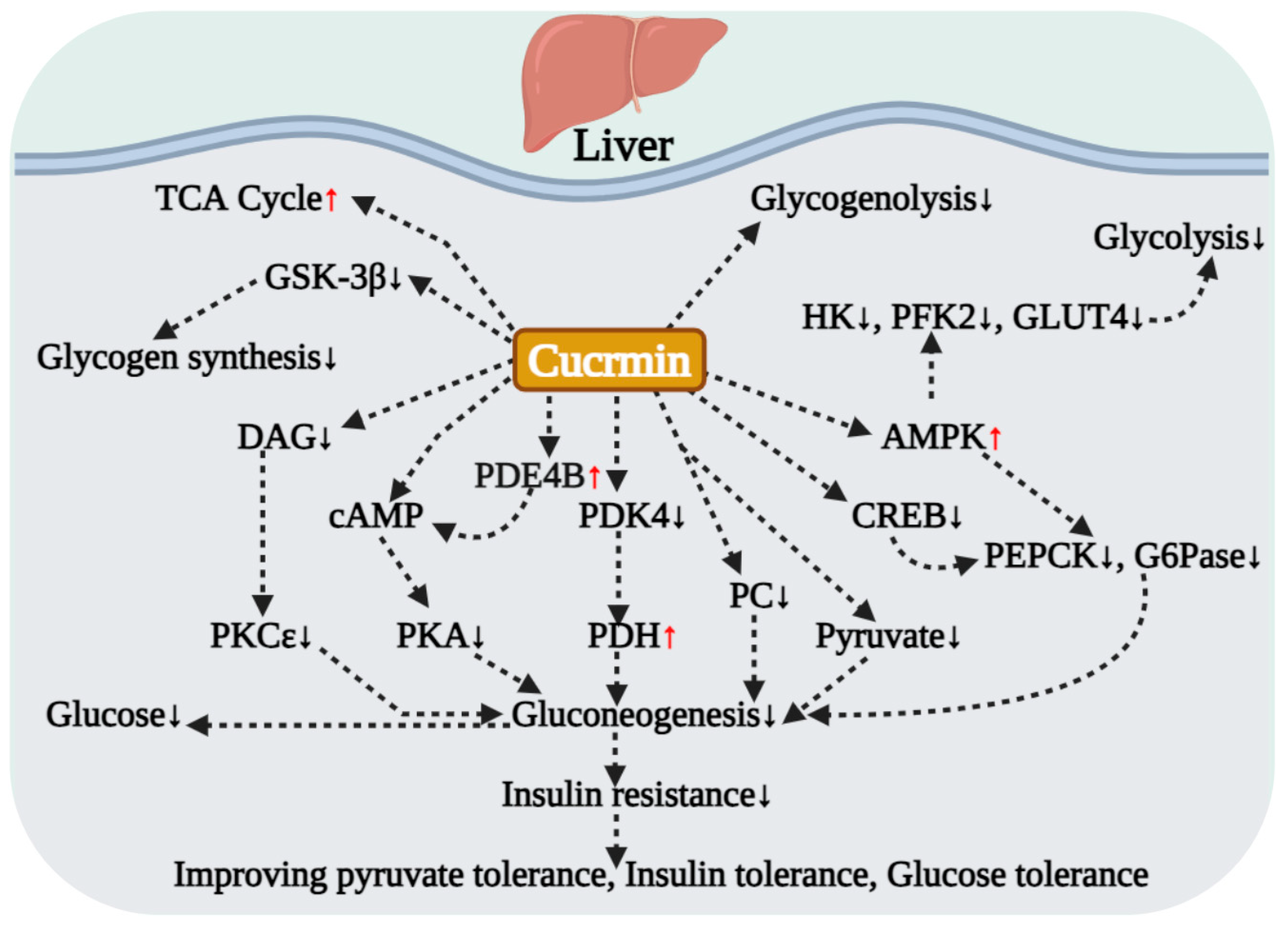
Figure 1. Curcumin regulates hepatic glucose metabolism. Curcumin inhibits hepatic gluconeogenesis by activating the AMPK signaling pathway and suppressing key enzymes such as G6Pase and PEPCK, while simultaneously promoting glycogen synthesis. Additionally, it modulates the interplay between glucose and lipid metabolism by reducing cAMP/PKA signaling and fatty acid oxidation, thereby enhancing hepatic insulin sensitivity. Colored arrows indicate the inhibitory (black) or stimulatory (red) effects of curcumin on downstream signaling targets, finally involved in regulating a variety of intracellular physiological processes. (Original drawing, created with BioRender, https://biorender.com, accessed on 8 January 2026).
Antioxidants 15 00109 g001
Figure 2. Curcumin regulates glucose metabolism in the intestine and muscle. In the intestines, curcumin regulates gut-derived hormones and delays sugar absorption by promoting the secretion of GLP-1 and inhibiting α-glucosidase, among other mechanisms. In the muscles, curcumin enhances glucose utilization by activating the AMPK/Akt signaling pathway, thereby promoting glucose uptake and glycogen synthesis. Colored arrows indicate the inhibitory (black) or stimulatory (red) effects of curcumin on downstream signaling targets, finally involved in regulating a variety of intracellular physiological processes. (Original drawing, created with BioRender, https://biorender.com, accessed on 8 January 2026).
Antioxidants 15 00109 g002
Figure 3. Curcumin regulates hepatic lipid metabolism. Curcumin reduces hepatic lipid accumulation by inhibiting lipogenesis through the AMPK/SREBP axis and promoting fatty acid oxidation. Additionally, it downregulates CD36-mediated fatty acid uptake and enhances cholesterol catabolism and bile acid synthesis. Colored arrows indicate the inhibitory (black) or stimulatory (red) effects of curcumin on downstream signaling targets, finally involved in regulating a variety of intracellular physiological processes. (Original drawing, created with BioRender, https://biorender.com, accessed on 8 January 2026).
Antioxidants 15 00109 g003
Figure 4. Curcumin regulates lipid metabolism in muscle, intestine, and adipose tissue. Curcumin enhances fatty acid oxidation in muscles, reduces lipid accumulation, and improves insulin sensitivity. In the intestines, it inhibits cholesterol absorption and promotes lipid excretion. Furthermore, in adipose tissue, curcumin suppresses adipogenesis, stimulates lipolysis, and induces the browning of white adipose tissue. Colored arrows indicate the inhibitory (black) or stimulatory (red) effects of curcumin on downstream signaling targets, finally involved in regulating a variety of intracellular physiological processes. (Original drawing, created with BioRender, https://biorender.com, accessed on 8 January 2026).
Antioxidants 15 00109 g004
Figure 5. Curcumin Improves Mitochondrial Function in Skeletal Muscle. Curcumin enhances the energy metabolism function of skeletal muscle by activating signaling pathways such as AMPK, promoting mitochondrial biogenesis, and alleviating oxidative stress. Colored arrows indicate the inhibitory (black) or stimulatory (red) effects of curcumin on downstream signaling targets, finally involved in regulating a variety of intracellular physiological processes. (Original drawing, created with BioRender, https://biorender.com, accessed on 8 January 2026).
Antioxidants 15 00109 g005
Figure 6. Curcumin improves mitochondrial respiratory function in hepatocytes and neurons. Curcumin enhances mitochondrial biogenesis and respiratory chain function in the liver by upregulating PGC-1α, NRF1, and TFAM. It restores ATP production and reduces oxidative stress, thereby alleviating hepatic steatosis. In neurons, curcumin maintains mitochondrial membrane integrity, enhances antioxidant defense, and protects cells from oxidative stress damage. Colored arrows indicate the inhibitory (black) or stimulatory (red) effects of curcumin on downstream signaling targets, finally involved in regulating a variety of intracellular physiological processes. (Original drawing, created with BioRender, https://biorender.com, accessed on 8 January 2026).
Antioxidants 15 00109 g006
Figure 7. Curcumin improves mitochondrial function in the kidney and adipose tissue. In the kidneys, curcumin enhances oxygen consumption and ATP synthesis efficiency by restoring the activity of mitochondrial respiratory chain complexes (I, II, III, and V). Simultaneously, it promotes mitochondrial biogenesis by upregulating PGC-1α and TFAM, alleviates oxidative stress and endoplasmic reticulum stress, thereby protecting renal function and reducing lipid accumulation and tissue damage. In adipose tissue, curcumin promotes the ‘browning’ of white adipose tissue (WAT), which is characterized by an increase in mitochondrial number and the expression of thermogenic proteins such as UCP1. It upregulates mitochondrial biogenesis and respiratory function by activating signaling pathways such as AMPK/PGC-1α, enhancing energy expenditure, and combating obesity. Colored arrows indicate the inhibitory (black) or stimulatory (red) effects of curcumin on downstream signaling targets, finally involved in regulating a variety of intracellular physiological processes. (Original drawing, created with BioRender, https://biorender.com, accessed on 8 January 2026).
Antioxidants 15 00109 g007
Figure 8. Curcumin improves systemic metabolism and insulin resistance through a multi-organ, multi-mechanism network. Curcumin-mediated systemic metabolic improvement involves a complex multi-organ regulatory network. It integratively ameliorates glucose and lipid metabolism disorders and IR through multiple mechanisms, including reshaping the gut microbiota structure, increasing the production of beneficial metabolites (such as short-chain fatty acids, SCFAs, and bile acids), repairing the intestinal barrier function to reduce endotoxin entry into the bloodstream, and synergistically suppressing systemic inflammation and oxidative stress. Colored arrows indicate the inhibitory (black) or stimulatory (red) effects of curcumin on downstream signaling targets, finally involved in regulating a variety of intracellular physiological processes. (Original drawing, created with BioRender, https://biorender.com, accessed on 8 January 2026).
Antioxidants 15 00109 g008
Disclaimer/Publisher’s Note: The statements, opinions and data contained in all publications are solely those of the individual author(s) and contributor(s) and not of MDPI and/or the editor(s). MDPI and/or the editor(s) disclaim responsibility for any injury to people or property resulting from any ideas, methods, instructions or products referred to in the content.