
You are currently viewing a new version of our website. To view the old version click .
Antioxidants
  • Review
  • Open Access

15 December 2025

Nanoparticle-Based Assays for Antioxidant Capacity Determination

,
,
,
and
1
Department of Analytical Chemistry, Medical University of Lublin, Chodźki 4A, 20-093 Lublin, Poland
2
Department of Plastic Surgery, St. John’s Cancer Center, Jaczewskiego 7, 20-090 Lublin, Poland
3
Institute of Health Sciences, John Paul II Catholic University of Lublin, Konstantynów 1 H, 20-708 Lublin, Poland
*
Author to whom correspondence should be addressed.
This article belongs to the Special Issue Bioactive Antioxidants: Structural Characterization, Synthetic Pathways, and Clinical Applications

Abstract

Thanks to both endogenous and exogenous antioxidants (AOs), the antioxidant defense system ensures redox homeostasis, which is crucial for protecting the body from oxidative stress and maintaining overall health. The food industry also exploits the antioxidant properties to prevent or delay the oxidation of other molecules during processing and storage. There are many classical methods for assessing antioxidant capacity/activity, which are based on mechanisms such as hydrogen atom transfer (HAT), single electron transfer (SET), electron transfer with proton conjugation (HAT/SET mixed mode assays) or the chelation of selected transition metal ions (e.g., Fe2+ or Cu1+). The antioxidant capacity (AOxC) index value can be expressed in terms of standard AOs (e.g., Trolox or ascorbic acid) equivalents, enabling different products to be compared. However, there is currently no standardized method for measuring AOxC. Nanoparticle sensors offer a new approach to assessing antioxidant status and can be used to analyze environmental samples, plant extracts, foodstuffs, dietary supplements and clinical samples. This review summarizes the available information on nanoparticle sensors as tools for assessing antioxidant status. Particular attention has been paid to nanoparticles (with a size of less than 100 nm), including silver (AgNPs), gold (AuNPs), cerium oxide (CeONPs) and other metal oxide nanoparticles, as well as nanozymes. Nanozymes belong to an advanced class of nanomaterials that mimic natural enzymes due to their catalytic properties and constitute a novel signal transduction strategy in colorimetric and absorption sensors based on the localized surface plasmon resonance (LSPR) band. Other potential AOxC sensors include quantum dots (QDs, <10 nm), which are particularly useful for the sensitive detection of specific antioxidants (e.g., GSH, AA and baicalein) and can achieve very good limits of detection (LOD). QDs and metallic nanoparticles (MNPs) operate on different principles to evaluate AOxC. MNPs rely on optical changes resulting from LSPR, which are monitored as changes in color or absorbance during synthesis, growth or aggregation. QDs, on the other hand, primarily utilize changes in fluorescence. This review aims to demonstrate that, thanks to its simplicity, speed, small sample volumes and relatively inexpensive instrumentation, nanoparticle-based AOxC assessment is a useful alternative to classical approaches and can be tailored to the desired aim and analytes.

1. Introduction

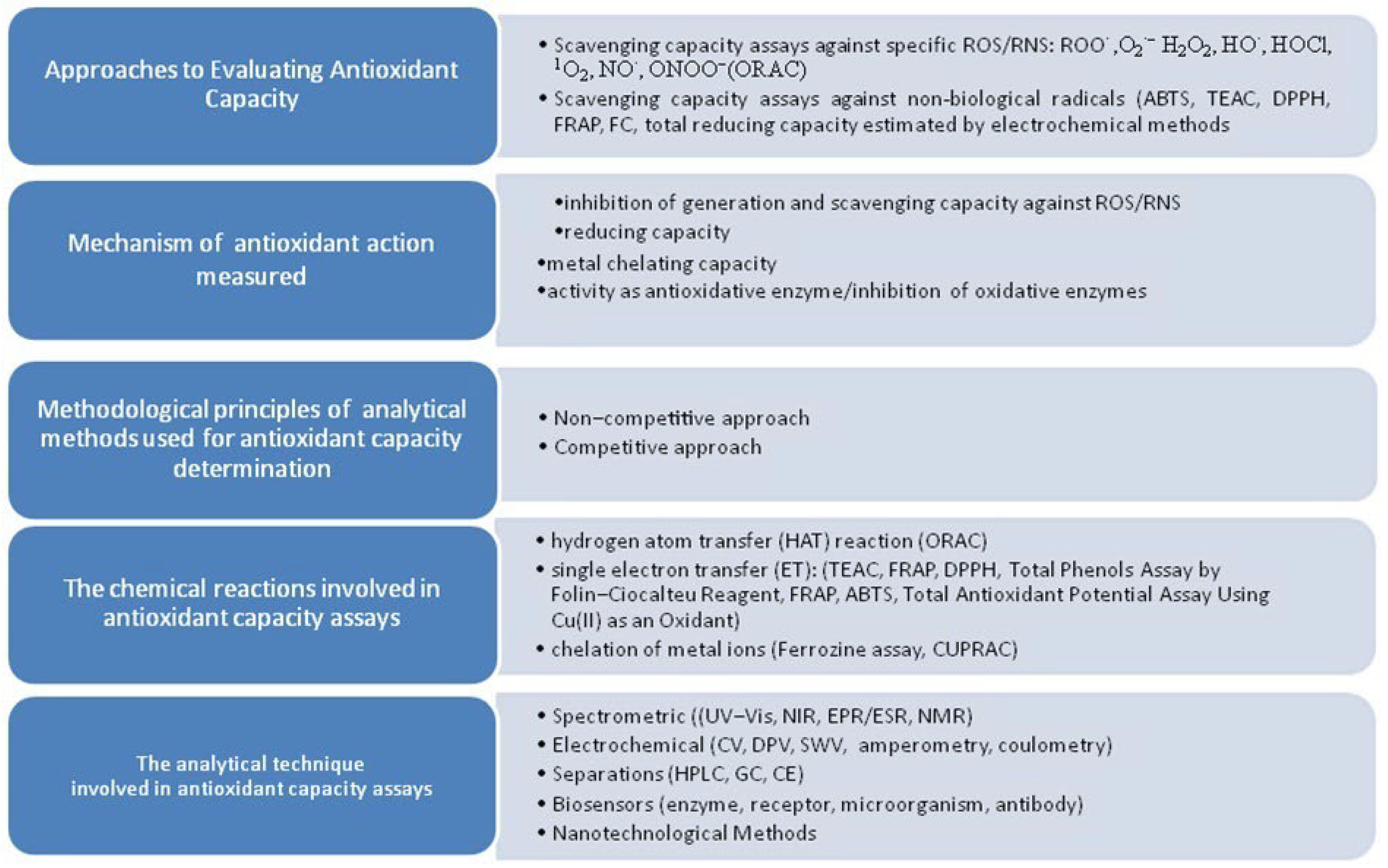
An imbalance between the oxidative and antioxidant systems can lead to an increase in the production of reactive oxygen/nitrogen species (ROS/RNS), which play an important role in the development of many diseases [1]. Natural dietary antioxidants (AOs), such as vitamins, carotenoids, polyphenolic compounds and flavonoids, can reduce oxidative stress and slow the development of diseases by delaying or preventing oxidation [2]. Several methods have been developed to determine the antioxidant capacity (AOxC) of various samples, including supplements, foods, and plant extracts [3,4]. These approaches can be categorized depending on the criterion applied. Figure 1 presents the selected criteria for characterizing AOxC tests [5].
Figure 1. Classification of AOxC methods into categories according to selected criteria.
In addition to UV-vis, fluorescence and electrochemical techniques, other techniques are gaining popularity in the study of AOxC, such as electron paramagnetic resonance (EPR) spectroscopy [6,7,8]. The EPR method enables direct measurement of free radical concentrations, and analysis of EPR spectra allows identification of the chemical nature of the observed paramagnetic species. EPR spectroscopy is particularly effective at detecting hydroxyl (OH), superoxide (O2•−) and nitric oxide (NO) radicals. As the intensity of the EPR signal is dependent on the concentration of free radicals, determining antioxidant properties involves measuring the EPR signal of stable radicals such as 1,1-diphenyl-2-picrylhydrazyl (DPPH), 4-hydroxy-2,2,6,6-tetramethyl-1-piperidinyloxyl (TEMPOL), and galvinoxyl, following their interaction with antioxidant compounds. EPR can also be used to study magnetic nanostructures and their modifications [9]. For example, this technique can be used to determine the type of magnetic iron oxide nanoparticles (Fe3O4, γ-Fe2O3, α-Fe2O3, or combinations thereof). The technique’s capabilities are further expanded by spin labeling polymer-coated nanoparticles, enabling the study of their interactions with biological fluids. In a study by Prima et al. [10], EPR coupled with spin trapping was used to evaluate the antioxidant properties of vegetable oils that produced free radicals following UV irradiation. N-tert-butyl-α-phenylnitrone (PBN) was used as a spin-trapping agent that forms stable, long-lived nitroxide spin adducts with highly reactive, short-lived free radicals, such as hydroxyl or lipid radicals.
Nanotechnology offers a different approach to assessing AOxC. Nanomaterials (with at least one dimension of less than 100 nm) have unique optical and catalytic properties (Surface Plasmon Resonance—SPR), which can be utilized for quantification. They can therefore be used as sensors to determine AOxC with various spectrometric and electrochemical detection systems. It should be emphasized that the optical, mechanical, electrical and magnetic properties of nanoparticles differ significantly from those of microparticles and bulk materials [11,12,13,14,15,16,17,18] and can be controlled by adjusting their size, shape and degree of agglomeration [19].
Nanoparticle-based assays (including AuNPs and AgNPs) fall under the category of non-radical, redox potential-based assays and typically operate via an electron transfer (ET) mechanism. Chemical reduction-based nanotechnological assays for colorimetric AOxC measurements exploit the generation, growth or aggregation of nanoparticles (NPs), primarily noble metals (e.g., AuNPs and AgNPs), following the reaction of their ions with an antioxidant (AO) [20,21]. Pure nanomaterials have low molecular specificity and cannot distinguish between individual analytes. However, nanoparticles, particularly AuNPs, can be used as modifiers for electrochemical sensors, improving sensitivity and detection limits [22]. Adding nanomaterials to electrochemical sensors increases the surface area for immobilizing sensing molecules (e.g., antibodies, enzymes and DNA) and boosts electron transfer kinetics. A significant advance in AOxC evaluation is the use of nanomaterials with catalytic activity similar to that of natural enzymes, known as nanozymes, which offer specific selectivity [23]. A milestone in AOxC testing is the use of nanomaterials with an ultra-small size (less than 1 nm), including carbon dots (CDs) and graphene quantum dots (GQDs), which have unique fluorescence properties and are biocompatible [24]. These materials can be produced from waste and offer multimodal platforms as fluorescent and colorimetric probes, as well as catalysts.
In recent years, numerous reviews have been published on methods for assessing antioxidant capacity and activity. In many of these reviews, nanosensors are mentioned in a single subsection. Between 2005 and 2025, a few reviews in the PubMed database were devoted to nanosensors for AOxC testing [17,18,25,26,27,28,29,30,31,32,33]. Some focus solely on electrochemical studies, others on fluorescence detection, others on luminescent quantum dots, and others on single metallic nanoparticles, such as AgNPs.
In antioxidant studies, nanomaterials (e.g., quantum dots (QDs)) can act as sensors that react with free radicals by changing color, fluorescence or conductivity. Metallic nanoparticles (AuNPs, AgNPs) and metal oxide nanoparticles (ZnO, TiO2) act as LSPR-based sensors, changing their LSPR colors/peaks when interacting with antioxidants. These can be used to create advanced platforms for the rapid, parallel evaluation of multiple antioxidants (high-throughput screening). There are numerous types of nanomaterial with different structures and various applications, including in cosmetics [34], industry and agriculture [35,36], and medicine [37,38]. This review focuses on nanomaterials known to be effective in AOxC tests, particularly metallic nanomaterials and QDs (semiconductor nanocrystals, graphene and carbon quantum dots), and presents key findings regarding their use. Particular attention is paid to the methodologies and mechanisms of the tests developed for this purpose. In line with this goal, the following sections will provide a critical review of the available literature on this topic.

2. Localized Surface Plasmon Resonance (LSPR)

A feature of metallic nanoparticles used in AOxC measurements is the phenomenon of localized surface plasmon resonance (LSPR), which causes the emission of light in the visible range, enabling colorimetric measurements. LSPR occurs when conduction electrons collectively oscillate under the influence of electromagnetic radiation of the same frequency [39,40,41].
The strong absorption band in the visible light range resulting from LSPR at a specific wavelength is used for quantitative detection. The light absorption capacity depends on the shape and size of the nanoparticles, as well as intermolecular interactions and the refractive index of the dispersion medium [42,43,44,45,46]. Since stronger antioxidants can form smaller NPs and the LSPR depends on particle size (smaller NPs = blue-shift, larger = red-shift), a significant shift in the maximum wavelength (λmax) may occur with changes in antioxidant strength, making quantification difficult [29]. Kinetic issues are resolved by controlled enlargement (increase in NP size) of nanoparticles, e.g., AgNPs. The Silver Nanoparticle Antioxidant Capacity (SNPAC) method utilizes the addition of Ag seed nanoparticles, which are coated with newly formed NP layers under the influence of polyphenolic antioxidants.
LSPR is a nanoscale phenomenon, mainly related to the nanostructures of noble metals such as gold (Au) and silver (Ag) [47]. In addition to noble metals, other metals such as aluminum (Al) and copper (Cu) also exhibit the LSPR phenomenon [18,31,33,48,49,50].
Plasmon oscillations are spatially confined in particles of sizes on the scale of light wavelengths, namely nanoparticles (NPs). These oscillations do not propagate over longer distances along the surface; hence, LSPR exhibits a non-propagating character in contrast to propagating plasmons, which spread out and occur on flat surfaces or continuous thin metal layers, known as surface plasmons (SP) [47,51].
The most important consequence of the non-propagating and localized nature of LSPR is the generation of a short electromagnetic (EM) field decay length in close proximity to the nanoparticle surface. The electromagnetic (EM) field near the nanoparticle surface, resulting from LSPR, rapidly diminishes with increasing distance. This short decay range (the so-called decay length) is typically about 10 to 30 nm.
Other resonant effects include optical extinction. The peak of optical extinction (representing maximum absorption and scattering) is visible in noble metal NPs at the resonance frequency [47].
The LSPR phenomenon is sensitive to environmental changes [51]. When molecules bind to a surface, a change in plasmon resonance occurs, which is detected as an altered plasmon signal, for example, as a shift in the LSPR spectral peak [52]. The position of the LSPR quenching (absorption/scattering) peak depends on the refractive index of the surrounding dielectric medium [53]. A change in the ambient refractive index causes a shift in the wavelength of the LSPR peak. The sensitivity and properties of LSPR depend on several factors, including the material (Ag generates sharper resonances and greater sensitivity), particle size (absorption dominates in smaller particles, scattering dominates in larger ones; for example, in gold nanospheres the transition from absorption to scattering dominance occurs at a diameter of about 80 nm), shape and aspect ratio (sharp shapes exhibit higher refractive index sensitivity, and nanorods have greater sensitivity and a redshift of the resonance peak) [47,54]. Furthermore, interactions between particles (aggregates) enhance LSPR effects. Aggregation is visible as a shift in the absorption spectrum toward longer wavelengths—a redshift [55].
To study antioxidant capacity, a band is used, which is attributed to the collective excitation of an electron gas, accompanied by a periodic change in electron density at the surface [56].
Strong absorption of visible light at a specific wavelength is the result of plasmon resonance absorption in MNPs. For individual metals, LSPR causes the appearance of surface plasmon absorption bands with characteristic intensity and location. In addition to the metal type, the color and optical properties of the nanoparticles depend on the shape, size, adsorbed molecules, and the refractive index of the dispersion medium. For example, spherical Au nanoparticles exhibit absorption in the visible spectrum (VIS) around 530 nm. In the case of nanotube-shaped particles, the resonance is significantly redshifted toward longer wavelengths. Silver nanoparticles (AgNPs) exhibit a strong absorption band (423 nm), which is absent in the spectrum of the bulk metal due to surface plasmon resonance (SPR).
AgNPs and AuNPs are most commonly used to study AOxC. AuNPs are utilized as metallic sensors due to their chemical stability and resistance to oxidation, while AgNPs provide sharper resonances and increased sensitivity. AgNPs are characterized by very high molar extinction coefficients (ε ≈ 3 × 10¹¹ M−1 cm−1), and are expected to provide higher sensitivity in optical detection methods than conventional reagents [57,58]. However, it should be noted that the reaction sensitivity is also influenced by the reaction stoichiometry, particle size and shape, and dielectric constants, as well as their surrounding environment [59].
Optical sensors can operate using two fundamental strategies: aggregation/dispersion and non-aggregation (etching, growth) [60,61]. In aggregation-based sensors, the analyte induces NPs aggregation, which leads to plasmon coupling and a shift in the LSPR band (often accompanied by a change in solution color). Consequently, the analyte concentration is directly correlated with the degree of nanoparticle aggregation and the resulting change in the LSPR band. The dispersion (anti-aggregation) mechanism occurs when the colloid is initially aggregated, and the analyte acts as a dispersant, displacing the ligand that caused aggregation from the NP surface. In these systems, the analyte concentration is inversely proportional to the degree of NP aggregation. An example is the detection of methionine (Met) based on the anti-aggregation mechanism of gold nanoparticles (AuNPs) treated with melamine (Mel) used as an aggregating agent [62]. Non-aggregation strategies, based on etching and growth of metallic nanoparticles, modify the LSPR band by changing the size, shape, and dielectric environment of the NPs. Etching involves the catalytic oxidation of metallic nanoparticles, induced directly or indirectly by the analyte, which changes their size, shape, or composition and consequently modifies the LSPR band (an example is the oxidative etching of AuNTPs by Cr(VI)) [63]. Growth involves the generation of new plasmonic nanostructures from metallic ions, leading to the formation or rearrangement of the LSPR band and associated color changes in the solution.
Optical sensors based on the LSPR effect, utilizing metallic nanomaterials (MNPs), form two main categories of analytical techniques. The first category encompasses surface-enhanced spectroscopies (SES) [64]. SES techniques utilize the interaction of analytes with intense electromagnetic (EM) fields, which are generated and localized near nanoparticles (NPs) due to the LSPR effect. SES includes: (i) Surface-enhanced Raman spectroscopy (SERS): This demonstrates the most advanced level of performance compared to SEF and SEIRA. SERS achieves significantly higher enhancement factors (EF), increasing by six to ten orders of magnitude, which can lead to single-molecule sensitivity; (ii) Surface-enhanced fluorescence (SEF); (iii) Surface-enhanced infrared absorption (SEIRA): Similarly to SEF, this technique demonstrates a moderate increase in analytical signal, up to about two orders of magnitude, although the fundamental challenge for SEIRA is achieving reliable quantification. The second group consists of optical sensors based on LSPR band extinction (absorption/colorimetry). These sensors rely on monitoring visible light absorption, which is modulated by changes in the dielectric environment surrounding the NPs. These changes are the result of nanoparticle aggregation/dispersion mechanisms or non-aggregation strategies (such as etching or MNP growth).

3. Determination of Antioxidant Capacity/Activity Using Metallic Nanoparticles

Assays based on NPs for determining AOxC utilize LSPR for colorimetric detection. As reductants, AOs reduce metal salts to NPs and/or act as catalysts for nanostructure enlargement [46]. Several approaches are used to assess AOxC: (i) nanoparticle aggregation; (ii) nanoparticle seed enlargement in the presence of an antioxidant compound; and (iii) nanoparticle formation through salt reduction by AOs [65].
In addition to AgNPs and AuNPs, in vitro assays for measuring AOxC use iron oxide nanoparticles (IONPs), titanium oxide nanoparticles (TiO2NPs), titanyl oxalate, rhodium nanoparticles (RhNPs), zirconium oxide (ZrO2), zinc oxide (ZnO) and cerium oxide (CeONPs) by optically monitoring changes in localized surface plasmon resonance (LSPR) [57,66,67,68,69,70].
NP formation can usually be observed visually due to its characteristic color, which depends on the nanoparticle morphology, adsorbed ligands and the properties of the dispersion medium [71].
The main instrumental techniques used to analyze nanoparticles include: microscopic techniques (SEM, TEM and AFM, i.e., scanning electron microscopy, transmission electron microscopy and atomic force microscopy), which are useful for identifying morphological surfaces; X-ray photoelectron spectroscopy and energy dispersive X-ray spectrometry, which are useful for confirming elemental composition; X-ray diffraction (XRD), which is useful for determining the crystallography of NPs; UV–Vis absorption spectroscopy, with other spectroscopic techniques (FTIR, spectrophotometry, Raman spectroscopy, surface-enhanced Raman scattering (SERS) and surface plasmon resonance (SPR) spectroscopy) [72]; Dynamic light scattering (DLS) measures the size distribution, surface charge (or zeta potential), hydrodynamic radius and concentration of nanoparticles dispersed in solution.
Nanoparticle-based assays are usually calibrated using reference antioxidants [65,73,74,75]. Some authors report good agreement between total antioxidant capacity (TAC) results obtained using nanoparticle-based assays and those obtained using reference methods such as ORAC, TEAC and CUPRAC [76], as well as Folin–Ciocalteu, FRAP and DPPH [73]. Table 1 summarizes information regarding metallic and metal oxide nanoparticles that are used to determine antioxidant capacity and which employ LSPR-based measurements.
Table 1. Summary of Nanoparticle-Based Assays for Antioxidant Capacity (AOxC).
Reducing agents are required for producing metallic nanoparticles and inducing changes in existing NPs. To create MNP colloidal dispersions, sodium citrate, hydrogen peroxide and hydrides are typically employed as reducing agents [19]. The morphological characteristics of NPs depend on the reducing agents, dispersion stabilizers, and pH. Strong reducing agents react rapidly with inorganic salt or metal complex precursors (e.g., Ni, Co, HAuCl4, AgNO3, H2PtCl6, RhCl3, PdCl2), resulting in small NPs being formed [16]. Conversely, the reaction is slow for weak reducing agents, and the synthesized NPs are usually larger. In multicomponent samples such as plant extracts, all antioxidants participate in the formation of nanoparticles as the process is not selective [81]. Therefore, the kinetics of the reduction process depend on the total antioxidant capacity (TAC) of the sample. Consequently, the process of nanoparticle formation/growth can be used to assess TAC.

3.1. Silver NanoParticle Antioxidant Capacity (SNPAC)

In 2012, Özyürek et al. [56] used an AgNP-based method to evaluate the antioxidant properties of polyphenols. They used the absorbance band of the fabricated core–shell Ag NP structures at 423 nm for quantitative analysis. This method is known as Silver NanoParticle Antioxidant Capacity (SNPAC).
The SNPAC mechanism of action is based on electron transfer (ET). Unlike classical reduction methods (e.g., CUPRAC and FRAP), which directly reduce the metal-ligand complex, the SNPAC method utilizes the growth of silver nanoparticles (AgNPs) under the influence of the addition of an antioxidant (e.g., polyphenols or vitamins) as a secondary reducing agent [82,83]. Unfortunately, using an antioxidant as the sole reducing agent did not produce a linear response [56]. The SNPAC assay, also known as ‘Seed-Mediated Growth’, employs a two-stage procedure. The first stage involves preparing monodisperse silver nanoparticle seeds by reducing them with a weak reducing agent, trisodium citrate:
Antioxidants 14 01506 i001
Citrate acts as both a reducing agent and a dispersion stabilizer, inhibiting the formation of new nucleation sites [84]. As a dispersion stabilizer, citrate imparts a negative charge to the nanoparticles, which causes electrostatic repulsion and enhances dispersion, thereby preventing aggregation. In the second stage of the test, the antioxidant (AO) being tested is added to the prepared nuclei and acts as a secondary reducing agent:
nAg+ + AO-(OH)n→nAg0(AgNPs) + AO(=O)n + nH+
In the method proposed by Özyürek [56], the SNPAC reaction mixture consists of the following components, at a final volume of 2.8 mL: 2.0 mL of the initial AgNP seed solution; x mL of the standard antioxidant or actual sample solution; and (0.8 − x) mL of H2O. The most commonly used incubation time in SNPAC is 30 min, compared to 30–60 min in CUPRAC and 20–60 min in free radical-based methods (e.g., DPPH and ABTS). It should be noted that authors using conventional methodologies rarely consider the kinetics of free radical reactions, which may be slow for some antioxidants [4,85,86], potentially generating inconsistencies in the results obtained.
The E potential of Ag(I)/Ag° is 0.8 V, whereas the standard potential of most antioxidants is in the range of 0.2–0.6 V. Consequently, electrons are transferred from the antioxidants (at a lower potential) to the Ag+ ions on the surface of the nanoparticle seeds. This results in the seeds’ growth and the formation of a core–shell structure. Simultaneously, the phenolic groups are reduced to the corresponding quinones. An increase in antioxidant concentration results in a linear increase in LSPR absorption that is directly proportional and can be monitored spectrophotometrically at 423 nm. The intensity of the absorption band of AgNPs increases linearly with increasing antioxidant concentration. For polyphenols, high linear correlation coefficients (r2 = 0.994) and LOD values of approximately 1 nM were obtained [56]. The growth of AgNPs can be observed with the naked eye as the reaction mixture changes from light yellow to brown as the antioxidant concentration increases.
Total antioxidant capacity (TAC) is determined by the increase in absorbance (ΔA) at 423 nm, measured relative to the blank sample after 30 min of incubation at 25 °C following the addition of the antioxidant to seeded AgNPs. Absorbance increases linearly with increasing concentrations of different (hydrophilic and lipophilic) antioxidants. The TEAC of a given antioxidant is the ratio of its molar absorbance (ε) to the molar absorbance of Trolox, measured under the same conditions. Ozyürek et al. showed that, in the case of a mixture containing different antioxidants, the absorbances are summative, confirming that the antioxidant capacities are additive [56].
Numerous examples of the practical application of the SNAPC method to analyze complex samples in the form of natural extracts can be found in the literature.
This method has been employed to evaluate the antioxidant capacity of food and beverage samples, including fruit juices and herbal teas [56,87]. For example, Szydlowska-Czerniak et al. used a method based on AgNPs to determine the AOxC of fats and oils from various rapeseed varieties and rapeseed processing by-products, such as flakes and oilcakes [73]. Other authors have studied hydrophilic and lipophilic compounds such as polyphenols (flavonoids, simple phenolic acids and hydroxycinnamic acids) and vitamins C and E using SNPAC methodology [77,88,89,90,91,92]. Bukovsky-Reyes et al. used a modified SNPAC assay to determine the total antioxidant capacity (TAC) of distilled spirits, including whisky, bourbon, tequila and rum [93].
In pioneering work, Özyürek et al. [56] used silver nucleating particles obtained by reducing Ag+ ions with trisodium citrate as a weak reducing agent. In this method, 50 mL of 1.0 mM AgNO3 is heated to boiling point for 10 min. Then, 5 mL of 1% trisodium citrate was added dropwise and the solution stirred. When the color of the mixture turned light yellow, it was cooled to room temperature. In the work presented by Bukovsky-Reyes et al., 15 mL of an Ag+ solution with a concentration of approximately 500 mg/L (4.6 mM) was added to a 35 mL microwave vessel containing ~150 mg of soluble starch. The AgNPs were synthesized in a microwave oven at 150 °C for 15 min and pre-capped with starch instead of citrate. Using microwave heating, the incubation time was shortened from 30 min to 6 min, and the volume of the AgNP reagent was reduced from 2 mL to 0.5 mL.
The SNPAC method produces results that correlate with those obtained using other ion-reduction methods, such as the CUPRAC (Cupric Reducing Antioxidant Capacity) test [94]. TEAC values obtained using the SNPAC method were found to be comparable to those obtained using the CUPRAC test (for the 15 antioxidants tested, the correlation coefficient was 0.936). However, a slightly poorer correlation was observed between AgNP and FRAP, DPPH and total phenolic content (Folin–Ciocalteu) in different rapeseed extracts, including flakes, press cake and meal, with r values ranging from 0.5971 to 0.9149 [73,87].
Bukovsky-Reyes et al. [93] evaluated the SNPAC assay’s ability to respond to antioxidants with different reducing powers by preparing calibration curves for individual antioxidants and comparing the resulting slopes (ε) and gallic acid equivalents (GAE) (in mg/L and µM). These results were then compared with the reactivity of various compounds using the Folin–Ciocalteu reagent, as described by Everette et al. [95], as well as with the data provided by Özyürek [56]. Modest consistency was found between the two sets of data for the AOs collected in this study. The received molar GAE values were approximately half the reported values of Everette et al. [95]. However, it was noted that the standards used for the SNPAC assay were prepared in a water–ethanol mixture (60:40, v/v). Ethanol may have a prooxidant effect, which could account for the lower molar concentration ratio of GAE. To test this hypothesis, ellagic acid and gallic acid standards were prepared in deionized water and reanalyzed using the SNPAC assay. The resulting data were much closer.
Bukovsky-Reyes et al. [93] used HPLC to validate the SNPAC assay. As gallic and ellagic acid concentrations were the major contributors to the enhanced plasmon resonance of the AgNPs, these acids were used to validate the SNPAC assay measurements. They evaluated the correlation between HPLC and SNPAC assays by determining t-test values (assuming a normal distribution) and the Wilcoxon signed-rank test for a non-normal distribution. To assess the agreement between the HPLC data and SNPAC assay values, Bland–Altman plots were also used. Only two of the 33 samples included in this study were beyond the mean difference ± 2 SD values, indicating agreement between the two methods.
The advantage of the SNPAC method is its high colorimetric sensitivity, expressed by high molar extinction coefficients (ε ≈ 3 × 10¹¹ M−1 cm−1) and the absence of interference from common substances present in food extracts, such as simple sugars (e.g., glucose, fructose) and amino acids (e.g., glycine, alanine), or components such as oxalates, citrates, and fruit acids [56]. This distinguishes SNPAC from the Folin–Ciocalteu method (FC) and nanoparticle-based assays, where non-phenolic compounds such as ascorbic acid, aromatic amines, and metal ions interfere with measurements [56], potentially leading to inaccurate test results. Mechanism-based (ET) methods require appropriate pH conditions to ensure optimal sensitivity. In the case of FRAP, an acidic environment (pH 3.6) is preferred [96]. For CUPRAC, pH 7 is optimal [97], whereas SNPAC provides the most favorable absorbance response at pH 6.0 [56].
A major advantage of the SNPAC method is its selectivity and the linear dependence of absorbance on concentration over a wide range of concentrations, which allows for comparison of TAC values across different samples. The two-step procedure and preparation of seed NPs ensure a wide linear range for the method. Furthermore, SNPAC (like modified CUPRAC or ORAC assays) can measure the TAC of both hydrophilic and lipophilic antioxidants (e.g., vitamins C and E and polyphenols).
“Turn-off” nanoparticle probes, which operate based on the disintegration of NPs, can be used to measure TAC through their ability to scavenge ROS [98,99,100]. An example is LSPR sensors, which operate by degrading AgNPs, catalyzing the decomposition of hydrogen peroxide, resulting in a visible discoloration of the solution. AOs, by scavenging hydrogen peroxide, inhibit this disintegration, restoring the LSPR signal. A disadvantage of this assay is the difficulty in obtaining a linear relationship between the signal and the antioxidant concentration.

3.2. Gold Nanoparticles (AuNPs)

Scampicchio et al. [77] were the first to describe a method for measuring antioxidant activity based on the catalytic growth of gold nanoparticles (AuNPs) under the influence of phenolic acids, which they published in 2006.
Using the method described by Enüstün and Turkevich in the 1960s, a stable dispersion of 20 nm AuNPs was obtained by reducing Au3+ salt with sodium citrate at 100 °C [101], or with other reductants such as borohydride, formaldehyde and stabilizing agents like thiol-functionalized organics, surfactants or polymers (e.g., heparin [102]). The use of AuNPs in TAC assays is based on redox reactions, whereby antioxidants reduce gold ions (Au3+) [78,101,103,104,105,106,107], resulting in the generation or growth of NPs [77,78,101,108]. The mechanism for determining TAC using AuNPs is based on electron transfer (ET). AuNPs can be detected using SERS or UV-visible spectroscopy due to their plasmonic properties. The absorption maximum of 10 nm AuNP nanoparticles occurs at 520 nm. A solution of well-dispersed AuNPs turns red. Aggregation and decreasing spacing between individual AuNPs shifts the LSPR absorption band towards longer wavelengths. Colloidal dispersions change color to various shades of violet-blue [109,110].
The antioxidant (AO) acts as an electron donor for the gold ions (Au3+), which are derived from the AuCl4 ion and are reduced to metallic gold (Au0). The ET reaction can be written in general terms and for the example antioxidant, ascorbic acid (AA), as follows:
Au3+ + AO {reduced} ↔ Au0 (AgNPs) + AO {oxidized}
Antioxidants 14 01506 i002
The monitoring of AuNPs is associated with a characteristic absorbance peak, typically around 517, 540 or 555 nm. The color of AuNPs depends on their shape and size, as well as intermolecular interactions and the refractive index of their environment.
Scampicchio et al. were the first to develop an AOxC assay that utilizes the generation and growth of AuNPs from a mixture of gold salts, citrate and cetyltrimethylammonium chloride (CTAC), when phenolic acids (vanillic acid, propyl gallate, protocatechuic acid, caffeic acid and ferulic acid) are added [77]. The localized surface plasmon resonance (LSPR) absorbance of the AuNPs, measured at 555 nm, was found to be linearly correlated with acid concentration. The plasmon absorption band was measured in a 0.01 M phosphate-buffer solution at pH 8.0 after an incubation period of 10 min at 45 °C. The authors compared the new Au NP protocol with total phenolic content determined by the FC test (r = 0.993) and cyclic voltammetry. Subsequent studies used the AuNP growth-based method to analyze phenolic acids and flavonoids in food samples such as tea, apples, pears, wine and honey [18,101,108,109], as well as selected isoflavone classes including aglycones (genistein and daidzein) and their glycosides (genistin and daidzin), soy extracts and the plants Tagetes lucida, Mentha piperita, Cynara scolymus, Cymbopogon citratus and Calendula officinalis. Polyphenol standards such as chlorogenic acid, rutin and hesperidin were also analyzed [111,112].
Wang et al. [111] studied the UV–vis absorption spectra of Au-NP seeds and enlarged NPs when treated with different concentrations of flavonoids, such as quercetin, daizeol and puerarin, which were present in the growth solution. They obtained a linear range with r = 0.9991–0.9999. They also employed an electrochemical technique to study the enlargement of the seeds of the gold nanoparticles (Au-NPs) onto a modified electrode by reducing tetrachloroauric acid using flavonoids as a source of gold.
Reza Hormozi Nezhad et al. [112] developed a colorimetric method for detecting a series of dihydroxybenzenes (DHBs) and their derivatives (e.g., hydroquinone, catechol, and pyrogallol). The reduction of AuCl4 to AuNPs by AOs in the presence of CTAC produced LSPR absorbance at λ = 568 nm that was linearly correlated with the concentration of AOs.
In exploring AuNP synthesis as an analytical tool for AOxC evaluation, Escarpa’s group made an important observation [18,113]. The researchers described the synthesis of AuNPs using soy isoflavone extracts [113]. The dependence of absorbance at 540 nm on concentration was defined using a sigmoidal curve. Based on this curve, the AOxC concentration at which absorption reaches half-value was determined, as well as Xc50, which indicates the AuNP production efficiency, and KAuNPs, which states the amount of AuNPs produced per concentration unit. The synthesis of AuNPs of different sizes and colors was associated with the antioxidant activity of various isoflavones. Genistein and soy extracts with high aglycone content exhibited the highest antioxidant activity, producing the most intense red colloidal solutions and the smallest particle sizes. The authors emphasize the consistency of the Au NP protocol results with respect to X50c (the concentration value at which absorption reaches half-value) and total phenolic compounds (r = 0.93, p-value < 0.05), as determined by the Folin–Ciocalteu (FC) test, as well as with respect to FRAP and ABTS (r = 0.85, p-value < 0.10). The relationship between the concentration of antioxidants and LSPR absorbance was measured for four selected polyphenols: chlorogenic acid, and the flavonoids rutin, apigenin and hesperidin, which belong to the flavonol, flavone and flavanone classes, respectively. The obtained relationship was sigmoidal, described by the equation:
A 540 = A m a x 1 + e K ( X X c 50 )
where Amax is the maximum absorbance at 540 nm, X is the polyphenol concentration, Xc50 denotes the inflection point, and K is the factor fit with the slope units, which is the parameter expressing the AOxC.
AuNPs have also been used to study the antioxidant capacity of chrysanthemum extracts, various teas (black, green), fruit juices (orange), edible oils, including olive oil, and to detect adulteration of argan oil [69,77,78,106,114].
AuNPs are also key in electrochemical methods for determining antioxidant activity. Gold nanoparticles (the most commonly used) can serve as a conductive matrix in biosensors, increasing the surface area of the working electrode and thus leading to higher currents and increased sensitivity. Amperometric TAC measurements of plant extracts using the electrochemical Au-nanozyme sensor (based on the enzyme-like catalytic activity of AuNPs) showed good correlation with the chemiluminescence method (Pearson’s correlation coefficient of 0.958) [103].
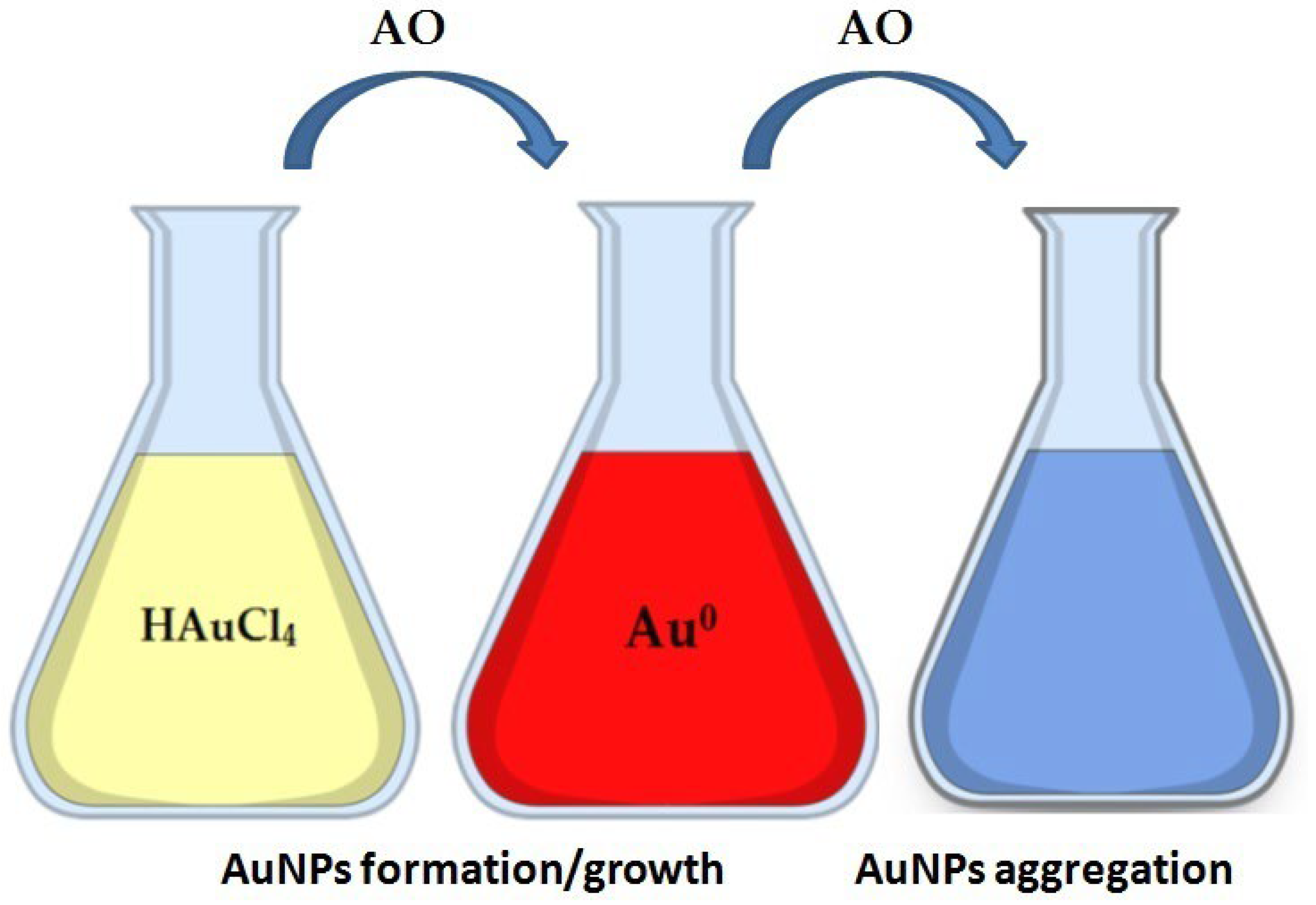
Several strategies for using AuNPs for the quantification of AOs have been described in the literature, including (i) antioxidant-induced AuNP formation and growth (AuNPs formation/growth). Antioxidants (e.g., phenolic acids, vitamin C) reduce Au3+ ions or HAuCl4 to AuNPs and other products. In electrochemistry, the growth of AuNPs on the electrode surface is monitored using cyclic voltammetry (CV); (ii) nanoparticle growth (Enlargement). In this case, AOs act as catalysts for the enlargement of nanostructures (e.g., nanoshells). Precursor nanocomposites containing a SiO2 core with added AuNPs can serve as nucleation sites; the analyte (phenolic antioxidant) reduces AuCl4 to Au0, inducing the growth of gold nanoshells on the SiO2 core [74,75,115,116,117,118]. The growth of AuNPs on the electrode surface was also monitored using CV; (iii) AuNP aggregation (AuNP aggregation). Some types of AOs, especially thiols (e.g., cysteine), can form a self-assembling layer on the AuNPs surface. This leads to nanoparticle aggregation and a shift in λmax to longer wavelengths (the batachromic effect) [119]. In this version, we observe a color change from red (dispersed nanoparticles) to blue (AuNPs aggregates) upon addition of an antioxidant. (Figure 2).
Figure 2. Main mechanisms and accompanying color changes in AuNPs used in antioxidant capacity assays.
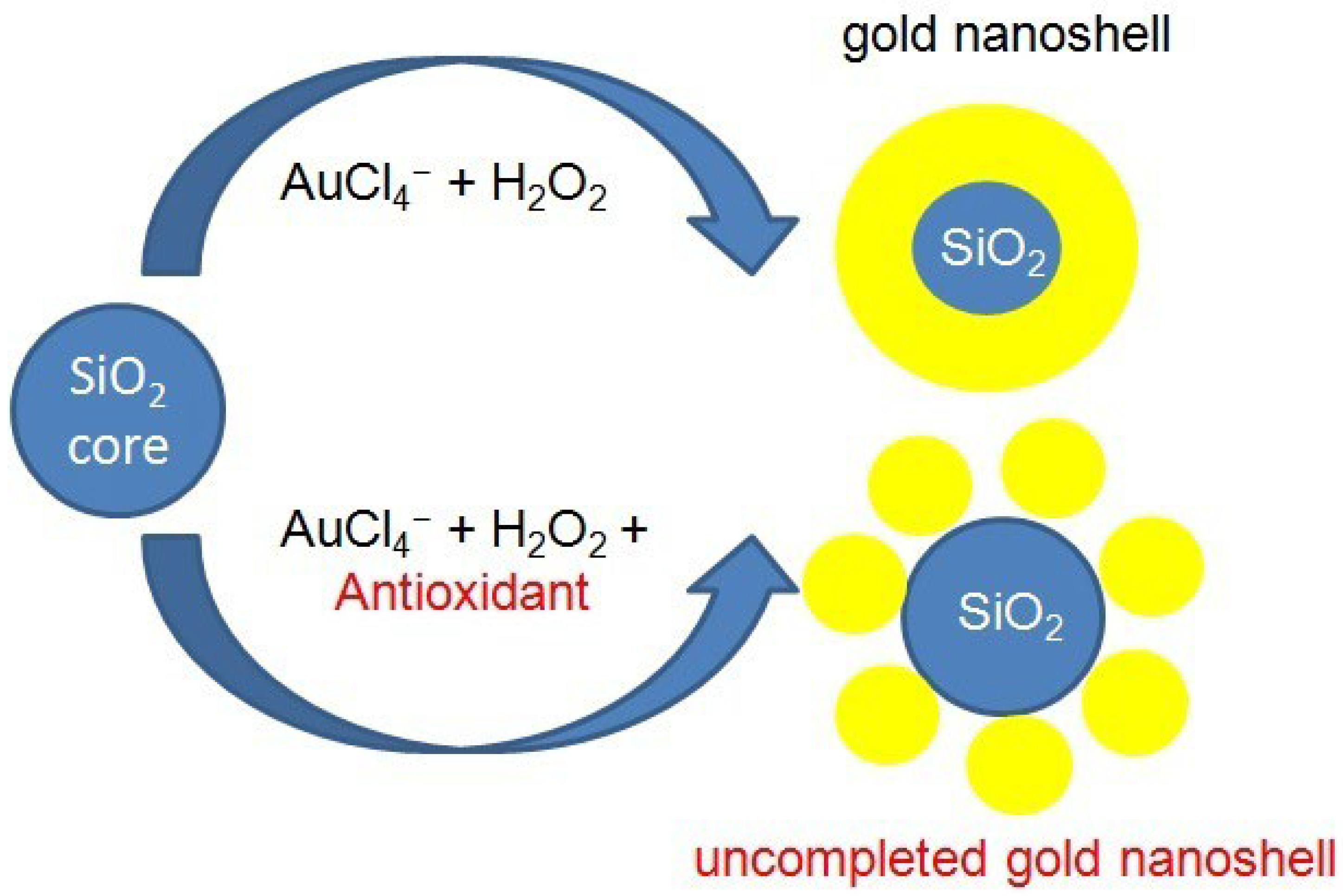
Sudeep et al. [116] described a highly selective (in the presence of various other amino acids) and sensitive (3 µM cysteine, 12 µM glutathione) method for detecting the endogenous antioxidants cysteine (Cys) and glutathione (GSH) using Au-nanorods, which undergo aggregation, visible as an LSPR absorption band at 850 nm. Nanotube aggregation is closely related to the feature anisotropy and plasmon absorption coupling. The thiol functional groups of Cys and GSH in their zwitterionic form promote nanotube self-assembly, which is strongly pH-dependent. Basu et al. [117] used citrate-coated AuNPs to determine GSH at relatively low pH, which induces AuNP aggregation via its sulfur- and nitrogen-containing functional groups. The method proved to be very sensitive, detecting GSH at a concentration of 10−6 M. (iv) Inhibition of AuNPs growth induced by initial reducing agent, e.g., H2O2. The addition of antioxidants inhibits AuNPs formation in a concentration-dependent manner. An antioxidant with H2O2 scavenging activity prevents the growth of AuNPs on the SiO2 surface, causing a wavelength shift in the LSPR spectrum and a change in absorption intensity. Inhibition of AuNP synthesis is proportional to the antioxidant concentration and provides the basis for measuring AOxC and IC50, which is the antioxidant concentration that induces 50% absorption inhibition [74,75,115,116,120] (Figure 3).
Figure 3. Antioxidant capacity assay utilizing AuNPs nanoshell growth inhibition.
(v) Surface functionalization. These mechanisms are distinguished by their selectivity, as they exploit specific interactions of a particular analyte with the functionalized nanoparticle surface. An example is the selective determination of biothiols using AuNPs nanoprobes modified with Ellman’s reagent (DTNB-Au-NP). The reaction occurring on the surface results in the release of the yellow anion 5-thio-2-nitrobenzoate (TNB2−), which is measured at 410 nm [29].
Bener et al. [102] proposed the use of synthesized AuNPs as a colorimetric sensor for TAC measurement. Negatively charged AuNPs stabilized with heparin adsorbed the reaction product of the CUPRAC reagent with an antioxidant, specifically the positive chelate copper(I)-neocuproine (Cu(I)-Nc) formed in the reaction of Cu(II)-Nc with antioxidants. Absorbance of the yellow-orange chromophore Cu(I)-Nc was measured at 455 nm. The authors emphasize the advantages of the developed method, i.e., resistance to aggregation, wide linear range, low LOD (0.2 µM for trolox), and higher molar absorptivity (8.36 × 10⁴ M−1 cm−1 for quercetin).
TAC can also be measured indirectly with nanoprobes through their ability to scavenge ROS/RNS. Free radicals, such as H2O2, which promote the growth of nanostructures like gold nanoshells (GNSs), are scavenged by the addition of antioxidants, thereby inhibiting this growth and attenuating the generated signal [120,121,122]. Çelik et al. [121] developed the first nanosensor using AuNPs prepared with starch for the reduction and stabilization of ss-AuNPs to evaluate the superoxide radical scavenging activity of phenolic antioxidants and to detect hydroperoxides formed during AAPH-induced oxidation of linoleic acid. The method is based on the oxidation of iodide ions by hydroperoxides to produce free iodine, followed by the subsequent formation of a triiodide ion complex. After adding the ss-AuNPs solution to the incubation mixture, triiodide ions are adsorbed on the AuNPs surface, resulting in the aggregation of gold nanoparticles. This aggregation increases the size of the ss-AuNPs from 22 nm to 75 nm, causing a red shift in the LSPR from 525 nm to 563 nm, which changes the color from red to blue-violet. Absorbance at 563 nm increases linearly with increasing hydroperoxide concentration. Phenolic antioxidants reduce the oxidation of iodide ions by superoxide radicals because they scavenge these radicals. The higher the antioxidant (scavenger) concentration, the fewer radicals are available to oxidize iodide, leading to a lower amount of triiodide ion produced and reduced aggregation of ss-AuNPs. Therefore, a reduction in SPR absorption at 563 nm allows for an indirect assessment of antioxidant activity.
Zhan et al. [123] developed a nanoprobe for determining and monitoring changes in the hydroxyl radical (OH) in living cells. A probe of gold nanoclusters (AuNCs) protected by bovine serum albumin (BSA) served as a reference fluorophore, which produced an emission peak at 637 nm. A specific non-fluorescent organic dye, 2-[6-(4′-hydroxy)phenoxy-3H-xanthen-3-one-9-yl]benzoic acid (HPF), upon reaction with OH, generated a product with concentration-dependent fluorescence emission at 515 nm—diaionic fluorescein—highly selective for the free radical.
Chen et al. [124] utilized unmodified gold nanoparticles (AuNPs) in the presence of single-stranded DNA (ssDNA), thereby preventing aggregation. Cleavage of ssDNA by ONOO− peroxynitrite caused the AuNPs to aggregate, and the solution color changed from red to blue. This method was used to measure the activity of the antioxidants gallic acid, ascorbic acid, and caffeic acid in scavenging ONOO−. ONOO− scavenging antioxidants restore the red color, and the decrease in absorbance is linearly dependent on the antioxidant concentration.
Lee et al. [104] developed a fluorescent probe for scavenging superoxide anion radicals (O●−) and OH. AuNPs were modified with fluorescein-labeled hyaluronic acid (HA) capped with dopamine. The assay mechanism was based on the fragmentation of HA chains by ROS, which restores the fluorescence signal. The assay was used to evaluate the ability of other antioxidants (ascorbic acid, p-coumaric acid, quercetin, and α-tocopherol) to scavenge free ROS by measuring the decrease in fluorescence.
AuNPs plasmonic nanostructures can tune the shape of the nanostructure (e.g., nanoprisms, nanorods, or nanoshells) to desired optical properties and enhance LSPR sensitivity. Examples of AuNPs applications for designing effective biosensing agents are described in a review by Jain et al. [125]. Table 2 summarizes the application of AuNPs in antioxidant activity assessment, categorized by detection mechanism, type, conditions, analyzed antioxidant, and matrix.
Table 2. The application of AuNPs in antioxidant activity assessment.

3.3. Metal Oxide Nanoparticles

Several types of metal oxide nanoparticles are utilized, often due to their ability to change their oxidation state reversibly, mimicking enzymatic activity.

3.3.1. Cerium Oxide Nanoparticles CeONPs or Nanoceria

AOxC determination based on CeO2NPs (CeONPs) involves the reduction of Ce(IV) ions to Ce(III) by antioxidants. The reversible oxidation state of cerium (Ce3+/Ce4+) enables the nanoparticles to change their redox states upon interaction with antioxidants [20,69,70,131]. This change in oxidation state on the NPs’ surface leads to changes in properties and color (e.g., red-orange). Measurement is performed spectrophotometrically at 510 nm or 396 nm.
CeONPs have been used as colorimetric probes on a paper platform for H2O2 detection [132]. CeONPs (NanoCerac) can be used for the rapid and sensitive detection of AOs in foods, including tea extracts, medicinal mushrooms, rapeseed, and by-products [3,69,70].

3.3.2. Other Metal Oxide Nanoparticles Used for AOxC Determination

TAC tests based on Iron Oxide Nanoparticles (IONPs) involve the reduction of Fe3+ ions to Fe2+ by antioxidants in an acidic environment. The resulting Fe2+ is then chelated, and FexOy (Fe2O3 and Fe3O4) are formed and grow at the nucleation sites, which is induced by the hydroxyl groups of the antioxidants. The formation of yellow IONP solutions is measured spectrophotometrically at 396 nm. IONPs were developed to determine the antioxidant activity of rapeseed oils at various stages of the refining process [80]. IONPs can be used to modify electrodes in electrochemical measurements of antioxidants. IONPs have high adsorption capacity and a large surface area, and their immobilization on the electrode enhances electrocatalytic oxidation [133].
Other metal oxide nanoparticles used in chemical sensing arrays include: TiO2 (titanium oxide), ZrO2 (zirconium oxide), ZnO (zinc oxide), SiO2 (silicon oxide), often as a carrier, NiAl2O4 (nickel aluminate) in composites for electrochemical detection, MnO (manganese oxide), and rhodium nanoparticles (RhNPs), which, when exposed to phenolic compounds, induce changes in the LSPR of rhodium nanoparticles, resulting in characteristic spectral and color transitions [15,16,18,57,66,70,71].
TiO2NPs are used in the electrochemical method to sensitively determine antioxidant capacity. The function of TiO2NPs is to generate free hydroxyl radicals through the photocatalytic oxidation of water. The antioxidant activity measurement mechanism is based on a competitive reaction, using 4-hydroxybenzoic acid (4-HBA) as the trapping agent for the OH radicals. The reaction of 4-HBA with ⋅OH radicals leads to the formation of 3,4-dihydroxybenzoic acid (3,4-DHBA). The amount of 3,4-DHBA formed is measured using square-wave voltammetry (SWV), as 3,4-DHBA and 4-HBA have different oxidation peaks (approximately 0.4 V and 0.8 V, respectively). The working electrode in this measurement is a cobalt phthalocyanine-modified screen-printed electrode (SPE). When an antioxidant is added to the system, it competes with 4-HBA for ⋅OH radical scavenging generated by TiO2 and UV light. Effective radical scavenging by the antioxidant inhibits the formation of 3,4-DHBA, leading to a decrease in the measured 3,4-DHBA peak current. The degree of current decrease is used to calculate the IC 50 and the Trolox equivalent (TEAC), which allows for quantification and comparison of the antioxidant capacity of the tested sample [134].
Aggregation of vanadium oxide (V2O5) nanoparticles in the presence of endogenous antioxidants Cys and GSH was used to detect them in biological media, e.g., blood, serum, and urine [135]. Aggregation of tetragonal NPs caused a color change from yellow to dark green or blue. The aggregated NPs exhibited a characteristic adsorption band at 720 nm, linearly dependent on the concentration of Cys or GSH.
Girault et al. research group [136] described the use of palladium nanoparticles deposited on a tin oxide electrode (Pd-NP-coated ITO electrodes) from an aqueous K2PdCl4 solution as a sensor to investigate the hydroxyl radical (HO) scavenging capacity of antioxidants. The authors demonstrated that a catalytic reduction current results from the oxidation of freshly exposed palladium metal by OH radicals, which are generated during the reduction of oxygen or hydrogen peroxide. This mechanism was confirmed by using terephthalic acid as a fluorescent probe to scavenge OH radicals. Measurement of this catalytic current can be used to evaluate the OH radical scavenging properties of various antioxidants. When antioxidants effectively scavenge OH radicals, the number of radicals available for Pd reoxidation decreases. This, in turn, lowers the observed catalytic reduction current (IAO) (Table 3). Antioxidant activity is characterized by comparing the current in the presence and absence of AO. According to the kinetic model, there is a linear relationship between the inverse of the current difference (1/(Ic − Ic,AO)) and the inverse of the antioxidant concentration (1/[AO]). The slope of the graph is inversely proportional to the OH radical scavenging rate constant (kAO). The smaller the slope, the higher the scavenging properties of the antioxidant.
Table 3. Key chemical/electrochemical processes and reactions in the kinetic model for the determination of antioxidant activity using Pd-NP-coated ITO electrodes according to Girault et al. [136].
Noteworthy is the work of Mei et al. [137], which describes a specialized nanoprobe for the selective detection of hydroxyl radicals and the evaluation of the AOxC of various compounds, such as tannic acid, ascorbic acid, and ferulic acid, as well as five traditional Chinese medicines. Luminescence from upconversion of NaYF4:Yb, Er nanoparticles was quenched initially by CA through the LRET mechanism. Later, free hydroxyl radicals formed from CA cleavage inhibited LRET, which increased luminescence. The hydroxyl radical scavenging capacity of the antioxidants was measured using luminescence imaging.

3.4. Nanozymes

Nanozymes are various types of nanomaterials with catalytic properties that mimic natural enzymes to directly scavenge ROS in vivo or in vitro. Nanozymes can be used not only for biosensors but also for therapeutic cytoprotective purposes. As artificial enzymes, they offer a number of advantages, the most significant of which are low cost and high stability [138].
There are two approaches to nanozyme research related to their application. The antioxidant activity of nanozymes means they are most often used in the context of therapeutic/cytoprotective applications.
For example, vanadium pentoxide (V2O5) nanowires serve primarily as GPx mimics, catalyzing the degradation of toxic H2O5 with GSH. Nanoceria mimic the action of superoxide dismutase, a component of the body’s defense against oxidative stress, helping to eliminate O2 and H2O2. Liu et al. [139] noted that F ions exhibit a very high affinity for nanoceria as Lewis acids and not only modify the surface of CeO2 nanoparticles but also accelerate electron transfer and improve the catalytic activity and stability.
However, several nanozymes are used for the detection of antioxidant molecules and the assessment of AOxC [140]. Manganese dioxide (Mn2O5) nanoplates detect GSH. Nanozymes mimic the action of peroxidase, catalyzing the oxidation of TMB to a blue product (oxTMB). The antioxidant GSH degrades the MnO2 nanoplates and reduces oxTMB, causing a decrease in absorbance, which is a measure of AOxC. Bimetallic gold-palladium-platinum nanorods (Au@PdPt NR) for the detection of ascorbic acid (AA). The nanozyme acts by mimicking oxidases, particularly due to the addition of Pd to the Pt nanostructure, catalyzing the oxidation of ascorbic acid (AA) in the presence of O2 [141]. Oxidase-mimicking cerium oxide (CeO2) nanoparticles were used for the colorimetric detection of AA. Graphene and carbon nanotubes, in turn, have been shown to have peroxidase-like properties, capable of catalyzing the oxidation of 3,3′,5,5′ substrates such as tetramethylbenzidine (TMB) and 2,2′-azino-bis(3-ethylbenzothiazoline-6-sulfonic acid) (ABTS) in the presence of H2O2 [138].

4. Quantum Dots (QDs)

Quantum dots (QDs, semiconductor nanocrystals, e.g., CdTe, CdSe) are utilized as strong fluorophores [29]. The most commonly used mechanism utilized for AOxC determination involving QDs is the “switch-on” mechanism. An example is the use of QDs to detect thiol antioxidants such as glutathione (GSH). In this case, polyaniline (PANI), which quenches the fluorescence of the QDs, is reduced by the antioxidants, restoring the QDs’ fluorescence in proportion to the antioxidant concentration [142]. Another example is the detection of polyphenols [143]. CdTe-QDs act as optical probes for the detection of polyphenols, which, upon enzymatic oxidation (e.g., by laccase) to quinones, cause fluorescence quenching. Carbon dots were considered as an ideal candidate for developing a fluorescent/colorimetric dual-mode sensor for real-time detection of the ROS, hypochlorous acid/hypochlorite (HOCl/ClO), and AA as a vital antioxidant that participates in the intracellular redox homeostasis [144]. According to Wei et al. [144], RD-CDs synthesized by a one-pot hydrothermal method can respond with a fluorescent and colorimetric signal to ClO and AA immediately and reversibly.
Carbon dots (CDs) and graphene quantum dots (GQDs) are fluorescent carbon nanomaterials characterized by high biocompatibility, minimal cytotoxicity, and high sensitivity to specific biomolecules. Carbon dots (CDs/CQDs) have a discrete structure, a quasi-spherical shape < 10 nm in diameter, a nanocrystalline or amorphous structure with a cluster of sp2 and sp3 carbon with attached functional groups on their surface.
Graphene quantum dots (GQDs) are composed of single or multiple sheets of graphene < 20 nm in diameter, single- or multilayered, and most commonly hexagonal, triangular, and elliptical in shape [145].
The optical properties result from quantum confinement effects and surface states. CDs and GQDs absorb in the UV range (260–320 nm), associated with the π–π transition of C=C bonds, and occasionally a shoulder peak in the 270–390 nm region, associated with the n–π transition of C=O bonds. The addition of other atoms can alter these absorption ranges. Upon excitation, we observe strong fluorescence characterized by a high quantum yield [145].
GQDs are more attractive compared to CDs because they have a large surface area and abundant edge sides, facilitating electron transfer. Oxygen groups on the edges confer catalytic properties to GQDs.

4.1. Graphene Quantum Dots (GQDs)

GQDs were first described by Sun et al. in 2008 [146]. GQDs are carbon nanomaterials with a diameter smaller than 10 nm, which are non-toxic, have remarkable hydrophilicity, and have size-dependent fluorescence properties [147]. Benítez-Martínez et al. [148] used GQDs as a sensor for polyphenols, and gallic acid and oleuropein as model analytes in olive oil extracts. GQDs with an average diameter of 3.6 ± 0.9 nm, obtained by pyrolysis from citric acid, emitted blue light (474 nm) upon excitation at a wavelength of 365–420 nm. The emission maximum occurred at an excitation wavelength around 380 nm. The phenolic fraction of the extract reduced the fluorescence intensity through π–π interactions and noncovalent interactions with the GQDs. The obtained LODs were lower than 0.12 mg L−1, and the RSD of the results was lower than 1.7%.
El-Maghrabey et al. [149] developed a method for quantitatively determining antioxidant capacity using the fluorescence on/off properties of graphene quantum dots (GQDs). Fluorescence was quenched with Fe3+ ions at pH 3.5 [150]. Selected antioxidants, i.e., L-ascorbic acid, DTT, Trolox, gallic acid, pyrogallol, (+)-catechin, and caffeic acid, restored fluorescence after reduction of Fe3+ to Fe2+, depending on the antioxidant concentration. Fluorescence detection (505 nm) demonstrated improved speed and sensitivity, with a detection limit in the range of 0.603–8.23 µM for the antioxidant, compared to absorption spectrophotometry, such as FRAP. Calibration curves representing the relationship between fluorescence intensity and antioxidant concentration showed good linearity in the range of 2–100 µM, depending on the type of antioxidant, with a coefficient of determination R2 greater than 0.991. The test was used to visualize the distribution of antioxidants on vegetable slices (carrot, cucumber).
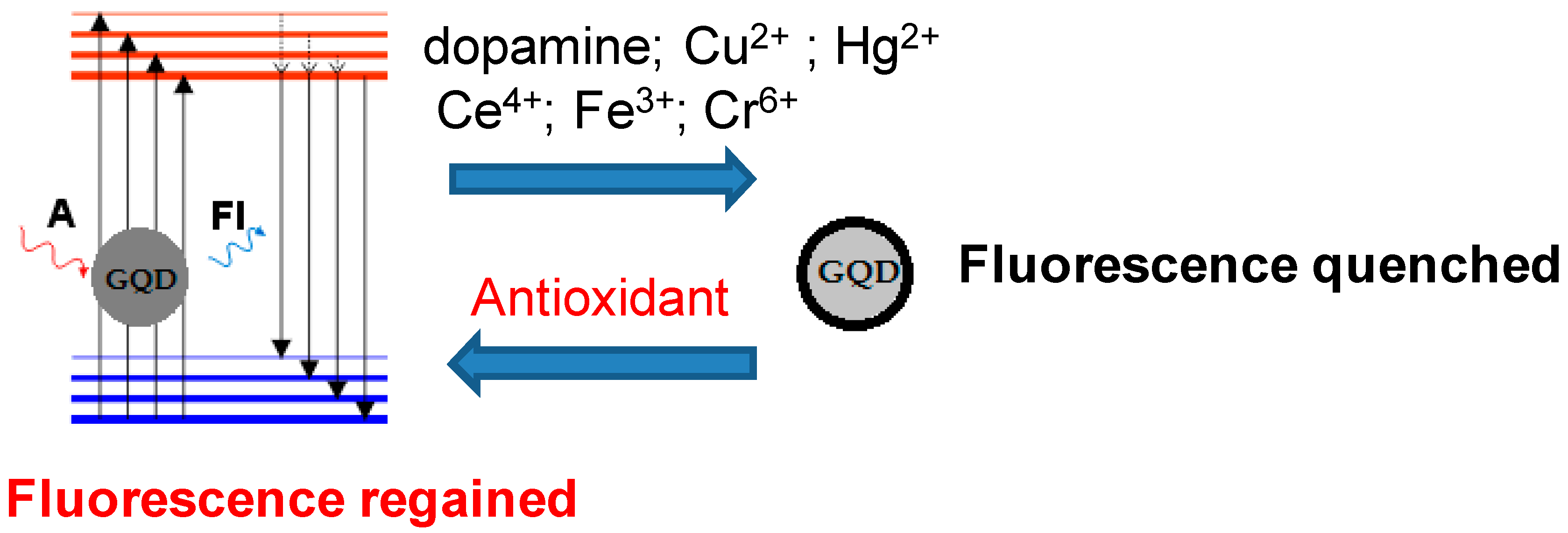
GQD fluorescence can be quenched using organic substances, such as dopamine (DA), which, through self-polymerization under an alkaline environment, forms a thin polydopamine (PDA) film on the quantum dot surface. The addition of antioxidants restores fluorescence by inhibiting polymerization [151]. Zhu et al. [151] used GQDs@PDA to analyze antioxidants in rat brain microdialytes.
In other studies, fluorescence quenching of GQDs with Cu(II) was used to detect ascorbic acid (AA) and N-acetylcysteine (NAC) [152,153]; Hg2+ to detect GSH and Cys [154,155]; Ce4+, Fe3+, Cr6+, etc. to detect AA [156,157,158]. Despite the high sensitivity of these tests, it is worth noting that the use of toxic metals for GQD modification prevents their in vivo application (Figure 4).
Figure 4. Mechanism of the antioxidant capacity assay based on fluorescence on/off of GQDs.
The research group of Bhaloo et al. [159] developed a series of biocompatible structures doped with metals, including Ag-, Al-, Ce-, Fe-, Ho-, MoS2-, TiO2-, Nd-, and Tm-GQDs, which are effective in scavenging free radicals. In addition to enhancing antioxidant properties, doping GQDs can alter photoluminescence, enabling imaging of near-infrared emission.

4.2. Semi-Conductor Metallic Nanocrystal QDs

Semiconductor nanocrystal QDs with physical dimensions smaller than the Bohr exciton radius (2–6 nm in diameter) often consist of atoms of elements from groups II-VI (e.g., CdSe, CdTe, CdS, and ZnSe) or III-V (e.g., InP and InAs) of the periodic table [30]. However, conventional QDs are considered semiconductor structures, e.g., cadmium-based. High-quality QDs resulting from quantum confinement are characterized by a narrow, symmetric emission spectrum and resistance to photobleaching, which is why they are considered ultrasensitive fluorophores. The unique optical properties of QDs are related to their exceptional ability to tune fluorescence emission depending on the core size (size-tunable properties) and their broad excitation spectra.
In the literature, various strategies to evaluate AOxC using QDs [160,161,162,163,164,165,166,167] can be found. The use of QDs for assessing AOxC is primarily based on monitoring changes in fluorescence quenching. Antioxidants can alter the luminescence signal (fluorescence or electrochemiluminescence) of QDs through various chemical reaction mechanisms:
(i) fluorescence quenching by AOs. Fluorescence quenching occurs when antioxidants trap holes in quantum dots (QDs). The photoluminescence process in QDs begins with the excitation of an electron from the valence band to the conduction band. This excitation generates positively charged holes in the valence band and free electrons in the conduction band [18]. Once the excitation stops, the free electrons and holes recombine, resulting in the emission of a fluorescent signal. However, when antioxidants are present in the solution, they can prevent this recombination process by trapping the holes, thus quenching the fluorescence emission. It has been observed that the reduction in the fluorescence signal depends on the amount of extract added, such as M. emarginata plant extract or the flavonoids baicalein and hesperetin [167].
(ii) the use of electrochemiluminescence (ECL). ECL-based methods utilize QDs to detect compounds with radical scavenging functionality [160]. In the presence of QDs (e.g., CdSe) and hydrogen peroxide (H2O2), hydroxyl radicals (OH) are produced through the reduction of H2O2 by electrons injected into the QDs. Antioxidants such as glutathione (GSH) and L-Cysteine (L-Cys) scavenge these radicals, leading to the quenching effect observed in electrochemiluminescence (ECL). The ECL intensity decreases with increasing GSH and L-Cys concentrations.
(iii) Inhibition of photobleaching. This method is based on measuring the inhibitory effect of antioxidant compounds on the photobleaching process of QDs induced by UV radiation [162]. UV radiation causes a rapid decrease in the fluorescence signal of QDs (e.g., L-Cys-capped CdTe-QDs) over time—this is the photobleaching effect, caused by the generation of reactive oxygen species (ROS) catalyzed by QDs. Antioxidant compounds scavenge the generated ROS, thereby inhibiting the photobleaching effect and maintaining the fluorescence signal. The percentage of photobleaching inhibition correlates with the concentration of antioxidant compounds.
(iv) Fluorescence Restoration (Turn-on Probe). In this approach, QDs are initially quenched, and the antioxidant restores the signal [164]. The fluorescence of QDs (e.g., GSH-CdTe QDs) can be quenched by an oxidant (e.g., KMnO4) due to oxidation of Te atoms on the QD surface. Adding an antioxidant such as ascorbic acid (AA) reduces the oxidized forms of QDs (CdTeO3/TeO2) and restores fluorescence (a “turn-on” effect). The restored fluorescence intensity correlates well linearly with the AA concentration. Hemmateenejad et al. [164] presented an antioxidant activity assay based on the inhibition of oxidation and photobleaching of L-cysteine-capped CdTe-QDs.
QD-based methods are typically highly selective and sensitive, with excellent limits of detection (LODs). They are often used to measure the concentration of specific target antioxidants, such as GSH, Cys, or AA, in biological samples [160]. Graphene oxide (GO) can be used as an amplification platform for semiconductor quantum dots, such as CdTe QDs. The combination of graphene oxide (GO) QDs with CdTe QDs relies on the ECL quenching mechanism. GQDs amplify the signal, improving the selectivity and sensitivity of antioxidant detection, such as GSH [161]. Examples of the use of QDs for antioxidant evaluation are summarized in Table 4 depending on the mechanism of action, assay conditions and type of antioxidant.
Table 4. Application of QDs for AOxC assessment.

5. Conclusions

Methods based on NPs for assessing AOxC utilize metallic nanoparticles (MNPs < 100 nm) and quantum dots (QDs < 10 nm) as sensitive nanosensors. These methods measure changes in Localized Surface Plasmon Resonance (LSPR) related to the formation, growth or aggregation of NPs. In contrast, QD-based AOxC assessment measures changes in fluorescence.
These assays primarily consider the total antioxidant pool in the sample, as they are non-specific to any single antioxidant class. This makes them an alternative to assays such as FC, FRAP, DPPH and ABTS. However, a few highly sensitive and specific AOxC assays utilizing modified sensors are gaining interest. These assays demonstrate selectivity for ultra-trace target antioxidants (GSH, Cys, and AA) thanks to the aggregation effect of MNPs or the quenching of QD fluorescence.
A key advantage of using NPs to assess AOxC selectively and across a broad range of antioxidants is the potential to create new assay variants depending on the sample type and analytical goals. Furthermore, both MNPs and QDs can be synthesized using green chemistry from waste products, thereby eliminating the need for complex equipment and multi-step protocols.
Despite their excellent sensitivity, which offers very good limits of detection (LOD)—crucial for measurements in biological samples—and selectivity, nanosensors require new approaches to improve stability, surface inactivation and linearity of response, especially for mechanisms based on NP formation.
Nanoparticles are undoubtedly a simple, inexpensive and highly adaptable method of measuring total AOxC. The main challenge is the lack of standardization. A significant limitation is that few nanoparticle-based AOxC assays have been compared with traditional, well-established methods such as FC, FRAP, DPPH and ABTS.
Future research should focus on developing plasmonic sensors that respond quickly at room temperature. Combining sensors with cutting-edge technologies, such as microfluidic devices, and integrating them with smartphone platforms [168], should improve reliability and accuracy. To extend the detection range of LSPR sensors beyond semiquantitative sensing, which is often susceptible to errors due to environmental factors or limited selectivity, multimodal detection techniques, including fluorescence, surface-enhanced Raman spectroscopy (SERS), and circular dichroism, should be utilized.

Author Contributions

Conceptualization, J.F. and N.Ż.; methodology, E.G.-B.; software, W.F.; validation, N.Ż., E.G.-B. and W.F.; formal analysis, N.Ż.; investigation, J.F. and N.Ż.; resources, W.F.; data curation, P.P.; writing—original draft preparation, J.F. and N.Ż.; writing—review and editing, J.F.; visualization, N.Ż.; supervision, J.F.; project administration, W.F. and P.P.; funding acquisition, J.F. All authors have read and agreed to the published version of the manuscript.

Funding

This research received no external funding.

Institutional Review Board Statement

Not applicable.

Data Availability Statement

No new data were created or analyzed in this study.

Conflicts of Interest

The authors declare no conflicts of interest.

Abbreviations

The following abbreviations are used in this manuscript:
3,4-DHBA3,4-dihydroxybenzoic acid
4-HBA4-hydroxybenzoic acid
Aabsorbance
AAAscorbic acid
AAPH2,2′-Azobis(2-amidinopropane) dihydrochloride
ABTS2,2′-azinobis(3-ethylbenzthiazoline-6-sulfonic acid) assay
AFMatomic force microscopy
AgNPssilver nanoparticles
AOsAntioxidants
AOxCantioxidant capacity
AuNCsgold nanoclusters
AuNPsgold nanoparticles
BSAbovine serum albumin
CAcarminic acid
CDsCarbon dots
CECapillary Electrophoresis
CeONPscerium oxide nanoparticles
CTABcetyltrimethylammonium bromide
CTACcetyltrimethylammonium chloride
Cu(I)-Nccopper(I)-neocuproine
CUPRACCupric Reducing Antioxidant Capacity
CVcyclic voltammetry
Cyscysteine
DLSDynamic Light Scattering
DPPH2,2-diphenyl-1-picrylhydrazyl
DPVdifferential pulse voltammetry
DTNBEllman’s reagent: 5,5′-Dithio-bis(2-nitrobenzoic acid)
ECLElectrochemiluminescence
EMElectromagnetic field
EPRElectron paramagnetic resonance spectroscopy
ETsingle electron transfer
FCFolin–Ciocalteu method
FIA-ADflow injection analysis with amperometric detection
FRAPFerric Reducing Antioxidant Power Assay
FTIRFourier transform infrared spectroscopy
GCGas Chromatography
GNSsgold nanoshells
GOGraphene Oxide
GQDsgraphene quantum dots
GSHglutathione
GSSGglutathione disulfide
HAhyaluronic acid
HAThydrogen atom transfer
HPF2-[6-(4′-hydroxy)phenoxy-3H-xanthen-3-one-9-yl]benzoic acid
HPLChigh-performance liquid chromatography
IC50Inhibitory Concentration 50%
IONPsIron Oxide Nano-particles
ITOindium tin oxide
LODlimit of detection
LRETluminescence resonance energy transfer
LSPRLocalized Surface Plasmon Resonance
Melmelamine
Metmethionine
MNPsmetal nanoparticles
NPsNanoparticles
ORACOxygen radical antioxidant capacity
OXTMBtetramethylbiphenyl
PBNN-tert-butyl-α-phenylnitrone
QDsquantum dots
RhNPsrhodium nanoparticles
RLSthe resonance light-scattering
RNSreactive nitrogen species
ROSReactive Oxygen Species
SEFSurface-enhanced fluorescence
SEIRASurface-enhanced infrared absorption
SEMScanning electron microscopy
SESSurface-enhanced spectroscopies
SERSSurface-enhanced Raman spectroscopy
SNAPCSilver NanoParticle Antioxidant Capacity
SPsurface plasmons
SPEscreen-printed electrode
SPRsurface plasmon resonance
ss-AuNPsstarch-stabilized gold nanoparticles
ssDNAsingle-stranded DNA
SWVsquare-wave voltammetry
TACTotal antioxidant capacity
TEACtrolox equivalent antioxidant capacity
TEMtransmission electron microscopy
TEMPOL4-hydroxy-2,2,6,6-tetramethyl-1-piperidinyloxyl
TMBtetramethylbenzidine
TPtotal phenolic compounds
TRAPtotal peroxyl radical-trapping antioxidant parameter assay
UV–VisUltraviolet-visible (UV-vis) spectroscopy
XRDX-ray diffraction

References

  1. Flora, S.J.S. Role of free radicals and antioxidants in health and disease. Cell Mol. Biol. 2007, 53, 1–2. [Google Scholar]
  2. Halliwell, B.; Gutteridge, J. Free Radicals in Biology and Medicine, 4th ed.; Oxford University Press: New York, NY, USA, 2007. [Google Scholar]
  3. López-Alarcón, C.; Denicola, A. Evaluating the antioxidant capacity of natural products: A review on chemical and cellular-based assays. Anal. Chim. Acta 2013, 763, 1–10. [Google Scholar] [CrossRef]
  4. Flieger, J.; Flieger, W.; Baj, J.; Maciejewski, R. Antioxidants: Classification, Natural Sources, Activity/Capacity Measurements, and Usefulness for the Synthesis of Nanoparticles. Materials 2021, 14, 4135. [Google Scholar] [CrossRef]
  5. Magalhães, L.M.; Segundo, M.A.; Reis, S.; Lima, J.L.F.C. Methodological aspects about in vitro evaluation of antioxidant properties. Anal. Chim. Acta 2008, 613, 1–19. [Google Scholar] [CrossRef] [PubMed]
  6. Davies, M.J. Detection and characterization of radicals using electron paramagnetic resonance (EPR) spin trapping and related methods. Methods 2016, 109, 21–30. [Google Scholar] [CrossRef]
  7. Kozmelj, T.R.; Voinov, M.A.; Grilc, M.; Smirnov, A.I.; Jasiukaitytė-Grojzdek, E.; Lucia, L.; Likozar, B. Lignin Structural Characterization and Its Antioxidant Potential: A Comparative Evaluation by EPR, UV-Vis Spectroscopy, and DPPH Assays. Int. J. Mol. Sci. 2024, 25, 9044. [Google Scholar] [CrossRef]
  8. Bešić, E.; Rajić, Z.; Šakić, D. Advancements in electron paramagnetic resonance (EPR) spectroscopy: A comprehensive tool for pharmaceutical research. Acta Pharm. 2025, 74, 551–594. [Google Scholar] [CrossRef]
  9. Kubiak, T.; Dobosz, B. Road Map for the Use of Electron Spin Resonance Spectroscopy in the Study of Functionalized Magnetic Nanoparticles. Materials 2025, 18, 2841. [Google Scholar] [CrossRef] [PubMed]
  10. Di Prima, G.; De Caro, V.; Cardamone, C.; Oliveri, G.; D’Oca, M.C. EPR Spectroscopy Coupled with Spin Trapping as an Alternative Tool to Assess and Compare the Oxidative Stability of Vegetable Oils for Cosmetics. Appl. Sci. 2024, 14, 10766. [Google Scholar] [CrossRef]
  11. Baig, N.; Kammakakam, I.; Falath, W. Nanomaterials: A review of synthesis methods, properties, recent progress, and challenges. Mater. Adv. 2021, 2, 1821–1871. [Google Scholar] [CrossRef]
  12. Katz, E.; Willner, I. Integrated nanoparticle-biomolecule hybrid systems: Synthesis, properties, and applications. Angew. Chem. Int. Ed. Engl. 2004, 43, 6042–6108. [Google Scholar] [CrossRef]
  13. Katz, E.; Willner, I.; Wang, J. Electroanalytical and Bioelectroanalytical Systems Based on Metal and Semiconductor Nanoparticles. Electroanalysis 2004, 16, 19–44. [Google Scholar] [CrossRef]
  14. Rosi, N.L.; Mirkin, C.A. Nanostructures in biodiagnostics. Chem. Rev. 2005, 105, 1547–1562. [Google Scholar] [CrossRef]
  15. Alarcon-Angeles, G.; Alvarez-Romero, G.A.; Merkoci, A. Emerging Nanomaterials for Analytical Detection. Biosensors for Sustainable Food—New Opportunities and Technical Challenges. Compr. Anal. Chem. 2016, 74, 195–246. [Google Scholar] [CrossRef]
  16. Della Pelle, F.; Compagnone, D. Nanomaterial-Based Sensing and Biosensing of Phenolic Compounds and Related Antioxidant Capacity in Food. Sensors 2018, 18, 462. [Google Scholar] [CrossRef] [PubMed]
  17. Bedlovičová, Z.; Strapáč, I.; Baláž, M.; Salayová, A. A Brief Overview on Antioxidant Activity Determination of Silver Nanoparticles. Molecules 2020, 25, 3191. [Google Scholar] [CrossRef] [PubMed]
  18. Vilela, D.; Gonzalez, M.C.; Escarpa, A. Nanoparticles as analytical tools for in-vitro antioxidant-capacity assessment and beyond. TrAC Trends Anal. Chem. 2015, 64, 1–16. [Google Scholar] [CrossRef]
  19. Cao, G. Nanostructures and Nanomaterials: Synthesis, Properties and Applications; Imperial College Press: London, UK, 2004. [Google Scholar] [CrossRef]
  20. Apak, R.; Çapanoğlu, E.; Arda, A.Ü. Nanotechnological Methods of Antioxidant Characterization. In The Chemical Sensory Informatics of Food: Measurement, Analysis, Integration; Guthrie, B., Beauchamp, J., Buettner, A., Lavine, B.K., Eds.; American Chemical Society: Washington, DC, USA, 2015; Volume 1191, pp. 209–234. ISBN 9780841230699. [Google Scholar]
  21. Sati, A.; Mali, S.N.; Samdani, N.; Annadurai, S.; Dongre, R.; Satpute, N.; Ranade, T.N.; Pratap, A.P. From Past to Present: Gold Nanoparticles (AuNPs) in Daily Life—Synthesis Mechanisms, Influencing Factors, Characterization, Toxicity, and Emerging Applications in Biomedicine, Nanoelectronics, and Materials Science. ACS Omega 2025, 10, 33999–34087. [Google Scholar] [CrossRef]
  22. GeGen, S.; Meng, G.; Aodeng, G.; Ga, L.; Ai, J. Advances in aptamer-based electrochemical biosensors for disease diagnosis: Integration of DNA and nanomaterials. Nanoscale Horiz. 2025, 10, 2668–2687. [Google Scholar] [CrossRef]
  23. Zhang, Y.; Ma, M. Metal-Organic Frameworks Nanocomposite Enzymes with Peroxidase-like Activity: Can They Bring Us a New Perspective in the Field of Biological Applications? ACS Biomater. Sci. Eng. 2025, 11, 4621–4652. [Google Scholar] [CrossRef]
  24. Tavan, M.; Yousefian, Z.; Bakhtiar, Z.; Rahmandoust, M.; Mirjalili, M.H. Carbon quantum dots: Multifunctional fluorescent nanomaterials for sustainable advances in biomedicine and agriculture. Ind. Crops Prod. 2025, 231, 121207. [Google Scholar] [CrossRef]
  25. Kaya, S.I.; Kurbanoglu, S.; Ozkan, S.A. Nanomaterials-Based Nanosensors for the Simultaneous Electrochemical Determination of Biologically Important Compounds: Ascorbic Acid, Uric Acid, and Dopamine. Crit. Rev. Anal. Chem. 2019, 49, 101–125. [Google Scholar] [CrossRef]
  26. Sargazi, S.; Fatima, I.; Hassan Kiani, M.; Mohammadzadeh, V.; Arshad, R.; Bilal, M.; Rahdar, A.; Díez-Pascual, A.M.; Behzadmehr, R. Fluorescent-based nanosensors for selective detection of a wide range of biological macromolecules: A comprehensive review. Int. J. Biol. Macromol. 2022, 206, 115–147. [Google Scholar] [CrossRef]
  27. Patil, N.D.; Bains, A.; Sridhar, K.; Sharma, M.; Dhull, S.B.; Goksen, G.; Chawla, P.; Inbaraj, B.S. Recent advances in the analytical methods for quantitative determination of antioxidants in food matrices. Food Chem. 2025, 463, 141348. [Google Scholar] [CrossRef]
  28. Mu, B.; Zhang, J.; McNicholas, T.P.; Reuel, N.F.; Kruss, S.; Strano, M.S. Recent advances in molecular recognition based on nanoengineered platforms. Acc. Chem. Res. 2014, 47, 979–988. [Google Scholar] [CrossRef] [PubMed]
  29. Apak, R.; Demirci Çekiç, S.; Üzer, A.; Çelik, S.E.; Bener, M.; Bekdeşer, B.; Can, Z.; Sağlam, Ş.; Önem, A.N.; Erçağ, E. Novel Spectroscopic and Electrochemical Sensors and Nanoprobes for the Characterization of Food and Biological Antioxidants. Sensors 2018, 18, 186. [Google Scholar] [CrossRef] [PubMed]
  30. Chan, W.C.; Maxwell, D.J.; Gao, X.; Bailey, R.E.; Han, M.; Nie, S. Luminescent quantum dots for multiplexed biological detection and imaging. Curr. Opin. Biotechnol. 2002, 13, 40–46. [Google Scholar] [CrossRef]
  31. Mello, L.D.; Kubota, L.T. Biosensors as a tool for the antioxidant status evaluation. Talanta 2007, 72, 335–348. [Google Scholar] [CrossRef] [PubMed]
  32. Akhtar, M.J.; Ahamed, M.; Alhadlaq, H.A.; Alshamsan, A. Mechanism of ROS scavenging and antioxidant signalling by redox metallic and fullerene nanomaterials: Potential implications in ROS associated degenerative disorders. Biochim. Biophys. Acta Gen. Subj. 2017, 1861, 802–813. [Google Scholar] [CrossRef]
  33. Anker, J.N.; Hall, W.P.; Lyandres, O.; Shah, N.C.; Zhao, J.; Van Duyne, R.P. Biosensing with plasmonic nanosensors. Nat. Mater. 2008, 7, 442–453. [Google Scholar] [CrossRef]
  34. Singh, N.B.; Abdala, A.; Jahan, M.I.; Susan, M.A.B.H. Nanomaterials in cosmetics: Transforming beauty through innovation and science. Nano-Struct. Nano-Objects 2025, 44, 101551. [Google Scholar] [CrossRef]
  35. Musa, A.A.; Bello, A.; Adams, S.M.; Onwualu, A.P.; Anye, V.C.; Bello, K.A.; Obianyo, I.I. Nano-Enhanced Polymer Composite Materials: A Review of Current Advancements and Challenges. Polymers 2025, 17, 893. [Google Scholar] [CrossRef]
  36. Narware, J.; Chakma, J.; Singh, S.P.; Prasad, D.R.; Meher, J.; Singh, P.; Bhargava, P.; Sawant, S.B.; Pitambara; Singh, J.P.; et al. Nanomaterial-based biosensors: A new frontier in plant pathogen detection and plant disease management. Front. Bioeng. Biotechnol. 2025, 13, 1570318. [Google Scholar] [CrossRef]
  37. Lin, C.; Huang, X.; Xue, Y.; Jiang, S.; Chen, C.; Liu, Y.; Chen, K. Advances in medical devices using nanomaterials and nanotechnology: Innovation and regulatory science. Bioact. Mater. 2025, 48, 353–369. [Google Scholar] [CrossRef] [PubMed]
  38. Çimen, D.; Ünal, S.; Denizli, A. Nanoparticle-assisted plasmonic sensors: Recent developments in clinical applications. Anal. Biochem. 2025, 698, 115753. [Google Scholar] [CrossRef]
  39. Guo, D.; Xie, G.; Luo, J. Mechanical properties of nanoparticles: Basics and applications. J. Phys. D Appl. Phys. 2014, 47, 013001. [Google Scholar] [CrossRef]
  40. Zamborini, F.P.; Bao, L.; Dasari, R. Nanoparticles in measurement science. Anal. Chem. 2012, 84, 541–576. [Google Scholar] [CrossRef] [PubMed]
  41. Willets, K.A.; Duyne, R.P.V. Localized Surface Plasmon Resonance Spectroscopy and Sensing. Annu. Rev. Phys. Chem. 2007, 58, 267–297. [Google Scholar] [CrossRef] [PubMed]
  42. Kreibig, U.; Vollmer, M. Optical Properties of Metal Clusters; Springer Series in Materials Science; Springer: Berlin/Heidelberg, Germany, 1995. [Google Scholar]
  43. Siangproh, W.; Dungchai, W.; Rattanarat, P.; Chailapakul, O. Nanoparticle-based electrochemical detection in conventional and miniaturized systems and their bioanalytical applications: A review. Anal. Chim. Acta 2011, 690, 10–25. [Google Scholar] [CrossRef]
  44. Suh, Y.H.; Suh, W.H.; Stucky, G.D. Multifunctional nanosystems at the interface of physical and life sciences. Nano Today 2009, 4, 27–36. [Google Scholar] [CrossRef]
  45. Bohren, C.H.D. Absorption and Scattering of Light by Small Particle; John-Wiley & Sons: New York, NY, USA, 1983. [Google Scholar]
  46. Kreibig, U.; Genzel, L. Optical absorption of small metallic particles. Surf. Sci. 1985, 156, 678–700. [Google Scholar] [CrossRef]
  47. Mcoyi, M.P.; Mpofu, K.T.; Sekhwama, M.; Mthunzi-Kufa, P. Developments in Localized Surface Plasmon Resonance. Plasmonics 2025, 20, 5481–5520. [Google Scholar] [CrossRef]
  48. Mello, L.D.; Kubota, L.T. Review of the use of biosensors as analytical tools in the food and drink industries. Food Chem. 2002, 77, 237–256. [Google Scholar] [CrossRef]
  49. Sherry, L.J.; Chang, S.-H.H.; Schatz, G.C.; Van Duyne, R.P.; Wiley, B.J.; Xia, Y. Localized surface plasmon resonance spectroscopy of single silver nanocubes. Nano Lett. 2005, 5, 2034–2038. [Google Scholar] [CrossRef] [PubMed]
  50. Amendola, V.; Bakr, O.M.; Stellacci, F. A study of the surface plasmon resonance of silver nanoparticles by the discrete dipole approximation method: Effect of shape, size, structure, and assembly. Plasmonics 2010, 5, 85–97. [Google Scholar] [CrossRef]
  51. Adhikari, S.; Spaeth, P.; Kar, A.; Baaske, M.D.; Khatua, S.; Orrit, M. Photothermal microscopy: Imaging the optical absorption of single nanoparticles and singlemolecules. ACS Nano 2020, 14, 16414–16445. [Google Scholar] [CrossRef]
  52. Albella, P.; Alcaraz de la Osa, R.; Moreno, F.; Maier, S.A. Electric andmagnetic field enhancement with ultralow heat radia-tion dielectric nanoantennas: Considerations for surface-enhanced spectroscopies. ACS Photonics 2014, 1, 524–529. [Google Scholar] [CrossRef]
  53. Fan, X.; Zheng, W.; Singh, D. Light scattering and surface plasmons on small spherical particles. Light Sci. Appl. 2014, 3, e179. [Google Scholar] [CrossRef]
  54. Mayer, K.M.; Hafner, J.H. Localized surface plasmon resonance sensors. Chem. Rev. 2011, 111, 3828–3857. [Google Scholar] [CrossRef] [PubMed]
  55. Lee, K.-S.; El-Sayed, M.A. Gold and silver nanoparticles in sensing and imaging: Sensitivity of plasmon response to size, shape, and metal composition. J. Phys. Chem. B 2006, 110, 19220–19225. [Google Scholar] [CrossRef]
  56. Özyürek, M.; Güngör, N.; Baki, S.; Güçlü, K.; Apak, R. Development of a Silver Nanoparticle-Based Method for the Antioxidant Capacity Measurement of Polyphenols. Anal. Chem. 2012, 84, 8052–8059. [Google Scholar] [CrossRef]
  57. Popa, C.V.; Vasilescu, A.; Litescu, S.C.; Albu, C.; Danet, A.F. Metal Nano-Oxide based Colorimetric Sensor Array for the Determination of Plant Polyphenols with Antioxidant Properties. Anal. Lett. 2020, 53, 627–645. [Google Scholar] [CrossRef]
  58. Hormozi Nezhad, M.R.; Karimi, M.A.; Shahheydari, F. A Sensitive Colorimetric Detection of Ascorbic Acid in Pharmaceutical Products Based on Formation of Anisotropic Silver Nanoparticles. Trans. F Nanotechnol. 2010, 17, 148–153. [Google Scholar]
  59. Eustis, S.; El-Sayed, M.A. Why gold nanoparticles are more precious than pretty gold: Noble metal surface plasmon resonance and its enhancement of the radiative and nonradiative properties of nanocrystals of different shapes. Chem. Soc. Rev. 2006, 35, 209–217. [Google Scholar] [CrossRef] [PubMed]
  60. Bartolomé, M.; Villaseñor, M.J.; Ríos, Á. Surface plasmon resonance optical sensors involving nanomaterials as reliable analytical tools: A critical view about performance and applications. Anal. Chim. Acta 2026, 1382, 344693. [Google Scholar] [CrossRef] [PubMed]
  61. Yılmaz, F.; Çimen, D.; Denizli, A. Plasmonic sensors for point of care diagnostics. J. Pharm. Biomed. Anal. 2025, 265, 117042. [Google Scholar] [CrossRef] [PubMed]
  62. Huang, P.-C.; Gao, N.; Li, J.-F.; Wu, F.-Y. Colorimetric detection of methionine based on anti-aggregation of gold nanoparticles in the presence of melamine. Sens. Actuators B Chem. 2018, 255, 2779–2784. [Google Scholar] [CrossRef]
  63. Wang, S.; Shi, Y.; Zhang, H.; Sun, Y.; Wang, F.; Zeng, L.; Li, X.; Wu, A.; Zhang, Y. Colorimetric sensor for Cr (VI) by oxidative etching of gold nanotetrapods at room temperature. Spectrochim. Acta A Mol. Biomol. Spectrosc. 2023, 295, 122589. [Google Scholar] [CrossRef]
  64. Akgönüllü, S.; Denizli, A. Plasmonic nanosensors for pharmaceutical and biomedical analysis. J. Pharm. Biomed. Anal. 2023, 236, 115671. [Google Scholar] [CrossRef]
  65. Zhao, W.; Brook, M.A.; Li, Y.F. Design of Gold NanoparticleBased Colorimetric Biosensing Assays. ChemBioChem 2008, 9, 2363–2371. [Google Scholar] [CrossRef]
  66. Gatselou, V.; Christodouleas, D.C.; Kouloumpis, A.; Gournis, D.; Giokas, D.L. Determination of phenolic compounds using spectral and color transitions of rhodium nanoparticles. Anal. Chim. Acta 2016, 932, 80–87. [Google Scholar] [CrossRef]
  67. Dahle, T.; Arai, Y. Environmental geochemistry of cerium: Applications and toxicology of cerium oxide nanoparticles. Int. J. Environ. Res. Public Health 2015, 12, 1253–1278. [Google Scholar] [CrossRef]
  68. Ozdemir Olgun, F.A.; Üzer, A.; Ozturk, B.D.; Apak, R. A novel cerium oxide nanoparticles-based colorimetric sensor using tetramethyl benzidine reagent for antioxidant activity assay. Talanta 2018, 182, 55–61. [Google Scholar] [CrossRef]
  69. Sharpe, E.; Frasco, T.; Andreescu, D.; Andreescu, S. Portable ceria nanoparticle-based assay for rapid detection of food antioxidants (NanoCerac). Analyst 2013, 138, 249–262. [Google Scholar] [CrossRef] [PubMed]
  70. Sharpe, E.; Bradley, R.; Frasco, T.; Jayathilaka, D.; Marsh, A.; Andreescu, S. Metal oxide-based multisensor array and portable database for field analysis of antioxidants. Sens. Actuators B-Chem. 2014, 193, 552–562. [Google Scholar] [CrossRef] [PubMed]
  71. Vasilescu, A.; Sharpe, E.; Andreescu, S. Nanoparticle-Based Technologies for the Detection of Food Antioxidants. Curr. Anal. Chem. 2012, 8, 495–505. [Google Scholar] [CrossRef]
  72. Mourdikoudis, S.; Pallares, R.M.; Thanh, N.T.K. Characterization techniques for nanoparticles: Comparison and complementarity upon studying nanoparticle properties. Nanoscale 2018, 10, 12871–12934. [Google Scholar] [CrossRef]
  73. Szydlowska-Czerniak, A.; Tulodziecka, A. Comparison of a silver nanoparticle-based method and the modified spectrophotometric methods for assessing antioxidant capacity of rapeseed varieties. Food Chem. 2013, 141, 1865–1871. [Google Scholar] [CrossRef]
  74. Rao, Y.; Chen, Q.; Dong, J.; Qian, W. Growth-sensitive 3D ordered gold nanoshells precursor composite arrays as SERS nanoprobes for assessing hydrogen peroxide scavenging activity. Analyst 2011, 136, 769–774. [Google Scholar] [CrossRef]
  75. Ma, X.; Qian, W. Phenolic acid induced growth of gold nanoshells precursor composites and their application in antioxidant capacity assay. Biosens. Bioelectron. 2010, 26, 1049–1055. [Google Scholar] [CrossRef]
  76. Alzahrani, E. Colorimetric Detection Based on Localised Surface Plasmon Resonance Optical Characteristics for the Detection of Hydrogen Peroxide Using Acacia Gum–Stabilised Silver Nanoparticles. Anal. Chem. Insights 2017, 12, 1–10. [Google Scholar] [CrossRef]
  77. Scampicchio, M.; Wang, J.; Blasco, A.J.; Sanchez Arribas, A.; Mannino, S.; Escarpa, A. Nanoparticle-based assays of antioxidant activity. Anal. Chem. 2006, 78, 2060–2063. [Google Scholar] [CrossRef] [PubMed]
  78. Liu, Q.; Liu, H.; Yuan, Z.; Wei, D.; Ye, Y. Evaluation of antioxidant activity of chrysanthemum extracts and tea beverages by gold nanoparticles-based assay. Colloids Surf. B Biointerfaces 2012, 92, 348–352. [Google Scholar] [CrossRef]
  79. Tułodziecka, A.; Szydłowska-Czerniak, A. Determination of Total Antioxidant Capacity of Rapeseed and Its By-Products by a Novel Cerium Oxide Nanoparticle-Based Spectrophotometric Method. Food Anal. Methods 2016, 9, 3053–3062. [Google Scholar] [CrossRef]
  80. Szydłowska-Czerniak, A.; Łaszewska, A.; Tułodziecka, A. A novel iron oxide nanoparticle-based method for the determination of the antioxidant capacity of rapeseed oils at various stages of the refining process. Anal. Methods 2015, 7, 4650–4660. [Google Scholar] [CrossRef]
  81. Blasco, A.J.; Crevillén, A.G.; González, M.C.; Escarpa, A. Direct Electrochemical Sensing and Detection of Natural Antioxidants and Antioxidant Capacity in Vitro Systems. Electroanalysis 2007, 19, 2275–2286. [Google Scholar] [CrossRef]
  82. Flieger, J.; Franus, W.; Panek, R.; Szymańska-Chargot, M.; Flieger, W.; Flieger, M.; Kołodziej, P. Green Synthesis of Silver Nanoparticles Using Natural Extracts with Proven Antioxidant Activity. Molecules 2021, 26, 4986. [Google Scholar] [CrossRef]
  83. Radzikowska-Büchner, E.; Flieger, W.; Pasieczna-Patkowska, S.; Franus, W.; Panek, R.; Korona-Głowniak, I.; Suśniak, K.; Rajtar, B.; Świątek, Ł.; Żuk, N.; et al. Antimicrobial and Apoptotic Efficacy of Plant-Mediated Silver Nanoparticles. Molecules 2023, 28, 5519. [Google Scholar] [CrossRef]
  84. Kowalczuk, J.; Demchuk, O.M.; Borkowski, M.; Bielejewski, M. Stabilisation of Nanosilver Supramolecular Hydrogels with Trisodium Citrate. Molecules 2025, 30, 1613. [Google Scholar] [CrossRef] [PubMed]
  85. Pisoschi, A.M.; Negulescu, G.P. Methods for Total Antioxidant Activity Determination: A Review. Biochem. Anal. Biochem. 2011, 1, 106. [Google Scholar] [CrossRef]
  86. Ndhlala, A.R.; Moyo, M.; Van Staden, J. Natural antioxidants: Fascinating or mythical biomolecules? Molecules 2010, 15, 6905–6930. [Google Scholar] [CrossRef] [PubMed]
  87. Szydłowska-Czerniak, A.; Tułodziecka, A.; Szłyk, E. A silver nanoparticle-based method for determination of antioxidant capacity of rapeseed and its products. Analyst 2012, 137, 3750–3759. [Google Scholar] [CrossRef] [PubMed]
  88. Shahidi, F.; Ambigaipalan, P. Phenolics and polyphenolics in foods, beverages and spices: Antioxidant activity and health effects—A review. J. Funct. Foods 2015, 18, 820–897. [Google Scholar] [CrossRef]
  89. Shahidi, F.; Zhong, Y. Measurement of antioxidant activity. J. Funct. Foods 2015, 18, 757–781. [Google Scholar] [CrossRef]
  90. Antolovich, M.; Prenzler, P.D.; Patsalides, E.; McDonald, S.; Robards, K. Methods for testing antioxidant activity. Analyst 2002, 127, 183–198. [Google Scholar] [CrossRef]
  91. Arnao, M.B. Some methodological problems in the determination of antioxidant activity using chromogen radicals: A practical case. Trends Food Sci. Technol. 2000, 11, 419–421. [Google Scholar] [CrossRef]
  92. Iveković, D.; Milardović, S.; Roboz, M.; Grabarić, B.S. Evaluation of the antioxidant activity by flow injection analysis method with electrochemically generated ABTS radical cation. Analyst 2005, 130, 708–714. [Google Scholar] [CrossRef]
  93. Bukovsky-Reyes, S.E.R.; Lowe, L.E.; Brandon, W.M.; Owens, J.E. Measurement of antioxidants in distilled spiritsby a silver nanoparticle assay. J. Inst. Brew. 2018, 124, 201–309. [Google Scholar] [CrossRef]
  94. Jiang, Z.-j.; Liu, C.-y. Seed-Mediated Growth Technique for the Preparation of a Silver Nanoshell on a Silica Sphere. J. Phys. Chem. B 2003, 107, 12411–12415. [Google Scholar] [CrossRef]
  95. Everette, J.D.; Bryant, Q.M.; Green, A.M.; Abbey, Y.A.; Wangila, G.W.; Walker, R.B. Thorough study of reactivity of various compound classes toward the Folin-Ciocalteu reagent. J. Agric. Food Chem. 2010, 58, 8139–8144. [Google Scholar] [CrossRef]
  96. Huang, D.; Ou, B.; Prior, R.L. The chemistry behind antioxidant capacity assays. J. Agric. Food Chem. 2005, 53, 1841–1856. [Google Scholar] [CrossRef]
  97. Apak, R.; Güçlü, K.; Ozyürek, M.; Karademir, S.E. Novel total antioxidant capacity index for dietary polyphenols and vitamins C and E, using their cupric ion reducing capability in the presence of neocuproine: CUPRAC method. J. Agric. Food Chem. 2004, 52, 7970–7981. [Google Scholar] [CrossRef]
  98. Üzer, A.; Durmazel, S.; Erçağ, E.; Apak, R. Determination of hydrogen peroxide and triacetone triperoxide (TATP) with a silver nanoparticles—Based turn-on colorimetric sensor. Sens. Actuators B Chem. 2017, 247, 98–107. [Google Scholar] [CrossRef]
  99. Vasileva, P.; Donkova, B.; Karadjova, I.; Dushkin, C. Synthesis of starch-stabilized silver nanoparticles and their application as a surface plasmon resonance-based sensor of hydrogen peroxide. Colloid Surf. A Physicochem. Eng. Asp. 2011, 382, 203–210. [Google Scholar] [CrossRef]
  100. Filippo, E.; Serra, A.; Manno, D. Poly(vinyl alcohol) capped silver nanoparticles as localized surface plasmon resonance-based hydrogen peroxide sensor. Sens. Actuators B Chem. 2009, 138, 625–630. [Google Scholar] [CrossRef]
  101. Vilela, D.; Gonzalez, M.C.; Escarpa, A. Gold-nanosphere formation using food sample endogenous polyphenols for in-vitro assessment of antioxidant capacity. Anal. Bioanal. Chem. 2012, 404, 341–349. [Google Scholar] [CrossRef]
  102. Bener, M.; Şen, F.B.; Apak, R. Heparin-stabilized gold nanoparticles-based CUPRAC colorimetric sensor for antioxidant capacity measurement. Talanta 2018, 187, 148–155. [Google Scholar] [CrossRef]
  103. David, M.; Serban, A.; Radulescu, C.; Danet, A.F.; Florescu, M. Bioelectrochemical evaluation of plant extracts and gold nanozyme-based sensors for total antioxidant capacity determination. Bioelectrochemistry 2019, 129, 124–134. [Google Scholar] [CrossRef] [PubMed]
  104. Lee, H.; Lee, K.; Kim, I.-K.; Tae, G.P. Fluorescent Gold Nano-probe Sensitive to Intracellular Reactive Oxygen Species. Adv. Funct. Mater. 2009, 19, 1884–1890. [Google Scholar] [CrossRef]
  105. Shi, H.; Xu, Y.; Wang, Y.; Song, W.B. Assembly of ferrocenylhex-anethiol functionalized gold nanoparticles for ascorbic acid determination. Microchim. Acta 2010, 171, 81–89. [Google Scholar] [CrossRef]
  106. Zougagh, M.; Salghi, R.; Dhair, S.; Rios, A. Nanoparticle-based assay for the detection of virgin argan oil adulteration and its rapid quality evaluation. Anal. Bioanal. Chem. 2011, 399, 2395–2405. [Google Scholar] [CrossRef]
  107. Della Pelle, F.; Gonzalez, M.C.; Sergi, M.; Del Carlo, M.; Compagnone, D.; Escarpa, A. Gold Nanoparticles-based Extraction-Free Colorimetric Assay in Organic Media: An Optical Index for Determination of Total Polyphenols in Fat-Rich Samples. Anal. Chem. 2015, 87, 6905–6911. [Google Scholar] [CrossRef]
  108. Vilela, D.; Castaneda, R.; Gonzalez, M.C.; Mendoza, S.; Escarpa, A. Fast and reliable determination of antioxidant capacity based on the formation of gold nanoparticles. Microchim. Acta 2015, 182, 105–111. [Google Scholar] [CrossRef]
  109. Vilela, D.; González, M.C.; Escarpa, A. Sensing colorimetric approaches based on gold and silver nanoparticles aggregation: Chemical creativity behind the assay. A review. Anal. Chim. Acta 2012, 751, 24–43. [Google Scholar] [CrossRef] [PubMed]
  110. Enüstün, B.V.; Turkevich, J. Coagulation of Colloidal Gold. J. Am. Chem. Soc. 1963, 85, 3317–3328. [Google Scholar] [CrossRef]
  111. Wang, J.; Zhou, N.; Zhu, Z.; Huang, J.; Li, G. Detection of flavonoids and assay for their antioxidant activity based on enlargement of gold nanoparticles. Anal. Bioanal. Chem. 2007, 388, 1199–1205. [Google Scholar] [CrossRef]
  112. Nezhad, M.R.; Alimohammadi, M.; Tashkhourian, J.; Razavian, S.M. Optical detection of phenolic compounds based on the surface plasmon resonance band of Au nanoparticles. Spectrochim. Acta A Mol. Biomol. Spectrosc. 2008, 71, 199–203. [Google Scholar] [CrossRef] [PubMed]
  113. Vilela, D.; González, M.C.; Escarpa, A. (Bio)-synthesis of Au NPs from soy isoflavone extracts as a novel assessment tool of their antioxidant capacity. RSC Adv. 2014, 4, 3075–3081. [Google Scholar] [CrossRef]
  114. Roy, N.; Laskar, R.A.; Sk, I.; Kumari, D.; Ghosh, T.; Begum, N.A. A detailed study on the antioxidant activity of the stem bark of Dalbergia sissoo Roxb., an Indian medicinal plant. Food Chem. 2011, 126, 1115–1121. [Google Scholar] [CrossRef]
  115. Chen, Q.; Rao, Y.; Ma, X.; Dong, J.; Qian, W. Raman spectroscopy for scavenging activity assay using nanoshell precursor nanocomposites as SERSprobes. Anal. Methods 2011, 3, 274–279. [Google Scholar] [CrossRef]
  116. Sudeep, P.K.; Joseph, S.T.; Thomas, K.G. Selective detection of cysteine and glutathione using gold nanorods. J. Am. Chem. Soc. 2005, 127, 6516–6517. [Google Scholar] [CrossRef]
  117. Basu, S.; Ghosh, S.K.; Kundu, S.; Panigrahi, S.; Praharaj, S.; Pande, S.; Jana, S.; Pal, T. Biomolecule induced nanoparticle aggregation: Effect of particle size on interparticle coupling. J. Colloid Interface Sci. 2007, 313, 724–734. [Google Scholar] [CrossRef] [PubMed]
  118. Zhang, Y.; Li, B.; Xu, C. Visual detection of ascorbic acid via alkyne-azide click reaction using gold nanoparticles as a colorimetric probe. Analyst 2010, 135, 1579–1584. [Google Scholar] [CrossRef] [PubMed]
  119. Li, Z.P.; Duan, X.R.; Liu, C.H.; Du, B.A. Selective determination of cysteine by resonance light scattering technique based on self-assembly of gold nanoparticles. Anal. Biochem. 2006, 351, 18–25. [Google Scholar] [CrossRef]
  120. Ma, X.; Li, H.; Dong, J.; Qian, W. Determination of hydrogen peroxide scavenging activity of phenolic acids by employing gold nanoshells precursor composites as nanoprobes. Food Chem. 2011, 126, 698–704. [Google Scholar] [CrossRef]
  121. Çelik, S.E.; Bekdeşer, B.; Apak, R. A novel colorimetric sensor for measuring hydroperoxide content and peroxyl radical scavenging activity using starch-stabilized gold nanoparticles. Talanta 2019, 196, 32–38. [Google Scholar] [CrossRef]
  122. Li, H.; Ma, X.Y.; Dong, J.; Qian, W.P. Development of Methodology Based on the Formation Process of Gold Nanoshells for Detecting Hydrogen Peroxide Scavenging Activity. Anal. Chem. 2009, 81, 8916–8922. [Google Scholar] [CrossRef] [PubMed]
  123. Zhan, M.; Ding, C.; Zhu, A.; Tian, Y. Ratiometric fluorescence probe for monitoring hydroxyl radical in live cells based on gold nanoclusters. Anal. Chem. 2014, 86, 1829–1836. [Google Scholar] [CrossRef]
  124. Chen, L.J.; Wu, N.; Sun, B.; Su, H.C.; Ai, S.Y. Colorimetric detection of peroxynitrite-induced DNA damage using gold nanoparticles, and on the scavenging effects of antioxidants. Microchim. Acta 2013, 180, 573–580. [Google Scholar] [CrossRef]
  125. Jain, P.K.; Huang, X.; El-Sayed, I.H.; El-Sayed, M.A. Noble metals on the nanoscale: Optical and photothermal properties and some applications in imaging, sensing, biology, and medicine. Acc. Chem. Res. 2008, 41, 1578–1586. [Google Scholar] [CrossRef]
  126. Vilchis-Nestor, A.R.; Sánchez-Mendieta, V.; Camacho-López, M.A.; Gómez-Espinosa, R.M.; Camacho-López, M.A.; Arenas-Alatorre, J.A. Solventless synthesis and optical properties of Au and Ag nanoparticles using Camellia sinensis extract. Mater. Lett. 2008, 62, 3103–3105. [Google Scholar] [CrossRef]
  127. Andreu-Navarro, A.; Fernández-Romero, J.M.; Gómez-Hens, A. Determination of antioxidant additives in foodstuffs by direct measurement of gold nanoparticle formation using resonance light scattering detection. Anal. Chim. Acta 2011, 695, 11–17. [Google Scholar] [CrossRef]
  128. Rao, Y.; Zhao, X.; Li, Z.; Huang, J. Phenolic acids induced growth of 3D ordered gold nanoshell composite array as sensitive SERS nanosensor for antioxidant capacity assay. Talanta 2018, 190, 174–181. [Google Scholar] [CrossRef]
  129. Lin, X.C.; Liu, J.; Hu, M.; Song, L.; Li, M.; Kou, Q.; Huang, R.; Sun, L.; Wen, C. An Au@CuS@CuO2 nanoplatform with peroxidase mimetic activity and self-supply H2O2 properties for SERS detection of GSH. Spectrochim. Acta A Mol. Biomol. Spectrosc. 2025, 340, 126376. [Google Scholar] [CrossRef]
  130. Choleva, T.G.; Kappi, F.A.; Giokas, D.L.; Vlessidis, A.G. Paper-based assay of antioxidant activity using analyte-mediated on-paper nucleation of gold nanoparticles as colorimetric probes. Anal. Chim. Acta 2015, 860, 61–69. [Google Scholar] [CrossRef]
  131. Danet, A.F. Recent Advances in Antioxidant Capacity Assays. In Antioxidants-Benefits, Sources, Mechanisms of Action; Waisundara, V., Ed.; IntechOpen: London, UK, 2021. [Google Scholar] [CrossRef]
  132. Zhou, N.; Wang, J.; Chen, T.; Yu, Z.; Li, G.X. Enlargement of gold nanoparticles on the surface of a self-assembled monolayer modified electrode: A mode in biosensor design. Anal. Chem. 2006, 78, 5227–5230. [Google Scholar] [CrossRef] [PubMed]
  133. Cui, L.; Ai, S.; Shang, K.; Meng, X.; Wang, C. Electrochemical determination of NADH using a glassy carbon electrode modified with Fe3O4 nanoparticles and poly-2,6-pyridinedicarboxylic acid, and its application to the determination of antioxidant capacity. Microchim. Acta 2011, 174, 31–39. [Google Scholar] [CrossRef]
  134. Wang, Y.; Calas-Blanchard, C.; Cortina-Puig, M.; Baohong, L.; Marty, J.-L. An electrochemical method for sensitive determination of antioxidant capacity. Electroanalysis 2009, 21, 1395–1400. [Google Scholar] [CrossRef]
  135. Bezerra, A.G.; Barison, A.; Oliveira, V.S.; Foti, L.; Krieger, M.A.; Dhalia, R.; Viana, I.F.T.; Schreiner, W.H. The mechanism of cysteine detection in biological media by means of vanadium oxide nanoparticles. J. Nanoparticle Res. 2012, 14, 1123–1132. [Google Scholar] [CrossRef]
  136. Liu, J.; Lagger, G.; Tacchini, P.; Girault, H.H. Generation of OH radicals at palladium oxide nanoparticle modified electrodes, and scavenging by fluorescent probes and antioxidants. J. Electroanal. Chem. 2008, 619–620, 131–136. [Google Scholar] [CrossRef]
  137. Mei, Q.; Li, Y.; Li, B.N.; Zhang, Y. Oxidative cleavage-based upconversional nanosensor for visual evaluation of antioxidant activity of drugs. Biosens. Bioelectron. 2015, 64, 88–93. [Google Scholar] [CrossRef]
  138. Huang, Y.; Ren, J.; Qu, X. Nanozymes: Classification, Catalytic Mechanisms, Activity Regulation, and Applications. Chem. Rev. 2019, 119, 4357–4412. [Google Scholar] [CrossRef] [PubMed]
  139. Liu, B.; Huang, Z.; Liu, J. Boosting the oxidase mimicking activity of nanoceria by fluoride capping: Rivaling protein enzymes and ultrasensitive F detection. Nanoscale 2016, 8, 13562–13567. [Google Scholar] [CrossRef]
  140. Huang, Y.; Liu, Z.; Liu, C.; Ju, E.; Zhang, Y.; Ren, J.; Qu, X. Self-Assembly of Multi-nanozymes to Mimic an Intracellular Antioxidant Defense System. Angew. Chem. Int. Ed. Engl. 2016, 55, 6646–6650. [Google Scholar] [CrossRef]
  141. Zhang, K.; Hu, X.; Liu, J.; Yin, J.J.; Hou, S.; Wen, T.; He, W.; Ji, Y.; Guo, Y.; Wang, Q.; et al. Formation of PdPt alloy nanodots on gold nanorods: Tuning oxidase-like activities via composition. Langmuir 2011, 27, 2796–2803. [Google Scholar] [CrossRef]
  142. Li, Y.; Li, W.; Zhou, H.; Wang, F.; Chen, Y.; Wang, Y.; Yu, C. A facile method for the sensing of antioxidants based on the redox transformation of polyaniline. Sens. Actuators B Chem. 2015, 208, 30–35. [Google Scholar] [CrossRef]
  143. Akshath, U.S.; Shubha, L.R.; Bhatt, P.; Thakur, M.S. Quantum dots as optical labels for ultrasensitive detection of polyphenols. Biosens. Bioelectron. 2014, 57, 317–323. [Google Scholar] [CrossRef] [PubMed]
  144. Wei, Z.; Li, H.; Liu, S.; Wang, W.; Chen, H.; Xiao, L.; Ren, C.; Chen, X. Carbon Dots as Fluorescent/Colorimetric Probes for Real-Time Detection of Hypochlorite and Ascorbic Acid in Cells and Body Fluid. Anal. Chem. 2019, 91, 15477–15483. [Google Scholar] [CrossRef]
  145. Khan, R.; Qureshi, A.; Azhar, M.; Hassan, Z.U.; Gul, S.; Ahmad, S. Recent Progress of Fluorescent Carbon Dots and Graphene Quantum Dots for Biosensors: Synthesis of Solution Methods and their Medical Applications. J. Fluoresc. 2025, 35, 2623–2640. [Google Scholar] [CrossRef]
  146. Sun, X.; Liu, Z.; Welsher, K.; Robinson, J.T.; Goodwin, A.; Zaric, S.; Dai, H. Nano-Graphene Oxide for Cellular Imaging and Drug Delivery. Nano Res. 2008, 1, 203–212. [Google Scholar] [CrossRef]
  147. Karami, M.H.; Abdouss, M.; Rahdar, A.; Pandey, S. Graphene Quantum Dots: Background, Synthesis Methods, and Applications as Nanocarrier in Drug Delivery and Cancer Treatment: An Updated Review. Inorg. Chem. Commun. 2024, 161, 112032. [Google Scholar] [CrossRef]
  148. Benítez-Martínez, S.; Valcárcel, M. Graphene quantum dots as sensor for phenols in olive oil. Sens. Actuators B Chem. 2014, 197, 350–357. [Google Scholar] [CrossRef]
  149. El-Maghrabey, M.; Yamamichi, A.; Abdel-Hakim, A.; Kishikawa, N.; Kuroda, N. Application of Ferric–Graphene Quantum Dot Complex for Evaluation and Imaging of Antioxidants in Foods Based on Fluorescence Turn-Off–On Strategy. Antioxidants 2025, 14, 1034. [Google Scholar] [CrossRef]
  150. Zhang, C.; Cui, Y.; Song, L.; Liu, X.; Hu, Z. Microwave Assisted One-Pot Synthesis of Graphene Quantum Dots as Highly Sensitive Fluorescent Probes for Detection of Iron Ions and PH Value. Talanta 2016, 150, 54–60. [Google Scholar] [CrossRef] [PubMed]
  151. Zhu, S.; Yan, X.; Qiu, J.; Sun, J.; Zhao, X.E. Turn-on fluorescent assay for antioxidants based on their inhibiting polymerization of dopamine on graphene quantum dots. Spectrochim. Acta A Mol. Biomol. Spectrosc. 2020, 225, 117516. [Google Scholar] [CrossRef]
  152. Liu, H.; Li, N.; Zhang, H.; Zhang, F.; Su, X. A simple and convenient fluorescent strategy for the highly sensitive detection of dopamine and ascorbic acid based on graphene quantum dots. Talanta 2018, 189, 190–195. [Google Scholar] [CrossRef]
  153. Liu, H.; Li, R.S.; Zhou, J.; Huang, C.Z. Branched polyethylenimine-functionalized carbon dots as sensitive and selective fluorescent probes for N-acetylcysteine via an off-on mechanism. Analyst 2017, 142, 4221–4227. [Google Scholar] [CrossRef] [PubMed]
  154. Ping, Y.; Ruiyi, L.; Yongqiang, Y.; Zaijun, L.; Zhiguo, G.; Guangli, W.; Junkang, L. Pentaethylene hexamine and penicillamine co-functionalized graphene quantum dots for fluorescent detection of mercury(II) and glutathione and bioimaging. Spectrochim. Acta A Mol. Biomol. Spectrosc. 2018, 203, 139–146. [Google Scholar] [CrossRef] [PubMed]
  155. Li, Z.; Wang, Y.; Ni, Y.N.; Serge, K. A rapid and label-free dual detection of Hg (II) and cysteine with the use of fluorescence switching of graphene quantum dots. Sens. Actuators B Chem. 2015, 207, 490–497. [Google Scholar] [CrossRef]
  156. Liu, R.; Yang, R.; Qu, C.J.; Mao, H.C.; Hu, Y.; Li, J.J.; Qu, L.B. Synthesis of glycinefunctionalized graphene quantum dots as highly sensitive and selective fluorescent sensor of ascorbic acid in human serum. Sens. Actuators B Chem. 2017, 241, 644–651. [Google Scholar] [CrossRef]
  157. Shi, F.; Zhang, Y.; Na, W.; Zhang, X.; Li, Y.; Su, X. Graphene quantum dots as selective fluorescence sensor for the detection of ascorbic acid and acid phosphatase via Cr(vi)/Cr(iii)-modulated redox reaction. J. Mater. Chem. B 2016, 4, 3278–3285. [Google Scholar] [CrossRef]
  158. Gao, Y.; Yan, X.L.; Li, M.; Gao, H.; Sun, J.; Zhu, S.Y.; Han, S.; Jia, L.N.; Zhao, X.E.; Wang, H. A “turn-on” fluorescence sensor for ascorbic acid based on graphene quantum dots via fluorescence resonance energy transfer. Anal. Methods 2018, 10, 611–616. [Google Scholar] [CrossRef]
  159. Bhaloo, A.; Nguyen, S.; Lee, B.H.; Valimukhametova, A.; Gonzalez-Rodriguez, R.; Sottile, O.; Dorsky, A.; Naumov, A.V. Doped Graphene Quantum Dots as Biocompatible Radical Scavenging Agents. Antioxidants 2023, 12, 1536. [Google Scholar] [CrossRef] [PubMed]
  160. Jiang, H.; Ju, H. Electrochemiluminescence sensors for scavengers of hydroxyl radical based on its annihilation in CdSe quantum dots film/peroxide system. Anal. Chem. 2007, 79, 6690–6696. [Google Scholar] [CrossRef] [PubMed]
  161. Wang, Y.; Lu, J.; Tang, L.; Chang, H.; Li, J. Graphene oxide amplified electrogenerated chemiluminescence of quantum dots and its selective sensing for glutathione from thiol-containing compounds. Anal. Chem. 2009, 81, 9710–9715. [Google Scholar] [CrossRef] [PubMed]
  162. Chen, Y.J.; Yan, X.P. Chemical redox modulation of the surface chemistry of CdTe quantum dots for probing ascorbic acid in biological fluids. Small 2009, 5, 2012–2018. [Google Scholar] [CrossRef]
  163. Ghosh, S.; Bhattacharya, S.C.; Saha, A. Probing of ascorbic acid by CdS/dendrimer nanocomposites: A spectroscopic investigation. Anal. Bioanal. Chem. 2010, 397, 1573–1582. [Google Scholar] [CrossRef]
  164. Hemmateenejad, B.; Shamsipur, M.; Khosousi, T.; Shanehsaz, M.; Firuzi, O. Antioxidant activity assay based on the inhibition of oxidation and photobleaching of L-cysteine-capped CdTe quantum dot. Analyst 2012, 137, 4029–4036. [Google Scholar] [CrossRef]
  165. Rameshkumar, A.; Sivasudha, T.; Jeyadevi, R.; Sangeetha, B.; Ananth, D.A.; Aseervatham, G.S.B.; Nagarajan, N.; Renganathan, R.; Kathiravan, A. In vitro antioxidant and antimicrobial activities of Merremia emarginata using thio glycolic acid-capped cadmium telluride quantum dots. Colloids Surf. B Biointerfaces 2013, 101, 74–82. [Google Scholar] [CrossRef]
  166. Zou, G.Z.; Ju, H.X. Electrogenerated chemiluminescence from a CdSe Nanocrystal film and its sensing application in aqueous solution. Anal. Chem. 2004, 76, 6871–6876. [Google Scholar] [CrossRef]
  167. Wang, X.; Li, P.; Liu, Z.; He, Y. Interaction of flavonoids (baicalein and hesperetin) with CdTe QDs by optical and electrochemical methods and their analytical applications. Colloids Surf. B Physicochem. Eng. Asp. 2013, 421, 118–124. [Google Scholar] [CrossRef]
  168. Loima, T.; Yoon, J.-Y.; Kaarj, K. Microfluidic Sensors Integrated with Smartphones for Applications in Forensics, Agriculture, and Environmental Monitoring. Micromachines 2025, 16, 835. [Google Scholar] [CrossRef] [PubMed]
Disclaimer/Publisher’s Note: The statements, opinions and data contained in all publications are solely those of the individual author(s) and contributor(s) and not of MDPI and/or the editor(s). MDPI and/or the editor(s) disclaim responsibility for any injury to people or property resulting from any ideas, methods, instructions or products referred to in the content.

Article Metrics

Citations

Article Access Statistics

Multiple requests from the same IP address are counted as one view.