Hypothesis

Focal Task-Specific Dystonia Beyond M1: Network Adaptations and a Causal-Architecture Taxonomy of Dystonia

Department of Biological Sciences, Florida Atlantic University, Jupiter, FL 33458, USA
*
Author to whom correspondence should be addressed.
Brain Sci. 2026, 16(9), 985; https://doi.org/10.3390/brainsci16090985

Submission received: 8 August 2026 / Revised: 15 September 2026 / Accepted: 15 September 2026 / Published: 17 September 2026
(This article belongs to the Special Issue Brain Plasticity and Motor Control—3rd Edition)

Abstract

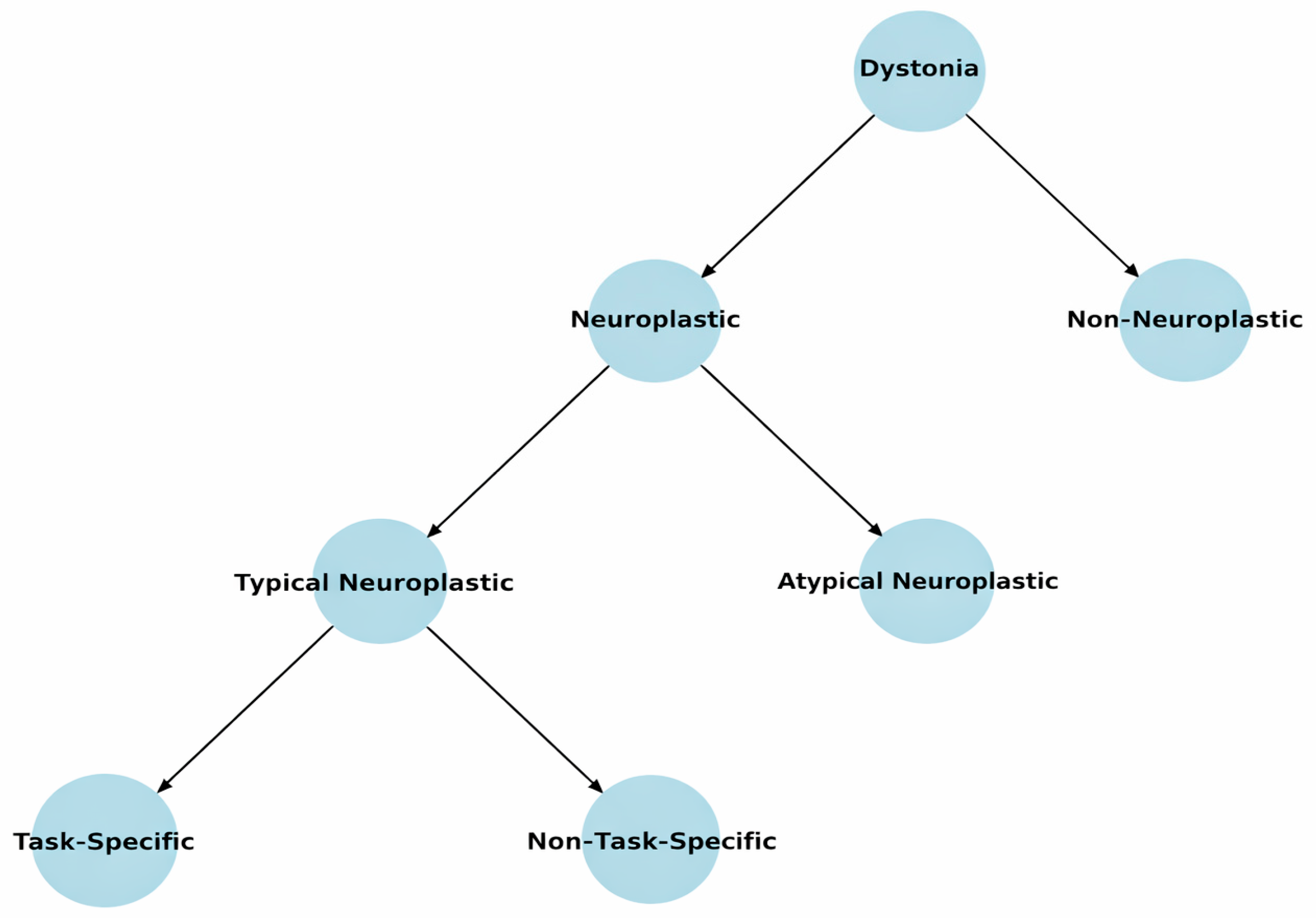
Focal task-specific dystonia (FTSD) is associated with abnormalities across primary motor cortex (M1), basal ganglia, cerebellum, primary somatosensory cortex (S1), and spinal circuits, but their causal ordering is unresolved. Starting from the companion M1-centered framework, we ask whether repeated expression of a task-specific motor synergy (TSMS) with a proposed M1 excitation–inhibition imbalance could produce task-linked adaptations elsewhere in the motor system. We propose candidate mechanisms linking abnormal M1 output to reweighting of striatal dopamine signaling and direct- and indirect-pathway function, recalibration of cerebellar teaching and corrective output, reduced functional separability of S1 sensory populations, and use-dependent weakening of spinal reciprocal inhibition. Reported FTSD findings serve as empirical constraints; these intermediate cellular and circuit links remain hypotheses rather than established causal sequences. Extra-M1 changes could later reinforce or help maintain the dystonic state, compensate for it, or interact bidirectionally with the cortical abnormality. The M1-primary claim concerns causal initiation rather than anatomical exclusivity and predicts that task-specific abnormalities of M1 recruitment and rapid inhibitory control should precede or closely track the proposed extra-M1 adaptations. We also propose a provisional causal-architecture taxonomy distinguishing typical neuroplastic, atypical neuroplastic, and non-neuroplastic dystonias by the process hypothesized to dominate symptom generation and persistence. The TSMS framework, including the symptom-threshold, overreaching sequence, a proposed state of task-specific output limitation termed true weakness, and below- or at-threshold retraining (BATR), is advanced for FTSD rather than assumed to generalize unchanged across dystonias. Longitudinal, intervention-based, and experimental-model tests are outlined to distinguish the proposed sequence from basal ganglia-primary, cerebellar-primary, sensory-primary, concurrent, and distributed alternatives and to test whether retraining-related improvement follows the predicted physiological route.
Keywords: focal task-specific dystonia; primary motor cortex; task-specific motor synergy; network adaptation; neuroplasticity; basal ganglia; cerebellum; symptom-threshold; below- or at-threshold retraining; causal architecture focal task-specific dystonia; primary motor cortex; task-specific motor synergy; network adaptation; neuroplasticity; basal ganglia; cerebellum; symptom-threshold; below- or at-threshold retraining; causal architecture