Childhood ADHD and Its Adult Mimics: When First-Time ADHD Diagnoses in Adulthood May Reflect Other Conditions—A Narrative Review

Highlights
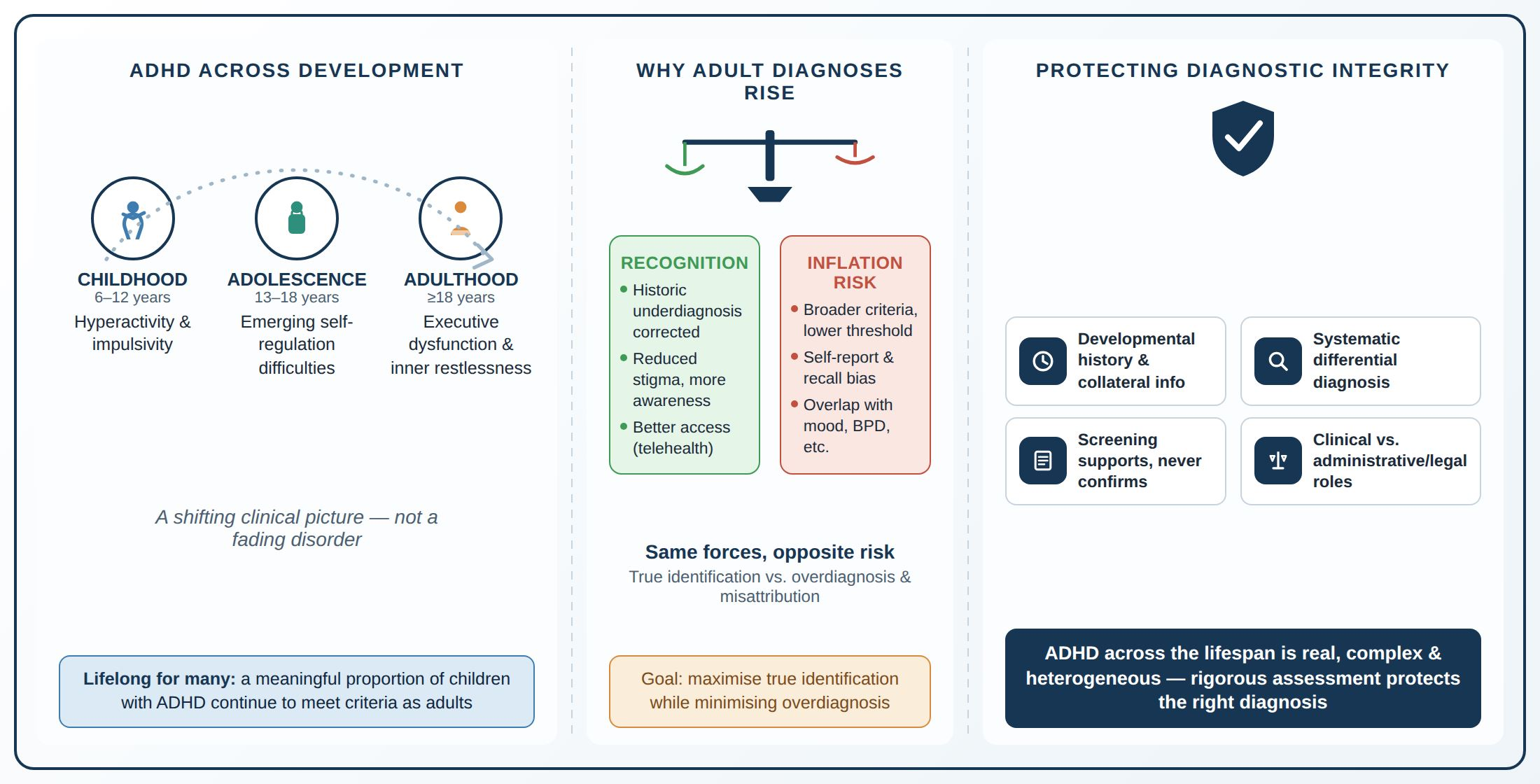
- ADHD changes across development, shifting from overt hyperactivity and impulsivity in childhood toward inner restlessness, executive dysfunction, disorganization, and impaired self-regulation in adulthood.
- The recent increase in adult ADHD diagnoses is compatible with several overlapping processes, including improved recognition of historically missed cases, broadened criteria, expanded access to assessment, and possible over-attribution in a subset of adult presentations; current evidence does not quantify their relative contributions.
- In some cases, a first-time adult ADHD diagnosis may instead reflect an alternative or co-occurring mood, anxiety, substance-use, sleep, stress-related, or personality condition; longitudinal studies also document associations between childhood ADHD and later borderline personality disorder or bipolar disorder without establishing diagnostic substitution.
- Adult ADHD assessment should combine a developmentally informed history with collateral information and systematic evaluation of mood, anxiety, substance-use, sleep, stress-related, and personality disorders, rather than relying on screening questionnaires alone.
- Apparent late-onset ADHD and retrospective rediagnosis should be approached cautiously, explicitly acknowledging diagnostic uncertainty and distinguishing clinical diagnosis from occupational, administrative, forensic, or medication-related considerations.
- Longitudinal associations between childhood ADHD and later personality or mood pathology strengthen the rationale for early identification and evidence-based treatment, but do not establish that early treatment prevents those later outcomes.
Abstract
1. Introduction
2. Materials and Methods
3. Diagnostic Visibility and Evidentiary Standards in Retrospective Reassessment
4. From a Childhood Syndrome to a Lifespan Condition
5. Developmental Phenomenology: How ADHD Looks in Childhood, Adolescence and Adulthood
6. Factors Contributing to the Rise in Adult ADHD Diagnoses
6.1. Diagnostic Criteria Broadening: What DSM-5 Actually Changed
6.2. Increased Detection and Historical Underrecognition
6.3. Expanded Healthcare Access and Telehealth
6.4. Apparent Adult-Onset ADHD: Genuine Late Emergence or Diagnostic Artefact?
7. Neurobiological, Executive-Function and Genetic Models
8. Differential Diagnosis in Adult Practice
8.1. Mood Disorders
8.2. Anxiety Disorders
8.3. Substance Use and ADHD
8.4. Borderline Personality Disorder: Overlapping Presentations and Diagnostic Caution
8.5. Sleep Disruption and Chronic Stress
9. The Limits of Adult Self-Report Screening
10. Retrospective Diagnosis and the Problem of Childhood Recall
11. Occupational and Medico-Legal Dimensions Specific to ADHD
12. Toward a Disciplined Diagnostic Approach
13. Conclusions
Author Contributions
Funding
Institutional Review Board Statement
Informed Consent Statement
Data Availability Statement
Acknowledgments
Conflicts of Interest
Abbreviations
| ADHD | attention-deficit/hyperactivity disorder |
| ASRS | Adult ADHD Self-Report Scale |
| DIVA-5 | Diagnostic Interview for ADHD in Adults, 5th ed. |
| DSM-5 | Diagnostic and Statistical Manual of Mental Disorders, 5th ed. |
| DSM-5-TR | DSM-5, Text Revision |
| GWAS | genome-wide association study |
| ICD-11 | International Classification of Diseases, 11th Revision |
| MMWR | Morbidity and Mortality Weekly Report |
| WHO | World Health Organization |
References
- Biederman, J.; Petty, C.R.; Evans, M.; Small, J.; Faraone, S.V. How persistent is ADHD? A controlled follow-up study of children with ADHD into early adulthood. Psychiatry Res. 2010, 177, 299–304. [Google Scholar] [PubMed]
- Faraone, S.V.; Asherson, P.; Banaschewski, T.; Biederman, J.; Buitelaar, J.K.; Ramos-Quiroga, J.A.; Rohde, L.A.; Sonuga-Barke, E.J.S.; Tannock, R.; Franke, B. Attention-deficit hyperactivity disorder. Nat. Rev. Dis. Primers 2015, 1, 15020. [Google Scholar] [PubMed]
- Kooij, J.J.S.; Bijlenga, D.; Salerno, L.; Jaeschke, R.; Bitter, I.; Balázs, J.; Thome, J.; Dom, G.; Kasper, S.; Filipe, C.N.; et al. Updated European Consensus Statement on diagnosis and treatment of adult ADHD. Eur. Psychiatry 2019, 56, 14–34. [Google Scholar] [CrossRef] [Scilit] [PubMed]
- American Psychiatric Association. Diagnostic and Statistical Manual of Mental Disorders, 5th ed.; DSM-5; American Psychiatric Publishing: Arlington, VA, USA, 2013. [Google Scholar] [CrossRef] [Scilit]
- Staley, B.S.; Robinson, L.R.; Claussen, A.H.; Katz, S.M.; Danielson, M.L.; Summers, A.D.; Farr, S.L.; Blumberg, S.J.; Tinker, S.C. Attention-Deficit/Hyperactivity Disorder Diagnosis, Treatment, and Telehealth Use in Adults—National Center for Health Statistics Rapid Surveys System, United States, October–November 2023. MMWR Morb. Mortal. Wkly. Rep. 2024, 73, 890–895. [Google Scholar] [CrossRef] [Scilit] [PubMed]
- Adler, L.A.; Spencer, T.; Faraone, S.V.; Kessler, R.C.; Howes, M.J.; Biederman, J.; Secnik, K. Validity of pilot Adult ADHD Self-Report Scale (ASRS) to rate adult ADHD symptoms. Ann. Clin. Psychiatry 2006, 18, 145–148. [Google Scholar] [CrossRef] [Scilit] [PubMed]
- Mannuzza, S.; Klein, R.G.; Klein, D.F.; Bessler, A.; Shrout, P. Accuracy of adult recall of childhood attention deficit hyperactivity disorder. Am. J. Psychiatry 2002, 159, 1882–1888. [Google Scholar] [CrossRef] [Scilit] [PubMed]
- Sibley, M.H.; Mitchell, J.T.; Becker, S.P. Method of adult diagnosis influences estimated persistence of childhood ADHD: A systematic review of longitudinal studies. Lancet Psychiatry 2016, 3, 1157–1165. [Google Scholar] [CrossRef] [Scilit] [PubMed]
- Matte, B.; Anselmi, L.; Salum, G.A.; Kieling, C.; Gonçalves, H.; Menezes, A.; Grevet, E.H.; Rohde, L.A. ADHD in DSM-5: A field trial in a large, representative sample of 18- to 19-year-old adults. Psychol. Med. 2015, 45, 361–373. [Google Scholar] [CrossRef] [Scilit] [PubMed]
- Sibley, M.H. Empirically-informed guidelines for first-time adult ADHD diagnosis. J. Clin. Exp. Neuropsychol. 2021, 43, 340–351. [Google Scholar] [CrossRef] [Scilit] [PubMed]
- Attoe, D.E.; Climie, E.A. Miss. Diagnosis: A systematic review of ADHD in adult women. J. Atten. Disord. 2023, 27, 645–657. [Google Scholar] [CrossRef] [Scilit] [PubMed]
- National Institute for Health and Care Excellence (NICE). Attention Deficit Hyperactivity Disorder: Diagnosis and Management; NICE Guideline NG87, Amended 2019; NICE: London, UK, 2018. [Google Scholar]
- Breda, V.; Rohde, L.A.; Menezes, A.M.B.; Anselmi, L.; Caye, A.; Rovaris, D.L.; Vitola, E.S.; Bau, C.H.D.; Grevet, E.H. Revisiting ADHD age-of-onset in adults: To what extent should we rely on the recall of childhood symptoms? Psychol. Med. 2020, 50, 857–866. [Google Scholar] [CrossRef] [Scilit] [PubMed]
- Asherson, P.; Young, A.H.; Eich-Höchli, D.; Moran, P.; Porsdal, V.; Deberdt, W. Differential diagnosis, comorbidity, and treatment of attention-deficit/hyperactivity disorder in relation to bipolar disorder or borderline personality disorder in adults. Curr. Med. Res. Opin. 2014, 30, 1657–1672. [Google Scholar] [CrossRef] [Scilit] [PubMed]
- Weiner, L.; Perroud, N.; Weibel, S. Attention deficit hyperactivity disorder and borderline personality disorder in adults: A review of their links and risks. Neuropsychiatr. Dis. Treat. 2019, 15, 3115–3129. [Google Scholar] [CrossRef] [Scilit] [PubMed]
- MacDonald, L.; Sadek, J. Management strategies for borderline personality disorder and bipolar disorder comorbidities in adults with ADHD: A narrative review. Brain Sci. 2023, 13, 1517. [Google Scholar] [CrossRef] [Scilit] [PubMed]
- Cabral, M.D.I.; Liu, S.; Soares, N. Attention-deficit/hyperactivity disorder: Diagnostic criteria, epidemiology, risk factors and evaluation in youth. Transl. Pediatr. 2020, 9, S104–S113. [Google Scholar] [CrossRef] [Scilit] [PubMed]
- Asherson, P.; Buitelaar, J.; Faraone, S.V.; Rohde, L.A. Adult attention-deficit hyperactivity disorder: Key conceptual issues. Lancet Psychiatry 2016, 3, 568–578. [Google Scholar] [CrossRef] [Scilit] [PubMed]
- Faraone, S.V.; Biederman, J.; Mick, E. The age-dependent decline of attention deficit hyperactivity disorder: A meta-analysis of follow-up studies. Psychol. Med. 2006, 36, 159–165. [Google Scholar] [CrossRef] [Scilit] [PubMed]
- Sibley, M.H.; Arnold, L.E.; Swanson, J.M.; Hechtman, L.T.; Kennedy, T.M.; Owens, E.; Molina, B.S.G.; Jensen, P.S.; Hinshaw, S.P.; Roy, A.; et al. Variable patterns of remission from ADHD in the Multimodal Treatment Study of ADHD. Am. J. Psychiatry 2022, 179, 142–151. [Google Scholar] [CrossRef] [Scilit] [PubMed]
- Kessler, R.C.; Adler, L.; Barkley, R.; Biederman, J.; Conners, C.K.; Demler, O.; Faraone, S.V.; Greenhill, L.L.; Howes, M.J.; Secnik, K.; et al. The prevalence and correlates of adult ADHD in the United States: Results from the National Comorbidity Survey Replication. Am. J. Psychiatry 2006, 163, 716–723. [Google Scholar] [CrossRef] [Scilit]
- Polanczyk, G.V.; Willcutt, E.G.; Salum, G.A.; Kieling, C.; Rohde, L.A. ADHD prevalence estimates across three decades: An updated systematic review and meta-regression analysis. Int. J. Epidemiol. 2014, 43, 434–442. [Google Scholar] [CrossRef] [Scilit] [PubMed]
- Popit, S.; Serod, K.; Locatelli, I.; Stuhec, M. Prevalence of attention-deficit hyperactivity disorder (ADHD): Systematic review and meta-analysis. Eur. Psychiatry 2024, 67, e68. [Google Scholar] [CrossRef] [Scilit] [PubMed]
- Díaz-Román, A.; Mitchell, R.; Cortese, S. Sleep in adults with ADHD: Systematic review and meta-analysis of subjective and objective studies. Neurosci. Biobehav. Rev. 2018, 89, 61–71. [Google Scholar] [CrossRef] [Scilit] [PubMed]
- Fu, X.; Wu, W.; Wu, Y.; Liu, X.; Liang, W.; Wu, R.; Li, Y. Adult ADHD and comorbid anxiety and depressive disorders: A review of etiology and treatment. Front. Psychiatry 2025, 16, 1597559. [Google Scholar] [CrossRef] [Scilit] [PubMed]
- Alarachi, A.; Merrifield, C.; Rowa, K.; McCabe, R.E. Are we measuring ADHD or anxiety? Examining the factor structure and discriminant validity of the Adult ADHD Self-Report Scale in an adult anxiety disorder population. Assessment 2024, 31, 1508–1524. [Google Scholar] [CrossRef] [Scilit] [PubMed]
- Katzman, M.A.; Bilkey, T.S.; Chokka, P.R.; Fallu, A.; Klassen, L.J. Adult ADHD and comorbid disorders: Clinical implications of a dimensional approach. BMC Psychiatry 2017, 17, 302. [Google Scholar] [CrossRef] [Scilit] [PubMed]
- Sibley, M.H.; Rohde, L.A.; Swanson, J.M.; Hechtman, L.T.; Molina, B.S.G.; Mitchell, J.T.; Arnold, L.E.; Caye, A.; Kennedy, T.M.; Roy, A.; et al. Multimodal Treatment Study of Children with ADHD (MTA) Cooperative Group. Late-onset ADHD reconsidered with comprehensive repeated assessments between ages 10 and 25. Am. J. Psychiatry 2018, 175, 140–149. [Google Scholar] [PubMed]
- American Psychiatric Association. Diagnostic and Statistical Manual of Mental Disorders, 5th ed.; Text Revision (DSM-5-TR); American Psychiatric Publishing: Washington, DC, USA, 2022. [Google Scholar] [CrossRef] [Scilit]
- World Health Organization. Clinical Descriptions and Diagnostic Requirements for ICD-11 Mental, Behavioural and Neurodevelopmental Disorders; WHO: Geneva, Switzerland, 2024. [Google Scholar]
- Herman, B.K.; Faraone, S.V.; Cutler, A.J.; Newcorn, J.H.; LaFrance, E.M.; Ripper Lewis, M.; Ruetsch, C. Validity of an online assessment of attention-deficit/hyperactivity disorder among a real-world sample of adults seeking web-based mental health care. J. Clin. Psychiatry 2025, 86, 25m15846. [Google Scholar] [CrossRef] [Scilit] [PubMed]
- Moffitt, T.E.; Houts, R.; Asherson, P.; Belsky, D.W.; Corcoran, D.L.; Hammerle, M.; Harrington, H.; Hogan, S.; Meier, M.H.; Polanczyk, G.V.; et al. Is adult ADHD a childhood-onset neurodevelopmental disorder? Evidence from a four-decade longitudinal cohort study. Am. J. Psychiatry 2015, 172, 967–977. [Google Scholar] [CrossRef] [Scilit] [PubMed]
- Agnew-Blais, J.C.; Polanczyk, G.V.; Danese, A.; Wertz, J.; Moffitt, T.E.; Arseneault, L. Evaluation of the persistence, remission, and emergence of attention-deficit/hyperactivity disorder in young adulthood. JAMA Psychiatry 2016, 73, 713–720. [Google Scholar] [CrossRef] [Scilit] [PubMed]
- Caye, A.; Rocha, T.B.-M.; Anselmi, L.; Murray, J.; Menezes, A.M.B.; Barros, F.C.; Gonçalves, H.; Wehrmeister, F.; Jensen, C.M.; Steinhausen, H.-C. Attention-deficit/hyperactivity disorder trajectories from childhood to young adulthood: Evidence from a birth cohort supporting a late-onset syndrome. JAMA Psychiatry 2016, 73, 705–712. [Google Scholar] [PubMed]
- Mitchell, J.T.; Sibley, M.H.; Hinshaw, S.P.; Kennedy, T.M.; Chronis-Tuscano, A.; Arnold, L.E.; Swanson, J.M.; Hechtman, L.T.; Molina, B.S.G.; Caye, A.; et al. A qualitative analysis of contextual factors relevant to suspected late-onset ADHD. J. Atten. Disord. 2021, 25, 724–737. [Google Scholar] [CrossRef] [Scilit] [PubMed]
- O’Grady, S.M.; Hinshaw, S.P. Developmental predictors of young adult borderline personality disorder: A prospective, longitudinal study of females with and without childhood ADHD. BMC Psychiatry 2023, 23, 109. [Google Scholar] [CrossRef] [Scilit] [PubMed]
- Brancati, G.E.; Perugi, G.; Milone, A.; Masi, G.; Sesso, G. Development of bipolar disorder in patients with attention-deficit/hyperactivity disorder: A systematic review and meta-analysis of prospective studies. J. Affect. Disord. 2021, 293, 186–196. [Google Scholar] [CrossRef] [Scilit] [PubMed]
- Barkley, R.A. Behavioral inhibition, sustained attention, and executive functions: Constructing a unifying theory of ADHD. Psychol. Bull. 1997, 121, 65–94. [Google Scholar] [CrossRef] [Scilit] [PubMed]
- Volkow, N.D.; Wang, G.J.; Kollins, S.H.; Wigal, T.L.; Newcorn, J.H.; Telang, F.; Fowler, J.S.; Zhu, W.; Logan, J.; Ma, Y.; et al. Evaluating dopamine reward pathway in ADHD: Clinical implications. JAMA 2009, 302, 1084–1091. [Google Scholar] [CrossRef] [Scilit] [PubMed]
- Demontis, D.; Walters, G.B.; Athanasiadis, G.; Walters, R.; Therrien, K.; Nielsen, T.T.; Farajzadeh, L.; Voloudakis, G.; Bendl, J.; Zeng, B.; et al. Genome-wide analyses of ADHD identify 27 risk loci, refine the genetic architecture and implicate several cognitive domains. Nat. Genet. 2023, 55, 198–208. [Google Scholar] [CrossRef] [Scilit] [PubMed]
- Wilens, T.E.; Martelon, M.; Joshi, G.; Bateman, C.; Fried, R.; Petty, C.; Biederman, J. Does ADHD predict substance-use disorders? A 10-year follow-up study of young adults with ADHD. J. Am. Acad. Child Adolesc. Psychiatry 2011, 50, 543–553. [Google Scholar] [CrossRef] [Scilit] [PubMed]
- Wilens, T.E.; Adler, L.A.; Adams, J.; Sgambati, S.; Rotrosen, J.; Sawtelle, R.; Utzinger, L.; Fusillo, S. Misuse and diversion of stimulants prescribed for ADHD: A systematic review of the literature. J. Am. Acad. Child Adolesc. Psychiatry 2008, 47, 21–31. [Google Scholar] [CrossRef] [Scilit] [PubMed]
- Gunderson, J.G.; Herpertz, S.C.; Skodol, A.E.; Torgersen, S.; Zanarini, M.C. Borderline personality disorder. Nat. Rev. Dis. Primers 2018, 4, 18029. [Google Scholar] [PubMed]
- Sharp, C.; Fonagy, P. Practitioner review: Borderline personality disorder in adolescence. J. Child Psychol. Psychiatry 2015, 56, 1266–1288. [Google Scholar] [CrossRef] [Scilit] [PubMed]
- Philipsen, A.; Limberger, M.F.; Lieb, K.; Feige, B.; Kleindienst, N.; Ebner-Priemer, U.; Barth, J.; Schmahl, C.; Bohus, M. Attention-deficit hyperactivity disorder as a potentially aggravating factor in borderline personality disorder. Br. J. Psychiatry 2008, 192, 118–123. [Google Scholar] [CrossRef] [Scilit] [PubMed]
- Di Lorenzo, R.; Latella, E.; Gualtieri, F.; Adriani, A.; Ferri, P.; Filippini, T. Validity of the Italian Version of DIVA-5: Semi-Structured Diagnostic Interview for Adult ADHD Based on the DSM-5 Criteria. Healthcare 2025, 13, 244. [Google Scholar] [CrossRef] [Scilit] [PubMed]
- White, D.J.; Ovsiew, G.P.; Rhoads, T.; Resch, Z.J.; Lee, M.; Oh, A.J.; Soble, J.R. The divergent roles of symptom and performance validity in the assessment of ADHD. J. Atten. Disord. 2022, 26, 101–108. [Google Scholar] [CrossRef] [Scilit] [PubMed]
- Song, P.; Zha, M.; Yang, Q.; Zhang, Y.; Li, X.; Rudan, I. The prevalence of adult attention-deficit hyperactivity disorder: A global systematic review and meta-analysis. J. Glob. Health 2021, 11, 04009. [Google Scholar] [CrossRef] [Scilit] [PubMed]

| Developmental Stage | Predominant Presentation | Typical Informant(s) | Common Source of Under-Recognition |
|---|---|---|---|
| Early/middle childhood (~6–10 y) | Overt hyperactivity, impulsivity, motor restlessness [2,4,17] | Parents, teachers [3,4] | Quiet, inattentive-predominant, compliant children are overlooked [11,17] |
| Adolescence (~11–17 y) | Inner restlessness, organizational failure as scaffolding is withdrawn [2,3,19,20] | Self, parents, teachers [3] | Symptoms misattributed to motivation, mood, or normal adolescent variability [3,11] |
| Adulthood (18+ y) | Executive dysfunction: disorganization, procrastination, forgetfulness, impulsive decisions [2,3,4,18] | Self (often sole informant) [3,7,8,10] | Overlap with mood, anxiety, substance use, sleep and personality pathology [3,14,24,25,26,27] |
| Condition | Core Overlap with ADHD | Principal Discriminating Feature |
|---|---|---|
| Major depressive/bipolar-spectrum disorders | Poor concentration, indecision, impulsivity (hypomania) | Episodic course tied to mood state vs. trait-like, context-independent inattention since childhood [3,14,25,27] |
| Generalized anxiety disorder | Perceived inability to concentrate, feeling overwhelmed | Content-linked worry-driven distraction that resolves with the worry vs. content-free attentional lapse [3,25,26,27] |
| Substance use disorder | Attention/memory impairment, impulsivity | Temporal relationship to use/withdrawal; requires a period of abstinence to clarify [3,18,41,42] |
| Borderline personality disorder | Impulsivity, emotional reactivity, instability | Impulsivity tied to interpersonal/affective triggers vs. context-independent inhibitory deficit [14,15,16,43,44,45] |
| Sleep disruption/chronic stress | Inattention, forgetfulness, irritability | Improvement with corrected sleep/stress vs. persistence independent of sleep or stressor [3,12,24] |
| Domain | Recommended Practice | Evidence/Source and Status |
|---|---|---|
| Developmental history | Obtain a full developmental and psychiatric history; seek collateral sources where available, and document their absence and the resulting uncertainty. | Diagnostic standard and guideline/consensus: DSM-5 [4]; European Consensus [3]; NICE NG87 [12]; Sibley [10]. |
| Differential diagnosis | Assess alternative and co-occurring mood, anxiety, substance-use, sleep, stress-related, and personality conditions before attributing symptoms to ADHD. | Guideline/consensus: European Consensus [3]; NICE NG87 [12]; Sibley [10]. |
| Screening instruments | Use validated screeners to identify the need for further evaluation, not to diagnose ADHD from a score alone; embed structured interviews within a full clinical assessment. | Screening/diagnostic evidence and guidance: ASRS [6]; DIVA-5 [46]; Sibley [10]; anxiety-sample validity study [26]. |
| Late-onset presentations | Neither dismiss nor automatically accept; evaluate impairment, substance use, psychiatric explanations, subthreshold childhood traits, and recall limitations. | Prospective/reassessment evidence: Sibley et al. [28,35]; recall evidence [13]. |
| Rediagnosis after a prior differing opinion | Reconstruct the available developmental and collateral evidence; a later diagnosis alone does not determine whether the earlier formulation was unreasonable. | Authors’ clinical synthesis based on recall evidence and diagnostic guidance [7,8,10,13]; not a formal standard of care. |
| Occupational/forensic context | Document the clinical diagnosis separately from jurisdiction-specific administrative eligibility or accommodation criteria. | Authors’ clinical synthesis informed by first-time diagnosis and validity guidance [10,47]; administrative requirements remain jurisdiction-specific. |
| Pharmacological treatment | When clinically indicated, assess misuse, diversion, or validity concerns without presuming deceptive intent; do not use treatment response to validate the diagnosis. | Guideline/evidence plus authors’ clinical synthesis: European Consensus [3]; NICE NG87 [12]; validity evidence [47]; misuse/diversion review [42]. |
Disclaimer/Publisher’s Note: The statements, opinions and data contained in all publications are solely those of the individual author(s) and contributor(s) and not of MDPI and/or the editor(s). MDPI and/or the editor(s) disclaim responsibility for any injury to people or property resulting from any ideas, methods, instructions or products referred to in the content. |
© 2026 by the authors. Licensee MDPI, Basel, Switzerland. This article is an open access article distributed under the terms and conditions of the Creative Commons Attribution (CC BY) license.
Share and Cite
Cuomo, A.; Pinzi, M.; Fagiolini, A. Childhood ADHD and Its Adult Mimics: When First-Time ADHD Diagnoses in Adulthood May Reflect Other Conditions—A Narrative Review. Brain Sci. 2026, 16, 965. https://doi.org/10.3390/brainsci16090965
Cuomo A, Pinzi M, Fagiolini A. Childhood ADHD and Its Adult Mimics: When First-Time ADHD Diagnoses in Adulthood May Reflect Other Conditions—A Narrative Review. Brain Sciences. 2026; 16(9):965. https://doi.org/10.3390/brainsci16090965
Chicago/Turabian StyleCuomo, Alessandro, Mario Pinzi, and Andrea Fagiolini. 2026. "Childhood ADHD and Its Adult Mimics: When First-Time ADHD Diagnoses in Adulthood May Reflect Other Conditions—A Narrative Review" Brain Sciences 16, no. 9: 965. https://doi.org/10.3390/brainsci16090965
APA StyleCuomo, A., Pinzi, M., & Fagiolini, A. (2026). Childhood ADHD and Its Adult Mimics: When First-Time ADHD Diagnoses in Adulthood May Reflect Other Conditions—A Narrative Review. Brain Sciences, 16(9), 965. https://doi.org/10.3390/brainsci16090965