Authentic Assessment of Social–Emotional Development in Early Childhood: A Scoping Review

Highlights
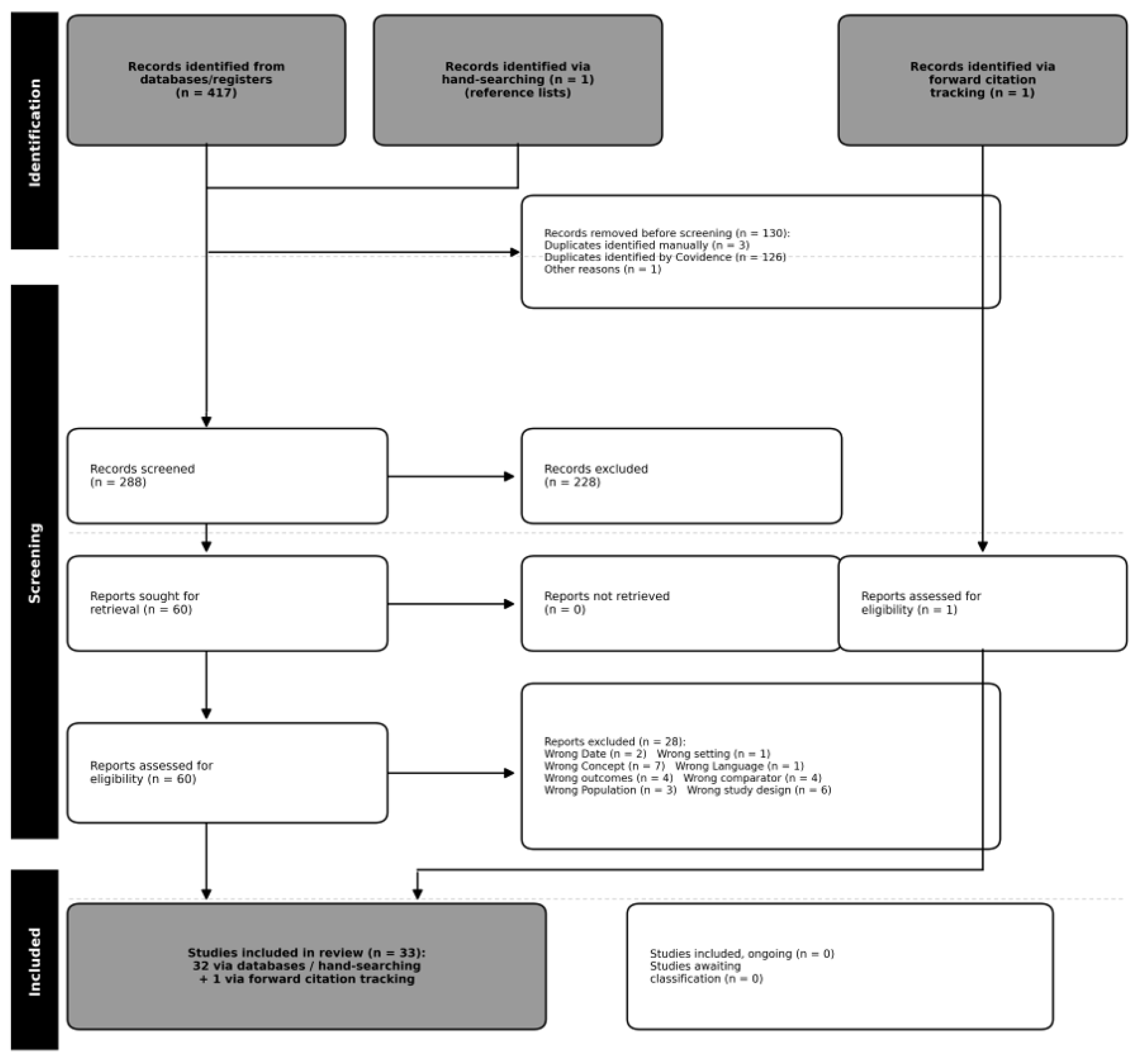
- Twenty-nine authentic SED assessment tools were identified across 33 studies, with naturalistic observation dominating (69.7%) while portfolio and curriculum-embedded approaches remained markedly under-represented.
- “Authenticity” is operationalized across ecological, participatory, and cultural dimensions that are rarely theorized in an integrated manner, revealing significant conceptual fragmentation.
- Substantial gaps in infant–toddler and primary-grade coverage, geographic diversity (57.6% U.S.-based), and cultural adaptation call for targeted tool development and cross-cultural validation research.
- The integrated sociocultural and interpretive assessment framework developed in this review offers an analytic model that may support equitable, contextually responsive SED assessment across the 0–8 continuum.
Abstract
1. Introduction
1.1. Global Context and Policy Landscape
1.2. Conceptual Definitions
1.3. Research Rationale and Gaps
1.4. Research Questions and Scope
2. Related Literature
2.1. Theoretical Foundations of Authentic Assessment
2.2. Authentic Assessment in Social–Emotional Development
2.3. Methodological Limitations and Research Gaps
3. Theoretical Framework
4. Methods
4.1. Protocol
4.2. Eligibility Criteria
4.3. Search Strategy
4.4. Study Selection and Data Charting
4.5. Synthesis
5. Results
5.1. Selection of Sources of Evidence
5.2. Characteristics of Sources of Evidence
5.2.1. Publication Year and Temporal Distribution

| Year | Studies | Period |
|---|---|---|
| 2004 | Gagnon | A |
| 2007 | Wimpory | A |
| 2009 | Rimm-Kaufman | A |
| 2010 | Bulotsky-Shearer; Meisels; Downer | A |
| 2011 | Moreno | A |
| 2012 | Razza | A |
| 2013 | Herndon | A |
| 2014 | Hughes; Gower | A |
| 2015 | Delvecchio; Kurki; Lambert; Alquraini | A |
| 2017 | Hernández | B |
| 2018 | Uyanık; Sutherland; Giske | B |
| 2019 | Sahin Asi; Ahmad | B |
| 2020 | Santos; Jaggy | B |
| 2021 | Hamaidi; Hanish; Bauminger-Zviely; Qiu | B |
| 2022 | Alamos; Silva Moreira; Sedem; Mathis | B |
| 2023 | Lasch | B |
| 2024 | Boise | B |
5.2.2. Geographic Distribution
5.2.3. Study Design
5.2.4. Target Age Groups
5.2.5. Population Characteristics
5.3. Assessment Tools Identified and Catalogued
5.3.1. Overview
5.3.2. Classification by Type of Authentic Assessment
6. Discussion
6.1. The Central Tension of the Field Shares
6.2. Conceptual Boundaries—What “Authentic” Means and for Whom
6.3. Measurement Architecture: Observation, Portfolio, and Curriculum-Embedded Approaches
6.4. Multi-Informant Perspectives and the Question of Coherence
6.5. Equity, Cultural Responsiveness, and the Politics of “Appropriate” Social–Emotional Behavior
6.6. Developmental Continuity Across the 0–8 Span
6.7. Existing Contributions and Future Directions
6.8. Synthesis and Implications
6.9. Implications for Practice and Policy
6.10. Limitations
7. Conclusions
Supplementary Materials
Author Contributions
Funding
Institutional Review Board Statement
Informed Consent Statement
Data Availability Statement
Conflicts of Interest
References
- Lu, C.; Black, M.M.; Richter, L.M. Risk of Poor Development in Young Children in Low-Income and Middle-Income Countries: An Estimation and Analysis at the Global, Regional, and Country Level. Lancet Glob. Health 2016, 4, e916–e922. [Google Scholar] [CrossRef] [Scilit] [PubMed]
- OECD. Starting Strong VI: Supporting Meaningful Interactions in Early Childhood Education and Care; Starting Strong; OECD Publishing: Paris, France, 2021; ISBN 978-92-64-32747-4. [Google Scholar]
- Collaborative for Academic, Social, and Emotional Learning (CASEL). CASEL’s SEL Framework: What Are the Core Competence Areas and Where Are They Promoted? Collaborative for Academic, Social, and Emotional Learning: Chicago, IL, USA, 2020. [Google Scholar]
- Arksey, H.; O’Malley, L. Scoping Studies: Towards a Methodological Framework. Int. J. Soc. Res. Methodol. 2005, 8, 19–32. [Google Scholar] [CrossRef] [Scilit]
- Levac, D.; Colquhoun, H.; O’Brien, K.K. Scoping Studies: Advancing the Methodology. Implement. Sci. 2010, 5, 69. [Google Scholar] [CrossRef] [Scilit] [PubMed]
- Peters, M.D.J.; Marnie, C.; Tricco, A.C.; Pollock, D.; Munn, Z.; Alexander, L.; McInerney, P.; Godfrey, C.M.; Khalil, H. Updated Methodological Guidance for the Conduct of Scoping Reviews. JBI Evid. Synth. 2020, 18, 2119–2126. [Google Scholar] [CrossRef] [Scilit] [PubMed]
- Wiggins, G. A True Test: Toward More Authentic and Equitable Assessment. Phi Delta Kappan 2011, 92, 81–93. [Google Scholar] [CrossRef] [Scilit]
- Bagnato, S.J. Authentic Assessment for Early Childhood Intervention: Best Practices; The Guilford School Practitioner Series; Guilford Press: New York, NY, USA, 2007; ISBN 978-1-59385-474-4. [Google Scholar]
- Neisworth, J.T.; Bagnato, S.J. The MisMeasure of Young Children: The Authentic Assessment Alternative. Infants Young Child. 2004, 17, 198–212. [Google Scholar] [CrossRef] [Scilit]
- Piaget, J. Origin of Intelligence in the Child: Selected Works, 1st ed.; Routledge: Abingdon, UK, 2013; Volume 3, ISBN 978-1-315-00626-0. [Google Scholar]
- DeVries, R.; Zan, B.S. Moral Classrooms, Moral Children: Creating a Constructivist Atmosphere in Early Education, 2nd ed.; Early Childhood Education Series; Teachers College Press: New York, NY, USA, 2012; ISBN 978-0-8077-5340-8. [Google Scholar]
- Vygotskij, L.S.; Cole, M. Mind in Society: The Development of Higher Psychological Processes; Harvard Univ. Press: Cambridge, MA, USA, 1981; ISBN 978-0-674-57629-2. [Google Scholar]
- Rogoff, B. Apprenticeship in Thinking: Cognitive Development in Social Context; Oxford Univ. Press: New York, NY, USA, 1991; ISBN 978-0-19-507003-3. [Google Scholar]
- Cannella; Gaile, S. Deconstructing Early Childhood Education: Social Justice and Revolution; Peter Lang: New York, NY, USA, 1997. [Google Scholar]
- Dahlberg, G.; Moss, P.; Pence, A. Beyond Quality in Early Childhood Education and Care: Languages of Evaluation; Routledge: Abingdon, UK, 2013; ISBN 978-0-203-37111-4. [Google Scholar]
- Shepard, L.A. The Role of Assessment in a Learning Culture. Educ. Res. 2000, 29, 4–14. [Google Scholar] [CrossRef]
- Fleer, M.; Hedegaard, M.; Tudge, J. (Eds.) Childhood Studies and the Impact of Globalization: Policies and Practices at Global and Local Levels; World Yearbook of Education Series; Routledge: New York, NY, USA, 2009; ISBN 978-0-415-99411-8. [Google Scholar]
- Moss, P.A. Can There Be Validity without Reliability? Educ. Res. 1994, 23, 5. [Google Scholar] [CrossRef] [Scilit] [PubMed]
- Delandshere, G. Assessment as Inquiry. Teach. Coll. Rec. Voice Scholarsh. Educ. 2002, 104, 1461–1484. [Google Scholar] [CrossRef] [Scilit]
- Tricco, A.C.; Lillie, E.; Zarin, W.; O’Brien, K.K.; Colquhoun, H.; Levac, D.; Moher, D.; Peters, M.D.J.; Horsley, T.; Weeks, L.; et al. PRISMA Extension for Scoping Reviews (PRISMA-ScR): Checklist and Explanation. Ann. Intern Med. 2018, 169, 467–473. [Google Scholar] [CrossRef] [Scilit] [PubMed]
- Covidence. Veritas Health Innovation Covidence Systematic Review Software; Covidence: Melbourne, Australia, 2026. [Google Scholar]
- Schalock, R.L. Intellectual Disability: Definition, Diagnosis, Classification, and Systems of Supports; AAIDD: Silver Spring, MD, USA, 2021; ISBN 978-0-9983983-6-5. [Google Scholar]
- Gagnon, S.G.; Nagle, R.J. Relationships between Peer Interactive Play and Social Competence in At-risk Preschool Children. Psychol. Sch. 2004, 41, 173–189. [Google Scholar] [CrossRef] [Scilit]
- Mokkink, L.B.; De Vet, H.C.W.; Prinsen, C.A.C.; Patrick, D.L.; Alonso, J.; Bouter, L.M.; Terwee, C.B. COSMIN Risk of Bias Checklist for Systematic Reviews of Patient-Reported Outcome Measures. Qual. Life Res. 2018, 27, 1171–1179. [Google Scholar] [CrossRef] [Scilit] [PubMed]
- Miake-Lye, I.M.; Hempel, S.; Shanman, R.; Shekelle, P.G. What Is an Evidence Map? A Systematic Review of Published Evidence Maps and Their Definitions, Methods, and Products. Syst. Rev. 2016, 5, 28. [Google Scholar] [CrossRef] [Scilit] [PubMed]
- Downer, J.T.; Booren, L.M.; Lima, O.K.; Luckner, A.E.; Pianta, R.C. The Individualized Classroom Assessment Scoring System (inCLASS): Preliminary Reliability and Validity of a System for Observing Preschoolers’ Competence in Classroom Interactions. Early Child. Res. Q. 2010, 25, 1–16. [Google Scholar] [CrossRef] [Scilit] [PubMed]
- Sutherland, K.S.; Conroy, M.A.; Algina, J.; Ladwig, C.; Jessee, G.; Gyure, M. Reducing Child Problem Behaviors and Improving Teacher-Child Interactions and Relationships: A Randomized Controlled Trial of BEST in CLASS. Early Child. Res. Q. 2018, 42, 31–43. [Google Scholar] [CrossRef] [Scilit]
- Alamos, P.; Williford, A.P.; Downer, J.T.; Turnbull, K.L.P. How Does Inhibitory Control Predict Emotion Regulation in Preschool? The Role of Individual Children’s Interactions with Teachers and Peers. Dev. Psychol. 2022, 58, 2049–2063. [Google Scholar] [CrossRef] [Scilit] [PubMed]
- Rimm-Kaufman, S.E.; Curby, T.W.; Grimm, K.J.; Brock, L.L.; Nathanson, L. The Contribution of Children’s Self-Regulation and Classroom Quality to Children’s Adaptive Behaviors in the Kindergarten Classroom. Dev. Psychol. 2009, 45, 958–972. [Google Scholar] [CrossRef] [Scilit] [PubMed]
- Bulotsky- Shearer, R.J.; Domínguez, X.; Bell, E.R.; Rouse, H.L.; Fantuzzo, J.W. Relations Between Behavior Problems in Classroom Social and Learning Situations and Peer Social Competence in Head Start and Kindergarten. J. Emot. Behav. Disord. 2010, 18, 195–210. [Google Scholar] [CrossRef] [Scilit]
- Meisels, S.J.; Wen, X.; Beachy-Quick, K. Authentic Assessment for Infants and Toddlers: Exploring the Reliability and Validity of the Ounce Scale. Appl. Dev. Sci. 2010, 14, 55–71. [Google Scholar] [CrossRef] [Scilit]
- Moreno, A.J.; Klute, M.M. Infant–Toddler Teachers Can Successfully Employ Authentic Assessment: The Learning Through Relating System. Early Child. Res. Q. 2011, 26, 484–496. [Google Scholar] [CrossRef] [Scilit]
- Razza, R.A.; Martin, A.; Brooks-Gunn, J. Anger and Children’s Socioemotional Development: Can Parenting Elicit a Positive Side to a Negative Emotion? J. Child Fam. Stud. 2012, 21, 845–856. [Google Scholar] [CrossRef] [Scilit] [PubMed]
- Herndon, K.J.; Bailey, C.S.; Shewark, E.A.; Denham, S.A.; Bassett, H.H. Preschoolers’ Emotion Expression and Regulation: Relations with School Adjustment. J. Genet. Psychol. 2013, 174, 642–663. [Google Scholar] [CrossRef] [Scilit] [PubMed]
- Gower, A.L.; Lingras, K.A.; Mathieson, L.C.; Kawabata, Y.; Crick, N.R. The role of preschool relational and physical aggression in the transition to kindergarten: Links with social-psychological adjustment. Early Educ. Dev. 2014, 25, 619–640. [Google Scholar] [CrossRef] [Scilit]
- Lambert, R.G.; Kim, D.-H.; Burts, D.C. The Measurement Properties of the Teaching Strategies GOLD® Assessment System. Early Child. Res. Q. 2015, 33, 49–63. [Google Scholar] [CrossRef] [Scilit]
- Alquraini, T.; Mahoney, G. An Exploratory Investigation of the Role of Parenting Stress in Relationship Focused Intervention. J. Appl. Res. Intellect. Disabil. 2015, 28, 536–547. [Google Scholar] [CrossRef] [Scilit] [PubMed]
- Hernández, M.M.; Eisenberg, N.; Valiente, C.; Diaz, A.; VanSchyndel, S.K.; Berger, R.H.; Terrell, N.; Silva, K.M.; Spinrad, T.L.; Southworth, J. Concurrent and Longitudinal Associations of Peers’ Acceptance with Emotion and Effortful Control in Kindergarten. Int. J. Behav. Dev. 2017, 41, 30–40. [Google Scholar] [CrossRef] [Scilit] [PubMed]
- Hanish, L.D.; Martin, C.L.; Cook, R.; DeLay, D.; Lecheile, B.; Fabes, R.A.; Goble, P.; Bryce, C. Building Integrated Peer Relationships in Preschool Classrooms: The Potential of Buddies. J. Appl. Dev. Psychol. 2021, 73, 101257. [Google Scholar] [CrossRef] [Scilit]
- Qiu, Y.; Leite, W.L.; Rodgers, M.K.; Hagler, N. Construct Validation of an Innovative Observational Child Assessment System: Teaching Strategies GOLD® Birth through Third Grade Edition. Early Child. Res. Q. 2021, 56, 41–51. [Google Scholar] [CrossRef] [Scilit]
- Mathis, E.; Hartz, K.; Berkowitz, M.; Carlson, A.; Kimport, R.; Brown, C.; Biel, M.G.; Domitrovich, C.E. Using early childhood mental health consultation to facilitate the social–emotional competence and school readiness of preschool children in marginalized communities. Sch. Ment. Health 2022, 14, 608–623. [Google Scholar] [CrossRef] [Scilit]
- Lasch, C.; Carlson, S.M.; Elison, J.T. Responding to Joint Attention as a Developmental Catalyst: Longitudinal Associations with Language and Social Responsiveness. Infancy 2023, 28, 339–366. [Google Scholar] [CrossRef] [Scilit] [PubMed]
- Boise, C.; Knoche, L.L. Social–Emotional Competence for Children with Identified Developmental Concerns: The Impact of Parenting and Executive Function. Behav. Sci. 2024, 14, 1232. [Google Scholar] [CrossRef] [Scilit] [PubMed]
- Uyanık, G.; Arslan Çiftçi, H.; Ünsal, Ö.; Kılıç, Z.; Değirmenci, Ş. Analyzing the relationships between preschool children’s play skills and their social competence and emotion regulation skills. Croat. J. Educ. 2018, 20, 243–257. [Google Scholar] [CrossRef] [Scilit]
- Sahin Asi, D.; Ocak Karabay, S.; Guzeldere Aydin, D. Emotional Correspondence between Preschoolers and Teachers: What Are the Effects on Child–Teacher Relationships? Educ. 3-13 2019, 47, 969–982. [Google Scholar] [CrossRef] [Scilit]
- Santos, A.J.; Daniel, J.R.; Antunes, M.; Coppola, G.; Trudel, M.; Vaughn, B.E. Changes in preschool children’s social engagement positively predict changes in social competence: A three-year longitudinal study of Portuguese children. Soc. Dev. 2020, 29, 544–563. [Google Scholar] [CrossRef] [Scilit]
- Silva Moreira, J.; Ferreira, P.C.; Veiga Simão, A.M. Dynamic Assessment of Self-Regulated Learning in Preschool. Heliyon 2022, 8, e10035. [Google Scholar] [CrossRef] [Scilit] [PubMed]
- Delvecchio, E.; Mabilia, D.; Li, J.-B.; Di Riso, D. Pretend play in Italian children: Validation of the Affect in Play Scale-Preschool Version. J. Child Fam. Stud. 2015, 24, 3556–3567. [Google Scholar] [CrossRef] [Scilit]
- Ahmad, S.; Peterson, E.R.; Waldie, K.E.; Morton, S.M.B. Development of an Index of Socio-Emotional Competence for Preschool Children in the Growing Up in New Zealand Study. Front. Educ. 2019, 4, 2. [Google Scholar] [CrossRef] [Scilit]
- Hamaidi, D.A.; Mattar, J.W.; Arouri, Y.M. Emotion regulation and its relationship to social competence among kindergarten children in Jordan. Eur. J. Contemp. Educ. 2021, 10, 66–76. [Google Scholar] [CrossRef] [Scilit]
- Kurki, K.; Jarvela, S.; Mykkanen, A.; Maaetta, E. Investigating Children’s Emotion Regulation in Socio-Emotionally Challenging Classroom Situations. Early Child Dev. Care 2015, 185, 1238–1254. [Google Scholar] [CrossRef] [Scilit]
- Sedem, M.; Siljehag, E.; Allodi, M.W.; Odom, S.L. Reliability and Validity of a Teacher Impressions Scale to Assess Social Play of Swedish Children in Inclusive Preschools. Assess. Eff. Interv. 2022, 48, 52–61. [Google Scholar] [CrossRef] [Scilit]
- Jaggy, A.-K.; Perren, S.; Sticca, F. Assessing preschool children’s social pretend play competence: An empirical comparison of three different assessment methods. Early Educ. Dev. 2020, 31, 1206–1223. [Google Scholar] [CrossRef] [Scilit]
- Wimpory, D.C.; Hobson, R.P.; Nash, S. What Facilitates Social Engagement in Preschool Children with Autism? J. Autism Dev. Disord. 2007, 37, 564–573. [Google Scholar] [CrossRef] [Scilit] [PubMed]
- Bauminger-Zviely, N.; Shefer, A. Naturalistic Evaluation of Preschoolers’ Spontaneous Interactions: The Autism Peer Interaction Observation Scale. Autism Int. J. Res. Pract. 2021, 25, 1520–1535. [Google Scholar] [CrossRef] [Scilit] [PubMed]
- Hughes, K.; Bullock, A.; Coplan, R.J. A person-centred analysis of teacher–child relationships in early childhood. Br. J. Educ. Psychol. 2014, 84, 253–267. [Google Scholar] [CrossRef] [Scilit] [PubMed]
- Giske, R.; Ugelstad, I.B.; Meland, A.T.; Kaltvedt, E.H.; Eikeland, S.; Tønnessen, F.E.; Reikerås, E.K.L. Toddlers’ social competence, play, movement skills and well-being: An analysis of their relationship based on authentic assessment in kindergarten. Eur. Early Child. Educ. Res. J. 2018, 26, 362–374. [Google Scholar] [CrossRef]
- Bagnato, S.J.; Neisworth, J.T.; Pretti-Frontczak, K.; Bagnato, S.J. LINKing Authentic Assessment and Early Childhood Intervention: Best Measures for Best Practices, 2nd ed.; Paul H. Brookes Pub: Baltimore, MD, USA, 2010; ISBN 978-1-59857-047-2. [Google Scholar]
- De Los Reyes, A.; Augenstein, T.M.; Wang, M.; Thomas, S.A.; Drabick, D.A.G.; Burgers, D.E.; Rabinowitz, J. The Validity of the Multi-Informant Approach to Assessing Child and Adolescent Mental Health. Psychol. Bull. 2015, 141, 858–900. [Google Scholar] [CrossRef] [Scilit] [PubMed]
- Peña, E.D. Lost in Translation: Methodological Considerations in Cross-Cultural Research. Child Dev. 2007, 78, 1255–1264. [Google Scholar] [CrossRef] [Scilit] [PubMed]
- Halle, T.G.; Darling-Churchill, K.E. Review of Measures of Social and Emotional Development. J. Appl. Dev. Psychol. 2016, 45, 8–18. [Google Scholar] [CrossRef] [Scilit]

| Element | Description |
|---|---|
| Population | Children aged 0–8 years (infants, toddlers, preschoolers, kindergarteners, and early primary-grade children) |
| Concept | Authentic assessment tools (naturalistic observation, play-based assessment, portfolio, performance-based assessment, curriculum-based measurement) targeting social–emotional development (self-awareness, self-regulation, social awareness, relationship skills, responsible decision-making, and related constructs) |
| Context | Any setting (home, childcare, preschool, primary school, clinic) globally; published literature in English, 2006–2026 |
| Country | n | % | Studies |
|---|---|---|---|
| United States | 19 | 57.6 | Gagnon 2004 [23]; Rimm-Kaufman 2009 [29]; Bulotsky-Shearer 2010 [30]; Downer 2010 [26]; Meisels 2010 [31]; Moreno 2011 [32]; Razza 2012 [33]; Herndon 2013 [34]; Gower 2014 [35]; Lambert 2015 [36]; Alquraini 2015 [37]; Hernández 2017 [38]; Sutherland 2018 [27]; Hanish 2021 [39]; Qiu 2021 [40]; Alamos 2022 [28]; Mathis 2022 [41]; Lasch 2023 [42]; Boise 2024 [43] |
| Turkey | 2 | 6.1 | Uyanık 2018 [44]; Sahin Asi 2019 [45] |
| Portugal | 2 | 6.1 | Santos 2020 [46]; Silva Moreira 2022 [47] |
| Italy | 1 | 3.0 | Delvecchio 2015 [48] |
| New Zealand | 1 | 3.0 | Ahmad 2019 [49] |
| Jordan | 1 | 3.0 | Hamaidi 2021 [50] |
| Finland | 1 | 3.0 | Kurki 2015 [51] |
| Sweden | 1 | 3.0 | Sedem 2022 [52] |
| Switzerland | 1 | 3.0 | Jaggy 2020 [53] |
| United Kingdom | 1 | 3.0 | Wimpory 2007 [54] |
| Israel | 1 | 3.0 | Bauminger-Zviely 2021 [55] |
| Canada | 1 | 3.0 | Hughes 2014 [56] |
| Norway | 1 | 3.0 | Giske 2018 [57] |
| Age Band | n | % | Representative Studies |
|---|---|---|---|
| Infants and toddlers (0–2 years) | 6 | 18.2 | Meisels 2010 [31] (0–42 mo); Moreno 2011 [32] (0–38 mo); Razza 2012 [33] (0 cohort); Lasch 2023 [42] (8–15 mo); Giske 2018 [57] (30–33 mo); Ahmad 2019 [49] (from 9 mo) |
| Preschool (3–5 years) | 25 | 75.8 | Uyanık 2018 [44]; Sahin Asi 2019 [45]; Gagnon 2004 [23]; Delvecchio 2015 [48]; Bulotsky-Shearer 2010 [30]; Downer 2010 [26]; Santos 2020 [46]; Alamos 2022 [28]; Hamaidi 2021 [50]; Herndon 2013 [34]; Hanish 2021 [39]; Boise 2024 [43]; Mathis 2022 [41]; Sedem 2022 [52]; Jaggy 2020 [53]; Alquraini 2015 [37]; Sutherland 2018 [27]; Wimpory 2007 [54]; Bauminger-Zviely 2021 [55]; Gower 2014 [35]; Rimm-Kaufman 2009 [29]; Hughes 2014 [56]; etc. |
| Kindergarten–Primary (5–8 years) | 6 | 18.2 | Kurki 2015 [51] (6–9 yr); Silva Moreira 2022 [47] (5 yr 3 mo –7 yr 6 mo); Hernández 2017 [38] (K, 5–6 yr); Rimm-Kaufman 2009 [29] (K); Hughes 2014 [56] (K, ~5 yr); Hamaidi 2021 [50] (K, 5.5 yr) |
| Broad span (birth–kindergarten) | 3 | 9.1 | Lambert 2015 [36] (0–71 mo); Qiu 2021 [40] (0–K); Ahmad 2019 [49] (9 mo to 4.5 yr) |
| Population | n | % |
|---|---|---|
| Typically developing only | 20 | 60.6 |
| Includes children with disabilities/special needs | 7 | 21.2 |
| Includes at-risk/low SES | 8 | 24.2 |
| Both disability and at-risk | 3 | 9.1 |
| Type of Authentic Assessment | N of Distinct Tools | N of Studies Using This Type | Examples |
|---|---|---|---|
| Naturalistic observation | 17 | 23 | MPAC-R/S; ASPI; inCLASS; TCIDOS; APIOS; CASPA; Alle Med; LTR; Child Behavior Coding Scale; PARCHISY; SCBE; ERC (teacher); SES; PSBS-T; Play Observation Scale; peer engagement coding (Hanish); video observation coding (Kurki) |
| Play-based assessment | 9 | 10 | Revised Knox Preschool Play Scale; PIPPS/PIPPS-T; APS-P; Teacher Impressions Scale; ToPS; DPPA; TPBA; Gift Wrap Task; DJAA |
| Performance-based assessment | 4 | 4 | PSRA; Ounce Scale; Dynamic Assessment of Self-regulated Learning; Peer Nomination |
| Portfolio/Curriculum-embedded | 2 | 2 | Teaching Strategies GOLD; Teaching Strategies GOLD B-3rd |
| Existing Contributions | Directions for Advancement |
|---|---|
| Authentic assessment is theoretically preferable to standardized testing for the SE domain. | Articulating an integrative framework that specifies how ecological, participatory, and cultural dimensions of authenticity interact in practice. |
| Various tool formats exist and are feasible. | Investigating the interpretive processes and decision architectures through which practitioners actually use these tools—moving from instrument-level to practice-level analysis. |
| Multi-informant approaches are recommended. | Examining the mechanisms of perspective reconciliation—how discrepant evidence from educators, families, and children is weighed and translated into pedagogical action. |
| Cultural responsiveness is normatively important. | Conducting empirical studies of cultural mediation in authentic SE assessment, using collaborative designs that position community members as co-analysts. |
| The 0–8 span is institutionally fragmented. | Developing vertically articulated assessment frameworks informed by developmental theory that support continuity across transition points. |
| Technology (e.g., digital portfolios, apps) is increasingly used. | Investigating whether and how digital tools alter the relational and interpretive qualities of authentic assessment, rather than evaluating technology adoption in isolation. |
Disclaimer/Publisher’s Note: The statements, opinions and data contained in all publications are solely those of the individual author(s) and contributor(s) and not of MDPI and/or the editor(s). MDPI and/or the editor(s) disclaim responsibility for any injury to people or property resulting from any ideas, methods, instructions or products referred to in the content. |
© 2026 by the authors. Licensee MDPI, Basel, Switzerland. This article is an open access article distributed under the terms and conditions of the Creative Commons Attribution (CC BY) license.
Share and Cite
Xia, Y.; Xu, Y.; Zhu, L.; Ai, J.; Chen, C.-C. Authentic Assessment of Social–Emotional Development in Early Childhood: A Scoping Review. Brain Sci. 2026, 16, 806. https://doi.org/10.3390/brainsci16080806
Xia Y, Xu Y, Zhu L, Ai J, Chen C-C. Authentic Assessment of Social–Emotional Development in Early Childhood: A Scoping Review. Brain Sciences. 2026; 16(8):806. https://doi.org/10.3390/brainsci16080806
Chicago/Turabian StyleXia, Yuyan, Yaoying Xu, Lin Zhu, Jun Ai, and Chin-Chih Chen. 2026. "Authentic Assessment of Social–Emotional Development in Early Childhood: A Scoping Review" Brain Sciences 16, no. 8: 806. https://doi.org/10.3390/brainsci16080806
APA StyleXia, Y., Xu, Y., Zhu, L., Ai, J., & Chen, C.-C. (2026). Authentic Assessment of Social–Emotional Development in Early Childhood: A Scoping Review. Brain Sciences, 16(8), 806. https://doi.org/10.3390/brainsci16080806