Targeting Neutrophil Extracellular Traps in Neuroinflammation: A Therapeutic Perspective on Neurodegenerative Diseases

 ,
,
Highlights
- NETs contribute to neuroinflammation by promoting blood–brain barrier disruption and the amplification of inflammatory signaling in several neurodegenerative diseases.
- Dysregulated NET formation is increasingly recognized as a mechanistic link between innate immune activation and neuronal injury in neurodegenerative disorders such as Alzheimer’s disease, Parkinson’s disease, and multiple sclerosis.
- Targeting the NETosis pathways represents a promising therapeutic strategy to modulate neuroinflammation and reduce neurovascular damage in neurodegenerative disorders.
- Emerging approaches, including PAD4 inhibition, DNase-mediated NET degradation, and modulation of oxidative signaling pathways, may provide new avenues for therapeutic intervention.
Abstract
1. Neuroinflammation, Neutrophils, and NETs in Neurodegenerative Pathology
2. Molecular Mechanisms of NETosis
2.1. Vesicle-Mediated NET Release (Vital NET)
2.2. Lytic Pathway (Suicidal/NOX-Dependent Pathway)
2.3. Mitochondrial DNA Pathway (Mito-NETosis)
3. Implications of NETs in Neurodegenerative Diseases
3.1. Alzheimer’s Disease
3.2. Parkinson’s Disease
3.3. Multiple Sclerosis
3.4. Huntington’s Disease
3.5. Amyotrophic Lateral Sclerosis
4. NETs as a Therapeutic Target
5. Conclusions
Author Contributions
Funding
Data Availability Statement
Acknowledgments
Conflicts of Interest
Abbreviations
References
- Bersano, A.; Engele, J.; Schäfer, M.K.E. Neuroinflammation and Brain Disease. BMC Neurol. 2023, 23, 227. [Google Scholar] [CrossRef] [Scilit] [PubMed]
- Adamu, A.; Li, S.; Gao, F.; Xue, G. The Role of Neuroinflammation in Neurodegenerative Diseases: Current Understanding and Future Therapeutic Targets. Front. Aging Neurosci. 2024, 16, 1347987. [Google Scholar] [CrossRef] [Scilit] [PubMed]
- Zhang, W.; Xiao, D.; Mao, Q.; Xia, H. Role of Neuroinflammation in Neurodegeneration Development. Signal Transduct. Target. Ther. 2023, 8, 267. [Google Scholar] [CrossRef] [Scilit] [PubMed]
- Mantovani, A.; Cassatella, M.A.; Costantini, C.; Jaillon, S. Neutrophils in the Activation and Regulation of Innate and Adaptive Immunity. Nat. Rev. Immunol. 2011, 11, 519–531. [Google Scholar] [CrossRef] [Scilit] [PubMed]
- Manda-Handzlik, A.; Demkow, U. The Brain Entangled: The Contribution of Neutrophil Extracellular Traps to the Diseases of the Central Nervous System. Cells 2019, 8, 1477. [Google Scholar] [CrossRef] [Scilit] [PubMed]
- Papayannopoulos, V. Neutrophil Extracellular Traps in Immunity and Disease. Nat. Rev. Immunol. 2018, 18, 134–147. [Google Scholar] [CrossRef] [Scilit] [PubMed]
- Crunfli, F.; Carregari, V.C.; Veras, F.P.; Silva, L.S.; Nogueira, M.H.; Antunes, A.S.L.M.; Vendramini, P.H.; Valença, A.G.F.; Brandão-Teles, C.; da Silva Zuccoli, G.; et al. Morphological, Cellular, and Molecular Basis of Brain Infection in COVID-19 Patients. Proc. Natl. Acad. Sci. USA 2022, 119, e2200960119. [Google Scholar] [CrossRef] [Scilit] [PubMed]
- Singhal, A.; Kumar, S. Neutrophil and Remnant Clearance in Immunity and Inflammation. Immunology 2022, 165, 22–43. [Google Scholar] [CrossRef] [Scilit] [PubMed]
- De Buhr, N.; Von Köckritz-Blickwede, M. How Neutrophil Extracellular Traps Become Visible. J. Immunol. Res. 2016, 2016, 4604713. [Google Scholar] [CrossRef] [Scilit] [PubMed]
- Jorch, S.K.; Kubes, P. An Emerging Role for Neutrophil Extracellular Traps in Noninfectious Disease. Nat. Med. 2017, 23, 279–287. [Google Scholar] [CrossRef] [Scilit] [PubMed]
- Meier, A.; Sakoulas, G.; Nizet, V.; Ulloa, E.R. Neutrophil Extracellular Traps: An Emerging Therapeutic Target to Improve Infectious Disease Outcomes. J. Infect. Dis. 2024, 230, 514–521. [Google Scholar] [CrossRef] [Scilit] [PubMed]
- Brinkmann, V.; Reichard, U.; Goosmann, C.; Fauler, B.; Uhlemann, Y.; Weiss, D.S.; Weinrauch, Y.; Zychlinsky, A. Neutrophil Extracellular Traps Kill Bacteria. Science 2004, 303, 1532–1535. [Google Scholar] [CrossRef] [Scilit] [PubMed]
- Shafqat, A.; Noor Eddin, A.; Adi, G.; Al-Rimawi, M.; Abdul Rab, S.; Abu-Shaar, M.; Adi, K.; Alkattan, K.; Yaqinuddin, A. Neutrophil Extracellular Traps in Central Nervous System Pathologies: A Mini Review. Front. Med. 2023, 10, 1083242. [Google Scholar] [CrossRef] [Scilit] [PubMed]
- Yu, X.; Chen, Z.; Bao, W.; Jiang, Y.; Ruan, F.; Wu, D.; Le, K. The Neutrophil Extracellular Traps in Neurological Diseases: An Update. Clin. Exp. Immunol. 2024, 218, 264–274. [Google Scholar] [CrossRef] [Scilit] [PubMed]
- Qiao, S.; Yuan, J.; Zhang, S.C.; Lu, Y.Y.; Zhou, P.; Xin, T. Neutrophil Extracellular Traps in Central Nervous System Disorders: Mechanisms, Implications, and Emerging Perspective. Front. Immunol. 2025, 16, 1602336. [Google Scholar] [CrossRef] [Scilit] [PubMed]
- Kretzschmar, G.C.; Bumiller-Bini, V.; Gasparetto Filho, M.A.; Zonta, Y.R.; Yu, K.S.T.; de Souza, R.L.R.; Dias-Melicio, L.A.; Boldt, A.B.W. Neutrophil Extracellular Traps: A Perspective of Neuroinflammation and Complement Activation in Alzheimer’s Disease. Front. Mol. Biosci. 2021, 8, 630869. [Google Scholar] [CrossRef] [Scilit] [PubMed]
- Branzk, N.; Lubojemska, A.; Hardison, S.E.; Wang, Q.; Gutierrez, M.G.; Brown, G.D.; Papayannopoulos, V. Neutrophils Sense Microbe Size and Selectively Release Neutrophil Extracellular Traps in Response to Large Pathogens. Nat. Immunol. 2014, 15, 1017–1025. [Google Scholar] [CrossRef] [Scilit] [PubMed]
- Burgener, S.S.; Schroder, K. Neutrophil Extracellular Traps in Host Defense. Cold Spring Harb. Perspect. Biol. 2020, 12, a037028. [Google Scholar] [CrossRef] [Scilit] [PubMed]
- Hidalgo, A.; Libby, P.; Soehnlein, O.; Aramburu, I.V.; Papayannopoulos, V.; Silvestre-Roig, C. Neutrophil Extracellular Traps: From Physiology to Pathology. Cardiovasc. Res. 2022, 118, 2737–2753. [Google Scholar] [CrossRef] [Scilit] [PubMed]
- Wang, H.; Kim, S.J.; Lei, Y.; Wang, S.; Wang, H.; Huang, H.; Zhang, H.; Tsung, A. Neutrophil Extracellular Traps in Homeostasis and Disease. Signal Transduct. Target. Ther. 2024, 9, 235. [Google Scholar] [CrossRef] [Scilit] [PubMed]
- Iba, T.; Miki, T.; Hashiguchi, N.; Tabe, Y.; Nagaoka, I. Is the Neutrophil a “prima Donna” in the Procoagulant Process during Sepsis? Crit. Care 2014, 18, 230. [Google Scholar] [CrossRef] [Scilit] [PubMed]
- Islam, M.M.; Takeyama, N. Role of Neutrophil Extracellular Traps in Health and Disease Pathophysiology: Recent Insights and Advances. Int. J. Mol. Sci. 2023, 24, 15805. [Google Scholar] [CrossRef] [Scilit] [PubMed]
- Stiel, L.; Meziani, F.; Helms, J. Neutrophil Activation During Septic Shock. Shock 2018, 49, 371–384. [Google Scholar] [CrossRef] [Scilit] [PubMed]
- Gao, F.; Peng, H.; Gou, R.; Zhou, Y.; Ren, S.; Li, F. Exploring Neutrophil Extracellular Traps: Mechanisms of Immune Regulation and Future Therapeutic Potential. Exp. Hematol. Oncol. 2025, 14, 80. [Google Scholar] [CrossRef] [Scilit] [PubMed]
- Farrera, C.; Fadeel, B. Macrophage Clearance of Neutrophil Extracellular Traps Is a Silent Process. J. Immunol. 2013, 191, 2647–2656. [Google Scholar] [CrossRef] [Scilit] [PubMed]
- Schoen, J.; Euler, M.; Schauer, C.; Schett, G.; Herrmann, M.; Knopf, J.; Yaykasli, K.O. Neutrophils’ Extracellular Trap Mechanisms: From Physiology to Pathology. Int. J. Mol. Sci. 2022, 23, 12855. [Google Scholar] [CrossRef] [Scilit] [PubMed]
- Bruschi, M.; Moroni, G.; Sinico, R.A.; Franceschini, F.; Fredi, M.; Vaglio, A.; Cavagna, L.; Petretto, A.; Pratesi, F.; Migliorini, P.; et al. Neutrophil Extracellular Traps in the Autoimmunity Context. Front. Med. 2021, 8, 614829. [Google Scholar] [CrossRef] [Scilit] [PubMed]
- Maruchi, Y.; Tsuda, M.; Mori, H.; Takenaka, N.; Gocho, T.; Huq, M.A.; Takeyama, N. Plasma Myeloperoxidase-Conjugated DNA Level Predicts Outcomes and Organ Dysfunction in Patients with Septic Shock. Crit. Care 2018, 22, 176. [Google Scholar] [CrossRef] [Scilit] [PubMed]
- Stiel, L.; Mayeur-Rousse, C.; Helms, J.; Meziani, F.; Mauvieux, L. First Visualization of Circulating Neutrophil Extracellular Traps Using Cell Fluorescence during Human Septic Shock-Induced Disseminated Intravascular Coagulation. Thromb. Res. 2019, 183, 153–158. [Google Scholar] [CrossRef] [Scilit] [PubMed]
- Thiam, H.R.; Wong, S.L.; Wagner, D.D.; Waterman, C.M. Cellular Mechanisms of NETosis. Annu. Rev. Cell Dev. Biol. 2020, 36, 191–218. [Google Scholar] [CrossRef] [Scilit] [PubMed]
- Keshari, R.S.; Jyoti, A.; Dubey, M.; Kothari, N.; Kohli, M.; Bogra, J.; Barthwal, M.K.; Dikshit, M. Cytokines Induced Neutrophil Extracellular Traps Formation: Implication for the Inflammatory Disease Condition. PLoS ONE 2012, 7, e48111. [Google Scholar] [CrossRef] [Scilit] [PubMed]
- Veras, F.P.; Pontelli, M.C.; Silva, C.M.; Toller-Kawahisa, J.E.; de Lima, M.; Nascimento, D.C.; Schneider, A.H.; Caetité, D.; Tavares, L.A.; Paiva, I.M.; et al. SARS-CoV-2-Triggered Neutrophil Extracellular Traps Mediate COVID-19 Pathology. J. Exp. Med. 2020, 217, e20201129. [Google Scholar] [CrossRef] [Scilit] [PubMed]
- Zhu, Y.; Chen, X.; Liu, X. NETosis and Neutrophil Extracellular Traps in COVID-19: Immunothrombosis and Beyond. Front. Immunol. 2022, 13, 838011. [Google Scholar] [CrossRef] [Scilit] [PubMed]
- Barnes, B.J.; Adrover, J.M.; Baxter-Stoltzfus, A.; Borczuk, A.; Cools-Lartigue, J.; Crawford, J.M.; Daßler-Plenker, J.; Guerci, P.; Huynh, C.; Knight, J.S.; et al. Targeting Potential Drivers of COVID-19: Neutrophil Extracellular Traps. J. Exp. Med. 2020, 217, e20200652. [Google Scholar] [CrossRef] [Scilit] [PubMed]
- Schönrich, G.; Raftery, M.J.; Samstag, Y. Devilishly Radical NETwork in COVID-19: Oxidative Stress, Neutrophil Extracellular Traps (NETs), and T Cell Suppression. Adv. Biol. Regul. 2020, 77, 100741. [Google Scholar] [CrossRef] [Scilit] [PubMed]
- Janiuk, K.; Jabłońska, E.; Garley, M. Significance of NETs Formation in COVID-19. Cells 2021, 10, 151. [Google Scholar] [CrossRef] [Scilit] [PubMed]
- Ackermann, M.; Verleden, S.E.; Kuehnel, M.; Haverich, A.; Welte, T.; Laenger, F.; Vanstapel, A.; Werlein, C.; Stark, H.; Tzankov, A.; et al. Pulmonary Vascular Endothelialitis, Thrombosis, and Angiogenesis in COVID-19. N. Engl. J. Med. 2020, 383, 120–128. [Google Scholar] [CrossRef] [Scilit] [PubMed]
- Ackermann, M.; Anders, H.J.; Bilyy, R.; Bowlin, G.L.; Daniel, C.; De Lorenzo, R.; Egeblad, M.; Henneck, T.; Hidalgo, A.; Hoffmann, M.; et al. Patients with COVID-19: In the Dark-NETs of Neutrophils. Cell Death Differ. 2021, 28, 3125–3139. [Google Scholar] [CrossRef] [Scilit] [PubMed]
- Shahjouei, S.; Naderi, S.; Li, J.; Khan, A.; Chaudhary, D.; Farahmand, G.; Male, S.; Griessenauer, C.; Sabra, M.; Mondello, S.; et al. Risk of Stroke in Hospitalized SARS-CoV-2 Infected Patients: A Multinational Study. eBioMedicine 2020, 59, 102939. [Google Scholar] [CrossRef] [Scilit] [PubMed]
- Chen, Y.; Zhang, H.; Hu, X.; Cai, W.; Ni, W.; Zhou, K. Role of NETosis in Central Nervous System Injury. Oxid. Med. Cell. Longev. 2022, 2022, 3235524. [Google Scholar] [CrossRef] [Scilit] [PubMed]
- Li, T.; Zhang, Z.; Li, X.; Dong, G.; Zhang, M.; Xu, Z.; Yang, J. Neutrophil Extracellular Traps: Signaling Properties and Disease Relevance. Mediat. Inflamm. 2020, 2020, 9254087. [Google Scholar] [CrossRef] [Scilit] [PubMed]
- Pilsczek, F.H.; Salina, D.; Poon, K.K.H.; Fahey, C.; Yipp, B.G.; Sibley, C.D.; Robbins, S.M.; Green, F.H.Y.; Surette, M.G.; Sugai, M.; et al. A Novel Mechanism of Rapid Nuclear Neutrophil Extracellular Trap Formation in Response to Staphylococcus Aureus. J. Immunol. 2010, 185, 7413–7425. [Google Scholar] [CrossRef] [Scilit] [PubMed]
- Tan, C.; Aziz, M.; Wang, P. The Vitals of NETs. J. Leukoc. Biol. 2021, 110, 797–808. [Google Scholar] [CrossRef] [Scilit] [PubMed]
- Yipp, B.G.; Kubes, P. NETosis: How Vital Is It? Blood 2013, 122, 2784–2794. [Google Scholar] [CrossRef] [Scilit] [PubMed]
- Fuchs, T.A.; Abed, U.; Goosmann, C.; Hurwitz, R.; Schulze, I.; Wahn, V.; Weinrauch, Y.; Brinkmann, V.; Zychlinsky, A. Novel Cell Death Program Leads to Neutrophil Extracellular Traps. J. Cell Biol. 2007, 176, 231–241. [Google Scholar] [CrossRef] [Scilit] [PubMed]
- Feitz, W.J.C.; Suntharalingham, S.; Khan, M.; Ortiz-Sandoval, C.G.; Palaniyar, N.; van den Heuvel, L.P.; van de Kar, N.C.A.J.; Licht, C. Shiga Toxin 2a Induces NETosis via NOX-Dependent Pathway. Biomedicines 2021, 9, 1807. [Google Scholar] [CrossRef] [Scilit] [PubMed]
- Khan, M.A.; Palaniyar, N. Transcriptional Firing Helps to Drive NETosis. Sci. Rep. 2017, 7, 41749. [Google Scholar] [CrossRef] [Scilit] [PubMed]
- Papayannopoulos, V.; Metzler, K.D.; Hakkim, A.; Zychlinsky, A. Neutrophil Elastase and Myeloperoxidase Regulate the Formation of Neutrophil Extracellular Traps. J. Cell Biol. 2010, 191, 677–691. [Google Scholar] [CrossRef] [Scilit] [PubMed]
- Wang, Y.; Li, M.; Stadler, S.; Correll, S.; Li, P.; Wang, D.; Hayama, R.; Leonelli, L.; Han, H.; Grigoryev, S.A.; et al. Histone Hypercitrullination Mediates Chromatin Decondensation and Neutrophil Extracellular Trap Formation. J. Cell Biol. 2009, 184, 205–213. [Google Scholar] [CrossRef] [Scilit] [PubMed]
- Azzouz, D.; Palaniyar, N. How Do ROS Induce NETosis? Oxidative DNA Damage, DNA Repair, and Chromatin Decondensation. Biomolecules 2024, 14, 1307. [Google Scholar] [CrossRef] [Scilit] [PubMed]
- Vorobjeva, N.; Galkin, I.; Pletjushkina, O.; Golyshev, S.; Zinovkin, R.; Prikhodko, A.; Pinegin, V.; Kondratenko, I.; Pinegin, B.; Chernyak, B. Mitochondrial Permeability Transition Pore Is Involved in Oxidative Burst and NETosis of Human Neutrophils. Biochim. Biophys. Acta Mol. Basis Dis. 2020, 1866, 165664. [Google Scholar] [CrossRef] [Scilit] [PubMed]
- Bernardi, P.; Rasola, A.; Forte, M.; Lippe, G. The Mitochondrial Permeability Transition Pore: Channel Formation by F-ATP Synthase, Integration in Signal Transduction, and Role in Pathophysiology. Physiol. Rev. 2015, 95, 1111–1155. [Google Scholar] [CrossRef] [Scilit] [PubMed]
- Zorov, D.B.; Juhaszova, M.; Sollott, S.J. Mitochondrial Reactive Oxygen Species (ROS) and ROS-Induced ROS Release. Physiol. Rev. 2014, 94, 909–950. [Google Scholar] [CrossRef] [Scilit] [PubMed]
- Greenwood, J.; Etienne-Manneville, S.; Adamson, P.; Couraud, P.O. Lymphocyte Migration into the Central Nervous System: Implication of ICAM-1 Signalling at the Blood-Brain Barrier. Vasc. Pharmacol. 2002, 38, 315–322. [Google Scholar] [CrossRef] [Scilit] [PubMed]
- Johnson-Léger, C.; Aurrand-Lions, M.; Imhof, B.A. The Parting of the Endothelium: Miracle, or Simply a Junctional Affair? J. Cell Sci. 2000, 113, 921–933. [Google Scholar] [CrossRef] [Scilit] [PubMed]
- Santos-Lima, B.; Pietronigro, E.C.; Terrabuio, E.; Zenaro, E.; Constantin, G. The Role of Neutrophils in the Dysfunction of Central Nervous System Barriers. Front. Aging Neurosci. 2022, 14, 965169. [Google Scholar] [CrossRef] [Scilit] [PubMed]
- Leinweber, J.; Mizurini, D.M.; Francischetti, I.M.B.; Fleischer, M.; Hermann, D.M.; Kleinschnitz, C.; Langhauser, F. Elastase Inhibitor Agaphelin Protects from Acute Ischemic Stroke in Mice by Reducing Thrombosis, Blood–Brain Barrier Damage, and Inflammation. Brain Behav. Immun. 2021, 93, 288–298. [Google Scholar] [CrossRef] [Scilit] [PubMed]
- Rosell, A.; Cuadrado, E.; Ortega-Aznar, A.; Hernández-Guillamon, M.; Lo, E.H.; Montaner, J. MMP-9-Positive Neutrophil Infiltration Is Associated to Blood-Brain Barrier Breakdown and Basal Lamina Type IV Collagen Degradation during Hemorrhagic Transformation after Human Ischemic Stroke. Stroke 2008, 39, 1121–1126. [Google Scholar] [CrossRef] [Scilit] [PubMed]
- Villalba, N.; Baby, S.; Cha, B.J.; Yuan, S.Y. Site-Specific Opening of the Blood-Brain Barrier by Extracellular Histones. J. Neuroinflamm. 2020, 17, 281. [Google Scholar] [CrossRef] [Scilit] [PubMed]
- Apel, F.; Andreeva, L.; Knackstedt, L.S.; Streeck, R.; Frese, C.K.; Goosmann, C.; Hopfner, K.P.; Zychlinsky, A. The Cytosolic DNA Sensor CGAS Recognizes Neutrophil Extracellular Traps. Sci. Signal. 2021, 14, eaax7942. [Google Scholar] [CrossRef] [Scilit] [PubMed]
- Li, T.; Chen, Z.J. The CGAS-CGAMP-STING Pathway Connects DNA Damage to Inflammation, Senescence, and Cancer. J. Exp. Med. 2018, 215, 1287–1299. [Google Scholar] [CrossRef] [Scilit] [PubMed]
- Kang, L.; Yu, H.; Yang, X.; Zhu, Y.; Bai, X.; Wang, R.; Cao, Y.; Xu, H.; Luo, H.; Lu, L.; et al. Neutrophil Extracellular Traps Released by Neutrophils Impair Revascularization and Vascular Remodeling after Stroke. Nat. Commun. 2020, 11, 2488. [Google Scholar] [CrossRef] [Scilit] [PubMed]
- Zlokovic, B.V. Neurovascular Pathways to Neurodegeneration in Alzheimer’s Disease and Other Disorders. Nat. Rev. Neurosci. 2011, 12, 723–738. [Google Scholar] [CrossRef] [Scilit] [PubMed]
- Zenaro, E.; Pietronigro, E.; Bianca, V.D.; Piacentino, G.; Marongiu, L.; Budui, S.; Turano, E.; Rossi, B.; Angiari, S.; Dusi, S.; et al. Neutrophils Promote Alzheimer’s Disease-like Pathology and Cognitive Decline via LFA-1 Integrin. Nat. Med. 2015, 21, 880–886. [Google Scholar] [CrossRef] [Scilit] [PubMed]
- Bagyinszky, E.; Van Giau, V.; Shim, K.; Suk, K.; An, S.S.A.; Kim, S.Y. Role of Inflammatory Molecules in the Alzheimer’s Disease Progression and Diagnosis. J. Neurol. Sci. 2017, 376, 242–254. [Google Scholar] [CrossRef] [Scilit] [PubMed]
- Chavoshinezhad, S.; Beirami, E.; Izadpanah, E. Neutrophils and NETosis in Alzheimer’s Disease: Unraveling Pathogenic Mechanisms and Novel Therapeutic Targets. Biomed. Pharmacother. 2025, 192, 118568. [Google Scholar] [CrossRef] [Scilit] [PubMed]
- Azevedo, E.P.C.; Guimarães-Costa, A.B.; Torezani, G.S.; Braga, C.A.; Palhano, F.L.; Kelly, J.W.; Saraiva, E.M.; Foguel, D. Amyloid Fibrils Trigger the Release of Neutrophil Extracellular Traps (NETs), Causing Fibril Fragmentation by NET-Associated Elastase. J. Biol. Chem. 2012, 287, 37206–37218. [Google Scholar] [CrossRef] [Scilit] [PubMed]
- Pietronigro, E.C.; Della Bianca, V.; Zenaro, E.; Constantin, G. NETosis in Alzheimer’s Disease. Front. Immunol. 2017, 8, 211. [Google Scholar] [CrossRef] [Scilit] [PubMed]
- Engelhart, M.J.; Geerlings, M.I.; Meijer, J.; Kiliaan, A.; Ruitenberg, A.; Van Swieten, J.C.; Stijnen, T.; Hofman, A.; Witteman, J.C.M.; Breteler, M.M.B. Inflammatory Proteins in Plasma and the Risk of Dementia: The Rotterdam Study. Arch. Neurol. 2004, 61, 668–672. [Google Scholar] [CrossRef] [Scilit] [PubMed]
- Nielsen, H.M.; Londos, E.; Minthon, L.; Janciauskiene, S.M. Soluble Adhesion Molecules and Angiotensin-Converting Enzyme in Dementia. Neurobiol. Dis. 2007, 26, 27–35. [Google Scholar] [CrossRef] [Scilit] [PubMed]
- Bawa, K.K.; Krance, S.H.; Herrmann, N.; Cogo-Moreira, H.; Ouk, M.; Yu, D.; Wu, C.Y.; Black, S.E.; Lanctôt, K.L.; Swardfager, W. A Peripheral Neutrophil-Related Inflammatory Factor Predicts a Decline in Executive Function in Mild Alzheimer’s Disease. J. Neuroinflamm. 2020, 17, 84. [Google Scholar] [CrossRef] [Scilit] [PubMed]
- Lotharius, J.; Brundin, P. Pathogenesis of Parkinson’s Disease: Dopamine, Vesicles and Alpha-Synuclein. Nat. Rev. Neurosci. 2002, 3, 932–942. [Google Scholar] [CrossRef] [Scilit] [PubMed]
- Tansey, M.G.; Wallings, R.L.; Houser, M.C.; Herrick, M.K.; Keating, C.E.; Joers, V. Inflammation and Immune Dysfunction in Parkinson Disease. Nat. Rev. Immunol. 2022, 22, 657–673. [Google Scholar] [CrossRef] [Scilit] [PubMed]
- Ataç Uçar, C.; Gökçe Çokal, B.; Ünal Artık, H.A.; İnan, L.E.; Yoldaş, T.K. Comparison of Neutrophil-Lymphocyte Ratio (NLR) in Parkinson’s Disease Subtypes. Neurol. Sci. 2017, 38, 287–293. [Google Scholar] [CrossRef] [Scilit] [PubMed]
- Li, X.; Luo, M.; Xu, H.; Jia, L.; Liang, Y.; Xu, Q.; Wang, Y. CAP2 Contributes to Parkinson’s Disease Diagnosed by Neutrophil Extracellular Trap-Related Immune Activity. Front. Immunol. 2024, 15, 1377409. [Google Scholar] [CrossRef] [Scilit] [PubMed]
- Wang, Q.; Gu, Y.; Chen, J.; Liu, X.; Xie, C.; Wang, X. Bioinformatics Gene Analysis for Potential Biomarkers and Therapeutic Targets of Parkinson’s Disease Based on Neutrophil Extracellular Traps. Front. Aging Neurosci. 2024, 16, 1388226. [Google Scholar] [CrossRef] [Scilit] [PubMed]
- Gatto, E.M.; Riobó, N.A.; Carreras, M.C.; Cherñavsky, A.; Rubio, A.; Satz, M.L.; Poderoso, J.J. Overexpression of Neutrophil Neuronal Nitric Oxide Synthase in Parkinson’s Disease. Nitric Oxide 2000, 4, 534–539. [Google Scholar] [CrossRef] [Scilit] [PubMed]
- Manda-Handzlik, A.; Bystrzycka, W.; Cieloch, A.; Glodkowska-Mrowka, E.; Jankowska-Steifer, E.; Heropolitanska-Pliszka, E.; Skrobot, A.; Muchowicz, A.; Ciepiela, O.; Wachowska, M.; et al. Nitric Oxide and Peroxynitrite Trigger and Enhance Release of Neutrophil Extracellular Traps. Cell. Mol. Life Sci. 2020, 77, 3059–3075. [Google Scholar] [CrossRef] [Scilit] [PubMed]
- Thompson, A.J.; Baranzini, S.E.; Geurts, J.; Hemmer, B.; Ciccarelli, O. Multiple Sclerosis. Lancet 2018, 391, 1622–1636. [Google Scholar] [CrossRef] [Scilit] [PubMed]
- Huppert, J.; Closhen, D.; Croxford, A.; White, R.; Kulig, P.; Pietrowski, E.; Bechmann, I.; Becher, B.; Luhmann, H.J.; Waisman, A.; et al. Cellular Mechanisms of IL-17-Induced Blood-Brain Barrier Disruption. FASEB J. 2010, 24, 1023–1034. [Google Scholar] [CrossRef] [Scilit] [PubMed]
- Pierson, E.R.; Wagner, C.A.; Goverman, J.M. The Contribution of Neutrophils to CNS Autoimmunity. Clin. Immunol. 2018, 189, 23–28. [Google Scholar] [CrossRef] [Scilit] [PubMed]
- Grist, J.J.; Marro, B.S.; Skinner, D.D.; Syage, A.R.; Worne, C.; Doty, D.J.; Fujinami, R.S.; Lane, T.E. Induced CNS Expression of CXCL1 Augments Neurologic Disease in a Murine Model of Multiple Sclerosis via Enhanced Neutrophil Recruitment. Eur. J. Immunol. 2018, 48, 1199–1210. [Google Scholar] [CrossRef] [Scilit] [PubMed]
- Tillack, K.; Naegele, M.; Haueis, C.; Schippling, S.; Wandinger, K.P.; Martin, R.; Sospedra, M. Gender Differences in Circulating Levels of Neutrophil Extracellular Traps in Serum of Multiple Sclerosis Patients. J. Neuroimmunol. 2013, 261, 108–119. [Google Scholar] [CrossRef] [Scilit] [PubMed]
- Khaw, Y.M.; Cunningham, C.; Tierney, A.; Sivaguru, M.; Inoue, M. Neutrophil-Selective Deletion of Cxcr2 Protects against CNS Neurodegeneration in a Mouse Model of Multiple Sclerosis. J. Neuroinflamm. 2020, 17, 49. [Google Scholar] [CrossRef] [Scilit] [PubMed]
- Liu, L.; Belkadi, A.; Darnall, L.; Hu, T.; Drescher, C.; Cotleur, A.C.; Padovani-Claudio, D.; He, T.; Choi, K.; Lane, T.E.; et al. CXCR2-Positive Neutrophils Are Essential for Cuprizone-Induced Demyelination: Relevance to Multiple Sclerosis. Nat. Neurosci. 2010, 13, 319–326. [Google Scholar] [CrossRef] [Scilit] [PubMed]
- Naegele, M.; Tillack, K.; Reinhardt, S.; Schippling, S.; Martin, R.; Sospedra, M. Neutrophils in Multiple Sclerosis Are Characterized by a Primed Phenotype. J. Neuroimmunol. 2012, 242, 60–71. [Google Scholar] [CrossRef] [Scilit] [PubMed]
- Hertwig, L.; Pache, F.; Romero-Suarez, S.; Stürner, K.H.; Borisow, N.; Behrens, J.; Bellmann-Strobl, J.; Seeger, B.; Asselborn, N.; Ruprecht, K.; et al. Distinct Functionality of Neutrophils in Multiple Sclerosis and Neuromyelitis Optica. Mult. Scler. 2016, 22, 160–173. [Google Scholar] [CrossRef] [Scilit] [PubMed]
- Shao, B.Z.; Jiang, J.J.; Zhao, Y.C.; Zheng, X.R.; Xi, N.; Zhao, G.R.; Huang, X.W.; Wang, S.L. Neutrophil Extracellular Traps in Central Nervous System (CNS) Diseases. PeerJ 2024, 12, e16465. [Google Scholar] [CrossRef] [Scilit] [PubMed]
- De Bondt, M.; Hellings, N.; Opdenakker, G.; Struyf, S. Neutrophils: Underestimated Players in the Pathogenesis of Multiple Sclerosis (MS). Int. J. Mol. Sci. 2020, 21, 4558. [Google Scholar] [CrossRef] [Scilit] [PubMed]
- Quan, M.; Zhang, H.; Deng, X.; Liu, H.; Xu, Y.; Song, X. Neutrophils, NETs and Multiple Sclerosis: A Mini Review. Front. Immunol. 2025, 16, 1487814. [Google Scholar] [CrossRef] [Scilit] [PubMed]
- Jiang, A.; Handley, R.R.; Lehnert, K.; Snell, R.G. From Pathogenesis to Therapeutics: A Review of 150 Years of Huntington’s Disease Research. Int. J. Mol. Sci. 2023, 24, 13021. [Google Scholar] [CrossRef] [Scilit] [PubMed]
- Chang, K.H.; Wu, Y.R.; Chen, Y.C.; Chen, C.M. Plasma Inflammatory Biomarkers for Huntington’s Disease Patients and Mouse Model. Brain Behav. Immun. 2015, 44, 121–127. [Google Scholar] [CrossRef] [Scilit] [PubMed]
- Kwan, W.; Träger, U.; Davalos, D.; Chou, A.; Bouchard, J.; Andre, R.; Miller, A.; Weiss, A.; Giorgini, F.; Cheah, C.; et al. Mutant Huntingtin Impairs Immune Cell Migration in Huntington Disease. J. Clin. Investig. 2012, 122, 4737–4747. [Google Scholar] [CrossRef] [Scilit] [PubMed]
- Beers, D.R.; Appel, S.H. Immune Dysregulation in Amyotrophic Lateral Sclerosis: Mechanisms and Emerging Therapies. Lancet Neurol. 2019, 18, 211–220. [Google Scholar] [CrossRef] [Scilit] [PubMed]
- Baird, L.A.; McQuown, H.; Park, J.; Teener, S.J.; Webber-Davis, I.F.; Carter, A.D.; Jang, D.G.; Feldman, E.L.; Goutman, S.A.; Murdock, B.J. Peripheral Neutrophil Activation and Extracellular Trap Formation in Amyotrophic Lateral Sclerosis. Ann. Clin. Transl. Neurol. 2026, 1–13. [Google Scholar] [CrossRef] [Scilit] [PubMed]
- Leggate, M.; Nowell, M.A.; Jones, S.A.; Nimmo, M.A. The Response of Interleukin-6 and Soluble Interleukin-6 Receptor Isoforms Following Intermittent High Intensity and Continuous Moderate Intensity Cycling. Cell Stress Chaperones 2010, 15, 827–833. [Google Scholar] [CrossRef] [Scilit] [PubMed]
- Garbuzova-Davis, S.; Haller, E.; Navarro, S.; Besong, T.E.; Boccio, K.J.; Hailu, S.; Khatib, M.; Sanberg, P.R.; Appel, S.H.; Borlongan, C.V. Transplantation of Human Bone Marrow Stem Cells into Symptomatic ALS Mice Enhances Structural and Functional Blood-Spinal Cord Barrier Repair. Exp. Neurol. 2018, 310, 33–47. [Google Scholar] [CrossRef] [Scilit] [PubMed]
- Trias, E.; King, P.H.; Si, Y.; Kwon, Y.; Varela, V.; Ibarburu, S.; Kovacs, M.; Moura, I.C.; Beckman, J.S.; Hermine, O.; et al. Mast Cells and Neutrophils Mediate Peripheral Motor Pathway Degeneration in ALS. JCI Insight 2018, 3, e123249. [Google Scholar] [CrossRef] [Scilit] [PubMed]
- Murdock, B.J.; Goutman, S.A.; Boss, J.; Kim, S.; Feldman, E.L. Amyotrophic Lateral Sclerosis Survival Associates With Neutrophils in a Sex-Specific Manner. Neurol. Neuroimmunol. Neuroinflamm. 2021, 8, e953. [Google Scholar] [CrossRef] [Scilit] [PubMed]
- Cotet, C.; Alarcan, H.; Hérault, O.; Corcia, P.; Vourc’h, P.; Andres, C.R.; Blasco, H.; Veyrat-Durebex, C. Neutrophil to Lymphocyte Ratio as a Prognostic Marker in Amyotrophic Lateral Sclerosis. Biomolecules 2023, 13, 1689. [Google Scholar] [CrossRef] [Scilit] [PubMed]
- Mcgill, R.B.; Steyn, F.J.; Ngo, S.T.; Thorpe, K.A.; Heggie, S.; Ruitenberg, M.J.; Henderson, R.D.; Mccombe, P.A.; Woodruff, T.M. Monocytes and Neutrophils Are Associated with Clinical Features in Amyotrophic Lateral Sclerosis. Brain Commun. 2020, 2, fcaa013. [Google Scholar] [CrossRef] [Scilit] [PubMed]
- Murdock, B.J.; Zhou, T.; Kashlan, S.R.; Little, R.J.; Goutman, S.A.; Feldman, E.L. Correlation of Peripheral Immunity With Rapid Amyotrophic Lateral Sclerosis Progression. JAMA Neurol. 2017, 74, 1446–1454. [Google Scholar] [CrossRef] [Scilit] [PubMed]
- Klein, S.L.; Flanagan, K.L. Sex Differences in Immune Responses. Nat. Rev. Immunol. 2016, 16, 626–638. [Google Scholar] [CrossRef] [Scilit] [PubMed]
- Grammas, P.; Samany, P.G.; Thirumangalakudi, L. Thrombin and Inflammatory Proteins Are Elevated in Alzheimer’s Disease Microvessels: Implications for Disease Pathogenesis. J. Alzheimers Dis. 2006, 9, 51–58. [Google Scholar] [CrossRef] [Scilit] [PubMed]
- Song, X.; Liu, T.; Yu, L.; Ji, Q.; Guo, X.; Zong, R.; Li, Y.; Huang, G.; Xue, Q.; Fu, Q.; et al. OTUD5 Protects Dopaminergic Neurons by Promoting the Degradation of α-Synuclein in Parkinson’s Disease Model. Adv. Sci. 2025, 12, 2406700. [Google Scholar] [CrossRef] [Scilit] [PubMed]
- Zeng, H.; Fu, X.; Cai, J.; Sun, C.; Yu, M.; Peng, Y.; Zhuang, J.; Chen, J.; Chen, H.; Yu, Q.; et al. Neutrophil Extracellular Traps May Be a Potential Target for Treating Early Brain Injury in Subarachnoid Hemorrhage. Transl. Stroke Res. 2022, 13, 112–131. [Google Scholar] [CrossRef] [Scilit] [PubMed]
- Wu, X.; Guo, Y.; Zeng, H.; Chen, G. DNase-1 Treatment Exerts Protective Effects in Neurogenic Pulmonary Edema via Regulating the Neutrophil Extracellular Traps after Subarachnoid Hemorrhage in Mice. J. Clin. Med. 2022, 11, 4349. [Google Scholar] [CrossRef] [Scilit] [PubMed]
- Peña-Martínez, C.; Durán-Laforet, V.; García-Culebras, A.; Ostos, F.; Hernández-Jiménez, M.; Bravo-Ferrer, I.; Pérez-Ruiz, A.; Ballenilla, F.; Díaz-Guzmán, J.; Pradillo, J.M.; et al. Pharmacological Modulation of Neutrophil Extracellular Traps Reverses Thrombotic Stroke TPA (Tissue-Type Plasminogen Activator) Resistance. Stroke 2019, 50, 3228–3237. [Google Scholar] [CrossRef] [Scilit] [PubMed]
- Denorme, F.; Portier, I.; Rustad, J.L.; Cody, M.J.; de Araujo, C.V.; Hoki, C.; Alexander, M.D.; Grandhi, R.; Dyer, M.R.; Neal, M.D.; et al. Neutrophil Extracellular Traps Regulate Ischemic Stroke Brain Injury. J. Clin. Investig. 2022, 132, 1–18. [Google Scholar] [CrossRef] [Scilit] [PubMed]
- Luo, H.; Guo, H.; Zhou, Y.; Fang, R.; Zhang, W.; Mei, Z. Neutrophil Extracellular Traps in Cerebral Ischemia/Reperfusion Injury: Friend and Foe. Curr. Neuropharmacol. 2023, 21, 2079–2096. [Google Scholar] [CrossRef] [Scilit] [PubMed]
- Su, X.T.; Wang, L.; Ma, S.M.; Cao, Y.; Yang, N.N.; Lin, L.L.; Fisher, M.; Yang, J.W.; Liu, C.Z. Mechanisms of Acupuncture in the Regulation of Oxidative Stress in Treating Ischemic Stroke. Oxid. Med. Cell. Longev. 2020, 2020, 7875396. [Google Scholar] [CrossRef] [Scilit] [PubMed]
- Vogelgesang, A.; Lange, C.; Blümke, L.; Laage, G.; Rümpel, S.; Langner, S.; Bröker, B.M.; Dressel, A.; Ruhnau, J. Ischaemic Stroke and the Recanalization Drug Tissue Plasminogen Activator Interfere with Antibacterial Phagocyte Function. J. Neuroinflamm. 2017, 14, 140. [Google Scholar] [CrossRef] [Scilit] [PubMed]
- Schindler, L.; Smyth, L.C.D.; Bernhagen, J.; Hampton, M.B.; Dickerhof, N. Macrophage Migration Inhibitory Factor (MIF) Enhances Hypochlorous Acid Production in Phagocytic Neutrophils. Redox Biol. 2021, 41, 101946. [Google Scholar] [CrossRef] [Scilit] [PubMed]
- Zheng, S.; Wang, S.; Zhang, Q.; Zhang, Z.; Xu, S. Avermectin Inhibits Neutrophil Extracellular Traps Release by Activating PTEN Demethylation to Negatively Regulate the PI3K-ERK Pathway and Reducing Respiratory Burst in Carp. J. Hazard. Mater. 2020, 389, 121885. [Google Scholar] [CrossRef] [Scilit] [PubMed]
- Yin, K.; Cui, Y.; Qu, Y.; Zhang, J.; Zhang, H.; Lin, H. Hydrogen Sulfide Upregulates MiR-16-5p Targeting PiK3R1 and RAF1 to Inhibit Neutrophil Extracellular Trap Formation in Chickens. Ecotoxicol. Environ. Saf. 2020, 194, 110412. [Google Scholar] [CrossRef] [Scilit] [PubMed]
- Mu, Q.; Yao, K.; Syeda, M.Z.; Wan, J.; Cheng, Q.; You, Z.; Sun, R.; Zhang, Y.; Zhang, H.; Lu, Y.; et al. Neutrophil Targeting Platform Reduces Neutrophil Extracellular Traps for Improved Traumatic Brain Injury and Stroke Theranostics. Adv. Sci. 2024, 11, 2308719. [Google Scholar] [CrossRef] [Scilit] [PubMed]
- Vaibhav, K.; Braun, M.; Alverson, K.; Khodadadi, H.; Kutiyanawalla, A.; Ward, A.; Banerjee, C.; Sparks, T.; Malik, A.; Rashid, M.H.; et al. Neutrophil Extracellular Traps Exacerbate Neurological Deficits after Traumatic Brain Injury. Sci. Adv. 2020, 6, eaax8847. [Google Scholar] [CrossRef] [Scilit] [PubMed]
- Espiritu, A.; O’Sullivan, K.M. A Web of Challenges: The Therapeutic Struggle to Target NETs in Disease. Int. J. Mol. Sci. 2025, 26, 4773. [Google Scholar] [CrossRef] [Scilit] [PubMed]



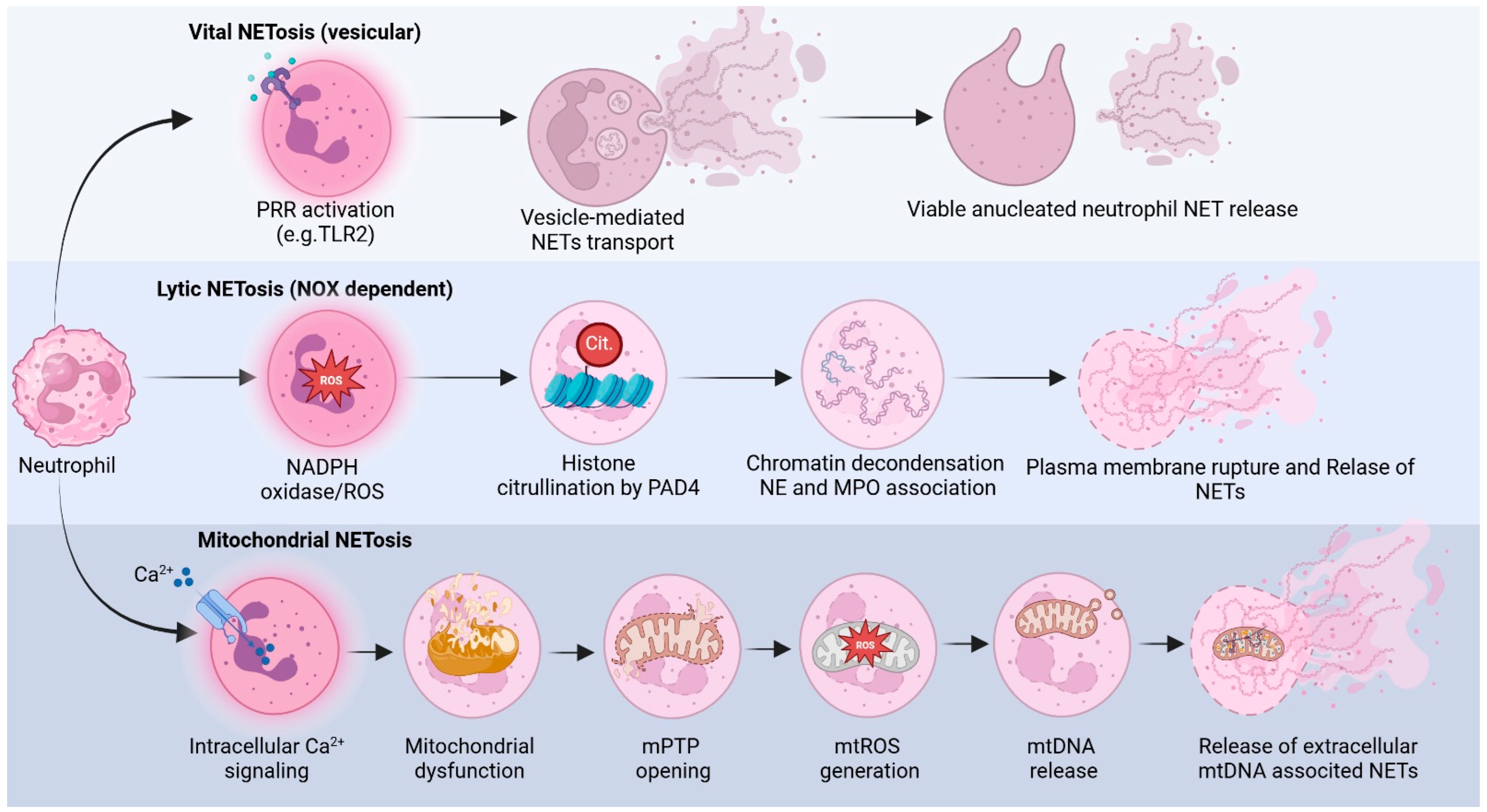
| Feature | Vital (Vesicular) | Suicidal/Lytic (NOX-Dependent) | Mitochondrial (Mito-NETosis) |
|---|---|---|---|
| Prototypical triggers | TLR2/TLR4 PAMPs; S. aureus; low-dose LPS; complement | PMA; sustained LPS; cholesterol crystals; immune complexes; large pathogens (C. albicans hyphae, aggregated bacteria) | GM-CSF priming + C5a or LPS; Ca2+ ionophores; sterile/ischemic stimuli |
| Kinetics | Minutes (rapid) | Hours (slow) | Rapid |
| ROS source | Oxidant-independent (NOX-independent) | NOX-derived ROS | Mitochondrial ROS (NOX-independent) |
| Core signaling | PRR signaling → vesicular chromatin export | NOX → ROS → MAPK → PAD4 citrullination → NE/MPO remodeling | Ca2+ → mitochondrial dysfunction → mPTP opening → mtROS generation → mtDNA release |
| DNA source | Nuclear (vesicle-packaged) | Nuclear (lytic) | Mitochondrial |
| Cell fate | Viable, membrane intact | Lytic cell death | Viable (short-term) |
| Predominant context | Early, rapid antibacterial defense | Strong/persistent or sterile (crystals, immune complexes) inflammation; chronic neuroinflammation | Sterile inflammation, ischemia–reperfusion, metabolic/oxidative stress |
| Disease | NETs Involvement | Mechanisms and Evidence | Consequences for the CNS | References |
|---|---|---|---|---|
| Alzheimer’s disease | Robust evidence of NET involvement | Aβ peptide induces neutrophil adhesion and transmigration via LFA-1 and Mac-1, NETosis, and cytokine release (TNF-α, IL-6, IL-8, IL-1β). NETs correlate with Aβ load and neurofibrillary tangles and generate ROS. Elevated levels of ICAM-1, MPO, and CRP, along with activated neutrophils, are observed. | Aβ fragmentation, exacerbated neuroinflammation, neuronal damage, and cognitive decline. | [5,13,14,40,63,65,66,68,71,90,104] |
| Parkinson’s disease | Suggested involvement is still poorly established | Parkinson’s disease patients present with an elevated neutrophil-to-lymphocyte ratio and higher neutrophil NOS expression, leading to peroxynitrite production that induces the release of dissociated NETs. | Aggravation of inflammation and possible acceleration of dopaminergic degeneration. | [14,40,74,75,76,78,105] |
| Multiple sclerosis | Strong association with pathogenesis | Neutrophil infiltration and cytokine release (IL-1β, IL-6, TNF-α, IFN-γ, IL-17), increasing chemokine production. Resistance to apoptosis and increased NETosis, along with upregulated expression of CXCR1, FPR1, and TLR2. | BBB dysfunction, neuronal death, and demyelination. | [14,40,79,80,81,82,83,84,85,86,87,88,89] |
| Huntington’s disease | The relationship is still incipient and indirect | Increased plasma IL-6, MMP-9, VEGF, and TGF-β1 suggest neutrophil activation. The absence of IL-6 worsens disease in murine models, suggesting a regulatory role for IL-6. | Possible inflammatory contribution, NET role is uncertain. | [14,40,91,92,93] |
| Amyotrophic lateral sclerosis | Significant relationship with disease progression | Formation of the IL-6/sIL-6R complex, derived from neutrophils and monocytes, activates inflammation. NETs contribute to inflammation and muscle damage. Neutrophil infiltration, increased CD16 expression, and a higher neutrophil-to-lymphocyte ratio. | BBB impairment, denervation, muscle atrophy, and progression of motor degeneration. | [14,40,96,97,98,99,100,101,102,103] |
Disclaimer/Publisher’s Note: The statements, opinions and data contained in all publications are solely those of the individual author(s) and contributor(s) and not of MDPI and/or the editor(s). MDPI and/or the editor(s) disclaim responsibility for any injury to people or property resulting from any ideas, methods, instructions or products referred to in the content. |
© 2026 by the authors. Licensee MDPI, Basel, Switzerland. This article is an open access article distributed under the terms and conditions of the Creative Commons Attribution (CC BY) license.
Share and Cite
Costa, I.M.; Kanashiro, A.; Barros, G.S.F.; Monteiro, A.J.; Bonilha, C.S.; Galdino, G.; Veras, F.P. Targeting Neutrophil Extracellular Traps in Neuroinflammation: A Therapeutic Perspective on Neurodegenerative Diseases. Brain Sci. 2026, 16, 792. https://doi.org/10.3390/brainsci16080792
Costa IM, Kanashiro A, Barros GSF, Monteiro AJ, Bonilha CS, Galdino G, Veras FP. Targeting Neutrophil Extracellular Traps in Neuroinflammation: A Therapeutic Perspective on Neurodegenerative Diseases. Brain Sciences. 2026; 16(8):792. https://doi.org/10.3390/brainsci16080792
Chicago/Turabian StyleCosta, Iolanda Masalskiene, Alexandre Kanashiro, Giovanna Siqueira Favi Barros, Ana Julia Monteiro, Caio Santos Bonilha, Giovane Galdino, and Flavio Protasio Veras. 2026. "Targeting Neutrophil Extracellular Traps in Neuroinflammation: A Therapeutic Perspective on Neurodegenerative Diseases" Brain Sciences 16, no. 8: 792. https://doi.org/10.3390/brainsci16080792
APA StyleCosta, I. M., Kanashiro, A., Barros, G. S. F., Monteiro, A. J., Bonilha, C. S., Galdino, G., & Veras, F. P. (2026). Targeting Neutrophil Extracellular Traps in Neuroinflammation: A Therapeutic Perspective on Neurodegenerative Diseases. Brain Sciences, 16(8), 792. https://doi.org/10.3390/brainsci16080792