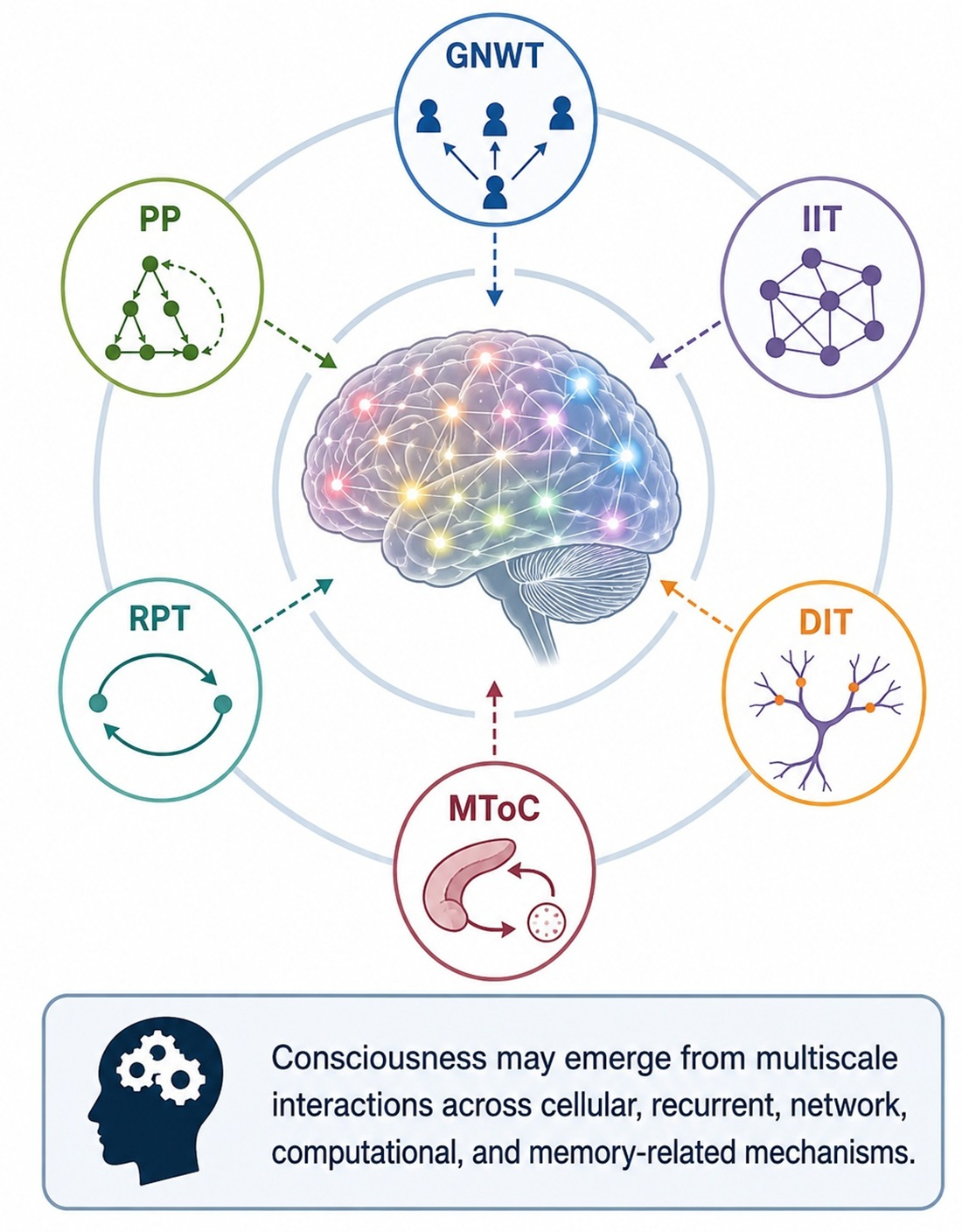
Consciousness in the Brain: An Integrative Review of Contemporary Theories


Abstract
1. Introduction
2. Conceptual Framework and Scope
2.1. Key Terminology in Consciousness Research
2.2. Scope and Organizational Framework of This Review
3. Theoretical Frameworks of Consciousness
3.1. Neurocomputational and Functional Theories of Consciousness
3.2. Philosophical and Non-Physicalist Perspectives on Consciousness
3.3. Science with Incomplete Laws: Consciousness as an Essential but Not Yet Fully Understood Component of Physical Reality
3.4. Field-Based and Other Physical Frameworks
4. Empirical and Clinical Correlates
5. Toward an Integrative Approach
6. Open Questions, Limitations, and Future Directions
6.1. Information Processing, Responsiveness, and Conscious Experience
6.2. From Experience to Access, Decision-Making, and Action
6.3. Is There a Minimum Level of Complexity Required for Consciousness?
6.4. Strengths and Limitations of This Review
6.5. Future Directions
7. Conclusions
Author Contributions
Funding
Data Availability Statement
Acknowledgments
Conflicts of Interest
References
- Overgaard, M. Phenomenal consciousness and cognitive access. Philos. Trans. R. Soc. Lond. Ser. B Biol. Sci. 2018, 373, 20170353. [Google Scholar] [CrossRef] [PubMed]
- Lau, H. What of the Hard Problem? In Consciousness We Trust: The Cognitive Neuroscience of Subjective Experience; Oxford Academic: Oxford, UK, 2022. [Google Scholar] [CrossRef]
- Wagner-Altendorf, T.A. Progress in Understanding Consciousness? Easy and Hard Problems, and Philosophical and Empirical Perspectives. Acta Anal. 2024, 39, 719–736. [Google Scholar] [CrossRef]
- Nani, A.; Manuello, J.; Mancuso, L.; Liloia, D.; Costa, T.; Cauda, F. The Neural Correlates of Consciousness and Attention: Two Sister Processes of the Brain. Front. Neurosci. 2019, 13, 1169. [Google Scholar] [CrossRef] [PubMed]
- Dennett, D.C.; Dennett, D.C. Consciousness Explained; Penguin UK: London, UK, 1993. [Google Scholar]
- Dennett, D.C.; Kinsbourne, M. Time and the observer: The where and when of consciousness in the brain. Behav. Brain Sci. 1992, 15, 183–201. [Google Scholar] [CrossRef]
- Wegner, D.M. Précis of the Illusion of Conscious Will. Behav. Brain Sci. 2017, 27, 649–659. [Google Scholar]
- Chalmers, D.J. Constructing the World; OUP: Oxford, UK, 2012. [Google Scholar]
- Dennett, D.C. Darwin’s Dangerous Idea: Evolution and the Meanins of Life (No. 39); Simon and Schuster: New York, NY, USA, 1996. [Google Scholar]
- Chopra, D. How to Know God: The Soul’s Journey Into the Mystery of Mysteries; Harmony: Seoul, Republic of Korea, 2007. [Google Scholar]
- Kant, I. Critique of Pure Reason; Minerva Heritage Press: London, UK, 2024; Volume 6. [Google Scholar]
- Berkeley, G. Philosophical Works: Including the Works on Vision; J.M. Dent & Sons: London, UK, 1992. [Google Scholar]
- Whitehead, A.N. Process and Reality; Simon and Schuster: New York, NY, USA, 2010. [Google Scholar]
- Whitehead, A.N. Adventures of Ideas; CUP Archive: Cambridge, UK, 1964. [Google Scholar]
- Penrose, R.; Hameroff, S. What ‘gaps’? Reply to Grush and Churchland. J. Conscious. Stud. 1995, 2, 98–111. [Google Scholar]
- Hameroff, S.; Penrose, R. Orchestrated reduction of quantum coherence in brain microtubules: A model for consciousness. Math. Comput. Simul. 1996, 40, 453–480. [Google Scholar] [CrossRef]
- Hameroff, S.R.; Penrose, R. Conscious events as orchestrated space-time selections. J. Conscious. Stud. 1996, 3, 36–53. [Google Scholar]
- Stuart, H. Quantum computation in brain microtubules? The Penrose–Hameroff ‘Orch OR ‘model of consciousness. Philos. Trans. R. Soc. Lond. Ser. A Math. Phys. Eng. Sci. 1998, 356, 1869–1896. [Google Scholar] [CrossRef]
- Hameroff, S.R. The brain is both neurocomputer and quantum computer. Cogn. Sci. 2007, 31, 1035–1045. [Google Scholar] [CrossRef] [PubMed]
- Penrose, R.; Hameroff, S. Consciousness in the universe: Neuroscience, quantum space-time geometry and Orch OR theory. J. Cosmol. 2011, 14, 1–17. [Google Scholar]
- Hameroff, S.R. ‘Funda-Mentality’: Is the conscious mind subtly linked to a basic level of the universe? Trends Cogn. Sci. 1998, 2, 119–124. [Google Scholar] [CrossRef] [PubMed]
- Butlin, P.; Long, R.; Bayne, T.; Bengio, Y.; Birch, J.; Chalmers, D.; Constant, A.; Deane, G.; Elmoznino, E.; Fleming, S.M.; et al. Identifying indicators of consciousness in AI systems. Trends Cogn. Sci. 2025, 30, 488–501. [Google Scholar] [CrossRef] [PubMed]
- Kuhn, R.L. A landscape of consciousness: Toward a taxonomy of explanations and implications. Prog. Biophys. Mol. Biol. 2024, 190, 28–169. [Google Scholar] [CrossRef] [PubMed]
- Percy, C. Can lists of requirements help consciousness research navigate its epistemological quandaries? J. Conscious. Stud. 2025, 32, 191–219. [Google Scholar] [CrossRef]
- Seth, A.K.; Bayne, T. Theories of consciousness. Nat. Rev. Neurosci. 2022, 23, 439–452. [Google Scholar] [CrossRef] [PubMed]
- Mashour, G.A.; Roelfsema, P.; Changeux, J.P.; Dehaene, S. Conscious Processing and the Global Neuronal Workspace Hypothesis. Neuron 2020, 105, 776–798. [Google Scholar] [CrossRef] [PubMed]
- Pitts, M.A.; Martínez, A.; Hillyard, S.A. Visual processing of contour patterns under conditions of inattentional blindness. J. Cogn. Neurosci. 2012, 24, 287–303. [Google Scholar] [CrossRef] [PubMed]
- Pitts, M.A.; Metzler, S.; Hillyard, S.A. Isolating neural correlates of conscious perception from neural correlates of reporting one’s perception. Front. Psychol. 2014, 5, 1078. [Google Scholar] [CrossRef] [PubMed]
- Frässle, S.; Sommer, J.; Jansen, A.; Naber, M.; Einhäuser, W. Binocular rivalry: Frontal activity relates to introspection and action but not to perception. J. Neurosci. 2014, 34, 1738–1747. [Google Scholar] [CrossRef] [PubMed]
- Pitts, M.A.; Padwal, J.; Fennelly, D.; Martínez, A.; Hillyard, S.A. Gamma band activity and the P3 reflect post-perceptual processes, not visual awareness. NeuroImage 2014, 101, 337–350. [Google Scholar] [CrossRef] [PubMed]
- Railo, H.; Koivisto, M.; Revonsuo, A. Tracking the processes behind conscious perception: A review of event-related potential correlates of visual consciousness. Conscious. Cogn. 2011, 20, 972–983. [Google Scholar] [CrossRef] [PubMed]
- Tsuchiya, N.; Wilke, M.; Frässle, S.; Lamme, V.A.F. No-Report Paradigms: Extracting the True Neural Correlates of Consciousness. Trends Cogn. Sci. 2015, 19, 757–770. [Google Scholar] [CrossRef] [PubMed]
- Brown, R.; Lau, H.; LeDoux, J.E. Understanding the Higher-Order Approach to Consciousness. Trends Cogn. Sci. 2019, 23, 754–768. [Google Scholar] [CrossRef] [PubMed]
- Revach, D.; Salti, M. Consciousness as the Temporal Propagation of Information. Front. Syst. Neurosci. 2022, 16, 759683. [Google Scholar] [CrossRef] [PubMed]
- Budson, A.E.; Richman, K.A.; Kensinger, E.A. Consciousness as a Memory System. Cogn. Behav. Neurol. 2022, 35, 263–297. [Google Scholar] [CrossRef] [PubMed]
- Hogendoorn, H. Blurred Lines: Memory, Perceptions, and Consciousness: Commentary on “Consciousness as a Memory System” by Budson et al (2022). Cogn. Behav. Neurol. 2023, 36, 54–58. [Google Scholar] [CrossRef] [PubMed]
- Tononi, G. Consciousness as integrated information: A provisional manifesto. Biol. Bull. 2008, 215, 216–242. [Google Scholar] [CrossRef] [PubMed]
- Tononi, G.; Boly, M.; Massimini, M.; Koch, C. Integrated information theory: From consciousness to its physical substrate. Nat. Rev. Neurosci. 2016, 17, 450–461. [Google Scholar] [CrossRef] [PubMed]
- Ihalainen, R.; Gosseries, O.; de Steen, F.V.; Raimondo, F.; Panda, R.; Bonhomme, V.; Marinazzo, D.; Bowman, H.; Laureys, S.; Chennu, S. How hot is the hot zone? Computational modelling clarifies the role of parietal and frontoparietal connectivity during anaesthetic-induced loss of consciousness. NeuroImage 2021, 231, 117841. [Google Scholar] [CrossRef] [PubMed]
- Siclari, F.; Baird, B.; Perogamvros, L.; Bernardi, G.; LaRocque, J.J.; Riedner, B.; Boly, M.; Postle, B.R.; Tononi, G. The neural correlates of dreaming. Nat. Neurosci. 2017, 20, 872–878. [Google Scholar] [CrossRef] [PubMed]
- Stephen, E.P.; Hotan, G.C.; Pierce, E.T.; Harrell, P.G.; Walsh, J.L.; Brown, E.N.; Purdon, P.L. Broadband slow-wave modulation in posterior and anterior cortex tracks distinct states of propofol-induced unconsciousness. Sci. Rep. 2020, 10, 13701. [Google Scholar] [CrossRef] [PubMed]
- Cogitate Consortium; Ferrante, O.; Gorska-Klimowska, U.; Henin, S.; Hirschhorn, R.; Khalaf, A.; Lepauvre, A.; Liu, L.; Richter, D.; Vidal, Y.; et al. Adversarial testing of global neuronal workspace and integrated information theories of consciousness. Nature 2025, 642, 133–142. [Google Scholar] [CrossRef] [PubMed]
- Naccache, L.; Sergent, C.; Dehaene, S.; Wang, X.-J.; Farisco, M.; Changeux, J.-P. GNW theoretical framework and the “adversarial testing of global neuronal workspace and integrated information theories of consciousness”. Neurosci. Conscious. 2025, 2025, niaf037. [Google Scholar] [CrossRef] [PubMed]
- Yaron, I.; Melloni, L.; Pitts, M.; Mudrik, L. The ConTraSt database for analysing and comparing empirical studies of consciousness theories. Nat. Hum. Behav. 2022, 6, 593–604. [Google Scholar] [CrossRef] [PubMed]
- Michel, M.; Doerig, A. A new empirical challenge for local theories of consciousness. Mind Lang. 2021, 37, 840–855. [Google Scholar] [CrossRef]
- Fazekas, P.; Cleeremans, A.; Overgaard, M. A construct-first approach to consciousness science. Neurosci. Biobehav. Rev. 2024, 156, 105480. [Google Scholar] [CrossRef] [PubMed]
- Lamme, V.A.F. Visual Functions Generating Conscious Seeing. Front. Psychol. 2020, 11, 83. [Google Scholar] [CrossRef] [PubMed]
- Bandara, K.H.; Rowe, E.G.; Garrido, M.I. Computational modelling shows evidence in support of both sensory and frontal theories of consciousness. bioRxiv 2024. [Google Scholar] [CrossRef]
- Auksztulewicz, R.; Spitzer, B.; Blankenburg, F. Recurrent neural processing and somatosensory awareness. J. Neurosci. 2012, 32, 799–805. [Google Scholar] [CrossRef] [PubMed]
- Aru, J.; Suzuki, M.; Larkum, M.E. Cellular Mechanisms of Conscious Processing. Trends Cogn. Sci. 2020, 24, 814–825. [Google Scholar] [CrossRef] [PubMed]
- Munn, B.R.; Müller, E.J.; Aru, J.; Whyte, C.J.; Gidon, A.; Larkum, M.E.; Shine, J.M. A thalamocortical substrate for integrated information via critical synchronous bursting. Proc. Natl. Acad. Sci. USA 2023, 120, e2308670120. [Google Scholar] [CrossRef] [PubMed]
- Pennartz, C.M.A. What is neurorepresentationalism? From neural activity and predictive processing to multi-level representations and consciousness. Behav. Brain Res. 2022, 432, 113969. [Google Scholar] [CrossRef] [PubMed]
- Nikolova, D. Predictive Processing Theory in Mind Studies: Cross Points with 4E Cognition and Cognitive Linguistics. Open J. Philos. 2025, 15, 349–366. [Google Scholar] [CrossRef]
- Laukkonen, R.E.; Slagter, H.A. From many to (n)one: Meditation and the plasticity of the predictive mind. Neurosci. Biobehav. Rev. 2021, 128, 199–217. [Google Scholar] [CrossRef] [PubMed]
- Banaraki, A.K.; Toghi, A.; Mohammadzadeh, A. RDoC Framework Through the Lens of Predictive Processing: Focusing on Cognitive Systems Domain. Comput. Psychiatry 2024, 8, 178–201. [Google Scholar] [CrossRef] [PubMed]
- Lee, K.M.; Ferreira-Santos, F.; Satpute, A.B. Predictive processing models and affective neuroscience. Neurosci. Biobehav. Rev. 2021, 131, 211–228. [Google Scholar] [CrossRef] [PubMed]
- Tsuchiya, N.; Saigo, H. A relational approach to consciousness: Categories of level and contents of consciousness. Neurosci. Conscious. 2021, 2021, niab034. [Google Scholar] [CrossRef] [PubMed]
- Maung, H.H. Dualism and its place in a philosophical structure for psychiatry. Med. Health Care Philos. 2019, 22, 59–69. [Google Scholar] [CrossRef] [PubMed]
- Mehta, N. Mind-body Dualism: A critique from a Health Perspective. Mens. Sana Monogr. 2011, 9, 202–209. [Google Scholar] [CrossRef] [PubMed]
- Eccles, J.C. Dualist-interactionism—My Story. In How the SELF Controls Its BRAIN; Springer: Berlin/Heidelberg, Germany, 1994. [Google Scholar] [CrossRef]
- Georgiev, D.S.; Glazebrook, J.F. The quantum physics of synaptic communication via the SNARE protein complex. Prog. Biophys. Mol. Biol. 2018, 135, 16–29. [Google Scholar] [CrossRef] [PubMed]
- Saad, B. A dualist theory of experience. Philos. Stud. 2025, 182, 939–967. [Google Scholar] [CrossRef] [PubMed]
- Hameroff, S.; Penrose, R. Consciousness in the universe: A review of the ‘Orch OR’ theory. Phys. Life Rev. 2014, 11, 39–78. [Google Scholar] [CrossRef] [PubMed]
- Hameroff, S. Consciousness, the brain, and spacetime geometry. Ann. N. Y. Acad. Sci. 2001, 929, 74–104. [Google Scholar] [CrossRef] [PubMed]
- Arachchige, A.S.P.M. Transitioning from PET/MR to trimodal neuroimaging: Why not cover the temporal dimension with EEG? AIMS Neurosci. 2023, 10, 1–4. [Google Scholar] [CrossRef] [PubMed]
- Hameroff, S. How quantum brain biology can rescue conscious free will. Front. Integr. Neurosci. 2012, 6, 93. [Google Scholar] [CrossRef] [PubMed]
- Hameroff, S. The “conscious pilot”-dendritic synchrony moves through the brain to mediate consciousness. J. Biol. Phys. 2010, 36, 71–93. [Google Scholar] [CrossRef] [PubMed]
- Różyk-Myrta, A.; Brodziak, A.; Muc-Wierzgoń, M. Neural Circuits, Microtubule Processing, Brain’s Electromagnetic Field-Components of Self-Awareness. Brain Sci. 2021, 11, 984. [Google Scholar] [CrossRef] [PubMed]
- Hameroff, S. Consciousness, Cognition and the Neuronal Cytoskeleton—A New Paradigm Needed in Neuroscience. Front. Mol. Neurosci. 2022, 15, 869935. [Google Scholar] [CrossRef] [PubMed]
- MacIver, M.B. Consciousness and inward electromagnetic field interactions. Front. Hum. Neurosci. 2022, 16, 1032339. [Google Scholar] [CrossRef] [PubMed]
- Hales, C.G. The origins of the brain’s endogenous electromagnetic field and its relationship to provision of consciousness. J. Integr. Neurosci. 2014, 13, 313–361. [Google Scholar] [CrossRef] [PubMed]
- Pockett, S. The Electromagnetic Field Theory of Consciousness A Testable Hypothesis about the Characteristics of Conscious as Opposed to Non-conscious Fields. J. Conscious. Stud. 2012, 19, 191–223. [Google Scholar]
- Patel, S.H.; Azzam, P.N. Characterization of N200 and P300: Selected studies of the Event-Related Potential. Int. J. Med. Sci. 2005, 2, 147–154. [Google Scholar] [CrossRef] [PubMed]
- Colombari, E.; Railo, H. Multiple independent components contribute to event-related potential correlates of conscious vision. Conscious. Cogn. 2024, 126, 103785. [Google Scholar] [CrossRef] [PubMed]
- Polich, J. Updating P300: An integrative theory of P3a and P3b. Clin. Neurophysiol. 2007, 118, 2128–2148. [Google Scholar] [CrossRef] [PubMed]
- Dembski, C.; Koch, C.; Pitts, M. Perceptual awareness negativity: A physiological correlate of sensory consciousness. Trends Cogn. Sci. 2021, 25, 660–670. [Google Scholar] [CrossRef] [PubMed]
- Li, R.; Song, W.Q.; Du, J.B.; Huo, S.; Shan, G.X. Connecting the P300 to the diagnosis and prognosis of unconscious patients. Neural Regen. Res. 2015, 10, 473–480. [Google Scholar] [CrossRef] [PubMed]
- Frigato, G. The Neural Correlates of Access Consciousness and Phenomenal Consciousness Seem to Coincide and Would Correspond to a Memory Center, an Activation Center and Eight Parallel Convergence Centers. Front. Psychol. 2021, 12, 749610. [Google Scholar] [CrossRef] [PubMed]
- Arachchige, A.S.P.M. 7-Tesla PET/MRI: A promising tool for multimodal brain imaging? AIMS Neurosci. 2022, 9, 516–518. [Google Scholar] [CrossRef] [PubMed]
- Perera Molligoda Arachchige, A.S. Neuroimaging with PET/MR: Moving beyond 3 T in preclinical systems, when for clinical practice? Clin. Transl. Imaging 2023, 11, 315–319. [Google Scholar] [CrossRef]
- Woodward, M.R.; Wells, C.L.; Arnold, S.; Dorman, F.; Ahmed, Z.; Morris, N.A.; Ciryam, P.; Podell, J.E.; Chang, W.-T.W.; Zimmerman, W.D.; et al. Behavioral Assessment with the Coma Recovery Scale-Revised Is Safe and Feasible in Critically Ill Patients with Disorders of Consciousness. Crit. Care Explor. 2024, 6, e1101. [Google Scholar] [CrossRef] [PubMed]
- Bodien, Y.G.; Katz, D.I.; Schiff, N.D.; Giacino, J.T. Behavioral Assessment of Patients with Disorders of Consciousness. Semin. Neurol. 2022, 42, 249–258. [Google Scholar] [CrossRef] [PubMed]
- Demertzi, A.; Diego Sitt, J.; Sarasso, S.; Pinxten, W. Measuring states of pathological (un)consciousness: Research dimensions, clinical applications, and ethics. Neurosci. Conscious. 2017, 2017, nix010. [Google Scholar] [CrossRef] [PubMed]
- Egawa, S.; Ader, J.; Claassen, J. Recovery of consciousness after acute brain injury: A narrative review. J. Intensive Care 2024, 12, 37. [Google Scholar] [CrossRef] [PubMed]
- Parnia, S.; Keshavarz Shirazi, T.; Patel, J.; Tran, L.; Sinha, N.; O’Neill, C.; Roellke, E.; Mengotto, A.; Findlay, S.; McBrine, M.; et al. AWAreness during REsuscitation—II: A multi-center study of consciousness and awareness in cardiac arrest. Resuscitation 2023, 191, 109903. [Google Scholar] [CrossRef] [PubMed]
- Gidon, A.; Aru, J.; Larkum, M.E. Does neural computation feel like something? Front. Neurosci. 2025, 19, 1511972. [Google Scholar] [CrossRef] [PubMed]
- Pepperell, R. Does Machine Understanding Require Consciousness? Front. Syst. Neurosci. 2022, 16, 788486. [Google Scholar] [CrossRef] [PubMed]
- Reid, C.R. Thoughts from the forest floor: A review of cognition in the slime mould Physarum polycephalum. Anim. Cogn. 2023, 26, 1783–1797. [Google Scholar] [CrossRef] [PubMed]
- Boussard, A.; Fessel, A.; Oettmeier, C.; Briard, L.; Döbereiner, H.G.; Dussutour, A. Adaptive behaviour and learning in slime moulds: The role of oscillations. Philos. Trans. R. Soc. Lond. Ser. B Biol. Sci. 2021, 376, 20190757. [Google Scholar] [CrossRef] [PubMed]
- Aparicio-Terrés, R.; López-Mochales, S.; Díaz-Andreu, M.; Escera, C. The neurobiology of altered states of consciousness induced by drumming and other rhythmic sound patterns. Ann. N. Y. Acad. Sci. 2025, 1550, 55–70. [Google Scholar] [CrossRef] [PubMed]
- Timmermann, C.; Roseman, L.; Williams, L.; Erritzoe, D.; Martial, C.; Cassol, H.; Laureys, S.; Nutt, D.; Carhart-Harris, R. DMT Models the Near-Death Experience. Front. Psychol. 2018, 9, 1424. [Google Scholar] [CrossRef] [PubMed]
- Arendt, J.; Aulinas, A. Physiology of the Pineal Gland and Melatonin. In Endotext; Feingold, K.R., Ed.; MDText.com, Inc.: Portland, OR, USA, 2022. [Google Scholar]
- Nichols, D.E. N,N-dimethyltryptamine and the pineal gland: Separating fact from myth. J. Psychopharmacol. 2017, 32, 30–36. [Google Scholar] [CrossRef] [PubMed]

| Term | Operational Definition Used in This Review | Important Distinction |
|---|---|---|
| Consciousness | Broad presence of subjective experience | Umbrella concept; exact boundaries remain disputed |
| Phenomenal consciousness | Qualitative first-person character of experience; what an experience feels like | Does not necessarily require reportability or explicit self-reflection |
| Access consciousness | Information available for reasoning, report, decision-making, and voluntary behavior | May involve global availability without resolving why subjective experience occurs |
| Awareness | Context-dependent detection or experience of internal or external stimuli | Used inconsistently in the literature; not always equivalent to consciousness |
| Subjective experience | First-person experiential character of a mental state | Closely overlaps with phenomenal consciousness |
| Self-consciousness | Awareness or representation of oneself as the subject of experience | Not necessarily intrinsic to every conscious experience |
| Neural correlates of consciousness | Minimal neural mechanisms jointly sufficient for a particular conscious experience or conscious state | Correlation alone does not establish a complete causal explanation of consciousness |
| Framework | Primary Explanatory Level | Principal Focus | Empirical Status | Main Manuscript Section |
|---|---|---|---|---|
| GNWT | Large-scale network | Access and global broadcasting | Strong empirical engagement | 3.1 |
| HOT | Higher-order cognitive | Meta-representation | Moderate/debated | 3.1 |
| RPT | Local recurrent network | Phenomenal consciousness | Strong empirical engagement | 3.1 |
| MToC | Memory systems | Temporal reconstruction and memory | Moderate/emerging | 3.1 |
| IIT | Information-theoretical/system | Integrated experience | Moderate and debated | 3.1 |
| DIT | Cellular | Dendritic integration | Emerging | 3.1 |
| PP | Computational | Prediction and generative models | Strong framework; consciousness-specific claims debated | 3.1 |
| Field-based theories | Physical field | Integration/unification through endogenous fields | Speculative/emerging | 3.4 |
| Orch-OR | Quantum/physical | Quantum state reduction | Highly speculative | 3.3 |
| Dualism/ panpsychism | Philosophical/ontological | Nature of mind and experience | Philosophical/metaphysical | 3.2 |
| Theory | Primary Focus | Neural Substrate | Consciousness Type | Empirical Markers | Empirical Evidence/Challenges |
|---|---|---|---|---|---|
| GNWT (Global Neuronal Workspace Theory) | Access | Frontoparietal cortex | Access consciousness | P3b, fMRI ignition | Partial support; limited evidence for sustained “ignition” at stimulus offset; prefrontal involvement debated [85] |
| IIT (Integrated Information Theory) | Phenomenal | Posterior hot zone | Phenomenal consciousness | PCI, Φ (Phi) estimates | Challenged posterior connectivity predictions; lack of consistent evidence for sustained integration patterns [85] |
| RPT (Recurrent Processing Theory) | Phenomenal | Visual cortex | Phenomenal consciousness | VAN, local recurrence | Not directly tested in COGITATE; supported by evidence for recurrent processing in perception |
| DIT (Dendritic Integration Theory) | Micro-scale integration | Layer 5 pyramidal neurons | Mixed (phenomenal & access) | Dendritic spikes (theoretical) | Largely theoretical; limited direct empirical validation |
| PP (Predictive Processing) | Computational modeling | Hierarchical neural networks | Both phenomenal & access | Prediction errors, precision-weighting | Not directly tested in COGITATE; supported by computational and behavioral evidence |
| HOT (Higher-Order Theories) | Meta-awareness | Prefrontal cortex | Access consciousness | Metacognition, confidence ratings | Empirical support debated; challenges regarding the necessity of higher-order representations |
| MToC (Memory Theory of Consciousness) | Reconstructed memory | Hippocampus, related cortex | Phenomenal consciousness | Postdictive effects, amnesia patterns | Critiqued for potential conflation of memory and consciousness |
Disclaimer/Publisher’s Note: The statements, opinions and data contained in all publications are solely those of the individual author(s) and contributor(s) and not of MDPI and/or the editor(s). MDPI and/or the editor(s) disclaim responsibility for any injury to people or property resulting from any ideas, methods, instructions or products referred to in the content. |
© 2026 by the authors. Licensee MDPI, Basel, Switzerland. This article is an open access article distributed under the terms and conditions of the Creative Commons Attribution (CC BY) license.
Share and Cite
Perera Molligoda Arachchige, A.S.; Svet, A.; Svet, M. Consciousness in the Brain: An Integrative Review of Contemporary Theories. Brain Sci. 2026, 16, 745. https://doi.org/10.3390/brainsci16070745
Perera Molligoda Arachchige AS, Svet A, Svet M. Consciousness in the Brain: An Integrative Review of Contemporary Theories. Brain Sciences. 2026; 16(7):745. https://doi.org/10.3390/brainsci16070745
Chicago/Turabian StylePerera Molligoda Arachchige, Arosh S., Afanasy Svet, and Maria Svet. 2026. "Consciousness in the Brain: An Integrative Review of Contemporary Theories" Brain Sciences 16, no. 7: 745. https://doi.org/10.3390/brainsci16070745
APA StylePerera Molligoda Arachchige, A. S., Svet, A., & Svet, M. (2026). Consciousness in the Brain: An Integrative Review of Contemporary Theories. Brain Sciences, 16(7), 745. https://doi.org/10.3390/brainsci16070745