This is an early access version, the complete PDF, HTML, and XML versions will be available soon.
Open AccessArticle
Activation of mGlu2 Receptors Rescues Persistent Post-Methamphetamine Deficit in Object-in-Place Recognition Memory
by
Viktoria Galbava
 Viktoria Galbava
Lizhen Wu
Lizhen Wu
Marek Schwendt
Marek Schwendt 
1
Department of Psychology, University of Florida, Gainesville, FL 32611, USA
2
Center for Addiction Research and Education (CARE), University of Florida, Gainesville, FL 32610, USA
*
Author to whom correspondence should be addressed.
Brain Sci. 2026, 16(7), 682; https://doi.org/10.3390/brainsci16070682 (registering DOI)
Submission received: 13 May 2026
/
Revised: 21 June 2026
/
Accepted: 22 June 2026
/
Published: 28 June 2026
Abstract
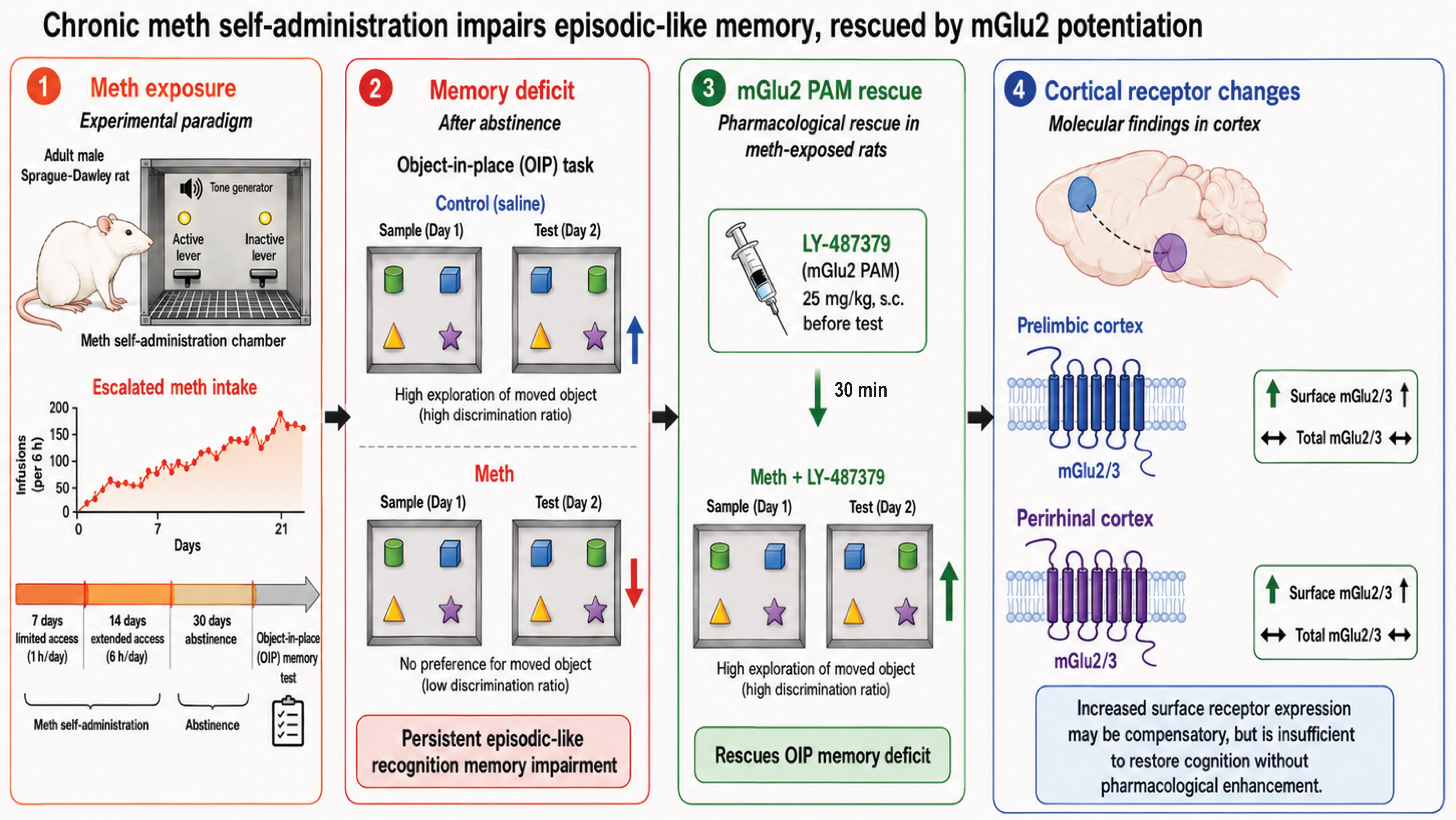
Background/Objectives: Persistent cognitive impairments are prevalent in methamphetamine (meth) use disorder and contribute to maladaptive decision-making and increased relapse vulnerability. There are currently no effective treatments for meth-associative cognitive deficits, and their neurobiological underpinnings remain incompletely understood. This study investigated the effects of chronic meth self-administration on episodic-like recognition memory and evaluated whether pharmacological potentiation of metabotropic glutamate receptor subtype 2 (mGlu2) could rescue these deficits. Methods: Adult male Long–Evans rats underwent 7 days of limited- (1 h/day) followed by 14 days of extended-access (6 h/day) meth self-administration, followed by 30 days of abstinence. Recognition memory was assessed using the object-in-place (OIP) task. A positive allosteric modulator of mGlu2 receptors, LY-487379 (25 mg/kg, s.c.), was administered prior to the memory test. In parallel, changes in total and surface mGlu2/3 protein levels in the prelimbic and perirhinal cortices were evaluated. Results: Rats with extended access to meth self-administration exhibited escalated drug intake and persistent deficits in OIP memory. Administration of LY-487379 acutely rescued this deficit. Total mGlu2/3 protein levels were unaltered; however, meth exposure was associated with a significant increase in surface mGlu2/3 receptor expression in both cortical regions examined. Conclusions: These results demonstrate that chronic meth produces persistent cognitive dysfunction that can be rescued by mGlu2 receptor potentiation. The observed increase in surface mGlu2/3 expression may represent a compensatory response to chronic glutamatergic dysregulation, but it appears to be insufficient to restore cognitive function alone, without pharmacological enhancement. The current data encourage further exploration of mGlu2’s role in stimulant-associated cognitive dysfunction.
Share and Cite
MDPI and ACS Style
Galbava, V.; Wu, L.; Schwendt, M.
Activation of mGlu2 Receptors Rescues Persistent Post-Methamphetamine Deficit in Object-in-Place Recognition Memory. Brain Sci. 2026, 16, 682.
https://doi.org/10.3390/brainsci16070682
AMA Style
Galbava V, Wu L, Schwendt M.
Activation of mGlu2 Receptors Rescues Persistent Post-Methamphetamine Deficit in Object-in-Place Recognition Memory. Brain Sciences. 2026; 16(7):682.
https://doi.org/10.3390/brainsci16070682
Chicago/Turabian Style
Galbava, Viktoria, Lizhen Wu, and Marek Schwendt.
2026. "Activation of mGlu2 Receptors Rescues Persistent Post-Methamphetamine Deficit in Object-in-Place Recognition Memory" Brain Sciences 16, no. 7: 682.
https://doi.org/10.3390/brainsci16070682
APA Style
Galbava, V., Wu, L., & Schwendt, M.
(2026). Activation of mGlu2 Receptors Rescues Persistent Post-Methamphetamine Deficit in Object-in-Place Recognition Memory. Brain Sciences, 16(7), 682.
https://doi.org/10.3390/brainsci16070682
Note that from the first issue of 2016, this journal uses article numbers instead of page numbers. See further details
here.
Article Metrics
Article Access Statistics
For more information on the journal statistics, click
here.
Multiple requests from the same IP address are counted as one view.