A Transdiagnostic Comparison of Emotional Regulation, Executive Functions, and Empathy in Three Groups of Female Adolescents: With Anorexia Nervosa, Attention Deficit Hyperactivity Disorder, and Comorbid Attention Deficit Hyperactivity Disorder and Autism Spectrum Disorder


 , , , , , , and
Abstract
1. Introduction
2. Materials and Methods
2.1. Participants
2.2. Measures
2.2.1. Clinician-Rated Scales
2.2.2. Self-Rated Questionnaires and Task Administered to Patients
2.2.3. Parent-Rated Questionnaires
2.3. Assessment Procedures
2.4. Statistical Analyses
3. Results
3.1. Demographic and Cognitive Profiles
3.2. Associated Psychopathology and Clinical Features
4. Discussion
5. Conclusions
Author Contributions
Funding
Institutional Review Board Statement
Informed Consent Statement
Data Availability Statement
Acknowledgments
Conflicts of Interest
References
- American Psychiatric Association. Diagnostic and Statistical Manual of Mental Disorders, 5th ed.; Text Rev.; American Psychiatric Publishing: Washington, DC, USA, 2022. [Google Scholar]
- Berends, T.; Boonstra, N.; van Elburg, A. Relapse in anorexia nervosa: A systematic review and meta-analysis. Curr. Opin. Psychiatry 2018, 31, 445–455. [Google Scholar] [CrossRef] [Scilit] [PubMed]
- Herpertz-Dahlmann, B. Adolescent eating disorders: Update on definitions, symptomatology, epidemiology, and comorbidity. Child Adolesc. Psychiatr. Clin. N. Am. 2015, 24, 177–196. [Google Scholar] [CrossRef] [Scilit] [PubMed]
- Herpertz-Dahlmann, B.; Dahmen, B. Children in Need-Diagnostics, Epidemiology, Treatment and Outcome of Early Onset Anorexia Nervosa. Nutrients 2019, 11, 1932. [Google Scholar] [CrossRef] [Scilit] [PubMed]
- Barkley, R.A. (Ed.) Attention-Deficit Hyperactivity Disorder: A Handbook for Diagnosis and Treatment, 4th ed.; Guilford Press: New York, NY, USA, 2015. [Google Scholar]
- Rosenthal, E.A.; Broos, H.C.; Timpano, K.R.; Johnson, S.L. Does Emotion-Related Impulsivity Relate to Specific ADHD Symptom Dimensions, and Do the Effects Generalize Across Comorbid Internalizing and Externalizing Syndromes? J. Atten. Disord. 2024, 28, 178–188. [Google Scholar] [CrossRef] [Scilit] [PubMed]
- Lecavalier, L.; Leone, S.; Wiltz, J. The impact of behaviour problems on caregiver stress in young people with autism spectrum disorders. J. Intellect. Disabil. Res. 2006, 50, 172–183. [Google Scholar] [CrossRef] [Scilit] [PubMed]
- Postorino, V.; Mazzone, L.; Reaven, J. Editorial: Internalizing disorders in individuals with autism spectrum disorder. Front. Psychiatry 2023, 13, 1112633. [Google Scholar] [CrossRef] [Scilit] [PubMed]
- Banaschewski, T.; Becker, K.; Dopfner, M.; Holtmann, M.; Rosler, M.; Romanos, M. Attention-deficit/hyperactivity disorder. Dtsch. Arztebl. Int. 2017, 114, 149–159. [Google Scholar] [CrossRef] [Scilit] [PubMed]
- Brugha, T.; Cooper, S.A.; McManus, S.; Purdon, S.; Smith, J.; Scott, F.J.; Spiers, N.; Tyrer, F. Estimating the Prevalence of Autism Spectrum Conditions in Adults: Extending the 2007 Adult Psychiatric Morbidity Survey; NHS Information Centre for Health and Social Care: Leeds, UK, 2012. [Google Scholar]
- Mandy, W.; Chilvers, R.; Chowdhury, U.; Salter, G.; Seigal, A.; Skuse, D. Sex differences in autism spectrum disorder: Evidence from a large sample. J. Autism Dev. Disord. 2012, 42, 1304–1313. [Google Scholar] [CrossRef] [Scilit] [PubMed]
- Lai, M.C.; Szatmari, P. Sex and gender impacts on the behavioural presentation and recognition of autism. Curr. Opin. Psychiatry 2020, 33, 117–123. [Google Scholar] [CrossRef] [Scilit] [PubMed]
- Hull, L.; Petrides, K.V.; Mandy, W. The female autism phenotype and camouflaging: A narrative review. Rev. J. Autism Dev. Disord. 2020, 7, 306–317. [Google Scholar] [CrossRef] [Scilit]
- Young, S.; Uysal, O.; Kahle, J.; Gudjonsson, G.H.; Hollingdale, J.; Cortese, S.; Sakalli-Kani, A.; Greer, B.; Cocallis, K.; Sylver, N.; et al. A systematic review and meta-analysis comparing the severity of core symptoms of attention-deficit/hyperactivity disorder in females and males. Psychol. Med. 2024, 54, 3763–3784. [Google Scholar] [CrossRef] [Scilit] [PubMed]
- Narzisi, A.; Barbetti, F.; Fabbri-Destro, M.; Berloffa, S.; Fantozzi, P.; Viglione, V.; Muccio, R.; Valente, E.; Accorinti, I.; Foti, E.; et al. Cognitive and emotional profiles in children with ASD, ADHD, and comorbid presentations: Evidence for a distinct clinical phenotype. Front. Psychiatry 2026, 17, 1765698. [Google Scholar] [CrossRef] [Scilit] [PubMed]
- Micai, M.; Fatta, L.M.; Gila, L.; Caruso, A.; Salvitti, T.; Fulceri, F.; Ciaramella, A.; D’Amico, R.; Del Giovane, C.; Bertelli, M.; et al. Prevalence of co-occurring conditions in children and adults with autism spectrum disorder: A systematic review and meta-analysis. Neurosci. Biobehav. Rev. 2023, 155, 105436. [Google Scholar] [CrossRef] [Scilit] [PubMed]
- Sheppes, G.; Scheibe, S.; Suri, G.; Gross, J.J. Emotion-regulation choice. Psychol. Sci. 2011, 22, 1391–1396. [Google Scholar] [CrossRef] [Scilit] [PubMed]
- Sheppes, G.; Suri, G.; Gross, J.J. Emotion regulation and psychopathology. Annu. Rev. Clin. Psychol. 2015, 11, 379–405. [Google Scholar] [CrossRef] [Scilit] [PubMed]
- McRae, K.; Gross, J.J. Emotion regulation. Emotion 2020, 20, 1–9. [Google Scholar] [CrossRef] [Scilit] [PubMed]
- Wozniak, J.; Biederman, J.; Kiely, K.; Ablon, J.S.; Faraone, S.V.; Mundy, E.; Mennin, D. Mania-like symptoms suggestive of childhood-onset bipolar disorder in clinically referred children. J. Am. Acad. Child Adolesc. Psychiatry 1995, 34, 867–876. [Google Scholar] [CrossRef] [Scilit] [PubMed]
- Faraone, S.V.; Rostain, A.L.; Blader, J.; Busch, B.; Childress, A.C.; Connor, D.F.; Newcorn, J.H. Practitioner Review: Emotional dysregulation in attention-deficit/hyperactivity disorder—Implications for clinical recognition and intervention. J. Child Psychol. Psychiatry 2019, 60, 133–150. [Google Scholar] [CrossRef] [Scilit] [PubMed]
- Salazar de Pablo, G.; Jordá, C.P.; Vaquerizo-Serrano, J.; Moreno, C.; Cabras, A.; Arango, C.; Hernández, P.; Veenstra-VanderWeele, J.; Simonoff, E.; Fusar-Poli, P.; et al. Systematic review and meta-analysis: Efficacy of pharmacological interventions for irritability and emotional dysregulation in autism spectrum disorder and predictors of response. J. Am. Acad. Child Adolesc. Psychiatry 2023, 62, 151–168. [Google Scholar] [CrossRef] [Scilit] [PubMed]
- Pamela, F.; Chiara, C.; Francesca, D.; Fabio, A.; Vittorio, B.; Raffaella, T.; Valentina, L.; Sara, C. Anorexia nervosa and emotional dysregulation: A longitudinal study on the characteristics and clinical implications in a group of female adolescents. Children 2026, 13, 402. [Google Scholar] [CrossRef] [Scilit] [PubMed]
- Lavender, J.M.; Wonderlich, S.A.; Engel, S.G.; Gordon, K.H.; Kaye, W.H.; Mitchell, J.E. Dimensions of emotion dysregulation in anorexia nervosa and bulimia nervosa: A conceptual review of the empirical literature. Clin. Psychol. Rev. 2015, 40, 111–122. [Google Scholar] [CrossRef] [Scilit] [PubMed]
- Blair, R.J.R. Fine cuts of empathy and the amygdala: Dissociable deficits in psychopathy and autism. Q. J. Exp. Psychol. 2008, 61, 157–170. [Google Scholar] [CrossRef] [Scilit] [PubMed]
- de Waal, F.B.M. Putting the altruism back into altruism: The evolution of empathy. Annu. Rev. Psychol. 2008, 59, 279–300. [Google Scholar] [CrossRef] [Scilit] [PubMed]
- Davis, M.H. Measuring individual differences in empathy: Evidence for a multidimensional approach. J. Personal. Soc. Psychol. 1983, 44, 113–126. [Google Scholar] [CrossRef]
- Decety, J.; Moriguchi, Y. The empathic brain and its dysfunction in psychiatric populations: Implications for intervention across different clinical conditions. Biopsychosoc. Med. 2007, 1, 22. [Google Scholar] [CrossRef] [Scilit] [PubMed]
- Decety, J.; Jackson, P.L. The functional architecture of human empathy. Behav. Cogn. Neurosci. Rev. 2004, 3, 71–100. [Google Scholar] [CrossRef] [Scilit] [PubMed]
- Preston, S.D.; de Waal, F.B.M. Empathy: Its ultimate and proximate bases. Behav. Brain Sci. 2002, 25, 1–20; discussion 20–71. [Google Scholar] [CrossRef] [Scilit] [PubMed]
- Decety, J.; Skelly, L.R.; Kiehl, K.A. Brain response to empathy-eliciting scenarios involving pain in incarcerated individuals with psychopathy. JAMA Psychiatry 2013, 70, 638–645. [Google Scholar] [CrossRef] [Scilit] [PubMed]
- Cordier, R.; Bundy, A.; Hocking, C.; Einfeld, S. Empathy in the play of children with attention deficit hyperactivity disorder. OTJR Occup. Ther. J. Res. 2010, 30, 122–132. [Google Scholar] [CrossRef] [Scilit]
- Bora, E.; Pantelis, C. Meta-analysis of social cognition in attention-deficit/hyperactivity disorder (ADHD): Comparison with healthy controls and autistic spectrum disorder. Psychol. Med. 2016, 46, 699–716. [Google Scholar] [CrossRef] [Scilit] [PubMed]
- Fantozzi, P.; Sesso, G.; Muratori, P.; Milone, A.; Masi, G. Biological bases of empathy and social cognition in patients with attention-deficit/hyperactivity disorder: A focus on treatment with psychostimulants. Brain Sci. 2021, 11, 1399. [Google Scholar] [CrossRef] [Scilit] [PubMed]
- Marton, I.; Wiener, J.; Rogers, M.; Moore, C.; Tannock, R. Empathy and social perspective taking in children with attention-deficit/hyperactivity disorder. J. Abnorm. Child Psychol. 2009, 37, 107–118. [Google Scholar] [CrossRef] [Scilit] [PubMed]
- Maoz, H.; Gvirts, H.Z.; Sheffer, M.; Bloch, Y. Theory of mind and empathy in children with ADHD. J. Atten. Disord. 2019, 23, 1331–1338. [Google Scholar] [CrossRef] [Scilit] [PubMed]
- Blair, R.J.R. Responding to the emotions of others: Dissociating forms of empathy through the study of typical and psychiatric populations. Conscious. Cogn. 2005, 14, 698–718. [Google Scholar] [CrossRef] [Scilit] [PubMed]
- Gillberg, C.L. The Emanuel Miller Memorial Lecture 1991. Autism and autistic-like conditions: Subclasses among disorders of empathy. J. Child Psychol. Psychiatry 1992, 33, 813–842. [Google Scholar] [CrossRef] [Scilit] [PubMed]
- Preti, A.; Vellante, M.; Baron-Cohen, S.; Zucca, G.; Petretto, D.R.; Masala, C. The Empathy Quotient: A cross-cultural comparison of the Italian version. Cogn. Neuropsychiatry 2011, 16, 50–70. [Google Scholar] [CrossRef] [Scilit] [PubMed]
- Kerr-Gaffney, J.; Harrison, A.; Tchanturia, K. Cognitive and affective empathy in eating disorders: A systematic review and meta-analysis. Front. Psychiatry 2019, 10, 102. [Google Scholar] [CrossRef] [Scilit] [PubMed]
- Yan, Z.; Hong, S.; Liu, F.; Su, Y. A meta-analysis of the relationship between empathy and executive function. PsyCh J. 2020, 9, 34–43. [Google Scholar] [CrossRef] [Scilit] [PubMed]
- Nickel, K.; Maier, S.; Endres, D.; Joos, A.; Maier, V.; van Elst, L.T.; Zeeck, A. Systematic review: Overlap between eating, autism spectrum, and attention-deficit/hyperactivity disorder. Front. Psychiatry 2019, 10, 708. [Google Scholar] [CrossRef] [Scilit] [PubMed]
- Cortese, S.; Aoki, Y.Y.; Itahashi, T.; Castellanos, F.X.; Eickhoff, S.B. Systematic review and meta-analysis: Resting-state functional MRI studies of ADHD. J. Am. Acad. Child Adolesc. Psychiatry 2021, 60, 61–75. [Google Scholar] [CrossRef] [Scilit] [PubMed]
- Westwood, H.; Stahl, D.; Mandy, W.; Tchanturia, K. The set-shifting profiles of anorexia nervosa and autism spectrum disorder using the Wisconsin Card Sorting Test: A systematic review and meta-analysis. Psychol. Med. 2016, 46, 1809–1827. [Google Scholar] [CrossRef] [Scilit] [PubMed]
- Antshel, K.M.; Russo, N. Autism spectrum disorders and ADHD: Overlapping phenomenology, diagnostic issues, and treatment considerations. Curr. Psychiatry Rep. 2019, 21, 34. [Google Scholar] [CrossRef] [Scilit] [PubMed]
- Westwood, H.; Tchanturia, K. Autism spectrum disorder in anorexia nervosa: An updated literature review. Curr. Psychiatry Rep. 2017, 19, 41. [Google Scholar] [CrossRef] [Scilit] [PubMed]
- Kerr-Gaffney, J.; Hayward, H.; Jones, E.J.H.; Halls, D.; Murphy, D.; Tchanturia, K. Autism symptoms in anorexia nervosa: A comparative study with females with autism spectrum disorder. Mol. Autism. 2021, 12, 47. [Google Scholar] [CrossRef] [Scilit] [PubMed]
- Huke, V.; Turk, J.; Saeidi, S.; Kent, A.; Morgan, J.F. Autism spectrum disorders in eating disorder populations: A systematic review. Eur. Eat. Disord. Rev. 2013, 21, 345–351. [Google Scholar] [CrossRef] [Scilit] [PubMed]
- Nazar, B.P.; Bernardes, C.; Peachey, G.; Sergeant, J.; Mattos, P.; Treasure, J. The risk of eating disorders comorbid with attention-deficit/hyperactivity disorder: A systematic review and meta-analysis. Int. J. Eat. Disord. 2016, 49, 1045–1057. [Google Scholar] [CrossRef] [Scilit] [PubMed]
- Adams, K.L.; Mandy, W.; Catmur, C.; Bird, G. Potential mechanisms underlying the association between feeding and eating disorders and autism. Neurosci. Biobehav. Rev. 2024, 162, 105717. [Google Scholar] [CrossRef] [Scilit] [PubMed]
- Inal-Kaleli, I.; Dogan, N.; Kose, S.; Bora, E. Investigating the presence of autistic traits and prevalence of autism spectrum disorder symptoms in anorexia nervosa: A systematic review and meta-analysis. Int. J. Eat. Disord. 2025, 58, 66–90. [Google Scholar] [CrossRef] [Scilit] [PubMed]
- Leppanen, J.; Sedgewick, F.; Treasure, J.; Tchanturia, K. Differences in the theory of mind profiles of patients with anorexia nervosa and individuals on the autism spectrum: A meta-analytic review. Neurosci. Biobehav. Rev. 2018, 90, 146–163. [Google Scholar] [CrossRef] [Scilit] [PubMed]
- Boltri, M.; Sapuppo, W. Anorexia nervosa and autism spectrum disorder: A systematic review. Psychiatry Res. 2021, 306, 114271. [Google Scholar] [CrossRef] [Scilit] [PubMed]
- Ghiotto, C.; Silva, C.; Charvin, I.; Atzori, P.; Givaudan, M.; Da Fonseca, D.; Bat-Pitault, F. Comparing executive functions profiles in anorexia nervosa and autism spectrum disorder in adolescence. Eur. Eat. Disord. Rev. 2022, 30, 474–485. [Google Scholar] [CrossRef] [Scilit] [PubMed]
- Kerr-Gaffney, J.; Mason, L.; Jones, E.; Hayward, H.; Ahmad, J.; Harrison, A.; Loth, E.; Murphy, D.; Tchanturia, K. Emotion recognition abilities in adults with anorexia nervosa are associated with autistic traits. J. Clin. Med. 2020, 9, 1057. [Google Scholar] [CrossRef] [Scilit] [PubMed]
- Calderoni, S.; Fantozzi, P.; Maestro, S.; Brunori, E.; Narzisi, A.; Balboni, G.; Muratori, F. Selective cognitive empathy deficit in adolescents with restrictive anorexia nervosa. Neuropsychiatr. Dis. Treat. 2013, 9, 1583–1589. [Google Scholar] [CrossRef] [Scilit] [PubMed]
- Kerr-Gaffney, J.; Harrison, A.; Tchanturia, K. Autism spectrum disorder traits are associated with empathic abilities in adults with anorexia nervosa. J. Affect. Disord. 2020, 266, 273–281. [Google Scholar] [CrossRef] [Scilit] [PubMed]
- Fantozzi, P.; Billeci, L.; Muratori, P.; Maestro, S.; Muratori, F.; Chakrabarti, B.; Calderoni, S. Autistic traits and perspective taking in youths with anorexia nervosa: An exploratory clinical and eye tracking study. J. Eat. Disord. 2024, 12, 116. [Google Scholar] [CrossRef] [Scilit] [PubMed]
- Kaufman, J.; Birmaher, B.; Brent, D.; Rao, U.; Flynn, C.; Moreci, P.; Williamson, D.; Ryan, N. Schedule for Affective Disorders and Schizophrenia for School-Age Children-Present and Lifetime Version (K-SADS-PL): Initial reliability and validity data. J. Am. Acad. Child Adolesc. Psychiatry 1997, 36, 980–988. [Google Scholar] [CrossRef] [Scilit] [PubMed]
- Wechsler, D. Wechsler Intelligence Scale for Children-Fourth Edition (WISC-IV): Technical and Interpretive Manual; Psychological Corporation: San Antonio, TX, USA, 2003. [Google Scholar]
- Orsini, A.; Pezzuti, L. WISC-IV: Wechsler Intelligence Scale for Children-Fourth Edition, Italian Adaptation Manual; Giunti O.S.: Florence, Italy, 2013. [Google Scholar]
- Wechsler, D. Wechsler Adult Intelligence Scale-Fourth Edition (WAIS-IV): Administration and Scoring Manual; Pearson: London, UK, 2008. [Google Scholar]
- Sesso, G.; Mazzullo, C.; Valente, E.; Ditaranto, F.; Fantozzi, P.; Belmonti, V.; Berloffa, S.; Placini, F.; Tancredi, R.; Masi, G.; et al. Non-Suicidal Self-Injury in Eating and Feeding Disorder Patients: Characteristics and Clinical Implications in a Group of Referred Female Adolescents. Children 2024, 11, 947. [Google Scholar] [CrossRef] [Scilit] [PubMed]
- Guy, W. Clinical Global Impressions. In ECDEU Assessment Manual for Psychopharmacology; US Department of Health, Education, and Welfare: Washington, DC, USA, 1976; pp. 218–222. [Google Scholar]
- Shaffer, D.; Gould, M.S.; Brasic, J.; Ambrosini, P.; Fisher, P.; Bird, H.; Aluwahlia, S. A children’s global assessment scale (CGAS). Arch. Gen. Psychiatry 1983, 40, 1228–1231. [Google Scholar] [CrossRef] [Scilit] [PubMed]
- Garner, D.M.; Olmsted, M.P.; Bohr, Y.; Garfinkel, P.E. The eating attitudes test: Psychometric features and clinical correlates. Psychol. Med. 1982, 12, 871–878. [Google Scholar] [CrossRef] [Scilit] [PubMed]
- Achenbach, T.M.; Rescorla, L.A. Manual for the ASEBA School-Age Forms & Profiles; University of Vermont, Research Center for Children, Youth, and Families: Burlington, VT, USA, 2001. [Google Scholar]
- Althoff, R.R.; Verhulst, F.C.; Rettew, D.C.; Hudziak, J.J.; van der Ende, J. Adult outcomes of childhood dysregulation: A 14-year follow-up study. J. Am. Acad. Child Adolesc. Psychiatry 2010, 49, 1105–1116. [Google Scholar] [CrossRef] [Scilit] [PubMed]
- Gioia, G.A.; Isquith, P.K.; Guy, S.C.; Kenworthy, L. Behavior Rating Inventory of Executive Function, Second Edition (BRIEF-2) Professional Manual; Psychological Assessment Resources: Lutz, FL, USA, 2015. [Google Scholar]
- Brancati, G.E.; Perugi, G. RIPoSt-Regolazione e Intensità della Postura Sociale e Temperamentale; Edizioni ETS: Pisa, Italy, 2019. [Google Scholar]
- Pisano, S.; Senese, V.P.; Bravaccio, C.; Santangelo, P.; Milone, A.; Masi, G.; Catone, G. Cyclothymic-hypersensitive temperament in youths: Refining the structure, the way of assessment and the clinical significance in the youth population. J. Affect. Disord. 2020, 271, 272–278. [Google Scholar] [CrossRef] [Scilit] [PubMed]
- Pisano, S.; Sesso, G.; Senese, V.P.; Catone, G.; Milone, A.; Masi, G. The assessment of cyclothymic-hypersensitive temperament in youth with mood disorders and attention deficit hyperactivity disorder. J. Affect. Disord. 2022, 298, 322–328. [Google Scholar] [CrossRef] [Scilit] [PubMed]
- Albiero, P.; Ingoglia, S.; Lo Coco, A. Contributo all’adattamento italiano dell’Interpersonal Reactivity Index di Davis. TPM Test. Psicometria Metodol. 2006, 13, 107–125. [Google Scholar]
- Baron-Cohen, S.; Wheelwright, S.; Hill, J.; Raste, Y.; Plumb, I. The “Reading the Mind in the Eyes” Test revised version: A study with normal adults, and adults with Asperger syndrome or high-functioning autism. J. Child Psychol. Psychiatry 2001, 42, 241–251. [Google Scholar] [CrossRef] [PubMed]
- Baron-Cohen, S.; Hoekstra, R.A.; Knickmeyer, R.; Wheelwright, S. The Autism-Spectrum Quotient (AQ)-Adolescent version. J. Autism Dev. Disord. 2006, 36, 343–350. [Google Scholar] [CrossRef] [Scilit] [PubMed]
- Ruta, L.; Mazzone, D.; Mazzone, L.; Wheelwright, S.; Baron-Cohen, S. The Autism-Spectrum Quotient--Italian version: A cross-cultural confirmation of the broader autism phenotype. J. Autism Dev. Disord. 2012, 42, 625–633. [Google Scholar] [CrossRef] [Scilit] [PubMed]
- Conners, C.K.; Sitarenios, G.; Parker, J.D.; Epstein, J.N. The revised Conners’ Parent Rating Scale (CPRS-R): Factor structure, reliability, and criterion validity. J. Abnorm. Child Psychol. 1998, 26, 257–268. [Google Scholar] [CrossRef] [Scilit] [PubMed]
- Baron-Cohen, S.; Wheelwright, S. The empathy quotient: An investigation of adults with Asperger syndrome or high functioning autism, and normal sex differences. J. Autism Dev. Disord. 2004, 34, 163–175. [Google Scholar] [CrossRef] [Scilit] [PubMed]
- Wilson, A.C. Cognitive Profile in Autism and ADHD: A Meta-Analysis of Performance on the WAIS-IV and WISC-V. Arch. Clin. Neuropsychol. 2024, 39, 498–515. [Google Scholar] [CrossRef] [Scilit] [PubMed]
- Craig, F.; Margari, F.; Legrottaglie, A.R.; Palumbi, R.; de Giambattista, C.; Margari, L. A review of executive function deficits in autism spectrum disorder and attention-deficit/hyperactivity disorder. Neuropsychiatr. Dis. Treat. 2016, 12, 1191–1202. [Google Scholar] [CrossRef] [Scilit] [PubMed]
- Brooks, S.J.; Funk, S.G.; Young, S.Y.; Schiöth, H.B. The Role of Working Memory for Cognitive Control in Anorexia Nervosa versus Substance Use Disorder. Front. Psychol. 2017, 8, 1651. [Google Scholar] [CrossRef] [Scilit] [PubMed]
- Krieger, V.; Amador-Campos, J.A. Clinical presentations of attention-deficit/hyperactivity disorder (ADHD) in children and adolescents: Comparison of neurocognitive performance. Child Neuropsychol. 2021, 27, 1024–1053. [Google Scholar] [CrossRef] [Scilit] [PubMed]
- Katsarou, D.V.; Angelidou, A.A. The impact of ADHD on children’s language development. Children 2026, 13, 206. [Google Scholar] [CrossRef] [Scilit] [PubMed]
- Miles, S.; Gnatt, I.; Phillipou, A.; Nedeljkovic, M. Cognitive flexibility in acute anorexia nervosa and after recovery: A systematic review. Clin. Psychol. Rev. 2020, 81, 101905. [Google Scholar] [CrossRef] [Scilit] [PubMed]
- Schnabel, J.; Cooper, M.; Stedal, K.; Rose, M.; van Noort, B.M.; Drabick, D.A.G.; Alloy, L.B.; Timko, C.A. Identifying Distinct Latent Profiles of Executive Functioning Among Adolescents and Adults With Anorexia Nervosa and Adolescent Healthy Controls. Eur. Eat. Disord. Rev. 2026, 34, 442–454. [Google Scholar] [CrossRef] [Scilit] [PubMed]
- Marucci, S.; Dalla Ragione, L.; De Iaco, G.; Mococci, T.; Vicini, M.; Guastamacchia, E.; Triggiani, V. Anorexia nervosa and comorbid psychopathology. Endocr. Metab. Immune Disord. Drug Targets. 2018, 18, 316–324. [Google Scholar] [CrossRef] [Scilit] [PubMed]
- Treasure, J.; Zipfel, S.; Micali, N.; Wade, T.; Stice, E.; Claudino, A.; Schmidt, U.; Frank, G.K.; Bulik, C.M.; Wentz, E. Anorexia nervosa. Nat. Rev. Dis. Primers 2015, 1, 15074. [Google Scholar] [CrossRef] [Scilit] [PubMed]
- McClelland, J.; Robinson, L.; Potterton, R.; Mountford, V.; Schmidt, U. Symptom trajectories into eating disorders: A systematic review of longitudinal, nonclinical studies in children/adolescents. Eur. Psychiatry 2020, 63, e60. [Google Scholar] [CrossRef] [Scilit] [PubMed]
- Barkley, R.A. Behavioral inhibition, sustained attention, and executive functions: Constructing a unifying theory of ADHD. Psychol. Bull. 1997, 121, 65–94. [Google Scholar] [CrossRef] [Scilit] [PubMed]
- Colombi, C.; Ghaziuddin, M. Neuropsychological characteristics of children with mixed autism and ADHD. Autism Res. Treat. 2017, 2017, 5781781. [Google Scholar] [CrossRef] [Scilit] [PubMed]
- Cristofani, C.; Sesso, G.; Cristofani, P.; Fantozzi, P.; Inguaggiato, E.; Muratori, P.; Narzisi, A.; Pfanner, C.; Pisano, S.; Polidori, L.; et al. The role of executive functions in the development of empathy and its association with externalizing behaviors in children with neurodevelopmental disorders and other psychiatric comorbidities. Brain Sci. 2020, 10, 489. [Google Scholar] [CrossRef] [Scilit] [PubMed]
- Sesso, G.; Cristofani, C.; Berloffa, S.; Cristofani, P.; Fantozzi, P.; Inguaggiato, E.; Narzisi, A.; Pfanner, C.; Ricci, F.; Tacchi, A.; et al. Autism spectrum disorder and disruptive behavior disorders comorbidities delineate clinical phenotypes in attention-deficit hyperactivity disorder: Novel insights from the assessment of psychopathological and neuropsychological profiles. J. Clin. Med. 2020, 9, 3839. [Google Scholar] [CrossRef] [Scilit] [PubMed]
- Cai, R.Y.; Samson, A.C.; Uljarevic, M. Editorial: Emotion regulation in neurodevelopmental disorders: Current understanding and treatments. Front. Psychiatry 2024, 15, 1467834. [Google Scholar] [CrossRef] [Scilit] [PubMed]
- Demurie, E.; De Corel, M.; Roeyers, H. Empathic accuracy in adolescents with autism spectrum disorders and adolescents with attention-deficit/hyperactivity disorder. Res. Autism Spectr. Disord. 2011, 5, 126–134. [Google Scholar] [CrossRef] [Scilit]
- Aiello, S.; Vagni, D.; Cerasa, A.; Leonardi, E.; Carrozza, C.; Famà, F.; Campisi, A.; Marino, F.; Siracusano, R.; Alquino, M.A.; et al. Autistic traits and empathy in children with attention deficit hyperactivity disorder, autism spectrum disorder and co-occurring attention deficit hyperactivity disorder/autism spectrum disorder. Front. Neurosci. 2021, 15, 734177. [Google Scholar] [CrossRef] [Scilit] [PubMed]
- Abikoff, H.; Hechtman, L.; Klein, R.G.; Gallagher, R.; Fleiss, K.; Etcovitch, J.; Cousins, L.; Greenfield, B.; Martin, D.; Pollack, S. Social functioning in children with ADHD treated with long-term methylphenidate and multimodal psychosocial treatment. J. Am. Acad. Child Adolesc. Psychiatry 2004, 43, 820–829. [Google Scholar] [CrossRef] [Scilit] [PubMed]
- Braaten, E.B.; Rosen, L.A. Self-regulation of affect in attention deficit-hyperactivity disorder (ADHD) and non-ADHD boys: Differences in empathic responding. J. Consult. Clin. Psychol. 2000, 68, 313–321. [Google Scholar] [CrossRef] [PubMed]
- Parke, E.M.; Becker, M.L.; Graves, S.J.; Baily, A.R.; Paul, M.G.; Freeman, A.J.; Allen, D.N. Social cognition in children with ADHD. J. Atten. Disord. 2021, 25, 519–529. [Google Scholar] [CrossRef] [Scilit] [PubMed]
- Beadle, J.N.; Paradiso, S.; Salerno, A.; McCormick, L.M. Alexithymia, emotional empathy, and self-regulation in anorexia nervosa. Ann. Clin. Psychiatry 2013, 25, 107–120. [Google Scholar] [CrossRef] [Scilit] [PubMed]
- Preti, A.; Siddi, S.; Marzola, E.; Abbate Daga, G. Affective cognition in eating disorders: A systematic review and meta-analysis of the performance on the “Reading the Mind in the Eyes” Test. Eat. Weight. Disord. 2022, 27, 2291–2307. [Google Scholar] [CrossRef] [Scilit] [PubMed]
- Gawron, L.P.; Garrido-Ribas, I.; Amaro-Carriba, M.A.; Hernández-Molina, M.; Carceller-Sindreu, M.; Carmona-Farrés, C.; Portella, M.J.; Pousa, E. Insight Barcelona Work Group. Dimensions of insight in eating disorders: Clinical and psychological predictors. Psychiatry Res. 2025, 351, 116566. [Google Scholar] [CrossRef] [Scilit] [PubMed]


| AN (n = 30) | ADHD (n = 47) | ADHD+ASD (n = 25) | F | p | ƞ2 | Group Significance | |
|---|---|---|---|---|---|---|---|
| Age | 15.6 ± 1.51 | 15.1 ± 1.85 | 14.7 ± 1.68 | 0.15 | - | ns | |
| VCI | 107.37 ± 13.3 | 101.22 ± 12.4 | 111.75 ± 18.7 | 4.412 | 0.015 | 0.087 | ADHD+ASD > ADHD |
| PRI | 113.22 ± 15.3 | 107.20 ± 14.2 | 111.92 ± 19.4 | 1.394 | 0.253 | 0.029 | ns |
| WMI | 101.27 ± 13.9 | 88.93 ± 15.8 | 88.50 ± 17.7 | 5.833 | 0.004 | 0.116 | AN > ADHD; AN > ADHD+ASD |
| PSI | 100.41 ± 11.6 | 91.27 ± 19.1 | 85.54 ± 19.6 | 4.756 | 0.011 | 0.094 | AN > ADHD+ASD |
| FSIQ | 108.19 ± 13.9 | 99.97 ± 13.2 | 104.10 ± 24.7 | 1.732 | 0.184 | 0.043 | ns |
| AN (n = 30) | ADHD (n = 47) | ADHD+ASD (n = 25) | F | p | η2 | Group Significance | |
|---|---|---|---|---|---|---|---|
| CGI-S | 4.43 ± 0.7 | 3.55 ± 0.5 | 4.60 ± 0.7 | 27.104 | <0.001 | 0.354 | AN > ADHD; ADHD+ASD > ADHD |
| C-GAS | 55.77 ± 9.4 | 61.49 ± 6.8 | 50.80 ± 7.9 | 15.292 | <0.001 | 0.204 | ADHD > AN; ADHD > ADHD+ASD |
| AQ-Adolescent | |||||||
| Social Skills | 3.63 ± 2.2 | 3.85 ± 2.5 | 6.04 ± 2.8 | 7.498 | <0.001 | 0.132 | ADHD+ASD > ADHD; ADHD+ASD > AN |
| Attention Switching | 5.47 ± 1.7 | 5.68 ± 1.8 | 6.52 ± 1.6 | 2.632 | 0.077 | 0.050 | ns |
| Attention to Detail | 3.93 ± 1.1 | 3.36 ± 2.0 | 4.44 ± 2.1 | 2.962 | 0.056 | 0.056 | ns |
| Communication | 2.10 ± 1.9 | 3.40 ± 2.3 | 4.80 ± 2.2 | 10.182 | <0.001 | 0.171 | ADHD > AN; ADHD+ASD > ADHD; ADHD+ASD > AN |
| Imagination | 2.50 ± 1.7 | 3.38 ± 2.1 | 3.40 ± 1.7 | 2.235 | 0.112 | 0.043 | ns |
| EAT-26 | 37.53 ± 22.0 | 10.13 ± 8.8 | 9.48 ± 12.5 | 37.565 | <0.001 | 0.431 | AN > ADHD; AN > ADHD+ASD |
| YSR-11/18 | |||||||
| Anxious/Depressed | 74.90 ± 11.3 | 67.38 ± 12.8 | 72.44 ± 15.0 | 3.319 | 0.040 | 0.063 | AN > ADHD |
| Withdrawn/Depressed | 71.27 ± 15.0 | 62.06 ± 10.9 | 70.04 ± 12.8 | 5.890 | 0.004 | 0.106 | AN > ADHD; ADHD+ASD > ADHD |
| Somatic Complaints | 60.57 ± 8.2 | 60.40 ± 9.7 | 62.08 ± 12.9 | 0.237 | 0.790 | 0.005 | ns |
| Social Problems | 63.80 ± 10.4 | 64.19 ± 10.9 | 71.56 ± 12.3 | 4.289 | 0.016 | 0.080 | ADHD+ASD > ADHD; ADHD+ASD > AN |
| Thought Problems | 61.57 ± 13.9 | 63.30 ± 11.3 | 68.12 ± 10.5 | 2.166 | 0.120 | 0.042 | ns |
| Attention Problems | 60.07 ± 7.5 | 71.02 ± 10.5 | 73.28 ± 10.6 | 15.616 | <0.001 | 0.240 | ADHD > AN; ADHD+ASD > AN |
| Rule-Breaking Problems | 53.13 ± 3.8 | 59.04 ± 7.6 | 57.24 ± 8.7 | 6.468 | 0.002 | 0.116 | ADHD > AN |
| Aggressive Behavior | 54.77 ± 4.4 | 62.85 ± 9.5 | 63.48 ± 10.9 | 9.498 | <0.001 | 0.161 | ADHD > AN; ADHD+ASD > AN |
| Composite Index | |||||||
| Dysregulation Profile | 189.73 ± 16.8 | 201.26 ± 24.3 | 209.20 ± 29.0 | 4.754 | 0.011 | 0.088 | ADHD+ASD > AN |
| Internalizing problems | 70.17 ± 9.3 | 63.34 ± 11.9 | 68.68 ± 12.1 | 3.869 | 0.024 | 0.072 | AN > ADHD |
| Externalizing problems | 52.37 ± 5.3 | 60.45 ± 10.3 | 60.16 ± 11.9 | 7.288 | 0.001 | 0.128 | ADHD > AN; ADHD+ASD > AN |
| Total Problems | 63.03 ± 7.2 | 64.49 ± 10.2 | 68.20 ± 11.3 | 2.019 | 0.138 | 0.039 | ns |
| CPRS-R:S | |||||||
| Oppositional | 53.27 ± 16.6 | 60.32 ± 20.4 | 67.12 ± 13.0 | 4.152 | 0.019 | 0.077 | ADHD+ASD > AN |
| Cognitive Problems/Inattention | 51.07 ± 16.0 | 72.87 ± 24.3 | 80.88 ± 17.7 | 16.267 | <0.001 | 0.249 | ADHD > AN; ADHD+ASD > AN |
| Hyperactivity | 50.33 ± 18.1 | 54.79 ± 20.7 | 64.64 ± 15.7 | 4.068 | 0.020 | 0.076 | ADHD+ASD > AN |
| ADHD Index | 52.07 ± 16.0 | 74.74 ± 20.8 | 81.21 ± 15.7 | 20.222 | <0.001 | 0.294 | ADHD > AN; ADHD+ASD > AN |
| BRIEF-2 SR | |||||||
| Inhibition | 53.93 ± 8.0 | 62.96 ± 12.1 | 60.44 ± 16.5 | 4.901 | 0.009 | 0.090 | ADHD > AN |
| Self-Monitoring | 48.50 ± 8.1 | 58.00 ± 12.0 | 57.13 ± 13.2 | 7.011 | 0.001 | 0.125 | ADHD > AN; ADHD+ASD > AN |
| Flexibility/Shift | 62.40 ± 11.1 | 65.02 ± 11.0 | 67.56 ± 12.4 | 1.393 | 0.253 | 0.028 | ns |
| Emotional Regulation | 61.23 ± 10.2 | 65.00 ± 11.2 | 65.72 ± 11.8 | 1.420 | 0.246 | 0.028 | ns |
| Task-Monitoring | 56.53 ± 11.5 | 67.66 ± 10.6 | 72.32 ± 13.3 | 14.026 | <0.001 | 0.221 | ADHD > AN; ADHD+ASD > AN |
| Working Memory | 52.93 ± 10.1 | 65.12 ± 9.4 | 64.05 ± 9.7 | 14.979 | <0.001 | 0.252 | ADHD > AN; ADHD+ASD > AN |
| Plan/Organize | 55.57 ± 10.5 | 66.28 ± 12.4 | 68.16 ± 10.4 | 10.622 | <0.001 | 0.177 | ADHD > AN; ADHD+ASD > AN |
| RIPoSt-Y | |||||||
| Affective Instability | 58.57 ± 17.7 | 57.64 ± 19.4 | 58.40 ± 17.1 | 0.028 | 0.973 | 0.001 | ns |
| Emotional Reactivity | 23.23 ± 8.3 | 27.83 ± 8.1 | 26.52 ± 12.8 | 2.147 | 0.122 | 0.042 | ns |
| Interpersonal Sensitivity | 33.67 ± 5.4 | 29.81 ± 8.0 | 30.92 ± 8.6 | 2.400 | 0.096 | 0.046 | ns |
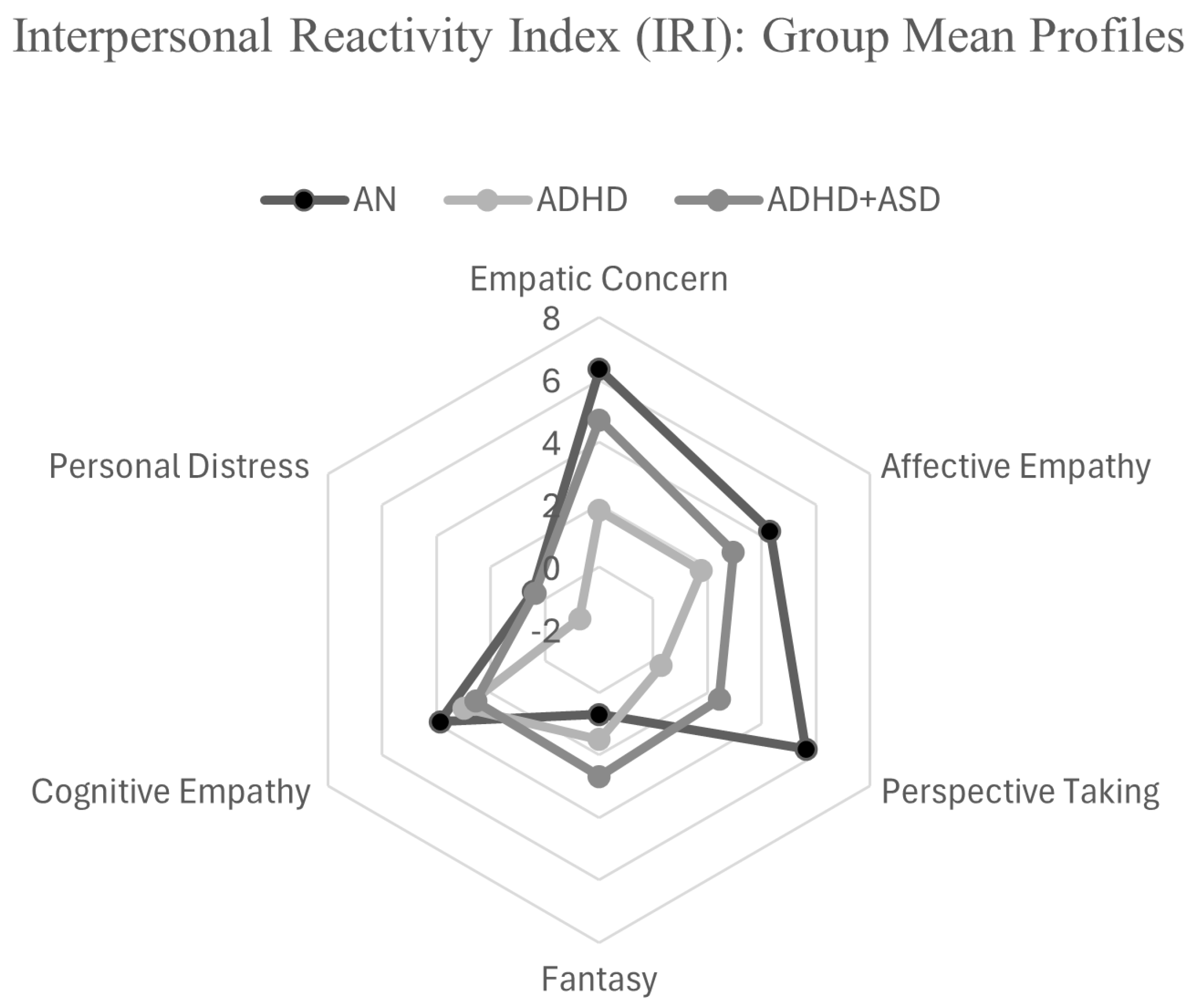
| IRI | |||||||
| Empathic Concern | 6.33 ± 7.2 | 1.81 ± 8.4 | 4.72 ± 8.4 | 3.045 | 0.052 | 0.153 | ns |
| Personal Distress | 0.43 ± 4.0 | −1.28 ± 5.6 | 0.36 ± 7.0 | 4.630 | 0.012 | 0.086 | AN > ADHD+ASD |
| Affective Empathy | 4.30 ± 4.2 | 1.77 ± 7.0 | 2.96 ± 7.7 | 1.380 | 0.256 | 0.020 | ns |
| Perspective Taking | 5.63 ± 4.1 | 0.30 ± 5.9 | 2.44 ± 5.9 | 8.663 | <0.001 | 0.149 | AN > ADHD |
| Fantasy | 0.70 ± 5.2 | 1.51 ± 5.0 | 2.68 ± 4.6 | 1.053 | 0.353 | 0.021 | ns |
| Cognitive Empathy | 3.87 ± 2.0 | 3.00 ± 2.9 | 2.56 ± 2.8 | 1.751 | 0.179 | 0.034 | ns |
| RME | 20.17 ± 2.3 | 18.36 ± 3.1 | 17.40 ± 4.9 | 1.128 | 0.328 | 0.086 | ns |
Disclaimer/Publisher’s Note: The statements, opinions and data contained in all publications are solely those of the individual author(s) and contributor(s) and not of MDPI and/or the editor(s). MDPI and/or the editor(s) disclaim responsibility for any injury to people or property resulting from any ideas, methods, instructions or products referred to in the content. |
© 2026 by the authors. Licensee MDPI, Basel, Switzerland. This article is an open access article distributed under the terms and conditions of the Creative Commons Attribution (CC BY) license.
Share and Cite
Olzi, F.; Raucci, D.; Narzisi, A.; Valente, E.; Ditaranto, F.; Belmonti, V.; Tancredi, R.; Pfanner, C.; Inguaggiato, E.; Villafranca, A.; et al. A Transdiagnostic Comparison of Emotional Regulation, Executive Functions, and Empathy in Three Groups of Female Adolescents: With Anorexia Nervosa, Attention Deficit Hyperactivity Disorder, and Comorbid Attention Deficit Hyperactivity Disorder and Autism Spectrum Disorder. Brain Sci. 2026, 16, 676. https://doi.org/10.3390/brainsci16070676
Olzi F, Raucci D, Narzisi A, Valente E, Ditaranto F, Belmonti V, Tancredi R, Pfanner C, Inguaggiato E, Villafranca A, et al. A Transdiagnostic Comparison of Emotional Regulation, Executive Functions, and Empathy in Three Groups of Female Adolescents: With Anorexia Nervosa, Attention Deficit Hyperactivity Disorder, and Comorbid Attention Deficit Hyperactivity Disorder and Autism Spectrum Disorder. Brain Sciences. 2026; 16(7):676. https://doi.org/10.3390/brainsci16070676
Chicago/Turabian StyleOlzi, Francesca, Daniela Raucci, Antonio Narzisi, Elena Valente, Francesca Ditaranto, Vittorio Belmonti, Raffaella Tancredi, Chiara Pfanner, Emanuela Inguaggiato, Arianna Villafranca, and et al. 2026. "A Transdiagnostic Comparison of Emotional Regulation, Executive Functions, and Empathy in Three Groups of Female Adolescents: With Anorexia Nervosa, Attention Deficit Hyperactivity Disorder, and Comorbid Attention Deficit Hyperactivity Disorder and Autism Spectrum Disorder" Brain Sciences 16, no. 7: 676. https://doi.org/10.3390/brainsci16070676
APA StyleOlzi, F., Raucci, D., Narzisi, A., Valente, E., Ditaranto, F., Belmonti, V., Tancredi, R., Pfanner, C., Inguaggiato, E., Villafranca, A., Lenzi, F., Berloffa, S., Tolomei, G., Viglione, V., Masi, G., Milone, A., & Fantozzi, P. (2026). A Transdiagnostic Comparison of Emotional Regulation, Executive Functions, and Empathy in Three Groups of Female Adolescents: With Anorexia Nervosa, Attention Deficit Hyperactivity Disorder, and Comorbid Attention Deficit Hyperactivity Disorder and Autism Spectrum Disorder. Brain Sciences, 16(7), 676. https://doi.org/10.3390/brainsci16070676