
Neuropsychological Mechanisms Associated with the Effectiveness of AI-Delivered Health Promotion Programs: A Comprehensive Meta-Analysis



Highlights
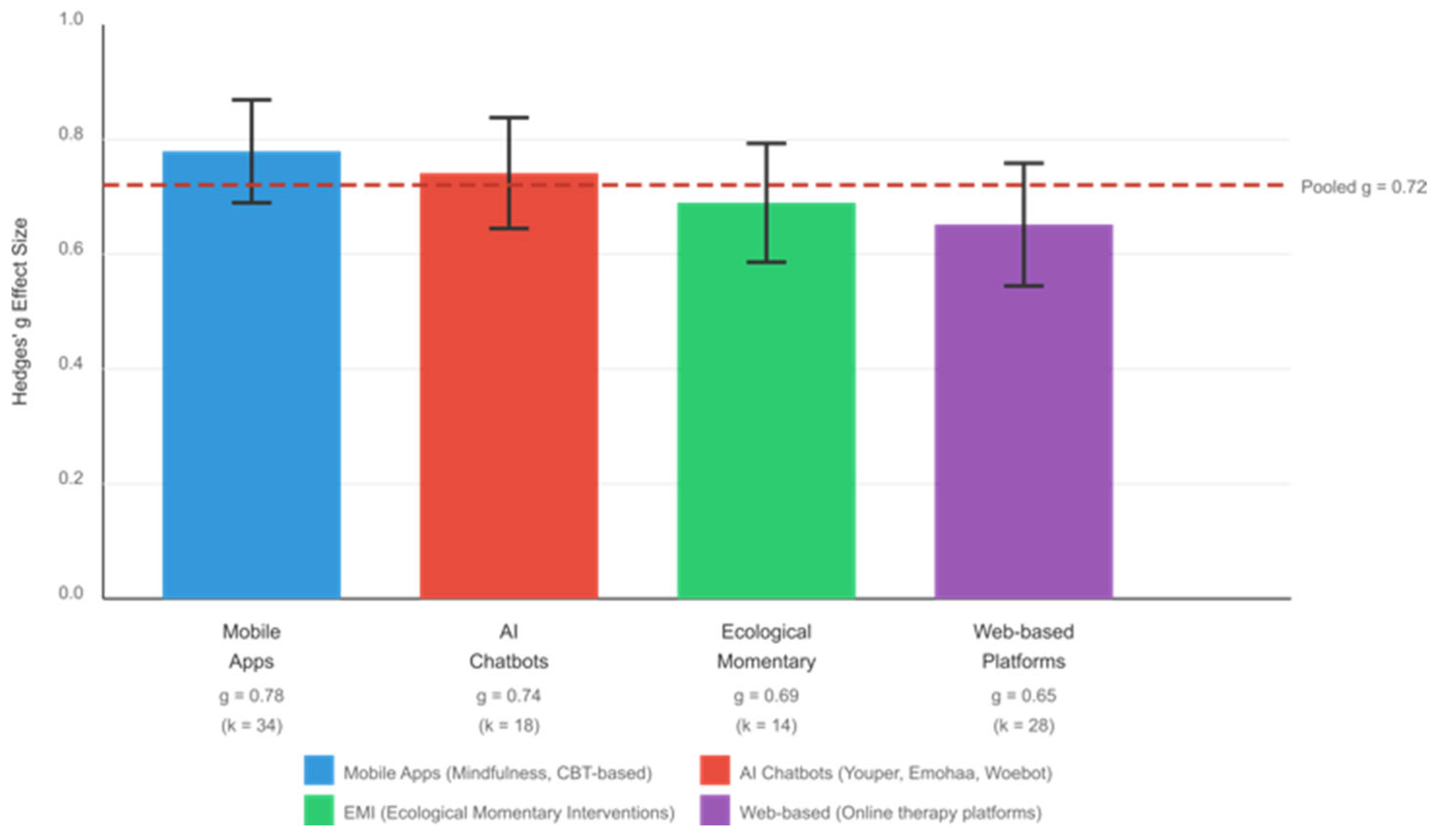
- AI-delivered health promotion interventions produce significant improvements in executive function (g = 0.61), emotion regulation (g = 0.61), and mental health outcomes (g = 0.72), with notably large effects for cognitive impairment populations (g = 1.02; this estimate is based on only 11 studies with n = 482 participants and should be considered preliminary pending replication in adequately powered trials) across 186 studies (n = 22,755).
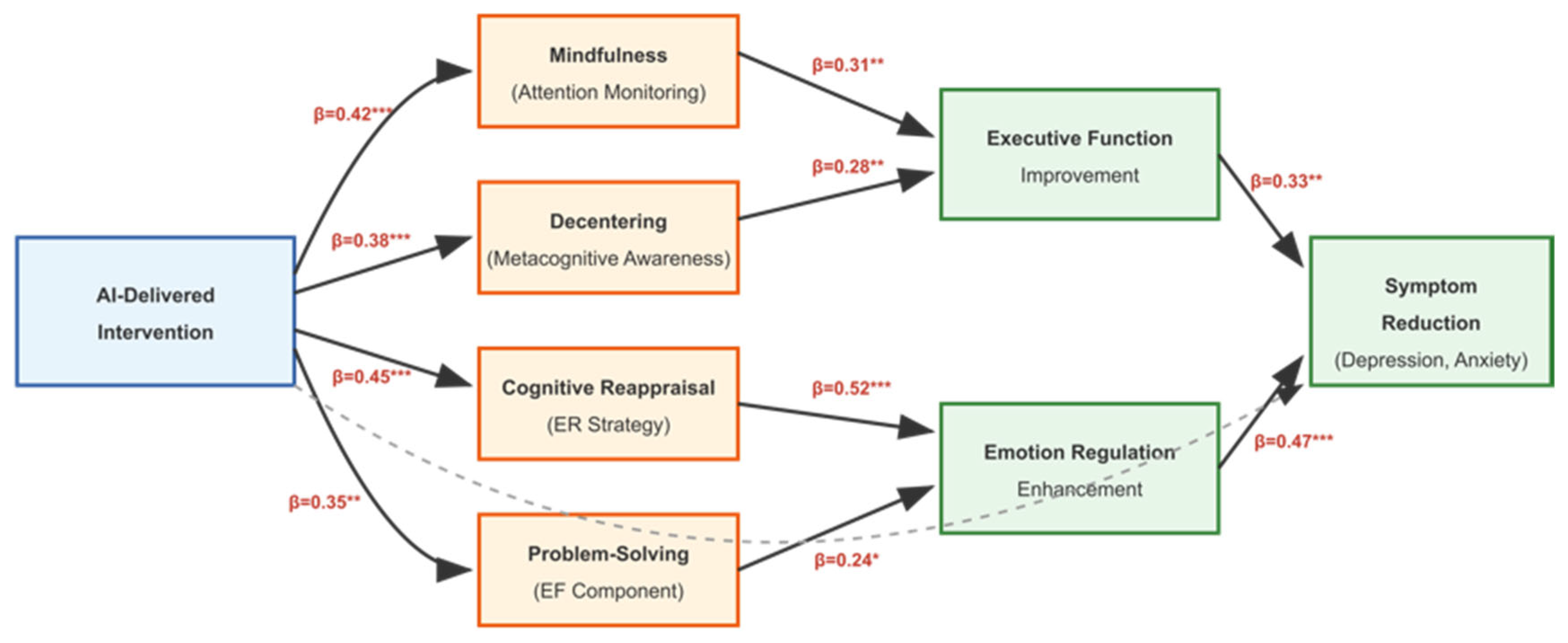
- Therapeutic effects are associated with neuropsychological mechanisms, including dorsolateral prefrontal cortex engagement, enhanced alpha-band neural activity, and concurrent changes in cognitive reappraisal capacity (β = 0.45).
- AI-delivered interventions offer a scalable, evidence-based solution for addressing global mental health treatment gaps, with mobile applications and chatbot-based formats demonstrating promise for widespread implementation.
- Clinical practice can be optimized by targeting specific neuropsychological processes, particularly working memory training and cognitive reappraisal skills, to enhance intervention effectiveness across diverse populations, with attention to individual patient profiles and baseline characteristics.
Abstract
1. Introduction
1.1. Background and Rationale
1.2. Executive Function as a Therapeutic Target
1.3. Emotion Regulation as a Core Mechanism of Change
1.4. Neuropsychological Mechanisms as Targets and Mediators of AI-Delivered Interventions
1.5. Conceptual Framework: Distinguishing Targets and Mechanisms
1.6. Clinical Subgroup Considerations
1.7. Clinical Decision-Making Relevance
1.8. Rationale for the Current Meta-Analysis
1.9. Research Questions
2. Materials and Methods
2.1. Study Design and Protocol Registration
2.2. Eligibility Criteria
2.2.1. Operational Definition of AI-Delivered Interventions
2.2.2. Inclusion Criteria
2.2.3. Exclusion Criteria
2.3. Information Sources and Search Strategy
2.4. Study Selection and Data Extraction
2.5. Risk of Bias Assessment
2.6. Statistical Analysis
3. Results
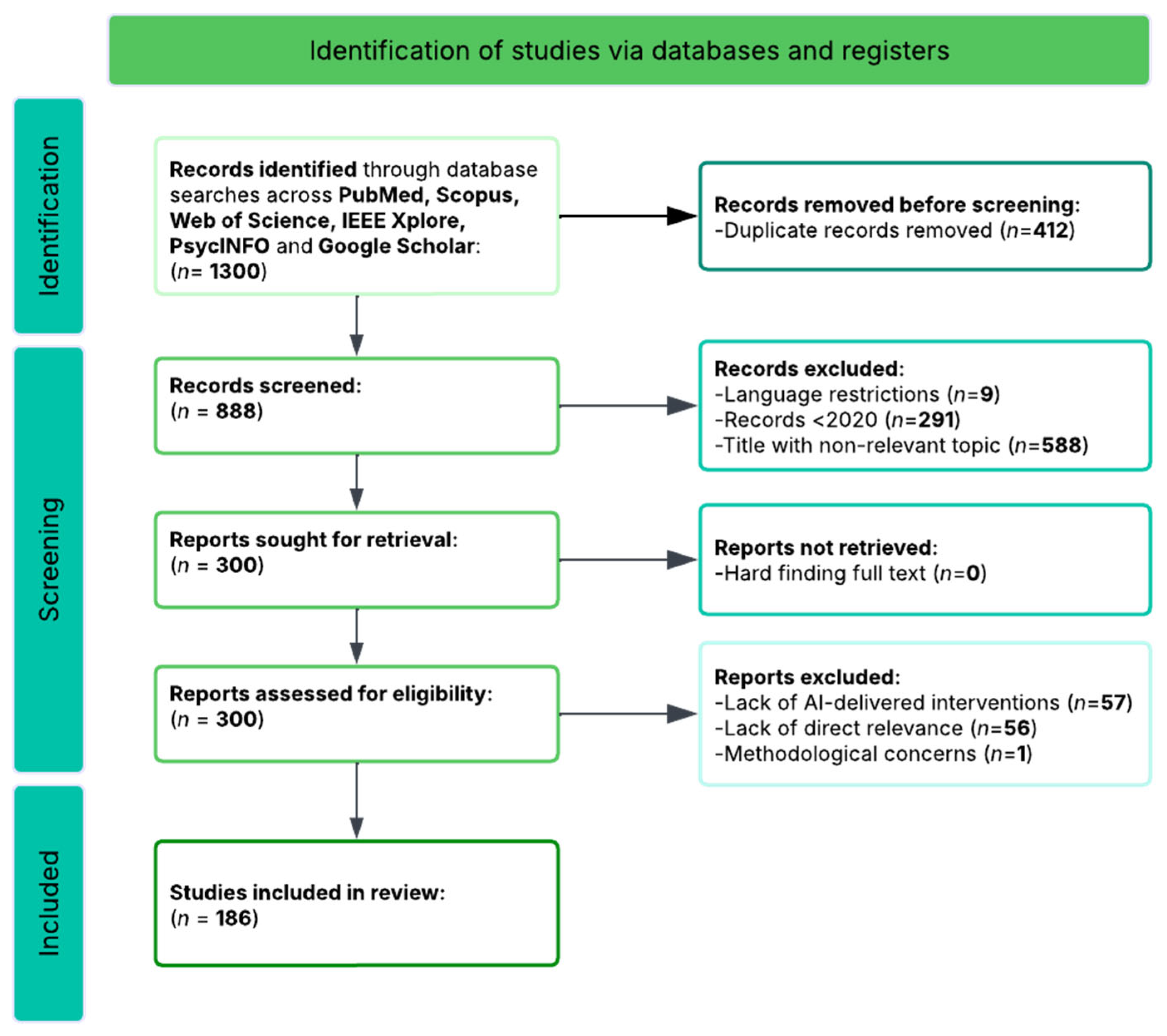
3.1. Study Selection and Characteristics

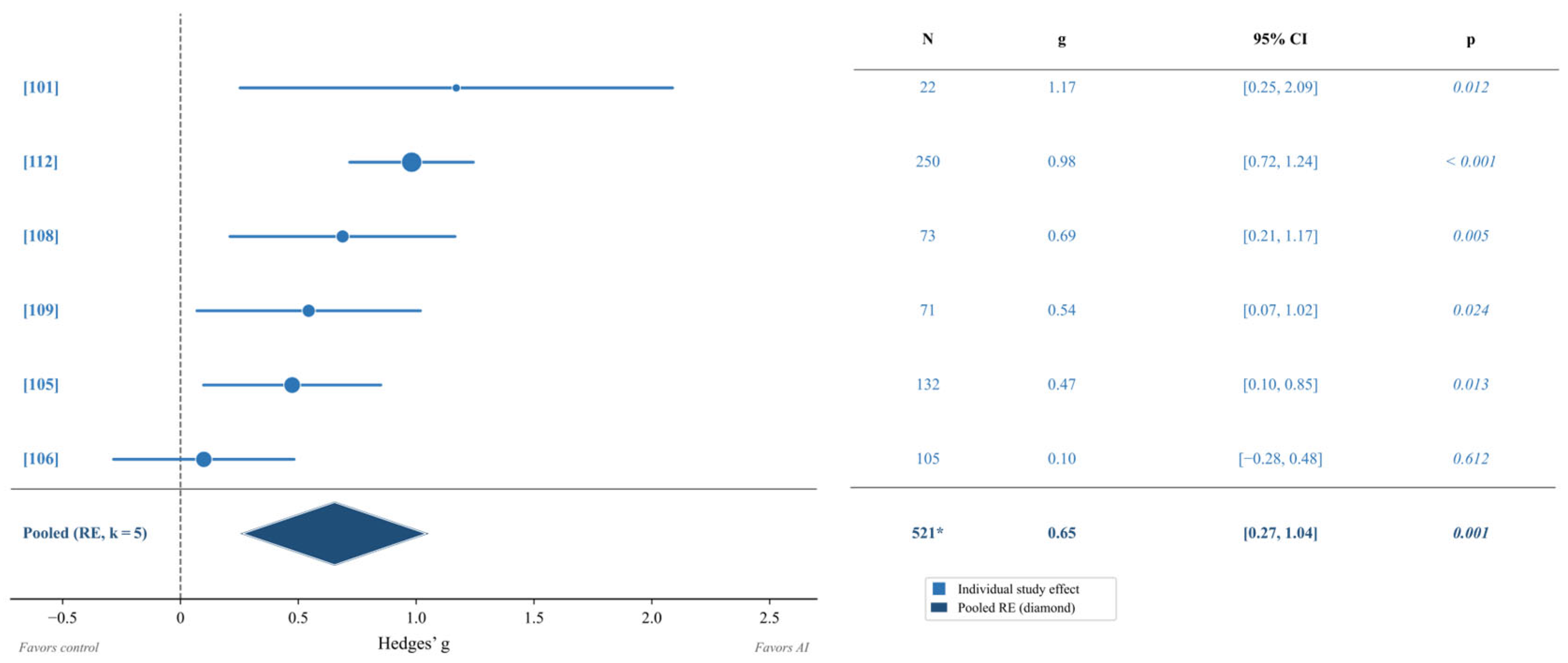
3.2. RQ1: Effectiveness of AI-Delivered Interventions on Executive Function
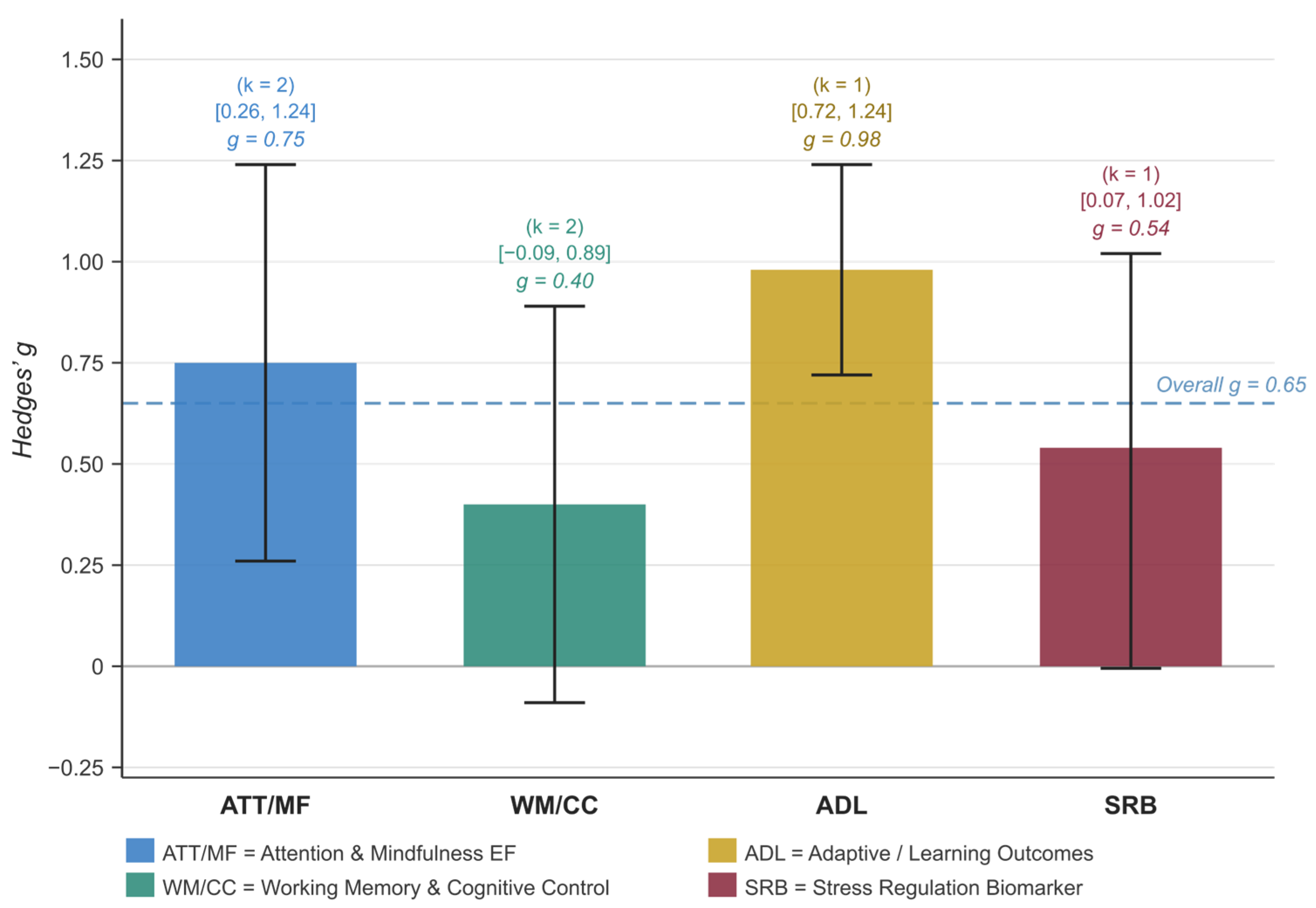
3.2.1. Executive Function Subdomains
3.2.2. Intervention Modality Moderators
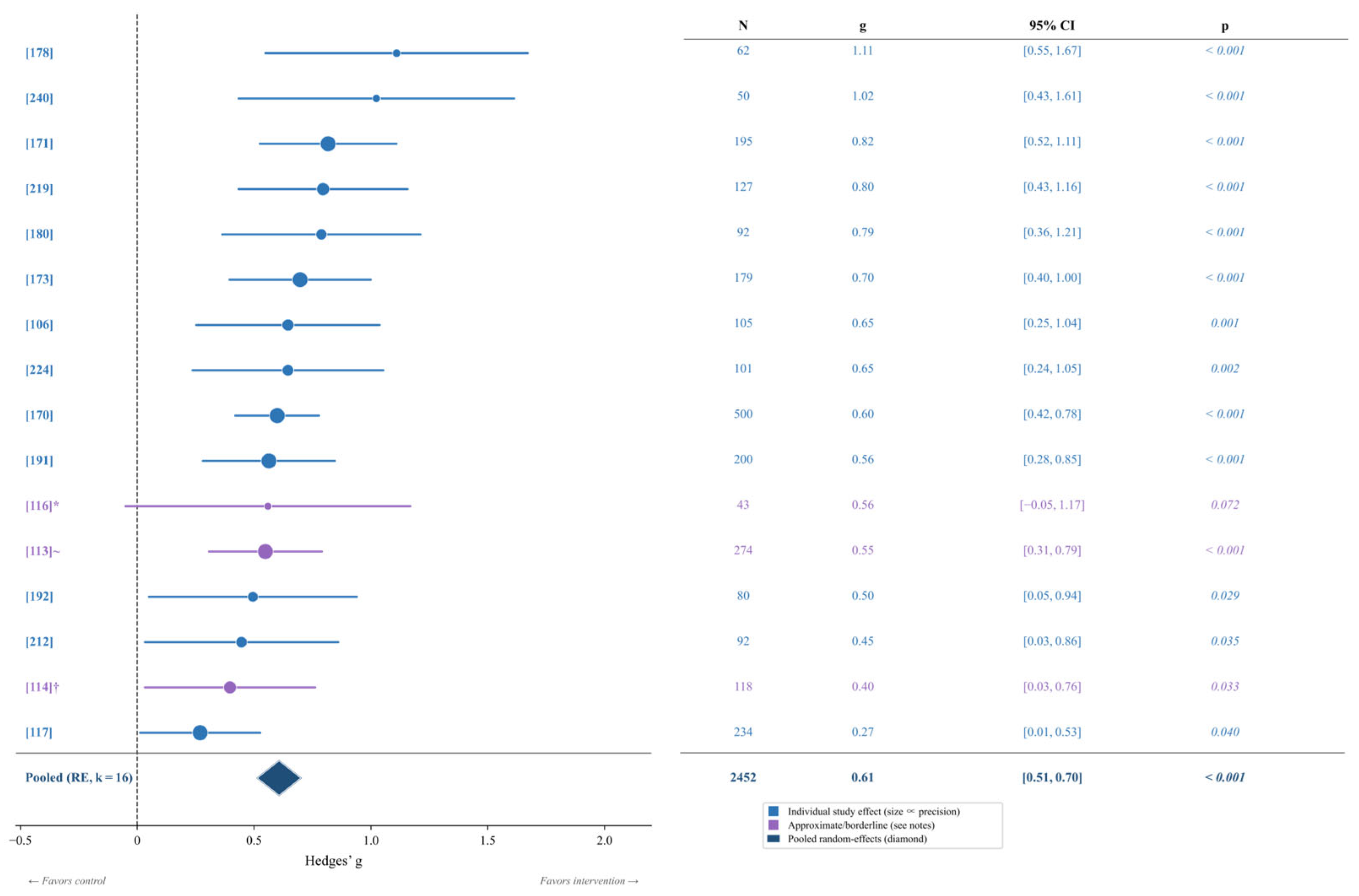
3.3. RQ2: Effectiveness of AI-Delivered Interventions on Emotion Regulation
Emotion Regulation Strategy Outcomes
3.4. RQ3: Neuropsychological Mechanisms
3.4.1. Neural Markers
3.4.2. Physiological Markers
3.4.3. Cognitive Process Mediators
3.5. RQ4: Clinical Subgroup—Mental Health Populations

3.5.1. Depression and Anxiety Outcomes
3.5.2. Intervention Delivery Modalities
3.6. RQ5: Clinical Subgroup—Cognitive Impairment Populations
- Small cumulative sample: The total sample size (n = 482; mean n = 44 per study) is modest compared with other clinical subgroups, increasing susceptibility to sampling variability and small-study effects.
- Publication bias indicators: Egger’s regression test indicated marginal funnel plot asymmetry (z = 1.78, p = 0.08), suggesting potential small-study bias.
- Trim-and-fill adjustment: Application of the trim-and-fill method imputed 2 potentially missing studies, yielding an adjusted effect size of g = 0.85 (95% CI [0.52, 1.18]).
- Study design characteristics: Five out of 11 studies (45.5%) were characterized as pilot or feasibility studies, which may be more susceptible to inflated effect estimates.
3.6.1. ADHD and Neurodevelopmental Populations
3.6.2. Autism Spectrum Disorder
3.7. RQ6: Clinical Subgroup—Other Clinical Populations
3.7.1. Substance Use Disorders
3.7.2. Chronic Health Conditions
3.8. Risk of Bias and Publication Bias
3.9. Sensitivity Analyses
3.9.1. Quality-Stratified Sensitivity Analyses
3.9.2. GRADE Certainty Assessment
- Executive function outcomes (RQ1): MODERATE certainly downgraded one level for inconsistency (I2 = 68.2%).
- Emotion regulation outcomes (RQ2): MODERATE certainty—heterogeneity is low-to-moderate (I2 = 17.5%); downgraded one level for indirectness given that three of the 16 studies relied on approximate or converted effect sizes.
- Mental health clinical outcomes (RQ4): MODERATE certainty—downgraded one level for suspected publication bias (Egger’s p = 0.032).
- Cognitive impairment outcomes (RQ5): LOW certainty—downgraded for imprecision and suspected small-study effects.
3.9.3. Study Design Sensitivity Analyses
3.10. Follow-Up Duration and Effect Maintenance
3.11. Demographic and Population Characteristics
4. Discussion
4.1. AI-Delivered Interventions and Executive Function Enhancement
4.2. AI-Delivered Interventions and Emotion Regulation Outcomes
4.3. Neuropsychological Mechanisms Underlying Intervention Effects
4.4. Clinical Subgroup Considerations and Population-Specific Effects
4.4.1. Mental Health Populations
4.4.2. Cognitive Impairment Populations
4.4.3. Other Clinical Populations
4.5. Clinical Decision-Making Implications
4.6. Technical and Methodological Considerations
4.7. Limitations and Future Directions
4.8. Considerations for Cultural Adaptation and Algorithmic Equity
4.9. Comparative Analysis with Previous Meta-Analyses
4.10. Implementation Framework for Clinical Translation

5. Conclusions
Supplementary Materials
Author Contributions
Funding
Institutional Review Board Statement
Informed Consent Statement
Data Availability Statement
Acknowledgments
Conflicts of Interest
Abbreviations
| Clinical/Psychological Terms | |
| ACT | Acceptance and Commitment Therapy |
| ADHD | Attention Deficit Hyperactivity Disorder |
| ASD | Autism Spectrum Disorder |
| CBT | Cognitive Behavioral Therapy |
| DMN | Default Mode Network |
| EF | Executive Function |
| ER | Emotion Regulation |
| MCI | Mild Cognitive Impairment |
| PTSD | Post-Traumatic Stress Disorder |
| WM | Working Memory |
| Neuroimaging/Physiological Terms | |
| DLPFC | Dorsolateral Prefrontal Cortex |
| ECG | Electrocardiogram |
| EEG | Electroencephalography |
| ERP/ERPs | Event-Related Potential(s) |
| fMRI | Functional Magnetic Resonance Imaging |
| HRV | Heart Rate Variability |
| LPP | Late Positive Potential |
| PFC | Prefrontal Cortex |
| SCRs | Skin Conductance Responses |
| tDCS | Transcranial Direct Current Stimulation |
| Technology/Intervention Terms | |
| AI | Artificial Intelligence |
| EMI | Ecological Momentary Intervention |
| PA | Physical Activity |
| VR | Virtual Reality |
| Methodological/Statistical Terms | |
| CI | Confidence Interval |
| g | Hedges’ g (standardized mean difference) |
| I2 | I-squared (heterogeneity statistic) |
| k | Number of studies |
| n | Total Sample Size |
| NOS | Newcastle-Ottawa Scale |
| PRISMA | Preferred Reporting Items for Systematic Reviews and Meta-Analyses |
| RCT/RCTs | Randomized Controlled Trial(s) |
| RoB 2 | Risk of Bias Tool 2.0 |
| ROBINS-I | Risk of Bias in Non-Randomized Studies of Interventions |
| RQ/RQs | Research Question(s) |
References
- GBD 2019 Mental Disorders Collaborators. Global, regional, and national burden of 12 mental disorders in 204 countries and territories, 1990–2019: A systematic analysis for the Global Burden of Disease Study 2019. Lancet Psychiatry 2022, 9, 137–150. [CrossRef]
- Piao, J.; Huang, Y.; Han, C.; Li, Y.; Xu, Y.; Liu, Y.; He, X. Alarming changes in the global burden of mental disorders in children and adolescents from 1990 to 2019: A systematic analysis for the Global Burden of Disease study. Eur. Child Adolesc. Psychiatry 2022, 31, 1827–1845. [Google Scholar] [CrossRef] [PubMed]
- Wu, Y.; Wang, L.; Tao, M.; Cao, H.; Yuan, H.; Ye, M.; Chen, X.; Wang, K.; Zhu, C. Changing trends in the global burden of mental disorders from 1990 to 2019 and predicted levels in 25 years. Epidemiol. Psychiatr. Sci. 2023, 32, e63. [Google Scholar] [CrossRef]
- Arias, D.; Saxena, S.; Verguet, S. Quantifying the global burden of mental disorders and their economic value. eClinicalMedicine 2022, 54, 101675. [Google Scholar] [CrossRef] [PubMed]
- Kim, S.; Hwang, J.; Lee, J.H.; Park, J.; Kim, H.J.; Son, Y.; Oh, H.; Smith, L.; Kang, J.; Fond, G.; et al. Psychosocial alterations during the COVID-19 pandemic and the global burden of anxiety and major depressive disorders in adolescents, 1990–2021: Challenges in mental health amid socioeconomic disparities. World J. Pediatr. 2024, 20, 1003–1016. [Google Scholar] [CrossRef] [PubMed]
- Deng, Y.; Sun, S.; Wu, S.; Chen, K.; Liu, Y.; Wei, W.; Bei, N.; Qiu, C.; Li, X. Burden and trends of mental disorders in China from 1990 to 2019: Findings from the Global Burden of Disease Study 2019. Soc. Psychiatry Psychiatr. Epidemiol. 2024, 59, 1563–1576. [Google Scholar] [CrossRef]
- Chen, S.; Huang, W.; Zhang, M.; Song, Y.; Zhao, C.; Sun, H.; Wang, Y.; Wang, J.; Sun, Y.; Zhou, L.; et al. Dynamic changes and future trend predictions of the global burden of anxiety disorders: Analysis of 204 countries and regions from 1990 to 2021 and the impact of the COVID-19 pandemic. eClinicalMedicine 2025, 79, 103014. [Google Scholar] [CrossRef]
- Felfe, C.; Saurer, J.; Schneider, P.; Vornberger, J.; Erhart, M.; Kaman, A.; Ravens-Sieberer, U. The youth mental health crisis: Quasi-experimental evidence on the role of school closures. Sci. Adv. 2023, 9, eadh4030. [Google Scholar] [CrossRef]
- Cénat, J.M.; Darius, W.P.; Noorishad, P.-G.; McIntee, S.-E.; Dromer, E.; Mukunzi, J.N.; Solola, O.; Williams, M.T. War in Ukraine and racism: The physical and mental health of refugees of color matters. Int. J. Public Health 2022, 67, 1604990. [Google Scholar] [CrossRef]
- Thieme, A.; Hanratty, M.; Lyons, M.; Palacios, J.; Marques, R.F.; Morrison, C.; Doherty, G. Designing human-centered AI for mental health: Developing clinically relevant applications for online CBT treatment. ACM Trans. Comput.-Hum. Interact. 2023, 30, 18. [Google Scholar] [CrossRef]
- Mahajan, P. Beyond biology: AI as family and the future of human bonds and relationships. F1000Research 2025, 14, 166251. [Google Scholar] [CrossRef]
- Takebayashi, T. Unobtrusive sensing technology for quantifying stress and well-being using pulse, speech, and body motion. In Digital Phenotyping and Digital Biomarkers to Monitor Psychiatric Disorders; Springer: Cham, Switzerland, 2022; pp. 1–24. [Google Scholar]
- Esmaeilzadeh, P. Decoding the cry for help: AI’s emerging role in suicide risk assessment. AI Ethics 2025, 5, 4645–4679. [Google Scholar] [CrossRef]
- Firth, J.; Torous, J.; Stubbs, B.; Firth, J.A.; Steiner, G.Z.; Smith, L.; Alvarez-Jimenez, M.; Gleeson, J.; Vancampfort, D.; Armitage, C.J.; et al. The evolving field of digital mental health: Current evidence and implementation issues for smartphone apps, generative artificial intelligence, and virtual reality. World Psychiatry 2025, PMC12079407. [Google Scholar] [CrossRef]
- Lundervold, A.J. Precision neuropsychology in the aera of AI. Front. Psychol. 2025, 16, 1537368. [Google Scholar] [CrossRef] [PubMed]
- Tariq, M.U. AI-powered breakthroughs: Revolutionizing cognitive psychology and neuropsychology with machine learning. In Transforming Neuropsychology and Cognitive Psychology with AI and Machine Learning; Bansal, R., Maqableh, T., Shuklaa, G., Rabby, F., Lathabhavan, R., Eds.; IGI Global: Hershey, PA, USA, 2025; pp. 65–92. [Google Scholar] [CrossRef]
- Medenica, V.; Ivanovic, L.; Milosevic, N. Applicability of artificial intelligence in neuropsychological rehabilitation of patients with brain injury. Appl. Neuropsychol. Adult 2024, 1–28. [Google Scholar] [CrossRef] [PubMed]
- Wolff, B. Artificial intelligence and natural language processing in modern clinical neuropsychology: A narrative review. Clin. Neuropsychol. 2025, 1–25. [Google Scholar] [CrossRef]
- Gkintoni, E.; Halkiopoulos, C. Digital twin cognition: AI-biomarker integration in biomimetic neuropsychology. Biomimetics 2025, 10, 640. [Google Scholar] [CrossRef]
- Li, H.; Zhang, R.; Lee YCKraut, R.E.; Mohr, D.C. Systematic review and meta-analysis of AI-based conversational agents for promot-ing mental health and well-being. npj Digit. Med. 2023, 6, 236. [Google Scholar] [CrossRef] [PubMed]
- Reddy, K.J. Introduction to neurocognitive rehabilitation. In Innovations in Neurocognitive Rehabilitation: Harnessing Technology for Effective Therapy; Springer Nature: Cham, Switzerland, 2025; pp. 1–18. [Google Scholar] [CrossRef]
- Bansal, R.; Maqableh, T.; Shuklaa, G.; Rabby, F.; Lathabhavan, R. (Eds.) Transforming Neuropsychology and Cognitive Psychology with AI and Machine Learning; IGI Global: Hershey, PA, USA, 2025. [Google Scholar] [CrossRef]
- Pluck, G.; Cerone, A.; Villagomez-Pacheco, D. Executive function and intelligent goal-directed behavior: Perspectives from psychology, neurology, and computer science. In Proceedings of the International Conference on Software Engineering and Formal Methods; Springer: Cham, Switzerland, 2022; pp. 324–350. [Google Scholar] [CrossRef]
- Merchant, J.T.; Moran, E.K.; Strube, M.J.; Barch, D.M. Correlates of real-world goal-directed behavior in schizophrenia. Psychol. Med. 2023, 53, 2409–2417. [Google Scholar] [CrossRef]
- Haugen, I.; Stubberud, J.; Haug, E.; McGurk, S.R.; Hovik, K.T.; Ueland, T.; Øie, M.G. A randomized controlled trial of Goal Management Training for executive functioning in schizophrenia spectrum disorders or psychosis risk syndromes. BMC Psychiatry 2022, 22, 575. [Google Scholar] [CrossRef]
- Ebrahimi, C.; Musial, M.P.M.; Doñamayor, N.; Prychynenko, D.S.; Bode, E.L.; Spanagel, R.; Heinz, A.; Deserno, L.; Smolka, M.N.; Ebner-Priemer, U.; et al. Goal-directed behavior and hippocampal activity predict real-life impact of drinking intentions in alcohol use disorder. Transl. Psychiatry 2025, 15, 425. [Google Scholar] [CrossRef] [PubMed]
- Seesjärvi, E.; Laine, M.; Kasteenpohja, K.; Salmi, J. Assessing goal-directed behavior in virtual reality with the neuropsychological task EPELI: Children prefer head-mounted display but flat screen provides a viable performance measure for remote testing. Front. Virtual Real. 2023, 4, 1138240. [Google Scholar] [CrossRef]
- Dimitropoulou, K.; Baxter, M.F. Neural basis of adaptation: Motivation, intention, resilience, and goal-directed behaviors. In Adaptation Through Occupation; Routledge: London, UK, 2024; pp. 95–118. [Google Scholar] [CrossRef]
- Friedman, N.P.; Robbins, T.W. The role of prefrontal cortex in cognitive control and executive function. Neuropsychopharmacology 2022, 47, 72–89. [Google Scholar] [CrossRef]
- Carlson, S.M. Let me choose: The role of choice in the development of executive function skills. Curr. Dir. Psychol. Sci. 2023, 32, 402–408. [Google Scholar] [CrossRef]
- Boyd, J.E.; Sanger, B.D.; Cameron, D.H.; Protopopescu, A.; McCabe, R.E.; O’Connor, C.; Lanius, R.A.; McKinnon, M.C. A pilot study assessing the effects of goal management training on cognitive functions among individuals with major depressive disorder and the effect of post-traumatic symptoms on response to intervention. Brain Sci. 2022, 12, 864. [Google Scholar] [CrossRef]
- Horowitz-Kraus, T.; Randell, K.; Morag, I. Neurobiological perspective on the development of executive functions. Acta Paediatr. 2023, 112, 2124–2133. [Google Scholar] [CrossRef]
- Loughnane, C.; Laiti, J.; O’Donovan, R.; Dunne, P.J. Systematic review exploring human, AI, and hybrid health coaching in digital health interventions: Trends, engagement, and lifestyle outcomes. Front. Digit. Health 2025, 7, 1536416. [Google Scholar] [CrossRef]
- Pachler, N.; Turvey, K.; Abaci, S. AI solutionism and the techno/human-centric remediation of agency in higher education. In Postdigital Education for Development; Springer: Cham, Switzerland, 2025; pp. 85–102. [Google Scholar] [CrossRef]
- Amirian, S.; Gao, F.; Littlefield, N.; Hill, J.H.; Yates, A.J.; Plate, J.F.; Pantanowitz, L.; Rashidi, H.H.; Tafti, A.P. State-of-the-art in responsible, explainable, and fair AI for medical image analysis. IEEE Access 2025, 13, 58229–58263. [Google Scholar] [CrossRef]
- Gkintoni, E.; Halkiopoulos, C. Mapping EEG Metrics to Human Affective and Cognitive Models: An Interdisciplinary Scoping Review from a Cognitive Neuroscience Perspective. Biomimetics 2025, 10, 730. [Google Scholar] [CrossRef]
- Brenning, K.; Soenens, B.; Vansteenkiste, M.; De Clercq, B.; Antrop, I. Emotion regulation as a transdiagnostic risk factor for (non)clinical adolescents’ internalizing and externalizing psychopathology: Investigating the intervening role of psychological need experiences. Child Psychiatry Hum. Dev. 2022, 53, 124–136. [Google Scholar] [CrossRef] [PubMed]
- Lincoln, T.M.; Schulze, L.; Renneberg, B. The role of emotion regulation in the characterization, development, and treatment of psychopathology. Nat. Rev. Psychol. 2022, 1, 364–378. [Google Scholar] [CrossRef]
- Hernández-Posadas, A.; Lommen, M.J.; de la Rosa Gómez, A.; Bouman, T.K.; Mancilla-Díaz, J.M.; del Palacio González, A. Transdiagnostic factors in symptoms of depression and post-traumatic stress: A systematic review. Curr. Psychol. 2024, 43, 5933–5948. [Google Scholar] [CrossRef] [PubMed]
- Holl, J.; Berning, A.; Kling, L.; Taubner, S.; Georg, A.K.; Volkert, J. Transdiagnostic mechanisms of mental health during the COVID-19 pandemic: Associations of childhood trauma, maladaptive personality traits, emotion regulation, mentalizing, and pandemic-related distress. Front. Psychol. 2024, 15, 1427469. [Google Scholar] [CrossRef] [PubMed]
- Preece, D.A.; Mehta, A.; Becerra, R.; Chen, W.; Allan, A.; Robinson, K.; Boyes, M.; Hasking, P.; Gross, J.J. Why is alexithymia a risk factor for affective disorder symptoms? The role of emotion regulation. J. Affect. Disord. 2022, 296, 337–341. [Google Scholar] [CrossRef]
- Sahib, A.; Chen, J.; Cárdenas, D.; Calear, A.L. Intolerance of uncertainty and emotion regulation: A meta-analytic and systematic review. Clin. Psychol. Rev. 2023, 104, 102270. [Google Scholar] [CrossRef]
- Antuña-Camblor, C.; Gómez-Salas, F.J.; Burgos-Julián, F.A.; González-Vázquez, A.; Juarros-Basterretxea, J.; Rodríguez-Díaz, F.J. Emotional regulation as a transdiagnostic process of emotional disorders in therapy: A systematic review and meta-analysis. Clin. Psychol. Psychother. 2024, 31, e2997. [Google Scholar] [CrossRef]
- Verhelst, P.; Sels, L.; Lemmens, G.; Verhofstadt, L. The role of emotion regulation in perinatal depression and anxiety: A systematic review. BMC Psychol. 2024, 12, 203. [Google Scholar] [CrossRef]
- Ni, Y.; Jia, F. A scoping review of AI-driven digital interventions in mental health care: Mapping applications across screening, support, monitoring, prevention, and clinical education. Healthcare 2025, 13, 1205. [Google Scholar] [CrossRef]
- Pawar, B.; Mahajan, S.; Kolhar, S. A comprehensive review on application of cognitive behavioral therapy in emotional AI solutions for mental well-being. Discov. Psychol. 2025, 5, 13. [Google Scholar] [CrossRef]
- Abbas, S.R.; Seol, H.; Abbas, Z.; Lee, S.W. Exploring the role of artificial intelligence in smart healthcare: A capability- and function-oriented review. Healthcare 2025, 13, 1642. [Google Scholar] [CrossRef]
- Oquendo, M.A.; Barrigon, M.L.; Baca-Garcia, E. Psychiatry at the turn of the century and a vision for future developments. Int. Rev. Psychiatry 2025, 1–15. [Google Scholar] [CrossRef]
- Croke, S.; Tyler, N.; Low, C.-N.; Gkintoni, E.; Angelakis, I.; Eylem-Van Bergeijk, O.; Hodkinson, A.; Mcmillan, B.; Panagioti, M. Digital peer support interventions for people with mental health conditions in outpatient settings: A systematic review and meta-analysis. BMJ Ment. Health 2026, 29, e302275. [Google Scholar] [CrossRef]
- Gkintoni, E.; Aroutzidis, A.; Antonopoulou, H.; Halkiopoulos, C. From neural networks to emotional networks: A systematic review of EEG-based emotion recognition in cognitive neuroscience and real-world applications. Brain Sci. 2025, 15, 220. [Google Scholar] [CrossRef] [PubMed]
- Chmiel, J.; Kurpas, D. Through massage to the brain—Neuronal and neuroplastic mechanisms of massage based on various neuroimaging techniques (EEG, fMRI, and fNIRS). J. Clin. Med. 2026, 15, 909. [Google Scholar] [CrossRef]
- Gkintoni, E.; Panagioti, M.; Vassilopoulos, S.P.; Nikolaou, G.; Boutsinas, B.; Vantarakis, A. Leveraging AI-driven neuroimaging biomarkers for early detection and social function prediction in autism spectrum disorders: A systematic review. Healthcare 2025, 13, 1776. [Google Scholar] [CrossRef] [PubMed]
- Hutchinson, A.N.; Antonsson, A.E.; Forsgård, R.A.; König, J.; Ganda Mall, J.P.; Rode, J. The effects of oral probiotic intervention on brain structure and function in human adults: A systematic review. npj Biofilms Microbiomes 2026, 12, 6. [Google Scholar] [CrossRef] [PubMed]
- Salamin, V.; Rigucci, S.; Rougemont-Bücking, A.; Horat, S.; Gothuey, I.; Merlo, M.; Missonnier, P. Attention-related neurophysiological changes after an 8-week mindfulness-based cognitive therapy intervention: A pilot follow-up study. Int. J. Cogn. Ther. 2024, 17, 290–316. [Google Scholar] [CrossRef]
- Jung, M.; Woo, J.; Kim, S.J.; Lim, Y.B.; Kim, Y.; Kang, D.; Min, J.-S.; Kim, B.-N. Efficacy and compliance of a working memory multitasking task mobile intervention for children with attention-deficit/hyperactivity disorder: Single-arm, pre–post pilot study. JMIR Hum. Factors 2025, 12, e70479. [Google Scholar] [CrossRef]
- Nelson, C.A.; Sullivan, E.; Engelstad, A.-M. Annual research review: Early intervention viewed through the lens of developmental neuroscience. J. Child Psychol. Psychiatry 2024, 65, 435–455. [Google Scholar] [CrossRef]
- Brian, A.; Abrams, T.C. Catching up with slowing down: A contemporary approach to assessing post-error slowing as an outcome of a dual-component gross motor and social-emotional skill intervention. Early Educ. Dev. 2025, 37, 336–346. [Google Scholar] [CrossRef]
- DelRosso, L.M.; Modi, H.; Chan-Golston, A.M.; Sandhu, P.; Jain, V.; Park, M. Demographic differences in periodic limb movement index and apnea–hypopnea index in a diverse clinical cohort. Int. J. Environ. Res. Public Health 2025, 22, 1476. [Google Scholar] [CrossRef]
- Ghahremani Arekhloo, N.; Parvizi, H.; Zuo, S.; Wang, H.; Nazarpour, K.; Marquetand, J.; Heidari, H. Alignment of magnetic sensing and clinical magnetomyography. Front. Neurosci. 2023, 17, 1154572. [Google Scholar] [CrossRef]
- Mathioudakis, N.; Lalani, B.; Abusamaan, M.S.; Alderfer, M.; Alver, D.; Dobs, A.; Kane, B.; McGready, J.; Riekert, K.; Ringham, B.; et al. An AI-powered lifestyle intervention vs human coaching in the Diabetes Prevention Program: A randomized clinical trial. JAMA 2025, 334, 2079–2089. [Google Scholar] [CrossRef] [PubMed]
- Gkintoni, E.; Ortiz, P.S. Neuropsychology of generalized anxiety disorder in clinical setting: A systematic evaluation. Healthcare 2023, 11, 2446. [Google Scholar] [CrossRef]
- Yip, W.L.T.; Yang, Y.; Wang, Z.L.; Stuckler, D. Effectiveness of AI-delivered cognitive behavioral therapy interventions for anxiety and depressive symptoms: A systematic review. Res. Sq. 2025, 8, 67. [Google Scholar] [CrossRef]
- Gkintoni, E.; Kourkoutas, E.; Yotsidi, V.; Stavrou, P.D.; Prinianaki, D. Clinical Efficacy of Psychotherapeutic Inter-ventions for Post-Traumatic Stress Disorder in Children and Adolescents: A Systematic Review and Analysis. Children 2024, 11, 579. [Google Scholar] [CrossRef]
- Kabrel, N. When can AI psychotherapy be considered comparable to human psychotherapy? Exploring the criteria. Front. Psychiatry 2025, 16, 1674104. [Google Scholar] [CrossRef]
- Attoh-Mensah, E.; Boujut, A.; Desmons, M.; Perrochon, A. Artificial intelligence in personalized rehabilitation: Current applications and a SWOT analysis. Front. Digit. Health 2025, 7, 1606088. [Google Scholar] [CrossRef]
- Halkiopoulos, C.; Gkintoni, E. The Role of Machine Learning in AR/VR-Based Cognitive Therapies: A Systematic Review for Mental Health Disorders. Electronics 2025, 14, 1110. [Google Scholar] [CrossRef]
- Josephson, C.B.; Beniczky, S.; Denaxas, S.; Ikeda, A.; Jehi, L.; Mwesige, A.K.; Jette, N.; Jones, G.D.; Ryvlin, P.; Sen, A.; et al. A call for ethical, equitable, and effective artificial intelligence to improve care for all people with epilepsy: A roadmap. A report by the ILAE Global Advocacy Council and Big Data Commission. Epilepsia 2025, 14, 1110. [Google Scholar] [CrossRef]
- Gucciardi, D.F.; Lines, R.L.; Ntoumanis, N. Handling effect size dependency in meta-analysis. Int. Rev. Sport Exerc. Psychol. 2022, 15, 152–178. [Google Scholar] [CrossRef]
- Huth, K.B.S.; Chung-Yan, G.A. Quantifying the evidence for the absence of the job demands and job control interaction on workers’ well-being: A Bayesian meta-analysis. J. Appl. Psychol. 2023, 108, 1060–1072. [Google Scholar] [CrossRef]
- Dowdy, A.; Hantula, D.A.; Travers, J.C.; Tincani, M. Meta-analytic methods to detect publication bias in behavior science research. Perspect. Behav. Sci. 2022, 45, 37–52. [Google Scholar] [CrossRef] [PubMed]
- Nakagawa, S.; Yang, Y.; Macartney, E.L.; Spake, R.; Lagisz, M. Quantitative evidence synthesis: A practical guide on meta-analysis, meta-regression, and publication bias tests for environmental sciences. Environ. Evid. 2023, 12, 8. [Google Scholar] [CrossRef]
- Buecker, S.; Luhmann, M.; Haehner, P.; Bühler, J.L.; Dapp, L.C.; Luciano, E.C.; Orth, U. The development of subjective well-being across the life span: A meta-analytic review of longitudinal studies. Psychol. Bull. 2023, 149, 418–461. [Google Scholar] [CrossRef]
- Cavicchioli, M.; Tobia, V.; Ogliari, A. Emotion regulation strategies as risk factors for developmental psychopathology: A meta-analytic review of longitudinal studies based on cross-lagged correlations and panel models. Res. Child Adolesc. Psychopathol. 2023, 51, 673–690. [Google Scholar] [CrossRef]
- Guo, L. Using metacognitive prompts to enhance self-regulated learning and learning outcomes: A meta-analysis of experimental studies in computer-based learning environments. J. Comput. Assist. Learn. 2022, 38, 1269–1286. [Google Scholar] [CrossRef]
- Christensen, M.A. Tracing the gender confidence gap in computing: A cross-national meta-analysis of gender differences in self-assessed technological ability. Soc. Sci. Res. 2023, 112, 102853. [Google Scholar] [CrossRef] [PubMed]
- Tabri, N.; Xuereb, S.; Cringle, N.; Clark, L. Associations between financial gambling motives, gambling frequency, and level of problem gambling: A meta-analytic review. Addiction 2022, 117, 344–359. [Google Scholar] [CrossRef]
- Nelson, J.; Kaplan, J.; Simerly, G.; Nutter, N.; Edson-Heussi, A.; Woodham, B.; Broman-Fulks, J. The balance and integration of artificial intelligence within cognitive behavioral therapy interventions. Curr. Psychol. 2025, 44, 7847–7857. [Google Scholar] [CrossRef]
- Weisker, L.M. AI-driven mental health chatbots: Perceived empathy, user satisfaction, and treatment outcomes. In AI-Driven Mental Health Chatbots; Springer: Cham, Switzerland, 2025; pp. 1–22. [Google Scholar] [CrossRef]
- Weisker, L.M. AI-Driven Mental Health Chatbots; Springer: Cham, Switzerland, 2025. [Google Scholar]
- Lau, Y.; Ang, W.H.D.; Ang, W.W.; Pang, P.C.I.; Wong, S.H.; Chan, K.S. Artificial intelligence–based psychotherapeutic intervention on psychological outcomes: A meta-analysis and meta-regression. Depress. Anxiety 2025, 2025, 8930012. [Google Scholar] [CrossRef]
- Cheng, A.S.K.; Wang, X.; Niu, N.; Liang, M.; Zeng, Y. Neuropsychological interventions for cancer-related cognitive impairment: A network meta-analysis of randomized controlled trials. Neuropsychol. Rev. 2022, 32, 528–545. [Google Scholar] [CrossRef]
- Despoti, A.; Megari, K.; Tsiakiri, A.; Toumaian, M.; Koutzmpi, V.; Liozidou, A.; Tsapanou, A. Effectiveness of remote neuropsychological interventions: A systematic review. Appl. Neuropsychol. Adult 2024, 1–9. [Google Scholar] [CrossRef]
- Halkiopoulos, C.; Gkintoni, E. Leveraging AI in e-learning: Personalized learning and adaptive assessment through cognitive neuropsychology—A systematic analysis. Electronics 2024, 13, 3762. [Google Scholar] [CrossRef]
- Zhou, S.; Zhao, J.; Zhang, L. Application of artificial intelligence on psychological interventions and diagnosis: An overview. Front. Psychiatry 2022, 13, 811665. [Google Scholar] [CrossRef]
- Gómez-Cáceres, B.; Cano-López, I.; Aliño, M.; Puig-Perez, S. Effectiveness of virtual reality–based neuropsychological interventions in improving cognitive functioning in patients with mild cognitive impairment: A systematic review and meta-analysis. Clin. Neuropsychol. 2023, 37, 1337–1370. [Google Scholar] [CrossRef]
- Orsoni, M. Exploring the Psychometric Dimensions: Theoretical and Practical Applications of Artificial Intelligence and Gamification in Education, Learning, and Neuropsychological Assessment. Doctoral Dissertation, University of Bologna, Bologna, Italy, 2024. [Google Scholar]
- Khorev, V.; Kiselev, A.; Badarin, A.; Antipov, V.; Drapkina, O.; Kurkin, S.; Hramov, A. Review on the use of AI-based methods and tools for treating mental conditions and mental rehabilitation. Eur. Phys. J. Spec. Top. 2025, 234, 4139–4158. [Google Scholar] [CrossRef]
- Yang, Q.; Zhang, L.; Chang, F.; Yang, H.; Chen, B.; Liu, Z. Virtual reality interventions for older adults with mild cognitive impairment: Systematic review and meta-analysis of randomized controlled trials. J. Med. Internet Res. 2025, 27, e59195. [Google Scholar] [CrossRef] [PubMed]
- Yu, J.; Song, J.; Shen, Q. Effects of fully immersive virtual reality training on cognitive function in patients with mild cognitive impairment: A systematic review and meta-analysis. Front. Hum. Neurosci. 2024, 18, 1467697. [Google Scholar] [CrossRef]
- Rodríguez Timaná, L.C.; Castillo García, J.F.; Bastos Filho, T.; Ocampo González, A.A.; Hincapié Monsalve, N.R.; Valencia Jimenez, N.J. Use of serious games in interventions of executive functions in neurodiverse children: Systematic review. JMIR Serious Games 2024, 12, e59053. [Google Scholar] [CrossRef] [PubMed]
- Veneziani, I.; Marra, A.; Formica, C.; Grimaldi, A.; Marino, S.; Quartarone, A.; Maresca, G. Applications of artificial intelligence in the neuropsychological assessment of dementia: A systematic review. J. Pers. Med. 2024, 14, 113. [Google Scholar] [CrossRef]
- Cruz-Gonzalez, P.; He, A.W.J.; Lam, E.P.; Ng, I.M.C.; Li, M.W.; Hou, R.; Chan, J.N.M.; Sahni, Y.; Guasch, N.V.; Miller, T.; et al. Artificial intelligence in mental health care: A systematic review of diagnosis, monitoring, and intervention applications. Psychol. Med. 2025, 55, e18. [Google Scholar] [CrossRef] [PubMed]
- Kirkham, R.; Kooijman, L.; Albertella, L.; Myles, D.; Yücel, M.; Rotaru, K. Immersive virtual reality–based methods for assessing executive functioning: Systematic review. JMIR Serious Games 2024, 12, e50282. [Google Scholar] [CrossRef]
- Haddaway, N.R.; Page, M.J.; Pritchard, C.C.; McGuinness, L.A. PRISMA2020: An R package & Shiny app producing PRISMA 2020-compliant flow diagrams. Campbell Syst. Rev. 2022, 18, e1230. [Google Scholar]
- Page, M.J.; McKenzie, J.E.; Bossuyt, P.M.; Boutron, I.; Hoffmann, T.C.; Mulrow, C.D.; Shamseer, L.; Tetzlaff, J.M.; Akl, E.A.; Brennan, S.E.; et al. The PRISMA 2020 statement: An updated guideline for reporting systematic reviews. BMJ 2021, 372, n71. [Google Scholar] [CrossRef] [PubMed]
- van den Akker, O.R.; Peters, G.-J.Y.; Bakker, C.J.; Carlsson, R.; Coles, N.A.; Corker, K.S.; Feldman, G.; Moreau, D.; Nordström, T.; Pickering, J.S.; et al. Increasing transparency systematic reviews: Presenting a generalized registration form. Syst. Rev. 2023, 12, 170. [Google Scholar] [CrossRef] [PubMed]
- Sterne, J.A.C.; Savović, J.; Page, M.J.; Elbers, R.G.; Blencowe, N.S.; Boutron, I.; Cates, C.J.; Cheng, H.Y.; Corbett, M.S.; Eldridge, S.M.; et al. RoB 2: A revised tool for assessing risk of bias in randomised trials. BMJ 2019, 366, l4898. [Google Scholar] [CrossRef]
- Hedges, L.V. Distribution Theory for Glass’s Estimator of Effect Size and Related Estimators. J. Educ. Stat. 1981, 6, 107–128. [Google Scholar] [CrossRef]
- Morris, S.B.; DeShon, R.P. Combining Effect Size Estimates in Meta-Analysis with Repeated Measures and Independent-Groups Designs. Psychol. Methods 2002, 7, 105–125. [Google Scholar] [CrossRef]
- Borenstein, M.; Higgins, J.P.T.; Hedges, L.V.; Rothstein, H.R. Basics of Meta-Analysis: I2 Is Not an Absolute Measure of Heterogeneity. Res. Synth. Methods. 2017, 8, 5–18. [Google Scholar] [CrossRef]
- Smith, J.L.; Allen, J.W.; Haack, C.; Wehrmeyer, K.; Alden, K.; Lund, M.B.; Mascaro, J.S. The Impact of App-Delivered Mindfulness Meditation on Functional Connectivity and Self-Reported Mindfulness Among Health Profession Trainees. Mindfulness 2020, 12, 92–106. [Google Scholar] [CrossRef] [PubMed]
- Kim, M.; Yang, J.; Ahn, W.-Y.; Choi, H.J. Machine Learning Analysis to Identify Digital Behavioral Phenotypes for Engagement and Health Outcome Efficacy of an mHealth Intervention for Obesity: Randomized Controlled Trial. J. Med. Internet Res. 2021, 23, e27218. [Google Scholar] [CrossRef]
- Van Vleet, T.; Bonato, P.; Fabara, E.; Dabit, S.; Kim, S.; Chiu, C.; Bisogno, A.L.; Merzenich, M.; Corbetta, M.; DeGutis, J. Alertness Training Improves Spatial Bias and Functional Ability in Spatial Neglect. Ann. Neurol. 2020, 88, 747–758. [Google Scholar] [CrossRef]
- Tang, J.S.Y.; Falkmer, M.; Chen, N.T.M.; Bölte, S.; Girdler, S. Development and Feasibility of MindChip™: A Social Emotional Telehealth Intervention for Autistic Adults. J. Autism Dev. Disord. 2020, 51, 1107–1130. [Google Scholar] [CrossRef]
- Gavrilova, L.; Zawadzki, M.J. Examining How Headspace Impacts Mindfulness Mechanisms Over an 8-Week App-Based Mindfulness Intervention. Mindfulness 2023, 14, 2236–2249. [Google Scholar] [CrossRef]
- Lo, S.L.; Gearhardt, A.N.; Fredericks, E.M.; Katz, B.; Sturza, J.; Kaciroti, N.; Gonzalez, R.; Hunter, C.M.; Sonneville, K.; Chaudhry, K.; et al. Targeted self-regulation interventions in low-income children: Clinical trial results and implications for health behavior change. J. Exp. Child Psychol. 2021, 208, 105157. [Google Scholar] [CrossRef]
- Johnson, C.; Egan, S.J.; Carlbring, P.; Shafran, R.; Wade, T.D. Artificial intelligence as a virtual coach in a cognitive behavioural intervention for perfectionism in young people: A randomised feasibility trial. Internet Interv. 2024, 38, 100795. [Google Scholar] [CrossRef]
- Wexler, B.E.; Vitulano, L.A.; Moore, C.C.; Katsovich, L.; Smith, S.D.; Perlman, S.; Merner, A.; Brandt, B.R.; Southwick, S.M. An integrated program of computer-presented and physical cognitive training exercises for children with attention-deficit/hyperactivity disorder. Psychol. Med. 2020, 51, 1524–1535. [Google Scholar] [CrossRef]
- Merrill, S.M.; Hogan, C.; Bozack, A.K.; Cardenas, A.; Comer, J.S.; Bagner, D.M.; Highlander, A.; Parent, J. Telehealth Parenting Program and Salivary Epigenetic Biomarkers in Preschool Children With Developmental Delay. JAMA Netw. Open 2024, 7, e2424815. [Google Scholar] [CrossRef]
- Silveira, S.; Godara, M.; Singer, T. Boosting Empathy and Compassion Through Mindfulness-Based and Socioemotional Dyadic Practice: Randomized Controlled Trial With App-Delivered Trainings. J. Med. Internet Res. 2023, 25, e45027. [Google Scholar] [CrossRef] [PubMed]
- Mewton, L.; Hodge, A.; Gates, N.; Visontay, R.; Lees, B.; Teesson, M. A randomised double-blind trial of cognitive training for the prevention of psychopathology in at-risk youth. Behav. Res. Ther. 2020, 132, 103672. [Google Scholar] [CrossRef]
- Naseer, F.; Khan, M.N.; Addas, A.; Awais, Q.; Ayub, N. Game Mechanics and Artificial Intelligence Personalization: A Framework for Adaptive Learning Systems. Educ. Sci. 2025, 15, 301. [Google Scholar] [CrossRef]
- Shi, L. The Integration of Advanced AI-Enabled Emotion Detection and Adaptive Learning Systems for Improved Emotional Regulation. J. Educ. Comput. Res. 2024, 63, 173–201. [Google Scholar] [CrossRef]
- Schillings, C.; Meißner, E.; Erb, B.; Bendig, E.; Schultchen, D.; Pollatos, O. Effects of a Chatbot-Based Intervention on Stress and Health-Related Parameters in a Stressed Sample: Randomized Controlled Trial. JMIR Ment. Health 2023, 11, e50454. [Google Scholar] [CrossRef] [PubMed]
- Yu, J.; Tao, Y. To be in AI-integrated language classes or not to be: Academic emotion regulation, self-esteem, L2 learning experiences and growth mindsets are in focus. Br. Educ. Res. J. 2025, 1–26. [Google Scholar] [CrossRef]
- Jaiswal, S.; Purpura, S.R.; Manchanda, J.K.; Nan, J.; Azeez, N.; Ramanathan, D.; Mishra, J. Design and Implementation of a Brief Digital Mindfulness and Compassion Training App for Health Care Professionals: Cluster Randomized Controlled Trial. JMIR Ment. Health 2024, 11, e49467. [Google Scholar] [CrossRef] [PubMed]
- Bjureberg, J.; Ojala, O.; Berg, A.; Edvardsson, E.; Kolbeinsson, Ö.; Molander, O.; Morin, E.; Nordgren, L.; Palme, K.; Särnholm, J.; et al. Targeting maladaptive anger with brief therapist-supported internet-delivered emotion regulation treatments: A randomized controlled trial. J. Consult. Clin. Psychol. 2022, 91, 254–266. [Google Scholar] [CrossRef]
- Selby, E.; Allabyrne, C.; Keenan, J.R. Delivering clinical evidence-based child–parent interventions for emotional development through a digital platform: A feasibility trial. Clin. Child Psychol. Psychiatry 2021, 26, 1271–1283. [Google Scholar] [CrossRef]
- Castro, S.A.; Infurna, F.J.; Lemery-Chalfant, K.; Waldron, V.R.; Zautra, E. Are Daily Well-Being and Emotional Reactivity to Stressors Modifiable in Midlife?: Evidence from a Randomized Controlled Trial of an Online Social Intelligence Training Program. Prev. Sci. 2023, 24, 841–851. [Google Scholar] [CrossRef]
- Öztürk, Ş. The effect of a distance-delivered mindfulness-based psychoeducation program on the psychological well-being, emotional intelligence and stress levels of nursing students in Turkey: A randomized controlled study. Health Educ. Res. 2023, 38, 575–586. [Google Scholar] [CrossRef]
- Bernstein, E.E.; Bentley, K.H.; Nock, M.K.; Stein, M.B.; Beck, S.; Kleiman, E.M. An Ecological Momentary Intervention Study of Emotional Responses to Smartphone-Prompted CBT Skills Practice and the Relationship to Clinical Outcomes. Behav. Ther. 2021, 53, 267–280. [Google Scholar] [CrossRef] [PubMed]
- Zhang, Z. The Role of Artificial Intelligence Tools on Chinese EFL Learners’ Self-Regulation, Resilience and Autonomy. Eur. J. Educ. 2025, 60, e70127. [Google Scholar] [CrossRef]
- Fernández-Álvarez, J.; Babl, A.; Botella, C.; Holtforth, M.G.; Penedo, J.M.G. Disentangling between- and within-patients effects of emotion regulation on outcome in naturalistic psychotherapy. J. Consult. Clin. Psychol. 2024, 92, 641–653. [Google Scholar] [CrossRef]
- Duarte, A.; Martins, S.; Augusto, C.; Silva, M.J.; Lopes, L.; Santos, R.; Rosário, R. The impact of a health promotion program on toddlers’ socio-emotional development: A cluster randomized study. BMC Public Health 2024, 24, 415. [Google Scholar] [CrossRef]
- D’amico, A.; Geraci, A. MetaEmotions at School: A Program for Promoting Emotional and MetaEmotional Intelligence at School; a Research-Intervention Study. Educ. Sci. 2022, 12, 589. [Google Scholar] [CrossRef]
- Pericas, C.; Clotas, C.; Espelt, A.; López, M.; Bosque-Prous, M.; Juárez, O.; Bartroli, M. Effectiveness of school-based emotional education program: A cluster-randomized controlled trial. Public Health 2022, 210, 142–148. [Google Scholar] [CrossRef]
- Shahane, A.D.; Pham, D.C.; Lopez, R.B.; Denny, B.T. Novel Computational Algorithms to Index Lexical Markers of Psychological Distancing and Their Relationship to Emotion Regulation Efficacy Over Time. Affect. Sci. 2021, 2, 262–272. [Google Scholar] [CrossRef]
- Fazlollahi, A.; Bakhaidar, M.; Alsayegh, A.; Yilmaz, R.; Winkler-Schwartz, A.; Langleben, I.; Mirchi, N.; Ledwos, N.; Harley, J.; Del Maestro, R. 510 Artificial Intelligence Tutoring Compared with Expert Instruction in Neurosurgical Simulation Training: A Randomized Controlled Trial. Neurosurgery 2022, 68, 128–129. [Google Scholar] [CrossRef]
- de Ramón, I.; Pacios, J.; Medina, R.; Bouhaben, J.; Cuesta, P.; Antón-Toro, L.; Quintero, J.; Quiroga, A.R.; Maestú, F. Alpha-band power increases in posterior brain regions in attention deficit hyperactivity disorder after digital cognitive stimulation treatment: Randomized controlled study. Brain Commun. 2022, 4, fcac038. [Google Scholar] [CrossRef]
- Smith, R.; Persich, M.R.; Chuning, A.E.; Cloonan, S.; Woods-Lubert, R.; Skalamera, J.; Berryhill, S.M.; Weihs, K.L.; Lane, R.D.; Allen, J.J.B.; et al. Improvements in mindfulness, interoceptive and emotional awareness, emotion regulation, and interpersonal emotion management following completion of an online emotional skills training program. Emotion 2023, 24, 431–450. [Google Scholar] [CrossRef]
- Kannampallil, T.; Ajilore, O.A.; Lv, N.; Smyth, J.M.; Wittels, N.E.; Ronneberg, C.R.; Kumar, V.; Xiao, L.; Dosala, S.; Barve, A.; et al. Effects of a virtual voice-based coach delivering problem-solving treatment on emotional distress and brain function: A pilot RCT in depression and anxiety. Transl. Psychiatry 2023, 13, 166. [Google Scholar] [CrossRef]
- Molavi, P.; Aziziaram, S.; Basharpoor, S.; Atadokht, A.; Nitsche, M.A.; Salehinejad, M.A. Repeated transcranial direct current stimulation of dorsolateral-prefrontal cortex improves executive functions, cognitive reappraisal emotion regulation, and control over emotional processing in borderline personality disorder: A randomized, sham-controlled, parallel-group study. J. Affect. Disord. 2020, 274, 93–102. [Google Scholar] [CrossRef]
- Alizadehgoradel, J.; Nejati, V.; Movahed, F.S.; Imani, S.; Taherifard, M.; Mosayebi-Samani, M.; Vicario, C.M.; Nitsche, M.A.; Salehinejad, M.A. Repeated stimulation of the dorsolateral-prefrontal cortex improves executive dysfunctions and craving in drug addiction: A randomized, double-blind, parallel-group study. Brain Stimul. 2020, 13, 582–593. [Google Scholar] [CrossRef]
- Nardi, W.R.; Harrison, A.; Saadeh, F.B.; Webb, J.; Wentz, A.E.; Loucks, E.B. Mindfulness and cardiovascular health: Qualitative findings on mechanisms from the mindfulness-based blood pressure reduction (MB-BP) study. PLoS ONE 2020, 15, e0239533. [Google Scholar] [CrossRef]
- Smith, P.J.; Mabe, S.M.; Sherwood, A.; Doraiswamy, P.M.; Welsh-Bohmer, K.A.; Burke, J.R.; Kraus, W.E.; Lin, P.-H.; Browndyke, J.N.; Babyak, M.A.; et al. Metabolic and Neurocognitive Changes Following Lifestyle Modification: Examination of Biomarkers from the ENLIGHTEN Randomized Clinical Trial. J. Alzheimers Dis. 2020, 77, 1793–1803. [Google Scholar] [CrossRef] [PubMed]
- Neacsiu, A.D.; Beynel, L.; Graner, J.L.; Szabo, S.T.; Appelbaum, L.G.; Smoski, M.J.; LaBar, K.S. Enhanc-ing cognitive restructuring with concurrent fMRI-guided neurostimulation for emotional dysregulation–A ran-domized controlled trial. J. Affect. Disord. 2022, 301, 378–389. [Google Scholar] [CrossRef]
- Medina, R.; Bouhaben, J.; de Ramón, I.; Cuesta, P.; Antón-Toro, L.; Pacios, J.; Quintero, J.; Ramos-Quiroga, J.A.; Maestú, F. Electrophysiological Brain Changes Associated With Cognitive Improvement in a Pediatric Attention Deficit Hyperactivity Disorder Digital Artificial Intelligence-Driven Intervention: Randomized Controlled Trial. J. Med. Internet Res. 2021, 23, e25466. [Google Scholar] [CrossRef] [PubMed]
- Muñoz-Navarro, R.; Medrano, L.A.; Limonero, J.T.; González-Blanch, C.; Moriana, J.A.; Ruiz-Rodríguez, P.; Cano-Vindel, A. The mediating role of emotion regulation in transdiagnostic cognitive behavioural therapy for emotional disorders in primary care: Secondary analyses of the PsicAP randomized controlled trial. J. Affect. Disord. 2022, 303, 206–215. [Google Scholar] [CrossRef]
- Goldstein-Piekarski, A.N.; Wielgosz, J.; Xiao, L.; Stetz, P.; Correa, C.G.; Chang, S.E.; Lv, N.; Rosas, L.G.; Lavori, P.W.; Snowden, M.B.; et al. Early changes in neural circuit function engaged by negative emotion and modified by behavioural intervention are associated with depression and problem-solving outcomes: A report from the ENGAGE randomized controlled trial. EBioMedicine 2021, 67, 103387. [Google Scholar] [CrossRef]
- Dercon, Q.; Mehrhof, S.Z.; Sandhu, T.R.; Hitchcock, C.; Lawson, R.P.; Pizzagalli, D.A.; Dalgleish, T.; Nord, C.L. A core component of psychological therapy causes adaptive changes in computational learning mechanisms. Psychol. Med. 2023, 54, 327–337. [Google Scholar] [CrossRef] [PubMed]
- Lin, F.V.; Tao, Y.; Chen, Q.; Anthony, M.; Zhang, Z.; Tadin, D.; Heffner, K.L. Processing speed and attention training modifies autonomic flexibility: A mechanistic intervention study. NeuroImage 2020, 213, 116730. [Google Scholar] [CrossRef]
- Chen, L.; Oei, T.P.; Zhou, R. The cognitive control mechanism of improving emotion regulation: A high-definition tDCS and ERP study. J. Affect. Disord. 2023, 332, 19–28. [Google Scholar] [CrossRef]
- Sanchez-Lopez, A.; De Raedt, R.; Puttevils, L.; Koster, E.H.; Baeken, C.; Vanderhasselt, M.-A. Combined effects of tDCS over the left DLPFC and gaze-contingent training on attention mechanisms of emotion regulation in low-resilient individuals. Prog. Neuropsychopharmacol. Biol. Psychiatry 2020, 108, 110177. [Google Scholar] [CrossRef]
- Lv, N.; Ajilore, O.A.; Xiao, L.; Venditti, E.M.; Lavori, P.W.; Gerber, B.S.; Snowden, M.B.; Wittels, N.E.; Ronneberg, C.R.; Stetz, P.; et al. Mediating Effects of Neural Targets on Depression, Weight, and Anxiety Outcomes of an Integrated Collaborative Care Intervention: The ENGAGE-2 Mechanistic Pilot Randomized Clinical Trial. Biol. Psychiatry Glob. Open Sci. 2022, 3, 430–442. [Google Scholar] [CrossRef] [PubMed]
- Egana-Delsol, P.; Sun, X.; Sajda, P. Neurophysiological markers of emotion regulation predict efficacy of entrepreneurship education. Sci. Rep. 2023, 13, 7206. [Google Scholar] [CrossRef] [PubMed]
- Edmunds, S.R.; MacNaughton, G.A.; Rueda, M.R.; Combita, L.M.; Faja, S. Beyond group differences: Exploring the preliminary signals of target engagement of an executive function training for autistic children. Autism Res. 2022, 15, 1261–1273. [Google Scholar] [CrossRef] [PubMed]
- Davey, D.; Caudle, M.M.; Hoffman, S.N.; Jak, A.J.; Bomyea, J.; Crocker, L.D. Neural activity during working memory predicts clinical response to computerized executive function training prior to cognitive processing therapy. Psychol. Med. 2024, 54, 4833–4842. [Google Scholar] [CrossRef]
- Dickey, L.; Pegg, S.; Cárdenas, E.F.; Green, H.; Dao, A.; Waxmonsky, J.; Pérez-Edgar, K.; Kujawa, A. Neural Predictors of Improvement With Cognitive Behavioral Therapy for Adolescents With Depression: An Examination of Reward Responsiveness and Emotion Regulation. Res. Child Adolesc. Psychopathol. 2023, 51, 1069–1082. [Google Scholar] [CrossRef]
- Lin, R.S.Y.; Yu, D.S.F.; Chau, P.P.H.; Li, P.W.C. An empowerment-psycho-behavioral program on neuropsychiatric symptoms in persons with mild cognitive impairment: Study protocol of a randomized controlled trial. J. Adv. Nurs. 2021, 77, 3507–3517. [Google Scholar] [CrossRef]
- Neacsiu, A.D.; Beynel, L.; Powers, J.P.; Szabo, S.T.; Appelbaum, L.G.; Lisanby, S.H.; LaBar, K.S. Enhancing Cognitive Restructuring with Concurrent Repetitive Transcranial Magnetic Stimulation: A Transdiagnostic Randomized Controlled Trial. Psychother. Psychosom. 2021, 91, 94–106. [Google Scholar] [CrossRef] [PubMed]
- Ha, S.; Han, J.H.; Ahn, J.; Lee, K.; Heo, J.; Choi, Y.; Park, J.Y.; Cheon, K.-A. Pilot study of a mobile application-based intervention to induce changes in neural activity in the frontal region and behaviors in children with attention deficit hyperactivity disorder and/or intellectual disability. J. Psychiatr. Res. 2021, 146, 286–296. [Google Scholar] [CrossRef]
- Macia, K.S.; Carlson, E.B.; Blonigen, D.M.; Lindsay, J.; Cloitre, M. Change processes associated with functional improvement in a web-based version of Skills Training in Affective and Interpersonal Regulation (webSTAIR) for trauma-exposed veterans. J. Consult. Clin. Psychol. 2024, 92, 698–710. [Google Scholar] [CrossRef]
- Albein-Urios, N.; Fernandez, L.; Hill, A.; Kirkovski, M.; Enticott, P.G. Prefrontal anodal High Definition-tDCS has limited effects on emotion regulation. Brain Stimul. 2022, 16, 17–19. [Google Scholar] [CrossRef] [PubMed]
- Světlák, M.; Malatincová, T.; Halámková, J.; Barešová, Z.; Lekárová, M.; Vigašová, D.; Slezáčková, A.; Šumec, R.; Humpolíček, P.; Šedo, J.; et al. The effectiveness of three mobile-based psychological interventions in reducing psychological distress and preventing stress-related changes in the psycho-neuro-endocrine-immune network in breast cancer survivors: Study protocol for a randomised controlled trial. Internet Interv. 2023, 32, 100628. [Google Scholar] [CrossRef]
- Garland, E.L.; Hudak, J.; Hanley, A.W.; Bernat, E.; Froeliger, B. Positive Emotion Dysregulation in Opioid Use Disorder and Normalization by Mindfulness-Oriented Recovery Enhancement. JAMA Psychiatry 2025, 82, 654. [Google Scholar] [CrossRef] [PubMed]
- Abed, M.; Mansureh, H.-H.; Masoud, G.-A.L.; Elaheh, H.; Mohammad-Hossein, N.H.; Yamin, B.D.; Abdol-Hossein, V. Construction of Meta-Thinking Educational Program Based on Mental-Brain Simulation (MTMBS) and Evaluating its Effectiveness on Executive Functions, Emotion Regulation, and Impulsivity in Children With ADHD: A Resting-State Functional MRI Study. J. Atten. Disord. 2023, 27, 1223–1251. [Google Scholar] [CrossRef]
- Bermudo-Gallaguet, A.; Ariza, M.; Dacosta-Aguayo, R.; Agudelo, D.; Camins-Vila, N.; Boldó, M.; Carrera, Ò.; Vidal, S.; Ferrer-Uris, B.; Busquets, A.; et al. Effects and mechanisms of mindfulness training and physical exercise on cognition, emotional wellbeing, and brain outcomes in chronic stroke patients: Study protocol of the MindFit project randomized controlled trial. Front. Aging Neurosci. 2022, 14, 936077. [Google Scholar] [CrossRef] [PubMed]
- Wang, M.; Akhter, S. Tracing interpersonal emotion regulation, behavioural emotion regulation strategies, hopelessness and vocabulary retention within Bing vs. ChatGPT environments. Br. Educ. Res. J. 2025. [Google Scholar] [CrossRef]
- Sanchez, T.A.; Ramos, L.R.; Araujo, F.; Schenberg, E.E.; Yonamine, M.; Lobo, I.; de Araujo, D.B.; Luna, L.E. Emotion regulation effects of Ayahuasca in experienced subjects during implicit aversive stimulation: An fMRI study. J. Ethnopharmacol. 2023, 320, 117430. [Google Scholar] [CrossRef]
- Monteiro, F.; Pereira, M.; Canavarro, M.C.; Fonseca, A. Be a Mom, a Web-Based Intervention to Promote Positive Mental Health Among Postpartum Women With Low Risk for Postpartum Depression: Exploring Psychological Mechanisms of Change. Front. Psychiatry 2021, 12, 701107. [Google Scholar] [CrossRef]
- Thai, M.; Olson, E.A.; Nickels, S.; Dillon, D.G.; Webb, C.A.; Ren, B.; Killgore, W.D.S.; Rauch, S.L.; Rosso, I.M.; Pizzagalli, D.A. Neural and behavioral markers of inhibitory control predict symptom improvement during internet-delivered cognitive behavioral therapy for depression. Transl. Psychiatry 2024, 14, 303. [Google Scholar] [CrossRef]
- Godara, M.; Hecht, M.; Singer, T. Training-related improvements in mental well-being through reduction in negative interpretation bias: A randomized trial of online socio-emotional dyadic and mindfulness interventions. J. Affect. Disord. 2024, 354, 662–672. [Google Scholar] [CrossRef]
- Hirshberg, M.J.; Dahl, C.J.; Bolt, D.M.; Davidson, R.J.; Goldberg, S.B. Psychological Mediators of Reduced Distress: Preregistered Analyses From a Randomized Controlled Trial of a Smartphone-Based Well-Being Training. Clin. Psychol. Sci. 2024, 13, 146–159. [Google Scholar] [CrossRef]
- Klumpp, H.; Jimmy, J.; Burkhouse, K.L.; Bhaumik, R.; Francis, J.; Craske, M.G.; Phan, K.L.; Ajilore, O. Brain response to emotional faces in anxiety and depression: Neural predictors of cognitive behavioral therapy outcome and predictor-based subgroups following therapy. Psychol. Med. 2020, 52, 2095–2105. [Google Scholar] [CrossRef] [PubMed]
- Kazinka, R.; Roediger, D.; Xuan, L.; Yu, L.; Mueller, B.A.; Camchong, J.; Opitz, A.; MacDonald, A.; Lim, K.O. tDCS-enhanced cognitive training improves attention and alters connectivity in control and somatomotor networks: A triple blind study. NeuroImage 2024, 298, 120792. [Google Scholar] [CrossRef]
- Carrico, A.W.; Cherenack, E.M.; Flentje, A.; Moskowitz, J.T.; Asam, K.; Ghanooni, D.; Chavez, J.V.; Neilands, T.B.; Dilworth, S.E.; Rubin, L.H.; et al. A positive affect intervention alters leukocyte DNA methylation in sexual minority men with HIV who use methamphetamine. Brain Behav. Immun. 2024, 120, 151–158. [Google Scholar] [CrossRef]
- Aksu, S.; Indahlastari, A.; O’sHea, A.; Marsiske, M.; Cohen, R.; Alexander, G.E.; DeKosky, S.T.; Hishaw, G.A.; Dai, Y.; Wu, S.S.; et al. Effect of transcranial direct current stimulation with cognitive training on executive functions in healthy older adults: A secondary analysis from the ACT trial. GeroScience 2024, 47, 1361–1380. [Google Scholar] [CrossRef]
- Huang, C.; Yan, Y.; Shi, Y.; Lin, R.; Li, H. Impact of Art-Based Intervention on Brain Functional Connectivity in Older Adults Along the Alzheimer’s Continuum. Innov. Aging 2024, 8, 940. [Google Scholar] [CrossRef]
- Shlomov, I.; Levit-Binnun, N.; Horowitz-Kraus, T. Neurodevelopmental Effects of a Mindfulness and Kindness Curriculum on Executive Functions in Preschool Children—A Randomized, Active-Controlled Study. Mind Brain Educ. 2023, 17, 132–148. [Google Scholar] [CrossRef]
- Mehta, A.; Niles, A.N.; Vargas, J.H.; Marafon, T.; Couto, D.D.; Gross, J.J. Acceptability and Effectiveness of Artificial Intelligence Therapy for Anxiety and Depression (Youper): Longitudinal Observational Study. J. Med. Internet Res. 2020, 23, e26771. [Google Scholar] [CrossRef] [PubMed]
- Sadeh-Sharvit, S.; Del Camp, T.; Horton, S.E.; Hefner, J.D.; Berry, J.M.; Grossman, E.; Hollon, S.D. Effects of an Artificial Intelligence Platform for Behavioral Interventions on Depression and Anxiety Symptoms: Randomized Clinical Trial. J. Med. Internet Res. 2023, 25, e46781. [Google Scholar] [CrossRef]
- Moye, J. Psychological Interventions to Improve Wellness in Older Adults. Clin. Gerontol. 2023, 46, 277–279. [Google Scholar] [CrossRef] [PubMed]
- Paucsik, M.; Baeyens, C.; Tessier, D.; Shankland, R. Reducing emotion dysregulation online in nonclinical population with compassion focused therapy and emotional competencies program: A randomized controlled trial. J. Clin. Psychol. 2024, 80, 2405–2433. [Google Scholar] [CrossRef]
- Sabour, S.; Zhang, W.; Xiao, X.; Zhang, Y.; Zheng, Y.; Wen, J.; Zhao, J.; Huang, M. A chatbot for mental health support: Exploring the impact of Emohaa on reducing mental distress in China. Front. Digit. Health 2022, 5, 1133987. [Google Scholar] [CrossRef]
- Tan, M.; Xiao, Y.; Jing, F.; Xie, Y.; Lu, S.; Xiang, M.; Ren, H. Evaluating machine learning-enabled and multimodal data-driven exercise prescriptions for mental health: A randomized controlled trial protocol. Front. Psychiatry 2024, 15, 1352420. [Google Scholar] [CrossRef]
- Fiol-DeRoque, M.A.; Serrano-Ripoll, M.J.; Jiménez, R.; Zamanillo-Campos, R.; Yáñez-Juan, A.M.; Bennasar-Veny, M.; Leiva, A.; Gervilla, E.; García-Buades, M.E.; García-Toro, M.; et al. A Mobile Phone–Based Intervention to Reduce Mental Health Problems in Health Care Workers During the COVID-19 Pandemic (PsyCovidApp): Randomized Controlled Trial. JMIR mHealth uHealth 2021, 9, e27039. [Google Scholar] [CrossRef]
- Wu, L.-L.; Potenza, M.N.; Zhou, N.; Kober, H.; Shi, X.-H.; Yip, S.W.; Xu, J.-H.; Zhu, L.; Wang, R.; Liu, G.-Q.; et al. A role for the right dorsolateral prefrontal cortex in enhancing regulation of both craving and negative emotions in internet gaming disorder: A randomized trial. Eur. Neuropsychopharmacol. 2020, 36, 29–37. [Google Scholar] [CrossRef]
- Gatto, A.J.; Elliott, T.J.; Briganti, J.S.; Stamper, M.J.; Porter, N.D.; Brown, A.M.; Harden, S.M.; Cooper, L.D.; Dunsmore, J.C. Development and Feasibility of an Online Brief Emotion Regulation Training (BERT) Program for Emerging Adults. Front. Public Health 2022, 10, 858370. [Google Scholar] [CrossRef] [PubMed]
- Chew, H.S.J.; Chew, N.W.; Loong, S.S.E.; Lim, S.L.; Tam, W.S.W.; Chin, Y.H.; Chao, A.M.; Dimitriadis, G.K.; Gao, Y.; So, J.B.Y.; et al. Effectiveness of an Artificial Intelligence-Assisted App for Improving Eating Behaviors: Mixed Methods Evaluation. J. Med. Internet Res. 2023, 26, e46036. [Google Scholar] [CrossRef] [PubMed]
- Paetzold, I.; Schick, A.; Rauschenberg, C.; Hirjak, D.; Banaschewski, T.; Meyer-Lindenberg, A.; Boehnke, J.R.; Boecking, B.; Reininghaus, U. Exploring putative therapeutic mechanisms of change in a hybrid compassion-focused, ecological momentary intervention: Findings from the EMIcompass trial. Behav. Res. Ther. 2023, 168, 104367. [Google Scholar] [CrossRef]
- Bendtsen, M.; Müssener, U.; Linderoth, C.; Thomas, K. A Mobile Health Intervention for Mental Health Promotion Among University Students: Randomized Controlled Trial. JMIR mHealth uHealth 2020, 8, e17208. [Google Scholar] [CrossRef]
- Godara, M.; Silveira, S.; Matthäus, H.; Heim, C.; Voelkle, M.; Hecht, M.; Binder, E.B.; Singer, T. Investigating differential effects of socio-emotional and mindfulness-based online interventions on mental health, resilience and social capacities during the COVID-19 pandemic: The study protocol. PLoS ONE 2021, 16, e0256323. [Google Scholar] [CrossRef] [PubMed]
- Klos, M.C.; Escoredo, M.; Joerin, A.; Lemos, V.N.; Rauws, M.; Bunge, E.L. Artificial Intelligence–Based Chatbot for Anxiety and Depression in University Students: Pilot Randomized Controlled Trial. JMIR Form. Res. 2021, 5, e20678. [Google Scholar] [CrossRef] [PubMed]
- Hoffman, V.; Flom, M.; Mariano, T.Y.; Chiauzzi, E.; Williams, A.; Kirvin-Quamme, A.; Pajarito, S.; Durden, E.; Perski, O. User Engagement Clusters of an 8-Week Digital Mental Health Intervention Guided by a Relational Agent (Woebot): Exploratory Study. J. Med. Internet Res. 2023, 25, e47198. [Google Scholar] [CrossRef] [PubMed]
- Malboeuf-Hurtubise, C.; Léger-Goodes, T.; Mageau, G.A.; Taylor, G.; Herba, C.M.; Chadi, N.; Lefrançois, D. Online art therapy in elementary schools during COVID-19: Results from a randomized cluster pilot and feasibility study and impact on mental health. Child Adolesc. Psychiatry Ment. Health 2020, 15, 15. [Google Scholar] [CrossRef]
- Baghaei, N.; Liang, H.-N.; Naslund, J.; Porter, R. Games for Mental Health. Games Health J. 2022, 11, 337–340. [Google Scholar] [CrossRef]
- Lohani, M.; McElvaine, K.; Payne, B.; Mitcheom, K.; Britton, W. A Longitudinal Training Study to Delineate the Specific Causal Effects of Open Monitoring Versus Focused Attention Techniques on Emotional Health. Complement. Ther. Med. 2020, 53, 102525. [Google Scholar] [CrossRef]
- Cao, Y.; Yin, H.; Hua, X.; Bi, S.; Zhou, D. Effects of artificial intelligence and virtual reality interventions in art therapy among older people with mild cognitive impairment. Australas. J. Ageing 2025, 44, e70006. [Google Scholar] [CrossRef]
- Jacobson, N.C.; Nemesure, M.D. Using Artificial Intelligence to Predict Change in Depression and Anxiety Symptoms in a Digital Intervention: Evidence from a Transdiagnostic Randomized Controlled Trial. Psychiatry Res. 2020, 295, 113618. [Google Scholar] [CrossRef]
- Andrews, B.; Klein, B.; Van Nguyen, H.; Corboy, D.; McLaren, S.; Watson, S. Efficacy of a Digital Mental Health Biopsychosocial Transdiagnostic Intervention With or Without Therapist Assistance for Adults With Anxiety and Depression: Adaptive Randomized Controlled Trial. J. Med. Internet Res. 2022, 25, e45135. [Google Scholar] [CrossRef]
- Bjureberg, J.; Ojala, O.; Hesser, H.; Häbel, H.; Sahlin, H.; Gratz, K.L.; Tull, M.T.; Knutsson, E.C.; Hedman-Lagerlöf, E.; Ljótsson, B.; et al. Effect of Internet-Delivered Emotion Regulation Individual Therapy for Adolescents With Nonsuicidal Self-Injury Disorder. JAMA Netw. Open 2023, 6, e2322069. [Google Scholar] [CrossRef]
- Keng, S.-L.; Chin, J.W.E.; Mammadova, M.; Teo, I. Effects of Mobile App-Based Mindfulness Practice on Healthcare Workers: A Randomized Active Controlled Trial. Mindfulness 2022, 13, 2691–2704. [Google Scholar] [CrossRef]
- Stubberud, J.; Huster, R.; Hoorelbeke, K.; Hammar, Å.; Hagen, B. Improved emotion regulation in depression following cognitive remediation: A randomized controlled trial. Behav. Res. Ther. 2021, 147, 103991. [Google Scholar] [CrossRef]
- Yang, L.; Gallant, S.N.; Wilkins, L.K.; Dyson, B. Cognitive and Psychosocial Outcomes of Self-Guided Executive Function Training and Low-Intensity Aerobic Exercise in Healthy Older Adults. Front. Aging Neurosci. 2020, 12, 576744. [Google Scholar] [CrossRef]
- Ronneberg, C.R.; Lv, N.; Ajilore, O.A.; Kannampallil, T.; Smyth, J.; Kumar, V.; Barve, A.; Garcia, C.; Dosala, S.; Wittels, N.; et al. Study of a PST-trained voice-enabled artificial intelligence counselor for adults with emotional distress (SPEAC-2): Design and methods. Contemp. Clin. Trials 2024, 142, 107574. [Google Scholar] [CrossRef]
- Graham, A.K.; Kwasny, M.J.; Lattie, E.G.; Greene, C.J.; Gupta, N.V.; Reddy, M.; Mohr, D.C. Targeting subjective engagement in experimental therapeutics for digital mental health interventions. Internet Interv. 2021, 25, 100403. [Google Scholar] [CrossRef]
- de la Barrera, U.; Mónaco, E.; Postigo-Zegarra, S.; Gil-Gómez, J.-A.; Montoya-Castilla, I. EmoTIC: Impact of a game-based social-emotional programme on adolescents. PLoS ONE 2021, 16, e0250384. [Google Scholar] [CrossRef] [PubMed]
- Addington, E.L.; Cummings, P.; Jackson, K.; Yang, D.; Moskowitz, J.T. Exploring Retention, Usage, and Efficacy of Web-Based Delivery of Positive Emotion Regulation Skills During the COVID-19 Pandemic. Affect. Sci. 2022, 4, 118–130. [Google Scholar] [CrossRef] [PubMed]
- Hirshberg, M.J.; Frye, C.; Dahl, C.J.; Riordan, K.M.; Vack, N.J.; Sachs, J.; Goldman, R.; Davidson, R.J.; Goldberg, S.B. A Randomized Controlled Trial of a Smartphone-Based Well-Being Training in Public School System Employees During the COVID-19 Pandemic. J. Educ. Psychol. 2022, 114, 1895–1911. [Google Scholar] [CrossRef]
- van Aubel, E.; Bakker, J.M.; Batink, T.; Michielse, S.; Goossens, L.; Lange, I.; Schruers, K.; Lieverse, R.; Marcelis, M.; van Amelsvoort, T.; et al. Blended care in the treatment of subthreshold symptoms of depression and psychosis in emerging adults: A randomised controlled trial of Acceptance and Commitment Therapy in Daily-Life (ACT-DL). Behav. Res. Ther. 2020, 128, 103592. [Google Scholar] [CrossRef]
- Nardi, W.; Roy, A.; Dunsiger, S.; Brewer, J. Analyzing the Impact of Mobile App Engagement on Mental Health Outcomes: Secondary Analysis of the Unwinding Anxiety Program. J. Med. Internet Res. 2021, 24, e33696. [Google Scholar] [CrossRef]
- Gandy, M.; Karin, E.; McDonald, S.; Meares, S.; Scott, A.J.; Titov, N.; Dear, B.F. A feasibility trial of an internet-delivered psychological intervention to manage mental health and functional outcomes in neurological disorders. J. Psychosom. Res. 2020, 136, 110173. [Google Scholar] [CrossRef]
- Jeannotte, A.M.; Hutchinson, D.M.; Kellerman, G.R. Time to Change for Mental Health and Well-being via Virtual Professional Coaching: Longitudinal Observational Study. J. Med. Internet Res. 2021, 23, e27774. [Google Scholar] [CrossRef]
- González-Robles, A.; Díaz-García, A.; García-Palacios, A.; Roca, P.; Ramos-Quiroga, J.A.; Botella, C. Effectiveness of a Transdiagnostic Guided Internet-Delivered Protocol for Emotional Disorders Versus Treatment as Usual in Specialized Care: Randomized Controlled Trial. J. Med. Internet Res. 2020, 22, e18220. [Google Scholar] [CrossRef]
- Castilla, D.; Navarro-Haro, M.V.; Suso-Ribera, C.; Díaz-García, A.; Zaragoza, I.; García-Palacios, A. Ecological momentary intervention to enhance emotion regulation in healthcare workers via smartphone: A randomized controlled trial protocol. BMC Psychiatry 2022, 22, 164. [Google Scholar] [CrossRef]
- Kang, S.; Lee, Y.; Kim, N.; Ok, S.-H.; Kim, P.; Park, O.-H.; Kim, D.-M.; Jang, Y.; Kim, H.-J. Beneficial effect of artificial intelligence care call on memory and depression in community dwelling individuals with dementia. Sci. Rep. 2025, 15, 27116. [Google Scholar] [CrossRef]
- Winslow, B.D.; Kwasinski, R.; Hullfish, J.; Ruble, M.; Lynch, A.; Rogers, T.; Nofziger, D.; Brim, W.; Woodworth, C. Automated stress detection using mobile application and wearable sensors improves symptoms of mental health disorders in military personnel. Front. Digit. Health 2022, 4, 919626. [Google Scholar] [CrossRef]
- Amo, V.; Lieder, F. Evaluating the Effectiveness of InsightApp for Anxiety, Valued Action, and Psychological Resilience: Longitudinal Randomized Controlled Trial. JMIR Ment. Health 2024, 12, e57201. [Google Scholar] [CrossRef]
- Beshai, S.; Bueno, C.; Yu, M.; Feeney, J.R.; Pitariu, A. Examining the effectiveness of an online program to cultivate mindfulness and self-compassion skills (Mind-OP): Randomized controlled trial on Amazon’s Mechanical Turk. Behav. Res. Ther. 2020, 134, 103724. [Google Scholar] [CrossRef]
- Browne, J.; Halverson, T.F.; Vilardaga, R. Engagement with a digital therapeutic for smoking cessation designed for persons with psychiatric illness fully mediates smoking outcomes in a pilot randomized controlled trial. Transl. Behav. Med. 2021, 11, 1717–1725. [Google Scholar] [CrossRef]
- Wang, Y.; Li, S. Tech vs. Tradition: ChatGPT and Mindfulness in Enhancing Older Adults’ Emotional Health. Behav. Sci. 2024, 14, 923. [Google Scholar] [CrossRef]
- Reininghaus, U.; Paetzold, I.; Rauschenberg, C.; Hirjak, D.; Banaschewski, T.; Meyer-Lindenberg, A.; Boehnke, J.R.; Boecking, B.; Schick, A. Effects of a Novel, Transdiagnostic Ecological Momentary Intervention for Prevention, and Early Intervention of Severe Mental Disorder in Youth (EMIcompass): Findings From an Exploratory Randomized Controlled Trial. Schizophr. Bull. 2023, 49, 592–604. [Google Scholar] [CrossRef]
- Wang, Z.; Chen, M.; Hu, A.; Feng, S.; Hofmann, S.G.; Liu, X. Effect of cognitive flexibility in mindfulness intervention for emotional distress: Two randomized controlled trials. J. Couns. Psychol. 2025, 72, 581–597. [Google Scholar] [CrossRef]
- Stephenson, C.; Jagayat, J.; Kumar, A.; Khamooshi, P.; Eadie, J.; Pannu, A.; Meartsi, D.; Danaee, E.; Gutierrez, G.; Khan, F.; et al. Comparing clinical decision-making of AI technology to a multi-professional care team in an electronic cognitive behavioural therapy program for depression: Protocol. Front. Psychiatry 2023, 14, 1220607. [Google Scholar] [CrossRef]
- Jiang, J.; Yang, Y. GymBuddy and Elomia, AI-integrated applications, effects on the mental health of the students with psychological disorders. BMC Psychol. 2025, 13, 350. [Google Scholar] [CrossRef]
- Hasking, P.; Chen, N.T.M.; Chiu, V.; Gray, N.; Gross, J.J.; Boyes, M. “Managing emotion”: Open label trial and waitlist controlled trial of an emotion regulation program for university students. J. Am. Coll. Health 2023, 72, 3297–3312. [Google Scholar] [CrossRef]
- Benzo, R.; Hoult, J.; McEvoy, C.; Clark, M.; Benzo, M.; Johnson, M.; Novotny, P. Promoting Chronic Obstructive Pulmonary Disease Wellness through Remote Monitoring and Health Coaching: A Clinical Trial. Ann. Am. Thorac. Soc. 2022, 19, 1808–1817. [Google Scholar] [CrossRef]
- Puzia, M.E.; Huberty, J.; Eckert, R.; Larkey, L.; Mesa, R. Associations Between Global Mental Health and Response to an App-Based Meditation Intervention in Myeloproliferative Neoplasm Patients. Integr. Cancer Ther. 2020, 19, 1534735420927780. [Google Scholar] [CrossRef]
- Roy, A.; Hoge, E.A.; Abrante, P.; Druker, S.; Liu, T.; Brewer, J.A. Clinical Efficacy and Psychological Mechanisms of an App-Based Digital Therapeutic for Generalized Anxiety Disorder: Randomized Controlled Trial. J. Med. Internet Res. 2021, 23, e26987. [Google Scholar] [CrossRef]
- Terhorst, Y.; Kaiser, T.; Brakemeier, E.-L.; Moshe, I.; Philippi, P.; Cuijpers, P.; Baumeister, H.; Sander, L.B. Heterogeneity of Treatment Effects in Internet- and Mobile-Based Interventions for Depression. JAMA Netw. Open 2024, 7, e2423241. [Google Scholar] [CrossRef]
- Danieli, M.; Ciulli, T.; Mousavi, S.M.; Silvestri, G.; Barbato, S.; Di Natale, L.; Riccardi, G. Assessing the Impact of Conversational Artificial Intelligence in the Treatment of Stress and Anxiety in Aging Adults: Randomized Controlled Trial. JMIR Ment. Health 2022, 9, e38067. [Google Scholar] [CrossRef]
- Knight, M.J.; Lyrtzis, E.; Fourrier, C.; Aboustate, N.; Sampson, E.; Hori, H.; Cearns, M.; Morgan, J.; Toben, C.; Baune, B.T. Psychological training to improve psychosocial function in patients with major depressive disorder: A randomised clinical trial. Psychiatry Res. 2021, 300, 113906. [Google Scholar] [CrossRef]
- Brinkhof, L.P.; Ridderinkhof, K.R.; Murre, J.M.J.; Krugers, H.J.; de Wit, S. Improving goal striving and resilience in older adults through a personalized metacognitive self-help intervention: A protocol paper. BMC Psychol. 2023, 11, 223. [Google Scholar] [CrossRef]
- Dietel, F.A.; Rupprecht, R.; Seriyo, A.M.; Post, M.; Sudhoff, B.; Reichart, J.; Berking, M.; Buhlmann, U. Efficacy of a smartphone-based Cognitive Bias Modification program for emotion regulation: A randomized-controlled crossover trial. Internet Interv. 2024, 35, 100719. [Google Scholar] [CrossRef]
- Enrique, A.; Eilert, N.; Wogan, R.; Earley, C.; Duffy, D.; Palacios, J.; Timulak, L.; Richards, D. Are Changes in Beliefs About Rumination and in Emotion Regulation Skills Mediators of the Effects of Internet-Delivered Cognitive-Behavioral Therapy for Depression and Anxiety? Results from a Randomized Controlled Trial. Cogn. Ther. Res. 2021, 45, 805–816. [Google Scholar] [CrossRef]
- Ownsworth, T.; Chambers, S.; Jones, S.; Parker, G.; Aitken, J.F.; Foote, M.; Gordon, L.G.; Shum, D.H.K.; Robertson, J.; Conlon, E.; et al. Evaluation of the telehealth making sense of brain tumor psychological support intervention for people with primary brain tumor and their caregivers: A randomized controlled trial. Psychooncology 2023, 32, 1385–1394. [Google Scholar] [CrossRef]
- Vieira, L.; Marques, D.; Melo, L.; Marques, R.C.; Monte-Silva, K.; Cantilino, A. Transcranial direct current stimulation effects on cognitive reappraisal: An unexpected result? Brain Stimul. 2020, 13, 650–652. [Google Scholar] [CrossRef]
- Moskowitz, J.T.; Jackson, K.; Freedman, M.E.; Grote, V.E.; Kwok, I.; Schuette, S.A.; Cheung, E.O.; Addington, E.L. Positive Psychological Intervention Effects on Depression: Positive Emotion Does Not Mediate Intervention Impact in a Sample with Elevated Depressive Symptoms. Affect. Sci. 2022, 4, 163–173. [Google Scholar] [CrossRef]
- Gould, C.E.; Carlson, C.; Alfaro, A.J.; Chick, C.F.; Bruce, M.L.; Forman-Hoffman, V.L. Changes in Quality of Life and Loneliness Among Middle-Aged and Older Adults Participating in Therapist-Guided Digital Mental Health Intervention. Front. Public Health 2021, 9, 746904. [Google Scholar] [CrossRef]
- Moskowitz, J.T.; Jackson, K.L.; Cummings, P.; Addington, E.L.; Freedman, M.E.; Bannon, J.; Lee, C.; Vu, T.H.; Wallia, A.; Hirschhorn, L.R.; et al. Feasibility, acceptability, and efficacy of a positive emotion regulation intervention to promote resilience for healthcare workers during the COVID-19 pandemic: A randomized controlled trial. PLoS ONE 2024, 19, e0305172. [Google Scholar] [CrossRef]
- Edalat, A.; Hu, R.; Patel, Z.; Polydorou, N.; Ryan, F.; Nicholls, D. Self-initiated humour protocol: A pilot study with an AI agent. Front. Digit. Health 2025, 7, 1530131. [Google Scholar] [CrossRef]
- Godara, M.; Singer, T. 10-Week Trajectories of Candidate Psychological Processes Differentially Predict Mental Health Gains from Online Dyadic versus Mindfulness Interventions: A Randomized Clinical Trial. J. Clin. Med. 2024, 13, 3295. [Google Scholar] [CrossRef]
- Hamdani, S.U.; Huma, Z.E.; Warraitch, A.; Suleman, N.; Muzzafar, N.; Minhas, F.A.; Psych, F.R.C.; Nizami, A.T.; Sikander, S.; Pringle, B.; et al. Technology-Assisted Teachers’ Training to Promote Socioemotional Well-Being of Children in Public Schools in Rural Pakistan. Psychiatr. Serv. 2020, 72, 69–76. [Google Scholar] [CrossRef]
- Lengua, L.J.; Thompson, S.F.; Calhoun, R.; Long, R.B.; Price, C.; Kantrowitz-Gordon, I.; Shimomaeda, L.; Nurius, P.S.; Katz, L.F.; Sommerville, J.; et al. Preliminary Evaluation of the Effectiveness of Perinatal Mindfulness-Based Well-Being and Parenting Programs for Low-Income New Mothers. Mindfulness 2023, 14, 933–952. [Google Scholar] [CrossRef]
- Álvarez, M.G.M.; Hölzel, B.K.; Bremer, B.; Wilhelm, M.; Hell, E.; Tavacioglu, E.E.; Koch, K.; Torske, A. Effects of web-based mindfulness training on psychological outcomes, attention, and neuroplasticity. Sci. Rep. 2023, 13, 22635. [Google Scholar] [CrossRef]
- Kosasih, F.R.; Yee, V.T.S.; Toh, S.H.Y.; Sündermann, O. Efficacy of Intellect’s self-guided anxiety and worry mobile health programme: A randomized controlled trial with an active control and a 2-week follow-up. PLoS Digit. Health 2023, 2, e0000095. [Google Scholar] [CrossRef]
- Catalogna, M.; Saporta, N.; Nathansohn-Levi, B.; Tamir, T.; Shahaf, A.; Molcho, S.; Erlich, S.; Shelly, S.; Amedi, A. Mobile application leads to psychological improvement and correlated neuroimmune function change in subjective cognitive decline. npj Digit. Med. 2025, 8, 359. [Google Scholar] [CrossRef]
- Beatty, L.; Kemp, E.; Turner, J.; Butow, P.; Milne, D.; Yates, P.; Lambert, S.; Wootten, A.; Koczwara, B. Moderators of intervention efficacy for Finding My Way: A web-based psychosocial intervention for cancer-related distress. Support. Care Cancer 2021, 29, 7669–7678. [Google Scholar] [CrossRef]
- Lopez, K.E.; Salvy, S.-J.; Fink, C.; Werner, J.; Wee, C.P.; Hegedus, E.; Gonzalez, J.; Fox, D.S.; Vidmar, A.P. Executive Functioning, Depressive Symptoms, and Intervention Engagement in a Sample of Adolescents Enrolled in a Weight Management Program. Child. Obes. 2021, 17, 281–290. [Google Scholar] [CrossRef]
- Isham, A.E.; del Palacio-Gonzalez, A.; Dritschel, B. The Effects of an Online Mindfulness Intervention on Emotion Regulation upon Autobiographical Memory Retrieval in Depression Remission: A Pilot Randomized Controlled Trial. Mindfulness 2022, 13, 2613–2627. [Google Scholar] [CrossRef]
- Schillings, C.; Meissner, D.; Erb, B.; Schultchen, D.; Bendig, E.; Pollatos, O. A chatbot-based intervention with ELME to improve stress and health-related parameters in a stressed sample: Study protocol of a randomised controlled trial. Front. Digit. Health 2023, 5, 1046202. [Google Scholar] [CrossRef]
- Cai, R.Y.; Edwards, C.; Love, A.M.; Brown, L.; Gibbs, V. Self-compassion improves emotion regulation and mental health outcomes: A pilot study of an online self-compassion program for autistic adults. Autism 2024, 28, 2572–2585. [Google Scholar] [CrossRef]
- Zainal, N.H.; Newman, M.G. Which client with generalized anxiety disorder benefits from a mindfulness ecological momentary intervention versus a self-monitoring app? Developing a multivariable machine learning predictive model. J. Anxiety Disord. 2024, 102, 102825. [Google Scholar] [CrossRef]
- Tong, A.C.Y.; Wong, K.T.Y.; Chung, W.W.T.; Mak, W.W.S. Effectiveness of Topic-Based Chatbots on Mental Health Self-Care and Mental Well-Being: Randomized Controlled Trial. J. Med. Internet Res. 2024, 27, e70436. [Google Scholar] [CrossRef]
- Goodman, F.R.; Peckham, A.D.; Kneeland, E.T.; Choate, A.M.; Daniel, K.E.; Beard, C.; Björgvinsson, T. How does emotion regulation change during psychotherapy? A daily diary study of adults in a transdiagnostic partial hospitalization program. J. Consult. Clin. Psychol. 2023, 91, 731–743. [Google Scholar] [CrossRef]
- Aguiar, C.; Oliveira, C.; Monteiro, M.; Paiva, A.; Salgado, J. Study of a brief online and group focusing intervention: A protocol for a randomised clinical trial. BMJ Open 2024, 14, e080094. [Google Scholar] [CrossRef]
- Papini, S.; Chi, F.W.; Schuler, A.; Satre, D.D.; Liu, V.X.; Sterling, S.A. Comparing the effectiveness of a brief intervention to reduce unhealthy alcohol use among adult primary care patients with and without depression: A machine learning approach with augmented inverse probability weighting. Drug Alcohol Depend. 2022, 239, 109607. [Google Scholar] [CrossRef]
- De la Barrera, U.; Postigo-Zegarra, S.; Mónaco, E.; Gil-Gómez, J.-A.; Montoya-Castilla, I. Serious game to promote socioemotional learning and mental health (emoTIC): A study protocol for randomised controlled trial. BMJ Open 2021, 11, e052491. [Google Scholar] [CrossRef]
- Kaldo, V.; Isacsson, N.; Forsell, E.; Bjurner, P.; Ben Abdesslem, F.; Boman, M. AI-driven adaptive treatment strategies in internet-delivered CBT. Eur. Psychiatry 2021, 64, S20. [Google Scholar] [CrossRef]
- Gual-Montolio, P.; Suso-Ribera, C.; García-Palacios, A.; Castilla, D.; Zaragoza, I.; Bretón-López, J. Enhancing Internet-based psychotherapy for adults with emotional disorders using ecological momentary assessments and interventions: Study protocol of a feasibility trial with “My EMI, Emotional Well-being” app. Internet Interv. 2023, 31, 100601. [Google Scholar] [CrossRef]
- Magalhães, S.; Carvalhais, L.; Oliveira, P.; Francisco, C.; Mourisco, C.; Leal, T.; Limpo, T. Promotion of Psychological Well-Being and Life Satisfaction in Pre-Adolescents Through Mindfulness Amidst COVID-19. Mindfulness 2023, 15, 174–188. [Google Scholar] [CrossRef]
- Fatouros, P.; Tsirmpas, C.; Andrikopoulos, D.; Kaplow, S.; Kontoangelos, K.; Papageorgiou, C. Randomized controlled study of a digital data driven intervention for depressive and generalized anxiety symptoms. npj Digit. Med. 2025, 8, 113. [Google Scholar] [CrossRef]
- Grunewald, K.; Minihan, S.; Andrews, J.L.; Songco, A.; Blakemore, S.-J.; Chau, A.K.C.; Fischer, J.; Fox, E.; Nelissen, A.B.; Raffe, W.; et al. Investigating the effects of a novel gamified cognitive training on adolescent mental health. Child Adolesc. Psychiatry Ment. Health 2025, 19, 72. [Google Scholar] [CrossRef]
- McLean, C.L.; Ruork, A.K.; Ramaiya, M.K.; Fruzzetti, A.E. Feasibility and initial impact of single-session internet-delivered acceptance vs change skills for emotions for stress- and trauma-related problems: A randomized controlled trial. Behav. Cogn. Psychother. 2023, 51, 443–458. [Google Scholar] [CrossRef]
- Areias, A.C.; Janela, D.; Moulder, R.G.; Molinos, M.; Bento, V.; Moreira, C.; Yanamadala, V.; Correia, F.D.; Costa, F. Applying AI to Safely and Effectively Scale Care to Address Chronic MSK Conditions. J. Clin. Med. 2024, 13, 4366. [Google Scholar] [CrossRef]
- Day, M.A.; Ciol, M.A.; Mendoza, M.E.; Borckardt, J.; Ehde, D.M.; Newman, A.K.; Chan, J.F.; Drever, S.A.; Friedly, J.L.; Burns, J.; et al. The effects of telehealth-delivered mindfulness meditation, cognitive therapy, and behavioral activation for chronic low back pain: A randomized clinical trial. BMC Med. 2024, 22, 156. [Google Scholar] [CrossRef]
- Crivelli, D.; Balconi, M. Improving psychological well-being and neurocognitive efficiency in aging: Efficacy of a neurofeedback-guided mindfulness protocol. Eur. Psychiatry 2021, 64, S464. [Google Scholar] [CrossRef]
- Cummings, P.; Petitclerc, A.; Moskowitz, J.; Tandon, D.; Zhang, Y.; MacNeill, L.A.; Alshurafa, N.; Krogh-Jespersen, S.; Hamil, J.L.; Nili, A.; et al. Feasibility of Passive ECG Bio-sensing and EMA Emotion Reporting Technologies and Acceptability of Just-in-Time Content in a Well-being Intervention, Considerations for Scalability and Improved Uptake. Affect. Sci. 2022, 3, 849–861. [Google Scholar] [CrossRef]
- Sönmez, D.; Yıldız, E.B.; Jordan, T.R. Exploring Digital Solutions: A Pilot Study on the Intersection of Autistic Traits and Mental Health. Eur. Psychiatry 2025, 68, S382. [Google Scholar] [CrossRef]
- Galluzzi, S.; Lanfredi, M.; Moretti, D.V.; Rossi, R.; Meloni, S.; Tomasoni, E.; Frisoni, G.B.; Chiesa, A.; Pievani, M. Cognitive, psychological, and physiological effects of a web-based mindfulness intervention in older adults during the COVID-19 pandemic: An open study. BMC Geriatr. 2024, 24, 151. [Google Scholar] [CrossRef]
- Rezapour, T.; McLean, K.L.; Psederska, E.; Chokshi, S.; Maleki, K.N.; Ekhtiari, H.; Vassileva, J. Efficacy of a neuroscience informed psychoeducation intervention on cognitive, emotional, and substance use outcomes in college students: A pilot study. Front. Psychiatry 2025, 16, 1655909. [Google Scholar] [CrossRef]
- Buric, I.; Žderić, L.; Koch, P.; de Bruin, C. Mindfulness-based integrative programme: The effectiveness, acceptability, and predictors of responses to a novel low-dose mindfulness-based intervention. J. Affect. Disord. 2024, 373, 99–106. [Google Scholar] [CrossRef]
- Sjöblom, K.; Frankenstein, K.; Klintwall, L.; Nilbrink, J.; Zetterqvist, M.; Hesser, H.; Hedman-Lagerlöf, E.; Gross, J.J.; Hellner, C.; Bellander, M.; et al. Online Transdiagnostic Emotion Regulation Treatment for Adolescents With Mental Health Problems. JAMA Netw. Open 2025, 8, e2514871. [Google Scholar] [CrossRef]
- Bonab, H.S.; Sani, S.E.; Behzadnia, B. The Impact of Virtual Reality Intervention on Emotion Regulation and Executive Functions in Autistic Children. Games Health J. 2024, 14, 146–158. [Google Scholar] [CrossRef]
- Zhang, W.; Li, H.; Sheng, Y. A Study of the Effects of Virtual Reality-Based Sports Games on Improving Executive and Cognitive Functions in Minors with ADHD—A Meta-Analysis of Randomized Controlled Trials. Behav. Sci. 2024, 14, 1141. [Google Scholar] [CrossRef]
- Koegel, L.K.; Ponder, E.; Bruzzese, T.; Wang, M.; Semnani, S.J.; Chi, N.; Koegel, B.L.; Lin, T.Y.; Swarnakar, A.; Lam, M.S. Using Artificial Intelligence to Improve Empathetic Statements in Autistic Adolescents and Adults: A Randomized Clinical Trial. J. Autism Dev. Disord. 2025. [Google Scholar] [CrossRef]
- Harrell, E.R.; Roque, N.A.; Boot, W.R.; Charness, N. Investigating message framing to improve adherence to technology-based cognitive interventions. Psychol. Aging 2021, 36, 974–982. [Google Scholar] [CrossRef]
- Barha, C.K.; Starkey, S.Y.; Hsiung, G.Y.R.; Tam, R.; Liu-Ambrose, T. Aerobic exercise improves executive functions in females, but not males, without the BDNF Val66Met polymorphism. Biol. Sex Differ. 2023, 14, 16. [Google Scholar] [CrossRef] [PubMed]
- Schmitter-Edgecombe, M.; Brown, K.; Luna, C.; Chilton, R.; Sumida, C.A.; Holder, L.; Cook, D. Partnering a Compensatory Application with Activity-Aware Prompting to Improve Use in Individuals with Amnestic Mild Cognitive Impairment: A Randomized Controlled Pilot Clinical Trial. J. Alzheimers Dis. 2021, 85, 73–90. [Google Scholar] [CrossRef]
- Groves, N.B.; Chan, E.S.M.; Marsh, C.L.; Gaye, F.; Jaisle, E.M.; Kofler, M.J. Does central executive training and/or inhibitory control training improve emotion regulation for children with attention-deficit/hyperactivity disorder? A randomized controlled trial. Front. Psychiatry 2022, 13, 1034722. [Google Scholar] [CrossRef]
- Luo, Y.; Lin, R.; Yan, Y.; Su, J.; Lin, S.; Ma, M.; Li, H. Effects of Remote Expressive Arts Program in Older Adults with Mild Cognitive Impairment: A Randomized Controlled Trial. J. Alzheimers Dis. 2022, 91, 815–831. [Google Scholar] [CrossRef]
- Tamm, L.; Hamik, E.; Yeung, T.S.; Zoromski, A.K.; Mara, C.A.; Duncan, A. Achieving Independence and Mastery in School: A School-Based Executive Function Group Intervention for Autistic Middle Schoolers. J. Autism Dev. Disord. 2023, 54, 4357–4368. [Google Scholar] [CrossRef]
- Fiorenzato, E.; Zabberoni, S.; De Simone, M.S.; Costa, A.; Tieri, G.; Taglieri, S.; Peppe, A.; Carlesimo, G.A.; Caltagirone, C.; Antonini, A.; et al. Effects of virtual reality cognitive training on executive function and prospective memory in Parkinson’s disease and healthy aging. J. Neurol. Sci. 2025, 473, 123507. [Google Scholar] [CrossRef]
- Funghi, G.; Meli, C.; Cavagna, A.; Bisoffi, L.; Zappini, F.; Papagno, C.; Dodich, A. The Social and Cognitive Online Training (SCOT) project: A digital randomized controlled trial to promote socio-cognitive well-being in older adults. Arch. Gerontol. Geriatr. 2024, 122, 105405. [Google Scholar] [CrossRef]
- Robinson, N.; Mahapatra, A.; Jean-Baptiste, B.; Mallard, A.; Yang, A.; Hollon, S.D.; Ezawa, I.D. Cognitive Behavioral Immersion for Substance Use Disorders: A Feasibility and Pilot Study of a Peer-Based Coaching Program in the Metaverse. Games Health J. 2023, 12, 397–404. [Google Scholar] [CrossRef]
- Mathenge, W.; Whitestone, N.; Nkurikiye, J.; Patnaik, J.L.; Piyasena, P.; Uwaliraye, P.; Lanouette, G.; Kahook, M.Y.; Cherwek, D.H.; Congdon, N.; et al. Impact of Artificial Intelligence Assessment of Diabetic Retinopathy on Referral Service Uptake in a Low-Resource Setting. Ophthalmol. Sci. 2022, 2, 100168. [Google Scholar] [CrossRef]
- Verdejo-Garcia, A.; Rezapour, T.; Giddens, E.; Khojasteh Zonoozi, A.; Rafei, P.; Berry, J.; Caracuel, A.; Copersino, M.L.; Field, M.; Garland, E.; et al. Cognitive training and remediation interventions for substance use disorders: A Delphi consensus study. Addiction 2022, 118, 935–951. [Google Scholar] [CrossRef] [PubMed]
- Sideris, K.; Weir, C.R.; Schmalfuss, C.; Hanson, H.; Pipke, M.; Tseng, P.-H.; Lewis, N.; Sallam, K.; Bozkurt, B.; Hanff, T.; et al. Artificial intelligence predictive analytics in heart failure: Results of the pilot phase of a pragmatic randomized clinical trial. J. Am. Med. Inform. Assoc. 2024, 31, 919–928. [Google Scholar] [CrossRef] [PubMed]
- Day, M.; Ehde, D.; Burns, J.; Ward, L.; Friedly, J.; Thorn, B.; Ciol, M.; Mendoza, E.; Chan, J.; Battalio, S.; et al. A randomized trial to examine the mechanisms of cognitive, behavioral and mindfulness-based psychosocial treatments for chronic pain: Study protocol. Contemp. Clin. Trials 2020, 93, 106000. [Google Scholar] [CrossRef]
- Flygare, O.; Ojala, O.; Pontén, M.; Klintwall, L.; Karemyr, M.; Sjöblom, K.; Wallert, J.; Hellner, C.; Nilbrink, J.; Bellander, M.; et al. Sub-groups of emotion dysregulation in youth with nonsuicidal self-injury: Latent profile analysis of a randomized controlled trial. Cogn. Behav. Ther. 2024, 54, 231–245. [Google Scholar] [CrossRef]
- Mascaro, J.S.; Singh, V.; Wehrmeyer, K.; Scott, B.; Juan, J.; McKenzie-Brown, A.M.; Lane, O.P.; Haack, C. Randomized, wait-list–controlled pilot study of app-delivered mindfulness for patients reporting chronic pain. PAIN Rep. 2021, 6, 1-e924. [Google Scholar] [CrossRef]
- Modi, A.C.; Mara, C.A.; Schmidt, M.; Smith, A.W.; Turnier, L.; Wade, S.L. Pilot Executive Functioning Intervention in Epilepsy: Behavioral and Quality of Life Outcomes. J. Pediatr. Psychol. 2021, 46, 363–374. [Google Scholar] [CrossRef] [PubMed]
- Garland, E.L.; Gullapalli, B.T.; Prince, K.C.; Hanley, A.W.; Sanyer, M.; Tuomenoksa, M.; Rahman, T. Zoom-Based Mindfulness-Oriented Recovery Enhancement Plus Just-in-Time Mindfulness Practice Triggered by Wearable Sensors for Opioid Craving and Chronic Pain. Mindfulness 2023, 14, 1329–1345. [Google Scholar] [CrossRef]
- Bao, T.; Zhi, I.; Baser, R.; Hooper, M.; Chen, C.; Piulson, L.; Li, Q.S.; Galantino, M.L.; Blinder, V.; Robson, M.; et al. Yoga for Chemotherapy-Induced Peripheral Neuropathy and Fall Risk: A Randomized Controlled Trial. JNCI Cancer Spectr. 2020, 4, pkaa048. [Google Scholar] [CrossRef]
- Weinstein, S.M.; Reilly, E.; Garland, N.; Zimmerman, V.; Jacobs, D. Impact of a Virtual Wellness Program on Quality of Life Measures for Patients Living With Multiple Sclerosis During the COVID-19 Pandemic. Int. J. MS Care 2022, 24, 282–286. [Google Scholar] [CrossRef]
- Martín-Ávila, J.; Rodríguez-Jiménez, E.; Valero-Moreno, S.; Gil-Gómez, J.-A.; Montoya-Castilla, I.; Pérez-Marín, M. Intervention through an intelligent technological platform for socio-emotional development and health promotion in adolescents with Type 1 Diabetes Mellitus (emoTICare): A study protocol for randomized controlled trial. PLoS ONE 2025, 20, e0325763. [Google Scholar] [CrossRef]
- Fox, K.E.; Johnson, S.T.; Berkman, L.F.; Sianoja, M.; Soh, Y.; Kubzansky, L.D.; Kelly, E.L. Organisational- and group-level workplace interventions and their effect on multiple domains of worker well-being: A systematic review. Work Stress 2022, 36, 30–59. [Google Scholar] [CrossRef]
- Khan, M.S.; Shahid, I.; Bennis, A.; Rakisheva, A.; Metra, M.; Butler, J. Global epidemiology of heart failure. Nat. Rev. Cardiol. 2024, 21, 717–734. [Google Scholar] [CrossRef]
- Scangos, K.W.; State, M.W.; Miller, A.H.; Baker, J.T.; Williams, L.M. New and emerging approaches to treat psychiatric disorders. Nat. Med. 2023, 29, 317–333. [Google Scholar] [CrossRef]
- Oliveira, G.; Wu, C.J. Dynamics and specificities of T cells in cancer immunotherapy. Nat. Rev. Cancer 2023, 23, 295–316. [Google Scholar] [CrossRef]
- Yang, X.; Yang, C.; Zhang, S.; Geng, H.; Zhu, A.X.; Bernards, R.; Qin, W.; Fan, J.; Wang, C.; Gao, Q. Precision treatment in advanced hepatocellular carcinoma. Cancer Cell 2024, 42, 180–197. [Google Scholar] [CrossRef]
- Kaczmarek, M.; Poznańska, J.; Fechner, F.; Michalska, N.; Paszkowska, S.; Napierała, A.; Mackiewicz, A. Cancer vaccine therapeutics: Limitations and effectiveness—A literature review. Cells 2023, 12, 2159. [Google Scholar] [CrossRef] [PubMed]
- Leichsenring, F.; Fonagy, P.; Heim, N.; Kernberg, O.F.; Leweke, F.; Luyten, P.; Salzer, S.; Spitzer, C.; Steinert, C. Borderline personality disorder: A comprehensive review of diagnosis and clinical presentation, etiology, treatment, and current controversies. World Psychiatry 2024, 23, 4–25. [Google Scholar] [CrossRef] [PubMed]
- Singh, S.; Dey, D.; Barik, D.; Mohapatra, I.; Kim, S.; Sharma, M.; Prasad, S.; Wang, P.; Singh, A.; Singh, G. Glioblastoma at the crossroads: Current understanding and future therapeutic horizons. Signal Transduct. Target. Ther. 2025, 10, 213. [Google Scholar] [CrossRef]
- Solmi, M.; Monaco, F.; Højlund, M.; Monteleone, A.M.; Trott, M.; Firth, J.; Carfagno, M.; Eaton, M.; De Toffol, M.; Vergine, M.; et al. Outcomes in people with eating disorders: A transdiagnostic and disorder-specific systematic review, meta-analysis, and multivariable meta-regression analysis. World Psychiatry 2024, 23, 124–138. [Google Scholar] [CrossRef]
- Abi-Dargham, A.; Moeller, S.J.; Ali, F.; DeLorenzo, C.; Domschke, K.; Horga, G.; Jutla, A.; Kotov, R.; Paulus, M.P.; Rubio, J.M.; et al. Candidate biomarkers in psychiatric disorders: State of the field. World Psychiatry 2023, 22, 236–262. [Google Scholar] [CrossRef]
- Cuzick, J. The importance of long-term follow-up of participants in clinical trials. Br. J. Cancer 2023, 128, 432–438. [Google Scholar] [CrossRef]
- Han, Q.; Zheng, B.; Daines, L.; Sheikh, A. Long-term sequelae of COVID-19: A systematic review and meta-analysis of one-year follow-up studies on post-COVID symptoms. Pathogens 2022, 11, 269. [Google Scholar] [CrossRef]
- Vienneau, D.; Saucy, A.; Schäffer, B.; Flückiger, B.; Tangermann, L.; Stafoggia, M.; Wunderli, J.M.; Röösli, M.; SNC Study Group. Transportation noise exposure and cardiovascular mortality: 15-years of follow-up in a nationwide prospective cohort in Switzerland. Environ. Int. 2022, 158, 106974. [Google Scholar] [CrossRef]
- Houben-Wilke, S.; Goërtz, Y.M.; Delbressine, J.M.; Vaes, A.W.; Meys, R.; Machado, F.V.; van Herck, M.; Burtin, C.; Posthuma, R.; Franssen, F.M.; et al. The impact of long COVID-19 on mental health: Observational 6-month follow-up study. JMIR Ment. Health 2022, 9, e33704. [Google Scholar] [CrossRef]
- Canoy, D.; Copland, E.; Nazarzadeh, M.; Ramakrishnan, R.; Pinho-Gomes, A.-C.; Salam, A.; Dwyer, J.P.; Farzadfar, F.; Sundström, J.; Woodward, M.; et al. Antihypertensive drug effects on long-term blood pressure: An individual-level data meta-analysis of randomised clinical trials. Heart 2022, 108, 1281–1289. [Google Scholar] [CrossRef] [PubMed]
- Copur, S.; Berkkan, M.; Basile, C.; Tuttle, K.; Kanbay, M. Post-acute COVID-19 syndrome and kidney diseases: What do we know? J. Nephrol. 2022, 35, 795–805. [Google Scholar] [CrossRef]
- Gazit, S.; Saciuk, Y.; Perez, G.; Peretz, A.; Pitzer, V.E.; Patalon, T. Short-term relative effectiveness of four doses versus three doses of BNT162b2 vaccine in people aged 60 years and older in Israel: Retrospective, test-negative, case-control study. BMJ 2022, 377, e071113. [Google Scholar] [CrossRef]
- Ekkekakis, P.; Biddle, S.J.H. Extraordinary claims in the literature on high-intensity interval training (HIIT): IV. Is HIIT associated with higher long-term exercise adherence? Psychol. Sport Exerc. 2023, 64, 102295. [Google Scholar] [CrossRef]
- Shalbaf, N.; Ahmadi, N.; Nasirimehr, K.; Emami, A. Efficacy and ethics of AI-delivered psychological support for chronic illness in low-income settings: A mixed-methods study among Iranian health professionals. InfoScience Trends 2025, 2, 58–70. [Google Scholar] [CrossRef]
- Nair, M.; Svedberg, P.; Larsson, I.; Nygren, J.M. A comprehensive overview of barriers and strategies for AI implementation in healthcare: Mixed-method design. PLoS ONE 2024, 19, e0305949. [Google Scholar] [CrossRef]
- Alber, J.M.; Askay, D.; Dhillon, A.; Sandoval, L.; Ramos, S.; Santilena, K. AI awareness and tobacco policy messaging among US adults: Electronic experimental study. JMIR AI 2025, 4, e72987. [Google Scholar] [CrossRef]
- Karve, Z.; Calpey, J.; Machado, C.; Knecht, M.; Mejia, M.C. New doc on the block: Scoping review of AI systems delivering motivational interviewing for health behavior change. J. Med. Internet Res. 2025, 27, e78417. [Google Scholar] [CrossRef] [PubMed]
- Loosen, A.M.; Kato, A.; Gu, X. Revisiting the role of computational neuroimaging in the era of integrative neuroscience. Neuropsychopharmacology 2025, 50, 103–113. [Google Scholar] [CrossRef]
- Halkiopoulos, C.; Gkintoni, E.; Aroutzidis, A.; Antonopoulou, H. Advances in neuroimaging and deep learning for emotion detection: A systematic review of cognitive neuroscience and algorithmic innovations. Diagnostics 2025, 15, 456. [Google Scholar] [CrossRef] [PubMed]
- Tanaka, M.; Battaglia, S. From biomarkers to behavior: Mapping the neuroimmune web of pain, mood, and memory. Biomedicines 2025, 13, 2226. [Google Scholar] [CrossRef]
- Preller, K.H.; Scholpp, J.; Wunder, A.; Rosenbrock, H. Neuroimaging biomarkers for drug discovery and development in schizophrenia. Biol. Psychiatry 2024, 96, 666–673. [Google Scholar] [CrossRef]
- Yen, C.; Lin, C.L.; Chiang, M.C. Exploring the frontiers of neuroimaging: A review of recent advances in understanding brain functioning and disorders. Life 2023, 13, 1472. [Google Scholar] [CrossRef]
- Nisar, S.; Haris, M. Correction to: Neuroimaging genetics approaches to identify new biomarkers for the early diagnosis of autism spectrum disorder. Mol. Psychiatry 2023, 28, 5009–5010. [Google Scholar] [CrossRef] [PubMed]
- Etkin, A.; Powell, J.; Savitz, A.J. Opportunities for use of neuroimaging in de-risking drug development and improving clinical outcomes in psychiatry: An industry perspective. Neuropsychopharmacology 2025, 50, 258–268. [Google Scholar] [CrossRef]
- Wang, T.; Tan, J.Y.B.; Liu, X.L.; Zhao, I. Barriers and enablers to implementing clinical practice guidelines in primary care: An overview of systematic reviews. BMJ Open 2023, 13, e062158. [Google Scholar] [CrossRef] [PubMed]
- Abu-Odah, H.; Said, N.B.; Nair, S.C.; Allsop, M.J.; Currow, D.C.; Salah, M.S.; Abu Hamad, B.; Elessi, K.; Alkhatib, A.; ElMokhallalati, Y.; et al. Identifying barriers and facilitators of translating research evidence into clinical practice: A systematic review of reviews. Health Soc. Care Community 2022, 30, e3265–e3276. [Google Scholar] [CrossRef]
- Zhou, P.; Chen, L.; Wu, Z.; Wang, E.; Yan, Y.; Guan, X.; Zhai, S.; Yang, K. The barriers and facilitators for the implementation of clinical practice guidelines in healthcare: An umbrella review of qualitative and quantitative literature. J. Clin. Epidemiol. 2023, 162, 169–181. [Google Scholar] [CrossRef]
- Pereira, V.C.; Silva, S.N.; Carvalho, V.K.S.; Zanghelini, F.; Barreto, J.O.M. Strategies for the implementation of clinical practice guidelines in public health: An overview of systematic reviews. Health Res. Policy Syst. 2022, 20, 13. [Google Scholar] [CrossRef]
- Cormican, A.; Hirani, S.P.; McKeown, E. Healthcare professionals’ perceived barriers and facilitators of implementing clinical practice guidelines for stroke rehabilitation: A systematic review. Clin. Rehabil. 2023, 37, 635–648. [Google Scholar] [CrossRef]
- Sum, G.; Nicholas, S.O.; Nai, Z.L.; Ding, Y.Y.; Tan, W.S. Health outcomes and implementation barriers and facilitators of comprehensive geriatric assessment in community settings: A systematic integrative review. BMC Geriatr. 2022, 22, 302. [Google Scholar] [CrossRef] [PubMed]
- Gkintoni, E.; Vantaraki, F.; Skoulidi, C.; Anastassopoulos, P.; Vantarakis, A. Gamified Health Promotion in Schools: The Integration of Neuropsychological Aspects and CBT—A Systematic Review. Medicina 2024, 60, 2085. [Google Scholar] [CrossRef] [PubMed]
- Huo, J. The Role of Learners’ Psychological Well-Being and Academic Engagement on Their Grit. Front. Psychol. 2022, 13, 848325. [Google Scholar] [CrossRef]
- Kouijzer, M.M.; Kip, H.; Bouman, Y.H.; Kelders, S.M. Implementation of virtual reality in healthcare: A scoping review on the implementation process of virtual reality in various healthcare settings. Implement. Sci. Commun. 2023, 4, 67. [Google Scholar] [CrossRef]
- Daneshfar, M.; Moonaghi, H.K. The impact of clinical simulation on bridging the theory–practice gap in nursing education: A systematic review. BMC Med. Educ. 2025, 25, 1216. [Google Scholar] [CrossRef] [PubMed]


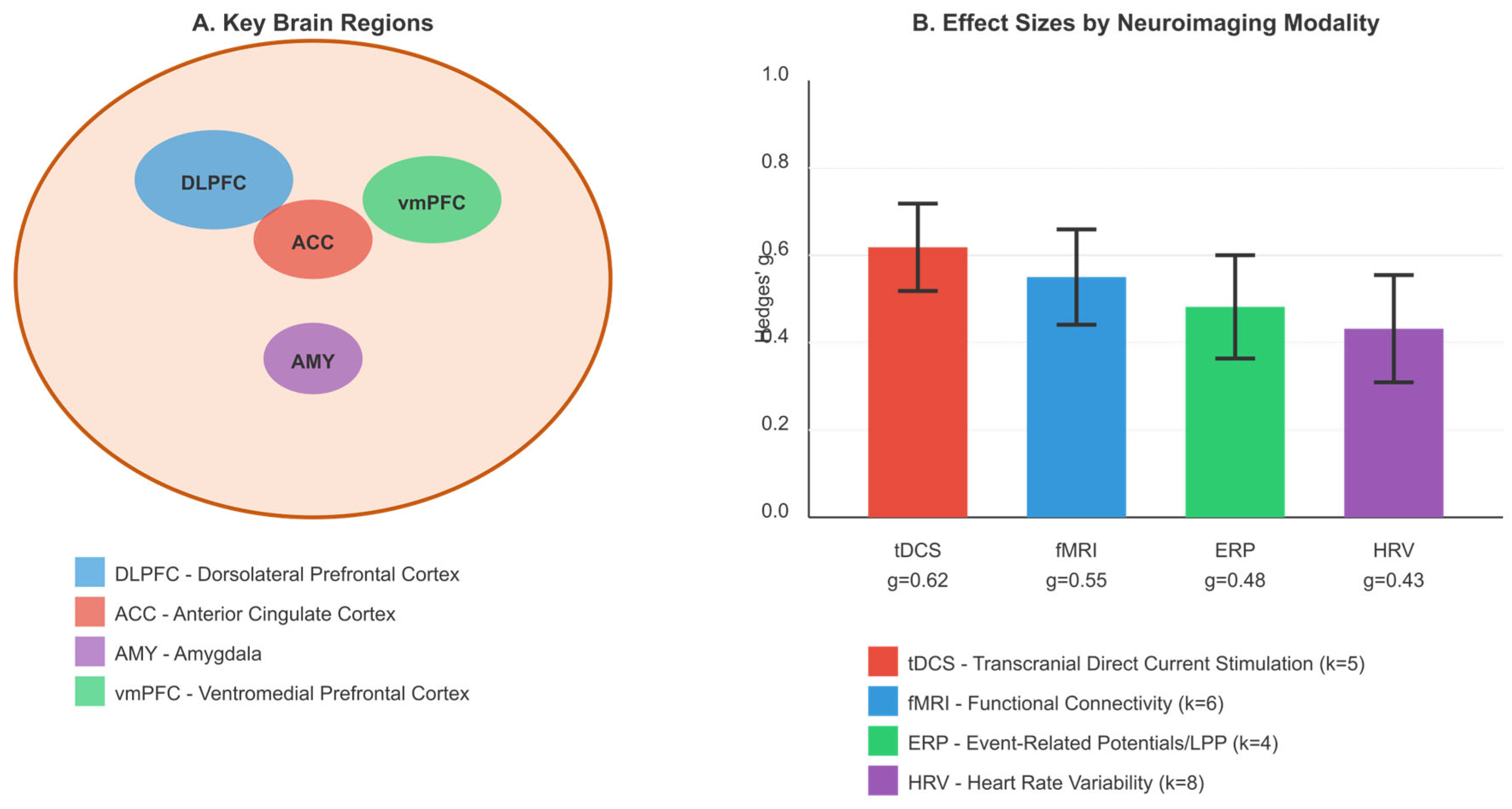



| Characteristic | RQ1 Exec. Function | RQ2 Emotion Reg. | RQ3 Mechanisms | RQ4 Mental Health | RQ5 Cog. Impair. | RQ6 Other Clin. |
|---|---|---|---|---|---|---|
| Number of studies (k) | 12 | 16 | 41 | 94 | 11 | 12 |
| Total participants (n) | 1484 | 2452 | 4454 | 12,899 | 482 | 984 |
| Study design, n (%) | ||||||
| RCT | 8 (66.7) | 12 (75.0) | 27 (65.9) | 57 (60.6) | 10 (90.9) | 7 (58.3) |
| Cluster-RCT | 0 (0.0) | 1 (6.3) | 0 (0.0) | 3 (3.2) | 0 (0.0) | 0 (0.0) |
| Quasi-experimental | 0 (0.0) | 0 (0.0) | 0 (0.0) | 2 (2.1) | 0 (0.0) | 1 (8.3) |
| Pilot/Feasibility | 1 (8.3) | 2 (12.5) | 2 (4.9) | 5 (5.3) | 0 (0.0) | 3 (25.0) |
| Other designs a | 3 (25.0) | 1 (6.3) | 12 (29.3) | 27 (28.7) | 1 (9.1) | 1 (8.3) |
| Delivery format, n (%) | ||||||
| Web-based platforms | 2 (16.7) | 5 (31.3) | 5 (12.2) | 25 (26.6) | 1 (9.1) | 2 (16.7) |
| Mobile applications | 0 (0.0) | 5 (31.3) | 2 (4.9) | 15 (16.0) | 0 (0.0) | 0 (0.0) |
| Chatbot/Conversational AI | 0 (0.0) | 1 (6.3) | 0 (0.0) | 8 (8.5) | 0 (0.0) | 0 (0.0) |
| Neuromodulation b | 0 (0.0) | 0 (0.0) | 11 (26.8) | 2 (2.1) | 0 (0.0) | 0 (0.0) |
| Virtual reality | 0 (0.0) | 0 (0.0) | 0 (0.0) | 1 (1.1) | 3 (27.3) | 1 (8.3) |
| Ecological momentary | 1 (8.3) | 2 (12.5) | 0 (0.0) | 5 (5.3) | 0 (0.0) | 0 (0.0) |
| Other digital modalities | 9 (75.0) | 3 (18.8) | 23 (56.1) | 38 (40.4) | 7 (63.6) | 9 (75.0) |
| Effect size (Hedges’ g) | ||||||
| Pooled g [95% CI] | 0.61 [0.44, 0.78] | 0.61 [0.51, 0.70] | 0.49 c | 0.72 [0.61, 0.83] | 1.02 [0.71, 1.33] | 0.19 [0.02, 0.36] |
| I2 (%) | 68.2 | 17.5 | 82.1 | 76.3 | 58.7 | 45.2 |
| 95% Prediction interval d | [0.12, 1.10] | [0.41, 0.80] | [−0.18, 1.16] | [0.15, 1.29] | [0.38, 1.66] | [−0.08, 0.46] |
| Publication years | 2020–2025 | 2021–2025 | 2020–2025 | 2020–2025 | 2021–2025 | 2020–2025 |
| Risk of bias, n (%) | ||||||
| Low | 5 (41.7) | 7 (43.8) | 17 (41.5) | 39 (41.5) | 5 (45.5) | 5 (41.7) |
| Some concerns | 5 (41.7) | 6 (37.5) | 15 (36.6) | 36 (38.3) | 4 (36.4) | 5 (41.7) |
| High | 2 (16.7) | 3 (18.8) | 9 (22.0) | 19 (20.2) | 2 (18.2) | 2 (16.7) |
| ER Domain | k | n | g [Range or Value] |
|---|---|---|---|
| Mindfulness-based ER programs | 2 | 112 | 1.02–1.11 |
| AI-platform/transdiagnostic digital ER | 4 | 1022 | 0.56–0.82 |
| Compassion-focused/CFT online ER | 2 | 271 | 0.70–0.79 |
| Cognitive reappraisal/CBM app | 2 | 206 | 0.65 |
| App-based mindfulness for healthcare/clinical | 2 | 172 | 0.45–0.50 |
| Internet-delivered anger/NSSI ER | 2 | 434 | 0.27–0.56 |
| AI emotion detection/EFL/chatbot | 3 | 235 | 0.40–0.56 |
| Analysis | k | g | 95% CI | Conclusion |
|---|---|---|---|---|
| All studies | 186 | 0.68 | [0.58, 0.78] | Reference |
| RCTs only | 121 | 0.71 | [0.60, 0.82] | Robust |
| Low RoB only | 78 | 0.74 | [0.61, 0.87] | Effect maintained |
| Trim-and-fill adjusted | 186 + 8 | 0.62 | [0.52, 0.72] | Effect robust |
Disclaimer/Publisher’s Note: The statements, opinions and data contained in all publications are solely those of the individual author(s) and contributor(s) and not of MDPI and/or the editor(s). MDPI and/or the editor(s) disclaim responsibility for any injury to people or property resulting from any ideas, methods, instructions or products referred to in the content. |
© 2026 by the authors. Licensee MDPI, Basel, Switzerland. This article is an open access article distributed under the terms and conditions of the Creative Commons Attribution (CC BY) license.
Share and Cite
Gkintoni, E.; Vantarakis, A. Neuropsychological Mechanisms Associated with the Effectiveness of AI-Delivered Health Promotion Programs: A Comprehensive Meta-Analysis. Brain Sci. 2026, 16, 389. https://doi.org/10.3390/brainsci16040389
Gkintoni E, Vantarakis A. Neuropsychological Mechanisms Associated with the Effectiveness of AI-Delivered Health Promotion Programs: A Comprehensive Meta-Analysis. Brain Sciences. 2026; 16(4):389. https://doi.org/10.3390/brainsci16040389
Chicago/Turabian StyleGkintoni, Evgenia, and Apostolos Vantarakis. 2026. "Neuropsychological Mechanisms Associated with the Effectiveness of AI-Delivered Health Promotion Programs: A Comprehensive Meta-Analysis" Brain Sciences 16, no. 4: 389. https://doi.org/10.3390/brainsci16040389
APA StyleGkintoni, E., & Vantarakis, A. (2026). Neuropsychological Mechanisms Associated with the Effectiveness of AI-Delivered Health Promotion Programs: A Comprehensive Meta-Analysis. Brain Sciences, 16(4), 389. https://doi.org/10.3390/brainsci16040389