What Can Neurosurgical Pediatric Populations Do in Functional Magnetic Resonance Imaging? Brain Activity Mapping Before Intervention Tasks, a Retrospective Study
 ,
,  and
and
Highlights
- The use of fMRI tasks on neurosurgical pediatric population can vary.
- Language and extra-language-related battery fMRI tasks are presented.
- Even young patients can reliably perform fMRI tasks.
- The approach proposes a personalized functional assessment of the young patient before surgery.
Abstract
1. Introduction
2. Materials and Methods
2.1. Participants
2.2. MRI Acquisition
2.3. fMRI Tasks
2.4. fMRI Analysis
3. Results
3.1. Case Series
3.2. fMRI Mapping
3.2.1. Relationship of fMRI Map with Intraoperative Stimulation Mapping
3.2.2. Case Series Examples
Extra-Language Functions
4. Discussion
Limitation of the Study
5. Conclusions
Author Contributions
Funding
Institutional Review Board Statement
Informed Consent Statement
Data Availability Statement
Conflicts of Interest
Abbreviations
| BAMBI | Brain Activity Mapping Before Intervention Tasks |
| fMRI | functional magnetic resonance imaging |
References
- Jaju, A.; Yeom, K.W.; Ryan, M.E. MR Imaging of Pediatric Brain Tumors. Diagnostics 2022, 12, 961. [Google Scholar] [CrossRef]
- Abu Mhanna, H.Y.; Omar, A.F.; Radzi, Y.M.; Oglat, A.A.; Akhdar, H.F.; Al Ewaidat, H.; Almahmoud, A.; Yaseen, A.-B.B.; Al Badarneh, L.; Alhamad, O.; et al. Systematic review of functional magnetic resonance imaging (fMRI) applications in the preoperative planning and treatment assessment of brain tumors. Heliyon 2025, 11, e42464. [Google Scholar] [CrossRef] [PubMed]
- Guerin, J.B.; Greiner, H.M.; Mangano, F.T.; Leach, J.L. Functional MRI in Children: Current Clinical Applications. Semin. Pediatr. Neurol. 2020, 33, 100800. [Google Scholar] [CrossRef]
- Charbonnier, L.; Raemaekers, M.A.; Cornelisse, P.A.; Verwoert, M.; Braun, K.P.; Ramsey, N.F.; Vansteensel, M.J. A functional magnetic resonance imaging approach for language laterality assessment in young children. Front. Pediatr. 2020, 8, 587593. [Google Scholar] [CrossRef]
- Desai, V.R.; Vedantam, A.; Lam, S.K.; Mirea, L.; Foldes, S.T.; Curry, D.J.; Adelson, P.D.; Wilfong, A.A.; Boerwinkle, V.L. Language lateralization with resting-state and task-based functional MRI in pediatric epilepsy. J. Neurosurg. Pediatr. 2019, 23, 171–177. [Google Scholar] [CrossRef]
- Genetti, M.; Grouiller, F.; Vulliemoz, S.; Spinelli, L.; Seeck, M.; Michel, C.M.; Schaller, K. Noninvasive language mapping in patients with epilepsy or brain tumors. Neurosurgery 2013, 72, 555–565. [Google Scholar] [CrossRef] [PubMed]
- Hoang, D.H.; Pagnier, A.; Cousin, E.; Guichardet, K.; Schiff, I.; Icher, C.; Dilharreguy, B.; Grill, J.; Frappaz, D.; Berger, C.; et al. Anatomo-functional study of the cerebellum in working memory in children treated for medulloblastoma. J. Neuroradiol. 2019, 46, 207–213. [Google Scholar] [CrossRef]
- Krafft, H.; Staudt, M. Clinical Speech fMRI in Children and Adolescents: Development of an Optimal Protocol and Analysis Algorithm. Clin. Neuroradiol. 2022, 32, 185–196. [Google Scholar] [CrossRef] [PubMed]
- Shurtleff, H.A.; Poliakov, A.; Barry, D.; Wright, J.N.; Warner, M.H.; Novotny, E.J.; Marashly, A.; Buckley, R.; Goldstein, H.E.; Hauptman, J.S.; et al. A clinically applicable functional MRI memory paradigm for use with pediatric patients. Epilepsy Behav. 2022, 126, 108461. [Google Scholar] [CrossRef]
- Jacola, L.M.; Schapiro, M.B.; Schmithorst, V.J.; Byars, A.W.; Strawsburg, R.H.; Szaflarski, J.P.; Plante, E.; Holland, S.K. Functional magnetic resonance imaging reveals atypical language organization in children following perinatal left middle cerebral artery stroke. Neuropediatrics 2006, 37, 46–52. [Google Scholar] [CrossRef]
- Sarlo, G.L.; Hooker, C.A.; Macdonald, K.T.; Sepeta, L.N.; Gaillard, W.D.; Xie, H.; Berl, M.M. FMRI activation during paragraph reading in pediatric epilepsy. Epilepsy Behav. 2025, 166, 110341. [Google Scholar] [CrossRef]
- Mankinen, K.; Ipatti, P.; Harila, M.; Nikkinen, J.; Paakki, J.J.; Rytky, S.; Starck, T.; Remes, J.; Tokariev, M.; Carlson, S.; et al. Reading, listening and memory-related brain activity in children with early-stage temporal lobe epilepsy of unknown cause-an fMRI study. Eur. J. Paediatr. Neurol. 2015, 19, 561–571. [Google Scholar] [CrossRef] [PubMed]
- Jenkinson, M.; Bannister, P.; Brady, M.; Smith, S. Improved optimization for the robust and accurate linear registration and motion correction of brain images. Neuroimage 2002, 17, 825–841. [Google Scholar] [CrossRef] [PubMed]
- Jenkinson, M.; Smith, S. A global optimisation method for robust affine registration of brain images. Med. Image Anal. 2001, 5, 143–156. [Google Scholar] [CrossRef]
- Korkman, M.; Kirk, U.; Kemp, S.L. Nepsy, II. Clinical and Interpretative Manual, 2nd ed.; Psychological Corporation: San Antonio, TX, USA, 2002. [Google Scholar]
- Bisiacchi, P.S.; Cendron, M.; Gugliotta, M.; Tressoldi, P.E.; Vio, C. BVN 5-11 Batteria di Valutazione Neuropsicologica per l’età Evolutiva; Erickson: Trento, Italy, 2005; Volume 1, pp. 1–324. ISBN 9788879467193. [Google Scholar]
- Gugliotta, M. BVN 12-18: Batteria di Valutazione Neuropsicologia per L’adolescenza; Edizioni Erickson: Trento, Italy, 2009; ISBN 978-8859036845. [Google Scholar]
- Miceli, G.; Laudanna, A.; Burani, C.; Capasso, R. Batteria per l’Analisi dei Deficits Afasici (BADA); CEPSAG: Roma, Italy, 1994. [Google Scholar]
- Woolrich, M.W.; Ripley, B.D.; Brady, M.; Smith, S.M. Temporal autocorrelation in univariate linear modeling of FMRI data. Neuroimage 2001, 14, 1370–1386. [Google Scholar] [CrossRef]
- Worsley, K.J.; Friston, K.J. Analysis of fMRI time-series revisited--again. Neuroimage 1995, 2, 173–181. [Google Scholar] [CrossRef]
- Worsley, K.J.; Liao, C.H.; Aston, J.; Petre, V.; Duncan, G.; Morales, F.; Evans, A. A general statistical analysis for fMRI data. Neuroimage 2002, 15, 1–15. [Google Scholar] [CrossRef]
- Lakhani, D.A.; Sabsevitz, D.S.; Chaichana, K.L.; Quiñones-Hinojosa, A.; Middlebrooks, E.H. Current state of functional MRI in the presurgical planning of brain tumors. Radiol. Imaging Cancer 2023, 5, e230078. [Google Scholar] [CrossRef]
- Engelhardt, L.E.; Roe, M.A.; Juranek, J.; DeMaster, D.; Harden, K.P.; Tucker-Drob, E.M.; Church, J.A. Children’s head motion during fMRI tasks is heritable and stable over time. Dev. Cogn. Neurosci. 2017, 25, 58–68. [Google Scholar] [CrossRef] [PubMed]
- Yuan, W.; Altaye, M.; Ret, J.; Schmithorst, V.; Byars, A.W.; Plante, E.; Holland, S.K. Quantification of head motion in children during various fMRI language tasks. Hum. Brain Mapp. 2009, 30, 1481–1489. [Google Scholar] [CrossRef]
- Davis, B.R.; Garza, A.; Church, J.A. Key considerations for child and adolescent MRI data collection. Front. Neuroimaging 2022, 1, 981947. [Google Scholar] [CrossRef] [PubMed]
- Price, C.J.; Friston, K.J. Scanning patients with tasks they can perform. Hum. Brain Mapp. 1999, 8, 102–108. [Google Scholar] [CrossRef]
- Meissner, T.W.; Walbrin, J.; Nordt, M.; Koldewyn, K.; Weigelt, S. Head motion during fMRI tasks is reduced in children and adults if participants take breaks. Dev. Cogn. Neurosci. 2020, 44, 100803. [Google Scholar] [CrossRef] [PubMed]



| Reference | fMRI Task | n. Patients/Pathology | Conclusion |
|---|---|---|---|
| Charbonnier L. et al. (2020) [4] | Story listening, letter–picture matching, verb generation | 32 healthy children (6–10 yrs) + 7 with epilepsy (7–11 yrs) | Designing tasks that match children’s interests and abilities allows for reliable mapping of language areas in both healthy children and those with epilepsy. Child-friendly tasks enable assessments of laterality. |
| Desai V.R. et al. (2019) [5] | rs-fMRI vs. tb-fMRI (verb generation, sentence completion) | 29 children with epilepsy | Very high rs/tb-fMRI concordance (0.93); rs useful if uncooperative. |
| Genetti M. et al. (2013) [6] | Auditory semantic decision (8 min) | 28 healthy controls and 35 consecutive patients with focal epilepsy or a brain tumor. | The proposed language tb-fMRI techniques have reliably localized language areas, becoming a valuable additional tool for surgical planning for seizure foci and brain tumors. |
| Hoang D.H. et al. (2019) [7] | Working memory (block-design) | 23 controls + 11 post-medulloblastoma (8–14 yrs) | The use of rs-fMRI and tb-fMRI can improve surgical outcomes. |
| Krafft H. and Staudt M. (2022) [8] | Vowel identification task, word-chain task, beep-story task, synonym task | 114 pediatric cases (5.8–17.8 yrs) with different etiologies | Based on 13 regions of interest (ROIs) valid for language lateralization (VLR_old), it was possible to classify language dominance. Four new task-specific VLRs (VLR_new) were identified, consistent with language dominance in patients. An optimal order for the q tasks was proposed. |
| Shurtleff H.A. et al. (2022) [9] | Memory autobiographical task encoding + retrieval (inside/outside scanner); language protocols involved verb and sentence generation | 72 patients (6.7–20.9 yrs) with seizure focus and/or tumor | Bilateral activation of temporal lobe. A clinically applicable functional MRI memory paradigm for use with pediatric patients. |
| Jacola et al. (2006) [10] | Verb generation + story listening | 3 children with perinatal stroke + 39 controls | In stroke pt, activity during verb generation tends to be bilateral or shifted towards the right hemisphere, while in controls, activation is strongly lateralized to the left. In subjects with lesions, there is bilateral or right-sided activation in story-listening tasks. Reorganization of language after stroke. |
| Sarlo et al. (2025) [11] | Paragraph-reading task | 41 children with epilepsy (6–16 yrs) | There was no significant difference in fMRI activation during the paragraph-reading task between the groups. Better reading skills correlated with greater activation in the left superior temporal gyrus. Struggling readers show less activation in specific areas: bilateral temporal gyri, left cerebellum, and right inferior frontal gyrus. This paradigm is robust for identifying the language network, for example, for presurgical language mapping in children with epilepsy. |
| Mankinen et al. (2015) [12] | Reading, story listening, memory encoding, memory retrieval | 21 children with epilepsy + 21 control | Different BOLD activation only in story listening (thalamus right, basal ganglia right). In patients with TLE, activation was increased compared to controls, and deactivation was decreased in the story-listening task. |
| Task | TR (ms) | TE (ms) | Voxel Size (mm) | Thickness (mm) | Number of Slices | Field of View (mm) | Acquisition Matrix | Flip Angle | Number of Volumes | Number Task_Blocks/Rest_Blocks | Duration Task_Blocks/Rest_Blocks | Total Time (min:s) |
|---|---|---|---|---|---|---|---|---|---|---|---|---|
| Arrows | 2500 | 35 | 1.797 × 1.797 | 3 | 29 | 230 × 88.33 × 230 | 128 × 128 | 90 | 132 | 9/10 | 20 s/15 s | 5:30 |
| Visual search | 2500 | 35 | 1.797 × 1.797 | 3 | 29 | 230 × 88.33 × 230 | 128 × 128 | 90 | 118 | 8/9 | 20 s/15 s | 4:54 |
| Memory | 2500 | 35 | 1.797 × 1.797 | 3 | 29 | 230 × 88.33 × 230 | 128 × 128 | 90 | 126 | 8/9 | 22.5 s/15 s | 5:15 |
| Inhibition/switch | 2500 | 35 | 1.797 × 1.797 | 3 | 29 | 230 × 88.33 × 230 | 128 × 128 | 90 | 186 | 15/16 | 15 s/15 s | 7:45 |
| Naming | 2500 | 35 | 1.797 × 1.797 | 3 | 29 | 230 × 88.33 × 230 | 128 × 128 | 90 | 78 | 6/7 | 15 s/15 s | 3:15 |
| Word listening | 2500 | 35 | 1.797 × 1.797 | 3 | 29 | 230 × 88.33 × 230 | 128 × 128 | 90 | 66 | 5/6 | 15 s/15 s | 2:45 |
| Hands localizer | 2500 | 35 | 1.797 × 1.797 | 3 | 29 | 230 × 88.33 × 230 | 128 × 128 | 90 | 102 | 8/9 | 15 s/15 s | 4:15 |
| Feet localizer | 2500 | 35 | 1.797 × 1.797 | 3 | 29 | 230 × 88.33 × 230 | 128 × 128 | 90 | 102 | 8/9 | 15 s/15 s | 4:15 |
| Tongue localizer | 2500 | 35 | 1.797 × 1.797 | 3 | 29 | 230 × 88.33 × 230 | 128 × 128 | 90 | 54 | 4/4 | 15 s/15 s | 2:15 |
| Mental navigation | 2500 | 35 | 1.797 × 1.797 | 3 | 29 | 230 × 88.33 × 230 | 128 × 128 | 90 | 108 | 8/8 | 15 s/15 s | 4:30 |
| Task | Function Examined | Task Description | nr Stimuli per Block/Total nr Stimuli/Each Stimulus Lasts (Seconds) |
|---|---|---|---|
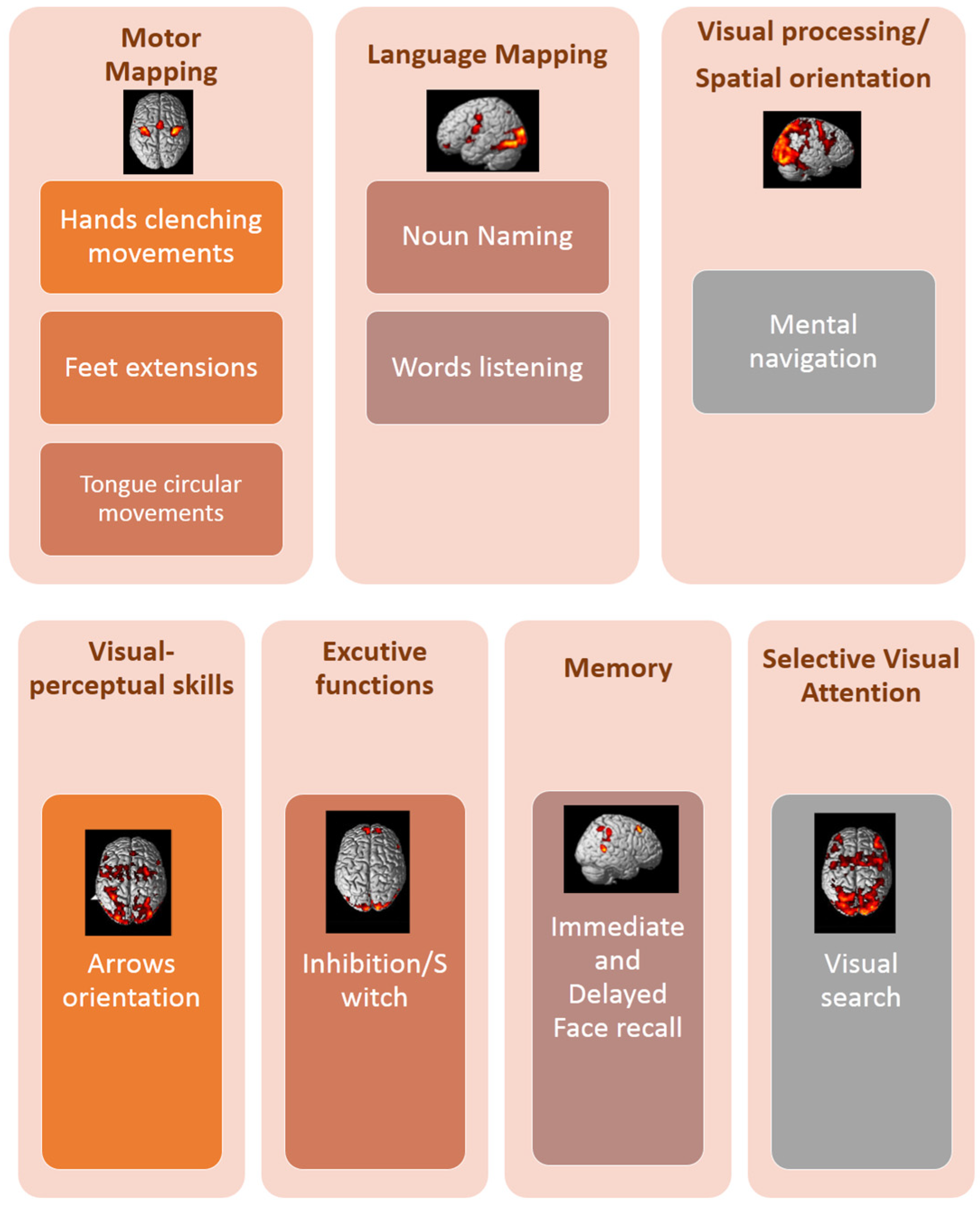
| Arrows [15] | Visual perceptual skills | The child sees a target and a variable number of arrows, which are marked with a number that may or may not point in the target’s direction. They have to say which of them, point to the target. | 5/50/4 |
| Inhibition/switch [15] | Ability to inhibit automatic responses in favor of new ones | The task consists of three parts. The stimuli are white or black squares and circles distributed randomly. 1—Say the name of the shapes one sees (squares and circles). 2—Say the opposite name of the shape one sees: if it is a square, say circle. 3—When the shape is black, one says the correct name of the shape; when the shape is white, one has to say the opposite name. | 1/15/15 |
| Memory [15] | Decoding facial features; recognizing and distinguishing faces; memory and learning non-verbal material | The task consists of two parts 1—Black-and-white faces are shown, and the subject must press key 1 if it is a male and key 2 if it is a female. 2—Triplets of faces are shown, and the subject must press keys 1 to 3 to indicate which face they saw previously. | 4/15 learning + 15 recognition/5 |
| Visual search [15] | Selective visual attention | The subject is presented with a target face (a girl). The task is to recognize all faces that are the same as the target during the scan by pressing a button (right hand) that corresponds to “yes” and a button (left hand) that corresponds to “no”. The second scan has a boy’s face as the target. The drawings are in black and white. | 20/160/1 |
| Naming [16,17] | Naming ability, retrieval of the correct lemma | The subject is asked to covertly name a series of black-and-white images depicting objects/animals. | 8/46/1.875 |
| Word listening [18] | Auditory processing; word listening | The subject is asked to pay attention to the words. | 12/216/1.25 |
| Motor tongue movement | Tongue circular movements | Subjects are asked to move their tongue inside their mouth, which must be kept closed. The “task” moments alternate with pause moments in which the subject must remain still and do nothing. | 4/4/15 |
| Motor hands movement | Hands clenching movements | With their hands at their sides and palms facing upwards, subjects are asked during the “task” phases to open and close their hands until the word “move” appears on the screen. The task phases alternate with “rest” phases in which they do not have to do anything. | 8/8/15 |
| Motor feet movement | Feet extension movements | Subjects are asked to move their foot by pointing their toes up/down every time the word “move” appears on the screen. During the “rest” phases, they must do nothing and remain still. | 8/8/15 |
| Mental navigation | Perceptual/mental navigation | The subject is presented with videos showing a labyrinth room with the camera moving inside. They imagine walking in and exploring the space. During the “rest” phases, they must do nothing and remain still. | 3/24/5 |
| Case | Age | Education | Sex | Histology | Site | Side |
|---|---|---|---|---|---|---|
| 1 | 16 | 10 | m | Pilocytic astrocytoma/pleomorphic xanthoastrocytoma | Frontal | RH |
| 2 | 15 | 9 | m | Oligodendroglioma | Temporo-parietal | LH |
| 3 | 16 | 10 | f | Papillary glioneuronal | Frontal | LH |
| 4 | 13 | 7 | m | Pilocytic | Fronto-parietal | LH |
| 5 | 13 | 7 | f | Glioneuronal tumor | Occipital | LH |
| 6 | 7 | 1 | m | Glioneuronal tumor | Occipital | RH |
| 7 | 15 | 9 | f | Glioneuronal tumor | Temporal | LH |
| 8 | 12 | 6 | m | DNET | Temporo-parietal | LH |
| 9 | 16 | 10 | m | Low-grade I | Frontal | RH |
| 10 | 8 | 2 | m | Glial tumor | hippocampus | RH |
| 11 | 9 | 3 | f | Glioblastoma | Parietal | RH |
| 12 | 13 | 7 | f | Expansive lesion ganglioglioma | Temporal | RH |
| 13 | 16 | 10 | f | Dysplasia | Frontal | RH |
| 14 | 15 | 9 | m | Cavernoma | Temporal | LH |
| 15 | 15 | 9 | f | Arteriovenous malformation | Temporal | LH |
| 16 | 14 | 8 | f | Cavernoma | Parietal | RH |
| 17 | 15 | 9 | f | Sclerosis | Hippocampus | LH |
| Site | Motor Localizers | Language Localizers | Mental Navigation | Extra-Language Tasks |
|---|---|---|---|---|
| Hippocampus/occipital cortex | 4/4 | |||
| Frontal or fronto/parietal | 4/5 | 4/5 | 3/5 | |
| Temporal or temporo/parietal | 5/6 | 6/6 | 2/6 | |
| Parietal | 2/2 | 2/2 |
| Case | fMRI Cluster Close to the Lesion (1)/Far from It (0) | fMRI Cluster Detail | Awake Surgery (1)/General Anesthesia (0) | Stimulation/Mapping Positive (1)/Negative (0) | Stimulation Details | Extent of Resection |
|---|---|---|---|---|---|---|
| 1 | 1 | Naming-related act. lateral/close | 1 | 0 | Mapping by language and subcortical areas. Negative response. | total |
| 2 | 1 | Naming-related act. anterior and within | 1 | 1 | Cortical monitoring plus tests. Partial removal of the neoplasm, constant intraoperative subcortical monitoring. Positive response for language (naming) | partial |
| 3 | 1 | The motor part of speech: superior, lateral and contiguous | 1 | 1 | Negative language stimulation, removal of the lesion clearly defined with respect to the parenchyma. In the final part, fluency worsens; stimulation causes speech arrest. However, this part appears healthy close to the lesion. | total |
| 4 | 1 | Hands: posterior, lateral, contiguous | 1 | 1 | Lesion in front of the motor strip and mapping shows motor response. | total |
| 5 | 0 | 0 | - | - | total | |
| 6 | 0 | 0 | - | - | total | |
| 7 | 0 | 0 | - | - | total | |
| 8 | 0 | 0 | - | - | total | |
| 9 | 0 | 0 | - | - | total | |
| 10 | 0 | 0 | - | total | ||
| 11 | 1 | Hands: superior, close | 0 | 1 | Mapping only for arm above the right margin of the lesion | total |
| 12 | 0 | 0 | - | - | total | |
| 13 | 1 | Naming: anterior, contiguous | 0 | - | - | total |
| 14 | 0 | 0 | - | - | total | |
| 15 | 0 | 0 | - | - | total | |
| 16 | 0 | 0 | - | - | total | |
| 17 | 0 | 0 | - | - | total |
Disclaimer/Publisher’s Note: The statements, opinions and data contained in all publications are solely those of the individual author(s) and contributor(s) and not of MDPI and/or the editor(s). MDPI and/or the editor(s) disclaim responsibility for any injury to people or property resulting from any ideas, methods, instructions or products referred to in the content. |
© 2026 by the authors. Licensee MDPI, Basel, Switzerland. This article is an open access article distributed under the terms and conditions of the Creative Commons Attribution (CC BY) license.
Share and Cite
Guarracino, I.; Maieron, M.; D’Agostini, S.; Skrap, M.; Cogo, P.; Ius, T.; Tomasino, B. What Can Neurosurgical Pediatric Populations Do in Functional Magnetic Resonance Imaging? Brain Activity Mapping Before Intervention Tasks, a Retrospective Study. Brain Sci. 2026, 16, 374. https://doi.org/10.3390/brainsci16040374
Guarracino I, Maieron M, D’Agostini S, Skrap M, Cogo P, Ius T, Tomasino B. What Can Neurosurgical Pediatric Populations Do in Functional Magnetic Resonance Imaging? Brain Activity Mapping Before Intervention Tasks, a Retrospective Study. Brain Sciences. 2026; 16(4):374. https://doi.org/10.3390/brainsci16040374
Chicago/Turabian StyleGuarracino, Ilaria, Marta Maieron, Serena D’Agostini, Miran Skrap, Paola Cogo, Tamara Ius, and Barbara Tomasino. 2026. "What Can Neurosurgical Pediatric Populations Do in Functional Magnetic Resonance Imaging? Brain Activity Mapping Before Intervention Tasks, a Retrospective Study" Brain Sciences 16, no. 4: 374. https://doi.org/10.3390/brainsci16040374
APA StyleGuarracino, I., Maieron, M., D’Agostini, S., Skrap, M., Cogo, P., Ius, T., & Tomasino, B. (2026). What Can Neurosurgical Pediatric Populations Do in Functional Magnetic Resonance Imaging? Brain Activity Mapping Before Intervention Tasks, a Retrospective Study. Brain Sciences, 16(4), 374. https://doi.org/10.3390/brainsci16040374