Article

Leuprolide Acetate Promotes Sensory Recovery and Modulates Dorsal Root Ganglion Responses After Sciatic Nerve Transection in Rats


by
Irma Hernández-Jasso
1,
Denisse Calderón-Vallejo
1,
José Ávila-Mendoza
2,
David Epardo
2,
Jerusa E. Balderas-Márquez
2,
Carlos Arámburo
2,
J. Luis Quintanar
1,* and
Carlos G. Martínez-Moreno
2,*
1
Departamento de Fisiología y Farmacología, Centro de Ciencias Básicas, Universidad Autónoma de Aguascalientes, Aguascalientes 20100, Mexico
2
Departamento de Neurobiología Celular y Molecular, Instituto de Neurobiología, Campus Juriquilla, Universidad Nacional Autónoma de México, Querétaro 76230, Mexico
*
Authors to whom correspondence should be addressed.
Brain Sci. 2026, 16(3), 332; https://doi.org/10.3390/brainsci16030332
Submission received: 16 February 2026 / Revised: 17 March 2026 / Accepted: 18 March 2026 / Published: 20 March 2026
(This article belongs to the Section Molecular and Cellular Neuroscience)

Highlights

What are the main findings?
LA promotes selective recovery of cold sensitivity after sciatic nerve transection.
LA enhances retrograde axonal transport after sciatic nerve transection.
LA attenuates reactive gliosis and macrophage activation in dorsal root ganglia after sciatic nerve transection.
LA modulates the expression of key pro-regenerative genes in peripheral nerve injury.
What is the implication of the main finding?
The results suggest that LA could be a promising therapeutic strategy to improve sensory recovery and neuroregeneration following peripheral nerve injury.

Abstract

Background/Objectives: Sciatic nerve injuries are among the most common classes of peripheral nerve harm and have a strong impact on quality of life, as well as a significant negative economic impact for patients, society, and governments, since they represent a frequent cause of work-related disabilities and sick leave applications. Following nerve injury, neurons, Schwann, and satellite cells undergo marked changes in phenotype, metabolic activity, neuronal survival, nervous transmission, and an exacerbated activation of the inflammatory response. Leuprolide acetate (LA), a clinically available agonist of gonadotropin-releasing hormone (GnRH), has shown clear neurotrophic properties and is considered a novel potential candidate for treating neural injuries, including sciatic nerve pathologies. This study aimed to analyze the effect of LA treatment on sensory function and dorsal root ganglia (DRG) changes in a rat sciatic nerve full-transection (SNT) model. Methods: Variations in cold and heat sensitivity were assessed using the thermal plate test, while DRG tissue sections were examined for modifications in reactive gliosis by immunofluorescence analysis, and axonal transport using a retrograde tracer. Also, changes in the expression of pro-regenerative genes Stat3, Socs3, Fos, Jun, Atf4, and Limk1 were quantified by qPCR. Results: Our results showed that LA treatment exerted a distinct neurotrophic effect, since it promoted the specific recovery of cold sensitivity, improved axonal transport, regulated the inflammatory response, and modulated the exacerbated expression of pro-regenerative genes in the SNT model. Conclusions: These findings indicate that LA therapy may have the potential to improve sensory recovery in patients with sciatic nerve injuries.

1. Introduction

Sciatic nerve (SN) pathologies include ischemia/hypoxia, trauma, mechanical compression, and bone fractures as primary etiological factors leading to functional and structural nerve damage [1,2,3]. It is important to note that the sciatic nerve originates in the spinal cord, and the sensory pathway includes the dorsal root ganglia (DRG) as a relay before re-entering the central nervous system [4]. DRG are simple neural structures containing the cell bodies of sensory neurons; their axons, together with motor neuron axons, form the sciatic nerve [5,6,7].
Following SN injury, important modifications are induced in cell metabolism, neuronal survival processes, electrochemical impulse transmission, and the activation of the inflammatory response, which is mediated mainly by glial cells and peripheral immune cells that infiltrate the nerves and the central nervous system (CNS) [8,9]. Initially, during the acute and subacute phases of the lesion, the interaction between satellite cells, infiltrating immune cells, and sensory neurons is able to activate mechanisms that promote axonal neuroprotection and regeneration, which could eventually lead to functional reinnervation; this is a specific characteristic of peripheral nerves [10,11,12]. However, existing therapeutic options often fail to achieve complete restoration due to inflammation, glial scarring, and misdirection of regenerating sensory axons, resulting in neuropathic pain and compromised sensory and motor capabilities [13,14]. Therefore, innovative experimental approaches are being explored to develop effective strategies for functional nerve regeneration after damage.
Neurotrophic factors are intimately involved in neuroregeneration in the CNS, peripheral nerves, and innervated tissues, including classical neurotrophins such as brain-derived neurotrophic factor (BDNF), ciliary neurotrophic factor (CNTF), and nerve growth factor (NGF) [15,16]. In the peripheral nervous system, neurotrophic factors play critical roles in the survival, differentiation, tissue homeostasis, and regeneration of DRG neurons, Schwann cells, and even stromal cells [17,18,19]. It is important to note that Schwann cells are key players during nerve regeneration, as they guide axonal regrowth [20].
Gonadotropin-releasing hormone (GnRH) is a decapeptide that was initially described in the hypothalamus, although now it is well established that it is produced in many tissues and cell types [21,22]. GnRH exerts its effects by binding to its receptor (GnRH-R); in the pituitary, this activation induces the production and secretion of luteinizing hormone (LH) and follicle-stimulating hormone (FSH), which, in turn, regulate gonadal functions [23,24]. Lately, novel roles for the GnRH peptide in other regions of the CNS have been described, and these are associated with aging, cognition, motor function, and inflammation [25,26,27,28,29]. Particularly in the SN, our group recently reported that GnRH was able to induce functional recovery after neural injury [30,31]. Leuprolide acetate is a synthetic nonapeptide and a gonadotropin-releasing hormone (GnRH) agonist that is less susceptible to enzymatic proteolysis and has a higher affinity for the GnRH receptor, which enhances its biological activity [32]. Because native GnRH has limited clinical applicability due to its rapid degradation, we used leuprolide acetate (LA), a clinically approved GnRH agonist widely used in the treatment of precocious puberty and other reproductive disorders.
There is increasing evidence supporting the neurotrophic properties of LA, making it a promising therapeutic option for conditions such as multiple sclerosis, brain trauma, spinal cord damage, and peripheral nerve injuries [33,34,35,36]. The aim of this study was to analyze the effect of LA treatment on sensory function and DRG in a rat sciatic nerve transection (SNT) model.

2. Materials and Methods

2.1. Animals

Male Wistar rats weighing between 250 and 300 g were obtained from the vivarium at the Universidad Autónoma de Aguascalientes (UAA). The rats were individually housed under standardized conditions, with food and water available ad libitum. The housing environment was maintained at a constant temperature of 21 °C, a relative humidity of 50%, and a 12:12 h light–dark cycle with artificial illumination. All experiments were conducted during the light phase of the cycle. The rats were randomly assigned to one of three experimental groups: sham-operated control (not damaged and untreated), sciatic nerve transection (SNT) group treated with saline solution, and SNT group treated with LA (SNT + LA), with n = 6–8 animals per group; the sample size was determined using G*power 3.1 software. All experimental protocols and procedures were conducted in strict accordance with the ethical guidelines outlined in the guide for the care and use of experimental animals by the U.S. National Institutes of Health (NIH). All procedures adhered to the animal welfare regulations committee of the UAA (CEADI/UAA/0025/18) and to the ARRIVE guidelines.

2.2. Sciatic Nerve Transection and Postoperative Care

The surgical procedure utilized the full-transection model previously described in detail by Hernández-Jasso et al. [35]. Briefly, with the animals under deep anesthesia (ketamine/xylazine 50/10 mg/kg), the sciatic nerve of the left limb was exposed and cut using straight microsurgical scissors. The nerve was then reanastomosed to the distal stump by stitching the epineural layer with microsutures (Atramat, Mexico City, Mexico, PGA surgical sutures, 8-0). The muscle and skin were subsequently sewn. To promote healing and alleviate discomfort, a topical antiseptic was applied, and sodium metamizole (15 mg/kg) was administered intramuscularly (IM) once daily for 3 days. After surgery, the animals were placed in a recovery chamber.

2.3. Treatment

Administration of LA (Sigma, St. Louis, MO, USA) was initiated one day after SNT. LA was injected intramuscularly (100 µL) at a dose of 10 µg/kg once daily for three consecutive days; thereafter, IM injections were administered every three days over a five-week period. This treatment protocol was similar to that used in previous experiments conducted in spinal cord and sciatic nerve injury models [33,35]. Animals in the sham and SNT groups received 100 µL of 0.9% sodium chloride solution by intramuscular injection.

2.4. Retrograde Axonal Transport Analysis

Five weeks after injury, animals from all experimental groups were anesthetized (ketamine/xylazine 50/10 mg/kg), and their left sciatic nerve was exposed through an incision parallel to the femur and then isolated from the surrounding soft tissue. Later, the peroneal, tibial, and saphenous branches were identified and separated. Using a 5 µL micro-syringe (Hamilton, Biel, Switzerland, 87943) with a 34 G needle (Hamilton, Biel, Switzerland, 207434-10), 2 µL of the anionic tracer (dextran; Invitrogen, Carlsbad, CA, USA, Alexa Fluor 568; 10,000 MW) was injected into each left sciatic nerve. The tip of the needle was initially advanced approximately 1 to 2 mm into each nerve branch, and the volume was infiltrated slowly over approximately 1 min. The needle was left in place for an additional 2 min and then slowly withdrawn to prevent leakage of the injected solution. This procedure was repeated for each branch of the nerve, and then the wound was sutured. The animals were sacrificed 72 h after tracer injection. Each animal was deeply anesthetized with ketamine/xylazine (50/10 mg/kg) and perfused with 150 mL of sterile saline solution (0.9% NaCl). After perfusion, dorsal root ganglia (L4, L5, L6, and S1) were removed and fixed in 4% paraformaldehyde (PFA) (Sigma, St. Louis, MO, USA) and cryopreserved until use. DRGs were sectioned and prepared for immunofluorescence as previously described, and images were captured directly after microscopical analysis [31].

2.5. Immunohistochemistry and Fluorescence Microscopy

Three days after tracer injection, the animals were deeply anesthetized with ketamine/xylazine (50/10 mg/kg) and perfused with physiological saline. Tissue, including dorsal root ganglia (DRG) and sciatic nerves, was collected for immunofluorescence analyses. To evaluate gliosis in the injured tissue, which may serve as an indicator of neurological recovery, immunofluorescence analysis of glial fibrillary acidic protein (GFAP) was performed. Additionally, to assess the possible infiltration of macrophages in response to the injury, Iba1 localization was analyzed. Dorsal root ganglia (DRG) and nerve tissues were fixed overnight in 4% paraformaldehyde at 4 °C. The tissues were then transferred to a series of increasing sucrose concentrations (10%, 20%, and 30%) in 0.1 M phosphate buffer (pH 7.4), spending 24 to 36 h at each concentration for cryoprotection prior to sectioning. Following cryoprotection, the sciatic nerves and DRG were embedded in Tissue-Tek O.C.T. compound (Sakura Finetek, Torrance, CA, USA) and mounted onto aluminum sectioning blocks. Fifteen-micrometer-thick sections were obtained using a cryostat (Leica CM3050 S, Buffalo Grove, IL, USA), producing longitudinal sections of the nerves and cross-sections of the DRG. The tissue sections were mounted on silane-treated glass slides to enhance adhesion. The sections were incubated with primary polyclonal antibodies against GFAP and Iba1 (Table 1), diluted in PBS containing 0.05% Triton X-100 and 1% non-fat dry milk, and incubated overnight at 4 °C. The secondary antibodies (Table 1) were diluted 1:1000 in TPBS with 1% non-fat dry milk (Bio-Rad, Hercules, CA, USA), and DAPI (100 ng/mL) (Sigma-Aldrich, St. Louis, MO, USA) was used for nuclear counterstaining. Incubation was carried out for 2 h at room temperature. Control samples without primary antibodies were included in the analysis. Because satellite glial cells closely surround neuronal somata in the DRG, quantitative assessment of GFAP immunoreactivity specifically around neuronal cell bodies can be technically challenging and may lead to apparent neuronal labeling due to the tight anatomical association between these cells. Therefore, to obtain a more reliable assessment of glial reactivity, quantitative analysis of GFAP expression was performed in the nerve root region, where increased GFAP expression in glial cells following nerve injury was consistently reported. Images were captured using an Olympus BX51 fluorescence microscope (Tokyo, Japan) and analyzed with ImageJ 2.16.0 software (NIH, Bethesda, MD, USA).

2.6. Morphological Analysis of Iba1-Postive Cells

Iba1 immunostaining was analyzed using the Skeleton Analysis and FracLac plugins in ImageJ (Fiji distribution, NIH, Bethesda, MD, USA). Images were converted to grayscale and then binarized after brightness and contrast adjustment to enhance the visualization of cellular processes. Individual Iba1-positive cells (macrophages) (n = 100) were isolated for subsequent analysis. Binary images were refined using the close and remove outlier functions.
For morphometric evaluation, images were skeletonized and analyzed using the Skeleton Analysis plugin to quantify the number of branches. Fractal analysis was performed using the FracLac plugin with the box-counting method (grid parameter “Num G” = 4), and the parameter obtained was circularity (an indicator of how circular the cell is).

2.7. Gene-Expression Quantification by Real-Time Polymerase Chain Reaction (qPCR)

DRG tissue was subjected to total RNA extraction using the TRIzol Reagent (Invitrogen) according to the manufacturer’s protocol. Each sample, consisting of 250 ng of total RNA, was treated with 20 IU of DNase I (Promega, Madison, WI, USA) for 30 min at 37 °C to remove any contaminating genomic DNA. Subsequently, cDNA synthesis was performed using the High Capacity Reverse Transcription Kit with ribonuclease inhibitor (Applied Biosystems, Waltham, MA, USA). Quantitative real-time PCR was conducted on a StepOne Systems machine (Applied Biosystems) using Maxima SYBR Green/ROX qPCR Master Mix (Thermo Scientific, Waltham, MA, USA). Oligonucleotide primers (listed in Table 2) were designed to span exon–exon boundaries whenever possible, utilizing the BLAST primer algorithm (https://www.ncbi.nlm.nih.gov/tools/primer-blast/ accessed on 3 March 2024). Changes in gene expression were assessed using the comparative threshold cycle (CT) method and the 2-ΔΔCT formula [37]. The target genes were normalized to the geometric mean of the mRNA levels of the reference genes Gapdh and Ppia, with the vehicle treatment used as the calibrator.

2.8. Hot/Cold Test for Sensory Recovery

Hind paw withdrawal latency to heat stimulation was assessed using the hot plate test [38]. The entire ventral surface of the left hind paw was placed on a hot plate (Panlab Instruments; Harvard Apparatus, Barcelona, Spain) maintained at a fixed temperature of 50 °C, ensuring that the time the rat remained on the plate did not exceed 60 s to prevent damage. Similarly, withdrawal latency to cold stimulation was assessed using a cold plate maintained at a constant temperature of −4 °C. The maximum time the rat was allowed to remain on the cold plate was set to 150 s to avoid freezing damage.

2.9. Statistical Analysis

Data are expressed as mean ± SEM. One-way analysis of variance (ANOVA) and Tukey’s and Fisher’s LSD post hoc tests were performed using GraphPad Prism version 9.00 (GraphPad Software, San Diego, CA, USA). Differences were considered significant at p < 0.05. All the experimental groups contained 6–8 animals.

3. Results

3.1. Effect of LA in Sensory Recovery After SNT

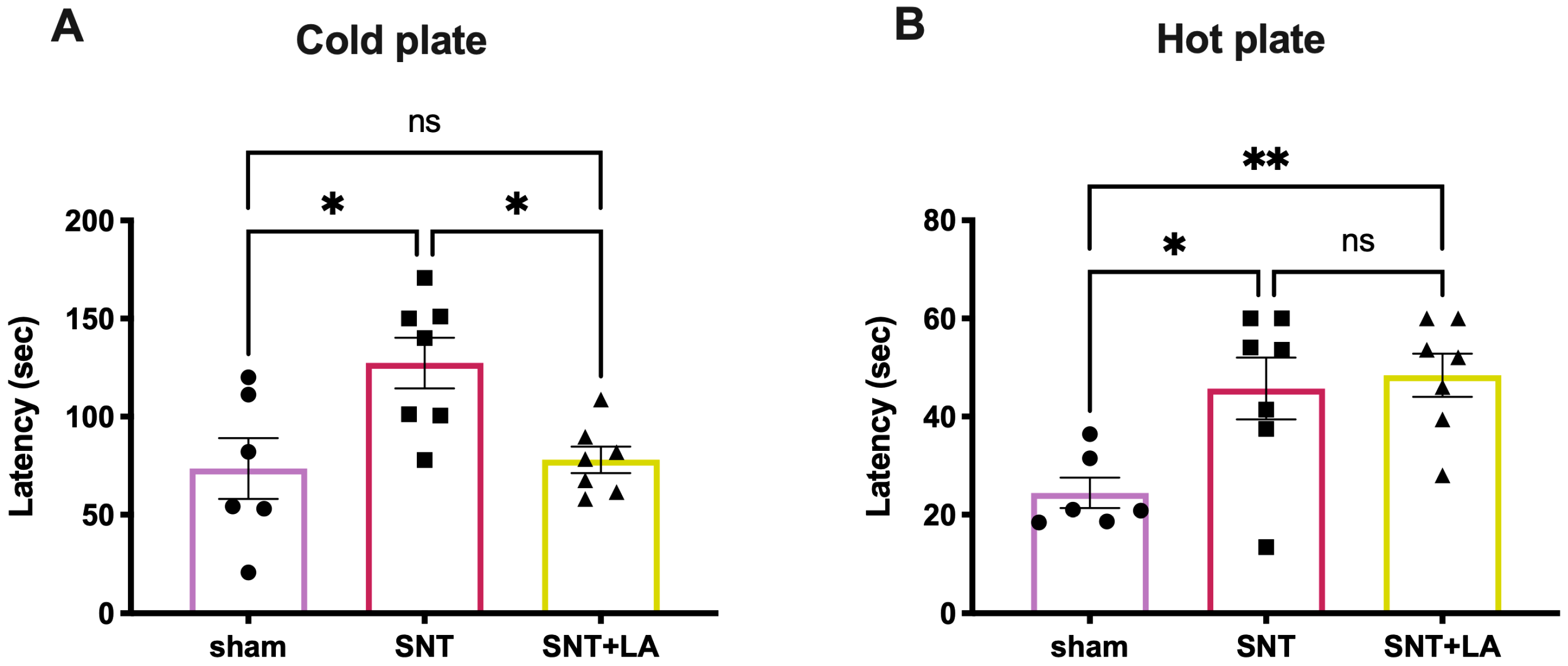
Thermal behavioral tests were used to assess the effect of LA administration, for 5 weeks, on sensory recovery (cold and heat) in SNT-injured rats. Response latency was recorded using the thermal plate test (Figure 1). In the cold sensitivity test (Figure 1A), the sham control group showed a latency of 73.58 ± 15.54 s, which increased significantly to 127.4 ± 12.89 s in the SNT group (p ≤ 0.05). In turn, LA treatment induced a significant recovery of the sensory response to cold compared with the lesioned untreated group, as the SNT + LA group showed a reduced latency of 78.01 ± 6.68 s (p ≤ 0.05), which was not different from the sham control. In contrast, in the heat sensitivity test (Figure 1B), both injured groups showed a significant increase in latency times (SNT: 45.71 ± 6.30; SNT + LA: 48.44 ± 4.39 s) compared with the sham control group, which presented a latency of 24.45 ± 3.10 s. No differences in heat sensitivity were observed between the LA-treated and the untreated injured groups.

3.2. Axonal Transport Recovery After SNT

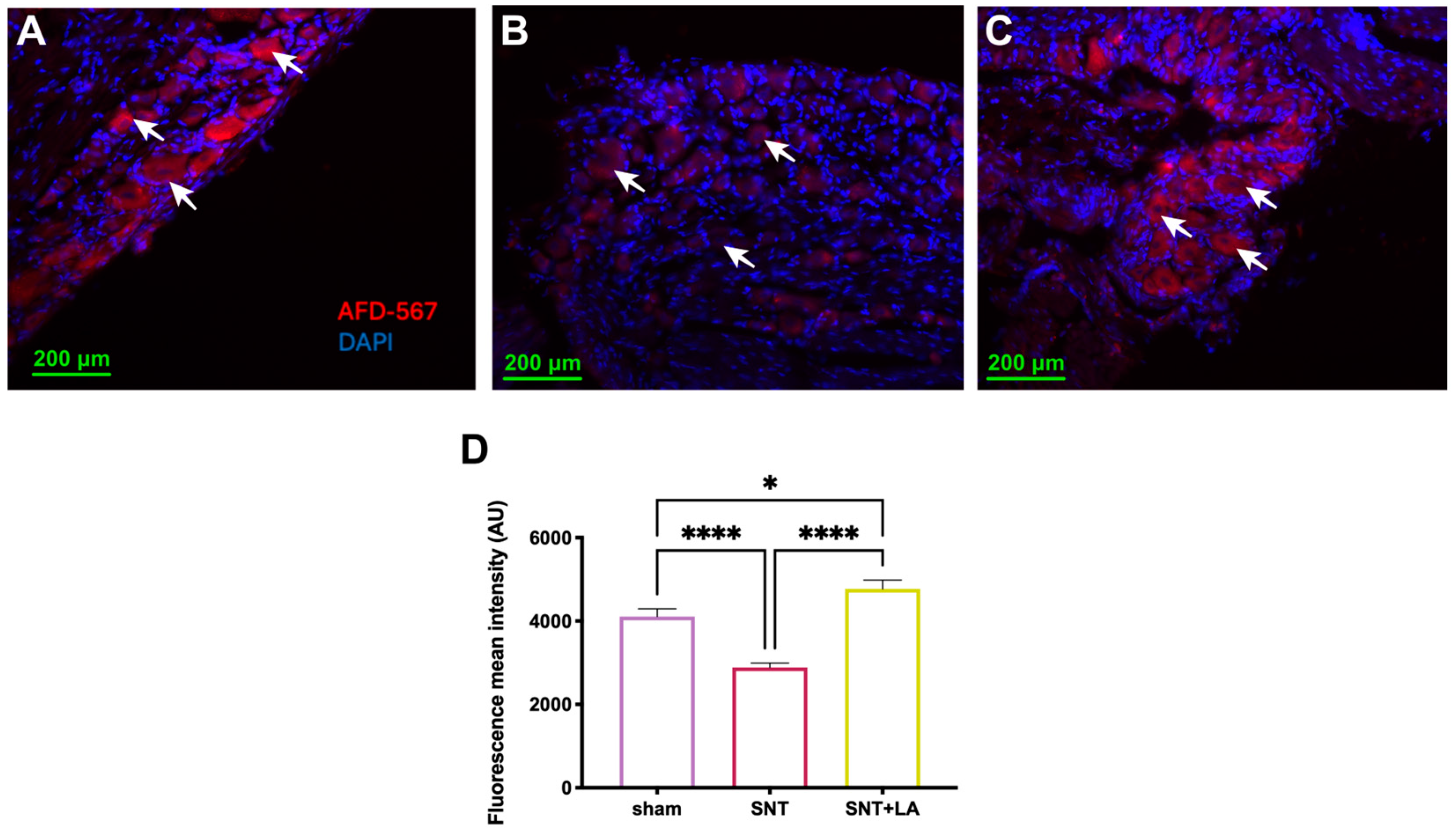
To analyze the functionality of retrograde axonal transport, dextran conjugated to AlexaFluor-568 was injected into the three branches of the sciatic nerve 3 days before tissue collection, and then the presence of red fluorescence in neuronal bodies was analyzed in sections of the DRG (Figure 2A–D). Results indicated that in the sham group, a mean fluorescence intensity of 4105 ± 183.5 arbitrary units (a.u.) was observed (Figure 2A,D). In contrast, the SNT-untreated group exhibited significantly less fluorescence in the somas of sensory neurons of the DRG (2888 ± 104.7 a.u.; p ≤ 0.0001) (Figure 2B,D) in comparison to the sham control and LA-treated group. Notably, the SNT + LA group showed a significant recovery of fluorescence in the neuronal bodies, which increased even above the control (4772 ± 208.6 a.u.; p ≤ 0.0001) (Figure 2C,D).

3.3. Effect of LA in Reactive Gliosis

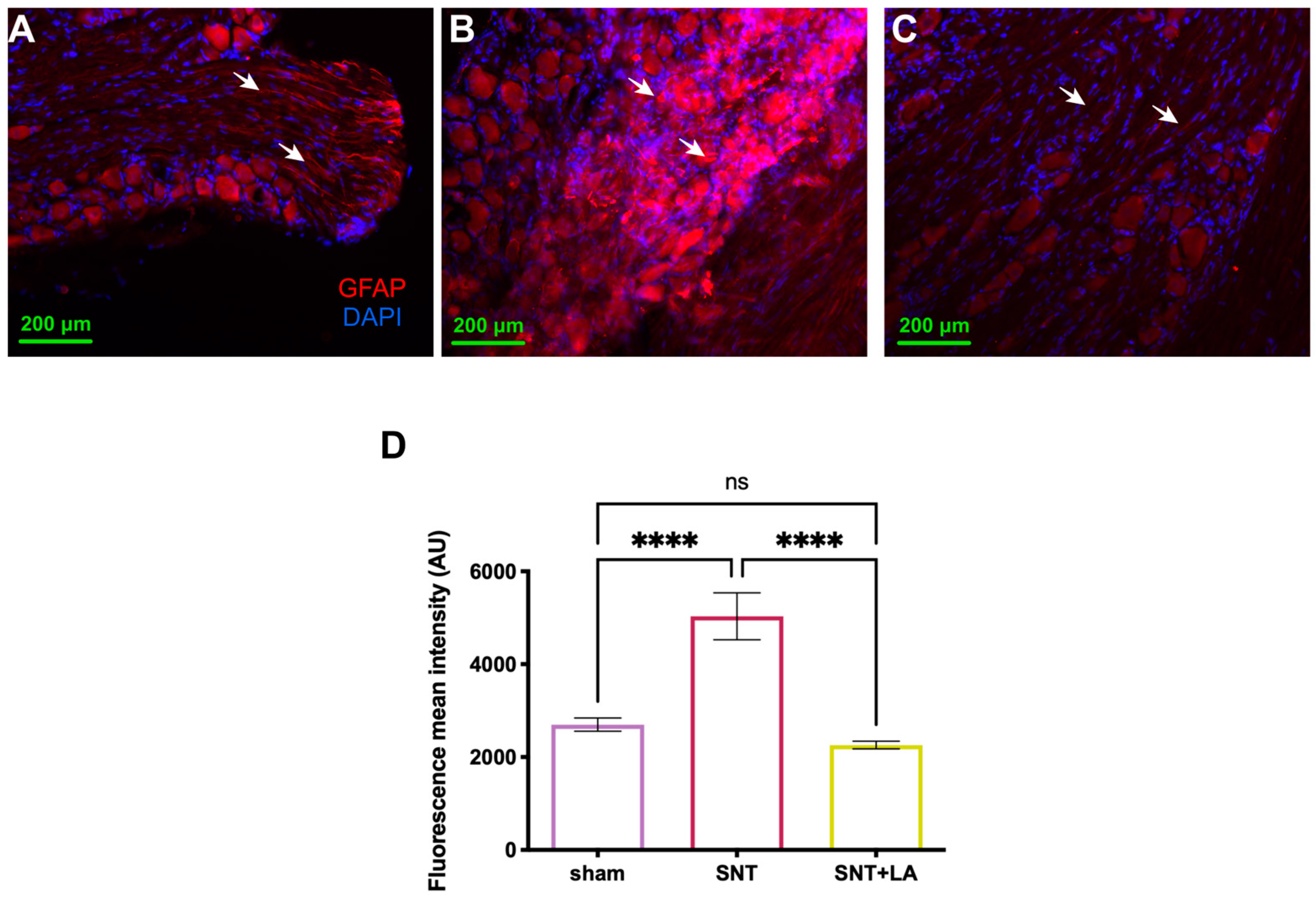
Figure 3 shows representative tissue sections of dorsal root ganglia (DRG) obtained five weeks after SNT from all experimental groups, which were immunolabeled with a specific antibody directed against GFAP (red) and counterstained with DAPI (blue) (Figure 3A–C). The fluorescence mean intensity of GFAP-IR was significantly increased (p ≤ 0.0001) in the SNT group (Figure 3B, 5033 ± 504.5 a.u.) as compared with the sham control (Figure 3A, 2699 ± 143.4 a.u.) and the SNT + LA group (Figure 3C, 2260 ± 81.04 a.u.), which had no differences among them (p < 0.05) (Figure 3D).

3.4. Iba1-Positive Cells Response to LA in the SNT Model

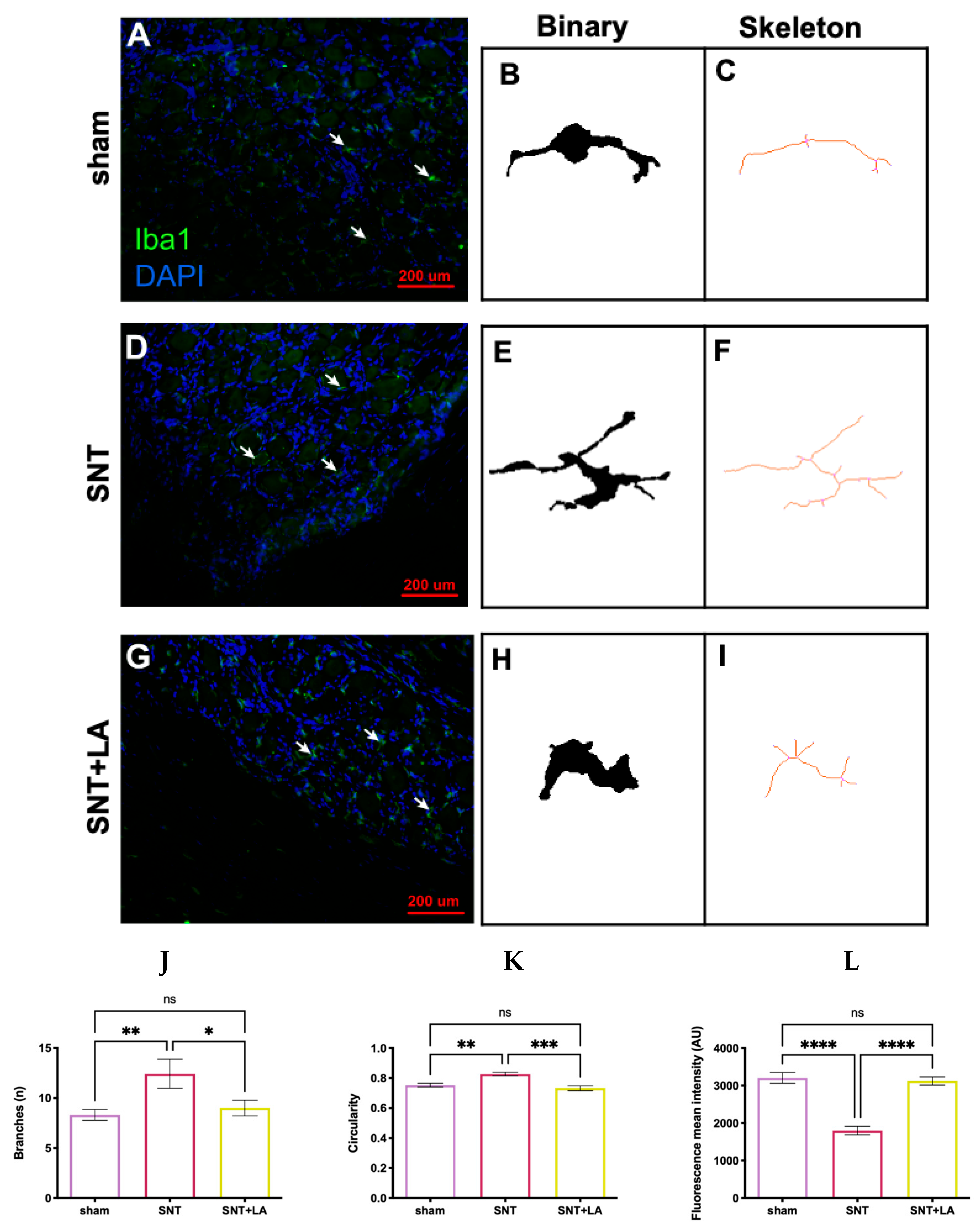
Iba1-positive cell (macrophage) response occurring in the DRG due to the different treatments was studied by immunohistochemistry using a specific antibody directed against Iba1, a commonly used marker to examine macrophage reactivity, by measuring changes in several morphological parameters. Morphological changes were quantified using Iba1 IHC analysis, and macrophage-like IR cells (indicated with arrows) were identified in all treatment groups (Figure 4A,D,G). Individual cells were isolated from the photomicrographs and then converted into binary images (Figure 4B,E,H), allowing for skeleton and fractal analyses. Representative skeleton test images (Figure 4C,F,I) display branches in red. Morphological analysis showed that, in comparison to the sham control (8.3 ± 0.5 branches), the number of branches was significantly increased (p ≤ 0.01) in the SNT-untreated group (12.4 ± 1.4 branches), but this effect was clearly reversed (p ≤ 0.05) in the SNT + LA group (9.0 ± 0.7 branches) (Figure 4J). A similar result was observed regarding the circularity of the cells (sham: 0.75 ± 0.01; SNT: 0.82 ± 0.01; and SNT + LA: 0.73 ± 0.1 circularity, respectively) (Figure 4K). In contrast, the fluorescence mean intensity of Iba1-IR was significantly reduced (p ≤ 0.0001) in the SNT group (1802 ± 112.5 a.u.) as compared with the sham control (3204 ± 144.3 a.u.) and the SNT + LA group (3124 ± 108.3 a.u.), which had no differences among them (p < 0.05) (Figure 4L).

3.5. Effect of LA on Pro-Regenerative Genes in the SNT Model

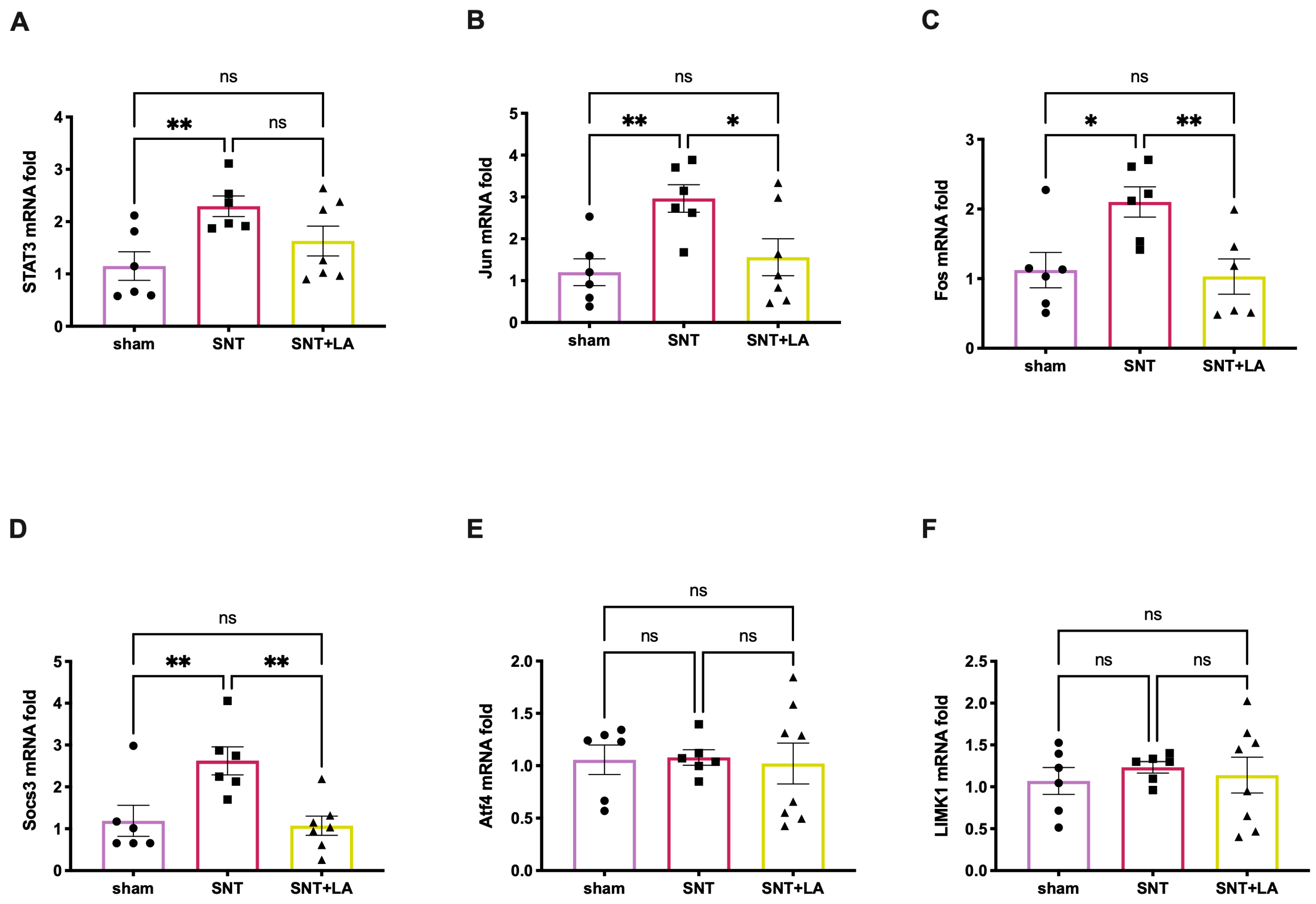
To investigate the potential effects of LA upon the activity of pro-regenerative genes, we examined the expression levels of Stat3, Jun, Fos, Socs3, Atf4, and Limk1 in DRG (Figure 5). Following SNT, DRG neurons exhibited a significantly elevated Stat3 expression (p ≤ 0.01) in the injured group (2.294 ± 0.1968 fold) compared to the sham group (1.152 ± 0.2742 fold). Notably, the Stat3 expression level was slightly lower in the LA-treated group (1.631 ± 0.2851 fold) than in the damaged group (2.294 ± 0.1968 fold) (Figure 5A). A significant induction (p ≤ 0.01) of Jun expression was also observed in the SNT-untreated group (2.964 ± 0.3296 fold) compared to the sham control group (1.202 ± 0.3190 fold); however, a significant reduction (p ≤ 0.05) in Jun expression was noted in the LA-treated group (1.561 ± 0.4407 fold) compared to the untreated lesioned group (2.964 ± 0.3296 fold) (Figure 5B). In turn, Fos, a gene that is coactivated with Jun to facilitate cellular proliferation and differentiation, showed a significantly increased expression (p ≤ 0.05) in the SNT-untreated group (2.101 ± 0.2180 fold) compared to the control group (1.123 ± 0.2542 fold). Importantly, the LA-treated group showed a significant reduction (p ≤ 0.01) in Fos expression (1.030 ± 0.2544 fold), reaching levels comparable to those observed in the sham group (Figure 5C). Similar results were observed for the expression of Socs3 (Figure 5D). In contrast, the expression levels of Atf4 and Limk1 remained unaffected in all three experimental groups (Figure 5E,F).

4. Discussion

This study demonstrates for the first time that LA promotes axonal regeneration following SNT. Evidence supporting LA-induced nerve regeneration includes sensory recovery to cold and enhanced axonal tracer transport, as well as a role in modulating the expression of several regeneration- and inflammation-related genes in sensory neurons of DRG.
While the presence of GnRH-R in the central nervous system (CNS) is well-established [39,40,41,42,43,44], its expression in the peripheral nervous system (PNS) has been scarcely reported. It is possible that the observed findings may indicate the participation of GnRH receptors in the DRG, as occurs in the sympathetic ganglia of amphibians, where GnRH modulates sympathetic neurons by inhibiting potassium channels [45,46]; however, this assumption remains to be explored. Previous studies have shown that GnRH analogs, such as LA and buserelin, facilitate functional recovery in rats with SNT, assessed through gait analysis and nerve conduction velocity measurements, effects attributed to GnRH-R activation in motor neurons of the spinal cord [35,47]. GnRH has been associated with the regulation of neurotrophic factor expression, particularly following neural injury. Experimental studies using animal models of spinal cord damage and sciatic nerve transection have reported that sustained GnRH administration enhances the expression of key neurotrophins, including nerve growth factor (NGF), brain-derived neurotrophic factor (BDNF), and neurotrophin-3 (NT-3) [30,31,48]. In addition, these treatments have been linked to improvements in synaptic protein expression and myelin preservation, supporting a potential neurotrophic and synaptogenic role of this hormone. The present study extends these findings by suggesting that peripheral nerve regeneration may occur through the induction of neurotrophic factors such as BDNF and NGF, as previously reported by our research group in spinal cord injury models.
Thermal stimulus encoding differs between cold and heat perception, since heat encoding is gradual; increasing temperatures activate more heat-sensitive neurons and enhance individual neuronal responses [49,50]. In contrast, cold encoding lacks a gradual pattern and may involve combinatorial coding, where specific combinations of activated neurons determine the response to cold stimuli [50]. In our study, LA treatment promoted the recovery of sensory function in response to cold stimulation. This finding suggests that LA may exert neuroprotective or neuroregenerative effects on DRG neurons involved in cold perception, potentially restoring neuronal connectivity and the activation patterns required for proper cold sensation encoding. One possible mechanism underlying this effect is the induction of neurotrophic factors. Previous studies have shown that neurotrophic factors can modulate the expression and functional activity of TRPM8, a cold-sensitive ion channel that plays a key role in sensory neuron signaling [51]. On the other hand, no differences in heat sensitivity were observed here, in contrast to previous studies in which GnRH administration was reported to promote recovery of heat sensitivity [30] in orchiectomized rats. This discrepancy may be explained, first, by the use of intact rats in the present work, since administration of leuprolide acetate (LA) may initially induce an increase in various sex hormones, which could alter the conductivity of thermal signaling related to heat perception [52]. In addition, the greater potency of LA compared with native GnRH [32,53] may lead to a differential activation of receptors involved in the detection of thermal stimuli, whether heat or cold. In this context, further studies are required to elucidate the signaling pathways involved and to clarify the mechanisms underlying the differences observed between heat and cold sensitivity. We could not detect the presence of GnRH receptor in the DRG and sciatic nerve samples, and single-cell RNA-seq studies have reported the absence of its transcript in DRG cells [54]; however, we previously identified its expression in the spinal cord [41]. We are currently investigating the distribution of the receptor that is activated by LA to exert the observed effects.
Proper axonal transport is critical for recovery from peripheral nerve injuries, facilitating the transport of growth factors, essential molecules for neuronal survival, transmission of damage signals to the neuronal soma, and tissue repair [55,56,57,58]. SNT completely abolishes nerve retrograde axonal transport after complete cut of the nerve and triggers regenerative signals associated with Schwann cell de-differentiation [59,60,61]. We assessed the effect of LA on retrograde axonal transport in DRG neurons using a fluorophore-conjugated tracer that was injected directly into the distal portion of the transected sciatic nerve. The untreated SNT group exhibited a significantly reduced presence of fluorescence in sensory DRG neurons, indicating impaired retrograde transport. In contrast, the SNT + LA group showed fluorescence levels comparable to those in the sham group, suggesting that LA fully restored retrograde transport in sensory fibers. This restoration may enhance signaling pathways that promote neuronal survival, regeneration, and functional recovery.
Glial fibrillary acidic protein (GFAP) is a marker for the activation of satellite glial cells and non-myelinating Schwann cells in the DRG [62,63]. Also, GFAP expression is significantly upregulated in response to nerve injury and inflammation [64]. Consistent with these reports, our study showed that SNT induced intense GFAP immunofluorescence in the DRG as compared to the control group. Conversely, LA treatment significantly reduced GFAP immunofluorescence in comparison to the SNT group, indicating that LA attenuated glial activation following nerve injury.
Recent research reveals that macrophages exhibit two phenotypes with distinct functions; the M1 phenotype is associated with proinflammatory responses, whereas the M2 phenotype is linked to anti-inflammatory and neuroprotective functions [65]. Interventions such as exercise [66] and minocycline [67] have been shown to alleviate neuropathic pain by shifting macrophages toward the M2 phenotype in the DRG, promoting anti-inflammatory and neuroprotective effects [68]. Morphometric analysis of Iba1-labeled macrophages in our study revealed that SNT induced morphological changes indicative of activation, including significant increases in branching and circularity, and an important reduction in fluorescence intensity. In contrast, LA treatment restored macrophage morphology to a state analogous to the control group, suggesting that LA may promote a shift toward the M2 phenotype. LA has demonstrated significant therapeutic potential in animal models of neurological damage by promoting neuroprotection and regeneration and modulating the inflammatory response [33,34,69,70,71,72]. Therefore, one possible mechanism of LA action is the induction of macrophage phenotype change to M2, enhancing the release of anti-inflammatory cytokines and neurotrophic factors. Additionally, complete SNT induces a cellular response in DRG neurons, modulating various genes and proteins involved in regeneration and inflammation [73].
Stat3 is a key factor in neural repair and regeneration, influencing neural stem cell fate, promoting axon regrowth, and modulating the repair function of Schwann cells through transcriptional regulation and mitochondrial function [74,75]. Stat3 activation has been implicated in neuropathic pain regulation in rodent models [76,77,78], and its inhibition alleviates neuropathic pain following peripheral nerve injury [79]. In our study, and consistent with previous findings, SNT induced a significant elevation of Stat3 expression in DRG neurons; however, LA treatment slightly reduced Stat3 expression levels in the lesioned DRG. Although Stat3 plays complex roles in neuroregeneration, LA does not directly activate the JAK/STAT pathway; instead, it may modulate this pathway indirectly through neurotrophic factors induced by GnRH-R signaling via G-protein-coupled receptors [80]. These results provide insights into the molecular mechanisms by which LA may modulate Stat3 expression and contribute to nerve regeneration.
Socs3 is a negative regulator of the JAK/Stat signaling pathway and limits neurite growth in sensory neurons. Deletion of Socs3 enhances early regeneration of DRG axons following sciatic nerve injury [81,82]. Our study found that SNT importantly induced Socs3 expression in comparison to the controls, while, in contrast, LA treatment led to a significant downregulation of Socs3 expression, which may facilitate the regenerative capacity of DRG neurons after injury. Upon peripheral nerve injury, a neuroinflammatory response propagates from the DRG to the spinal cord via the CNTF-Stat3-IL-6 pathway; ciliary neurotrophic factor (CNTF) activates Stat3, leading to interleukin-6 (IL-6) production in sensory neurons, contributing to neuropathic pain modulation [83]. LA treatment has been shown to modulate inflammation by suppressing cytokine expression [69]. Previous studies have shown that STAT3 signaling may persist for extended periods after injury [84,85]. These findings suggest that STAT3 activation is not exclusively restricted to the initial phase of regeneration, but may also contribute to longer-term regenerative and plasticity-related processes. In this context, the expression changes observed several weeks after sciatic nerve transection in the present study may reflect molecular mechanisms involved in the maintenance and consolidation of the regenerative response rather than only the early regenerative phase. Notably, our findings suggest that LA treatment may facilitate the resolution of the injury by promoting a regenerative phenotype in which, at this later time point, STAT3 signaling is no longer required. In contrast, in untreated rats, the sustained elevation of Stat3 expression may reflect a prolonged inflammatory state that could even contribute to the establishment of a chronic pain-associated phenotype [86,87]. Therefore, modulating the JAK/STAT pathway, either by downregulating Socs3 to enhance neuronal regeneration or influencing CNTF-Stat3-IL-6 signaling to manage neuropathic pain, represents a potential therapeutic strategy following peripheral nerve injury.
Elevated levels of Jun mRNA and protein expression in DRG neurons have been reported following axotomy, reflecting activation of injury-related genes [88,89]. In our study, Jun expression was upregulated in the SNT group, whereas LA treatment led to a significant decrease in Jun expression. Jun expression in axotomized neurons is transient and decreases as regenerating nerve fibers reach their peripheral targets [90,91]. The reduction in Jun expression observed with LA treatment may be attributed to the restoration of sensory fibers facilitated by LA, indicating progression in nerve regeneration.
Fos, a transcription factor involved in DRG regeneration [92,93], is associated with pathological damage and disrupted neuronal functions following peripheral nerve injury. We observed a significantly increased Fos expression in the injured group, consistent with previous reports. Treatments such as calcium channel blockers suppress Fos expression [94], and inhibition of Fos is linked to reduced neuronal damage and improved function [95]. Our findings showed a significant reduction in Fos expression in DRG neurons following LA treatment, suggesting a potential neuroprotective effect of LA.
Atf4 regulates the expression of genes involved in stress adaptation, metabolism, and apoptosis, playing critical roles in tissue development and synaptic plasticity. Recent studies have implicated Atf4 in heat nociception through non-transcriptional mechanisms [96]. In our study, Atf4 expression remained unchanged following SNT and LA treatment, correlating with the observed lack of recovery in heat avoidance. Similarly, Limk1, known to regulate axonal regeneration after injury [97], showed no significant changes in gene expression, suggesting that LA’s regenerative effects may not involve changes in Atf4 or Link1 activation.

5. Conclusions

In summary, LA treatment following SNT in male rats promotes recovery of cold sensitivity, enhances retrograde axonal transport, modulates the inflammatory response, and affects the expression of pro-regenerative genes (Stat3, Jun, Socs3, and Fos), suggesting its potential contribution to sensory function restoration. The lack of effect on heat sensitivity and unchanged expression of Atf4 and Limk1 indicate that LA’s regenerative effects may be specific to certain neuronal populations and pathways. Further research is necessary to elucidate the molecular and cellular mechanisms by which LA facilitates nerve regeneration and functional recovery.

Author Contributions

Conceptualization, I.H.-J., C.A., J.L.Q., and C.G.M.-M.; methodology, I.H.-J., D.C.-V., J.Á.-M., D.E., J.E.B.-M., and C.G.M.-M.; validation, J.Á.-M., J.L.Q., and C.G.M.-M.; formal analysis, I.H.-J. and D.C.-V.; investigation, I.H.-J., D.E., and J.E.B.-M.; resources, J.L.Q.; data curation, I.H.-J., J.Á.-M., D.E., J.E.B.-M., and C.G.M.-M.; writing—original draft, I.H.-J., J.L.Q., and C.G.M.-M.; writing—review and editing, I.H.-J., D.C.-V., C.A., J.L.Q., and C.G.M.-M. visualization, C.G.M.-M.; supervision, I.H.-J., D.C.-V., J.L.Q., and C.G.M.-M.; project administration, C.A., J.L.Q., and C.G.M.-M.; funding acquisition, C.A., J.L.Q., and C.G.M.-M. All authors have read and agreed to the published version of the manuscript.

Funding

This work was supported by grant CF-214971 from the Consejo Nacional de Humanidades, Ciencias y Tecnologías (CONAHCYT, México City, Mexico), grant CBF-2025-G-1038 from Secretaría de Ciencia, Humanidades, Tecnología e Innovación (SEHCITI, México City, México), and the PAPIIT-DGAPA-UNAM grants (IN215522, IN207524, IN207624), as well as Graduate fellowships for D.E. (#1083209) and JEB-M (#921788), which were provided by CONAHCYT, and Fondo Alejandro Bayón (Lab. D-01, INb-UNAM).

Institutional Review Board Statement

The animal study protocol was approved by the local ethics committee of the Universidad Autónoma de Aguascalientes (CEADI/UAA/0025/18, Comité de Ética de Uso de Animales en la Docencia e Investigación), on 2 March 2018.

Informed Consent Statement

Not applicable.

Data Availability Statement

The data presented in this study are available on request from the corresponding authors due to departmental policy.

Acknowledgments

We thank Sonia Sofía Cruz Muñoz, María Consolación Martínez Saldaña, and Martha Carranza for their technical assistance.

Conflicts of Interest

The authors declare no conflicts of interest.

Abbreviations

The following abbreviations are used in this manuscript:
a.u.Arbitrary units
BDNFBrain-derived neurotrophic factor
CNSCentral nervous system
CNTFCiliary neurotrophic factor
DRGDorsal root ganglia
FSHFollicle-stimulating hormone
GnRHGonadotropin-releasing hormone
LALeuprolide acetate
LHLuteinizing hormone
NGFNerve growth factor
SNSciatic nerve
SNTSciatic nerve transection

References

  1. Supra, R.; Agrawal, D.K. Peripheral Nerve Regeneration: Opportunities and Challenges. J. Spine Res. Surg. 2023, 5, 10–18. [Google Scholar] [CrossRef] [PubMed]
  2. Wojtkiewicz, D.M.; Saunders, J.; Domeshek, L.; Novak, C.B.; Kaskutas, V.; Mackinnon, S.E. Social impact of peripheral nerve injuries. Hand 2015, 10, 161–167. [Google Scholar] [CrossRef]
  3. Lopes, B.; Sousa, P.; Alvites, R.; Branquinho, M.; Sousa, A.C.; Mendonça, C.; Atayde, L.M.; Luís, A.L.; Varejão, A.S.; Maurício, A.C. Peripheral Nerve Injury Treatments and Advances: One Health Perspective. Int. J. Mol. Sci. 2022, 23, 918. [Google Scholar] [CrossRef]
  4. Giuffre, B.A.; Black, A.C.; Jeanmonod, R. Anatomy, Sciatic Nerve; StatPearls Publishing: Treasure Island, FA, USA, 2023. Available online: https://www.ncbi.nlm.nih.gov/sites/books/NBK482431/ (accessed on 19 February 2026). [PubMed]
  5. Middleton, S.J.; Perez-Sanchez, J.; Dawes, J.M. The structure of sensory afferent compartments in health and disease. J. Anat. 2022, 241, 1186–1210. [Google Scholar] [CrossRef]
  6. Haberberger, R.V.; Barry, C.; Dominguez, N.; Matusica, D. Human Dorsal Root Ganglia. Front. Cell. Neurosci. 2019, 13, 271. [Google Scholar] [CrossRef]
  7. Haberberger, R.V.; Kuramatilake, J.; Barry, C.M.; Matusica, D. Ultrastructure of dorsal root ganglia. Cell Tissue Res. 2023, 393, 17–36. [Google Scholar] [CrossRef]
  8. Chalaki, M.; Cruz, L.J.; van Neerven, S.G.A.; Verhaagen, J.; Dahan, A.; Malessy, M.J.A. Molecular Changes in the Dorsal Root Ganglion during the Late Phase of Peripheral Nerve Injury–induced Pain in Rodents: A Systematic Review. Anesthesiology 2022, 136, 362–388. [Google Scholar]
  9. Gu, D.; Xia, Y.; Ding, Z.; Qian, J.; Gu, X.; Bai, H.; Jiang, M.; Yao, D. Inflammation in the Peripheral Nervous System after Injury. Biomedicines 2024, 12, 1256. [Google Scholar] [CrossRef] [PubMed]
  10. Avraham, O.; Feng, R.; Ewan, E.E.; Rustenhoven, J.; Zhao, G.; Cavalli, V. Profiling sensory neuron microenvironment after peripheral and central axon injury reveals key pathways for neural repair. elife 2021, 10, e68457. [Google Scholar] [CrossRef] [PubMed]
  11. Gordon, T. Peripheral Nerve Regeneration and Muscle Reinnervation. Int. J. Mol. Sci. 2020, 21, 8652. [Google Scholar] [CrossRef]
  12. Liu, Y.; Wang, H. Peripheral nerve injury induced changes in the spinal cord and strategies to counteract/enhance the changes to promote nerve regeneration. Neural Regen. Res. 2020, 15, 189–198. [Google Scholar] [CrossRef] [PubMed]
  13. Gouveia, D.; Cardoso, A.; Carvalho, C.; Oliveira, A.C.; Almeida, A.; Gamboa, Ó.; Lopes, B.; Coelho, A.; Alvites, R.; Varejão, A.S.; et al. Early Intensive Neurorehabilitation in Traumatic Peripheral Nerve Injury-State of the Art. Animals 2024, 14, 884. [Google Scholar]
  14. Hussain, G.; Wang, J.; Rasul, A.; Anwar, H.; Qasim, M.; Zafar, S.; Aziz, N.; Razzaq, A.; Hussain, R.; De Aguilar, J.L.G.; et al. Current Status of Therapeutic Approaches against Peripheral Nerve Injuries: A Detailed Story from Injury to Recovery. Int. J. Biol. Sci. 2020, 16, 116–134. [Google Scholar] [CrossRef]
  15. Gordon, T. The role of neurotrophic factors in nerve regeneration. Neurosurg. Focus 2009, 26, E3. [Google Scholar] [CrossRef]
  16. Wawrzyniak, A.; Krawczyk-Marć, I.; Żuryń, A.; Kłosowicz, M.; Walocha, J.; Wysiadecki, G.; Balawender, K. Unveiling significance of peripheral nervous system glia: Implications for nervous system disorders and therapeutic interventions. Folia Morphol. 2025, 84, 493–500. [Google Scholar]
  17. Fukuoka, T.; Kondo, E.; Dai, Y.; Hashimoto, N.; Noguchi, K. Brain-Derived Neurotrophic Factor Increases in the Uninjured Dorsal Root Ganglion Neurons in Selective Spinal Nerve Ligation Model. J. Neurosci. 2001, 21, 4891–4900. [Google Scholar] [CrossRef]
  18. Klimovich, P.; Rubina, K.; Sysoeva, V.; Semina, E. Three-Dimensional Model of Dorsal Root Ganglion Explant as a Method of Studying Neurotrophic Factors in Regenerative Medicine. Biomedicines 2020, 8, 49. [Google Scholar] [CrossRef]
  19. Mashanov, V.; Alwan, A.; Kim, M.W.; Lai, D.; Poerio, A.; Ju, Y.M.; Kim, J.H.; Yoo, J.J. Synergistic effect of CNTF and GDNF on directed neurite growth in chick embryo dorsal root ganglia. PLoS ONE 2020, 15, e0240235. [Google Scholar]
  20. Bolívar, S.; Navarro, X.; Udina, E. Schwann Cell Role in Selectivity of Nerve Regeneration. Cells 2020, 9, 2131. [Google Scholar] [CrossRef] [PubMed]
  21. Aguilar-Rojas, A.; Huerta-Reyes, M. Human gonadotropin-releasing hormone receptor-activated cellular functions and signaling pathways in extra-pituitary tissues and cancer cells (Review). Oncol. Rep. 2009, 22, 981–990. [Google Scholar] [CrossRef] [PubMed]
  22. Cheung, L.W.T.; Wong, A.S.T. Gonadotropin-releasing hormone: GnRH receptor signaling in extrapituitary tissues. FEBS J. 2008, 275, 5479–5495. [Google Scholar] [CrossRef] [PubMed]
  23. Rispoli, L.A.; Nett, T.M. Pituitary gonadotropin-releasing hormone (GnRH) receptor: Structure, distribution and regulation of expression. Anim. Reprod. Sci. 2005, 88, 57–74. [Google Scholar] [CrossRef]
  24. Wang, H.Q.; Zhang, W.D.; Yuan, B.; Zhang, J.B. Advances in the Regulation of Mammalian Follicle-Stimulating Hormone Secretion. Animals 2021, 11, 1134. [Google Scholar] [CrossRef]
  25. Barabás, K.; Szabó-Meleg, E.; Ábrahám, I.M. Effect of Inflammation on Female Gonadotropin-Releasing Hormone (GnRH) Neurons: Mechanisms and Consequences. Int. J. Mol. Sci. 2020, 21, 529. [Google Scholar] [CrossRef]
  26. Fanis, P.; Neocleous, V.; Papapetrou, I.; Phylactou, L.A.; Skordis, N. Gonadotropin-Releasing Hormone Receptor (GnRHR) and Hypogonadotropic Hypogonadism. Int. J. Mol. Sci. 2023, 24, 15965. [Google Scholar] [CrossRef]
  27. Kacimi, L.; Prevot, V. GnRH and Cognition. Endocrinology 2025, 166, bqaf033. [Google Scholar] [CrossRef]
  28. Wickramasuriya, N.; Hawkins, R.; Atwood, C.; Butler, T. The roles of GnRH in the human central nervous system. Horm. Behav. 2022, 145, 105230. [Google Scholar] [CrossRef] [PubMed]
  29. Zakharova, L.; Sharova, V.; Izvolskaia, M. Mechanisms of Reciprocal Regulation of Gonadotropin-Releasing Hormone (GnRH)-Producing and Immune Systems: The Role of GnRH, Cytokines and Their Receptors in Early Ontogenesis in Normal and Pathological Conditions. Int. J. Mol. Sci. 2020, 22, 114. [Google Scholar]
  30. Baca-Alonso, J.J.; Calderón-Vallejo, D.; Hernández-Jasso, I.; Epardo, D.; Balderas-Márquez, J.E.; Luna, M.; Arámburo, C.; Quintanar, J.L.; Martínez-Moreno, C.G. Neurotrophic Effects of GH and GnRH in a Full Sciatic Nerve Transection Model in Male Rats. Neuroendocrinology 2025, 115, 530–552. [Google Scholar] [CrossRef] [PubMed]
  31. Martínez-Moreno, C.G.; Calderón-Vallejo, D.; Díaz-Galindo, C.; Hernández-Jasso, I.; Olivares-Hernández, J.D.; Ávila-Mendoza, J.; Epardo, D.; Balderas-Márquez, J.E.; Urban-Sosa, V.A.; Baltazar-Lara, R.; et al. Gonadotropin-releasing hormone and growth hormone act as anti-inflammatory factors improving sensory recovery in female rats with thoracic spinal cord injury. Front. Neurosci. 2023, 17, 1164044. [Google Scholar]
  32. Wilson, A.C.; Vadakkadath Meethal, S.; Bowen, R.L.; Atwood, C.S. Leuprolide acetate: A drug of diverse clinical applications. Expert. Opin. Investig. Drugs 2007, 16, 1851–1863. [Google Scholar] [CrossRef] [PubMed]
  33. Galindo, C.D.; Gómez-González, B.; Salinas, E.; Calderón-Vallejo, D.; Hernández-Jasso, I.; Bautista, E.; Quintanar, J.L. Leuprolide acetate induces structural and functional recovery of injured spinal cord in rats. Neural Regen. Res. 2015, 10, 1819–1824. [Google Scholar] [CrossRef] [PubMed]
  34. Guzmán-Soto, I.; Salinas, E.; Hernández-Jasso, I.; Quintanar, J.L. Leuprolide acetate, a GnRH agonist, improves experimental autoimmune encephalomyelitis: A possible therapy for multiple sclerosis. Neurochem. Res. 2012, 37, 2190–2197. [Google Scholar] [CrossRef] [PubMed]
  35. Hernández-Jasso, I.; Domínguez-Del-Toro, E.; Delgado-García, J.M.; Quintanar, J.L. Recovery of sciatic nerve with complete transection in rats treated with leuprolide acetate: A gonadotropin-releasing hormone agonist. Neurosci. Lett. 2020, 739, 135439. [Google Scholar] [CrossRef]
  36. Quintanar, J.; Díaz-Galindo, C.; Calderón-Vallejo, D.; Rojas, I.; Medina-Aguiñaga, D.; Olvera-Sandoval, C. Neurological improvement in patients with chronic spinal cord injury treated with leuprolide acetate, an agonist of GnRH. Acta Neurobiol. Exp. 2018, 78, 352–357. [Google Scholar] [CrossRef]
  37. Livak, K.J.; Schmittgen, T.D. Analysis of relative gene expression data using real-time quantitative PCR and the 2(-Delta Delta C(T)) Method. Methods 2001, 25, 402–408. [Google Scholar] [CrossRef]
  38. Mehta, A.K.; Tripathi, C.D. Commiphora mukul attenuates peripheral neuropathic pain induced by chronic constriction injury of sciatic nerve in rats. Nutr. Neurosci. 2015, 18, 97–102. [Google Scholar] [CrossRef]
  39. Albertson, A.J.; Talbott, H.; Wang, Q.; Jensen, D.; Skinner, D.C. The Gonadotropin-Releasing Hormone Type I Receptor is Expressed in the Mouse Cerebellum. Cerebellum 2008, 7, 379–384. [Google Scholar] [CrossRef]
  40. Albertson, A.J.; Navratil, A.; Mignot, M.; Dufourny, L.; Cherrington, B.; Skinner, D.C. Immunoreactive GnRH type I receptors in the mouse and sheep brain. J. Chem. Neuroanat. 2008, 35, 326–333. [Google Scholar] [CrossRef]
  41. Díaz-Galindo, C.; Calderón-Vallejo, D.; Hernández-Jasso, I.; Cervantes-García, D.; Martínez-Díaz, D.; Ibarra-Martínez, D.; Muñoz-Ortega, M.; Quintanar, J.L. Gonadotropin-Releasing Hormone Receptor Expression in Human Spinal Cord. Neurochem. Res. 2021, 46, 165–170. [Google Scholar] [CrossRef]
  42. Dolan, S.; Evans, N.P.; Richter, T.A.; Nolan, A.M. Expression of gonadotropin-releasing hormone and gonadotropin-releasing hormone receptor in sheep spinal cord. Neurosci. Lett. 2003, 346, 120–122. [Google Scholar] [CrossRef]
  43. Jennes, L.; Eyigor, O.; Janovick, J.A.; Conn, P.M. Brain gonadotropin releasing hormone receptors: Localization and regulation. Recent Prog. Horm. Res. 1997, 52, 475–490; discussion 490–491. [Google Scholar]
  44. Martínez-Moreno, C.G.; Calderón-Vallejo, D.; Harvey, S.; Arámburo, C.; Quintanar, J.L. Growth Hormone (GH) and Gonadotropin-Releasing Hormone (GnRH) in the Central Nervous System: A Potential Neurological Combinatory Therapy? Int. J. Mol. Sci. 2018, 19, 375. [Google Scholar] [CrossRef] [PubMed]
  45. Bosma, M.M.; Bernheim, L.; Leibowitz, M.D.; Pfaffinger, P.J.; Hille, B. Modulation of M current in frog sympathetic ganglion cells. Soc. Gen. Physiol. Ser. 1990, 45, 43–59. [Google Scholar] [PubMed]
  46. Ford, C.P.; Wong, K.V.; Lu, V.B.; Posse de Chaves, E.; Smith, P.A. Differential neurotrophic regulation of sodium and calcium channels in an adult sympathetic neuron. J. Neurophysiol. 2008, 99, 1319–1332. [Google Scholar] [CrossRef][Green Version]
  47. Farjah, G.H.; Peirouvi, T.; Heshmatian, B.; Yasami, M.; Dolatkhah, M.A. The effect of short-term treatments of a gonadotropin-releasing hormone analog (buserelin) on sciatic nerve regeneration. Iran. J. Vet. Res. 2014, 15, 104–109. [Google Scholar]
  48. Martínez-Moreno, C.G.; Calderón-Vallejo, D.; Díaz-Galindo, C.; Hernández-Jasso, I.; Olivares-Hernández, J.D.; Ávila-Mendoza, J.; Epardo, D.; Balderas-Márquez, J.E.; Urban-Sosa, V.A.; Baltazar-Lara, R.; et al. Neurotrophic and synaptic effects of GnRH and/or GH upon motor function after spinal cord injury in rats. Sci. Rep. 2024, 14, 26420. [Google Scholar] [CrossRef] [PubMed]
  49. Green, B.G. Temperature perception and nociception. J. Neurobiol. 2004, 61, 13–29. [Google Scholar] [CrossRef]
  50. Wang, F.; Bélanger, E.; Côté, S.L.; Desrosiers, P.; Prescott, S.A.; Côté, D.C.; De Koninck, Y. Sensory Afferents Use Different Coding Strategies for Heat and Cold. Cell Rep. 2018, 23, 2001–2013. [Google Scholar] [CrossRef]
  51. Kayama, Y.; Shibata, M.; Takizawa, T.; Ibata, K.; Nakahara, J.; Shimizu, T.; Toriumi, H.; Yuzaki, M.; Suzuki, N. Signaling Pathways Relevant to Nerve Growth Factor-induced Upregulation of Transient Receptor Potential M8 Expression. Neuroscience 2017, 367, 178–188. [Google Scholar] [CrossRef]
  52. Azcoitia, I.; Leonelli, E.; Magnaghi, V.; Veiga, S.; Garcia-Segura, L.M.; Melcangi, R.C. Progesterone and its derivatives dihydroprogesterone and tetrahydroprogesterone reduce myelin fiber morphological abnormalities and myelin fiber loss in the sciatic nerve of aged rats. Neurobiol. Aging 2003, 24, 853–860. [Google Scholar] [CrossRef]
  53. Chwalisz, K. Clinical development of the GnRH agonist leuprolide acetate depot. FS Rep. 2022, 4, 33–39. [Google Scholar]
  54. Jager, S.E.; Pallesen, L.T.; Lin, L.; Izzi, F.; Pinheiro, A.M.; Villa-Hernandez, S.; Cesare, P.; Vaegter, C.B.; Denk, F. Comparative transcriptional analysis of satellite glial cell injury response. Wellcome Open Res. 2022, 7, 156. [Google Scholar] [CrossRef] [PubMed]
  55. Maday, S.; Twelvetrees, A.E.; Moughamian, A.J.; Holzbaur, E.L.F. Axonal transport: Cargo-specific mechanisms of motility and regulation. Neuron 2014, 84, 292–309. [Google Scholar] [CrossRef] [PubMed]
  56. Mar, F.M.; Simoes, A.R.; Leite, S.; Morgado, M.M.; Santos, T.E.; Rodrigo, I.S.; Teixeira, C.A.; Misgeld, T.; Sousa, M.M. CNS axons globally increase axonal transport after peripheral conditioning. J. Neurosci. 2014, 34, 5965–5970. [Google Scholar] [CrossRef]
  57. Perlson, E.; Maday, S.; Fu, M.M.; Moughamian, A.J.; Holzbaur, E.L.F. Retrograde Axonal Transport: Pathways To Cell Death? Trends Neurosci. 2010, 33, 335–344. [Google Scholar] [CrossRef]
  58. Petrova, V.; Eva, R. The Virtuous Cycle of Axon Growth: Axonal Transport of Growth-Promoting Machinery as an Intrinsic Determinant of Axon Regeneration. Dev. Neurobiol. 2018, 78, 898–925. [Google Scholar] [CrossRef] [PubMed]
  59. Ben-Yaakov, K.; Dagan, S.Y.; Segal-Ruder, Y.; Shalem, O.; Vuppalanchi, D.; Willis, D.E.; Yudin, D.; Rishal, I.; Rother, F.; Bader, M.; et al. Axonal transcription factors signal retrogradely in lesioned peripheral nerve. EMBO J. 2012, 31, 1350–1363. [Google Scholar] [CrossRef]
  60. Fink, D.J.; Purkiss, D.; Mata, M. Retrograde axonal transport in rat sciatic nerve after nerve crush injury. Brain Res. Bull. 1987, 19, 29–33. [Google Scholar] [CrossRef]
  61. Jessen, K.R.; Mirsky, R. The repair Schwann cell and its function in regenerating nerves. J. Physiol. 2016, 594, 3521–3531. [Google Scholar] [CrossRef]
  62. Konnova, E.A.; Deftu, A.F.; Chu Sin Chung, P.; Pertin, M.; Kirschmann, G.; Decosterd, I.; Suter, M.R. Characterisation of GFAP-Expressing Glial Cells in the Dorsal Root Ganglion after Spared Nerve Injury. Int. J. Mol. Sci. 2023, 24, 15559. [Google Scholar] [CrossRef]
  63. Siemionow, K.; Klimczak, A.; Brzezicki, G.; Siemionow, M.; McLain, R.F. The Effects of Inflammation on Glial Fibrillary Acidic Protein Expression in Satellite Cells of the Dorsal Root Ganglion. Spine 2009, 34, 1631–1637. [Google Scholar] [CrossRef]
  64. Kim, D.S.; Figueroa, K.W.; Li, K.W.; Boroujerdi, A.; Yolo, T.; Luo, D.Z. Profiling of dynamically changed gene expression in dorsal root ganglia post peripheral nerve injury and a critical role of injury-induced glial fibrillary acetic protein in maintenance of pain behaviors. Pain 2009, 143, 114–122. [Google Scholar] [CrossRef] [PubMed]
  65. Gheorghe, R.O.; Grosu, A.V.; Magercu, M.; Ghenghea, M.S.; Zbarcea, C.E.; Tanase, A.; Negres, S.; Filippi, A.; Chiritoiu, G.; Gherghiceanu, M.; et al. Switching Rat Resident Macrophages from M1 to M2 Phenotype by Iba1 Silencing Has Analgesic Effects in SNL-Induced Neuropathic Pain. Int. J. Mol. Sci. 2023, 24, 15831. [Google Scholar] [CrossRef]
  66. Bai, J.; Geng, B.; Wang, X.; Wang, S.; Yi, Q.; Tang, Y.; Xia, Y. Exercise Facilitates the M1-to-M2 Polarization of Microglia by Enhancing Autophagy via the BDNF/AKT/mTOR Pathway in Neuropathic Pain. Pain Physician 2022, 25, E1137–E1151. [Google Scholar] [PubMed]
  67. Li, Z.; Wei, H.; Piirainen, S.; Chen, Z.; Kalso, E.; Pertovaara, A.; Tian, L. Spinal versus brain microglial and macrophage activation traits determine the differential neuroinflammatory responses and analgesic effect of minocycline in chronic neuropathic pain. Brain Behav. Immun. 2016, 58, 107–117. [Google Scholar]
  68. Yu, X.; Liu, H.; Hamel, K.A.; Morvan, M.G.; Yu, S.; Leff, J.; Guan, Z.; Braz, J.M.; Basbaum, A.I. Dorsal root ganglion macrophages contribute to both the initiation and persistence of neuropathic pain. Nat. Commun. 2020, 11, 264. [Google Scholar] [CrossRef] [PubMed]
  69. Guzmán-Soto, I.; Salinas, E.; Quintanar, J.L. Leuprolide Acetate Inhibits Spinal Cord Inflammatory Response in Experimental Autoimmune Encephalomyelitis by Suppressing NF-κB Activation. Neuroimmunomodulation 2016, 23, 33–40. [Google Scholar] [CrossRef]
  70. Medina-Aguiñaga, D.; Munoz, A.; Luna, M.; Martinez-Moreno, C.G.; Quintanar-Stephano, A.; Quintanar, J.L. Administration of leuprolide acetate, a GnRH agonist, improves urodynamic parameters in ovariectomized rats. Neurourol. Urodyn. 2018, 37, 1574–1582. [Google Scholar]
  71. Montoya-García, R.; Fernández-Vargas, V.; Albor-Martínez, K.N.; Martínez-Martínez, A.; Hernández-Jasso, I.; Quintanar-Stephano, A.; Calderón-Vallejo, D.; Quintanar, J.L. Analysis of hippocampus in rats with acute brain ischemia-reperfusion injury treated with leuprolide acetate, an agonist of GnRH. Restor. Neurol. Neurosci. 2023, 41, 83–89. [Google Scholar] [CrossRef]
  72. Pedroza-García, K.A.; Calderón-Vallejo, D.; Cervantes-García, D.; Quintanar-Stephano, A.; Salinas, E.; Quintanar, J.L. Effect of leuprolide acetate, a GnRH agonist, on neuroinflammation and anxiety-like behavior after mild hypoxic-ischemic encephalopathy in rat model. Neuroimmunomodulation 2023, 30, 206–212. [Google Scholar] [CrossRef]
  73. Li, S.; Xue, C.; Yuan, Y.; Zhang, R.; Wang, Y.; Wang, Y.; Yu, B.; Liu, J.; Ding, F.; Yang, Y.; et al. The transcriptional landscape of dorsal root ganglia after sciatic nerve transection. Sci. Rep. 2015, 5, 16888. [Google Scholar] [CrossRef]
  74. Bareyre, F.M.; Garzorz, N.; Lang, C.; Misgeld, T.; Büning, H.; Kerschensteiner, M. In vivo imaging reveals a phase-specific role of STAT3 during central and peripheral nervous system axon regeneration. Proc. Natl. Acad. Sci. USA 2011, 108, 6282–6287. [Google Scholar] [PubMed]
  75. Cao, F.; Hata, R.; Zhu, P.; Nakashiro, K.I.; Sakanaka, M. Conditional deletion of Stat3 promotes neurogenesis and inhibits astrogliogenesis in neural stem cells. Biochem. Biophys. Res. Commun. 2010, 394, 843–847. [Google Scholar] [CrossRef] [PubMed]
  76. Ding, H.H.; Zhang, S.B.; Lv, Y.Y.; Ma, C.; Liu, M.; Zhang, K.B.; Ruan, X.C.; Wei, J.Y.; Xin, W.J.; Wu, S.L. TNF-α/STAT3 pathway epigenetically upregulates Nav1.6 expression in DRG and contributes to neuropathic pain induced by L5-VRT. J. Neuroinflammation 2019, 16, 29. [Google Scholar]
  77. Dominguez, E.; Rivat, C.; Pommier, B.; Mauborgne, A.; Pohl, M. JAK/STAT3 pathway is activated in spinal cord microglia after peripheral nerve injury and contributes to neuropathic pain development in rat. J. Neurochem. 2008, 107, 50–60. [Google Scholar] [CrossRef]
  78. Mori, T.; Miyamoto, T.; Yoshida, H.; Asakawa, M.; Kawasumi, M.; Kobayashi, T.; Morioka, H.; Chiba, K.; Toyama, Y.; Yoshimura, A. IL-1β and TNFα-initiated IL-6-STAT3 pathway is critical in mediating inflammatory cytokines and RANKL expression in inflammatory arthritis. Int. Immunol. 2011, 23, 701–712. [Google Scholar] [CrossRef] [PubMed]
  79. Tsuda, M.; Kohro, Y.; Yano, T.; Tsujikawa, T.; Kitano, J.; Tozaki-Saitoh, H.; Koyanagi, S.; Ohdo, S.; Ji, R.R.; Salter, M.W.; et al. JAK-STAT3 pathway regulates spinal astrocyte proliferation and neuropathic pain maintenance in rats. Brain 2011, 134, 1127–1139. [Google Scholar] [CrossRef]
  80. Díaz-Galindo, M.D.C.; Calderón-Vallejo, D.; Olvera-Sandoval, C.; Quintanar, J.L. Therapeutic approaches of trophic factors in animal models and in patients with spinal cord injury. Growth Factors 2020, 38, 1–15. [Google Scholar] [CrossRef]
  81. Miao, T.; Wu, D.; Zhang, Y.; Bo, X.; Subang, M.C.; Wang, P.; Richardson, P.M. Suppressor of cytokine signaling-3 suppresses the ability of activated signal transducer and activator of transcription-3 to stimulate neurite growth in rat primary sensory neurons. J. Neurosci. 2006, 26, 9512–9519. [Google Scholar] [CrossRef]
  82. Sun, F.; Park, K.K.; Belin, S.; Wang, D.; Lu, T.; Chen, G.; Zhang, K.; Yeung, C.; Feng, G.; Yankner, B.A.; et al. Sustained axon regeneration induced by co-deletion of PTEN and SOCS3. Nature 2011, 480, 372–375. [Google Scholar] [CrossRef]
  83. Hu, Z.; Deng, N.; Liu, K.; Zhou, N.; Sun, Y.; Zeng, W. CNTF-STAT3-IL-6 Axis Mediates Neuroinflammatory Cascade across Schwann Cell-Neuron-Microglia. Cell Reports 2020, 31, 107657. [Google Scholar] [CrossRef]
  84. Schwaiger, F.W.; Schmitt, G.H.A.B.; Horvat, A.; Hager, G.; Streif, R.; Spitzer, C.; Gamal, S.; Breuer, S.; Brook, G.A.; Nacimiento, W.; et al. Peripheral but not central axotomy induces changes in Janus kinases (JAK) and signal transducers and activators of transcription (STAT). Eur. J. Neurosci. 2000, 12, 1165–1176. [Google Scholar] [CrossRef] [PubMed]
  85. Benito, C.; Davis, C.M.; Gomez-Sanchez, J.A.; Turmaine, M.; Meijer, D.; Poli, V.; Mirsky, R.; Jessen, K.R. STAT3 Controls the Long-Term Survival and Phenotype of Repair Schwann Cells during Nerve Regeneration. J. Neurosci. 2017, 37, 4255–4269. [Google Scholar] [CrossRef]
  86. Zhang, X.S.; Li, X.; Luo, H.J.; Huang, Z.X.; Liu, C.C.; Wan, Q.; Xu, S.W.; Wu, S.L.; Ke, S.J.; Ma, C. Activation of the RAGE/STAT3 Pathway in the Dorsal Root Ganglion Contributes to the Persistent Pain Hypersensitivity Induced by Lumbar Disc Herniation. Pain Physician 2017, 20, 419–427. [Google Scholar] [CrossRef] [PubMed]
  87. Mo, Y.; Liu, B.; Qiu, S.; Wang, X.; Zhong, L.; Han, X.; Mi, F. Down-regulation of microRNA-34c-5p alleviates neuropathic pain via the SIRT1/STAT3 signaling pathway in rat models of chronic constriction injury of sciatic nerve. J. Neurochem. 2020, 154, 301–315. [Google Scholar] [CrossRef]
  88. De León, M.; Nahin, R.L.; Molina, C.A.; De Léon, D.D.; Ruda, M.A. Comparison of c-jun, junB, and junD mRNA expression and protein in the rat dorsal root ganglia following sciatic nerve transection. J. Neurosci. Res. 1995, 42, 391–401. [Google Scholar] [CrossRef] [PubMed]
  89. Jenkins, R.; McMahon, S.B.; Bond, A.B.; Hunt, S.P. Expression of c-Jun as a response to dorsal root and peripheral nerve section in damaged and adjacent intact primary sensory neurons in the rat. Eur. J. Neurosci. 1993, 5, 751–759. [Google Scholar] [CrossRef]
  90. Broude, E.; McAtee, M.; Kelley, M.S.; Bregman, B.S. c-Jun expression in adult rat dorsal root ganglion neurons: Differential response after central or peripheral axotomy. Exp. Neurol. 1997, 148, 367–377. [Google Scholar] [CrossRef]
  91. Leah, J.D.; Herdegen, T.; Murashov, A.; Dragunow, M.; Bravo, R. Expression of immediate early gene proteins following axotomy and inhibition of axonal transport in the rat central nervous system. Neuroscience 1993, 57, 53–66. [Google Scholar] [CrossRef]
  92. Nilsson, A.; Moller, K.; Dahlin, L.; Lundborg, G.; Kanje, M. Early changes in gene expression in the dorsal root ganglia after transection of the sciatic nerve; effects of amphiregulin and PAI-1 on regeneration. Mol. Brain Res. 2005, 136, 65–74. [Google Scholar] [CrossRef] [PubMed]
  93. Soares, H.D.; Chen, S.C.; Morgan, J.I. Differential and prolonged expression of Fos-lacZ and Jun-lacZ in neurons, glia, and muscle following sciatic nerve damage. Exp. Neurol. 2001, 167, 1–14. [Google Scholar] [CrossRef] [PubMed]
  94. Connor, J.; Sawczuk, I.S.; Benson, M.C.; Tomashefsky, P.; O’Toole, K.M.; Olsson, C.A.; Buttyan, R. Calcium channel antagonists delay regression of androgen-dependent tissues and suppress gene activity associated with cell death. Prostate 1988, 13, 119–130. [Google Scholar] [CrossRef]
  95. Su, J.H.; Chen, Y.F.; Tang, J.R.; Wu, L.; Zhang, P.; Yu, L.B.; Niu, Q.; Xiao, H. Protective effects of the calcium-channel blocker flunarizine on crush injury of sciatic nerves in a rat model. Neurol. India 2010, 58, 530–536. [Google Scholar] [CrossRef]
  96. Xie, M.X.; Cao, X.Y.; Zeng, W.A.; Lai, R.C.; Guo, L.; Wang, J.C.; Xiao, Y.B.; Zhang, X.; Chen, D.; Liu, X.G.; et al. ATF4 selectively regulates heat nociception and contributes to kinesin-mediated TRPM3 trafficking. Nat. Commun. 2021, 12, 1401. [Google Scholar] [CrossRef]
  97. Frendo, M.E.; Silva, A.D.; Phan, K.D.; Riche, S.; Butler, S.J. The Cofilin/Limk1 Pathway Controls the Growth Rate of Both Developing and Regenerating Motor Axons. J. Neurosci. 2019, 39, 9316–9327. [Google Scholar] [CrossRef] [PubMed]
Figure 1. Response to cold and hot in rats with SNT. Latency of response in cold (A) and hot (B) plate assay in animals with SNT. Results are shown as mean ± SEM from 6 to 8 animals. Experimental groups: sham (control), sciatic nerve transection treated with saline solution (SNT), and sciatic nerve transection treated with leuprolide acetate (SNT + LA). Units are in seconds (s). (*) p ≤ 0.05 and (**) p ≤ 0.01, as determined by one-way ANOVA with Tukey as post hoc test.
Brainsci 16 00332 g001
Figure 2. Retrograde axonal transport to DRG. Axonal transport was assessed by Dextran Alexa Fluor-568 injection in the branches of the sciatic nerve 5 weeks after injury. Sections of DRG tissue were analyzed. Representative images at 10× magnification of experimental groups are shown, with a scale bar of 200 μm. Experimental groups: (A) sham; (B) sciatic nerve transection treated with saline solution (SNT); and (C) sciatic nerve transection treated with leuprolide acetate (SNT + LA). (D) Analysis of tracer fluorescence in DRG neuronal bodies. Red: Dextran; blue: DAPI staining (nuclei). Arrows indicate positive Dextran neuronal bodies. Results are shown as mean ± SEM from 6 to 8 animals. Units are in arbitrary units (AU). (*) p ≤ 0.05 and (****) p ≤ 0.0001, as determined by one-way ANOVA with Tukey as post hoc test.
Brainsci 16 00332 g002
Figure 3. Glial fibrillary acidic protein (GFAP) immunohistochemistry in DRGs. Images at 10× magnification of sections of dorsal root ganglia were analyzed, with a scale bar of 200 μm. Experimental groups: (A) sham; (B) sciatic nerve transection treated with saline solution (SNT); and (C) sciatic nerve transection treated with leuprolide acetate (SNT + LA). (D) Analysis of GFAP immunofluorescence mean intensity (red); Blue: DAPI staining (nuclei) in DRG tissue. Arrows show representative immunostaining. Results are shown as mean ± SEM, 6–8 animals. Units are in arbitrary units (AU). (****) p ≤ 0.0001, as determined by one-way ANOVA with Tukey as post hoc test.
Brainsci 16 00332 g003
Figure 4. Effect of LA upon SNT-treated DRGs. Ionized calcium-binding adapter molecule 1 (Iba1) immunohistochemistry in dorsal root ganglia tissue was analyzed to assess morphological changes in Iba1-positive immune cells (macrophages). Representative images of dorsal root ganglia of experimental groups, analyzed at 10× magnification, are shown, with a scale bar of 200 μm. Experimental groups: (A) sham; (D) sciatic nerve transection treated with saline solution (SNT); and (G) sciatic nerve transection treated with leuprolide acetate (SNT + LA). (B,E,H) Binary images of the isolated individual Iba-1-postive cells; (C,F,I) skeletonized images of individual cells, where branches are in red. (J,K,L) Analysis of morphological parameters of macrophages and Iba-1 immunofluorescence mean intensity (green); blue: DAPI staining (nuclei) in DRG tissue. Arrows show representative macrophage cells. Results are shown as mean ± SEM, n = 100 Iba1-positive cells, 6–8 animals. Units are in number of branches (J), circularity (K), and arbitrary units (AU) (L). (*) p ≤ 0.05, (**) p ≤ 0.01, (***) p ≤ 0.001, and (****) p ≤ 0.0001, as determined by one-way ANOVA with Tukey as post hoc test.
Brainsci 16 00332 g004
Figure 5. Relative gene-expression of neuroregenerative markers in DRGs. (A) Relative change in Stat3 mRNA; (B) relative change in Jun mRNA; (C) relative change in Fos mRNA; (D) relative change in Socs3 mRNA; (E) relative change in Atf4 mRNA, and (F) relative change in Limk1 mRNA. Experimental groups: sham (control), sciatic nerve transection treated with saline solution (SNT), and sciatic nerve transection treated with leuprolide acetate (SNT + LA). Results are shown as mean ± SEM from 6 to 8 animals: (*) p ≤ 0.05, and (**) p ≤ 0.01, determined by one-way ANOVA with Fisher’s LSD as post hoc test.
Brainsci 16 00332 g005
Table 1. Antibodies.
TargetHost/TypeDilutionSourceCat. No.
GFAPRabbit/polyclonal1:500Abcam (Cambridge, UK)Ab16997-1
Iba1Goat/polyclonal1:500Abcam (Cambridge, UK)Ab5076
Rabbit IgGGoat/Alexa fluor 5941:1000Invitrogen (Carlsbad, CA, USA)A11012
Goat IgGRabbit/Alexa fluor 4881:1000Invitrogen (Carlsbad, CA, USA)A-11078
Table 2. Oligonucleotides used reverse transcriptase quantitative PCR (RT-qPCR).
TargetSequences (5′–3′)
ForwardReverse
Stat3TGGATGCGACCAACATCCTGCAATGGTATTGCTGCAGGTCG
JunGCACATCACCACTACACCGAGGGAAGCGTGTTCTGGCTAT
Socs3CTACGCATCCAGTGTGAGGGTGAGTACACAGTCGAAGCGG
Atf4GGTGGCCAAGCACTTGAAACGTCCCGGAAAAGGCATCCTC
FosTACTACCATTCCCCAGCCGAGCTGTCACCGTGGGGATAAA
Limk1ATCACAGAGTACACTAAGGGCGTTCATGCAATGGAGGTAGGC
GapdhTGTGTCCGTCGTGGATCTGACTTCACCACCTTCTTGATGTCACT
PpiaGGTTCCTCCTTTCACAGAATAATTTCTCTCCGTAGATGGAC
Disclaimer/Publisher’s Note: The statements, opinions and data contained in all publications are solely those of the individual author(s) and contributor(s) and not of MDPI and/or the editor(s). MDPI and/or the editor(s) disclaim responsibility for any injury to people or property resulting from any ideas, methods, instructions or products referred to in the content.