Application and Outcomes of Indocyanine Green in Endoscopic Transsphenoidal Surgery for Functional Pituitary Tumors: A Literature Review

Abstract
1. Introduction
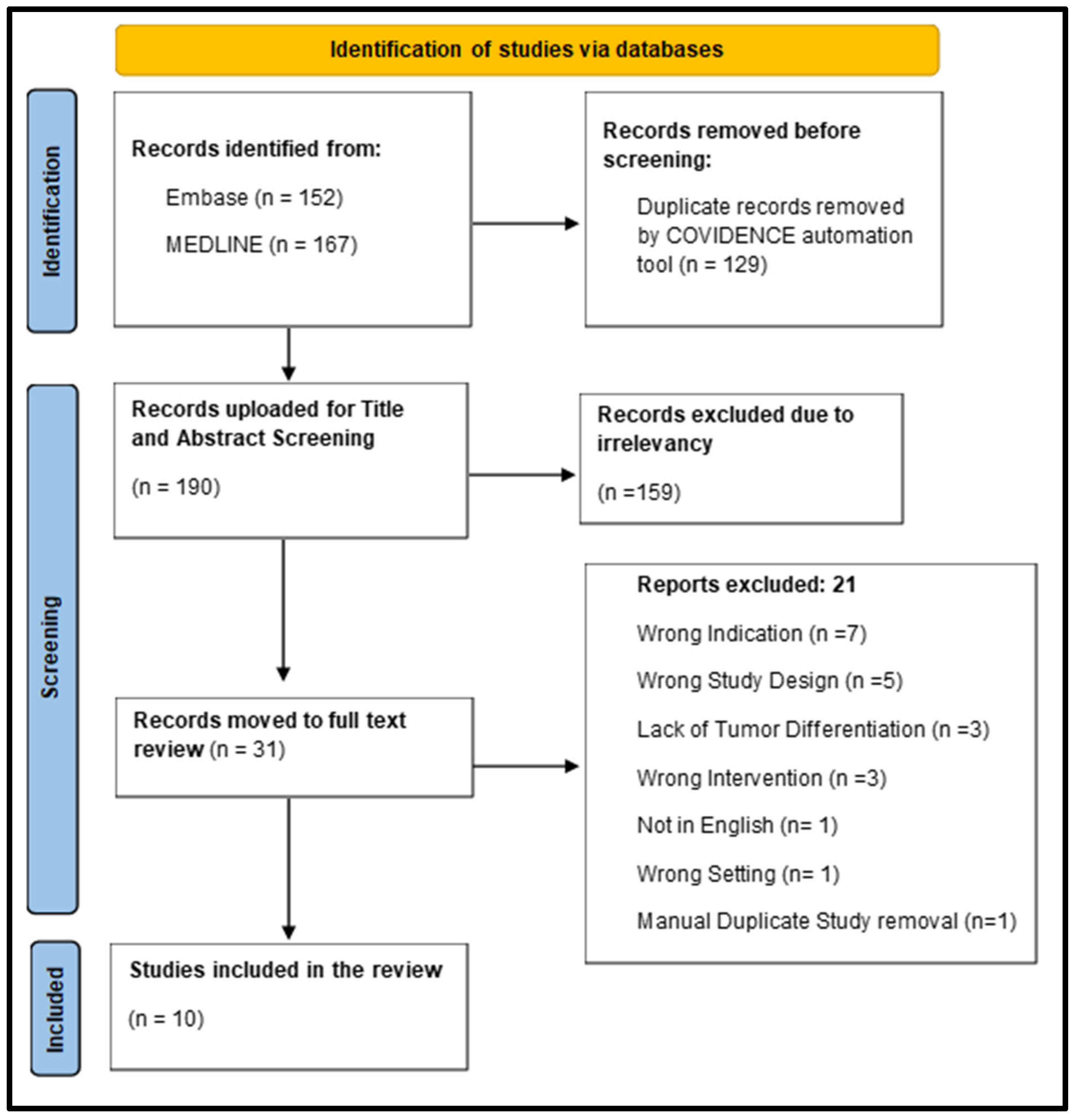
2. Methods
3. Results

| Study | Year of Publication | Sample Size for FPT Cases | Pathology | ICG Administration Summary | ICG Recommended |
|---|---|---|---|---|---|
| Wang et al. [21] | 2025 | 1 | Cushing’s syndrome | Intraoperative administration of 12.5 mg | Yes |
| Verstegen et al. [20] | 2016 | 6 | Cushing’s Disease; Acromegaly; Prolactinoma | Multiple IV dose of 5 mg ICG with a maximum dose of 15 mg per patient. The first dose was administered before tumor removal, and the and dose at the end of the surgery to check resection. | Yes |
| Amano et al. [13] | 2019 | 9 | Growth Hormone Secreting Adenoma | ICG dose of 6.25 or 12.5 mg was given as a bolus into the peripheral veins. | Yes |
| Muto et al. [18] | 2023 | 2 | Lactotroph Pituitary Adenoma | 12.5 mg of ICG was administered intravenously during the surgery. | Yes |
| Lee et al. [16] | 2022 | 1 | GH-secreting Pituitary Adenoma | 12.5 mg of ICG was administered intravenously during the surgery. | Yes |
| Inoue et al. [14] | 2015 | 5 | GH and PRL-secreting pituitary adenoma | 25 mg of ICG compound was dissolved in 10 mL of sterile water. 5 mL of this solution was administered to patients into the peripheral vein as a bolus during the surgery, followed by 10 mL of saline flush. | Yes |
| Lindner Dirk [17] | 2020 | 6 | Hormone-secreting pituitary adenoma | No | |
| Nakassa et al. [19] | 2017 | 7 | Hormone-secreting pituitary adenoma | Out of the total hormone and non-hormone secreting cases, 18 patients received 25 mg of ICG and 22 received 12.5 mg. | No |
| Jeon et al. [15] | 2018 | 4 | Acromegaly; Cushing’s Disease; Null Cell with Hypogonadism | 5 mg/kg 24 h before the operation | Yes |
| Cho et al. [12] | 2018 | 14 | Growth Hormone Secreting Adenoma; Adrenocorticotropic Secreting Adenoma; Prolactin Secreting Adenoma | No |
| Characteristic | N | % |
|---|---|---|
| Age | ||
| Mean/Median | 50.5 years | - |
| Range | 22–73 years | - |
| Gender | ||
| Male | 48 | 43.60% |
| Female | 62 | 56.40% |
| Pathology—FPT Types | ||
| Cushing’s Disease | 19 | 17.30% |
| Acromegaly (GH-secreting) | 24 | 21.80% |
| Prolactinoma | 8 | 7.30% |
| Thyrotroph | 1 | 0.90% |
| Gonadotropin-secreting | 1 | 0.90% |
| Pathology—Non-FPT Types | ||
| Non-functioning adenoma | 24 | 21.80% |
| Craniopharyngioma | 3 | 2.70% |
| Chordoma | 4 | 3.60% |
| Rathke’s cleft cyst | 3 | 2.70% |
| Meningioma | 1 | 0.90% |
| Pituitary apoplexy | 2 | 1.80% |
| Gangliocytoma | 1 | 0.90% |
| Total Cases | 110 | - |
4. Discussion
4.1. Surgical Utilization of ICG in FPTs
4.2. ICG Dosing
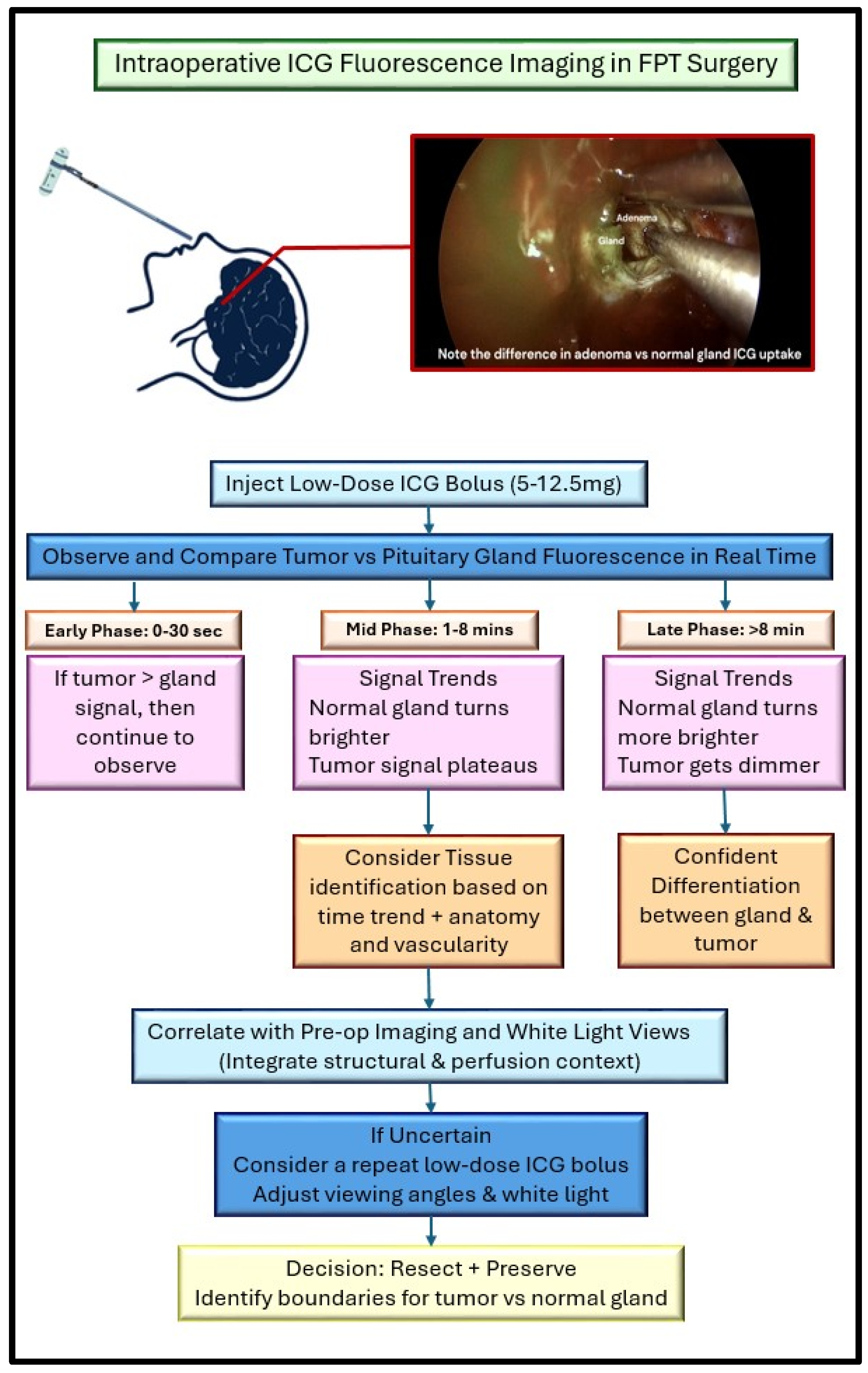
4.2.1. Low-Dose, Intraoperative Techniques: A Focus on Dynamic Differentiation
4.2.2. High-Dose, Preoperative SWIG Technique: A Focus on Sensitivity
5. Conclusions
6. Limitations
Author Contributions
Funding
Data Availability Statement
Acknowledgments
Conflicts of Interest
References
- DeLellis, R.A.; Lloyd, R.V.; Heitz, P.U.; Eng, C. World Health Organization Classification of Tumours: Pathology and Genetics of Tumours of Endocrine Organs; IARC Press: Lyon, France, 2004. [Google Scholar]
- Melmed, S. Pituitary tumors. Endocrinol. Metab. Clin. N. Am. 2015, 44, 1–9. [Google Scholar] [CrossRef] [Scilit] [PubMed]
- Araujo-Castro, M.; Berrocal, V.R.; Pascual-Corrales, E. Pituitary tumors: Epidemiology and clinical presentation spectrum. Hormones 2020, 19, 145–155. [Google Scholar] [CrossRef] [Scilit] [PubMed]
- Molitch, M.E. Diagnosis and Treatment of Pituitary Adenomas: A Review. JAMA 2017, 317, 516–524. [Google Scholar] [CrossRef] [Scilit] [PubMed]
- AlMalki, M.H.; Ahmad, M.M.; Brema, I.; AlDahmani, K.M.; Pervez, N.; Al-Dandan, S.; AlObaid, A.; A Beshyah, S. Contemporary Management of Clinically Non-functioning Pituitary Adenomas: A Clinical Review. Clin. Med. Insights Endocrinol. Diabetes 2020, 13, 1179551420932921. [Google Scholar] [CrossRef] [Scilit]
- Kalinin, P.L.; Astaf’Eva, L.I.; Kadashev, B.A.; Ismailov, D.B.; Acтaфьeвa, Л.И. Pokazaniia k khirurgicheskomu lecheniiu prolaktin-sekretiruiushchikh adenom gipofiza [Indications for surgical treatment of prolactin-secreting pituitary adenomas]. Zhurnal Vopr. Neirokhirurgii Im. N. N. Burdenko 2017, 81, 117–124. [Google Scholar] [CrossRef] [Scilit]
- Vergeer, R.A.; Theunissen, R.E.P.; van Elk, T.; Schmidt, I.; Postma, M.R.; Tamasi, K.; van Dijk, J.M.C.; Kuijlen, J.M.A. Fluorescence-guided detection of pituitary neuroendocrine tumor (PitNET) tissue during endoscopic transsphenoidal surgery available agents, their potential, and technical aspects. Rev. Endocr. Metab. Disord. 2022, 23, 647–657. [Google Scholar] [CrossRef] [Scilit]
- Kreutzer, J.; Fahlbusch, R. Diagnosis and treatment of pituitary tumors. Curr. Opin. Neurol. 2004, 17, 693–703. [Google Scholar] [CrossRef] [Scilit]
- Jane, J.A., Jr.; Catalino, M.P.; Laws, E.R., Jr. Surgical Treatment of Pituitary Adenomas. In Endotext; Feingold, K.R., Adler, R.A., Ahmed, S.F., Eds.; MDText.com, Inc.: Boston, MA, USA, 2022. [Google Scholar]
- Kim, E.H.; Cho, J.M.; Chang, J.H.; Kim, S.H.; Lee, K.S. Application of intraoperative indocyanine green videoangiography to brain tumor surgery. Acta Neurochir. 2011, 153, 1487–1495; discussion 1494–1495. [Google Scholar] [CrossRef] [Scilit]
- Sandow, N.; Klene, W.; Elbelt, U.; Strasburger, C.J.; Vajkoczy, P. Intraoperative indocyanine green videoangiography for identification of pituitary adenomas using a microscopic transsphenoidal approach. Pituitary 2015, 18, 613–620. [Google Scholar] [CrossRef] [Scilit]
- Cho, S.S.; Jeon, J.; Buch, L.; Nag, S.; Nasrallah, M.; Low, P.S.; Grady, M.S.; Singhal, S.; Lee, J.Y.K. Intraoperative near-infrared imaging with receptor-specific versus passive delivery of fluorescent agents in pituitary adenomas. J. Neurosurg. 2018, 131, 1974–1984. [Google Scholar] [CrossRef] [Scilit]
- Amano, K.; Aihara, Y.; Tsuzuki, S.; Okada, Y.; Kawamata, T. Application of indocyanine green fluorescence endoscopic system in transsphenoidal surgery for pituitary tumors. Acta Neurochir. 2019, 161, 695–706. [Google Scholar] [CrossRef] [Scilit]
- Inoue, A.; Ohnishi, T.; Kohno, S.; Nishida, N.; Nakamura, Y.; Ohtsuka, Y.; Matsumoto, S.; Ohue, S. Usefulness of an Image Fusion Model Using Three-Dimensional CT and MRI with Indocyanine Green Fluorescence Endoscopy as a Multimodal Assistant System in Endoscopic Transsphenoidal Surgery. Int. J. Endocrinol. 2015, 2015, 694273. [Google Scholar] [CrossRef] [Scilit]
- Jeon, J.W.; Cho, S.S.; Nag, S.; Buch, L.; Pierce, J.; Su, Y.S.; Adappa, N.D.; Palmer, J.N.; Newman, J.G.; Singhal, S.; et al. Near-Infrared Optical Contrast of Skull Base Tumors During Endoscopic Endonasal Surgery. Oper. Neurosurg. 2019, 17, 32–42. [Google Scholar] [CrossRef] [Scilit] [PubMed]
- Lee, M.H.; Lee, T.-K. Application of fusion-fluorescence imaging using indocyanine green in endoscopic endonasal surgery. J. Clin. Neurosci. Off. J. Neurosurg. Soc. Australas. 2022, 98, 45–52. [Google Scholar] [CrossRef] [Scilit]
- Lindner, D. Indocyanine green fluorescence endoscopy in endonasal transsphenoidal surgery. Biomed. Eng./Biomed. Tech. 2020, 65, S38. [Google Scholar] [CrossRef] [Scilit]
- Muto, J.; Mine, Y.; Nishiyama, Y.; Murayama, K.; Hayakawa, M.; Hasegawa, M.; Lee, J.K.; Hirose, Y. Intraoperative Real-Time Near-Infrared Image-Guided Endoscopic Endonasal Surgery for Pituitary Tumors. World Neurosurg. 2023, 175, e218–e229. [Google Scholar] [CrossRef] [Scilit] [PubMed]
- Nakassa, A.C.I.; Wang, E.W.; Fernandez-Miranda, J.C.; Snyderman, C.H.; Gardner, P.A. Usefulness of Indocyanine Green Fluorescence Endoscopy for Intraoperative Differentiation of Intracranial Tumors and Adjacent Structures. J. Neurol. Surg. Part BSkull Base 2017, 78, A153. [Google Scholar] [CrossRef] [Scilit]
- Verstegen, M.J.; Tummers, Q.R.; Schutte, P.J.; Pereira, A.M.; van Furth, W.R.; van de Velde, C.J.; Malessy, M.J.; Vahrmeijer, A.L. Intraoperative Identification of a Normal Pituitary Gland and an Adenoma Using Near-Infrared Fluorescence Imaging and Low-Dose Indocyanine Green. Oper. Neurosurg. 2016, 12, 260–268. [Google Scholar] [CrossRef] [Scilit]
- Wang, Y.; Cheng, H.; He, W.; Zhang, Q.; Yao, S.; Chen, Z.; Ma, Z.; Shou, X.; Shen, M.; Wang, Y. Endoscopic endonasal surgery using indocyanine green fluorescence endoscope for Cushing’s disease caused by mixed intrasellar gangliocytoma and adrenocorticotropin adenoma: Illustrative case. J. Neurosurg. Case Lessons 2025, 9, CASE25237. [Google Scholar] [CrossRef] [Scilit]
- Litvack, Z.N.; Zada, G.; Laws, E.R. Indocyanine green fluorescence endoscopy for visual differentiation of pituitary tumor from surrounding structures. J. Neurosurg. 2012, 116, 935–941. [Google Scholar] [CrossRef] [Scilit]
- Mirzayeva, L.S.; Uçar, M.; Budak, S.N.; Kaymaz, A.M.; Yaylı, N. Pushing the boundaries of neurosurgical oncology: Evaluating the superiority of supratotal resection over gross total resection in intraoperative MRI-guided glioma surgery. Neurosurg. Rev. 2025, 48, 200. [Google Scholar] [CrossRef] [Scilit]
- Begley, S.L.; McBriar, J.D.; Pelcher, I.; Schulder, M. Intraoperative MRI: A Review of Applications Across Neurosurgical Specialties. Neurosurgery 2024, 95, 527–536. [Google Scholar] [CrossRef] [Scilit]
- Song, X.; Huang, P.; Liu, X.; Yu, H.; Wei, J.; Ming, D. Advanced imaging and localization techniques in brain tumor resection: A review for precision tumor removal. Brain Res. Bull. 2025, 230, 111533. [Google Scholar] [CrossRef] [Scilit]
- Fransvea, P.; Miccini, M.; Rondelli, F.; Brisinda, G.; Costa, A.; Garbarino, G.M.; Costa, G. A Green Lantern for the Surgeon: A Review on the Use of Indocyanine Green (ICG) in Minimally Invasive Surgery. J. Clin. Med. 2024, 13, 4895. [Google Scholar] [CrossRef] [Scilit]
- Kim, M.; Lee, S.; Park, J.C.; Jang, D.-M.; Ha, S.I.; Kim, J.-U.; Ahn, J.S.; Park, W. Anaphylactic Shock After Indocyanine Green Video Angiography During Cerebrovascular Surgery. World Neurosurg. 2020, 133, 74–79. [Google Scholar] [CrossRef] [Scilit]


Disclaimer/Publisher’s Note: The statements, opinions and data contained in all publications are solely those of the individual author(s) and contributor(s) and not of MDPI and/or the editor(s). MDPI and/or the editor(s) disclaim responsibility for any injury to people or property resulting from any ideas, methods, instructions or products referred to in the content. |
© 2026 by the authors. Licensee MDPI, Basel, Switzerland. This article is an open access article distributed under the terms and conditions of the Creative Commons Attribution (CC BY) license.
Share and Cite
Habes, M.; Lang, D.K.; Khairy, S.; Vargas-Moreno, A.; Rabski, J.; Kilty, S.-J.; AlKherayf, F. Application and Outcomes of Indocyanine Green in Endoscopic Transsphenoidal Surgery for Functional Pituitary Tumors: A Literature Review. Brain Sci. 2026, 16, 293. https://doi.org/10.3390/brainsci16030293
Habes M, Lang DK, Khairy S, Vargas-Moreno A, Rabski J, Kilty S-J, AlKherayf F. Application and Outcomes of Indocyanine Green in Endoscopic Transsphenoidal Surgery for Functional Pituitary Tumors: A Literature Review. Brain Sciences. 2026; 16(3):293. https://doi.org/10.3390/brainsci16030293
Chicago/Turabian StyleHabes, Moustafa, Damanpreet Kaur Lang, Sami Khairy, Alejandro Vargas-Moreno, Jessica Rabski, Shaun-Jason Kilty, and Fahad AlKherayf. 2026. "Application and Outcomes of Indocyanine Green in Endoscopic Transsphenoidal Surgery for Functional Pituitary Tumors: A Literature Review" Brain Sciences 16, no. 3: 293. https://doi.org/10.3390/brainsci16030293
APA StyleHabes, M., Lang, D. K., Khairy, S., Vargas-Moreno, A., Rabski, J., Kilty, S.-J., & AlKherayf, F. (2026). Application and Outcomes of Indocyanine Green in Endoscopic Transsphenoidal Surgery for Functional Pituitary Tumors: A Literature Review. Brain Sciences, 16(3), 293. https://doi.org/10.3390/brainsci16030293