1. Introduction
In recent years, the incidence of limb disability and paralysis resulting from amyotrophic lateral sclerosis (ALS) and spinal cord injury (SCI) has been steadily increasing. Patients with motor disabilities have intact cognitive functions but lack voluntary control over their muscles and the peripheral nervous system, making it impossible for them to effectively control their body trunk through brain signals. Although traditional clinical approaches have achieved certain progress in limb function recovery, they still struggle to fully restore complex motor functions. Brain–Computer Interface (BCI) technology offers the possibility of establishing a bidirectional communication pathway between the brain and external devices. By acquiring and decoding neurophysiological signals such as Electroencephalography (EEG), this technology can directly convert the subject’s motor intentions into physical commands, thereby enabling the control of assistive devices [
1,
2]. This technology brings new hope to patients with motor impairments but intact cognitive abilities.
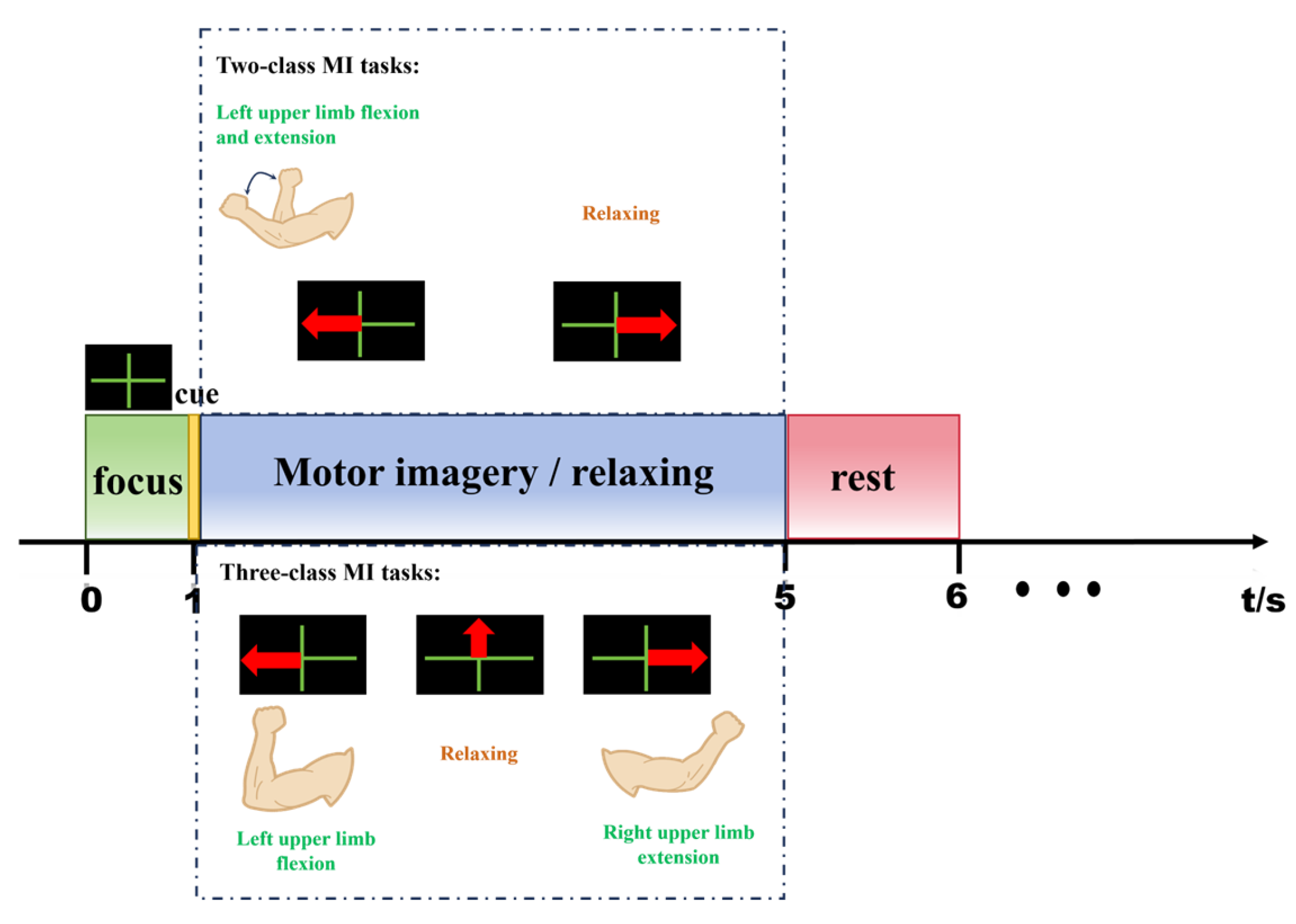
In neural rehabilitation, the Motor Imagery (MI) experimental paradigm is widely used as a control source due to its ability to map active intentions without requiring actual limb movements. It not only promotes the repair or reconstruction of damaged motor pathways and awakens some dormant neural synapses but also can interact with actual movements to achieve better motor cortex reorganization effects [
3]. However, distinguishing between different fine movements within the upper limb (Extension and Flexion) still poses significant challenges [
4]. The representational areas of such movements in the cerebral cortex highly overlap, and EEG signals are characterized by low signal-to-noise ratio (SNR) and significant individual differences, which place extremely high demands on the discriminative power of feature extraction algorithms.
Commonly utilized feature extraction methods for MI can be categorized into several primary types based on the nature of the classification features. First, time–domain analysis focuses on waveform characteristics as they evolve over time, employing techniques such as statistical features (mean, variance, and standard deviation) [
5], autoregressive (AR) models [
6], and event-related potentials (ERP) [
7]. Second, frequency–domain analysis investigates EEG signal characteristics across different frequency bands corresponding to various physiological states, utilizing methods such as power spectral density (PSD) [
8,
9], differential entropy (DE) [
10], and energy ratios [
11]. Thirdly, spatial–domain analysis focuses on exploring the activation relationships among different brain regions, mainly extracting features through methods such as Common Spatial Pattern (CSP) [
12,
13], Independent Component Analysis (ICA) [
14], and Surface Laplacian (SL) [
15]. In addition, time-frequency analysis can be performed to capture the time-frequency domain features of EEG signals using techniques including Wavelet Transform (WT) [
16] and Hilbert-Huang Transform-Empirical Mode Decomposition (HHT-EMD) [
17]. MI-EEG signals exhibit the most distinct spatial distribution differences, making the CSP widely used for extracting discriminative spatial features. Numerous researchers have conducted extensive studies to derive more prominent CSP features [
18]. For instance, Ana [
19] proposed an adaptive CSP (ACSP) algorithm, which significantly reduced the training time required for new subjects and achieved successful three-class classification for complex MI tasks. Tang et al. [
20] proposed a method based on the Bhattacharyya distance to select the optimal frequency band for each electrode across different subjects, followed by feature extraction using an improved B-CSP algorithm to achieve the classification of motor imagery tasks. Fu et al. [
21] addressed the issue that the CSP algorithm repeatedly selects feature patterns in the feature space by proposing a sparse CSP algorithm. This approach embeds sparse technology and iterative search into the CSP framework, selecting EEG signals from a few channels with the most prominent features and thereby improving the accuracy of feature classification. Peterson V et al. [
22] proposed a novel classification method integrating multi-band and time window techniques. This method extracts features from each frequency band using the CSP algorithm and incorporates a priori discriminative information into the model via a fast feature selection and classification approach based on elastic net regression, thereby improving the classification accuracy of MI-based BCI systems. Convolutional networks exhibit excellent automatic feature extraction capability in complex signal processing scenarios [
23]. Fu et al. [
24] proposed a convolutional transformer network integrated with an adaptive learning module, which not only enhances the individual motor imagery classification performance but also shortens the calibration time for new subjects.
The CSP is a spatial filtering feature extraction algorithm designed for binary classification tasks. It is capable of extracting the spatial distribution components of each class from multi-channel BCI data. But the traditional CSP algorithm is highly sensitive to noise, and its performance is significantly dependent on the selection of frequency bands [
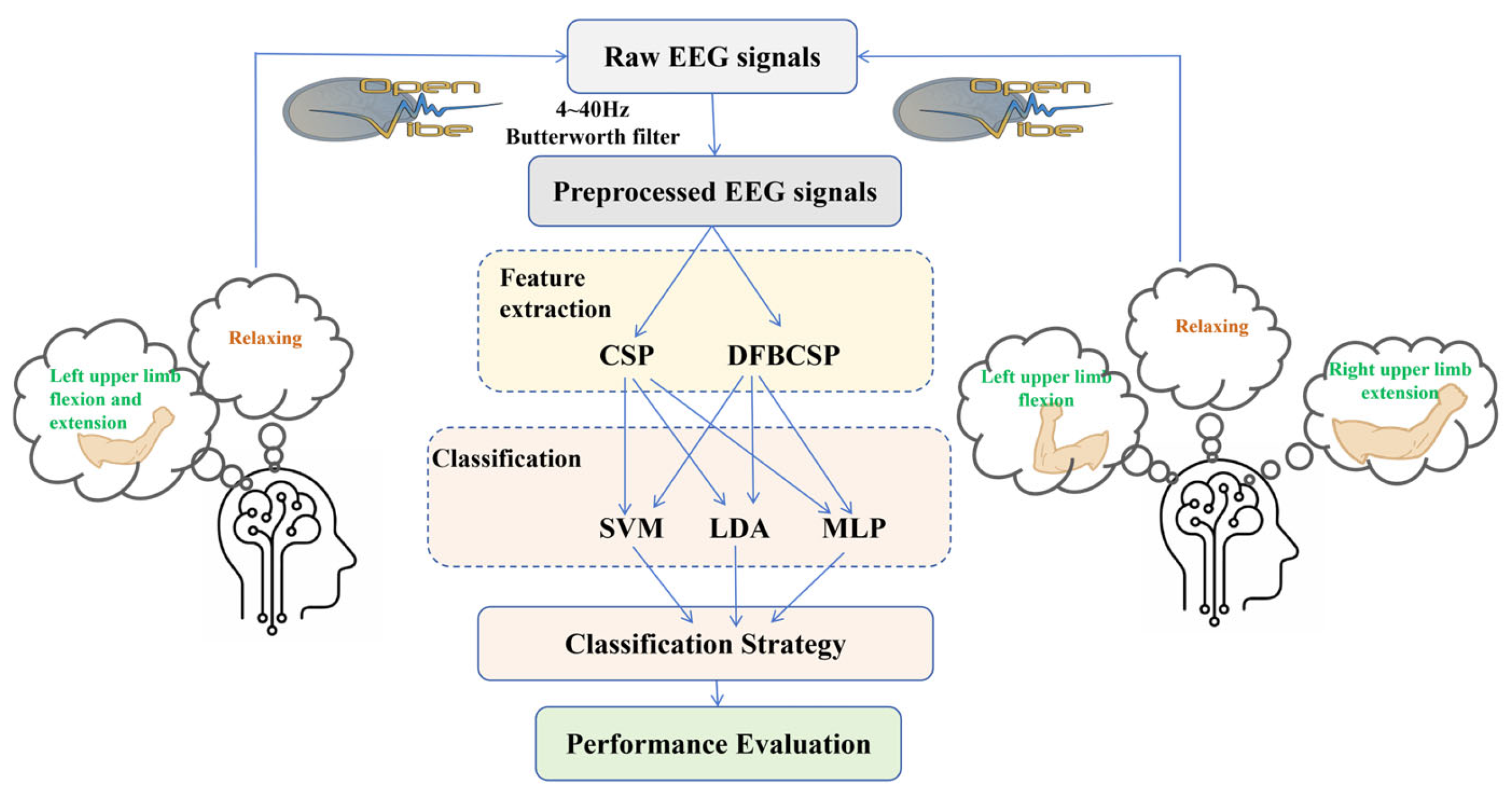
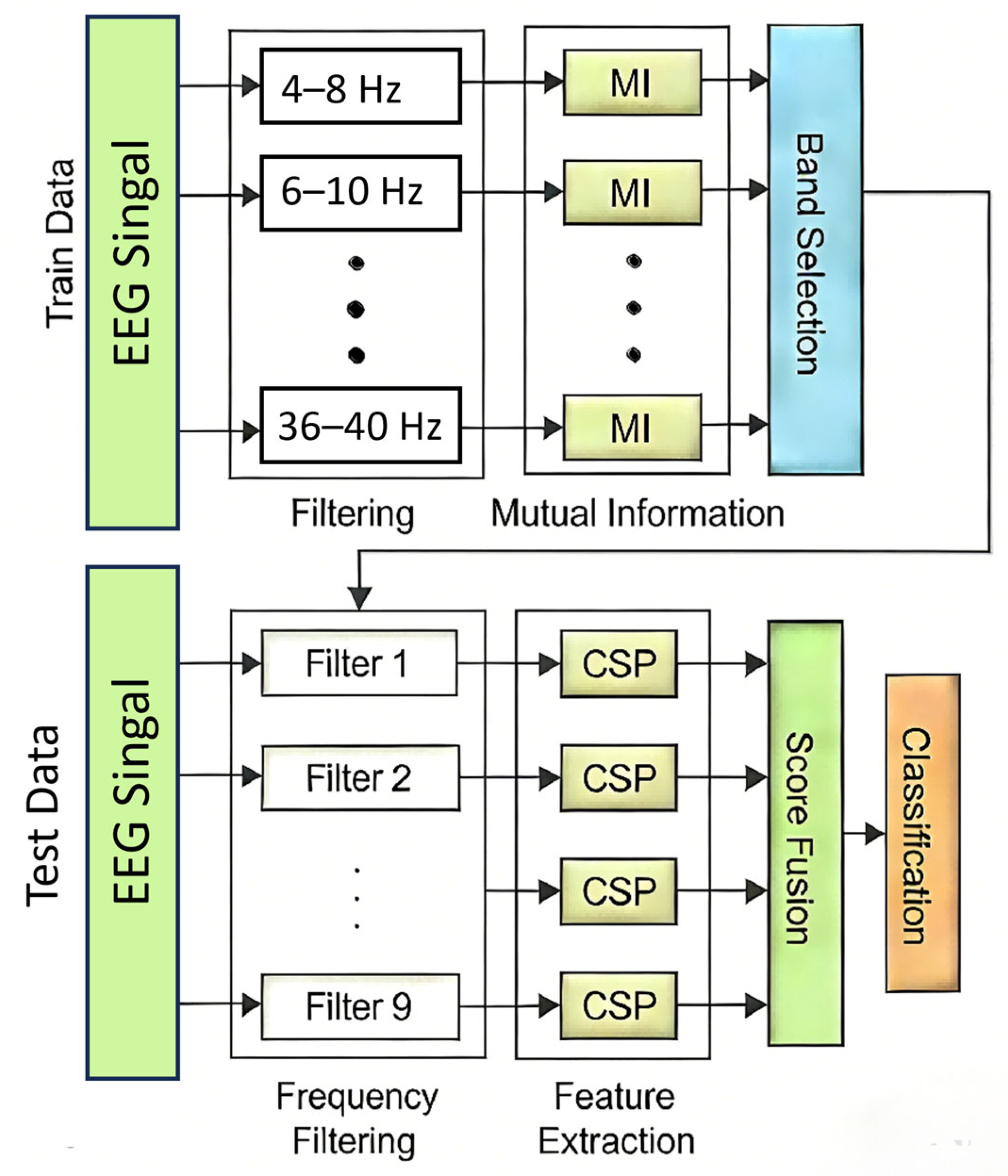
25]. To address these limitations, we introduce the discriminative filter bank common spatial pattern (DFBCSP), which enables the precise elimination of redundant information while retaining features with the highest discriminative contribution. We aim to explore the potential of the DFBCSP algorithm in the classification of EEG signals during upper-limb extension and flexion MI. We developed a feature extraction model based on DFBCSP and integrated it with classification techniques, including multi-layer perceptron (MLP), support vector machine (SVM), and linear discriminant analysis (LDA), to analyze EEG signals from subjects performing upper-limb imagery tasks. By comparing with the traditional CSP, this study evaluates the classification performance of the DFBCSP in upper limb motor imagery tasks using statistical metrics such as classification accuracy, Kappa value, and Receiver Operating Characteristic (ROC) curve.
3. Results and Analysis
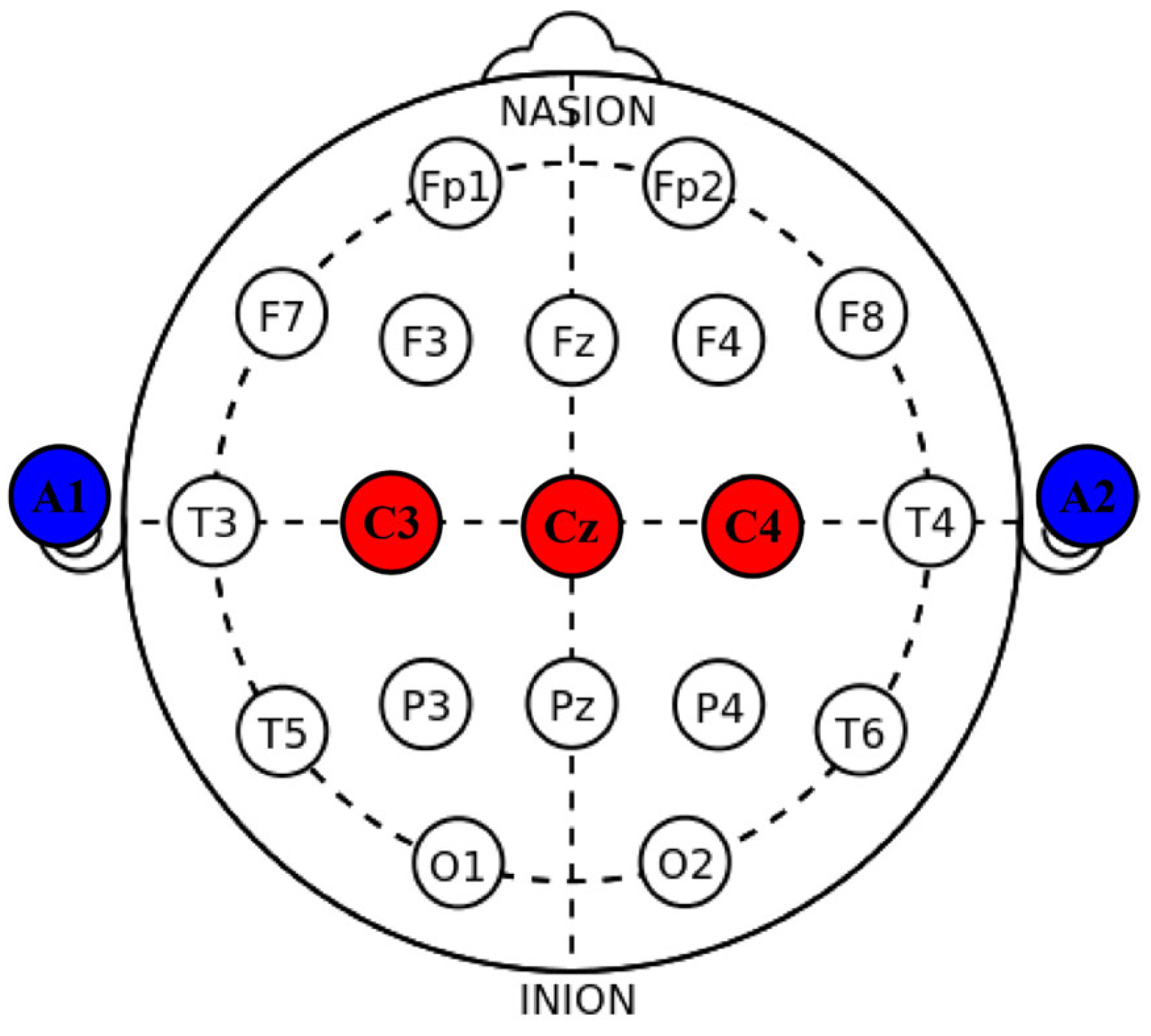
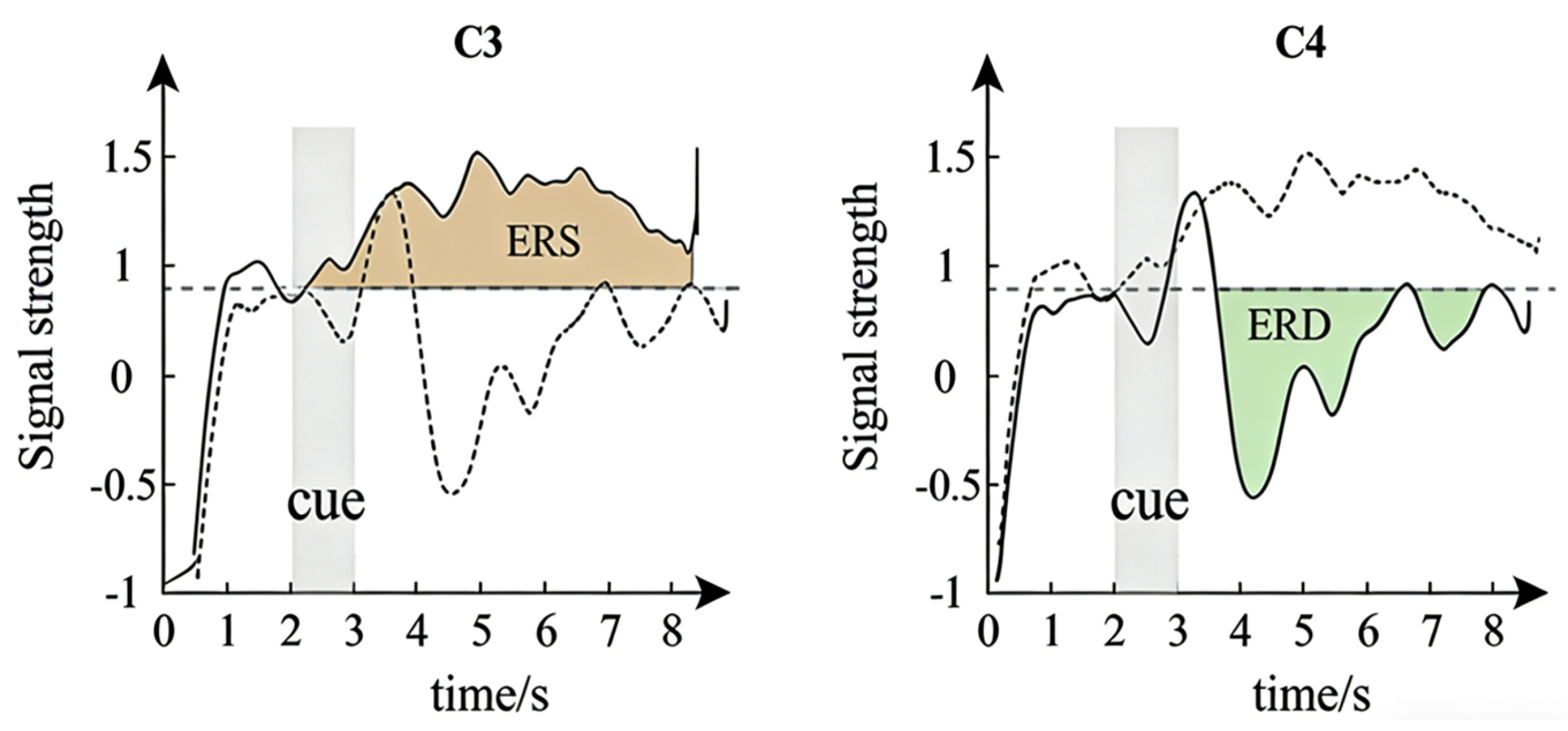
Figure 5 first shows the change process of ERD/ERS from 0 s to 8 s. There are obvious ERD and ERS in the electroencephalogram cortical signals, and the time range for the occurrence of ERD/ERS in each experiment is from 3.5 s to 5.5 s. When imagining the flexion and extension movements of the left upper limb, the C3 channel shows a higher potential during the ERS phenomenon, while the C4 channel shows a lower potential during the ERD phenomenon, which reflects the dynamic neural regulation of the brain when processing information.
To facilitate optimal experimental outcomes, the dataset is evenly divided into five subsets. Each time, four subsets are used as the training set and one subset is used as the validation set to conduct a five—fold cross—validation experiment. The specific training accuracies for the respective classification tasks are detailed in
Table 1 and
Table 2. Subsequently, the performance of six algorithm combinations—comprising DFBCSP + MLP, DFBCSP + SVM, DFBCSP + LDA, CSP + MLP, CSP + SVM, and CSP + LDA—was rigorously evaluated on the test set using classification accuracy, the Kappa coefficient, and receiver operating characteristic (ROC) curves.
For subjects S1–S16, we use the average accuracy and standard deviation in the table to calculate the 95% confidence interval for each algorithm. The calculation formula is as follows:
Here, represents the accuracy rate, is the number of samples, is the standard deviation, and the degrees of freedom .
To quantify the differences in classification performance among the various algorithms, we first conducted a one-way repeated-measures analysis of variance (ANOVA [
30]) on the classification accuracies of 16 subjects obtained with the six algorithms. The results demonstrated an extremely significant main effect of algorithm type on classification accuracy, indicating the presence of overall differences in the accuracies of the six algorithms, as detailed in
Table 3 and
Table 4. To further identify the specific sources of these differences, we performed post hoc multiple comparisons using Bonferroni-corrected paired
t-tests. The test results showed that the DFBCSP series algorithms achieved significantly higher accuracies than their corresponding conventional CSP series algorithms. Additionally, under the DFBCSP framework, the Multi-Layer Perceptron (MLP) classifier significantly outperformed the Support Vector Machine (SVM) and Linear Discriminant Analysis (LDA) classifiers, which confirms the performance superiority of the DFBCSP + MLP algorithm.
To conduct an in-depth analysis of the classification performance of each algorithm, we introduced the Kappa coefficient as a pivotal evaluation metric. An elevation in this value directly reflects enhancements in both model accuracy and stability [
31]. Drawing upon experimental data from subjects S1 through S16,
Table 5 and
Table 6 delineate the specific performance of the six comparative methods across two-class and three-class classification tasks, respectively. Through the comparison of these quantitative data, performance disparities among the models when addressing classification tasks of varying complexities can be clearly observed.
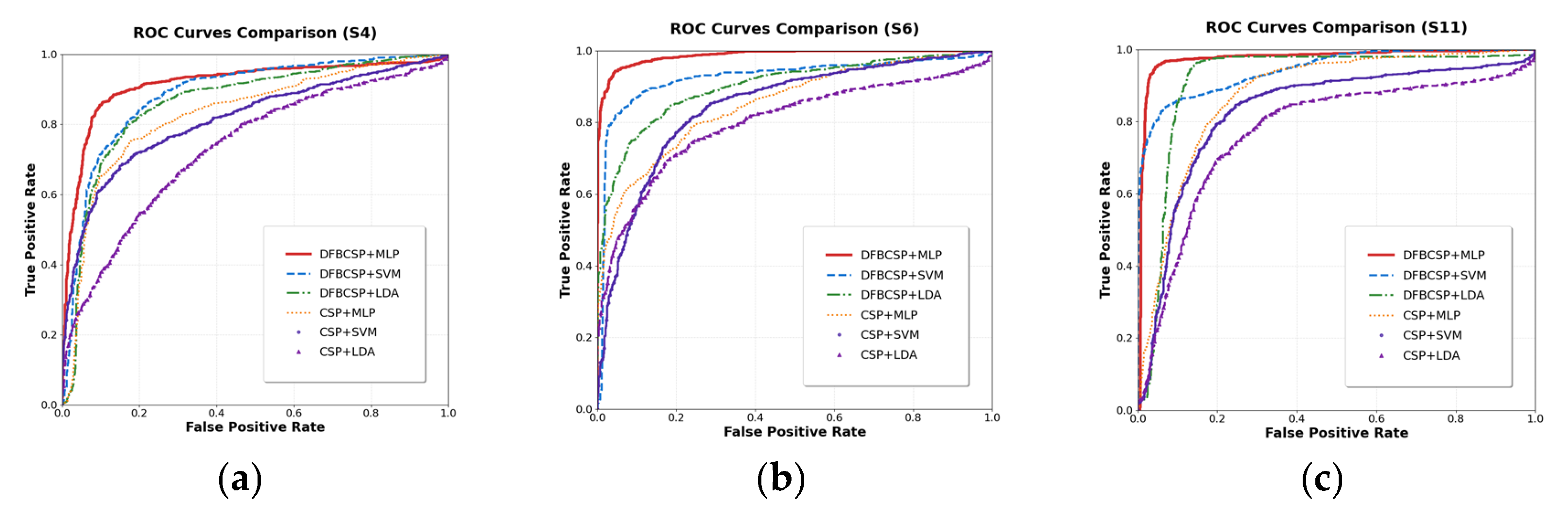
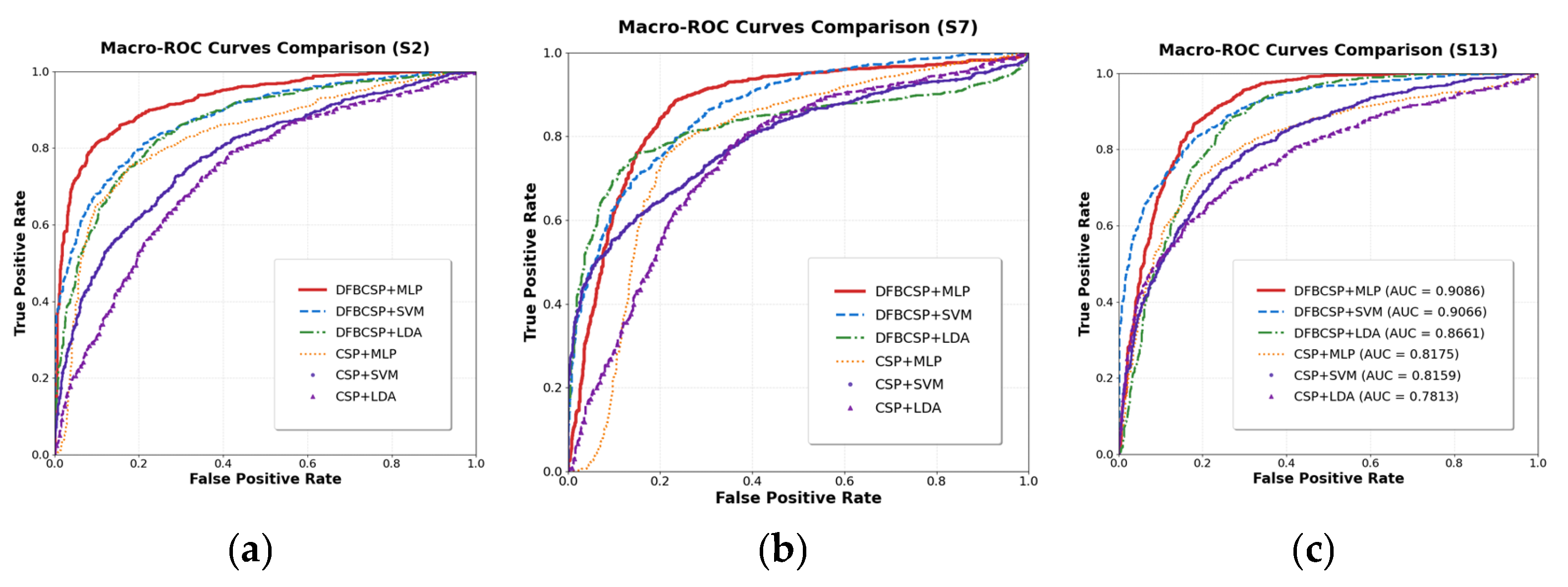
The ROC curve not only dynamically depicts the trade-off between the true positive rate (TPR) and false positive rate (FPR) across a continuum of decision thresholds but also offers a robust characterization of a model’s discriminative performance in motor imagery electroencephalography (MI-EEG) classification. In this study, clear classification labels were defined a priori: for the two-class task, MI of left upper limb extension/flexion was designated as the positive class, while the resting (relaxation) state was assigned as the negative class. For the three-class task, to enable a streamlined evaluation of multidimensional discriminative performance and objectively reflect the model’s overall ability to recognize the three specific movement states—Relaxation, Left Limb Flexion, and Right Limb Extension—we employed the macro-average ROC curve, which is derived by macro-averaging the per-class ROC curves computed for each individual class against all other classes combined. As a canonical global metric for assessing classifier performance, the AUC is highly sensitive to the distinctness of the learned classification boundaries; an AUC value approaching 1 (corresponding to an ROC curve that nears the top-left corner of the coordinate plane) signifies the model’s superior capacity to extract and discriminate task-relevant MI-EEG signal features [
32].
Figure 6 and
Figure 7 present the ROC curve profiles for representative subjects across different experimental paradigms, while
Table 7 reports the mean AUC values (including the macro-average AUC for the three-class task) for each classification method.
Based on the data in the above pictures and tables, it can be concluded that the DFBCSP + MLP algorithm demonstrates significant performance advantages when processing EEG signals. In summary, the DFBCSP + MLP algorithm demonstrated superior classification performance in the task of upper-limb-motor-intention recognition; comparative experiments indicate that this algorithm achieved a significant improvement in performance relative to the conventional CSP algorithm.
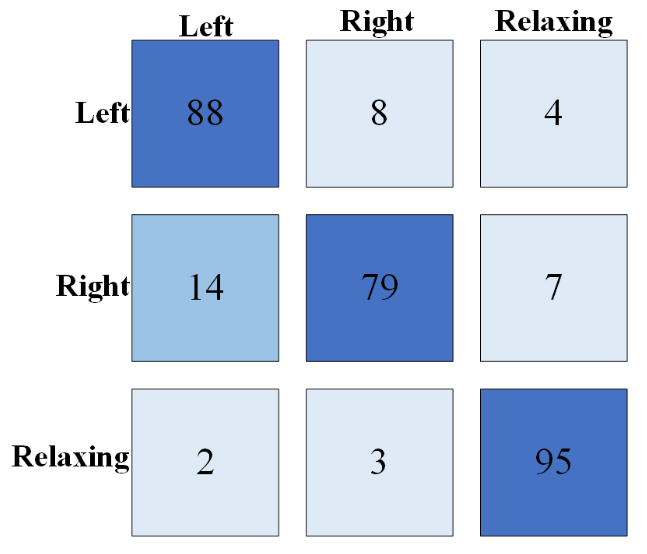
Figure 8 shows the confusion matrix of the real-time three-classification results for one of the subjects. The main diagonal of the confusion matrix reflects the prediction of the three categories. The columns represent the actual categories, and the rows represent the predicted categories. The darker the color, the higher the prediction accuracy.
4. Discussion
The performance of DFBCSP and conventional CSP in motor imagery (MI) EEG decoding is systematically evaluated through two-class (relaxing vs. left upper limb MI) and three-class tasks, with results corroborated by accuracy, Kappa coefficient, ROC curves, and AUC metrics.
Experimental results demonstrate that the selection of feature extraction methods and classifiers exerts a significant influence on the recognition performance of electroencephalogram (EEG) signals. In terms of feature extraction, DFBCSP exhibited superior performance to the traditional CSP in both binary and ternary classification tasks, with an average accuracy improvement of approximately 5% to 8% and a significantly lower standard deviation. This verifies the robustness of multi-band discriminative features in capturing the non-stationary information of EEG signals and suppressing individual differences. In the aspect of classifiers, under the same feature conditions, the performance of the three classifiers followed the order of MLP > SVM > LDA. This reflects that nonlinear classifiers represented by MLP possess stronger feature mapping and discriminative capabilities than linear classifiers (LDA) in processing high-dimensional EEG features. In summary, the DFBCSP + MLP combination achieved the highest recognition accuracy in both binary (94.83%) and ternary (86.20%) classification tasks, with the most concentrated distribution of 95% confidence intervals. This proves that the combination serves as the optimal recognition framework for addressing complex multi-class EEG tasks.
BCI illiteracy refers to the phenomenon in motor imagery (MI) based brain–computer interface (BCI) training and experiments where certain individuals fail to achieve sufficiently high and usable control performance over an extended period [
33]. Its causes may be associated with multiple factors, such as neurophysiological differences, yet no unified conclusion has been reached to date. In the experiments, Subject S4 exhibited a significantly lower accuracy rate than other participants in the ternary classification task, presenting this phenomenon in a typical manner. The DFBCSP method can amplify weak and scattered discriminative information through multi-band filtering and mutual information-based discriminative feature selection. Even for Subject S4, the DFBCSP combined with a multi-layer perceptron (MLP) achieved an accuracy increase of approximately 10.38% compared with the CSP + MLP framework in the three-class task; in two-class and three-class tasks, it further yielded increases of 16.92% and 15.54%, respectively, relative to the CSP + LDA framework. This demonstrates the DFBCSP’s robustness and compensatory ability for users with weak signals/low controllability, and its potential to enhance the generalizability of BCI systems to illiterate subjects. This study only investigates the manifestations and performance differences of BCI illiteracy, without exploring its underlying neural mechanisms or enabling a rigorous clinical diagnosis of BCI illiteracy. Moreover, DFBCSP cannot fundamentally eradicate this phenomenon. Future research will conduct in-depth investigations into the causes and intervention strategies of BCI illiteracy, analyze the characteristics of low-controllability users via multi-dimensional assessment, and explore the improvement effects of combined methodological frameworks.
Regarding the computational complexity and system response time, we have specifically presented them in
Table 8. Here,
N,
K,
T,
F,
S, and
H, respectively, represent the number of EEG signal channels, the number of sub-bands of DFBCSP, the number of sampling points of the EEG signal, the number of extracted features, the number of training samples, and the number of neurons in the hidden layer of the MLP.
While the proposed approach yields promising results, several limitations merit discussion. First, the study’s sample size (sixteen participants) is relatively small, and the MI tasks (e.g., left flexion vs. right extension) are simplified compared to real-world rehabilitation scenarios. Future research should expand the cohort to include more diverse populations and validate the method on more complex, ecologically valid MI paradigms. Second, the current DFBCSP framework uses a fixed set of nine sub-bands, which may not be optimal for all individuals or MI tasks. Adaptive sub-band selection (e.g., personalized frequency partitioning based on individual EEG characteristics) could further enhance performance, particularly for subjects with “BCI illiteracy”.
In terms of clinical relevance and translational potential, the method’s feasibility hinges on addressing key real-world constraints. Temporally, the DFBCSP + MLP’s offline processing latency is acceptable for offline personalized rehabilitation planning but requires optimization (e.g., adaptive sub-band pruning, lightweight MLP quantization) to meet the <100 ms latency threshold for real-time BCI-guided training, critical for patient-machine interaction in clinical settings. System-wise, the moderate computational demands (
Table 8) are compatible with portable EEG devices, supporting deployment in rehabilitation centers or home-based care, though power consumption optimization is needed for long-term wearable use. Clinically, the simplified MI tasks limit direct translation; future validation on patients with upper limb dysfunction should incorporate functional, task-specific movements (e.g., reaching, grasping) to align with real rehabilitation goals.
In recent years, deep learning methods like CNNs and their variants [
34,
35] have achieved excellent performance on public MI-EEG datasets by automatically learning spatiotemporal features from raw or minimally preprocessed signals in an end-to-end manner, showing great potential for modeling complex nonlinear EEG patterns yet relying on sufficient data and computing power; by contrast, the DFBCSP + MLP proposed in this study integrates classic neurophysiological priors with a lightweight nonlinear classifier, where DFBCSP leverages μ and β band ERD/ERS priors and improves feature interpretability and robustness via multi-sub-band filtering and discriminative feature selection, and MLP implements nonlinear mapping at the feature space level with far fewer parameters than deep CNNs/EEGNet. This method has lower demands for training data scale and hardware resources, making it more suitable for the few-shot learning, portability and real-time performance requirements of rehabilitation scenarios; for future work, we will further incorporate lightweight CNNs/EEGNet or attention modules into the framework to build a “DFBCSP features + micro deep networks” hybrid architecture, and integrate transfer learning and adaptive frequency band selection strategies to compare and fuse the performance and deployability of mainstream deep learning methods in clinical populations. Notably, the present study does not incorporate the integration of physical modeling (e.g., the finite element method, FEM) with artificial intelligence (AI) into its research scope, yet numerous studies have demonstrated that this integration strategy can effectively enhance the generalization ability and interpretability of AI systems for upper limb rehabilitation [
36]. This presents a highly promising future research direction for further improving the interpretability and robustness of rehabilitation-based brain–computer interface (BCI) systems based on the method we proposed.
Despite these limitations, the findings highlight DFBCSP’s potential as a robust feature extraction tool for upper limb MI-EEG decoding, providing a technical foundation for precision neurorehabilitation. For clinical applications, the DFBCSP + MLP model could be integrated into wearable BCI devices to deliver personalized rehabilitation training, particularly for patients with upper limb motor dysfunction.
5. Conclusions
We investigated six algorithm combinations to optimize the classification strategy and performance of the MI-BCI system by differentiating between upper limb extension and flexion movements. These combinations included DFBCSP + MLP, DFBCSP + SVM, and DFBCSP + LDA, alongside the conventional CSP + based counterparts: CSP + MLP, CSP + SVM, and CSP + LDA. By incorporating multi-band filtering and mutual information-based discriminative feature selection, the DFBCSP algorithm effectively eliminates redundant information while retaining features that yield the highest classification contribution. Methodologies employing the DFBCSP algorithm consistently outperformed those based on the conventional CSP algorithm. Specifically, in the two-class classification task, the DFBCSP + MLP method achieved a remarkable average accuracy of 94.83%, representing an improvement of approximately 8.23% over traditional methods; the average Kappa coefficient reached 0.890, and the average AUC value was 0.954. Furthermore, in the three-class classification task, the Kappa coefficient improved by approximately 0.10. Moreover, our results indicate that the MLP classifier, leveraging its nonlinear mapping capabilities, exhibited performance significantly superior to that of SVM and LDA. Consequently, identified as the optimal combination of spatial filtering and classification algorithms, the DFBCSP + MLP method demonstrates immense potential for enhancing the performance of upper limb motor imagery systems.