


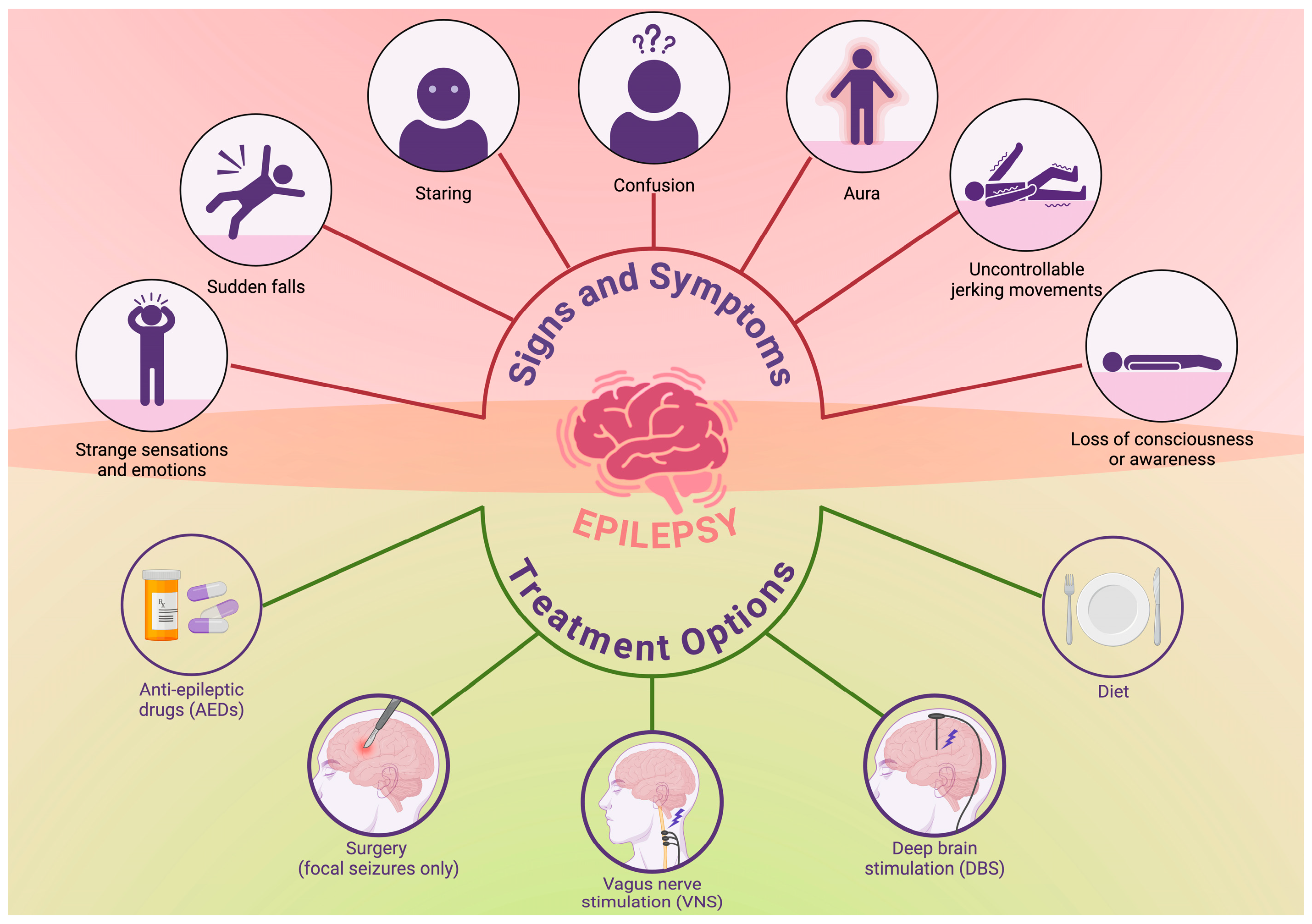
Epilepsy is a chronic neurologic disorder characterized by recurrent and spontaneous seizures (Figure 1). It is known to affect more than 50 million people worldwide [1]. That is why it is considered one of the great healthcare challenges faced today [2]. It is a heterogeneous disorder, resulting from an extremely diverse range of genetic, structural, metabolic, and immune-mediated etiologies that have significant variations in terms of both clinical symptoms and therapeutic outcomes [3,4]. This Special Issue in the journal Brain Sciences, titled “Etiology, Symptoms, and Treatment of Epilepsy,” discusses several findings that have enhanced our knowledge of the disease process and provide potential opportunities for novel interventions [4,5,6]. Epilepsy is an etiologically complex disease [7,8]. Genetic generalized epilepsy exemplifies how complex polygenic influences and network dysfunctions contribute to the disease risk [9]. Additionally, it involves the thalamocortical circuits, which adds to therapeutic complications [7,9,10]. This is supported by emerging neuromodulation studies that target the anterior thalamic nuclei to modulate these circuits for subtypes of drug-resistant epilepsy [3,5].
Figure 1.
The signs and symptoms of epilepsy and the treatment options available. Created in BioRender. Singh, D. (2025). https://BioRender.com/3k45g59.
Alongside genetic causes, structural lesions due to developmental malformations, trauma, infections, or stroke are still significant contributors to epilepsy [7,11]. On the other hand, neuroimaging advances offer better diagnosis and surgical candidacy evaluation [12,13]. Various neuroimmune mechanisms underlying metabolic dysfunction (like Type 2 diabetes mellitus) are known to promote seizure propensity [2,4]. Regarding this connection, Phoswa and Mokgalaboni have discussed the involvement of inflammatory cytokines like IL-1β, IL-6, and TNF-α, disruption of the blood–brain barrier, and oxidative stress in both the pathomechanisms of epilepsy and diabetes [14]. Neuroinflammation has gained increasing recognition as a central contributor to epileptogenesis and pharmaco-resistance [15,16,17]. It is also known to work through the mediation of activated microglia, astrocytes, and cytokine cascades [18,19,20]. This paradigm shift heralds immunomodulation as a promising adjunct therapeutic strategy [14,21,22].
- Clinical Symptomatology
Epilepsy has a very wide symptomatology. It ranges from the seizures themselves to autonomic, cognitive, psychiatric, and behavioral dysfunction [4,6,23,24]. Salluce et al. provide compelling evidence of interictal autonomic dysfunction in pediatric epilepsy patients, identified by reduced skin conductance, which may underlie increased risks of SUDEP [6]. This finding implicates systemic autonomic involvement as part of epilepsy’s phenotypic spectrum, warranting holistic clinical assessment. Seizure semiology continues to be varied, including focal aware/impaired awareness seizures, as well as generalized tonic–clonic, myoclonic, and absence seizures, which all require different approaches, both diagnostically and therapeutically [2,4,25]. Ambulatory electrocorticography (including the closed-loop responsive neurostimulation) is revolutionizing the diagnostic yield and precision treatment [5,26,27]. Nevertheless, treatment adherence is crucial for controlling symptoms and improving quality of life [28,29]. Indeed, compliance, or lack thereof, remains a concerning issue that, intrinsically, is linked with socioeconomic class, lifestyle, and access to care, particularly among patients with reported alcohol use or unstable employment [30]. Treatment should be performed under regular clinical follow-up and patient education to optimize adherence and outcomes [31].
- Therapeutic Innovations
Conventional ASMs can control seizures in the majority of patients, but a third go on to develop drug-resistant epilepsy [4,32]. Therefore, it is crucial to accelerate the process of development and integration of advanced therapies:
- (a)
- Responsive Neurostimulation (RNS) for refractory generalized epilepsies targets the anterior thalamic nuclei, as described by the case series in this Special Issue [5,33]. The reduction in seizures and significant improvement in quality of life are worth highlighting [34]. This is a form of closed-loop neuromodulation that disrupts pathological network synchronization, heralding a personalized era of implantable therapies.
- (b)
- Vagus Nerve Stimulation (VNS) and Deep Brain Stimulation (DBS) are neuromodulation modalities that modulate limbic and thalamic networks, thus offering supplementary seizure control in refractory cases [4,14,35,36]. Newer closed-loop variants of these devices hold promise for greater specificity and tolerability.
- (c)
- Pharmacological and dietary adjuncts, including cannabidiol and ketogenic diets, have shown promise in specific refractory syndromes [37,38]. This area of research is especially encouraging in terms of non-pharmacologic complementary methods [2,4,39].
- (d)
- Immunomodulatory therapies have helped to advance our understanding of neuroinflammatory mechanisms, charting innovative pathways for new treatments aimed at cytokines, inflammasomes, and glial activation [12,21,22]. These therapies have opened a new frontier of precision medicine where newly emerging fields can facilitate highly personalized, mechanism-based interventions. These would include genomic profiling, gene therapy, and optogenetics, especially for the monogenic forms of epilepsy.
- Psychosocial Aspects of Epilepsy Care
In addition to the treatment mode, optimal management extends beyond pharmacological treatment and surgical interventions [40]. This is to address the multifaceted psychosocial determinants of disease trajectory, treatment adherence, and overall quality of life. According to Jopowicz et al. and Niriayo et al., these include lifestyle choices, social support systems, mental health comorbidities, societal stigma, and patient empowerment [31,41]. Lifestyle factors (including sleep hygiene, levels of stress, substance use, diet, and exercise) bear significantly on seizure control and adherence to treatment regimens [42,43]. Poor sleep hygiene, for example, is a recognized seizure precipitant; indeed, studies have shown that poor sleep hygiene is associated with increased seizure frequency [44,45]. Many patients do not appreciate the role that stress and fatigue may play in lowering seizure thresholds [46]. Encouraging lifestyle changes, engaging in stress management, and maintaining regular sleep is crucial to greatly reducing seizure burden.
Education about epilepsy increases self-efficacy and acceptance of the disease. This should be focused toward the eradication of myths and the decreasing of stigma [47]. Patients with knowledge regarding seizure triggers, the importance of medication, and safety management will have a higher chance of adhering to prescribed regimens [48]. Individualized psychoeducation sessions conducted by multidisciplinary teams of neurologists, psychologists, and social workers enable patients to understand and become more involved in the treatment program, providing them with more control over their disease, which decreases the anxiety associated with unpredictable seizures. Depression, anxiety, and social isolation are common comorbidities among people with epilepsy [49], and this is often understood to further worsen seizure control and impair psychosocial functioning [49,50]. Various psychological interventions like cognitive-behavioral therapy (commonly known as CBT) might improve mood and have a direct, positive effect on seizure frequency by reducing stress via adaptive coping styles [51]. The identification and management of psychiatric comorbidities improve not only mental health but also compliance and treatment outcome.
Nevertheless, the stigma associated with epilepsy remains a significant obstacle to social integration, employment, and education in many low-resource populations [52]. Negative perceptions often bring about the discrimination and social exclusion of people with epilepsy. This, too, contributes to ever-worsening depression and anxiety. Community-based awareness programs, as well as advocacy and policy reform, can serve to dispel misconceptions and improve the social acceptance of people affected by epilepsy [47,53]. Family members are very important in ensuring that medication is managed properly and that safety is monitored, as well as in providing emotional support [54]. Caregiver education programs that emphasize practical skills and psychosocial support have the potential to reduce caregiver burden and improve patient and family outcomes [55]. Promotion of open family discussions positively fosters trust and encourages adherence. Models like this are based on personalized treatment programs considering biological, psychological, and social needs. Importantly, these programs also need to take into consideration the peculiarities of an individual’s problems [56]. Increasingly, telehealth and digital tools have been able to provide seamless support, education, and self-management, especially in geographically remote or otherwise underserved areas [57].
Continued research into the psychosocial determinants of epilepsy underlines the need for evidence-based interventions. These need to be tailored to specific cultural, socioeconomic, and demographic contexts. We hope that future policy initiatives will be directed towards integrating mental health, creating community awareness, and assuring equal access to comprehensive care. A holistic, patient-centered approach promises a reduction in seizure frequency, an improvement in treatment program adherence, the empowerment of patients, the dismantling of societal stigma, and, ultimately, improved quality of life.
Author Contributions
Conceptualization, S.G. and J.K.S.; methodology, S.G. and J.K.S.; resources, S.G. and J.K.S.; writing—original draft preparation, S.G.; writing—review and editing, J.K.S. All authors have read and agreed to the published version of the manuscript.
Funding
This research received no external funding.
Institutional Review Board Statement
Not applicable.
Informed Consent Statement
Not applicable.
Data Availability Statement
No new data were created.
Acknowledgments
S.G. and J.K.S. acknowledge the support from GloNeuro, K. K. Singh, and the International Brain Research Organization (IBRO).
Conflicts of Interest
The authors declare no conflicts of interest.
References
- Feigin, V.L.; Vos, T.; Nair, B.S.; Hay, S.I.; Abate, Y.H.; Abd Al Magied, A.H.A.; Abd ElHafeez, S.; Abdelkader, A.; Abdollahifar, M.-A.; Abdullahi, A.; et al. Global, regional, and national burden of epilepsy, 1990–2021: A systematic analysis for the Global Burden of Disease Study 2021. Lancet Public Health 2025, 10, e203–e227. [Google Scholar] [CrossRef] [Scilit]
- World Health Organization. Epilepsy: Fact Sheet; World Health Organization: Geneva, Switzerland, 2024. [Google Scholar]
- McTague, A.; Howell, K.B.; Cross, J.H.; Kurian, M.A.; Scheffer, I.E. The genetic landscape of the epileptic encephalopathies of infancy and childhood. Lancet Neurol. 2016, 15, 304–316. [Google Scholar] [CrossRef] [Scilit]
- Ghosh, S.; Sinha, J.K.; Ghosh, S.; Sharma, H.; Bhaskar, R.; Narayanan, K.B. A Comprehensive Review of Emerging Trends and Innovative Therapies in Epilepsy Management. Brain Sci. 2023, 13, 1305. [Google Scholar] [CrossRef] [Scilit]
- O’Donnell, C.M.; Swanson, S.J.; Carlson, C.E.; Raghavan, M.; Pahapill, P.A.; Anderson, C.T. Responsive Neurostimulation of the Anterior Thalamic Nuclei in Refractory Genetic Generalized Epilepsy: A Case Series. Brain Sci. 2023, 13, 324. [Google Scholar] [CrossRef] [Scilit]
- Salluce, C.; Cocciante, M.; Gazzillo, M.; Ferrari, A.R.; Battini, R.; Santorelli, F.M.; Bartolini, E. Children and Young Adults with Epilepsy Exhibit an Interictal Autonomic Dysfunction: A Prospective Exploratory Study. Brain Sci. 2024, 14, 670. [Google Scholar] [CrossRef] [Scilit] [PubMed]
- Shariff, S.; Nouh, H.A.; Inshutiyimana, S.; Kachouh, C.; Abdelwahab, M.M.; Nazir, A.; Wojtara, M.; Uwishema, O. Advances in understanding the pathogenesis of epilepsy: Unraveling the molecular mechanisms. Health Sci. Rep. 2024, 7, e1896. [Google Scholar] [CrossRef] [Scilit]
- Ghosh, S.; Sinha, J.K.; Khan, T.; Devaraju, K.S.; Singh, P.; Vaibhav, K.; Gaur, P. Pharmacological and Therapeutic Approaches in the Treatment of Epilepsy. Biomedicines 2021, 9, 470. [Google Scholar] [CrossRef] [Scilit] [PubMed]
- Vorderwülbecke, B.J.; Wandschneider, B.; Weber, Y.; Holtkamp, M. Genetic generalized epilepsies in adults—Challenging assumptions and dogmas. Nat. Rev. Neurol. 2021, 18, 71–83. [Google Scholar] [CrossRef] [Scilit]
- Hermann, B.P.; Struck, A.F.; Busch, R.M.; Reyes, A.; Kaestner, E.; McDonald, C.R. Neurobehavioural comorbidities of epilepsy: Towards a network-based precision taxonomy. Nat. Rev. Neurol. 2021, 17, 731–746. [Google Scholar] [CrossRef] [Scilit] [PubMed]
- Alarcón, A.; Carreras, N.; Muehlbacher, T.; Casas-Alba, D.; Arena, R.; Roca-Llabrés, P.; Navarro-Morón, J.; de Vries, L.S.; Govaert, P. Foetal disruptive brain injuries: Diagnosing the underlying pathogenetic mechanisms with cranial ultrasonography. Dev. Med. Child Neurol. 2025, 67, 1383–1408. [Google Scholar] [CrossRef] [Scilit]
- Aklamanu, B.W. A review of neuroimaging in epilepsy: Diagnostic strategies and clinical decision framework. Brain Disord. 2025, 19, 100261. [Google Scholar] [CrossRef] [Scilit]
- Pastore, L.V.; De Vita, E.; Sudhakar, S.V.; Löbel, U.; Mankad, K.; Biswas, A.; Cirillo, L.; Pujar, S.; D’Arco, F. Advances in magnetic resonance imaging for the assessment of paediatric focal epilepsy: A narrative review. Transl. Pediatr. 2024, 13, 1617–1633. [Google Scholar] [CrossRef] [Scilit]
- Phoswa, W.N.; Mokgalaboni, K. Immunological Imbalances Associated with Epileptic Seizures in Type 2 Diabetes Mellitus. Brain Sci. 2023, 13, 732. [Google Scholar] [CrossRef] [Scilit]
- Elgohary, M.K.; Elkotamy, M.S.; Alkabbani, M.A.; Almehizia, A.A.; Naglah, A.M.; Alqarni, M.H.; Fares, M.; Eldehna, W.M.; Abdel-Aziz, H.A. Discovery and characterization of phenoxyacetic acid derivatives as potential antiepileptic agents. RSC Adv. 2025, 15, 39161–39179. [Google Scholar] [CrossRef] [Scilit]
- Chen, S.; Jiao, Y.; Han, C.; Li, Y.; Zou, W.; Liu, J. Drug-Resistant Epilepsy and Gut-Brain Axis: An Overview of a New Strategy for Treatment. Mol. Neurobiol. 2023, 61, 10023–10040. [Google Scholar] [CrossRef] [Scilit]
- Servilha-Menezes, G.; Garcia-Cairasco, N. A complex systems view on the current hypotheses of epilepsy pharmacoresistance. Epilepsia Open 2022, 7, S8–S22. [Google Scholar] [CrossRef] [Scilit]
- Biswas, K. Microglia mediated neuroinflammation in neurodegenerative diseases: A review on the cell signaling pathways involved in microglial activation. J. Neuroimmunol. 2023, 383, 578180. [Google Scholar] [CrossRef] [Scilit]
- Leng, F.; Edison, P. Neuroinflammation and microglial activation in Alzheimer disease: Where do we go from here? Nat. Rev. Neurol. 2020, 17, 157–172. [Google Scholar] [CrossRef] [Scilit] [PubMed]
- Zhang, W.; Xiao, D.; Mao, Q.; Xia, H. Role of neuroinflammation in neurodegeneration development. Signal Transduct. Target. Ther. 2023, 8, 267. [Google Scholar] [CrossRef] [Scilit] [PubMed]
- Vezzani, A.; Friedman, A. Brain Inflammation as a Biomarker in Epilepsy. Biomark. Med. 2011, 5, 607–614. [Google Scholar] [CrossRef] [Scilit]
- Vezzani, A.; French, J.; Bartfai, T.; Baram, T.Z. The role of inflammation in epilepsy. Nat. Rev. Neurol. 2010, 7, 31–40. [Google Scholar] [CrossRef] [Scilit]
- Beniczky, S.; Tatum, W.O.; Blumenfeld, H.; Stefan, H.; Mani, J.; Maillard, L.; Fahoum, F.; Vinayan, K.P.; Mayor, L.C.; Vlachou, M.; et al. Seizure semiology: ILAE glossary of terms and their significance. Epileptic Disord. 2022, 24, 447–495. [Google Scholar] [CrossRef] [Scilit] [PubMed]
- Thijs, R.D.; Ryvlin, P.; Surges, R. Autonomic manifestations of epilepsy: Emerging pathways to sudden death? Nat. Rev. Neurol. 2021, 17, 774–788. [Google Scholar] [CrossRef] [Scilit] [PubMed]
- Nordli, D.R.; Nordli, D.R. Focal and Multifocal Seizures. In Swaiman’s Pediatric Neurology; Elsevier: Amsterdam, The Netherlands, 2024; pp. 800–806.e805. [Google Scholar]
- Soleimani, G.; Nitsche, M.A.; Bergmann, T.O.; Towhidkhah, F.; Violante, I.R.; Lorenz, R.; Kuplicki, R.; Tsuchiyagaito, A.; Mulyana, B.; Mayeli, A.; et al. Closing the loop between brain and electrical stimulation: Towards precision neuromodulation treatments. Transl. Psychiatry 2023, 13, 279. [Google Scholar] [CrossRef] [Scilit] [PubMed]
- Lerman, I.; Bu, Y.; Singh, R.; Silverman, H.A.; Bhardwaj, A.; Mann, A.J.; Widge, A.; Palin, J.; Puleo, C.; Lim, H. Next generation bioelectronic medicine: Making the case for non-invasive closed-loop autonomic neuromodulation. Bioelectron. Med. 2025, 11, 1. [Google Scholar] [CrossRef] [Scilit]
- Mishra, P.; Mittal, A.K.; Kalonia, H.; Madan, S.; Ghosh, S.; Sinha, J.K.; Rajput, S.K. SIRT1 Promotes Neuronal Fortification in Neurodegenerative Diseases through Attenuation of Pathological Hallmarks and Enhancement of Cellular Lifespan. Curr. Neuropharmacol. 2021, 19, 1019–1037. [Google Scholar] [CrossRef] [Scilit]
- Mishra, P.; Mittal, A.K.; Rajput, S.K.; Sinha, J.K. Cognition and memory impairment attenuation via reduction of oxidative stress in acute and chronic mice models of epilepsy using antiepileptogenic Nux vomica. J. Ethnopharmacol. 2021, 267, 113509. [Google Scholar] [CrossRef] [Scilit]
- von Gaudecker, J.R.; Buelow, J.M.; Miller, W.R.; Tanner, A.L.; Austin, J.K. Social determinants of health associated with epilepsy treatment adherence in the United States: A scoping review. Epilepsy Behav. 2021, 124, 108328. [Google Scholar] [CrossRef] [Scilit]
- Jopowicz, A.; Piechal, A.; Bronisz, E.; Kurkowska-Jastrzębska, I. Adherence to Epilepsy’s Medical Recommendations. Brain Sci. 2024, 14, 255. [Google Scholar] [CrossRef] [Scilit]
- Klein, P.; Friedman, D.; Kwan, P. Recent Advances in Pharmacologic Treatments of Drug-Resistant Epilepsy: Breakthrough in Sight. CNS Drugs 2024, 38, 949–960. [Google Scholar] [CrossRef] [Scilit]
- Roa, J.A.; Abramova, M.; Fields, M.; Vega-Talbott, M.L.; Yoo, J.; Marcuse, L.; Wolf, S.; McGoldrick, P.; Ghatan, S.; Panov, F. Responsive Neurostimulation of the Thalamus for the Treatment of Refractory Epilepsy. Front. Hum. Neurosci. 2022, 16, 926337. [Google Scholar] [CrossRef] [Scilit] [PubMed]
- Santiago-Mejias, S.; Land, M.; Haneef, Z.; Stinson, J.M. Responsive neurostimulation in Epilepsy: Effects on mood and quality of life. Epilepsy Behav. 2025, 167, 110406. [Google Scholar] [CrossRef] [Scilit]
- Cukiert, A.; Cukiert, C.M.; Burattini, J.A.; Guimaraes, R.B. Combined Neuromodulation (Vagus Nerve Stimulation and Deep Brain Stimulation) in Patients With Refractory Generalized Epilepsy: An Observational Study. Neuromodulation Technol. Neural Interface 2023, 26, 1742–1746. [Google Scholar] [CrossRef] [Scilit]
- Gouveia, F.V.; Warsi, N.M.; Suresh, H.; Matin, R.; Ibrahim, G.M. Neurostimulation treatments for epilepsy: Deep brain stimulation, responsive neurostimulation and vagus nerve stimulation. Neurotherapeutics 2024, 21, e00308. [Google Scholar] [CrossRef] [Scilit]
- Duda, J.; Reinert, J.P. Cannabidiol in refractory status epilepticus: A review of clinical experiences. Seizure Eur. J. Epilepsy 2022, 103, 115–119. [Google Scholar] [CrossRef] [Scilit] [PubMed]
- Gras, M.; Bearden, D.; West, J.; Nabbout, R. Efficacy of anti-seizure medications and alternative therapies (ketogenic diet, CBD, and quinidine) in KCNT1-related epilepsy: A systematic review. Epilepsia Open 2024, 9, 1176–1191. [Google Scholar] [CrossRef] [Scilit] [PubMed]
- Mishra, P.; Sinha, J.K.; Rajput, S.K. Efficacy of Cicuta virosa medicinal preparations against pentylenetetrazole-induced seizures. Epilepsy Behav. 2021, 115, 107653. [Google Scholar] [CrossRef] [Scilit]
- Waris, A.; Siraj, M.; Khan, A.; Lin, J.; Asim, M.; Alhumaydh, F.A. A Comprehensive Overview of the Current Status and Advancements in Various Treatment Strategies against Epilepsy. ACS Pharmacol. Transl. Sci. 2024, 7, 3729–3757. [Google Scholar] [CrossRef] [Scilit]
- Niriayo, Y.L.; Mamo, A.; Gidey, K.; Demoz, G.T. Medication Belief and Adherence among Patients with Epilepsy. Behav. Neurol. 2019, 2019, 2806341. [Google Scholar] [CrossRef] [Scilit] [PubMed]
- Sauls, R.M.; Buro, A.W.; Kirby, R.S. Lifestyle Behavioral Interventions and Health-Related Outcomes Among People with Epilepsy: A Review of Randomized Controlled Trials. Am. J. Health Promot. 2024, 38, 720–730. [Google Scholar] [CrossRef] [Scilit] [PubMed]
- Sinha, J.K.; Vashisth, K.; Ghosh, S. Epidemiological studies on sleep quality can help in improving public mental health initiatives and development of better sleep technologies. Sleep Epidemiol. 2022, 2, 100049. [Google Scholar] [CrossRef] [Scilit]
- Singh, K.K.; Ghosh, S.; Bhola, A.; Verma, P.; Amist, A.D.; Sharma, H.; Sachdeva, P.; Sinha, J.K. Sleep and Immune System Crosstalk: Implications for Inflammatory Homeostasis and Disease Pathogenesis. Ann. Neurosci. 2024, 32, 196–206. [Google Scholar] [CrossRef] [Scilit]
- Moore, J.L.; Carvalho, D.Z.; St Louis, E.K.; Bazil, C. Sleep and Epilepsy: A Focused Review of Pathophysiology, Clinical Syndromes, Co-morbidities, and Therapy. Neurotherapeutics 2021, 18, 170–180. [Google Scholar] [CrossRef] [Scilit]
- Reddy, D.S.; Thompson, W.; Calderara, G. Does Stress Trigger Seizures? Evidence from Experimental Models. In Psychiatric and Behavioral Aspects of Epilepsy; Current Topics in Behavioral Neurosciences; Springer: Cham, Switzerland, 2020; pp. 41–64. [Google Scholar]
- Kajumba, M.M.; Njeru, P.; Prose, N.S.; Mason, A.; Ramasubramanian, P.; Tebulwa, J.B.; Kakooza-Mwesige, A.; Andrews, I.; Johnson, T.; Nshemerirwe, S.; et al. Adolescents’ perspectives on health literacy interventions for reducing epilepsy misconceptions and stigma, and enhancing epilepsy management in Uganda. BMC Psychol. 2025, 13, 689. [Google Scholar] [CrossRef] [Scilit] [PubMed]
- Arnet, I.; Dietrich, F.; Rüegg, S.; Allemann, S.S. Non-adherence and epileptic emergency—Reasons and solutions. Clin. Epileptol. 2023, 36, 280–287. [Google Scholar] [CrossRef] [Scilit]
- Mula, M.; Kanner, A.M.; Jetté, N.; Sander, J.W. Psychiatric Comorbidities in People With Epilepsy. Neurol. Clin. Pract. 2021, 11, e112–e120. [Google Scholar] [CrossRef] [Scilit] [PubMed]
- Batchelor, R.; Taylor, M.D. Young adults with epilepsy: Relationships between psychosocial variables and anxiety, depression, and suicidality. Epilepsy Behav. 2021, 118, 107911. [Google Scholar] [CrossRef] [Scilit]
- Moro, P.; Lattanzi, S.; Beier, C.P.; Di Bonaventura, C.; Cerulli Irelli, E. Cognitive behavioral therapy in adults with functional seizures: A systematic review and meta-analysis of randomized controlled trials. Epilepsy Behav. 2024, 159, 109981. [Google Scholar] [CrossRef] [Scilit]
- The Lancet Regional Health—Western Pacific. Addressing the epilepsy treatment gap in low resource settings. Lancet Reg. Health-West. Pac. 2024, 45, 101081. [Google Scholar] [CrossRef] [Scilit]
- Shawahna, R. A community-based awareness program improves knowledge and attitudes toward epilepsy: An interventional study. Epilepsy Behav. 2024, 150, 109586. [Google Scholar] [CrossRef] [Scilit]
- Newman, H.; Rudra, S.; Burrows, L.; Tromans, S.; Watkins, L.; Triantafyllopoulou, P.; Hassiotis, A.; Gabrielsson, A.; Shankar, R. Who cares? A scoping review on intellectual disability, epilepsy and social care. Seizure Eur. J. Epilepsy 2023, 107, 35–42. [Google Scholar] [CrossRef] [Scilit] [PubMed]
- Kaçan, H.; Sakız, H. Impact of a Psychoeducation on Caregiver Burden, Internalized Stigma, Anxiety, and Coping in Caregivers of Children With Epilepsy: A Randomized Pilot Study. Nurs. Health Sci. 2025, 27, e70095. [Google Scholar] [CrossRef] [Scilit] [PubMed]
- Dallmer-Zerbe, I.; Jiruska, P.; Hlinka, J. Personalized dynamic network models of the human brain as a future tool for planning and optimizing epilepsy therapy. Epilepsia 2023, 64, 2221–2238. [Google Scholar] [CrossRef] [Scilit] [PubMed]
- Ramdani, S.; Benkaddour, N.E.H.; Chergui, I.; Haddiya, I. Telemedicine in Chronic Disease Management: Transforming Care Delivery. In HealthTech “Global Summit of Digital Health”; Lecture Notes in Networks and Systems; Springer: Cham, Switzerland, 2026; pp. 220–233. [Google Scholar]
Disclaimer/Publisher’s Note: The statements, opinions and data contained in all publications are solely those of the individual author(s) and contributor(s) and not of MDPI and/or the editor(s). MDPI and/or the editor(s) disclaim responsibility for any injury to people or property resulting from any ideas, methods, instructions or products referred to in the content. |
© 2026 by the authors. Licensee MDPI, Basel, Switzerland. This article is an open access article distributed under the terms and conditions of the Creative Commons Attribution (CC BY) license.