
Intrinsic Functional Connectivity Network in Children with Dyslexia: An Extension Study on Novel Cognitive–Motor Training
Abstract
1. Introduction
2. Methods
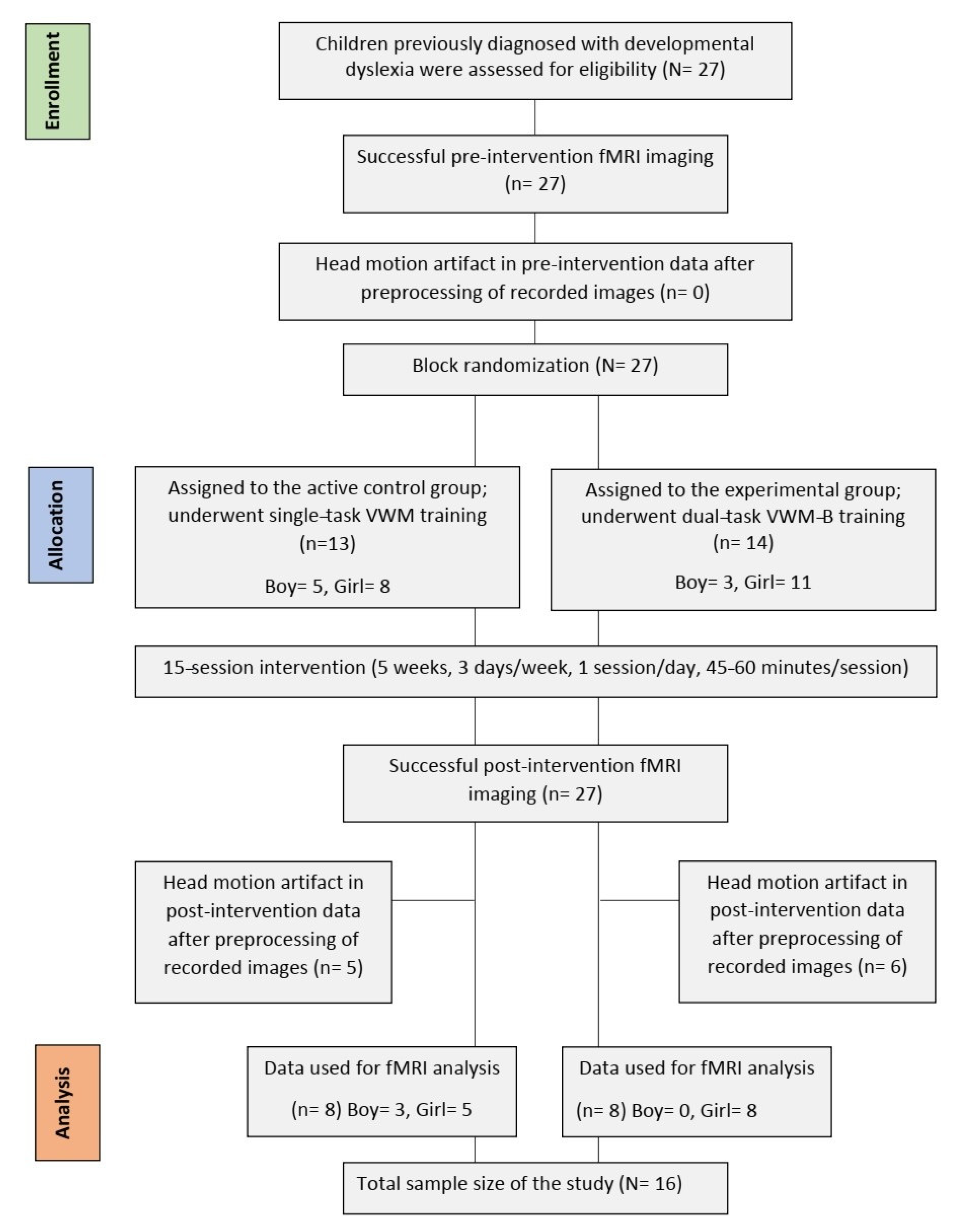
2.1. Methodology Overview of the Original Study
2.2. MRI Acquisition and Parameters
2.3. Image Preprocessing and Analyses
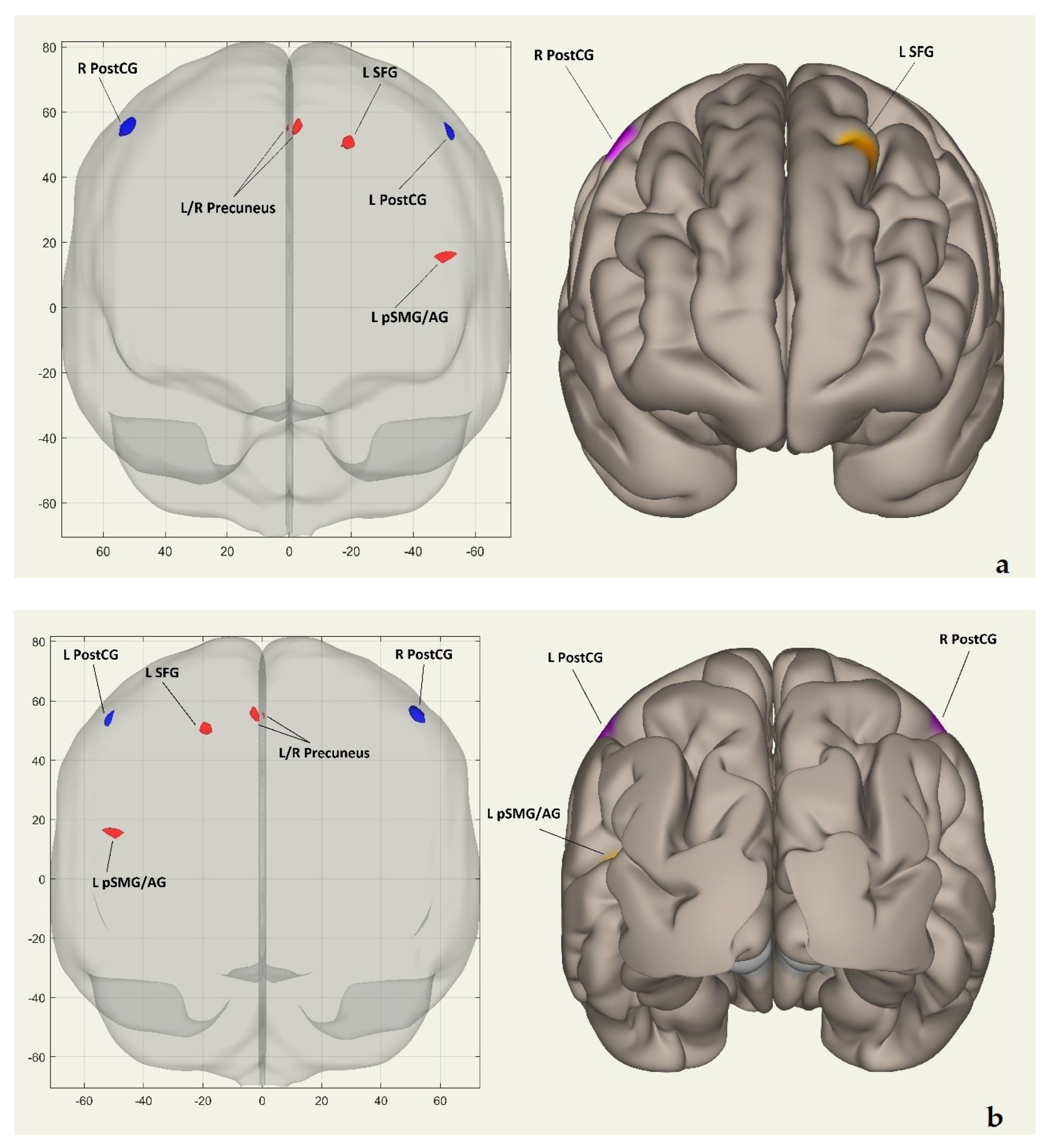
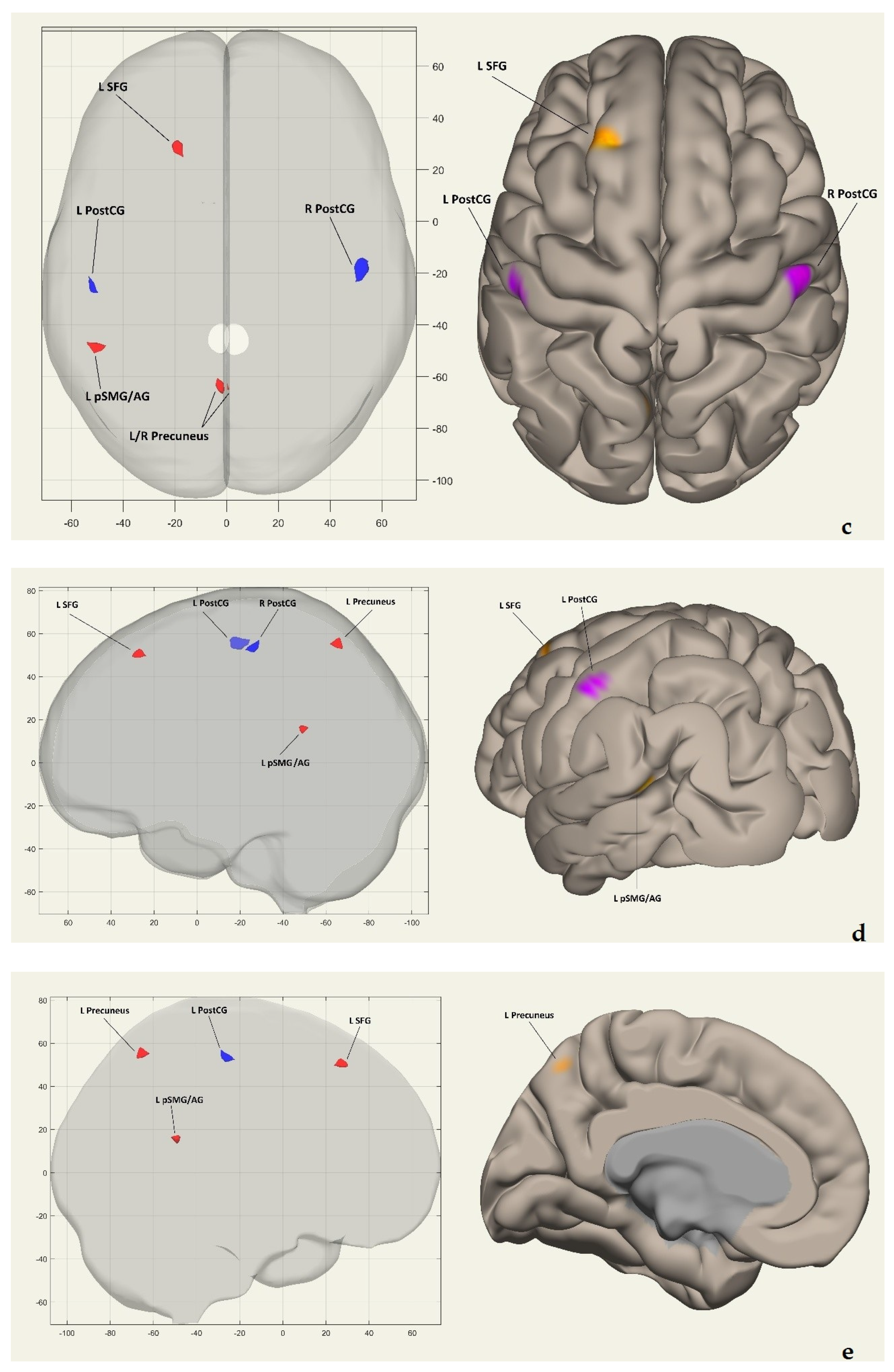
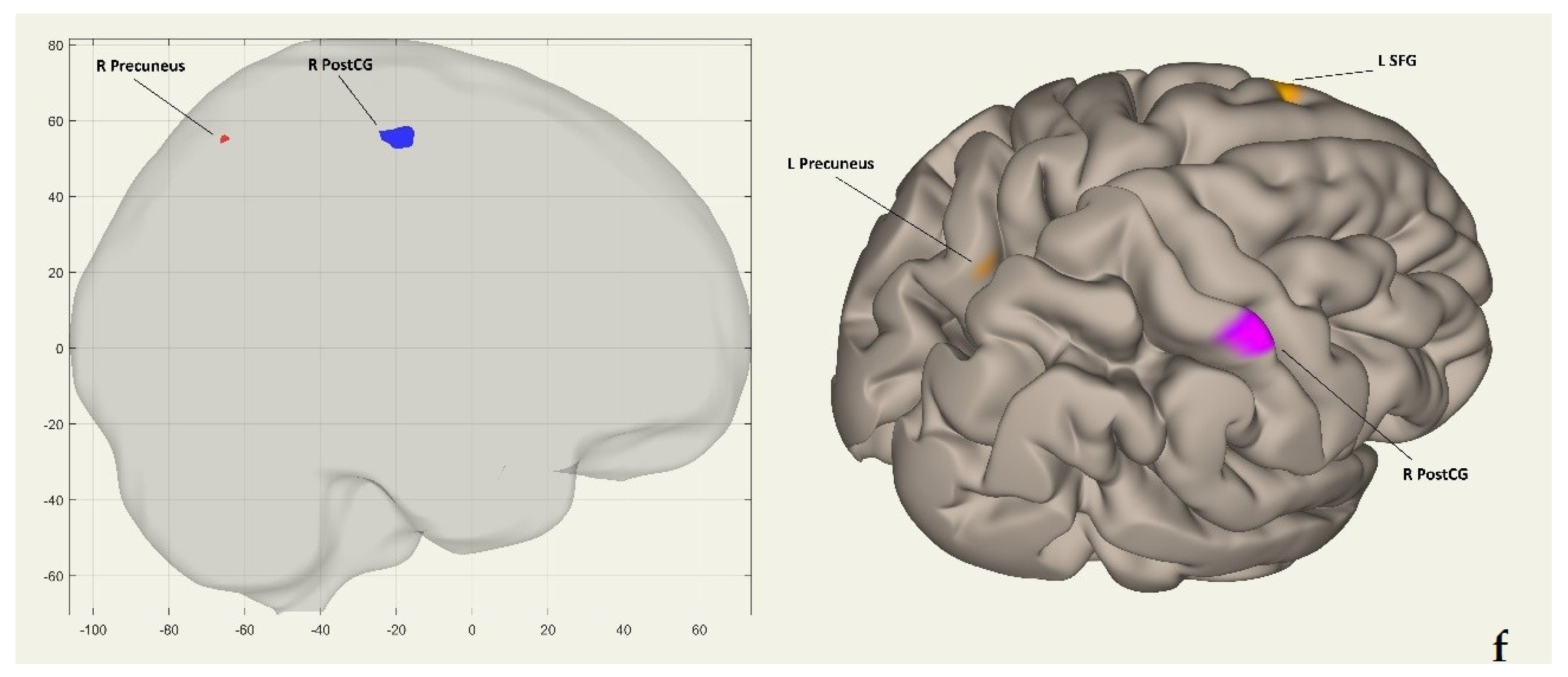
3. Results
4. Discussion
5. Limitations
6. Conclusions
Author Contributions
Funding
Institutional Review Board Statement
Informed Consent Statement
Data Availability Statement
Acknowledgments
Conflicts of Interest
References
- Stein, J. Theories about developmental dyslexia. Brain Sci. 2023, 13, 208. [Google Scholar] [CrossRef]
- Ramezani, M.; Behzadipour, S.; Fawcett, A.J.; Joghataei, M.T. Verbal Working Memory-Balance program training alters the left fusiform gyrus resting-state functional connectivity: A randomized clinical trial study on children with dyslexia. Dyslexia 2023, 29, 264–285. [Google Scholar] [CrossRef]
- Yang, L.; Li, C.; Li, X.; Zhai, M.; An, Q.; Zhang, Y.; Zhao, J.; Weng, X. Prevalence of developmental dyslexia in primary school children: A systematic review and meta-analysis. Brain Sci. 2022, 12, 240. [Google Scholar] [CrossRef]
- Di Folco, C.; Guez, A.; Peyre, H.; Ramus, F. Epidemiology of developmental dyslexia: A comparison of DSM-5 and ICD-11 criteria. MedRxiv 2020. [Google Scholar] [CrossRef]
- Hettiarachchi, D. An overview of dyslexia. Sri Lanka J. Child Health 2021, 50, 529–534. [Google Scholar] [CrossRef]
- Thambirajah, M. Developmental dyslexia: Clinical aspects. Adv. Psychiatr. Treat. 2010, 16, 380–387. [Google Scholar] [CrossRef]
- Jimerson, S.; Egeland, B.; Sroufe, L.A.; Carlson, B. A prospective longitudinal study of high school dropouts examining multiple predictors across development. J. Sch. Psychol. 2000, 38, 525–549. [Google Scholar] [CrossRef]
- Roitsch, J.; Watson, S.M. An overview of dyslexia: Definition, characteristics, assessment, identification, and intervention. Sci. J. Educ. 2019, 7, 81. [Google Scholar] [CrossRef]
- Snowling, M.J. Early identification and interventions for dyslexia: A contemporary view. J. Res. Spec. Educ. Needs 2013, 13, 7–14. [Google Scholar] [CrossRef]
- Schatschneider, C.; Torgesen, J.K. Using our current understanding of dyslexia to support early identification and intervention. J. Child Neurol. 2004, 19, 759–765. [Google Scholar] [CrossRef]
- Wright, M.; Mullan, F. Dyslexia and the Phono-Graphix reading programme. Support Learn. 2006, 21, 77–84. [Google Scholar] [CrossRef]
- Elbro, C.; Petersen, D.K. Long-term effects of phoneme awareness and letter sound training: An intervention study with children at risk for dyslexia. J. Educ. Psychol. 2004, 96, 660. [Google Scholar] [CrossRef]
- Silva, C.D.; Capellini, S.A. Efficacy of phonological intervention program in students at risk for dyslexia. Rev. CEFAC 2015, 17, 1827–1837. [Google Scholar] [CrossRef]
- Tressoldi, P.E.; Vio, C.; Iozzino, R. Efficacy of an intervention to improve fluency in children with developmental dyslexia in a regular orthography. J. Learn. Disabil. 2007, 40, 203–209. [Google Scholar] [CrossRef]
- Schneider, W.; Roth, E.; Ennemoser, M. Training phonological skills and letter knowledge in children at risk for dyslexia: A comparison of three kindergarten intervention programs. J. Educ. Psychol. 2000, 92, 284. [Google Scholar] [CrossRef]
- Caldani, S.; Moiroud, L.; Miquel, C.; Peiffer, V.; Florian, A.; Bucci, M.P. Short vestibular and cognitive training improves oral reading fluency in children with dyslexia. Brain Sci. 2021, 11, 1440. [Google Scholar] [CrossRef]
- Goulème, N.; Gérard, C.-L.; Bucci, M.P. The effect of training on postural control in dyslexic children. PLoS ONE 2015, 10, e0130196. [Google Scholar] [CrossRef] [PubMed]
- Bucci, M.P.; Mélithe, D.; Ajrezo, L.; Bui-Quoc, E.; Gérard, C.-L. The influence of oculomotor tasks on postural control in dyslexic children. Front. Hum. Neurosci. 2014, 8, 981. [Google Scholar] [CrossRef]
- Luo, Y.; Wang, J.; Wu, H.; Zhu, D.; Zhang, Y. Working-memory training improves developmental dyslexia in Chinese children. Neural Regen. Res. 2013, 8, 452–460. [Google Scholar]
- Yang, J.; Peng, J.; Zhang, D.; Zheng, L.; Mo, L. Specific effects of working memory training on the reading skills of Chinese children with developmental dyslexia. PLoS ONE 2017, 12, e0186114. [Google Scholar] [CrossRef] [PubMed]
- Nasr, M. Teachers’ reference to the individualized education program for reading instruction: Effects of student and teacher factors. Doctoral Dissertation, University of Illinois at Urbana-Champaign, Chicago, IL, USA, April 2024. [Google Scholar]
- Hall, C.; Dahl-Leonard, K.; Cho, E.; Solari, E.J.; Capin, P.; Conner, C.L.; Henry, A.R.; Cook, L.; Hayes, L.; Vargas, I.; et al. Forty years of reading intervention research for elementary students with or at risk for dyslexia: A systematic review and meta-analysis. Read. Res. Q. 2023, 58, 285–312. [Google Scholar] [CrossRef]
- van der Leij, A. Dyslexia and early intervention: What did we learn from the Dutch Dyslexia Programme? Dyslexia 2013, 19, 241–255. [Google Scholar] [CrossRef]
- Ramezani, M.; Behzadipour, S.; Pourghayoomi, E.; Joghataei, M.T.; Shirazi, E.; Fawcett, A.J. Evaluating a new verbal working memory-balance program: A double-blind, randomized controlled trial study on Iranian children with dyslexia. BMC Neurosci. 2021, 22, 1–17. [Google Scholar] [CrossRef]
- Wollesen, B.; Wildbredt, A.; van Schooten, K.S.; Lim, M.L.; Delbaere, K. The effects of cognitive-motor training interventions on executive functions in older people: A systematic review and meta-analysis. Eur. Rev. Aging Phys. Act. 2020, 17, 1–22. [Google Scholar] [CrossRef]
- Kao, C.-C.; Chiu, H.-L.; Liu, D.; Chan, P.-T.; Tseng, I.-J.; Chen, R.; Niu, S.-F.; Chou, K.-R. Effect of interactive cognitive motor training on gait and balance among older adults: A randomized controlled trial. Int. J. Nurs. Stud. 2018, 82, 121–128. [Google Scholar] [CrossRef]
- Pichierri, G.; Wolf, P.; Murer, K.; de Bruin, E.D. Cognitive and cognitive-motor interventions affecting physical functioning: A systematic review. BMC Geriatr. 2011, 11, 1–19. [Google Scholar] [CrossRef] [PubMed]
- Wollesen, B.; Voelcker-Rehage, C. Training effects on motor–cognitive dual-task performance in older adults: A systematic review. Eur. Rev. Aging Phys. Act. 2014, 11, 5–24. [Google Scholar] [CrossRef]
- Ramezani, M.; Fawcett, A.J. Cognitive-Motor Training Improves Reading-Related Executive Functions: A Randomized Clinical Trial Study in Dyslexia. Brain Sci. 2024, 14, 127. [Google Scholar] [CrossRef]
- Nieto-Castanon, A. Brain-wide connectome inferences using functional connectivity MultiVariate Pattern Analyses (fc-MVPA). PLoS Comput. Biol. 2022, 18, e1010634. [Google Scholar] [CrossRef] [PubMed]
- Smith, S.M.; Beckmann, C.F.; Andersson, J.; Auerbach, E.J.; Bijsterbosch, J.; Douaud, G.; Duff, E.; Feinberg, D.A.; Griffanti, L.; Harms, M.P.; et al. Resting-state fMRI in the human connectome project. Neuroimage 2013, 80, 144–168. [Google Scholar] [CrossRef]
- Bullmore, E.; Sporns, O. Complex brain networks: Graph theoretical analysis of structural and functional systems. Nat. Rev. Neurosci. 2009, 10, 186–198. [Google Scholar] [CrossRef]
- Shehzad, Z.; Kelly, A.M.C.; Reiss, P.T.; Gee, D.G.; Gotimer, K.; Uddin, L.Q.; Lee, S.H.; Margulies, D.S.; Roy, A.K.; Biswal, B.B.; et al. The resting brain: Unconstrained yet reliable. Cereb. Cortex 2009, 19, 2209–2229. [Google Scholar] [CrossRef]
- Fonov, V.; Evans, A.C.; Botteron, K.; Almli, C.R.; McKinstry, R.C.; Collins, D.L. The Brain Development Cooperative Group. Unbiased average age-appropriate atlases for pediatric studies. Neuroimage 2011, 54, 313–327. [Google Scholar] [CrossRef]
- Buckner, R.L.; Krienen, F.M.; Yeo, B.T. Opportunities and limitations of intrinsic functional connectivity MRI. Nat. Neurosci. 2013, 16, 832–837. [Google Scholar] [CrossRef] [PubMed]
- Behzadi, Y.; Restom, K.; Liau, J.; Liu, T.T. A component based noise correction method (CompCor) for BOLD and perfusion based fMRI. Neuroimage 2007, 37, 90–101. [Google Scholar] [CrossRef]
- Nieto-Castanon, A. Handbook of Functional Connectivity Magnetic Resonance Imaging Methods in CONN; Hilbert Press (CONN team from Boston University, Massachusetts Institue of Technology, and Northeastern University, US): Boston, MA, USA, 2020; 108p, ISBN 9780578644004. [Google Scholar]
- Whitfield-Gabrieli, S.; Nieto-Castanon, A. Conn: A functional connectivity toolbox for correlated and anticorrelated brain networks. Brain Connect. 2012, 2, 125–141. [Google Scholar] [CrossRef] [PubMed]
- Kropf, E.; Syan, S.K.; Minuzzi, L.; Frey, B.N. From anatomy to function: The role of the somatosensory cortex in emotional regulation. Braz. J. Psychiatry 2018, 41, 261–269. [Google Scholar] [CrossRef] [PubMed]
- Laprevotte, J.; Papaxanthis, C.; Saltarelli, S.; Quercia, P.; Gaveau, J. Movement detection thresholds reveal proprioceptive impairments in developmental dyslexia. Sci. Rep. 2021, 11, 299. [Google Scholar] [CrossRef]
- Quercia, P.; Demougeot, L.; Dos Santos, M.; Bonnetblanc, F. Integration of proprioceptive signals and attentional capacity during postural control are impaired but subject to improvement in dyslexic children. Exp. Brain Res. 2011, 209, 599–608. [Google Scholar] [CrossRef]
- Virlet, L.; Sparrow, L.; Barela, J.; Berquin, P.; Bonnet, C. Proprioceptive intervention improves reading performance in developmental dyslexia: An eye-tracking study. Res. Dev. Disabil. 2024, 153, 104813. [Google Scholar] [CrossRef]
- Changizi, T.; Naderi, F.; Homaei, R.; Bavi, S. Effectiveness of Proprioception-Enhancing Exercises on Dyslexia and Dysgraphia in Students with Specific Learning Disorder. Iran. J. Learn. Mem. 2022, 5, 5–12. [Google Scholar]
- Gouleme, N.; Gerard, C.L.; Bui-Quoc, E.; Bucci, M.P. Spatial and temporal analysis of postural control in dyslexic children. Clin. Neurophysiol. 2015, 126, 1370–1377. [Google Scholar] [CrossRef]
- Brouwer, E.J.; Priovoulos, N.; Hashimoto, J.; van der Zwaag, W. Proprioceptive engagement of the human cerebellum studied with 7T-fMRI. Imaging Neurosci. 2024, 2, 1–12. [Google Scholar] [CrossRef]
- Dadario, N.B.; Sughrue, M.E. The functional role of the precuneus. Brain 2023, 146, 3598–3607. [Google Scholar] [CrossRef]
- Cavanna, A.E.; Trimble, M.R. The precuneus: A review of its functional anatomy and behavioural correlates. Brain 2006, 129, 564–583. [Google Scholar] [CrossRef]
- Margulies, D.S.; Vincent, J.L.; Kelly, C.; Lohmann, G.; Uddin, L.Q.; Biswal, B.B.; Villringer, A.; Castellanos, F.X.; Milham, M.P.; Petrides, M. Precuneus shares intrinsic functional architecture in humans and monkeys. Proc. Natl. Acad. Sci. USA 2009, 106, 20069–20074. [Google Scholar] [CrossRef]
- Boisgueheneuc, F.D.; Levy, R.; Volle, E.; Seassau, M.; Duffau, H.; Kinkingnehun, S.; Samson, Y.; Zhang, S.; Dubois, B. Functions of the left superior frontal gyrus in humans: A lesion study. Brain 2006, 129, 3315–3328. [Google Scholar] [CrossRef]
- Alagapan, S.; Lustenberger, C.; Hadar, E.; Shin, H.W.; Fröhlich, F. Low-frequency direct cortical stimulation of left superior frontal gyrus enhances working memory performance. Neuroimage 2019, 184, 697–706. [Google Scholar] [CrossRef] [PubMed]
- Li, W.; Qin, W.; Liu, H.; Fan, L.; Wang, J.; Jiang, T.; Yu, C. Subregions of the human superior frontal gyrus and their connections. Neuroimage 2013, 78, 46–58. [Google Scholar] [CrossRef] [PubMed]
- Zhang, S.; Chiang-shan, R.L. Functional connectivity mapping of the human precuneus by resting state fMRI. Neuroimage 2012, 59, 3548–3562. [Google Scholar] [CrossRef] [PubMed]
- Şahin, M.H.; Akyüz, M.E.; Karadağ, M.K.; Yalçın, A. Supramarginal Gyrus and Angular Gyrus Subcortical Connections: A Microanatomical and Tractographic Study for Neurosurgeons. Brain Sci. 2023, 13, 430. [Google Scholar] [CrossRef]
- Graves, W.W.; Purcell, J.; Rothlein, D.; Bolger, D.J.; Rosenberg-Lee, M.; Staples, R. Correspondence between cognitive and neural representations for phonology, orthography, and semantics in supramarginal compared to angular gyrus. Brain Struct. Funct. 2023, 228, 255–271. [Google Scholar] [CrossRef] [PubMed]
- Hartwigsen, G.; Baumgaertner, A.; Price, C.J.; Koehnke, M.; Ulmer, S.; Siebner, H.R. Phonological decisions require both the left and right supramarginal gyri. Proc. Natl. Acad. Sci. USA 2010, 107, 16494–16499. [Google Scholar] [CrossRef]
- Segal, E.; Petrides, M. Functional activation during reading in relation to the sulci of the angular gyrus region. Eur. J. Neurosci. 2013, 38, 2793–2801. [Google Scholar] [CrossRef] [PubMed]
- Law, I.; Kannao, I.; Fujita, H.; Lassen, N.A.; Miura, S.; Uemura, K. Left supramarginal/angular gyri activation during reading of syllabograms in the Japanese language. J. Neurolinguistics 1991, 6, 243–251. [Google Scholar] [CrossRef]
- Penniello, M.-J.; Lambert, J.; Eustache, F.; Petit-Taboué, M.C.; Barré, L.; Viader, F.; Morin, P.; Lechevalier, B.; Baron, J.-C. A PET study of the functional neuroanatomy of writing impairment in Alzheimer’s disease The role of the left supramarginal and left angular gyri. Brain 1995, 118, 697–706. [Google Scholar] [CrossRef]
- González-Garrido, A.A.; Barrios, F.A.; Gómez-Velázquez, F.R.; Zarabozo-Hurtado, D. The supramarginal and angular gyri underlie orthographic competence in Spanish language. Brain Lang. 2017, 175, 1–10. [Google Scholar] [CrossRef]
- Rubinstein, D.Y.; Camarillo-Rodriguez, L.; Serruya, M.D.; Herweg, N.A.; Waldman, Z.J.; Wanda, P.A.; Sharan, A.D.; Weiss, S.A.; Sperling, M.R. Contribution of left supramarginal and angular gyri to episodic memory encoding: An intracranial EEG study. Neuroimage 2021, 225, 117514. [Google Scholar] [CrossRef]
- Oberhuber, M.; Hope, T.M.H.; Seghier, M.L.; Jones, O.P.; Prejawa, S.; Green, D.W.; Price, C.J. Four functionally distinct regions in the left supramarginal gyrus support word processing. Cereb. Cortex 2016, 26, 4212–4226. [Google Scholar] [CrossRef]
- Powell, M.A. Ethical Principles, Dilemmas and Risks in Collecting Data on Violence Against Children: A Review of Available Literature; The global Child Protection Monitoring and Evaluation Reference Group (UNICEF): New York, NY, USA, 2012. [Google Scholar]
- Nicolson, R.I.; Fawcett, A.J. Automaticity: A new framework for dyslexia research? Cognition 1990, 35, 159–182. [Google Scholar] [CrossRef]
- Nicolson, R.I.; Fawcett, A.J.; Dean, P. Developmental dyslexia: The cerebellar deficit hypothesis. Trends Neurosci. 2001, 24, 508–511. [Google Scholar] [CrossRef] [PubMed]



| Demography | Control (n = 8) | Experiment (n = 8) | Total (N = 16) | Group Differences (p-Value) | |
|---|---|---|---|---|---|
| Mean (SD) | |||||
| Age (year) | 8 (1.24) | 8 (1.13) | 8 (1.15) | u = 31.50 (0.955) | |
| IQ level (WISC-IV) | 92 (3.50) | 95 (6.45) | 93 (5.29) | t = 1.25 (0.175) | |
| Attention level (CSI-4) | 3 (1.19) | 3 (1.98) | 3 (1.58) | t = 0.153 (0.063) | |
| Frequency (%) | |||||
| Gender | Boy | 3 (37.50) | 0 (0) | 3 (18.70) | χ2 (1) = 3.69 (0.055) |
| Girl | 5 (62.50) | 8 (100) | 13 (81.30) | ||
| School grade | First | 4 (50.00) | 3 (37.50) | 7 (43.80) | χ2 (3) = 4.14 (0.246) |
| Second | 0 (0) | 3 (37.50) | 3 (18.80) | ||
| Third | 3 (37.50) | 1 (12.50) | 4 (25.00) | ||
| Fourth | 1 (12.50) | 1 (12.50) | 2 (12.40) | ||
| Visual ability | Normal | 8 (100) | 7 (87.50) | 15 (93.70) | χ2 (1) = 1.07 (0.302) |
| Corrected | 0 (0) | 1 (12.50) | 1 (6.30) | ||
| Hearing ability | Normal | 8 (100) | 7 (87.50) | 15 (93.70) | χ2 (1) = 1.07 (0.302) |
| Corrected | 0 (0) | 1 (12.50) | 1 (6.30) | ||
| Disability | Reading | 3 (37.50) | 1 (12.50) | 4 (25.00) | χ2 (2) = 2.33 (0.311) |
| Reading/Writing | 3 (37.50) | 6 (75.00) | 9 (56.30) | ||
| Reading/Writing/Math | 2 (25.00) | 1 (12.50) | 3 (18.70) | ||
| Region | Clusters (x, y, z) | Voxel Size | Side | Connectivity | Beta (T = 14) | p-FDR | p-unc |
|---|---|---|---|---|---|---|---|
| PostCG | +52 −18 +54 | 74 | right | negative | −2.13 (−5.55) | 0.000 | 0.000 |
| PostCG | −50 −26 +56 | 40 | left | negative | −1.91 (−5.46) | 0.000 | 0.000 |
| Precuneous | −02 −66 +54 | 48 | left/right | positive | 1.54 (5.55) | 0.000 | 0.000 |
| SFG | −20 +26 +52 | 46 | left | positive | 1.43 (8.06) | 0.000 | 0.000 |
| pSMG/AG | −50 −50 +14 | 40 | left | positive | 1.27 (7.50) | 0.000 | 0.000 |
Disclaimer/Publisher’s Note: The statements, opinions and data contained in all publications are solely those of the individual author(s) and contributor(s) and not of MDPI and/or the editor(s). MDPI and/or the editor(s) disclaim responsibility for any injury to people or property resulting from any ideas, methods, instructions or products referred to in the content. |
© 2025 by the authors. Licensee MDPI, Basel, Switzerland. This article is an open access article distributed under the terms and conditions of the Creative Commons Attribution (CC BY) license.
Share and Cite
Ramezani, M.; Fawcett, A.J. Intrinsic Functional Connectivity Network in Children with Dyslexia: An Extension Study on Novel Cognitive–Motor Training. Brain Sci. 2026, 16, 55. https://doi.org/10.3390/brainsci16010055
Ramezani M, Fawcett AJ. Intrinsic Functional Connectivity Network in Children with Dyslexia: An Extension Study on Novel Cognitive–Motor Training. Brain Sciences. 2026; 16(1):55. https://doi.org/10.3390/brainsci16010055
Chicago/Turabian StyleRamezani, Mehdi, and Angela J. Fawcett. 2026. "Intrinsic Functional Connectivity Network in Children with Dyslexia: An Extension Study on Novel Cognitive–Motor Training" Brain Sciences 16, no. 1: 55. https://doi.org/10.3390/brainsci16010055
APA StyleRamezani, M., & Fawcett, A. J. (2026). Intrinsic Functional Connectivity Network in Children with Dyslexia: An Extension Study on Novel Cognitive–Motor Training. Brain Sciences, 16(1), 55. https://doi.org/10.3390/brainsci16010055