
Understanding Athlete Emotions: A Psychometric Approach to the AEQ-S in Sports


Abstract
1. Introduction
2. Materials and Methods
2.1. Participants
2.2. Measurements
2.3. Procedure
2.4. Data Analysis
3. Results
3.1. Exploratory Factorial Analysis
3.2. Confirmatory Factor Analysis
3.3. Descriptive Analyses and Bivariate Correlations
3.4. Linear Regression Analysis
4. Discussion
4.1. Limitation and Prospective
4.2. Conclusions
Supplementary Materials
Author Contributions
Funding
Institutional Review Board Statement
Informed Consent Statement
Data Availability Statement
Acknowledgments
Conflicts of Interest
Appendix A. Sports Learning Emotions
Appendix B. Training Sessions Emotion
Appendix C. Competition Emotion
References
- Tamminen, K.A.; Bennett, E.V. No emotion is an island: An overview of theoretical perspectives and narrative research on emotions in sport and physical activity. Qual. Res. Sport Exerc. Health 2017, 9, 183–199. [Google Scholar] [CrossRef]
- Balk, Y.A.; Englert, C. Recovery self-regulation in sport: Theory, research, and practice. Int. J. Sports Sci. Coach. 2020, 15, 273–281. [Google Scholar] [CrossRef]
- Cohen, A.B.; Tenenbaum, G.; English, R.W. Emotions and golf performance: An IZOF-based applied sport psychology case study. Behav. Modif. 2006, 30, 259–280. [Google Scholar] [CrossRef]
- Pekrun, R. The control-value theory of achievement emotions: Assumptions, corollaries, and implications for educational research and practice. Educ. Psychol. Rev. 2006, 18, 315–341. [Google Scholar] [CrossRef]
- Schutz, P.A.; Pekrun, R. (Eds.) Emotion in Education; Academic Press: New York, NY, USA, 2007. [Google Scholar]
- Campo, M.; Champely, S.; Louvet, B.; Rosnet, E.; Ferrand, C.; Pauketat, J.V.; Mackie, D.M. Group-based emotions: Evidence for emotion-performance relationships in team sports. Res. Q. Exerc. Sport 2019, 90, 54–63. [Google Scholar] [CrossRef]
- Lee, Y.H.; Chelladurai, P. Affectivity, emotional labor, emotional exhaustion, and emotional intelligence in coaching. J. Appl. Sport Psychol. 2016, 28, 170–184. [Google Scholar] [CrossRef]
- Pekrun, R.; Goetz, T.; Frenzel, A.C.; Perry, R.P. Academic Emotions Questionnaire (AEQ), 2nd ed.; User’s Manual; Department of Psychology, University of Munich: Munich, Germany, 2011. [Google Scholar]
- Bieleke, M.; Gogol, K.; Goetz, T.; Daniels, L.; Pekrun, R. The AEQ-S: A short version of the Achievement Emotions Questionnaire. Contemp. Educ. Psychol. 2021, 65, 101940. [Google Scholar] [CrossRef]
- Turner, J.E.; Schallert, D.L. Expectancy–value relationships of shame reactions and shame resiliency. J. Educ. Psychol. 2001, 93, 320–329. [Google Scholar] [CrossRef]
- Lazarus, R.S.; Folkman, S. Stress, Appraisal, and Coping; Springer: Berlin/Heidelberg, Germany, 1984. [Google Scholar]
- Weiner, B. An attributional theory of achievement motivation and emotion. Psychol. Rev. 1985, 92, 548–573. [Google Scholar] [CrossRef]
- Fredrickson, B.L. The role of positive emotions in positive psychology: The broaden-and-build theory of positive emotions. Am. Psychol. 2001, 56, 218–226. [Google Scholar] [CrossRef]
- Pekrun, R.; Goetz, T.; Frenzel, A.C.; Barchfeld, P.; Perry, R.P. Measuring emotions in students’ learning and performance: The Achievement Emotions Questionnaire (AEQ). Contemp. Educ. Psychol. 2011, 36, 36–48. [Google Scholar] [CrossRef]
- Zeidner, M. Test anxiety in educational contexts: What I have learned so far. In Emotion in Education; Schutz, P.A., Pekrun, R., Eds.; Academic Press: New York, NY, USA, 2007; pp. 165–184. [Google Scholar]
- McClean, Z.J.; Pasanen, K.; Lun, V.; Charest, J.; Herzog, W.; Werthner, P.; Black, A.; Vleuten, R.V.; Lacoste, E.; Jordan, M.J. A biopsychosocial model for understanding training load, fatigue, and musculoskeletal sport injury in university athletes: A scoping review. J. Strength Cond. Res. 2024, 38, 1177–1188. [Google Scholar] [CrossRef]
- Ruiz, M.C.; Raglin, J.S.; Hanin, Y.L. The individual zones of optimal functioning (IZOF) model (1978–2014): Historical overview of its development and use. Int. J. Sport Exerc. Psychol. 2017, 15, 41–63. [Google Scholar] [CrossRef]
- Woodcock, C.; Cumming, J.; Duda, J.L.; Sharp, L.A. Working within an Individual Zone of Optimal Functioning (IZOF) framework: Consultant practice and athlete reflections on refining emotion regulation skills. Psychol. Sport Exerc. 2012, 13, 291–302. [Google Scholar] [CrossRef]
- Acee, T.W.; Kim, H.; Kim, H.J.; Kim, J.-I.; Chu, H.-N.R.; Kim, M.; Cho, Y.; Wicker, F.W. Academic boredom in under- and overchallenging situations. Contemp. Educ. Psychol. 2010, 35, 17–27. [Google Scholar] [CrossRef]
- Daniels, L.M.; Stupnisky, R.H.; Pekrun, R.; Haynes, T.L.; Perry, R.P.; Newall, N.E. A longitudinal analysis of achievement goals: From affective antecedents to emotional effects and achievement outcomes. J. Educ. Psychol. 2009, 101, 948–963. [Google Scholar] [CrossRef]
- Pekrun, R.; Goetz, T.; Daniels, L.M.; Stupnisky, R.H.; Perry, R.P. Boredom in achievement settings: Exploring control-value antecedents and performance outcomes of a neglected emotion. J. Educ. Psychol. 2010, 102, 531–549. [Google Scholar] [CrossRef]
- Bieleke, M.; Goetz, T.; Yanagida, T.; Botes, E.; Frenzel, A.C.; Pekrun, R. Measuring emotions in mathematics: The Achievement Emotions Questionnaire—Mathematics (AEQ-M). ZDM Math. Educ. 2023, 55, 269–284. [Google Scholar] [CrossRef]
- Fierro-Suero, S.; Almagro, B.J.; Sáenz-López, P. Validation of the achievement emotions questionnaire for physical education (AEQ-PE). Int. J. Environ. Res. Public Health 2020, 17, 4560. [Google Scholar] [CrossRef]
- Lichtenfeld, S.; Pekrun, R.; Stupnisky, R.H.; Reiss, K.; Murayama, K. Measuring students’ emotions in the early years: The achievement emotions questionnaire-elementary school (AEQ-ES). Learn. Individ. Differ. 2012, 22, 190–201. [Google Scholar] [CrossRef]
- Zaccoletti, S.; Altoè, G.; Mason, L. Enjoyment, anxiety and boredom, and their control-value antecedents as predictors of reading comprehension. Learn. Individ. Differ. 2020, 79, 101869. [Google Scholar] [CrossRef]
- Meijen, C.; Turner, M.; Jones, M.V.; Sheffield, D.; McCarthy, P. A theory of challenge and threat states in athletes: A revised conceptualization. Front. Psychol. 2020, 11, 126. [Google Scholar] [CrossRef] [PubMed]
- Simonton, K.L.; Garn, A. Exploring achievement emotions in physical education: The potential for the control-value theory of achievement emotions. Quest 2019, 71, 434–446. [Google Scholar] [CrossRef]
- Faul, F.; Erdfelder, E.; Lang, A.G.; Buchner, A. G* Power 3: A flexible statistical power analysis program for the social, behavioral, and biomedical sciences. Behav. Res. Methods 2007, 39, 175–191. [Google Scholar] [CrossRef]
- Levy, P.S.; Lemeshow, S. Sampling of Populations: Methods and Applications; John Wiley & Sons: Chichester, UK, 2013. [Google Scholar]
- Trigueros, R.; Álvarez, J.; Aguilar-Parra, J.M.; Ibáñez, M.A.; Rosado, A. Validación y adaptación española de la escala de resiliencia en el contexto deportivo (ERCD). Psychol. Soc. Educ. 2017, 9, 311–324. [Google Scholar] [CrossRef]
- Hambleton, R.K. Adaptación de test para su uso en diferentes idiomas y culturas: Fuentes de error, posibles soluciones y directrices prácticas. In Psicometría; Muñiz, J., Ed.; Universitas: Madrid, Spain, 1996; pp. 67–89. [Google Scholar]
- Ferguson, E.; Cox, T. Exploratory factor analysis: A users’ guide. Int. J. Sel. Assess. 1993, 1, 84–94. [Google Scholar] [CrossRef]
- Beauducel, A.; Herzberg, P.Y. On the performance of maximum likelihood versus means and variance adjusted weighted least squares estimation in CFA. Struct. Equ. Model. 2006, 13, 186–203. [Google Scholar] [CrossRef]
- Byrne, B.M. Structural Equation Modeling with Mplus: Basic Concepts, Applications, and Programming; Routledge: London, UK, 2013. [Google Scholar]
- Hair, J.F.; Black, W.C.; Babin, B.J.; Anderson, R.E.; Tatham, R.L. Multivariate Data Analysis, 7th ed.; Pearson Prentice Hall: Upper Saddle River, NJ, USA, 2006. [Google Scholar]
- Baumgarten, M.; Wetzel, E. Discriminant validity. In Encyclopedia of Personality and Individual Differences; Springer: Cham, Switzerland, 2020; pp. 1139–1142. [Google Scholar]
- Henseler, J.; Ringle, C.M.; Sarstedt, M. A new criterion for assessing discriminant validity in variance-based structural equation modeling. J. Acad. Mark. Sci. 2015, 43, 115–135. [Google Scholar] [CrossRef]
- Trigueros, R.; Aguilar-Parra, J.M. Adaptation and testing of the factorial structure of the Achievement Emotional Questionnaire-Short to the Spanish context of physical education classes. Eur. Phys. Educ. Rev. 2022, 28, 777–796. [Google Scholar] [CrossRef]
- Fernández, B.C.; Cortés, D.F.G.; Palacio, E.V.G. El estudio de caso como alternativa metodológica en la investigación en educación física, deporte y actividad física. Conceptualización y aplicación. Retos Nuevas Tend. En Educ. Física Deporte Y Recreación 2019, 28, 428–433. [Google Scholar]
- Liu, F.; Zhu, Z.; Jiang, B. The influence of Chinese college students’ physical exercise on life satisfaction: The chain mediation effect of Core self-evaluation and positive emotion. Front. Psychol. 2021, 12, 763046. [Google Scholar] [CrossRef] [PubMed]
- Drew, B.; Matthews, J. The prevalence of depressive and anxiety symptoms in student-athletes and the relationship with resilience and help-seeking behavior. J. Clin. Sport Psychol. 2019, 13, 421–439. [Google Scholar] [CrossRef]
- Sun, Y.; Zhao, Y.; Yang, J. The impact of sports preferences on physical activity participation among college students: The mediating role of sports achievement emotions and exercise motivation. Front. Psychol. 2025, 16, 1565998. [Google Scholar] [CrossRef] [PubMed]
- Lirola, M.J.; Trigueros, R.; Cangas, A.J.; Aguilar-Parra, J.M. THE Influence of Emotions on Adolescent Sport Resilience: A Transcontextual Approach. Psychol. Sch. 2025, 62, 5164–5175. [Google Scholar] [CrossRef]
- Sarkar, M.; Fletcher, D. Psychological resilience in sport performers: A review of stressors and protective factors. J. Sports Sci. 2014, 32, 1419–1434. [Google Scholar] [CrossRef]
- den Hartigh, R.; Hill, Y. Conceptualizing and measuring psychological resilience: What can we learn from physics? New Ideas Psychol. 2022, 66, 100934. [Google Scholar] [CrossRef]
- Galli, N.; Gonzalez, S.P. Psychological resilience in sport: A review of the literature and implications for research and practice. Int. J. Sport Exerc. Psychol. 2015, 13, 243–257. [Google Scholar] [CrossRef]
- Fletcher, D.; Sarkar, M. Mental fortitude training: An evidence-based approach to developing psychological resilience for sustained success. J. Sport Psychol. Action 2016, 7, 135–157. [Google Scholar] [CrossRef]
- Roslan, N.Q.B.; Cho, H. Sport participants’ well-being during the COVID-19 pandemic: The roles of nostalgia, resilience, and curiosity. Int. J. Sport Exerc. Psychol. 2024, 22, 106–122. [Google Scholar] [CrossRef]



| Item | Enjoyment | Hope | Pride | Anger | Anxiety | Shame | Hopelessness | Boredom |
|---|---|---|---|---|---|---|---|---|
| 1 | 0.74 | |||||||
| 9 | 0.75 | |||||||
| 17 | 0.72 | |||||||
| 25 | 0.77 | |||||||
| 2 | 0.70 | |||||||
| 10 | 0.76 | |||||||
| 18 | 0.74 | |||||||
| 26 | 0.75 | |||||||
| 3 | 0.76 | |||||||
| 11 | 0.72 | |||||||
| 19 | 0.77 | |||||||
| 27 | 0.74 | |||||||
| 4 | 0.75 | |||||||
| 12 | 0.73 | |||||||
| 20 | 0.79 | |||||||
| 28 | 0.71 | |||||||
| 5 | 0.76 | |||||||
| 13 | 0.72 | |||||||
| 21 | 0.72 | |||||||
| 29 | 0.75 | |||||||
| 6 | 0.77 | |||||||
| 14 | 0.73 | |||||||
| 22 | 0.75 | |||||||
| 30 | 0.77 | |||||||
| 7 | 0.79 | |||||||
| 15 | 0.74 | |||||||
| 23 | 0.80 | |||||||
| 31 | 0.74 | |||||||
| 8 | 0.74 | |||||||
| 16 | 0.72 | |||||||
| 24 | 0.75 | |||||||
| 32 | 0.77 |
| Item | Enjoyment | Hope | Pride | Anger | Anxiety | Shame | Hopelessness | Boredom |
|---|---|---|---|---|---|---|---|---|
| 1 | 0.77 | |||||||
| 9 | 0.69 | |||||||
| 17 | 0.73 | |||||||
| 25 | 0.75 | |||||||
| 2 | 0.74 | |||||||
| 10 | 0.72 | |||||||
| 18 | 0.79 | |||||||
| 26 | 0.71 | |||||||
| 3 | 0.73 | |||||||
| 11 | 0.70 | |||||||
| 19 | 0.76 | |||||||
| 27 | 0.73 | |||||||
| 4 | 0.73 | |||||||
| 12 | 0.75 | |||||||
| 20 | 0.70 | |||||||
| 28 | 0.72 | |||||||
| 5 | 0.76 | |||||||
| 13 | 0.74 | |||||||
| 21 | 0.72 | |||||||
| 29 | 0.75 | |||||||
| 6 | 0.76 | |||||||
| 14 | 0.74 | |||||||
| 22 | 0.73 | |||||||
| 30 | 0.71 | |||||||
| 7 | 0.72 | |||||||
| 15 | 0.69 | |||||||
| 23 | 0.74 | |||||||
| 31 | 0.71 | |||||||
| 8 | 0.69 | |||||||
| 16 | 0.67 | |||||||
| 24 | 0.74 | |||||||
| 32 | 0.71 |
| Item | Enjoyment | Hope | Pride | Anger | Anxiety | Shame | Hopelessness | Relief |
|---|---|---|---|---|---|---|---|---|
| 1 | 0.77 | |||||||
| 9 | 0.72 | |||||||
| 17 | 0.67 | |||||||
| 25 | 0.76 | |||||||
| 2 | 0.72 | |||||||
| 10 | 0.74 | |||||||
| 18 | 0.77 | |||||||
| 26 | 0.79 | |||||||
| 3 | 0.73 | |||||||
| 11 | 0.71 | |||||||
| 19 | 0.77 | |||||||
| 27 | 0.74 | |||||||
| 4 | 0.70 | |||||||
| 12 | 0.69 | |||||||
| 20 | 0.73 | |||||||
| 28 | 0.75 | |||||||
| 5 | 0.71 | |||||||
| 13 | 0.75 | |||||||
| 21 | 0.77 | |||||||
| 29 | 0.73 | |||||||
| 6 | 0.73 | |||||||
| 14 | 0.72 | |||||||
| 22 | 0.69 | |||||||
| 30 | 0.68 | |||||||
| 7 | 0.74 | |||||||
| 15 | 0.70 | |||||||
| 23 | 0.69 | |||||||
| 31 | 0.77 | |||||||
| 8 | 0.69 | |||||||
| 16 | 0.72 | |||||||
| 24 | 0.66 | |||||||
| 32 | 0.73 |
| Training-Related Emotions | |||||||||||||
| Factors | M | SD | α | ω | ICC | 1 | 2 | 3 | 4 | 5 | 6 | 7 | 8 |
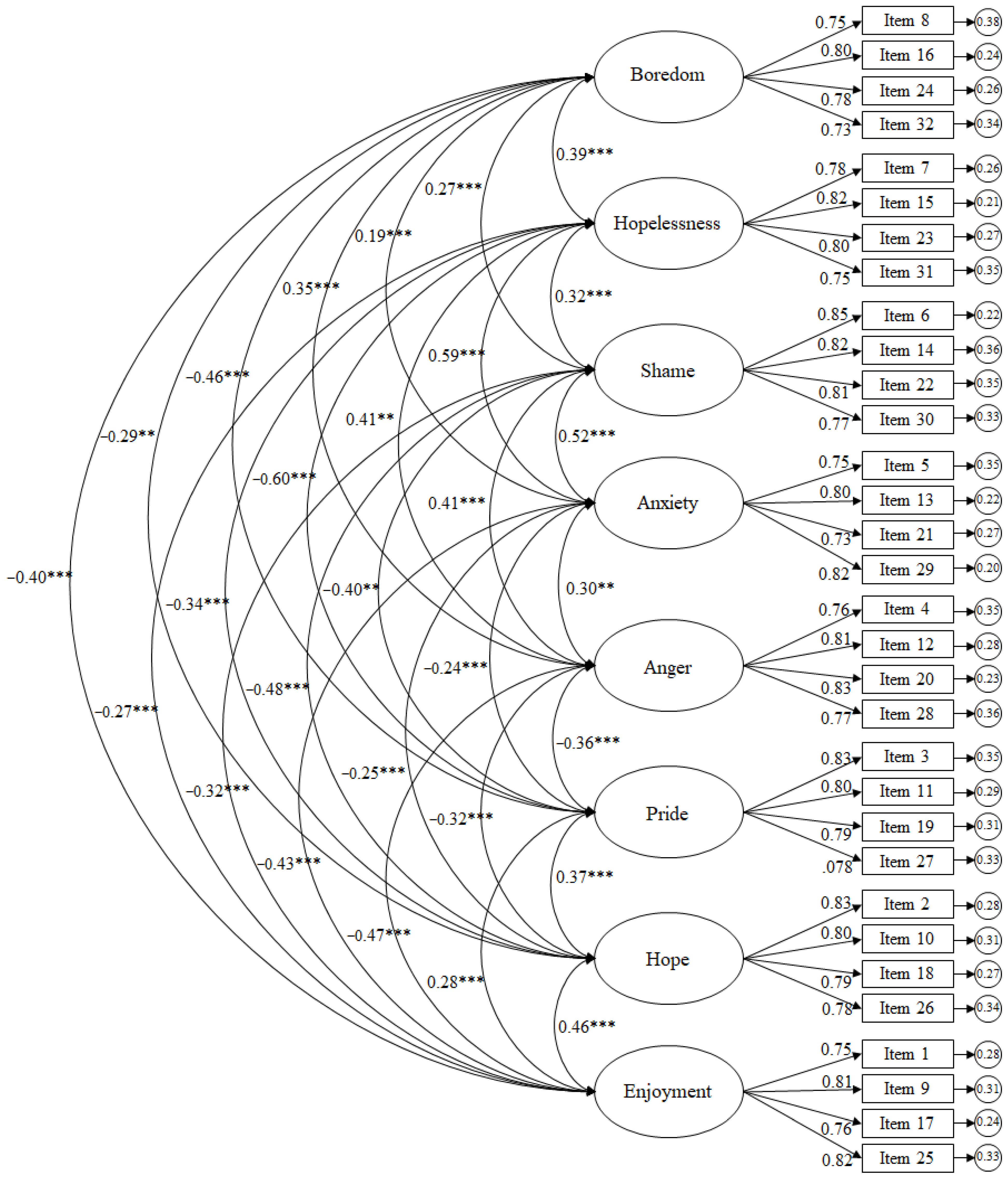
| 1. Boredom | 2.10 | 0.81 | 0.80 | 0.81 | 0.90 | - | 0.41 *** | 0.38 *** | 0.52 ** | 0.28 *** | −0.17 ** | −0.22 *** | −0.67 *** |
| 2. Hopelessness | 1.79 | 0.73 | 0.84 | 0.84 | 0.89 | 0.46 | - | 0.27 ** | 0.33 *** | 0.48 ** | −0.24 *** | −0.58 *** | −0.49 *** |
| 3. Shame | 1.63 | 0.71 | 0.79 | 0.79 | 0.92 | 0.44 | 0.34 | - | 0.50 *** | 0.23 ** | −0.21 ** | −0.43 *** | −0.36 ** |
| 4. Anxiety | 1.73 | 1.03 | 0.83 | 0.83 | 0.89 | 0.60 | 0.39 | 0.58 | - | 0.55 *** | −0.19 *** | −0.27 * | −0.24 ** |
| 5. Anger | 1.86 | 0.98 | 0.88 | 0.88 | 0.91 | 0.34 | 0.52 | 0.30 | 0.61 | - | −0.34 ** | −0.46 ** | −0.55 ** |
| 6. Pride | 3.25 | 1.09 | 0.80 | 0.81 | 0.88 | −0.22 | −0.30 | −0.27 | −0.25 | −0.41 | - | 0.34 *** | 0.12 *** |
| 7. Hope | 3.77 | 0.86 | 0.82 | 0.82 | 0.87 | −0.30 | −0.64 | −0.50 | −0.32 | −0.51 | 0.40 | - | 0.38 *** |
| 8. Enjoyment | 4.08 | 0.69 | 0.86 | 0.87 | 0.92 | −0.73 | −0.55 | −0.44 | −0.31 | −0.61 | 0.18 | 0.46 | - |
| Emotions-Related to Learning | |||||||||||||
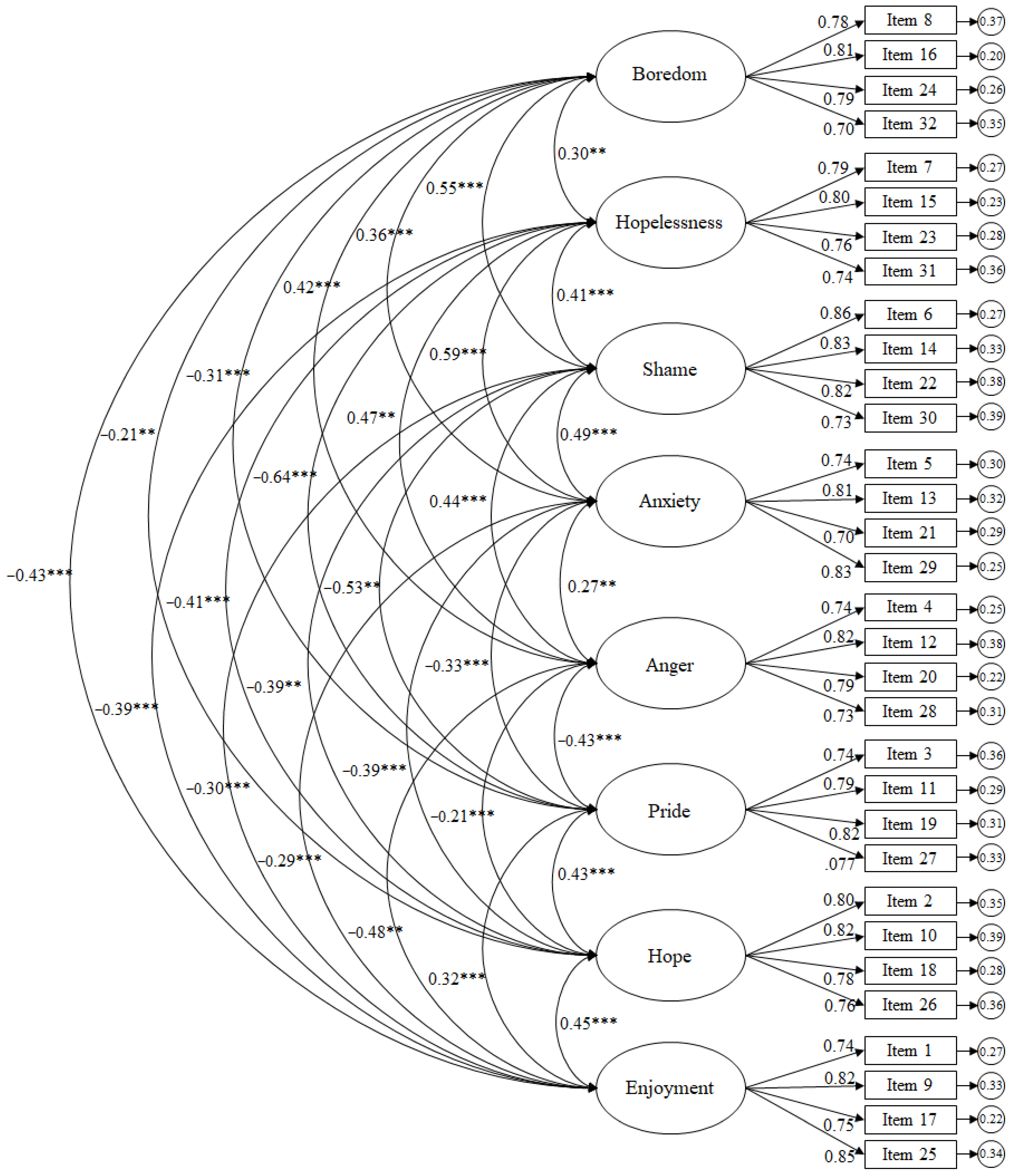
| Factors | M | SD | α | ω | CCI | 1 | 2 | 3 | 4 | 5 | 6 | 7 | 8 |
| 1. Boredom | 2.20 | 0.76 | 0.83 | 0.84 | 0.84 | - | 0.37 ** | 0.25 *** | 0.36 *** | 0.48 ** | −0.26 *** | −0.32 ** | −0.59 *** |
| 2. Hopelessness | 1.68 | 0.82 | 0.79 | 0.80 | 0.87 | 0.46 | - | 0.34 ** | 0.29 ** | 0.41 ** | −0.48 ** | −0.38 ** | −0.51 ** |
| 3. Shame | 2.33 | 0.91 | 0.85 | 0.85 | 0.85 | 0.28 | 0.40 | - | 0.34 *** | 0.38 *** | −0.32 * | −0.35 ** | −0.42 *** |
| 4. Anxiety | 2.09 | 1.01 | 0.83 | 0.83 | 0.88 | 0.44 | 0.36 | 0.39 | - | 0.31 *** | −0.37 ** | −0.52 *** | −0.38 *** |
| 5. Anger | 1.57 | 0.85 | 0.84 | 0.84 | 0.91 | 0.56 | 0.49 | 0.45 | 0.37 | - | −0.54 *** | −0.41 *** | −0.26 *** |
| 6. Pride | 3.81 | 0.79 | 0.82 | 0.82 | 0.82 | −0.31 | −0.53 | −0.38 | −0.43 | −0.60 | - | 0.29 *** | 0.33 *** |
| 7. Hope | 3.74 | 0.83 | 0.78 | 0.79 | 0.88 | −0.39 | −0.45 | −0.41 | −0.56 | −0.47 | 0.35 | - | 0.37 *** |
| 8. Enjoyment | 3.88 | 0.82 | 0.87 | 0.87 | 0.85 | −0.64 | −0.57 | −0.50 | −0.46 | −0.31 | 0.40 | 0.48 | - |
| Competition-Related Emotions | |||||||||||||
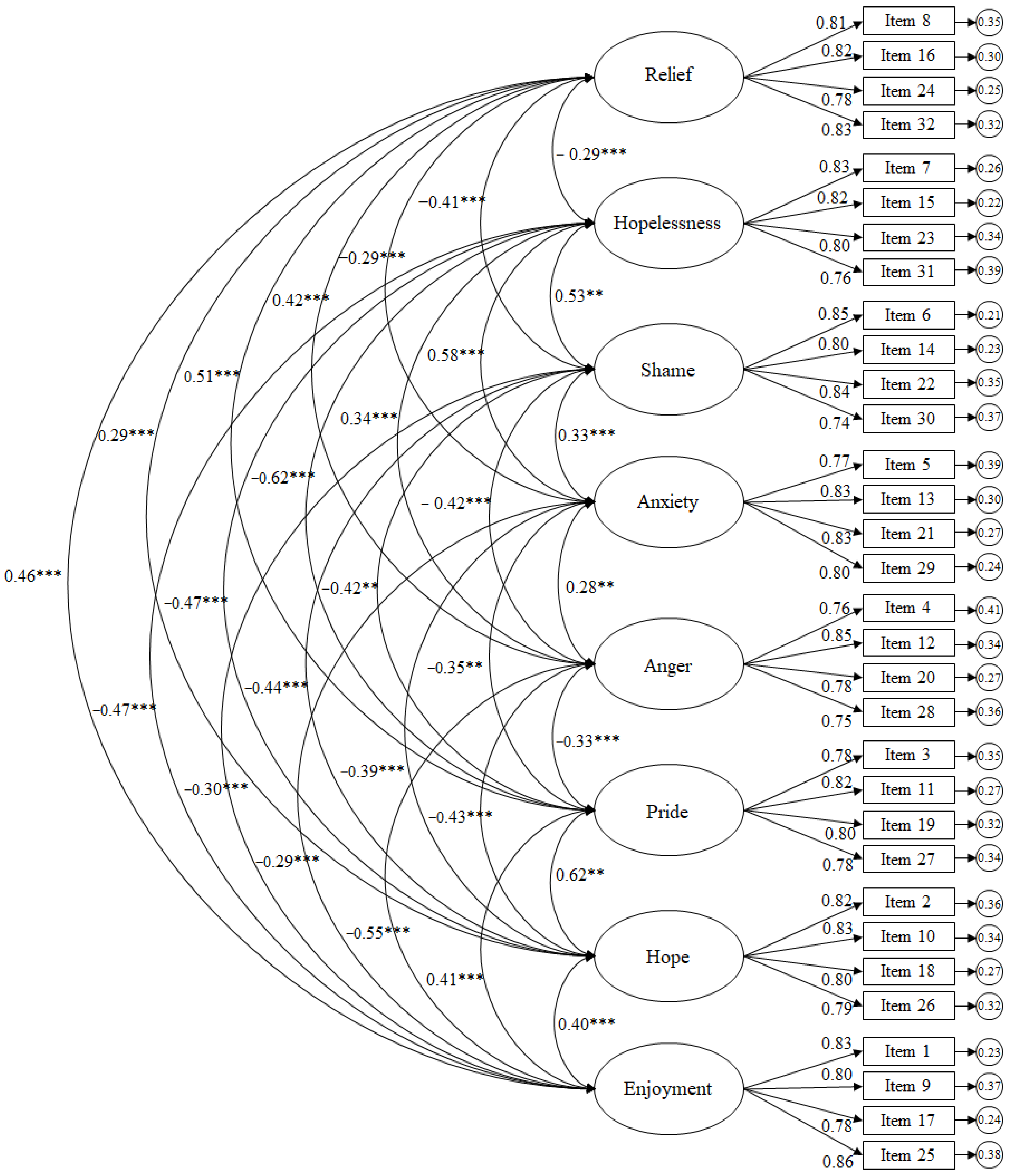
| Factors | M | SD | α | ω | CCI | 1 | 2 | 3 | 4 | 5 | 6 | 7 | 8 |
| 1. Anger | 2.04 | 0.85 | 0.81 | 0.81 | 0.87 | - | 0.24 *** | 0.11 * | 0.47 *** | −0.59 *** | −0.33 ** | −0.26 *** | −0.22 ** |
| 2. Hopelessness | 1.55 | 1.12 | 0.77 | 0.78 | 0.84 | 0.30 | - | 0.39 ** | 0.27 ** | −0.14 ** | −0.31 ** | −0.62 *** | −0.37 ** |
| 3. Shame | 1.99 | 1.04 | .84 | 0.85 | 0.86 | 0.18 | 0.44 | - | 0.55 *** | 0.19 | −0.17 * | −0.35 ** | −0.22 *** |
| 4. Anxiety | 2.13 | 1.29 | 0.83 | 0.84 | 0.88 | 0.54 | 0.32 | 0.62 | - | −0.63 *** | −0.22 ** | −0.44 *** | −0.18 *** |
| 5. Relief | 3.04 | 0.88 | 0.80 | 0.81 | 0.85 | −0.64 | −0.20 | 0.24 | −0.70 | - | 0.32 ** | 0.25 * | 0.38 *** |
| 6. Pride | 3.32 | 1.07 | 0.79 | 0.79 | 0.86 | −0.40 | −0.37 | −0.24 | −0.28 | 0.38 | - | 0.39 *** | 0.28 ** |
| 7. Hope | 3.52 | 0.81 | 0.82 | 0.82 | 0.83 | −0.32 | −0.70 | −0.42 | −0.51 | 0.31 | 0.45 | - | 0.41 *** |
| 8. Enjoyment | 3.05 | 0.93 | 0.78 | 0.79 | 0.87 | −0.27 | −0.45 | −0.28 | −0.25 | 0.43 | 0.35 | 0.48 | - |
Disclaimer/Publisher’s Note: The statements, opinions and data contained in all publications are solely those of the individual author(s) and contributor(s) and not of MDPI and/or the editor(s). MDPI and/or the editor(s) disclaim responsibility for any injury to people or property resulting from any ideas, methods, instructions or products referred to in the content. |
© 2025 by the authors. Licensee MDPI, Basel, Switzerland. This article is an open access article distributed under the terms and conditions of the Creative Commons Attribution (CC BY) license.
Share and Cite
Lirola, M.-J.; Trigueros, R.; Aguilar Parra, J.M.; Franco, C. Understanding Athlete Emotions: A Psychometric Approach to the AEQ-S in Sports. Brain Sci. 2026, 16, 46. https://doi.org/10.3390/brainsci16010046
Lirola M-J, Trigueros R, Aguilar Parra JM, Franco C. Understanding Athlete Emotions: A Psychometric Approach to the AEQ-S in Sports. Brain Sciences. 2026; 16(1):46. https://doi.org/10.3390/brainsci16010046
Chicago/Turabian StyleLirola, María-Jesús, Rubén Trigueros, José Manuel Aguilar Parra, and Clemente Franco. 2026. "Understanding Athlete Emotions: A Psychometric Approach to the AEQ-S in Sports" Brain Sciences 16, no. 1: 46. https://doi.org/10.3390/brainsci16010046
APA StyleLirola, M.-J., Trigueros, R., Aguilar Parra, J. M., & Franco, C. (2026). Understanding Athlete Emotions: A Psychometric Approach to the AEQ-S in Sports. Brain Sciences, 16(1), 46. https://doi.org/10.3390/brainsci16010046