Development and Psychometric Validation of the Cyprus Aphasia Screening Test (CAST)


Abstract
1. Introduction
1.1. International Aphasia Screening Tests and the Need for Culturally Relevant Tools
1.2. Development and Main Characteristics of the CAST
1.3. Aim
2. Materials and Methods
2.1. Participants
2.2. Description of the CAST: Content, Materials, and Scoring
2.3. Pilot Testing
2.4. Main Validation Study
2.5. Measures
- (i)
- The Greek adaptation of the Boston Diagnostic Aphasia Examination Short Form (BDAE-SF) [25] served as a valuable reference point for validating the newly developed tool, the CAST, by supporting convergent validity testing. The Greek BDAE-SF [25] measures multiple domains of language function commonly impaired in aphasia, including aphasia severity, spontaneous speech, auditory comprehension, repetition, and naming. Aphasia severity and spontaneous speech are assessed through conversational and expository tasks that examine fluency, grammatical construction, and lexical retrieval. Auditory comprehension is evaluated through tasks that test word discrimination, the ability to follow commands, and the understanding of complex sentences. Repetition tasks involve repeating words, phrases, and sentences, providing insight into phonological processing and verbal working memory. Naming tasks include confrontation and responsive naming, assessing lexical access, and semantic organization. The Greek BDAE-SF takes approximately 45 min to complete. To minimize participant burden and align with the scope of the CAST, only selected BDAE-SF subtests corresponding to CAST domains were administered. These were: the aphasia severity rating, fluency, repetition, auditory comprehension, and naming tasks. As a result, convergent validity claims are restricted to these shared domains.
- (ii)
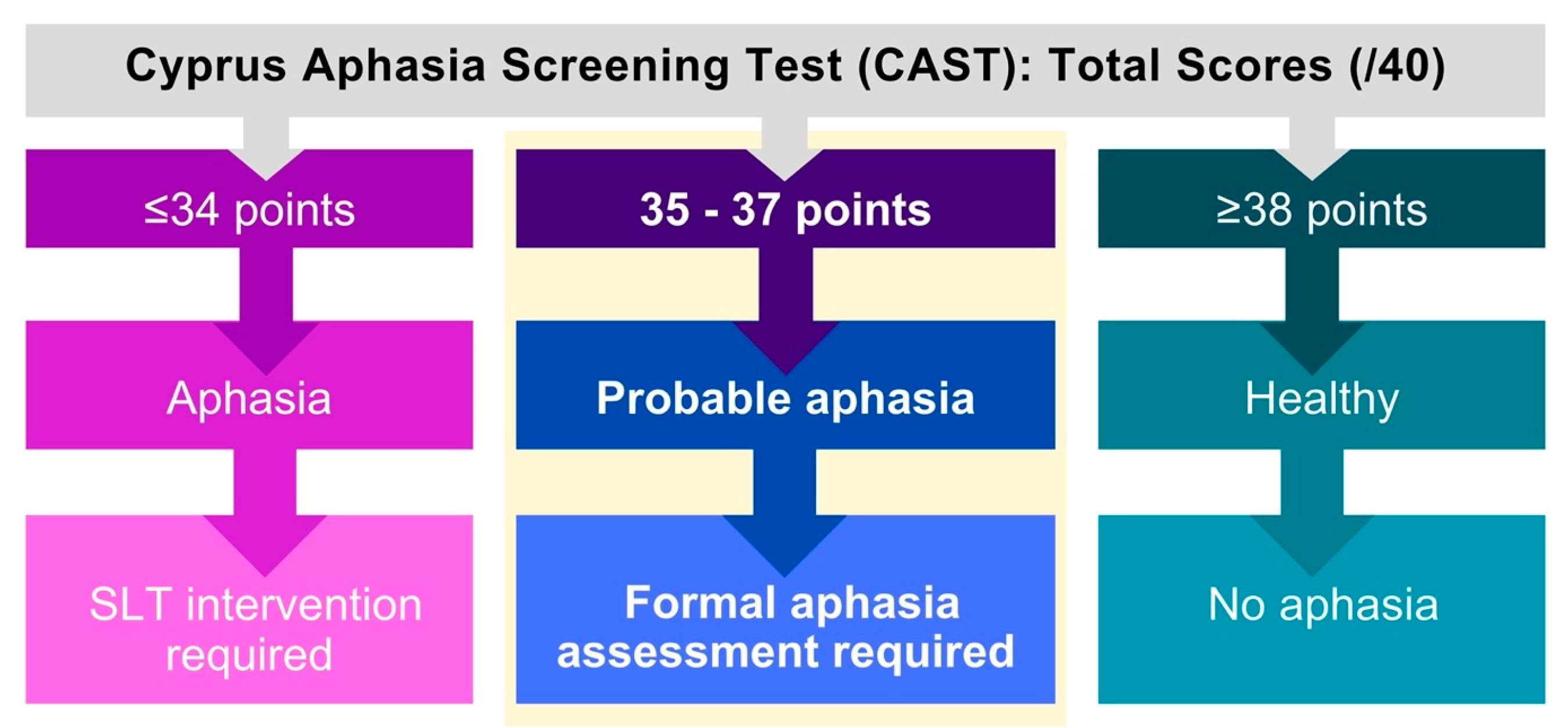
- The CAST is a brief clinician-reported measure. It consists of a short case history interview followed by ten subtests: a spontaneous speech sample to assess aphasia severity, verbal fluency tasks, auditory comprehension tasks, word and sentence repetition tasks, and object and picture naming tasks. The CAST is scored out of 40, with lower scores warranting a formal clinical speech and language therapy assessment. The CAST is completed in approximately 8 min, depending on language skills.
2.6. Data Analysis
- Test–retest reliability was examined to determine the temporal stability of CAST scores, with intraclass correlation coefficients (ICCs) of 0.75 or higher indicating good reliability [28].
- Interrater reliability was assessed using ICCs as well, with coefficients of 0.80 or above interpreted as evidence of strong agreement between independent raters [28]. High test–retest and interrater reliability together ensure that the CAST produces consistent and reproducible results across time and examiners.
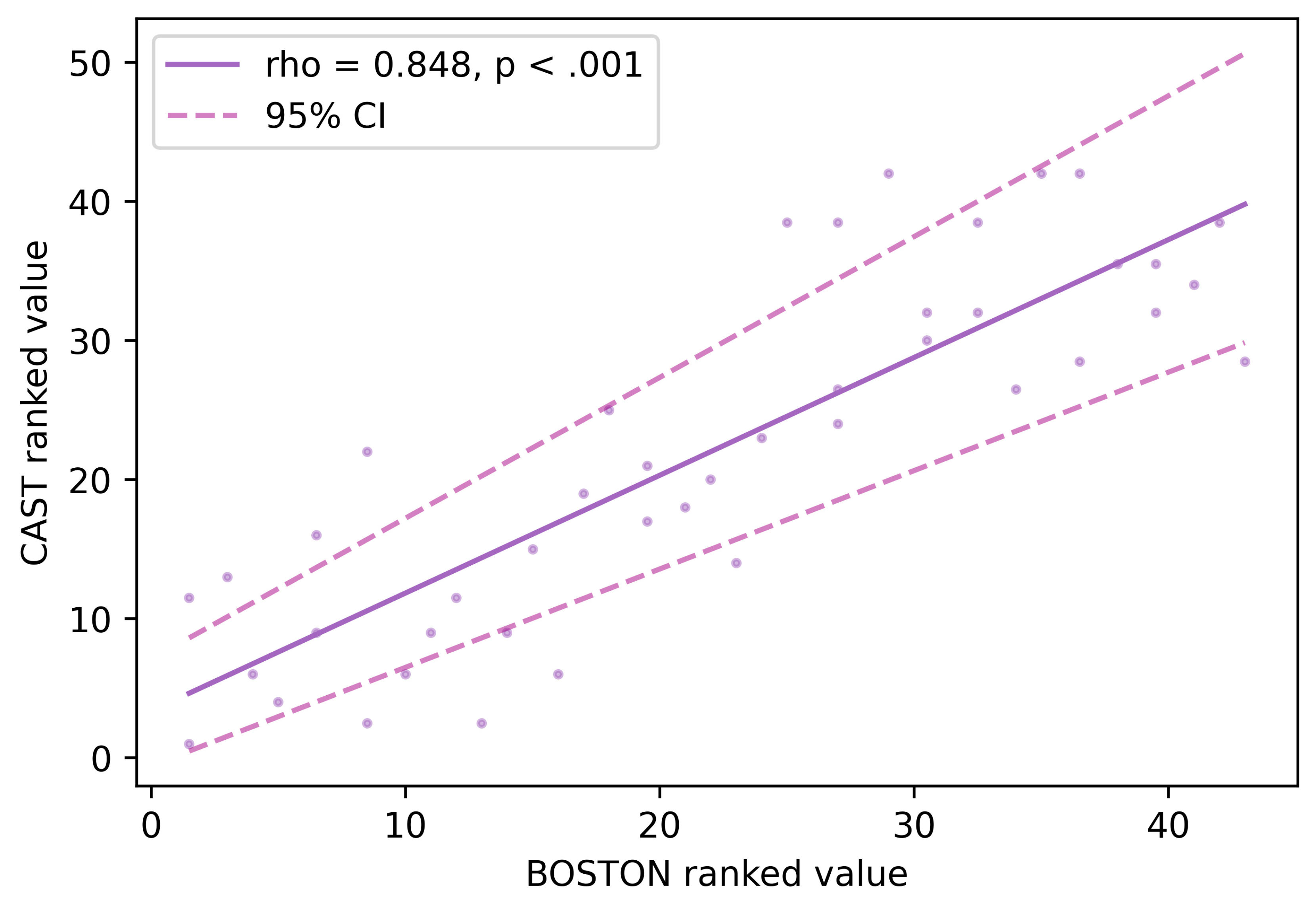
- Convergent validity was evaluated using correlations between CAST performance and equivalent subtests from the Greek version of the BDAE-SF, following procedures used in comparable validation studies [8]. Correlation strength was interpreted according to established psychometric thresholds: weak (<0.30), moderate (0.40–0.60), and strong (>0.60) [29].
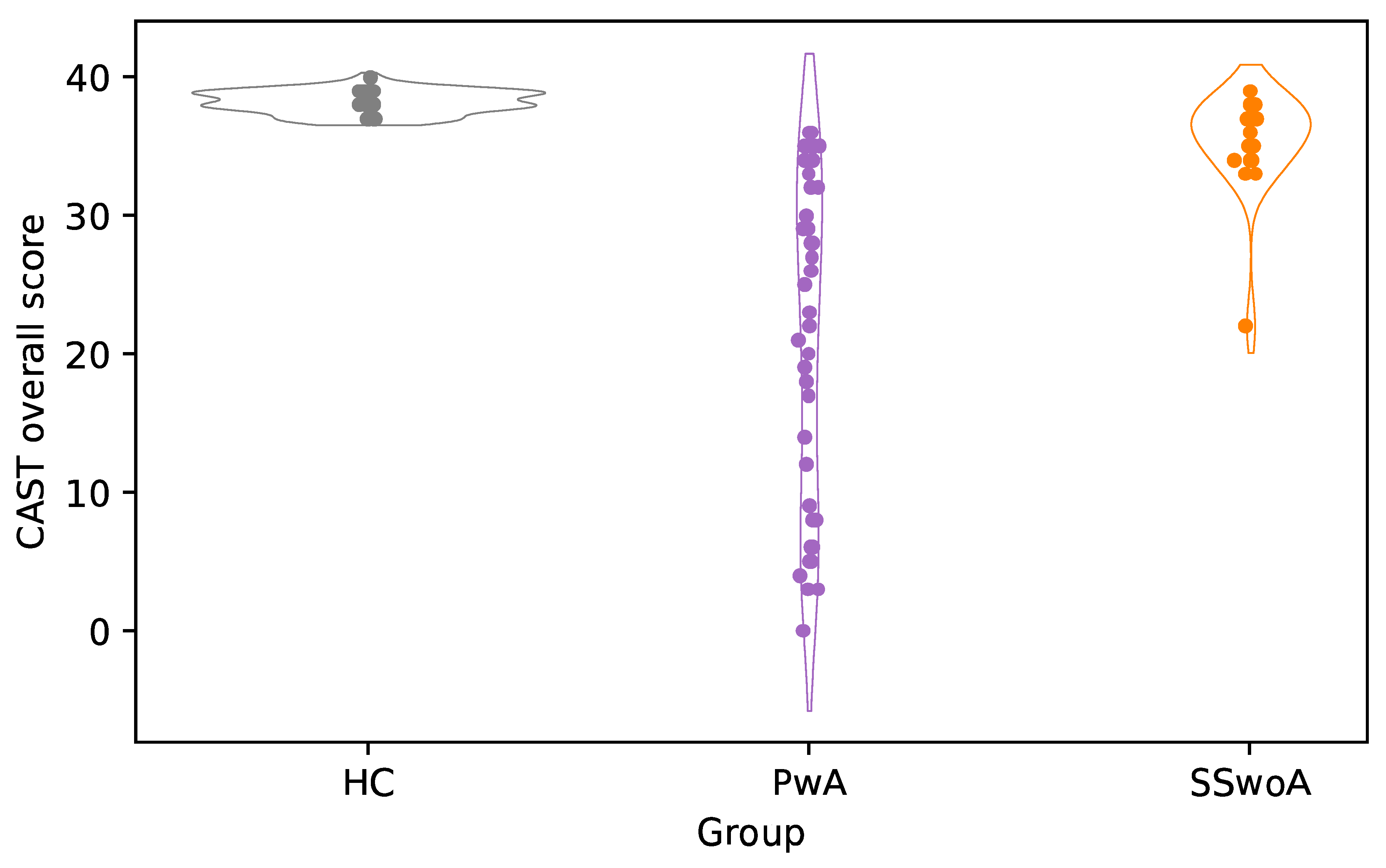
- Known-groups validity was examined by testing whether the CAST could distinguish among people with aphasia, stroke survivors without aphasia, and healthy controls; statistically significant group differences (with α = 0.05) were taken as evidence of valid discrimination [30].
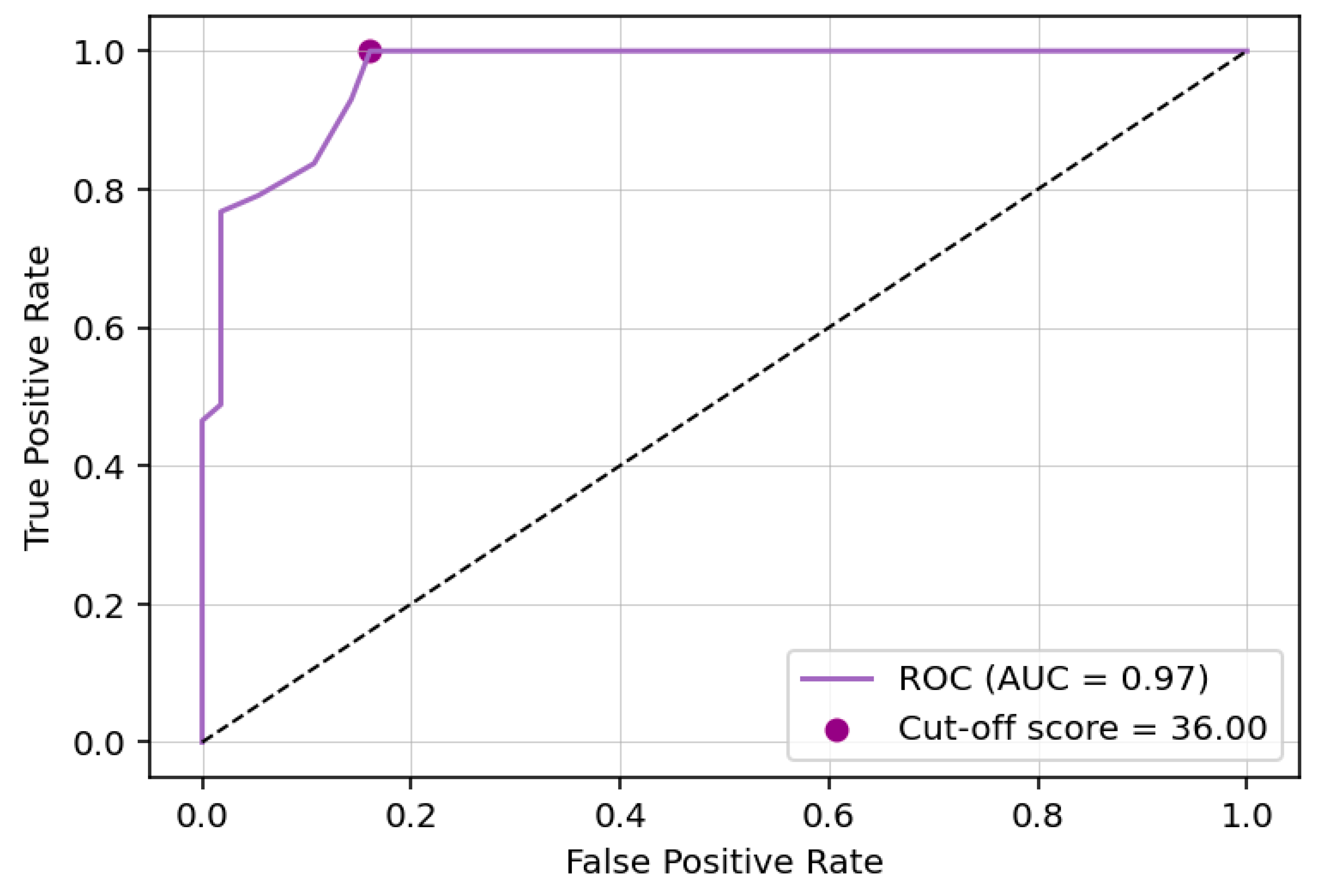
- Diagnostic validity was assessed using the Area Under the Curve (AUC) metric, with AUC values of 0.80 or higher considered clinically useful, values near 1.0 indicating excellent discrimination, and values near 0.50 reflecting chance-level classification [28]. Optimal cut-off scores were determined by identifying the point at which sensitivity and specificity were maximized [31].
3. Results
3.1. Internal Consistency
3.2. Intraclass Correlations
3.3. Known Groups Validity
3.4. Validity Analyses
3.5. Cut-Off Scores
4. Discussion
4.1. Overall Reliability
4.2. Overall Validity
4.3. Comparison of the CAST with Other Published Screening Tools
4.4. CAST Cut-Off Score
4.5. Clinical Implications
4.6. Limitations
4.7. Future Directions
5. Conclusions
Author Contributions
Funding
Institutional Review Board Statement
Informed Consent Statement
Data Availability Statement
Acknowledgments
Conflicts of Interest
Abbreviations
| CAST | Cyprus Aphasia Screening Test |
| ASRS | Aphasia Severity Rating Scale |
| BDAE-SF | Boston Diagnostic Aphasia Examination Short Form |
| PwA | People with Aphasia |
| HC | Healthy Controls |
| SSwoA | Stroke Survivors without Aphasia |
| HAST | Hungarian Aphasia Screening Test |
| SAST | Serbian Aphasia Screening Test |
| TeRAp | Aphasia Screening Test for European Portuguese |
References
- Feigin, V.L.; Brainin, M.; Norrving, B.; Martins, S.O.; Pandian, J.; Lindsay, P.; Grupper, M.F.; Rautalin, I. World Stroke Organization: Global Stroke Fact Sheet 2025. Int. J. Stroke 2025, 20, 132–144. [Google Scholar] [CrossRef]
- Wafa, H.A.; Wolfe, C.D.A.; Emmett, E.; Roth, G.A.; Johnson, C.O.; Wang, Y. Burden of stroke in Europe: Thirty-year projections of incidence, prevalence, deaths, and disability-adjusted life years. Stroke 2020, 51, 2418–2427. [Google Scholar] [CrossRef]
- Georgiou, A.M.; Kambanaros, M. Therapies and Challenges in the Post-Stroke Aphasia Rehabilitation Arena: Current and Future Prospects. Medicina 2023, 59, 1674. [Google Scholar] [CrossRef]
- Mitchell, C.; Gittins, M.; Tyson, S.; Vail, A.; Conroy, P.; Paley, L.; Bowen, A. Prevalence of aphasia and dysarthria among inpatient stroke survivors: Describing the population, therapy provision and outcomes on discharge. Aphasiology 2020, 35, 950–960. [Google Scholar] [CrossRef]
- Kristinsson, S.; den Ouden, D.B.; Rorden, C.; Newman-Norlund, R.; Neils-Strunjas, J.; Fridriksson, J. Predictors of Therapy Response in Chronic Aphasia: Building a Foundation for Personalized Aphasia Therapy. J. Stroke 2022, 24, 189–206. [Google Scholar] [CrossRef] [PubMed]
- Flowers, H.L.; Skoretz, S.A.; Silver, F.L.; Rochon, E.; Fang, J.; Flamand-Roze, C.; Martino, R. Poststroke Aphasia Frequency, Recovery, and Outcomes: A Systematic Review and Meta-Analysis. Arch. Phys. Med. Rehabil. 2016, 97, 2188–2201.e8. [Google Scholar] [CrossRef]
- Brady, M.C.; Mills, C.; Prag Øra, H.; Novaes, N.; Becker, F.; Constantinidou, F.; Flöel, A.; Sunnerhagen, K.S.; Isaksen, J.; Jagoe, C.; et al. European Stroke Organisation (ESO) guideline on aphasia rehabilitation. Eur. Stroke J. 2025. advance online publication. [Google Scholar] [CrossRef]
- Zakariás, L.; Lukács, Á. The first aphasia screening test in Hungarian: A preliminary study on validity and diagnostic accuracy. PLoS ONE 2023, 18, e0290153. [Google Scholar] [CrossRef] [PubMed]
- Rohde, A.; Worrall, L.; Godecke, E.; O’Halloran, R.; Farrell, A.; Massey, M. Diagnosis of aphasia in stroke populations: A systematic review of language tests. PLoS ONE 2018, 13, e0194143. [Google Scholar] [CrossRef] [PubMed]
- Panuccio, F.; Rossi, G.; Di Nuzzo, A.; Ruotolo, I.; Cianfriglia, G.; Simeon, R.; Sellitto, G.; Berardi, A.; Galeoto, G. Quality of Assessment Tools for Aphasia: A Systematic Review. Brain Sci. 2025, 15, 271. [Google Scholar] [CrossRef]
- Nakase-Thompson, R.; Manning, E.; Sherer, M.; Yablon, S.A.; Gontkovsky, S.L.; Vickery, C. Brief assessment of severe language impairments: Initial validation of the Mississippi aphasia screening test. Brain Inj. 2005, 19, 685–691. [Google Scholar] [CrossRef]
- Košťálová, M.; Bártková, E.; Šajgalíková, K.; Dolenská, A.; Dušek, L.; Bednařík, J. A standardization study of the Czech version of the Mississippi Aphasia Screening Test (MASTcz) in stroke patients and control subjects. Brain Inj. 2008, 22, 793–801. [Google Scholar] [CrossRef]
- Romero, M.; Sánchez, A.; Marín, C.; Navarro, M.D.; Ferri, J.; Noé, E. Clinical usefulness of the Spanish version of the Mississippi Aphasia Screening Test (MASTsp): Validation in stroke patients. Neurologia 2012, 27, 216–224. [Google Scholar] [CrossRef]
- Khatoonabadi, A.R.; Nakhostin-Ansari, N.; Piran, A.; Tahmasian, H. Development, cross-cultural adaptation, and validation of the Persian Mississippi Aphasia Screening Test in patients with post-stroke aphasia. Iran. J. Neurol. 2015, 14, 101–107. [Google Scholar]
- Nursi, A.; Padrik, M.; Nursi, L.; Pähkel, M.; Virkunen, L.; Küttim-Rips, A.; Taba, P. Adaption and validation of the Mississippi Aphasia Screening Test to Estonian speakers with aphasia. Brain Behav. 2019, 9, e01188. [Google Scholar] [CrossRef] [PubMed]
- Martínez-Ferreiro, S.; Arslan, S.; Fyndanis, V.; Howard, D.; Kraljević, J.K.; Škorić, A.M.; Munarriz-Ibarrola, A.; Norvik, M.; Peñaloza, C.; Pourquié, M.; et al. Guidelines and recommendations for cross-linguistic aphasia assessment: A review of 10 years of comprehensive aphasia test adaptations. Aphasiology 2024, 1–25. [Google Scholar] [CrossRef]
- Fyndanis, V.; Lind, M.; Varlokosta, S.; Kambanaros, M.; Soroli, E.; Ceder, K.; Grohmann, K.K.; Rofes, A.; Simonsen, H.G.; Bjekić, J.; et al. Cross-linguistic adaptations of The Comprehensive Aphasia Test: Challenges and solutions. Clin. Linguist. Phon. 2017, 31, 697–710. [Google Scholar] [CrossRef]
- Vuković, M.; Milovanović, T.; Teovanović, P.; Stojanovik, V. Evaluation of reliability and validity of the Serbian Aphasia Screening Test. PLoS ONE 2024, 19, e0304565. [Google Scholar] [CrossRef]
- Fonseca, J.; Miranda, F.; Stein, B.; Maruta, C. Aphasia Screening Test (TeRAp): Construction and Validation for European Portuguese. Acta Medica Port. 2024, 37, 831–837. [Google Scholar] [CrossRef]
- Charalambous, M.; Phylactou, P.; Serafim, M.; Vlotinou, P.; Georgiou, A.M.; Pampoulou, E.; Papaioannou, M.; Georgiou, F.; Palazis, L. Cypriot healthcare professionals’ knowledge and skills when interacting with patients with aphasia in clinical settings. Int. J. Lang. Commun. Disord. 2025, 60, e70089. [Google Scholar] [CrossRef] [PubMed]
- Charalambous, M.; Phylactou, P.; Elriz, T.; Psychogios, L.; Annoni, J.M.; Kambanaros, M. Adaptation of the Scenario Test for Greek-speaking people with aphasia: A reliability and validity study. Int. J. Lang. Commun. Disord. 2022, 57, 865–880. [Google Scholar] [CrossRef] [PubMed]
- Charalambous, M.; Phylactou, P.; Kountouri, A.; Serafeim, M.; Psychogios, L.; Annoni, J.-M.; Kambanaros, M. Adaptation of the Aphasia Impact Questionnaire-21 into Greek: A reliability and validity study. Clin. Transl. Neurosci. 2022, 6, 24. [Google Scholar] [CrossRef]
- Charalambous, M.; Phylactou, P.; Antoniou, E.; Christodoulou, M.; Kambanaros, M. The adaptation of the Communicative Effectiveness Index (CETI) into Greek: A reliability and validity study. Brain Sci. 2024, 14, 689. [Google Scholar] [CrossRef]
- Castro, N.; Hula, W.D.; Ashaie, S.A. Defining aphasia: Content analysis of six aphasia diagnostic batteries. Cortex 2023, 166, 19–32. [Google Scholar] [CrossRef]
- Messinis, L.; Panagea, E.; Papathasopoulos, P.; Kastellakis, A. Boston Diagnostic Aphasia Examination-Short Form in Greek Language; Gotsis: Patras, Greece, 2013. [Google Scholar]
- JASP Team. JASP, Version 0.19.3, [Computer Software]; JASP Team: Amsterdam, The Netherlands, 2024. [Google Scholar]
- Nunnally, J.C.; Bernstein, I.H. Psychometric Theory, 3rd ed.; McGraw-Hill: New York, NY, USA, 1994. [Google Scholar]
- Streiner, D.L.; Geoffrey, R.N.; Cairney, J. Health Measurement Scales: A Practical Guide to Their Development and Use, 5th ed.; Oxford University Press: Oxford, UK, 2015. [Google Scholar] [CrossRef]
- Akoglu, H. User’s guide to correlation coefficients. Turk. J. Emerg. Med. 2018, 18, 91–93. [Google Scholar] [CrossRef]
- DeVellis, R.F. Scale Development: Theory and Applications, 4th ed.; Sage: Thousand Oaks, CA, USA, 2017. [Google Scholar]
- Çorbacıoğlu, Ş.K.; Aksel, G. Receiver operating characteristic curve analysis in diagnostic accuracy studies: A guide to interpreting the area under the curve value. Turk. J. Emerg. Med. 2023, 23, 195–198. [Google Scholar] [CrossRef]
- Villalobos, D.; Torres-Simón, L.; Pacios, J.; Paúl, N.; Del Río, D. A Systematic Review of Normative Data for Verbal Fluency Test in Different Languages. Neuropsychol. Rev. 2023, 33, 733–764. [Google Scholar] [CrossRef]
- Casals-Coll, M.; Sánchez-Benavides, G.; Quintana, M.; Manero, R.M.; Rognoni, T.; Calvo, L.; Palomo, R.; Aranciva, F.; Tamayo, F.; Peña-Casanova, J. Spanish normative studies in young adults (NEURONORMA young adults project): Norms for verbal fluency tests. Neurologia 2013, 28, 33–40. [Google Scholar] [CrossRef] [PubMed]
- Schmidt, C.S.M.; Nitschke, K.; Bormann, T.; Römer, P.; Kümmerer, D.; Martin, M.; Umarova, R.M.; Leonhart, R.; Egger, K.; Dressing, A.; et al. Dissociating frontal and temporal correlates of phonological and semantic fluency in a large sample of left hemisphere stroke patients. NeuroImage Clin. 2019, 23, 101840. [Google Scholar] [CrossRef]
- Kosmidis, M.H.; Vlahou, C.H.; Panagiotaki, P.; Kiosseoglou, G. The verbal fluency task in the Greek population: Normative data, and clustering and switching strategies. J. Int. Neuropsychol. Soc. 2004, 10, 164–172. [Google Scholar] [CrossRef] [PubMed]
- Bose, A.; Patra, A.; Antoniou, G.E.; Stickland, R.C.; Belke, E. Verbal fluency difficulties in aphasia: A combination of lexical and executive control deficits. Int. J. Lang. Commun. Disord. 2022, 57, 593–614. [Google Scholar] [CrossRef] [PubMed]
- RELEASE Collaborators. Predictors of Poststroke Aphasia Recovery: A Systematic Review-Informed Individual Participant Data Meta-Analysis. Stroke 2021, 52, 1778–1787. [Google Scholar] [CrossRef]
- Larweh, G.; Owusu Antwi, A.A.; Owusu, E.A.; Tagoe, T.A. Exploring benefits of speech and language therapy interventions for post-stroke aphasia rehabilitation: A qualitative study. Heliyon 2024, 11, e41373. [Google Scholar] [CrossRef]
- Lamborn, E.; Carragher, M.; O’Halloran, R.; Rose, M.L. Optimising Healthcare Communication for People with Aphasia in Hospital: Key Directions for Future Research. Curr. Phys. Med. Rehabil. Rep. 2024, 12, 89–99. [Google Scholar] [CrossRef]
- Thiessen, A.; Brown, K. Personalization of Restorative and Compensatory Treatments for People with Aphasia: A Review of the Evidence. Top. Lang. Disord. 2021, 41, 269–281. [Google Scholar] [CrossRef]
- Charalambous, M.; Kountouri, A.; Schwyter, J.R.; Annoni, J.M.; Kambanaros, M. The development of the People with Aphasia and Other Layperson Involvement (PAOLI) framework for guiding patient and public involvement (PPI) in aphasia research. Res. Involv. Engagem. 2023, 9, 74. [Google Scholar] [CrossRef]



| Screening Test | HAST | SAST | TeRAp |
|---|---|---|---|
| Origin | Hungary | Serbia | Portugal (as a digital app). |
| Administration time | 5–10 min | 10–20 min | Rapid digital screener (time not explicitly stated). |
| Total Subtests | 5: (1) Word comprehension, (2) Sentence comprehension, (3) Repetition, (4) Naming, (5) Word fluency. | 10 + 1 unscored: (1) Automatized sequences, (2) Auditory comprehension, (3) Visual confrontation naming, (4) Responsive naming, (5) Word repetition, (6) Sentence repetition; (7) Word reading, (8) Oral sentence reading, (9) Reading comprehension, (10) Writing, (11) Conversation (used for clinical impression, not scored). | 6: (1) Speech description, (2) Naming, (3) Auditory comprehension, (4) Repetition, (5) Reading aloud, (6) Writing. |
| Sample size (validation) | 117 (40 PWA; 26 strokes without aphasia; 51 controls). | 240 (120 PWA; 120 controls) | 475 total (257 healthy; 218 clinical: aphasia, dysarthria, MCI) |
| Internal Consistency | α = 0.74 | a = 0.98 | α = 0.99 |
| Inter-rater Reliability | Not reported | ICC = 0.94 | r = 0.96 |
| Test–retest Reliability | Not reported | r = 0.74 | r = 0.96 |
| Convergent Validity | ρ = 0.81 Strong correlation with WAB | ρ = 0.87 Strong correlation with BDAE | ρ = 0.78 Strong correlation with BAAL |
| Diagnostic Accuracy: AUC | AUC = 0.95 (95% CI [0.89–1.00]) | Not reported | Not reported |
| Diagnostic Accuracy: Sensitivity | 92.5% | Not reported | 1.00 (100%) |
| Diagnostic Accuracy: Specificity | Stroke controls: 88.5% Healthy controls: 96.1% | Not reported | 0.99 (99%) |
| ROC Cut-off | ≤17 | Not reported | Not provided (algorithm-based scoring) |
| Effect Sizes | Group differences reported but no d or η2 | Subtest Cohen’s d values: 0.79–6.07 | Not reported |
| Clinical Strengths | Very brief; high diagnostic accuracy; bedside-appropriate; controlled stimuli. | Comprehensive multimodality assessment; sensitive to aphasia type and severity; large sample size. | Digital; automatic scoring; high sensitivity/specificity; wide modality coverage. |
| Limitations | Few items; lacks reading/writing; some reliability indices missing. | Longer, literacy-dependent tasks may challenge acute/severe cases. | Requires device/internet; some psychometrics not reported. |
| Characteristic | PwA (n = 43) | SSwoA (n = 21) | Controls (n = 35 *) | Subgroup Differences |
|---|---|---|---|---|
| Sex | ||||
| Male | 23 (53%) | 14 (67%) | 10 (29%) | χ2(4) = 10.75 p = 0.03 |
| Female | 20 (47%) | 7 (33%) | 22 (65%) | |
| Other | - | - | 2 (6%) | |
| Age | ||||
| Mean (sd) | 68.51 (12.09) | 64.71 (13.89) | 49.47 (7.20) | F(2, 95) = 29.35 p < 0.001 |
| Min-Max | 35–90 | 32–89 | 41–69 | |
| Stroke Type | ||||
| Ischemic | 30 (70%) | 17 (81%) | N/A | χ2(1) = 0.95 p = 0.34 |
| Haemorrhagic | 13 (30%) | 4 (19%) | N/A | |
| Lesion Side | ||||
| Left | 33 (77%) | 9 (43%) | N/A | χ2(1) = 7.18 p = 0.007 |
| Right | 10 (23%) | 12 (57%) | N/A | |
| Hemiplegia | ||||
| Left | 9 (21%) | 8 (38%) | N/A | χ2(1) = 4.31 p = 0.12 |
| Right | 30 (70%) | 9 (43%) | N/A | |
| None | 4 (9%) | 4 (19%) | N/A | |
| Months post stroke diagnosis | ||||
| Mean (sd) | 18.54 (22.10) | 17.95 (20.84) | N/A | t(62) = 0.10 p = 0.92 |
| Min–Max | 3–96 | 3–82 | N/A | |
| Completed education | ||||
| Elementary School | 9 (21%) | 3 (14%) | 2 (6%) | χ2(10) = 28.60 p = 0.001 |
| High School | 20 (47%) | 12 (57%) | 17 (50%) | |
| College | - | 3 (14%) | 8 (24%) | |
| Bachelor’s | 13 (30%) | - | 6 (18%) | |
| Master’s | 1 (2%) | 3 (14%) | - | |
| Other | - | - | 1 (3%) | |
| Marital Status | ||||
| Married | 35 (81%) | 15 (71%) | 27 (79%) | χ2(1) = 20.71 p = 0.02 |
| Divorced | 4 (9%) | 1 (5%) | 4 (12%) | |
| Widowed | 2 (5%) | - | - | |
| Single | 2 (5%) | 4 (19%) | - | |
| Engaged | - | 1 (5%) | - | |
| Other | - | - | 3 (9%) | |
| Test | Group | Mean | SD | Minimum | Max |
|---|---|---|---|---|---|
| CAST-Overall | PwA | 20.95 | 12.11 | 0 | 36 |
| SSwoA | 35.48 | 3.54 | 22 | 39 | |
| HC | 38.26 | 0.82 | 37 | 40 | |
| CAST-ASRS | PwA | 3.12 | 1.50 | 1 | 5 |
| SSwoA | 5.67 | 0.91 | 2 | 6 | |
| HC | 6 | 0 | 6 | 6 | |
| CAST-Fluency | PwA | 3.47 | 2.67 | 0 | 8 |
| SSwoA | 7.14 | 1.71 | 3 | 10 | |
| HC | 8.46 | 0.70 | 7 | 10 | |
| CAST-Auditory Comprehension | PwA | 5.37 | 2.68 | 0 | 8 |
| SSwoA | 7.71 | 0.46 | 7 | 8 | |
| HC | 7.94 | 0.24 | 7 | 8 | |
| CAST-Repetition | PwA | 4.30 | 3.23 | 0 | 8 |
| SSwoA | 7.62 | 0.97 | 4 | 8 | |
| HC | 7.91 | 0.28 | 7 | 8 | |
| CAST-Naming | PwA | 4.09 | 3.32 | 0 | 8 |
| SSwoA | 7.71 | 0.56 | 6 | 8 | |
| HC | 7.94 | 0.24 | 7 | 8 | |
| BDAE-SF—Total | PwA | 36.651 | 24.217 | 0 | 68 |
| BDAE-SF—ASRS | PwA | 2.49 | 1.58 | 0 | 5 |
| BDAE-SF—Fluency | PwA | 2.36 | 1.81 | 0 | 4 |
| BDAE-SF—Auditory Comprehension | PwA | 16.81 | 10.45 | 0 | 32 |
| BDAE-SF—Repetition | PwA | 3.98 | 3.06 | 0 | 7 |
| BDAE-SF—Naming | PwA | 10.49 | 8.62 | 0 | 23 |
| Subcategory | F-Test (Brown-Forsythe Corrected) | t-Test (Tuckey Corrected) | |
|---|---|---|---|
| ASRS | F(2,61.91) = 96.759, p < 0.001 | PwA vs. HC | t(96) = −11.776, p < 0.001 |
| PwA vs. SSwoA | t(96) = −8.906, p < 0.001 | ||
| HC vs. SSwoA | t(96) = 1.123, p = 0.503 | ||
| Fluency | F(2,67.52) = 77.478, p < 0.001 | PwA vs. HC | t(96) = −11.110, p < 0.001 |
| PwA vs. SSwoA | t(96) = −6.999, p < 0.001 | ||
| HC vs. SSwoA | t(96) = 2.412, p = 0.046 | ||
| Auditory Comprehension | F(2,46.16) = 35.316, p < 0.001 | PwA vs. HC | t(96) = −6.302, p < 0.001 |
| PwA vs. SSwoA | t(96) = −4.910, p < 0.001 | ||
| HC vs. SSwoA | t(96) = 0.462, p = 0.889 | ||
| Repetition | F(2,52.35) = 44.593, p < 0.001 | PwA vs. HC | t(96) = −7.242, p < 0.001 |
| PwA vs. SSwoA | t(96) = −5.687, p < 0.001 | ||
| HC vs. SSwoA | t(96) = 0.488, p = 0.877 | ||
| Naming | F(2,45.75) = 52.900, p < 0.001 | PwA vs. HC | t(96) = −7.628, p < 0.001 |
| PwA vs. SSwoA | t(96) = −6.136, p < 0.001 | ||
| HC vs. SSwoA | t(96) = 0.374, p = 0.926 | ||
| Subgroup | Spearman ρ | p-Value |
|---|---|---|
| ASRS | 0.890 | <0.001 |
| Fluency | 0.860 | <0.001 |
| Auditory Comprehension | 0.782 | <0.001 |
| Repetition | 0.740 | <0.001 |
| Naming | 0.855 | <0.001 |
| Percentile | |||||
|---|---|---|---|---|---|
| Group | 10th | 25th | 50th | 75th | 90th |
| PwA | 5 | 8 | 23 | 32 | 35 |
| SSwoA | 33 | 34 | 37 | 37 | 38 |
| HC | 37 | 38 | 38 | 39 | 39 |
| Tool | Internal Consistency (Cronbach’s α) | Test–Retest Reliability (ICC) | Interrater Reliability (ICC) | Known-Groups Validity | Convergent Validity |
|---|---|---|---|---|---|
| CAST (Charalambous et al., 2025 [20]) | α = 0.96 | ICC = 0.98 | ICC = 0.97 | Significant group differences across PwA, SSwoA, and HC (p < 0.001) | ρ = 0.84 with BDAE-SF |
| HAST (Zakariás & Lukács, 2023 [8]) | α = 0.74 | Not reported | Not reported | PwA vs. non-aphasic stroke vs. controls, (all p < 0.001) | ρ = 0.81 with BDAE-HU |
| SAST (Vuković et al., 2024 [18]) | α = 0.98 | ICC > 0.74 | ICC = 0.94 | Strong separation among clinical groups (p < 0.001) | ρ = 0.87 with Serbian version of WAB |
| TeRAp (Fonseca et al., 2024 [19]) | α = 0.99 | ICC = 0.96 | ICC = 0.91 | PwA scored significantly lower than stroke and control groups (p < 0.001) | ρ = 0.78 with BAAL |
Disclaimer/Publisher’s Note: The statements, opinions and data contained in all publications are solely those of the individual author(s) and contributor(s) and not of MDPI and/or the editor(s). MDPI and/or the editor(s) disclaim responsibility for any injury to people or property resulting from any ideas, methods, instructions or products referred to in the content. |
© 2025 by the authors. Licensee MDPI, Basel, Switzerland. This article is an open access article distributed under the terms and conditions of the Creative Commons Attribution (CC BY) license.
Share and Cite
Charalambous, M.; Phylactou, P.; Kambanaros, M. Development and Psychometric Validation of the Cyprus Aphasia Screening Test (CAST). Brain Sci. 2026, 16, 32. https://doi.org/10.3390/brainsci16010032
Charalambous M, Phylactou P, Kambanaros M. Development and Psychometric Validation of the Cyprus Aphasia Screening Test (CAST). Brain Sciences. 2026; 16(1):32. https://doi.org/10.3390/brainsci16010032
Chicago/Turabian StyleCharalambous, Marina, Phivos Phylactou, and Maria Kambanaros. 2026. "Development and Psychometric Validation of the Cyprus Aphasia Screening Test (CAST)" Brain Sciences 16, no. 1: 32. https://doi.org/10.3390/brainsci16010032
APA StyleCharalambous, M., Phylactou, P., & Kambanaros, M. (2026). Development and Psychometric Validation of the Cyprus Aphasia Screening Test (CAST). Brain Sciences, 16(1), 32. https://doi.org/10.3390/brainsci16010032