Effects of Continuous Theta Burst Stimulation to the Dorsolateral Prefrontal Cortex on Attention to Emotional Stimuli: A Randomized Controlled Trial


Abstract
1. Introduction
2. Materials and Methods
2.1. Participants
2.2. Research Design
2.3. Study Procedure
2.4. Experimental Procedure
2.5. Plan of Analysis
3. Results
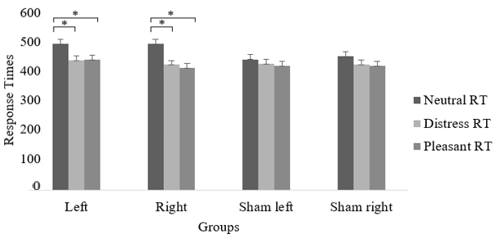
3.1. Effects of Emotional Stimuli on RTs
3.2. Effects of Stimulation Conditions on RTs
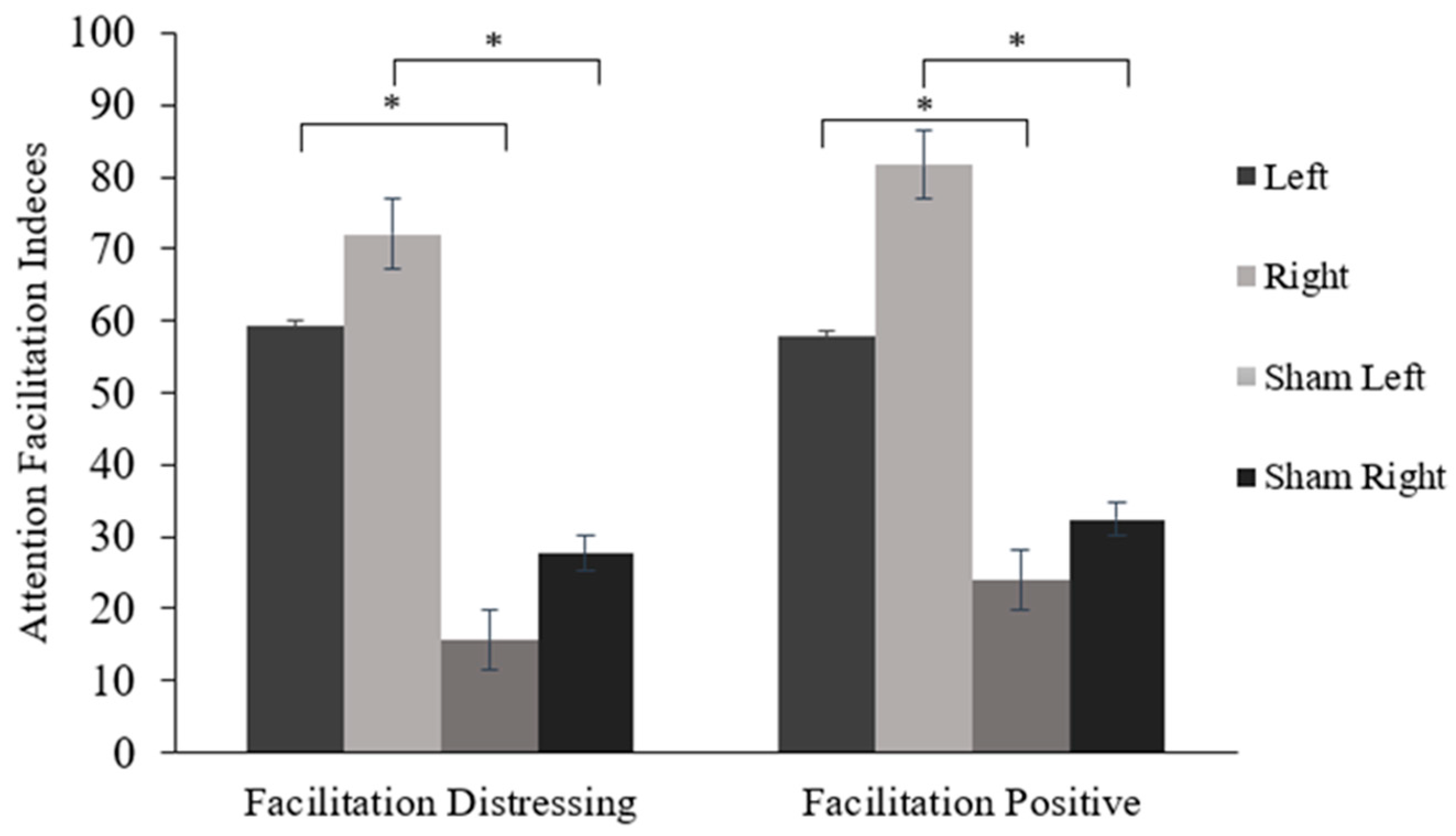
3.3. Attentional Facilitation Indices
4. Discussion
5. Conclusions
Author Contributions
Funding
Institutional Review Board Statement
Informed Consent Statement
Data Availability Statement
Conflicts of Interest
Abbreviations
| DLPFC | Dorsolateral Prefrontal Cortex |
| rTMS | Repetitive Transcranial Magnetic Stimulation |
| TBS | Theta-Burst Stimulation |
| cTBS | Continuous Theta-Burst Stimulation |
| iTBS | Intermittent Theta-Burst Stimulation |
| EEG | Electroencephalogram |
| AMT | Active Motor Threshold |
| RT | Response Time |
| M | Mean |
| SE | Standard Error |
References
- Buschman, T.J.; Kastner, S. From Behavior to Neural Dynamics: An Integrated Theory of Attention. Neuron 2015, 88, 127–144. [Google Scholar] [CrossRef] [PubMed]
- Connor, C.E.; Egeth, H.E.; Yantis, S. Visual Attention: Bottom-Up Versus Top-Down. Curr. Biol. 2004, 14, R850–R852. [Google Scholar] [CrossRef] [PubMed]
- Corbetta, M.; Shulman, G.L. Control of Goal-Directed and Stimulus-Driven Attention in the Brain. Nat. Rev. Neurosci. 2002, 3, 201–215. [Google Scholar] [CrossRef] [PubMed]
- Katsuki, F.; Constantinidis, C. Bottom-up and Top-down Attention: Different Processes and Overlapping Neural Systems. Neuroscientist 2013, 20, 509–521. [Google Scholar] [CrossRef]
- Lobier, M.; Palva, J.M.; Palva, S. High-Alpha Band Synchronization across Frontal, Parietal and Visual Cortex Mediates Behavioral and Neuronal Effects of Visuospatial Attention. NeuroImage 2018, 165, 222–237. [Google Scholar] [CrossRef]
- Petersen, S.E.; Posner, M.I. The Attention System of the Human Brain: 20 Years After. Annu. Rev. Neurosci. 2012, 35, 73–89. [Google Scholar] [CrossRef]
- Desimone, R.; Duncan, J. Neural Mechanisms of Selective Visual Attention. Annu. Rev. Neurosci. 1995, 18, 193–222. [Google Scholar] [CrossRef]
- Scolari, M.; Seidl-Rathkopf, K.N.; Kastner, S. Functions of the Human Frontoparietal Attention Network: Evidence from Neuroimaging. Curr. Opin. Behav. Sci. 2015, 1, 32–39. [Google Scholar] [CrossRef]
- Carretié, L.; Hinojosa, J.A.; Martín-Loeches, M.; Mercado, F.; Tapia, M. Automatic Attention to Emotional Stimuli: Neural Correlates. Hum. Brain Mapp. 2004, 22, 290–299. [Google Scholar] [CrossRef]
- Chaisilprungraung, T.; Kaewbuapan, P.; Intrachooto, S.; Pongsuwan, S.; Itthipuripat, S. The Impact of Emotional Valence on the Spatial Scope of Visual Selective Attention. Sci. Rep. 2024, 14, 30231. [Google Scholar] [CrossRef]
- Vuilleumier, P. How Brains Beware: Neural Mechanisms of Emotional Attention. Trends Cogn. Sci. 2005, 9, 585–594. [Google Scholar] [CrossRef] [PubMed]
- Carretié, L. Exogenous (Automatic) Attention to Emotional Stimuli: A Review. Cogn. Affect. Behav. Neurosci. 2014, 14, 1228–1258. [Google Scholar] [CrossRef] [PubMed]
- Pessoa, L.; Adolphs, R. Emotion Processing and the Amygdala: From a “low Road” to “Many Roads” of Evaluating Biological Significance. Nat. Rev. Neurosci. 2010, 11, 773–782. [Google Scholar] [CrossRef] [PubMed]
- Berboth, S.; Morawetz, C. Amygdala-Prefrontal Connectivity during Emotion Regulation: A Meta-Analysis of Psychophysiological Interactions. Neuropsychologia 2021, 153, 107767. [Google Scholar] [CrossRef]
- Pessoa, L.; Ungerleider, L.G. Neuroimaging Studies of Attention and the Processing of Emotion-Laden Stimuli. Prog. Brain Res. 2004, 144, 171–182. [Google Scholar] [CrossRef]
- Davidson, R.J. What Does the Prefrontal Cortex “Do” in Affect: Perspectives on Frontal EEG Asymmetry Research. Biol. Psychol. 2004, 67, 219–234. [Google Scholar] [CrossRef]
- De Raedt, R.; Leyman, L.; Baeken, C.; Van Schuerbeek, P.; Luypaert, R.; Vanderhasselt, M.-A.; Dannlowski, U. Neurocognitive Effects of HF-rTMS over the Dorsolateral Prefrontal Cortex on the Attentional Processing of Emotional Information in Healthy Women: An Event-Related fMRI Study. Biol. Psychol. 2010, 85, 487–495. [Google Scholar] [CrossRef]
- Banks, S.J.; Eddy, K.T.; Angstadt, M.; Nathan, P.J.; Phan, K.L. Amygdala–Frontal Connectivity during Emotion Regulation. Soc. Cogn. Affect. Neurosci. 2007, 2, 303–312. [Google Scholar] [CrossRef]
- Maier, M.J.; Rosenbaum, D.; Haeussinger, F.B.; Brüne, M.; Enzi, B.; Plewnia, C.; Fallgatter, A.J.; Ehlis, A.-C. Forgiveness and Cognitive Control–Provoking Revenge via Theta-Burst-Stimulation of the DLPFC. NeuroImage 2018, 183, 769–775. [Google Scholar] [CrossRef]
- Zhang, L.; Opmeer, E.M.; van der Meer, L.; Aleman, A.; Ćurčić-Blake, B.; Ruhé, H.G. Altered Frontal-Amygdala Effective Connectivity during Effortful Emotion Regulation in Bipolar Disorder. Bipolar Disord. 2018, 20, 349–358. [Google Scholar] [CrossRef]
- Palomero-Gallagher, N.; Amunts, K. A Short Review on Emotion Processing: A Lateralized Network of Neuronal Networks. Brain Struct. Funct. 2022, 227, 673–684. [Google Scholar] [CrossRef]
- Borod, J.C.; Cicero, B.A.; Obler, L.K.; Welkowitz, J.; Erhan, H.M.; Santschi, C.; Grunwald, I.S.; Agosti, R.M.; Whalen, J.R. Right Hemisphere Emotional Perception: Evidence across Multiple Channels. Neuropsychology 1998, 12, 446–458. [Google Scholar] [CrossRef]
- Gainotti, G. The Role of the Right Hemisphere in Emotional and Behavioral Disorders of Patients With Frontotemporal Lobar Degeneration: An Updated Review. Front. Aging Neurosci. 2019, 11, 55. [Google Scholar] [CrossRef] [PubMed]
- Smith, S.D.; Bulman-Fleming, M.B. An Examination of the Right-Hemisphere Hypothesis of the Lateralization of Emotion. Brain Cogn. 2005, 57, 210–213. [Google Scholar] [CrossRef] [PubMed]
- Grimshaw, G.M.; Carmel, D. An Asymmetric Inhibition Model of Hemispheric Differences in Emotional Processing. Front. Psychol. 2014, 5, 489. [Google Scholar] [CrossRef] [PubMed]
- Herrington, J.D.; Mohanty, A.; Koven, N.S.; Fisher, J.E.; Stewart, J.L.; Banich, M.T.; Webb, A.G.; Miller, G.A.; Heller, W. Emotion-Modulated Performance and Activity in Left Dorsolateral Prefrontal Cortex. Emotion 2005, 5, 200–207. [Google Scholar] [CrossRef]
- Davidson, R.J. Emotion and Affective Style: Hemispheric Substrates. Psychol. Sci. 1992, 3, 39–43. [Google Scholar] [CrossRef]
- Heller, W. Neuropsychological Mechanisms of Individual Differences in Emotion, Personality, and Arousal. Neuropsychology 1993, 7, 476–489. [Google Scholar] [CrossRef]
- Tomarken, A.J.; Davidson, R.J.; Wheeler, R.E.; Doss, R.C. Individual Differences in Anterior Brain Asymmetry and Fundamental Dimensions of Emotion. J. Personal. Soc. Psychol. 1992, 62, 676–687. [Google Scholar] [CrossRef]
- Abbassi, E.; Kahlaoui, K.; Wilson, M.A.; Joanette, Y. Processing the Emotions in Words: The Complementary Contributions of the Left and Right Hemispheres. Cogn. Affect. Behav. Neurosci. 2011, 11, 372–385. [Google Scholar] [CrossRef]
- Prete, G.; Laeng, B.; Fabri, M.; Foschi, N.; Tommasi, L. Right Hemisphere or Valence Hypothesis, or Both? The Processing of Hybrid Faces in the Intact and Callosotomized Brain. Neuropsychologia 2015, 68, 94–106. [Google Scholar] [CrossRef] [PubMed]
- Shobe, E.R. Independent and Collaborative Contributions of the Cerebral Hemispheres to Emotional Processing. Front. Hum. Neurosci. 2014, 8, 230. [Google Scholar] [CrossRef] [PubMed]
- Berger, C.; Domes, G.; Balschat, J.; Thome, J.; Höppner, J. Effects of Prefrontal rTMS on Autonomic Reactions to Affective Pictures. J. Neural Transm. 2017, 124, 139–152. [Google Scholar] [CrossRef] [PubMed]
- Begemann, M.J.; Brand, B.A.; Ćurčić-Blake, B.; Aleman, A.; Sommer, I.E. Efficacy of Non-Invasive Brain Stimulation on Cognitive Functioning in Brain Disorders: A Meta-Analysis. Psychol. Med. 2020, 50, 2465–2486. [Google Scholar] [CrossRef]
- Disner, S.G.; Beevers, C.G.; Gonzalez-Lima, F. Transcranial Laser Stimulation as Neuroenhancement for Attention Bias Modification in Adults with Elevated Depression Symptoms. Brain Stimul. 2016, 9, 780–787. [Google Scholar] [CrossRef]
- Zhang, L.; Cao, X.; Liang, Q.; Li, X.; Yang, J.; Yuan, J. High-Frequency Repetitive Transcranial Magnetic Stimulation of the Left Dorsolateral Prefrontal Cortex Restores Attention Bias to Negative Information in Methamphetamine Addicts. Psychiatry Res. 2018, 265, 151–160. [Google Scholar] [CrossRef]
- Rossi, S.; Antal, A.; Bestmann, S.; Bikson, M.; Brewer, C.; Brockmöller, J.; Carpenter, L.L.; Cincotta, M.; Chen, R.; Daskalakis, J.D.; et al. Safety and Recommendations for TMS Use in Healthy Subjects and Patient Populations, with Updates on Training, Ethical and Regulatory Issues: Expert Guidelines. Clin. Neurophysiol. 2021, 132, 269–306. [Google Scholar] [CrossRef]
- Asgharian Asl, F.; Vaghef, L. The Effectiveness of High-Frequency Left DLPFC-rTMS on Depression, Response Inhibition, and Cognitive Flexibility in Female Subjects with Major Depressive Disorder. J. Psychiatr. Res. 2022, 149, 287–292. [Google Scholar] [CrossRef]
- Lam, R.W.; Kennedy, S.H.; Adams, C.; Bahji, A.; Beaulieu, S.; Bhat, V.; Blier, P.; Blumberger, D.M.; Brietzke, E.; Chakrabarty, T.; et al. Canadian Network for Mood and Anxiety Treatments (CANMAT) 2023 Update on Clinical Guidelines for Management of Major Depressive Disorder in Adults: Réseau Canadien Pour Les Traitements de l’humeur et de l’anxiété (CANMAT) 2023: Mise à Jour Des Lignes Directrices Cliniques Pour La Prise En Charge Du Trouble Dépressif Majeur Chez Les Adultes. Can. J. Psychiatry 2024, 69, 641–687. [Google Scholar] [CrossRef]
- McClintock, S.M.; Reti, I.M.; Carpenter, L.L.; McDonald, W.M.; Dubin, M.; Taylor, S.F.; Cook, I.A.; O’Reardon, J.; Husain, M.M.; Wall, C.; et al. Consensus Recommendations for the Clinical Application of Repetitive Transcranial Magnetic Stimulation (rTMS) in the Treatment of Depression. J. Clin. Psychiatry 2018, 79, 16cs10905. [Google Scholar] [CrossRef]
- Bystritsky, A.; Kaplan, J.T.; Feusner, J.D.; Kerwin, L.E.; Wadekar, M.; Burock, M.; Wu, A.D.; Iacoboni, M. A Preliminary Study of fMRI-Guided rTMS in the Treatment of Generalized Anxiety Disorder. J. Clin. Psychiatry 2008, 69, 1092–1098. [Google Scholar] [CrossRef]
- Diefenbach, G.J.; Bragdon, L.B.; Zertuche, L.; Hyatt, C.J.; Hallion, L.S.; Tolin, D.F.; Goethe, J.W.; Assaf, M. Repetitive Transcranial Magnetic Stimulation for Generalised Anxiety Disorder: A Pilot Randomised, Double-Blind, Sham-Controlled Trial. Br. J. Psychiatry 2016, 209, 222–228. [Google Scholar] [CrossRef]
- Gay, A.; Cabe, J.; De Chazeron, I.; Lambert, C.; Defour, M.; Bhoowabul, V.; Charpeaud, T.; Tremey, A.; Llorca, P.-M.; Pereira, B.; et al. Repetitive Transcranial Magnetic Stimulation (rTMS) as a Promising Treatment for Craving in Stimulant Drugs and Behavioral Addiction: A Meta-Analysis. J. Clin. Med. 2022, 11, 624. [Google Scholar] [CrossRef]
- Cailhol, L.; Roussignol, B.; Klein, R.; Bousquet, B.; Simonetta-Moreau, M.; Schmitt, L.; Thalamas, C.; Tap, G.; Birmes, P. Borderline Personality Disorder and rTMS: A Pilot Trial. Psychiatry Res. 2014, 216, 155–157. [Google Scholar] [CrossRef] [PubMed]
- Sverak, T.; Linhartova, P.; Gajdos, M.; Kuhn, M.; Latalova, A.; Lamos, M.; Ustohal, L.; Kasparek, T. Brain Connectivity and Symptom Changes After Transcranial Magnetic Stimulation in Patients With Borderline Personality Disorder. Front. Psychiatry 2022, 12. [Google Scholar] [CrossRef] [PubMed]
- Cavicchioli, M.; Sarzetto, A.; Erzegovesi, S.; Ogliari, A. Is Repetitive Transcranial Magnetic Stimulation (RTMS) a Promising Therapeutic Intervention for Eating Disorders and Obesity? Clinical Considerations Based on a Meta-Analytic Review. Clin. Neuropsychiatry 2022, 19, 314–327. [Google Scholar] [CrossRef] [PubMed]
- Longo, P.; Bevione, F.; Lacidogna, M.C.; Lavalle, R.; Abbate Daga, G.; Preti, A. Neuromodulatory Techniques in Eating Disorders: From Electroconvulsive Therapy to Transcranial Magnetic Stimulation and beyond: A Mixed Method Systematic Meta-Review. Psychiatry Res. 2025, 344, 116346. [Google Scholar] [CrossRef]
- Asgarinejad, M.; Saviz, M.; Sadjadi, S.M.; Saliminia, S.; Kakaei, A.; Esmaeili, P.; Hammoud, A.; Ebrahimzadeh, E.; Soltanian-Zadeh, H. Repetitive Transcranial Magnetic Stimulation (rTMS) as a Tool for Cognitive Enhancement in Healthy Adults: A Review Study. Med. Biol. Eng. Comput. 2024, 62, 653–673. [Google Scholar] [CrossRef]
- Ebrahimzadeh, E.; Sadjadi, S.M.; Asgarinejad, M.; Dehghani, A.; Rajabion, L.; Soltanian-Zadeh, H. Neuroenhancement by Repetitive Transcranial Magnetic Stimulation (rTMS) on DLPFC in Healthy Adults. Cogn. Neurodyn 2025, 19, 34. [Google Scholar] [CrossRef]
- Andò, A.; Vasilotta, M.L.; Zennaro, A. The Modulation of Emotional Awareness Using Non-Invasive Brain Stimulation Techniques: A Literature Review on TMS and tDCS. J. Cogn. Psychol. 2021, 33, 993–1010. [Google Scholar] [CrossRef]
- Sagliano, L.; D’Olimpio, F.; Panico, F.; Gagliardi, S.; Trojano, L. The Role of the Dorsolateral Prefrontal Cortex in Early Threat Processing: A TMS Study. Soc. Cogn. Affect. Neurosci. 2016, 11, 1992–1998. [Google Scholar] [CrossRef]
- Notzon, S.; Steinberg, C.; Zwanzger, P.; Junghöfer, M. Modulating Emotion Perception: Opposing Effects of Inhibitory and Excitatory Prefrontal Cortex Stimulation. Biol. Psychiatry Cogn. Neurosci. Neuroimaging 2018, 3, 329–336. [Google Scholar] [CrossRef]
- Vanderhasselt, M.-A.; Baeken, C.; Hendricks, M.; De Raedt, R. The Effects of High Frequency rTMS on Negative Attentional Bias Are Influenced by Baseline State Anxiety. Neuropsychologia 2011, 49, 1824–1830. [Google Scholar] [CrossRef]
- Zwanzger, P.; Steinberg, C.; Rehbein, M.A.; Bröckelmann, A.-K.; Dobel, C.; Zavorotnyy, M.; Domschke, K.; Junghöfer, M. Inhibitory Repetitive Transcranial Magnetic Stimulation (rTMS) of the Dorsolateral Prefrontal Cortex Modulates Early Af-fective Processing. NeuroImage 2014, 101, 193–203. [Google Scholar] [CrossRef]
- Balconi, M.; Canavesio, Y. Empathy, Approach Attitude, and rTMs on Left DLPFC Affect Emotional Face Recognition and Facial Feedback (EMG). J. Psychophysiol. 2016, 30, 17–28. [Google Scholar] [CrossRef]
- Hussain, S.J.; Freedberg, M.V. Debunking the Myth of Excitatory and Inhibitory Repetitive Transcranial Magnetic Stimulation in Cognitive Neuroscience Research. J. Cogn. Neurosci. 2025, 37, 1009–1022. [Google Scholar] [CrossRef] [PubMed]
- Guse, B.; Falkai, P.; Wobrock, T. Cognitive Effects of High-Frequency Repetitive Transcranial Magnetic Stimulation: A Systematic Review. J. Neural Transm. 2010, 117, 105–122. [Google Scholar] [CrossRef] [PubMed]
- Rounis, E.; Huang, Y.-Z. Theta Burst Stimulation in Humans: A Need for Better Understanding Effects of Brain Stimulation in Health and Disease. Exp. Brain Res. 2020, 238, 1707–1714. [Google Scholar] [CrossRef]
- Blumberger, D.M.; Vila-Rodriguez, F.; Thorpe, K.E.; Feffer, K.; Noda, Y.; Giacobbe, P.; Knyahnytska, Y.; Kennedy, S.H.; Lam, R.W.; Daskalakis, Z.J.; et al. Effectiveness of Theta Burst versus High-Frequency Repetitive Transcranial Magnetic Stimulation in Patients with Depres-sion (THREE-D): A Randomised Non-Inferiority Trial. Lancet 2018, 391, 1683–1692. [Google Scholar] [CrossRef]
- Bulteau, S.; Laurin, A.; Pere, M.; Fayet, G.; Thomas-Ollivier, V.; Deschamps, T.; Auffray-Calvier, E.; Bukowski, N.; Vanelle, J.-M.; Sébille, V.; et al. Intermittent Theta Burst Stimulation (iTBS) versus 10 Hz High-Frequency Repetitive Transcranial Magnetic Stimulation (rTMS) to Alleviate Treatment-Resistant Unipolar Depression: A Randomized Controlled Trial (THETA-DEP). Brain Stimul. Basic. Transl. Clin. Res. Neuromodulation 2022, 15, 870–880. [Google Scholar] [CrossRef]
- Chen, L.; Hudaib, A.-R.; Hoy, K.E.; Fitzgerald, P.B. Is rTMS Effective for Anxiety Symptoms in Major Depressive Disorder? An Efficacy Analysis Comparing Left-Sided High-Frequency, Right-Sided Low-Frequency, and Sequential Bilateral rTMS Protocols. Depress. Anxiety 2019, 36, 723–731. [Google Scholar] [CrossRef]
- Li, X.; Zhang, C.; Tan, J.; Ding, L.; Wang, C.; Wang, M.; Lin, Y. Clinical Effects of Continuous Theta Burst Stimulation for Generalized Anxiety Disorder and a Mechanism Involving α Oscillations: A Randomized Controlled Trial. J. Psychiatry Neurosci. 2022, 47, E123–E133. [Google Scholar] [CrossRef]
- Lowe, C.J.; Manocchio, F.; Safati, A.B.; Hall, P.A. The Effects of Theta Burst Stimulation (TBS) Targeting the Prefrontal Cortex on Executive Functioning: A Systematic Review and Meta-Analysis. Neuropsychologia 2018, 111, 344–359. [Google Scholar] [CrossRef] [PubMed]
- Ngetich, R.; Zhou, J.; Zhang, J.; Jin, Z.; Li, L. Assessing the Effects of Continuous Theta Burst Stimulation Over the Dorsolateral Prefrontal Cortex on Human Cognition: A Systematic Review. Front. Integr. Neurosci. 2020, 14, 35. [Google Scholar] [CrossRef] [PubMed]
- Luber, B.; Lisanby, S.H. Enhancement of Human Cognitive Performance Using Transcranial Magnetic Stimulation (TMS). NeuroImage 2014, 85, 961–970. [Google Scholar] [CrossRef] [PubMed]
- Wyczesany, M.; Adamczyk, A.K.; Hobot, J.; Barbalinardo, G.; Adamczyk, P.; Labaza, A.; Ligeza, T.S. Offline rTMS Inhibition of the Right Dorsolateral Prefrontal Cortex Impairs Reappraisal Efficacy. Sci. Rep. 2022, 12, 21394. [Google Scholar] [CrossRef]
- Schmaußer, M.; Raab, M.; Laborde, S. The Dynamic Role of the Left dlPFC in Neurovisceral Integration: Differential Effects of Theta Burst Stimulation on Vagally Mediated Heart Rate Variability and Cognitive-affective Processing. Psychophysiology 2024, 61, e14606. [Google Scholar] [CrossRef]
- Cao, D.; Li, Y.; Niznikiewicz, M.A.; Tang, Y.; Wang, J. The Theta Burst Transcranial Magnetic Stimulation over the Right PFC Affects Electroencephalogram Oscillation during Emotional Processing. Prog. Neuropsychopharmacol. Biol. Psychiatry 2018, 82, 21–30. [Google Scholar] [CrossRef]
- Coan, J.A.; Allen, J.J.B. Frontal EEG Asymmetry as a Moderator and Mediator of Emotion. Biol. Psychol. 2004, 67, 7–50. [Google Scholar] [CrossRef]
- Keuper, K.; Terrighena, E.L.; Chan, C.C.H.; Junghoefer, M.; Lee, T.M.C. How the Dorsolateral Prefrontal Cortex Controls Affective Processing in Absence of Visual Awareness–Insights From a Combined EEG-rTMS Study. Front. Hum. Neurosci. 2018, 12, 412. [Google Scholar] [CrossRef]
- Cruciani, A.; Mancuso, M.; Sveva, V.; Maccarrone, D.; Todisco, A.; Motolese, F.; Santoro, F.; Pilato, F.; Spampinato, D.A.; Rocchi, L.; et al. Using TMS-EEG to Assess the Effects of Neuromodulation Techniques: A Narrative Review. Front. Hum. Neurosci. 2023, 17, 1247104. [Google Scholar] [CrossRef]
- Nikolin, S.; Moffa, A.H.; Martin, D.; Loo, C.; Boonstra, T.W. Assessing Neuromodulation Effects of Theta Burst Stimulation to the Prefrontal Cortex Using Transcranial Magnetic Stimulation Electroencephalography (TMS-EEG). Eur. J. Neurosci. 2025, 61, e70121. [Google Scholar] [CrossRef]
- Sharbafshaaer, M.; Cirillo, G.; Esposito, F.; Tedeschi, G.; Trojsi, F. Harnessing Brain Plasticity: The Therapeutic Power of Repetitive Transcranial Magnetic Stimulation (rTMS) and Theta Burst Stimulation (TBS) in Neurotransmitter Modulation, Receptor Dynamics, and Neuroimaging for Neurological Innovations. Biomedicines 2024, 12, 2506. [Google Scholar] [CrossRef]
- Speranza, B.E.; Hill, A.T.; Do, M.; Cerins, A.; Donaldson, P.H.; Desarkar, P.; Oberman, L.M.; Das, S.; Enticott, P.G.; Kirkovski, M. The Neurophysiological Effects of Theta Burst Stimulation as Measured by Electroencephalography: A Systematic Review. Biol. Psychiatry Cogn. Neurosci. Neuroimaging 2024, 9, 1083–1120. [Google Scholar] [CrossRef] [PubMed]
- Jung, J.; Lambon Ralph, M.A. The Immediate Impact of Transcranial Magnetic Stimulation on Brain Structure: Short-Term Neuroplasticity Following One Session of cTBS. NeuroImage 2021, 240, 118375. [Google Scholar] [CrossRef] [PubMed]
- Konikkou, K.; Kostantinou, N.; Fanti, K.A. Transcranial Magnetic Stimulation over the Dorsolateral Prefrontal Cortex Affects Emotional Processing: Accounting for Individual Differences in Antisocial Behavior. J. Exp. Criminol. 2020, 16, 349–366. [Google Scholar] [CrossRef]
- Roesmann, K.; Dellert, T.; Junghoefer, M.; Kissler, J.; Zwitserlood, P.; Zwanzger, P.; Dobel, C. The Causal Role of Prefrontal Hemispheric Asymmetry in Valence Processing of Words–Insights from a Combined cTBS-MEG Study. NeuroImage 2019, 191, 367–379. [Google Scholar] [CrossRef]
- Onie, S.; Most, S.B. On the Relative Sensitivity of Spatial and Nonspatial Measures of Attentional Bias: Emotion-Induced Blindness, the Dot Probe, and Gradations in Ratings of Negative Pictures. Emotion 2022, 22, 1942–1951. [Google Scholar] [CrossRef]
- Pool, E.; Brosch, T.; Delplanque, S.; Sander, D. Attentional Bias for Positive Emotional Stimuli: A Meta-Analytic Investigation. Psychol. Bull. 2016, 142, 79–106. [Google Scholar] [CrossRef]
- Bradley, M.M.; Lang, P.J. The International Affective Picture System (IAPS) in the Study of Emotion and Attention. In Handbook of Emotion Elicitation and Assessment; Coan, J.A., Allen, J.J., Eds.; Oxford University Press: New York, NY, USA, 2007; pp. 29–46. [Google Scholar]
- Fanti, K.A.; Mavrommatis, I.; Georgiou, G.; Kyranides, M.N.; Andershed, H.; Colins, O.F. Extending the Construct of Psychopathy to Childhood: Testing Associations with Heart Rate, Skin Conductance, and Startle Reactivity. J. Psychopathol. Behav. Assess. 2022, 44, 26–38. [Google Scholar] [CrossRef]
- Kellough, J.L.; Beevers, C.G.; Ellis, A.J.; Wells, T.T. Time Course of Selective Attention in Clinically Depressed Young Adults: An Eye Tracking Study. Behav. Res. Ther. 2008, 46, 1238–1243. [Google Scholar] [CrossRef] [PubMed]
- McManis, M.H.; Bradley, M.M.; Berg, W.K.; Cuthbert, B.N.; Lang, P.J. Emotional Reactions in Children: Verbal, Physiological, and Behavioral Responses to Affective Pictures. Psychophysiology 2001, 38, 222–231. [Google Scholar] [CrossRef] [PubMed]
- Martinelli, A.; Grüll, J.; Baum, C. Attention and Interpretation Cognitive Bias Change: A Systematic Review and Meta-Analysis of Bias Modification Paradigms. Behav. Res. Ther. 2022, 157, 104180. [Google Scholar] [CrossRef]
- Rooney, T.; Sharpe, L.; Todd, J.; Michalski, S.C.; Van Ryckeghem, D.; Crombez, G.; Colagiuri, B. Beyond the Modified Dot-Probe Task: A Meta-Analysis of the Efficacy of Alternate Attention Bias Modification Tasks across Domains. Clin. Psychol. Rev. 2024, 110, 102436. [Google Scholar] [CrossRef]
- Rossi, S.; Hallett, M.; Rossini, P.M.; Pascual-Leone, A. Screening Questionnaire before TMS: An Update. Clin. Neurophysiol. 2011, 122, 1686. [Google Scholar] [CrossRef]
- Baeken, C.; Leyman, L.; De Raedt, R.; Vanderhasselt, M.A.; D’haenen, H. Lack of Impact of Repetitive High Frequency Transcranial Magnetic Stimulation on Mood in Healthy Female Subjects. J. Affect. Disord. 2006, 90, 63–66. [Google Scholar] [CrossRef]
- Baeken, C.; Vanderhasselt, M.A.; De Raedt, R. Baseline ‘State Anxiety’ Influences HPA-Axis Sensitivity to One Sham-Controlled HF-rTMS Session Applied to the Right Dorsolateral Prefrontal Cortex. Psychoneuroendocrinology 2011, 36, 60–67. [Google Scholar] [CrossRef]
- Spielberger, C.D.; Gorsuch, R.L.; Lushene, R.E.; Vagg, P.R.; Jacobs, G.A. Manual for the State-Trait Anxiety Inventory (STAI); Consulting Psychologist Press: Palo Alto, CA, USA, 1983. [Google Scholar]
- Beck, A.T.; Steer, R.A.; Brown, G.K. Beck Depression Inventory–II (BDI–II) [Measurement instrument]. In APA PsycTests; 1996. [Google Scholar] [CrossRef]
- Steinmetz, H.; Fürst, G.; Meyer, B.-U. Craniocerebral Topography within the International 10–20 System. Electroencephalogr. Clin. Neurophysiol. 1989, 72, 499–506. [Google Scholar] [CrossRef]
- McAllister, S.M.; Rothwell, J.C.; Ridding, M.C. Selective Modulation of Intracortical Inhibition by Low-Intensity Theta Burst Stimulation. Clin. Neurophysiol. 2009, 120, 820–826. [Google Scholar] [CrossRef]
- Ortu, E.; Deriu, F.; Suppa, A.; Tolu, E.; Rothwell, J.C. Effects of Volitional Contraction on Intracortical Inhibition and Facilitation in the Human Motor Cortex. J. Physiol. 2008, 586, 5147–5159. [Google Scholar] [CrossRef]
- Han, S.; Ogawa, A.; Osada, T.; Suda, A.; Tanaka, M.; Nanjo, H.; Shimo, Y.; Hattori, N.; Konishi, S. More Subjects Are Required for Ventrolateral than Dorsolateral Prefrontal TMS Because of Intolerability and Potential Drop-Out. PLoS ONE 2019, 14, e0217826. [Google Scholar] [CrossRef]
- Huang, Y.-Z.; Edwards, M.J.; Rounis, E.; Bhatia, K.P.; Rothwell, J.C. Theta Burst Stimulation of the Human Motor Cortex. Neuron 2005, 45, 201–206. [Google Scholar] [CrossRef]
- Chistyakov, A.V.; Kreinin, B.; Marmor, S.; Kaplan, B.; Khatib, A.; Darawsheh, N.; Koren, D.; Zaaroor, M.; Klein, E. Preliminary Assessment of the Therapeutic Efficacy of Continuous Theta-Burst Magnetic Stimulation (cTBS) in Major Depression: A Double-Blind Sham-Controlled Study. J. Affect. Disord. 2015, 170, 225–229. [Google Scholar] [CrossRef] [PubMed]
- Smith, J.E.; Peterchev, A.V. Electric Field Measurement of Two Commercial Active/Sham Coils for Transcranial Magnetic Stimulation. J. Neural Eng. 2018, 15, 054001. [Google Scholar] [CrossRef] [PubMed]
- MacLeod, C.; Mathews, A.; Tata, P. Attentional Bias in Emotional Disorders. J. Abnorm. Psychol. 1986, 95, 15–20. [Google Scholar] [CrossRef] [PubMed]
- Kimonis, E.R.; Frick, P.J.; Fazekas, H.; Loney, B.R. Psychopathy, Aggression, and the Processing of Emotional Stimuli in Non-Referred Girls and Boys. Behav. Sci. Law. 2006, 24, 21–37. [Google Scholar] [CrossRef]
- Vennewald, N.; Winter, B.; Limburg, K.; Diemer, J.; Notzon, S.; Fohrbeck, I.; Arolt, V.; Domschke, K.; Pauli, P.; Zwanzger, P. Emotional Processing and rTMS: Does Inhibitory Theta Burst Stimulation Affect the Human Startle Reflex? J. Neural Transm. 2016, 123, 1121–1131. [Google Scholar] [CrossRef]
- Cohen, J. Statistical Power Analysis for the Behavioral Sciences, 2nd ed.; Routledge: New York, NY, USA, 1988; ISBN 978-0-203-77158-7. [Google Scholar]
- Gibb, B.E.; McGeary, J.E.; Beevers, C.G. Attentional Biases to Emotional Stimuli: Key Components of the RDoC Constructs of Sustained Threat and Loss. Am. J. Med. Genet. Part B Neuropsychiatr. Genet. 2016, 171, 65–80. [Google Scholar] [CrossRef] [PubMed]
- Botelho, C.; Pasion, R.; Prata, C.; Barbosa, F. Neuronal Underpinnings of the Attentional Bias toward Threat in the Anxiety Spectrum: Meta-Analytical Data on P3 and LPP Event-Related Potentials. Biol. Psychol. 2023, 176, 108475. [Google Scholar] [CrossRef] [PubMed]
- Cisler, J.M.; Koster, E.H.W. Mechanisms of Attentional Biases towards Threat in Anxiety Disorders: An Integrative Review. Clin. Psychol. Rev. 2010, 30, 203–216. [Google Scholar] [CrossRef] [PubMed]
- Valadez, E.A.; Pine, D.S.; Fox, N.A.; Bar-Haim, Y. Attentional Biases in Human Anxiety. Neurosci. Biobehav. Rev. 2022, 142, 104917. [Google Scholar] [CrossRef]
- Kaiser, R.H.; Snyder, H.R.; Goer, F.; Clegg, R.; Ironside, M.; Pizzagalli, D.A. Attention Bias in Rumination and Depression: Cognitive Mechanisms and Brain Networks. Clin. Psychol. Sci. 2018, 6, 765–782. [Google Scholar] [CrossRef]
- Keller, A.S.; Leikauf, J.E.; Holt-Gosselin, B.; Staveland, B.R.; Williams, L.M. Paying Attention to Attention in Depression. Transl. Psychiatry 2019, 9, 279. [Google Scholar] [CrossRef]
- Wyczesany, M.; Capotosto, P.; Zappasodi, F.; Prete, G. Hemispheric Asymmetries and Emotions: Evidence from Effective Connectivity. Neuropsychologia 2018, 121, 98–105. [Google Scholar] [CrossRef]
- Friedman, N.P.; Robbins, T.W. The Role of Prefrontal Cortex in Cognitive Control and Executive Function. Neuropsychopharmacol. 2022, 47, 72–89. [Google Scholar] [CrossRef]
- Curtin, A.; Ayaz, H.; Tang, Y.; Sun, J.; Wang, J.; Tong, S. Enhancing Neural Efficiency of Cognitive Processing Speed via Training and Neurostimulation: An fNIRS and TMS Study. NeuroImage 2019, 198, 73–82. [Google Scholar] [CrossRef]
- Grosshagauer, S.; Woletz, M.; Vasileiadi, M.; Linhardt, D.; Nohava, L.; Schuler, A.-L.; Windischberger, C.; Williams, N.; Tik, M. Chronometric TMS-fMRI of Personalized Left Dorsolateral Prefrontal Target Reveals State-Dependency of Subgenual Anterior Cingulate Cortex Effects. Mol. Psychiatry 2024, 29, 2678–2688. [Google Scholar] [CrossRef]
- Tik, M.; Vasileiadi, M.; Woletz, M.; Linhardt, D.; Schuler, A.-L.; Williams, N.; Windischberger, C. Concurrent TMS/fMRI Reveals Individual DLPFC Dose-Response Pattern. NeuroImage 2023, 282, 120394. [Google Scholar] [CrossRef]
- Bradley, C.; Nydam, A.S.; Dux, P.E.; Mattingley, J.B. State-Dependent Effects of Neural Stimulation on Brain Function and Cognition. Nat. Rev. Neurosci. 2022, 23, 459–475. [Google Scholar] [CrossRef]
- Sack, A.T.; Paneva, J.; Küthe, T.; Dijkstra, E.; Zwienenberg, L.; Arns, M.; Schuhmann, T. Target Engagement and Brain State Dependence of Transcranial Magnetic Stimulation: Implications for Clinical Practice. Biol. Psychiatry 2024, 95, 536–544. [Google Scholar] [CrossRef]
- Schutter, D.J.L.G.; Smits, F.; Klaus, J. Mind Matters: A Narrative Review on Affective State-Dependency in Non-Invasive Brain Stimulation. Int. J. Clin. Health Psychol. 2023, 23, 100378. [Google Scholar] [CrossRef] [PubMed]
- Chapman, A.; Devue, C.; Grimshaw, G.M. Fleeting Reliability in the Dot-Probe Task. Psychol. Res. 2019, 83, 308–320. [Google Scholar] [CrossRef] [PubMed]
- van Rooijen, R.; Ploeger, A.; Kret, M.E. The Dot-Probe Task to Measure Emotional Attention: A Suitable Measure in Comparative Studies? Psychon. Bull. Rev. 2017, 24, 1686–1717. [Google Scholar] [CrossRef] [PubMed]
- Lu, Q.; Li, H.; Luo, G.; Wang, Y.; Tang, H.; Han, L.; Yao, Z. Impaired Prefrontal–Amygdala Effective Connectivity Is Responsible for the Dysfunction of Emotion Process in Major Depressive Disorder: A Dynamic Causal Modeling Study on MEG. Neurosci. Lett. 2012, 523, 125–130. [Google Scholar] [CrossRef]
- Siegle, G.J.; Thompson, W.; Carter, C.S.; Steinhauer, S.R.; Thase, M.E. Increased Amygdala and Decreased Dorsolateral Prefrontal BOLD Responses in Unipolar Depression: Related and Independent Features. Biol. Psychiatry 2007, 61, 198–209. [Google Scholar] [CrossRef]
- Kishi, T.; Ikuta, T.; Sakuma, K.; Hatano, M.; Matsuda, Y.; Wilkening, J.; Goya-Maldonado, R.; Tik, M.; Williams, N.R.; Kito, S.; et al. Theta Burst Stimulation for Depression: A Systematic Review and Network and Pairwise Meta-Analysis. Mol. Psychiatry 2024, 29, 3893–3899. [Google Scholar] [CrossRef]
- Herrmann, M.J.; Schaub, D.; Ziegler, G.C.; Mühlberger, A.; Cybinski, L.M. Disrupting Fear Memory Reconsolidation in Individuals with Fear of Spiders with cTBS: A Proof-of-Concept Study. Behav. Brain Res. 2025, 491, 115644. [Google Scholar] [CrossRef]
- Newman, M.G.; Llera, S.J. A Novel Theory of Experiential Avoidance in Generalized Anxiety Disorder: A Review and Synthesis of Research Supporting a Contrast Avoidance Model of Worry. Clin. Psychol. Rev. 2011, 31, 371–382. [Google Scholar] [CrossRef]
- Dickson, K.S.; Ciesla, J.A.; Reilly, L.C. Rumination, Worry, Cognitive Avoidance, and Behavioral Avoidance: Examination of Temporal Effects. Behav. Ther. 2012, 43, 629–640. [Google Scholar] [CrossRef]
- Bar-Haim, Y. Research Review: Attention Bias Modification (ABM): A Novel Treatment for Anxiety Disorders. J. Child Psychol. Psychiatry 2010, 51, 859–870. [Google Scholar] [CrossRef]
- Hakamata, Y.; Lissek, S.; Bar-Haim, Y.; Britton, J.C.; Fox, N.A.; Leibenluft, E.; Ernst, M.; Pine, D.S. Attention Bias Modification Treatment: A Meta-Analysis Toward the Establishment of Novel Treatment for Anxiety. Biol. Psychiatry 2010, 68, 982–990. [Google Scholar] [CrossRef]
- Mogg, K.; Waters, A.M.; Bradley, B.P. Attention Bias Modification (ABM): Review of Effects of Multisession ABM Training on Anxiety and Threat-Related Attention in High-Anxious Individuals. Clin. Psychol. Sci. 2017, 5, 698–717. [Google Scholar] [CrossRef]



| N | cTBS Left | cTBS Right | Sham Left | Sham Right | |||
|---|---|---|---|---|---|---|---|
| Total | 91 | ||||||
| Male | 32 | 7 | 7 | 9 | 9 | ||
| Female | 59 | 17 | 16 | 13 | 13 | ||
| M (SD) | M (SD) | M (SD) | M (SD) | F(1,90) | p | ||
| Age | 20.00 (1.16) | 21.17 (1.74) | 21.13 (1.78) | 22.00 (3.23) | 1.04 | 0.37 | |
| BDI-II | 3.29 (2.40) | 3.09 (2.12) | 4.34 (2.06) | 4.03 (3.02) | 0.24 | 0.88 | |
| STAI-T | 39.71 (10.36) | 37.37 (8.99) | 37.33 (9.02) | 38.05 (7.66) | 0.35 | 0.79 |
| Emotion | M (RT) | SD (RT) | |
|---|---|---|---|
| Real Left | Distressing | 440.70 | 87.27 |
| Pleasant | 442.09 | 94.34 | |
| Neutral | 499.95 | 98.34 | |
| Real Right | Distressing | 426.15 | 58.97 |
| Pleasant | 415.08 | 62.13 | |
| Neutral | 503.51 | 76.31 | |
| Sham Left | Distressing | 424.63 | 64.77 |
| Pleasant | 416.35 | 58.91 | |
| Neutral | 440.27 | 59.66 | |
| Sham Right | Distressing | 425.69 | 92.25 |
| Pleasant | 422.90 | 96.32 | |
| Neutral | 453.61 | 82.90 |
Disclaimer/Publisher’s Note: The statements, opinions and data contained in all publications are solely those of the individual author(s) and contributor(s) and not of MDPI and/or the editor(s). MDPI and/or the editor(s) disclaim responsibility for any injury to people or property resulting from any ideas, methods, instructions or products referred to in the content. |
© 2025 by the authors. Licensee MDPI, Basel, Switzerland. This article is an open access article distributed under the terms and conditions of the Creative Commons Attribution (CC BY) license (https://creativecommons.org/licenses/by/4.0/).
Share and Cite
Konikkou, K.; Isdahl-Troye, A.; Sikki, M.; Fanti, K. Effects of Continuous Theta Burst Stimulation to the Dorsolateral Prefrontal Cortex on Attention to Emotional Stimuli: A Randomized Controlled Trial. Brain Sci. 2025, 15, 1328. https://doi.org/10.3390/brainsci15121328
Konikkou K, Isdahl-Troye A, Sikki M, Fanti K. Effects of Continuous Theta Burst Stimulation to the Dorsolateral Prefrontal Cortex on Attention to Emotional Stimuli: A Randomized Controlled Trial. Brain Sciences. 2025; 15(12):1328. https://doi.org/10.3390/brainsci15121328
Chicago/Turabian StyleKonikkou, Katerina, Aimé Isdahl-Troye, Maria Sikki, and Kostas Fanti. 2025. "Effects of Continuous Theta Burst Stimulation to the Dorsolateral Prefrontal Cortex on Attention to Emotional Stimuli: A Randomized Controlled Trial" Brain Sciences 15, no. 12: 1328. https://doi.org/10.3390/brainsci15121328
APA StyleKonikkou, K., Isdahl-Troye, A., Sikki, M., & Fanti, K. (2025). Effects of Continuous Theta Burst Stimulation to the Dorsolateral Prefrontal Cortex on Attention to Emotional Stimuli: A Randomized Controlled Trial. Brain Sciences, 15(12), 1328. https://doi.org/10.3390/brainsci15121328