Article

Positive and Negative Symptoms Are Associated with Distinct Effects on Predictive Saccades
by
Eleanor S. Smith
1 and
Trevor J. Crawford
2,*
1
Department of Psychology, University of Cambridge, Cambridge CB2 3EB, UK
2
Centre for Ageing Research, Department of Psychology, Lancaster University, Lancaster LA1 4YF, UK
*
Author to whom correspondence should be addressed.
Brain Sci. 2022, 12(4), 418; https://doi.org/10.3390/brainsci12040418

Submission received: 1 February 2022 / Revised: 10 March 2022 / Accepted: 19 March 2022 / Published: 22 March 2022
(This article belongs to the Section Neuropsychiatry)

Abstract

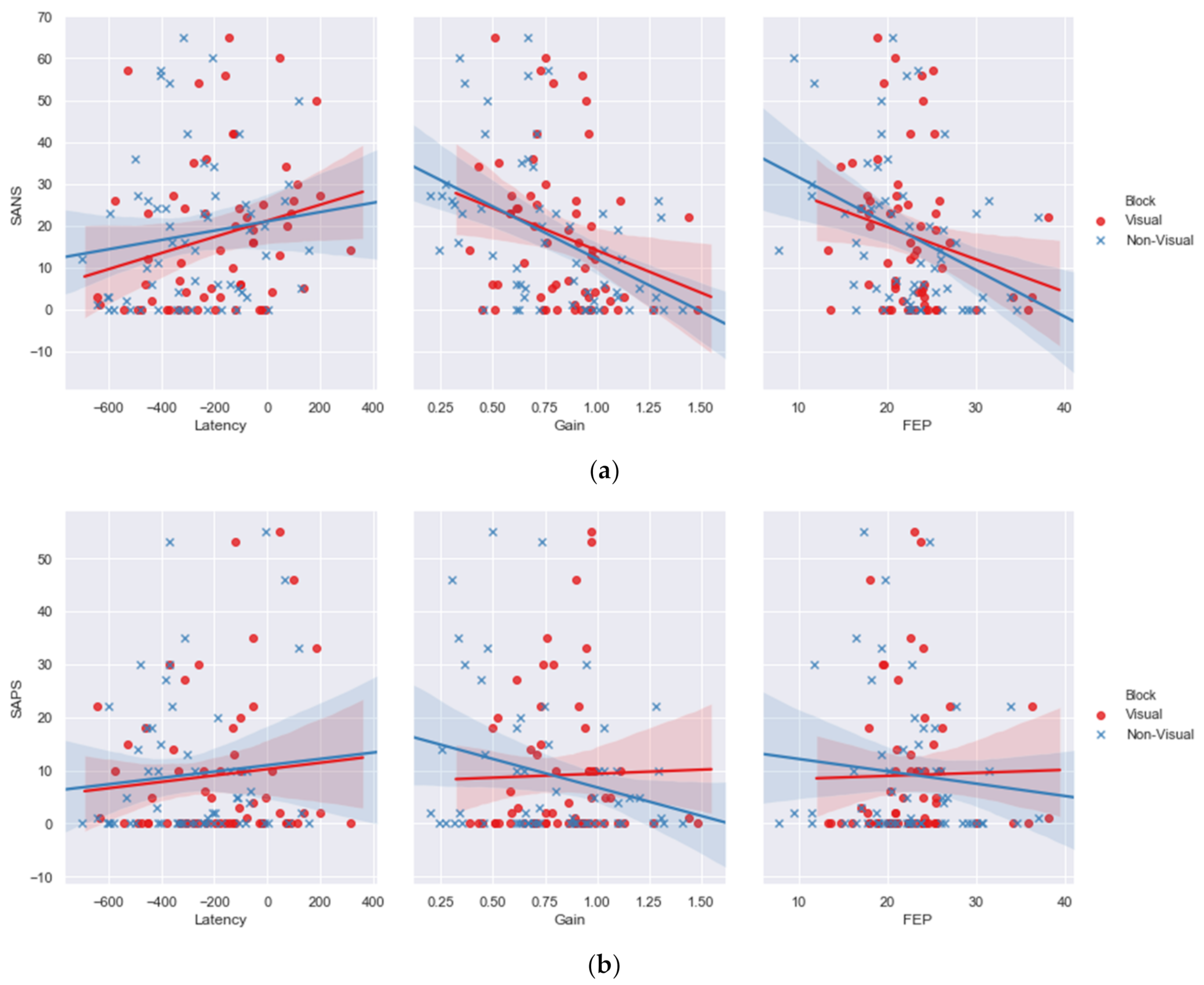
The predictive saccade task is a motor learning paradigm requiring saccades to track a visual target moving in a predictable pattern. Previous research has explored extensively anti-saccade deficits observed across psychosis, but less is known about predictive saccade-related mechanisms. The dataset analysed came from the studies of Crawford et al, published in 1995, where neuroleptically medicated schizophrenia and bipolar affective disorder patients were compared with non-medicated patients and control participants using a predictive saccade paradigm. The participant groups consisted of medicated schizophrenia patients (n = 40), non-medicated schizophrenia patients (n = 18), medicated bipolar disorder patients (n = 14), non-medicated bipolar disorder patients (n = 18), and controls (n = 31). The current analyses explore relationships between predictive saccades and symptomatology, and the potential interaction of medication. Analyses revealed that the schizophrenia and bipolar disorder diagnostic categories are indistinguishable in patterns of predictive control across several saccadic parameters, supporting a dimensional hypothesis. Once collapsed into predominantly high-/low- negative/positive symptoms, regardless of diagnosis, differences were revealed, with significant hypometria and lower gain in those with more negative symptoms. This illustrates how the presentation of the deficits is homogeneous across diagnosis, but heterogeneous when surveyed by symptomatology; attesting that a diagnostic label is less informative than symptomatology when exploring predictive saccades.
Keywords: predictive saccades; schizophrenia; bipolar disorder; positive symptoms; negative symptoms predictive saccades; schizophrenia; bipolar disorder; positive symptoms; negative symptoms