Article

Early Auditory Processing Predicts Efficient Working Memory Functioning in Schizophrenia
1
Clinical Research Center for Brain Sciences, Herzog Medical Center, Jerusalem 91035, Israel
2
Faculty of Education, Bar-Ilan University, Ramat Gan 5290002, Israel
*
Author to whom correspondence should be addressed.
Brain Sci. 2022, 12(2), 212; https://doi.org/10.3390/brainsci12020212

Submission received: 29 December 2021 / Revised: 25 January 2022 / Accepted: 30 January 2022 / Published: 3 February 2022
(This article belongs to the Special Issue Working Memory: Recent Outlooks)

Abstract

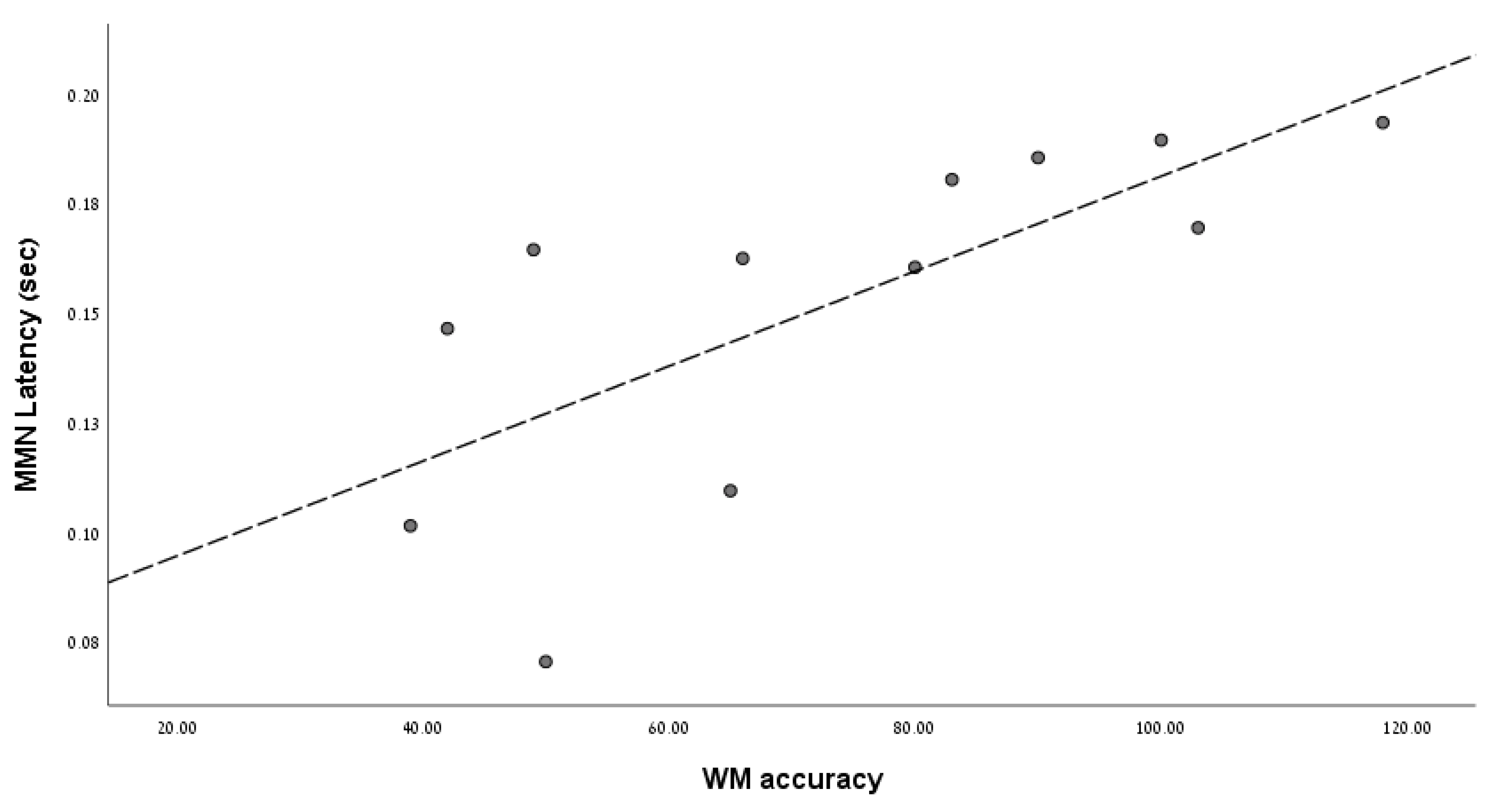
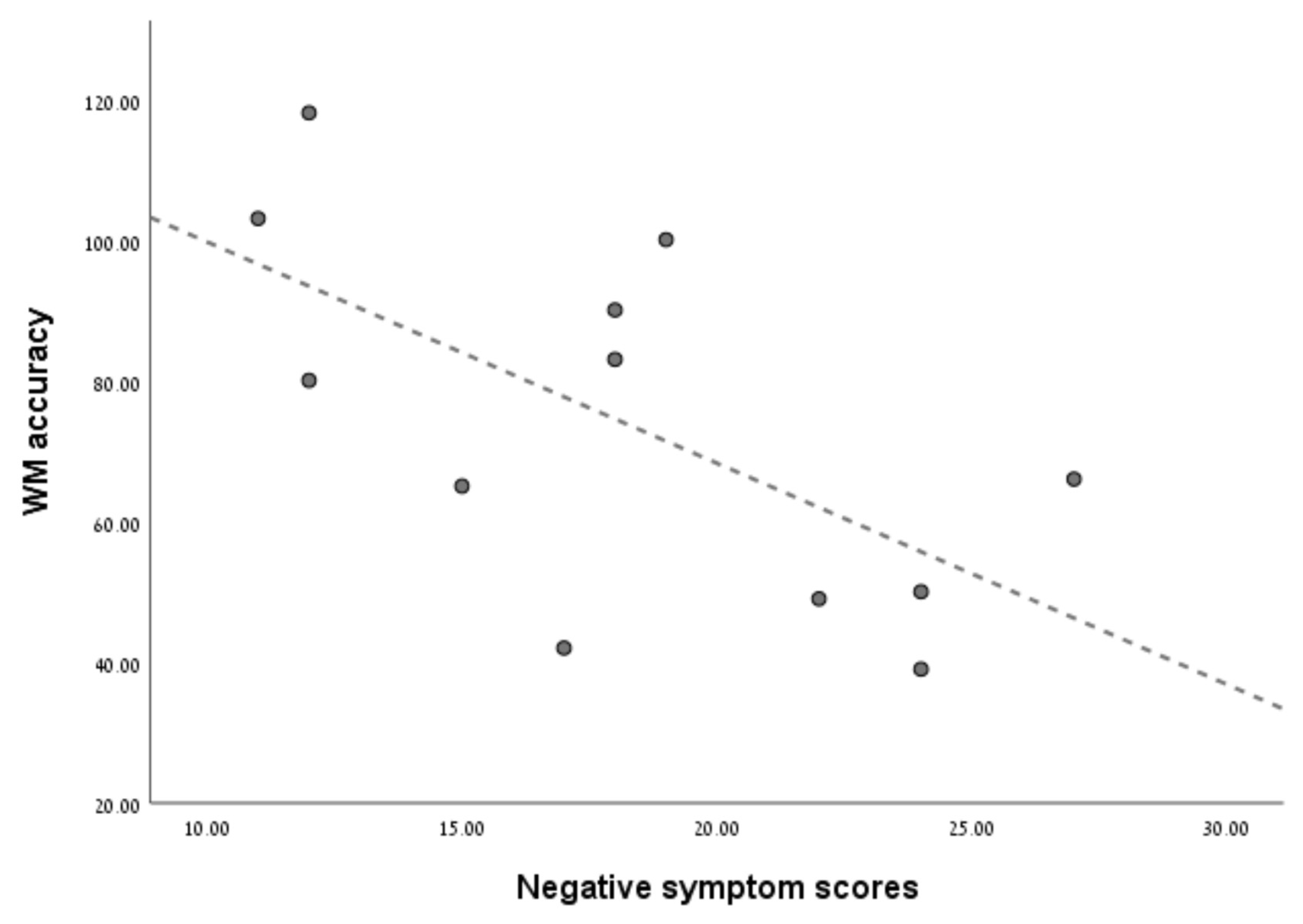
Early auditory processing (EAP) deficits have been consistently documented in individuals diagnosed with schizophrenia (SZ). However, a relationship between EAP and executive attention has not been confirmed in SZ versus healthy controls (HC). The current study aimed to demonstrate that unlike HC, in SZ patients, auditory change-detection event-related potentials (ERPs) are significantly associated with executive working memory (WM) functioning. Additionally, correlational analyses investigated the relationships between patients’ auditory ERPs, WM performance, and schizophrenia symptom severity scores. We examined verbal WM accuracy associated with “executive-control” prefrontal cortex mechanisms and EAP ERPs under midline prefrontal electrodes in 12 SZ patients versus 12 demographically matched HC. Mismatch negativity (MMN) amplitudes and latencies in SZ patients were not significantly different from HC, however, their verbal WM performance was significantly impaired versus HC. Importantly, prolonged MMN latencies in the SZ group were correlated with better WM accuracy. In the HC group, WM accuracy was unrelated to MMN latencies. Patients’ MMN parameters were unrelated to schizophrenia symptom-domain severity. However, patients’ WM RTs and accuracy were significantly related to illness severity and negative symptom severity, respectively. Therefore, inefficient sensory excitation related to EAP timing may underlie poor executive verbal WM functioning and might indirectly exacerbate the severity of negative symptoms in SZ. Treatments targeting prefrontal cortex dysfunction in schizophrenia are discussed.
Keywords: dorsolateral prefrontal cortex (DLPFC); executive attention (EA); mismatch negativity (MMN); negative symptoms dorsolateral prefrontal cortex (DLPFC); executive attention (EA); mismatch negativity (MMN); negative symptoms