Article

A CNN-Based Autoencoder and Machine Learning Model for Identifying Betel-Quid Chewers Using Functional MRI Features

1
Department of Psychology, Chung Shan Medical University, Taichung 40201, Taiwan
2
Clinical Psychological Room, Chung Shan Medical University Hospital, Taichung 40201, Taiwan
3
Department of Medical Imaging and Radiological Sciences, Bachelor Program in Artificial Intelligence, Chang Gung University, Taoyuan 33302, Taiwan
4
Department of Counseling and Clinical Psychology, Columbia University, New York, NY 10027, USA
5
Medical Imaging Research Center, Institute for Radiological Research, Chang Gung University and Chang Gung Memorial Hospital at Linkou, Taoyuan 33302, Taiwan
6
Department of Psychiatry, Chang Gung Memorial Hospital, Chiayi 61363, Taiwan
*
Author to whom correspondence should be addressed.
Brain Sci. 2021, 11(6), 809; https://doi.org/10.3390/brainsci11060809

Submission received: 19 May 2021 / Revised: 11 June 2021 / Accepted: 16 June 2021 / Published: 18 June 2021

Abstract

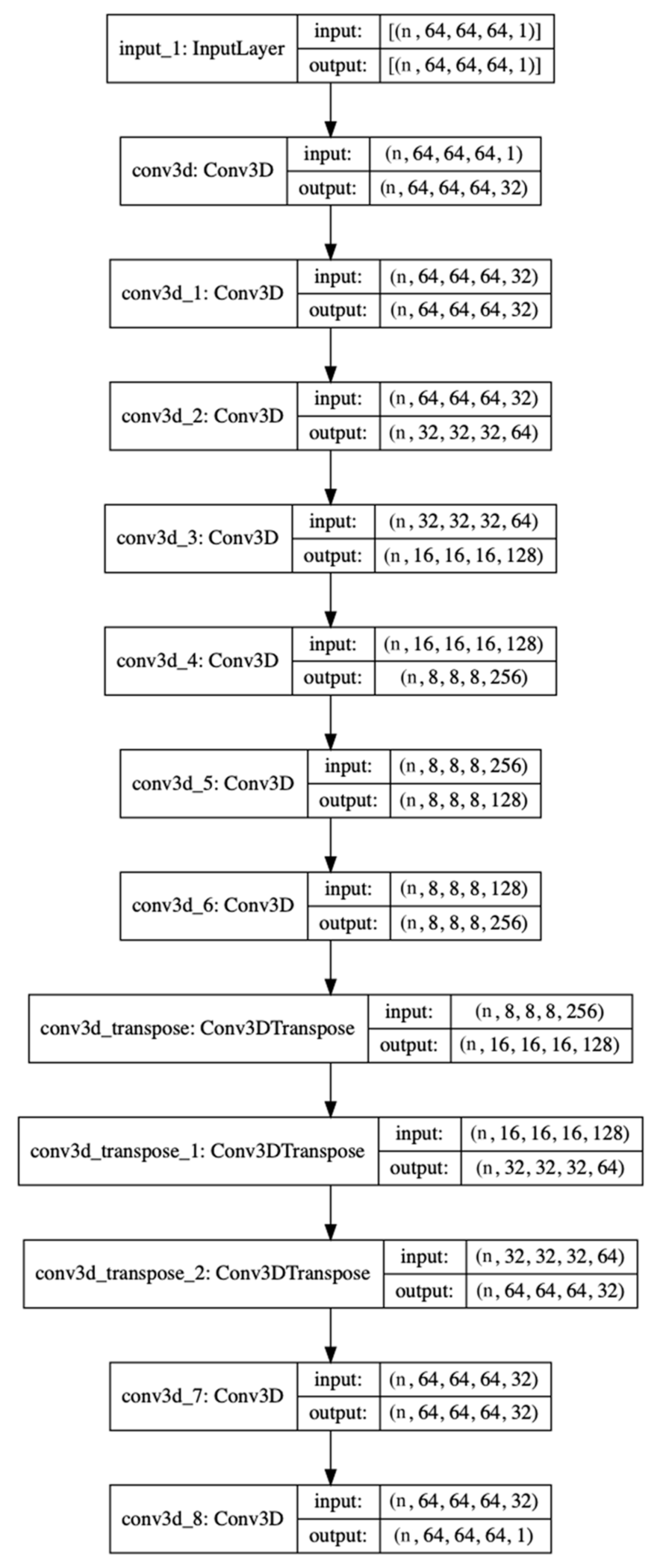
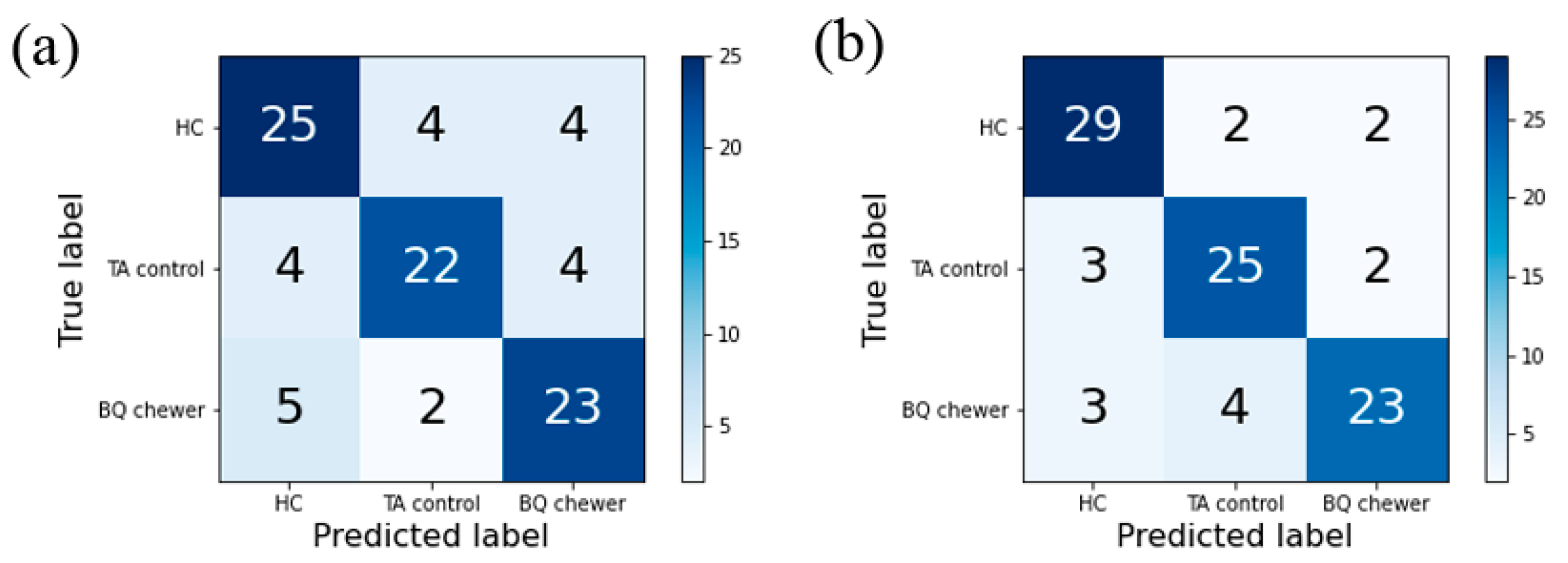
Betel quid (BQ) is one of the most commonly used psychoactive substances in some parts of Asia and the Pacific. Although some studies have shown brain function alterations in BQ chewers, it is virtually impossible for radiologists’ to visually distinguish MRI maps of BQ chewers from others. In this study, we aimed to construct autoencoder and machine-learning models to discover brain alterations in BQ chewers based on the features of resting-state functional magnetic resonance imaging. Resting-state functional magnetic resonance imaging (rs-fMRI) was obtained from 16 BQ chewers, 15 tobacco- and alcohol-user controls (TA), and 17 healthy controls (HC). We used an autoencoder and machine learning model to identify BQ chewers among the three groups. A convolutional neural network (CNN)-based autoencoder model and supervised machine learning algorithm logistic regression (LR) were used to discriminate BQ chewers from TA and HC. Classifying the brain MRIs of HC, TA controls, and BQ chewers by conducting leave-one-out-cross-validation (LOOCV) resulted in the highest accuracy of 83%, which was attained by LR with two rs-fMRI feature sets. In our research, we constructed an autoencoder and machine-learning model that was able to identify BQ chewers from among TA controls and HC, which were based on data from rs-fMRI, and this might provide a helpful approach for tracking BQ chewers in the future.
Keywords: betel quid; resting-state functional MRI (rs-fMRI); autoencoder; logistic regression betel quid; resting-state functional MRI (rs-fMRI); autoencoder; logistic regression