Case Report

Insula and Olfaction: A Literature Review and Case Report

by
Frédérique Roy-Côté
1,2,
Rayane Zahal
1,3,
Johannes Frasnelli
3,4,
Dang Khoa Nguyen
2,5,6 and
Olivier Boucher
1,2,7,*
1
Département de Psychologie, Université de Montréal, Montréal, QC H3C 3J7, Canada
2
Centre de Recherche du Centre Hospitalier de l’Université de Montréal, Montréal, QC H2X 0A9, Canada
3
Centre de Recherche de l’Hôpital du Sacré-Cœur-de-Montréal, Montréal, QC H4J 1C5, Canada
4
Département d’anatomie, Université du Québec à Trois-Rivières, Trois-Rivières, QC G8Z 1V3, Canada
5
Service de Neurologie, Centre Hospitalier de l’Université de Montréal, Montréal, QC H2X 3E4, Canada
6
Département de Neurosciences, Université de Montréal, Montréal, QC H3C 3J7, Canada
7
Service de Psychologie, Centre Hospitalier de l’Université de Montréal, Montréal, QC H2X 0C1, Canada
*
Author to whom correspondence should be addressed.
Brain Sci. 2021, 11(2), 198; https://doi.org/10.3390/brainsci11020198

Submission received: 7 January 2021 / Revised: 29 January 2021 / Accepted: 2 February 2021 / Published: 5 February 2021
(This article belongs to the Collection Insula: Rediscovering the Hidden Lobe of the Brain)

Abstract

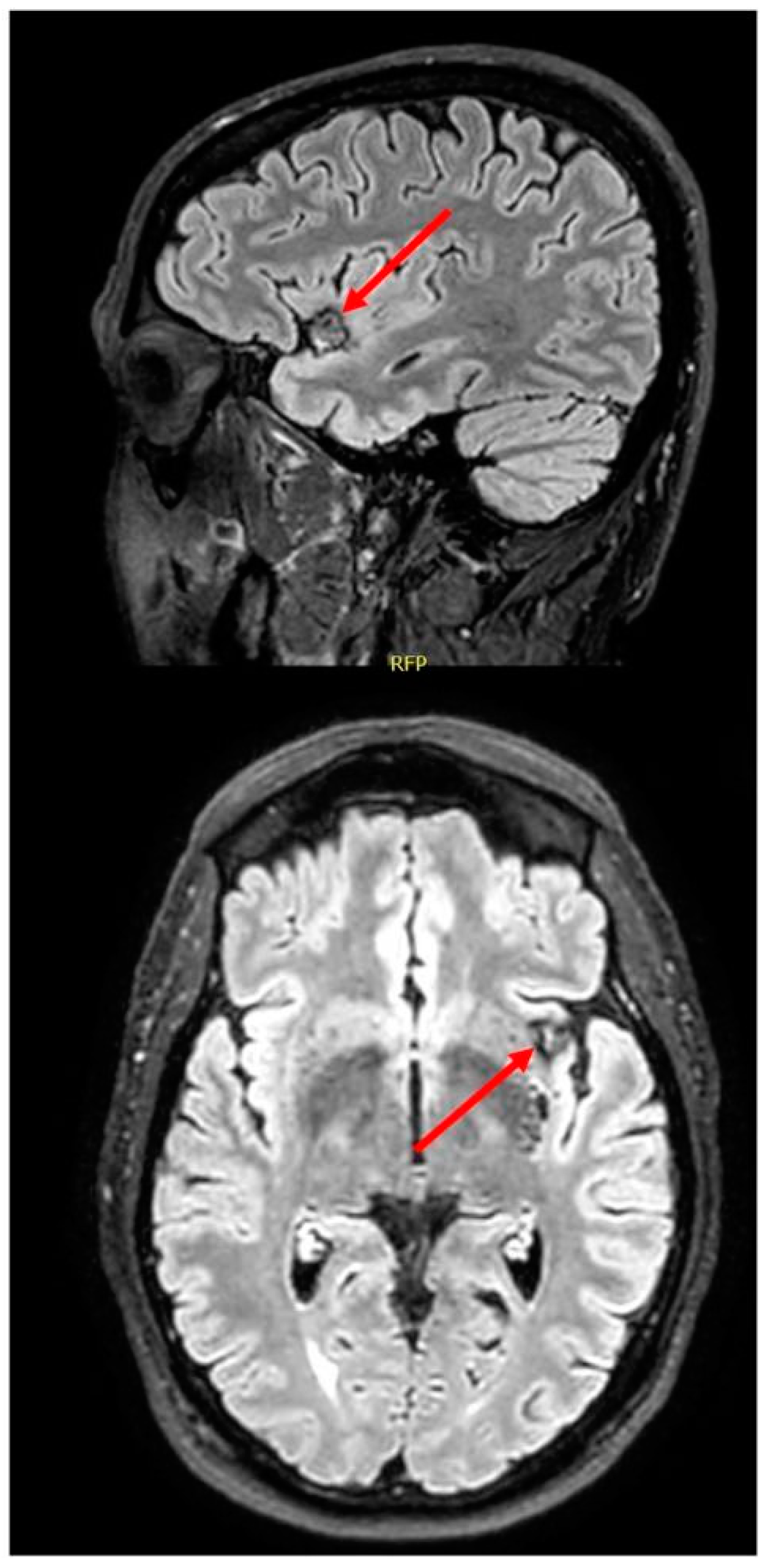
(1) Background: It is well established that the insula is involved in olfaction, though its specific role in olfactory processing remains uncertain. In this paper, we first review the current literature on the insula and olfaction. Then, we describe the case of a 56-year-old man with a left insular cavernoma that caused olfactory disturbances. (2) Results: Structural neuroimaging studies suggest that insular gray matter volume is related to olfactory function, and functional neuroimaging shows that various types of stimuli lead to either lateralized or bilateral insular activations. Studies using electro-cortical stimulation reveal a specific region of the insular cortex, around the central insular sulcus, that could be related to unpleasant odor processing. Previous cases of insular lesions leading to olfactory disturbances suggest that left-sided insular lesions may more frequently lead to olfactory changes. In our patient with a left insular cavernoma, odors that were previously perceived as pleasant started smelling unpleasant and were hard to distinguish. Despite these subjective complaints, olfactory function assessed with the Sniffin’ Sticks test was normal. (3) Conclusions: Current tests may not be sensitive to all types of olfactory impairments associated with insular damage, and further studies should be conducted to develop olfactory tests assessing the hedonic appreciation of odors.
Keywords: insula; lesion; olfaction; Sniffin’ Sticks; cavernous angioma; review insula; lesion; olfaction; Sniffin’ Sticks; cavernous angioma; review