Toward a State-of-the-Art of Fly-Rock Prediction Technology in Open-Pit Mines Using EANNs Model

 ,
,  , and
, and
Abstract
1. Introduction
2. Dataset Used
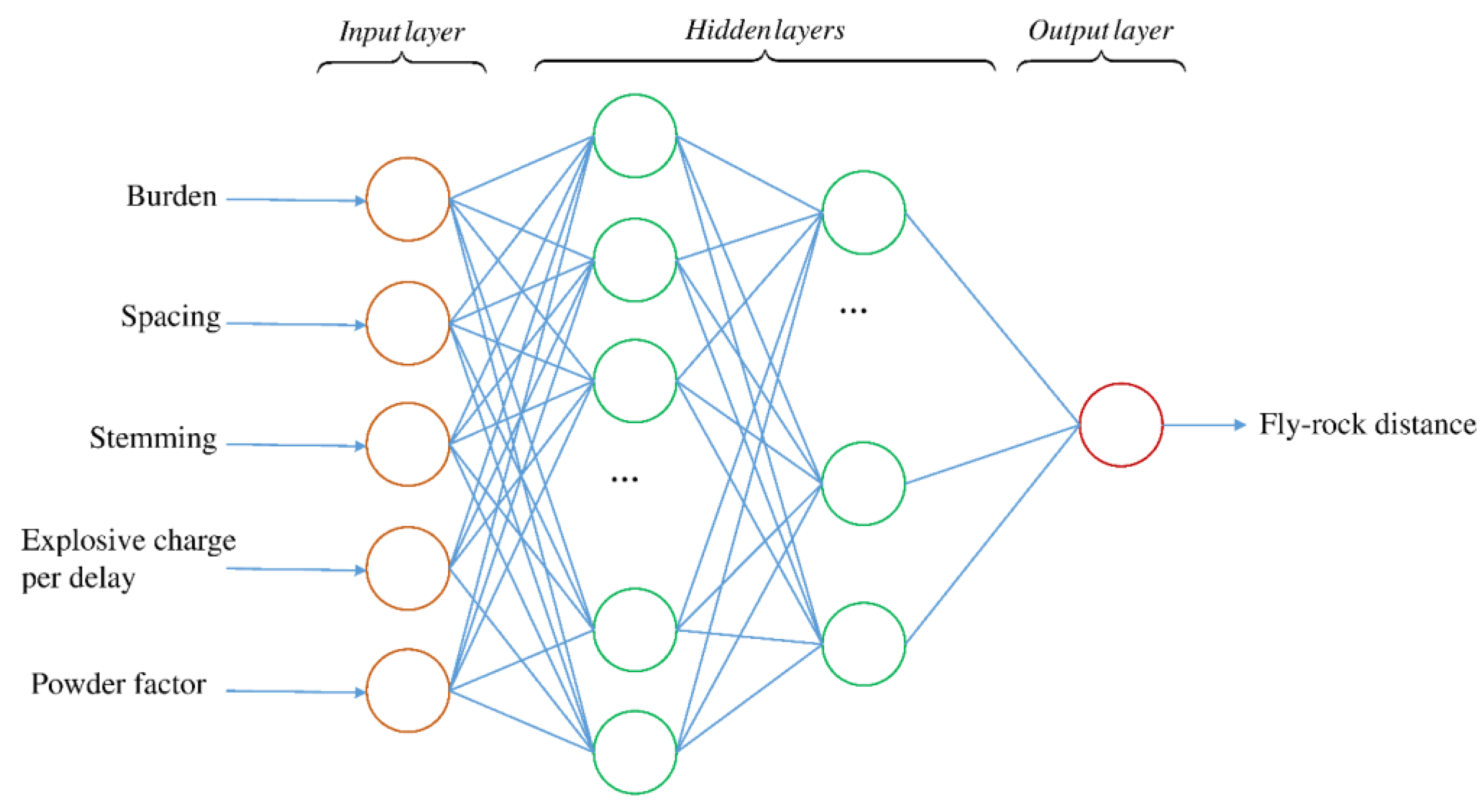
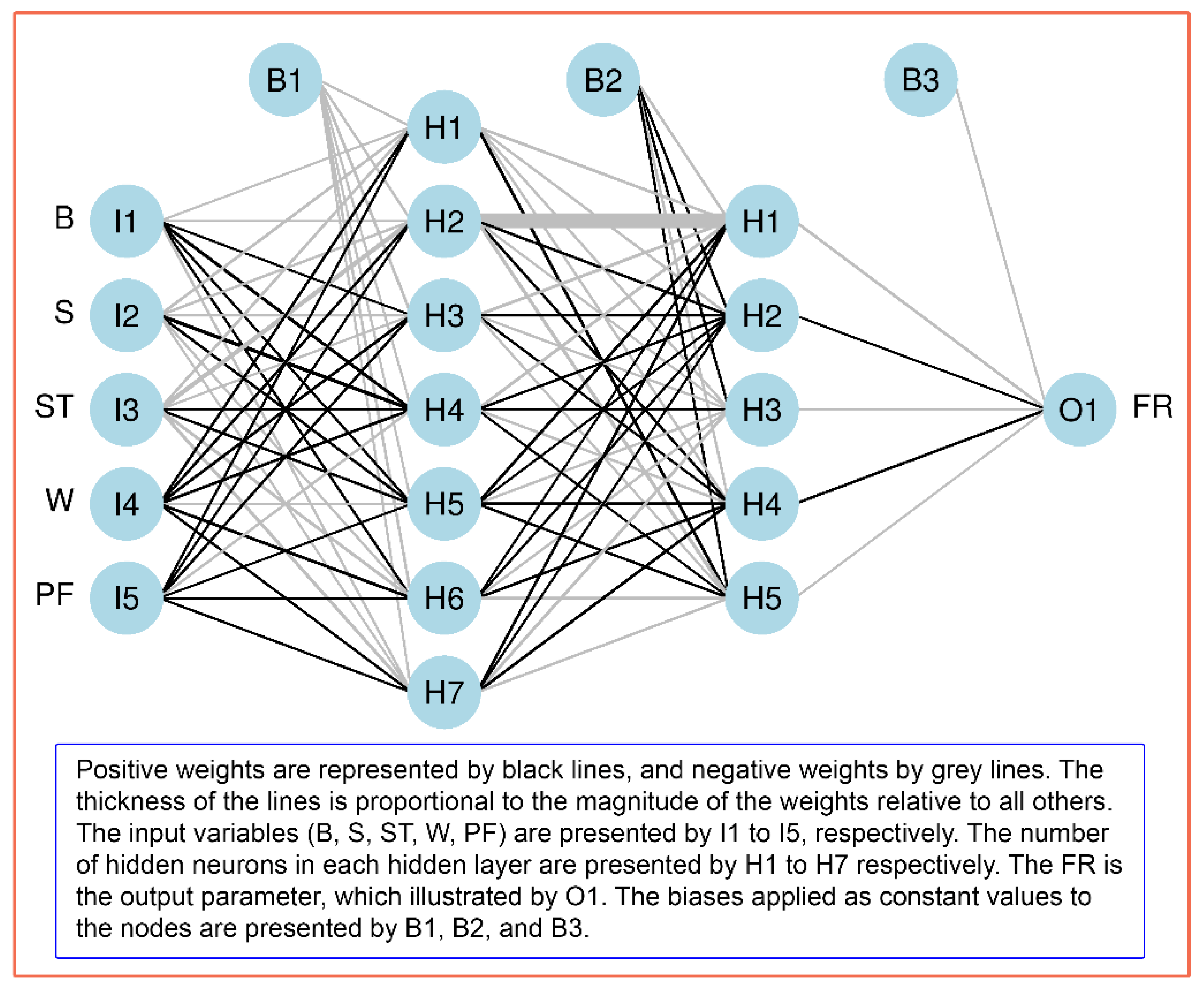
3. Artificial Neural Network (ANN)
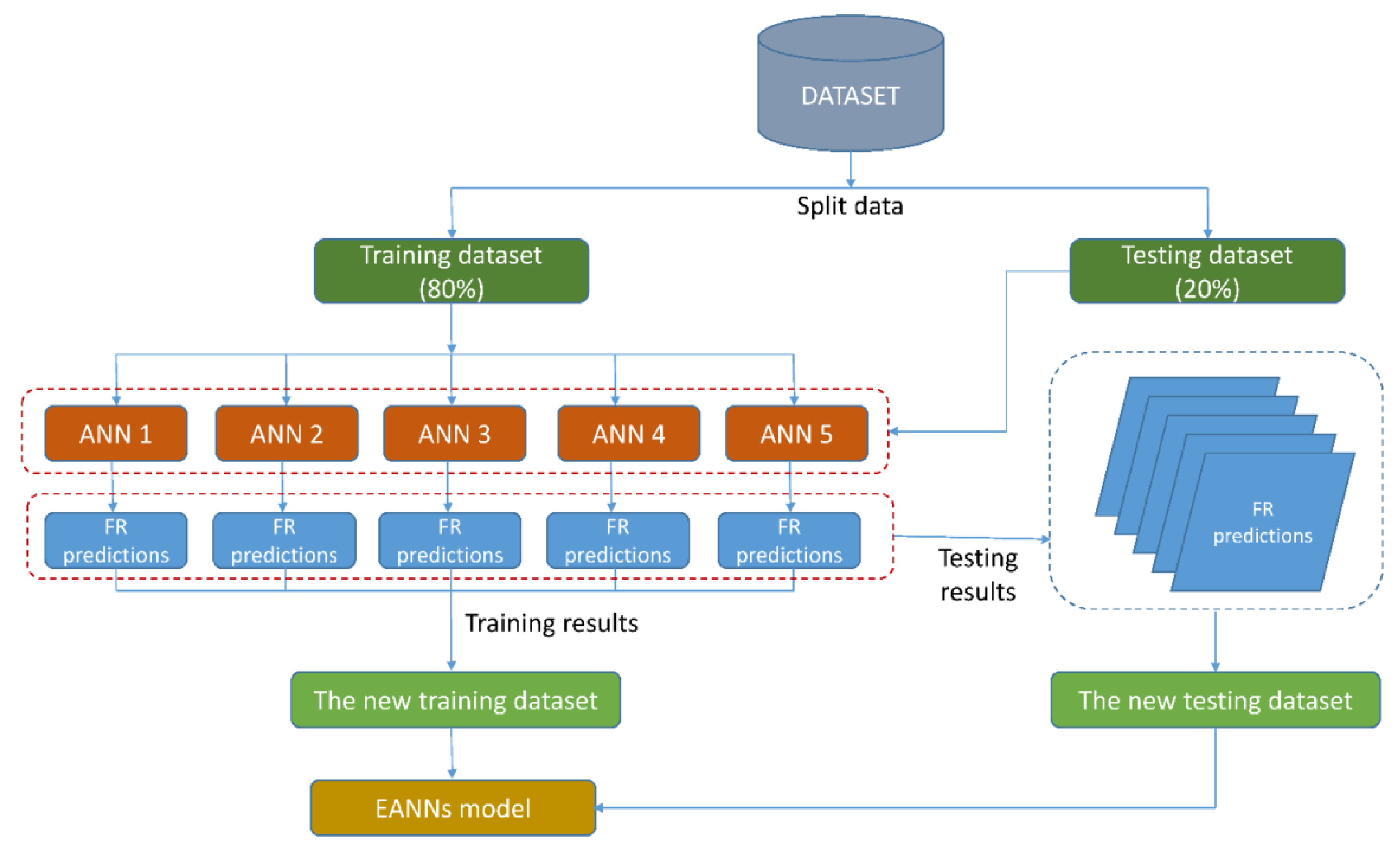
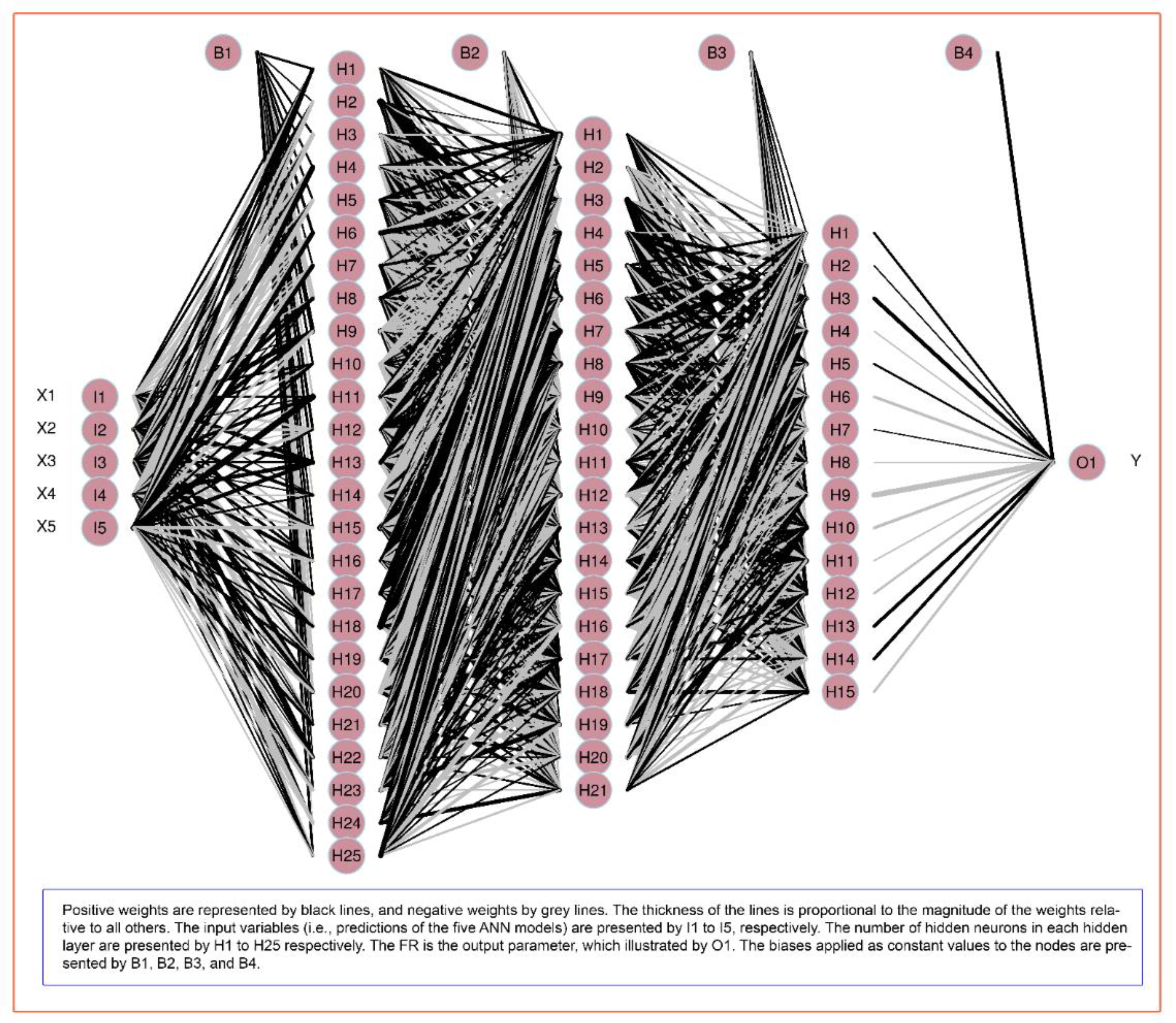
4. Combination of Multiple ANN Models
5. Performance Indexes for Evaluation of the Models
6. Results
7. Conclusions
Author Contributions
Funding
Acknowledgments
Conflicts of Interest
References
- Kecojevic, V.; Radomsky, M. Flyrock phenomena and area security in blasting-related accidents. Saf. Sci. 2005, 43, 739–750. [Google Scholar] [CrossRef] [Scilit]
- Bui, X.-N.; Jaroonpattanapong, P.; Nguyen, H.; Tran, Q.-H.; Long, N.Q. A novel Hybrid Model for predicting Blast-induced Ground Vibration Based on k-nearest neighbors and particle Swarm optimization. Sci. Rep. 2019, 9, 13971. [Google Scholar] [CrossRef] [Scilit] [PubMed]
- Choi, Y.; Song, J. Review of photovoltaic and wind power systems utilized in the mining industry. Renew. Sustain. Energy Rev. 2017, 75, 1386–1391. [Google Scholar] [CrossRef] [Scilit]
- Verakis, H.; Lobb, T. Blasting accidents in surface mines, a two decade summary. In Proceedings of the Annual Conference on Explosives and Blasting Technique; International Society of Explosives Engineers: Cleveland, OH, USA, 28–31 January 2001; Volume I, pp. 145–152. [Google Scholar]
- Choi, Y.; Park, H.-D.; Sunwoo, C. Flood and gully erosion problems at the Pasir open pit coal mine, Indonesia: A case study of the hydrology using GIS. Bull. Eng. Geol. Environ. 2008, 67, 251–258. [Google Scholar] [CrossRef] [Scilit]
- Choi, Y. A new algorithm to calculate weighted flow-accumulation from a DEM by considering surface and underground stormwater infrastructure. Environ. Model. Softw. 2012, 30, 81–91. [Google Scholar] [CrossRef] [Scilit]
- Langefors, U.; Kihlström, B. The Modern Technique of Rock Blasting; Wiley: Hoboken, NJ, USA, 1963. [Google Scholar]
- Roth, J. A Model for the Determination of Flyrock Range as a Function of Shot Conditions; US Bureau of Mines Contract JManagement Science Associates: Los Altos, CA, USA, 1979. [Google Scholar]
- Lundborg, N. Risk for Flyrock when Blasting; BFR Report R; Swedish Council for Building Research: Stockholm, Sweden, 1981; Volume 29. [Google Scholar]
- Monjezi, M.; Khoshalan, H.A.; Varjani, A.Y. Prediction of flyrock and backbreak in open pit blasting operation: A neuro-genetic approach. Arab. J. Geosci. 2012, 5, 441–448. [Google Scholar] [CrossRef] [Scilit]
- Nguyen, H.; Bui, X.-N.; Bui, H.-B.; Cuong, D.T. Developing an XGBoost model to predict blast-induced peak particle velocity in an open-pit mine: A case study. Acta Geophys. 2019, 67, 477–490. [Google Scholar] [CrossRef] [Scilit]
- Nguyen, H.; Bui, X.-N.; Bui, H.-B.; Mai, N.-L. A comparative study of artificial neural networks in predicting blast-induced air-blast overpressure at Deo Nai open-pit coal mine, Vietnam. Neural Comput. Appl. 2018, 1–17. [Google Scholar] [CrossRef] [Scilit]
- Bui, X.N.; Nguyen, H.; Le, H.A.; Bui, H.B.; Do, N.H. Prediction of Blast-induced Air Over-pressure in Open-Pit Mine: Assessment of Different Artificial Intelligence Techniques. Nat. Resour. Res. 2019. [Google Scholar] [CrossRef] [Scilit]
- Le, L.T.; Nguyen, H.; Dou, J.; Zhou, J. A Comparative Study of PSO-ANN, GA-ANN, ICA-ANN, and ABC-ANN in Estimating the Heating Load of Buildings’ Energy Efficiency for Smart City Planning. Appl. Sci. 2019, 9, 2630. [Google Scholar] [CrossRef] [Scilit]
- Khandelwal, M.; Singh, T. Prediction of blast-induced ground vibration using artificial neural network. Int. J. Rock Mech. Min. Sci. 2009, 46, 1214–1222. [Google Scholar] [CrossRef] [Scilit]
- Zhou, J.; Shi, X.-Z.; Huang, R.-D.; Qiu, X.-Y.; Chong, C. Feasibility of stochastic gradient boosting approach for predicting rockburst damage in burst-prone mines. Trans. Nonferrous Met. Soc. China 2016, 26, 1938–1945. [Google Scholar] [CrossRef] [Scilit]
- Hasanipanah, M.; Shahnazar, A.; Amnieh, H.B.; Armaghani, D.J. Prediction of air-overpressure caused by mine blasting using a new hybrid PSO–SVR model. Eng. Comput. 2017, 33, 23–31. [Google Scholar] [CrossRef] [Scilit]
- Hajihassani, M.; Armaghani, D.J.; Marto, A.; Mohamad, E.T. Ground vibration prediction in quarry blasting through an artificial neural network optimized by imperialist competitive algorithm. Bull. Eng. Geol. Environ. 2015, 74, 873–886. [Google Scholar] [CrossRef] [Scilit]
- Ghasemi, E.; Kalhori, H.; Bagherpour, R. A new hybrid ANFIS–PSO model for prediction of peak particle velocity due to bench blasting. Eng. Comput. 2016, 32, 607–614. [Google Scholar] [CrossRef] [Scilit]
- Gao, W.; Karbasi, M.; Hasanipanah, M.; Zhang, X.; Guo, J. Developing GPR model for forecasting the rock fragmentation in surface mines. Eng. Comput. 2018, 34, 339–345. [Google Scholar] [CrossRef] [Scilit]
- Carranza, E.J.M. Data-Driven Evidential Belief Modeling of Mineral Potential Using Few Prospects and Evidence with Missing Values. Nat. Resour. Res. 2015, 24, 291–304. [Google Scholar] [CrossRef] [Scilit]
- Bui, X.N.; Muazu, M.A.; Nguyen, H. Optimizing Levenberg–Marquardt backpropagation technique in predicting factor of safety of slopes after two-dimensional OptumG2 analysis. Eng. Comput. 2019. [Google Scholar] [CrossRef] [Scilit]
- Asteris, P.G.; Argyropoulos, I.; Cavaleri, L.; Rodrigues, H.; Varum, H.; Thomas, J.; Lourenço, P.B. Masonry Compressive Strength Prediction using Artificial Neural Networks. In International Conference on Transdisciplinary Multispectral Modeling and Cooperation for the Preservation of Cultural Heritage; Springer: Cham, Switzerland, 2018; pp. 200–224. [Google Scholar]
- Armaghani, D.J.; Mohamad, E.T.; Narayanasamy, M.S.; Narita, N.; Yagiz, S. Development of hybrid intelligent models for predicting TBM penetration rate in hard rock condition. Tunn. Undergr. Space Technol. 2017, 63, 29–43. [Google Scholar] [CrossRef] [Scilit]
- Dou, J.; Paudel, U.; Oguchi, T.; Uchiyama, S.; Hayakavva, Y.S. Shallow and Deep-Seated Landslide Differentiation Using Support Vector Machines: A Case Study of the Chuetsu Area, Japan. Terr. Atmos. Ocean. Sci. 2015, 26, 227–239. [Google Scholar] [CrossRef] [Scilit]
- Prashanth, R.; Nimaje, D. Estimation of ambiguous blast-induced ground vibration using intelligent models: A case study. Noise Vib. Worldw. 2018, 49, 147–157. [Google Scholar] [CrossRef] [Scilit]
- Taheri, K.; Hasanipanah, M.; Golzar, S.B.; Majid, M.Z.A. A hybrid artificial bee colony algorithm-artificial neural network for forecasting the blast-produced ground vibration. Eng. Comput. 2017, 33, 689–700. [Google Scholar] [CrossRef] [Scilit]
- Nguyen, H.; Bui, X.-N. Predicting Blast-Induced Air Overpressure: A Robust Artificial Intelligence System Based on Artificial Neural Networks and Random Forest. Nat. Resour. Res. 2018, 1–15. [Google Scholar] [CrossRef] [Scilit]
- Nguyen, H.; Bui, X.-N.; Moayedi, H. A comparison of advanced computational models and experimental techniques in predicting blast-induced ground vibration in open-pit coal mine. Acta Geophys. 2019. [Google Scholar] [CrossRef] [Scilit]
- Nguyen, H.; Bui, X.-N.; Tran, Q.-H.; Mai, N.-L. A new soft computing model for estimating and controlling blast-produced ground vibration based on hierarchical K-means clustering and cubist algorithms. Appl. Soft Comput. 2019, 77, 376–386. [Google Scholar] [CrossRef] [Scilit]
- Luo, Z.; Bui, X.-N.; Nguyen, H.; Moayedi, H. A novel artificial intelligence technique for analyzing slope stability using PSO-CA model. Eng. Comput. 2019. [Google Scholar] [CrossRef] [Scilit]
- Monjezi, M.; Bahrami, A.; Varjani, A.Y.; Sayadi, A.R. Prediction and controlling of flyrock in blasting operation using artificial neural network. Arab. J. Geosci. 2011, 4, 421–425. [Google Scholar] [CrossRef] [Scilit]
- Ghasemi, E.; Amini, H.; Ataei, M.; Khalokakaei, R. Application of artificial intelligence techniques for predicting the flyrock distance caused by blasting operation. Arab. J. Geosci. 2014, 7, 193–202. [Google Scholar] [CrossRef] [Scilit]
- Trivedi, R.; Singh, T.; Raina, A. Prediction of blast-induced flyrock in Indian limestone mines using neural networks. J. Rock Mech. Geotech. Eng. 2014, 6, 447–454. [Google Scholar] [CrossRef] [Scilit]
- Amini, H.; Gholami, R.; Monjezi, M.; Torabi, S.R.; Zadhesh, J. Evaluation of flyrock phenomenon due to blasting operation by support vector machine. Neural Comput. Appl. 2012, 21, 2077–2085. [Google Scholar] [CrossRef] [Scilit]
- Manoj, K.; Monjezi, M. Prediction of flyrock in open pit blasting operation using machine learning method. Int. J. Min. Sci. Technol. 2013, 23, 313–316. [Google Scholar] [CrossRef] [Scilit]
- Trivedi, R.; Singh, T.; Gupta, N. Prediction of blast-induced flyrock in opencast mines using ANN and ANFIS. Geotech. Geol. Eng. 2015, 33, 875–891. [Google Scholar] [CrossRef] [Scilit]
- Hasanipanah, M.; Armaghani, D.J.; Amnieh, H.B.; Majid, M.Z.A.; Tahir, M.M. Application of PSO to develop a powerful equation for prediction of flyrock due to blasting. Neural Comput. Appl. 2017, 28, 1043–1050. [Google Scholar] [CrossRef] [Scilit]
- Dehghani, H.; Shafaghi, M. Prediction of blast-induced flyrock using differential evolution algorithm. Eng. Comput. 2017, 33, 149–158. [Google Scholar] [CrossRef] [Scilit]
- Faradonbeh, R.S.; Armaghani, D.J.; Amnieh, H.B.; Mohamad, E.T. Prediction and minimization of blast-induced flyrock using gene expression programming and firefly algorithm. Neural Comput. Appl. 2018, 29, 269–281. [Google Scholar] [CrossRef] [Scilit]
- Rad, H.N.; Bakhshayeshi, I.; Jusoh, W.A.W.; Tahir, M.; Foong, L.K. Prediction of Flyrock in mine blasting: A new computational intelligence approach. Nat. Resour. Res. 2019, 1–15. [Google Scholar] [CrossRef] [Scilit]
- Armaghani, D.J.; Hajihassani, M.; Mohamad, E.T.; Marto, A.; Noorani, S. Blasting-induced flyrock and ground vibration prediction through an expert artificial neural network based on particle swarm optimization. Arab. J. Geosci. 2014, 7, 5383–5396. [Google Scholar] [CrossRef] [Scilit]
- Hasanipanah, M.; Faradonbeh, R.S.; Armaghani, D.J.; Amnieh, H.B.; Khandelwal, M. Development of a precise model for prediction of blast-induced flyrock using regression tree technique. Environ. Earth Sci. 2017, 76, 27. [Google Scholar] [CrossRef] [Scilit]
- Kumar, N.; Mishra, B.; Bali, V. A Novel Approach for Blast-Induced Fly Rock Prediction Based on Particle Swarm Optimization and Artificial Neural Network. In Proceedings of International Conference on Recent Advancement on Computer and Communication; Springer: Singapore, 2018; pp. 19–27. [Google Scholar]
- Guo, H.; Nguyen, H.; Bui, X.-N.; Armaghani, D.J. A new technique to predict fly-rock in bench blasting based on an ensemble of support vector regression and GLMNET. Eng. Comput. 2019. [Google Scholar] [CrossRef] [Scilit]
- Asteris, P.; Kolovos, K.; Douvika, M.; Roinos, K. Prediction of self-compacting concrete strength using artificial neural networks. Eur. J. Environ. Civ. Eng. 2016, 20 (Suppl. 1), s102–s122. [Google Scholar] [CrossRef] [Scilit]
- Asteris, P.G.; Nikoo, M. Artificial bee colony-based neural network for the prediction of the fundamental period of infilled frame structures. Neural Comput. Appl. 2019. [Google Scholar] [CrossRef] [Scilit]
- Gardner, M.W.; Dorling, S. Artificial neural networks (the multilayer perceptron)—A review of applications in the atmospheric sciences. Atmos. Environ. 1998, 32, 2627–2636. [Google Scholar] [CrossRef] [Scilit]
- Kalogirou, S.A. Artificial neural networks in renewable energy systems applications: A review. Renew. Sustain. Energy Rev. 2001, 5, 373–401. [Google Scholar] [CrossRef] [Scilit]
- Gao, W.; Wang, W.; Dimitrov, D.; Wang, Y. Nano properties analysis via fourth multiplicative ABC indicator calculating. Arab. J. Chem. 2018, 11, 793–801. [Google Scholar] [CrossRef] [Scilit]
- Moayed, H.; Rashid, A.S.A.; Muazu, M.A.; Nguyen, H.; Bui, X.-N.; Bui, D.T. Prediction of ultimate bearing capacity through various novel evolutionary and neural network models. Eng. Comput. 2019. [Google Scholar] [CrossRef] [Scilit]
- Burrascano, P.; Fiori, S.; Mongiardo, M. A review of artificial neural networks applications in microwave computer-aided design (invited article). Int. J. RF Microw. Comput. Aided Eng. 1999, 9, 158–174. [Google Scholar] [CrossRef]
- Lisboa, P.J.; Taktak, A.F. The use of artificial neural networks in decision support in cancer: A systematic review. Neural Netw. 2006, 19, 408–415. [Google Scholar] [CrossRef] [Scilit]
- Carranza, E.J.M. Natural resources research publications on geochemical anomaly and mineral potential mapping, and introduction to the special issue of papers in these fields. Nat. Resour. Res. 2017, 26, 379–410. [Google Scholar] [CrossRef] [Scilit]
- Yegnanarayana, B. Artificial Neural Networks; PHI Learning Pvt. Ltd.: New Delhi, India, 2009. [Google Scholar]
- Nguyen, H.; Drebenstedt, C.; Bui, X.-N.; Bui, D.T. Prediction of Blast-Induced Ground Vibration in an Open-Pit Mine by a Novel Hybrid Model Based on Clustering and Artificial Neural Network. Nat. Resour. Res. 2019. [Google Scholar] [CrossRef] [Scilit]
- Oh, H.-J.; Lee, S. Application of artificial neural network for gold–silver deposits potential mapping: A case study of Korea. Nat. Resour. Res. 2010, 19, 103–124. [Google Scholar] [CrossRef] [Scilit]
- Buscema, P.M.; Massini, G.; Breda, M.; Lodwick, W.A.; Newman, F.; Asadi-Zeydabadi, M. Artificial Adaptive Systems Using Auto Contractive Maps: Theory, Applications and Extensions; Springer International Publishing AG: Cham, Switzerland, 2018. [Google Scholar]
- Gao, W.; Guirao, J.L.G.; Abdel-Aty, M.; Xi, W. An independent set degree condition for fractional critical deleted graphs. Discret. Contin. Dyn. Syst. S 2018, 12, 877–886. [Google Scholar] [CrossRef] [Scilit]
- Bui, D.T.; Tuan, T.A.; Klempe, H.; Pradhan, B.; Revhaug, I. Spatial prediction models for shallow landslide hazards: A comparative assessment of the efficacy of support vector machines, artificial neural networks, kernel logistic regression, and logistic model tree. Landslides 2016, 13, 361–378. [Google Scholar]
- Zhang, X.; Nguyen, H.; Bui, X.-N.; Tran, Q.-H.; Nguyen, D.-A.; Bui, D.T.; Moayedi, H. Novel Soft Computing Model for Predicting Blast-Induced Ground Vibration in Open-Pit Mines Based on Particle Swarm Optimization and XGBoost. Nat. Resour. Res. 2019. [Google Scholar] [CrossRef] [Scilit]
- Tessema, A. Mineral systems analysis and artificial neural network modeling of chromite prospectivity in the Western Limb of the Bushveld Complex, South Africa. Nat. Resour. Res. 2017, 26, 465–488. [Google Scholar] [CrossRef] [Scilit]
- Zhou, Z.-H.; Wu, J.; Tang, W. Ensembling neural networks: Many could be better than all. Artif. Intell. 2002, 137, 239–263. [Google Scholar] [CrossRef] [Scilit]

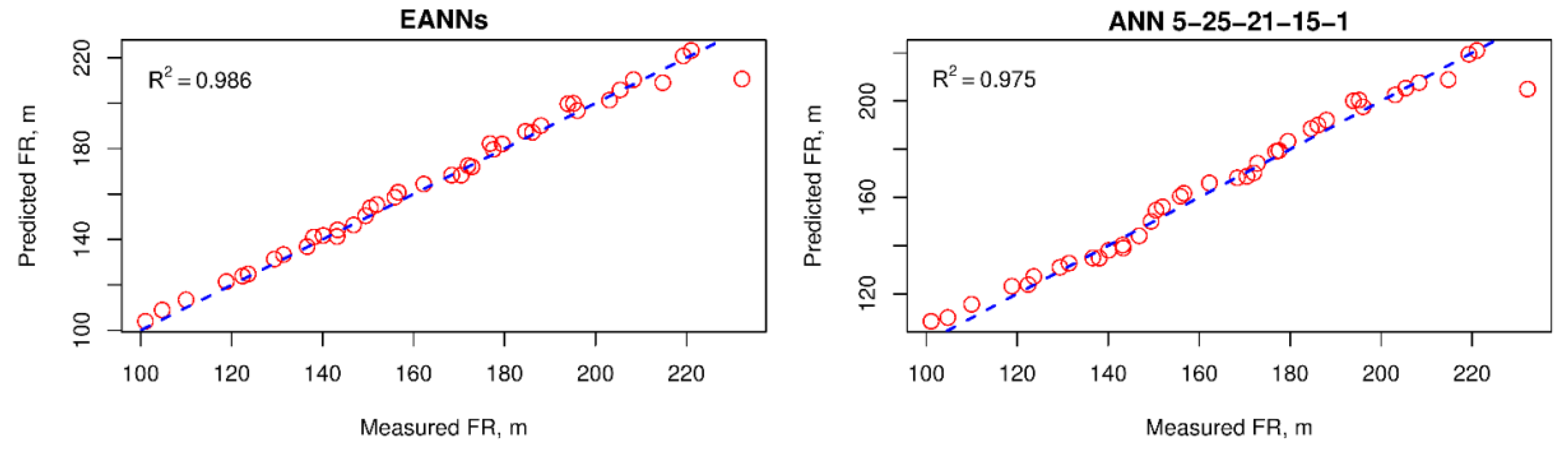
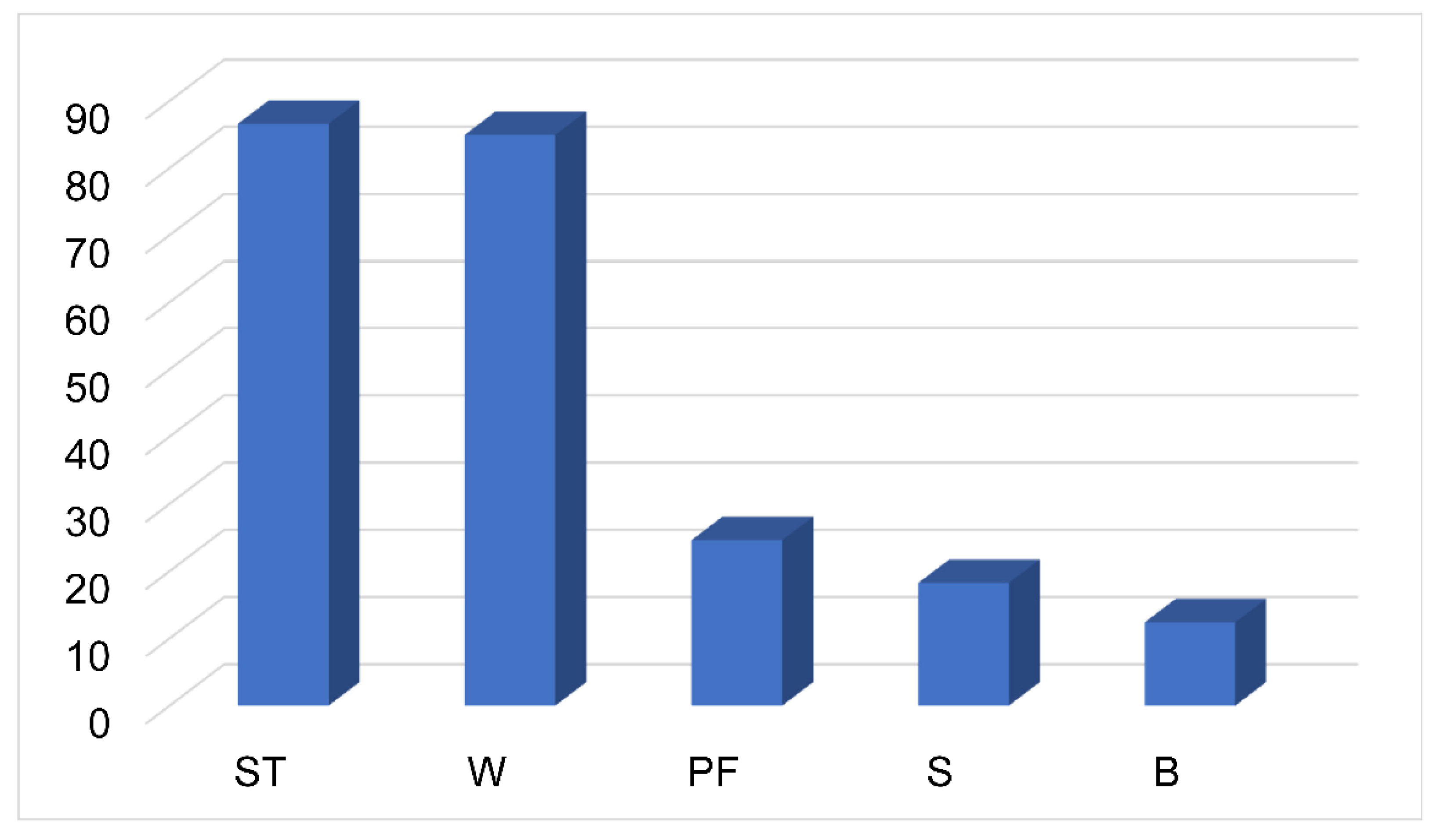

| B (m) | S (m) | ST (m) | W (Kg) | PF (kg/m3) | FR (m) | |
|---|---|---|---|---|---|---|
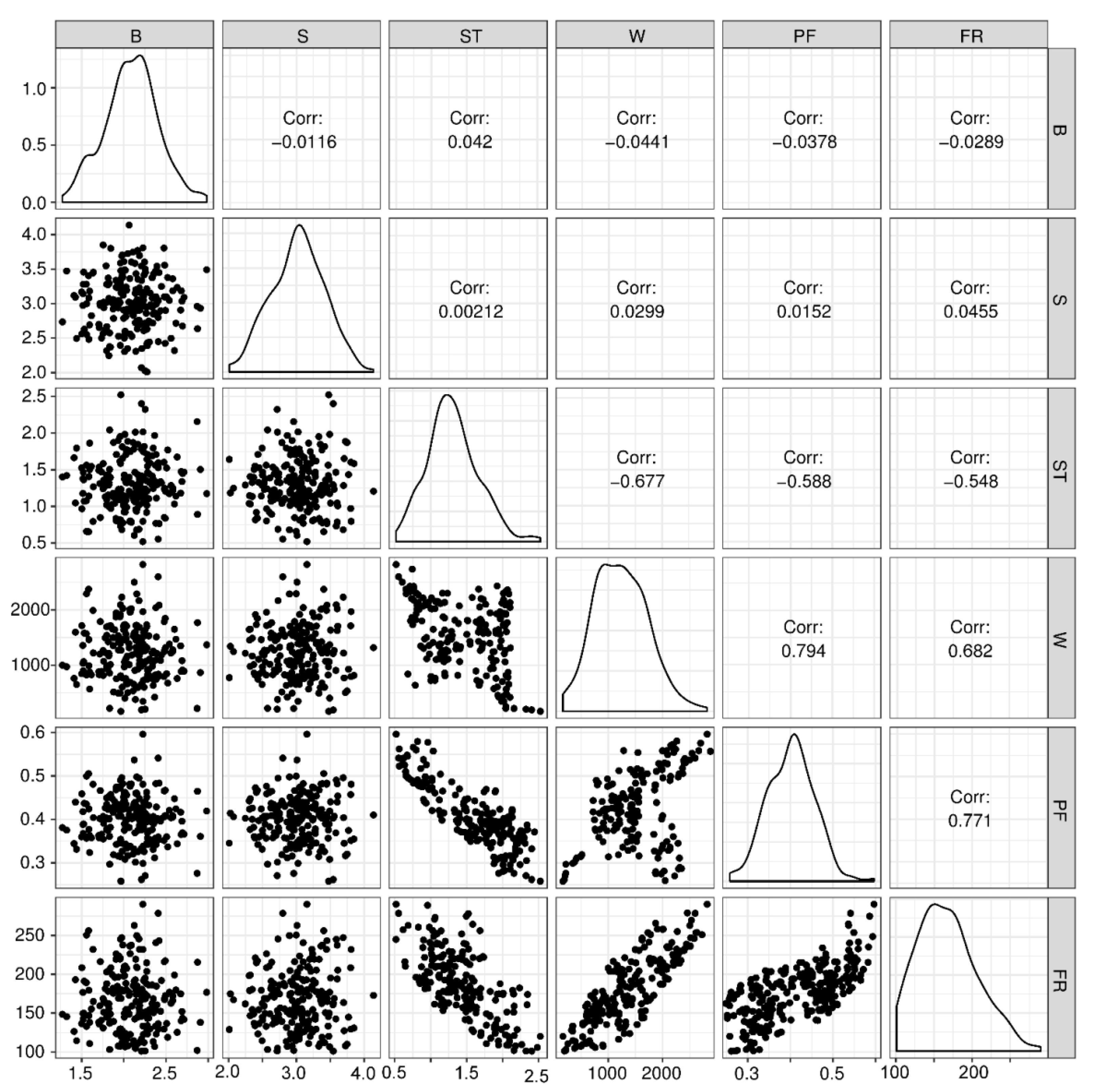
| Minimum | 1.272 | 2.010 | 0.5194 | 166.3 | 0.2578 | 101.1 |
| Mean | 2.090 | 3.021 | 1.3038 | 1236.4 | 0.4013 | 167.7 |
| Maximum | 2.982 | 4.137 | 2.5236 | 2820.5 | 0.5963 | 290.1 |
| Model | MAE | MAPE | RMSE | VAF | R2 | Rank for MAE | Rank for MAPE | Rank for RMSE | Rank for VAF | Rank for R2 |
|---|---|---|---|---|---|---|---|---|---|---|
| ANN 5-7-5-1 | 3.301 | 0.021 | 6.231 | 97.563 | 0.976 | 6 | 5 | 5 | 5 | 5 |
| ANN 5-10-8-1 | 3.416 | 0.022 | 6.413 | 97.419 | 0.974 | 4 | 4 | 2 | 2 | 2 |
| ANN 5-14-9-1 | 3.326 | 0.021 | 6.122 | 97.648 | 0.976 | 5 | 5 | 6 | 6 | 5 |
| ANN 5-18-13-1 | 3.482 | 0.023 | 6.309 | 97.502 | 0.975 | 3 | 3 | 4 | 4 | 3 |
| ANN 5-21-16-1 | 3.67 | 0.024 | 6.672 | 97.206 | 0.972 | 2 | 1 | 1 | 1 | 1 |
| ANN 5-25-21-15-1 | 3.695 | 0.024 | 6.361 | 97.460 | 0.975 | 1 | 1 | 3 | 3 | 3 |
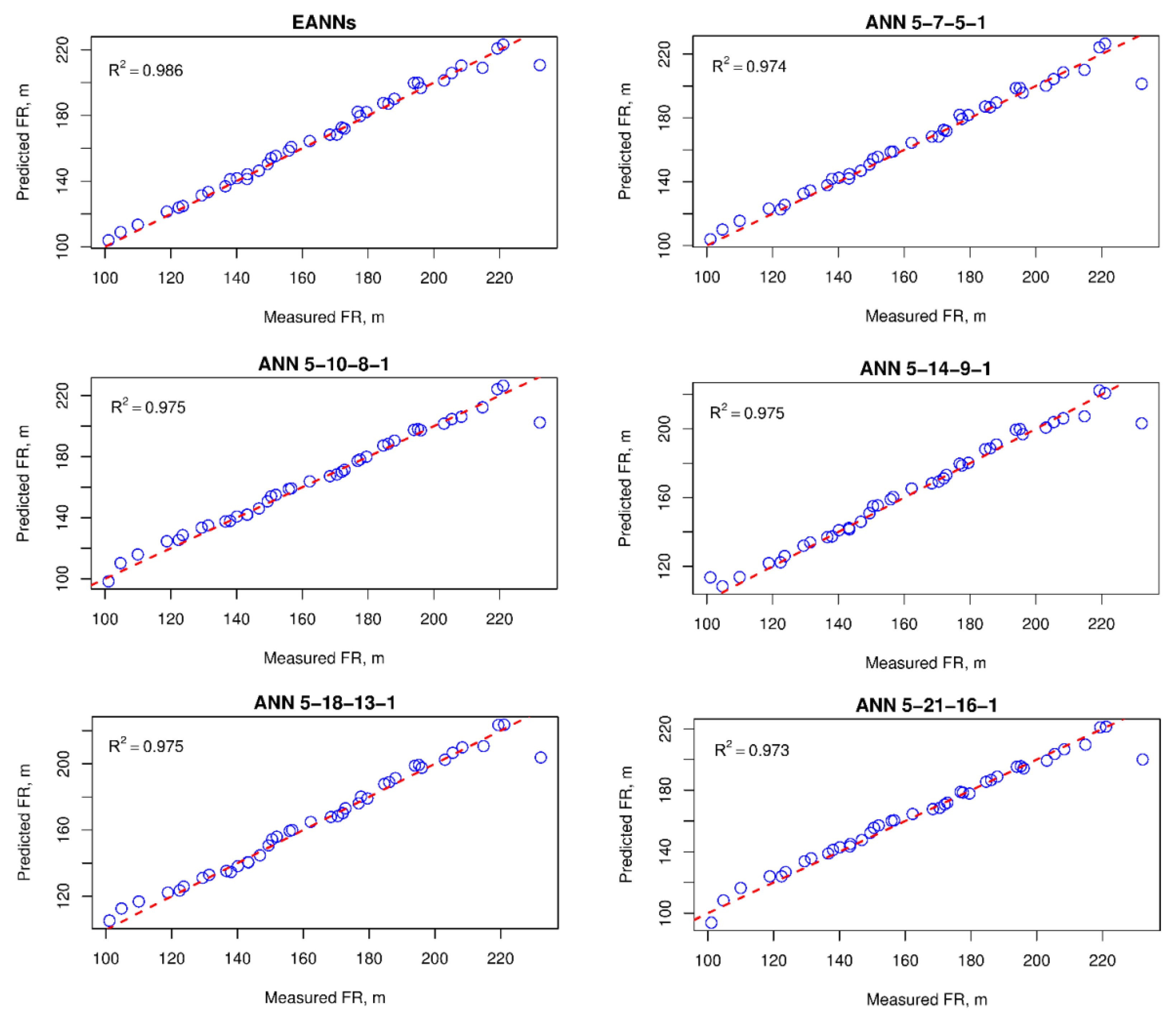
| EANNs | 2.908 | 0.019 | 4.954 | 98.464 | 0.985 | 7 | 7 | 7 | 7 | 7 |
| Model | MAE | MAPE | RMSE | VAF | R2 | Rank for MAE | Rank for MAPE | Rank for RMSE | Rank for VAF | Rank for R2 |
|---|---|---|---|---|---|---|---|---|---|---|
| ANN 5-7-5-1 | 3.227 | 0.019 | 5.71 | 97.242 | 0.974 | 4 | 5 | 2 | 3 | 2 |
| ANN 5-10-8-1 | 3.162 | 0.019 | 5.55 | 97.349 | 0.975 | 6 | 5 | 4 | 4 | 3 |
| ANN 5-14-9-1 | 3.202 | 0.02 | 5.684 | 97.225 | 0.975 | 5 | 4 | 3 | 2 | 3 |
| ANN 5-18-13-1 | 3.322 | 0.021 | 5.459 | 97.437 | 0.975 | 2 | 2 | 6 | 6 | 3 |
| ANN 5-21-16-1 | 3.300 | 0.021 | 5.945 | 96.919 | 0.973 | 3 | 2 | 1 | 1 | 1 |
| ANN 5-25-21-15-1 | 3.568 | 0.022 | 5.541 | 97.373 | 0.975 | 1 | 1 | 5 | 5 | 3 |
| EANNs | 2.777 | 0.017 | 4.346 | 98.446 | 0.986 | 7 | 7 | 7 | 7 | 7 |
© 2019 by the authors. Licensee MDPI, Basel, Switzerland. This article is an open access article distributed under the terms and conditions of the Creative Commons Attribution (CC BY) license (http://creativecommons.org/licenses/by/4.0/).
Share and Cite
Nguyen, H.; Bui, X.-N.; Nguyen-Thoi, T.; Ragam, P.; Moayedi, H. Toward a State-of-the-Art of Fly-Rock Prediction Technology in Open-Pit Mines Using EANNs Model. Appl. Sci. 2019, 9, 4554. https://doi.org/10.3390/app9214554
Nguyen H, Bui X-N, Nguyen-Thoi T, Ragam P, Moayedi H. Toward a State-of-the-Art of Fly-Rock Prediction Technology in Open-Pit Mines Using EANNs Model. Applied Sciences. 2019; 9(21):4554. https://doi.org/10.3390/app9214554
Chicago/Turabian StyleNguyen, Hoang, Xuan-Nam Bui, Trung Nguyen-Thoi, Prashanth Ragam, and Hossein Moayedi. 2019. "Toward a State-of-the-Art of Fly-Rock Prediction Technology in Open-Pit Mines Using EANNs Model" Applied Sciences 9, no. 21: 4554. https://doi.org/10.3390/app9214554
APA StyleNguyen, H., Bui, X.-N., Nguyen-Thoi, T., Ragam, P., & Moayedi, H. (2019). Toward a State-of-the-Art of Fly-Rock Prediction Technology in Open-Pit Mines Using EANNs Model. Applied Sciences, 9(21), 4554. https://doi.org/10.3390/app9214554