Numerical Simulation of the Percolation Threshold in Non-Overlapping Ellipsoid Composites: Toward Bottom-Up Approach for Carbon Based Electromagnetic Components Realization


 ,
, 

Abstract
1. Introduction
2. Modelling
2.1. Positioning the Ellipsoid in 3D Space
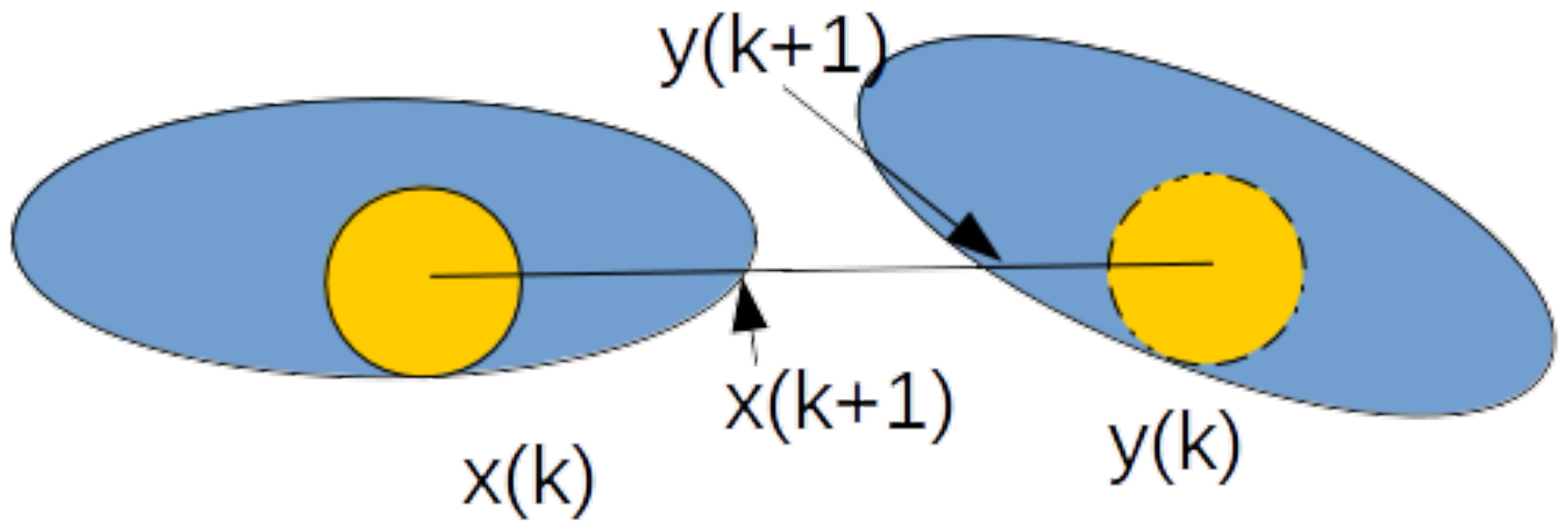
2.2. Distance between Ellipsoids
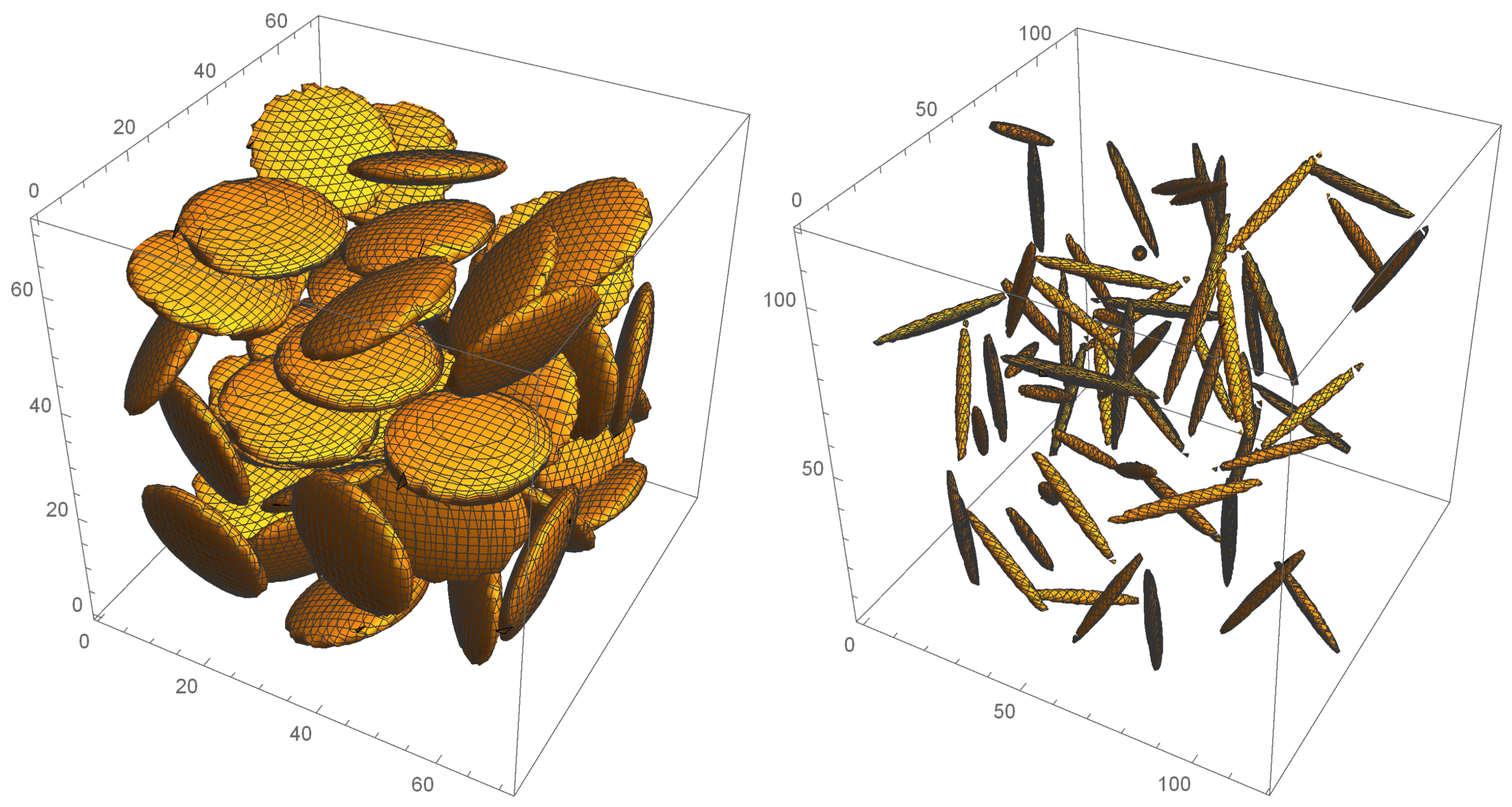
2.3. Composite Generation Procedure
- i
- i-th the ellipsoid should not intersect the walls of the unit cell.
- ii
- i-th ellipsoid should not penetrate into any ellipsoid of the already existing system of i−1.
2.4. Percolation Computation
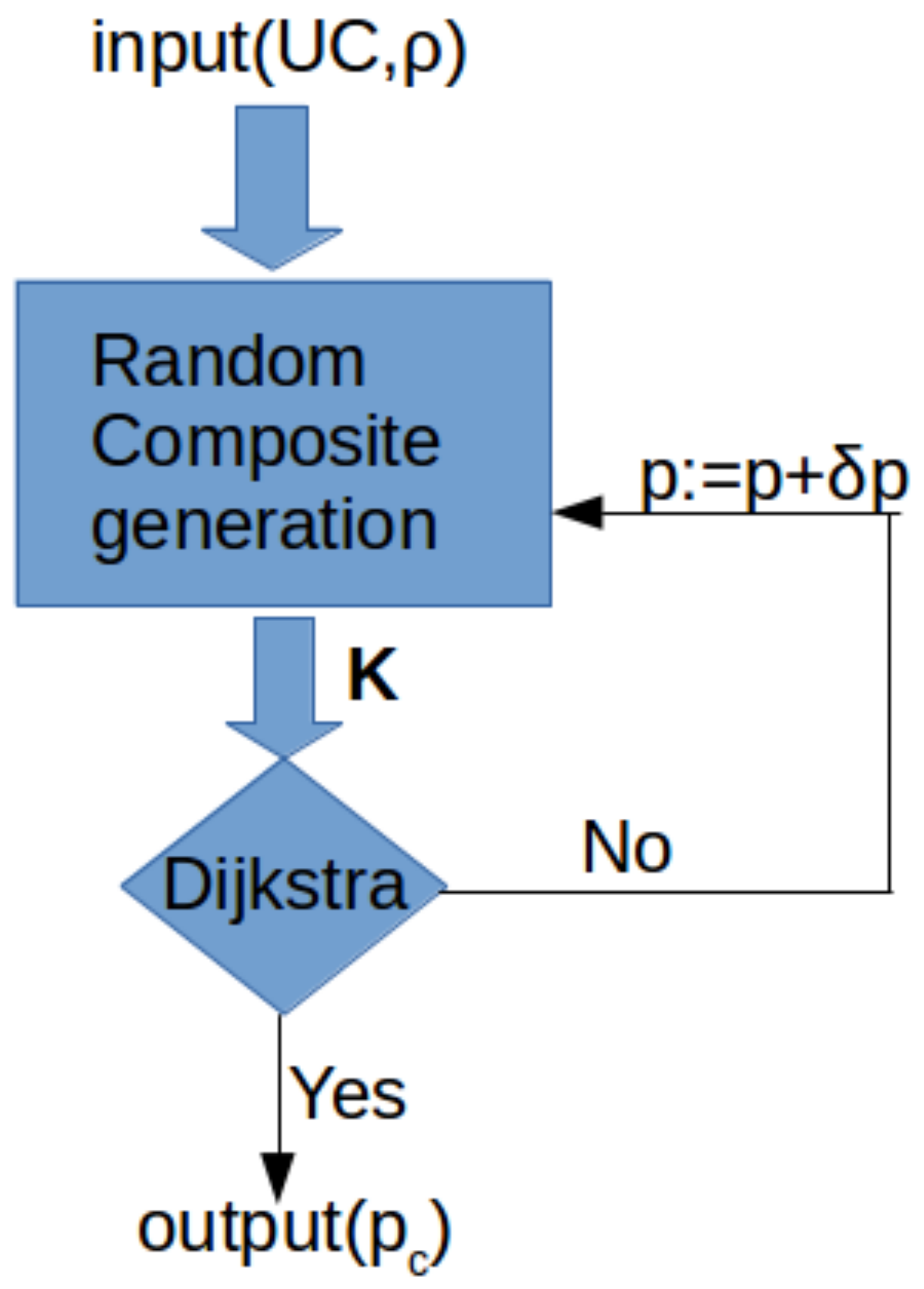
2.5. Total Algorithm
- Generation of the composite of ellipsoids, where p is the volume fraction. A result of this step is an array of ellipsoid coordinates . The number of strings is .
- Checking if the system is percolated.
3. Result and Discussion
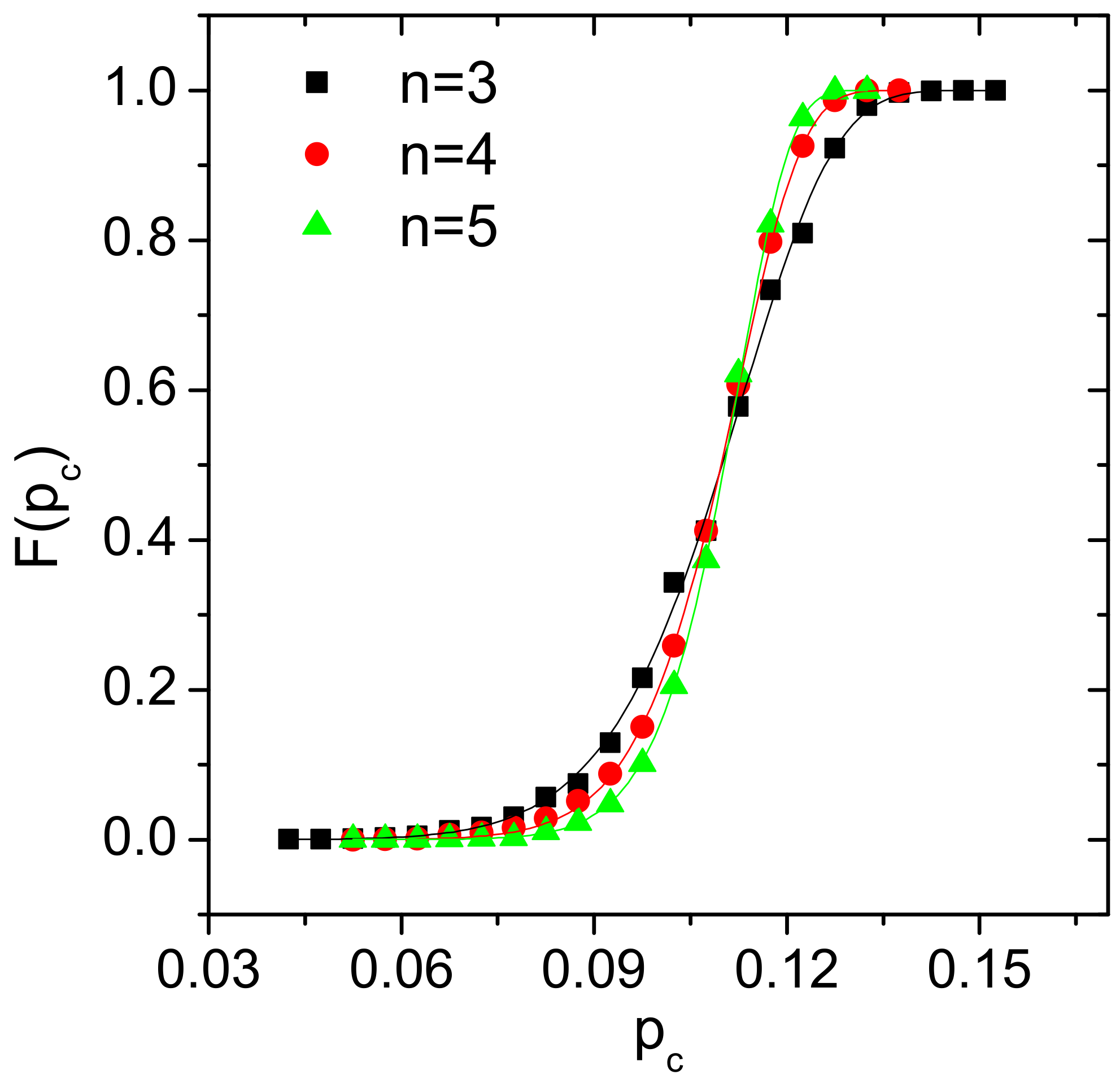
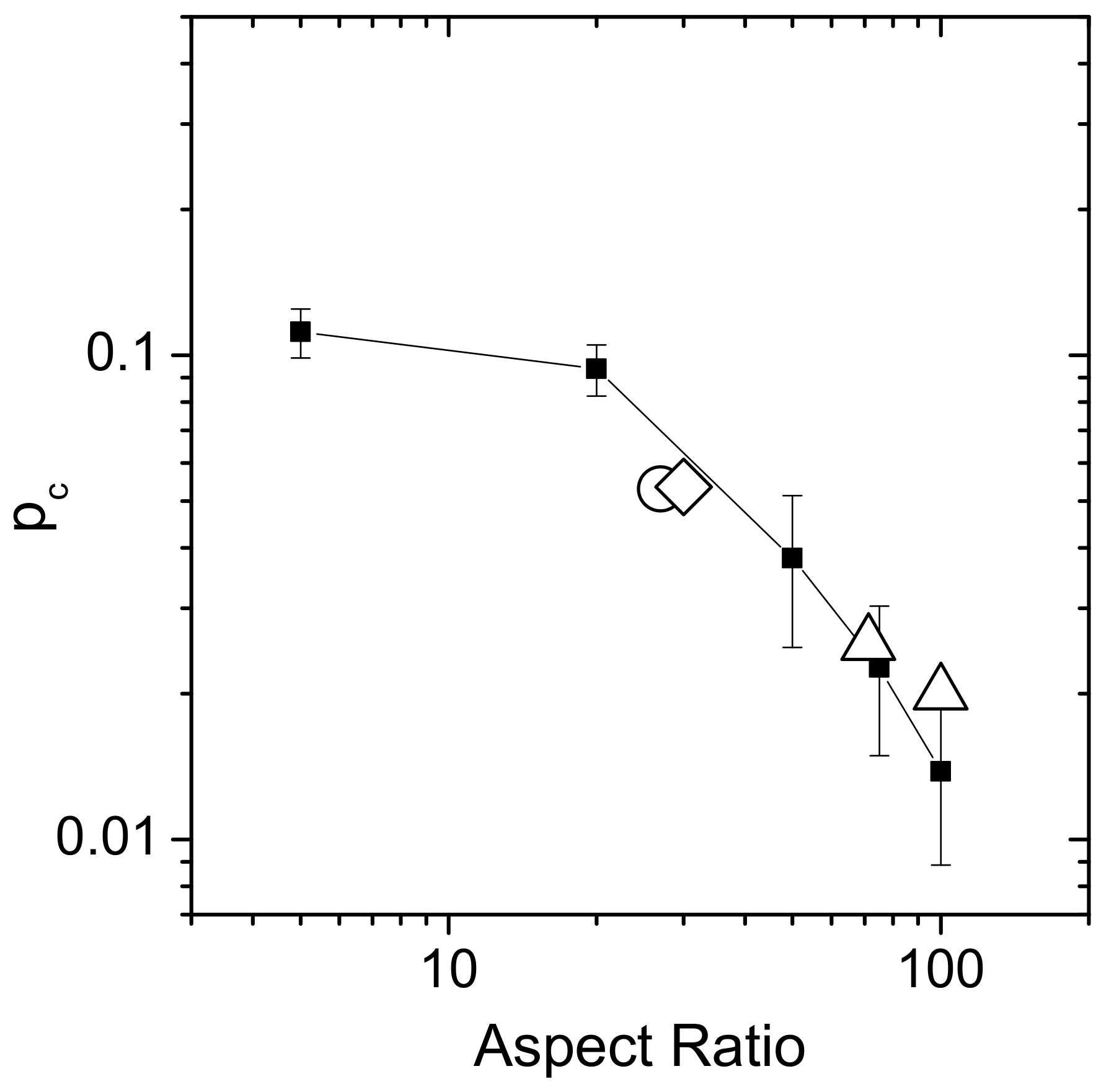
3.1. Two-Phase system
3.2. Three-phase system (Hybrids)
4. Conclusions
Author Contributions
Funding
Acknowledgments
Conflicts of Interest
References
- Shuba, M.; Paddubskaya, A.; Plyushch, A.; Kuzhir, P.; Slepyan, G.Y.; Maksimenko, S.; Ksenevich, V.; Buka, P.; Seliuta, D.; Kasalynas, I.; et al. Experimental evidence of localized plasmon resonance in composite materials containing single-wall carbon nanotubes. Phys. Rev. B 2012, 85, 165435. [Google Scholar] [CrossRef] [Scilit]
- Hanson, G.W. Fundamental transmitting properties of carbon nanotube antennas. IEEE Trans. Antennas Propag. 2005, 53, 3426–3435. [Google Scholar] [CrossRef] [Scilit]
- Burke, P.J.; Li, S.; Yu, Z. Quantitative theory of nanowire and nanotube antenna performance. IEEE Trans. Nanotechnol. 2006, 5, 314–334. [Google Scholar] [CrossRef] [Scilit]
- Spitalsky, Z.; Tasis, D.; Papagelis, K.; Galiotis, C. Carbon nanotube–polymer composites: Chemistry, processing, mechanical and electrical properties. Prog. Polym. Sci. 2010, 35, 357–401. [Google Scholar] [CrossRef] [Scilit]
- Kuzhir, P.; Paddubskaya, A.; Bychanok, D.; Nemilentsau, A.; Shuba, M.; Plusch, A.; Maksimenko, S.; Bellucci, S.; Coderoni, L.; Micciulla, F.; et al. Microwave probing of nanocarbon based epoxy resin composite films: Toward electromagnetic shielding. Thin Solid Films 2011, 519, 4114–4118. [Google Scholar] [CrossRef] [Scilit]
- Bauhofer, W.; Kovacs, J.Z. A review and analysis of electrical percolation in carbon nanotube polymer composites. Compos. Sci. Technol. 2009, 69, 1486–1498. [Google Scholar] [CrossRef] [Scilit]
- Qin, F.; Brosseau, C. A review and analysis of microwave absorption in polymer composites filled with carbonaceous particles. J. Appl. Phys. 2012, 111, 4. [Google Scholar] [CrossRef] [Scilit]
- Sandler, J.; Kirk, J.; Kinloch, I.; Shaffer, M.; Windle, A. Ultra-low electrical percolation threshold in carbon-nanotube-epoxy composites. Polymer 2003, 44, 5893–5899. [Google Scholar] [CrossRef] [Scilit]
- Slepyan, G.Y.; Shuba, M.; Maksimenko, S.; Lakhtakia, A. Theory of optical scattering by achiral carbon nanotubes and their potential as optical nanoantennas. Phys. Rev. B 2006, 73, 195416. [Google Scholar] [CrossRef] [Scilit]
- Grimmett, G. What is Percolation. In Percolation; Springer: Berlin, Germany, 1999; pp. 1–31. [Google Scholar]
- Stauffer, D.; Aharony, A. Introduction to Percolation Theory; CRC Press: Boca Raton, FL, USA, 1994. [Google Scholar]
- Celzard, A.; McRae, E.; Deleuze, C.; Dufort, M.; Furdin, G.; Marêché, J. Critical concentration in percolating systems containing a high-aspect-ratio filler. Phys. Rev. B 1996, 53, 6209. [Google Scholar] [CrossRef] [Scilit]
- Balberg, I.; Binenbaum, N.; Wagner, N. Percolation thresholds in the three-dimensional sticks system. Phys. Rev. Lett. 1984, 52, 1465. [Google Scholar] [CrossRef] [Scilit]
- Bug, A.; Safran, S.; Webman, I. Continuum percolation of rods. Phys. Rev. Lett. 1985, 54, 1412. [Google Scholar] [CrossRef] [Scilit] [PubMed]
- De Vivo, B.; Lamberti, P.; Spinelli, G.; Tucci, V. A morphological and structural approach to evaluate the electromagnetic performances of composites based on random networks of carbon nanotubes. J. Appl. Phys. 2014, 115, 154311. [Google Scholar] [CrossRef] [Scilit]
- De Vivo, B.; Lamberti, P.; Spinelli, G.; Tucci, V. Numerical investigation on the influence factors of the electrical properties of carbon nanotubes-filled composites. J. Appl. Phys. 2013, 113, 244301. [Google Scholar] [CrossRef] [Scilit]
- Garboczi, E.; Snyder, K.; Douglas, J.; Thorpe, M. Geometrical percolation threshold of overlapping ellipsoids. Phys. Rev. E 1995, 52, 819. [Google Scholar] [CrossRef] [Scilit]
- Yi, Y.B.; Sastry, A. Analytical approximation of the two-dimensional percolation threshold for fields of overlapping ellipses. Phys. Rev. E 2002, 66, 066130. [Google Scholar] [CrossRef] [Scilit] [PubMed]
- Yi, Y.B.; Wang, C.W.; Sastry, A. Two-dimensional vs. three-dimensional clustering and percolation in fields of overlapping ellipsoids. J. Electrochem. Soc. 2004, 151, A1292–A1300. [Google Scholar] [CrossRef] [Scilit]
- Feng, S.; Halperin, B.; Sen, P. Transport properties of continuum systems near the percolation threshold. Phys. Rev. B 1987, 35, 197. [Google Scholar] [CrossRef] [Scilit]
- Fujie, R.; Odagaki, T. Effects of superspreaders in spread of epidemic. Phys. A Stat. Mech. Appl. 2007, 374, 843–852. [Google Scholar] [CrossRef] [Scilit]
- Sagalianov, I.Y.; Lazarenko, O.A.; Vovchenko, L.L.; Matzui, L.Y. Monte-Carlo study of the percolation in a binary composites: Hardcore and softcore models comparison. In Proceedings of the 2017 IEEE 7th International Conference on Nanomaterials: Application & Properties (NAP), Odessa, Ukraine, 10–15 September 2017. [Google Scholar]
- Akagawa, S.; Odagaki, T. Geometrical percolation of hard-core ellipsoids of revolution in the continuum. Phys. Rev. E 2007, 76, 051402. [Google Scholar] [CrossRef] [Scilit] [PubMed]
- Kosolap, A. Quadratic Optimization Problems of Computer Geometry. Art. Int. 2009, 1, 70–75. [Google Scholar]
- Lin, A.; Han, S.P. On the distance between two ellipsoids. SIAM J. Optim. 2002, 13, 298–308. [Google Scholar] [CrossRef] [Scilit]
- Tamasyan, G.S.; Chumakov, A.A. Finding the distance between ellipsoids. J. Appl. Ind. Math. 2014, 8, 400–410. [Google Scholar] [CrossRef] [Scilit]
- Uteshev, A.Y.; Yashina, M. Computation of the distance from an ellipsoid to a linear surface and a quadric in Rn. In Doklady Mathematics; Springer: Berlin, Germany, 2008; Volume 77, pp. 269–272. [Google Scholar]
- Dijkstra, E.W. A note on two problems in connexion with graphs. Numer. Math. 1959, 1, 269–271. [Google Scholar] [CrossRef] [Scilit]
- Glover, F. Tabu search—Part I. ORSA J. Comput. 1989, 1, 190–206. [Google Scholar] [CrossRef] [Scilit]
- Glover, F. Tabu search—Part II. ORSA J. Comput. 1990, 2, 4–32. [Google Scholar] [CrossRef] [Scilit]
- Glover, F.; Laguna, M. Tabu Search. In Handbook of Combinatorial Optimization; Springer: Berlin, Germany, 2013; pp. 3261–3362. [Google Scholar]
- Weibull, W. A statistical distribution function of wide applicability. J. Appl. Mech. 1951, 18, 293–297. [Google Scholar]
- Stathis, J. Percolation models for gate oxide breakdown. J. Appl. Phys. 1999, 86, 5757–5766. [Google Scholar] [CrossRef] [Scilit]
- Kauerauf, T.; Degraeve, R.; Cartier, E.; Soens, C.; Groeseneken, G. Low Weibull slope of breakdown distributions in high-k layers. IEEE Electron Device Lett. 2002, 23, 215–217. [Google Scholar] [CrossRef] [Scilit]
- Long, S.; Lian, X.; Cagli, C.; Perniola, L.; Miranda, E.; Liu, M.; Suñé, J. A model for the set statistics of RRAM inspired in the percolation model of oxide breakdown. IEEE Electron Device Lett. 2013, 34, 999–1001. [Google Scholar] [CrossRef] [Scilit]
- Li, B.; Zhong, W.H. Review on polymer/graphite nanoplatelet nanocomposites. J. Mater. Sci. 2011, 46, 5595–5614. [Google Scholar] [CrossRef] [Scilit]
- Araby, S.; Meng, Q.; Zhang, L.; Kang, H.; Majewski, P.; Tang, Y.; Ma, J. Electrically and thermally conductive elastomer/graphene nanocomposites by solution mixing. Polymer 2014, 55, 201–210. [Google Scholar] [CrossRef] [Scilit]
- Shen, J.W.; Huang, W.Y.; Zuo, S.W.; Hou, J. Polyethylene/grafted polyethylene/graphite nanocomposites: Preparation, structure, and electrical properties. J. Appl. Polym. Sci. 2005, 97, 51–59. [Google Scholar] [CrossRef] [Scilit]
- Celzard, A.; Marêché, J.; Payot, F. Simple method for characterizing synthetic graphite powders. J. Phys. D Appl. Phys. 2000, 33, 1556. [Google Scholar] [CrossRef] [Scilit]
- Sun, Y.; Bao, H.D.; Guo, Z.X.; Yu, J. Modeling of the electrical percolation of mixed carbon fillers in polymer-based composites. Macromolecules 2008, 42, 459–463. [Google Scholar] [CrossRef] [Scilit]
- Kranauskaite, I.; Macutkevic, J.; Banys, J.; Talik, E.; Kuznetsov, V.; Nunn, N.; Shenderova, O. Synergy effects in the electrical conductivity behavior of onion-like carbon and multiwalled carbon nanotubes composites. Phys. Status Solidi B 2015, 252, 1799–1803. [Google Scholar] [CrossRef] [Scilit]
- Drubetski, M.; Siegmann, A.; Narkis, M. Electrical properties of hybrid carbon black/carbon fiber polypropylene composites. J. Mater. Sci. 2007, 42, 1–8. [Google Scholar] [CrossRef] [Scilit]
- Yue, L.; Pircheraghi, G.; Monemian, S.A.; Manas-Zloczower, I. Epoxy composites with carbon nanotubes and graphene nanoplatelets–Dispersion and synergy effects. Carbon 2014, 78, 268–278. [Google Scholar] [CrossRef] [Scilit]
- Bychanok, D.; Angelova, P.; Paddubskaya, A.; Meisak, D.; Shashkova, L.; Demidenko, M.; Plyushch, A.; Ivanov, E.; Krastev, R.; Kotsilkova, R.; et al. Terahertz absorption in graphite nanoplatelets/polylactic acid composites. J. Phys. D Appl. Phys. 2018, 51, 145307. [Google Scholar] [CrossRef] [Scilit]
- Shuba, M.; Yuko, D.; Kuzhir, P.; Maksimenko, S.; Kanygin, M.; Okotrub, A.; Tenne, R.; Lambin, P. How effectively do carbon nanotube inclusions contribute to the electromagnetic performance of a composite material? Estimation criteria from microwave and terahertz measurements. Carbon 2018, 129, 688–694. [Google Scholar] [CrossRef] [Scilit]
- Guadagno, L.; Naddeo, C.; Raimondo, M.; Barra, G.; Vertuccio, L.; Russo, S.; Lafdi, K.; Tucci, V.; Spinelli, G.; Lamberti, P. Influence of carbon nanoparticles/epoxy matrix interaction on mechanical, electrical and transport properties of structural advanced materials. Nanotechnology 2017, 28, 094001. [Google Scholar] [CrossRef] [Scilit] [PubMed]





© 2018 by the authors. Licensee MDPI, Basel, Switzerland. This article is an open access article distributed under the terms and conditions of the Creative Commons Attribution (CC BY) license (http://creativecommons.org/licenses/by/4.0/).
Share and Cite
Plyushch, A.; Lamberti, P.; Spinelli, G.; Macutkevič, J.; Kuzhir, P. Numerical Simulation of the Percolation Threshold in Non-Overlapping Ellipsoid Composites: Toward Bottom-Up Approach for Carbon Based Electromagnetic Components Realization. Appl. Sci. 2018, 8, 882. https://doi.org/10.3390/app8060882
Plyushch A, Lamberti P, Spinelli G, Macutkevič J, Kuzhir P. Numerical Simulation of the Percolation Threshold in Non-Overlapping Ellipsoid Composites: Toward Bottom-Up Approach for Carbon Based Electromagnetic Components Realization. Applied Sciences. 2018; 8(6):882. https://doi.org/10.3390/app8060882
Chicago/Turabian StylePlyushch, Artyom, Patrizia Lamberti, Giovanni Spinelli, Jan Macutkevič, and Polina Kuzhir. 2018. "Numerical Simulation of the Percolation Threshold in Non-Overlapping Ellipsoid Composites: Toward Bottom-Up Approach for Carbon Based Electromagnetic Components Realization" Applied Sciences 8, no. 6: 882. https://doi.org/10.3390/app8060882
APA StylePlyushch, A., Lamberti, P., Spinelli, G., Macutkevič, J., & Kuzhir, P. (2018). Numerical Simulation of the Percolation Threshold in Non-Overlapping Ellipsoid Composites: Toward Bottom-Up Approach for Carbon Based Electromagnetic Components Realization. Applied Sciences, 8(6), 882. https://doi.org/10.3390/app8060882