1. Introduction
Handball is a high-intensity sport in which the shoulder functions as the central link of the kinetic chain during throwing, blocking, and defensive contact actions. The epidemiology of shoulder injuries in this sport is particularly relevant; seasonal shoulder pain prevalence has been estimated to range between 20% and 41% among handball players [
1,
2]. Due to the mechanical demands of the game, largely based on repetitive overhead actions and high external loads, the shoulder represents one of the most frequently affected anatomical regions, with a high prevalence of pain and functional complaints among elite female players [
3]. Moreover, athletes with a history of prior shoulder injury demonstrate persistent vulnerability, often developing recurrent pain episodes that negatively impact sports performance and long-term musculoskeletal health [
4].
To ensure joint integrity and optimal performance in handball players, it is essential to monitor key clinical variables such as shoulder range of motion (ROM), rotator muscle strength, and scapular motor control. Scientific evidence highlights that scapular dyskinesis [
5], glenohumeral proprioceptive deficits [
6], and strength imbalances [
7] are critical markers of shoulder dysfunction. In overhead athletes, the balance between mobility and stability is inherently delicate; reductions in internal rotation, external rotation weakness, and altered neuromuscular control substantially increase the risk of structural pathology [
8,
9]. Objective assessment of these parameters therefore constitutes a cornerstone for injury prevention strategies, rehabilitation planning, and return-to-play (RTP) decision-making.
The clinical scenario becomes even more complex in athletes with a history of shoulder injury. Previous injury is widely recognized as the strongest predictor of recurrence and often leaves residual deficits such as altered scapular kinematics, impaired neuromuscular timing, and persistent load intolerance [
10,
11]. In handball, these mechanical alterations not only compromise throwing velocity and accuracy but may also perpetuate compensatory movement patterns that increase cumulative joint stress. The persistence of subclinical deficits after RTP clearance highlights the need for continuous monitoring beyond the acute rehabilitation phase, particularly in sports characterized by high weekly throwing volume and match congestion [
11].
Documented biomechanical and physiological differences between female and male athletes further justify a sex-specific approach. Variations in muscle activation patterns, hormonal influences on ligamentous laxity, and neuromuscular control strategies may influence shoulder stability and injury risk in women [
9]. Furthermore, much of the sports medicine literature has historically relied on male-dominant samples, frequently extrapolating screening and assessment protocols without accounting for sex-specific adaptations. In female handball players, distinct scapular kinematics and high rates of overuse-related shoulder complaints have been reported [
3,
7]. Consequently, population-specific validation of assessment strategies in female overhead athletes is warranted.
In parallel, the rapid digitalization of healthcare has profoundly transformed musculoskeletal clinical practice. Telemedicine and tele-rehabilitation platforms are increasingly integrated into sports medicine workflows, enabling remote evaluation, monitoring, and follow-up [
12,
13]. Systematic reviews have demonstrated that real-time telerehabilitation can achieve outcomes comparable to conventional face-to-face care in several musculoskeletal conditions [
14,
15]. In upper extremity contexts, telemedicine has shown feasibility in hand surgery and orthopedic shoulder examinations [
16,
17]. However, feasibility does not necessarily imply measurement equivalence.
From a methodological perspective, establishing agreement between assessment modalities requires specific statistical and reporting standards. Reliability and agreement are distinct constructs; high correlation alone does not guarantee interchangeability between methods. As emphasized by Bland and Altman [
18], agreement analysis must quantify whether two measurement approaches can be used interchangeably without clinically meaningful bias. The Guidelines for Reporting Reliability and Agreement Studies (GRRAS) further underscore the importance of transparent methodology, reproducibility, and standardized reporting in such investigations [
19].
In sports medicine, where small variations in ROM or strength may influence RTP decisions or load management strategies, demonstrating measurement agreement between remote and in-person evaluations is critical. Digital motion analysis tools, such as image-based photogrammetry, have shown valid and reliable angle measurements when compared with conventional instruments [
20,
21]. Nevertheless, remote assessment introduces potential sources of variability—including camera positioning, lighting conditions, internet stability, and two-dimensional image limitations—that may influence measurement precision [
22].
Within overhead sports, shoulder biomechanics involve complex three-dimensional interactions between glenohumeral rotation, scapulothoracic motion, and trunk contribution [
23]. Even subtle alterations in rotational ROM or scapular control may predispose athletes to overload syndromes and structural injury. Therefore, validating tele-assessment protocols in this population requires careful standardization of movement planes, testing positions, and visual calibration to ensure reproducibility.
Despite the growing implementation of telehealth, there remains insufficient scientific validation regarding the agreement of complex shoulder clinical tests performed via videoconferencing in athletes with previous injuries [
20]. Most existing studies have focused on general musculoskeletal populations rather than sport-specific cohorts [
14,
15], leaving a gap in the literature regarding high-demand female athletes. In particular, no previous studies have simultaneously addressed agreement in female overhead athletes with a history of shoulder injury, a subgroup characterized by high functional demands and elevated risk of recurrence. This combined focus on tele-assessment, sport specificity, and prior injury status represents a relevant gap in the current literature.
Therefore, the aim of this study was to evaluate the level of agreement between face-to-face and tele-assessment methods for measuring shoulder range of motion, dynamic stability, muscular endurance, and scapular dyskinesia in female handball players with a history of shoulder injury. We hypothesized that the outcomes obtained through the online system would not differ significantly from those obtained through traditional in-person assessment, thereby supporting tele-assessment as a reliable remote monitoring tool for this population.
2. Materials and Methods
2.1. Design
A cross-sectional agreement study was conducted to determine the level of agreement between face-to-face and tele-assessment methods for evaluating shoulder function and clinical impairment in female handball players with a previous shoulder injury. Each participant underwent two assessments (face-to-face and tele-assessment) within the same session, allowing comparison between methods under stable clinical conditions. The order of assessment was randomized using a computer-generated randomization sequence with block randomization (block size = 4) to minimize potential order effects and learning bias. Both assessments were completed on the same day and separated by a standardized 30 min washout interval to reduce fatigue while minimizing biological variability. During the washout period, participants remained seated and were instructed to avoid any upper limb exertion or stretching. The study was designed and reported according to the Guidelines for Reporting Reliability and Agreement Studies (GRRAS) [
19].
2.2. Participants
Female handball players with a documented history of shoulder injury within the previous 24 months were recruited from regional competitive clubs and a hospital-based sports rehabilitation service in Granada (Spain). Participants were eligible if they were female handball players competing at regional or national level, had experienced a previous unilateral shoulder injury (traumatic or overuse), were aged 18 years or older, had fully returned to sport participation at the time of assessment, and had basic digital literacy with access to a computer and stable internet connection. Participants were excluded if they presented current acute shoulder pain limiting active movement, had undergone shoulder surgery within the previous six months, or had any neurological, rheumatological, or systemic disorder affecting upper limb function.
All participants provided written informed consent prior to participation. The study protocol was approved by the Institutional Ethics Committee of the University of Granada, and all procedures were conducted in accordance with the Declaration of Helsinki.
2.3. Procedure
Anthropometric data including age, weight, height, and body mass index were collected. Clinical records were reviewed to document injury mechanism, time since injury, dominant arm, and previous medical conditions. Upper limb function and perceived disability were assessed using the Disabilities of the Arm, Shoulder, and Hand (DASH) questionnaire [
24].
All in-person assessments were conducted at the Faculty of Health Sciences, University of Granada. Testing was performed in a temperature-controlled laboratory (22–24 °C) under standardized lighting conditions to ensure visual consistency between assessments.
Each participant underwent two independent evaluations: one face-to-face assessment and one tele-assessment conducted via real-time videoconferencing. The order of assessment was randomized as described above. A 30 min washout interval separated both sessions.
Both assessments were conducted by physiotherapists with more than 10 years of experience in sports musculoskeletal rehabilitation. Each method was performed by a different examiner, and both examiners were blinded to the results obtained in the alternate assessment to reduce measurement bias. Prior to study initiation, the tele-assessment examiner completed a standardized calibration session including camera alignment training, anatomical landmark identification practice, and pilot testing on three volunteer subjects to ensure procedural consistency.
Tele-assessment was performed using Google Meet (Google LLC, Mountain View, CA, USA) via the University of Granada’s institutional Google Workspace for Education platform [
25]. The sessions were conducted on a computer equipped with an integrated high-definition camera and a stable broadband connection. Minimum technical requirements included 1080 p camera resolution and internet speed greater than 20 Mbps to minimize image distortion and latency. Camera positioning, participant distance, and room setup were standardized to replicate in-person visual angles. Participants received written instructions 48 h prior to testing regarding room setup, camera height (aligned with shoulder level), minimum distance of 1.5 m from the camera, neutral background, and adequate frontal lighting.
2.4. Outcome Measures
Active shoulder range of motion (ROM) in external rotation and internal rotation was assessed using digital photogrammetry. During the face-to-face evaluation, a camera was placed at a distance of 1.5 m from the participant and mounted on a tripod at shoulder height to ensure consistent sagittal and frontal plane visualization. Anatomical landmarks were identified and marked using adhesive skin markers to improve measurement accuracy. For the tele-assessment, screenshots were captured at peak movement, ensuring that body positioning replicated the in-person setup. Kinovea software (version 0.8.15) was used to calculate shoulder angles. Each movement was performed twice, and the mean value was used for statistical analysis. Previous studies have demonstrated acceptable reliability of digital photogrammetry for shoulder ROM assessment [
18,
20].
Scapular dyskinesia was evaluated bilaterally during active shoulder flexion and abduction while holding a one-kilogram dumbbell. The physiotherapist observed glenohumeral motion from a posterior view at a standardized distance of three meters, corresponding to the camera position used during tele-assessment. After two repetitions per shoulder, scapular dyskinesia was classified dichotomously as present or absent based on visible winging, asymmetry, or dysrhythmia [
26,
27].
Shoulder complex stability was assessed using the Y Balance Test—Upper Quarter (YBT-UQ). Participants performed three repetitions in the medial, superolateral, and inferolateral directions. The maximal reach distance in each direction was recorded and normalized to upper limb length. The composite score was calculated as the sum of the maximal normalized reach distances divided by three times the limb length, multiplied by 100 [
28,
29].
Shoulder complex muscular endurance was evaluated using a one-minute arm lift endurance performance test. Participants completed the maximal number of arm lifts in shoulder flexion and abduction using a load ranging from 2 to 4 lb depending on body weight. Two trials were performed for each movement, and repetitions were summed. A metronome set at 60 beats per minute was used to standardize movement tempo across participants and between assessment methods [
30].
2.5. Statistical Analysis
A sample size of 25 participants was estimated to be sufficient to detect an expected intraclass correlation coefficient (ICC) of at least 0.75 with 90% power and a 5% significance level, based on previous agreement studies in telerehabilitation. This approach is consistent with methodological recommendations for reliability and agreement analyses. This sample size was similar in previous studies that carried out an agreement analysis between face-to-face and telerehabilitation methods [
31,
32].
The agreement between face-to-face and tele-assessment was analyzed applying the two-way random-effects intraclass correlation coefficient with absolute agreement definition (ICC (2.1)) for the remainder of variables, and their confidence intervals were calculated for the interrater reliability trials. A value of ρ < 0.4 was considered poor reliability; 0.4 to 0.75, fair to good reliability; and ρ < 0.75, excellent reliability. SPSS version 20.0 (IBM Corporation, Armonk, NY, USA) was used for the statistical analyses. Agreement between face-to-face and tele-assessment methods was further evaluated using Bland–Altman analysis. Mean bias and 95% limits of agreement were calculated for each continuous variable to assess systematic differences and measurement dispersion between methods. For the categorical variable (scapular dyskinesia), clinical agreement between face-to-face and tele-assessment was evaluated using Cohen’s Kappa coefficient. The level of agreement was interpreted according to Landis and Koch criteria: <0.00 (poor), 0.00–0.20 (slight), 0.21–0.40 (fair), 0.41–0.60 (moderate), 0.61–0.80 (substantial), and 0.81–1.00 (almost perfect).
3. Results
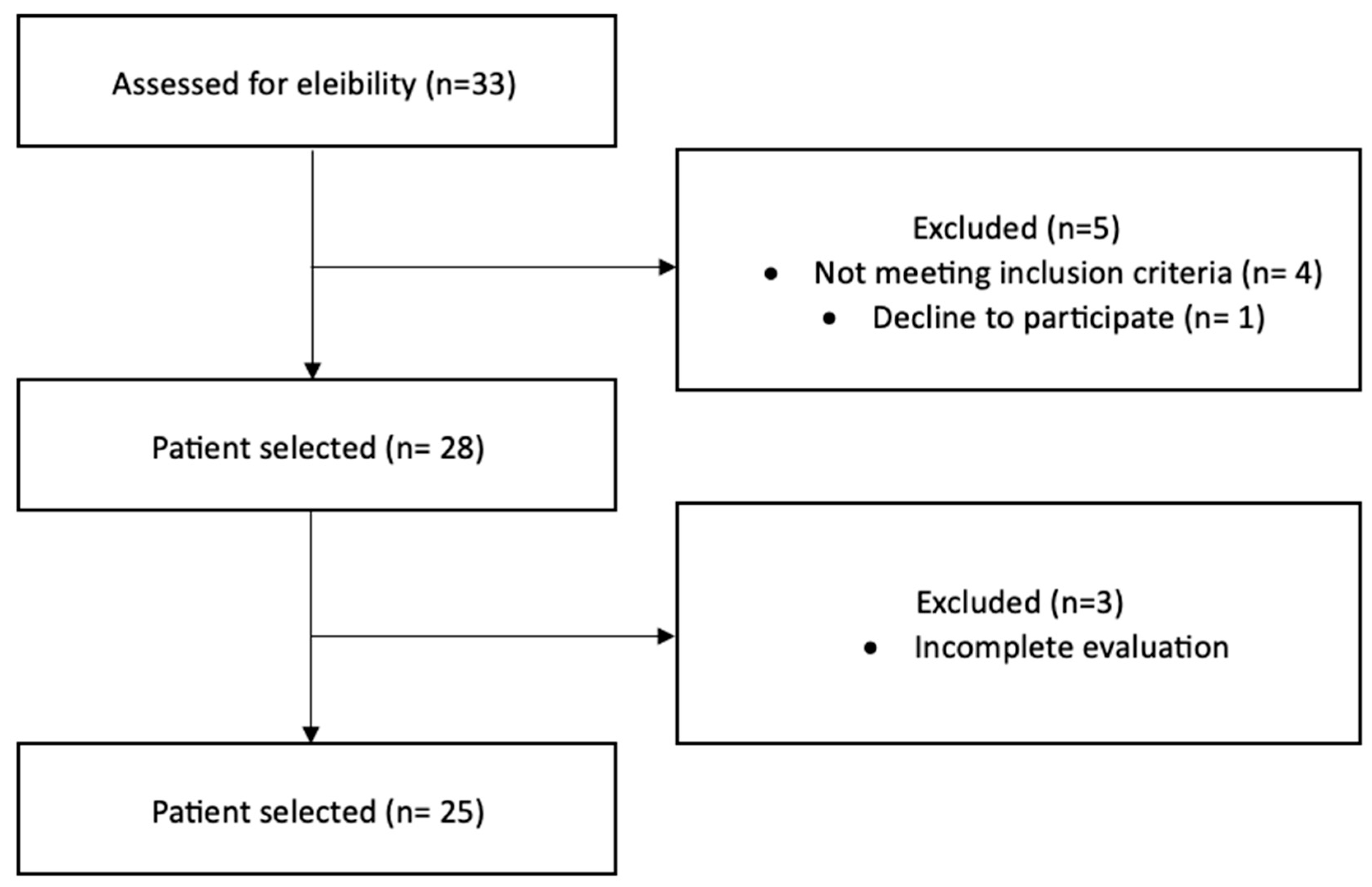
A total of 28 patients were initially selected for the study. Of these, 3 were excluded for being unable to complete the evaluations in full. Finally, 25 patients were evaluated and analyzed (
Figure 1). Participant characteristics are summarized in
Table 1 (mean age: 20.4 ± 1.9 years; Body Mass Index (BMI): 23.5 ± 2.1 kg/m
2; 91.3% right-hand dominant). Participant characteristics are summarized in
Table 1 (mean age: 20.4 ± 1.9 years; BMI: 23.5 ± 2.1 kg/m
2; 91.3% right-hand dominant). The mean DASH score for upper limb function was 7.0 ± 3.7, indicating low levels of self-reported disability and confirming that participants had effectively returned to sport participation at the time of testing.
Table 2 presents the descriptive data (mean ± SD) for both face-to-face and tele-assessment sessions across all clinical variables (Dyskinesia, Stability, Muscular endurance and ROM). Overall, the mean values obtained in tele-assessment were remarkably similar to those recorded during face-to-face evaluation across all continuous variables. The absolute mean differences between methods were minimal, ranging from 0.04° to 0.31° for ROM measures and from 0.10 cm to 0.16 cm for stability measures, indicating negligible systematic deviation between assessment modalities.
For muscular endurance outcomes, the absolute differences between methods ranged from 0.06 to 0.53 repetitions, representing less than 2% relative variation compared to face-to-face measurements.
The prevalence of scapular dyskinesia was 56.52% in the face-to-face assessment and 60.87% in the tele-assessment. This small discrepancy corresponded to the assessment with the worst agreement between the methods.
As shown in
Table 3, interrater reliability between the two assessment methods was excellent for almost all measures. ICC values ranged from 0.72 to 1.00, with narrow confidence intervals. Specifically, all measures for stability, muscular endurance, and ROM showed high reliability (ICC ≥ 0.96). Regarding scapular dyskinesia assessment, an absolute agreement of 80% (20 out of 25 matched observations) was found between the two methods.
For stability assessment, ICC values were 0.98 (95% CI: 0.96–0.99) for the dominant shoulder and 0.99 (95% CI: 0.98–0.99) for the non-dominant shoulder.
Muscular endurance measurements showed ICC values of 0.99 (95% CI: 0.99–0.99) for dominant shoulder flexion, 1.00 (95% CI: 0.99–0.99) for non-dominant shoulder flexion, 0.99 (95% CI: 0.99–1.00) for dominant shoulder abduction, and 1.00 (95% CI: 0.99–1.00) for non-dominant shoulder abduction.
Regarding range of motion, internal rotation demonstrated ICC values of 1.00 (95% CI: 0.99–1.00) for the dominant shoulder and 0.99 (95% CI: 0.99–0.99) for the non-dominant shoulder. External rotation showed ICC values of 0.99 (95% CI: 0.99–0.99) for the dominant shoulder and 0.99 (95% CI: 0.99–1.00) for the non-dominant shoulder.
The highest reliability levels were observed for internal rotation ROM (dominant) and abduction muscular endurance (non-dominant), both achieving an ICC of 1.00 (95% CI: 0.99–1.00).
The Cohen’s Kappa coefficient was 0.59 (p < 0.05), indicating a moderate level of agreement between face-to-face and tele-assessment for this clinical sign.
Bland–Altman analysis demonstrated minimal systematic bias between face-to-face and tele-assessment methods across all evaluated variables (
Supplementary Material). For range of motion (ROM), mean differences were extremely small, indicating high precision. In the dominant arm, mean differences were −0.04° for internal rotation and −0.30° for external rotation, with narrow limits of agreement (−0.76° to 0.68° and −2.47° to 1.86°, respectively). Similarly, the non-dominant arm showed a mean difference of −0.04° for internal rotation (limits of agreement −2.13° to 2.04°) and 0.04° for external rotation (limits of agreement −1.57° to 1.66°). For functional and performance-based measures, muscular endurance assessments demonstrated small systematic biases. Mean differences for shoulder flexion were 1.59 for the dominant side and −1.28 for the non-dominant side. For shoulder abduction, the mean differences were 2.10 (dominant) and −1.71 (non-dominant). Regarding upper extremity stability, the dominant arm showed a mean difference of 1.03 cm, with wider limits of agreement (−6.46 cm to 8.53 cm), indicating slightly greater variability compared to goniometric measures. The non-dominant arm demonstrated a similar pattern with a mean difference of −0.47 cm (limits of agreement −5.42 cm to 4.49 cm).
Overall, these findings indicate good to excellent agreement with minimal systematic error between the face-to-face and tele-assessment methods for all continuous variables, with range of motion displaying the highest level of absolute agreement.
4. Discussion
The aim of this study was to evaluate the level of agreement between face-to-face and tele-assessment methods for measuring shoulder range of motion, dynamic stability, muscular endurance, and scapular dyskinesia in female handball players with a history of shoulder injury. Our findings demonstrated excellent agreement for ROM, dynamic stability, and muscular endurance (ICC ≥ 0.96), and good agreement for scapular dyskinesia (ICC = 0.72). Mean differences between in-person and tele-assessment were minimal across all variables, indicating that videoconference-based evaluation provides clinically comparable results to traditional face-to-face assessment in this athletic population. Female handball players of this study presented low levels of self-reported disability (DASH score: 7.0 ± 3.7), indicating that they had successfully returned to sport participation. Therefore, these findings should be interpreted within the context of a high-functioning athletic population and may not be generalizable to individuals in the acute phase of injury, postoperative patients, or those with significant functional impairment. Also, the exceptionally high ICC values observed for ROM and stability (0.98–1.00) require careful interpretation. While they reflect the rigorous standardization of camera angles and the use of digital software, they may also be influenced by the relatively homogeneous functional status of the participants, all of whom had already returned to play. This could result in lower variability, potentially inflating correlation coefficients.
The inclusion of Bland–Altman analysis provides further insight into the agreement between methods. The minimal bias observed across all variables indicates the absence of systematic measurement error between face-to-face and tele-assessment. Additionally, the relatively narrow limits of agreement for range of motion and performance tests support the consistency of remote assessment. However, wider limits observed in functional measures such as the Y Balance Test suggest increased variability in more complex, multi-planar tasks, which may be influenced by environmental or visual factors inherent to tele-assessment.
These findings align with previous evidence supporting the validity and reliability of telehealth-based musculoskeletal assessment. Mani et al. [
15], in a systematic review, reported high reliability and validity for internet-based physiotherapy assessment across multiple joints, including the shoulder. Similarly, Suso-Martí et al. [
33] demonstrated substantial agreement between telehealth and in-person physiotherapy assessment in patients with musculoskeletal conditions. Specifically for shoulder ROM, Russell et al. [
34] found high correlation (r > 0.90) between remote and face-to-face goniometric measurements in individuals with shoulder disorders, supporting the robustness of remote angular measurement when standardized procedures are followed. The near-perfect ICC values observed in our study for internal and external rotation (0.99–1.00) are consistent with these prior findings and extend the evidence to a young, competitive overhead athletic population.
The use of digital photogrammetry with Kinovea software further strengthens the methodological rigor of our protocol. Damayanti et al. [
35] demonstrated that Kinovea provides valid and reliable joint angle measurements in sports settings, supporting its applicability for remote assessment environments. The standardized camera positioning implemented in our study likely contributed to the high agreement levels observed.
Dynamic shoulder stability assessed through the Upper Quarter Y Balance Test (YBT-UQ) also showed excellent agreement. Plisky et al. [
36] previously reported high interrater reliability (ICC = 0.80–0.99) for the YBT-UQ in active adults. Moreover, Teyhen et al. [
37] identified an association between lower YBT-UQ performance and increased upper extremity injury risk, highlighting its relevance in injury surveillance. Although telehealth-specific YBT-UQ studies are limited, our results suggest that standardized visual calibration preserves measurement accuracy in remote settings.
Muscular endurance assessment demonstrated ICC values between 0.99 and 1.00, indicating near-perfect agreement. Shoulder strength imbalance is a well-established risk factor in overhead athletes. Ellenbecker and Cools [
38] emphasized the importance of rotator cuff strength balance in injury prevention and rehabilitation. In handball players specifically, Clarsen et al. [
39] showed that shoulder problems are highly prevalent and associated with load and functional deficits during the competitive season. Therefore, reliable remote muscular endurance assessment may facilitate early detection of asymmetries and improve load management strategies. Similar telehealth findings were reported by Lade et al. [
40], who demonstrated substantial agreement between videoconference and face-to-face muscular endurance testing in musculoskeletal patients.
Scapular dyskinesia demonstrated lower, though still acceptable, agreement (ICC = 0.72). This result is consistent with the inherent variability of visual scapular assessment even under direct clinical conditions. However, it is true that the confidence interval associated with the concordance of scapular dyskinesia was relatively wide (95% CI: 0.33–0.88), indicating variability in the estimates and suggesting that caution should be exercised when interpreting this result. Paraskevopoulos et al. [
41] reported moderate interrater reliability (κ = 0.48–0.61) for scapular dyskinesis classification in overhead athletes. Uhl et al. [
27] also observed moderate reliability in clinical scapular observation. The reduced agreement likely reflects the three-dimensional complexity of scapular motion and limitations of two-dimensional video capture. Importantly, the reliability observed in our tele-assessment condition is comparable to that reported in face-to-face studies, suggesting that remote evaluation does not substantially compromise diagnostic consistency.
A central contribution of this study lies in its focus on female handball players. Shoulder injuries are highly prevalent in this sport, particularly due to repetitive overhead throwing and contact demands. Myklebust et al. [
3] reported a high prevalence of shoulder problems in elite female handball players, with many cases related to overuse mechanisms. Clarsen et al. [
39] further demonstrated that shoulder issues represent one of the most common overuse conditions in handball athletes.
Sex-specific biomechanical differences further justify analyzing female athletes separately. Escamilla and Andrews [
42] described differences in muscle activation and throwing mechanics in overhead sports, while Cools et al. [
43] emphasized the importance of scapular control and neuromuscular balance in overhead athletes, noting differences that may be influenced by sex-related factors such as ligamentous laxity. Historically, many shoulder evaluation protocols have been validated in predominantly male samples, particularly in baseball and other male-dominated overhead sports. Validating tele-assessment specifically in female handball players with prior injury addresses an important gap in sports medicine literature.
Finally, the growing implementation of telehealth in musculoskeletal care underscores the importance of sport-specific validation studies. Pastora-Bernal et al. [
44] highlighted the expanding role of telerehabilitation and emphasized the need for rigorous methodological validation. Given that previous shoulder injury is one of the strongest predictors of recurrence in overhead athletes [
39], continuous and reliable monitoring is essential. Tele-assessment may provide a practical and scalable solution for maintaining clinical oversight during training cycles, competition seasons, or geographical transitions between clubs.
However, this study presents several limitations that should be considered. First, although the sample size was adequately powered for agreement analysis, it was relatively small and limited to young competitive female handball players who had returned to sport and exhibited low disability levels. Therefore, the findings may not be generalizable to athletes in the acute phase of injury, postoperative populations, or individuals with higher levels of pain and functional impairment. Second, tele-assessment depends on technological factors such as video quality, internet stability, and environmental conditions. Despite standardized camera positioning, the two-dimensional nature of videoconferencing may limit depth perception, which could partially explain the lower agreement observed for scapular dyskinesia compared to ROM and muscular endurance measures. Third, intra-rater reliability was not assessed, and the 30 min washout period, while standardized, might not completely eliminate learning effects or minor fatigue, which should be addressed in future multi-day designs. Forth, although the level of agreement was high, these findings should be interpreted with caution, as the absence of clinically established thresholds such as minimal detectable change (MDC) or standard error of measurement (SEM) limits the ability to confirm full interchangeability between methods. Additionally, although minimum technical requirements were established, objective data regarding connection stability, latency, or image quality during assessments were not systematically recorded, which may affect reproducibility in real-world settings. Future longitudinal studies are warranted to evaluate the stability of remote measurements over time. Despite these limitations, the standardized methodology and sport-specific focus provide relevant evidence supporting the feasibility of tele-assessment for shoulder evaluation in female handball players with a history of injury.





 ,
,