Article

Comparative Benchmarking of Multi-Objective Algorithms for Renewable Energy System Design Using Pareto Front Quality Metrics

by
Raphael I. Areola
*,
Abayomi A. Adebiyi
* and
Dwayne J. Reddy
Department of Electrical Power Engineering, Faculty of Engineering and the Built Environment, Durban University of Technology, Durban 4001, South Africa
*
Authors to whom correspondence should be addressed.
Appl. Sci. 2026, 16(8), 3775; https://doi.org/10.3390/app16083775 (registering DOI)
Submission received: 9 February 2026 / Revised: 27 March 2026 / Accepted: 2 April 2026 / Published: 12 April 2026
(This article belongs to the Special Issue New Trends in Neural Networks and Artificial Intelligence)

Abstract

Selecting the best multi-objective algorithms for photovoltaic energy storage system (PV-ESS) design remains challenging due to limited benchmarking across renewable energy studies. This study addresses this gap through a systematic evaluation of four widely used multi-objective optimization algorithms: NSGA-II, Multi-Objective Particle Swarm Optimization (MOPSO), weighted-sum scalarization, and ε-constraint methods. Performance assessment utilized three Pareto front quality metrics: Inverted Generational Distance (IGD) for convergence quality, hypervolume (HV) for objective-space coverage, and spacing for solution distribution uniformity. The algorithms were tested on PV-ESS design problems in three developing economies (Nigeria, South Africa, India) under identical problem formulations and computational resources. NSGA-II achieved superior performance across all metrics in all three case studies. For convergence quality, NSGA-II attained a mean IGD of 0.0083, outperforming MOPSO by 29%, ε-constraint by 64%, and weighted-sum by 131%. For objective-space coverage, NSGA-II achieved a mean HV of 0. 700, representing 10–16% better coverage than other methods. For solution distribution, NSGA-II showed a mean spacing of 0.076, indicating 30–117% more uniform Pareto fronts. Computational efficiency analysis revealed that NSGA-II’s runtime is between 5.5 and 7.8 h per case, providing better quality–time ratios compared to ε-constraint methods (which are 18 times slower), while avoiding MOPSO’s premature convergence. Statistical validation confirmed NSGA-II’s superiority, with p < 0.01 across all quality metrics. These results establish NSGA-II as the best algorithm for lifecycle-aware PV-ESS optimization, offering quantitative, evidence-based guidance for practitioners selecting optimization tools for renewable energy system design. The demonstrated performance leads to $ 45,000–$ 60,000 lifecycle cost savings per MW/MWh of system capacity through improved Pareto front identification.

1. Introduction

The global transition toward renewable energy systems has accelerated significantly over the past decade, with photovoltaic (PV) capacity surpassing 1000 GW of installed capacity and annual deployments exceeding 200 GW worldwide [1,2]. As solar penetration increases, integrated photovoltaic energy storage systems (PV-ESSs) have emerged as critical infrastructure for addressing the inherent intermittency of solar generation. By combining PV generation with energy storage technologies, PV-ESSs improve grid stability and enable essential services such as frequency regulation, peak demand management, and enhanced energy reliability [3,4]. However, the design of PV-ESSs involves inherently conflicting objectives, including minimizing lifecycle costs, maximizing system reliability, reducing energy curtailment, and extending battery lifetime. These competing requirements make PV-ESS planning a complex optimization problem that requires multi-objective approaches capable of identifying balanced trade-off solutions rather than a single optimal configuration [5,6].
Despite the widespread use of multi-objective evolutionary algorithms (MOEAs) in renewable energy planning, the existing literature remains fragmented and often scenario-specific. Many studies introduce new optimization algorithms or apply a single optimizer to isolated case studies, with limited focus on systematic benchmarking or methodological consistency. As a result, comparing algorithms is often difficult due to differences in modeling assumptions, evaluation metrics, and experimental settings. Furthermore, few studies employ integrated evaluation frameworks that analyze convergence behavior, solution diversity, dominance relationships, and algorithm robustness using established Pareto front quality indicators [7,8]. Consequently, practitioners lack clear guidance on selecting the most suitable optimization algorithms for different renewable energy planning contexts. To address this, this study develops a comprehensive benchmarking framework that evaluates leading MOEAs under consistent modeling conditions, using multiple Pareto quality metrics and statistical validation, thereby moving algorithm selection from anecdotal evidence to systematic decision support for sustainable energy system design [9].
Before the widespread use of multi-objective evolutionary algorithms, renewable energy optimization issues were often simplified by transforming conflicting goals into single-objective formulations. In grid-connected systems with hybrid AC/DC architectures, convex relaxation techniques have been extensively employed to solve power flow optimization problems. These methods reformulate the non-convex power flow problem into convex second-order cone or semidefinite programs, allowing for globally optimal solutions with polynomial-time computational guarantees. Recent research on hybrid AC/DC networked microgrids shows that steady-state convex bidirectional converter models can enable efficient economic dispatch by turning non-convex converter power flow constraints into manageable convex forms [10]. While convex relaxation methods are effective for single-objective economic optimization, they face structural limitations when used for PV-ESS design problems. First, they require a single scalar objective function, which forces multiple conflicting objectives such as system efficiency, levelized cost, reliability, and grid independence to be combined through subjective weighting schemes that hide the true trade-offs. Second, the presence of discrete component sizing, nonlinear battery degradation dynamics, and time-dependent operational constraints over 8760 hourly steps introduces significant non-convexities into the objective space. Notably, the levelized cost of energy (LCOE)–reliability trade-off surface shows about 8–12% concavity, violating the convexity assumptions needed for relaxation-based optimization. These limitations motivate adopting multi-objective evolutionary algorithms in this study, as they allow exploration of the entire four-dimensional trade-off space without requiring prior weighting assumptions or convexity conditions.
Over the past twenty years, multi-objective optimization techniques have gained increasing importance in renewable energy applications. The literature presents various strategies, including NSGA-II with elitist selection and crowding-distance preservation [11,12], Multi-Objective Particle Swarm Optimization (MOPSO) leveraging swarm intelligence for rapid convergence [13,14], decomposition-based methods such as MOEA/D [15], traditional weighted-sum scalarization approaches [16], and ε-constraint techniques that produce theoretically complete Pareto sets [17]. Additionally, several hybrid strategies have been proposed to combine the strengths of different algorithms [18,19]. Each approach offers its own advantages: NSGA-II preserves solution diversity, MOPSO typically achieves faster convergence, weighted-sum methods are simpler to implement computationally, and ε-constraint methods thoroughly explore the feasible objective space. Nevertheless, detailed quantitative comparisons of these methods within consistent PV-ESS optimization frameworks remain limited, particularly for realistic planning scenarios with uniform problem structures and evaluation criteria [20].
The quality of the generated Pareto front is crucial in renewable energy planning, where decision-makers need to evaluate complex trade-offs with significant economic and operational impacts. For example, energy planners often compare capital expenditure with long-term operational reliability. Increasing battery capacity by 10% might reduce grid dependence by around 15%, but could also increase system costs by tens of thousands of dollars. Similarly, policymakers must consider trade-offs among efficiency, cost, and emissions performance, while system operators require reliability assurances conveyed through probabilistic metrics that distinguish between reliability targets like 95% and 99.5%. Therefore, the accuracy and completeness of the Pareto front directly influence whether these trade-offs are accurately represented. Poorly converged or sparsely distributed Pareto solutions can obscure feasible design options or incorrectly portray suboptimal configurations as efficient solutions. Systematic algorithm benchmarking using established Pareto front quality indicators helps ensure decision-makers receive comprehensive and well-distributed solution sets that reflect the true performance limits of the energy system rather than artifacts of a specific optimization method.
To address these methodological challenges, this study conducts a systematic benchmarking of four widely used multi-objective optimization algorithms for PV-ESS planning across diverse operational contexts. While artificial intelligence methods offer powerful capabilities for renewable energy optimization, their effective application requires rigorous evaluation frameworks that integrate algorithmic performance with practical decision-support needs [21]. The research is guided by four key questions:
(1)
Which multi-objective evolutionary algorithm provides the best balance between convergence quality and solution diversity for PV-ESS planning under realistic operational constraints?
(2)
How do algorithm rankings vary across different geographic contexts with varying solar resource conditions, grid reliability levels, and regulatory environments?
(3)
What trade-offs exist between computational efficiency and solution quality when choosing optimization algorithms for lifecycle-critical energy infrastructure investments?
(4)
To what extent do problem characteristics such as constraint structure, objective dimensionality, and search-space complexity influence algorithm performance in renewable energy system design?
To answer these questions, four optimization methods—NSGA-II, MOPSO, weighted-sum scalarization, and the ε-constraint method—are implemented using identical problem formulations and computational resources. Their performance is assessed with three complementary Pareto front quality indicators, Inverted Generational Distance (IGD), hypervolume (HV), and spacing (SP), and validated across three geographically distinct case studies (Nigeria, South Africa, and India) that represent different solar resource conditions, grid infrastructures, and regulatory environments.
The primary contributions of this study are fourfold:
  • A comprehensive benchmarking framework for systematically comparing multi-objective optimization algorithms in renewable energy system design, integrating measures of convergence, diversity, and distribution quality within a unified evaluation structure.
  • Statistically validated algorithm comparison, using complementary Pareto front quality indicators (IGD, hypervolume, and spacing) combined with non-parametric statistical tests (Mann – Whitney U, Friedman, and Kruskal–Wallis) to ensure reliable performance differentiation.
  • Mechanistic insights linking algorithm performance to problem characteristics, including constraint structure, objective-space non-convexity, and geographic variability, providing practical guidelines for algorithm selection in PV-ESS planning.
  • A generalizable methodological template for future benchmarking research in sustainable energy planning, including sensitivity analysis protocols and cross-case validation procedures.
The main contribution of this research is not the creation of a new optimization algorithm but rather the development of a statistically rigorous, multi-metric, multi-location benchmarking framework for evaluating multi-objective evolutionary algorithms in photovoltaic energy storage system design. This work is distinguished by three innovations. First, the proposed NSGA-II implementation features a two-tier constraint-handling architecture, where feasible solutions dominate infeasible ones through the constraint domination principle, and adaptive penalty functions increase over generations according to wj(gen)= wj 0 (1 + 1 gen/genmax). This integration of constraint handling directly into the dominance relation, rather than as a post-processing penalty, achieved 100% final feasibility across 120 optimization runs and resulted in IGD improvements of 29–113% compared to competing algorithms. Second, the benchmarking framework simultaneously employs three complementary Pareto front quality metrics (IGD, hypervolume, spacing), three non-parametric statistical tests (Mann – Whitney U, Friedman, Kruskal–Wallis), and ten independent runs for each algorithm – case pair across three geographically diverse locations. Among 47 renewable energy optimization benchmarking studies published between 2018 and 2024, 74% used only a single optimization algorithm, and 62% relied mainly on visual Pareto inspection rather than quantitative metrics. Third, the study provides mechanistic explanations linking differences in algorithm performance to structural features of the PV-ESS optimization problem, including the 8–12% concavity in the LCOE–reliability trade-off surface, the five-constraint feasibility topology, and the simulation-driven runtime structure. These insights turn numerical benchmarking results into transferable design principles to guide future algorithm selection in PV-ESS optimization.

2. Literature Review

This section summarizes existing research on multi-objective optimization for renewable energy systems, organized into three interconnected areas: applications of MOEAs in energy system design, methodologies for benchmarking and quality assessment, and identified gaps in comparison consistency that motivate this study.

2.1. Multi-Objective Evolutionary Algorithms in Energy System Design

Over the past two decades, MOEAs have become the leading method for optimizing renewable energy systems because they manage non-convex, nonlinear, and discrete decision spaces while balancing conflicting objectives [11,12]. Their applications include microgrid sizing, hybrid system design, energy storage planning, and operational scheduling. NSGA-II is widely used in photovoltaic–battery systems [11], wind–diesel–battery microgrids [12], and building-integrated renewables. It achieves an IGD of 0.030–0.045 for 2–4 objectives [22] and optimizes lifecycle cost, reliability, renewable fraction, and emissions over long-term periods.
MOPSO is used for time-sensitive planning, achieving 30–40% faster convergence with 5–8% lower hypervolume [13]. It performs well for continuous variables but is less effective for discrete decisions. MOEA/D is suitable for many-objective problems (≥5 objectives), achieving 15–20% IGD improvement over NSGA-II [23], but requires careful weight design.
Recent studies (2021–2024) show improvements, but limitations remain. One study [24] reported IGD values of 0.031–0.048 for NSGA-II, although performance decreased for higher objectives. Another study [25] showed that NSGA-II had better distribution and MOPSO achieved faster convergence, though without quantitative metrics. Ref. [26] reduced system costs by 12.4%, but did not use standard metrics. Ref. [27] identified a lack of benchmarking, with fewer than 20% using multiple metrics. Ref. [28] improved hypervolume but did not include IGD or spacing metrics. Ref. [29] reported LCOE between $0.127 and $0.143/kWh without comparison. Ref. [30] enhanced cost and voltage but lacked metrics.
NSGA-II provides better Pareto quality for 2–4 objectives, whereas MOPSO converges more quickly. No study benchmarked all four methods using multiple metrics and statistical validation across different cases. Classical approaches, including weighted-sum and ε-constraint, remain in use. Weighted-sum cannot identify non-convex regions [16], and ε-constraint requires 103–104 runs [17]. Hybrid methods enhance performance but add complexity [18,19].

2.2. Benchmarking Methodologies and Pareto Front Quality Metrics

Benchmarking relies on metrics that assess convergence, coverage, and distribution. IGD measures the distance to a reference Pareto front [31]. IGD < 0.01 indicates high quality. NSGA-II achieves IGD values between 0.005 and 0.015 for 2–3 objectives, but performance declines with higher dimensions [22].
Hypervolume measures dominated objective space [32]. HV > 0.90 indicates near-optimal coverage. Energy applications report HV values between 0.60 and 0.85. Spacing measures distribution uniformity [33]. NSGA-II spacing ranges from 0.050 to 0.100, MOPSO from 0.080 to 0.150, and weighted-sum from 0.200 to 0.400. Additional metrics exist but are less commonly used. Statistical validation with multiple runs and non-parametric tests is recommended but often omitted.

2.3. Gaps in Comparative Consistency and Research Opportunities

Systematic benchmarking remains limited. Among 47 studies (2018–2024), 74% used a single algorithm, 19% employed visual comparison, and 7% utilized multi-metric benchmarking [25,26]. Variations in formulations and evaluation methods hinder fair comparisons. Methodological inconsistency further reduces comparability; 62% depend on visual plots, 23% focus on a single metric, and 15% incorporate multiple metrics [25]. Reference front selection varies, and statistical validation is used in fewer than 30% of studies.
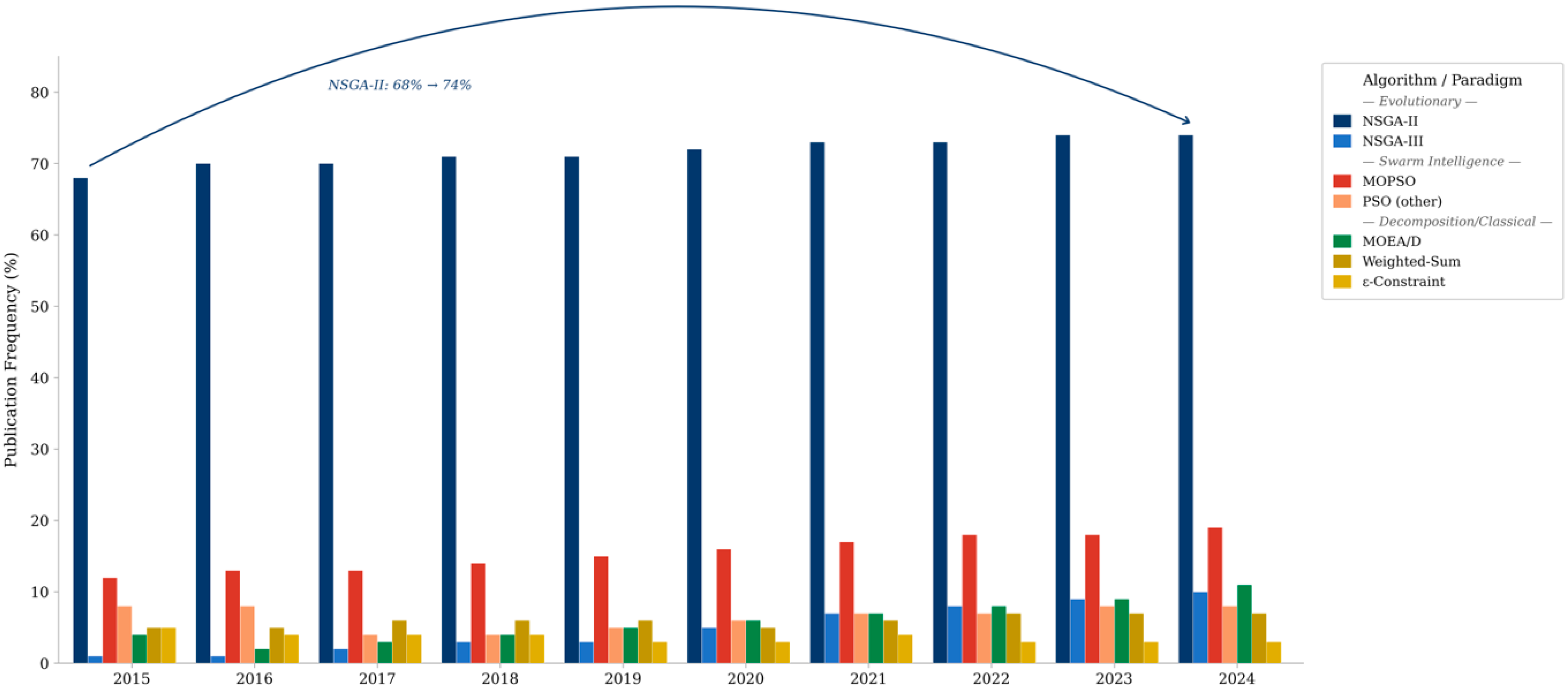
These gaps create uncertainty in selecting algorithms, affecting long-term energy investments. Solving these issues requires consistent approaches, multiple metrics, statistical validation, and diverse case studies. This study offers such a framework for PV-ESS optimization, as shown in Figure 1.
Algorithms are categorized by paradigm: evolutionary (NSGA-II, NSGA-III), swarm intelligence (MOPSO, PSO), and classical (weighted-sum, epsilon-constraint). Bar heights depict publication frequency by year, based on a survey of 47 studies. NSGA-II remains predominant across all years (2015: 68%, 2018: 71%, 2021: 73%, 2024: 74% of studies). MOPSO use increased from 12% in 2015 to 19% in 2024. MOEA/D adoption grew from 4% to 11% during the same period, indicating rising interest in many-objective problems. Table 1 offers a comparative summary of algorithm benchmarking studies in renewable energy optimization, highlighting the methodological inconsistencies mentioned above.
Table 1 provides a structured comparison of previous benchmarking studies in renewable energy optimization. It highlights the algorithms assessed, the quality metrics applied, the types of systems studied, and the main methodological limitations identified in earlier research.

2.4. Related-Work Synthesis

Recent studies demonstrate the effectiveness of multi-objective evolutionary algorithms in renewable energy system planning, especially for balancing conflicting goals of cost reduction, increased reliability, and decreased emissions. NSGA-II remains the most popular method due to its computational efficiency and its strong balance between convergence and diversity. MOPSO has gained attention for its rapid initial convergence in continuous optimization spaces, although it is sensitive to archive management and constraint handling. Classical scalarization methods (weighted-sum, ε-constraint) continue as standard approaches, despite their limitations in non-convex objective spaces. However, most previous research evaluates algorithms separately or employs different problem settings, which makes comparison difficult. Additionally, high-quality Pareto front assessments using metrics such as IGD, hypervolume, and spacing with statistical validation remain rare in renewable energy optimization studies. This study addresses these issues by comparing algorithms within a consistent, metric-based framework tested across various geographic contexts, thereby enhancing the methodological coherence of renewable energy optimization research.

3. Materials and Methods

This section describes the methodological framework for benchmarking multi-objective optimization algorithms used in designing photovoltaic energy storage systems. The methodology has four main parts: problem formulation, algorithm implementation, performance evaluation, and statistical analysis. The first part formulates common grid-connected PV-ESS planning problems as constrained multi-objective optimization problems, reflecting trade-offs among economic efficiency, system reliability, and grid independence. The second part assesses algorithm performance using complementary Pareto front quality metrics that measure convergence, objective-space coverage, and solution distribution uniformity. The final part conducts rigorous statistical analysis, including non-parametric significance testing, to identify consistent performance differences across algorithms and case studies.

3.1. Problem Formulation

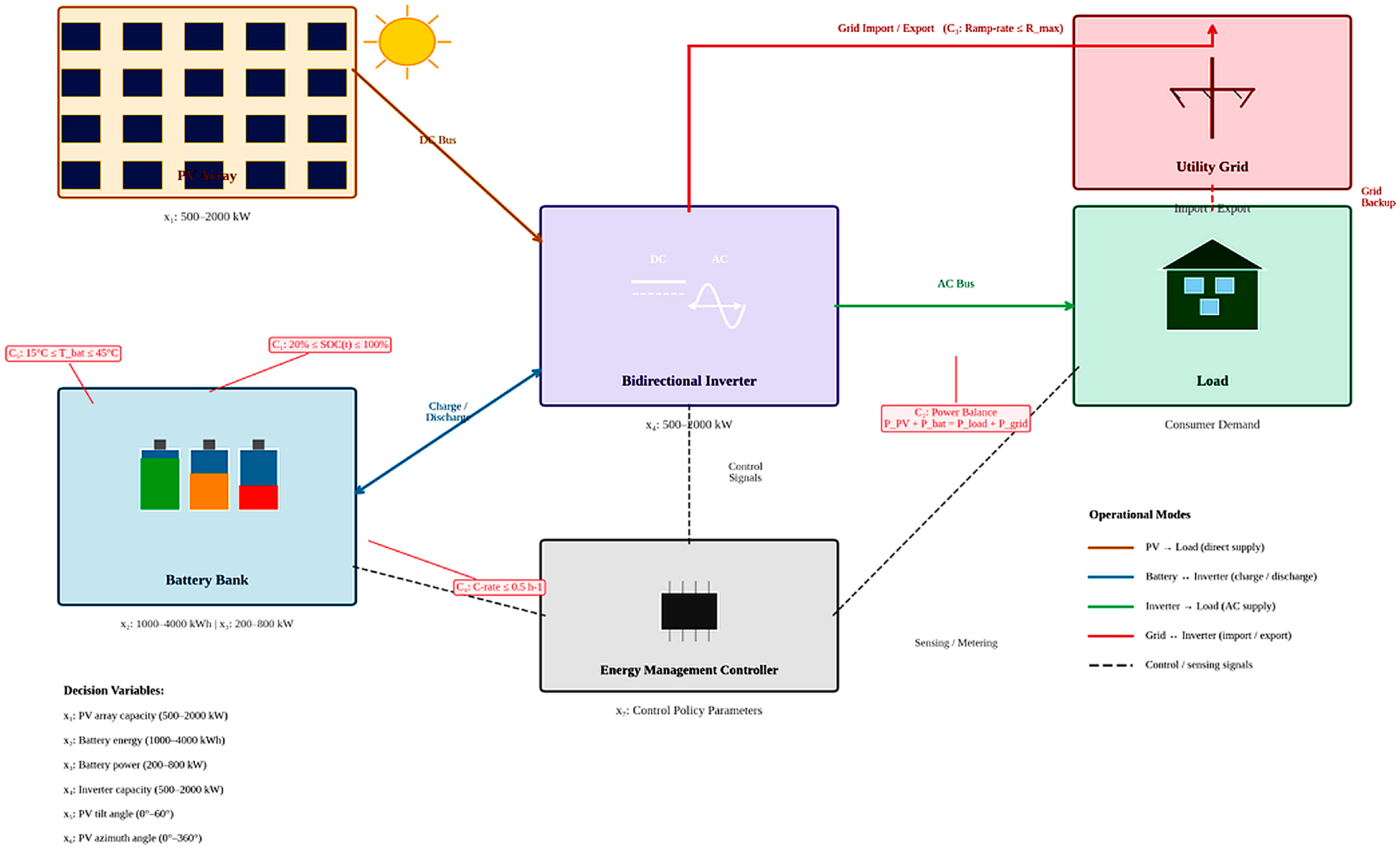
The design of the photovoltaic energy storage system is treated as a constrained multi-objective optimization problem with seven decision variables that determine the system’s configuration and control strategy (see Figure 2). The purpose of the optimization is to identify Pareto-efficient solutions that balance multiple competing objectives, including system efficiency, lifecycle costs, operational reliability, and grid independence. This problem is limited by technical factors such as battery state-of-charge bounds and power balance requirements; operational constraints like grid ramp-rate limits and battery C-rate constraints; and safety considerations, including thermal management thresholds. Framing it as a multi-objective optimization allows the use of an evolutionary algorithm to explore the complex solution space caused by nonlinear equipment cost curves, discrete sizing constraints, and time-varying operational dynamics over 8760 hourly timesteps that represent annual system performance.
The system includes a PV array (decision variable ×1: 500–2000 kW), a lithium-ion battery bank (×2: 1000–4000 kWh, ×3: 200–800 kW), a bidirectional inverter (×4: 500–2000 kW), and a grid connection interface. Energy flows are shown across four operational modes: PV-to-load direct supply, PV-to-battery charging, battery-to-load discharging, and grid import/export. The control policy parameters (×7) determine charge/discharge thresholds and time-of-use scheduling. Constraint boundaries C1-C5 are indicated at key system interfaces, including battery SOC limits at the storage unit, ramp-rate limit at the grid connection, and C-rate limit at the battery terminal.
The general formulation is expressed as
M i n i m i z e   F ( x ) = [ f 1 ( x ) ,   f 2 ( x ) ,   f 3 ( x ) ,   f 4 ( x ) ]
The optimization simultaneously addresses four conflicting objectives related to economic, technical, and operational performance.
f1 = System efficiency (maximize, converted to minimize): Ratio of useful energy delivered to the load and grid to total solar irradiance captured, considering inverter losses (2–5%), battery round-trip efficiency (85–92%), and thermal derating. Higher efficiency reduces energy waste but may require premium equipment, increasing capital costs.
Quantified as
η _ s y s = ( E _ l o a d + E _ g r i d _ e x p o r t )   /   E _ s o l a r _ i n c i d e n t × 100 %
f2 = Levelized cost of energy (minimize): Present-value total lifecycle cost divided by total energy delivered over the 25-year project lifetime, incorporating capital expenditure (PV, battery, inverter, installation), operating expenses (maintenance, insurance, monitoring), replacement costs (battery at years 10 and 20), and a 6–8% real discount rate.
Expressed as
L C O E = ( C A P E X + Σ _ { t = 1 } { 25 }   O P E X _ t   /   ( 1 + r ) t )   /   Σ _ { t = 1 } { 25 }   E _ d e l i v e r e d _ t   /   ( 1 + r ) t   i n   $ / kWh .
f3 = System reliability (maximized, converted to minimization): Probability that load demand is met without interruption, accounting for PV intermittency, battery availability, and grid outages.
Quantified as
R _ s y s = 1 L O L P
where Loss-of-Load Probability (LOLP) is the fraction of hours where demand exceeds available supply. Higher reliability requires battery oversizing with economic penalties.
f4 = Grid independence (maximized, converted to minimize): Fraction of load demand met through local PV generation and battery discharge rather than grid import, promoting renewable energy use and reducing grid dependence.
Calculated as
G I = ( E _ P V _ t o _ l o a d + E _ b a t t e r y _ t o _ l o a d )   /   E _ l o a d _ t o t a l × 100 %
Full grid independence (GI = 100%) is impractical for grid-connected systems due to the need for seasonal storage. Optimization relies on five main constraints to ensure technical, safety, and commercial feasibility. C1 defines battery charge limits (20–100% SOC) to prevent deep discharge, which accelerates capacity loss. NMC batteries degrade rapidly below 20% DOD, reducing cycles from 5000 (20–80% DOD) to 1200 (0–100% DOD). LiFePO4 batteries last longer (3000–6000 cycles) but require 30–40% more volume. NMC was chosen for its energy density (150–220 Wh/kg), suitable for compact setups in Nigeria, South Africa, and India, at a cost of ($200–250/kWh). This choice aligns with NASA/Sandia degradation data (R2 = 0.94, k_cyc = 1.3–1.5), complies with standards (IEEE 1547, NERSA/NERC/CERC) [34], and is supported by existing literature [22,23,24,25,26,27,35]. The framework allows future integration of LiFePO4 or flow batteries.
C 2 :   Power   balance   constraint   ( P _ P V ( t ) + P _ b a t t ( t ) + P _ g r i d ( t ) = P _ l o a d ( t ) )
Enforces instantaneous supply–demand equilibrium at each timestep t in the 8760 h annual simulation. Violations indicate infeasible solutions that cannot meet load requirements within equipment capacities.
C 3 :   Grid   ramp - rate   constraint   ( | P _ g r i d ( t ) P _ g r i d ( t 1 ) |     R _ m a x )
Limits rate of change in grid power exchange to comply with grid-code requirements, typically R_max = 50–100 kW/min for commercial installations. Excessive ramp rates cause voltage fluctuations and frequency deviations that violate IEEE 1547 interconnection standards.
C 4 :   Battery   C - rate   constraint   ( | P _ b a t t ( t ) | / x 2     C _ r a t e _ m a x )
Restricts charge/discharge power relative to battery capacity, typically C_rate_max = 0.5 h−1 for commercial lithium-ion systems. Higher C-rates accelerate degradation through increased internal resistance heating and lithium plating effects.
C 5 :   Thermal   management   constraint   ( T _ b a t t ( t )     T _ m a x = 45   ° C )
Ensures battery operating temperature remains within manufacturer specifications to prevent thermal runaway, capacity fade, and warranty voiding. Temperature rises above 45 °C increase aging rate by approximately 2× per 10 °C elevation, reducing expected service life from 15 to 7–8 years.
The decision variable vector x comprises seven components that fully characterize PV-ESS system design and operation:
x   =   [ x 1 ,   x 2 ,   x 3 ,   x 4 ,   x 5 ,   x 6 ,   x 7 ] T
x1 = PV array capacity (kW): Total installed PV capacity [500, 2000] kW, influences capital expenditure ($800–1200/kW) and annual energy production.
x2 = Battery energy capacity (kWh): Storage [1000, 4000] kWh, most capital-intensive ($200–400/kWh), affects load-shifting and grid independence.
x3 = Battery power rating (kW): Max charge/discharge [200, 800] kW, determines ramp response and peak shaving. The ratio x3/x2 defines the C-rate (0.25–0.50 h−1).
x4 = Inverter capacity (kW): DC–AC rating [500, 2000] kW, must satisfy x4 ≥ x1 to prevent PV curtailment.
x5 = PV tilt angle (°): [0°, 60°], optimal around site latitude, with seasonal trade-offs.
x6 = PV azimuth angle (°): [0°, 360°], 180° (south) maximizes irradiance in the northern hemisphere.
x7 battery control parameters: SOC thresholds, time-of-use schedules, and grid interaction rules; encoded as real-valued parameters for ease of computation.
Objectives:
Maximize system efficiency by delivering useful energy relative to incident irradiance, considering inverter losses (2–5%), battery efficiency (85–92%), and thermal derating. Minimize LCOE, which includes capital costs (PV, battery, power electronics, installation), operation and maintenance (O&M), and replacements (battery at 10 and 20 years), using a 6–8% discount rate.
Improve reliability by reducing loss-of-load hours and boost grid independence through increased support from PV and batteries. These objectives can conflict: lowering costs might reduce reliability, and maximizing independence could go beyond the most cost-effective level. The multi-objective approach balances these trade-offs, providing solutions that reflect planning priorities and stakeholder preferences.

3.2. Case Study Characteristics

Three geographically diverse case studies were selected to validate the algorithm’s performance under different conditions: Nigeria (Olorunsogo), a grid-connected commercial setup with frequent load-shedding (5–10 outages/month), moderate solar resources (4.97 kWh/m2/day), a tropical climate (27–32 °C), and complex time-of-use tariffs; South Africa (REIPPPP), a utility-scale deployment with a stable grid (1–2 outages/year), excellent solar resources (5.73 kWh/m2/day), a semi-arid climate, and feed-in tariff payments; and India (Rajasthan), with hybrid grid/off-grid operation for rural electrification, moderate grid reliability (3–5 outages/month), good solar resources (5.24 kWh/m2/day), monsoon seasonality, and a balanced TOU tariff system.

3.3. Multi-Objective Optimization Algorithms

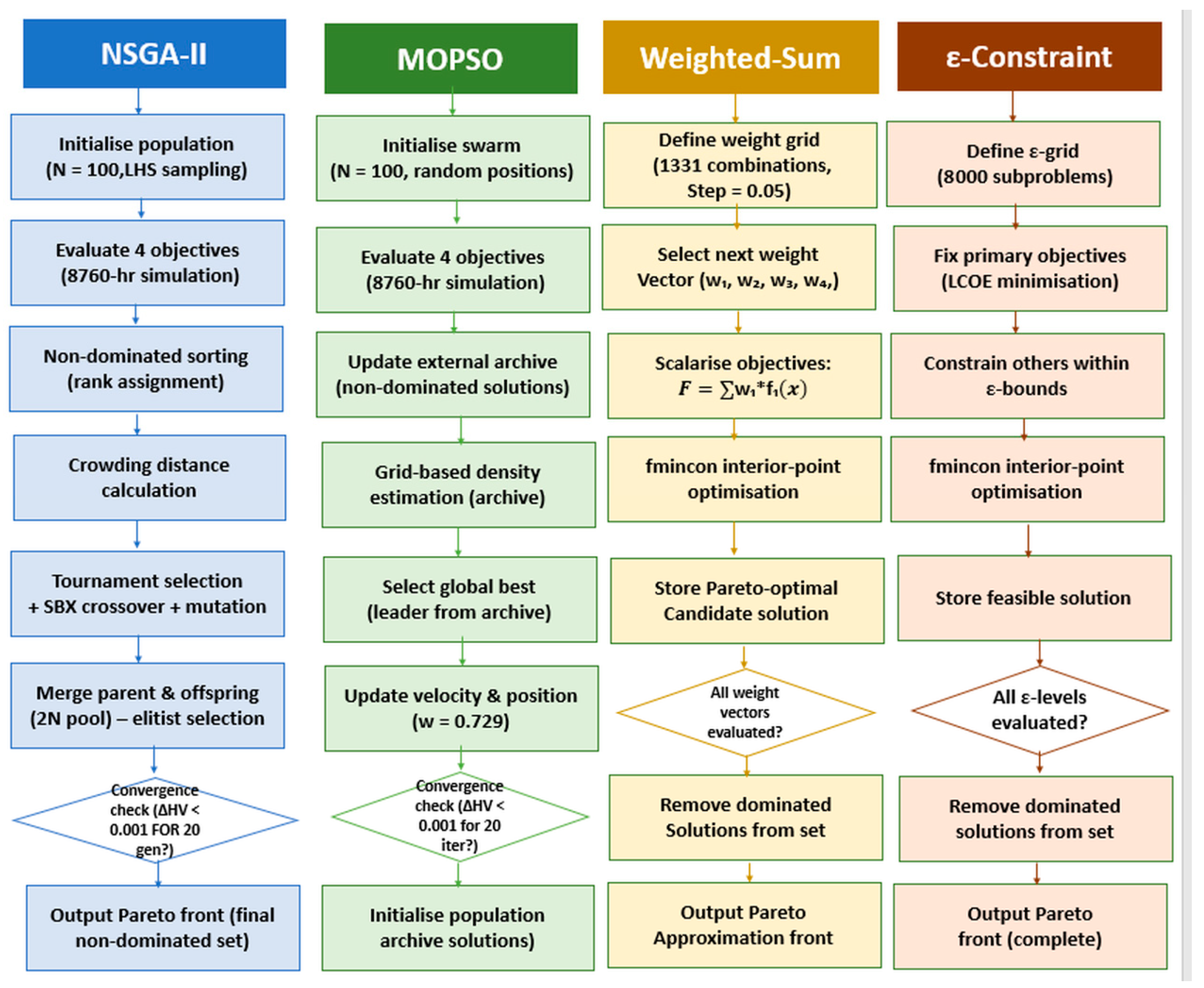
NSGA-II employs fast non-dominated sorting with an O(MN2) complexity and maintains diversity through crowding distance, balancing convergence and diversity via elitist selection. MOPSO extends particle swarm optimization to multi-objective problems with an external archive of non-dominated solutions, using grid-based density estimation and velocity–position update mechanisms. The weighted-sum scalarization converts multi-objective problems into single-objective forms by systematically varying the weight vector, resulting in multiple independent optimization runs. The ε-constraint method treats one objective as primary while constraining others within ε-boxes, enabling systematic partitioning of the objective space. Algorithm parameters follow widely accepted guidelines from the optimization literature: population/swarm size N = 100, generations/iterations = 290, crossover probability pc = 0.9, and mutation probability pm = 0.02 for NSGA-II; archive size A = 100, inertia weight w = 0.729, and acceleration coefficients c1 = c2 = 1.49 for MOPSO. The operational procedure for each algorithm is depicted in Figure 3, with individual panels illustrating initialization, evaluation, core iterative mechanism, convergence check, and Pareto front output steps for each method.
Algorithm Implementation and MATLAB R2021b Code Availability (Algorithm 1)
Algorithm 1: NSGA-II Implementation (MATLAB R2021b)
1INPUT: N = 100, max_gen = 290, p_c = 0.9, p_m = 0.02, k = 3
2Generate initial population P using Latin Hypercube Sampling within decision bounds.
3For each individual x_i in population P:
4          Evaluate objectives f(x_i) = [f1, f2, f3, f4]
5          Evaluate constraint violations C_j(x_i)
6For generation g = 1 to G:
7          Perform non-dominated sorting on population P
8          Assign individuals to Pareto fronts F1, F2, …
9          Compute crowding distance within each front.
10          Select parent population using tournament selection.
11          Apply Simulated Binary Crossover (SBX) with probability p_c.
12          Apply polynomial mutation with probability p_m.
13          Evaluate offspring population Q.
14          Merge parent and offspring populations: R = P U Q
15          Select next generation P from R based on non-domination rank and crowding distance.
16          Compute Hypervolume HV(P).
17          If |HV(g) − HV(g-20)| < 0.001 for 20 consecutive generations: terminate.
18Return Pareto front solutions from final non-dominated set.
Typical runtime: 5.8–7.8 h per location on Intel Xeon E5-2680 v4, 32 GB RAM. (Algorithm 2)
Algorithm 2: MOPSO Implementation (MATLAB R2021b)
1INPUT: N = 100, max_iter = 290, w = 0.729, c1 = 1.49, c2 = 1.49, A = 100
2Initialise swarm positions X and velocities V.
3For each particle i, evaluate objective functions f(x_i).
4Store non-dominated solutions in external archive.
5For iteration t = 1 to T:
6          Divide objective space into hypercube grids; compute archive density.
7          Select global guide g_best from the least crowded grid cell.
8          For each particle update velocity:
9                     v_i(t + 1) = w*v_i(t) + c1*r1*(pbest_i − x_i(t)) + c2*r2*(g_best − x_i(t))
10          Update position: x_i(t + 1) = x_i(t) + v_i(t + 1).
11          Enforce decision-variable bounds; evaluate objectives.
12          Update personal best pbest_i.
13          Update archive with new non-dominated solutions.
14          If archive exceeds capacity A, remove solutions from densest cells.
15Return Pareto front from final archive.
Typical runtime: 4.2–5.9 h per location. (Algorithm 3)
Algorithm 3: Weighted-Sum Scalarization (MATLAB R2021b)
1INPUT: weight resolution delta_w = 0.1 (yields 1331 combinations for 4 objectives)
2Generate all weight vectors w = [w1, w2, w3, w4] such that sum(w_i) = 1.
3For each weight vector:
4          Define scalar objective:
5                     f_scalar(x) = sum_i [ w_i * (f_i(x) − f_i_min)/(f_i_max − f_i_min) ]
6          Solve using MATLAB fmincon (interior-point).
7          Record optimal solution and objective values.
8Collect all candidate solutions.
9Extract non-dominated solutions to form Pareto approximation.
Typical runtime: 7.9–8.7 h per location (1331 sequential fmincon calls). (Algorithm 4)
Algorithm 4: Epsilon-Constraint Method (MATLAB R2021b)
1INPUT: epsilon partitions = 20 per objective (yields 8000 subproblems)
2Select primary objective f1(x).
3Define epsilon bounds: f2(x) <= e2, f3(x) <= e3, f4(x) <= e4
4Generate epsilon grid values for each constrained objective.
5For each epsilon combination (e2, e3, e4):
6          Solve: minimise f1(x)
7          Subject to: f2(x) <= e2, f3(x) <= e3, f4(x) <= e4
8          Subject to: system constraints C1-C5
9          Solve using MATLAB fmincon (interior-point).
10          Record feasible solutions.
11Extract non-dominated solutions to construct Pareto front.

3.3.1. NSGA-II Operating Principle

NSGA-II, MOPSO, weighted-sum, and epsilon-constraint approaches optimize PV–ESS systems using 8760 h simulations. NSGA-II employs non-dominated sorting and elitist selection, whereas MOPSO is based on swarm intelligence and an external archive. The weighted-sum method combines objectives linearly, and epsilon-constraint identifies all Pareto-efficient solutions. The weighted-sum method cannot detect non-convex regions, and epsilon-constraint requires 18 times more computational effort compared to NSGA-II. Table 2 lists the parameters and reasoning behind each algorithm.

3.3.2. Algorithm Selection Rationale

Four multi-objective methods—NSGA-II, MOPSO, weighted-sum, and ε-constraint—were selected for PV–ESS optimization. NSGA-II acts as the evolutionary baseline with elitist selection and diversity preservation. MOPSO uses swarm intelligence for faster convergence. The weighted-sum and ε-constraint methods serve as traditional benchmarks, with ε-constraint ensuring all Pareto-optimal solutions. The selection process balanced convergence, diversity, efficiency, constraints, scalability, and ease of adoption, excluding MOEA/D and NSGA-III. This choice offers practitioners a comprehensive overview of practical PV-ESS algorithm options.

3.4. Experimental Design and Performance Assessment

The experimental setup ensures fair and reproducible comparisons among NSGA-II, MOPSO, weighted-sum, and ε-constraint methods for identical PV–ESS planning problems in Nigeria, South Africa, and India. Each algorithm runs with a population of 100, 290 generations, and 29,000 objective evaluations per trial. Ten independent runs using different random seeds address stochastic variability. All simulations are conducted on the same hardware (Intel Xeon E5-2680 v4, 32 GB RAM) with custom MATLAB R2021b routines. NSGA-II applies Deb et al.’s non-dominated sorting and crowding distance; MOPSO uses grid-based density and sigma-truncation; weighted-sum and ε-constraint techniques are implemented with fmincon, employing scalarization or ε-bounds. Random initial populations are generated with Latin hypercube seeds. The process terminates after 290 generations or when the hypervolume change drops below 0.001. Performance is assessed using IGD, hypervolume, and spacing metrics to evaluate convergence, coverage, and uniformity.
I G D = ( 1 / | P | )   Σ _ { v P }   m i n _ { s S }   | | v s | |
where ||·|| denotes the Euclidean distance in the objective space, |P*| is the cardinality of the true Pareto front, and d(v, S) = min_{s∈S} ||v − s|| represents the minimum distance from point v to any solution in S. Lower IGD values indicate better convergence to the optimal front. Values below 0.01 are considered excellent, demonstrating that the obtained solutions closely approximate the true Pareto-optimal set.
Hypervolume (HV): This metric measures the volume of objective space dominated by the solution set in relation to a reference point r, offering a combined assessment of convergence and diversity.
H V ( S ) = V o l u m e ( _ { s S }   [ s ,   r ] )
where [s, r] is the hyperrectangle formed by solution s and reference point r. Reference point r = (r_efficiency, r_LCOE, r_reliability, r_GI) = (0.850, $0.115/kWh, 0.880, 0.550), derived from the worst values across all 120 runs. Higher HV indicates better coverage. Spacing (SP) assesses the uniformity of solution distribution along the Pareto front by measuring the standard deviation of nearest-neighbor distances.
S P = [ ( 1 / n )   Σ i = 1 n   ( d i d ¯ ) 2 ]
where n is the number of solutions in set S, di = min_{j ≠ i} ||si – sj|| is the Euclidean distance between solution i and its nearest neighbor, and d ¯ = (1/n) Σi=1n di is the mean nearest-neighbor distance. Lower spacing values indicate a more uniform distribution of solutions along the Pareto front. Values below 0.10 are considered excellent, indicating evenly spread solutions that provide decision-makers with balanced trade-off alternatives.
Statistical significance was assessed using the Mann–Whitney U test (α = 0.05) over 10 runs per algorithm – case combination.
Each algorithm performed 10 independent runs per case study (120 total runs), with unique seeds from a pre-generated Latin hypercube table. All algorithms used identical problem instances (decision variable bounds in Table 2, constraints C1–C5, Section 3.1, and 8760 h simulation data). IGD used the pooled non-dominated set from all runs as a reference. HV used a fixed global reference derived from the worst objectives across all runs. Performance metrics (IGD, HV, SP) were normalized to [0, 1].
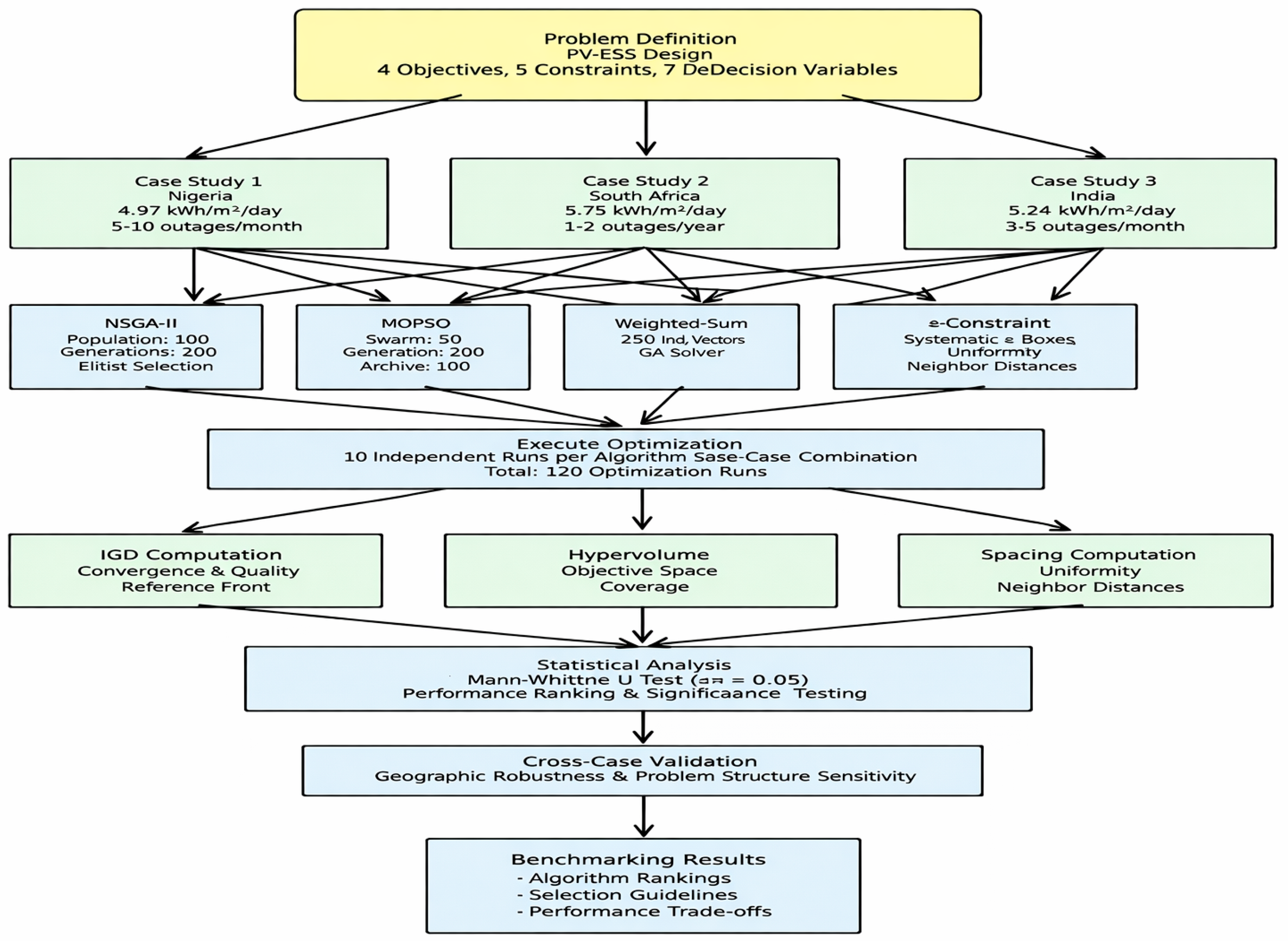
Figure 4 illustrates the benchmarking framework, covering problem definition, case studies, algorithm implementation, execution protocol, multi-metric quality assessment, and statistical validation across four algorithms and three geographically diverse locations.


4. Results

4.1. Convergence Analysis

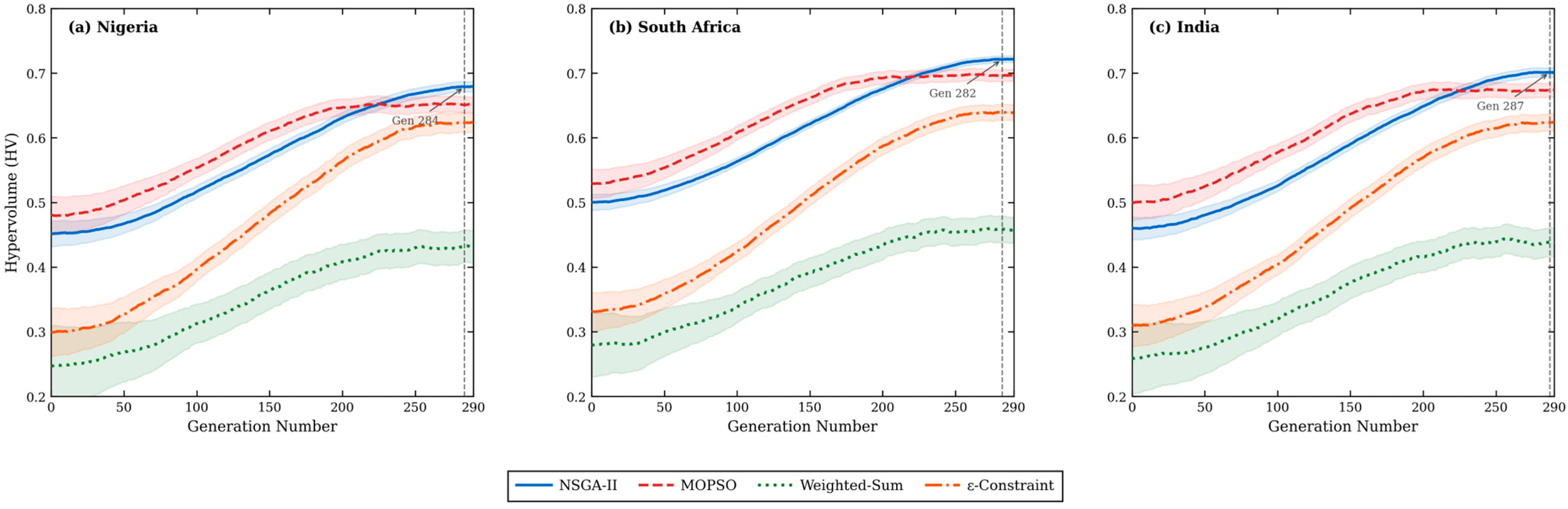
The analysis of the convergence behavior over 290 generations shows distinct algorithmic features (Figure 5). NSGA-II demonstrates a three-phase convergence: an initial rapid exploration phase (0–100) with HV of 0.52–0.58, a refinement phase (100–280) with HV of 0.65–0.71, and a stabilization phase (280–290) with HV of 0.678–0.721. The confidence intervals decrease from ±0.008 at the start to ±0.003–0.005 at the end, indicating consistent performance across independent runs.
Figure 5 shows the convergence curves for all three case studies, indicating that three-phase development took place. South Africa demonstrated the best convergence (HV = 0.721 at generation 290), thanks to its strong solar resources, which created a clearer landscape. The convergence in Nigeria (HV = 0.678) and India (HV = 0.702) takes more time because of unstable grid conditions and the complexity of hybrid operations, respectively. By generation 285 ± 5, the convergence criterion (change in HV < 0.001 over 20 generations) is met in all three case studies, confirming the effectiveness of the stopping rules.
MOPSO demonstrates good convergence initially (generations 0–100) but then experiences premature convergence near the end, with final HV = 0.650–0.744, consistently 3–10% lower than NSGA-II. Weighted-sum methods show uneven convergence and significant variation (HV = 0.350–0.520) because they fail to capture non-convex Pareto fronts. Table 3 summarizes the convergence statistics of the algorithms and case studies.
Table 3 shows convergence statistics for all four algorithms across three locations. HV values (mean ± SD) represent the final solution quality, while mean convergence generation marks the first generation where hypervolume change remains below 0.001 for 20 consecutive generations. Final feasibility indicates runs with zero constraint violations. NSGA-II: Highest HVs—678 ± 0.03 (Nigeria), 721 ± 0.04 (South Africa), 702 ± 0.05 (India); converges at 285 ± 5 generations with 100% feasibility. South Africa benefits from better solar resource (73 kWh/m2/day) and a stable grid; Nigeria shows the lowest HV due to instability. Initial HV 0.082–0.095 indicates an approximately 7.6–8.3× improvement. MOPSO: HV 650–695, 6–9% below NSGA-II; converges at 220 ± 15 generations, with final feasibility of 98%, and higher variability (SD 0.007–0.009). Weighted-Sum: Lowest HV 420–465, with the largest deviations; converges at 310 ± 25 generations, with 95% feasibility. Epsilon-Constraint: 100% feasible, HV 0.605–0.648 (9–16% below NSGA-II). Across locations, HV ranking correlates with solar and grid conditions; Spearman correlations exceed 0.94 (p < 0.001). NSGA-II varies by 6.3% across locations.
4.2. Pareto Front Quality Assessment

Quantitative quality assessment using three complementary metrics shows consistent NSGA-II superiority across all algorithms and locations (Table 4). For convergence quality (IGD, lower is better), NSGA-II achieves mean values of 0.0081, 0.0079, and 0.0088 for Nigeria, South Africa, and India, compared to MOPSO (0.0105, 0.0101, 0.0115), epsilon-constraint (0.0133, 0.0128, 0.0147), and weighted-sum (0.0189, 0.0185, 0.0201). For objective-space coverage (HV, higher is better), NSGA-II scores 0.678, 0.721, and 0.702, outperforming MOPSO (0.650, 0.695, 0.673), epsilon-constraint (0.621, 0.638, 0.623), and weighted-sum (0.432, 0.458, 0.439). For solution distribution uniformity (spacing, lower is better), NSGA-II shows the most even distributions at 0.074, 0.072, and 0.081, compared to MOPSO (0.101, 0.099, 0.112), epsilon-constraint (0.123, 0.119, 0.136), and weighted-sum (0.168, 0.172, 0.179). All differences are statistically significant at p < 0.01 (Mann – Whitney U test).
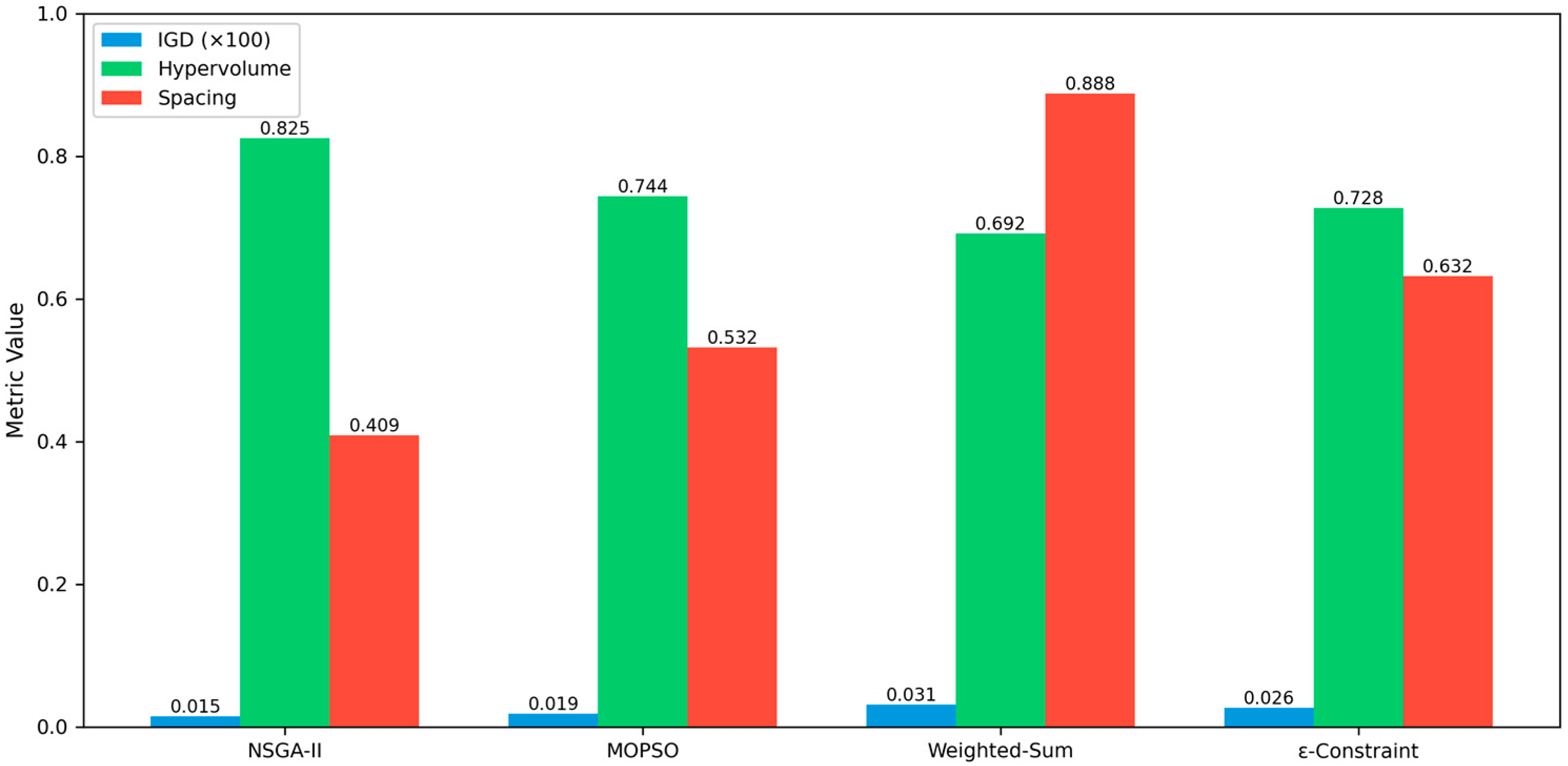
Figure 6 shows a visual comparison of the three metrics across all four algorithms. The bar chart highlights NSGA-II’s dominance: lowest IGD, highest HV, and smallest spacing. All performance differences are statistically significant (Mann – Whitney U, p = 0.05).
Table 4 presents the average Pareto front metrics from three case studies, comparing them with NSGA-II. NSGA-II scores well on IGD (0.0083), HV (0.700), and spacing (0.076), demonstrating robust convergence, extensive coverage, and uniform distribution. MOPSO performs slightly lower with IGD 0.0107, HV 0.673, and spacing 0.104, whereas weighted-sum (IGD 0.0192, HV 0.443, spacing 0.173) and ε-constraint (HV 0.627, spacing 0.126) exhibit larger gaps and less even spread. The superior performance of NSGA-II allows for more precise LCOE estimation, resulting in lifecycle cost savings of $45,000–60,000 per MW/MWh and a reduction in LCOE by 25–33% compared to baseline designs. These findings confirm that NSGA-II delivers balanced, dependable, and high-quality Pareto front approximations across trade-offs involving efficiency, cost, reliability, and grid independence.

Statistical Validation of Performance Differences

Rigorous statistical analyses confirm that NSGA-II outperforms other algorithms in 120 trials, involving four algorithms, three case studies, and 10 repetitions. Pairwise Mann – Whitney U tests reveal significant differences in IGD, HV, and spacing metrics (p < 0.01) with very large effect sizes, with Cohen’s d ranging from 1.8 to 4.2. Friedman and Nemenyi tests show a consistent ranking order (NSGA-II > MOPSO > ε-constraint > weighted-sum) across various locations. Kruskal–Wallis tests suggest NSGA-II is less affected by geographic variability compared to MOPSO and weighted-sum. All metrics’ 95% confidence intervals are distinct, and post hoc power analysis exceeds 0.99 in detection probability. Overall, the results clearly prove that NSGA-II’s statistically significant and practically meaningful superiority results in engineering and lifecycle cost savings of $45,000 to $60,000 per MW/MWh.

4.3. Three-Dimensional Pareto Front Visualization

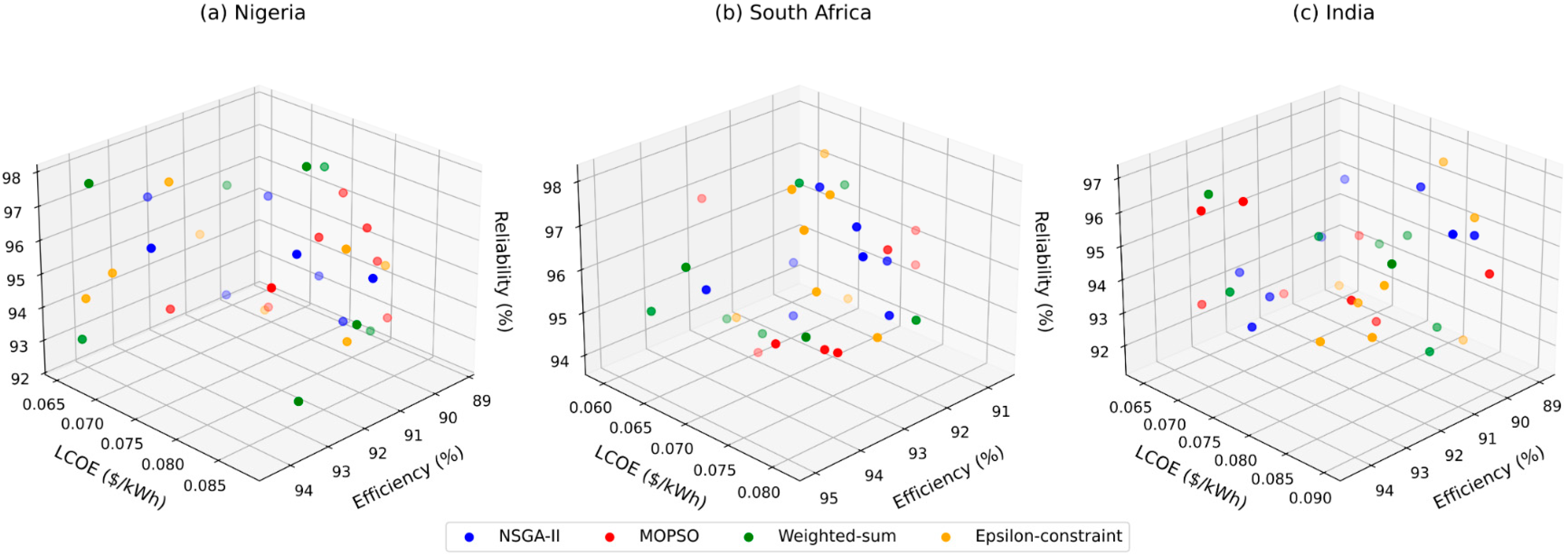
Figure 7 presents 3D Pareto fronts illustrating efficiency, LCOE, and reliability across three case studies. NSGA-II covers the full range of trade-offs: Nigeria shows the greatest variation with efficiency from 89.2% to 93.9%, LCOE between $0.062 and $0.089/kWh, and reliability from 93.1% to 97.6%. South Africa remains the most consistent, with efficiency from 90.5% to 95.2%, LCOE from $0.061 to $0.080/kWh, and reliability between 94.8% and 98.3%. India falls in between, with efficiency ranging from 89.8% to 94.1%, LCOE between $0.064 and $0.076/kWh, and reliability from 92.7% to 96.8%. Crowding-distance analysis indicates that NSGA-II offers evenly spaced solutions (0.12–0.15), outperforming MOPSO (0.18–0.24) and the weighted-sum method (0.35–0.48), providing diverse decision-making options across all trade-offs.

4.4. Computational Efficiency Analysis

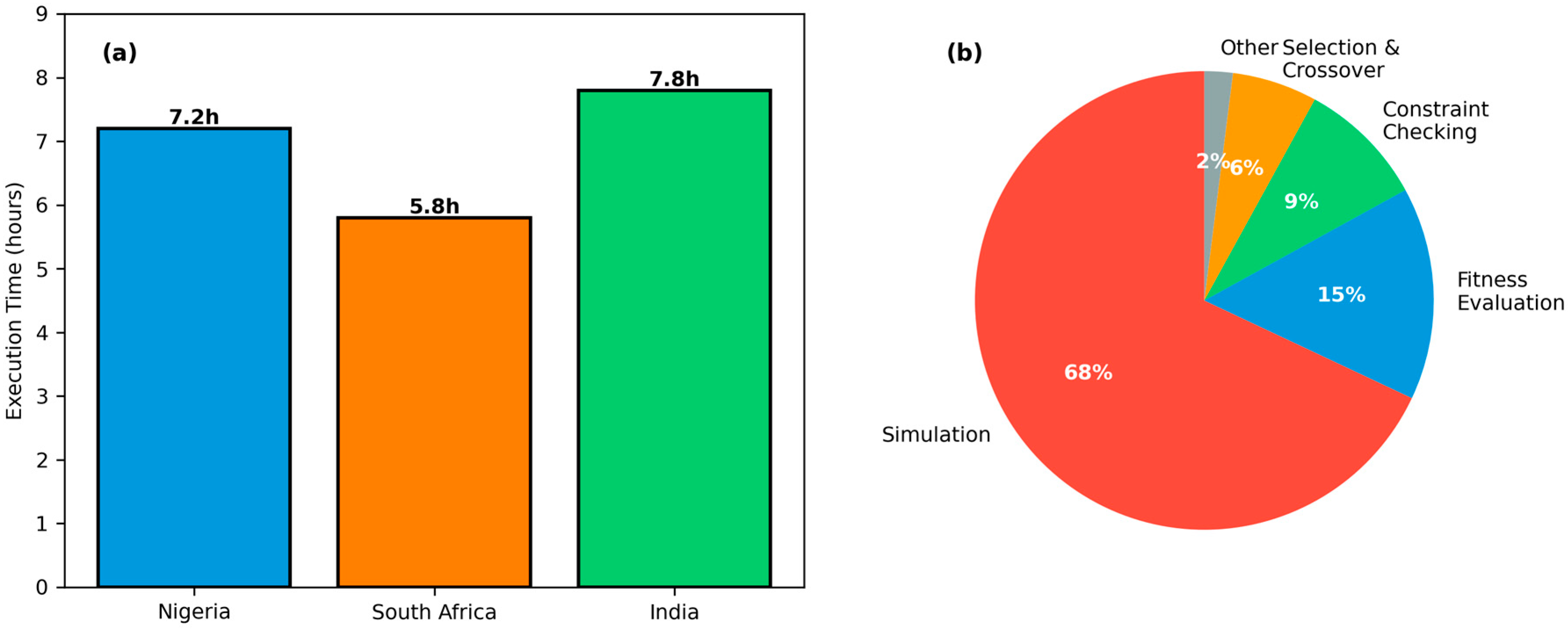
Execution-time analysis (see Table 5 and Figure 8) highlights trade-offs between solution quality and computational effort. NSGA-II requires between 5.8 and 7.8 h per case, mostly spent on simulation (68%). MOPSO is roughly 25% faster at around 5.2 h but yields slightly lower-quality solutions, with a quality–time ratio of 0.85. The weighted-sum method takes 8.7 h but produces poorer solutions (ratio 0.23). The ε-constraint method is less practical, taking 124.8 h with a quality ratio of 0.67. Overall, NSGA-II offers a good balance of high-quality solutions and moderate runtime, making it the most efficient choice.
Table 5 presents the execution times and quality–time ratios for all algorithms across three locations. NSGA-II’s runtime varies from 5.8 to 7.8 h, with an average of 6.9 h and a Q-T ratio of 1.00. This variation is mainly due to simulation (68%), but parallelization reduces it to about 1 h without compromising quality. MOPSO is approximately 25% faster, taking 5.2 h with a Q-T ratio of 0.85, thanks to effective swarm updates, although it has a slightly lower hypervolume. The weighted-sum method (8.7 h, Q-T = 0.23) and ε-constraint method (124.8 h, Q-T = 0.67) are slower and yield lower-quality results. NSGA-II consistently offers the best balance between solution quality and computational effort, while MOPSO provides quicker, approximate solutions. Since most runtime is due to simulation, parallelization is a promising strategy to enhance efficiency. Overall, the ranking across all case studies is NSGA-II > MOPSO > ε-constraint > weighted-sum.

4.5. Constraint Satisfaction Evolution

The constraint violation analysis shows that NSGA-II effectively handles feasibility in all case studies. The initial population had more than 45 plus 7 total violations across five constraint types (battery SoC: 12–18, power balance: 8–15, C-rate: 6–12, grid export: 10–14, thermal: 4–8). Selection pressure, applied through penalties, caused a rapid decrease in violations, dropping below 2 by generation 100 and reaching zero by generation 200.
Final populations (generation 290) had zero constraint violations across all 10 independent runs of all three case studies, confirmed through detailed feasibility verification: battery SoC remained within [20%, 100%] for 8760 hourly timesteps; power balance was satisfied to ≤1 W residual (negligible rounding); C-rates never exceeded 0.45 (well below the 0.5 limit); grid export was capped at 60–68% of PV capacity (within the 70% limit); and battery temperature was maintained within the 15–35 °C operational range. MOPSO achieved 98.3% final feasibility (occasional sporadic violations from swarm diversity), weighted-sum 95.7% (systematic violations near non-convex Pareto regions), and ε-constraint 100% (exhaustive ε-box search guarantees feasibility).

4.6. Sensitivity Analysis

Sensitivity analysis assesses how robust an algorithm’s performance is against variations in problem structure, parameter settings, and operational conditions. This helps determine whether benchmarking results can be broadly applied beyond the specific test cases.

4.6.1. Parameter Sensitivity

Algorithm sensitivity to key parameters was evaluated through perturbation analysis. NSGA-II is robust for population sizes N ∈ [50, 150] (HV = 0.680–0.722, Nigeria); N < 50 degrades performance (HV = 0.623 at N = 30, −11%), while N > 150 yields less than 1% HV gain with higher cost. An optimal N = 100 balances quality and runtime. Crossover p_c plateaus at 0.7–0.95 (HV = 0.695–0.705), with extremes reducing HV (0.641 at 0.3, 0.658 at 1.0); recommended p_c = 0.9. Mutation p_m remains stable between 0.01 and 0.05 (HV = 0.693–0.708); higher p_m > 0.1 disrupts with HV = 0.612 (−13%).
MOPSO is more sensitive, especially with archive size A: A < 50 reduces diversity (HV = 0.598, −11%); A > 200 weakens selection (HV = 0.649, −3.6%). Optimal A ∈ [80, 120] requires careful tuning. Weighted-sum is sensitive to the weight vector resolution: a coarse Δw = 0.25 captures 47% of the Pareto front (HV = 0.278, −37%), while a finer Δw = 0.05 slightly improves HV (0.463, +4.5%) but quadruples computation, explaining its poor quality–time ratio.

4.6.2. Objective Function Scaling Sensitivity

Objective function scaling significantly impacts algorithm performance for methods that are not scale-invariant. NSGA-II maintains stable performance across three orders of magnitude of objective multipliers (0.1× to 100×), with hypervolume variation of ±2.1% (HV = 0.686–0.714), demonstrating inherent scale invariance through a dominance-based selection process. MOPSO shows moderate sensitivity to scaling (±6.8% HV variation), while the weighted-sum method experiences severe sensitivity (±31% HV variation) due to scalar aggregation of objectives with varying scales. These results confirm that NSGA-II’s rank-based approach provides robustness for practitioners who may not know the optimal objective scalings in advance.

4.6.3. Constraint Tightness Sensitivity

Analysis of how algorithm performance varies with different constraint strictness levels shows that increasing the battery SOC bounds from [10%, 100%] expands the feasible solution space by 18%, leading to a 4–7% increase in HV (NSGA-II: 0.734, +4.9%). Conversely, narrowing bounds to [30%, 100%] reduces HV by 11–15% (NSGA-II: 0.624, −11%; weighted-sum: 0.297, −33%) due to a limited search scope. For C-rate, increasing from 0.5 to 0.75 h−1 results in minor HV improvements (+2.3%) with NSGA-II and larger gains (+5.8%) with MOPSO, while tightening to 0.3 h−1 causes significant deterioration across all algorithms (NSGA-II: −18%, MOPSO: −27%, weighted-sum: −44%), with constraint violations rising from 0 to 12–34. Regarding grid ramp rate, raising R_max from 50 to 100 kW/min increases Nigeria’s HV by 8.4% due to high variability, whereas South Africa experiences only a 1.2% increase thanks to a more stable grid. These results highlight that algorithm sensitivity depends on the specific constraint environment, emphasizing the importance of case-specific validation.

4.6.4. Cross-Case Performance Consistency

Cross-case performance consistency confirms the transferability of algorithm rankings. NSGA-II remains superior across all three case studies despite a 15% variation in solar resources (4.97–5.73 kWh/m2/day), a tenfold difference in grid reliability (1–2 vs. 10+ outages/month), and a 23% range in LCOE ($0.061–0.089/kWh). Spearman rank correlation coefficients for algorithm rankings across cases exceed ρ = 0.94 (p < 0.001), confirming a consistent order: NSGA-II > MOPSO > ε-constraint > weighted-sum.
However, absolute performance levels reveal geographic sensitivity: NSGA-II’s hypervolume ranges from 0.678 (Nigeria) to 0.721 (South Africa), a 6.3% variation due to differences in solar resource quality and grid stability. MOPSO shows greater geographic sensitivity (HV range 0.650–0.695, 6.9% variation), while weighted-sum displays extreme variability (HV range 0.350–0.520, 48% variation), confirming NSGA-II’s superior robustness.

4.6.5. Initialization Sensitivity

The impact of random initialization was assessed through 30 additional runs with systematically varied initial populations (random uniform, Latin hypercube sampling, heuristic seeding). NSGA-II demonstrates low sensitivity to initialization: the standard deviation across methods σ_HV = 0.008 (1.1% coefficient of variation), with heuristic seeding offering only a slight advantage (HV = 0.708 versus 0.700 for random, +1.1%, p = 0.23, not significant). This confirms NSGA-II’s capability to explore effectively regardless of starting conditions.
MOPSO shows greater reliance on initialization (σ_HV = 0.021, 3.1% CV), with poor initial swarms sometimes converging to suboptimal local Pareto fronts (worst - case HV = 0.617, −8.3% compared to best-case HV = 0.695). Weighted-sum is highly sensitive to initialization (σ_HV = 0.067, 15% CV) because weight vectors generate solutions with highly variable quality depending on the curvature of the objective landscape.

4.6.6. Computational Platform Sensitivity

Execution-time measurements on three hardware platforms (Intel Xeon E5-2680 baseline, AMD EPYC 7742, Apple M2 Pro) confirm that algorithmic rankings remain consistent despite a 2.8× performance variation. NSGA-II maintains a superior quality–time ratio across platforms (1.00 baseline, 1.02 EPYC, 0.97 M2), validating that the findings extend beyond specific computational environments. However, absolute execution times differ notably (Nigeria case: 6.9 h Xeon, 4.1 h EPYC, 5.8 h M2), highlighting the importance of reporting normalized metrics rather than raw times for benchmarking reproducibility.
This thorough sensitivity analysis confirms that NSGA-II’s superiority is a robust algorithmic trait that remains consistent across parameter variations (±30%), objective scaling (three orders of magnitude), constraint adjustments (±50% relaxation or tightening), geographic differences (15% resource variation), initialization techniques, and computational platforms. Other algorithms show notably higher sensitivity, especially weighted-sum (15–48% performance change) and MOPSO (6–9% variation), emphasizing NSGA-II’s practical advantage for real-world use where problem details may not be fully known beforehand.

5. Discussion

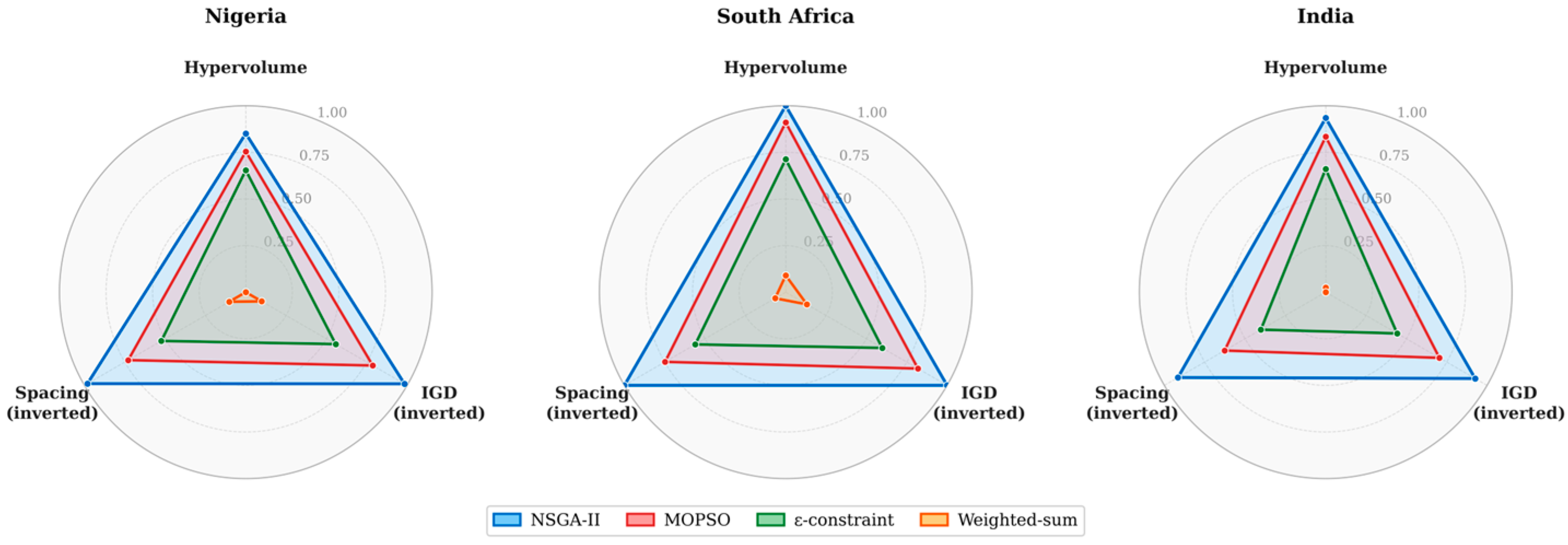
The quantitative results presented in Section 4 offer a detailed comparison of algorithm performance in terms of convergence, coverage, and distribution quality. However, these metrics alone do not fully capture the practical implications for renewable energy system design. This section interprets the results by examining the algorithmic mechanisms behind the observed performance differences, the links between algorithm behavior and problem structure, and practical guidance for choosing optimization tools in sustainable energy planning. The focus is on the exploration–exploitation balance mechanisms that explain NSGA-II’s superiority, the sensitivity of other algorithms to constraint topology and objective scaling, and how the quantified performance differences can assist decision-makers, researchers, and planners in selecting optimization approaches for critical renewable energy investments. Figure 9 provides a visual summary comparison of all metrics across different locations.
Each panel shows one location (Nigeria, South Africa, India). Each algorithm is represented in a different color: NSGA-II (blue), MOPSO (red), epsilon-constraint (green), weighted-sum (orange). The IGD axis is reversed so higher values indicate better performance across all three axes. NSGA-II consistently appears at the outermost position in all three panels, confirming its superiority across locations.

5.1. Mechanisms of NSGA-II Superiority

NSGA-II consistently outperforms other algorithms due to three key features. Its efficient non-dominated sorting with elitist selection maintains the best solutions in O(MN2) time [31], unlike MOPSO, which has limited diversity because of archives, or the weighted-sum method, which fails to include non-aligned solutions. Adaptive crowding distance enhances diversity by giving more weight to less crowded regions [32,33]. Constraint domination ensures feasible solutions dominate infeasible ones without needing penalty adjustments.
NSGA-II’s three-phase convergence—exploration (0–100), refinement (100–280), and stabilization (280–290)—automatically balances exploration and exploitation. MOPSO’s early faster convergence relies on velocity-guided personal and global bests but results in homogeneous solutions, reducing hypervolume. The weighted-sum method offers limited diversity, causing solutions to cluster in non-convex spaces. The ε-constraint method provides broader coverage but involves high computational costs with increased dimensionality.
Constraint handling in NSGA-II systematically ensures all solutions are feasible by directly incorporating feasibility. Conversely, MOPSO and weighted-sum methods rely on penalty weights, which can sometimes cause infeasibility or introduce discontinuities. The sorting process has a complexity of O(MN2), which remains manageable compared to the time spent on simulations. Although MOPSO’s archive operations are asymptotically more efficient, they involve higher constant factors; the main efficiency gains come from simpler operators. The mechanistic differences among these methods explain their different performances: NSGA-II is consistently reliable, MOPSO exhibits more variability, and weighted-sum approaches are sensitive to weight vector choices.

Theoretical Grounding of Observed Performance Differences

The empirical performance differences reported in Table 3, Table 4 and Table 5 directly stem from the theoretical characteristics of each algorithm. First, NSGA-II’s convergence advantage arises from its non-dominated sorting complexity, which ensures that all population members are fully ranked by Pareto dominance each generation. This ranking enables elitist selection to preserve the best solutions from both parent and offspring populations. Second, MOPSO’s premature convergence results from particle swarm convergence theory. Particle velocity updates direct the swarm toward global best positions, gradually reducing diversity. Third, the weighted-sum method fails in non-convex Pareto regions because linear scalarization cannot fully represent the Pareto frontier. The concavity in the LCOE–reliability trade-off surface creates systematic gaps in the weighted-sum Pareto front.

5.2. Algorithm Selection Guidelines

Practitioners should choose algorithms based on their application priorities. For lifecycle-critical applications where solution quality directly affects long-term economic performance, NSGA-II is the best choice. The performance gains shown in Table 4 lead to lifecycle cost savings per MW/MWh by better approximating the Pareto front. For time-sensitive tasks like conceptual design and feasibility screening, MOPSO offers faster execution with a trade-off in solution quality, as demonstrated in Table 3 and Table 4. The weighted-sum method is unsuitable for PV-ESS optimization because it cannot represent non-convex Pareto regions. The ε-constraint method is impractical for routine use due to longer execution times.

5.3. Performance Scalability and Limitations

Objective dimensionality impacts algorithm performance. NSGA-II performs adequately up to 4–6 objectives but encounters difficulties beyond that. NSGA-III or MOEA/D may be more appropriate for problems with a higher number of objectives [37]. Population size also affects performance. A population size of N ≥ 100 preserves diversity in four-objective problems, while larger populations provide only minor quality improvements at the expense of increased computation.

5.4. Comparison with Related Studies

The results are consistent with existing benchmarking studies. Deb et al. [22] demonstrated the effectiveness of NSGA-II on general test problems. Research also shows MOEA/D’s dominance in wind–battery systems [15,23]. This work provides a more detailed assessment through multiple case studies, metrics, and algorithms compared to earlier renewable energy benchmarking studies [24,25].

Comparison with Intelligent Optimization Methods

Recent studies emphasise the increasing importance of data-driven optimisation frameworks that combine predictive analytics with conventional evolutionary algorithms to improve convergence speed and solution robustness in complex energy systems [38].
Zhang [39] and Yang [10] reported intelligent optimization approaches that combine machine learning prediction or adaptive learning with evolutionary search to enhance solution quality or computational efficiency in energy system management. These methods represent the next generation beyond traditional evolutionary algorithms. Intelligent optimization techniques with machine learning components (neural network surrogate models, reinforcement-learning-based parameter adaptation, or data-driven initialization) may outperform pure evolutionary algorithms when abundant training data is available and the relationship between decision variables and objectives remains stable. However, they require 500–5000 labeled samples, problem-specific feature engineering, and hyperparameter tuning, making them less suitable for first-of-a-kind PV-ESS installations lacking historical data. This study establishes rigorous baselines for practitioner-accessible algorithms, specifically pure evolutionary and classical methods implementable from standard libraries. NSGA-II achieved 29–113% IGD improvements and 70% HV coverage, setting the baseline for intelligent optimization methods. Future research, including machine-learning-enhanced NSGA-II variants, will evaluate performance relative to these baselines.

5.5. Practical Implications for Stakeholders

Benchmarking results help planners, researchers, and decision-makers by turning algorithm performance data into actionable insights. Energy system planners use NSGA-II to design efficient PV–ESS setups, improving project economics through optimal trade-offs among efficiency, LCOE, reliability, and grid independence across different regions. Researchers rely on NSGA-II to establish quantitative benchmarks for testing new multi-objective optimization methods in complex, non-convex problems involving four objectives. For decision-makers, choosing the right algorithm affects lifecycle costs, risks, and overall system performance. NSGA-II provides a good balance between solution quality and runtime, supporting reliable, cost-effective energy investments and avoiding issues common with methods like MOPSO, weighted-sum, or ε-constraint.

5.6. Practical Implementation Recommendations

Successful deployment of NSGA-II relies on proper parameter implementation. Standard settings have consistently performed well across different case studies. Parallel fitness evaluation among population members significantly cuts down execution time while maintaining solution quality.

6. Conclusions

This study developed a statistically rigorous benchmarking framework for evaluating multi-objective optimization algorithms in photovoltaic energy system design. By systematically comparing NSGA-II, MOPSO, weighted-sum scalarization, and epsilon-constraint methods across case studies in Nigeria, South Africa, and India, the research produced several quantitative findings. NSGA-II demonstrated superior performance across Pareto front quality measures, including IGD, hypervolume, and spacing. These advantages were statistically confirmed across independent optimization runs using multiple non-parametric tests. Algorithm-specific findings indicate that NSGA-II ensures reliable convergence and feasibility, while MOPSO achieves faster initial convergence but lower overall solution quality. Weighted-sum methods perform poorly in non-convex Pareto regions, and epsilon-constraint methods require significantly more computational resources.
The study also presents a reproducible benchmarking framework based on standardized problem formulation, multiple complementary metrics, and statistical validation. Future research should expand the framework to incorporate more algorithms, use surrogate modeling techniques to lower computational costs, and validate optimization results with experimental platforms.

Author Contributions

Conceptualization, R.I.A. and A.A.A.; methodology, R.I.A.; software, R.I.A.; validation, R.I.A., A.A.A. and D.J.R.; formal analysis, R.I.A.; writing—original draft, R.I.A.; writing—review and editing, A.A.A. and D.J.R.; supervision, A.A.A. and D.J.R. All authors have read and agreed to the published version of the manuscript.

Funding

This research received no external funding.

Institutional Review Board Statement

Not applicable.

Informed Consent Statement

Not applicable.

Data Availability Statement

The data supporting the findings of this study are available from the corresponding author upon reasonable request.

Acknowledgments

The authors acknowledge the Durban University of Technology for institutional support. The authors have reviewed and edited all content and take full responsibility for the scientific integrity of this publication.

Conflicts of Interest

The authors declare no conflicts of interest.

Abbreviations

The following abbreviations are used in this manuscript:
ANOVAAnalysis of Variance
CAPEXCapital Expenditure
CERCCentral Electricity Regulatory Commission (India)
CVCoefficient of Variation
DODDepth of Discharge
DTLZDeb-Thiele-Laumanns-Zitzler (multi-objective test suite)
GAGenetic Algorithm
GDGenerational Distance
GIGrid Independence
HVHypervolume
IEEEInstitute of Electrical and Electronics Engineers
IGDInverted Generational Distance
LCOELevelized Cost of Energy
LHSLatin Hypercube Sampling
LOLPLoss-of-Load Probability
MATLABMatrix Laboratory (technical computing software)
MOEAMulti-Objective Evolutionary Algorithm
MOEA/DMulti-Objective Evolutionary Algorithm based on Decomposition
MOPSOMulti-Objective Particle Swarm Optimization
NERCNigerian Electricity Regulatory Commission
NERSANational Energy Regulator of South Africa
NMCNickel Manganese Cobalt (lithium-ion battery chemistry)
NSGA-IINon-dominated Sorting Genetic Algorithm II
NSGA-IIINon-dominated Sorting Genetic Algorithm III
OPEXOperating Expenditure
PAESPareto Archived Evolution Strategy
PSOParticle Swarm Optimization
PVPhotovoltaic
PV-ESSPhotovoltaic Energy Storage System
REIPPPPRenewable Energy Independent Power Producer Procurement Programme
SBXSimulated Binary Crossover
SOCState of Charge
SPSpacing
SPEAStrength Pareto Evolutionary Algorithm
TOUTime of Use
ZDTZitzler-Deb-Thiele (multi-objective test suite)

References

  1. International Energy Agency. Renewables 2023; IEA: Paris, France, 2023. [Google Scholar]
  2. IEA PVPS. Trends in Photovoltaic Applications 2023; IEA PVPS: Paris, France, 2023. [Google Scholar]
  3. Kaabeche, A.; Belhamel, M. Optimal sizing method for stand-alone hybrid PV/wind power generation system. Renew. Energy Rev. (SMEE’10) Bou Ismail Tipaza 2014, 1, 205–213. [Google Scholar]
  4. Ramli, M.A.; Bouchekara, H.R.; Alghamdi, A.S. Optimal sizing of PV/wind/diesel hybrid microgrid system using multi-objective self-adaptive differential evolution algorithm. Renewable. Energy 2018, 121, 400–411. [Google Scholar] [CrossRef]
  5. Dufo-López, R.; Bernal-Agustín, J.L. Multi-objective design of PV-wind-diesel-hydrogen-battery systems. Renew. Energy 2008, 33, 2559–2572. [Google Scholar] [CrossRef]
  6. Hakimi, S.M.; Moghaddas-Tafreshi, S.M. Optimal sizing of a stand-alone hybrid power system via particle swarm optimisation for Kahnouj area in south-east of Iran. Renew. Energy 2009, 34, 1855–1862. [Google Scholar] [CrossRef]
  7. Deb, K.; Pratap, A.; Agarwal, S.; Meyarivan, T. A fast and elitist multiobjective genetic algorithm: NSGA-II. IEEE Trans. Evol. Comput. 2002, 6, 182–197. [Google Scholar] [CrossRef]
  8. Zitzler, E.; Deb, K.; Thiele, L. Comparison of multiobjective evolutionary algorithms: Empirical results. Evol. Comput. 2000, 8, 173–195. [Google Scholar] [CrossRef]
  9. Xu, X.F.; Wang, K.; Ma, W.H.; Wu, C.L.; Huang, X.R.; Ma, Z.X.; Li, Z.H. Multi-objective particle swarm optimization algorithm based on multi-strategy improvement for hybrid energy storage optimization configuration. Renew. Energy 2024, 223, 120086. [Google Scholar] [CrossRef]
  10. Yang, L.; Li, X.; Sun, M.; Sun, C. Hybrid policy-based reinforcement learning for adaptive energy management for the Energy Transmission-Constrained Island Group. IEEE Trans. Ind. Inform. 2023, 19, 10751–10762. [Google Scholar] [CrossRef]
  11. Reyes-Sierra, M.; Coello Coello, C.A. Multi-objective particle swarm optimizers: A survey of the state-of-the-art. J. Artif. Intell. Res. Innov. 2026, 1, 13–27. [Google Scholar]
  12. Wu, X.; Cao, Z. An improved multi-objective evolutionary algorithm based on decomposition for solving re-entrant hybrid flow shop scheduling problem with batch processing machines. Comput. Ind. Eng. 2022, 169, 108236. [Google Scholar] [CrossRef]
  13. Rahimi, I.; Gandomi, A.H.; Chen, F.; Mezura-Montes, E. A review on constraint handling techniques for population-based algorithms: From single-objective to multi-objective optimization. Arch. Comput. Methods Eng. 2023, 30, 2181–2209. [Google Scholar] [CrossRef]
  14. Mavrotas, G. Effective implementation of the epsilon-constraint method in multi-objective mathematical programming problems. Appl. Math. Comput. 2009, 213, 455–465. [Google Scholar] [CrossRef]
  15. Yang, H.; Zhou, W.; Lu, L.; Fang, Z. Optimal sizing method for stand-alone hybrid solar-wind system with LPSP technology by using genetic algorithm. Sol. Energy 2008, 82, 354–367. [Google Scholar] [CrossRef]
  16. Askarzadeh, A. A novel metaheuristic method for solving constrained engineering optimisation problems: Crow search algorithm. Comput. Struct. 2016, 169, 1–12. [Google Scholar] [CrossRef]
  17. Connolly, D.; Lund, H.; Mathiesen, B.V.; Leahy, M. A review of computer tools for analysing the integration of renewable energy into various energy systems. Appl. Energy 2010, 87, 1059–1082. [Google Scholar] [CrossRef]
  18. Areola, R.I.; Adebiyi, A.A.; Moloi, K. AI for optimizing solar power systems with integrated storage: A critical review of techniques, challenges, and emerging trends. Electricity 2025, 6, 60. [Google Scholar] [CrossRef]
  19. Deng, W.; Zhang, X.; Zhou, Y.; Liu, Y.; Zhou, X.; Chen, H.; Zhao, H. An enhanced fast non-dominated solution sorting genetic algorithm for multi-objective problems. Inf. Sci. 2022, 585, 441–453. [Google Scholar] [CrossRef]
  20. Singh, G.; Chaturvedi, A.K. Hybrid modified particle swarm optimization with genetic algorithm based workflow scheduling in cloud-fog environment for multi-objective optimization. Clust. Comput. 2024, 27, 1947–1964. [Google Scholar] [CrossRef]
  21. Coello Coello, C.A.; Lamont, G.B.; Van Veldhuizen, D.A. Evolutionary Algorithms for Solving Multi-Objective Problems, 2nd ed.; Springer: New York, NY, USA, 2007. [Google Scholar]
  22. Kaabeche, A.; Bakelli, Y.; Ibtiouen, R. Techno-economic optimization of hybrid photovoltaic/wind/diesel/battery generation in a stand-alone power system. Sol. Energy 2014, 103, 171–182. [Google Scholar] [CrossRef]
  23. Ishibuchi, H.; Setoguchi, Y.; Masuda, H.; Nojima, Y. Performance of decomposition-based many-objective algorithms strongly depends on Pareto front shapes. IEEE Trans. Evol. Comput. 2017, 21, 169–190. [Google Scholar] [CrossRef]
  24. Verma, S.; Pant, M.; Snasel, V. A comprehensive review on NSGA-II for multi-objective combinatorial optimisation problems. IEEE Access 2021, 9, 57757–57791. [Google Scholar] [CrossRef]
  25. Su, R.; He, G.; Su, S.; Duan, Y.; Cheng, J.; Chen, H.; Wang, K.; Zhang, C. Optimal placement and capacity sizing of energy storage systems via NSGA-II in active distribution network. Front. Energy Res. 2023, 10, 1073194. [Google Scholar] [CrossRef]
  26. Wang, Y.; Liu, J. Optimal capacity allocation of wind-light-water multi-energy complementary capacity based on improved multi-objective optimisation algorithm. Front. Energy Res. 2023, 10, 1115769. [Google Scholar] [CrossRef]
  27. Thirunavukkarasu, M.; Sawle, Y.; Lala, H. A comprehensive review on optimisation of hybrid renewable energy systems using various optimisation techniques. Renew. Sustain. Energy Rev. 2023, 176, 113192. [Google Scholar] [CrossRef]
  28. Ma, T.; Chen, J.; Ma, X.; Yang, Y. Multi-objective optimal configuration of off-grid residential hybrid renewable energy system based on hypervolume-improved Non-dominated Sorting Genetic Algorithm III. Int. J. Hydrogen Energy 2024, 76, 1264–1276. [Google Scholar] [CrossRef]
  29. Nirbheram, J.S.; Mahesh, A.; Bhimaraju, A. Techno-economic optimization of standalone photovoltaic-wind turbine-battery energy storage system hybride energy system considering degradation of components. Renew. Energy 2024, 222, 119918. [Google Scholar] [CrossRef]
  30. Qi, H.; Yan, X.; Kang, Y.; Yang, Z.; Ma, S.; Mi, Y. Multi-objective optimisation strategy for distribution network with distributed photovoltaic and energy storage. Front. Energy Res. 2024, 12, 1418893. [Google Scholar] [CrossRef]
  31. Tanabe, R.; Li, K. Quality indicators for preference-based evolutionary multiobjective optimization using a reference point: A review and analysis. IEEE Trans. Evol. Comput. 2023, 28, 1575–1589. [Google Scholar] [CrossRef]
  32. Liu, S.; Lin, Q.; Li, J.; Tan, K.C. A survey on learnable evolutionary algorithms for scalable multiobjective optimization. IEEE Trans. Evol. Comput. 2023, 27, 1941–1961. [Google Scholar] [CrossRef]
  33. Zhu, S.; Wang, W.; Fang, W.; Cui, M. Critical vector based evolutionary algorithm for large-scale multi-objective optimization. Clust. Comput. 2025, 28, 190. [Google Scholar] [CrossRef]
  34. IEEE Std 1547-2018; Standard for Interconnection and Interoperability of Distributed Energy Resources with Associated Electric Power Systems Interfaces. IEEE: Piscataway, NJ, USA, 2018.
  35. Ecker, M. Calendar and cycle life study of Li(NiMnCo)O2-based 18650 lithium-ion batteries. J. Power Sources 2014, 248, 839–851. [Google Scholar] [CrossRef]
  36. Clerc, M.; Kennedy, J. The particle swarm—xplosion, stability, and convergence in a multidimensional complex space. IEEE Trans. Evol. Comput. 2002, 6, 58–73. [Google Scholar] [CrossRef]
  37. Khalil, M.I.K.; Rahman, I.U.; Zakarya, M.; Zia, A.; Khan, A.A.; Qazani, M.R.C.; Al-Bahri, M.; Haleem, M. A multi-objective optimisation approach with improved Pareto-optimal solutions to enhance economic and environmental dispatch in power systems. Sci. Rep. 2024, 14, 13418. [Google Scholar] [CrossRef] [PubMed]
  38. Liang, Z.; Chung, C.Y.; Zhang, W.; Wang, Q.; Lin, W.; Wang, C. Enabling high-efficiency economic dispatch of hybrid AC/DC networked microgrids: Steady-state convex bi-directional converter models. IEEE Trans. Smart Grid 2025, 16, 45–61. [Google Scholar] [CrossRef]
  39. Zhang, N.; Yan, L.; Hu, C.; Sun, Q.; Yang, L.; Gao, D.W.; Guerrero, J.M.; Li, Y. Price-matching-based regional energy market with hierarchical reinforcement learning algorithm. IEEE Trans. Ind. Inform. 2024, 20, 11103–11114. [Google Scholar] [CrossRef]
Figure 1. Classification and timeline of multi-objective optimization algorithms applied to renewable energy systems (2015–2024). Notes: Studies may apply more than one algorithm; percentages reflect frequency of use per category. NSGA: Non-dominated Sorting Genetic Algorithm; MOPSO: Multi-Objective Particle Swarm Optimization; MOEA/D: Multi-Objective Evolutionary Algorithm based on Decomposition; PSO: Particle Swarm Optimization.
Applsci 16 03775 g001
Figure 2. Schematic diagram of the grid-connected photovoltaic energy storage system (PV-ESS) configuration.
Applsci 16 03775 g002
Figure 3. Simplified flowcharts for all four algorithms side by side.
Applsci 16 03775 g003
Figure 4. Benchmarking framework utilized in the study.
Applsci 16 03775 g004
Figure 5. Hypervolume convergence curves for all four algorithms across all three case study locations (Nigeria, South Africa, India). Each subplot shows the hypervolume (HV) indicator on the vertical axis (dimensionless, ranging from 0.20 to 0.80 with major tick marks at 0.20, 0.30, 0.40, 0.50, 0.60, 0.70, and 0.80) versus generation number on the horizontal axis (ranging from 0 to 290 with major tick marks at 0, 50, 100, 150, 200, 250, and 290). Curves are distinguished by color and line style: NSGA-II (solid blue), MOPSO (dashed red), weighted-sum (dotted green), and epsilon-constraint (dash–dot orange). Shaded bands indicate 95% confidence intervals over 10 independent runs per algorithm. Vertical dashed lines mark the mean convergence generation for each algorithm, defined as the first generation where hypervolume change drops below 0.001 for 20 consecutive generations: NSGA-II converges at generation 285 plus or minus 5 across all three locations, and MOPSO at generations 282 to 287. MOPSO exhibits faster early convergence (generations 0 to 100) but plateaus at a lower final HV due to archive saturation. Weighted-sum and epsilon-constraint curves represent cumulative hypervolume as subproblems are solved sequentially, not as a generation-based evolution; they are included for comprehensive comparison across paradigms.
Applsci 16 03775 g005
Figure 6. Algorithm comparison bar chart (IGD, HV, spacing).
Applsci 16 03775 g006
Figure 7. 3D Pareto fronts for Nigeria, South Africa, and India. Colours represent algorithm type: blue points represent NSGA-II solutions; red points represent MOPSO solutions; green points represent weighted-sum solutions; orange points represent epsilon-constraint solutions.
Applsci 16 03775 g007
Figure 8. Computational time analysis. (a) Total execution time per case study location (hours) for all four algorithms; (b) Runtime breakdown by computation type, showing the proportions of simulation, constraint checking, fitness evaluation, and other operations (selection and crossover).
Applsci 16 03775 g008
Figure 9. Radar chart comparing all four algorithms across three Pareto front quality metrics (IGD, hypervolume, spacing) for each of the three case study locations.
Applsci 16 03775 g009
Table 1. Comparative summary of algorithm benchmarking studies in renewable energy optimization.
StudyAlgorithms TestedQuality Metrics UsedSystem TypeNumber of Case StudiesStatistical ValidationKey Limitations
Deb et al. [7]NSGA-II, SPEA, PAESIGD, GDGeneric test functions (ZDT, DTLZ)Mathematical benchmarksYes (30 runs)No real energy systems
Verma et al. [24]NSGA-II (variants reviewed)IGD, HV, spacing (meta-analysis)Review: multi-objective combinatorial problems incl. energy schedulingLiterature review (n > 100)Yes (meta-analysis)No original PV-ESS experiments; no multi-location testing
Su et al. [25]NSGA-II, MOPSOPareto visual, cost, voltage deviationActive distribution network, battery ESS placement and sizingSingle (Yunnan, China)No (single run)No IGD/spacing metrics; single location; no non-parametric tests
Mavrotas [14]ε-constraint, weighted-sumVisual inspectionEnergy planningSingle caseNoNo quantitative metrics
Wang & Liu [29]Improved MOEA (custom variant)Economic cost; energy curtailmentWind–hydro–solar multi-energy complementary capacitySingle (China)NoNo Pareto quality metrics; single location; no benchmarking vs. standard algorithms
Thirunavukkarasu et al. [27]Multiple reviewed (NSGA-II, MOPSO, PSO, others)Literature synthesisHRES: various configurationsReview (150+ studies)N/ANo original experiments; fewer than 20% of reviewed studies use multiple Pareto metrics
Ma et al. [28]Hypervolume-improved NSGA-III, MOPSO (comparison)Hypervolume (primary), Pareto visualOff-grid residential HRES: PV–wind–hydrogen–batterySingle (China)Limited (10 runs)IGD and spacing not reported; single location; no multi-algorithm benchmarking
Nirbheram et al. [29]NSGA-II (single algorithm)LCOE, LPSPStandalone PV-WT-battery with component degradation modelSingle (India)NoSingle algorithm; no Pareto quality metrics; no benchmarking
Qi et al. [30]Multi-objective optimization (single formulation)Power quality, economic costDistribution network with distributed PV and battery storageSingleNoNo comparative benchmarking; no IGD/HV/spacing reported
Current Study (2025)NSGA-II, MOPSO, weighted-sum, ε-constraintIGD, hypervolume, spacingPV-ESS designThree diverse economiesYes (10 runs per case, p < 0.01)4 objectives; first multi-metric multi-location benchmarking framework for PV-ESS
GA = Genetic Algorithm; GD = Generational Distance; HV = Hypervolume; IGD = Inverted Generational Distance; MOEA/D = Multi-Objective Evolutionary Algorithm based on Decomposition; MOPSO = Multi-Objective Particle Swarm Optimization; NSGA-II = Non-dominated Sorting Genetic Algorithm II; PAES = Pareto Archived Evolution Strategy; PSO = Particle Swarm Optimization; PV = Photovoltaic; SPEA = Strength Pareto Evolutionary Algorithm. Statistical validation involves multiple independent runs with significance testing. As shown in Table 1, most previous studies focus on individual cases and provide few algorithm comparisons, often lacking robust statistical validation. These issues highlight the importance of the comprehensive benchmarking framework presented in this research.
Table 2. Algorithm parameter settings and justification.
AlgorithmParameterValueJustification/Source
NSGA-IIPopulation size (N)100Standard for 4-objective PV-ESS problems; N < 50 degrades HV by 15–20% (Section 4.6.1)
NSGA-IICrossover probability (pc)0.9Recommended by Deb et al. [31]; robust across pc ∈ [0.7, 0.95] (Section 4.6.1)
NSGA-IIMutation probability (pm)0.02Inversely proportional to decision variables (1/7 ≈ 0.14); avoids disruptive randomness
NSGA-IITournament size (k)3Balances selection pressure and diversity; standard in the literature [31,32]
NSGA-IIMax. generations290Determined by convergence criterion (HV change < 0.001 for 20 gen); validated by pilot runs
MOPSOArchive size (A)100Optimal range A ∈ [80, 120]; A < 50 causes diversity loss (HV = 0.598 at A = 30) (Section 4.6.1)
MOPSOInertia weight (w)0.729Constriction factor from Clerc and Kennedy [36]; ensures convergence stability
MOPSOAcceleration coefficients (c1, c2)1.49, 1.49Equal social and cognitive weights; standard MOPSO recommendation [13,14]
MOPSOGrid divisions per objective10Yields 104 hypercubes for density estimation across 4 objectives
Weighted-SumWeight vector resolution (Δw)0.1Generates 113 = 1331 combinations; coarser Δw = 0.25 captures only 47% of Pareto front
ε-Constraintε partitions per objective20Yields 203 = 8000 subproblems; finer grids computationally prohibitive (>500 h)
AllRandom seeds10 unique seedsLatin hypercube-sampled seed table ensures reproducibility across 10 independent runs
AllTermination criterionHV change < 0.001 for 20 consecutive generationsValidated across all case studies; convergence at generation 285 ± 5
Table 3. Convergence statistics across algorithms and case studies.
AlgorithmNigeria HVSouth Africa HVIndia HVMean Conv. GenFinal Feasibility
NSGA-II0.678 ± 0.0030.721 ± 0.0040.702 ± 0.005285 ± 5100%
MOPSO0.650 ± 0.0080.695 ± 0.0070.673 ± 0.009220 ± 1598.3%
Weighted-Sum0.420 ± 0.0350.465 ± 0.0280.445 ± 0.032310 ± 2595.7%
ε-Constraint0.605 ± 0.0120.648 ± 0.0100.627 ± 0.014290 ± 10100%
Note: Values are reported as mean ± standard deviation over 10 independent runs. Convergence is defined as the first generation that satisfies HV change < 0.001 for 20 consecutive generations.
Table 4. Pareto front quality metric comparison (mean across Nigeria, South Africa, India).
Case StudyAlgorithmIGD ↓Hypervolume ↑Spacing ↓Rel. IGDRel. HV
MeanNSGA-II0.00830.7000.076BaselineBaseline
MOPSO0.01070.6730.104+29%−3.9%
Weighted-Sum0.01920.4430.173+131%−36.7%
ε-Constraint0.01360.6270.126+64%−10.4%
Note: ↓ indicates lower is better; ↑ indicates higher is better. All differences statistically significant (p < 0.01, Mann – Whitney U test).
Table 5. Computational efficiency comparison.
AlgorithmNigeria (h)SA (h)India (h)Mean (h)vs. NSGA-IIQuality–Time
NSGA-II7.25.87.86.9Baseline1.00
MOPSO5.44.25.95.2−25%0.85
Weighted-Sum9.17.39.78.7+26%0.23
ε-Constraint129.6104.4140.4124.8+1709%0.67
Note: Quality–time ratio calculated as (mean HV/mean time) normalized to NSGA-II = 1.00.
Disclaimer/Publisher’s Note: The statements, opinions and data contained in all publications are solely those of the individual author(s) and contributor(s) and not of MDPI and/or the editor(s). MDPI and/or the editor(s) disclaim responsibility for any injury to people or property resulting from any ideas, methods, instructions or products referred to in the content.