1. Introduction
Three-dimensional (3D) bioprinting has emerged as a multifunctional biofabrication approach for tissue engineering, disease modeling, and regenerative medicine by enabling the controlled deposition of cells and biomaterials into defined 3D structures. Among existing methods, extrusion-based bioprinting is the most widely used because of its compatibility with a broad range of hydrogel biomaterial inks, relatively simple hardware requirements, and suitability for multimaterial deposition. However, important challenges remain, including limited microscale resolution, structural heterogeneity, and difficulty in quality control. These limitations indicate that further advances in printer hardware are needed to improve the reliability and accessibility of biofabrication workflows [
1,
2].
At the hardware level, the broader adoption of bioprinting is constrained in part by the limited accessibility of commercial systems. Commercial bioprinters can range from several thousand to more than one million US dollars, placing many platforms beyond the reach of typical research laboratories [
3]. In addition to cost, proprietary systems are often difficult to modify, may restrict hardware–software interoperability, and can limit reproducibility when design details are not fully disclosed [
4]. Certain laboratories have found it necessary to assemble their own customized printers or modify dispensers to satisfy specific printing requirements [
5]. By contrast, open-source scientific hardware offers a route toward improved transparency, reproducibility, and adaptability by allowing systems to be reproduced, modified, and extended by the research community.
Recent studies have demonstrated the feasibility of low-cost open-source bioprinting platforms [
6]. Desktop thermoplastic printers have been converted into open-source bioprinters with useful positional accuracy and printing fidelity. In recent years, the Adam W. Feinberg laboratory has developed the high-performance and widely used open-source Replistruder series of bioprinters and, on this basis, further established the FRESH printing method, which has become a benchmark approach for high-precision collagen printing [
5,
7]. Other group have developed systems capable of multimaterial bioprinting, FRESH printing, hybrid thermoplastic–hydrogel fabrication, and microfluidic-assisted extrusion [
8,
9,
10,
11]. Collectively, these studies show that open-source bioprinting has progressed beyond proof-of-concept hardware toward application-oriented platforms.
Despite this progress, current open-source bioprinting systems remain fragmented in design and functionality [
8]. Open-source printers developed by different groups often address only one or two specific challenges, and researchers with additional requirements frequently have to assemble or adapt other printing systems. This limitation makes open-source bioprinters considerably less user-friendly than well-organized commercial platforms, even though commercial systems often evolve more slowly in terms of technological innovation.
Multimaterial bioprinting is a particularly important capability because biological tissues vary in both composition and structure. The ability to extrude different types of biomaterial inks within a single fabrication workflow enables the creation of complex constructs that are difficult to realize with single-material systems [
5]. Existing open-source platforms have already demonstrated the value of multimaterial and hybrid fabrication [
11]. However, the practical need is no longer limited to mounting several materials on the same machine; it increasingly includes the convenient and reliable exchange between task-specific modules during a unified experimental workflow.
Another central requirement is temperature control. For thermosensitive biomaterial inks, viscosity and gelation behavior can depend strongly on thermal conditions. Recent studies of temperature-regulated printheads have shown that active thermal management can improve the handling and structural stability of such formulations [
12,
13]. Thermal control at the syringe or module level should therefore be regarded not merely as a convenience feature, but as an important design factor for reproducible bioprinting with temperature-sensitive biomaterial inks [
14,
15].
At the same time, increasing demands for reproducibility and manufactory translation have highlighted the need for integrated process monitoring and print-quality control. Many current bioprinting platforms still function primarily as deposition devices, which provide limited capability for in situ observation, including extruded filament formation, layer integrity, or construct morphology during printing. Recent work on integrated microscopy and computer-vision-assisted monitoring has underscored the value of embedding imaging directly into the printing workflow [
16].
In parallel, practical bioprinting workflows often involve operations beyond material deposition itself, including crosslinker addition, washing, staining, medium exchange, and sample transfer. In related areas of biological automation, robotic liquid handling has been shown to improve consistency and throughput, suggesting that integration of pipetting into bioprinting workflows could help connect fabrication with downstream handling and analysis in a more continuous and reproducible manner [
17,
18].
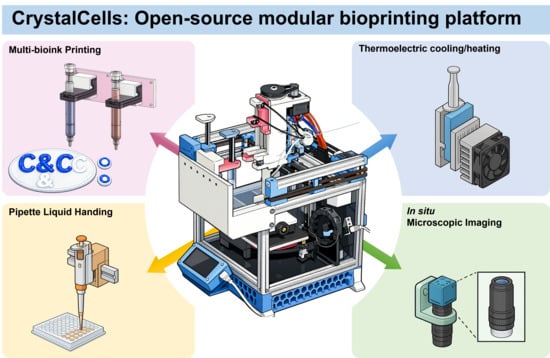
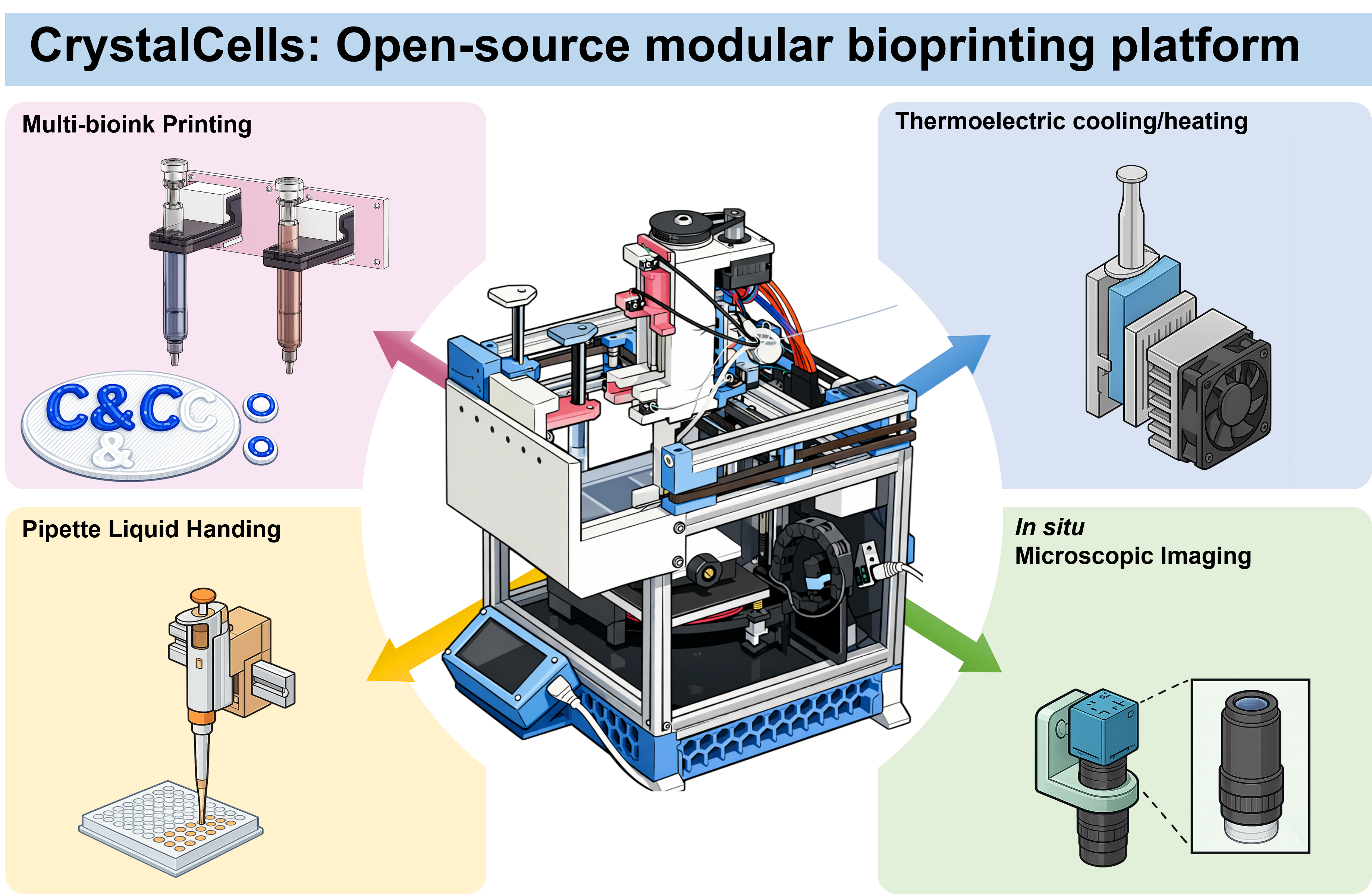
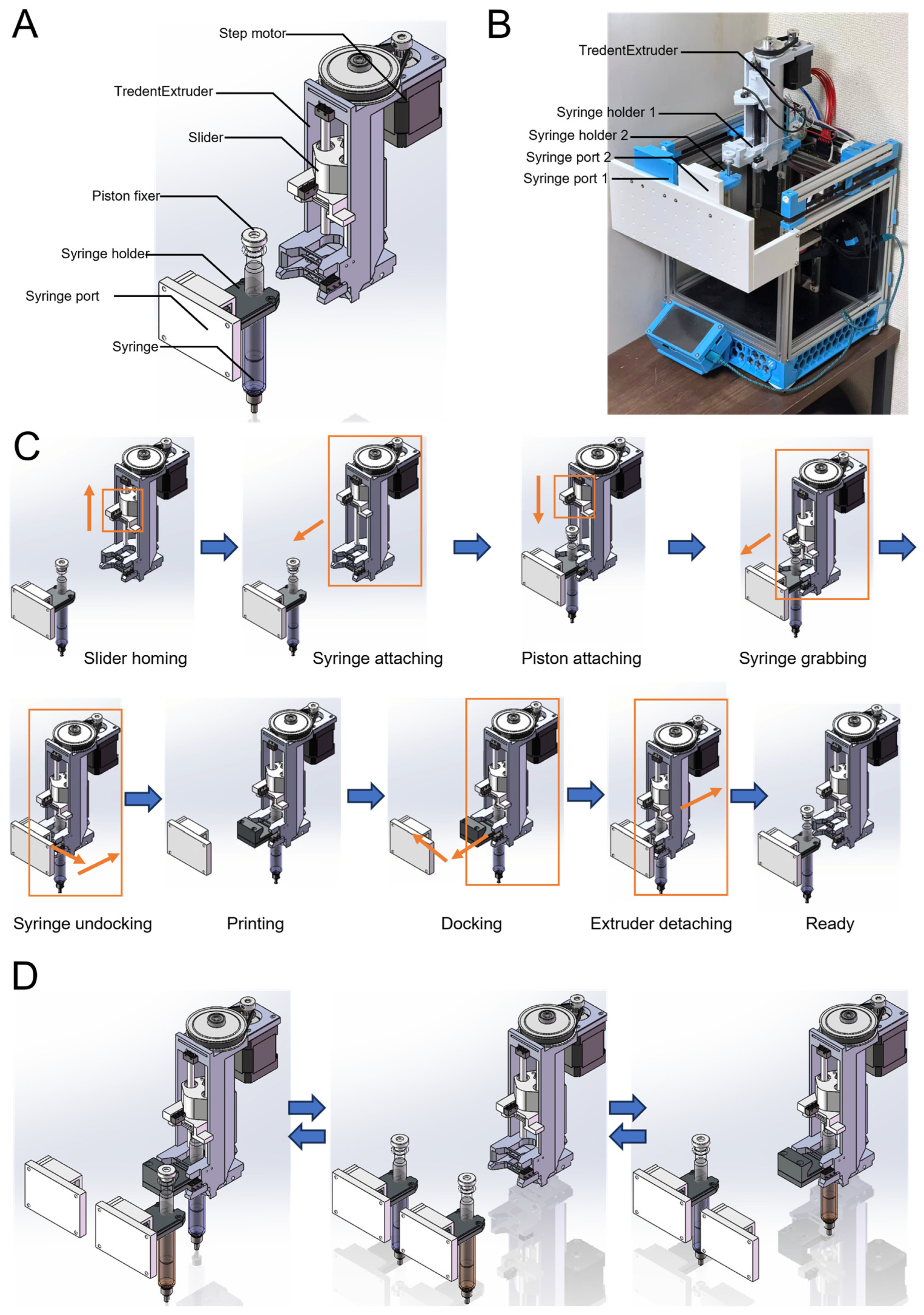
In this study, we present an open-source modular bioprinting platform designed around a high-performance extruder architecture with linear guidance, lead-screw actuation, and retraction capability. In contrast to previous open-source tool-changing approaches that exchange the entire syringe-pump tool, our system exchanges only the syringe-based or task-specific module, thereby simplifying material reloading while broadening the range of supported functions. The extruder can automatically engage modules positioned on the printer frame, including a standard syringe module, a temperature-controlled syringe module, a microscope module, and a pipette module. In addition, the system is designed to automatically identify syringe piston position after module exchange, eliminating manual screw-based rematching during reloading. Through this strategy, the platform is intended to support multimaterial bioprinting, thermosensitive biomaterial ink processing, in situ imaging, and automated liquid handling within a single reproducible open-source workflow for bioprinting and related laboratory operations.
2. Materials and Methods
2.1. Construction of the CrystalCells Bioprinter
The Voron 0.2 R2 plastic 3D printer framework was assembled according to the official Voron Design instructions (
https://docs.vorondesign.com/). All printed frame components were fabricated on a Voron Trident using blue ABS (Kexcelled, Suzhou, China). A Fly MINI Pad (Mellow, Guangzhou, China) was used as the host controller, and a Fly D5 board served as the main printer control board. Stepper motors were driven by TMC2209 drivers (Mellow), and the system was operated with Klipper firmware v0.13.0 (
https://www.klipper3d.org/).
Bioprinter conversion was performed with reference to the Replistruder 4 modification workflow, and the detailed procedure is provided in
Figure S5 [
6]. Unless otherwise stated, the TridentExtruder was printed from PLA (PINMIAO, Shandong, China), whereas the syringe ports and their mounting components were printed from ABS (Kexcelled, Suzhou, China). Printing parameters were matched to those used for the Replistruder 4, with three walls and 60% infill. All conversion-kit components were printed on a Bambu P1S printer (Bambu Lab, Shenzhen, China). The TridentExtruder was actuated by a HANPOSE NEMA 17 stepper motor with a 0.9° step angle (HANPOSE, Guangzhou, China). Two cylindrical magnets (6 mm diameter, 2.5 mm thickness) were installed in the syringe-gripping section of the TridentExtruder with the north pole facing upward. Endstop switches were mounted on both the slider and the upper portion of the TridentExtruder to support automatic syringe piston recognition. The syringe ports and their supporting frame were mounted onto the aluminum extrusion frame of the Voron 0.2 printer. Each syringe port was likewise fitted with two cylindrical magnets (6 mm diameter, 2.5 mm thickness), with the north pole facing upward
(Figures S6 and S7) (Videos S3 and S4).
2.2. Design of the Syringe Holder Modules
Syringe holder modules were designed for 2.5 mL glass syringes (Bolige Company, Shanghai, China), 5 mL gas-tight glass syringes (PTFE Luer Lock, PN: 2032260, Hamilton Company, Reno, NV, USA), and 30 mL BD syringes (Becton, Dickinson and Company, Franklin Lakes, NJ, USA) (
Figure S4B). All holder modules were fabricated from PLA. The upper and lower components were assembled using M3 screws, and the lower part of each holder was fitted with four cylindrical magnets (6 mm diameter, 2.5 mm thickness) with the north pole facing upward. For the glass syringes, the pistons were fixed to a piston adapter using screws to standardize their geometry and enable reliable gripping by the slider.
2.3. Biomaterial Inks Preparation
Three biomaterial inks were used in this study. (1) Alginate biomaterial ink was prepared by dissolving sodium alginate (Sodium Alginate 500-600, Fujifilm Wako, Japan) in deionized water to a final concentration of 4% (w/v), with 0.01% CBB R-250 (Fujifilm Wako, Japan) added for visualization. Next, 3 mL of the alginate solution was loaded into a 5 mL gas-tight syringe, and 1 mL of 1% (w/v) CaCl2 (Calcium Chloride Dihydrate, Fujifilm Wako, Japan) solution was prepared in a second syringe. The two syringes were connected, and the solutions were mixed by reciprocal extrusion for 200 cycles to obtain pre-crosslinked alginate. (2) Nivea cream (Product No. 00365, NIVEA, Beiersdorf, Hamburg, Germany) was transferred directly from the commercial product into a 30 mL syringe. After air removal, it was further transferred into a 2.5 mL gas-tight syringe. (3) The alginate–collagen biomaterial ink was prepared as follows. A 10% (w/v) type I collagen solution derived from bovine tendon (Product No. 9007-34-5, Duly Biotech Co., Ltd., Nanjing, China, average molecular weight ~1kDa) was first prepared in 1× PBS precooled to 4 °C. A 5% (w/v) alginate solution was prepared separately in 1× PBS. The precooled alginate and collagen solutions were then mixed at a 1:1 ratio. Finally, 3.5 mL of the mixed biomaterial ink was combined with 0.5 mL of 1% (w/v) CaCl2.
2.4. FRESH Gelatin Microparticle Support Bath
The FRESH v2.0 support bath was prepared according to a previously reported protocol [
6]. In brief, 2.0% (
w/
v) gelatin type B (Bovine bone gelatin, type B, Nitta Gelatin Inc., Osaka, Japan), 0.25% (
w/
v) Pluronic
® F-127 (Duly Biotech Co., Ltd., Nanjing, China, average molecular weight ~12.6 kDa), and 0.1% (
w/
v) gum Arabic (Duly Biotech Co., Ltd., Nanjing, China) were added to 50% (
v/
v) ethanol (Traceable 95, Japan Alcohol Trading Co., Ltd., Japan) in a 1 L beaker and dissolved at 45 °C. The pH was then adjusted to 7.5 with 1 M hydrochloric acid (Fujifilm Wako, Japan). The suspension was mixed using a stirrer, and the beaker was covered with parafilm to reduce evaporation while stirring was continued overnight as the mixture cooled to room temperature. The resulting gelatin microparticle suspension was aliquoted into 250 mL containers and centrifuged at 300×
g for 2 min to compact the particles. After discarding the supernatant, the pellet was resuspended in 0.1% (
w/
v) CaCl
2 solution.
2.5. Multi-Biomaterial Ink Bioprinting
For printing, alginate biomaterial ink was loaded into a 5 mL gas-tight syringe and Nivea into a 2.5 mL gas-tight syringe. Each syringe was connected to a 23G needle through a Luer-lock fitting. The prepared syringes were installed into their respective holder modules and docked in the corresponding syringe ports of the printer. Print models were processed in Bambu Studio to generate G-code, which was then uploaded to the CrystalCells printer. Automated syringe exchange was implemented by inserting a [pick syringe] command into the filament-change segment of the G-code, which triggered the syringe exchange script built into the printer system.
2.6. Measurement of Printer Positioning Accuracy
Printer travel was measured using a Mitutoyo Absolute Digimatic Indicator (Mitutoyo, Japan, 543-691B; accuracy ±2 µm) mounted on a custom PLA-printed fixture. For X- and Y-axis measurements, the indicator was rigidly fixed to the printer frame, with the probe contacting the syringe holder module. For Z-axis measurements, the indicator was mounted on the syringe holder module and automatically picked up by the CrystalCells system, while the probe contacted the print stage.
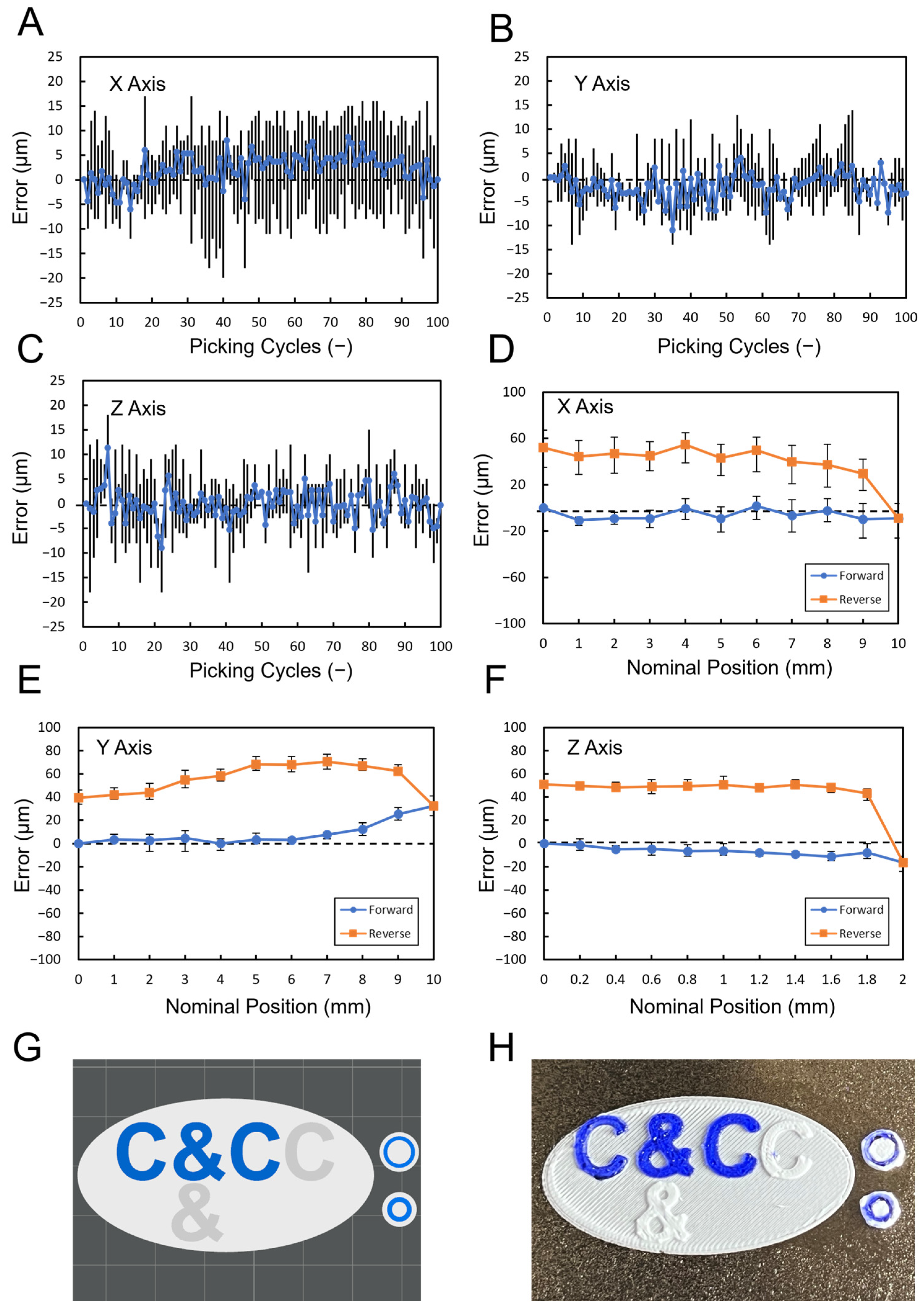
Syringe pickup repeatability was assessed by first picking up the syringe and moving the printhead to a predefined measurement position, where the indicator was zeroed. The syringe was then returned, picked up again, and brought back to the same coordinates for measurement. This cycle was repeated 100 times, and the entire procedure was repeated three times after system restart.
X- and Y-axis travel accuracy was assessed by moving the printhead in 1 mm nominal increments over a total travel distance of 10 mm under Klipper control, while recording the actual displacement from the indicator. The motion was then reversed to the nominal zero position. This procedure was repeated three times. For Z-axis travel accuracy, the same procedure was used except that the step size was reduced to 0.2 mm, because the compact structure limited the measurable stroke to less than 3 mm. As Z-axis motion in bioprinting is typically smaller than motion in the XY plane, this shorter measurement range was considered sufficient.
Slider positioning accuracy of the TridentExtruder was measured using the same approach, with the indicator mounted on the syringe holder module and the probe facing the slider. The slider was moved in 1 mm increments over seven steps.
2.7. Syringe Cooling Module
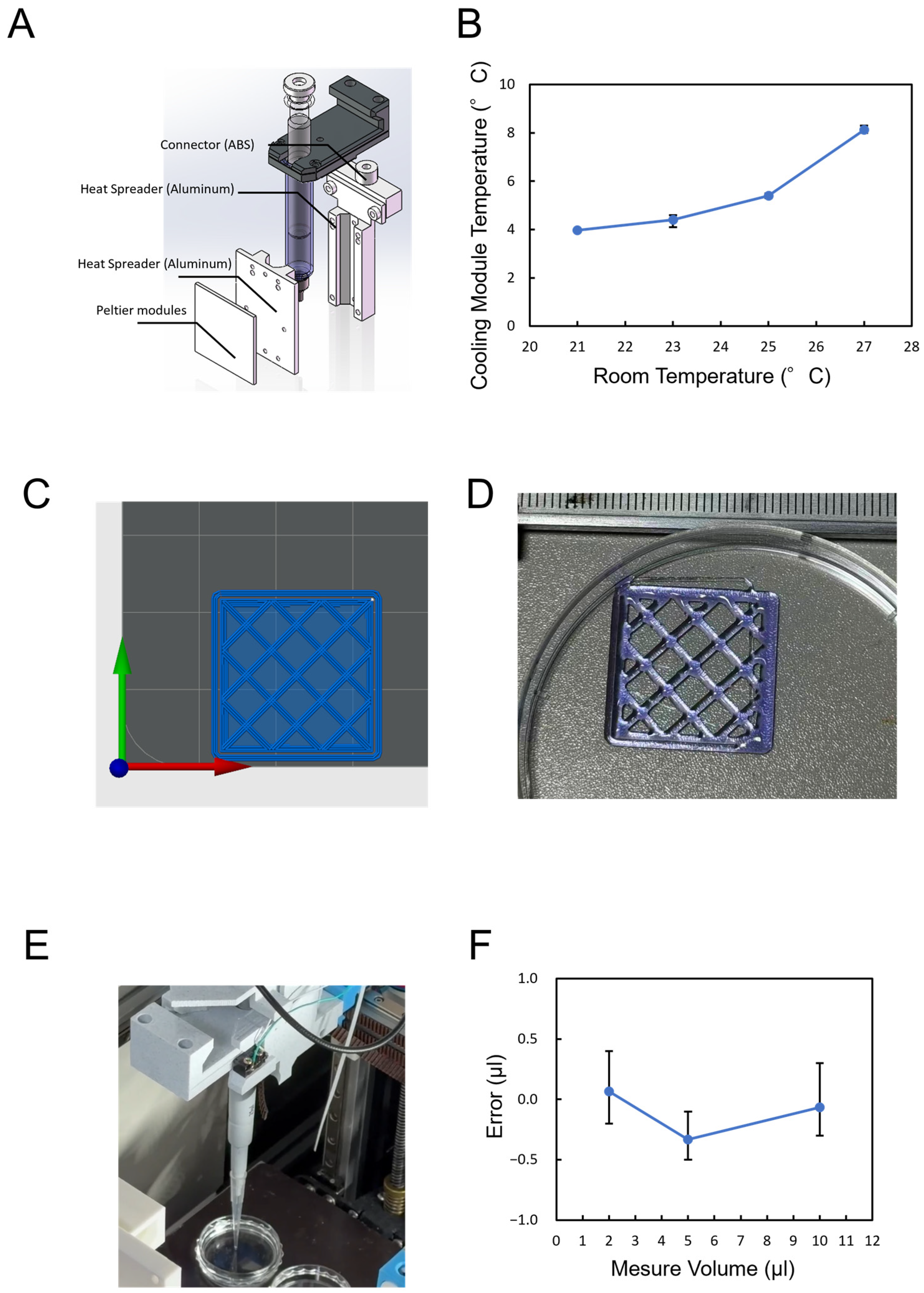
An aluminum heat spreader designed for simple CNC fabrication was developed. Machining of the aluminum plate was outsourced to Quanzhou Tec (Guangzhou, China), which provides low-cost CNC processing services. The heat spreader was mounted onto the syringe holder module using ABS-printed components. A Peltier module (TEC1-12706; Zave, Jinhua, China), coated with thermal grease and coupled to a heat dissipation assembly, was fixed to one side of the heat spreader. An NTC100K thermistor, also coated with thermal grease, was attached to the opposite side to monitor the temperature of the cooling module and regulate power delivery to the Peltier device (
Figure S4A).
2.8. Cooling Performance Evaluation
For cooling performance measurements, the printer was placed in an air-conditioned room away from the air outlet and other areas with strong thermal convection. Room temperature in the vicinity of the printer was monitored using an NTC100K thermistor, and the air conditioner output was adjusted to maintain the local temperature at 21, 23, 25, or 27 °C. The cooling module was set to 4 °C, and the module temperature was recorded after 15 min of stabilization. Measurements were repeated three times at each ambient temperature.
2.9. Printing of Alginate–Collagen Mixed Biomaterial Ink
For alginate–collagen biomaterial ink printing, the cooling module was first set to 5 °C. Once the target temperature was reached, the module was mounted onto the syringe holder containing a 5 mL gas-tight syringe filled with the alginate–collagen biomaterial ink. The assembled module was then placed in the corresponding syringe port of the printer and kept there until printing. G-code generated in Bambu Studio, including a material temperature setting of 4 °C, was sent to the printer to execute printing. After printing, the hydrogel constructs were incubated at 37 °C for 2 h to complete crosslinking.
2.10. HeLa Cell Culture
HeLa cells (RIKEN, Tsukuba, Japan) were cultured in high-glucose Dulbecco’s modified Eagle’s medium (DMEM; Gibco, Waltham, MA, USA) supplemented with 10% fetal bovine serum (BioWest, Nuaillé, France), 3.7 g L−1 Sodium Hydrogen Carbonate (Fujifilm Wako), 100 units mL−1 streptomycin sulfate (Fujifilm Wako) and 90 μg mL−1 penicillin G potassium (Fujifilm Wako) under adherent conditions using cell culture plates (Thermo Fisher Scientific, Waltham, MA, USA) at 37 °C and 5% (v/v) CO2 in a humidified incubator.
For colony formation, cells were seeded in 6-well plates (Thermo Fisher Scientific) at a density of 1000 cells per well in 2.0 mL of culture medium; after visible colonies had formed, the wells were washed with 1×PBS and fixed with 4% paraformaldehyde (Narabyori Laboratory, Nara, Japan) at 37 °C for 15 min. Fixed cells were stained with 0.05% crystal violet (Sigma-Aldrich, St. Louis, MO, USA) for 1–5 min, followed by three washes with PBS.
2.11. Microscopic Observation
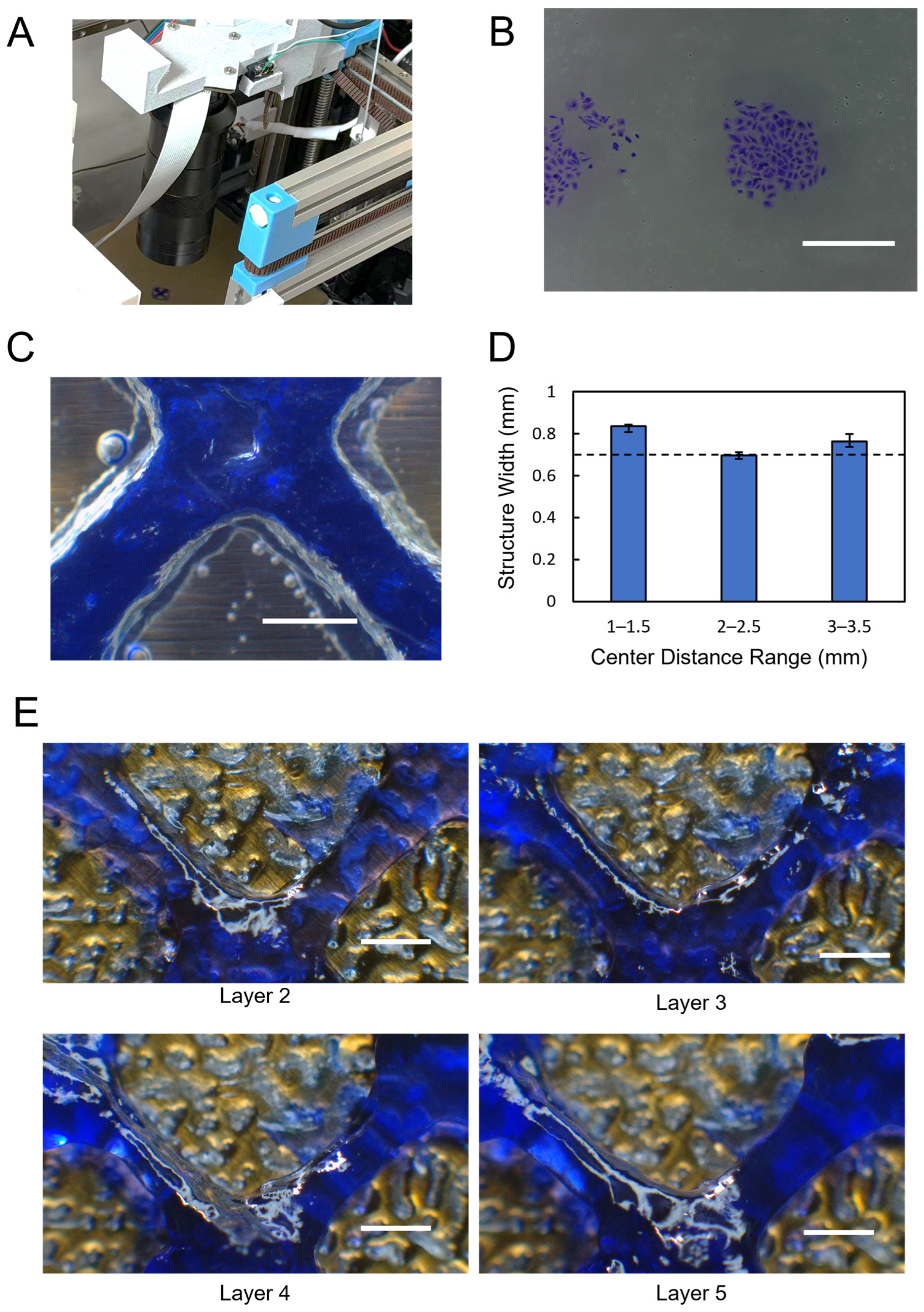
An IMX477 camera module (Waveshare, Shenzhen, China) was mounted on a custom-designed PLA-printed microscope holder module. A CS-mount microscope lens with optical magnification ranging from 0.12× to 1.8× (Waveshare) was attached to the IMX477 module, which was connected to a Jetson Nano microcomputer (NVIDIA, Santa Clara, CA, USA). The microscope holder module was docked in a syringe port and could be automatically picked up by the TridentExtruder. A culture dish containing HeLa cells or a stage micrometer was positioned on the printer stage. The target region was located by adjusting the X and Y axes of the bioprinter, and focus was achieved by Z-axis adjustment.
For automated microscopic observation during printing, the XYZ coordinate offset between the microscope focal point after pickup and the extrusion position of the syringe needle was first determined and incorporated into the control script for automatic correction. After the target position on the printed model had been defined, commands were inserted into the imaging G-code in the slicing software to return the syringe, pick up the microscope module, move to the observation position for image acquisition, return the microscope module, and re-engage the syringe. This workflow enabled fully automated layer-by-layer imaging. During imaging, the microscope lens was fixed at 1.8× optical magnification.
2.12. Measurement of Printed Construct Dimensions
Printed constructs were imaged with the microscope module at 1.8× magnification. A stage micrometer was imaged under identical conditions for calibration. The pixel length corresponding to 1 mm on the stage micrometer was determined in ImageJ 1.54p, and the pixel thickness of the thin-wall features in the printed construct was measured using the same software. These measurements were then used to calculate the actual thickness of the thin-wall features.
2.13. Liquid Handling
A 25 µL micropipette (Microlit, Lucknow, India) was mounted in a custom-designed PLA-printed holder. The holder was docked in a syringe port and could be automatically picked up by the TridentExtruder. A microtube or culture dish was positioned on the print stage. The micropipette tip was moved in the X, Y and Z directions by the motion of the TridentExtruder together with the print stage, while aspiration and dispensing volumes were controlled by slider movement.
2.14. Calibration and Error Measurement of Liquid Handling
To calibrate the liquid-handling system, ultrapure water was aspirated from a microtube using a 25 µL micropipette, and the remaining weight of the source tube was measured with an analytical balance (tuning-fork vibration system, HTR-220, ±0.0003 g; SHINKO DENSHI Co., Ltd., Tokyo, Japan). This measurement was used to determine the aspirated volume and establish the relationship between slider displacement and aspirated volume. For error analysis, samples of 2, 5, and 10 µL of liquid were aspirated based on the calibrated displacement–volume relationship and transferred into a pre-weighed microtube. The total mass was then measured, and the transfer error was estimated assuming a water density of 1 g mL−1.
2.15. Statistical Analysis
Statistical comparisons were performed using an ANOVA test, with p < 0.05 being considered to indicate a statistically significant difference.
2.16. Use of Generative AI Tools
A generative AI tool, ChatGPT (OpenAI, San Francisco, CA, USA; GPT-5.4 Thinking), was used only to assist with language polishing and improvement of sentence clarity during manuscript preparation. The authors reviewed and edited all AI-assisted text and take full responsibility for the final content of the manuscript.
4. Discussion
In recent years, a wide range of open-source bioprinters has been developed [
6,
11,
19]. However, establishing an open-source bioprinting platform that is both multifunctional and standardized remains challenging. In this study, by modifying the fully open-source Voron 0.2 printer and Klipper firmware, we developed a multifunctional bioprinting platform capable of employing fully automated tools and syringe exchange. The resulting system supports multi-biomaterial-ink printing, cooled printing, FRESH printing, microscopic observation and liquid handling.
The CrystalCells 3D printing tool-management system presented here is based on a modular universal tool interface combined with an automated tool pickup and placement mechanism. All tools included in the toolkit described in this study can be automatically picked up and placed by the TridentExtruder. The modular toolset currently includes syringe kits ranging from 2.5 mL to 30 mL, a cooling module compatible with 2.5–5 mL syringes, a microscopic imaging module and a liquid-handling module (
Figure S4).
Existing strategies for multimaterial bioprinting generally fall into three categories. The first is remote extrusion with a shared printhead, which is attractive because of its low cost, simple construction, and low moving mass. However, this approach may be less suitable for highly viscous materials and can suffer from unintended material mixing or material waste during switching. The second strategy uses multiple extruders mounted in parallel. This configuration enables efficient multimaterial printing without cross-contamination or switching waste, but it requires multi-nozzle calibration, occupies substantial space on the motion axis, increases moving load, and often raises system cost. The third strategy relies on toolhead or extruder exchange, which reduces moving mass and local space occupation by shifting more hardware to the printer frame. However, this approach still requires multiple extrusion modules and their associated calibration, which can increase both cost and system complexity.
In contrast, our platform adopts a different design concept: only the syringe and its holding module are exchanged, while the extrusion drive mechanism remains unified. This architecture allows each material to be stored in an independent syringe–needle unit, helping to reduce cross-contamination while avoiding the need to calibrate multiple separate extrusion systems. At the same time, it reduces occupied space, moving mass, and hardware cost relative to multi-extruder configurations. In addition, because the exchangeable unit is not limited to a conventional extrusion module, this strategy may support switching among different tool types and thereby provide a more modular framework for biofabrication workflows.
A major advantage of the system is its low cost and ease of assembly. The CrystalCells system and TridentExtruder components required to convert a plastic 3D printer into a bioprinter are fabricated primarily by 3D printing from PLA or ABS, with the remaining parts consisting of commonly available screws, motors and other standard components. The modification costs less than USD 300, with Hamilton gas-tight syringes accounting for most of the expense. Assembly is also straightforward: except for the cooling module, all functions can be fabricated and assembled using common tools and without metalworking. The Voron 0.2 platform itself is also inexpensive, with an estimated build cost of approximately USD 400 according to its official documentation. Although the interface described here was designed specifically for Voron 0.2, the underlying design principles are transferable. In principle, any CoreXY printer capable of running open-source firmware could adopt this system with only minor interface modifications. Candidate platforms include the Creality K1 and Flashforge Adventurer 5M, both of which already have active open-modification communities.
The CrystalCells tool-exchange system and TridentExtruder were validated on the compact Voron 0.2 platform. The assembled printer measured only 230 mm × 320 mm × 450 mm and weighed 5.25 kg including two syringes, making it light enough to be carried with one hand and readily moved into or out of a biosafety cabinet. This compact form factor not only improves portability but also broadens the range of possible operating environments. In particular, the current system is small enough to be placed inside a biosafety cabinet, which may facilitate aseptic handling in future cell-related printing workflows. This compactness, however, also imposes limitations. The Voron 0.2 provides a nominal motion range of 120 mm × 120 mm × 120 mm, and because the CrystalCells tool-exchange system stores tools within the printer’s XY motion envelope, 70 mm of Y-axis travel is sacrificed. Together with the reduction in Z-axis travel imposed by syringe length, the effective bioprinting volume is limited to 120 mm × 50 mm × 50 mm. Even so, this build volume remains sufficient for many routine bioprinting applications.
A systematic review has reported that pressures in the range of approximately 400–1000 kPa have been used for materials such as alginate, GelMA, and hyaluronic acid in extrusion bioprinting [
24]. In addition, commercial pneumatic bioprinters typically operate in a comparable order of magnitude. For example, the CELLINK INKREDIBLE+ specifies a maximum operating pressure of 700 kPa, while Allevi systems specify maximum pressures of 100–120 psi (approximately 689–827 kPa). In this context, the measured maximum pressure capability of approximately 950 kPa in the TridentExtruder suggests that pressure capacity is unlikely to be the primary limiting factor for many extrusion-based bioprinting materials. It should also be noted that CrystalCells uses syringe-based mechanical extrusion rather than constant-pressure pneumatic extrusion.
The same spatial constraints also limit the number of tools that can be mounted simultaneously. On Voron 0.2, the CrystalCells tool-exchange system can accommodate only two modular tools at a time. On larger platforms such as Voron 2.4 or Voron Trident, however, the available XY travel of up to 350 mm × 350 mm could allow substantially greater tool capacity. In particular, the moving-Z toolhead architecture of Voron 2.4 may permit further expansion. For example, on Voron 2.4 with a nominal build volume of 350 mm × 350 mm × 350 mm, it should be feasible to accommodate at least eight modular tools while retaining an effective build volume of approximately 350 mm × 280 mm × 280 mm. These considerations highlight the scalability of the design and its potential for broader functional integration.
Repeatability tests showed that the unidirectional positioning error over a 10 mm travel distance along the XY plane was below 25 µm, whereas backlash during reverse motion remained below 70 µm. Along the Z-axis, over a 2 mm travel distance, the unidirectional error was also below 25 µm and reverse-motion backlash remained below 60 µm. These values are comparable to those previously reported for a bioprinter modified from the Flashforge Finder platform and are adequate for most extrusion-based bioprinting applications [
6].
Compared with commercial bioprinters, the CrystalCells platform occupies an interesting position. CELLINK offers both the higher-cost BIO X, which supports multimaterial printing, and the more affordable BIO ONE, which supports only single-syringe extrusion (
https://www.cellink.com/bioprinting, accessed on 5 March 2026). CrystalCells provides multi-biomaterial-ink printing, compatibility with different syringe types, cooling and heating capability, and automated image acquisition. Functionally, it is therefore closer to the BIO X, while costing substantially less than the BIO ONE. By contrast, the BIO ONE does not support multi-biomaterial-ink printing. CrystalCells does not yet match the positioning specifications of commercial systems, such as the 1 µm resolution claimed for the BIO X or the XY (10 µm) and Z (2.5 µm) specifications of the BIO ONE. Replacing the belt-driven toolhead motion with a high-precision ball-screw system could improve positioning accuracy but would substantially increase both cost and assembly complexity. Given the current resolution limits of extrusion-based biomaterial inks themselves, the positioning performance achieved here is nevertheless likely to be sufficient for many practical applications.
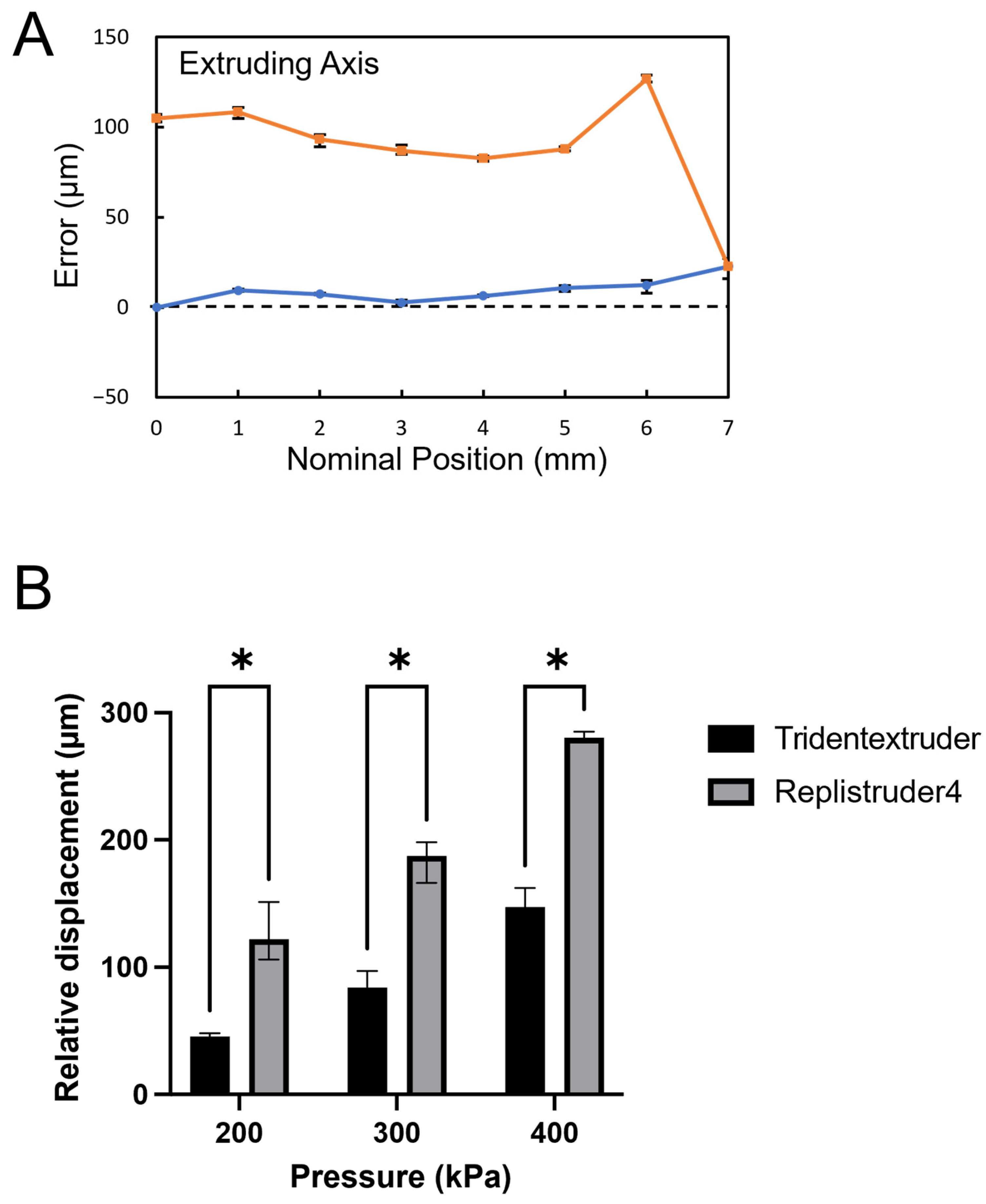
Performance testing further showed that the TridentExtruder had a unidirectional error below 27 µm over a 7 mm travel distance, indicating adequate precision for controlled extrusion. In pressure tests, the TridentExtruder also outperformed the widely used Replistruder 4 [
19]. This improvement likely arises from the more stable monolithic extruder core, the reduced distance between the syringe axis and the drive-screw axis, and the use of three guide rods. Mechanical performance could likely be further improved by replacing the extruder core material with a stronger engineering polymer such as PPA-CF. Commercial bioprinters such as the CELLINK BIO X and BIO ONE also support syringe extrusion but are limited to syringe volumes of 3 mL or less. Although their actual pressure performance was not evaluated here, their mechanical architectures, characterized by fewer linear guide elements and a longer offset between the transmission axis and the syringe center, suggest a lower theoretical stiffness limit than that of the TridentExtruder.
A broader issue highlighted by this work is the lack of modularity and standardization in the open-source bioprinting community. Open-source communities typically advance by building on shared designs, reusable components and common software foundations. The success of open-source software and desktop 3D printing has been driven in large part by iterative development on top of previously shared achievements. In bioprinting, by contrast, open-source platforms remain fragmented, with major differences in architecture and poor cross-platform compatibility of components. As a result, researchers seeking to upgrade existing systems often need to develop entirely new hardware and relearn both assembly and operation.
To facilitate incremental upgrading and improve cross-platform compatibility, the TridentExtruder was intentionally designed to retain key strengths of the Replistruder 4. The syringe holder preserves the same dimensions and is therefore fully compatible across the two systems. The assembly process is also largely unchanged, allowing users familiar with the Replistruder 4 to adopt the TridentExtruder with minimal additional effort. The two systems can directly share the syringe holders, and the TridentExtruder can grip the Replistruder 4 syringe holder without screws, enabling rapid manual attachment and detachment.
Despite these advantages, open-source bioprinting systems still face substantial challenges relative to commercial platforms, particularly in positioning accuracy, durability, and standardization. The goal of this study was to establish and validate the core engineering framework of CrystalCells—including modular tool exchange, multifunctional integration, and low-cost open-source implementation—on a compact desktop platform. Therefore, the present work should be interpreted as a proof-of-concept study and provide an accessible bioprinting solution for laboratories with limited resources, while several limitations remain.
First, the effective build volume of the current Voron 0.2-based implementation (120 mm × 50 mm × 50 mm) is suitable for small tissue constructs, organ-on-chip fabrication, and other compact biofabrication applications. However, this size is insufficient for larger and more physiologically relevant tissue constructs. Because the underlying CrystalCells concept is not restricted to the Voron 0.2 platform, it can in principle be adapted to other open-source CoreXY-based 3D printers after appropriate mechanical integration. To extend the applicability of this concept, we have started constructing and testing a larger implementation based on the Voron 2.4 platform as our future proposal. The corresponding design files have been released through our open-source GitHub repository and Zenodo archive, and a
supplementary figure has been added to illustrate this scale-up design direction (
Figure S10).
Second, the current system supports only two stored tools/syringes. This limitation reflects a design trade-off made to preserve reliability under low-cost fabrication conditions and limited machining precision. In the present implementation, the locking and pickup geometry occupies substantial space, which restricts dense tool storage in the compact Voron 0.2 architecture. With improved fabrication precision and a more compact locking mechanism, denser tool storage should be achievable even on the same printer platform. In addition, migration to a larger architecture such as Voron 2.4 is expected to further increase tool capacity. Both directions are part of our ongoing development plans.
Third, motion precision remains limited by the current mechanical transmission system. The maximum backlash observed in CrystalCells was approximately 70 μm, which is likely attributable to the combined effects of the open-loop stepper motor system, timing belt-driven motion, and the use of an M8 screw in the extruder rather than a backlash-reduced ball screw. Although this level of precision is lower than that of some commercial bioprinters and advanced ball-screw-based systems, it is still sufficient for many extrusion-based bioprinting tasks using nozzle diameters of 0.2 mm or larger, especially when considering the low-cost design goals of the platform. In this sense, the current configuration represents a practical compromise between cost and precision for resource-limited laboratories. At the same time, users with higher precision requirements could further improve motion performance by adopting higher-precision motion components at increased cost. To address this issue, we have already begun testing closed-loop stepper control and plan to replace the current screw- and belt-driven elements with ball-screw-based solutions in future iterations.
Fourth, the present platform relies heavily on 3D-printed PLA/ABS components, whose fabrication accuracy is inherently influenced by printer performance, material shrinkage, and dimensional tolerance. Such variation may affect the homogenization and repeatability of the tool-exchange workflow. To mitigate this, the printhead–tool interface was designed so that positional fixation is determined primarily by insertion into the mechanical end position and interference–fit interface, with magnets serving mainly as auxiliary components for insertion guidance and retention. We further confirmed that acceptable repeatability could still be maintained even without magnetic assistance, with repeated tool exchange yielding XYZ positional errors within ±25 μm over 100 cycles. Nevertheless, environmental conditions, long-term wear, and material aging may affect the stability of this mechanism and warrant further evaluation.
In addition, repeated cleaning and prolonged use may affect the long-term integrity of printed PLA/ABS components, particularly at thin or stress-concentrating features. Previous studies have shown that additively manufactured thermoplastic parts can undergo structural and mechanical changes after repeated exposure to ethanol- or chlorine-based disinfectants. In our system, the 3D bioprinting region intended for sterilizable operation is covered by acrylic panels, while electronic components that are more difficult to disinfect are similarly enclosed by acrylic shielding. This design helps reduce direct exposure of the major printed structural parts to routine chemical or UV-based disinfection. Components located closest to the biomaterial ink, such as the syringe holder, were intentionally designed as simple and low-cost replaceable parts and may be treated as consumables when stricter cleanliness control is required. Systematic evaluation of fatigue resistance and chemical durability under realistic laboratory cleaning protocols remains an important topic for future work.
Fifth, contamination control and operational biosafety remain important practical constraints. The current system does not incorporate built-in UV sterilization or HEPA filtration. Accordingly, the printer is intended to be operated inside a biological safety cabinet when used with biomaterials or cells. The electronic and mechanical components are enclosed within acrylic panels, whereas the build chamber itself has a relatively simple internal geometry that can be disinfected before and after use. In our intended workflow, the printer is maintained in a controlled P2/BSL-2 laboratory environment, the chamber surfaces are disinfected with ethanol after use, and components directly contacting biomaterials, such as gas-tight syringes, are sterilized by autoclaving when appropriate. Thus, the term “user-friendly” in this study refers to operational accessibility for trained laboratory users and should not be interpreted as implying exemption from biosafety, risk assessment, or future regulatory requirements.
Sixth, only a limited range of biomaterials was evaluated in the present study, including alginate and collagen, and cell-laden bioinks were not tested. In addition, although photo-crosslinkable bioinks such as GelMA represent an important class of materials in bioprinting, they were not experimentally validated here. Owing to its modular architecture, CrystalCells can in principle be adapted for such materials through integration of an external light-curing component. To explore this possibility, we designed a simple UV lamp holding device that can be mounted to the platform (
Figure S9A,B), providing a basis for post-deposition or in situ photocuring. Future work will focus on validation using GelMA and/or cell-laden photocurable bioinks, while also considering irradiation conditions and possible effects on cell viability.
Despite these limitations, the platform presented here provides a practical and low-cost route to satisfy the basic requirements of multimaterial and multi-tool bioprinting research. Achieving substantially higher precision, larger build volume, higher tool capacity, and more advanced biosafety integration would inevitably increase system cost and complexity. Our future strategy is therefore not only to improve the baseline platform but also to develop modular upgrade options so that researchers can select different levels of performance expansion according to their own experimental priorities, such as precision, build volume, or material compatibility.