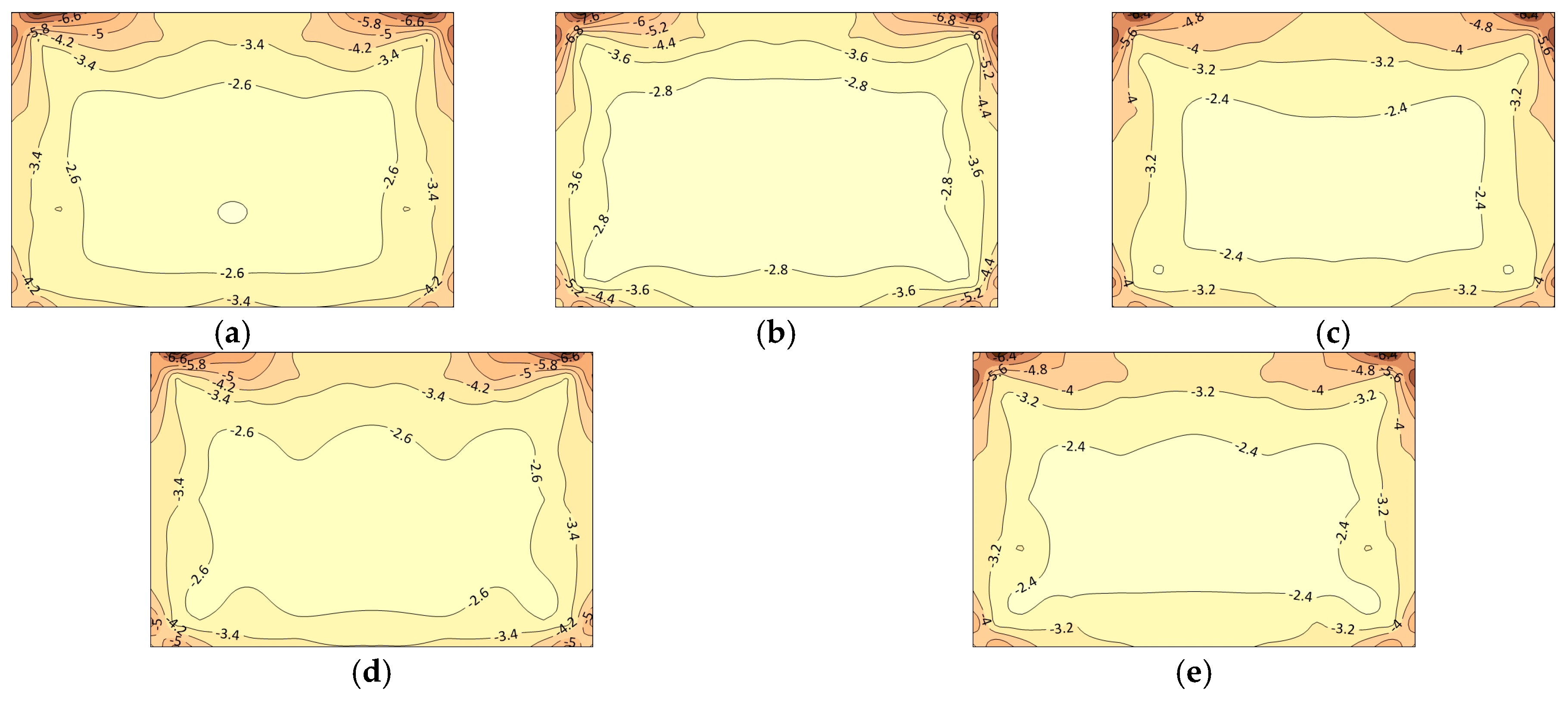
In this section, four typical wind direction angles, namely 0°, 45°, 135°, and 180°, are selected for analysis. Among them, 0° and 180° are symmetric wind directions, corresponding to the windward and leeward conditions of the photovoltaic roof under the influence of parapets, respectively, facilitating a comparison of the effects of different incoming flow directions on wind pressure distribution. Furthermore, studies by Jiang et al. indicate that open canopy structures are prone to significant unfavorable wind pressures under a 45° wind direction [
10], with the resulting oblique separation flow having a pronounced effect on the roof corner region—a similar mechanism exists in the rooftop overhead photovoltaic system in this study. Meanwhile, research by Stathopoulos et al. points out that the 135° wind direction is the most unfavorable for negative wind loads on flat-roof solar panel systems [
25]. Therefore, 45° and 135° are included in the analysis of typical wind directions to cover the most unfavorable conditions. Regarding extreme wind pressures, since wind-induced damage to photovoltaic roofs is primarily governed by wind suction, this paper only discusses the minimum pressure coefficients.
3.1. Mean and Fluctuating Wind Pressure Distribution
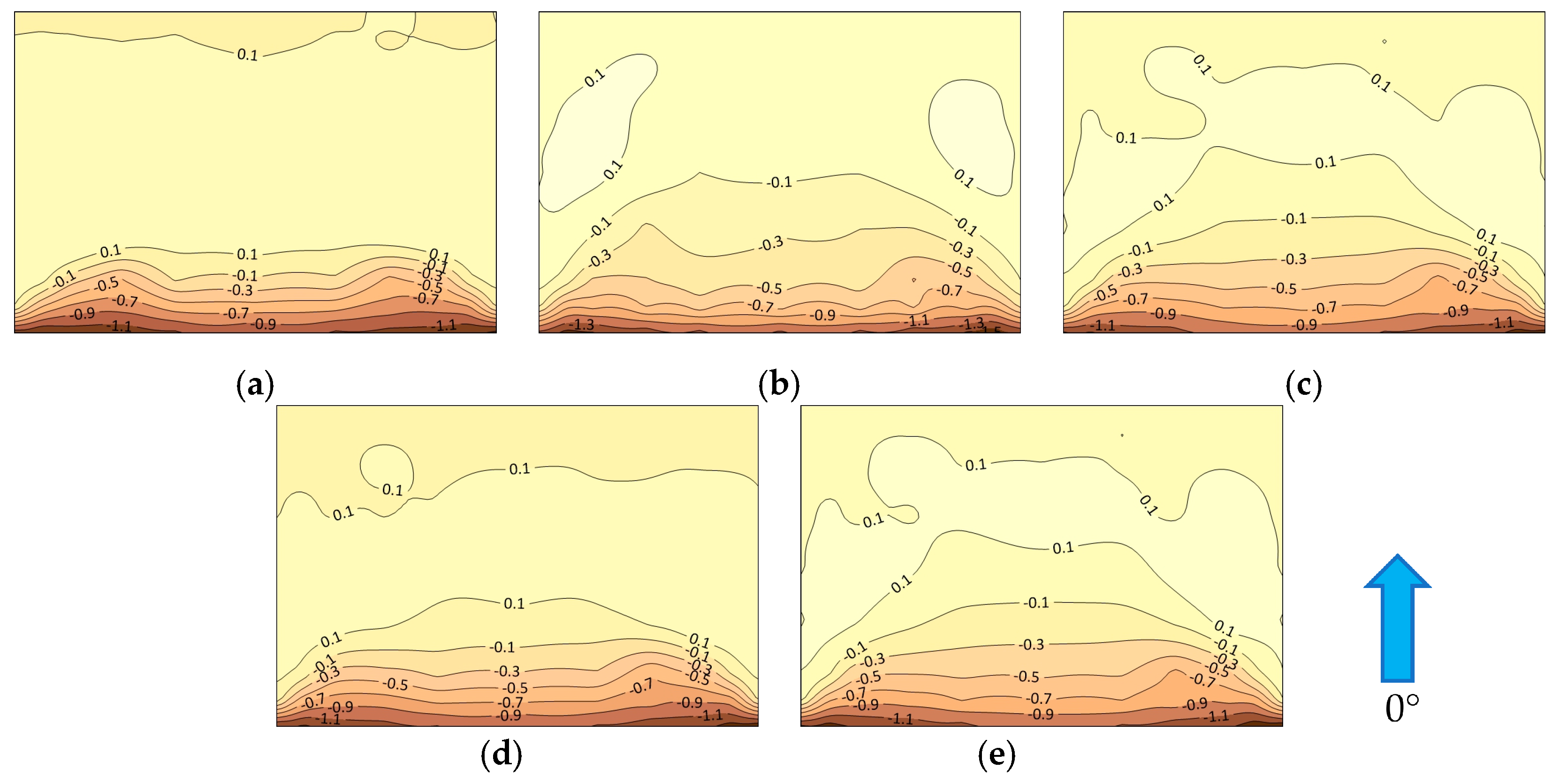
Figure 5 presents the distribution of net mean wind pressure on the overhead photovoltaic roof installed on a building rooftop under different parapet configurations at a wind direction angle of 0°. As shown in
Figure 5a, the wind load on the overhead photovoltaic roof is predominantly negative. The incoming flow separates at the windward lower eave of the roof, and the separated shear layer rolls up to form columnar vortices. These vortices, with axes parallel to the windward edge, extend along the roof span and create a region of strong negative pressure. Among these, the negative mean pressure coefficient reaches its maximum value of −1.38 in the windward corner region. The contour lines of wind pressure distribution are approximately parallel to the windward low eave of the roof, and the negative mean wind pressure coefficient gradually decreases along the incoming wind direction. The maximum negative pressure at the windward corner is attributed to bidirectional flow separation; the airflow separates simultaneously along both the long and short edges of the photovoltaic panel, and the coupling of these two separation zones significantly increases the negative pressure magnitude. Notably, the study by Jiang et al. indicated that under a 0° incoming flow, an open canopy installed on a building also experiences airflow separation at the windward leading edge, forming columnar vortices and generating maximum negative pressure at the windward corner. This conclusion is highly consistent with the experimental results of this study.
As shown in
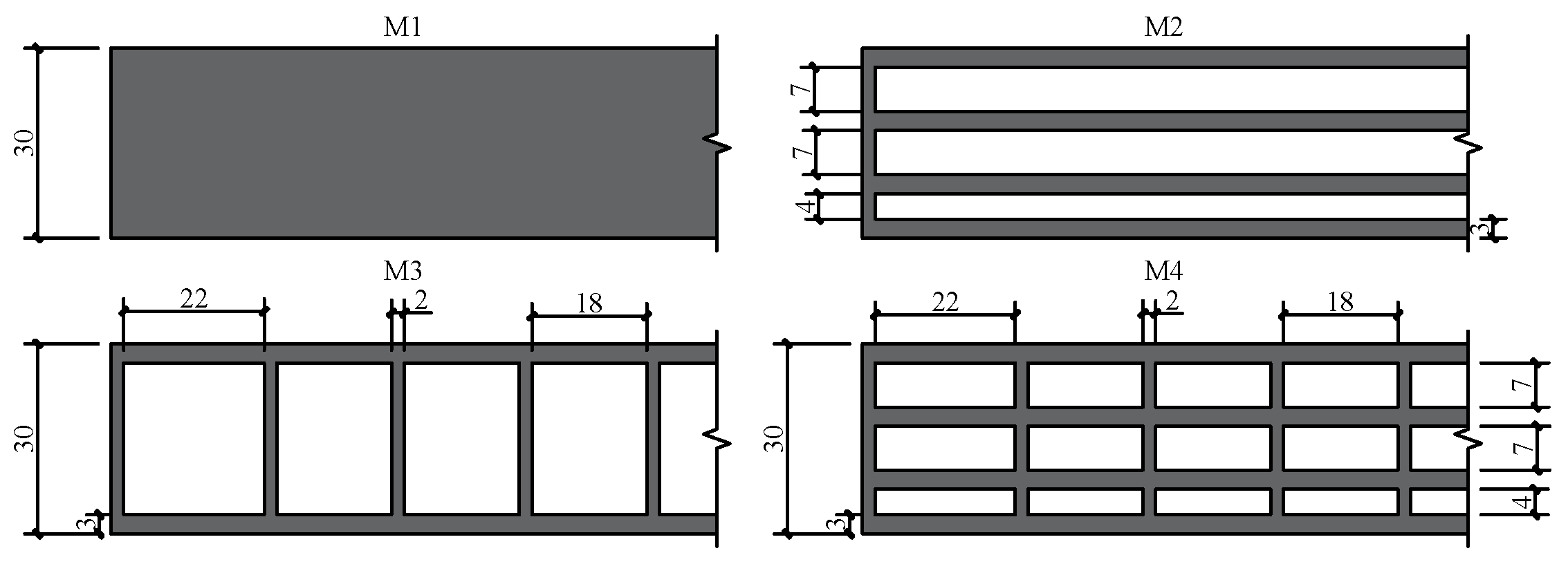
Figure 5b–e, the mean wind pressure distributions of the overhead photovoltaic roof under different parapet configurations exhibit similar patterns, and the maximum negative mean wind pressure coefficient consistently appears in the windward low-eave corner region. The maximum negative mean wind pressure coefficients for models M1 to M4 are −1.64, −1.43, −1.45, and −1.47, respectively, representing increases of 19%, 4%, 5%, and 7% compared with the value of −1.38 for Ref. These results indicate that the presence of parapets increases the maximum negative mean wind pressure coefficient on the roof, but only the solid parapet causes a significant increase. This is because the solid parapet more effectively blocks and guides the incoming flow, altering its flow path, which intensifies flow separation on the upper surface of the photovoltaic roof while shortening the impact path of the separated airflow from the parapet top to the lower surface of the roof. Consequently, a windward pressure amplification effect occurs [
15], resulting in a greater increase in negative pressure near the windward leading edge. Although models M2, M3, and M4 exhibit similar effects, their permeable railings guide and dissipate the incoming flow, which suppresses the flow separation and vortex development near the roof to a certain extent, thereby producing a smaller increase in negative pressure.
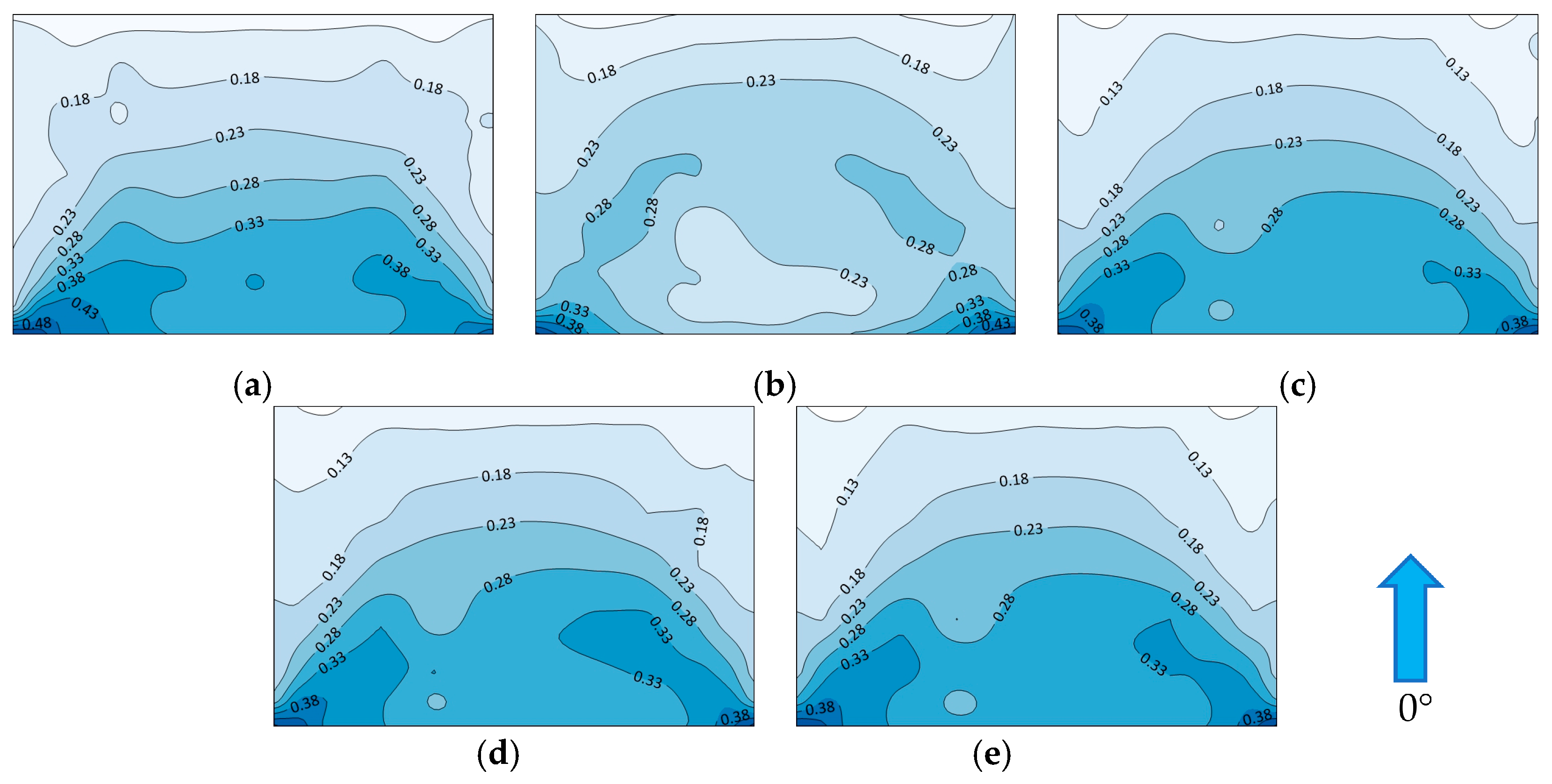
Figure 6 displays the net fluctuating wind pressure distribution characteristics on the overhead photovoltaic roof under diverse parapet configurations when the wind direction is 0°. The figure demonstrates that the peak value of the fluctuating wind pressure coefficient on the photovoltaic roof is attained at the windward leading edge. Compared with the case without parapets, the presence of parapets reduces the coefficient of fluctuating wind pressure along the windward edge of the photovoltaic roof, while slightly increasing the coefficient at the leeward trailing edge. As shown in
Figure 6b–e, compared with the no-parapet case (Ref), all types of parapets significantly reduce the fluctuating pressure coefficient in the region near the windward front edge of the photovoltaic roof. The maximum fluctuating wind pressure coefficients for models M1 to M4 are 0.55, 0.51, 0.50, and 0.49, representing reductions of 9%, 14%, 15%, and 17%, respectively, compared with 0.59 for the Ref case. This is because the wind pressure on the photovoltaic roof results from the coupled effects of airflow separation at the roof’s own leading edge, the rooftop parapet, and the bottom building rooftop. The presence of parapets therefore influences the airflow separation on both the photovoltaic roof and the bottom building rooftop.
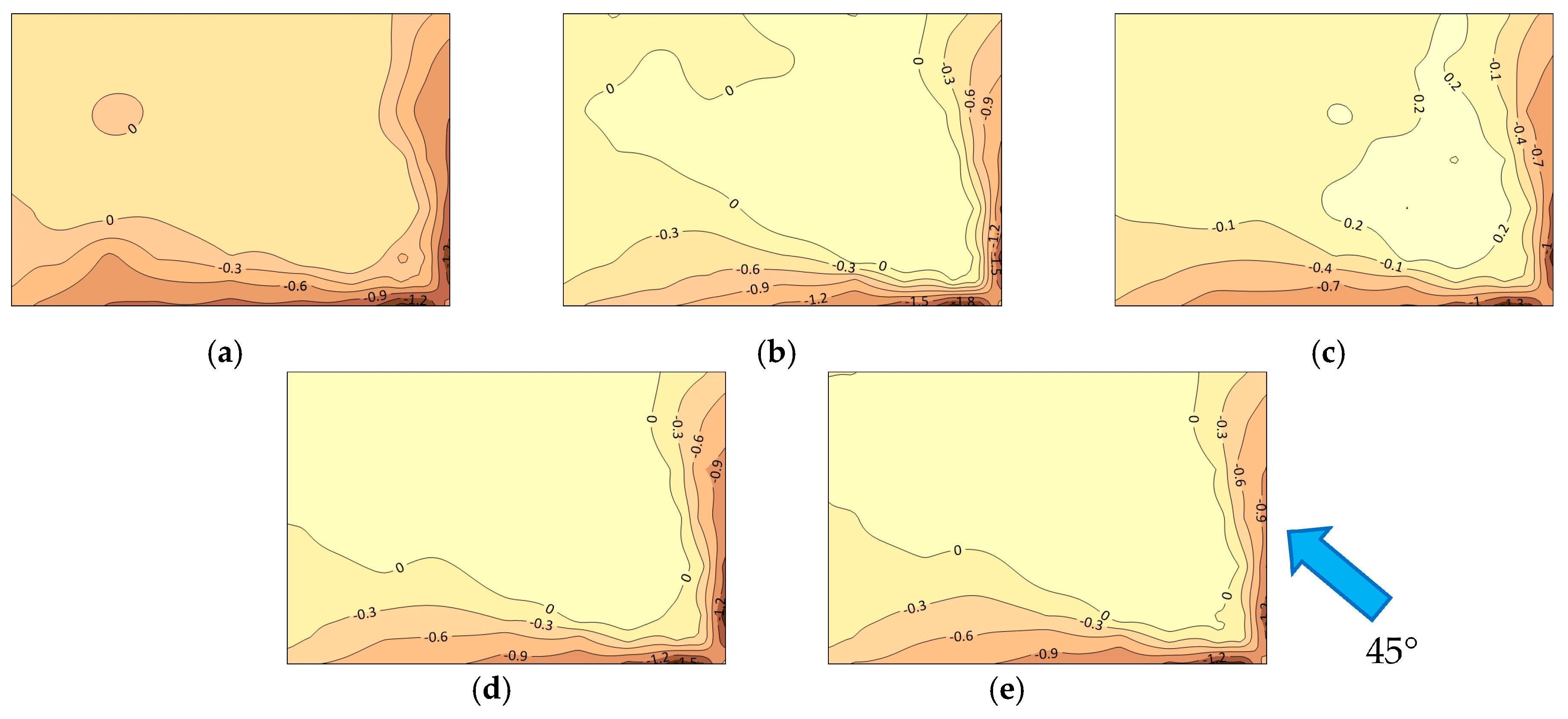
Figure 7 displays the net mean wind pressure distribution characteristics on the overhead photovoltaic roof installed on a building rooftop under different parapet configurations at 45° wind incidence. As shown in the figure, when the wind direction angle is 45°, the incoming flow obliquely impinges on the roof corner, causing flow separation on both sides of the windward corner. The separated shear layer rolls up to form conical vortices. The vortex core originates from the corner and develops downstream, thereby generating a strong suction zone in the windward corner region. As the influence of the conical vortices is primarily along the windward edge, the wind pressure intensities over non-windward roof areas are relatively modest; furthermore, the intensity of the conical vortices gradually decreases along the direction of the incoming flow. This is consistent with the findings of Jiang et al. on the wind pressure distribution of an open canopy on a building rooftop under a 45° incoming flow. Additionally, it can be observed that compared to the case without parapets, the solid parapet (M1) significantly increases the negative mean pressure coefficient at the windward leading edge, whereas the other parapet types have no significant effect on the pressure coefficient. The maximum negative mean pressure coefficients for models M1 to M4 are −2.28, −1.55, −1.77, and −1.72, respectively; compared with the Ref case value of −1.65, M1, M3, and M4 show increases of 38%, 7%, and 4%, respectively, while M2 shows a decrease of 6%. It is thus evident that the solid parapet significantly alters the wind load on the area near the windward front edge of the overhead photovoltaic roof, whereas the perforated parapets do not have a significant effect.
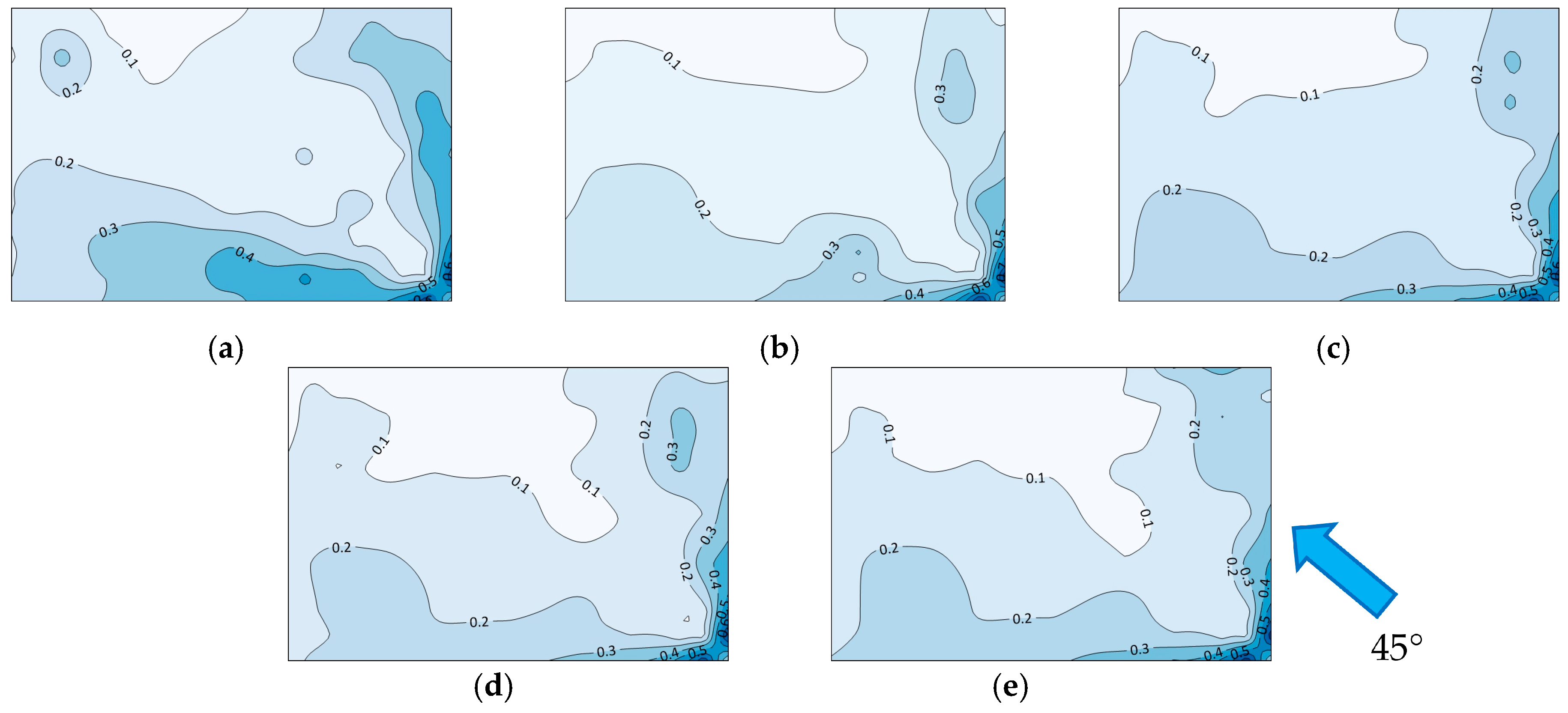
Figure 8 presents the distribution of net fluctuating wind pressure on the overhead photovoltaic roof installed on a building rooftop under different parapet configurations at a wind direction angle of 45°. It can be seen from the figure that the airflow forms conical separating vortices on both windward sides of the overhead photovoltaic roof, resulting in large fluctuating wind pressure coefficients at the windward corners. Compared with the no-parapet case (Ref), the various parapets types all have a certain degree of influence on the fluctuating pressure at the windward corner leading edge, while the changes in the fluctuating wind pressure coefficient on the rest of the roof are comparatively weak. The maximum fluctuating wind pressure coefficients for models M1 to M4 are 0.99, 0.81, 0.85, and 0.79, respectively; compared with the Ref case value of 0.80, M1, M2, and M3 show increases of 24%, 1%, and 6%, respectively, while M4 shows a decrease of 1%. This is because, under a 45° incoming flow direction, the solid parapet (M1) more effectively accelerates the convergence of airflow at the corner areas of the overhead photovoltaic roof, further stimulating the development of conical vortices, thus leading to more intense fluctuations in vortex separation. It is thus evident that, similar to its effect on the mean pressure coefficient at 45°, the solid parapet substantially modifies the fluctuating wind pressure in the windward leading edge region of the overhead photovoltaic roof, whereas the perforated parapets have a relatively minor effect.
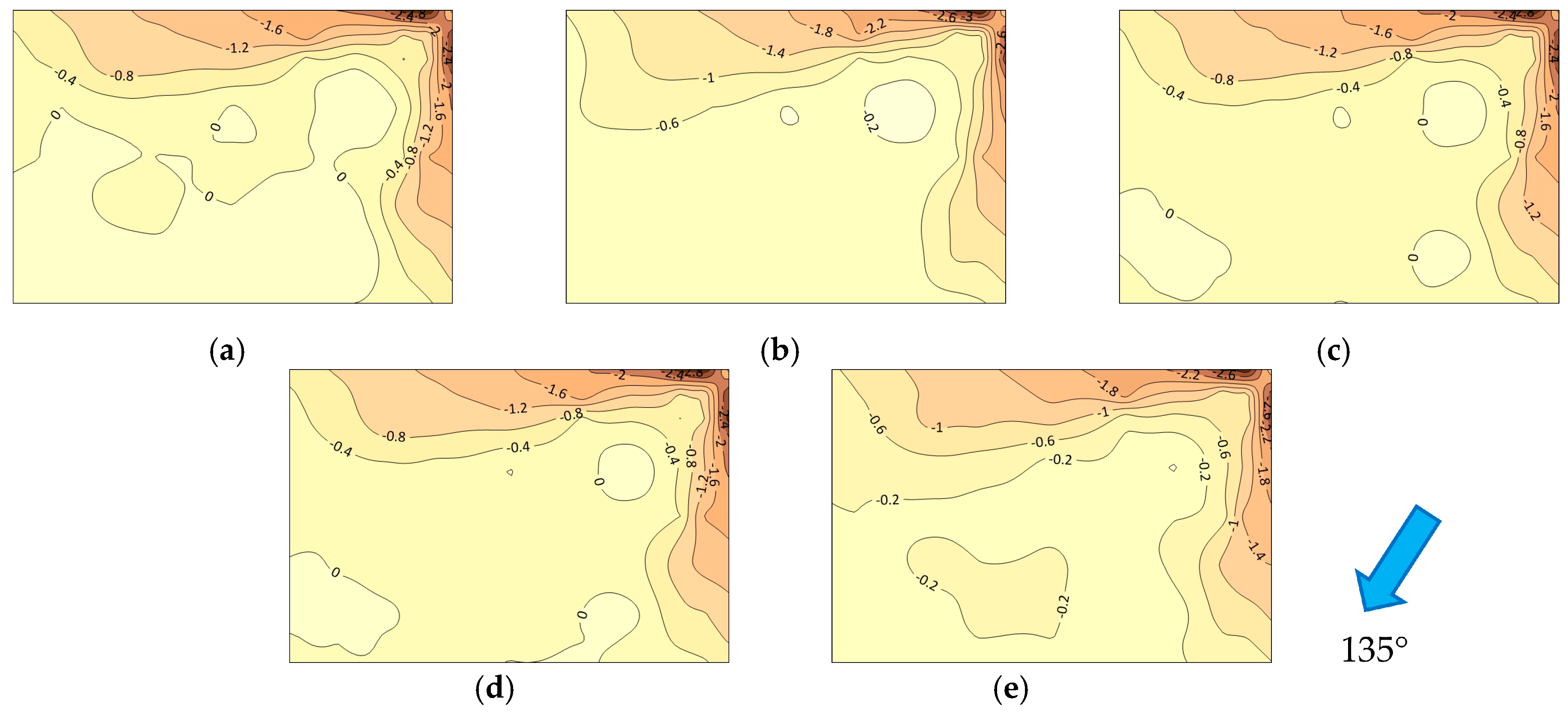
Figure 9 shows how the net mean wind pressure is distributed on the overhead photovoltaic roof installed on a building rooftop under different parapet configurations for wind approaching from 135°. It can be seen from
Figure 9 that the net mean pressure distribution for a 135° incoming flow is similar to that for a 45° incoming flow. However, the coverage area of negative pressure is significantly enlarged, and its intensity is also markedly enhanced. Taking the no-parapet case (Ref) as an example, the range of the mean pressure coefficient changes from 0.10 to −1.65 at a 45° wind direction to 0.04 to −3.26. This is attributed to the tilt angle of the overhead photovoltaic roof, which intensifies the airflow separation of conical vortices on the upper surface of the high eave while simultaneously increasing the windward pressure effect on the lower surface. The maximum negative mean pressure coefficients for models M1 to M4 are −3.88, −3.28, −3.21, and −3.33, respectively; compared with the Ref case value of −3.26, M1, M2, and M4 show increases of 19%, 1%, and 2%, respectively, while M3 shows a decrease of 2%. It can thus be concluded that under a 135° incoming flow, the influence of perforated parapets on the mean pressure coefficient of the overhead photovoltaic roof is almost identical to that of the no-parapet case, whereas the solid parapet significantly increases the maximum negative mean pressure coefficient.
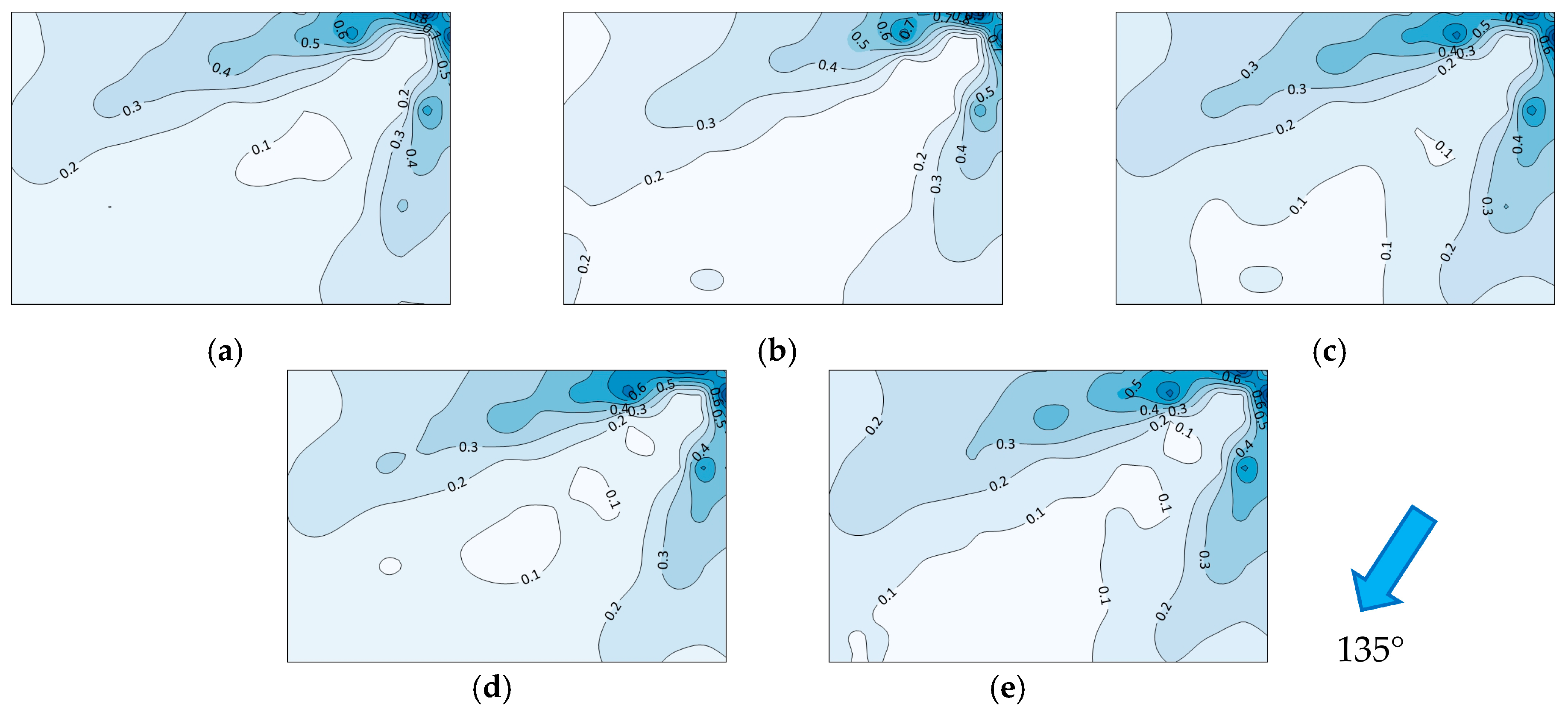
Figure 10 provides the distribution pattern of the net fluctuating wind pressure on the overhead photovoltaic roof on the rooftop of the bottom building under different parapet configurations with the wind approaching at 135°. As shown in
Figure 10, compared with the case without a parapet (Ref), the presence of parapets reduces the fluctuating wind pressure coefficients to some extent in the windward leading-edge corner region. The maximum fluctuating wind pressure coefficients for models M1 to M4 are 1.08, 1.02, 0.96, and 0.98, respectively, which decrease by 7%, 12%, 17%, and 16% compared with the value of 1.16 for Ref. This behavior is significantly different from that under the 45° incoming wind direction, indicating that the windward inclination angle and the vertical clearance at the windward eave modify the way parapets alter the fluctuating wind pressure.
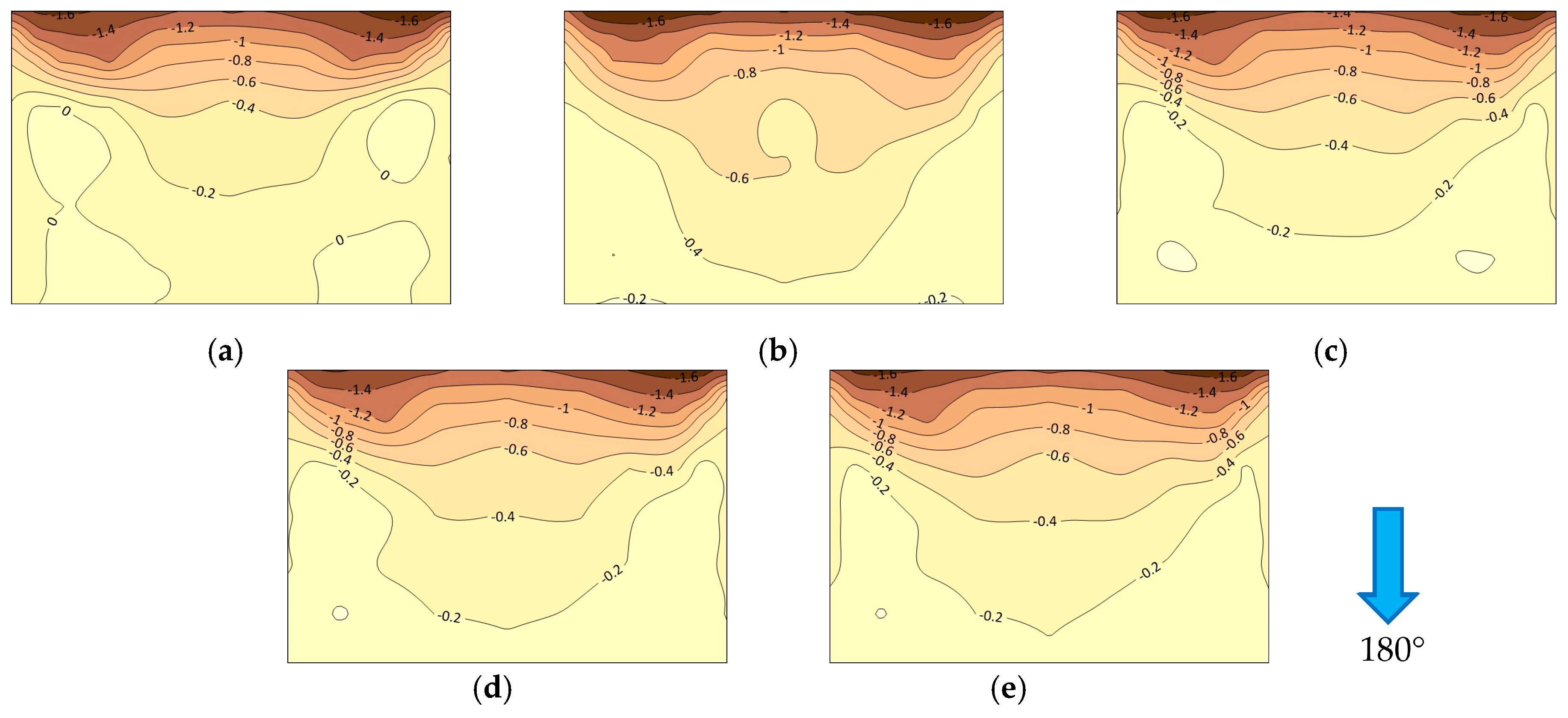
Figure 11 shows the distribution pattern of the net mean pressure on the overhead photovoltaic roof on the rooftop of the bottom building under different parapet configurations for the case of 180° wind incidence. As illustrated in the figure, under the 180° incoming wind direction, the distribution pattern of the mean wind pressure is similar to that under the 0° incoming wind direction; however, the range of the negative pressure region expands and the negative pressure intensity increases significantly due to the inclination angle of the photovoltaic roof. Taking the case without a parapet (Ref) as an example, the range of the mean wind pressure coefficient changes from 0.61 to −1.38 under the 0° incoming wind direction to 0.20 to −1.77. In addition, different from the 0° incoming wind direction, the solid parapet does not significantly increase the negative pressure intensity in the windward leading edge region of the high roof eave, and the influence of different parapet configurations on the negative pressure at the windward leading edge is relatively small. The maximum negative mean wind pressure coefficients for models M1 to M4 are −1.79, −1.77, −1.71, and −1.71, respectively; compared with the value of −1.77 for Ref, model M1 increases by 1%, model M2 shows no change, and models M3 and M4 decrease by 3%.
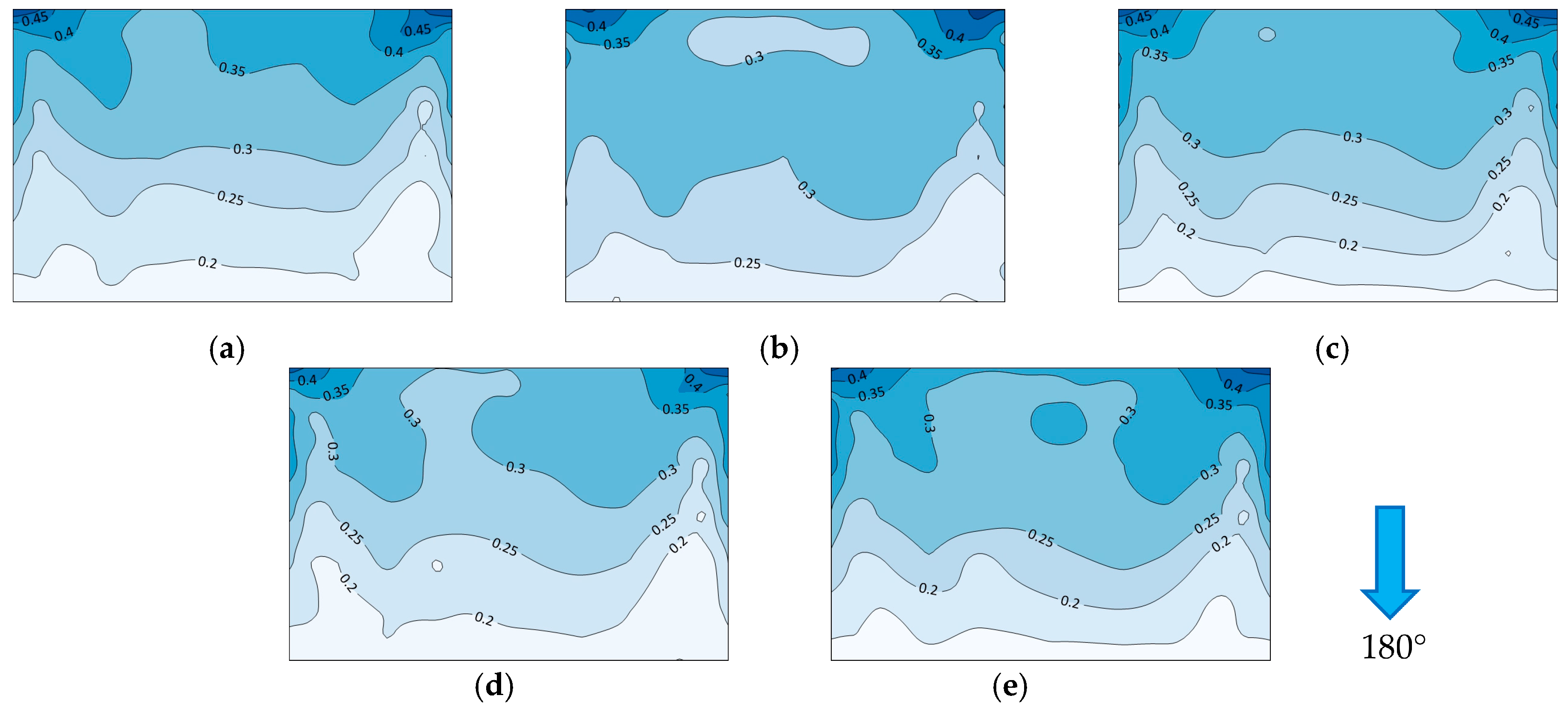
Figure 12 represents the distribution characteristics of the net fluctuating wind pressure on the overhead photovoltaic roof on the rooftop of the bottom building under different parapet configurations at a wind direction angle of 180°. Under the 180° incoming wind direction, except for the vertical parapet (M3), the other parapet configurations significantly reduce the net fluctuating wind pressure coefficients in the windward leading-edge corner region of the roof. Different from the case under the 0° incoming wind direction, except for the rectangular grid parapet (M4), the other parapet configurations significantly increase the net fluctuating wind pressure coefficients in the leeward trailing-edge region of the roof. The maximum fluctuating wind pressure coefficients for models M1 to M4 are 0.47, 0.58, 0.50, and 0.49, respectively; compared with the value of 0.55 for Ref, models M1, M3, and M4 decrease by 15%, 9%, and 11%, respectively, whereas model M2 increases by 5%.
In summary, compared with the case without a parapet (Ref), different parapet configurations have certain influences on the wind loads of the overhead photovoltaic roof, particularly in the windward leading-edge region. In terms of mean wind pressure, under the four typical wind direction angles, the solid parapet significantly increases the negative mean wind pressure intensity in the windward leading-edge region compared with the case without a parapet, indicating that the solid parapet amplifies the unfavorable wind load acting on the roof and thereby raises the risk of wind-induced damage. In contrast, perforated parapets have little influence on the negative mean wind pressure intensity, suggesting that they are more beneficial for preventing wind-induced damage to the photovoltaic roof. In terms of fluctuating wind pressure, parapets reduce the maximum fluctuating wind pressure coefficients on the roof in most cases, while only under certain specific conditions do they increase the fluctuating wind pressure coefficients.
3.2. Peak Wind Pressure Distribution
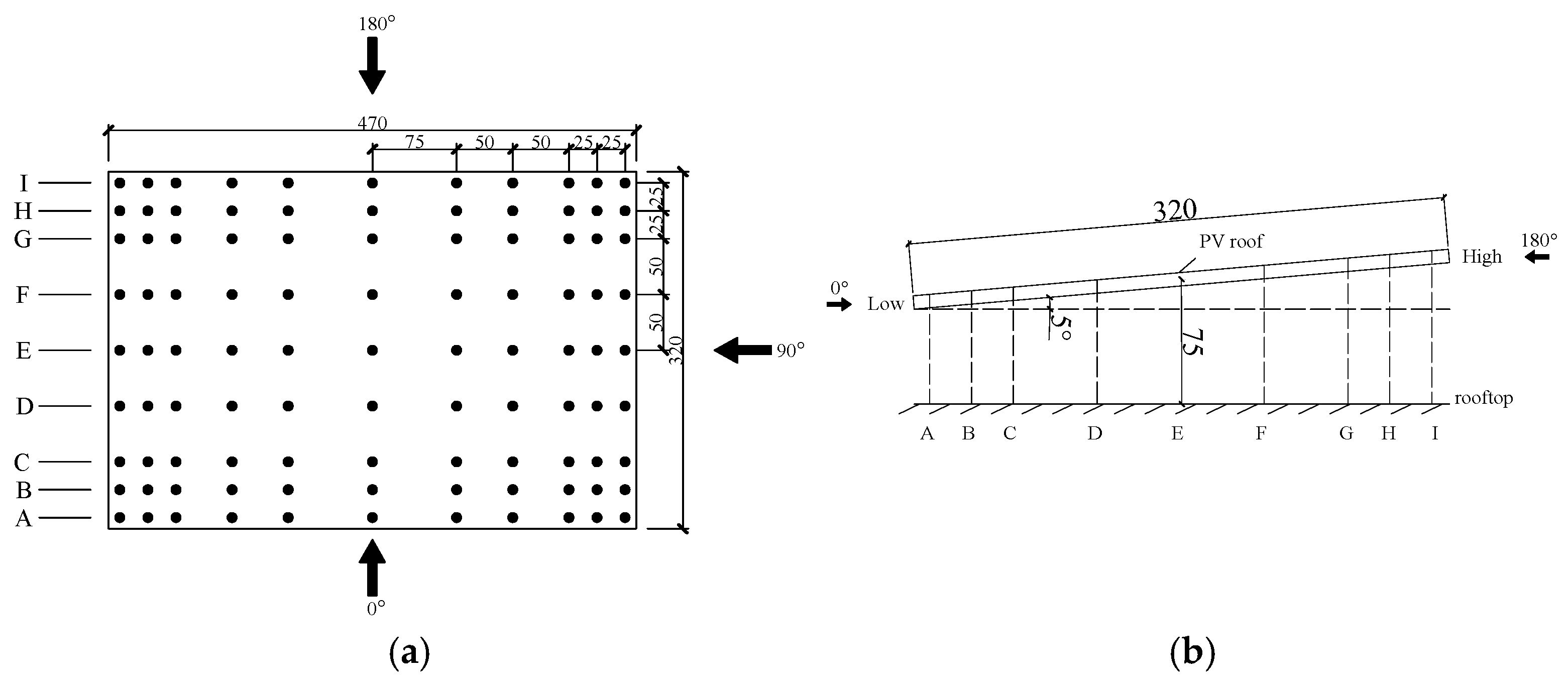
Figure 13 presents the distribution of the most unfavorable minimum pressure coefficient of the overhead photovoltaic roof under all wind directions for different parapet configurations obtained through symmetry. Due to the symmetry of the model and the wind field, the results for the measuring points in the right half area of the roof for wind directions from 195° to 360° are obtained by symmetry from the results for the left half area for wind directions from 165° to 0°. Similarly, the results for the measuring points in the left half area are obtained accordingly. Finally, the minimum pressure coefficients for all measuring points under all wind directions are derived. Based on these values, the distribution of the most unfavorable extreme pressure coefficients on the overhead photovoltaic roof is obtained. The results show that the distribution exhibits obvious regional characteristics, with a large gradient at the outer edges and a smaller gradient in the central region. The region with the greatest peak wind pressure intensity is located at the high-eave corner, where the solid parapet produces the largest peak wind pressure intensity. The maximum most unfavorable minimum pressure coefficients for models M1 to M4 are −9.67, −8.16, −8.82, and −8.11, respectively. Compared with the value of −8.74 for Ref, models M1 and M3 increase by 11% and 1%, respectively, while models M2 and M4 decrease by 7% and 9%, respectively.
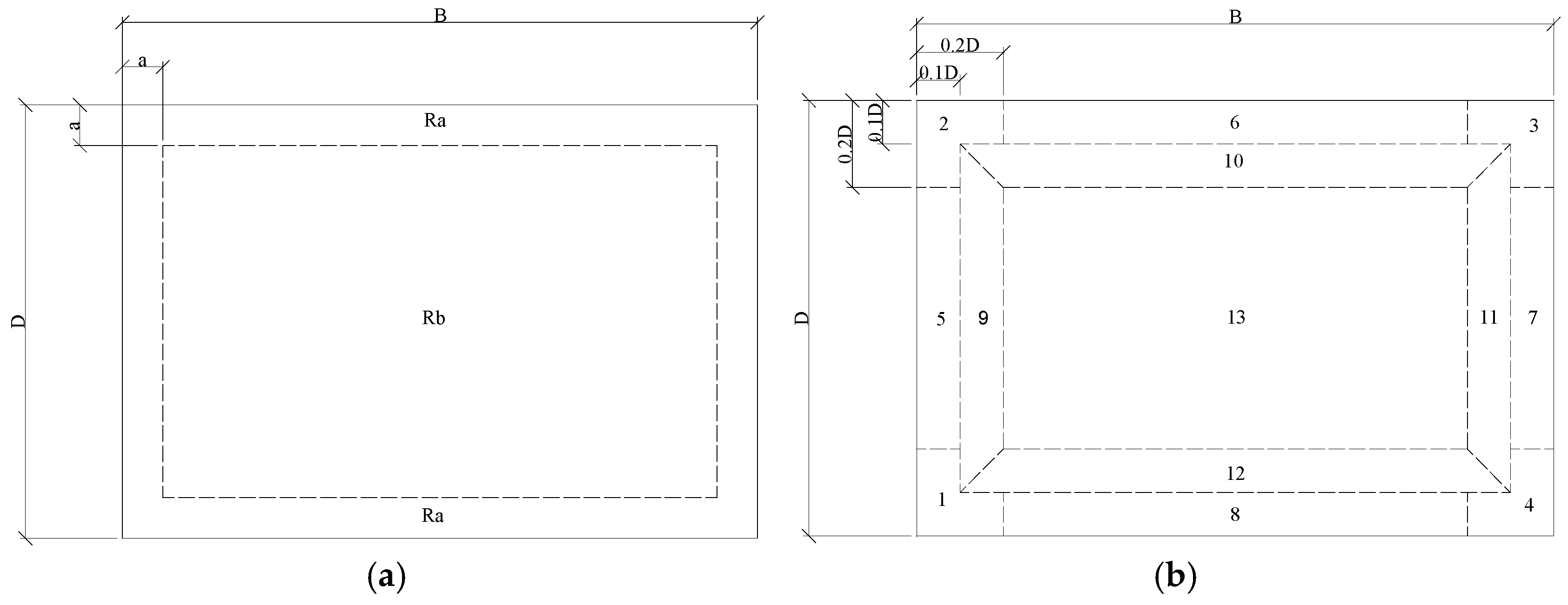
Figure 14a shows the zoning scheme of extreme wind pressure coefficients under full-direction inflow for an open single-slope roof provided in the Chinese code JGJ/T 481-2019 [
26]. In this scheme, the roof is divided into inner and outer regions, where a = 30 mm. The extreme wind pressure in a given zone is defined as the area-weighted average of the most unfavorable peak wind pressure coefficients under full-direction wind for the measuring points within that zone. The peak wind pressure coefficients obtained according to the code zoning are listed in
Table 1. In region Ra, except for model M1 whose value is slightly larger than the code value but does not exceed 5%, the peak pressure coefficients of the remaining configurations are smaller than the code values, with models M2 and M4 showing the most significant reductions of about 10%. In region Rb, the peak wind pressure coefficients of models Ref and M1 to M4 are only about 70% of the code values, indicating that wind load design based on the Chinese code can generally ensure the wind resistance safety of the roof. However, as shown in
Figure 13, the distribution of peak wind pressure coefficients on the overhead photovoltaic roof is highly non-uniform. Large pressure gradients occur in the outer edge regions, particularly at the high-eave and low-eave corners. These areas not only exhibit large absolute values of peak wind pressure coefficients but also demonstrate significant gradient variations relative to adjacent regions, reflecting their distinct aerodynamic characteristics. If these regions are still uniformly classified into the outer zone Ra according to the code, the local unfavorable effects would be weakened during the area-weighted averaging process, potentially leading to an underestimation of the design wind loads in critical areas such as roof corners. Therefore, this study adopts the magnitude of peak values and spatial gradients as the primary criteria and refines the code-based zoning scheme by integrating existing studies [
27], the ASCE code [
28], and the experimentally obtained distribution characteristics of peak wind pressure coefficients. Regions with large peak values and significant gradient variations are defined as independent zones, whereas regions with relatively uniform distributions are appropriately merged, thereby balancing zoning accuracy with engineering practicality. Based on this principle, the outer zone Ra defined in the code is further subdivided into eight subzones, with the four corner regions separately identified to emphasize their unfavorable loading characteristics. Meanwhile, the inner zone Rb is further subdivided according to the wind pressure distribution features, ultimately forming a 13-zone scheme. This zoning approach maintains consistency with the existing code framework while enhancing the representation of local peak wind pressure distributions on the roof. Zones 1 to 8 are located within region Ra, while the remaining zones belong to region Rb. Considering the symmetry of the model and wind field,
Table 2 lists only the peak wind pressure coefficients of zones 3 to 4, 6 to 8, and 10 to 13. The maximum peak wind pressure coefficients for models Ref and M1 to M4 occur in zone 3 at the high-eave corner, followed by zone 4 at the low-eave corner, while the smallest value occurs in zone 13 at the central region. Compared with Ref, the influence of different parapet configurations on the peak wind pressure coefficients in zones 6 to 13 is not significant. In zones 3 and 4, model M1 increases the peak wind pressure coefficients by 8% and 20%, respectively. Models M2 and M4 reduce the peak wind pressure coefficient in zone 3 by 8% while having little influence on zone 4, whereas model M3 increases the peak wind pressure coefficient in zone 4 by 7% while having little influence on zone 3. Compared with the Chinese roof code, the high-eave corner region exceeds the code value by 43% without a parapet and by 32% to 54% with different parapet configurations. In the low-eave corner region, except for the case with a solid parapet which exceeds the code value by 17%, the differences from the code values in other cases do not exceed 5%. Overall, the most unfavorable region of the photovoltaic roof is the roof corner. Solid parapets and vertical parapets significantly increase the peak wind pressure coefficients at the roof corners, whereas horizontal parapets and rectangular grid parapets can reduce the most unfavorable peak wind pressure coefficients in the corner region to some extent.
In addition, it should be noted that the proposed 13-zone scheme has two aspects of practical value for engineering design. First, the refined zoning enables the determination of more detailed design wind loads for critical regions such as corners and edges. Second, under simplified design conditions, the maximum value in key zones (e.g., corner regions) may be adopted for conservative design, thereby balancing safety and practicality. However, this scheme is developed based on a specific overhead photovoltaic roof model, including building geometry, roof slope, and parapet configuration, and its applicability is therefore mainly limited to low-rise building photovoltaic roof systems with similar aerodynamic characteristics. For other roof types or structural configurations with significantly different parameters, direct application of this zoning scheme should be approached with caution and requires further validation. Furthermore, the scheme retains a certain degree of empiricism, as it is derived from wind tunnel test results and may be influenced by factors such as incoming flow characteristics, model scale effects, and sampling parameters. Although the distribution patterns obtained under different conditions show good consistency, their generality and robustness still need to be further verified through more extensive parametric analyses, numerical simulations, and full-scale measurements. In summary, the proposed 13-zone scheme represents a targeted refinement of existing codes, improving the representation of wind pressure characteristics in critical unfavorable regions of photovoltaic roofs while maintaining consistency with current design methodologies, and thereby providing a more rational and application-oriented basis for wind-resistant structural design.
3.3. Limitations of the Study and Future Work
This experiment was conducted only for Terrain Category B (i.e., medium-roughness terrain such as fields, countryside, sparsely forested areas, etc.), without covering the effects of different wind profile exponents and turbulence characteristics under Terrain Categories A (offshore sea surface, deserts, etc.), C (dense urban clusters), and D (downtown areas of large cities with dense high-rise buildings). Therefore, the applicability of the conclusions to other terrain types requires further verification. Secondly, the parapet height in the experiment was fixed at 1.2 m, and the differences in the regulation effects of parapets with different heights (e.g., 0.6 m, 1.5 m, 1.8 m, etc.) on the wind load of the roof were not systematically investigated. Furthermore, the inclination angle of the photovoltaic roof was only 5°, while the common range of inclination angles in practical engineering is 0°~15° or even larger. The mechanisms of flow separation and reattachment vary significantly with different inclination angles, and this experiment failed to reveal their influence patterns. Meanwhile, the experimental model was a single building, without considering the interference effects among adjacent building groups or multiple buildings, whereas building spacing and layout in actual urban environments have important influences on wind pressure distribution. Although several types of parapet configurations (e.g., solid, perforated, etc.) were selected, the optimal ranges of parameters such as opening ratio, hole shape, and arrangement pattern were not thoroughly analyzed. In summary, the conclusions of this experiment are representative under specific conditions, and caution is needed when extending them to broader engineering practice. It is recommended that future research expand the parameters of terrain type, parapet height, roof inclination angle, and building layout, and combine numerical simulations with field measurements to establish more universal wind-resistant design methods for photovoltaic roofs.