Article

Simulation of Photothermal Effects in Biological Tissues and Exploration of Temperature Fitting Method

1
Sanya Research Institute of Hainan University, School of Biomedical Engineering, Hainan University, Sanya 572025, China
2
School of Mechanical and Electrical Engineering, Hainan University, Haikou 570228, China
*
Authors to whom correspondence should be addressed.
Appl. Sci. 2026, 16(8), 3689; https://doi.org/10.3390/app16083689
Submission received: 11 March 2026 / Revised: 5 April 2026 / Accepted: 7 April 2026 / Published: 9 April 2026

Abstract

The photothermal effect is an important part of biological tissue optics. The reasonable use of temperature changes caused by the photothermal effect is of great value for the treatment of lesions. However, it is not easy to measure changes in light and heat temperatures in tissues experimentally. This paper combines Monte Carlo simulation and finite-element numerical calculation based on the Pennes biological tissue heat transfer equation to simulate light transmission and distributions of light and heat in biological tissues, including single-layer uniform biological tissue simulations and a classic three-layer skin optical model. Through the simulation of single-layer uniform biological tissue, the overall trend and range of biological tissue temperature change under different parameters are obtained in this work. Third, in the classic three-layer skin optical model simulation, this work combines a data-fitting method to derive a formula relating internal temperature and tissue depth to the absorption coefficient. Compared with the simulation standard results, the error of the above fitting formula is within 1.2%, and it can be applied in the field of photothermal therapy in the future to help medical workers understand the range of temperature changes in biological tissues.

1. Introduction

Light propagation in biological tissues usually occurs in a diffusive manner. A portion of the incident optical energy is absorbed by the tissue and subsequently converted into thermal energy, elevating the temperature within the biological medium. In clinical practice, temperature variations induced by photothermal effects are increasingly utilized for therapeutic purposes. In recent years, photodynamic therapy has emerged as one of the most promising minimally invasive treatment strategies [1]. For instance, in rehabilitation medicine, laser irradiation has been reported to facilitate fatigue recovery and provide analgesic effects [2,3]. Moreover, photothermal effects contribute to the induction of tumor cell apoptosis [4,5,6,7], thereby playing a significant role in cancer therapy. In addition, optical stimulation has been shown to enhance hair follicle activity and promote hair growth. On the other hand, owing to the tunable optical absorption properties and favorable targeting capability of functionalized nanomaterials, photothermal therapy has been extensively investigated and increasingly applied in biomedical research and clinical practice [8,9]. In both photodynamic and photothermal therapies, accurate temperature monitoring is an indispensable issue. While surface temperature variations of biological tissues can be measured using contact-based thermistor sensors or non-contact infrared thermal imaging systems, noninvasive monitoring of internal tissue temperature remains rarely reported.
In general, the internal light-intensity distribution in biological tissues can be obtained numerically by combining forward models with inverse reconstruction algorithms. By coupling the calculated optical intensity distribution with heat conduction equations, the corresponding temperature distribution within the tissue can be determined. However, significant variability exists in the optical and thermal parameters of biological tissues among different individuals. Even within the same individual, tissue optical properties may vary over time. As a result, accurate reconstruction of tissue parameters using inverse algorithms and, consequently, precise determination of internal temperature distributions remain challenging. For clinical applications of photodynamic and photothermal therapies, extremely high temperature monitoring accuracy is not always required. In this study, Monte Carlo modeling, the heat conduction equation, the radiative transfer equation, and the classical optical parameters of biological tissues are integrated to investigate the trends of internal temperature variation under different parameter conditions. Based on these analyses, an empirical fitting formula is established to enable rapid estimation of internal tissue temperature under photothermal effects. The proposed approach may assist clinicians in approximating internal temperature changes during photodynamic and photothermal treatments, thereby improving therapeutic efficiency. In addition, from a photothermal safety perspective, the present work provides an empirical framework for the optical safety assessment of wearable optoelectronic devices.

2. Materials and Methods

In this study, the internationally established Monte Carlo (MC) simulation model was employed to numerically compute the internal light-intensity distribution in biological tissues [10,11,12]. The spatial distribution of light within biological tissues is governed by the radiative transfer equation (RTE), which can be effectively solved using the Monte Carlo method. The radiative transfer equation is shown as Equation (1):
1 c ( r ) L t + s · L = μ t L + μ s 4 π 4 π p s , s L r , s , t d Ω
The radiance L ( r , s , t ) process is determined by the absorption coefficient μa, the scattering coefficient μs, and the scattering phase function p(s, s′). The total attenuation coefficient is defined as μt = μa + μs. The absorption coefficient μa is mainly determined by the absorbing substances inside the biological tissue, while the scattering coefficient originates from the high inhomogeneity of the medium inside the biological tissue. The phase function p(s, s′) related to the size of the biomolecules and its functional form is determined by both Rayleigh scattering and Mie scattering.
As a statistical numerical approach, MC simulates photon packet transport in turbid media. When a photon packet propagates through biological tissue, it undergoes gradual absorption and scattering events determined by the local optical properties of the medium. During photon packet tracking, pseudo-random numbers are utilized to determine the initial position, propagation direction, scattering events, and step size between successive scattering interactions. As a photon packet traverses from one voxel to another, the absorbed energy is deposited within the voxel according to the local absorption coefficient (μa). The deposited energy accumulates throughout the simulation and is stored in the corresponding computational array elements. In the simulation, when a photon reaches the boundary, Fresnel’s reflection/refraction theory is used to determine whether the photon is reflected or refracted. Upon completion of the MC simulation, the temperature distribution within biological tissues is obtained by coupling the calculated light-intensity distributions across all voxels with the heat conduction equation [13,14,15]. The present work further investigates light transport and photothermal distribution in biological tissues under varying optical and physical parameters [16,17].
The present study employed the open-source three-dimensional Monte Carlo program MCmatlab [18], developed by Dominik Marti et al. This program is implemented in MATLAB (R2014a). The MCmatlab RTE solver is based on the MCxyz framework, originally developed by Jacques and colleagues at the Oregon Medical Laser Center, and further extended by Martietal. In this program, the optical and thermal properties of biological tissues are characterized by the absorption coefficient (μa), the scattering coefficient (μs), the anisotropy factor (g), the refractive index (n), the volumetric heat capacity (Cv), and the thermal conductivity (k). The laser beam parameters are described by the beam radius (r) and optical power (P), while the tissue depth is denoted by d. The initial tissue temperature (T) is typically set to 37 °C [18].
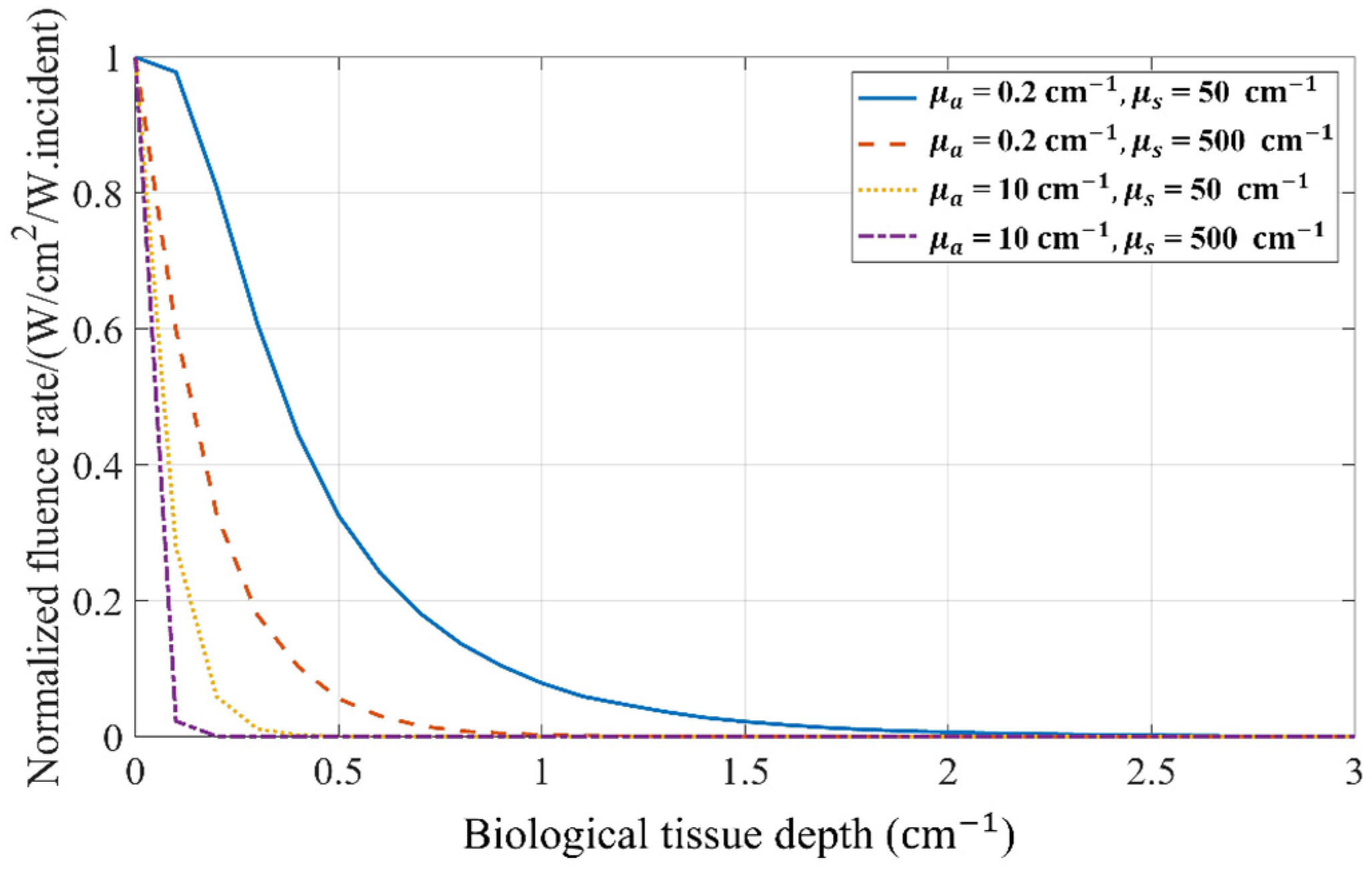
To preliminarily investigate the internal light-intensity distribution in biological tissues under laser irradiation, a simulation domain of 5 cm × 5 cm × 3 cm was constructed. In the present simulations, the absorption coefficient (μa) was varied within the range of 0.2–10 cm−1, while the scattering coefficient (μs) was set in the range of 50–500 cm−1. The refractive index (n) and anisotropy factor (g) were fixed at 1.44 and 0.9, respectively. The corresponding simulation results are presented in Figure 1. As shown in Figure 1, when the scattering coefficient remains constant, increasing the absorption coefficient from 0.5 cm−1 to 10 cm−1 results in a significantly accelerated attenuation of light intensity within the tissue. In contrast, when the absorption coefficient is held constant, increasing the scattering coefficient from 50 cm−1 to 500 cm−1 produces only a minor influence on the overall attenuation rate of light intensity. These results indicate that, under the selected parameter conditions, the absorption coefficient plays a more dominant role in determining the decay behavior of light intensity. Further investigations will focus on the photothermal response of biological tissues under varying physical parameters.
The form of the Pennes equation is shown as Equation (2):
T t = q + ( k T ) C V
In the formula, T and ΔT represent temperature and temperature changes, respectively; Cv represents local volumetric heat capacity; k represents thermal conductivity; and q is the local thermal deposition rate, calculated by multiplying the voxel flux rate F (obtained by statistically analyzing photon paths after Monte Carlo simulation) by its absorption coefficient. This equation is solved using the explicit finite element method. The method for calculating the temperature change ΔT at spatial locations (ix, iy, iz) after a short time Δt is shown as Equation (3):
Δ T = Δ t C V ( P μ a F + ( T x T ) 2 k k x k + k x 1 d x 2 + ( T x + T ) 2 k k x + k + k x + 1 d x 2 + ( T x T ) 2 k k y k + k y + 1 d y 2 + ( T y + T ) 2 k k y + k + k y + 1 d y 2 + ( T z T ) 2 k k z k + k z 1 d z 2 + ( T z + T ) 2 k k z + k + k z + 1 d z 2 )
Herein, P is the incident laser power, (dx, dy, dz) is the voxel side length, k is the heat transfer coefficient of the voxel, T is its temperature, and the subscripts indicate the adjacent voxels in the negative and positive directions of x, y, and z. This work employs Dirichlet boundary conditions.
This study focuses on establishing a basic heat conduction model, prioritizing the validation of core mechanisms, such as the light source power and the absorption-scattering coefficient. In the current work, no consideration has been given to boundary conditions at surfaces and phase boundaries (including convection, blood perfusion, and anisotropic conduction). In the absence of blood perfusion, temperature will be overestimated. In areas with low perfusion and short irradiation time, the impact of blood perfusion is relatively small. However, if the perfusion index of the irradiated area is high and the irradiation time is long, blood perfusion will indeed reduce temperature changes.
For the photothermal simulation of skin, Robin boundary conditions are more accurate. However, for in vivo photothermal studies of biological tissues, simple Dirichlet boundary conditions can also be applied. Normally, Robin boundary conditions are considered more accurate, and as the depth of biological tissue increases, the error introduced by Dirichlet boundary conditions gradually decreases. Using Dirichlet boundary conditions will simplify numerical calculations. This work focuses primarily on parameters such as light intensity, absorption, and scattering. Therefore, the simpler Dirichlet boundary condition is chosen.
In the case of photothermal effects, metabolic heat production can be ignored; hence, we did not include it.

3. Results

3.1. Single-Layer Homogeneous Biological Tissue Model

The optical absorption and scattering coefficients of biological tissues vary with laser wavelength, and variations in these parameters lead to corresponding changes in internal light-intensity distribution and temperature profiles. Owing to its higher computational efficiency and flexibility in parameter adjustment, the single-layer homogeneous tissue model was first adopted to investigate photothermal responses and to obtain the overall trends and ranges of temperature variation under different parameter conditions. The dimensions of the simulation domain were set to 5 cm × 5 cm × 3 cm. The absorption coefficient (μa) was sequentially assigned values of 0.5, 1, 4, 10, 32, 80, and 160 cm−1, while the scattering coefficient (μs) was varied as 50, 100, 200, 300, and 350 cm−1 for Monte Carlo simulations. Temperature sensors were positioned along the z-axis at depths of 0, 0.1, 0.2, 0.3, 0.4, 0.5, 1, 1.5, 2, 2.5, and 3 cm within the simulation domain. Simulations were conducted to analyze the temporal temperature evolution and spatial trends at different locations inside the tissue model.

3.2. Selection of Simulation Volume

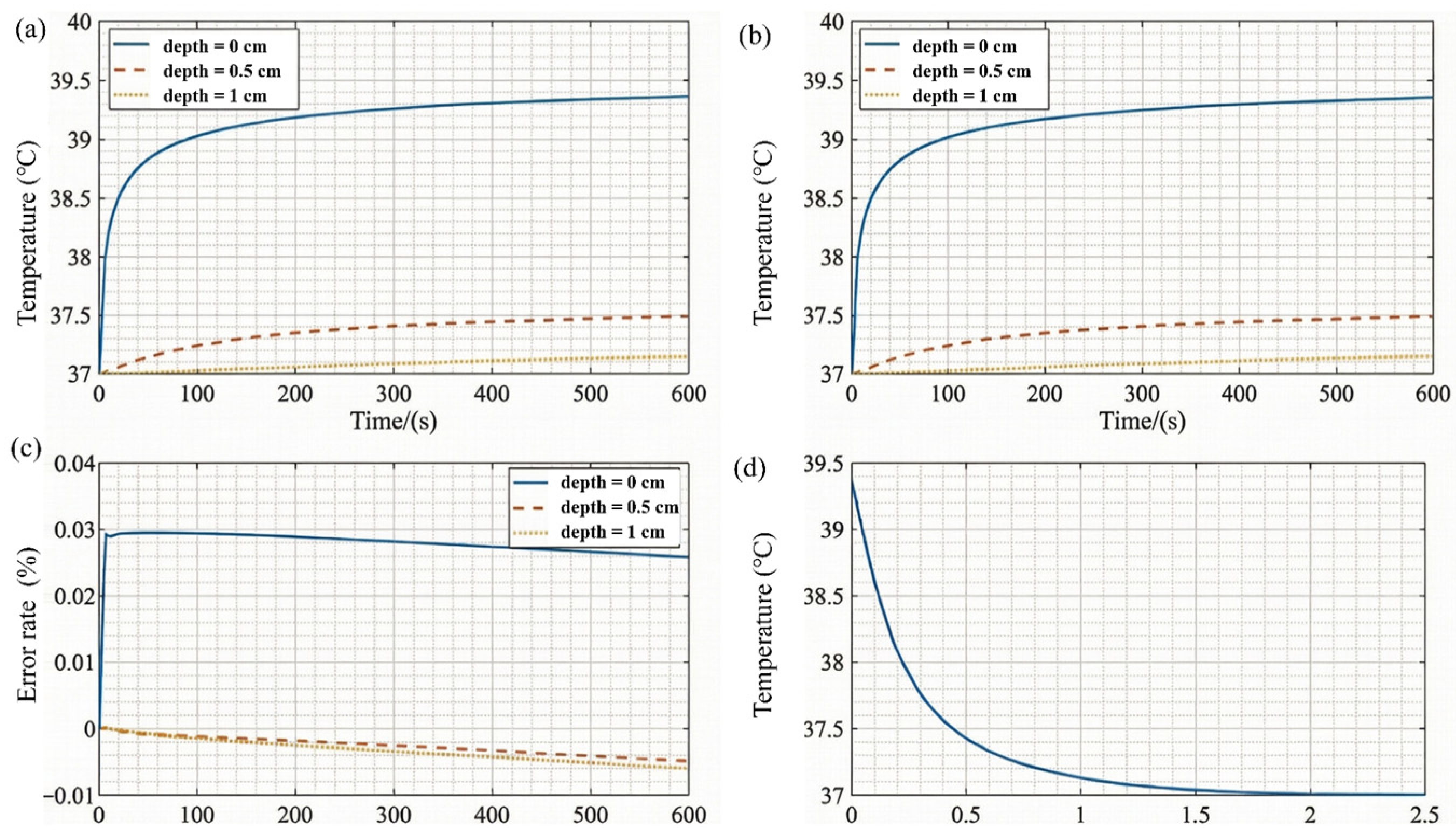
The boundary conditions of biological tissues may affect the accuracy of internal simulations, whereas excessively large computational domains reduce efficiency. To ensure that the selected simulation volume does not introduce significant boundary-induced errors, two domain sizes (5 cm × 5 cm × 3 cm and 10 cm × 10 cm × 6 cm) were systematically compared. For both configurations, identical physical parameters were adopted: μa = 0.5 cm−1 and μs = 500 cm−1. The tissue was irradiated for 600 s using a continuous laser with a power of 50 mW and a beam radius of 0.03 cm. Temperature evolution was monitored at three depths along the z-axis (0, 0.5, and 1 cm). The temperature distributions obtained from the two simulation volumes are presented in Figure 2a,b, respectively. The relative error between the corresponding temperature curves is shown in Figure 2c. The discrepancy at identical depths remains below 3%, indicating that boundary effects associated with the 5 cm × 5 cm × 3 cm domain are negligible for the selected observation points. Therefore, the smaller simulation volume is considered sufficient for subsequent analyses. Figure 2d illustrates the surface temperature distribution at different radial positions. A rapid temperature decay is observed with increasing distance from the laser beam center, reflecting the strong spatial localization of the photothermal effect.

3.3. Temperature Variations Induced by Pulsed and Continuous Irradiation

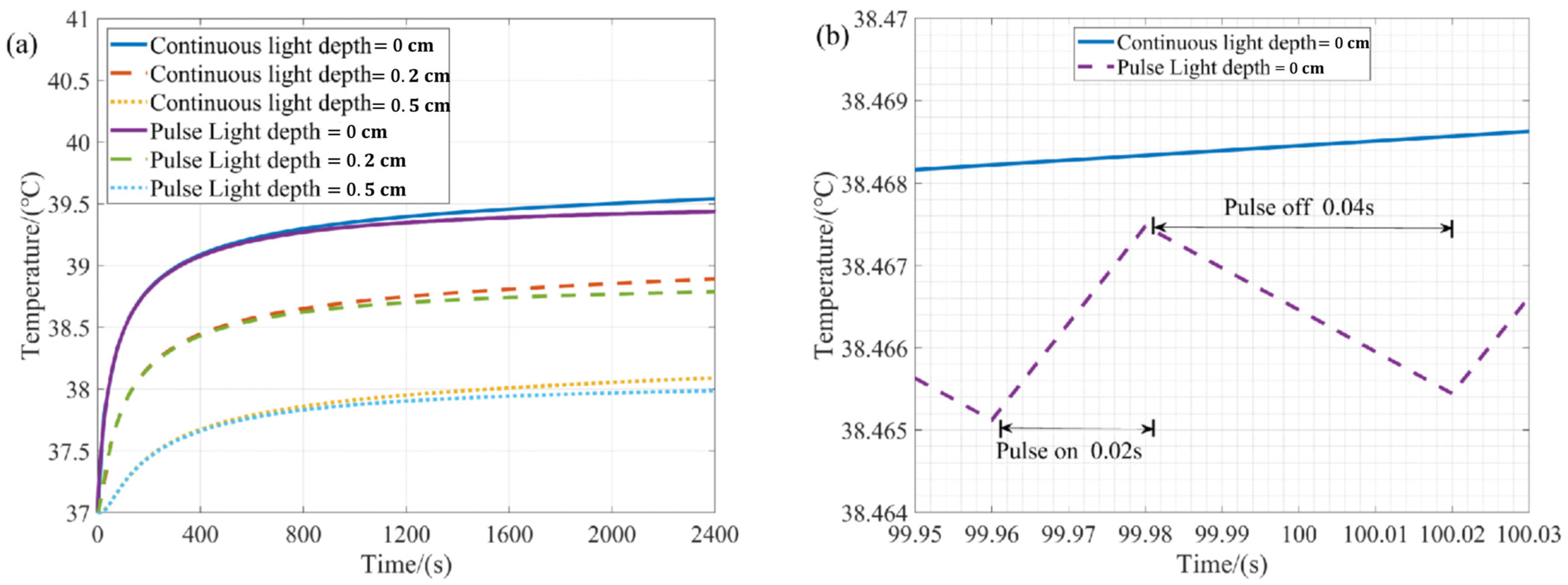
To investigate the thermal response of biological tissues under pulsed and continuous irradiation with identical average power, simulations were conducted using a pulsed laser with a peak power of 60 mW and a duty cycle of 1/3 (corresponding to an average power of 20 mW), and a continuous laser with a power of 20 mW. The irradiation duration was 2400 s, and the beam radius was set to 0.55 cm. As shown in Figure 3a, under equal average power and identical irradiation time, both pulsed and continuous irradiation produce nearly identical temperature evolution profiles within the tissue. The temperature rise induced by continuous irradiation is slightly higher, with a maximum difference of approximately 0.1 °C. During the initial heating stage (0–500 s), a pronounced temperature increase is observed, and the central surface temperature of the tissue rises by approximately 2.2 °C. Beyond 500 s, the temperature gradually approaches a steady state. Between 500 s and 2400 s, the additional temperature increase at the surface center is only about 0.2 °C. To further examine the transient temperature fluctuation within a single pulse cycle, Figure 3b presents the temperature variation over the time interval from 99.95 s to 100.03 s. During the pulse-on period, the temperature increases, whereas it slightly decreases during the pulse-off phase. Notably, the rate of temperature rise during pulse-on is significantly greater than the rate of temperature decay during pulse-off. Consequently, the net temperature change over a single pulse cycle remains positive, leading to an overall accumulation of temperature.

3.4. Effect of Scattering Coefficient on Photothermal Response

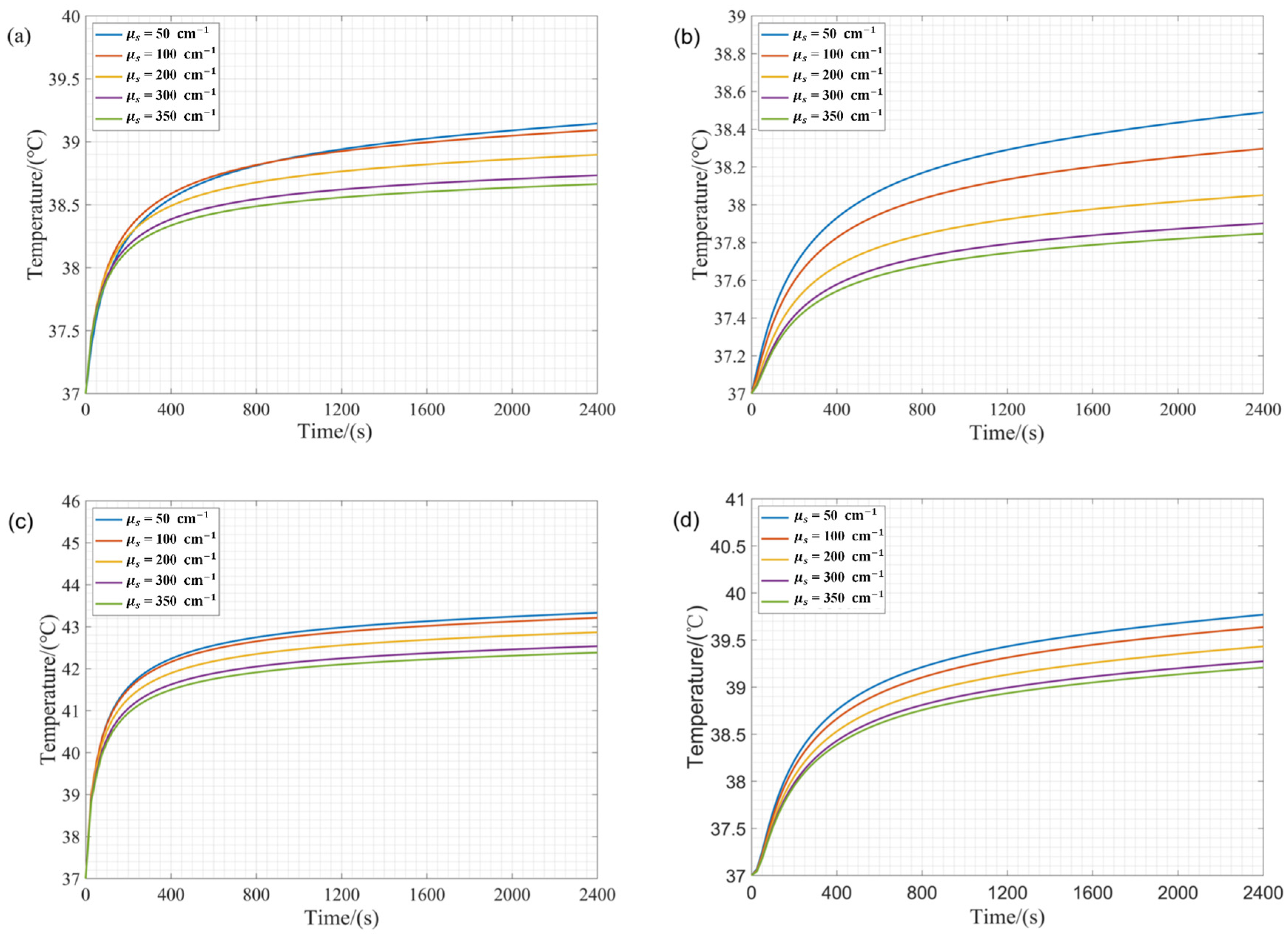
To investigate the influence of the scattering coefficient on tissue temperature variation, the absorption coefficient (μa) was first fixed at 0.5 cm−1, while the scattering coefficient (μs) was varied as 50, 100, 200, 300, and 350 cm−1. In these simulations, the beam radius was set to 0.5 cm, the laser power was 50 mW, and the irradiation duration was 2400 s. The temperature evolution curves at the tissue surface and at a depth of 0.5 cm are presented in Figure 4a,b, respectively. As shown in these figures, when the absorption coefficient is held constant, increasing the scattering coefficient from 50 cm−1 to 350 cm−1 results in a gradual reduction in temperature rise. This behavior can be attributed to enhanced photon diffusion caused by stronger scattering, which redistributes optical energy and reduces localized heat accumulation within the tissue. A similar analysis was conducted with the absorption coefficient increased to 10 cm−1, while all other parameters remained unchanged. The corresponding results are shown in Figure 4c,d. When μs = 50 cm−1, the temperature increase at the tissue surface center reached approximately 6.0 °C, whereas at a depth of 0.5 cm the temperature rose by 2.77 °C. In contrast, when μs = 350 cm−1, the surface temperature increase decreased to 5.2 °C, and the temperature rise at 0.5 cm depth was 2.1 °C. These results indicate that, for scattering coefficients in the range of 50–350 cm−1, the overall variation in tissue temperature remains approximately 1–2 °C under the specified conditions. Therefore, when high-precision temperature monitoring is not required, numerical fitting of simulation data may provide a practical approach for estimating internal temperature variations under different scattering conditions.
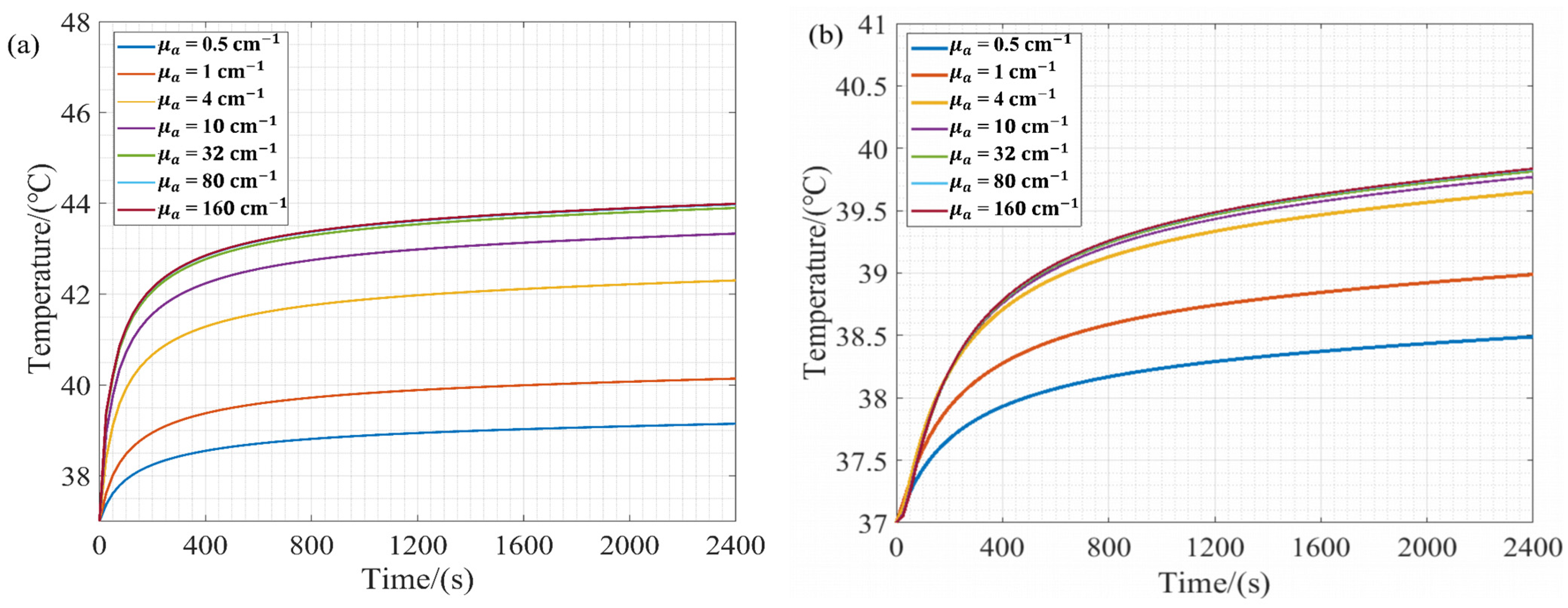
To investigate the effect of the absorption coefficient on tissue temperature variation, the scattering coefficient (μs) was fixed at 50 cm−1, while the absorption coefficient (μa) was varied as 0.5, 1, 4, 10, 32, 80, and 160 cm−1. A continuous laser irradiation with a beam radius of 0.5 cm and a power of 50 mW was applied for 2400 s. The corresponding simulation results are presented in Figure 5. When the scattering coefficient is maintained at 50 cm−1, the rate and magnitude of the temperature rise increase monotonically with increasing absorption coefficient. As illustrated in Figure 5a, when μa = 0.5 cm−1, the temperature at the tissue surface center increases by approximately 2.1 °C. In contrast, when μa = 160 cm−1, the surface center temperature rise reaches approximately 7.0 °C. Overall, the temperature elevation exhibits a positive correlation with the absorption coefficient; higher absorption leads to stronger localized energy deposition and, consequently, a greater temperature increase. It should be noted that, under red or near-infrared irradiation, the absorption coefficient of normal biological tissues rarely reaches values on the order of 160 cm−1. Therefore, such high absorption conditions may primarily correspond to scenarios involving exogenous chromophores or engineered photothermal agents.
A comparison of the effects of scattering and absorption coefficients on tissue temperature reveals that the absorption coefficient exerts a substantially stronger influence on thermal response. When the scattering coefficient increases from 50 cm−1 to 350 cm−1, the resulting temperature variation remains below 1 °C under the specified conditions. In contrast, increasing the absorption coefficient from 0.5 cm−1 to 4 cm−1 leads to a temperature rise of approximately 3 °C. These findings indicate that, within the investigated parameter ranges, tissue temperature is considerably more sensitive to variations in absorption than to changes in scattering. This behavior is consistent with the fact that optical absorption directly governs volumetric energy deposition, whereas scattering primarily redistributes photon trajectories without significantly altering the total absorbed energy.

3.5. Temperature Variation Characteristics Under Different Laser Powers

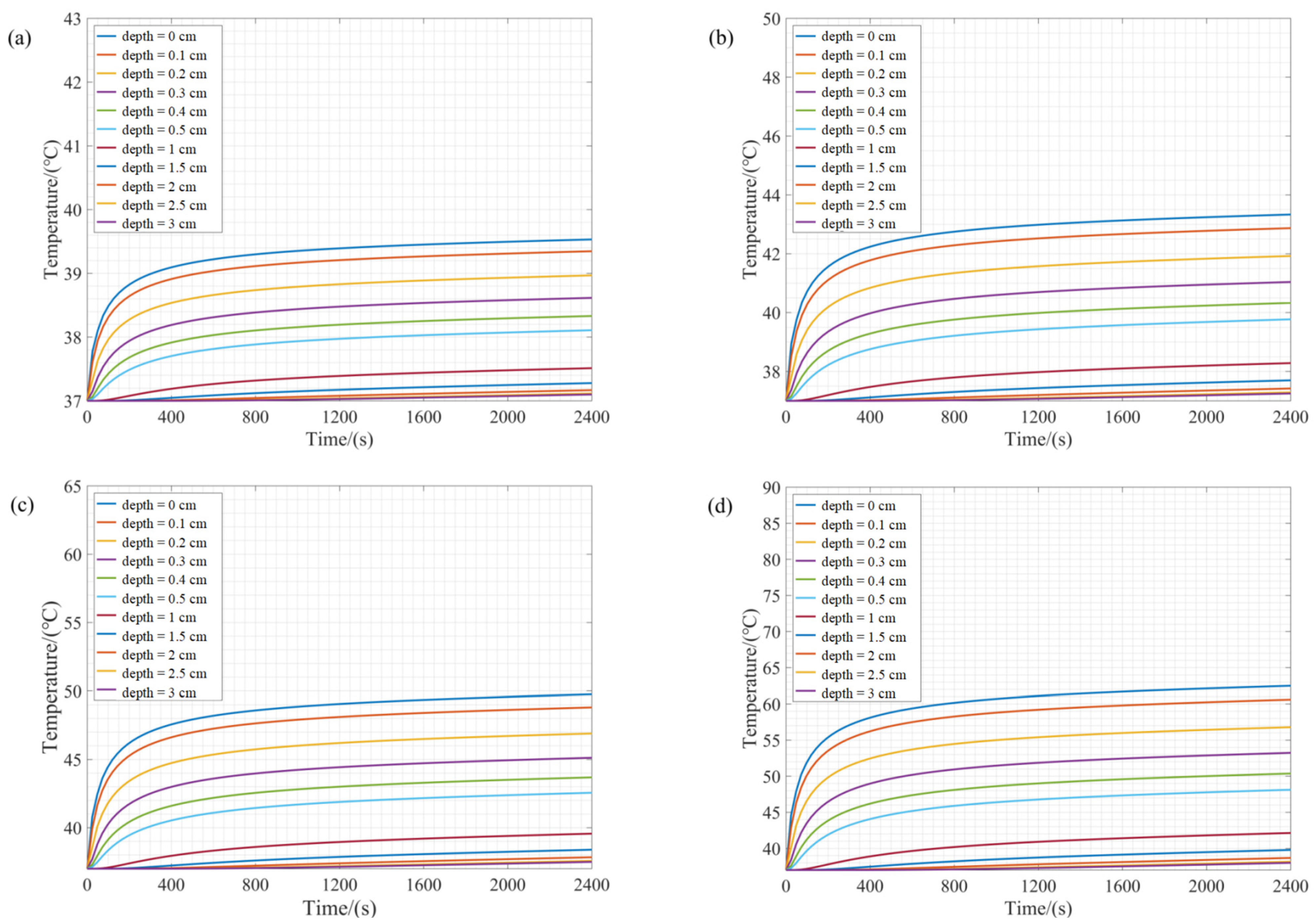
To investigate the effect of laser power on tissue temperature variation, a continuous laser irradiation with a beam radius of 0.5 cm was applied to the simulation domain for 2400 s. The laser power was varied to 20, 50, 100, and 200 mW, while the absorption coefficient (μa) and scattering coefficient (μs) were fixed at 10 cm−1 and 50 cm−1, respectively. The corresponding simulation results are presented in Figure 6.
As shown in Figure 6, the temperature rise of biological tissue increases with increasing laser power. Taking Figure 6a,b as examples, when the laser power is 20 mW, the temperature at the tissue surface center (depth = 0 cm) reaches 39.53 °C, corresponding to a temperature increase of 2.53 °C relative to the initial temperature. When the power is increased to 50 mW, the surface center temperature rises to 43.38 °C, representing an increase of 6.38 °C. At a depth of 0.5 cm, the temperature increase is 1.11 °C for 20 mW irradiation, whereas it reaches 2.78 °C under 50 mW irradiation. These results indicate that the magnitude of temperature elevation scales positively with laser power at both surface and subsurface locations. With increasing depth, the temperature attenuation becomes less steep. As illustrated in Figure 6c, under 100 mW irradiation, the temperature decreases by 7.20 °C when the depth increases from 0 cm to 0.5 cm, whereas the decrease is only 2.99 °C when the depth further increases from 0.5 cm to 1 cm. This non-uniform decay suggests that the temperature gradient is most pronounced near the surface and gradually diminishes in deeper tissue regions.

3.6. Effect of Spot Radius on Tissue Temperature Distribution

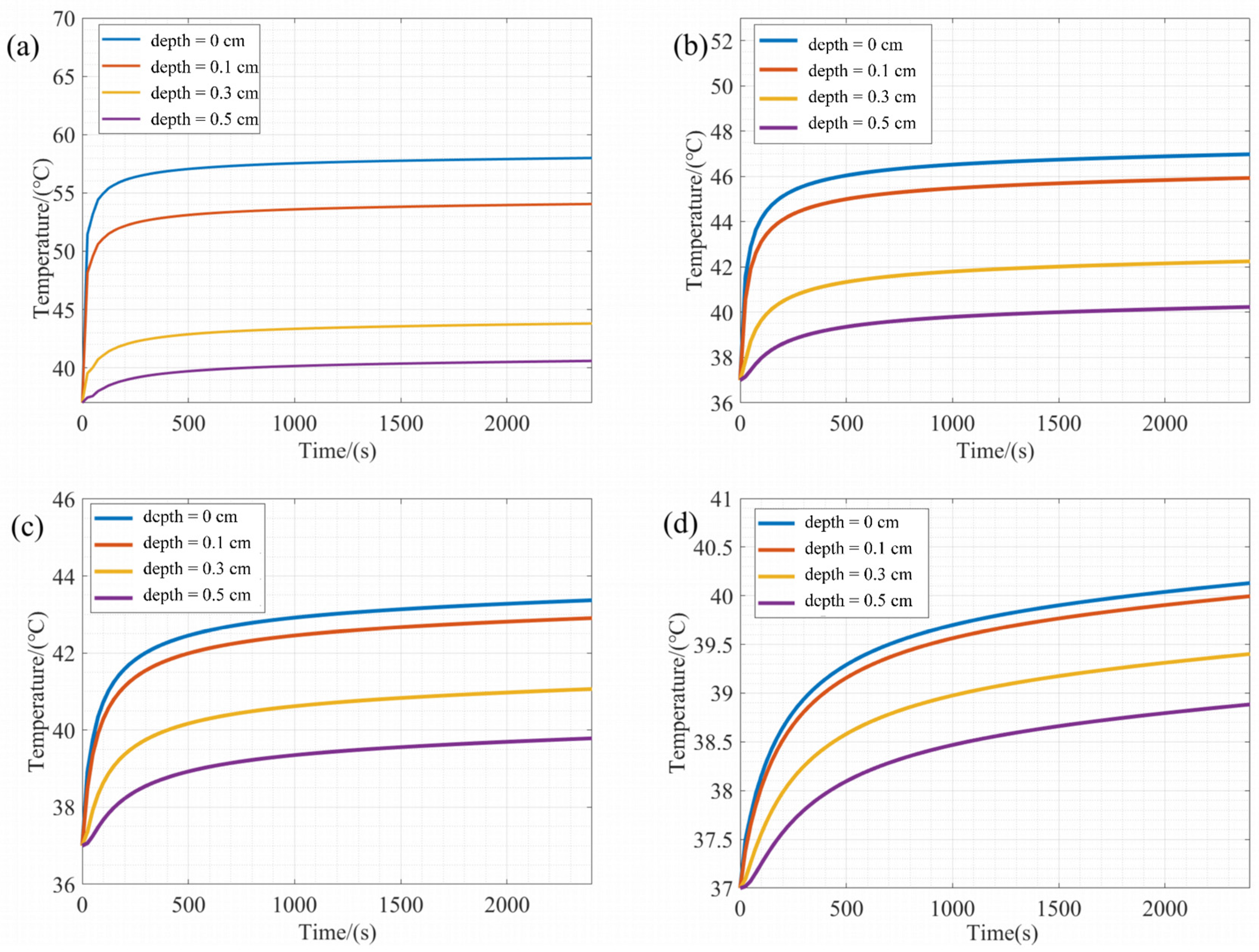
To investigate the influence of spot radius on temperature variation in biological tissues, the scattering and absorption coefficients were set to 50 cm−1 and 10 cm−1, respectively. The spot radius was set to 0.1, 0.3, 0.5, and 1 cm, while a continuous laser with a power of 50 mW was applied to irradiate the tissue for 2400 s. The corresponding simulation results are shown in Figure 7. The temperature evolution curves presented in the figure correspond to tissue depths of 0, 0.1, 0.3, and 0.5 cm.
As shown in Figure 7a, when the spot radius is 0.1 cm, after 2400 s of irradiation, the temperature at the tissue surface center (depth = 0 cm) increases by approximately 21 °C. In contrast, the temperature rise inside the tissue at a depth of 0.5 cm is about 3.5 °C. As shown in Figure 7b, when the spot radius is increased to 0.3 cm, the temperature rise at the tissue surface center decreases to about 10 °C, while the temperature increase at a depth of 0.5 cm is approximately 3.2 °C. In Figure 7c, when the spot radius is 0.5 cm, the surface center temperature increases by about 6.5 °C after 2400 s of irradiation, and the temperature rise at a depth of 0.5 cm is about 2.8 °C. As shown in Figure 7d, when the spot radius is further increased to 1 cm, the surface center temperature rise decreases to about 3.2 °C, while the temperature increase at a depth of 0.5 cm is about 1.9 °C. A comparison of temperature variation trends under different spot radii reveals a negative correlation between the magnitude of tissue temperature rise and the spot radius. This relationship holds when the absorption and scattering coefficients are kept constant. Specifically, a larger spot radius results in a smaller temperature increase, whereas a smaller spot radius leads to a greater temperature rise. This behavior can be attributed to the redistribution of laser energy over a larger illuminated area as the spot radius increases, thereby reducing the local energy density and weakening the photothermal effect within the tissue. Conversely, when the spot radius is reduced, the laser energy is concentrated in a smaller region, producing more pronounced local heat accumulation and a higher temperature rise. Therefore, the spot radius is an important factor that affects the spatial distribution and magnitude of the photothermal response in biological tissues.

3.7. Simulation and Fitting of the Classical Three-Layer Skin Model

The classical three-layer skin model consists of the epidermis, dermis, and subcutaneous tissue, from superficial to deep, each with distinct physiological functions. Skin thickness varies depending on anatomical location, and both epidermal and dermal thicknesses differ across body regions. For example, the epidermal and dermal thicknesses of the forehead are 0.2018 ± 0.2647 mm and 1.0081 ± 0.26184 mm, respectively. For the neck, the corresponding values are 0.1764 ± 0.2812 mm (epidermis) and 0.9616 ± 0.18852 mm (dermis), while for the forearm, they are 0.2061 ± 0.2862 mm and 0.9819 ± 0.18141 mm, respectively [19]. In scenarios involving optical irradiation of biological tissues, surface temperature can be readily measured, whereas internal temperature variations within the skin are considerably more difficult to detect. Therefore, to investigate the photothermal characteristics inside realistic skin tissue, the optical and thermophysical parameters of the three-layer skin model were selected according to the literature [20,21,22], as summarized in Table 1. In the simulations, continuous laser irradiation at 20, 50, and 100 mW was applied to the classical three-layer skin model. The beam radius was set to 0.5 cm, and the initial skin temperature was fixed at 37 °C. The temperature distribution within the tissue at 2400 s was taken as the simulation output for subsequent analysis.
Based on the simulation results presented in Section 3.1, the internal temperature variation within biological tissues changes relatively smoothly under different physical parameter conditions. This characteristic suggests that numerical fitting can be employed to estimate temperature distributions inside the tissue with acceptable accuracy. In the present section, temperature sensors were arranged along the depth (z-axis) at intervals of 0.05 cm, corresponding to depths of 0, 0.05, 0.1, 0.15, 0.2, 0.25, 0.3, 0.35, 0.4, 0.45, and 0.5 cm. These eleven temperature data points were used to establish a fitting function describing the depth-dependent temperature distribution. Based on the derived fitting function, temperature values were subsequently predicted at intermediate depths of 0.025, 0.075, 0.125, 0.175, 0.225, 0.275, 0.325, 0.375, 0.425, and 0.475 cm. To validate the fitting performance, additional simulations were performed at these ten intermediate positions, and the corresponding simulated temperatures were used as reference data to quantify the fitting error.
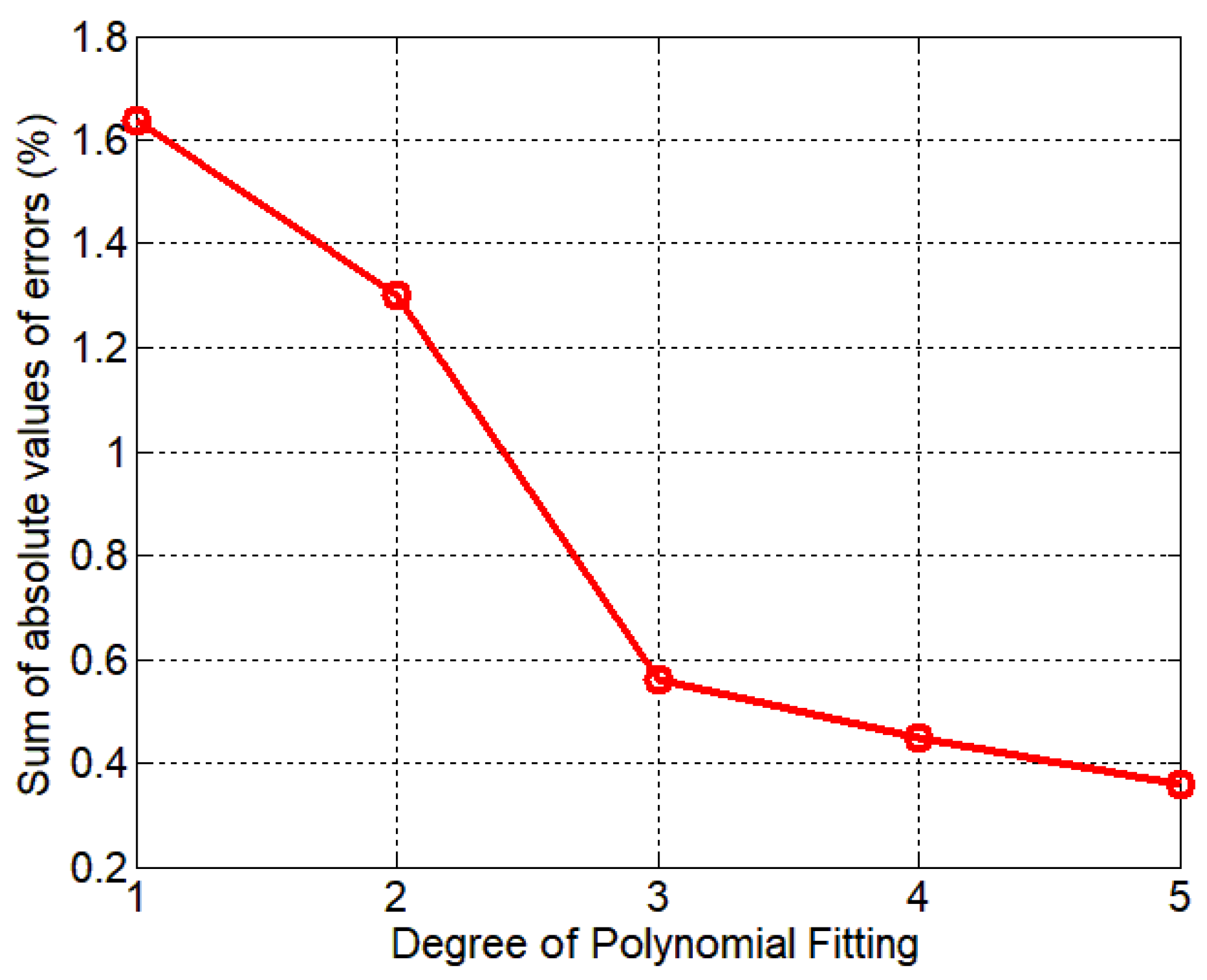
During the temperature-fitting procedure, polynomial models of orders 1 through 5 were sequentially evaluated. The corresponding fitting errors are presented in Figure 8. Among the tested models, the fourth- and fifth-order polynomials yielded very similar fitting accuracy, with errors below 0.5% in both cases. To avoid potential overfitting while maintaining high predictive accuracy, a fourth-order polynomial was selected as the optimal fitting model in this study. This choice provides a balance between model complexity and fitting performance.
T ( d ) = a d 4 + b d 3 + m d 2 + n d + T 0
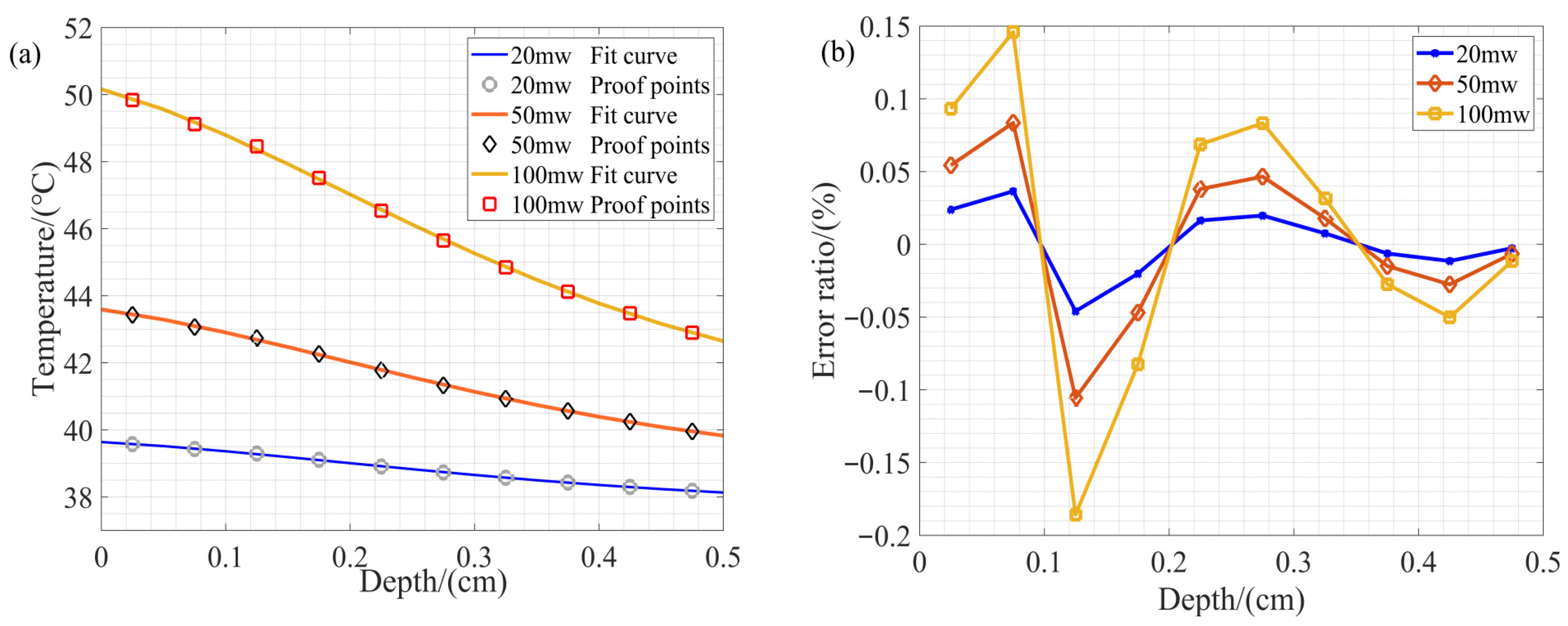
In the proposed fitting model (Equation (4)), the parameters a, b, m, and n represent the fitting parameters, d denotes the tissue depth, and T0 represents the surface center temperature of the tissue. The simulated temperature values at different depths, together with the corresponding depth data, were used as input to determine the fitting parameters. The optimized fitting coefficients are summarized in Table 2. As shown in Figure 9a, the solid curves represent the fitted temperature profiles at different depths under three irradiation power conditions. The fitted results exhibit a monotonic decrease in temperature with increasing tissue depth. The discrete data points in Figure 9a correspond to the reference temperature values obtained from Monte Carlo simulations. The relative fitting errors are presented in Figure 9b. For all three power levels, the fitting error remains below 0.2%, demonstrating excellent agreement between the fitted model and the simulation results. Therefore, once the surface temperature of the skin is known, the internal temperature distribution at different depths can be reliably estimated using the proposed fitting formulation.
It is worth noting that polynomial models of orders 1 through 5 were systematically evaluated during the temperature-fitting process. The corresponding fitting errors for each polynomial order are shown in Figure 8. Among these models, the fourth- and fifth-order polynomials achieved nearly identical fitting accuracy, with relative errors below 0.5% in both cases. Although the fifth-order polynomial provided a marginal improvement in fitting precision, the gain in accuracy was negligible compared to the increase in model complexity. To mitigate the risk of overfitting and improve model generalizability, a fourth-order polynomial was selected as the optimal fitting model in this study.
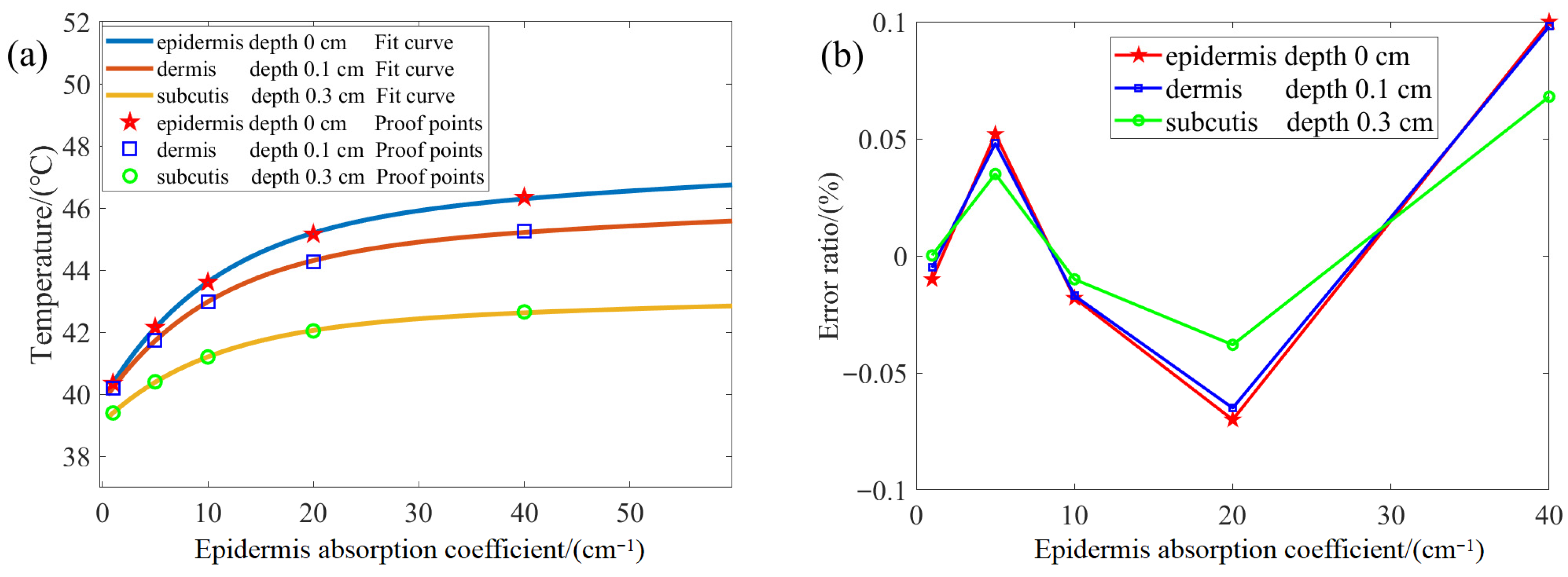
Furthermore, the feasibility of fitting internal tissue temperature under varying absorption coefficients was systematically investigated. Based on the baseline parameters listed in Table 1, the epidermal absorption coefficient (μa) was varied as 0.5, 1, 3, 5, 8, 10, 15, 20, 30, 40, and 60 cm−1, resulting in eleven independent simulation cases. In all simulations, the laser power and beam radius were fixed at 50 mW and 0.5 cm, respectively. The temperature distributions at 2400 s were extracted at depths of 0, 0.1, and 0.3 cm, corresponding to the epidermis, dermis, and subcutaneous tissue layers, respectively. Among the simulated cases, the temperature data corresponding to absorption coefficients of 0.5, 3, 8, 15, 30, and 60 cm−1 were used as input data for the fitting procedure. Additional simulations were then performed for intermediate absorption coefficients of 1, 5, 10, 20, and 40 cm−1. The resulting temperature values were treated as reference data to evaluate the predictive accuracy of the fitting model.
In the present study, a power-law function was adopted to describe the change in temperature. The temperature fitting function is expressed as Equation (5):
T ( μ a ) = m μ a n + c
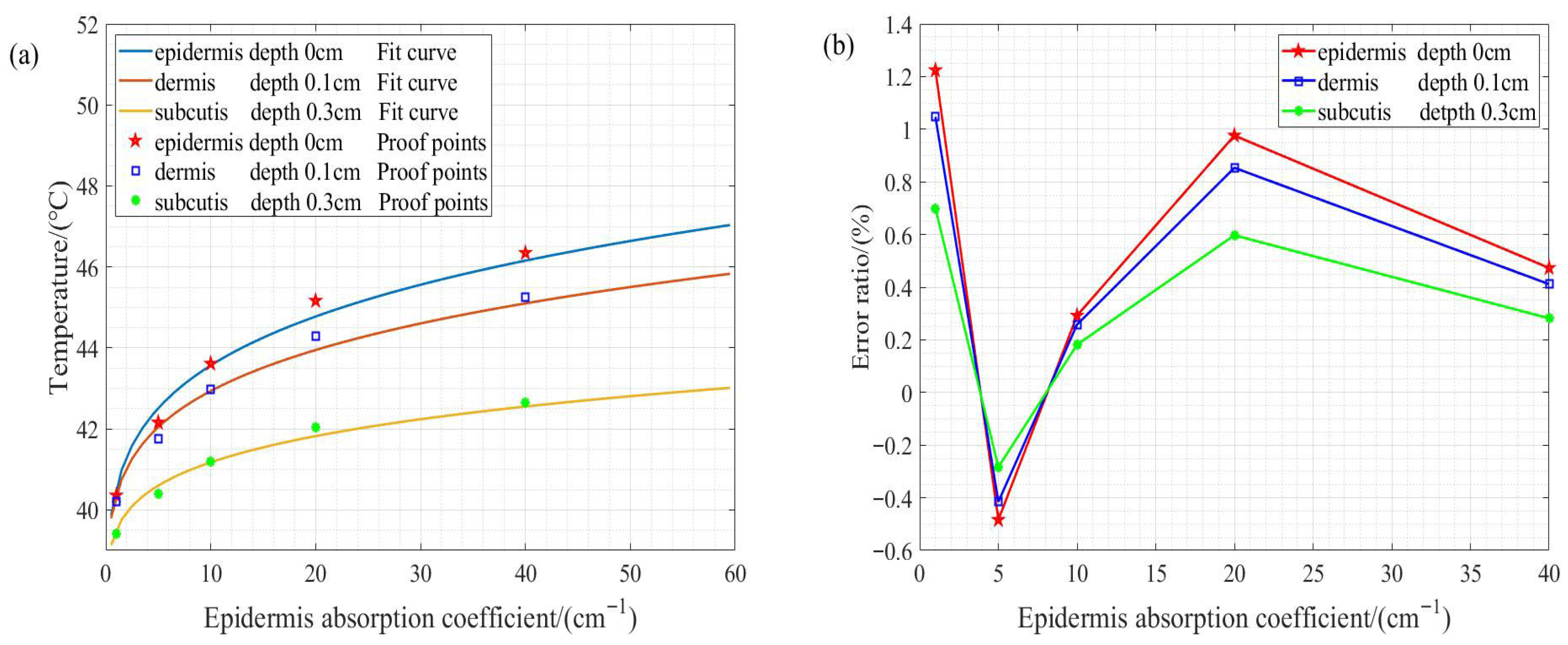
In the above formulation, μa denotes the epidermal absorption coefficient, while m, n, and c are fitting constants. The optimized fitting coefficients are summarized in Table 3. As shown in Figure 10a, the solid curves represent the fitted results, whereas the discrete points correspond to simulated temperatures at three depths for varying absorption coefficients. The relative fitting errors are presented in Figure 10b, indicating that the deviation between the fitted curves and the simulation results remains within 1.2%. These results demonstrate that the proposed fitting approach can effectively characterize the internal temperature distribution of biological tissues under different absorption coefficients. Therefore, the temperature response within tissue can be reliably estimated using the fitted model without requiring full numerical simulation for each parameter configuration.
In addition, an exponential function was adopted for temperature fitting, and the mathematical expression of the temperature fitting function is given as Equation (6):
T ( μ a ) = a e b μ a + m e n μ a
where μa denotes the epidermal absorption coefficient, and a, b, m, and n are fitting constants. The corresponding values of these parameters at different tissue depths are listed in Table 4.
As shown in Figure 11a, the solid curves represent the fitting results, whereas the discrete points correspond to simulated temperatures at three depths for varying absorption coefficients. The corresponding fitting errors are presented in Figure 11b. It can be observed that the errors of all three fitting curves remain within 0.1%. The fitting error using the exponential function is 0.1%, which is smaller than that using the power-law function. According to the Beer–Lambert law, the light intensity within biological tissues typically exhibits exponential decay, which may explain why the exponential function performs better in temperature fitting. In the Pennes equation, q is the local thermal deposition rate, calculated by multiplying the voxel flux rate F by its absorption coefficient. For a known biological tissue, its absorption coefficient is fixed. From a macro perspective, the relationship between flux rate F and distance conforms to the Beer–Lambert law. Therefore, the q parameter in the Pennes equation can be approximated as strongly correlated with the Beer–Lambert law, and the temperature change should also have a greater correlation with the exponential function.

4. Discussion and Conclusions

This study integrates Monte Carlo simulation with finite-element bioheat transfer modeling to investigate temperature variations within biological tissues under different physical and optical parameters. The effects of pulsed and continuous irradiation were first examined, followed by a systematic comparison of the influences of the absorption coefficient, the scattering coefficient, and laser power on the tissue temperature distribution. The results indicate that absorption coefficient and laser power play dominant roles in determining temperature elevation, whereas the impact of scattering coefficient is comparatively moderate within practical parameter ranges. Furthermore, a classical three-layer skin model was established to evaluate the relationship between internal temperature and relevant tissue parameters. Based on the simulated data, empirical fitting models were developed to estimate tissue temperature at different depths and under varying absorption coefficients. The proposed fitting approach achieved high predictive accuracy, with relative errors below 1.2% compared with the simulation benchmarks. Over a wide range of absorption coefficients (0.5–60 cm−1), the fitting error is relatively small, with the exponential model still yielding less than 0.1% error at different depths, indicating good robustness within this range. And this absorption coefficient can encompass those of most biological tissues. This also demonstrates the effectiveness of this fitting. Moreover, among various fitting methods, the fitting error analysis shows that the error does not increase or decrease overall with parameter changes, indicating that a portion of the error stems from random errors in MC simulation, consistent with the characteristics of MC simulation. The effectiveness of the proposed photothermal temperature-fitting methodology suggests its potential for rapid estimation of internal tissue temperature in photothermal and photodynamic therapy applications. This approach may also contribute to optical safety assessment in biomedical and wearable optoelectronic systems.
Reference [24] also combined the Monte Carlo method and the Pennes biological heat conduction equation to simulate temperature distribution in biological tissues. This work calculated the temperature characteristics inside biological tissues under a large number of different parameters. We verified the feasibility of combining the Monte Carlo method and the Pennes biological heat conduction equation to simulate temperature distribution in biological tissues.
Changes in both the scattering and absorption coefficients alter the light-intensity distribution within biological tissues. An increase in the scattering and absorption coefficients reduces the internal light intensity in biological tissues, making it more difficult to distinguish between them. However, in terms of photothermal properties, an increase in the absorption coefficient will cause biological tissues, especially surface tissues, to absorb more energy, thereby increasing temperature. As shown in Figure 5, when the absorption coefficient increases, the temperature increase becomes more pronounced, and the surface temperature change becomes more significant. An increase in the scattering coefficient causes an opposite temperature change. As shown in Figure 4, as the scattering coefficient increases, the light intensity becomes more dispersed, resulting in smaller temperature changes. However, in specific applications, changes in the scattering and absorption coefficients of biological tissues follow unique patterns. For example, in common photothermal therapy, the near-infrared band is typically used. In this band, the change in scattering coefficient is relatively gradual, while the absorption coefficient of water gradually increases with wavelength in the near-infrared band. Therefore, in near-infrared applications, more attention needs to be paid to temperature changes caused by the absorption coefficient. Increased absorption means energy is more readily absorbed by superficial biological tissues, leading to a rapid decrease in temperature with depth. In the ultraviolet band, such as in ultraviolet therapy for Vitiligo, hemoglobin has a large absorption and scattering coefficient. The combined effects of absorption and scattering coefficients cause a more rapid attenuation of light intensity, leading to a rapid temperature decrease in both the depth and lateral directions.
While this work achieved temperature parameter fitting, it did not yet discuss its application in conjunction with photothermal therapy. Reference [25] explored the photothermal effects of different wavelengths of laser light in three layers of skin tissue, providing a basis for selecting the optimal excitation wavelength in clinical treatment. Furthermore, exogenous metal nanoparticles are commonly used heating agents in photothermal therapy; Reference [26] provides a more comprehensive analysis of the photothermal effects of metal nanoparticles as photothermal sensitizers. Future work will further consider the use of exogenous heating agents, accommodate the changes in absorption and scattering coefficients introduced by their inclusion in the program, and gain a more comprehensive understanding of commonly used clinical laser wavelengths, focusing on their simulation and application.
The fitting method used in this work primarily estimates temperature changes under relatively coarse parameter variations to help researchers understand the general trend of internal temperature in biological tissues. It is mainly used to assist in determining safety thresholds in photothermal therapy and is not suitable for fine-grained temperature distribution analysis. In future work, we will construct tissue-mimicking optical phantoms to experimentally validate the proposed fitting model. By combining thermal imaging and multi-/hyperspectral imaging techniques [27,28], the surface light intensity and temperature variations under different wavelengths will be investigated. While Monte Carlo simulation can accurately obtain the light-intensity distribution within biological tissue, it is a random sampling method and computationally very time-consuming. When the scattering coefficient of biological tissue is much greater than its absorption coefficient, the radiative transfer equation can be approximated as a diffuse equation, which can be solved using the finite element method, offering relatively high computational efficiency. In this work, the temperature distribution within biological tissue relied on accurate light-intensity distribution data. In future work, we will consider combining these two methods: (1) using Monte Carlo simulation when the scattering coefficient is low or when the region of interest is very close to the light source; (2) using the diffuse equation to calculate the light-intensity distribution within biological tissue when the scattering coefficient is high. This would help improve computational efficiency. In addition, ultra-fine thermocouples will be employed to measure internal temperature changes, providing further experimental verification of the proposed temperature estimation framework.

Author Contributions

Conceptualization, X.X., F.C. and F.Z.; Methodology, C.W., X.X. and F.C.; Software, W.L. and C.W.; Validation, W.L.; Formal analysis, W.L. and P.X.; Investigation, W.L. and X.X.; Data curation, P.X., X.X. and F.C.; Writing—original draft, W.L. and C.W.; Writing—review & editing, X.X. and F.C.; Visualization, C.W. and P.X.; Supervision, X.X., F.C. and F.Z.; Project administration, F.C.; Funding acquisition, F.C. and F.Z. All authors have read and agreed to the published version of the manuscript.

Funding

This study was funded in part by Sanya Yazhou Bay Science and Technology City (SKJC-JYRC-2024-38), Hainan Provincial Sanya Yazhou Bay Science and Technology Innovation Joint Project (ZDYF2025GXJS136), and Hainan Provincial Natural Science Foundation of China (2019RC080).

Institutional Review Board Statement

Not applicable.

Informed Consent Statement

Not applicable.

Data Availability Statement

The original contributions presented in this study are included in the article. Further inquiries can be directed to the corresponding author.

Conflicts of Interest

The authors declare that they have no conflicts of interest.

References

  1. Olszowy, M.; Nowak-Perlak, M.; Woźniak, M. Current Strategies in Photodynamic Therapy (PDT) and Photodynamic Diagnostics (PDD) and the Future Potential of Nanotechnology in Cancer Treatment. Pharmaceutics 2023, 15, 1712. [Google Scholar] [CrossRef] [PubMed]
  2. Tsagkaris, C.; Papazoglou, A.S.; Eleftheriades, A.; Tsakopoulos, S.; Alexiou, A.; Găman, M.-A.; Moysidis, D.V. Infrared Radiation in the Management of Musculoskeletal Conditions and Chronic Pain: A Systematic Review. Eur. J. Investig. Health Psychol. Educ. 2022, 12, 334–343. [Google Scholar] [CrossRef] [PubMed]
  3. Casas-Alvarado, A.; Ogi, A.; Villanueva-García, D.; Martínez-Burnes, J.; Hernández-Avalos, I.; Olmos-Hernández, A.; Mora-Medina, P.; Domínguez-Oliva, A.; Mota-Rojas, D. Application of Infrared Thermography in the Rehabilitation of Patients in Veterinary Medicine. Animals 2024, 14, 696. [Google Scholar] [CrossRef] [PubMed]
  4. Aebisher, D.; Przygórzewska, A.; Bartusik-Aebisher, D. Natural Photosensitizers in Clinical Trials. Appl. Sci. 2024, 14, 8436. [Google Scholar] [CrossRef]
  5. Zafari, J.; Jouni, F.J.; Jamali, S.; Marzoghi, S.; Zadehmodarres, S.; Razzaghi, M. The effect of cisplatin-low-level laser therapy on cell viability and death of LNCaP prostate cancer cell line. Lasers Med. Sci. 2022, 37, 1283–1288. [Google Scholar] [CrossRef]
  6. Kaneko, K.; Osada, T.; Morse, M.A.; Gwin, W.R.; Ginzel, J.D.; Snyder, J.C.; Yang, X.-Y.; Liu, C.-X.; Diniz, M.A.; Bodoor, K.; et al. Heat shock protein 90-targeted photodynamic therapy enables treatment of subcutaneous and visceral tumors. Commun. Biol. 2020, 3, 226. [Google Scholar] [CrossRef]
  7. Gas, P. Essential facts on the history of hyperthermia and their connections with electromedicine. Prz. Elektrotech. 2011, 87, 37–40. [Google Scholar]
  8. Miaskowski, A.; Gas, P. Estimation of SLP/ILP parameters inside a female breast tumor during hyperthermia with mobilized and immobilized magnetic nanoparticles. Acta Bioeng. Biomech. 2025, 27, 159–169. [Google Scholar] [CrossRef]
  9. Gas, P.; Muhammad, S.; Khaliq, F. 3D Computational Modeling of Fe3O4@Au Nanoparticles in Hyperthermia Treatment of Skin Cancer. Nanotechnol. Sci. Appl. 2025, 18, 173–196. [Google Scholar] [CrossRef]
  10. Wang, L.; Jacques, S.L.; Zheng, L. MCML—Monte Carlo modeling of light transport in multi-layered tissues. Comput. Methods Programs Biomed. 1995, 47, 131–146. [Google Scholar] [CrossRef]
  11. Cai, F.; He, S. Using graphics processing units to accelerate perturbation Monte Carlo simulation in a turbid medium. J. Biomed. Opt. 2012, 17, 040502. [Google Scholar] [CrossRef] [PubMed]
  12. Cai, F.; Yu, J.; He, S. Vectorial electric field Monte Carlo simulations for focused laser beams (800 nm–2220 nm) in a biological sample. Prog. Electromagn. Res. 2013, 142, 667–681. [Google Scholar] [CrossRef]
  13. Jeynes, J.C.G.; Wordingham, F.; Moran, L.J.; Curnow, A.; Harries, T.J. Monte Carlo Simulations of Heat Deposition during Photothermal Skin Cancer Therapy Using Nanoparticles. Biomolecules 2019, 9, 343. [Google Scholar] [CrossRef] [PubMed]
  14. Kim, D.; Kim, H.; Kim, H.-S. Analysis of Peri-Implantitis Photothermal Therapy Effect According to Laser Irradiation Location and Angle: A Numerical Approach. Biomedicines 2024, 12, 1976. [Google Scholar] [CrossRef]
  15. Cheng, Y.; Shen, Y.; Gao, Y.; Wen, Y.; Lv, Z.; Wang, E.; Wang, M.; Zhang, S.; Bo, Y.; Peng, Q. Theoretical and Experimental Analysis of the Effect of Vaporization Heat on the Interaction between Laser and Biological Tissue. Appl. Sci. 2024, 14, 4333. [Google Scholar] [CrossRef]
  16. Xia, W.C. Heat transfer characteristics of biological tissues under laser irradiation. Sci. Educ. Guide Electron. Ed. 2017, 10, 132. [Google Scholar]
  17. Zhao, Y.Q.; Fan, S.F.; Chao, W.X. Optical parameters of biological tissues & their description. Foreign Med. Sci. Biomed. Eng. 2000, 23, 76–79. [Google Scholar]
  18. Marti, D.; Aasbjerg, R.N.; Andersen, P.E.; Hansen, A.K. MCmatlab: An open-source, user-friendly, MATLAB-integrated three-dimensional Monte Carlo light transport solver with heat diffusion and tissue damage. J. Biomed. Opt. 2018, 23, 121622. [Google Scholar] [CrossRef]
  19. Xu, R.C.; Zhang, L.N.; Lyu, H.L. Detection of skin thickness in different parts of the body in healthy adults by using 24 MHz high-frequency ultrasound. Chin. J. Lepr. Ski. Dis. 2022, 38, 141–145. [Google Scholar] [CrossRef]
  20. Zhou, L.; Yu, J.J.; Liu, C.H.; Li, Z.G.; Shan, Q.S. Simulation study on spectral characteristics of skin tissue volume pulse wave at 400–1000 nm. Spectrosc. Spectr. Anal. 2020, 40, 1071–1075. [Google Scholar]
  21. Yu, S.; Nishimura, T.; Hazama, H.; Ozawa, T.; Awazu, K. Measurement of absorption and reduced scattering coefficients in Asian human epidermis, dermis, and subcutaneous fat tissues in the 400- to 1100-nm wavelength range for optical penetration depth and energy deposition analysis. J. Biomed. Opt. 2020, 25, 045002. [Google Scholar] [CrossRef]
  22. Bashkatov, A.N.; Genina, E.A.; Kochubey, V.I.; Tuchin, V.V. Optical properties of human skin, subcutaneous and mucous tissues in the wavelength range from 400 to 2000 nm. J. Phys. D Appl. Phys. 2005, 38, 2543–2555. [Google Scholar] [CrossRef]
  23. Krackowizer, P.; Brenner, E. Thickness of the human skin: 24 points of measurement. Phlebologie 2008, 37, 83–92. [Google Scholar] [CrossRef]
  24. Deng, Z.-S.; Liu, J. Mathematical modeling of temperature mapping over skin surface and its implementation in thermal disease diagnostics. Comput. Biol. Med. 2004, 34, 495–521. [Google Scholar] [CrossRef] [PubMed]
  25. Azhdari, M.; Rezazadeh, G.; Lambers, L.; Ricken, T.; Tautenhahn, H.-M.; Tautenhahn, F.; Seyedpour, S.M. Refining thermal therapy: Temperature distribution modeling with distinct absorption in multi-layered skin tissue during infrared laser exposure. Int. Commun. Heat Mass Transf. 2024, 157, 107818. [Google Scholar] [CrossRef]
  26. Wang, D.; Rao, W. Numerical simulation on thermal response of laser-irradiated biological tissues embedded with liquid metal nanoparticles. J. Therm. Sci. 2022, 31, 1220–1235. [Google Scholar] [CrossRef]
  27. Cai, F.; Wang, T.; Wu, J.; Zhang, X. Handheld four-dimensional optical sensor. Optik 2020, 203, 164001. [Google Scholar] [CrossRef]
  28. Li, Y.; Fu, Y.; Lang, Z.; Cai, F. A High-Frequency and Real-Time Ground Remote Sensing System for Obtaining Water Quality Based on a Micro Hyper-Spectrometer. Sensors 2024, 24, 1833. [Google Scholar] [CrossRef]
Figure 1. Relationship between fluence rate and tissue depth under different absorption and scattering coefficients.
Applsci 16 03689 g001
Figure 2. Selection of simulation volume. (a) Temperature evolution at tissue depths of 0, 0.5, and 1 cm in a simulation volume of 5 cm × 5 cm × 3 cm; (b) temperature evolution at tissue depths of 0, 0.5, and 1 cm in a simulation volume of 10 cm × 10 cm × 6 cm; (c) relative error between the temperature curves obtained from the two simulation volumes; (d) radial surface temperature distribution after 600 s of irradiation in the 5 cm × 5 cm × 3 cm simulation volume.
Applsci 16 03689 g002
Figure 3. Comparison of tissue temperature responses under pulsed and continuous irradiation. (a) Temperature evolution at tissue depths of 0, 0.2, and 0.5 cm under pulsed and continuous irradiation with the same average power; (b) temperature fluctuation during a single pulse cycle.
Applsci 16 03689 g003
Figure 4. Effect of different scattering coefficients on tissue temperature. (a) Temperature change at the tissue surface (depth = 0 cm) with a fixed absorption coefficient of 0.5 cm−1; (b) temperature change at a depth of 0.5 cm with a fixed absorption coefficient of 0.5 cm−1; (c) temperature change at the tissue surface (depth = 0 cm) with a fixed absorption coefficient of 10 cm−1; (d) temperature change at a depth of 0.5 cm with a fixed absorption coefficient of 10 cm−1.
Applsci 16 03689 g004
Figure 5. Effect of different absorption coefficients on tissue temperature. (a) Temperature change at the tissue surface (depth = 0 cm); (b) temperature change at a depth of 0.5 cm.
Applsci 16 03689 g005
Figure 6. Effect of different powers on tissue temperature, at smaller depths, the temperature curves exhibit higher values compared to those at greater depths. (a) Incident light power 20 mW; (b) Incident light power 50 mW; (c) Incident light power 100 mW; (d) Incident light power 200 mW.
Applsci 16 03689 g006
Figure 7. Effect of different spot radii on tissue temperature. (a) Spot radius 0.1 cm; (b) Spot radius 0.3 cm; (c) Spot radius 0.5 cm; (d) Spot radius 1 cm.
Applsci 16 03689 g007
Figure 8. Polynomial-order selection and fitting error analysis.
Applsci 16 03689 g008
Figure 9. Depth-dependent temperature profiles of skin tissue under different irradiation powers. (a) Fitted internal temperature curves under different powers; (b) relative fitting errors.
Applsci 16 03689 g009
Figure 10. Temperature variations at the centers of different skin layers under varying epidermal absorption coefficients. (a) Fitting curve of skin tissue center temperature with skin absorption coefficient change; (b) Fitting error ratio.
Applsci 16 03689 g010
Figure 11. Exponential fitting curves of tissue temperature under varying epidermal absorption coefficients.
Applsci 16 03689 g011
Table 1. Parameter settings for the classical three-layer skin tissue model [21,22,23].
Biological TissueThickness (mm) μ a (cm−1) μ s (cm−1)Refractive Index (n)gCv (J/cm3K)k (W(cmK))
Epidermis0.25 mm102501.50.93.760.0037
Dermis1.25 mm12001.40.83.760.0037
Subcutis-11301.440.93.800.002
Table 2. Values of depth fit parameters.
Power (P)abmnT0
20 mW−12.770121.2255−9.4150−2.015439.6381
50 mW−31.9030253.1085−23.5643−5.035643.5932
100 mW−65.1947107.7879−47.8022−9.925250.1610
Table 3. Value of the fitting parameter for the absorption coefficient.
Biological Tissue (Depth: cm)mnc
Epidermis (0 cm)5.4760.196234.97
Dermis (0.1 cm)4.8710.188835.42
Subcutis (0.3 cm)3.34030.17836.05
Table 4. Values of the exponential fitting parameters.
Biological Tissue (Depth: cm)abmn
Epidermis (0 cm)45.750.0003678−5.951−0.09492
Dermis (0.1 cm)44.780.0003062−5.039 −0.09605
Subcutis (0.3 cm)42.370.000193−3.279−0.09717
Disclaimer/Publisher’s Note: The statements, opinions and data contained in all publications are solely those of the individual author(s) and contributor(s) and not of MDPI and/or the editor(s). MDPI and/or the editor(s) disclaim responsibility for any injury to people or property resulting from any ideas, methods, instructions or products referred to in the content.