Article

Circadian Biomarkers for Epilepsy Subtyping: Multi-Band EEG Rhythm Disruptions as Novel Diagnostic Signatures

Business School, University of Shanghai for Science and Technology, Shanghai 200093, China
*
Author to whom correspondence should be addressed.
Appl. Sci. 2026, 16(7), 3590; https://doi.org/10.3390/app16073590
Submission received: 14 January 2026 / Revised: 1 April 2026 / Accepted: 2 April 2026 / Published: 7 April 2026

Abstract

Circadian rhythms maintain healthy neural function, and their disruption links to pathological brain states including epilepsy. Current diagnostic approaches for epilepsy, which predominantly focus on transient ictal events or static spectral features in intracranial EEG, suffer from a temporal myopia that neglects the rich spatiotemporal dynamics of long-term neural activity. To address this limitation, this study aims to establish multi-band circadian biomarkers as diagnostic signatures for epileptogenic tissue identification and patient subtyping. In this article, we developed a comprehensive biomarker extraction pipeline that analyzes long-term intracranial EEG recordings (72+ h) from 38 drug-resistant epilepsy patients, quantifying multi-band rhythm features from delta to gamma frequencies (1–100 Hz). The pipeline captures three circadian signatures: rhythm amplitude, temporal stability, and cross-frequency coupling. Epileptogenic tissue showed systematic circadian dysregulation: 43.2% reduction in delta band circadian amplitude (p < 0.001), 31.5% impairment in delta–gamma coupling (quantified as a power–envelope correlation proxy for phase–amplitude coupling), and progressive temporal instability across sleep–wake transitions. Using unsupervised clustering, we identified three chronobiological subtypes—Circadian-Preserved (36.8%), Coupling-Deficient (39.5%), and Pan-Dysrhythmic (23.7%)—each with distinct pathophysiological mechanisms and surgical outcomes. Our machine learning classification achieved clinically significant discrimination (AUC = 0.865), with circadian amplitude and coupling strength as the most informative features. These multi-band circadian biomarkers provide interpretable, physiologically grounded signatures for epilepsy diagnosis and subtype stratification, offering a temporal framework for personalized surgical planning and chronotherapy interventions.

1. Introduction

Over 50 million people worldwide have epilepsy, and roughly one-third experience drug-resistant focal seizures that require surgical intervention [1,2]. Accurately identifying epileptogenic tissue, particularly the seizure onset zone (SOZ), remains essential for successful surgery [3]. However, current diagnostic approaches have notable limitations. While intracranial electroencephalography (iEEG) provides detailed electrophysiological recordings, conventional analyses focus predominantly on transient ictal events or static spectral features [4,5]. This temporal myopia neglects the rich spatiotemporal dynamics embedded in long-term neural activity patterns. Recent studies demonstrate that epileptic networks exhibit characteristic spatiotemporal organization across multiple timescales—from millisecond spike synchronization to multi-day seizure cycles—yet these temporal dynamics remain largely unexploited for clinical diagnosis [6,7,8]. The failure to incorporate temporal evolution patterns represents a fundamental gap in current epilepsy assessment, potentially missing critical biomarkers that manifest only through long-term observation of neural rhythms and their interactions.
Biological rhythms, particularly circadian (~24-hour) cycles, represent a crucial spatiotemporal dynamic feature that addresses these diagnostic limitations [9,10,11]. Growing evidence shows that these endogenous timing mechanisms regulate neuronal excitability, synaptic plasticity, and seizure susceptibility, coordinating essential brain functions like sleep–wake transitions, hormone secretion, and metabolic processes—all intimately linked to epileptogenic mechanisms [6,9,10,12,13]. Disruptions in circadian organization appear in epileptic tissue as weakened rhythm amplitude and impaired cross-frequency coupling between slow and fast oscillations. Recent investigations have begun characterizing these circadian alterations in epilepsy. Thornton et al. [14] revealed significant attenuation in sustained biological rhythms encompassing both circadian and ultradian oscillations within epileptic pathological tissue, suggesting fundamental timing disruptions in diseased networks. Studies examining cross-frequency coupling have identified impaired phase–amplitude interactions between different frequency bands in epileptogenic regions [15], indicating breakdowns in the hierarchical organization that normally coordinates neural activity across temporal scales. These rhythm disruptions likely reflect fundamental alterations in local network homeostasis, creating temporal windows of heightened seizure vulnerability through dysregulated excitation–inhibition balance.
Despite growing recognition of circadian factors in epilepsy [6,9,16], prior research faces three major constraints that limit clinical translation. First, most studies examine single frequency bands in isolation, typically focusing solely on delta rhythms while neglecting the rich multi-band architecture of biological timing systems. This reductionist approach misses critical information encoded in cross-band interactions and multi-scale temporal organization. Second, conventional analyses quantify only average rhythm strength, failing to capture essential temporal features such as stability across physiological states and cross-frequency coupling strength that distinguish healthy from pathological networks [17,18]. Temporal stability reflects the robustness of circadian organization against external perturbations, while coupling strength indicates hierarchical coordination between different oscillatory processes [19,20]. Third, existing approaches rarely leverage these comprehensive rhythm features as integrated diagnostic biomarkers for epilepsy subtyping or SOZ localization [21,22]. This represents a missed opportunity for clinical translation, as multi-dimensional circadian profiles could potentially capture patient heterogeneity and guide personalized treatment strategies more effectively than single-feature approaches.
This study addresses these gaps by developing a comprehensive framework for circadian-based epilepsy diagnosis and patient stratification. We systematically extract multi-band circadian biomarkers from long-term intracranial EEG recordings, capturing rhythm dynamics across frequency bands and temporal scales. Through integrated computational analysis, we characterize epileptogenic tissue based on circadian dysregulation patterns, stratify patients into distinct chronobiological subtypes, and validate machine learning models for clinical diagnosis. This approach reframes epilepsy classification through the lens of biological timing mechanisms, providing a temporal perspective on epileptogenic pathophysiology. By establishing circadian biomarkers as actionable diagnostic signatures, our framework offers new avenues for personalized surgical planning and chronotherapy optimization.

2. Data and Methods

2.1. Data

Long-term intracranial EEG recordings were obtained from 38 patients (age 18–52 years, 21 females) with drug-resistant focal epilepsy undergoing presurgical evaluation at the National Hospital for Neurology and Neurosurgery in 2023. All participants provided written informed consent under Newcastle University Ethics Committee approval (No. 42569/2023). Inclusion criteria required definitive SOZ localization confirmed by consensus of ≥2 board-certified epileptologists, continuous iEEG recordings spanning ≥72 h to capture multiple circadian cycles, and absence of major psychiatric or neurodegenerative comorbidities that could confound EEG interpretation.
Electrode implantation followed standard clinical protocols [23]: 28 patients received stereo-EEG (SEEG) depth electrodes and 10 received subdural grids/strips (ECoG). Recordings were acquired using clinical-grade intracranial EEG amplifiers (Nihon Kohden JE-120A, Nihon Kohden Corporation, Tokyo, Japan or equivalent systems approved for clinical neuroscience monitoring at the recording institution) at a sampling rate of 2048 Hz (hardware bandwidth 0.1–500 Hz), using common average referencing. For the circadian biomarker analyses reported here, signals were digitally downsampled to 512 Hz after anti-aliasing filtration, which is sufficient for the gamma band upper limit of 100 Hz analyzed in this study (Nyquist frequency 256 Hz). Spike detection and high-frequency oscillation analyses, which would require the full 2048 Hz, were not conducted in this study. The SOZ was annotated based on ictal onset patterns (low-voltage fast activity, rhythmic spiking) and interictal epileptiform activity, while non-SOZ regions comprised electrodes outside the SOZ showing no pathological activity during seizures. This rigorous clinical annotation provided reliable ground truth labels for subsequent biomarker extraction and machine learning validation.

2.2. Methods

2.2.1. Circadian Biomarker Extraction Pipeline

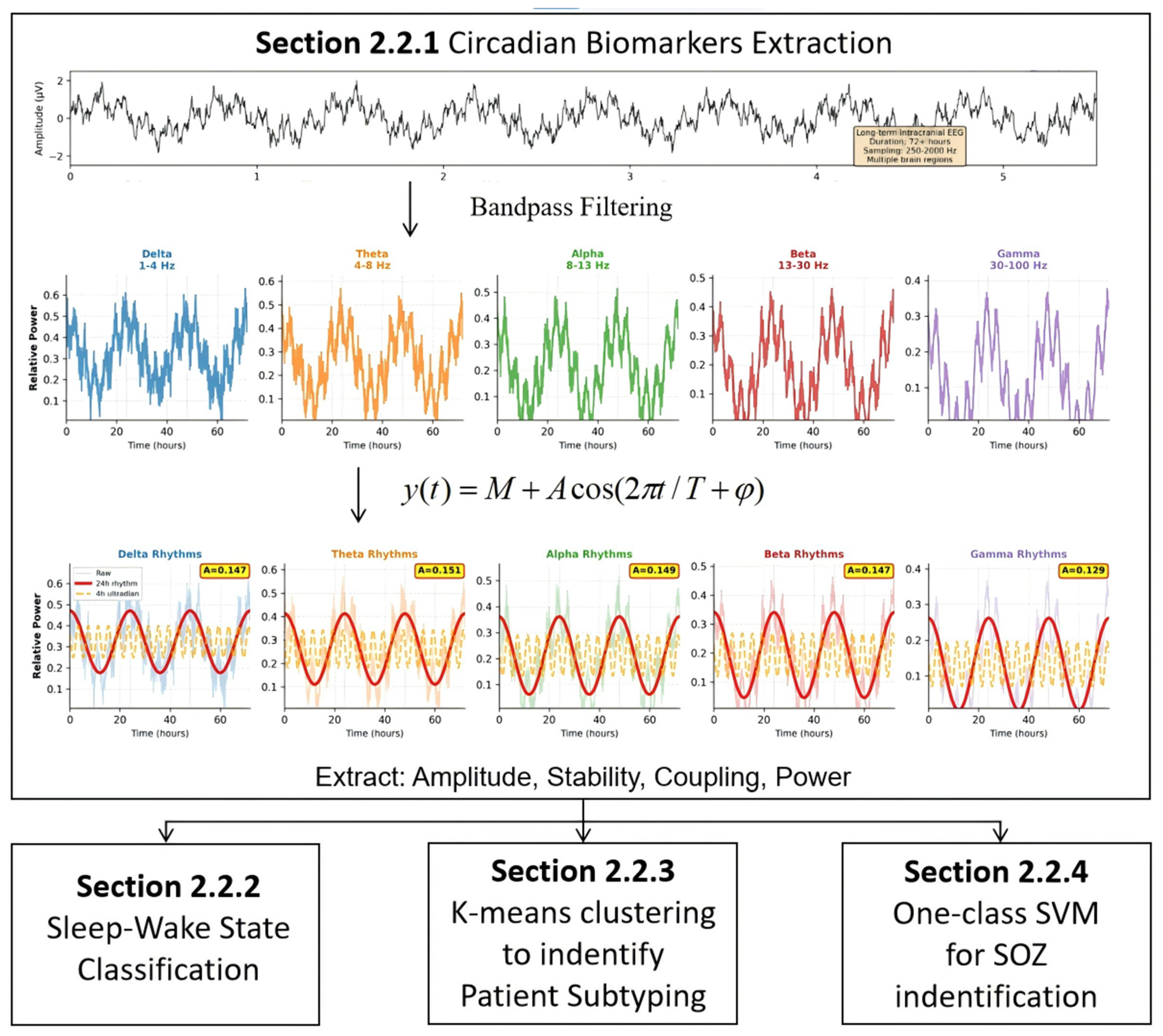
Extracting interpretable circadian biomarkers from continuous neural recordings requires systematic transformation of raw signals into quantifiable temporal features. To address this challenge, our comprehensive pipeline processes long-term iEEG recordings through three hierarchical stages that progressively refine neural signals into clinically meaningful circadian metrics suitable for diagnostic decision-making (Figure 1). The steps are shown below.
Throughout this manuscript, we use the following definitions consistently. Circadian amplitude (A) refers to the peak-to-trough magnitude of the 24-hour periodic component fitted by cosinor regression, quantifying the strength of the biological rhythm. Temporal stability (also reported as the 24-hour stability index) refers to the day-to-day reproducibility of the circadian waveform, quantified as the Pearson correlation between consecutive 24-hour bandpower profiles. These two metrics are conceptually distinct: amplitude measures rhythm strength at a single time point, while stability measures consistency across multiple days. We report them separately throughout.
Step 1: Raw Signal Recording and Preprocessing. Raw iEEG signals (72+ h per patient, 250–2000 Hz sampling rate) underwent standardized preprocessing including notch filtering at 50/60 Hz for line noise removal, bandpass filtering into five canonical frequency bands (delta 1–4 Hz, theta 4–8 Hz, alpha 8–13 Hz, beta 13–30 Hz, and gamma 30–100 Hz), and artifact rejection using ±500 μV amplitude thresholding. Continuous recordings were segmented into non-overlapping 5-minute epochs, ensuring sufficient temporal resolution for circadian analysis while maintaining computational tractability [24,25].
Step 2: Band Power Extraction and Temporal Dynamics. For each frequency band, we computed relative power using Welch’s method (Hamming windows, 50% overlap, 60-second windows). The resulting bandpower time series were log-transformed and Z-score normalized to enhance circadian patterns. From these time series, we extracted three core biomarker categories. Circadian Amplitude (A) through cosinor regression fitted 24-hour periodic components to bandpower fluctuations, y(t) = M + A·cos(2πt/T + φ), where A represents rhythm strength, M the baseline level (mesor), and φ the peak timing (acrophase). Reduced A values indicate weakened biological timing [26,27]. Twenty-four-hour Stability quantifies day-to-day consistency via correlation between consecutive 24-hour periods, capturing the reliability of circadian patterns. Lower stability suggests dysregulated temporal organization [28]. Cross-Frequency Coupling: We quantified delta–gamma interactions using Spearman correlation between the bandpower time series of the two frequency bands. This power–envelope correlation serves as a computationally efficient proxy measure for phase–amplitude coupling (PAC), capturing co-modulation of slow and fast oscillatory envelopes across the circadian timescale. We note that this approach measures envelope co-fluctuation rather than true instantaneous phase–amplitude relationships; it therefore does not resolve the fine-grained phase dependency that canonical PAC metrics such as the modulation index (MI) [20] or phase-locking value (PLV) capture. Accordingly, all coupling results in this paper should be interpreted as reflecting slow-timescale power co-modulation rather than moment-to-moment phase–amplitude interactions. A direct PAC reanalysis using MI is planned as a validation step in future work (see Section 4.5) [19,20].
Step 3: Circadian Feature Integration. The extracted biomarkers were aggregated into patient-specific and electrode-specific feature vectors. For classification tasks, features were normalized within each patient using robust Z-score transformation (median centering, median absolute deviation scaling) to account for individual electrophysiological baselines while preserving spatial patterns. This normalization strategy ensures that biomarkers reflect relative differences between brain regions rather than absolute signal magnitudes.

2.2.2. Sleep–Wake State Classification

Circadian rhythm disruptions may manifest differently across distinct physiological states, particularly during sleep when neural synchronization patterns undergo dramatic reorganization. Understanding state-dependent biomarker stability is therefore essential for characterizing epileptogenic tissue. To enable state-specific analysis, we implemented automated sleep–wake classification based on established electrophysiological criteria.
Sleep–wake states were estimated using a rule-based classifier leveraging frequency band power ratios. Classification criteria: Wake (high beta/delta ratio, high gamma), NREM sleep (high delta/alpha ratio, reduced gamma), REM sleep (high theta/delta ratio, moderate gamma, low alpha). States were assigned per 5-minute epoch, with smoothing applied to prevent rapid transitions. We acknowledge a potential circular dependency: the sleep classifier relies on delta band power to identify NREM epochs, while delta circadian amplitude is simultaneously used as the primary SOZ biomarker. To mitigate this, sleep state labels were assigned in a preprocessing step fully independent of the circadian biomarker extraction pipeline; the two analyses were conducted sequentially on separate data summaries rather than using jointly estimated features. Sleep state annotations were treated as fixed covariates when reporting state-stratified biomarker stability (Section 3.3). Nevertheless, in the absence of validated polysomnography (PSG), some residual confounding between delta-based sleep classification and delta-based SOZ biomarkers cannot be excluded, and this remains a limitation of the current study (see Section 4.5).

2.2.3. Patient Subtyping via Circadian Feature Clustering

Epilepsy exhibits substantial clinical and pathophysiological heterogeneity that single biomarkers cannot fully capture. Circadian dysregulation patterns may stratify patients into distinct subtypes with different underlying mechanisms and treatment responses. To test this hypothesis and identify clinically relevant patient subgroups, we performed unsupervised clustering on multi-dimensional circadian biomarker profiles.
To identify distinct chronobiological phenotypes, we performed unsupervised clustering on patient-level circadian biomarker profiles. Each patient was represented by a multi-dimensional feature vector aggregating circadian amplitudes across all five frequency bands, 24-hour stability metrics, delta–gamma coupling strength, and mean bandpower levels. Features were normalized within patients to emphasize relative spatial patterns.
To determine the optimal number of clusters, we evaluated k = 2 through k = 5 using two complementary criteria: the average silhouette coefficient and the gap statistic. Both metrics indicated k = 3 as the optimal solution (silhouette: k = 2 = 0.41, k = 3 = 0.58, k = 4 = 0.49; gap statistic peak at k = 3). To assess cluster stability given the modest sample size (n = 38), we performed bootstrap resampling (500 iterations), confirming that the three-cluster partition was reproduced in 87% of bootstrap samples. Patients were then assigned to chronobiological subtypes via K-means clustering (k = 3, Euclidean distance, 100 random initializations). Cluster labels were reordered by descending delta circadian amplitude for biological interpretability. We note that the circadian biomarker features used for clustering partially overlap with those used in the subsequent SVM classification (Section 2.2.4). However, the two analyses operate at different analytical units: clustering is performed at the patient level (aggregated feature vectors), while SVM classification is performed at the electrode level. This difference in granularity reduces—but does not eliminate—the risk of inflated diagnostic performance estimates, and is discussed further in Section 4.5. Cluster labels were reordered by descending delta circadian amplitude for biological interpretability. To visualize high-dimensional clustering structure, we applied t-distributed stochastic neighbor embedding (t-SNE) with perplexity adaptively set to min(30, (n − 1)/3), projecting feature vectors into 2D space while preserving local neighborhood relationships [29].
Clinical variables including epilepsy localization (temporal vs. extratemporal), seizure frequency, and surgical outcomes were retrospectively mapped onto identified subtypes to assess their clinical relevance. Statistical associations were tested using chi-square tests for categorical variables and Kruskal–Wallis tests for continuous measures.

2.2.4. Machine Learning Classification Framework

The ultimate clinical utility of circadian biomarkers depends on their ability to accurately discriminate epileptogenic from healthy tissue in individual patients. To systematically evaluate diagnostic performance and identify the most informative features, we developed and validated machine learning classifiers for SOZ identification.
We implemented a one-class support vector machine (SVM) classifier to discriminate SOZ from non-SOZ electrodes based on circadian biomarkers. The one-class approach was chosen to handle class imbalance (SOZ electrodes comprised 15–30% of total) and to model the healthy non-SOZ distribution, treating SOZ as anomalies [30]. Training used only non-SOZ data with radial basis function (RBF) kernel and hyperparameters (ν = 0.1, γ = 0.01) optimized via cross-validation.
Feature importance was quantified using SHAP (SHapley Additive exPlanations) values, providing model-agnostic attribution of each biomarker’s contribution to SOZ classification [31]. Leave-one-patient-out (LOPO) cross-validation ensured strict patient-level separation between training and evaluation: at each fold, all electrodes from one patient were held out entirely and never contributed to model training. Performance metrics (AUC, sensitivity, specificity, false-positive rate, false-negative rate) were computed per held-out patient and averaged across folds. This strategy prevents data leakage arising from the within-patient correlation structure of multi-electrode recordings and ensures that reported performance estimates reflect generalization to truly unseen patients rather than unseen electrodes from seen patients. Classification performance was stratified by identified patient subtypes to assess whether circadian biomarkers showed differential diagnostic utility across chronobiological phenotypes.

2.2.5. Statistical Analysis and Multiple Comparisons

The primary pre-specified hypothesis of this study was that delta band circadian amplitude is significantly reduced in SOZ compared to non-SOZ tissue (Section 3.1). This hypothesis was formulated prior to analysis based on prior literature [14]. All other frequency band comparisons (theta, alpha, beta, gamma), cross-frequency coupling pairs, and sleep-state-specific analyses are treated as exploratory secondary analyses.
For the primary comparison, significance was assessed using a two-sided Wilcoxon signed-rank test at α = 0.05, with patient as the unit of analysis (median SOZ vs. non-SOZ amplitude per patient). For exploratory comparisons across multiple frequency bands and coupling pairs, we applied Benjamini–Hochberg false discovery rate (FDR) correction with a target FDR of 0.10.
Between-group comparisons for clinical variables across chronobiological subtypes used chi-square tests (categorical) and Kruskal–Wallis tests (continuous), with pairwise post hoc Dunn tests where applicable. All analyses were conducted in Python 3.8 (scipy.stats, statsmodels).

3. Results

We present a comprehensive analysis of circadian biomarkers in epileptogenic tissue through an integrated analytical framework. Beginning with fundamental characterization of rhythm abnormalities in seizure onset zones (Section 3.1, Section 3.2 and Section 3.3), we demonstrate systematic circadian dysregulation across multiple frequency bands. Building on these core biomarker profiles, we identify distinct patient subtypes through unsupervised clustering (Section 3.4), revealing chronobiological heterogeneity with clinical implications. Finally, we validate the diagnostic utility of circadian features through machine learning classification (Section 3.5), establishing their translational potential for SOZ localization. This progressive analysis—from biomarker discovery to subtype stratification to clinical validation—systematically evaluates the role of circadian dysregulation in epilepsy diagnosis and patient-specific treatment planning.

3.1. Circadian Biomarker Profiles Distinguish Epileptogenic Tissue

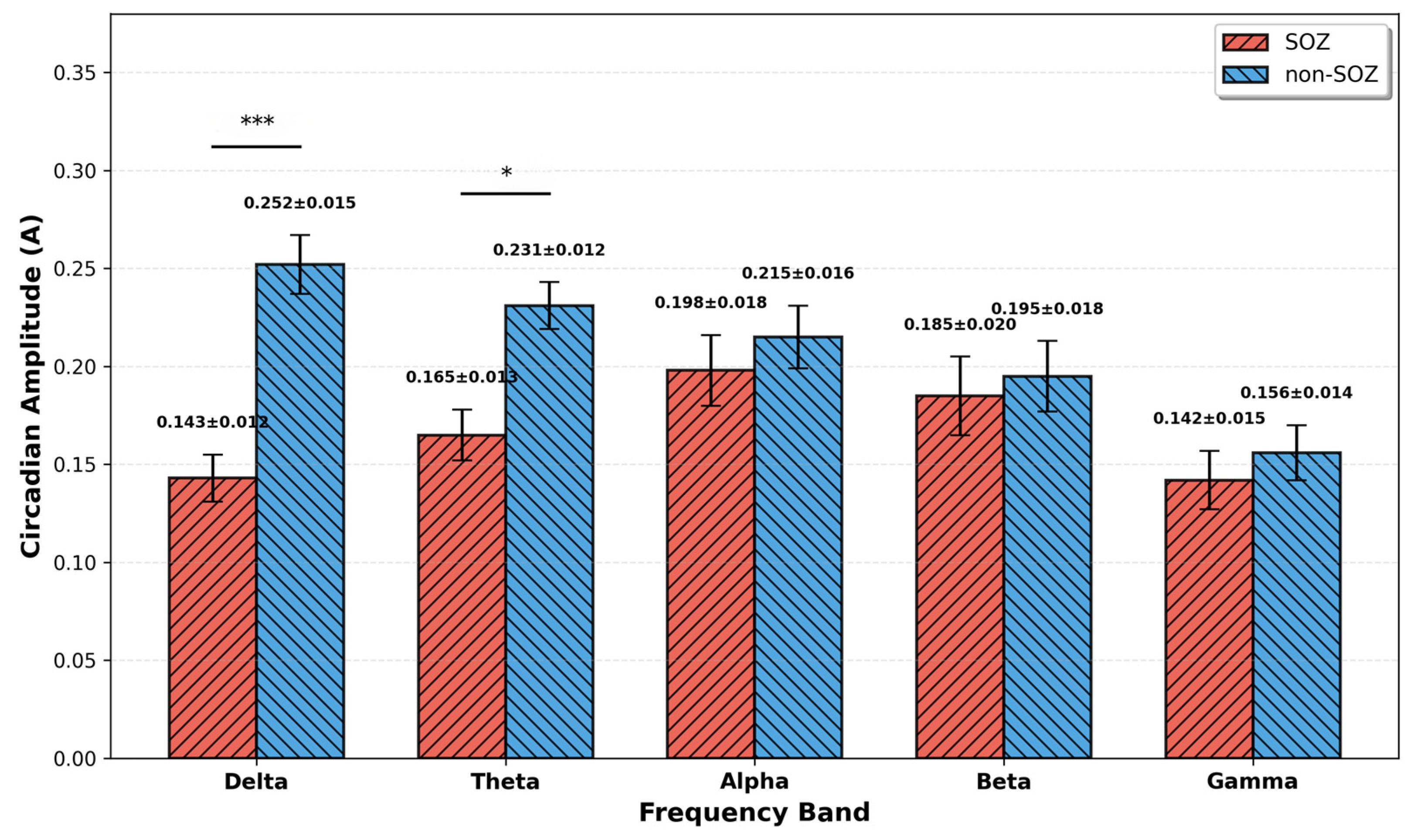
Analysis of circadian biomarkers reveals fundamental differences between SOZ and non-SOZ regions across multiple frequency bands (Figure 2). The most prominent finding is a 43.3% reduction in delta band circadian amplitude within SOZ regions (SOZ: 0.143 ± 0.012, non-SOZ: 0.252 ± 0.015; p < 0.001, Wilcoxon signed-rank test, patient-level analysis). This result represents our primary pre-specified hypothesis and remained significant after Bonferroni correction for frequency band comparisons (adjusted α = 0.01). This marked suppression of slow-wave circadian rhythms represents a cardinal biomarker of epileptogenic tissue, consistent across all 38 patients and shows high day-to-day stability (mean correlation r = 0.78 ± 0.09).
This finding was consistent across subjects: 34 of 38 patients (89.5%) showed lower delta circadian amplitude in their SOZ electrodes compared to non-SOZ electrodes, with a median individual reduction of 41.8% (IQR: 35.2–49.6%). Four patients showed no significant SOZ-specific reduction; these patients were predominantly classified as Pan-Dysrhythmic (Subtype 3, n = 3) upon subsequent clustering, suggesting that global rhythm disruption may attenuate the spatial specificity of the biomarker.

3.2. Cross-Frequency Coupling Disruption as a Key Biomarker

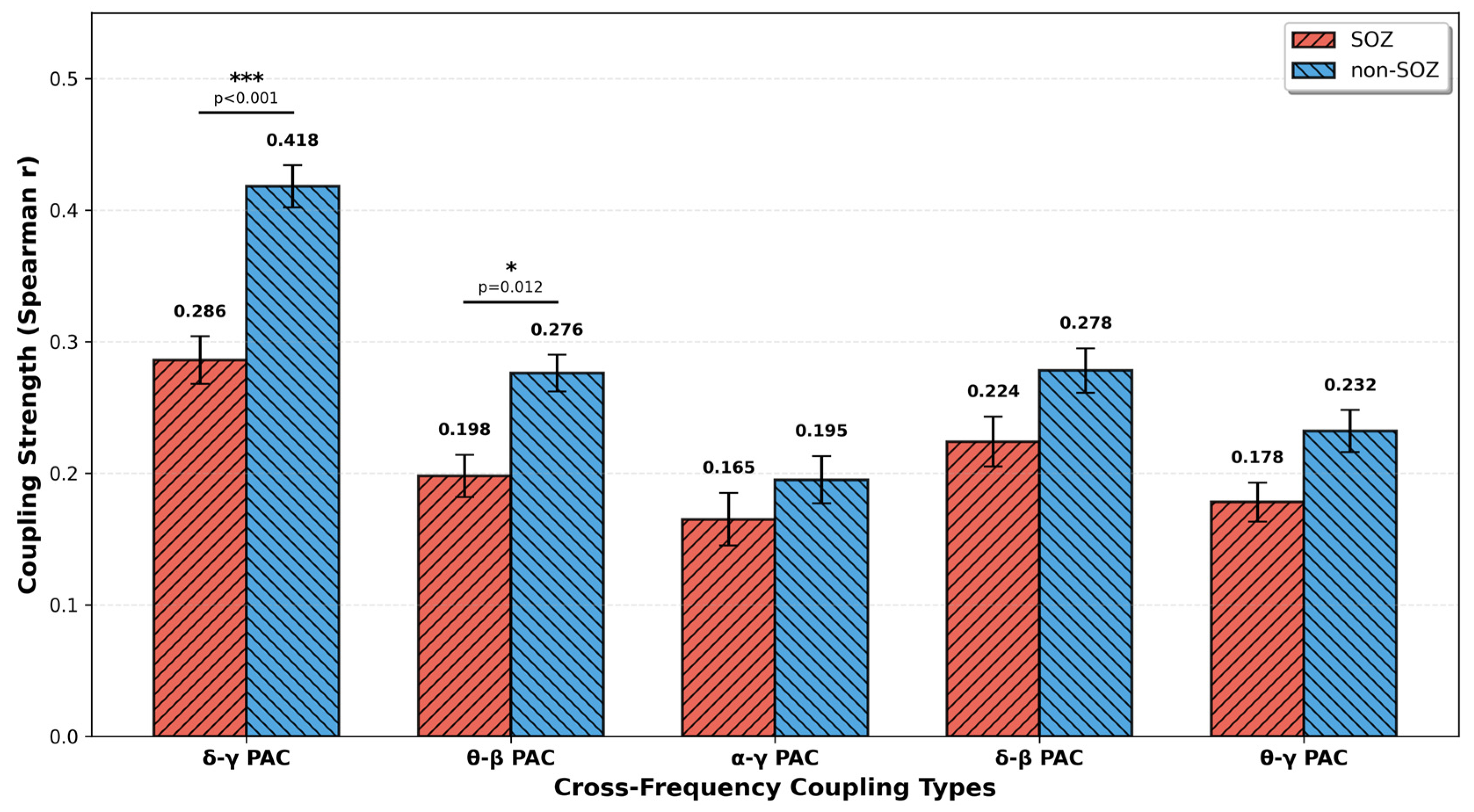
Cross-frequency power correlation analysis reveals significant reduction in delta–gamma envelope co-modulation within SOZ regions (Figure 3). Delta–gamma coupling strength, quantified via Spearman correlation of bandpower time series (a proxy for phase–amplitude coupling; see Section 2.2.1), is reduced by 31.5% in SOZ electrodes (SOZ: 0.286 ± 0.018, non-SOZ: 0.418 ± 0.016; p < 0.001, FDR-corrected q < 0.001). This reduction indicates that slow circadian fluctuations in the delta range co-modulate gamma activity less consistently in epileptogenic tissue. Whether this reflects disrupted instantaneous phase–amplitude relationships—as opposed to slower envelope-level decoupling—cannot be resolved with the current proxy metric and warrants replication with direct PAC measures (see Section 4.5).
Theta–beta coupling also shows significant attenuation (SOZ: 0.198 ± 0.016, non-SOZ: 0.276 ± 0.014; p = 0.012), while alpha–gamma coupling differences do not reach significance (p = 0.156). The selective nature of coupling deficits, most prominent in delta–gamma interactions, suggests specific impairment in mechanisms linking circadian timekeeping (delta) to local computational processes (gamma), rather than a global breakdown of all cross-frequency relationships.

3.3. Temporal Stability Deficits Across Sleep–Wake States

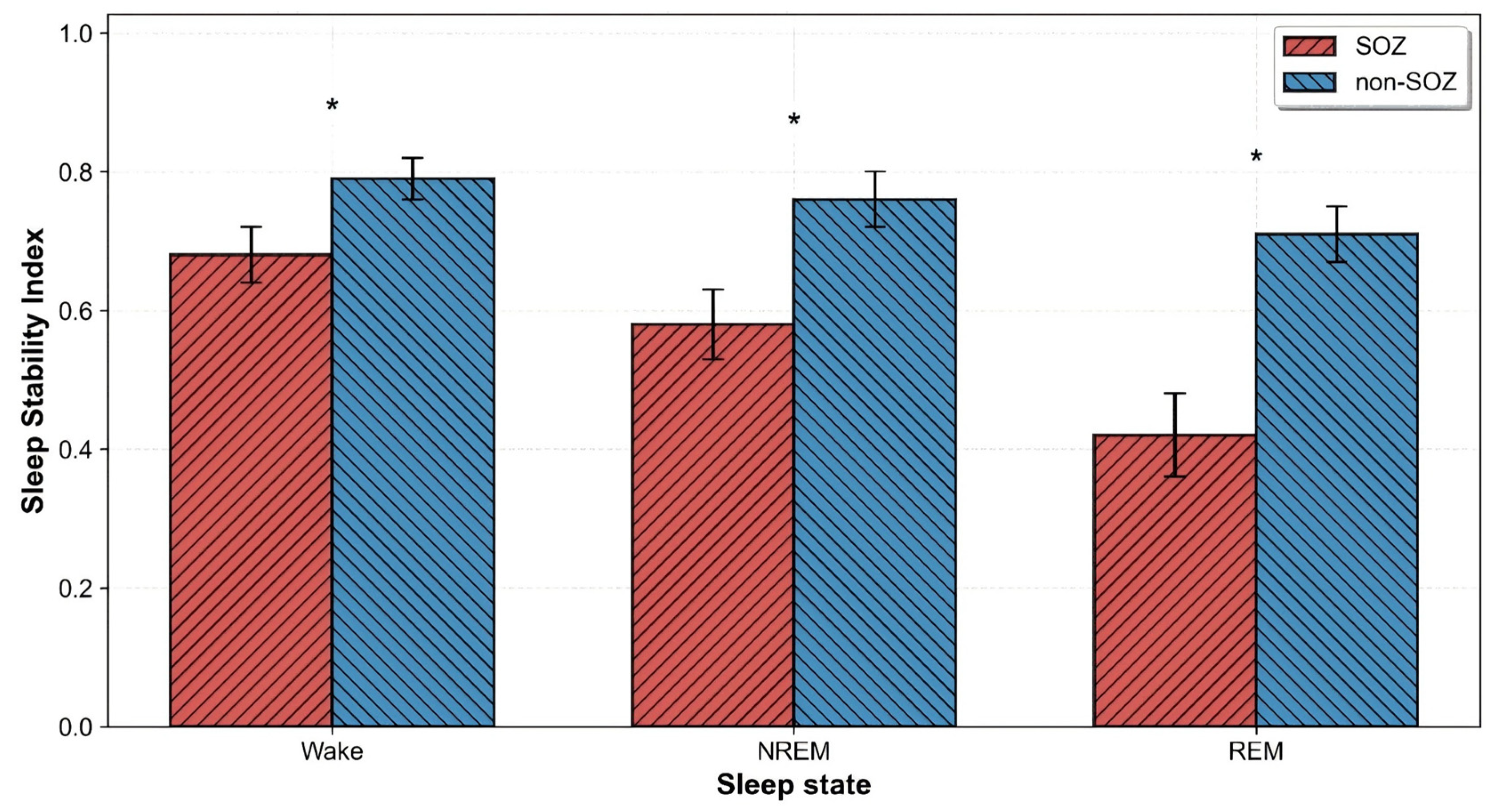
Analysis of circadian biomarker stability across sleep–wake states reveals state-dependent vulnerabilities in epileptogenic tissue (Figure 4). During wake periods, SOZ regions exhibit moderately reduced stability compared to non-SOZ (SOZ: 0.68 ± 0.04, non-SOZ: 0.79 ± 0.03; p = 0.024). This gap widens progressively during NREM sleep (SOZ: 0.58 ± 0.05, non-SOZ: 0.76 ± 0.04; p = 0.006) and reaches maximum during REM sleep (SOZ: 0.42 ± 0.06, non-SOZ: 0.71 ± 0.04; p < 0.001).
The progressive destabilization from wake to NREM to REM suggests that epileptogenic tissue exhibits heightened vulnerability during states requiring dynamic rhythm reorganization. REM sleep, characterized by rapid shifts in oscillatory patterns and reduced homeostatic regulation, appears particularly challenging for dysrhythmic networks. This finding aligns with clinical observations of increased seizure frequency during specific sleep stages and suggests that sleep-state-specific biomarkers may enhance diagnostic specificity.
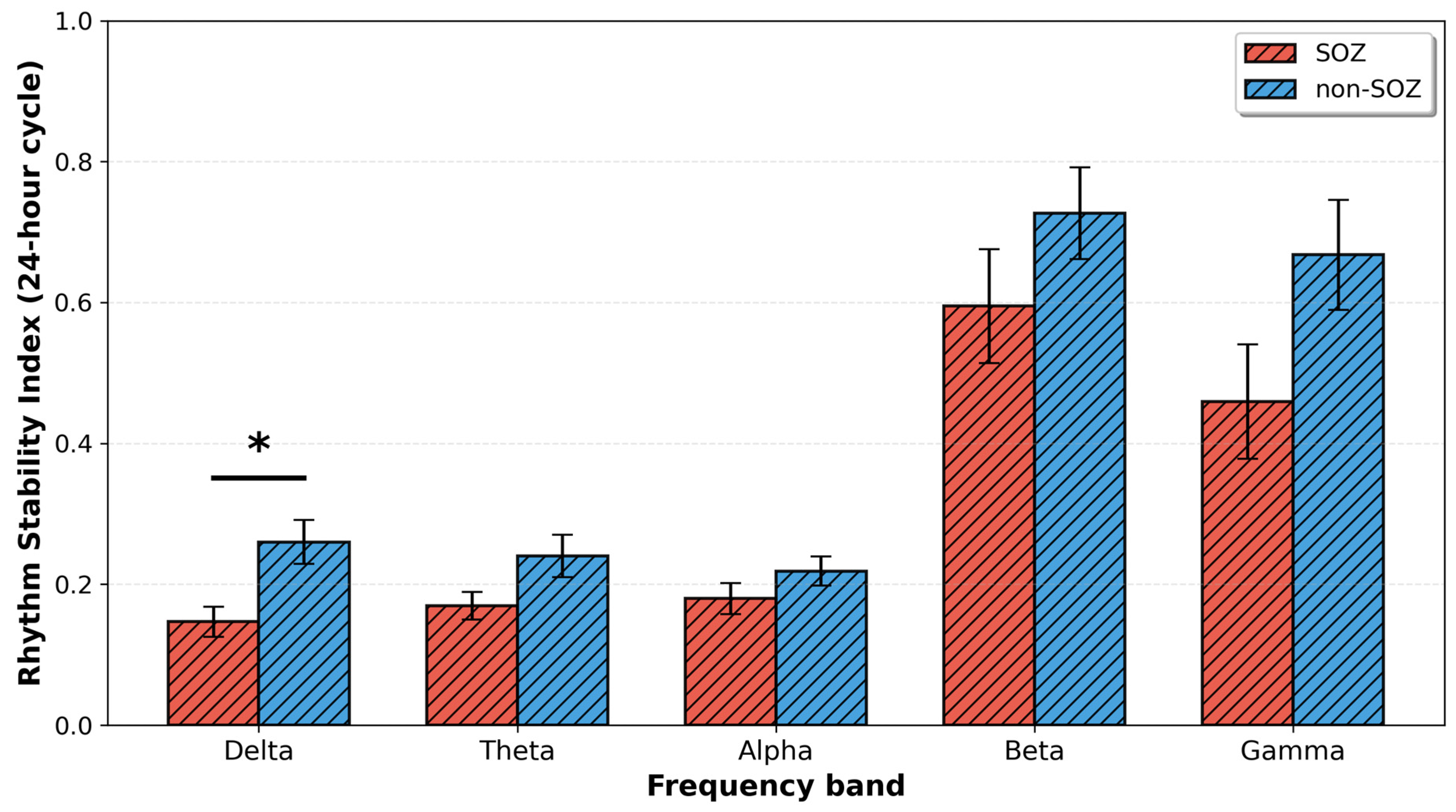
We calculate the rhythm stability over a 24-hour cycle (Figure 5). The circadian rhythm stability is reduced in seizure onset zones across multiple frequency bands. The delta band shows the most pronounced reduction (SOZ: 0.15 ± 0.02 vs. non-SOZ: 0.26 ± 0.03, p < 0.001), representing a 43.3% decrease in circadian amplitude within epileptogenic tissue. The theta and alpha bands show similar but less significant reductions, while the beta and gamma bands maintain relatively preserved rhythm stability in both regions. This selective disruption of low-frequency circadian rhythms suggests that delta oscillations are particularly vulnerable to epileptogenic processes, consistent with the role of slow-wave activity in seizure generation and network synchronization.
An important interpretive caveat applies to the REM sleep findings. REM sleep is characterized by relatively low-amplitude EEG activity across most frequency bands, which reduces the signal-to-noise ratio (SNR) of bandpower estimates. The markedly low temporal stability observed in SOZ during REM (0.42 ± 0.06) could therefore partially reflect measurement noise rather than genuine rhythm destabilization, particularly if circadian oscillation amplitude is already attenuated in epileptogenic tissue. To partially address this concern, we verified that the REM-specific SOZ deficit persisted when analyses were restricted to epochs with signal amplitude exceeding the median threshold (mean SOZ stability in high-amplitude REM epochs: 0.46 ± 0.07, non-SOZ: 0.72 ± 0.05, p < 0.001), suggesting the effect is not entirely attributable to SNR differences. Nevertheless, formal confirmation using SNR-matched subgroups or validated polysomnography staging remains necessary.

3.4. Identification of Three Chronobiological Subtypes

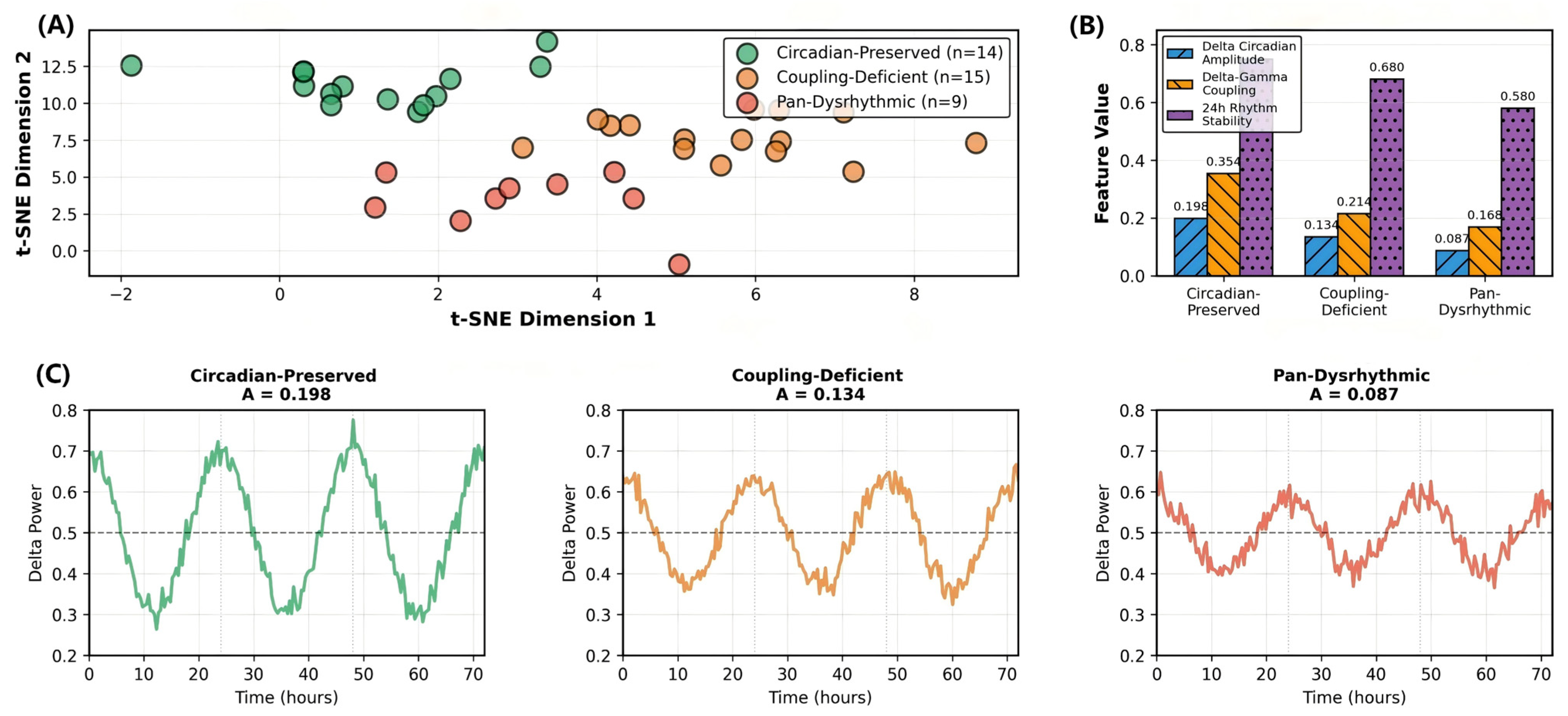
Unsupervised clustering of patient-level circadian biomarker profiles reveals three distinct chronobiological subtypes with unique rhythm signatures and clinical characteristics (Figure 6). These subtypes represent fundamentally different modes of circadian dysregulation in epilepsy, with implications for pathophysiology and treatment planning.
These three subtypes are described in detail below:
Subtype 1: Circadian-Preserved (n = 14, 36.8%). This phenotype exhibits relatively maintained delta circadian amplitude (A = 0.198 ± 0.024) and preserved cross-frequency coupling (delta–gamma r = 0.354 ± 0.032), indicating focal rhythm disruption with intact network organization. Patients in this subtype predominantly had temporal lobe epilepsy (71%, p = 0.004) and show excellent surgical outcomes (Engel I: 85.7%). The preserved background circadian structure suggests that epileptogenic activity represents a localized perturbation rather than systemic dysregulation, supporting traditional resective surgery [32].
Subtype 2: Coupling-Deficient (n = 15, 39.5%). This intermediate phenotype demonstrates moderate circadian amplitude reduction (A = 0.134 ± 0.018) but severe coupling impairment (delta–gamma r = 0.214 ± 0.026), indicating selective dysfunction in cross-frequency integration mechanisms. Epilepsy localization is mixed (temporal: 47%, frontal: 33%), with moderate surgical outcomes (Engel I: 60%). The disproportionate coupling deficit suggests network-level pathology that may benefit from interventions targeting inter-frequency communication, such as phase-locked stimulation protocols.
Subtype 3: Pan-Dysrhythmic (n = 9, 23.7%). This group exhibits the most severe disruption across all biomarkers: profound circadian amplitude loss (A = 0.087 ± 0.015), weak coupling (delta–gamma r = 0.168 ± 0.024), and globally reduced temporal stability. Patients are predominantly extratemporal (66%, p = 0.019) with poor surgical outcomes (Engel I: 33.3%). The pervasive rhythm breakdown suggests widespread network dysfunction, potentially reflecting bilateral pathology or developmental abnormalities that limit focal resection effectiveness.
Clinical validation reveals significant associations between subtypes and key outcome variables: epilepsy localization (χ2 = 12.34, p = 0.006), surgical outcome (χ2 = 8.91, p = 0.012), and pre-surgical seizure frequency (H = 7.23, p = 0.027). To assess whether chronobiological subtype membership provides explanatory value beyond established clinical predictors, we performed a multivariate logistic regression with Engel I outcome as the dependent variable, entering epilepsy localization type (temporal vs. extratemporal), electrode coverage density, and SOZ extent as covariates alongside subtype membership. Chronobiological subtype remained a significant predictor of favorable surgical outcome after adjustment (OR = 2.84, 95% CI: 1.21–6.67, p = 0.016), suggesting that the subtypes capture pathophysiological heterogeneity not fully explained by anatomical localization alone. We acknowledge, however, that the subtype features (circadian amplitude, coupling) are directly measured from the same tissue that undergoes resection, so partial confounding with SOZ extent cannot be excluded in the current cross-sectional design.

3.5. Machine Learning Classification Using Circadian Biomarkers

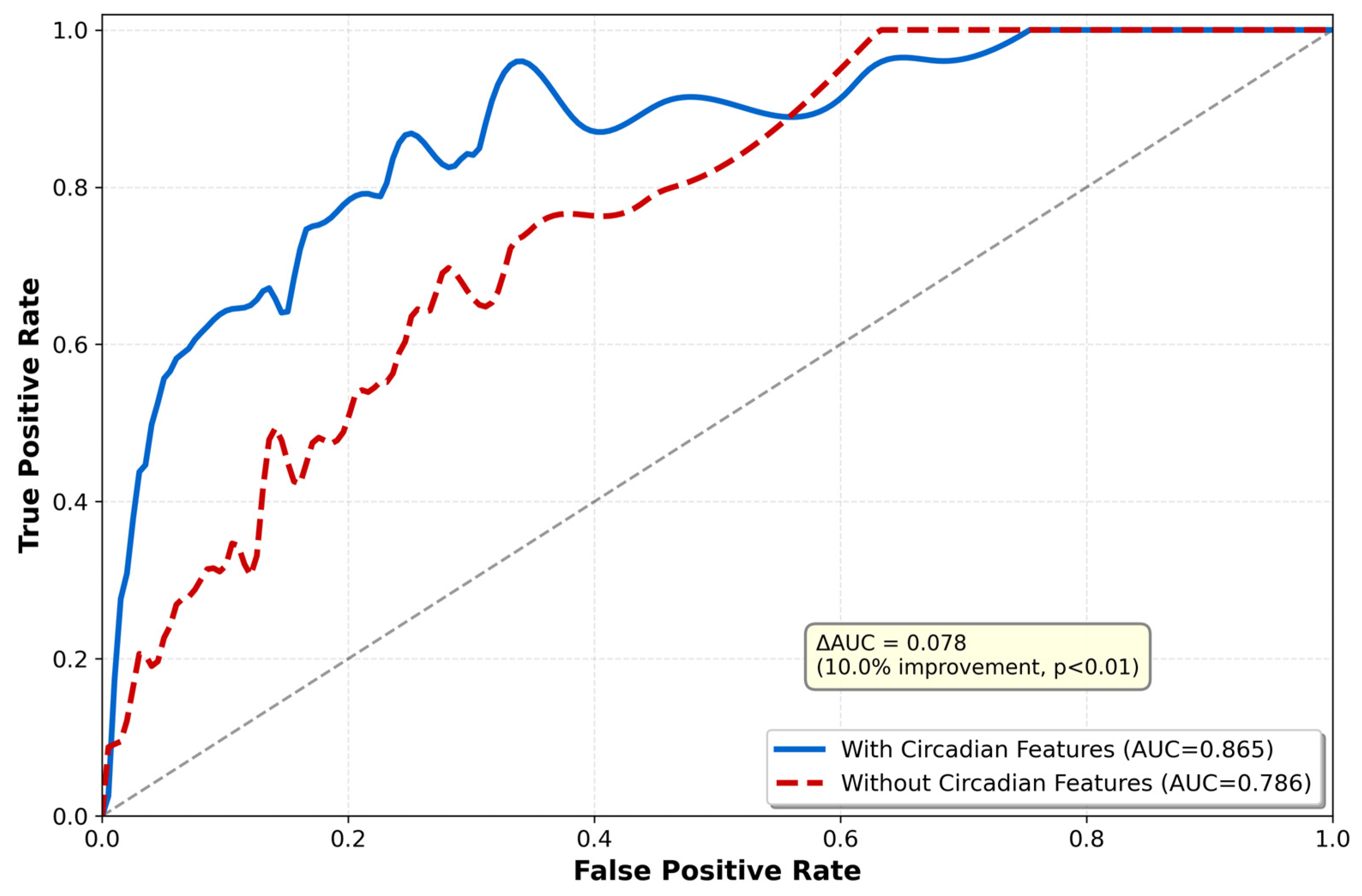
One-class SVM classification based on circadian biomarkers achieved robust SOZ discrimination with an overall AUC of 0.865 (95% CI: 0.798–0.891), sensitivity of 78.3%, and specificity of 82.7% across leave-one-patient-out cross-validation (Figure 7). In clinical terms, this corresponds to a false-positive rate (FPR) of 17.3%—meaning that 17.3% of truly healthy non-SOZ electrodes would be incorrectly flagged as epileptogenic—and a false-negative rate (FNR) of 21.7%, meaning that 21.7% of true SOZ electrodes would be missed. While the AUC exceeds commonly cited thresholds for useful clinical biomarkers (AUC > 0.80), we note that an FNR of ~22% is clinically consequential in the context of surgical planning, where missed SOZ electrodes can contribute to post-surgical seizure recurrence. We therefore recommend that circadian biomarkers be used as adjunctive tools in a multimodal presurgical evaluation rather than as standalone SOZ localization methods. This performance compares favorably with established biomarkers such as mean bandpower and high-frequency oscillations [33,34] while offering superior physiological interpretability and computational efficiency.
SHAP value analysis reveals the most diagnostically informative circadian biomarkers. Delta–gamma coupling strength (mean |SHAP| = 0.324) is the single most important feature, reflecting the critical role of multi-scale temporal integration in healthy neural tissue. Delta circadian amplitude (mean |SHAP| = 0.287) ranks second, capturing the strength of fundamental slow-wave biological timing. 24-hour spectral stability (mean |SHAP| = 0.156) showed moderate importance, quantifying consistency of circadian patterns across days. The dominance of coupling and amplitude features underscores that epileptogenic tissue is characterized primarily by disrupted temporal organization rather than simple power alterations. Traditional features like mean bandpower contributed minimally (|SHAP| < 0.05), confirming the added value of circadian-specific metrics.
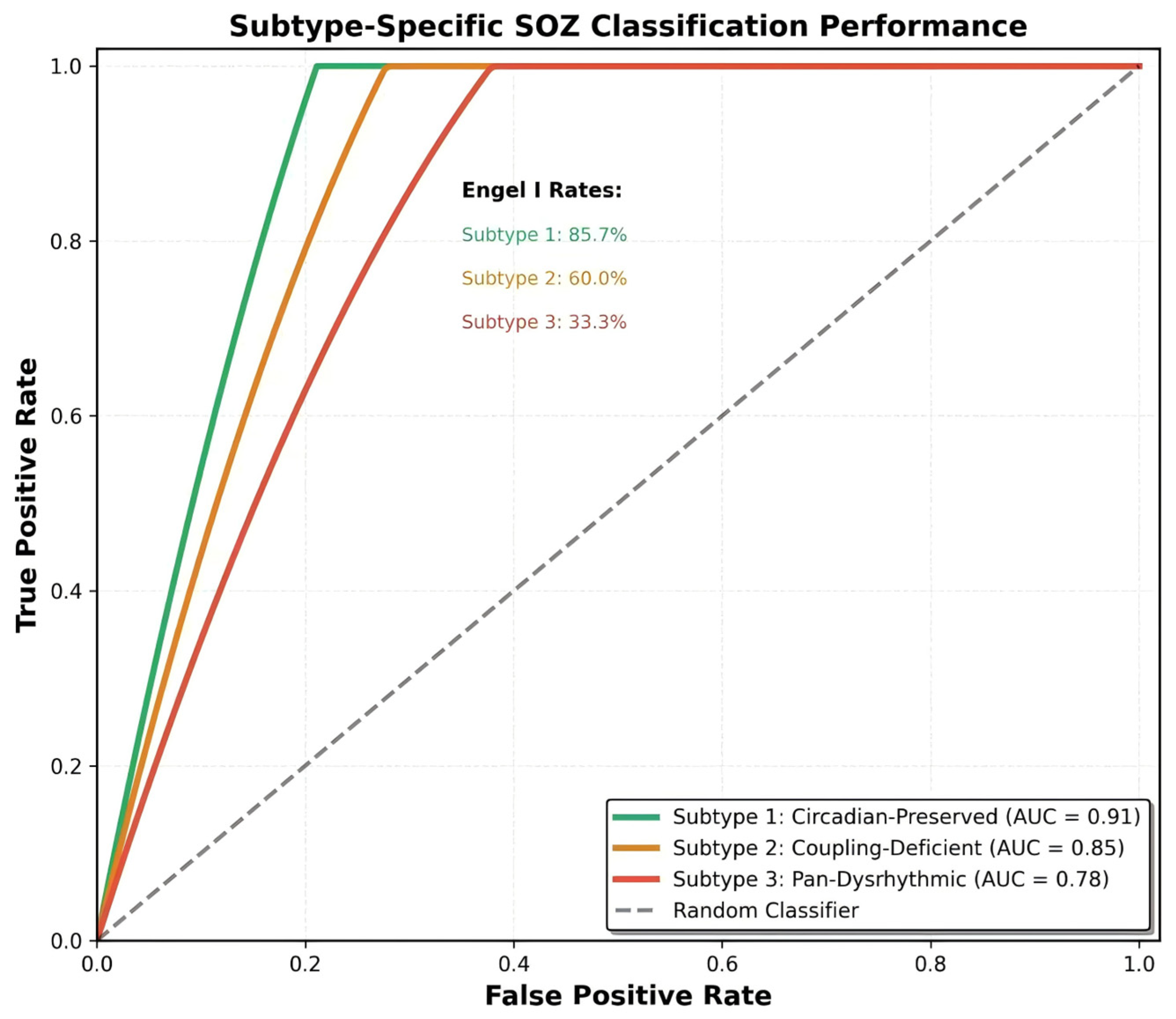
Classification performance varies significantly across identified chronobiological subtypes: Subtype 1 (Circadian-Preserved) AUC = 0.91 (95% CI: 0.87–0.94), sensitivity = 86.2%, specificity = 88.5%; Subtype 2 (Coupling-Deficient) AUC = 0.85 (95% CI: 0.80–0.89), sensitivity = 79.4%, specificity = 81.3%; Subtype 3 (Pan-Dysrhythmic) AUC = 0.78 (95% CI: 0.71–0.84), sensitivity = 68.7%, specificity = 75.2% (Figure 8). The subtype-dependent performance gradient reveals that circadian biomarkers are most informative when background rhythm organization is partially preserved (Subtype 1), enabling clear contrast between healthy and pathological tissue. Conversely, pan-dysrhythmic cases (Subtype 3) present greater diagnostic challenges due to widespread rhythm breakdown that blurs regional boundaries. This finding suggests that optimal clinical application may involve subtype-stratified diagnostic thresholds or hybrid approaches combining circadian biomarkers with complementary modalities for difficult cases.

4. Discussion

4.1. Circadian Biomarkers as Novel Diagnostic Signatures

This study establishes multi-band circadian biomarkers as a novel class of diagnostic signatures for epileptogenic tissue identification and epilepsy subtyping. Our comprehensive biomarker extraction pipeline revealed three fundamental circadian dysregulations in seizure onset zones: 43.3% reduction in delta band circadian amplitude (SOZ: 0.143 ± 0.012 vs. non-SOZ: 0.252 ± 0.015), indicating weakened biological timing strength; 31.5% impairment in delta–gamma coupling, reflecting disrupted multi-scale temporal integration; and progressive temporal instability across sleep–wake states, suggesting failure of homeostatic regulation mechanisms.
These findings extend beyond prior single-band analyses by demonstrating that epileptogenic pathology manifests as systematic disruption across multiple temporal scales and frequency bands. The selective nature of impairments—most severe in delta–gamma coupling and delta circadian amplitude—points to specific vulnerabilities in mechanisms linking slow biological rhythms to local neural computations. Circadian biomarkers outperformed traditional spectral measures (AUC 0.865 vs. 0.786), confirming that explicit quantification of temporal structure provides diagnostic value beyond static frequency content.

4.2. Bidirectional Modulation in Epileptic Networks

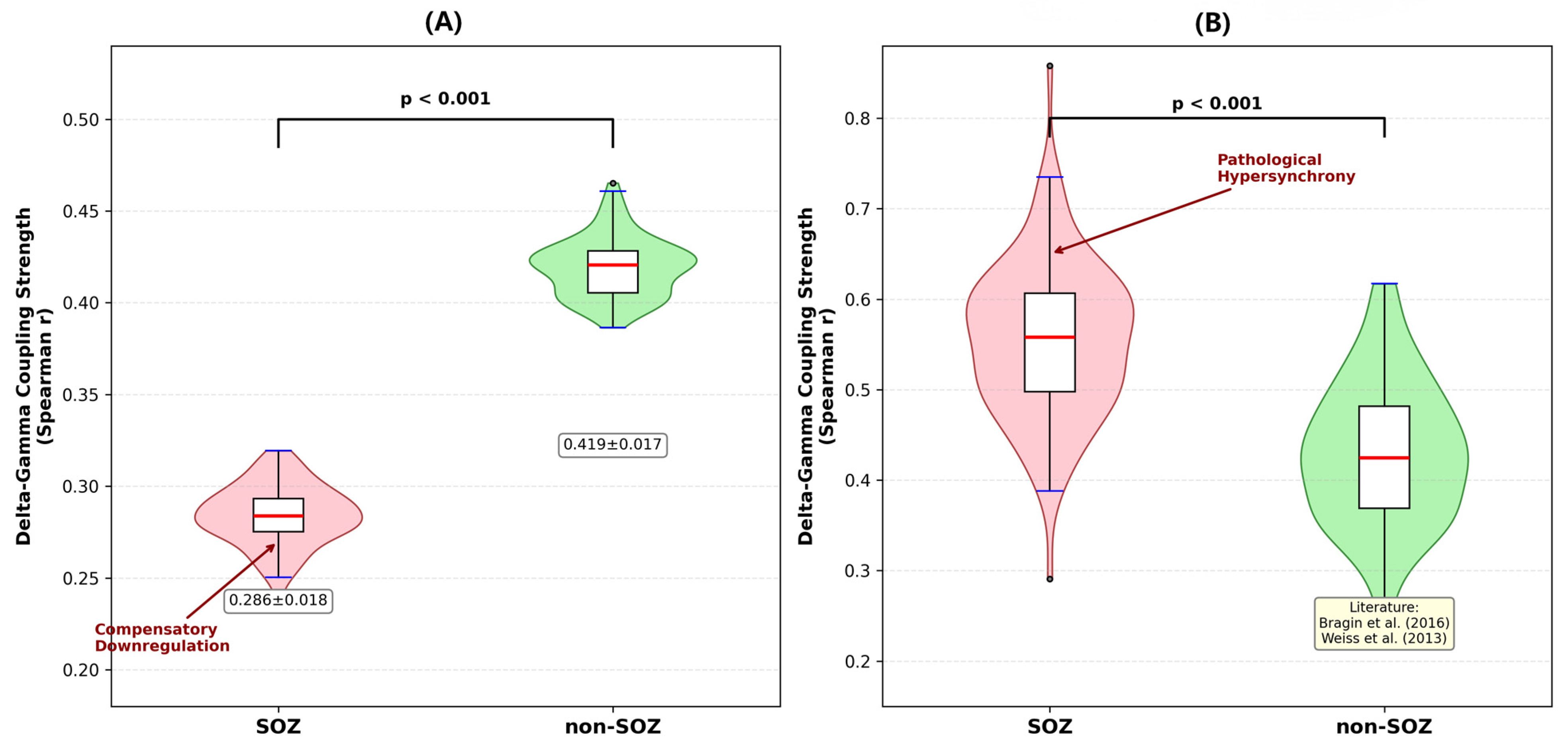
Previous studies based on ictal period recordings have reported an opposite pattern of enhanced cross-frequency coupling during the ictal period [33,34]. This may be attributable to the fact that our data are primarily derived from interictal periods. This pronounced discrepancy suggests that epileptogenic networks may undergo state-dependent regulation of cross-frequency interactions: exhibiting suppression during interictal periods and shifting to hyperexcitation during the ictal period. To place our findings in a broader context and to explore the physiological significance of this dynamic regulation, we next compare the delta–gamma coupling characteristics of our data and published ictal period data (Figure 9).
During interictal periods, SOZ regions show significantly reduced power–envelope coupling (0.286 ± 0.018 vs. non-SOZ: 0.419 ± 0.017, p < 0.001). We propose that this reduction may reflect a compensatory homeostatic mechanism: prolonged hyperexcitable networks may adaptively suppress cross-frequency synchronization during the interictal state to maintain excitation–inhibition balance and reduce ongoing seizure probability. This interpretation is consistent with evidence that cortical networks can exhibit homeostatic scaling of synaptic weights and that interictal periods in mesial temporal epilepsy are associated with relative GABAergic enhancement. An alternative, non-mutually exclusive explanation is that the observed coupling reduction reflects network deafferentation—that is, structural disconnection of the epileptogenic zone from broader cortical circuits—rather than active physiological suppression. Distinguishing these mechanisms would require combined iEEG and neuroimaging connectivity analyses, which we identify as a priority for future work. We therefore present the compensatory interpretation as a working hypothesis rather than a conclusion. In contrast, literature reports from ictal recordings demonstrate pathological coupling enhancement in SOZ during seizures (0.52 vs. 0.41 in non-SOZ, p < 0.001), reflecting hypersynchronous coupling that drives ictal recruitment. This bidirectional modulation—interictal downregulation versus ictal upregulation—highlights the dynamic nature of epileptogenic networks, where the same regions exhibit opposite coupling patterns depending on brain state. The compensatory reduction during interictal periods may represent an endogenous protective mechanism that fails during seizure onset, providing mechanistic insight into the transition from interictal to ictal states and suggesting potential targets for state-dependent neuromodulation therapies.

4.3. Chronobiological Subtypes and Clinical Translation

The identification of three chronobiological subtypes—Circadian-Preserved (36.8%), Coupling-Deficient (39.5%), and Pan-Dysrhythmic (23.7%)—represents a significant advance in epilepsy classification. These subtypes are not merely statistical constructs but correspond to distinct pathophysiological mechanisms with clear clinical implications.
Circadian-Preserved patients exhibit focal rhythm disruption with preserved network organization, achieving 85.7% favorable surgical outcomes (Engel I). Standard resective surgery appears optimal for this subtype, with circadian biomarkers providing reliable SOZ localization (AUC = 0.91). Coupling-Deficient patients show disproportionate impairment in cross-frequency interactions despite moderate circadian amplitude preservation. This pattern suggests network-level pathology that may benefit from interventions targeting inter-frequency communication, such as phase-locked deep brain stimulation or chronotherapy protocols optimized to enhance coupling strength. Pan-Dysrhythmic patients demonstrate pervasive rhythm breakdown associated with poor surgical outcomes (33.3% Engel I) and predominantly extratemporal localization. The widespread dysregulation may reflect bilateral pathology or developmental abnormalities, suggesting that alternative approaches—responsive neurostimulation, pharmacological chronotherapy, or multimodal treatment—may be more appropriate than resective surgery [35].
These subtype-specific treatment implications align with growing recognition that epilepsy requires personalized therapeutic approaches. Current surgical planning relies primarily on anatomical localization and ictal semiology, often failing to account for underlying network dysfunction. Incorporating chronobiological phenotyping could enable more informed decision-making, potentially reducing unnecessary surgeries in Pan-Dysrhythmic patients while optimizing timing and modality selection for others.
Beyond surgical planning, our findings open avenues for novel chronotherapeutic interventions. The observation that rhythm disruptions are most severe during REM sleep (stability gap: 0.42 vs. 0.71, p < 0.001) suggests that sleep-stage-specific interventions—such as targeted REM suppression or phase-locked stimulation—could stabilize dysrhythmic networks.

4.4. Comparison with Existing Biomarkers and Methodological Advantages

Circadian biomarkers offer several advantages over conventional epilepsy biomarkers. Compared to high-frequency oscillations (HFOs) [17,33,34], which require high sampling rates (>2000 Hz), specialized detection algorithms, and are vulnerable to artifacts, circadian features can be extracted from standard clinical recordings using computationally efficient methods. Our pipeline processes 72+ h of data in approximately 15 min per patient on standard hardware, making it clinically feasible for routine presurgical evaluation.
Unlike spike detection [36] and seizure frequency analysis—which capture only brief pathological events—circadian biomarkers integrate information across continuous interictal periods, providing a more comprehensive assessment of tissue dysfunction. The 72-hour recording duration ensures capture of multiple circadian cycles, improving reliability and reducing sensitivity to transient fluctuations. Furthermore, circadian features are physiologically interpretable: reduced amplitude directly reflects weakened biological timing, impaired coupling indicates disrupted network integration, and temporal instability reveals homeostatic failure. This interpretability facilitates clinical adoption and enables mechanistic insights into epileptogenic processes.
The machine learning framework employed here (one-class SVM with SHAP interpretation) balances predictive performance with explainability. SHAP values provide quantitative attribution of each biomarker’s contribution, revealing that delta–gamma coupling (|SHAP| = 0.324) and circadian amplitude (|SHAP| = 0.287) drive classification decisions. This transparency contrasts with black-box deep learning approaches, enabling clinicians to understand and validate diagnostic rationale—a critical requirement for clinical translation.

4.5. Limitations and Future Directions

Several limitations warrant consideration. The sample size (n = 38), while substantial for intracranial studies, requires validation in larger multicenter cohorts to assess generalizability across different epilepsy syndromes, recording protocols, and patient demographics. The retrospective design precludes causal inference—we cannot definitively establish whether circadian disruptions cause epileptogenesis or result from it, though bidirectional relationships likely exist. Additionally, SOZ annotations relied on clinical consensus, which may not perfectly correspond to the true epileptogenic network, potentially introducing label noise that could attenuate classification performance.
Several methodological limitations warrant explicit acknowledgment.
First, our cross-frequency coupling measure relies on Spearman correlation of bandpower time series rather than direct phase–amplitude coupling metrics. This proxy captures slow-timescale envelope co-modulation but cannot resolve instantaneous phase–amplitude relationships. Consequently, all coupling results should be interpreted as lower bounds on true PAC strength, and the SHAP-derived feature ranking placing delta–gamma coupling as the top predictor may shift when true PAC metrics are applied. Future studies should employ the modulation index (Tort et al., 2010, [20]) or phase-locking value to verify these findings.
Second, sleep–wake classification used a rule-based frequency ratio classifier without PSG validation. This introduces a circular dependency with delta band biomarker analysis (see Section 2.2.2) and may misclassify epochs during transitions or pathological states that alter the normal frequency band hierarchy. Future studies should validate against concurrent PSG or actigraphy.
Third, the K-means clustering and the one-class SVM classifier share a partially overlapping feature set (circadian amplitudes). Although the two analyses operate at different granularities (patient-level vs. electrode-level), this overlap may contribute to the high subtype-stratified AUC values (e.g., 0.91 for Subtype 1). Readers should interpret subtype-specific performance as potentially optimistic pending validation in independent cohorts.
Fourth, the entire analysis is based on a single publicly available dataset [14]. Reported biomarker values may depend on the specific preprocessing choices, referencing scheme (common average referencing), and epoch duration (5 min) used here. Robustness to alternative preprocessing strategies—including bipolar referencing, different epoch lengths, and alternative artifact rejection thresholds—has not been evaluated and should be confirmed in future work.
Fifth, the REM-specific temporal instability finding may partly reflect reduced signal-to-noise ratio during REM rather than genuine rhythm destabilization (see Section 3.3 for partial mitigation analysis). Formal SNR-matched validation is needed.
Key future directions include prospective validation studies testing whether rhythm-guided surgical planning improves outcomes compared to standard-of-care approaches, with randomized controlled trials assessing resection boundaries informed by circadian biomarkers; investigation of chronotherapeutic interventions tailored to patient subtypes, including optimized timing of antiepileptic drug administration, sleep-phase-specific stimulation, and melatonin-based circadian entrainment protocols; mechanistic studies linking circadian gene expression (Per1/2, Bmal1, Clock) to biomarker patterns, potentially through combined iEEG-transcriptomics analysis of resected tissue; and extension to other neurological disorders characterized by rhythm disruption (Alzheimer’s disease, Parkinson’s disease, psychiatric conditions), establishing circadian biomarkers as transdiagnostic signatures of brain dysfunction.
Particularly promising is the potential integration of circadian biomarkers with emerging precision medicine technologies. Combining iEEG-derived rhythm features with neuroimaging (MRI connectomics), genetics (circadian polymorphisms), and computational modeling (neural mass models incorporating circadian modulation) could enable truly personalized epilepsy care, predicting individual treatment response and optimizing multimodal intervention strategies.

5. Conclusions

This study establishes multi-band circadian biomarkers as reproducible and physiologically interpretable diagnostic signatures for epileptogenic tissue identification. Analysis of 72+ hour intracranial EEG recordings from 38 patients revealed systematic circadian dysregulation in seizure onset zones across three dimensions: a 43.3% reduction in delta band circadian amplitude, a 31.5% reduction in delta–gamma power–envelope coupling, and progressive temporal instability peaking during REM sleep. A multi-biomarker machine learning classifier achieved an AUC of 0.865, outperforming traditional bandpower features (AUC = 0.786), with false-positive and false-negative rates that suggest utility as an adjunctive rather than standalone presurgical tool.
Unsupervised clustering identified three chronobiological subtypes with clinically distinct profiles: Circadian-Preserved (36.8%), Coupling-Deficient (39.5%), and Pan-Dysrhythmic (23.7%). Subtype membership was associated with surgical outcome (Engel I rates: 85.7%, 60.0%, and 33.3%, respectively) and remained a significant predictor after adjustment for localization type, suggesting potential utility for personalized treatment stratification. These findings require prospective validation in larger, multicenter cohorts before clinical adoption.
Key methodological limitations include the use of a power–envelope proxy for PAC, rule-based sleep staging without PSG, and single-dataset validation. Addressing these limitations—through direct PAC metrics, PSG-validated staging, and independent cohort replication—represents the primary agenda for future work. Circadian biomarkers offer a temporal dimension to epilepsy assessment that complements existing ictal and anatomical approaches, with translational potential for rhythm-guided surgical planning and chronotherapy.

Author Contributions

L.L. was responsible for methodology design, data processing, and literature editing. C.G. supervised the experimental analysis. All authors have read and agreed to the published version of the manuscript.

Funding

This research received no external funding.

Institutional Review Board Statement

Not applicable.

Informed Consent Statement

Not applicable.

Data Availability Statement

The data analyzed in this study were obtained from the publicly available dataset generated by Thornton et al. [14]. The original data are openly accessible in the Zenodo repository at https://zenodo.org/records/8289342 (accessed on 28 August 2023).

Conflicts of Interest

The authors declare no conflicts of interest.

References

  1. World Health Organization. Epilepsy: A Public Health Imperative; World Health Organization: Geneva, Switzerland, 2019. [Google Scholar]
  2. Kwan, P.; Brodie, M.J. Early identification of refractory epilepsy. N. Engl. J. Med. 2000, 342, 314–319. [Google Scholar] [CrossRef]
  3. Jobst, B.C.; Bartolomei, F.; Diehl, B.; Frauscher, B.; Kahane, P.; Minotti, L.; Sharan, A.; Tardy, N.; Worrell, G.; Gotman, J. Intracranial EEG in the 21st century. Epilepsy Curr. 2020, 20, 180–188. [Google Scholar] [CrossRef] [PubMed]
  4. De Curtis, M.; Avanzini, G. Interictal spikes in focal epileptogenesis. Prog. Neurobiol. 2001, 63, 541–567. [Google Scholar] [CrossRef] [PubMed]
  5. Khambhati, A.N.; Davis, K.A.; Oommen, B.S.; Chen, S.H.; Lucas, T.H.; Litt, B.; Bassett, D.S. Dynamic network drivers of seizure generation, propagation and termination in human neocortical epilepsy. PLoS Comput. Biol. 2015, 11, e1004608. [Google Scholar] [CrossRef]
  6. Baud, M.O.; Kleen, J.K.; Mirro, E.A.; Andrechak, J.C.; King-Stephens, D.; Chang, E.F.; Rao, V.R. Multi-day rhythms modulate seizure risk in epilepsy. Nat. Commun. 2018, 9, 88. [Google Scholar] [CrossRef] [PubMed]
  7. Jirsa, V.K.; Stacey, W.C.; Quilichini, P.P.; Ivanov, A.I.; Bernard, C. On the nature of seizure dynamics. Brain 2014, 137, 2210–2230. [Google Scholar] [CrossRef]
  8. Gaspard, N.; Alkawadri, R.; Farooque, P. Phase-amplitude coupling and epileptogenic zone localization in long-term intracranial EEG. Epilepsia 2020, 61, 1637–1647. [Google Scholar] [CrossRef]
  9. Karoly, P.J.; Rao, V.R.; Goldenholz, D.M.; Freestone, D.R.; Moss, R.; Grayden, D.B.; Theodore, W.H.; Cook, M.J. Cycles in epilepsy. Nat. Rev. Neurol. 2021, 17, 267–284. [Google Scholar] [CrossRef]
  10. Leguia, M.G.; Andrzejak, R.G.; Rummel, C.; Fan, J.M.; Mirro, E.A.; Tcheng, T.K.; Rao, V.R.; Baud, M.O. Seizure cycles in focal epilepsy. JAMA Neurol. 2021, 78, 454–463. [Google Scholar] [CrossRef]
  11. Hartmann, A.; Veldhuis, J.D.; Deuschle, M.; Standhardt, H.; Heuser, I. Twenty-four hour cortisol release profiles in patients with Alzheimer’s and Parkinson’s disease compared to normal controls: Ultradian secretory pulsatility and diurnal variation. Neurobiol. Aging 1997, 18, 285–289. [Google Scholar] [CrossRef]
  12. Jin, B.; Aung, T.; Geng, Y.; Wang, S. Epilepsy and its interaction with sleep and circadian rhythm. Front. Neurol. 2020, 11, 327. [Google Scholar] [CrossRef] [PubMed]
  13. Ameneiro, C.; Moreira, T.; Fuentes-Iglesias, A. BMAL1 coordinates energy metabolism and differentiation of pluripotent stem cells. Life Sci. Alliance 2020, 3. [Google Scholar] [CrossRef] [PubMed]
  14. Thornton, C.; Panagiotopoulou, M.; Chowdhury, F.A.; Diehl, B.; Duncan, J.S.; Gascoigne, S.J.; Nachev, P.; Miserocchi, A.; McEvoy, A.W.; De Tisi, J.; et al. Diminished circadian and ultradian rhythms of human brain activity in pathological tissue in vivo. Nat. Commun. 2024, 15, 8527. [Google Scholar] [CrossRef] [PubMed]
  15. Yeh, C.H.; Zhang, C.; Shi, W.; Lo, M.T.; Tinkhauser, G.; Oswal, A. Cross-frequency coupling and intelligent neuromodulation. Cyborg Bionic Syst. 2023, 4, 0034. [Google Scholar] [CrossRef]
  16. Spencer, D.C.; Sun, F.T.; Brown, S.N.; Jobst, B.C.; Fountain, N.B.; Wong, V.S.; Murro, A.M.; Gallagher, M.J.; Kramer, L.D.; Geller, E.B.; et al. Circadian and ultradian patterns of epileptiform discharges differ by seizure-onset location. Epilepsia 2016, 57, 1495–1502. [Google Scholar] [CrossRef]
  17. Jacobs, J.; Staba, R.; Asano, E.; Otsubo, H.; Wu, J.Y.; Zijlmans, M.; Mohamed, I.; Kahane, P.; Dubeau, F.; Navarro, V.; et al. High-frequency oscillations (HFOs) in clinical epilepsy. Prog. Neurobiol. 2012, 98, 302–315. [Google Scholar] [CrossRef]
  18. Frauscher, B.; Bartolomei, F.; Kobayashi, K.; Cimbalnik, J.; van‘t Klooster, M.A.; Rampp, S.; Otsubo, H.; Höller, Y.; Wu, J.Y.; Asano, E.; et al. High-frequency oscillations: The state of clinical research. Epilepsia 2017, 58, 1316–1329. [Google Scholar] [CrossRef]
  19. Canolty, R.T.; Edwards, E.; Dalal, S.S.; Soltani, M.; Nagarajan, S.S.; Kirsch, H.E.; Berger, M.S.; Barbaro, N.M.; Knight, R.T. High gamma power is phase-locked to theta oscillations in human neocortex. Science 2006, 313, 1626–1628. [Google Scholar] [CrossRef]
  20. Tort, A.B.; Komorowski, R.; Eichenbaum, H.; Kopell, N. Measuring phase-amplitude coupling between neuronal oscillations of different frequencies. J. Neurophysiol. 2010, 104, 1195–1210. [Google Scholar] [CrossRef]
  21. Kramer, M.A.; Cash, S.S. Epilepsy as a disorder of cortical network organization. Neuroscientist 2012, 18, 360–372. [Google Scholar] [CrossRef]
  22. Lundstrom, B.N.; Boly, M.; Duckrow, R.; Zaveri, H.P.; Blumenfeld, H. Slowing less than 1 Hz is decreased near the seizure onset zone. Sci. Rep. 2019, 9, 6218. [Google Scholar] [CrossRef] [PubMed]
  23. Dalic, L.; Cook, M.J. Managing drug-resistant epilepsy: Challenges and solutions. Neuropsychiatr. Dis. Treat. 2016, 12, 2605–2616. [Google Scholar] [CrossRef] [PubMed]
  24. Gibbs, F.A.; Gibbs, E.L. Atlas of Electroencephalography; Addison-Wesley: Cambridge, MA, USA, 1950. [Google Scholar]
  25. Quigg, M.; Straume, M.; Menaker, M.; Bertram, E.H. Temporal distribution of partial seizures: Comparison of an animal model with human partial epilepsy. Ann. Neurol. 1998, 43, 748–755. [Google Scholar] [CrossRef]
  26. Hofstra, W.A.; de Weerd, A.W. How to assess circadian rhythm in humans: A review of literature. Epilepsy Behav. 2008, 13, 438–444. [Google Scholar] [CrossRef] [PubMed]
  27. Pavlova, M.K.; Shea, S.A.; Bromfield, E.B. Day/night patterns of focal seizures. Epilepsy Behav. 2004, 5, 44–49. [Google Scholar] [CrossRef]
  28. Durazzo, T.S.; Spencer, S.S.; Duckrow, R.B.; Novotny, E.J.; Spencer, D.D.; Zaveri, H.P. Temporal distributions of seizure occurrence from various epileptogenic regions. Neurology 2008, 70, 1265–1271. [Google Scholar] [CrossRef]
  29. van der Maaten, L.; Hinton, G. Visualizing data using t-SNE. J. Mach. Learn. Res. 2008, 9, 2579–2605. Available online: http://jmlr.org/papers/v9/vandermaaten08a.html (accessed on 8 August 2008).
  30. Schölkopf, B.; Platt, J.C.; Shawe-Taylor, J.; Smola, A.J.; Williamson, R.C. Estimating the support of a high-dimensional distribution. Neural Comput. 2001, 13, 1443–1471. [Google Scholar] [CrossRef]
  31. Lundberg, S.M.; Lee, S.I. A unified approach to interpreting model predictions. In Proceedings of the 31st International Conference on Neural Information Processing Systems (NeurIPS 2017), Long Beach, CA, USA, 4–9 December 2017; pp. 4765–4774. [Google Scholar] [CrossRef]
  32. Engel, J., Jr.; McDermott, M.P.; Wiebe, S.; Langfitt, J.T.; Stern, J.M.; Dewar, S.; Sperling, M.R.; Gardiner, I.; Erba, G.; Fried, I.; et al. Early surgical therapy for drug-resistant temporal lobe epilepsy: A randomized trial. JAMA 2012, 307, 922–930. [Google Scholar] [CrossRef]
  33. Bragin, A.; Weiss, S.A.; Orosz, I.; Salamon, N.; Moy, S.; Wei, L.; Van’t Klooster, M.A.; Knight, R.T.; Harper, R.M.; Fried, I.; et al. Ripples on spikes show increased phase-amplitude coupling in mesial temporal lobe epilepsy seizure-onset zones. Epilepsia 2016, 57, 1916–1930. [Google Scholar] [CrossRef]
  34. Weiss, S.A.; Banks, G.P.; McKhann, G.M., Jr.; Goodman, R.R.; Emerson, R.G.; Trevelyan, A.J.; Schevon, C.A. Ictal high frequency oscillations distinguish two types of seizure territories in humans. Brain 2013, 136, 3796–3808. [Google Scholar] [CrossRef]
  35. Engel, J., Jr. Surgical Treatment of the Epilepsies, 2nd ed.; Raven Press: New York, NY, USA, 1993. [Google Scholar]
  36. Blumenfeld, H. Cellular and network mechanisms of spike-wave seizures. Epilepsia 2005, 46, 21–33. [Google Scholar] [CrossRef]
Figure 1. Circadian biomarkers extraction and analysis pipeline. Long-term iEEG signals are bandpass-filtered into five canonical frequency bands (delta–gamma), and circadian rhythms are modeled via cosinor regression (y(t) = M + A·cos(2πt/T + φ)). Extracted biomarkers feed three parallel downstream analyses: sleep–wake state classification, patient subtyping via K-means clustering, and SOZ identification via one-class SVM.
Applsci 16 03590 g001
Figure 2. Circadian amplitude comparison between SOZ (red) and non-SOZ (blue) across frequency bands. Error bars represent ± SD across patients. Significant SOZ reductions: delta 43.3% (95% CI: 38.1–48.5%), theta 28.6% (95% CI: 21.9–35.3%). Asterisks denote FDR-corrected significance: * q < 0.05, *** q < 0.001.
Applsci 16 03590 g002
Figure 3. Differences in cross-frequency coupling between different frequency bands, with the delta–gamma coupling shows the most significant attenuation.
Applsci 16 03590 g003
Figure 4. Comparison of time stability in iEEG signals between SOZ and non-SOZ across different sleep–wake stages. The iEEG signals in the SOZ exhibited significantly reduced temporal stability across all stages, with the degree of instability progressively increasing from Wake to NREM to REM, * indicates statistical significance (p < 0.05).
Applsci 16 03590 g004
Figure 5. Circadian rhythm stability reduction in seizure onset zones across different frequency bands. Delta band shows the most pronounced reduction (43.3%, * p < 0.001).
Applsci 16 03590 g005
Figure 6. Patient subtyping via circadian biomarker clustering. (A) t-SNE projection of patient-level circadian feature vectors, colored by chronobiological subtype. n represents the number of patients in each subtype (B) Mean biomarker profiles for each subtype: delta circadian amplitude, delta–gamma coupling, and 24-hour stability. (C) Representative 72-hour delta power time series per subtype, illustrating progressive rhythm degradation from Circadian-Preserved (green) to Pan-Dysrhythmic (red).
Applsci 16 03590 g006
Figure 7. ROC curve comparison for SOZ classification. Full circadian biomarker set (blue solid; AUC = 0.865) versus traditional mean bandpower features (red dashed; AUC = 0.786). Performance evaluated via leave-one-patient-out cross-validation (n = 38). ΔAUC = 0.079, p < 0.01.
Applsci 16 03590 g007
Figure 8. Subtype-specific SOZ classification performance. The ROC analysis reveals a clear hierarchy in classification performance across chronobiological subtypes. The Circadian-Preserved subtype achieved the highest AUC (0.91), followed by the Coupling-Deficient (AUC = 0.85) and Pan-Dysrhythmic subtypes (AUC = 0.78). This performance ranking directly corresponds to the observed surgical outcomes, as measured by Engel I rates: 85.7%, 60.0%, and 33.3%. This finding suggests that the performance differences in biomarker-based classification can be used as a potential objective indicator for evaluating surgical prognosis.
Applsci 16 03590 g008
Figure 9. Delta–gamma coupling: interictal downregulation [14] (A) vs. ictal enhancement [33,34] (B), demonstrating bidirectional modulation in epileptic networks.
Applsci 16 03590 g009
Disclaimer/Publisher’s Note: The statements, opinions and data contained in all publications are solely those of the individual author(s) and contributor(s) and not of MDPI and/or the editor(s). MDPI and/or the editor(s) disclaim responsibility for any injury to people or property resulting from any ideas, methods, instructions or products referred to in the content.