Article

A Cross-Scale Study of Data-Driven Micro-to-Macro Mechanical Heterogeneity in Sandstone

State Key Laboratory of Coal Mine Disaster Dynamics and Control, Chongqing University, Chongqing 400030, China
*
Author to whom correspondence should be addressed.
Appl. Sci. 2026, 16(7), 3589; https://doi.org/10.3390/app16073589
Submission received: 10 March 2026 / Revised: 2 April 2026 / Accepted: 2 April 2026 / Published: 7 April 2026

Abstract

Tight sandstone gas development is largely governed by mineral composition and micromechanical heterogeneity. This study proposes a cross-scale method integrating these two factors to characterize macroscopic sandstone heterogeneity. First, a CNN–Transformer model was trained on thin-section images to identify mineral types and contents. Second, probability density functions of Young’s modulus for each mineral were derived from nanoindentation data, and stochastic sampling was used to assign mechanical properties to mineral grains in an FDEM-GBM uniaxial compression model. Finally, numerical results validated against experiments show that the random spatial distribution of micromechanical parameters leads to a normal distribution of the macroscopic Young’s modulus. Decreasing high-strength mineral content reduces the mean Young’s modulus while increasing its standard deviation, indicating greater mechanical heterogeneity, with cracks preferentially propagating in low-strength minerals. Mineral composition and content are the primary controls on macroscopic behavior, while micromechanical heterogeneity plays a secondary role. A brittleness index integrating mineral composition and multi-scale Young’s modulus distribution is proposed, providing a theoretical basis for evaluating heterogeneity and fracability in tight sandstone reservoirs.

1. Introduction

With the continuous growth of global energy demand, unconventional oil and gas resources have become increasingly important in exploration and development. Among these, tight sandstone gas, due to its widespread distribution and substantial reserves, has emerged as a key exploration and development target [1,2]. The macroscopic mechanical behavior of tight sandstone and the fracture expansion pattern during hydraulic fracturing are determined by its mineral types, content, and micro-mechanical properties [3]. Therefore, thorough investigation of the mineral composition and its multi-scale mechanical heterogeneity of tight sandstones, followed by establishing a brittleness evaluation index related to these factors, holds significant theoretical and engineering value for achieving efficient development of tight sandstone reservoirs.
The mineral composition of tight sandstone plays an important role in determining its mechanical properties. Current primary methods for analyzing rock mineral composition include X-ray diffraction (XRD), optical microscope thin-section analysis, and scanning electron microscopy–energy-dispersive spectroscopy (SEM-EDS) [4,5,6,7,8,9,10]. However, these methods are often limited by high experimental costs and long processing times. In recent years, deep learning-based methods for automated mineral identification in rock thin-sections have emerged, offering fast processing speed, good reproducibility, and reduced labor costs [11,12,13,14]. Despite their promising performance, existing segmentation models still face challenges such as blurred mineral boundaries, internal noise, and difficulties in simultaneously capturing both local and global features.
In sandstone reservoirs, not only do mineral compositions vary, but the micromechanical properties of different minerals (such as elastic modulus and Poisson’s ratio) also exhibit significant differences [15,16]. This heterogeneity in micromechanical properties is another key factor controlling the macroscopic mechanical response of sandstone [17]. Luo et al. [18], Cao et al. [19], and Liu et al. [20] obtained micromechanical parameters of different mineral phases using nanoindentation technology and found that these parameters follow certain distribution patterns, revealing variability in the mechanical properties of the same mineral type. For example, Luo et al. [18] reported that the elastic modulus and hardness of quartz measured via nanoindentation were 81.96 ± 8.72 GPa and 12.48 ± 2.25 GPa, respectively. To investigate the influence of sandstone mineral composition and mechanical properties on macroscopic performance, researchers have employed various methods. Luo et al. [18] first obtained the elastic modulus and hardness of each mineral component through nanoindentation tests, then calculated the homogenized elastic modulus and Poisson’s ratio of sandstone using the dilution method and the Mori–Tanaka homogenization scheme. These results were compared with uniaxial compression test data, and the impact of micromechanical properties of mineral components on the macroscopic mechanical behavior of sandstone was analyzed. Cao et al. [19] conducted nanoindentation and triaxial compression tests, and they further performed triaxial compression finite element simulations based on the average mechanical parameters of each mineral, systematically revealing the relationship between the micromechanical characteristics of mineral phases and the macroscopic fracture patterns in tight sandstone.
Numerical simulation has been widely used in cross-scale rock studies due to its low cost, high efficiency, repeatability, and capacity to characterize complex heterogeneity. Yan et al. [20] proposed an index system to quantify mineralogical and micromechanical heterogeneity based on mineral volume fractions and their mechanical properties, using the discrete element method with grain-based modeling (DEM-GBM) to investigate the influence of heterogeneity on shale mechanical behavior. Liu et al. [21] revealed within-mineral mechanical variability through nanoindentation and employed accurate grain-based modeling (AGBM) within a Finite-Discrete element framework to upscale nanoscale heterogeneity to macroscale uniaxial compression responses. Hu et al. [22] employed the combined Finite-Discrete element method with grain-based modeling (FDEM-GBM) to construct a two-dimensional fracture model, exploring the influence of mineral composition and mechanical properties on crack propagation. Chen et al. [23], Liu and Deng [24], and Wu et al. [25] also successfully simulated the failure processes of sandstone under different loading conditions using FDEM-GBM. While these studies upscaled micromechanical properties to obtain homogenized macroscopic parameters, they commonly relied on average mechanical properties for each mineral phase, thereby failing to fully capture the heterogeneous characteristics inherent in macroscopic mechanical responses.
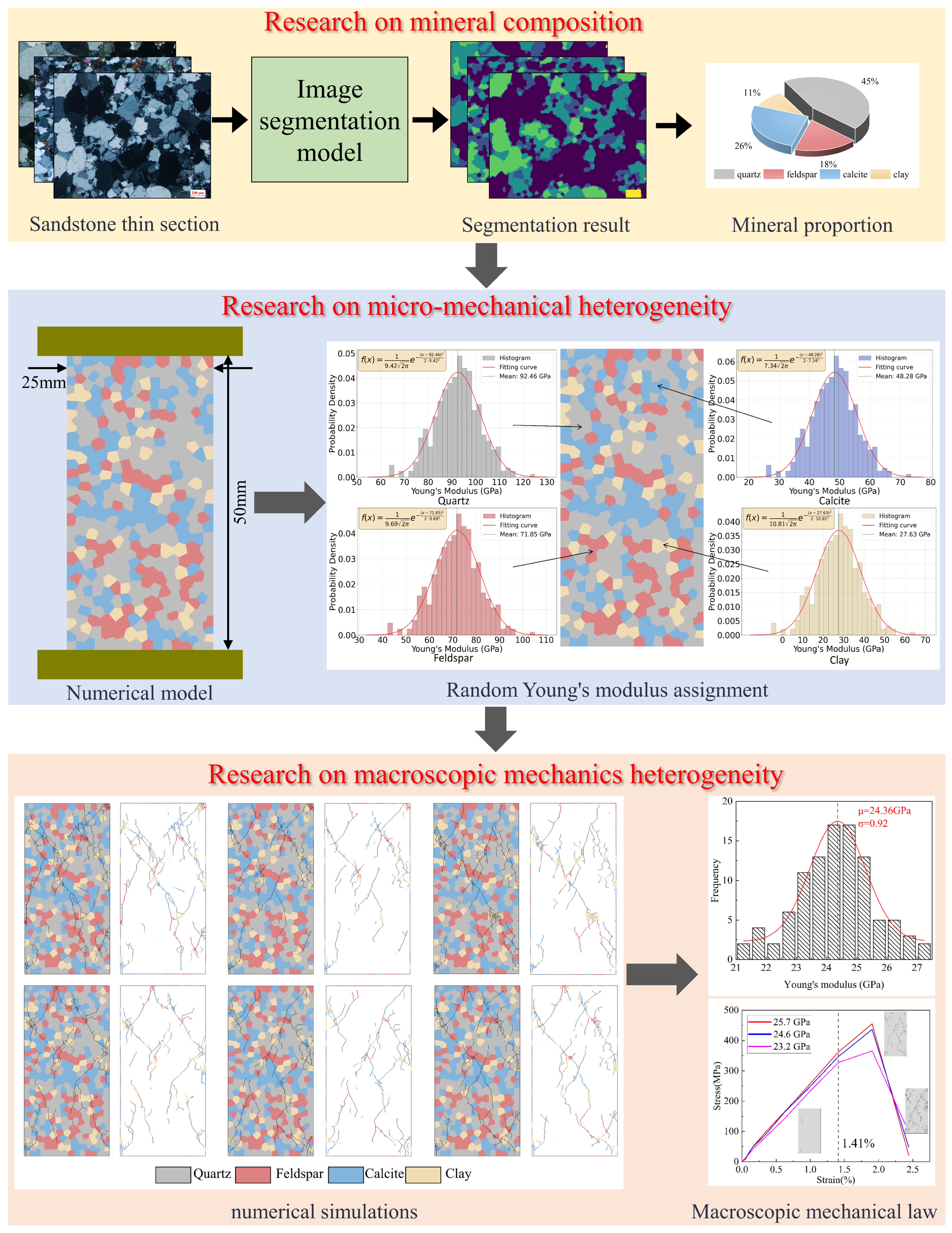
To address these challenges, this paper proposes a cross-scale research method based on sandstone thin-section images and nanoindentation data, which integrates mineral composition and micromechanical heterogeneity to characterize macroscopic mechanical behavior. As shown in Figure 1, this method consists of three key components. First, we construct a dual-branch CNN–Transformer image segmentation model that combines the local feature extraction strengths of CNNs with the global feature capture advantages of Transformers, and incorporates a boundary enhancement module to improve recognition of complex mineral boundaries, thereby obtaining mineral components and their contents. Second, based on statistical patterns from nanoindentation data, mechanical parameters are assigned to mineral particles through random sampling. Third, combined with the FDEM-GBM heterogeneity characterization method, we establish a uniaxial compression model for sandstone. Through extensive numerical simulations, we reveal the influence patterns of mineral composition and micro-heterogeneity on the macro-mechanical behavior of sandstone, and propose a brittleness evaluation index that considers both mineral composition and Young’s modulus heterogeneity. The proposed cross-scale framework contributes to characterizing micro-to-macro heterogeneity and supports practical applications including hydraulic fracturing design, brittleness assessment, and fracture propagation prediction for tight sandstone reservoirs.

2. Materials and Methods

2.1. CNN–Transformer Image Segmentation Model

2.1.1. Improved Network Model

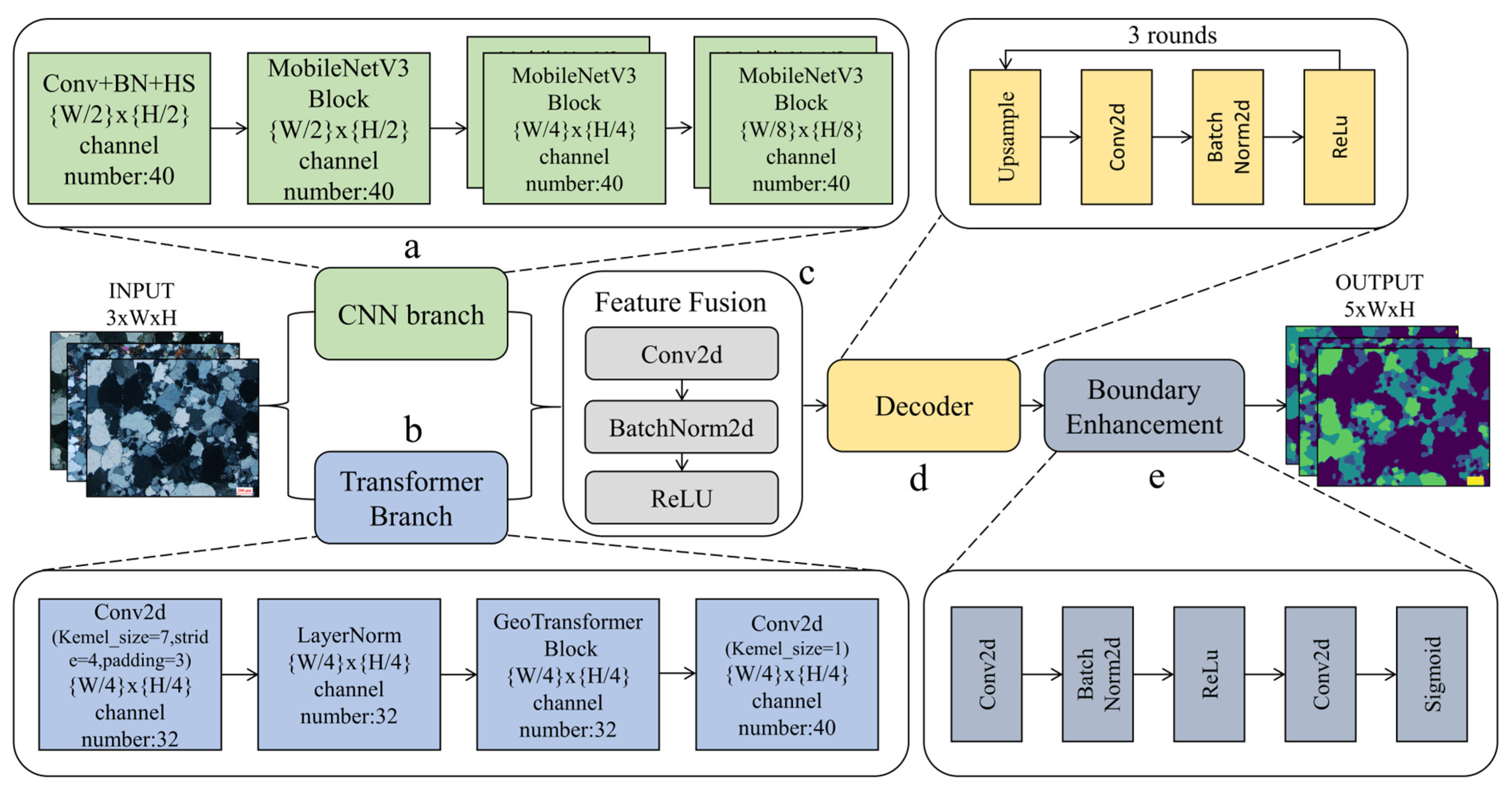
Segmentation of rock thin-section images faces numerous challenges, such as blurred mineral boundaries and complex internal structures. Lightweight CNN architectures like MobileNetV3 can efficiently extract local features, but their ability to extract global features is limited [26,27,28,29]. In contrast, Transformer models originating from natural language processing, with their self-attention mechanisms, demonstrate strong global feature capture abilities in computer vision the field [30,31,32]. However, it has a relatively weak ability to perceive local details. The CNN branch excels at extracting local texture and mineral boundary details, while the Transformer branch captures global mineral distribution and long-range dependencies. The feature fusion module and boundary enhancement module effectively combine the advantages of both branches to address the problem of insufficient local detail perception and blurred mineral boundaries. This model integrates the local feature extraction strengths of CNNs with the global feature capture advantages of Transformers and specifically incorporates a boundary enhancement module to improve the recognition ability for complex mineral boundaries.
This encoder employs a dual-branch architecture combining CNN and Transformer, integrating local details and global features through a feature fusion module. As shown in Figure 2a, the CNN branch was constructed based on the first six layers of MobileNetV3, comprising one initial convolutional layer and five MobileNetV3 modules. This branch undergoes three-stage spatial downsampling, outputting 40 channels of feature maps. As shown in Figure 2b, the Transformer branch first converted the input image into a 32-channel 1/4-scale feature map via a convolution layer with a 7 × 7 kernel and 4 strides. Subsequently, a core Transformer module modeled global dependencies. Finally, a 1 × 1 convolution reduced the channel to 40, and bilinear interpolation was adopted to fully align the spatial dimensions with those of the CNN branch output before concatenation. As shown in Figure 2c, during the feature fusion stage, the outputs from the CNN and Transformer branches are concatenated along the channel dimension. Subsequently, a 1 × 1 convolutional layer expands the channel count to 96, forming the final fused features that support subsequent decoding.
As shown in Figure 2d, the decoder employs a three-stage upsampling architecture, progressively restoring the feature map size from 1/8 to its original resolution. Each stage comprises one bilinear upsampling layer and two convolutional layers (3 × 3 convolution + Batch Normalization + ReLU). As shown in Figure 2e, boundary enhancement extracts boundary features through a convolutional layer and then utilizes a gating mechanism to fuse the original features with the boundary features, thereby achieving the enhancement of mineral boundary regions. By integrating these techniques, this method provides an effective solution to challenges in rock thin-section image segmentation, such as boundary blurring and noise within minerals.

2.1.2. Datasets and Training Parameters

The rock thin-section images in this paper are from the sandstone micrograph dataset within Nanjing University’s rock teaching specimens (https://d.wanfangdata.com.cn/periodical/zgkxsj202003003, accessed on 10 September 2025). We manually segmented the images of sandstone thin-sections using the LabelMe tool (3.16.7) [33], with mineral identification specialists annotating the data to generate labeled images. The annotation results revealed that the sandstone’s mineral composition primarily consists of four types: quartz, feldspar, calcite, and clay. Consequently, the segmentation model’s labels in this paper include five categories: quartz, feldspar, calcite, clay, and scale (representing the measurement scale mark in rock thin-section images). The input image size is 320 × 256 pixels. The dataset comprises 2240 images, with 80% randomly selected for training and 20% for testing. During training, 10% of the training set was further split as the validation set to monitor model convergence and implement early stopping.
The model training parameters are as follows: batch size set to 4, learning rate set to 1 × 10⁻⁴, the number of label types set to 5 (including quartz, feldspar, calcite, clay and scale), and training epochs set to 100. The hardware and software environment for this experiment is as follows: the operating system is Windows 10, equipped with an NVIDIA GeForce RTX 5060 Ti 16 GB graphics card based on the new Blackwell architecture. Therefore, to leverage the parallel computing capabilities of the Blackwell architecture, NVIDIA’s CUDA v12.8 was employed as the GPU acceleration platform. The extended component cuDNN v8.9.7 served as the GPU acceleration library, PyTorch Nightly (2015.10.14) was selected as the deep learning framework, and Python 3.9 was chosen as the development language.
To prevent overfitting, two strategies were implemented. Weight decay of 1 × 10⁻⁵ was applied in the Adam optimizer to regularize model parameters, and a ReduceLROnPlateau scheduler dynamically reduced the learning rate by a factor of 0.1 when the test loss plateaued for five consecutive epochs, preventing late-stage overfitting. Batch normalization and layer normalization were incorporated throughout the network to provide implicit regularization, while Focal Loss (α = 0.25, γ = 2.0) was employed to focus training on hard-to-classify pixels (mineral boundaries), further improving generalization.

2.1.3. Analysis of Experimental Results

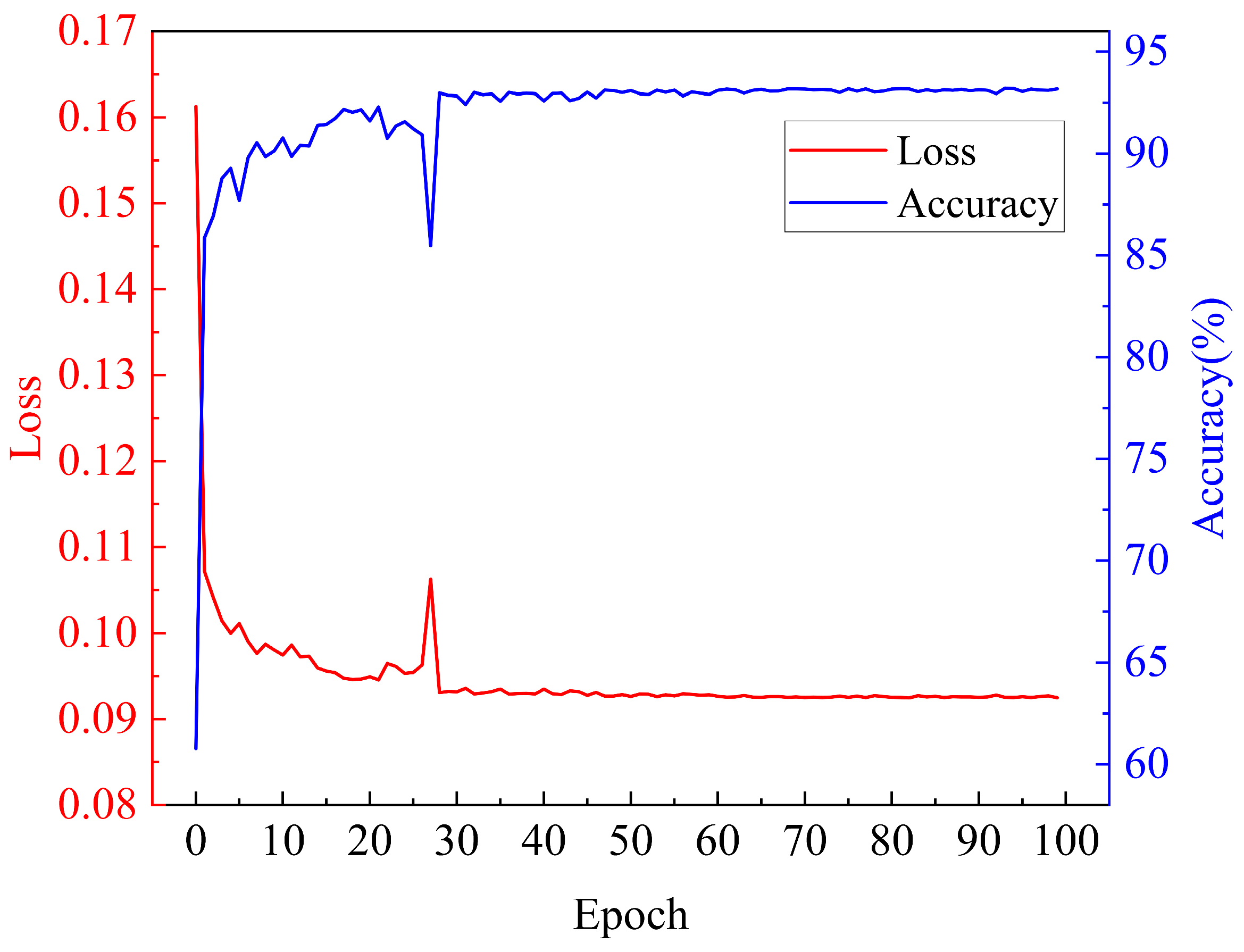
We first analyzed the accuracy and loss curves during model training. As shown in Figure 3, the model accuracy increases with the number of training epochs, while the loss continuously decreases, indicating the model’s learning capability progressively improves. In the 27th epoch, slight fluctuations occurred in both accuracy and loss curves as the model converged to a local optimum, though this did not affect the overall convergence trend. After the 45th epoch, both the accuracy and loss curves stabilize as training continues. Accuracy remains at approximately 93%, while loss stabilizes around 0.092, indicating that the model has fully converged.
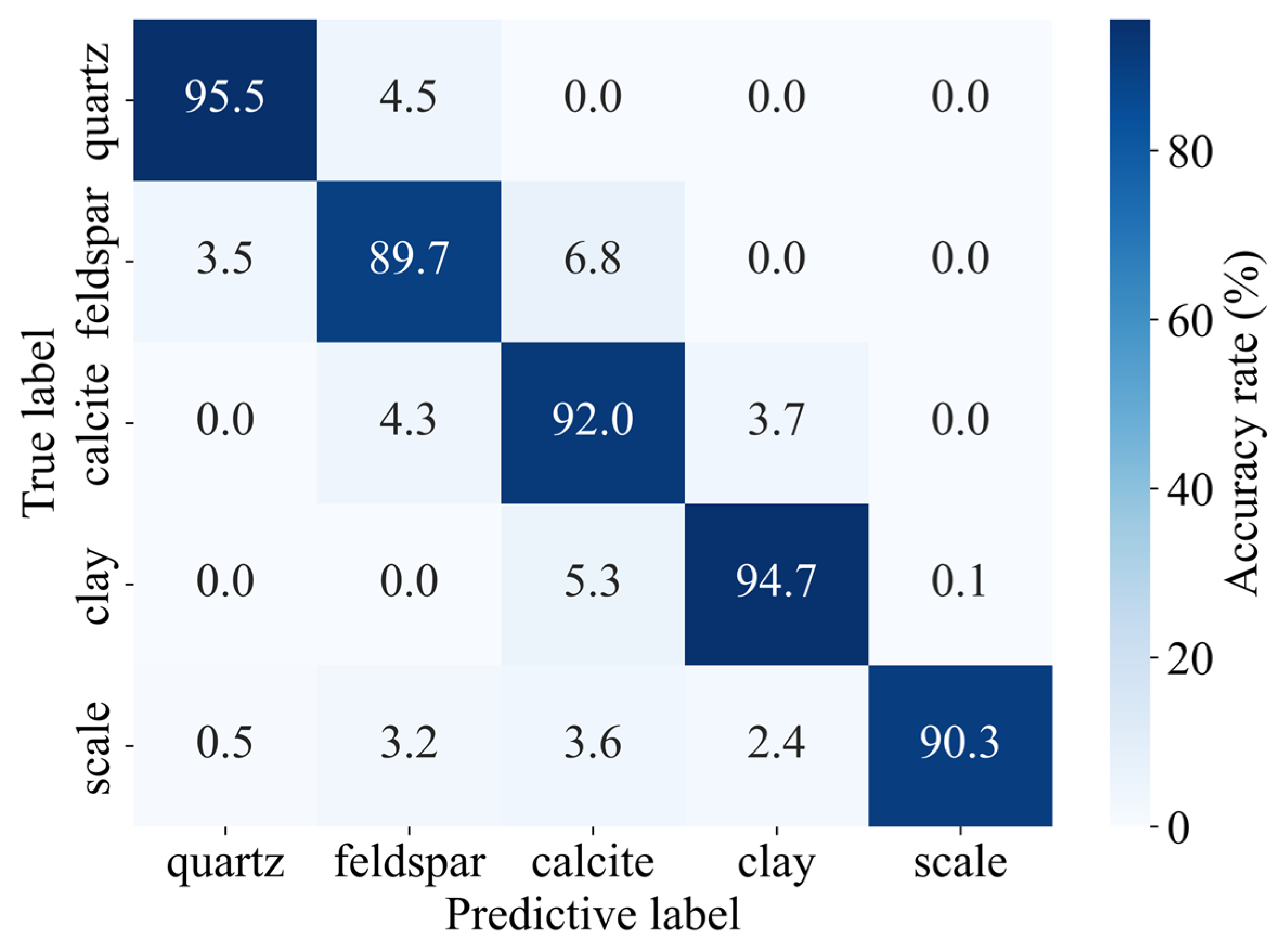
The confusion matrix reflects the model’s classification performance. The diagonal elements in the matrix represent the proportion of correctly classified categories, while the remaining elements reflect misclassification rates between different categories [34]. Figure 4 shows that the CNN–Transformer image segmentation model achieves high accuracy when labeling quartz and clay minerals, which exhibit distinct color characteristics. The labeling accuracy rates are 95.5% and 94.7%, respectively. In contrast, the annotation performance for feldspar and scale is relatively weaker, with accuracy rates of 89.7% and 90.3%, respectively. For feldspar, the lower accuracy arises from its high similarity to quartz and calcite in color, crystal morphology, and optical characteristics, which makes it difficult for the model to distinguish these mineral phases. For the scale, the relatively low classification accuracy is mainly caused by the limited number of scale samples and the ambiguous boundaries between the scale and adjacent mineral regions, both of which increase the classification difficulty. This issue is therefore attributed to a combination of dataset imbalance and boundary ambiguity, rather than a single factor.
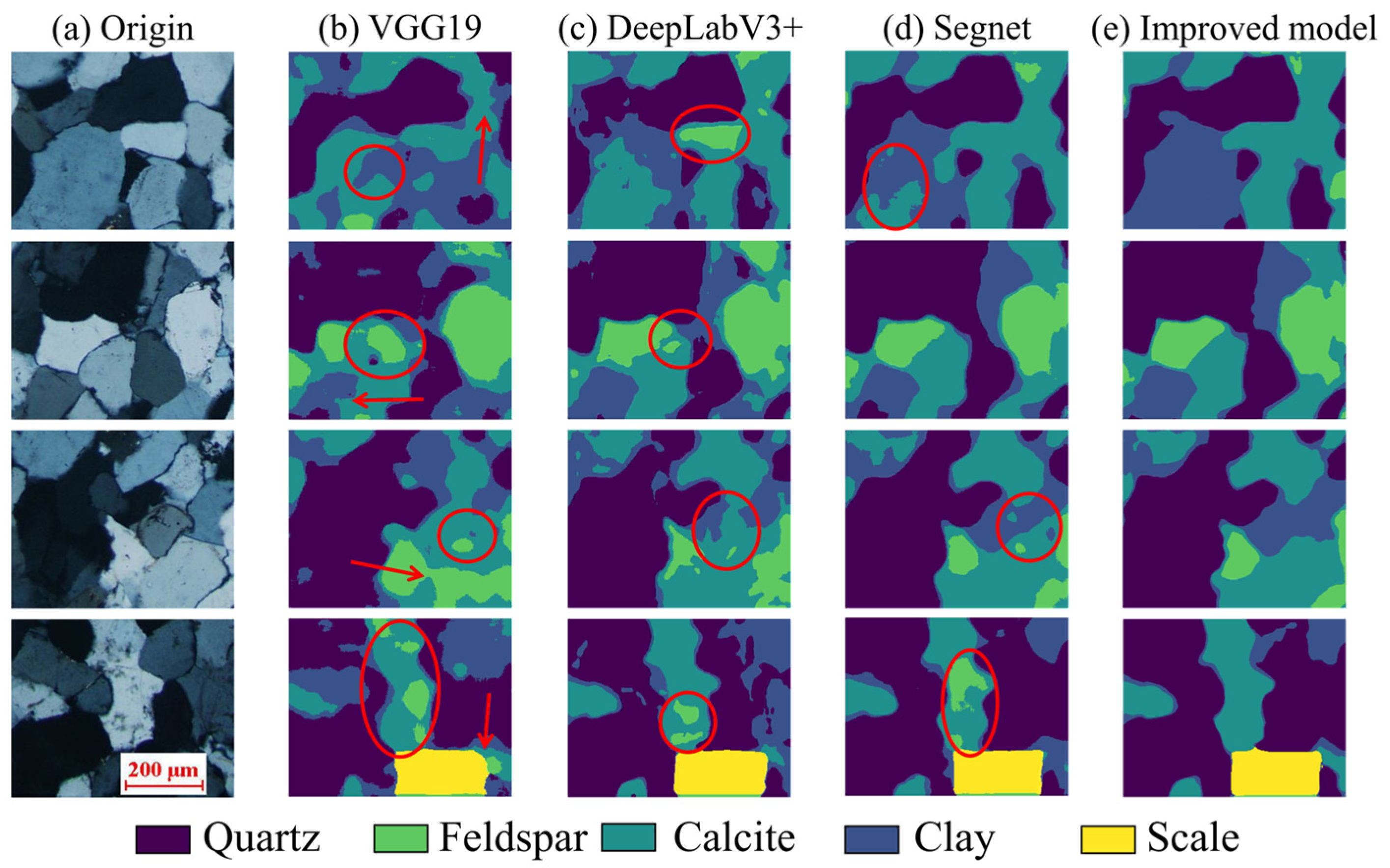
To further evaluate the annotation performance of the proposed CNN–Transformer image segmentation model, we compared it with three mainstream models—VGG19 [35], DeepLabV3+ [36], and Segnet [37] on the same dataset. As shown in Figure 5, the VGG19 model fails to produce clear boundaries between different mineral phases (quartz in purple, feldspar in green, calcite in cyan, and clay in blue). The results exhibit severe blurring, as highlighted by red circles and arrows in Figure 5b: the edges of clay and calcite grains are poorly defined, feldspar regions are incorrectly classified into calcite or clay, and the overall mineral outlines are heavily distorted due to over-reliance on local features and loss of global context. The DeepLabV3+ model generates scattered, fragmented segmentation results with obvious noise within mineral grains (Figure 5c). As marked by red circles, isolated misclassified pixels appear inside feldspar, calcite, and clay regions, reflecting its inability to capture the complex, fine-grained textural variations in multi-mineral components, leading to discontinuous and noisy segmentation masks. The SegNet model can roughly identify the main areas of each mineral phase but still suffers from residual artifacts (Figure 5d). Red circles indicate persistent misclassification noise within grains and unsmooth, irregular boundaries, especially at the interfaces between different minerals, which compromises the overall segmentation accuracy. In contrast, the proposed improved model (Figure 5e) accurately delineates all mineral phases across all four micrograph samples. It produces crisp, continuous boundaries between different minerals, eliminates the blurring, fragmentation, and internal noise observed in the three baseline models, and achieves pixel-level alignment with the true mineral distributions visible in the original micrographs.
The evaluation results in Table 1 further validate the superiority of the proposed model. The proposed model performed better than the comparison model across all metrics, including accuracy (93.26%), Dice coefficient (0.9271), recall (92.65%), precision (92.76%), average intersection-over-union ratio (86.50%), and F1 score (92.71%). In summary, the proposed CNN–Transformer dual-branch feature fusion image segmentation model effectively balances global and local features, achieving high-precision identification of mineral compositions in rock thin-sections.
Although a systematic evaluation of the model’s performance across different textural conditions was not conducted in this study, the training dataset comprises 2240 sandstone thin-section images covering a range of textures, brightness levels, and mineral boundary complexities, all manually annotated by mineral identification specialists. The proposed CNN–Transformer dual-branch architecture inherently balances local texture extraction (the CNN branch) with global context capture (the Transformer branch), contributing to robust segmentation performance under varying textural conditions. The high test accuracy (93.26%) and consistent convergence observed on the independent test set indirectly reflect the model’s generalization capability. In future work, we plan to explicitly evaluate the model on datasets with categorized textural characteristics to further quantify its robustness and guide model improvements.

2.2. Cross-Scale Upgrading Method

2.2.1. The Combined Finite-Discrete Element Method (FDEM)

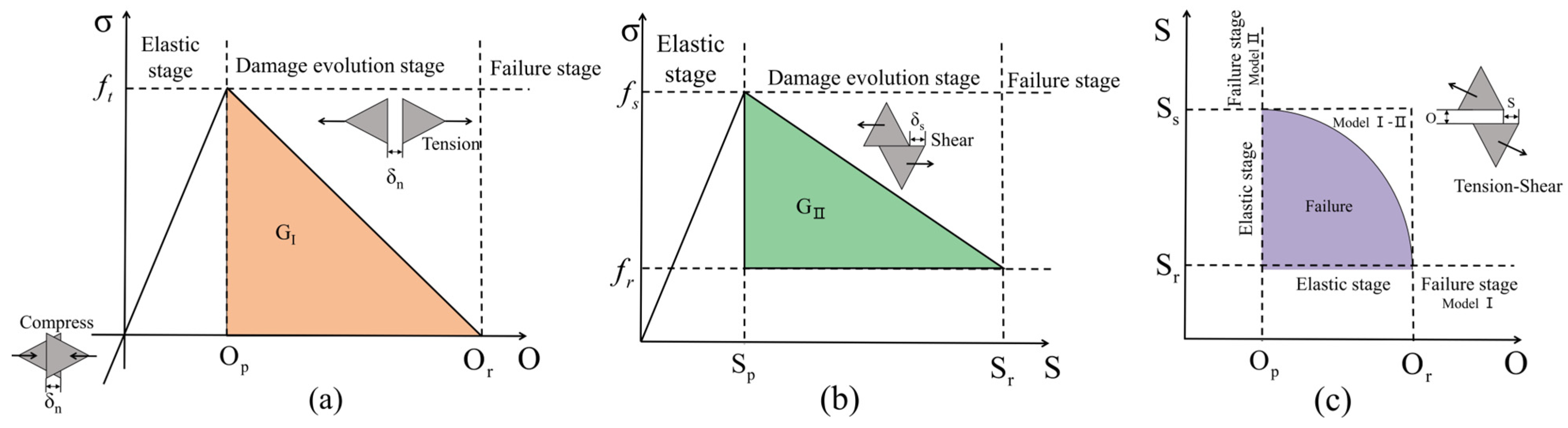
The Finite-Discrete Element Method (FDEM) was first proposed by Munjiza [38]. The core principle of this method involves discretizing intact rock into a triangular finite element mesh and inserting zero-thickness cohesive elements at the common boundaries of adjacent matrix elements [22]. Each cohesive element undergoes elastic deformation when stresses remain below its inherent strength; upon exceeding yield strength, the cohesive elements enter a yielding state, and if stresses increase beyond the ultimate strength, the cohesive elements will fail and be removed, thereby simulating the initiation and propagation of cracks. Under plane stress conditions, cohesive elements can simulate three fundamental failure modes: tensile failure (Type I), shear failure (Type II), and mixed failure (Type I–II), as shown in Figure 6. This method combines the strengths of finite elements in simulating continuum deformation with those of discrete elements in handling discontinuous cracks, enabling the simulation of the entire process from continuous deformation to crack propagation in rock [39,40]. Other related theories have been extensively detailed in numerous publications [28,29,30,31,32,33,34,35,36,37,38,39,40,41,42,43,44].
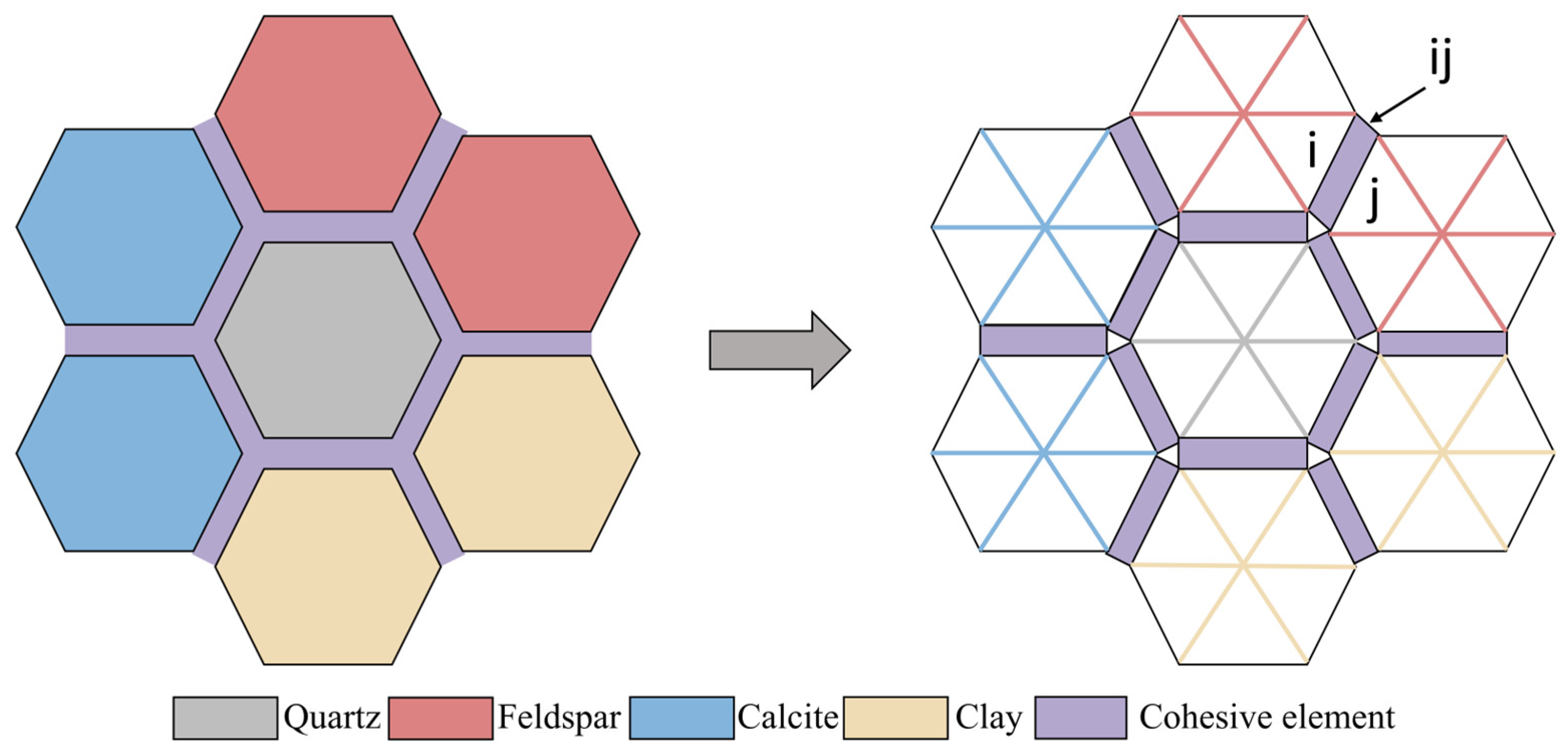
According to Deng et al. [42], the elastic modulus of mineral particles is proportional to their strength parameters, meaning that a higher elastic modulus corresponds to greater cohesion and tensile strength. Based on this, we propose a heterogeneous parameter allocation procedure to characterize rock heterogeneity by establishing a relationship between the mechanical parameters of matrix elements and cohesive elements. In the FDEM model, Young’s modulus is assigned to matrix elements, while cohesion and tensile strength are handled by cohesive elements. As shown in Figure 7, if the cohesive element between matrix elements i and j is denoted as element ij, the cohesion and tensile strength of element ij, along with their corresponding Type I and Type II fracture energies, can be determined by the following equation [45]:
C i j = E i + E j E i 0 + E j 0 C 0 F t , i j = E i + E j E i 0 + E j 0 F t , 0 G I , i j = E i + E j E i 0 + E j 0 G I , 0 G I I , i j = E i + E j E i 0 + E j 0 G I I , 0
where Ei, Ej are the Young’s moduli of the matrix elements i, j, Ei0, Ej0 are the expected Young’s modulus of the minerals corresponding to matrix elements i, j; Cij, Ft,ij, GI,ij and GII,ij are the cohesion, tensile strength, Mode I fracture energy, and Mode II fracture energy of the cohesive element ij; and C0, Ft,0, GI,0 and GII,0 are the expected values of these corresponding parameters. This method can also be applied to determine the relevant parameters for other cohesive elements.
In this study, the FDEM-GBM (Finite-Discrete Element Method combined with Grain-Based Model) was adopted. FDEM (Finite-Discrete Element Method) is a hybrid numerical approach that integrates finite element method (FEM) for continuous deformation and discrete element method (DEM) for discontinuous fracture and block motion. GBM (Grain-Based Model) explicitly represents individual mineral grains and grain boundaries. The FDEM-GBM couples these two methods: each mineral grain is discretized into multiple finite elements (crystal units), and the mesh size refers to the size of these crystal units.

2.2.2. Cross-Scale Upgrading Method Based on Sandstone Cast Specimen Thin-Section Data and Nanoindentation Data

Numerical approaches can reveal the influence of micro-heterogeneity on macroscopic mechanical behavior, which is hard to realize only by experimental tests. Numerous studies have employed FDEM-GBM to upscale the micromechanical properties of sandstone and investigate its macroscopic mechanical behavior [23,24,25]. Therefore, this paper proposed a cross-scale upscaling method based on FDEM-GBM that considers mineral composition and its micro-mechanical heterogeneity. First, the composition and content of each mineral within the sandstone cast thin-section data were obtained through the CNN–Transformer image segmentation model. The Young’s modulus probability density function for each mineral is then statistically calculated using nanoindentation data. Subsequently, stochastic sampling is employed to assign mechanical parameters to mineral grains according to their respective Young’s modulus probability density functions. By coupling the heterogeneous mechanical parameters of matrix elements and cohesive elements, a uniaxial compression FDEM-GBM model is constructed to compute the macroscopic Young’s modulus. Finally, through numerous non-repeated sampling assignments and numerical simulations, the distribution pattern of sandstone’s Young’s modulus is statistically analyzed, achieving cross-scale upscaling from microscopic heterogeneity to macroscopic mechanical response. The specific procedure is as follows:
(1)
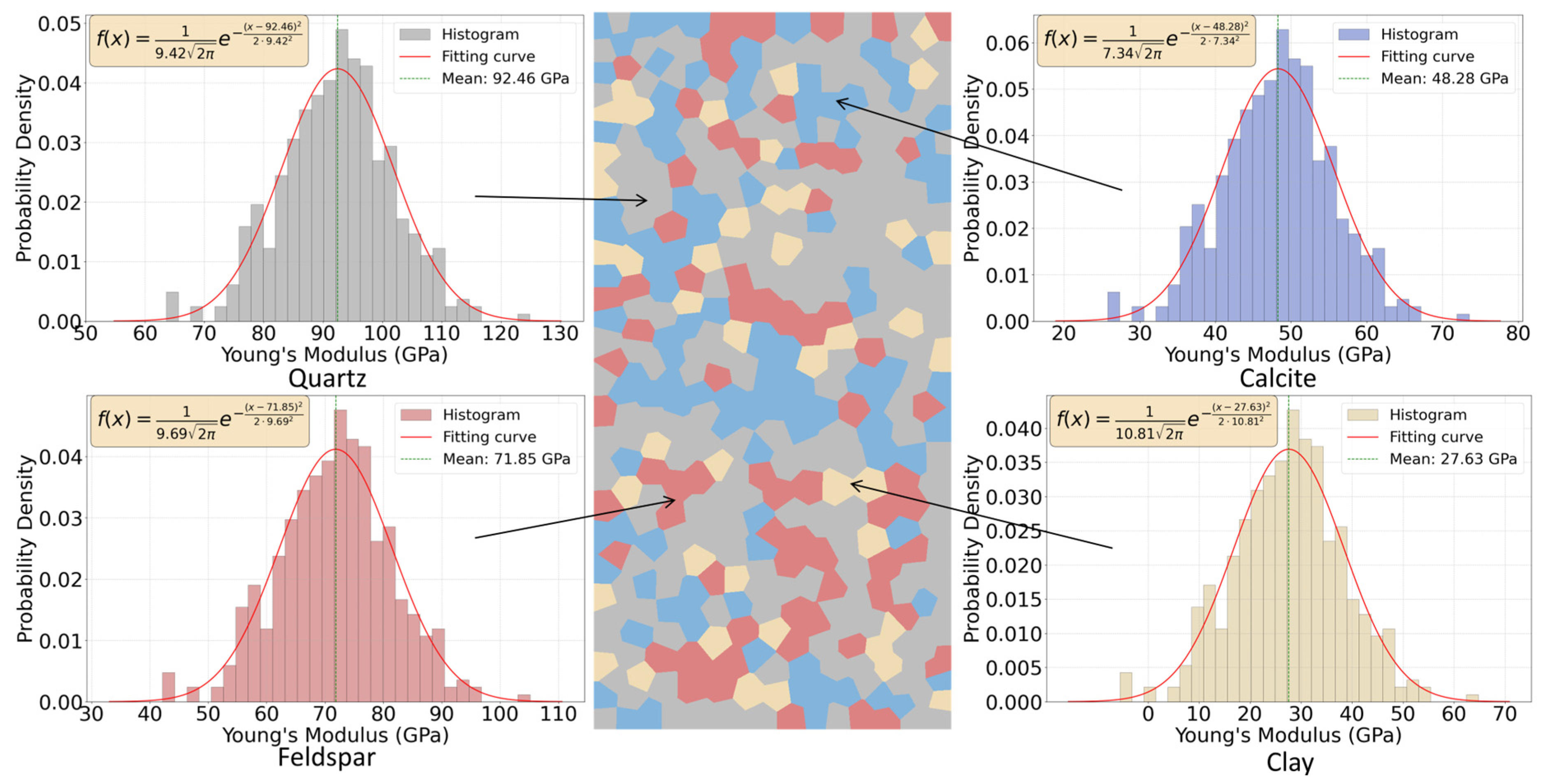
Acquisition of mineral composition and Young’s modulus probability density functions: The proposed CNN–Transformer dual-branch feature fusion image segmentation model was used to obtain mineral composition and content from sandstone thin-section data. Statistical analysis was performed on the nanoindentation experimental data of various mineral phases in sandstone [18,19,46,47]. The Young’s modulus values were generally found to follow a normal distribution. Based on this, the probability density function of Young’s modulus for each mineral phase was established through statistical calculation.
(2)
Random sampling and assignment: To fully account for the random distribution of minerals in sandstone reservoirs, this study requires multiple rounds of sampling and numerical simulation. To ensure variability among the sampling results, different random seeds were used in the sampling process. For assigning mechanical parameters to mineral grains, a stratified sampling method was employed to ensure that the sampled Young’s modulus values effectively cover the entire probability density distribution of each mineral. The specific procedure for stratified sampling is as follows: First, calculate the cumulative distribution function of Young’s modulus for each mineral. Divide its range [0, 1] uniformly into N subintervals (where N is the number of grain elements for that mineral type). A random seed is then used to sample within each sub-interval, and the sampled value is mapped to a specific Young’s modulus value via inverse transform sampling. During the assignment process, to prevent abnormal spatial clustering of mineral particle mechanical parameters, the spatial positions of mineral particles were randomly sorted using the same random seed. The sampled Young’s moduli were then assigned to the mineral particles, as illustrated in Figure 8.
(3)
Numerical Simulation: Through the aforementioned random sampling assignment method, the spatial random distribution of mineral mechanical properties was achieved and applied to the FDEM-GBM uniaxial compression model. Subsequently, through numerous independent random assignment simulations, a statistical analysis was conducted on the distribution pattern of the macroscopic Young’s modulus of sandstone, thereby achieving cross-scale upscaling from microscopic heterogeneity to macroscopic mechanical response. It should be noted that this study focuses on the influence of mineral composition and its microscopic heterogeneity on the macroscopic mechanical properties of sandstone; therefore, initial pores and defects in the rock were not considered. This idealized treatment leads to a purely linear elastic stage in the numerical simulation, which is different from the pore compaction stage observed in laboratory experiments.
Figure 8. Assignment of Young’s modulus values for mineral grains in the uniaxial compression model.
Applsci 16 03589 g008

2.2.3. Method Validation

To validate the effectiveness of the cross-scale upscaling method proposed in this paper, numerical simulations were conducted using the dense sandstone compression test reported by Cao et al. [19] as the reference. The mineral compositions and their contents are as follows: quartz (66%), feldspar (20%), calcite (1%), and clay minerals (13%). The specimen size is 25 mm × 50 mm, and the loading rate is 0.05 mm/min. Based on this, we constructed an FDEM-GBM numerical model with identical mineral proportions and dimensions and conducted multiple simulation runs. The average diameter of mineral grains in the model was 1.5 mm. Each mineral grain contains multiple crystal units, and the mesh size of 0.285 mm refers to the size of these crystal units, which ensures the convergence of numerical calculations. In the assignment of mechanical properties, each mineral grain was treated as a homogeneous unit: a single set of mechanical parameters (e.g., Young’s modulus) was sampled from the corresponding probability density function and uniformly assigned to all crystal units within that grain. This approach preserves intra-grain homogeneity while capturing inter-grain heterogeneity through grain-wise random sampling. Specific parameter settings are detailed in Table 2.
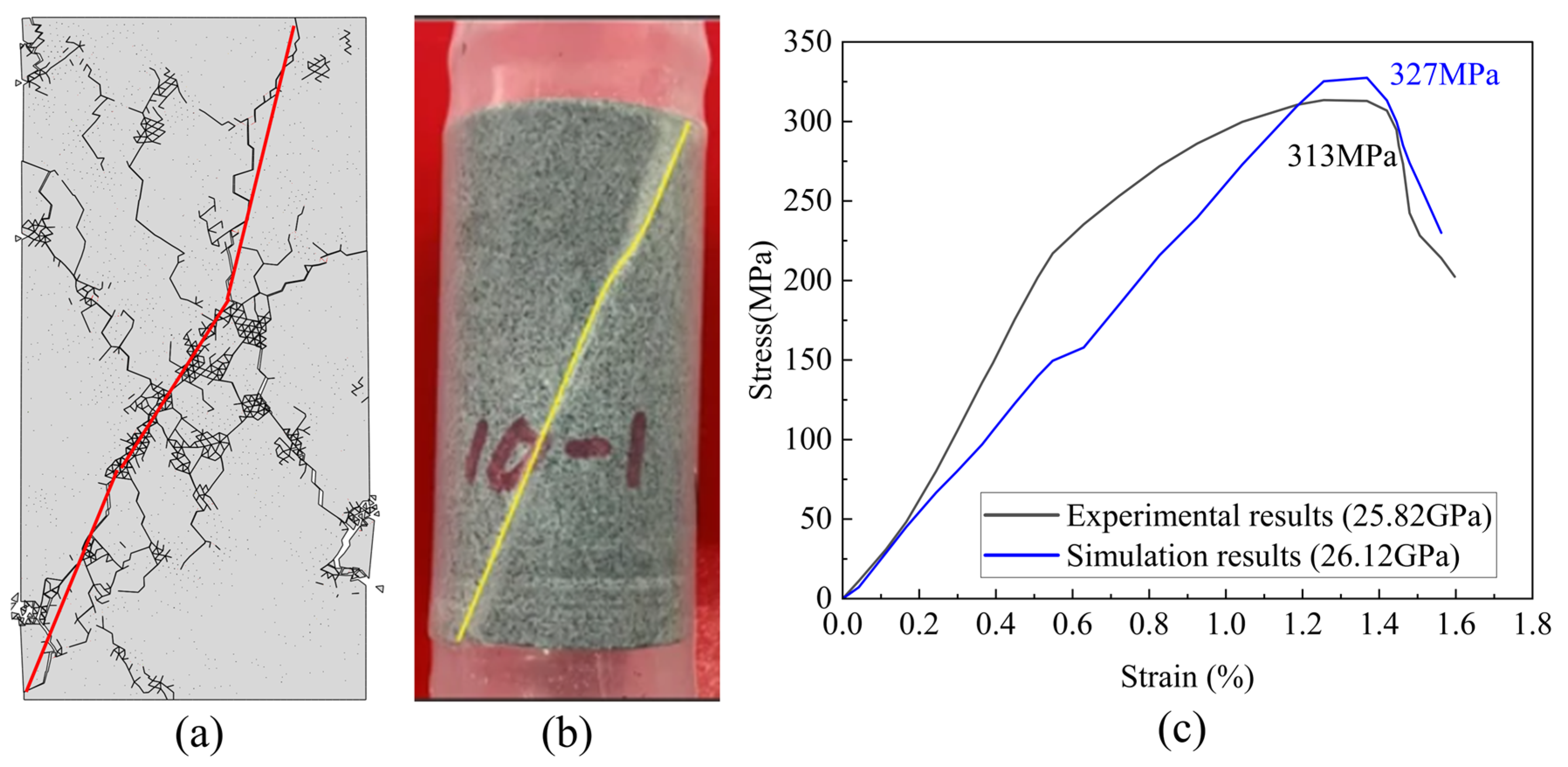
The cross-scale upscaling method proposed in this paper requires numerous numerical simulations to obtain the distribution of macroscopic mechanical properties. Therefore, we can select the simulation results that most closely match the experimental results from multiple sets of simulation results, as shown in Figure 9. The numerical simulation result (Figure 9a) displays the main crack penetrating the sandstone model along with densely distributed branch cracks. The experimental result (Figure 9b) is a surface photograph of the sandstone after compressive failure, where internal micro-cracks cannot be observed, so the validation of microcrack distribution is not fully realized in this study. The comparison reveals that the simulated results exhibit a high degree of similarity to the experimental results in terms of the morphology of the main crack. The stress–strain curve obtained from the sandstone compression test is higher than the simulation result in the elastic stage (Figure 9c). This is because the initial pores and defects inside the sandstone close under very low stress, after which the sandstone begins to bear load as a whole, causing stress to increase more rapidly with strain. After a certain amount of deformation, due to the presence of initial porosity and defects, micro-cracks start to develop inside the sandstone, slowing down the rate of stress increase with strain. Since the initial porosity and defects of the sandstone were not considered in the numerical model, the simulated stress–strain curve exhibits an approximately linear increase, and the peak compressive strength is slightly higher than that in the experiment. The Young’s modulus and compressive strength obtained from the simulation are 26.12 GPa and 327 MPa, respectively, while the experimental results are 25.82 GPa and 313 MPa. The relative errors for Young’s modulus and compressive strength are 1.16% and 4.47%, respectively. Given the inherent variability in rock mechanical properties and the simplifications adopted in the numerical model (e.g., ignoring initial pores and defects), these deviations are considered acceptable, and the numerical results show reasonable agreement with the experimental data. This close agreement fully demonstrates the reliability of the modeling approach presented in this paper and also validates the parameters listed in Table 2.

3. Results and Discussion

3.1. Influence of Mineral Micro-Heterogeneity on the Macro-Mechanical Properties of Sandstone

Based on the image segmentation model described in Section 2.1.3, we performed mineral segmentation and content statistics on 14 sandstone thin-section images (Table 3). These thin sections originate from the same set of tight sandstone reservoir samples used for subsequent numerical modeling and experimental validation, sharing a consistent sedimentary environment, mineral types, and mechanical background, thereby ensuring the representativeness of the statistical results. The average values of these 14 samples were set as the mineral proportions in the numerical model (S15). Following the method in Section 3.2, we conducted 100 sets of uniaxial compression numerical simulations and calculated the Young’s modulus of the sandstone. The numerical simulation parameter settings are shown in Table 2.
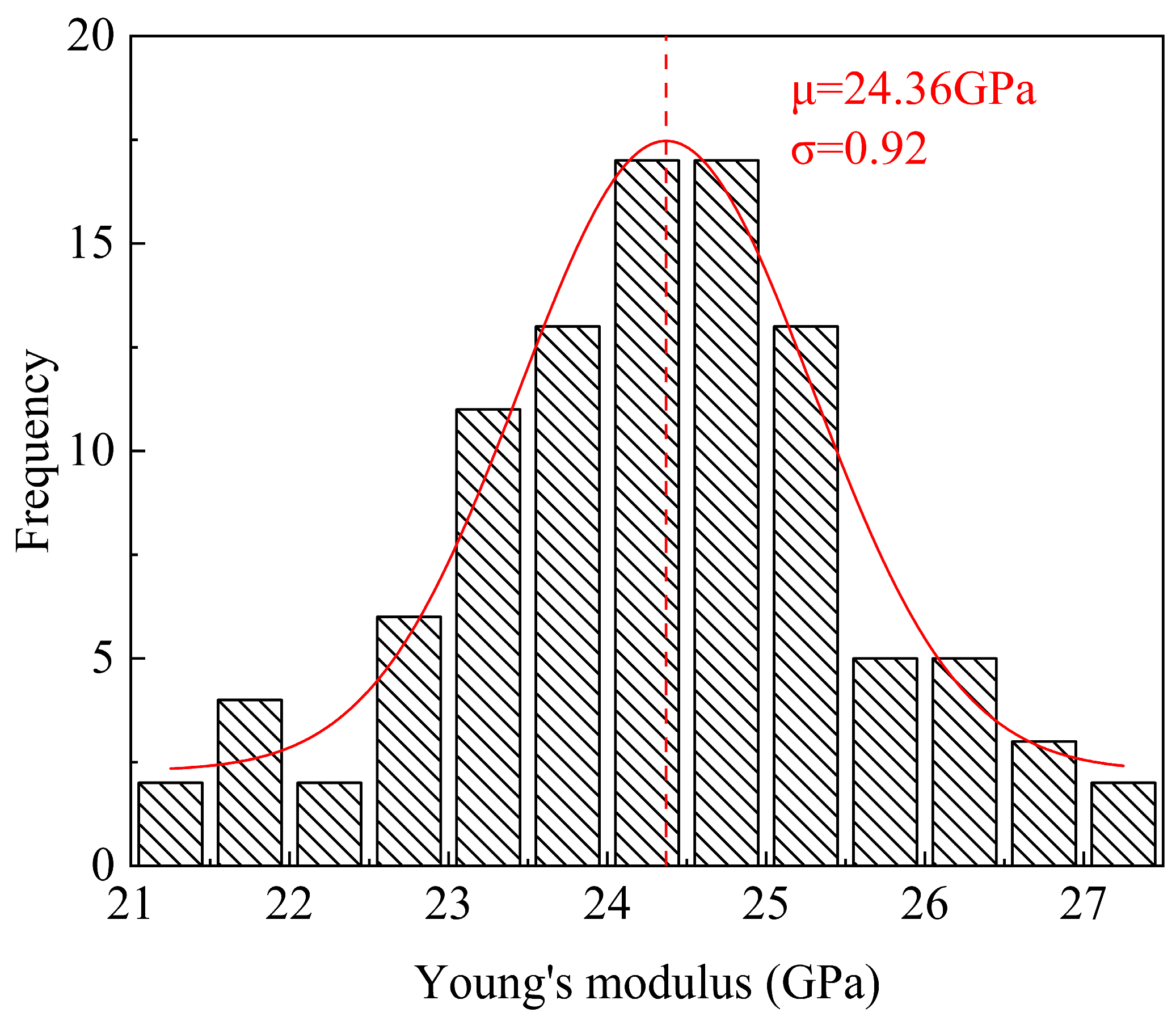
Statistical analysis of the sandstone’s Young’s modulus reveals that it follows a normal distribution, as shown in Figure 10. The fitting equation is given in Equation (3). The maximum and minimum values of Young’s modulus are 27.1 GPa and 21.4 GPa, respectively, with a mean of 24.36 GPa and a standard deviation of 0.92. This distribution originates from the variability in the micromechanical properties of constituent minerals and their irregular spatial distribution. Under macroscopic loading, the combined effects of statistical fluctuations and spatial heterogeneities lead to variations in the mechanical properties of sandstone.
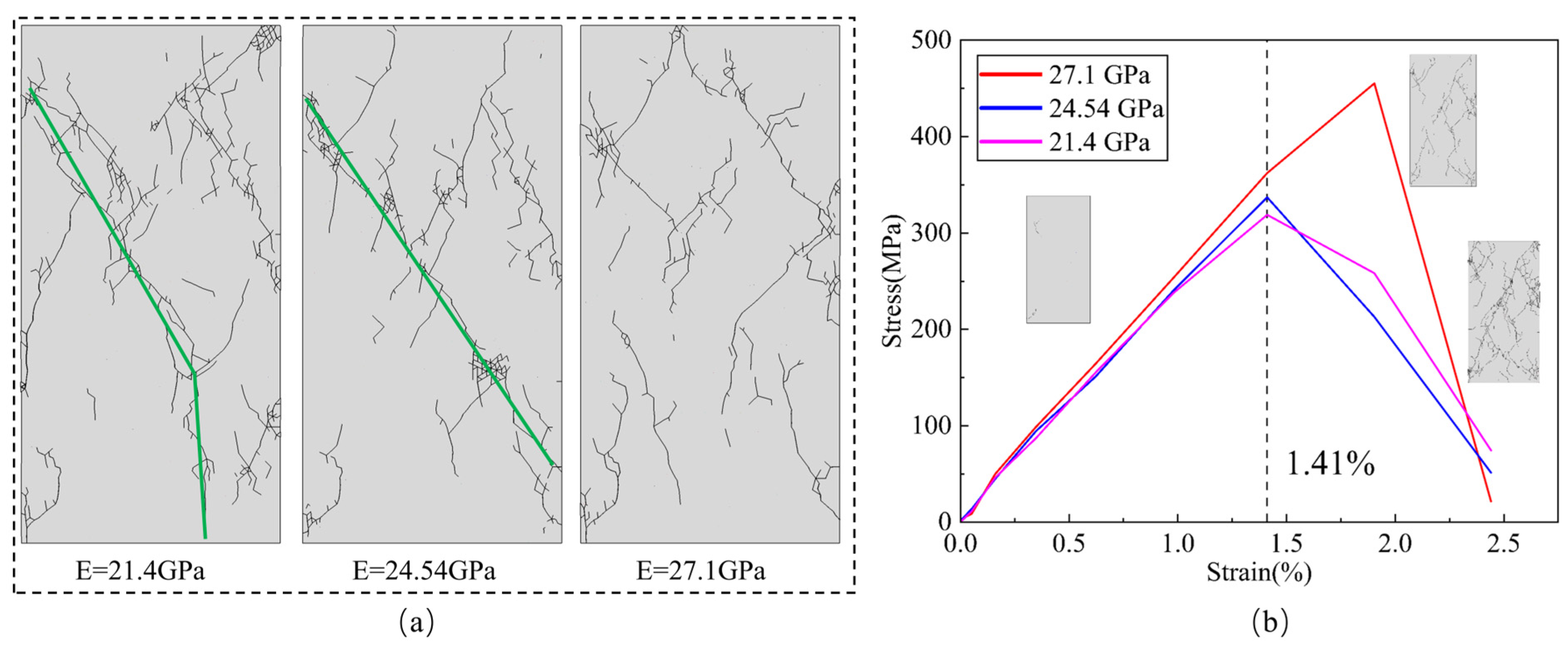
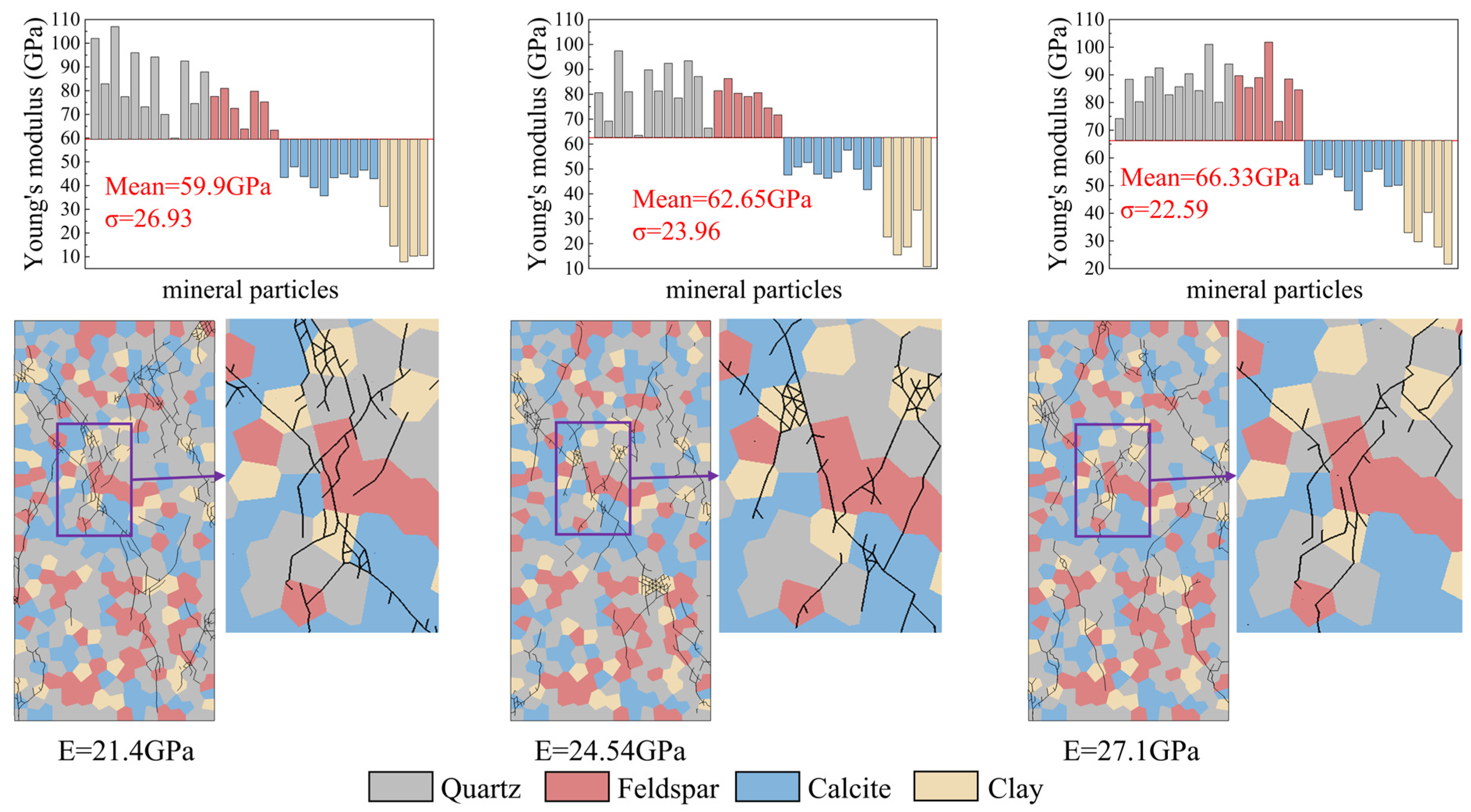
This paper compared the simulation results of three groups with Young’s moduli of 21.4 GPa, 24.54 GPa, and 27.1 GPa, as shown in Figure 11. The uniaxial compressive strengths of the three groups are 318.84 MPa, 338.6 MPa, and 455.3 MPa, respectively, with the third group showing a significantly higher strength than the other two. An analysis of crack distribution at the same strain level (1.41%) reveals that cracks in the first two groups propagate and coalesce earlier, leading to a premature loss of load-bearing capacity. To further investigate the influence of microcracks on macroscopic mechanical properties, a statistical analysis was conducted on the number of cracks and the mechanical parameters of mineral grains within the purple boxes for all three groups. As shown in Figure 12, as the Young’s modulus increases from 21.4 GPa to 27.1 GPa, the total crack lengths within the purple boxes are 77.01 mm, 61.43 mm, and 44.16 mm, respectively, while the statistical standard deviations of Young’s modulus for mineral grains are 26.93, 23.96, and 22.59, respectively. This indicates that, under identical loading conditions, greater spatial variability in the mechanical properties of mineral grains tends to induce more cracks, resulting in a lower macroscopic Young’s modulus of the sandstone.

3.2. Influence of Mineral Content on the Macro-Mechanical Properties of Sandstone

To investigate the influence of mineral content on the macroscopic mechanical properties of sandstone, we additionally constructed two numerical models with significantly different mineral contents: S2 (quartz 56.4%, feldspar 14%, calcite 25.9%, clay minerals 3.7%) and S6 (quartz 30.2%, feldspar 14.6%, calcite 27.1%, clay minerals 28.1%). Among S2, S6, and S15, feldspar and calcite contents were similar, while quartz and clay mineral contents varied significantly. Using the method described in Section 2.2.2, 100 uniaxial compression numerical simulations were conducted for each of the S2 and S6 mineral compositions. The simulation results for different mineral compositions were analyzed in comparison with the findings from Section 3.1.
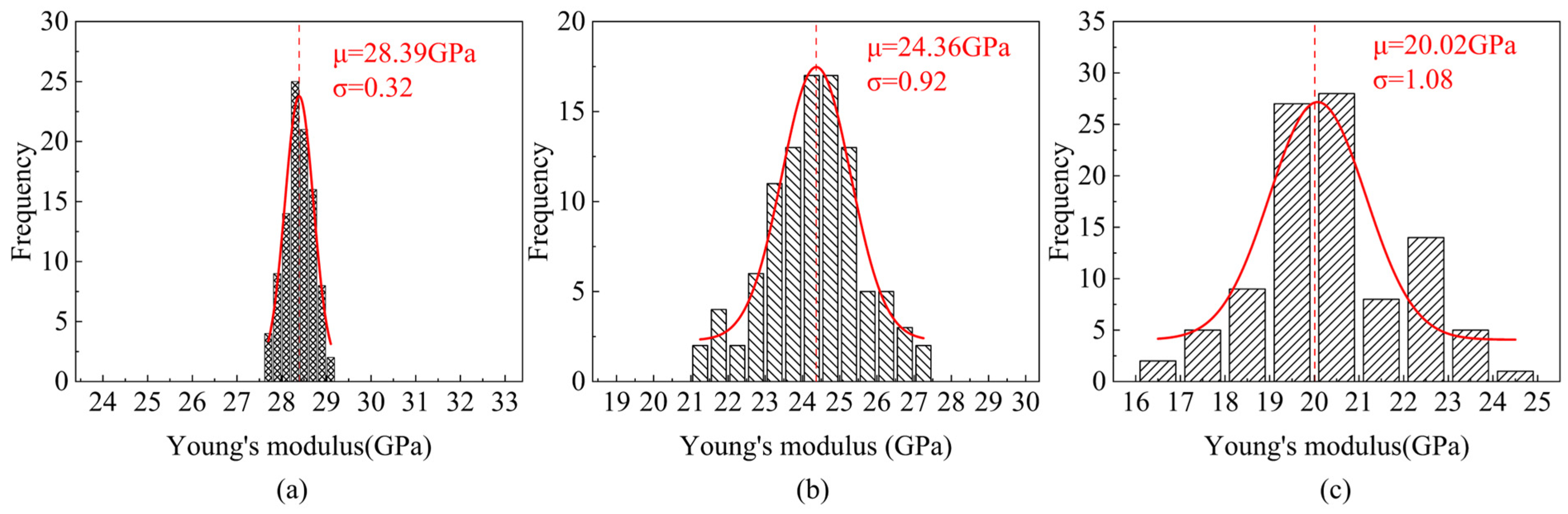
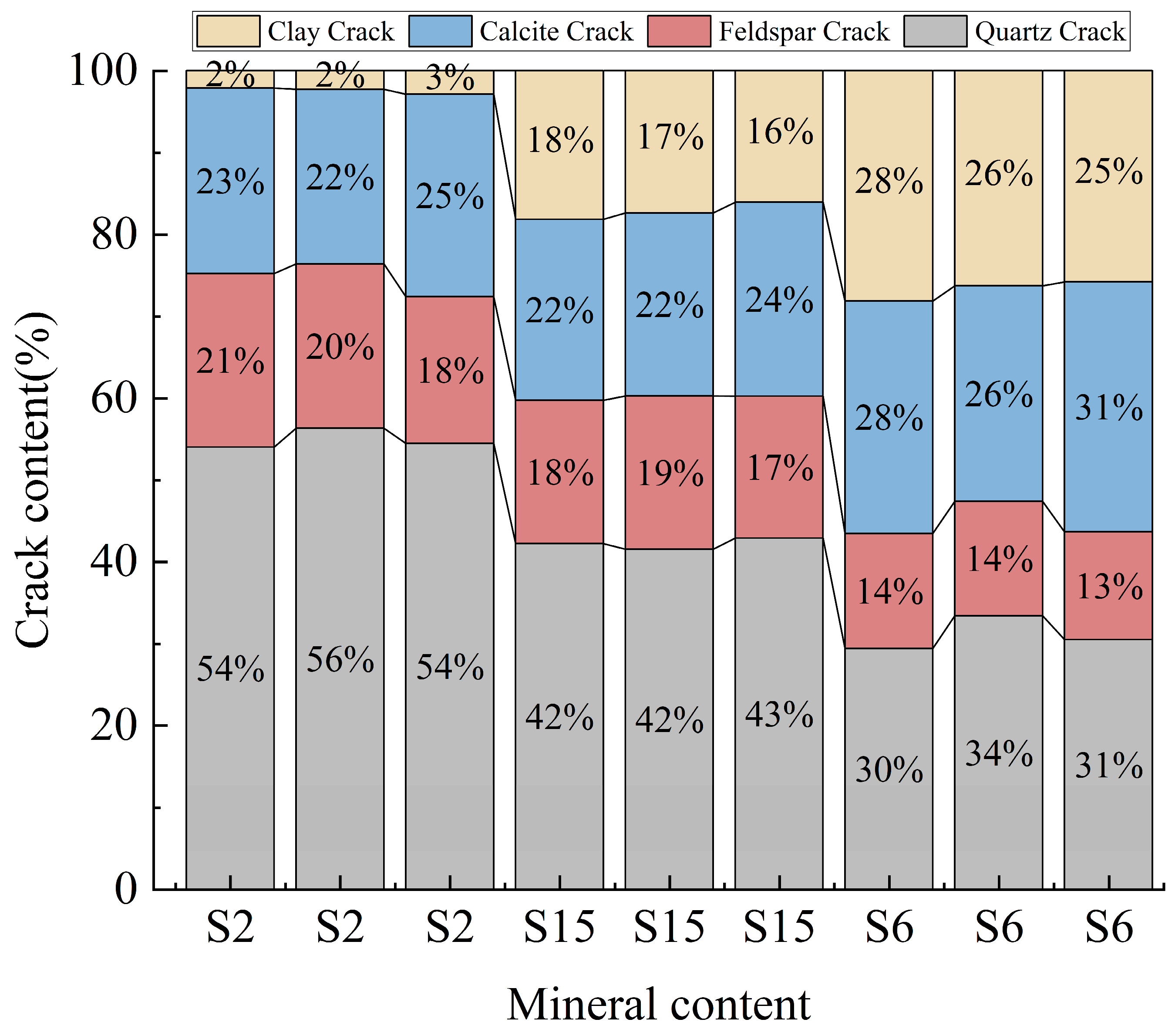
Statistical analysis of the frequency distribution of the macroscopic Young’s modulus of sandstone under the three mineral compositions (S2, S15, and S6) revealed that they all conform to a normal distribution, as shown in Figure 13, with the corresponding fitting equations given by Equation (2), Equation (3), and Equation (4), respectively. Quantitative analysis indicates that, as the quartz content decreases from 56.4% to 30.2% and the clay content increases from 3.7% to 28.1%, the mean macroscopic Young’s modulus of sandstone decreases from 28.39 GPa to 20.02 GPa, while the standard deviation of the distribution increases from 0.32 to 1.08. This is because the cohesion between high-strength minerals is stronger; thus, a reduction in their content weakens the load-bearing capacity of sandstone during uniaxial compression. Meanwhile, the inherently weaker mechanical properties and greater variability of low-strength minerals lead to an increased dispersion in the macroscopic mechanical properties of sandstone as their content rises. Further statistical analysis of the proportion of cracks passing through each mineral phase (Figure 14) shows that the average proportion of cracks passing through the quartz phase decreases from 54.67% (S2) to approximately 31% (S6), whereas the average proportion passing through the clay phase increases from 2.55% to 26.67%. This trend in crack proportions closely aligns with the changes in mineral content, indicating that the mineral composition of sandstone controls its macroscopic mechanical behavior by influencing crack propagation paths.
In summary, the macroscopic mechanical properties of sandstone are influenced by multiple factors. The irregular spatial distribution of the mechanical properties of mineral grains leads to statistical fluctuations in the macroscopic mechanical strength of sandstone. With the decrease in high-strength mineral phases, the macroscopic mechanical strength of sandstone is reduced, the dispersion of its mechanical properties increases, and the proportion of cracks generated within low-strength mineral phases rises accordingly. This indicates that mineral composition and content are the primary factors influencing the macroscopic mechanical behavior of sandstone, while the heterogeneity in micromechanical properties of minerals plays a secondary role.
y = 4.0729 + 62.351 1.08 × 2 π exp x 20.02 2 2 × 1.08 2
y = 2.2951 + 35.096 0.92 × 2 π exp ( x 24.36 ) 2 2 × 0.92 2
y = 1.2054 + 18.068 0.32 × 2 π exp ( x 28.39 ) 2 2 × 0.32 2

3.3. Brittleness Evaluation Index for Sandstone

Brittleness reflects the deformation and failure characteristics of rocks under external forces, and the brittleness index serves as a key parameter in engineering practice for evaluating the fracability of sandstone and designing hydraulic fracturing schemes. Numerous scholars have proposed a brittleness index based on mineral content or mechanical parameters [48,49,50,51]. However, these indexes generally average the contribution of mineral composition to brittleness, ignoring the impact of micromechanical heterogeneity of minerals on rock brittleness [52]. To calibrate the brittleness index, three representative mineral compositions (S2, S15, and S6) were selected from the 14 thin-section samples. As shown in Table 3, these three groups cover a wide range of mineral content variations: S2 represents high quartz content (56.4%) with low clay content (3.7%); S6 represents low quartz content (30.2%) with high clay content (28.1%); and S15 represents the average composition of all samples (quartz 45.0%, clay 11.0%). These three compositions are therefore sufficient to capture the typical variation range of tight sandstone in the study area, enabling a robust calibration of the relationship between mineral composition, mechanical heterogeneity, and brittleness. Therefore, based on mineral content and the distribution characteristics of Young’s modulus at both macro- and micro-scales, we proposed a brittleness evaluation index:
B = i = 1 n A i W i W t
A i = k μ i σ i
μ Sj σ Sj = i = 1 n k μ i σ i × W i
k ¯ = k 1 + k 2 + k 3 3
where B is the proposed mineral brittleness evaluation index; I is the mineral type (quartz, feldspar, calcite, clay minerals); Wi is the content of mineral in the rock; Wt is the total mineral content; Ai is the weighting factor for the mineral contribution to brittleness; k is a correction factor; Sj indicates different experimental groups (j = 2, 6, 15, see Table 3); and n = 4.
We first calculated weighting factors based on the mean Young’s modulus ( μ i ) and standard deviation ( σ i ) of each mineral. Then, by incorporating the mean ( μ Sj ) and standard deviation ( σ Sj ) of the frequency distribution function of the sandstone’s macroscopic Young’s modulus, we established the relationship between the weighting factors and the macroscopic Young’s modulus. This allowed us to determine the correction factors k1, k2, and k3 for the three mineral contents (S6, S15, S2). Since a correction factor derived from a single mineral content is not representative, we computed the average of the three correction factors, denoted as k ¯ . We substituted k ¯ into Equation (6) to calculate the weighting factors characterizing the elastic properties of each mineral. Finally, normalizing these weighting factors relative to quartz produced a mineral-composition-based brittleness index for sandstone:
B = W quartz + 0.824 W feldspar + 0.466 W calcite + 0.011 W clay W t × 100 %
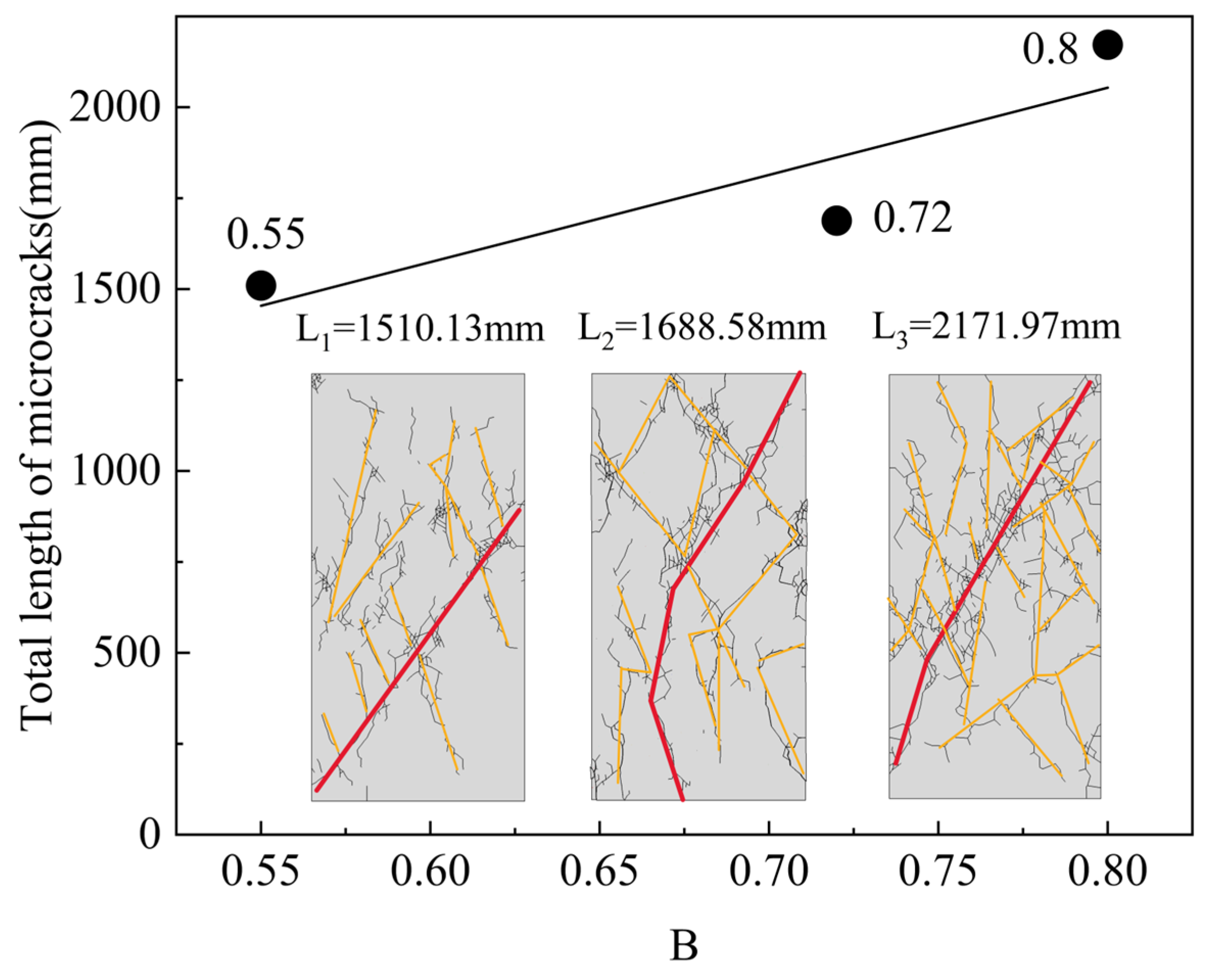
As shown in Equation (9), quartz has the strongest influence on sandstone brittleness, followed by feldspar and calcite, while clay minerals exhibit the weakest effect. Based on the three mineral proportions (S6, S15, S2) presented in Section 3.1 of this paper, the corresponding brittleness indexes were calculated as 0.55, 0.72, and 0.8, respectively. The brittleness index is one of the parameters describing the fracturing capacity of sandstone reservoirs. Statistical analysis of the number of cracks under different brittleness indexes shows that the total crack lengths are 1510.13 mm, 1688.58 mm, and 2171.97 mm, respectively, as illustrated in Figure 15. This indicates that, during hydraulic fracturing, rocks with higher brittleness tend to generate more cracks, which is conducive to forming complex fracture networks, thereby demonstrating the validity of the proposed brittleness index. In summary, the brittleness index proposed in this study effectively characterizes the varying contributions of different minerals to brittleness based on mineral composition and the distribution parameters of their micromechanical properties. It avoids the averaging of mineral contributions to brittleness, providing a reasonable quantitative basis for evaluating the fracability of sandstone reservoirs.

4. Conclusions

This study developed a cross-scale research method integrating mineral composition and its micro-mechanical heterogeneity into macro-scale heterogeneity, systematically revealing the intrinsic relationship between microstructure and macro-mechanical response in tight sandstone. Key findings are as follows:
(1)
The CNN–Transformer dual-branch image segmentation model proposed in this study was trained on sandstone thin-section data. It effectively captures both local details and global features of mineral distribution, achieving a segmentation accuracy of 93.26% and a mean intersection over union (mIoU) of 86.50%, thereby obtaining reliable mineral composition data.
(2)
Based on the nanoindentation data of minerals, their micromechanical probability density functions were obtained. Random sampling and assignment were then performed according to the probability density functions of each mineral. This spatial random distribution of mineral mechanical properties was implemented into the FDEM-GBM uniaxial compression model for calculating the sandstone’s macroscopic mechanical strength. Consequently, a cross-scale research method was proposed that integrates sandstone mineral composition and its microscopic heterogeneity into macroscopic heterogeneity.
(3)
The spatially irregular distribution of mineral mechanical properties in sandstone leads to a normal distribution of the macroscopic Young’s modulus obtained from uniaxial compression numerical simulations, with Young’s modulus ranging from 21.4 GPa to 27.1 GPa across different mineral compositions. Further investigation reveals that, as the content of high-strength minerals (e.g., quartz) decreases from 56.4% to 30.2% and clay content increases from 3.7% to 28.1%, the mean macroscopic Young’s modulus decreases from 28.39 GPa to 20.02 GPa, while its standard deviation increases from 0.32 to 1.08, and the proportion of cracks propagating through low-strength minerals rises from 2.55% to 26.67%. This indicates that mineral composition and content are the primary factors controlling the macroscopic mechanical properties of sandstone, while the heterogeneity in mineral mechanical properties is a secondary factor.
(4)
Based on the mineral content of sandstone and the distribution characteristics of its micromechanical and macro-mechanical properties, a brittleness evaluation index was developed. The calculated brittleness indexes for three representative mineral compositions are 0.55, 0.72, and 0.80, respectively. This study found that a higher sandstone brittleness index leads to a greater tendency to generate branched cracks during the fracturing process, forming a complex fracture network.
The core contribution of this study is a multi-scale method combining mineral composition and micromechanical heterogeneity. This method provides effective guidance for industrial applications such as hydraulic fracturing optimization, brittleness evaluation, and crack distribution prediction. Moreover, this cross-scale framework offers a generalizable methodology for understanding micro-to-macro heterogeneity in heterogeneous geomaterials, which can be extended to other rock types and supports fundamental research in geomechanics and reservoir modeling.
Several limitations of this study should be acknowledged. First, the accuracy of mineral segmentation relies on the quality and diversity of the training dataset; although the current dataset covers a range of textures, its representativeness for all sandstone types remains limited. Second, the numerical model assumes an idealized microstructure without initial pores, defects, or microcracks, which simplifies the elastic response and may affect the simulation of the pore compaction stage. Third, this study focuses on a specific set of tight sandstone samples; thus, the generalizability of the proposed brittleness index to other sandstone formations requires further validation. Based on the above limitations, future work will focus on the following aspects: (1) more extensive experimental validation using actual reservoir data to further verify the reliability of the cross-scale method; (2) extending the proposed approach to other rock types (e.g., shale, carbonate) to assess its generalizability; (3) developing a 3D cross-scale numerical model that incorporates realistic pore structures and defect distributions, moving beyond the current 2D cross-sectional representation to better capture the true mechanical behavior of rocks.

Author Contributions

B.X.: funding acquisition, methodology, project administration, supervision. Y.Z.: data curation, formal analysis, investigation, methodology, writing—original draft. X.X.: data curation, formal analysis, methodology. L.W.: data curation, funding acquisition, project administration, supervision. R.L.: data curation, investigation, methodology. X.Z.: data curation, investigation. All authors have read and agreed to the published version of the manuscript.

Funding

This research is supported by the National Key Research and Development Program of China (Grant No. 2023YFC3009005) and the Chongqing Talents·Program Excellent·Scientist Project (No. cstc2024ycjh-bgzxm0016).

Institutional Review Board Statement

Not applicable.

Informed Consent Statement

Not applicable.

Data Availability Statement

Data will be made available upon request.

Acknowledgments

During the preparation of this manuscript, the authors used DeepSeek (version: DeepSeek-V3, available at https://deepseek.com) for the purposes of polishing and refining the English language expression. The authors have reviewed and edited the output and take full responsibility for the content of this publication.

Conflicts of Interest

The authors declare no conflicts of interest.

References

  1. Zou, C.N.; Yang, Z.; Tao, S.Z.; Yuan, X.J.; Zhu, R.K.; Hou, L.H.; Wu, S.T.; Sun, L.; Zhang, G.S.; Bai, B.; et al. Continuous hydrocarbon accumulation over a large area as a distinguishing characteristic of unconventional petroleum: The Ordos Basin, North-Central China. Earth-Sci. Rev. 2013, 126, 358–369. [Google Scholar] [CrossRef]
  2. Gao, H.; Li, H. Pore structure characterization, permeability evaluation and enhanced gas recovery techniques of tight gas sandstones. J. Nat. Gas Sci. Eng. 2016, 28, 536–547. [Google Scholar] [CrossRef]
  3. Guo, Z.Q.; Li, X.Y.; Liu, C.; Feng, X.; Shen, Y. A shale rock physics model for analysis of brittleness index, mineralogy and porosity in the Barnett Shale. J. Geophys. Eng. 2013, 10, 025006. [Google Scholar] [CrossRef]
  4. Guo, P.; Li, X.; Li, S.D.; He, J.M.; Mao, T.Q.; Zheng, B. Combined effect of rock fabric, in-situ stress, and fluid viscosity on hydraulic fracture propagation in Chang 73 lacustrine shale from the Ordos Basin. J. Cent. South Univ. 2024, 31, 1646–1658. [Google Scholar] [CrossRef]
  5. Sun, W.B.; Zuo, Y.J.; Wu, Z.H.; Liu, H.; Zheng, L.J.; Shui, Y.; Xi, S.; Lou, Y.; Luo, X. The distribution characteristics of brittle minerals in the Lower Cambrian Niutitang Formation in northern Guizhou. J. Nat. Gas Sci. Eng. 2021, 86, 103752. [Google Scholar] [CrossRef]
  6. Su, Z.Z.; Li, T.T.; Bai, M.X.; Zhou, Z.J. Influence of mineral composition on initiation pressure of waterflood-induced fractures in tight sandstone reservoir. ACS Omega 2024, 9, 9269–9285. [Google Scholar] [CrossRef]
  7. Liu, K.D.; Zhao, S.X.; Diao, L.; Yue, W.P.; Sun, C.W.; Xia, Y. Research on the mechanical properties and micro damage mechanism of water bearing sandstone under uniaxial compression. Sci. Rep. 2025, 15, 7320. [Google Scholar] [CrossRef] [PubMed]
  8. Du, K.; Sun, Y.; Zhou, J.; Khandelwal, M.; Gong, F.Q. Mineral Composition and Grain Size Effects on the Fracture and Acoustic Emission (AE) Characteristics of Rocks Under Compressive and Tensile Stress. Rock Mech. Rock Eng. 2022, 55, 6445–6474. [Google Scholar] [CrossRef]
  9. Shi, X.C.; Tang, Y.; Chen, S.; Gao, L.Y.; Wang, Y.M. Experimental study on the sandstone abrasiveness via mineral composition and microstructure analysis. Petroleum 2024, 10, 440–445. [Google Scholar] [CrossRef]
  10. Ahmed, Z.; Khan, A.S.; Ahmed, B. Sandstone Composition and Provenance of the Nari Formation, Central Kirthar Fold belt, Pakistan. Pak. J. Geol. 2020, 4, 90–96. [Google Scholar] [CrossRef]
  11. Marques, V.G.; da Silva, L.R.D.; Carvalho, B.M.; de Lucena, L.R.F.; Vieira, M.M. Deep learning-based pore segmentation of thin rock sections for aquifer characterization using color space reduction. In Proceedings of the 2019 International Conference on Systems, Signals and Image Processing (IWSSIP), Osijek, Croatia, 5–7 June 2019; IEEE: New York, NY, USA, 2019; pp. 235–240. [Google Scholar] [CrossRef]
  12. Yu, Q.Y.; Xiong, Z.W.; Du, C.; Dai, Z.X.; Soltanian, M.R.; Soltanian, M.; Yin, S.; Liu, W.; Liu, C.; Wang, C.; et al. Identification of rock pore structures and permeabilities using electron microscopy experiments and deep learning interpretations. Fuel 2020, 268, 117416. [Google Scholar] [CrossRef]
  13. Jin, C.Y.; Wang, K.; Han, T.; Lu, Y.; Liu, A.X.; Liu, D. Segmentation of ore and waste rocks in borehole images using the multi-module densely connected U-net. Comput. Geosci. 2022, 159, 105018. [Google Scholar] [CrossRef]
  14. Zheng, D.Y.; Hou, L.; Hu, X.M.; Hou, M.C.; Dong, K.; Hu, S.H.; Teng, R.; Ma, C. Sediment grain segmentation in thin-section images using dual-modal Vision Transformer. Comput. Geosci. 2024, 183, 105664. [Google Scholar] [CrossRef]
  15. Liao, S.Z.; Hu, J.H.; Zhang, Y. Mechanism of hydraulic fracture vertical propagation in deep shale formation based on elastic–plastic model. Eng. Fract. Mech. 2024, 295, 109806. [Google Scholar] [CrossRef]
  16. Haddad, M.; Sepehrnoori, K. Simulation of hydraulic fracturing in quasi-brittle shale formations using characterized cohesive layer: Stimulation controlling factors. J. Unconv. Oil Gas Resour. 2015, 9, 65–83. [Google Scholar] [CrossRef]
  17. Fan, C.H.; Nie, S.; Li, H.; Radwan, A.E.; Pan, Q.C.; Shi, X.C.; Li, J.; Liu, Y.; Guo, Y. Quantitative prediction and spatial analysis of structural fractures in deep shale gas reservoirs within complex structural zones: A case study of the Longmaxi Formation in the Luzhou area, southern Sichuan Basin, China. J. Asian Earth Sci. 2024, 263, 106025. [Google Scholar] [CrossRef]
  18. Luo, Y.F.; Zhang, S.L.; Zhu, Y.J.; Huang, F.; Wu, Q.H. Micromechanical properties and homogenization of sandstone based on nanoindentation. Phys. Fluids 2024, 36, 086611. [Google Scholar] [CrossRef]
  19. Cao, F.; He, J.H.; Cao, H.X.; Deng, H.C.; La Croix, A.D.; Jiang, R.; Li, R.; Li, J. Quantitative characterization of the multiscale mechanical properties of low-permeability sandstone roofs of coal seams based on nanoindentation and triaxial tests and its implications for CO2 geological sequestration. Int. J. Coal Sci. Technol. 2025, 12, 18. [Google Scholar] [CrossRef]
  20. Yan, D.D.; Zhao, L.X.; Wang, Y.; Zhang, Y.H.; Cai, Z.J.; Song, X.H.; Zhang, F.; Geng, J. Heterogeneity indexes of unconventional reservoir shales: Quantitatively characterizing mechanical properties and failure behaviors. Int. J. Rock Mech. Min. Sci. 2023, 171, 105577. [Google Scholar] [CrossRef]
  21. Liu, Y.W.; Liu, Q.S.; Feng, G.; Lyu, Q.; Liu, S.M.; Wang, Y.J.; Tang, X. Upscaling mechanical properties of shale obtained by nanoindentation to macroscale using accurate grain-based modeling (AGBM). Energy 2025, 314, 134126. [Google Scholar] [CrossRef]
  22. Hu, L.; Wang, F.; Jiang, F.; Huang, G. Study on the influence of mineral composition on the mechanical properties of granite based on FDEM-GBM method. Simul. Model. Pract. Theory 2023, 129, 102834. [Google Scholar] [CrossRef]
  23. Chen, B.; Xiang, J.; Latham, J.P.; Bakker, R.R. Grain-scale failure mechanism of porous sandstone: An experimental and numerical FDEM study of the Brazilian Tensile Strength test using CT-Scan microstructure. Int. J. Rock Mech. Min. Sci. 2020, 132, 104348. [Google Scholar] [CrossRef]
  24. Liu, Q.; Deng, P.H. Numerical Study of Rock Fragmentation Process and Acoustic Emission by FDEM Based on Heterogeneous Model. Math. Probl. Eng. 2020, 2020, 2109584. [Google Scholar] [CrossRef]
  25. Wu, D.; Li, H.B.; Fukuda, D.; Liu, H.Y. Development of a finite-discrete element method with finite-strain elasto-plasticity and cohesive zone models for simulating the dynamic fracture of rocks. Comput. Geotech. 2023, 156, 105271. [Google Scholar] [CrossRef]
  26. Wang, R.; Chen, R.Q.; Yan, H.; Guo, X.X. Lightweight concrete crack recognition model based on improved MobileNetV3. Sci. Rep. 2025, 15, 312. [Google Scholar] [CrossRef] [PubMed]
  27. Howard, A.; Sandler, M.; Chen, B.; Wang, W.J.; Chen, L.C.; Tan, M.X. Searching for MobileNetV3. In Proceedings of the 2019 IEEE/CVF International Conference on Computer Vision (ICCV), Seoul, Republic of Korea, 27 October–2 November 2019; IEEE: New York, NY, USA, 2019; pp. 1314–1324. [Google Scholar]
  28. Elfwing, S.; Uchibe, E.; Doya, K. Sigmoid-weighted linear units for neural network function approximation in reinforcement learning. Neural Netw. 2018, 107, 3–11. [Google Scholar] [CrossRef] [PubMed]
  29. Everingham, M.; Eslami, S.M.A.; Van Gool, L.; Williams, C.K.I.; Winn, J.; Zisserman, A. The pascal visual object classes challenge: A retrospective. Int. J. Comput. Vis. 2014, 111, 98–136. [Google Scholar] [CrossRef]
  30. de la Rosa, J.; Pérez, Á.; de Sisto, M.; Hernández, L.; Díaz, A.; Ros, S.; González-Blanco, E. Transformers analyzing poetry: Multilingual metrical pattern prediction with transformer-based language models. Neural Comput. Appl. 2021, 35, 18171–18176. [Google Scholar] [CrossRef]
  31. Lin, T.Y.; Dollár, P.; Girshick, R.; He, K.; Hariharan, B.; Belongie, S. Feature pyramid networks for object detection. In Proceedings of the 2017 IEEE Conference on Computer Vision and Pattern Recognition (CVPR), Honolulu, HI, USA, 21–26 July 2017; IEEE: New York, NY, USA, 2017; pp. 936–944. [Google Scholar]
  32. Singh, B.; Davis, L.S. An analysis of scale invariance in object detection—SNIP. In Proceedings of the 2018 IEEE/CVF Conference on Computer Vision and Pattern Recognition, Salt Lake City, UT, USA, 18–23 June 2018; IEEE: New York, NY, USA, 2018; pp. 3578–3587. [Google Scholar]
  33. Russell, B.C.; Torralba, A.; Murphy, K.P.; Freeman, W.T. LabelMe: A database and web-based tool for image annotation. Int. J. Comput. Vis. 2007, 77, 157–173. [Google Scholar] [CrossRef]
  34. Liu, T.; Liu, Z.B.; Zhang, K.J.; Li, C.S.; Zhang, Y.; Mu, Z.H.; Xu, M.; Zhang, Y.; Li, X. Research on the generation and annotation method of thin section images of tight oil reservoir based on deep learning. Sci. Rep. 2024, 14, 9175. [Google Scholar] [CrossRef]
  35. Tariq, M.; Akram, A.; Yaqoob, S.; Rasheed, M. Real-time Age and Gender Classification using VGG19. Adv. Mach. Learn. Artif. Intell. 2023, 4, 1106. [Google Scholar] [CrossRef]
  36. Peng, H.M.; Xiang, S.Y.; Chen, M.J.; Li, H.Y.; Su, Q. DCN-Deeplabv3+: A novel road segmentation algorithm based on improved deeplabv3+. IEEE Access 2024, 12, 87397–87406. [Google Scholar] [CrossRef]
  37. Liu, H. Optimization research on decorative pattern design of Dunhuang caisson based on SegNet image segmentation technology. GeoJournal 2025, 90, 119. [Google Scholar] [CrossRef]
  38. Munjiza, A. The Combined Finite-Discrete Element Method; John Wiley & Sons: Chichester, UK, 2004. [Google Scholar] [CrossRef]
  39. Lisjak, A.; Grasselli, G. A review of discrete modeling techniques for fracturing processes in discontinuous rock masses. J. Rock. Mech. Geotech. Eng. 2014, 6, 301–314. [Google Scholar] [CrossRef]
  40. Mahabadi, O.K.; Lisjak, A.; Munjiza, A.; Grasselli, G. Y-Geo: New combined finite-discrete element numerical code for geomechanical applications. Int. J. Geomech. 2012, 12, 676–688. [Google Scholar] [CrossRef]
  41. Deng, P.H.; Liu, Q.S.; Huang, X.; Bo, Y.; Liu, Q.; Li, W.W. Sensitivity analysis of fracture energies for the combined finite-discrete element method (FDEM). Eng. Fract. Mech. 2021, 251, 107793. [Google Scholar] [CrossRef]
  42. Feng, Z.C.; Zhao, Y.S.; Duan, K.Y. Influence of rock cell characteristics and rock inhomogeneity parameter on complete curve of stress-strain. Chin. J. Rock Mech. Eng. 2004, 23, 1819–1823. [Google Scholar] [CrossRef]
  43. Deng, P.H.; Liu, Q.S.; Huang, X.; Liu, Q.; Ma, H.; Li, W.W. Acquisition of normal contact stiffness and its influence on rock crack propagation for the combined finite-discrete element method (FDEM). Eng. Fract. Mech. 2021, 242, 107459. [Google Scholar] [CrossRef]
  44. Lisjak, A.; Grasselli, G.; Vietor, T. Continuum–discontinuum analysis of failure mechanisms around unsupported circular excavations in anisotropic clay shales. Int. J. Rock Mech. Min. Sci. 2014, 65, 96–115. [Google Scholar] [CrossRef]
  45. Huang, T.; Zhu, H.Y.; Liu, Q.Y.; Dai, X.W.; Tang, X.H.; Yi, X.Y.; He, X.; She, C.; Zheng, M. Study on multi-cluster fracture interlaced competition propagation model of hydraulic fracturing in heterogeneous reservoir. SSRN Electron. J. 2024, 244, 213415. [Google Scholar] [CrossRef]
  46. Munjiza, A.; Andrews, K.R.F. Penalty function method for combined finite–discrete element systems comprising large number of separate bodies. Int. J. Numer. Methods Eng. 2000, 49, 1377–1396. [Google Scholar] [CrossRef]
  47. Qi, Y.; Ju, Y.W.; Yu, K.; Meng, S.Z.; Qiao, P. The effect of grain size, porosity and mineralogy on the compressive strength of tight sandstones: A case study from the eastern Ordos Basin, China. J. Pet. Sci. Eng. 2022, 208, 109461. [Google Scholar] [CrossRef]
  48. Ye, Y.; Tang, S.; Xi, Z. Brittleness evaluation in shale gas reservoirs and its influence on fracability. Energies 2020, 13, 388. [Google Scholar] [CrossRef]
  49. Jarvie, D.M.; Hill, R.J.; Ruble, T.; Pollastro, R.M. Unconventional shale-gas systems: The Mississippian Barnett Shale of north-central Texas as one model for thermogenic shale-gas assessment. AAPG Bull. 2007, 91, 475–499. [Google Scholar] [CrossRef]
  50. Rickman, R.; Mullen, M.; Petre, E.; Grieser, B.; Kundert, D. A practical use of shale petrophysics for stimulation design optimization: All shale plays are not clones of the Barnett shale. In Proceedings of the SPE Annual Technical Conference and Exhibition, Denver, CO, USA, 21–24 September 2008; Society of Petroleum Engineers: Richardson, TX, USA, 2008; p. SPE-115258-MS. [Google Scholar]
  51. Harbert, W.; Goodman, A.; Spaulding, R.; Haljasmaa, I.; Crandall, D.; Sanguinito, S.; Kutchko, B.; Tkach, M.; Fuchs, S.; Werth, C.J.; et al. CO2 induced changes in Mount Simon sandstone: Understanding links to post CO2 injection monitoring, seismicity, and reservoir integrity. Int. J. Greenh. Gas Control 2020, 100, 103109. [Google Scholar] [CrossRef]
  52. Wu, H.M.; Zhang, N.; Lou, Y.S.; Zhai, X.P.; Liu, B.; Li, S. Optimization of fracturing technology for unconventional dense oil reservoirs based on rock brittleness index. Sci. Rep. 2024, 14, 8909. [Google Scholar] [CrossRef] [PubMed]
Figure 1. Micro-to-macro cross-scale research method.
Applsci 16 03589 g001
Figure 2. Image segmentation model architecture.
Applsci 16 03589 g002
Figure 3. Accuracy and loss curve.
Applsci 16 03589 g003
Figure 4. Confusion matrix.
Applsci 16 03589 g004
Figure 5. Comparison of model segmentation effects. The circles indicate noise points, and the arrows represent the blurred boundaries.
Applsci 16 03589 g005
Figure 6. Constitutive relationships for material failure in FDEM: (a) Failure mode under tensile and compressive stresses. (b) Failure mode under shear stresses. (c) Failure mode under tensile-shear stress.
Applsci 16 03589 g006
Figure 7. Simplified sandstone model.
Applsci 16 03589 g007
Figure 9. Comparison of experimental and simulated results: (a) simulated results, (b) experimental results, (c) stress–strain curve.
Applsci 16 03589 g009
Figure 10. Statistical results of Young’s modulus for sandstone at S15 mineral content.
Applsci 16 03589 g010
Figure 11. Simulation results for S15 mineral proportion: (a) Result of crack distribution. (b) Stress–strain curve.
Applsci 16 03589 g011
Figure 12. Crack distribution and Young’s modulus of mineral grains at S15 mineral proportion.
Applsci 16 03589 g012
Figure 13. Statistical results of Young’s modulus for sandstone at different mineral contents: (a) S2. (b) S15. (c) S6.
Applsci 16 03589 g013
Figure 14. Crack proportion at different mineral contents.
Applsci 16 03589 g014
Figure 15. Number and distribution of cracks with brittleness variation. Yellow indicates secondary cracks, and red indicates primary cracks.
Applsci 16 03589 g015
Table 1. Comparison results of different models.
Segmentation MethodAccuracy/%DiceRecall/%Precision/%mIoU/%F1 Score
VGG1969.780.716771.6872.0346.3871.67
DeepLabV3+82.690.784283.4675.5765.2278.42
Segnet87.800.881687.8088.5679.1888.16
Improved model93.260.927192.6592.7686.5092.71
Table 2. Numerical model parameters.
ParameterValue
Quartz Young’s modulus expected value92.46 GPa
Feldspar Young’s modulus expected value71.85 GPa
Calcite Young’s modulus expected value48.28 GPa
Clay Young’s modulus expected value27.63 GPa
Quartz Poisson’s ratio0.17
Feldspar Poisson’s ratio0.20
Calcite Poisson’s ratio0.28
Clay Poisson’s ratio0.31
Quartz density2712 kg/m3
Feldspar density2650 kg/m3
Calcite density2560 kg/m3
Clay density1600 kg/m3
Tensile strength expected value2 MPa
Shear strength expected value20 MPa
Tensile fracture energy expected value28 N/mm
Shear fracture energy expected value200 N/mm
Table 3. Mineral content of sandstone thin-sections.
Serial NumberQuartz (%)Feldspar (%)Calcite (%)Clay (%)
S145.917.021.715.4
S256.414.025.93.7
S342.919.727.89.6
S441.621.928.58.0
S547.919.524.28.3
S630.214.627.128.1
S733.414.925.026.7
S846.015.421.517.1
S947.013.939.00.1
S1049.016.334.20.5
S1144.421.722.311.6
S1239.921.227.711.2
S1353.618.415.212.8
S1448.322.320.09.4
Mean (S15)45.018.026.011.0
Disclaimer/Publisher’s Note: The statements, opinions and data contained in all publications are solely those of the individual author(s) and contributor(s) and not of MDPI and/or the editor(s). MDPI and/or the editor(s) disclaim responsibility for any injury to people or property resulting from any ideas, methods, instructions or products referred to in the content.