1. Introduction
As the global population ages, increasing attention has been directed toward non-pharmacological interventions that may support the cognitive and emotional well-being of older adults. Neuropsychiatric and cognitive conditions such as dementia, mild cognitive impairment, and depression affect a substantial proportion of the older population. They are known to impair daily functioning, autonomy, and quality of life [
1,
2]. Given the limitations of pharmacological treatment alone, interest has increased in structured psychosocial interventions that can be delivered safely and meaningfully in later life.
The Life Story Program (LSP), a structured reminiscence-based intervention, encourages individuals to revisit, organize, and reflect on autobiographical experiences [
3,
4]. Through this process, participants may reinforce identity continuity, rediscover personal meaning, and construct a more integrated narrative of their lives. Previous studies have reported that reminiscence-based interventions can improve mood, reduce depressive symptoms, and enhance quality of life and life satisfaction in older adults [
2,
5,
6,
7]. However, much of this evidence has been based on subjective reports, interviews, or behavioral observation, and the physiological correlates of participation remain less clearly characterized.
Electroencephalography (EEG) offers a practical and non-invasive way to collect objective physiological information around intervention participation. At the same time, EEG interpretation depends strongly on signal quality, preprocessing choices, recording condition, montage coverage, and the analytic strategy applied [
8,
9,
10]. Recent work has ranged from broad reviews of EEG-based affect decoding to connectivity-aware end-to-end modeling for EEG state classification [
10,
11], underscoring the methodological diversity of the field and the importance of interpreting findings in light of the specific recording context. In the present study, EEG was obtained from two temporal scalp channels during controlled pre-assessment and post-assessment recordings conducted before and after participation in a Life Story Program. Accordingly, the EEG data analyzed here should be interpreted as physiological observations collected before and after participation in the Life Story Program, rather than as direct measures of autobiographical memory retrieval processes.
The temporal scalp regions remain relevant in this context because temporal lobe systems are implicated in autobiographical memory and affective processing in prior neurocognitive literature [
12,
13,
14,
15]. Nevertheless, the present design was not intended to test whether LSP enhances neural efficiency during autobiographical memory tasks. Rather, the purpose of this study was to explore whether temporal scalp EEG absolute power and brief psychological state measures show descriptive pre-post changes around participation in the program.
The contributions of this pilot study are threefold. First, it presents a feasible protocol for combining a brief psychological state questionnaire with two-channel temporal EEG acquisition before and after an LSP in older adults. Second, it reports descriptive pre-post observations of band-limited EEG absolute power and questionnaire responses obtained in a controlled seated assessment setting. Third, it identifies methodological considerations for future controlled studies, including careful alignment between recorded condition and interpretation, transparent outlier handling, and cautious treatment of small-sample effect sizes.
The remainder of this manuscript is organized as follows.
Section 2 reviews related work on reminiscence-based interventions and EEG-based physiological interpretation.
Section 3 describes the participants, study procedure, EEG acquisition and preprocessing, outlier handling, questionnaire, and statistical analysis.
Section 4 reports the descriptive pre-post results.
Section 5 discusses the findings, limitations, and implications for future research.
Section 6 concludes the study.
3. Materials and Methods
3.1. Participants and Procedure
The study initially recruited five healthy older women (mean age = 82.8 ± 4.9 years). All participants had no reported neurological or psychiatric history and voluntarily provided written informed consent before participation. All procedures involving human participants received approval from the Institutional Review Board of Kyungpook National University (Approval No. 2024-0605) and were conducted in compliance with the relevant guidelines and regulations, including the Declaration of Helsinki.
Each participant completed one pre-assessment before the first LSP session and one post-assessment after completion of the third LSP session. For each participant, the pre-assessment and post-assessment were scheduled at approximately the same time of day. Each assessment included administering a brief four-item psychological state questionnaire and collecting biosignals in a controlled, seated environment.
All five participants completed the questionnaire assessments. EEG analysis was conducted on four participants after systematic outlier screening, as described below.
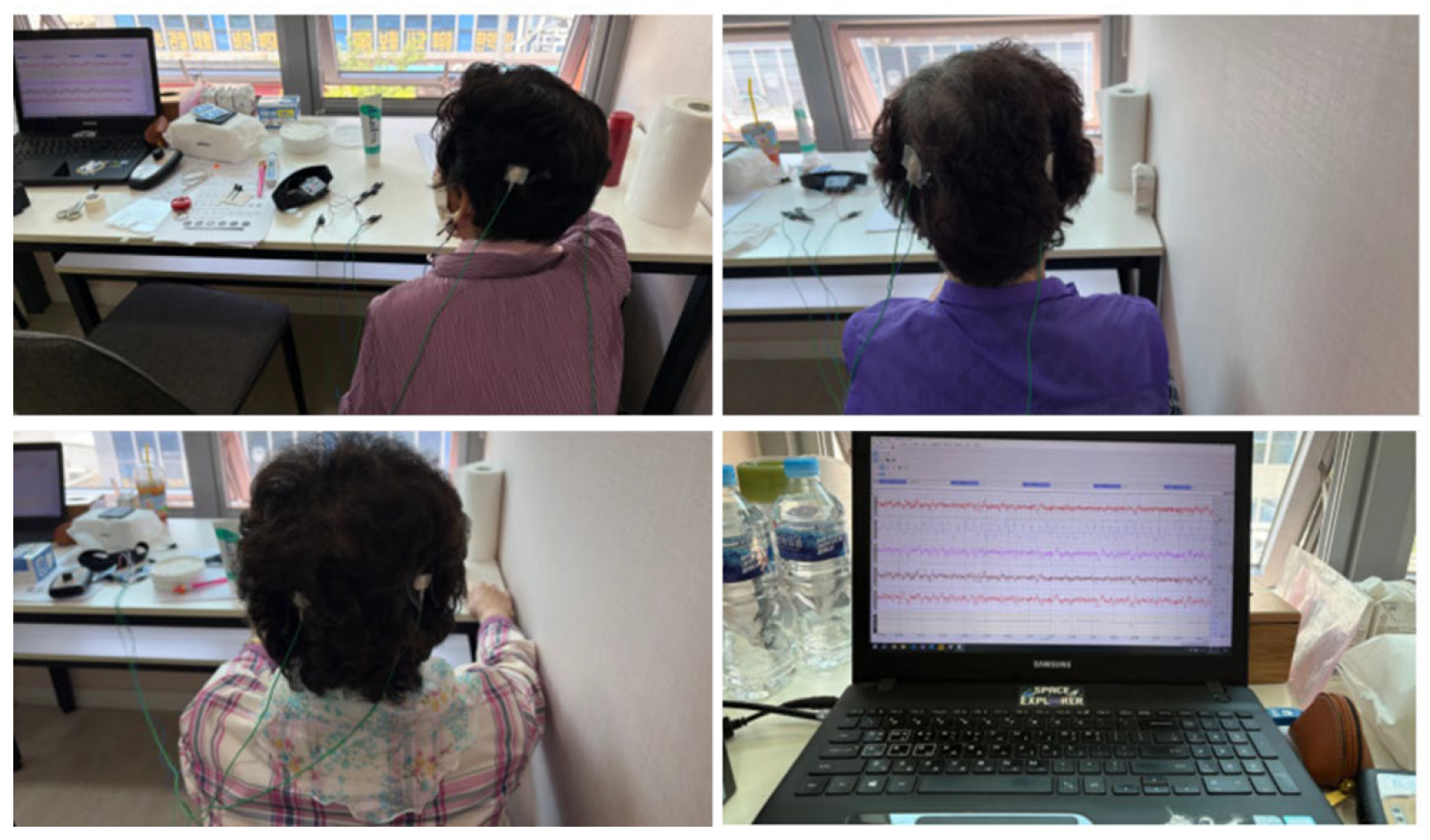
The experimental setup for seated EEG acquisition and real-time signal monitoring is shown in
Figure 1.
3.2. Life Story Program Protocol
The Life Story Program consisted of three consecutive daily sessions, each lasting approximately 45–50 min. During these sessions, participants engaged in a structured reminiscence-based program focused on personal life experiences. The present manuscript analyzes biosignal data obtained during the pre-assessment and post-assessment sessions conducted before and after the LSP sequence, rather than during the reminiscence sessions themselves.
During each EEG assessment, participants were seated comfortably in a controlled environment and instructed to remain quiet with their eyes closed. After sensor placement and signal verification, an initial 3–5 min stabilization period was recorded but excluded from analysis. The subsequent 10 min of EEG data were analyzed. Only non-speaking segments were used for EEG analysis. No explicit autobiographical recall task was administered during the EEG segments analyzed. Accordingly, the present design should be understood as a pre-post biosignal assessment conducted around the LSP, not as an EEG recording of autobiographical memory retrieval itself.
The pre- and post-assessment biosignal acquisition workflow is shown in
Figure 2.
3.3. Instruments and Signal Processing
3.3.1. EEG Acquisition and Signal Processing
EEG data were acquired using the MP160 system (BIOPAC Systems, Inc., Goleta, CA, USA) equipped with the BN-EEG2-TN module and recorded through AcqKnowledge 5.0 at a sampling rate of 500 Hz. EEG activity was recorded from two temporal scalp channels, T5 and T6, using A1 as the reference electrode. A separate ground electrode was not used. Before each recording, electrode impedance was checked using an impedance checker and maintained within approximately 5–10 kΩ, and electrode contact was adjusted as needed to ensure stable signal acquisition. During acquisition, a 60 Hz comb band-stop filter was applied in AcqKnowledge to the T5 and T6 channels through the EEG2-R module to attenuate power-line interference at the time of signal collection. T5 and T6 were selected a priori to capture temporal scalp activity in a region broadly relevant to autobiographical memory and affective processing in prior literature, while acknowledging that this two-channel scalp configuration, together with the absence of a separate ground electrode, does not permit strong spatial inference and is more vulnerable to recording noise and non-neural contamination than a conventional multichannel EEG setup [
8,
9,
26]. No additional offline re-referencing was applied during EEG preprocessing.
The acquired signals were then processed offline in MATLAB R2022a (9.12.0.2910573, Update 9). Signals were linearly detrended, band-pass filtered from 0.5 to 50 Hz using a fourth-order Butterworth filter, and subsequently used for spectral analysis. The 60 Hz notch filtering step was retained as a conservative acquisition-stage measure to suppress potential mains interference before offline preprocessing and spectral estimation [
8,
9].
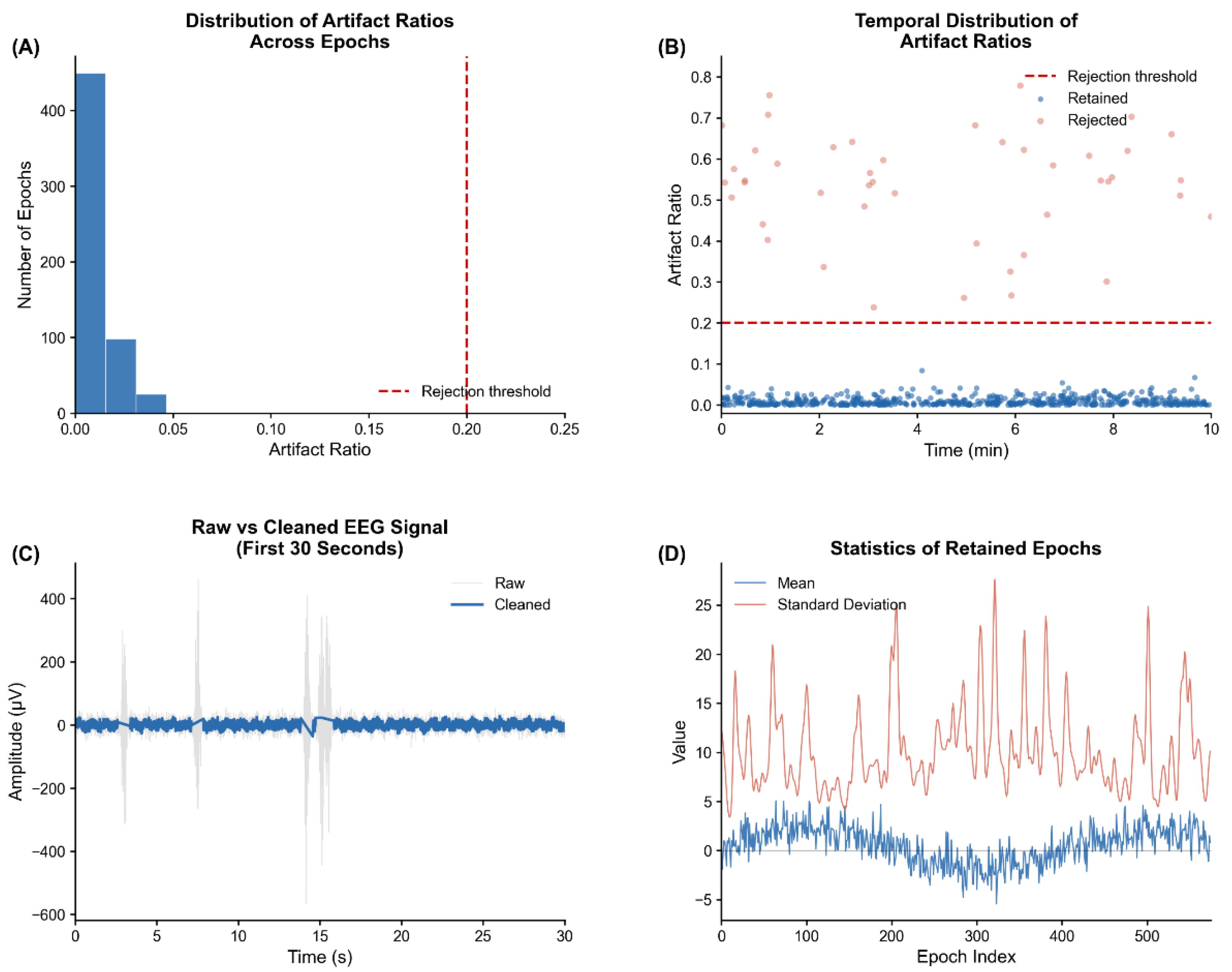
Artifact rejection was performed using an amplitude threshold of ±100 μV and a gradient threshold of 50 μV/sample. These criteria were implemented in the preprocessing pipeline with a 10% tolerance. After exclusion of Subject 03 based on outlier screening, the retained analytic dataset comprised 16 channel-condition recordings (4 participants × 2 channels × 2 assessments), and the mean epoch rejection rate across these retained recordings was 1.5%.
Power spectral density (PSD) was estimated using Welch’s periodogram with a Hamming window [
27]. Canonical frequency bands were defined a priori as delta (1–4 Hz), theta (4–8 Hz), alpha (8–13 Hz), beta (13–30 Hz), and gamma (30–50 Hz). These conventional band boundaries were used to facilitate comparison with prior spectral EEG studies and with recent EEG state-decoding studies that adopted the same standard band structure [
28]. Absolute power was calculated for each band and log-transformed to decibel (dB) units for statistical analysis.
3.3.2. Psychological State Questionnaire
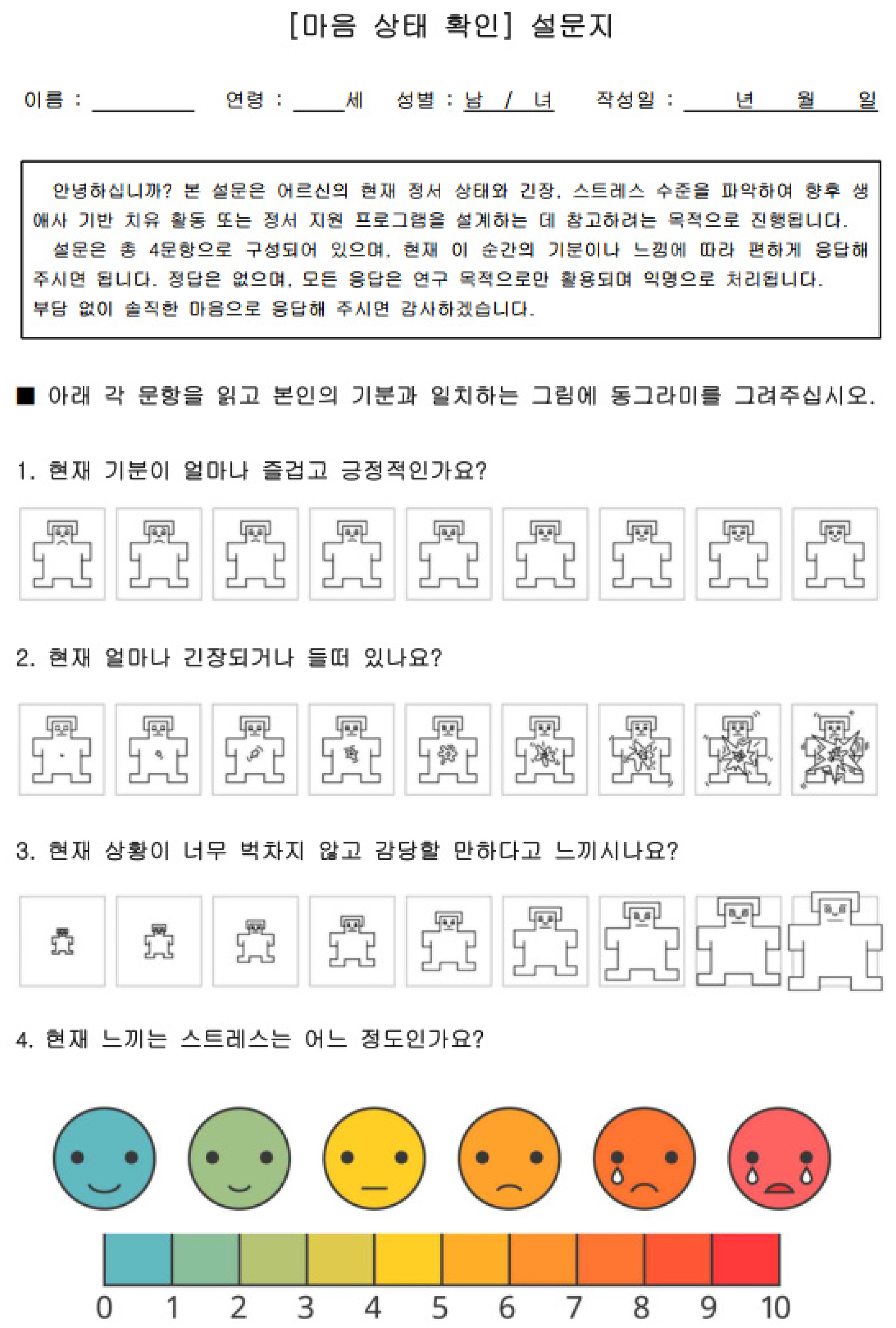
A brief four-item Korean questionnaire was administered to assess the current psychological state. The four items asked participants: (1) how pleasant and positive they felt at the moment; (2) how tense or excited they felt; (3) whether they felt that the current situation was manageable; and (4) how much stress they were currently experiencing.
Items 1–3 were rated on a 1–9 visual scale, and Item 4 was rated on a 0–10 distress thermometer. Higher scores indicated greater positive affect for Item 1, greater tension or arousal for Item 2, greater perceived manageability for Item 3, and greater perceived stress for Item 4. The questionnaire was used as a brief study-specific state measure and was interpreted descriptively rather than as a validated standalone scale of emotional stability.
The study-specific four-item psychological state questionnaire used in the pre- and post-assessments is shown in
Figure 3.
3.3.3. EEG Preprocessing
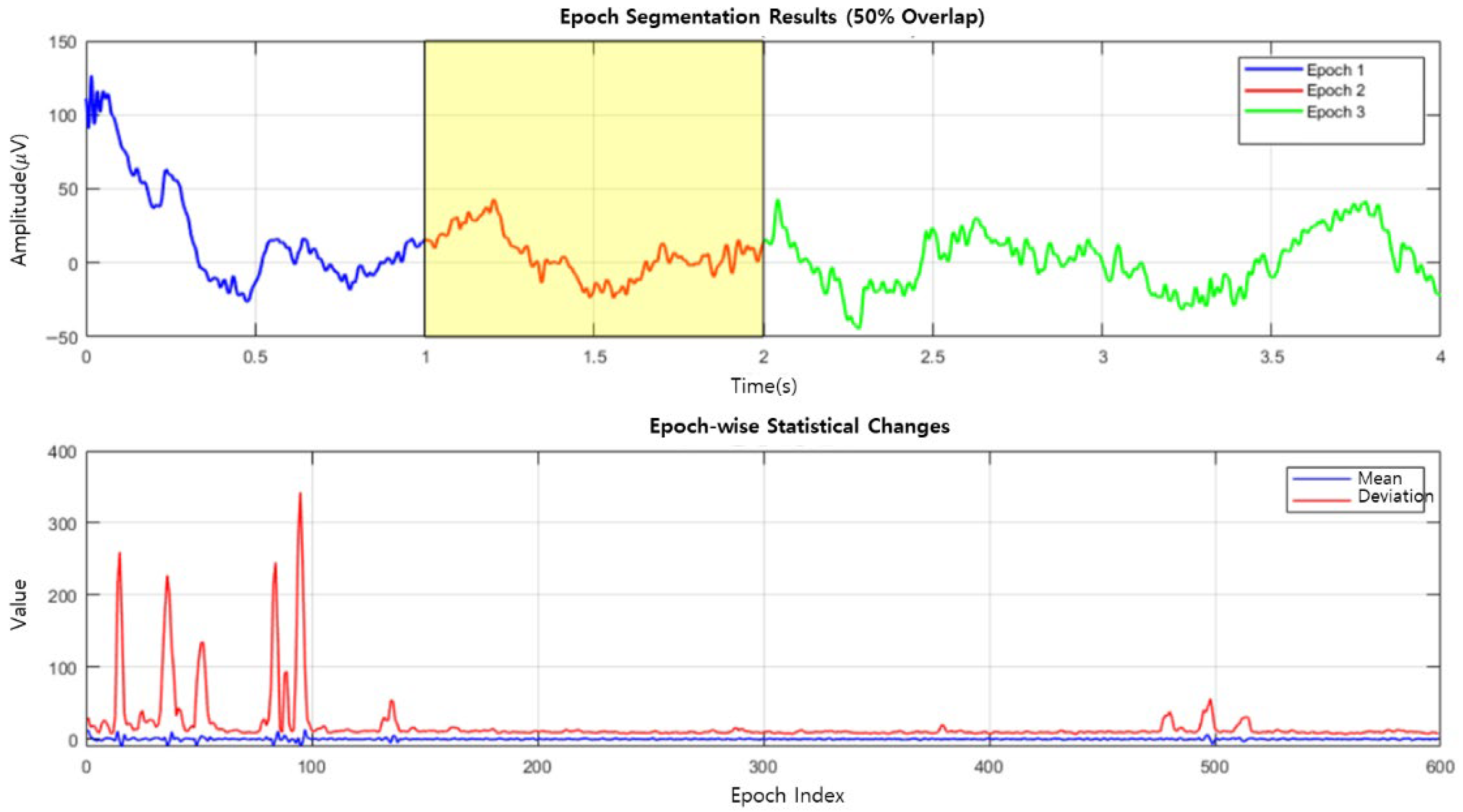
For spectral analysis, the continuous EEG data were segmented into 2-s epochs with 50% overlap. This epoch length enabled stable estimation of both low- and high-frequency components while preserving temporal continuity throughout the analyzed recording. The 50% overlap produced a 1-s step size between successive epochs and was used to reduce spectral variance and improve the stability of the estimates. This setting provided a practical balance between frequency resolution, spectral stability, and temporal continuity for short-window absolute-power estimation across the analyzed delta-to-gamma range [
8,
27].
Epoch-wise signal quality was then evaluated using the artifact rejection criteria described above. The retained epochs were used for PSD estimation and for calculating band-specific absolute power.
Figure 4 illustrates the epoching procedure, and
Figure 5 summarizes the artifact detection and cleaned-signal overview.
3.3.4. Outlier Detection
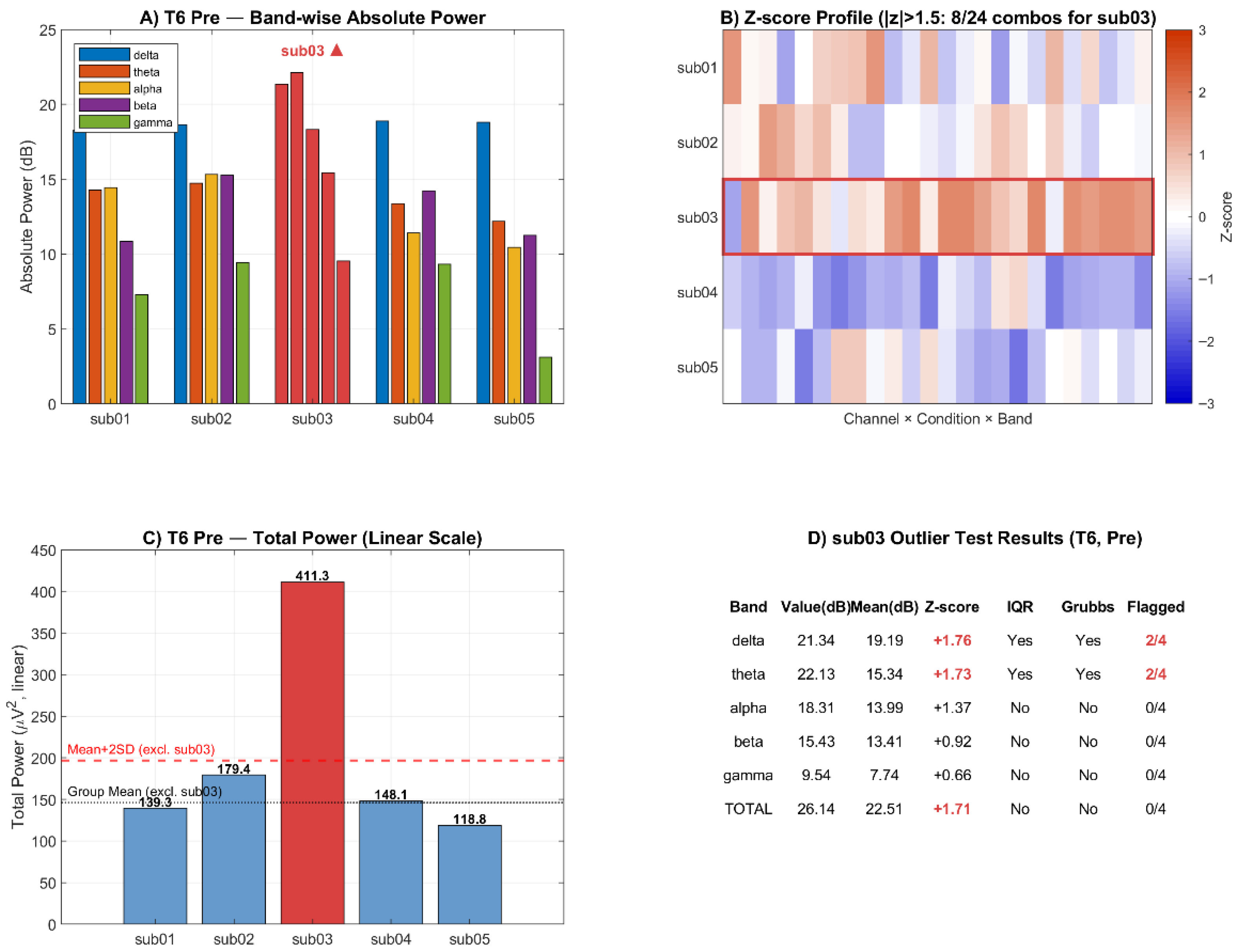
Absolute band power values were screened across all recruited participants (N = 5) using four complementary methods applied directly to band-specific absolute power values derived from the original .mat files: Tukey’s interquartile range (IQR) rule (median ± 1.5 × IQR), mean ± 2 SD, mean ± 3 SD, and Grubbs’ test (two-tailed, α = 0.05).
Subject 03 was flagged as an outlier in the T6 pre-assessment for the delta band (21.34 dB; group mean = 19.19 dB; z = +1.76) and the theta band (22.13 dB; group mean = 15.34 dB; z = +1.73) by both the IQR and Grubbs criteria. No other participant was flagged by any method in any channel–condition–band combination. In linear units, the total T6 pre-assessment power of Subject 03 was 411.3 μV
2, which was 2.81 times the mean of the remaining four participants (146.4 μV
2). Subject 03 was therefore excluded from subsequent EEG analyses, yielding a final EEG sample of N = 4. The restriction of the outlier to the delta and theta bands in a single pre-assessment channel is more consistent with transient low-frequency contamination—such as slow drift related to electrode contact instability, local impedance fluctuation, movement-related artifact, or other nonstationary recording noise—than with a stable participant-level physiological characteristic. However, the exact cause cannot be determined retrospectively from the available data. Because exclusion of one participant materially affects summary estimates in a sample of this size, the exclusion itself should be regarded as an important limitation of the present study.
Figure 6 summarizes the evidence supporting this exclusion.
3.4. Statistical Analysis
For EEG, each participant contributed one pre-assessment value and one post-assessment value for each channel-band combination. Given the small final EEG sample (N = 4), paired pre-post comparisons were conducted using the Wilcoxon signed-rank test. Exact p-values were reported when available. To address multiple comparisons, the Benjamini-Hochberg false discovery rate (FDR) procedure was applied across the five frequency bands within each channel.
Cohen’s dz was retained as a supplementary standardized effect size and was calculated as the mean of the paired difference scores divided by the standard deviation of those difference scores. In the present manuscript, Wilcoxon statistics are treated as the primary inferential analysis, whereas Cohen’s dz is reported only as a descriptive standardized mean-change index. Because the present study included only four paired EEG observations, both p-values and effect sizes were interpreted cautiously and were not treated as confirmatory evidence of intervention efficacy.
Questionnaire responses were summarized descriptively using pre-assessment and post-assessment means and standard deviations.
4. Results
4.1. Psychological State Questionnaire Results
All five participants completed the psychological state questionnaire at both assessment points. As shown in
Table 1, positive affect and perceived manageability remained high across the two assessments, whereas tension/arousal and perceived stress remained low. Descriptively, pre-post mean scores changed from 8.2 ± 1.79 to 9.0 ± 0.00 for positive affect, from 2.4 ± 1.67 to 1.0 ± 0.00 for tension/arousal, from 8.2 ± 1.79 to 9.0 ± 0.00 for perceived manageability, and from 0.8 ± 1.10 to 0.4 ± 0.89 for perceived stress.
Because the questionnaire was a brief study-specific measure and the sample was small, these values are reported descriptively. They descriptively suggest generally stable, favorable self-reported psychological states from pre- to post-assessment, but by themselves do not establish a definitive effect of the intervention.
4.2. Pre-Post EEG Absolute Power Changes
The final EEG dataset comprised 4 participants and 16 processed channel-condition recordings (T5/T6 × pre/post). None of the Wilcoxon signed-rank tests reached statistical significance after FDR correction (
Table 2).
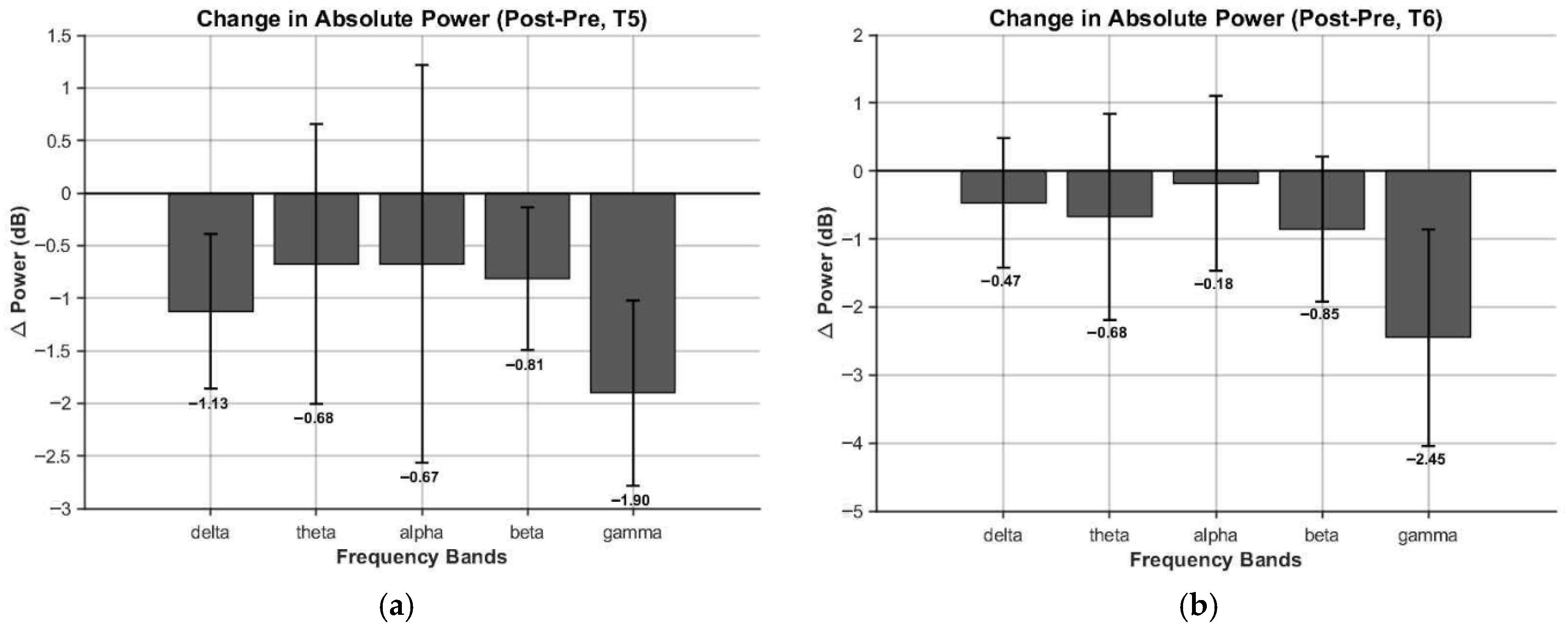
In the left temporal channel (T5), mean post-pre differences were negative across all five bands. The largest mean reduction was observed in the gamma band (mean difference = −2.539 dB), followed by beta (−1.292 dB), alpha (−0.936 dB), delta (−0.886 dB), and theta (−0.311 dB). Cohen’s dz values were likewise negative in all five T5 bands, with the largest magnitudes observed in gamma (dz = −1.542) and beta (dz = −1.282). However, these differences were not statistically significant under the Wilcoxon signed-rank test.
In the right temporal channel (T6), mean post-pre differences were negative in four of the five bands and slightly positive in the delta band. The largest mean reduction was observed in the gamma band (mean difference = −3.854 dB), followed by beta (−1.522 dB), alpha (−0.496 dB), and theta (−0.396 dB), whereas delta showed a small positive mean difference (+0.064 dB). Cohen’s dz values were negative in theta, alpha, beta, and gamma, with the largest magnitude observed in gamma (dz = −1.226). Again, none of the band-wise pre-post comparisons were statistically significant after FDR correction.
Taken together, the EEG results descriptively show directional pre-post differences in several bands, particularly the gamma band, but they do not establish a statistically reliable intervention effect in this sample. Accordingly, the effect sizes are reported as supplementary descriptive indices rather than confirmatory evidence.
The mean pre–post differences in EEG absolute power across frequency bands for T5 and T6 are shown in
Figure 7.
5. Discussion
This pilot study examined temporal scalp EEG absolute power and brief psychological state measures obtained before and after a Life Story Program in older adults. The analyzed EEG data were collected during controlled pre-assessment and post-assessment recordings in a seated, non-speaking condition. In this context, the present findings are more appropriately interpreted as pre-post physiological observations collected around participation in the program than as direct indices of autobiographical memory retrieval processes.
Within this limited design, the questionnaire results remained generally stable, and the EEG data showed directional reductions in several bands, with the largest mean decreases observed in the gamma band. However, none of the Wilcoxon signed-rank tests were statistically significant after multiple-comparison correction. Although some of Cohen’s dz values, particularly in the gamma band, were relatively large in magnitude, these values were derived from only four paired EEG observations. They should therefore be interpreted cautiously as descriptive standardized indices rather than as confirmatory evidence.
These observations nevertheless remain of interest. First, the questionnaire findings suggest that participants maintained favorable self-reported psychological states across the assessment period. Positive affect and perceived manageability remained high, whereas tension and perceived stress remained low. Because the questionnaire was brief and study-specific, these patterns should be treated as descriptive rather than definitive. Even so, they indicate that participation in the overall protocol did not appear to coincide with marked deterioration in self-reported psychological state.
The modest relationship between the questionnaire pattern and the EEG pattern in the present study should also be interpreted cautiously. In a small pilot design, self-reported psychological state and physiological measures need not change in parallel or with the same sensitivity. Brief subjective ratings may remain relatively stable even when subtle physiological variation is observed, particularly when both measures are collected around participation rather than during a common task. More broadly, structured psychosocial interventions can influence psychological outcomes, while physiological monitoring approaches in older or clinical populations have been explored across multiple biosignal modalities [
29,
30,
31]. For this reason, the present study should be viewed primarily as a feasibility-oriented multimodal observation rather than as evidence of a tightly coupled psychophysiological mechanism.
Second, the EEG findings show that mean post-assessment absolute power values tended to be lower than pre-assessment values across most frequency bands, particularly in the gamma band. In prior EEG literature, gamma-band activity has often been discussed in relation to attention, cognitive effort, and arousal [
16,
17,
18,
19]. However, the current design does not permit a strong mechanistic interpretation. Given the recording condition and the small uncontrolled design, the present data provide only a limited basis for inferring changes in autobiographical recall-related processing or neural efficiency.
More broadly, recent neurophysiological studies across EEG- and fNIRS-based paradigms have shown that physiological markers can be sensitive to attentional allocation, cognitive demand, and functional status, but that their interpretation remains strongly dependent on task structure, recording modality, and population characteristics [
32,
33,
34]. In this regard, the present findings should be viewed cautiously as a small-sample physiological snapshot around participation in the program rather than as a direct marker of a specific cognitive mechanism.
Several design features further constrain interpretation. First, the study did not include a control or comparator condition. Accordingly, the observed pre-post differences cannot be attributed specifically to the LSP. They may also reflect repeated measurement, habituation to the recording environment, repeated sensor application, time-related effects, or nonspecific changes in arousal or relaxation. Second, the EEG montage was limited to two temporal scalp channels, and no separate ground electrode was used. This minimal configuration provided very low spatial resolution and may have been more susceptible to environmental noise, electrode-related instability, and other non-neural contamination than a conventional multichannel EEG setup [
8,
9,
26]. These constraints are especially relevant when interpreting band-specific changes, including high-frequency activity, because residual artifact cannot be ruled out as confidently in such a limited montage [
9,
26,
35]. Third, the psychological questionnaire was a brief study-specific state measure rather than a validated standalone scale. Fourth, one participant was excluded from the EEG analysis after systematic outlier screening, further reducing the already small sample size. The outlying values were restricted to the T6 pre-assessment delta and theta bands, which may be more consistent with transient low-frequency contamination than with a stable participant-level physiological characteristic. Plausible sources include slow drift related to electrode contact instability, local impedance fluctuation, movement-related artifact, or other nonstationary recording noise, but the exact cause cannot be determined retrospectively from the available data. In a dataset of this size, exclusion of a single participant can materially influence summary estimates and should therefore be regarded as an important limitation. Finally, future studies with larger datasets may benefit from more advanced multichannel or attention-based modeling approaches capable of capturing richer spatiotemporal structure in EEG signals [
11,
36]. However, such methods differ substantially from the present two-channel pre-post spectral design and were beyond the scope of this pilot study.
Despite these limitations, the study contributes in two practical ways. It provides a preliminary illustration of how a brief psychological state assessment can be combined with temporal EEG acquisition before and after a reminiscence-based program in very old adults. It also provides a transparent example of how small-sample biosignal data can be reported conservatively, with explicit outlier handling and without overstating mechanism or efficacy. Future studies should use larger samples, predefined preprocessing and outlier rules, clearer multimodal reporting, and a control or comparator condition to determine whether the observed pre-post patterns are reproducible and intervention-specific.
6. Conclusions
This pilot study examined temporal scalp EEG absolute power and brief psychological state measures before and after a Life Story Program in older adults. No statistically significant pre-post EEG differences were observed after false discovery rate correction, although several bands, particularly gamma, showed negative mean differences and negative Cohen’s dz values. Questionnaire responses also remained generally stable across the two assessments.
These findings are best interpreted as preliminary pre-post biosignal observations collected in the context of LSP participation. They should not be taken as definitive evidence of task-specific neural efficiency or autobiographical retrieval-related neural change. Larger controlled studies with clearer task control, broader physiological monitoring, and predefined analytic procedures are needed to determine whether these patterns are reliable, intervention-specific, and clinically meaningful.