1. Introduction
Seasonal snowpacks in continental climates evolve through tightly coupled thermodynamic and mass-balance processes that govern the relationship between snow depth (SD) and snow water equivalent (SWE) [
1,
2]. In snow-dominated environments, meltwater availability is primarily determined by the seasonal accumulation of SWE, which integrates precipitation input, temperature variability, and surface energy exchange throughout the cold season [
3,
4,
5]. Because snow accumulation and ablation frequently occur near the melting-point threshold, relatively small variations in meteorological forcing can significantly influence snowpack evolution and seasonal persistence [
6,
7]. This sensitivity highlights the role of continental snowpacks as a key component of the terrestrial water cycle and as an indicator of climatic variability [
8,
9].
Despite their hydrological importance, direct SWE measurements remain sparse due to logistical and operational constraints [
10,
11]. Snow depth observations, by contrast, are widespread and operationally accessible. Consequently, bulk-density relationships are commonly employed to infer SWE from snow depth in hydrological, meteorological, and remote sensing applications [
12,
13,
14,
15]. The accuracy of such approaches depends critically on the behaviour of the underlying depth–mass coupling [
8,
16,
17]. Snow density evolves dynamically through compaction, metamorphism, melt–freeze cycles, and mechanical loading [
18,
19]. These processes introduce temporal and climatic variability into SD–SWE relationships, particularly in continental regions characterised by strong thermal gradients and heterogeneous snowfall regimes [
14,
20,
21]. Although empirical density climatologies are widely used, their transferability across climatic regimes and perturbation conditions is not well constrained [
10,
22].
From a physical perspective, the SD–SWE relationship is controlled by processes that control snow-density evolution. Mechanical compaction driven by overburden pressure increases bulk snow density and can modify the proportionality between snow depth and snow water equivalent [
23]. Temperature variations influence melt–freeze cycles and metamorphism, redistributing liquid water and altering internal density structure [
24]. Precipitation affects snowpack mass loading, thereby enhancing compaction rates and potentially leading to systematic changes in the SD–SWE scaling coefficient. These mechanisms indicate that SD–SWE coupling reflects dynamic physical processes rather than a purely empirical relationship.
Alternative approaches to SWE estimation include remote sensing techniques and physically based snowpack modelling. Passive microwave retrievals and lidar-based methods provide valuable large-scale constraints but often exhibit considerable uncertainties over complex terrain and heterogeneous snow conditions [
25,
26]. Process-resolving snow models such as SNTHERM, Crocus, and SNOWPACK simulate coupled energy and mass-balance processes and provide physically consistent estimates of snow stratigraphy, density evolution, and SWE [
27,
28,
29].
The theoretical foundation of physically based snow modelling is rooted in earlier studies describing snow stratigraphy and metamorphism processes, which govern snowpack evolution and thermodynamic behaviour [
24], as well as in energy and mass-balance formulations that underpin process-based snow models [
30]. In particular, the SNTHERM model, originally developed by Jordan [
31], represents a physically based, one-dimensional framework that resolves heat and mass transfer within layered snowpacks. Subsequent studies have demonstrated its capability to simulate snow depth, grain size, and brightness temperature with reasonable accuracy under various climatic conditions [
32]. Previous work has demonstrated the applicability of the SNTHERM model for snowpack simulation in eastern Kazakhstan under ERA5-Land meteorological forcing, with good agreement for seasonal snow depth dynamics, although SWE may be affected by precipitation bias in reanalysis data [
33]. At the same time, such models require detailed meteorological forcing and remain sensitive to uncertainties in atmospheric inputs, which may limit their applicability in data-sparse continental regions [
34].
Although substantial progress has been made in SWE estimation, many studies implicitly assume that the functional form of the SD–SWE relationship remains unchanged under climatic variability. In practice, temperature and precipitation are often considered to influence snow accumulation and seasonal timing rather than the underlying mapping between snow depth and snow mass. Evolving snow density driven by compaction, metamorphism, melt–freeze cycles, and mechanical loading may introduce adjustments to SD–SWE coupling that are not captured by static conversion approaches [
14,
35]. Changes in temperature regimes and precipitation patterns can alter densification rates, liquid-water retention, and melt frequency, potentially modifying the effective depth–mass relationship itself [
36]. Evaluating these adjustments within realistic perturbation ranges therefore requires a process-resolving modelling framework capable of separating thermodynamic and accumulation effects [
17,
37,
38].
Physically based snow models provide a physically consistent framework for investigating the behaviour of SD–SWE coupling. Process-resolving models such as SNTHERM explicitly simulate the coupled energy and mass balance of the snowpack and represent internal processes such as densification, metamorphism, meltwater percolation, and refreezing [
27,
39]. When driven by realistic meteorological forcing, these models enable controlled numerical experiments in which temperature and precipitation can be perturbed independently. Such experiments allow not only evaluation of sensitivity in individual snow variables but also examination of structural relationships between them [
40,
41].
Cold continental regions of Central Asia provide a valuable natural laboratory for examining snowpack behaviour under strong seasonal temperature gradients and variable precipitation regimes [
42,
43]. Eastern Kazakhstan is characterised by long, cold winters, large intra-seasonal thermal variability, and heterogeneous snowfall patterns that strongly control snow accumulation and melt dynamics [
44,
45,
46]. Regional water resources depend heavily on seasonal snowmelt, while direct SWE observations remain extremely limited [
44,
47]. As a result, operational monitoring relies largely on snow depth measurements, highlighting the importance of understanding SD–SWE coupling for regional hydrological applications. Despite this importance, snowpack evolution and the performance of process-resolving snow models have not been systematically evaluated for northeastern Kazakhstan [
48,
49]. Understanding how the SD–SWE relationship responds to climatic perturbations is therefore essential for evaluating depth-based SWE estimation approaches in a changing climate.
In addition to physically based modelling approaches, recent studies have explored statistical and machine-learning methods to improve snow model performance [
50,
51]. Hybrid approaches combining physically based models with machine learning can improve agreement with observations across large spatial domains [
52]. However, such improvements may partly reflect temporal persistence in residual errors rather than enhanced physical representation of snow processes [
53,
54]. Without explicit analysis of residual structure, statistical postprocessing may compensate for forcing uncertainty and observational noise rather than improve physical consistency [
55,
56,
57]. In this study, machine-learning methods are used only for bias correction and do not influence the structural analysis of the SD–SWE relationship.
Although empirical SD–SWE relationships are well documented [
18], relatively few studies have examined how this relationship behaves under controlled climatic perturbations. Previous work has demonstrated that SNTHERM can reproduce seasonal snow depth and snow water equivalent dynamics in northeastern Kazakhstan when driven by ERA5-Land meteorological forcing [
33]. However, the extent to which the SD–SWE relationship maintains its structural form under controlled thermodynamics and accumulation perturbations remains insufficiently understood.
Most previous studies have examined the SD-SWE relationship primarily as an empirical conversion for estimating snow water equivalent from snow depth observations. In contrast, relatively limited attention has been paid to the behaviour of this relationship within physically based snowpack models under controlled perturbations in temperature and precipitation.
This study makes several contributions to the existing literature. First, it isolates the effects of thermodynamic forcing (temperature) and accumulation forcing (precipitation) on snowpack evolution within a controlled experimental framework. Second, it examines the SD–SWE relationship within a physically based snow model rather than relying on empirical regression approaches. Third, it evaluates the structural behaviour of the SD–SWE relationship under perturbations, focusing on its stability rather than solely on predictive accuracy. To achieve this, a process-based perspective is adopted to examine how proportional depth–mass scaling responds to controlled perturbations in temperature and precipitation within a physically consistent modelling framework.
The aim of this study is to investigate the sensitivity of the SD–SWE relationship to climatic perturbations and assess whether its approximately linear form is preserved under moderate changes in thermodynamics and accumulation. The central research question is whether the SD–SWE relationship remains approximately linear under controlled perturbations in thermodynamic and accumulation.
To address this aim, three objectives are defined. First, we evaluate the SNTHERM model’s ability to reproduce observed snow depth and snow water equivalent dynamics in northeastern Kazakhstan. Second, we quantify the sensitivity of snowpack evolution to controlled thermodynamic (air temperature) and mass-balance (precipitation) perturbations using a delta-change experimental framework. Third, we assess how these perturbations influence the SD–SWE relationship using regression diagnostics and analysis of covariance (ANCOVA).
2. Materials and Methods
2.1. Study Area
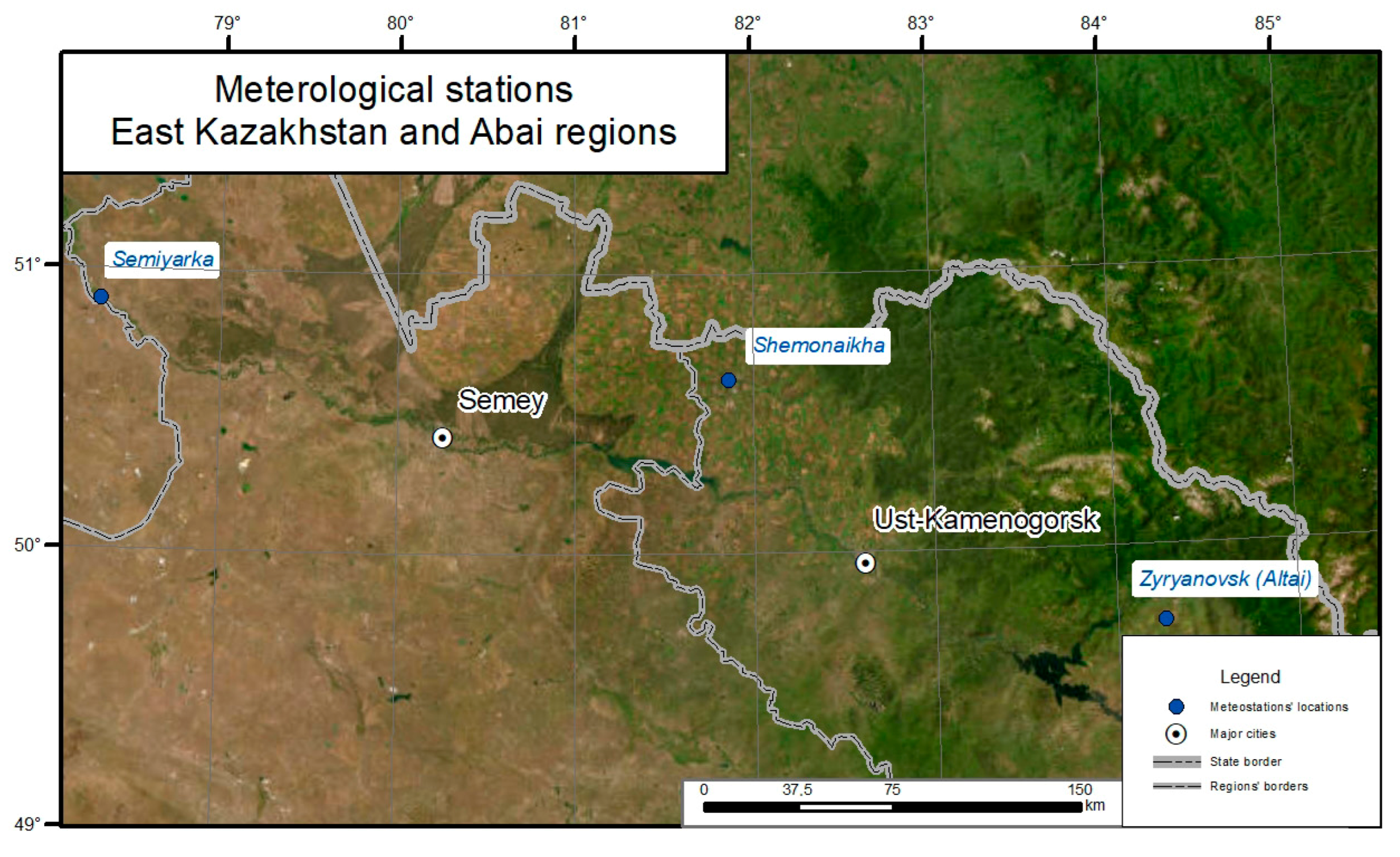
This study focuses on three weather stations in East Kazakhstan—Shemonaikha (SHE), Semiyarka (SEM), and Zyryanovsk (ZYR)—selected to represent a transect from dry open steppe to wetter foothill–montane environments. The stations capture pronounced gradients in elevation, wind exposure, and snow accumulation characteristics typical of continental Eurasian winter climates (
Table 1,
Figure 1).
Site selection was guided by three considerations. First, the stations span distinct terrain settings that shape local snow processes. Semiyarka (148 m) is situated in a low-relief steppe environment where strong winds and sparse vegetation enhance snow redistribution and sublimation losses. Shemonaikha (297 m) lies within a foothill forest–steppe transition zone that provides greater shelter and supports more stable seasonal snow cover. Zyryanovsk (471 m) is situated in a foothill–montane setting influenced by orographic uplift, resulting in deeper, more persistent snowpacks.
Second, the sites are subject to different meteorological controls. Semiyarka frequently experiences advective cold-air outbreaks and wind-driven sublimation; Shemonaikha is influenced by local terrain sheltering; and Zyryanovsk receives a larger fraction of solid precipitation and cooler conditions due to orographic enhancement. These contrasts provide a natural framework for evaluating model behaviour across distinct accumulation, compaction, and melt regimes.
Third, all three stations are operated by Kazhydromet and provide consistent, quality-controlled winter observations of SD and SWE in accordance with standardised WMO protocols. The availability of complete observational records for the 2022–2023 winter season enables a season-specific evaluation of SNTHERM performance and supports the sensitivity experiments conducted in this study.
Together, the three stations form a representative environmental gradient from dry steppe to montane conditions, offering a physically meaningful basis for assessing snowpack dynamics and for analysing how small perturbations in temperature and precipitation propagate through snow mass, density evolution, and melt phenology under continental winter climates.
2.2. Snowpack Model and Governing Equations
Snowpack evolution was simulated using the physically based one-dimensional mass- and energy-balance model SNTHERM (U.S. Army Cold Regions Research and Engineering Laboratory (CRREL), Hanover, NH, USA) [
27,
39]. SNTHERM explicitly resolves the coupled processes of surface energy exchange, internal heat transfer, phase change, liquid-water percolation, snow densification, and melt–refreeze transformation within a vertically discretised snowpack [
40]. Owing to its physically based formulation, the model has been widely applied across a range of cold and temperate climates for simulating SD, SWE, internal temperature profiles, and melt dynamics [
41].
The snowpack is represented as a one-dimensional column composed of layers of variable thickness . For each layer , the prognostic state variables include temperature , bulk density , liquid-water content , and layer thickness . New layers are added at the surface when solid precipitation is diagnosed, while melt, refreezing, compaction, and metamorphism dynamically modify the internal stratigraphy. Vertical heat transfer within the pack is governed by temperature-driven diffusion, while liquid-water transport is simulated via gravity-driven percolation subject to retention and refreezing constraints.
Snow densification is modelled as the combined effect of overburden pressure, destructive metamorphism, and melt–refreeze transformation. The evolving internal density structure controls the conversion between geometric snow depth and total water storage and exerts a primary influence on melt and runoff generation.
Meteorological forcing is prescribed at the upper boundary using near-surface air temperature, total precipitation, wind speed, relative humidity, surface pressure, and incoming shortwave and longwave radiation. The model internally partitions precipitation into solid and liquid components as a function of air temperature. At the lower boundary, thermal exchange with the underlying soil is represented through conductive heat fluxes driven by the soil temperature profile. The one-dimensional formulation neglects lateral redistribution by wind and topography but provides a physically consistent framework for isolating vertical mass and energy exchange and for conducting controlled sensitivity experiments.
Within the snowpack domain
, temperature evolution is governed by the one-dimensional heat diffusion Equation (1) with phase change:
where
is the density of liquid water,
is bulk snow density,
is the specific heat capacity of snow,
is the thermal conductivity,
is temperature,
is volumetric liquid-water content,
is the latent heat of fusion, and
is time. The latent heat term couples internal temperature evolution to melt and refreezing processes and ensures thermodynamic consistency.
Liquid water generated by melt percolates vertically under gravity. Its downward flux is controlled by hydraulic conductivity and irreducible water content thresholds, allowing for both refreezing in colder layers and drainage toward the snow–soil interface. The governing equations are closed by prescribing boundary conditions at the upper (snow–atmosphere) and lower (snow–soil) interfaces.
At the snow surface
, the surface temperature
is determined from the full surface energy balance (Equation (2)):
where
and
denote the net shortwave and longwave radiation fluxes,
and
are the turbulent sensible and latent heat fluxes, and
represents energy advected by rainfall. All fluxes are defined positive toward the snowpack.
The surface temperature is constrained by Equation (3):
where
is the melting temperature. When
and
, the surplus energy is consumed by phase change and converted into surface melt at a rate (Equation (4)):
The melt rate
computed from Equation (4) directly modifies the geometric structure of the snowpack. The mass of melted ice is removed from the uppermost snow layer, leading to a proportional decrease in its thickness
. At each model time step, the thickness of individual layers is updated according to the local mass balance (Equation (5)):
where
is the mass change per unit area due to melt or refreezing in layer
i and
is its bulk density. Layers thinner than a prescribed minimum threshold are merged with adjacent layers to ensure numerical stability. Liquid water produced at the surface may percolate downward and refreeze in colder layers, further altering layer mass and thickness. The total snow depth is calculated using Equation (6):
and therefore evolves dynamically as a result of accumulation, compaction, refreezing and melt processes.
Total precipitation
is partitioned into snowfall
and rainfall
using an air temperature threshold formulation as Equation (7):
where
is near-surface air temperature and
is the rain–snow transition threshold. Snowfall contributes directly to mass accumulation, while rainfall contributes both mass and thermal energy via Equation (2).
At the snow–soil interface
, thermal exchange is governed by conductive heat transfer (Equation (8)):
where
and
are the thermal conductivity of snow and soil respectively, and
is soil temperature. The soil temperature profile is prescribed from observations or initialised under snow-free conditions and evolved independently.
Liquid water reaching the lower boundary drains into the soil column subject to retention and refreezing constraints in the lowest snow layer. The lower water-flux boundary condition is expressed as Equation (9):
where
represents the outflow of liquid water from the snowpack to the soil.
The governing equations are discretised vertically over the evolving snow layers and integrated forward in time using an explicit finite-difference scheme with adaptive layer thickness. Mass and energy conservation are enforced at each time step. The one-dimensional formulation does not explicitly represent horizontal snow redistribution caused by wind transport or terrain heterogeneity. However, it provides a physically consistent framework for resolving vertical energy and mass-balance processes that govern snow accumulation, metamorphism, and melting. This modelling framework is therefore appropriate for the present study, which focuses on isolating process-level sensitivities of snow depth (SD), snow water equivalent (SWE), and their structural coupling under controlled perturbations in temperature and precipitation.
The SNTHERM model was initialised using standard parameter settings recommended in the model documentation for seasonal snowpack simulations. Soil temperature and moisture conditions were prescribed using default soil-layer parameters, while snow layers evolved dynamically according to snowfall events derived from ERA5-Land forcing. Surface albedo evolves dynamically within the model as a function of snow age, temperature, and metamorphic state. The SNTHERM configuration used in this study follows the modelling framework previously developed and validated for the Shemonaikha region [
33], where ERA5-Land forcing was successfully applied to reconstruct seasonal snowpack evolution. No site-specific parameter calibration was applied in the present study, allowing model behaviour to reflect the physically based formulation of snow energy- and mass-balance processes.
2.3. Datasets for Physically Based Modelling
Meteorological forcing for SNTHERM was obtained from the ERA5-Land reanalysis produced by the European Centre for Medium-Range Weather Forecasts (ECMWF, Reading, UK) through the Copernicus Climate Change Service. ERA5-Land provides hourly near-surface meteorological fields at approximately 9 km horizontal resolution and is specifically designed to support land-surface and hydrological modelling by improving surface energy and water-balance consistency relative to coarser global reanalyses. For each station (SHE, SEM, ZYR), meteorological variables were extracted from the nearest ERA5-Land grid cell for the period 1 November 2022 to 30 April 2023, spanning the complete accumulation and melt season. This forcing provides the meteorological variables required to drive the SNTHERM mass- and energy-balance equations.
Although ERA5-Land provides physically consistent forcing fields, uncertainties in precipitation and radiative fluxes may affect snowpack simulations in cold continental environments. In particular, snowfall can be underestimated due to gauge undercatch and uncertainties in precipitation phase partitioning. In this study, ERA5-Land precipitation was used without explicit bias correction in order to preserve internal consistency of the forcing dataset. Because the analysis focuses on relative responses to controlled perturbations rather than absolute snowpack magnitude, these uncertainties are not expected to substantially affect the interpretation of SD–SWE structural relationships. Nevertheless, they should be considered when interpreting absolute SWE values.
The variables used to force SNTHERM include near-surface air temperature, total precipitation, wind speed, relative humidity, surface pressure, and downwelling shortwave and longwave radiation (
Table 2). Preprocessing steps included unit conversion, transformation of cumulative precipitation into hourly increments, and alignment of timestamps to local standard time (UTC + 6). These procedures ensured temporal consistency and compatibility with the SNTHERM mass- and energy-balance formulation. All forcing data and preprocessing steps were applied consistently across baseline and perturbation experiments to ensure that differences among simulations arise exclusively from imposed temperature and precipitation modifications.
Model evaluation relies on snow depth (SD) and snow water equivalent (SWE) observations obtained from Kazhydromet (National Hydrometeorological Service of Kazakhstan, Kazakhstan), the national hydrometeorological service of Kazakhstan [
58]. Observational records were visually inspected and statistically screened for quality control, converted to SI units, and temporally aligned with model outputs. Only dates with concurrent observations and simulations were retained for validation. The combination of reanalysis forcing and in situ observations provides a consistent basis for evaluating SNTHERM performance across continental snow conditions. A summary of the datasets used in the study is provided in
Table 3.
2.4. Experimental Design
To investigate how climatic forcing influences the internal structure and depth–mass coupling of continental snowpacks, a regime-specific perturbation framework was implemented using the physically based SNTHERM model. The experimental design combines baseline simulations with controlled sensitivity experiments to isolate the effects of thermodynamic and mass-balance forcing on snowpack evolution. Baseline simulations were conducted for three representative snow regimes in northeastern Kazakhstan (SHE, SEM, and ZYR) using unmodified ERA5-Land forcing for the 2022–2023 winter season. All simulations were initialised under snow-free conditions on 1 November 2022 with identical soil temperature and moisture profiles, allowing snowpack development to evolve dynamically from the first snowfall. This consistent initialisation ensures that differences among experiments arise exclusively from atmospheric forcing perturbations rather than from initial-condition effects.
The perturbation experiments were limited to temperature and precipitation, as these variables represent the primary thermodynamic and mass-balance controls governing snowpack evolution. Temperature regulates melt–freeze processes and snow metamorphism through the surface energy balance, whereas precipitation determines the accumulation of snow mass. Other meteorological variables (e.g., wind speed, humidity, and radiation) were kept unchanged to preserve internal consistency of the energy-balance formulation. The framework therefore focuses on the dominant drivers directly influencing the SD–SWE relationship.
To evaluate structural responses under controlled forcing, a delta-change methodology was applied. Selected meteorological variables were systematically perturbed while preserving the temporal variability and sequencing of the baseline forcing. Perturbations are interpreted as diagnostic adjustments rather than climate projections, enabling first-order thermodynamic and mass-balance sensitivities to be examined within a physically consistent modelling framework.
The experiments include baseline simulations, precipitation perturbations of ±5%, temperature perturbations of ±1 °C, and stress-test experiments combining ±10% precipitation scaling with ±2 °C air temperature shifts (
Table 4). These perturbations were applied independently to isolate thermodynamic and accumulation effects while maintaining internally consistent snowpack physics.
Total precipitation was uniformly scaled by ±5% relative to the baseline forcing. These amplitudes were selected based on observed regional variability derived from the 2000–2023 Kazhydromet record, in which seasonal (November–April) precipitation anomalies commonly fall within this range. The ±5% experiments therefore represent moderate interannual variability rather than extreme forcing conditions. By modifying snowfall input while holding thermodynamic forcing constant, the precipitation experiments isolate the mass-controlled response of the snowpack. This configuration enables quantification of changes in peak SWE, seasonal water storage, overburden-driven compaction, and their influence on SD–SWE proportionality under incremental accumulation shifts.
Thermodynamic sensitivity was evaluated by applying uniform ±1 °C perturbations to hourly 2 m air temperature. This magnitude reflects typical seasonal anomaly amplitudes in the regional observational record and is sufficient to influence melt–freeze thresholds without altering the governing snow regime. In these experiments, only air temperature was modified, while precipitation, wind, humidity, and radiative fluxes were held constant. Temperature and precipitation perturbations were applied in separate simulations to isolate thermodynamic and accumulation-driven responses. Although air temperature and longwave radiation are physically coupled, their decoupling within the modelling framework enables isolation of the direct energetic influence of temperature on snow evolution.
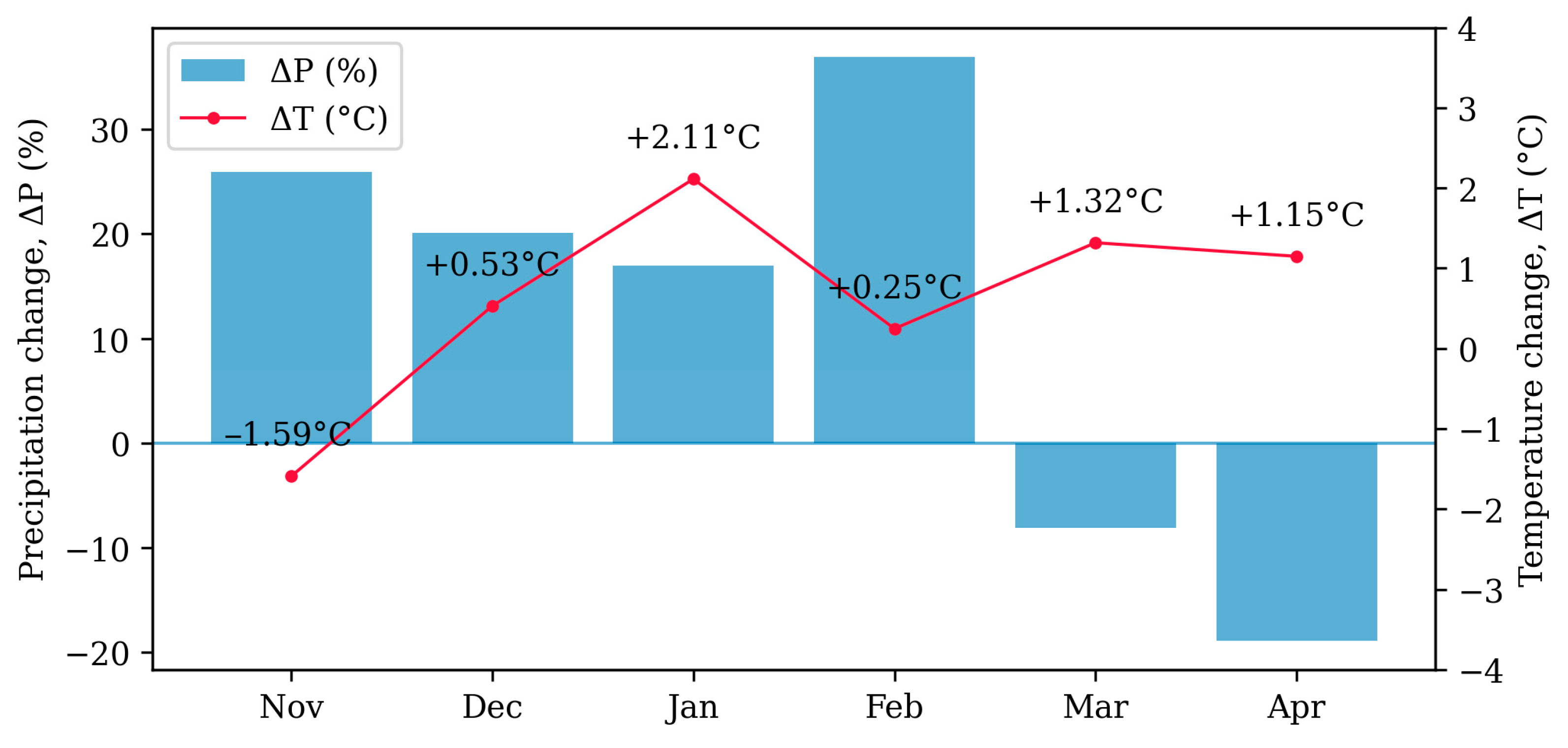
The selected perturbation magnitudes remain within a moderate-amplitude domain relative to observed variability. Seasonal anomaly envelopes derived from the 2000–2023 Kazhydromet record indicate that temperature anomalies typically range from −3 to +3 °C, while precipitation anomalies range between −30% and +30%. The ±1 °C and ±5% perturbations therefore represent realistic interannual fluctuations (
Figure 2,
Figures S1 and S2).
Sensitivity experiments were applied primarily to the Shemonaikha (SHE) station, where snowpack conditions are particularly responsive to temperature variability due to frequent proximity to the melting threshold. In contrast, deeper snowpacks at ZYR and wind-affected conditions at SEM exhibit stronger accumulation control or increased spatial heterogeneity, which can obscure direct thermodynamic signals. The perturbation experiments therefore focus on the regime where structural changes in SD–SWE coupling are most likely to occur, while the remaining stations serve as reference environments representing contrasting continental snow regimes.
Overall, the perturbation framework treats incremental and stress-test forcing adjustments as controlled probes of snowpack behaviour. By preserving the temporal structure of the baseline forcing, the experimental design provides a physically interpretable basis for evaluating how thermodynamic and accumulation changes influence snow depth, snow water equivalent, and their structural coupling within a process-based snow model.
2.5. Postprocessing and Bias Correction
The analytical framework of the study combines process-based snowpack simulation with statistical diagnostics of the SD–SWE relationship. Snowpack evolution was simulated using the physically based SNTHERM model, which resolves the coupled mass and energy balance of layered snowpacks.
The SD–SWE relationship was evaluated using regression analysis, analysis of covariance (ANCOVA), and residual diagnostics. This approach allows assessment of whether the proportional relationship between snow depth and snow water equivalent is modified when the simulated snowpack is subjected to controlled perturbations in temperature and precipitation.
To improve agreement between simulated and observed snow depth prior to statistical analysis, a postprocessing step was applied to SNTHERM outputs. A CatBoost regression model was used for bias correction. CatBoost is a gradient boosting algorithm designed to capture nonlinear relationships between predictors.
The model was trained using SNTHERM-simulated variables together with meteorological predictors derived from ERA5-Land forcing data, while observed snow depth was used as the target variable. The purpose of this step is not to replace the physically based model, but to reduce systematic discrepancies arising from uncertainties in forcing data and model simplifications. The machine-learning model was applied exclusively for bias correction and does not influence the analysis of the SD–SWE structural relationship.
2.6. Model Evaluation Metrics
SNTHERM performance was evaluated against quality-controlled snow observations. Validation focused on snow depth (SD) and snow water equivalent (SWE), measured approximately every 10 days at the three study sites. Only dates with concurrent observations and model outputs were retained to ensure temporally consistent comparison. In the SNTHERM model, SD is defined as the sum of individual snow layer thicknesses, while SWE is calculated as the vertically integrated bulk water mass per unit surface area (Equation (10)):
where
is the density of liquid water,
is the bulk water density (ice + liquid) of layer
and
is its thickness at time
. Model outputs were sampled at the exact calendar dates of the observations.
Model skill was quantified using four standard metrics: mean absolute error (MAE), root mean square error (RMSE), coefficient of determination (
), and mean bias (Bias). These metrics jointly describe the magnitude error, dispersion of deviations, correlation strength, and systematic offset. They are defined as follows in Equations (11)–(14):
where
represents the observed value,
denotes the corresponding model simulation,
is the mean of the observations, and
is the number of paired observations–model samples. All metrics were computed separately for SD and SWE at each station. To facilitate comparison across sites with contrasting snow regimes and accumulation magnitudes, RMSE and Bias were also expressed in normalised form relative to the mean observed value. This evaluation framework provides a rigorous basis for assessing SNTHERM’s ability to reproduce observed snowpack dynamics and underpins the interpretation of subsequent sensitivity experiments.
Although the primary model validation focuses on the 2022–2023 winter season due to the availability of complete SWE observations, additional SNTHERM simulations were conducted for the winters 2021–2022, 2022–2023, and 2023–2024 to evaluate the robustness of model responses under different background climatic conditions. These additional simulations provide a qualitative assessment of interannual variability in snowpack sensitivity to temperature and precipitation perturbations. While a longer observational record would further strengthen statistical robustness, the multi-season perturbation analysis helps ensure that the reported thermodynamic and mass-balance responses are not specific to a single winter.
In addition to the standard performance metrics, the structural relationship between snow depth (SD) and snow water equivalent (SWE) was evaluated using an analysis of covariance (ANCOVA) framework. In this analysis, SWE was treated as the response variable, SD as a continuous covariate, and the perturbation scenario as a categorical factor. The interaction term between SD and the perturbation scenario (SD × Scenario) was used to test whether temperature or precipitation perturbations significantly modify the SD–SWE scaling relationship. Statistical significance was assessed at the 95% confidence level (p < 0.05).
3. Results
3.1. Baseline Validation
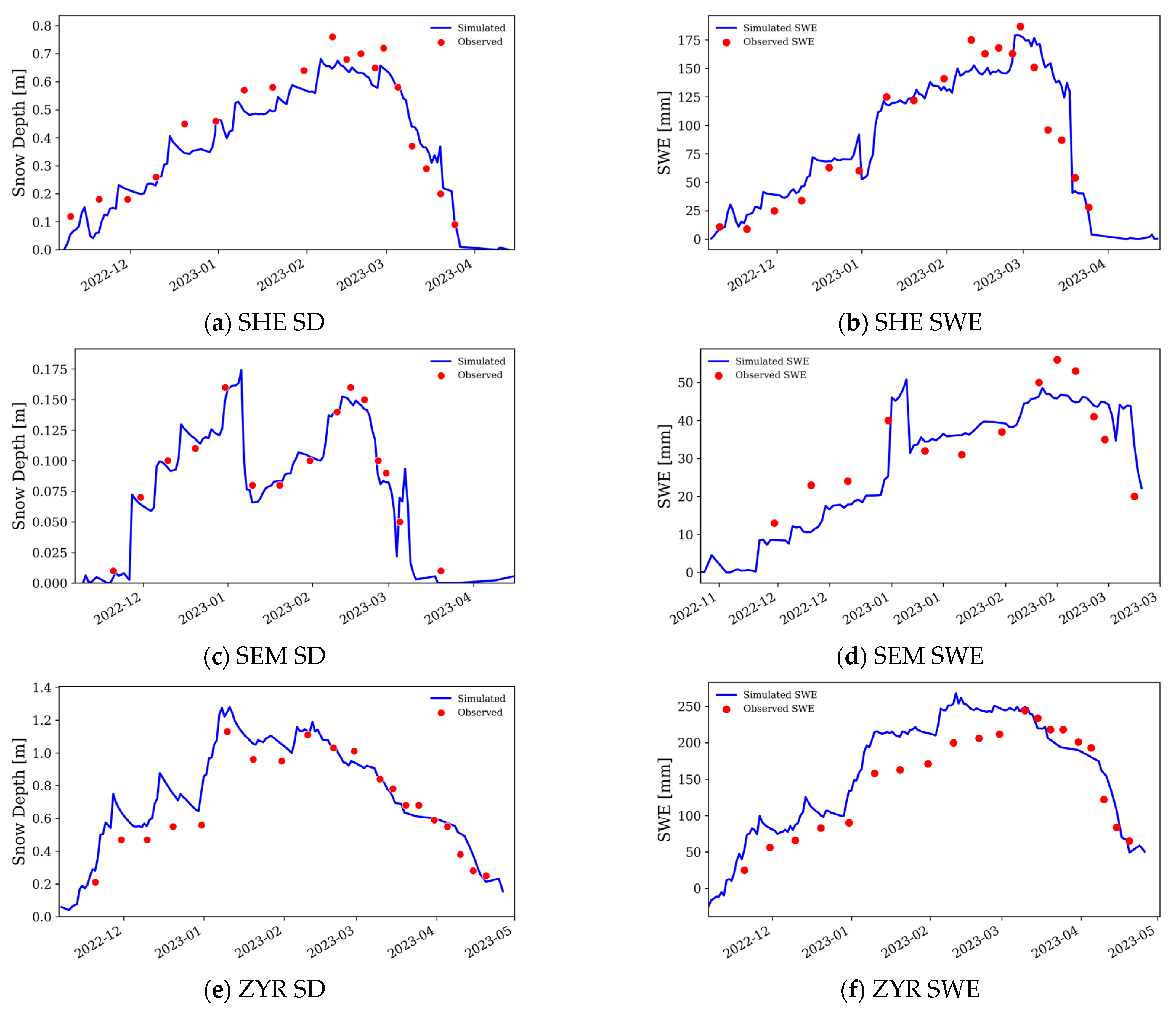
Baseline simulations reproduce the seasonal evolution of continental snowpacks consistently across the three Kazhydromet stations representing contrasting snow regimes. The model captures the onset of snow accumulation in late autumn, mid-winter growth and compaction phases, and the transition to rapid spring ablation (
Figure 3). Agreement in seasonal timing indicates that the SNTHERM energy- and mass-balance formulation responds realistically to the regional meteorological forcing conditions characteristic of northeastern Kazakhstan.
Simulated snow depth (SD) and snow water equivalent (SWE) closely follow the observed seasonal evolution across the three study sites (
Figure 3). The model reproduces the timing of accumulation, mid-winter compaction, and the transition to spring ablation, indicating that the SNTHERM energy- and mass-balance formulation responds realistically to regional meteorological forcing. Deviations between simulated and observed values remain within the range typically expected for point-scale snowpack modelling in heterogeneous continental environments.
Quantitative evaluation supports consistent baseline performance (
Table 5). For SD,
range from 0.841 to 0.943, with the strongest agreement at the steppe station SEM (
= 0.943, RMSE = 0.010 m). Slightly larger SD errors at the ZYR station (RMSE = 0.122 m) are consistent with deeper snowpacks and increased spatial variability associated with orographic snowfall and wind redistribution processes that are not explicitly resolved in the one-dimensional model framework.
Model performance for SWE is moderate to strong ( = 0.544–0.860). The highest correspondence occurs at SHE ( = 0.860), where sheltered terrain and more uniform accumulation support stable SWE evolution. Lower agreement at SEM ( = 0.544) reflects known observational uncertainties in wind-exposed steppe environments, including gauge undercatch, mixed-phase precipitation, and enhanced sublimation losses. In addition, SWE errors are generally larger than snow depth errors because SWE integrates both geometric depth and density evolution, which depends on compaction, metamorphism, and melt–refreeze processes that are sensitive to precipitation phase and accumulation history. Consequently, uncertainties in snowfall magnitude and density evolution tend to propagate more strongly into SWE estimates than into snow depth simulations.
Spatial differences in model performance largely reflect contrasts in snow regime characteristics and measurement uncertainty rather than systematic model bias. The simulations successfully capture key seasonal diagnostics, including accumulation magnitude, peak SWE timing, and melt-out behaviour across foothill, steppe, and montane environments.
Although the primary model validation focuses on the 2022–2023 winter season due to the availability of complete SWE observations, the sensitivity experiments were repeated for multiple winters to evaluate the robustness of model responses under different background climatic conditions. These additional simulations provide a qualitative assessment of interannual variability in snowpack sensitivity to temperature and precipitation perturbations.
Overall, the baseline configuration provides a physically consistent representation of seasonal snow evolution across the study sites and establishes a consistent foundation for interpreting the thermodynamic and mass-balance sensitivity experiments presented in the following sections.
3.2. Thermodynamic Sensitivity of Snowpack to Air Temperature Perturbations
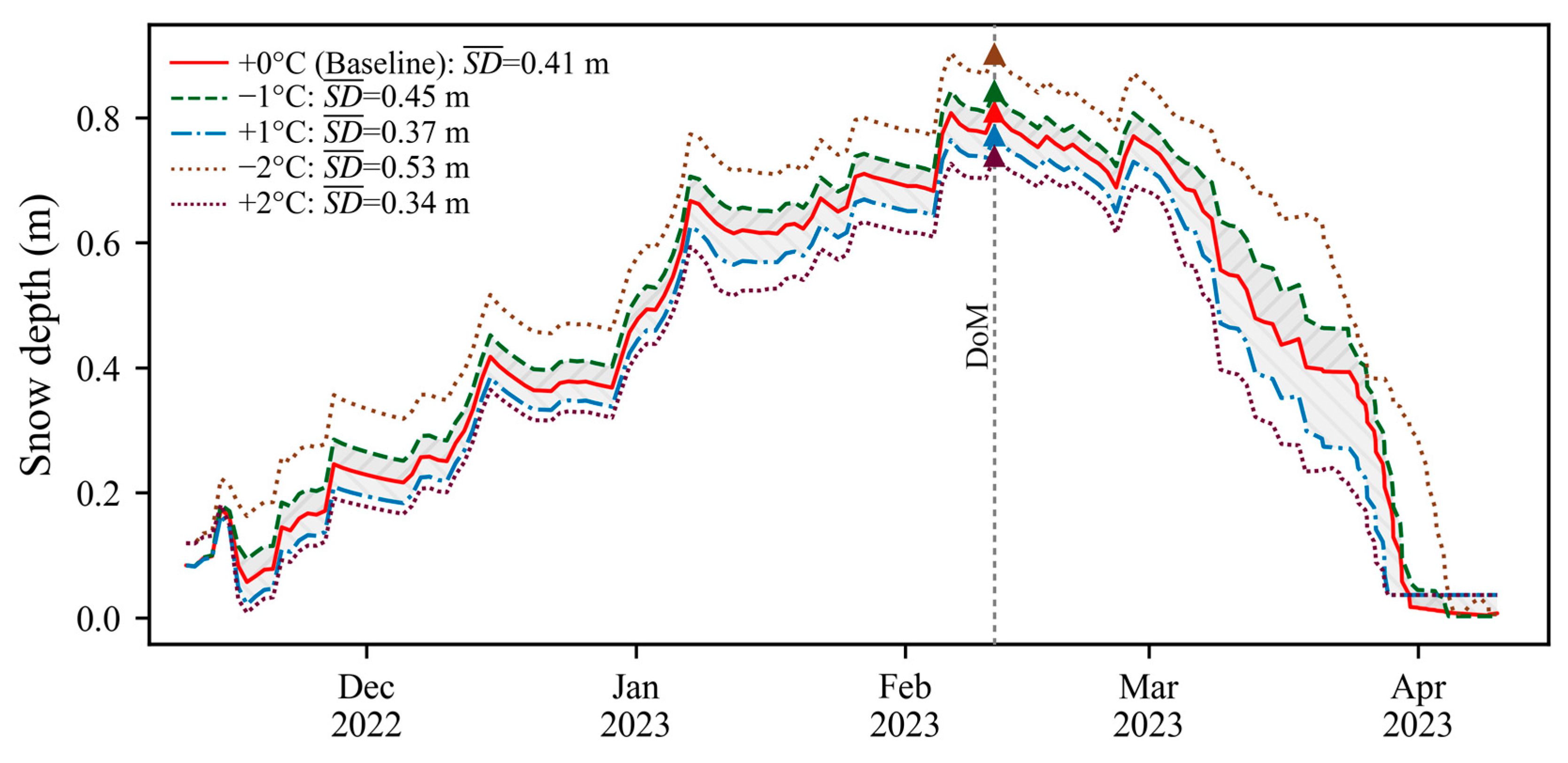
To assess thermodynamic controls on seasonal snow evolution, uniform ±1 °C and ±2 °C perturbations were applied to the complete hourly 2 m air temperature forcing, while all other meteorological variables were held constant. This configuration isolates the energetic influence of temperature on phase partitioning, internal metamorphism, melt onset, and ablation efficiency. The simulated snow depth (SD) trajectories in
Figure 4 show limited divergence among scenarios during early winter, when temperatures remain well below freezing, and accumulation is governed mainly by snowfall input and cold-content storage. Under these fully subfreezing conditions, moderate temperature shifts do not substantially alter accumulation dynamics.
Systematic separation among simulations emerges as temperatures approach the melting threshold and becomes more pronounced during late winter. Cooling (−1 °C and −2 °C) increases seasonal snow depth and extends snow persistence, whereas warming (+1 °C and +2 °C) reduces peak depth and accelerates ablation. Across all perturbations, the overall accumulation–ablation sequence appears to remain unchanged, indicating that temperature mainly alters the magnitude of snow storage rather than the seasonal structure of snow evolution.
For the baseline simulation, seasonal-mean snow depth equals 0.44 m. A −1 °C perturbation increases mean SD to 0.48 m (+9%), while +1 °C reduces it to 0.40 m (−9%). Under ±2 °C forcing, −2 °C yields a mean SD of 0.53 m (+20%), whereas +2 °C reduces it to 0.34 m (−23%), indicating increased response amplitude relative to the ±1 °C experiments. The stronger reduction under +2 °C relative to +1 °C indicates increasing sensitivity as the snowpack approaches isothermal conditions and melt processes intensify. The asymmetric response suggests that the snowpack operates near a thermodynamic transition regime, where small positive temperature shifts disproportionately enhance melt efficiency relative to equivalent negative shifts. The date of maximum snow depth remains nearly unchanged across scenarios. In contrast, the snow-free date shifts by approximately ±3–4 days, with cooling delaying melt-out and warming advancing it. These results indicate that temperature perturbations primarily affect late-season ablation rather than the timing of peak accumulation.
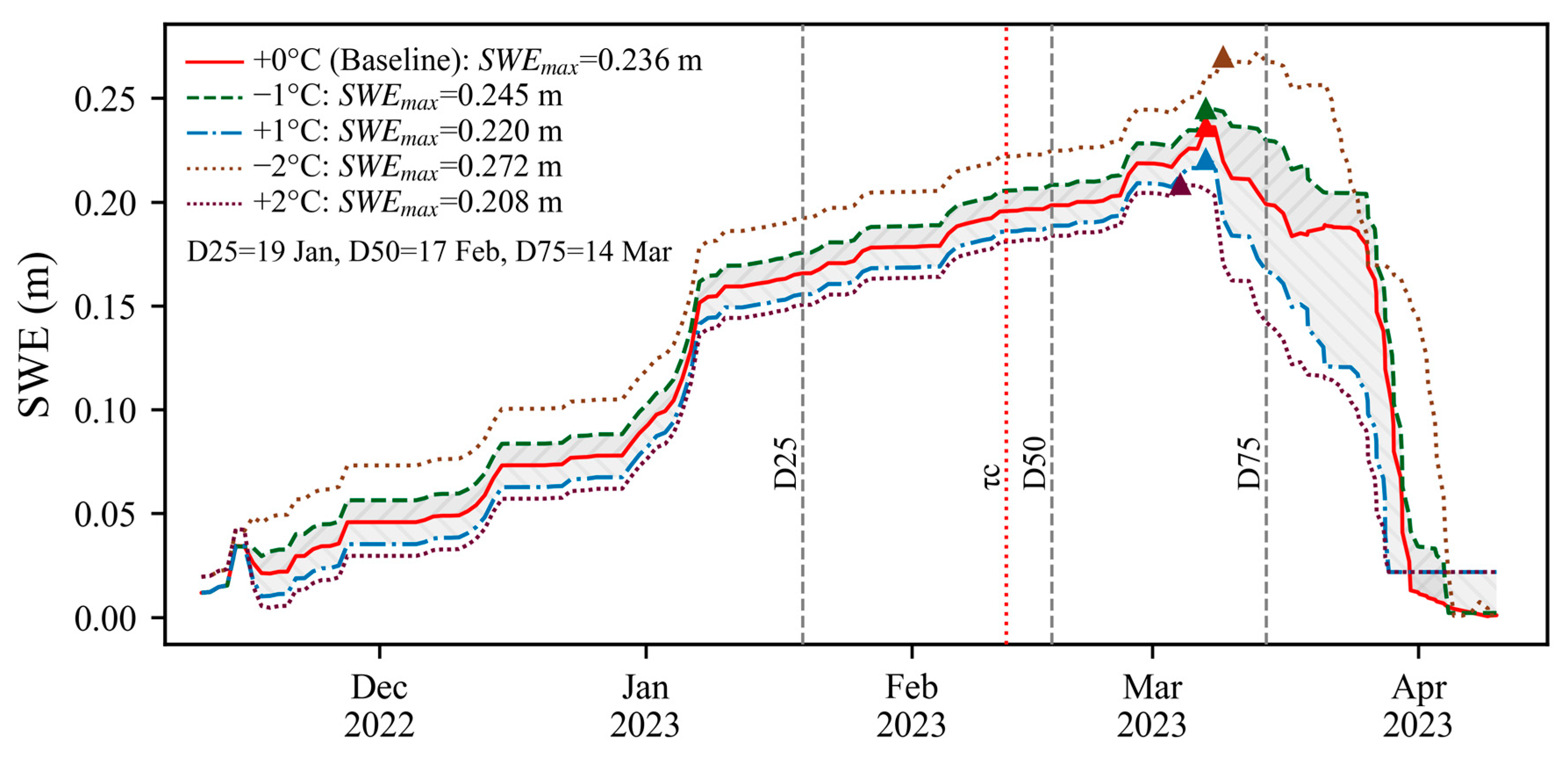
SWE exhibits stronger thermodynamic sensitivity than SD because it reflects both geometric depth and internal energy redistribution, as illustrated in
Figure 5. For the baseline simulation, seasonal
equals 0.127 m, with a maximum value (
) of 0.236 m. Cooling (−1 °C) increases
to 0.139 m and
to 0.245 m, whereas warming (+1 °C) reduces
to 0.109 m and
to 0.220 m. Under extended forcing, −2 °C increases
to 0.272 m, while +2 °C reduces it to 0.208 m.
The asymmetric response between cooling and warming reflects threshold-sensitive melt processes: once the snowpack approaches isothermal conditions, additional energy enhances melt efficiency more effectively than equivalent cooling increases cold-content storage. Despite these magnitude changes, peak SWE timing remains nearly unchanged across scenarios, indicating that temperature perturbations mainly modify storage amplitude and melt trajectory rather than the occurrence of peak accumulation.
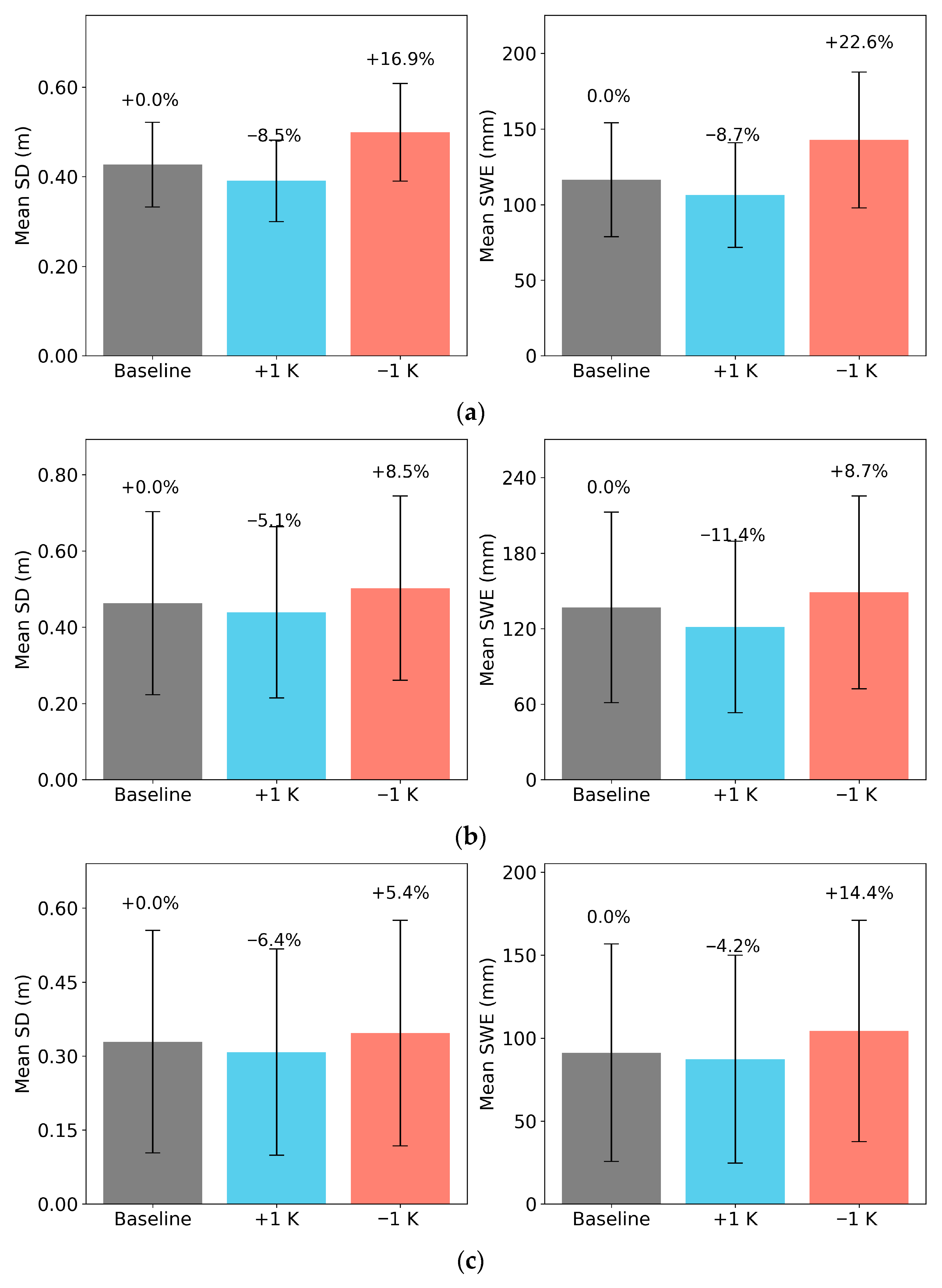
The ±1 °C perturbation experiments were repeated for three climatically distinct winters (2021–2022, 2022–2023, and 2023–2024;
Figure 6). Across seasons, +1 °C warming reduces mean SD by approximately 5–9%, whereas −1 °C cooling increases SD by 5–17%, depending on background climate conditions. SWE exhibits larger and more asymmetric responses, particularly under cooling in colder winters. These differences indicate state-dependent behaviour: when the snowpack is already cold, additional cooling produces diminishing increases in storage, whereas warming near the melting threshold results in relatively stronger reductions due to enhanced ablation.
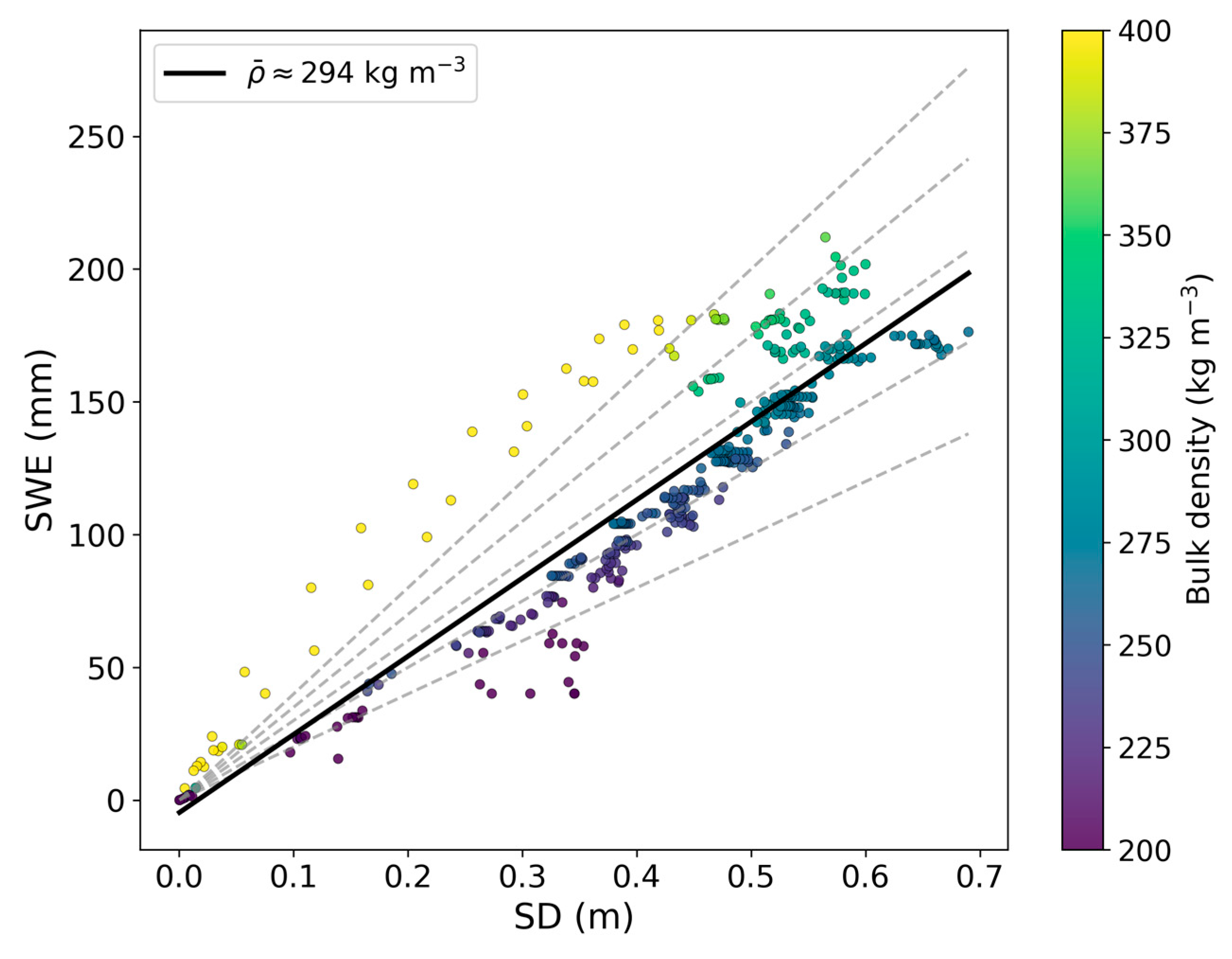
To examine whether temperature perturbations modify the structural relationship between snow depth and snow water equivalent, SD and SWE were analysed jointly in state space (
Figure 7). Under bulk snowpack conditions, SWE can be expressed as the product of snow depth and bulk snow density:
where
represents the effective bulk density of the snowpack. Short-term deviations from the mean SD–SWE scaling reflect density evolution driven by compaction, metamorphism, and melt–refreeze processes.
Across all winters and perturbation scenarios, simulated SD–SWE states align along a compact linear envelope characterised by a mean bulk density of approximately 294 kg m−3, with seasonal values spanning roughly 200–400 kg m−3. Temperature perturbations shift the distribution of density states along this envelope but do not introduce a qualitative reorganisation of the SD–SWE mapping within the tested ±2 °C range. Warming favours relatively denser late-season configurations associated with increased melt activity, whereas cooling maintains colder and generally lower-density states. Despite these thermodynamic adjustments, the proportional coupling between snow depth and snow water equivalent appears to remain preserved.
ANCOVA results indicate that the interaction term between snow depth and perturbation scenario is not statistically significant (p > 0.05), suggesting that the SD–SWE relationship does not show statistically significant evidence of change under the tested conditions. This finding is consistent with the hypothesis that the SD–SWE scaling relationship is primarily regulated by snow-density evolution rather than short-term variability in atmospheric forcing.
Overall, temperature perturbations largely modulate melt efficiency, cold-content evolution, and snow-density state, producing nonlinear adjustments in seasonal snow storage. The timing of peak snow accumulation remains largely unaffected, whereas late-season ablation exhibits measurable sensitivity. The SD–SWE relationship therefore remains approximately proportional, indicating thermodynamic modulation of snowpack state rather than structural alteration of the depth–mass coupling.
3.3. Mass-Balance Sensitivity of the Snowpack to Precipitation Perturbations
In contrast to the thermodynamic experiments presented in
Section 3.2, precipitation perturbations directly modify the mass input to the snowpack while preserving the energetic forcing that governs melt processes. Uniform scaling of total precipitation by ±5% and ±10% provides a controlled assessment of accumulation-driven responses under fixed melt conditions.
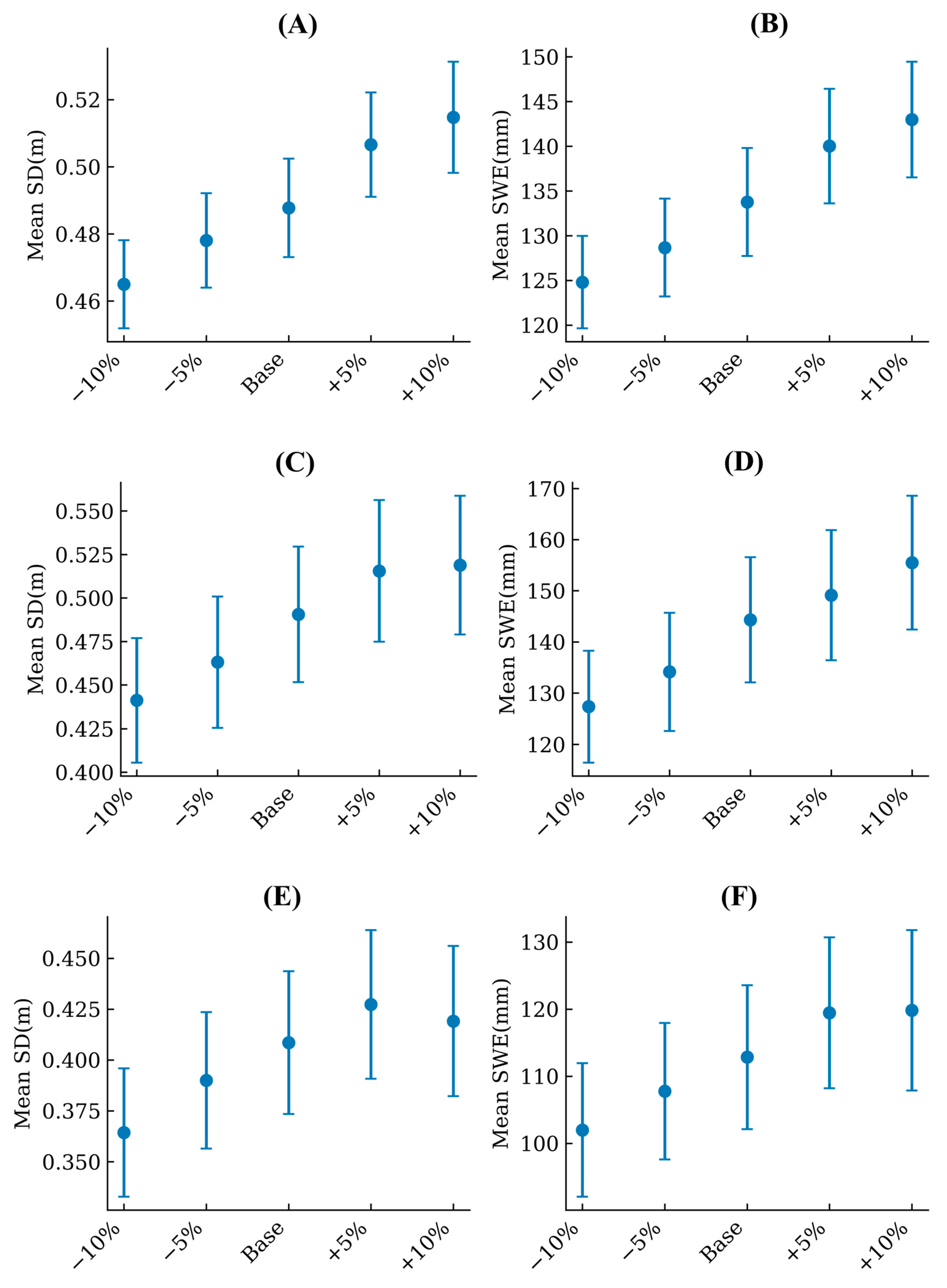
For all three winters (2021–2022, 2022–2023, and 2023–2024), both seasonal-mean snow depth (SD) and snow water equivalent (SWE) exhibit a consistent and near-linear response to precipitation scaling (
Figure 8). Increased precipitation leads to systematically larger seasonal storage, whereas reduced precipitation results in proportionally lower SD and SWE values. The ordering of scenarios (−10% < −5% < baseline < +5% < +10%) is preserved across all winters.
For snow depth, fractional changes closely track the magnitude of the imposed perturbation. A ±5% precipitation adjustment produces changes of approximately ±4–5% in seasonal-mean depth, while ±10% scaling results in differences approaching ±8–10%, depending on the winter. Although absolute accumulation varies among seasons, the relative response remains comparable, suggesting that geometric snow depth scales approximately with snowfall input when thermodynamic forcing is held constant.
Snow water equivalent exhibits similar monotonic behaviour, with slightly larger fractional differences in some winters. Because SWE reflects both snow depth and bulk-density evolution, increased snowfall contributes not only to greater thickness but also to enhanced mechanical loading, which can influence compaction rates. Conversely, reduced snowfall decreases both accumulation and late-season persistence. These effects remain moderate and do not introduce qualitative changes in system behaviour.
Precipitation perturbations produce only minor differences in seasonal timing. The dates of maximum SD and peak SWE vary at most a few days across scenarios, and melt-out timing remains largely unchanged. This indicates that, within the tested perturbation range, ablation continues to be governed mainly by energy availability rather than by accumulated mass.
The similarity of fractional responses across climatically distinct winters indicates that accumulation of sensitivity remains relatively consistent under different background conditions. While interannual variability affects the absolute magnitudes of SD and SWE, the proportional response to precipitation scaling remains comparable.
Overall, precipitation primarily modulates seasonal snow storage through approximately proportional changes in accumulation magnitude. In contrast to temperature perturbations, precipitation scaling does not substantially modify melt timing or internal phase transitions within the tested range. The two forcing pathways influence snowpack evolution through distinct physical mechanisms: temperature primarily controls melt efficiency and snow-density evolution, whereas precipitation governs accumulation magnitude.
3.4. Thermodynamic and Mass-Balance Controls on the SD-SWE Relationship
While
Section 3.2 and
Section 3.3 quantified the sensitivity of seasonal snow evolution to thermodynamic and precipitation perturbations, the present analysis evaluates whether these forcings modify the structural coupling between SD and SWE.
The SD–SWE relationship was examined across all temperature scenarios (−2, −1, 0, +1, +2 °C) using linear regression with an intercept term (
Table 6). As shown in
Table 5, the slope coefficient β varies between 268.77 and 288.90 mm m
−1 across the ±2 °C perturbations. The 95% confidence intervals overlap substantially, and coefficients of determination remain high (
= 0.78–0.84). These results indicate that, despite differences in seasonal accumulation and ablation magnitudes, SD and SWE maintain an approximately linear relationship across the examined range of thermal perturbations.
The regression intercept α remains small across scenarios, indicating that deviations from strict proportionality are limited and primarily associated with shallow-snow conditions and short transitional phases during early accumulation or melt–refreeze cycles. Inclusion of the intercept does not materially alter the estimated slopes.
To assess whether temperature perturbations introduce statistically meaningful modifications to SD–SWE scaling, an analysis of covariance (ANCOVA) framework was applied using the general linear formulation:
where the categorical factor
denotes the temperature scenario,
accounts for scenario-dependent intercept shifts, and the interaction term
represents potential slope deviations among experiments. A joint F-test for the interaction term yields F = 0.50 and
p = 0.74, indicating no statistically significant differences in SD–SWE slopes across the five temperature perturbations.
The non-significant interaction term indicates that the slope of the SD–SWE relationship does not vary systematically among temperature scenarios. In practical terms, this means that temperature perturbations modify snowpack magnitude but do not alter the proportional scaling between snow depth and water equivalent within the tested perturbation range. Residual diagnostics confirm that regression errors remain approximately homoscedastic and normally distributed across scenarios, indicating that the linear model assumptions underlying the ANCOVA framework are reasonably satisfied.
Independent density diagnostics provide additional physical context (
Table 7). Mean bulk density ranges from 289 kg m
−3 under −1 °C cooling to 250 kg m
−3 under +2 °C warming, with intermediate values of 270 kg m
−3 (−2 °C), 274 kg m
−3 (baseline), and 265 kg m
−3 (+1 °C). Moderate cooling produces the highest mean density, consistent with enhanced compaction under prolonged snow persistence, whereas progressive warming reduces mean density in association with shorter seasonal duration. Maximum instantaneous densities approach near ice-equivalent values during transient refreezing episodes; however, these short-lived states do not alter the overall SD–SWE proportionality documented in
Table 6.
Although seasonal-mean density varies between 250 and 289 kg m−3 across temperature scenarios, these differences reflect redistribution of density states within the existing SD–SWE envelope rather than a coherent rotation of the regression relationship. Consequently, variability in bulk density does not translate into statistically significant changes in the scaling coefficient β, and the proportional depth–mass coupling remains statistically invariant.
Precipitation scaling produces a complementary structural response. In contrast to temperature forcing, which modifies internal energy balance and melts efficiency, precipitation variability primarily alters cumulative mechanical loading.
As shown in
Table 8, the SD–SWE scaling coefficient β increases progressively from 265.95 mm m
−1 under −10% precipitation to 293.60 mm m
−1 under +10%. Intermediate scenarios exhibit gradual adjustments (267.88 mm m
−1 at −5%, 269.64 mm m
−1 at baseline, and 277.52 mm m
−1 at +5%). The 95% confidence intervals overlap among adjacent scenarios, and coefficients of determination remain consistently high (
= 0.79–0.84), indicating that the linear SD–SWE relationship explains most of the variability across all precipitation experiments.
The monotonic increase in β with increasing snowfall magnitude is consistent with enhanced mechanical compaction associated with greater cumulative overburden in thicker snowpacks. Increased accumulation promotes vertical stress and densification, leading to a higher effective depth-to-water conversion factor.
Bulk-density diagnostics calculated over a common seasonal period (
Table 9) show that mean density varies within a narrow range, from 256 kg m
−3 under −10% precipitation to 263 kg m
−3 under +10% precipitation. Median values follow a similar pattern. The limited spread in seasonal-mean density indicates that precipitation scaling primarily modifies snowpack thickness, with only moderate adjustments in bulk density.
The contrasting slope behaviour reflects fundamentally different, distinct governing mechanisms. Temperature perturbations modify the internal thermodynamic state of the snowpack by altering energy balance, phase partitioning, melt efficiency, and cold-content evolution. These processes redistribute density states within the existing SD–SWE envelope without systematically modifying cumulative mechanical loading. Consequently, despite seasonal-mean density varying between 250 and 289 kg m−3, the regression structure remains statistically invariant, and the proportional depth–mass coupling is preserved within the tested ±2 °C and ±10% forcing envelope.
In contrast, precipitation perturbations directly alter total mass input and therefore cumulative overburden stress. Increased snowfall enhances vertical loading and compaction efficiency, promoting progressive densification and producing a coherent upward shift in the effective depth-to-water conversion factor. The observed increase in β from 265 to 294 mm m−1 across the ±10% scaling range is consistent with mechanically driven compaction under thicker snowpacks.
Thermodynamic forcing primarily redistributes density states within an otherwise stable structural relationship, whereas mass-balance forcing modifies the mechanical loading regime governing snowpack densification. Within the evaluated perturbation range, both pathways preserve the approximate linearity of the SD–SWE relationship, whereas only precipitation scaling produces a systematic shift in the regression slope.
3.5. Statistical Error Structure and Postprocessing of SNTHERM Snow Depth
Although SNTHERM preserves the proportional SD–SWE scaling identified in
Section 3.4, comparison with in situ observations reveals systematic daily-scale deviations. As illustrated in
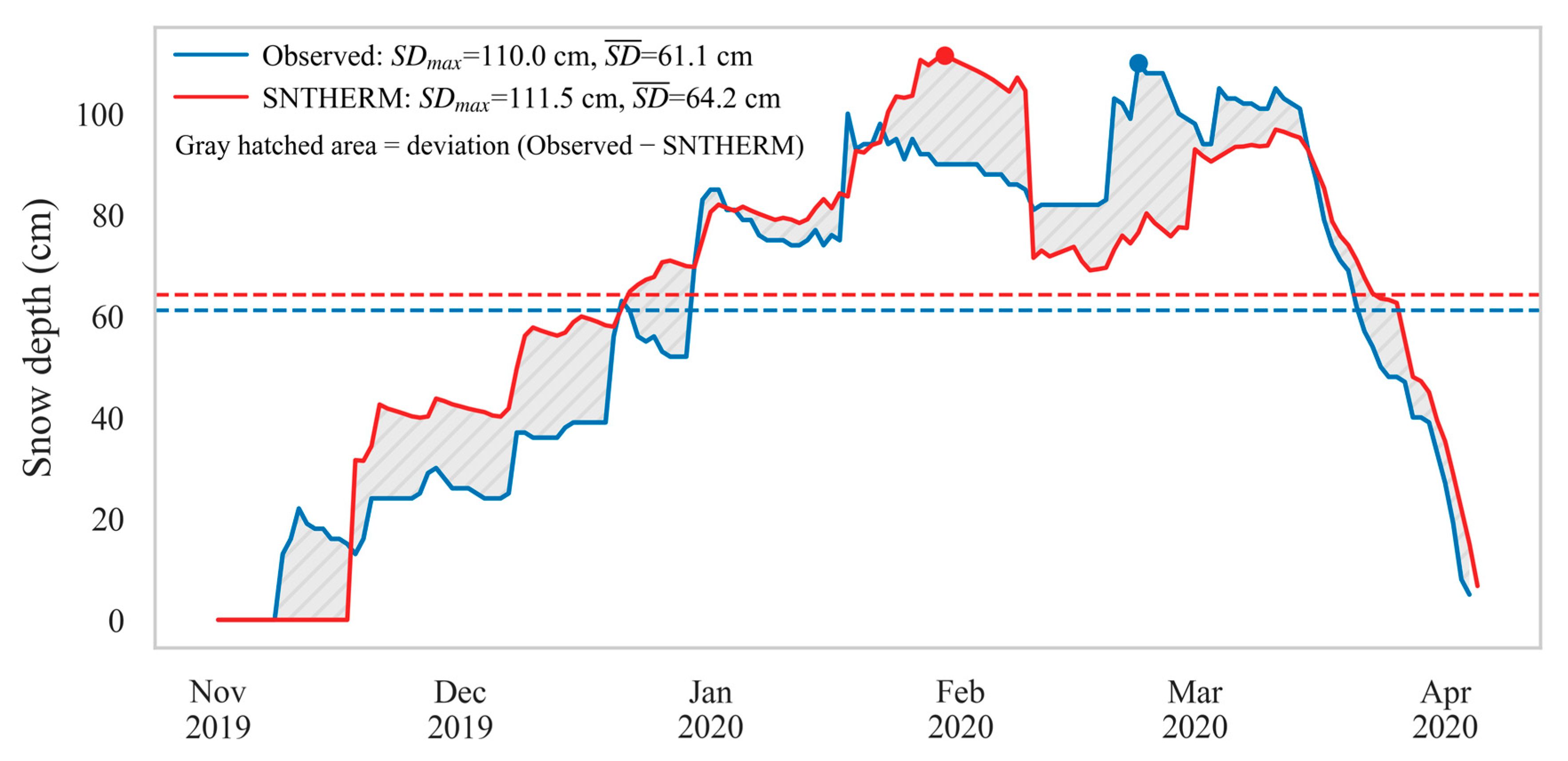
Figure 9 for the independent winter season of 2019–2020, the model reproduces the seasonal accumulation–ablation envelope and peak magnitude, yet exhibits a persistent mean offset and episodic high-frequency departures during rapid transition periods. Because SD constitutes the operationally measured variable within the regional monitoring network, postprocessing and residual diagnostics were conducted at the depth level rather than for SWE. This adjustment does not alter the SD–SWE structural relationship demonstrated in
Section 3.4, as the physically based density-depth coupling remains unchanged. To characterise the statistical structure of these deviations, daily residuals were defined as (17):
where
and
denote observed and simulated snow depth, respectively. The analysis was restricted to the snow season (November–March).
The Augmented Dickey–Fuller test rejects the unit-root hypothesis (ADF = −7.35,
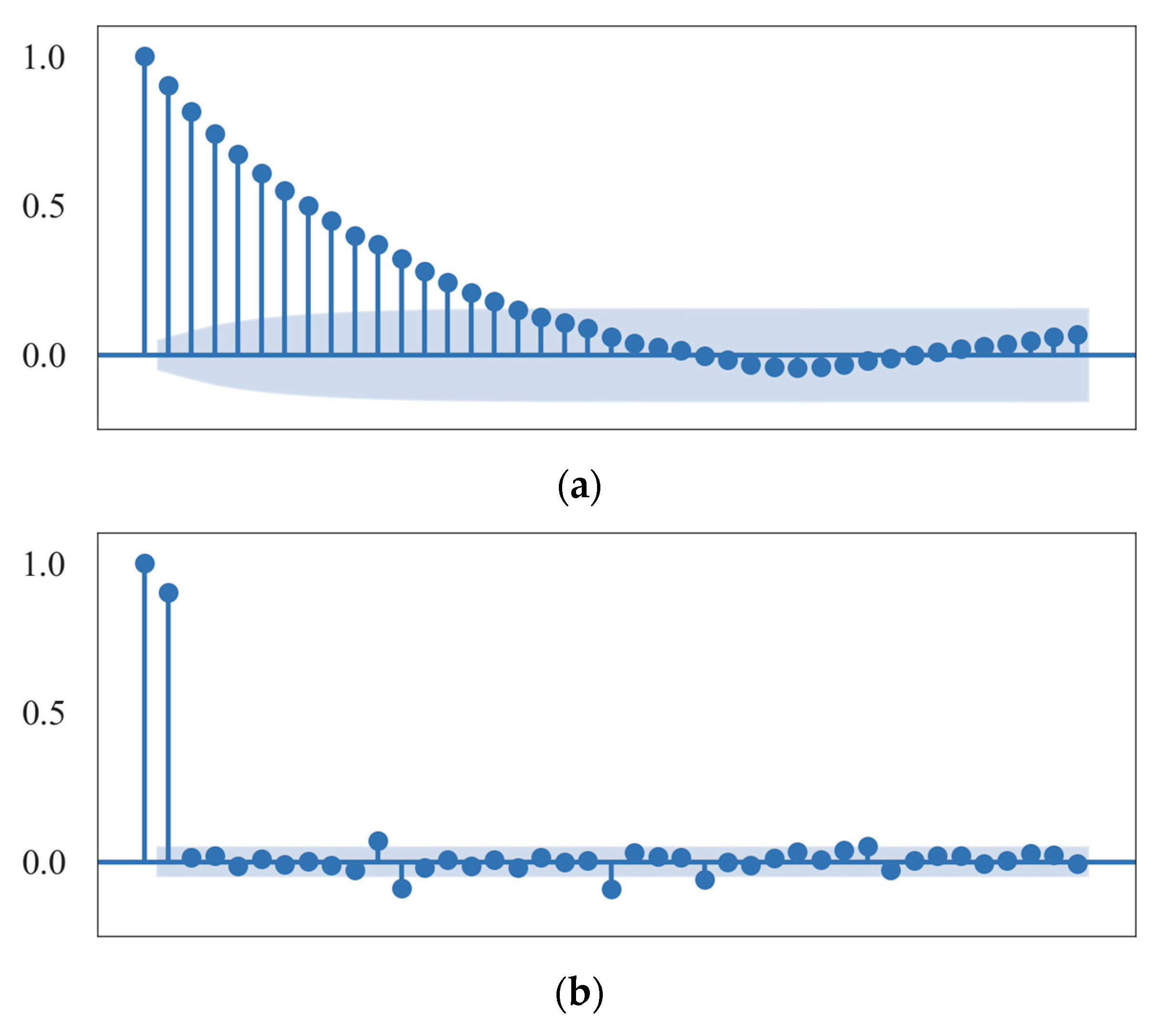
p < 0.001), supporting that the residual series is stationary over the winter subset. Autocorrelation diagnostics (
Figure 10) indicate statistically significant short-lag dependence with rapid decay beyond the first few lags. This behaviour is consistent with a short-memory error structure, suggesting that model deviations mainly reflect transient timing mismatches in accumulation and melt processes rather than structural drift.
Based on these diagnostics, a residual-based statistical bias correction was implemented as an additive adjustment layer. The expected residual
was estimated using regression-based modelling conditioned exclusively on information available at time
, including lagged model outputs and contemporaneous meteorological inputs. The corrected snow depth is defined as (18):
thereby preserving physical non-negativity and retaining the thermodynamic structure of the original model.
Model calibration employed a strictly time-ordered split, with winters preceding November 2019 used for estimation and subsequent data reserved for independent evaluation. This configuration avoids information leakage and ensures that reported performance reflects genuine out-of-sample behaviour.
Performance metrics for the independent winter test period are summarised in
Table 10. Statistical correction reduces MAE from 12.21 cm to 7.99 cm and RMSE from 14.44 cm to 10.49 cm, while increasing
from 0.797 to 0.843. The moderate improvement indicates that a portion of the snow depth error is attributable to predictable short-memory processes that can be statistically adjusted without modifying the physical snow model.
Importantly, this correction does not alter the SD–SWE proportionality analysed in
Section 3.4. The density-regulated coupling between snow depth and snow water equivalent remains governed by the physically based SNTHERM framework. Statistical postprocessing serves solely as a bias-adjustment refinement at the snow depth level and does not affect the study’s structural conclusions.
4. Discussion
4.1. Density-Regulated Structural Scaling of SD–SWE in Continental Snowpacks
The combined thermodynamic, mass-balance, and residual analyses indicate that the SD–SWE relationship simulated by SNTHERM is density-regulated rather than purely empirical. Across incremental perturbations in temperature and precipitation, snow depth and snow water equivalent evolve within a coherent state space in which bulk density serves as a dynamically regulated variable that links energy balance, phase change, and mechanical compaction processes. This behaviour can be explained by physical processes controlling snow-density evolution. Increasing precipitation increases snowpack mass and overburden pressure, promoting mechanical compaction and leading to higher bulk density. In contrast, temperature variations primarily influence melt–freeze cycles and snow metamorphism, which modify snow microstructure and internal energy without substantially changing total mass. These processes jointly regulate the relationship between snow depth and snow water equivalent, maintaining a consistent depth–mass coupling under moderate forcing.
Residual diagnostics further indicate that remaining discrepancies are mainly associated with short-memory persistence and threshold-sensitive melt dynamics rather than with instability in the underlying SD–SWE relationship. This suggests that variability arises from transient thermodynamic processes rather than from structural changes in depth–mass scaling. Regression and ANCOVA analyses show consistent SD–SWE behaviour across temperature scenarios, supporting the interpretation that proportional depth–water scaling remains approximately stable within the tested range of perturbations. This response reflects the competing mechanisms of density evolution. Colder conditions promote prolonged snowpack persistence and cumulative overburden, leading to gradual compaction and slightly higher effective densities. In contrast, moderate warming introduces intermittent melt–refreeze restructuring that modifies snow microstructure and shortens seasonal duration.
Together, these processes indicate that snow density acts as an internal buffering mechanism that helps maintain the SD–SWE relationship under moderate thermodynamic and accumulation perturbations. Similar behaviour has been reported in multilayer snow models such as Crocus and SNOWPACK, in which density integrates mechanical and thermodynamic processes that govern snowpack evolution. However, previous studies have mainly focused on density parameterisation or SWE prediction, whereas the present study explicitly examines the structure of the depth–mass relationship under controlled perturbations.
4.2. Dual Forcing Pathways: Thermodynamic Thresholds Versus Mass-Controlled Scaling
The perturbation experiments reveal a clear separation between thermodynamic and mass-balance controls on snowpack evolution, highlighting two complementary forcing pathways that shape SD–SWE behaviour. Temperature perturbations primarily influence snowpack energetics through threshold-controlled processes, whereas precipitation perturbations act as magnitude-scaling factors that modify accumulation without fundamentally altering depth–mass coupling.
Thermodynamic forcing produces nonlinear responses associated with melt–freeze transitions and snow metamorphism. Changes in air temperature affect ablation efficiency and cold-content dynamics, leading to density modifications through compaction, grain metamorphism, and melt–refreeze cycles. These processes influence the internal structure of the snowpack, but do not substantially change the bulk mass–depth relationship within the tested perturbation range. As a result, the SD–SWE relationship remains approximately linear, although its parameters may vary slightly under changing thermal conditions.
In contrast, precipitation perturbations primarily control snowpack mass. Increased snowfall increases overburden pressure and promotes mechanical compaction, while reduced snowfall limits the increase in density due to loading. These changes lead to nearly proportional adjustments in both snow depth and SWE, with limited influence on melt timing or thermodynamic state transitions. Accumulation, therefore, acts mainly as a scaling factor for snowpack magnitude rather than as a driver of structural change.
The contrast between threshold-sensitive temperature responses and near-linear precipitation scaling highlights the dual nature of continental snowpack dynamics. Temperature controls the energy balance and regulates density evolution, whereas precipitation determines the mass input to the system. Snow density mediates the interaction between these processes, linking thermodynamic forcing with mechanical compaction.
These findings indicate that SD–SWE scaling is governed primarily by density evolution processes rather than by direct variability in forcing. Evaluating snowpack behaviour within the joint SD–SWE state space, therefore, provides a physically consistent framework for interpreting snowpack response under moderate climatic perturbations.
4.3. Interpretation and Limitations of Structural SD–SWE Stability
Although the results indicate consistent behaviour of the SD–SWE relationship under incremental forcing, they should not be interpreted as universal across all snow climates or modelling conditions. The analysis is based on a one-dimensional energy-balance framework that resolves vertical processes but does not explicitly represent lateral redistribution mechanisms such as wind transport, canopy interception, or subgrid heterogeneity. These processes can influence snow accumulation and density evolution, particularly in exposed or complex terrain, and may contribute to discrepancies between simulated and observed snow conditions.
The approximately linear SD–SWE relationship identified here is therefore best interpreted as a model-consistent property of continental snowpacks under moderate perturbations rather than as a general rule. Under stronger thermodynamic forcing, such as sustained near-zero winter temperatures or frequent rain-on-snow events, nonlinear processes including liquid-water retention, drainage, and refreezing may alter snowpack structure and weaken depth–mass coupling.
Uncertainty in meteorological forcing represents an additional limitation. ERA5-Land precipitation may be biased due to snowfall undercatch and uncertainties in precipitation phase partitioning, which can influence snow accumulation, mechanical compaction, and density evolution. Similar SWE overestimation has been reported in previous SNTHERM applications for the study region, indicating that precipitation uncertainty remains a key source of modelling error. However, because the present analysis focuses on relative responses to controlled perturbations rather than absolute snow mass values, the influence of these uncertainties on SD–SWE structural behaviour is expected to be limited.
Wind-driven snow redistribution and lateral mass transport are not represented in the one-dimensional SNTHERM framework. This limitation is particularly relevant for wind-exposed environments such as the SEM station, where snow drifting, erosion, and deposition can significantly influence local snow accumulation and density. The reduced model performance at SEM is therefore likely due to the model’s inability to capture lateral snow transport processes.
Additional limitations arise from the experimental design. The perturbation analysis is based on a limited number of stations and primarily focuses on a single site, which limits the generality of the conclusions. Furthermore, the simulations cover a single winter season and rely on a single physically based model without multi-model comparison or explicit parameter uncertainty analysis. The applied delta-change approach represents diagnostic sensitivity experiments rather than full climate projections.
Despite these limitations, the results provide insight into the physical controls governing SD–SWE behaviour. The persistence of an approximately linear relationship under moderate perturbations suggests that snow density acts as a regulating variable linking energy balance, compaction, and accumulation processes. This behaviour supports the use of snow depth as a proxy for snow water equivalent in data-sparse continental regions, while indicating that deviations from linearity are more likely to occur under stronger climatic forcing or in environments where lateral processes dominate.
Future work could extend this analysis using multi-year datasets, multi-model comparisons, and improved representation of precipitation uncertainty and snow redistribution processes.
5. Conclusions
This study developed a process-based modelling framework to investigate how the snow depth-snow water equivalent (SD–SWE) relationship responds to controlled thermodynamic and accumulation perturbations in a continental snow regime. Using SNTHERM simulations combined with regression analysis, ANCOVA diagnostics, and bulk-density evaluation, the analysis quantified how moderate changes in temperature (±1–2 °C) and precipitation (±5–10%) influence snowpack evolution and depth–mass coupling.
The results indicate that the SD–SWE relationship remains approximately linear within the tested perturbation range, although its parameters are partially sensitive to changes in precipitation-driven accumulation. Temperature perturbations primarily affect melt processes, seasonal persistence, and snow-density redistribution, whereas precipitation directly modifies snowpack mass and overburden, enhancing mechanical compaction. These contrasting responses highlight the dual role of thermodynamic and accumulation forcing in regulating snowpack structure.
The findings suggest that snow density is a key state variable linking energy balance, phase change, and mechanical compaction processes. Under moderate climatic variability, density evolution buffers the depth–mass relationship, allowing snow depth to remain a reliable proxy for snow water equivalent in continental environments. Rather than proposing a new empirical conversion, this study shows how controlled perturbation experiments within a physically based modelling framework can be used to evaluate the structural behaviour of SD–SWE scaling.
The results should be interpreted as an exploration of model behaviour under controlled perturbations rather than as a generalised assessment of long-term climatic variability. The analysis is constrained by the model’s one-dimensional structure, the use of reanalysis-based forcing, and the limited temporal and spatial coverage of observations. In particular, wind-driven snow redistribution and precipitation uncertainty may influence snowpack structure and the evolution of snowpack density.
Taken together, the results demonstrate that depth–mass coupling in continental snowpacks remains predictable under moderate climatic variability, with snow density acting as a key integrative state variable. This provides a physically based basis for interpreting SD–SWE relationships and improves confidence in depth-based SWE estimation under data-limited conditions.
Further research should extend this framework to broader climatic regimes, incorporate multi-model approaches, and explicitly quantify uncertainty associated with precipitation forcing and snow redistribution processes.




 ,
,