Digital Twin-Based Intelligent System for Thermal Conditioning of Engines and Vehicles with Phase Change Thermal Energy Storage


Abstract
1. Introduction
2. Background and Related Work
- -
- Analysis of thermal processes in thermal conditioning systems of vehicle power units;
- -
- Development of the digital twin architecture for the engine thermal conditioning system;
- -
- Development of mathematical models of heat transfer considering PCM-based thermal storage units;
- -
- Development of algorithms for intelligent control of thermal regimes;
- -
- Evaluation of the efficiency of the proposed system based on modeling and experimental studies.
3. Materials and Methods
- -
- Pre-start heating of the engine (coolant and engine oil up to +50 °C) and the passenger compartment (cabin);
- -
- Post-start (accelerated) warm-up (coolant and engine oil from +50 °C to approximately +85 °C);
- -
- Maintenance of rational thermal parameters during operation and charging of phase change thermal energy storage units for subsequent thermal conditioning cycles.
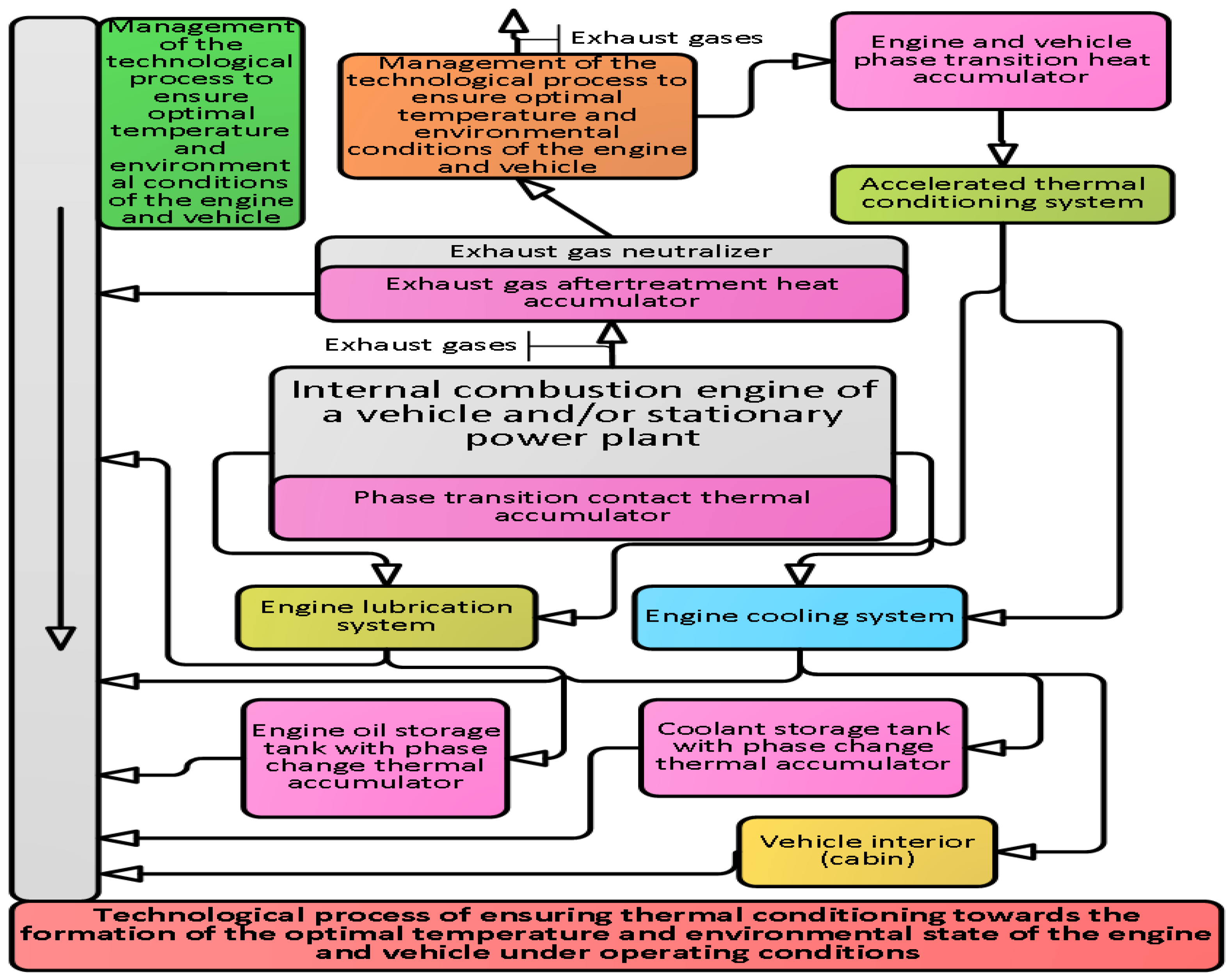
3.1. Energy Structure of the Intelligent Thermal Conditioning System
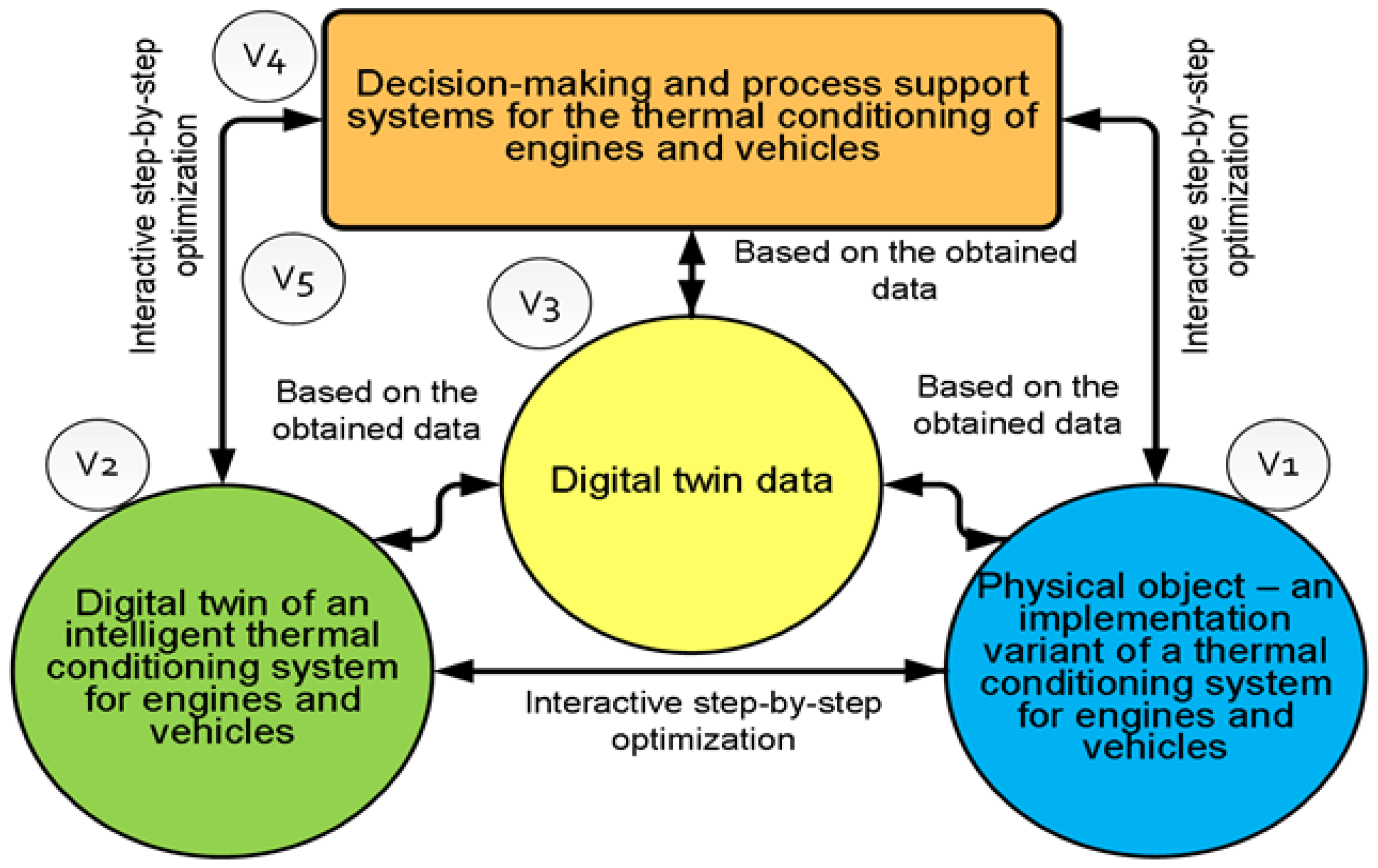
3.2. Digital Twin Architecture
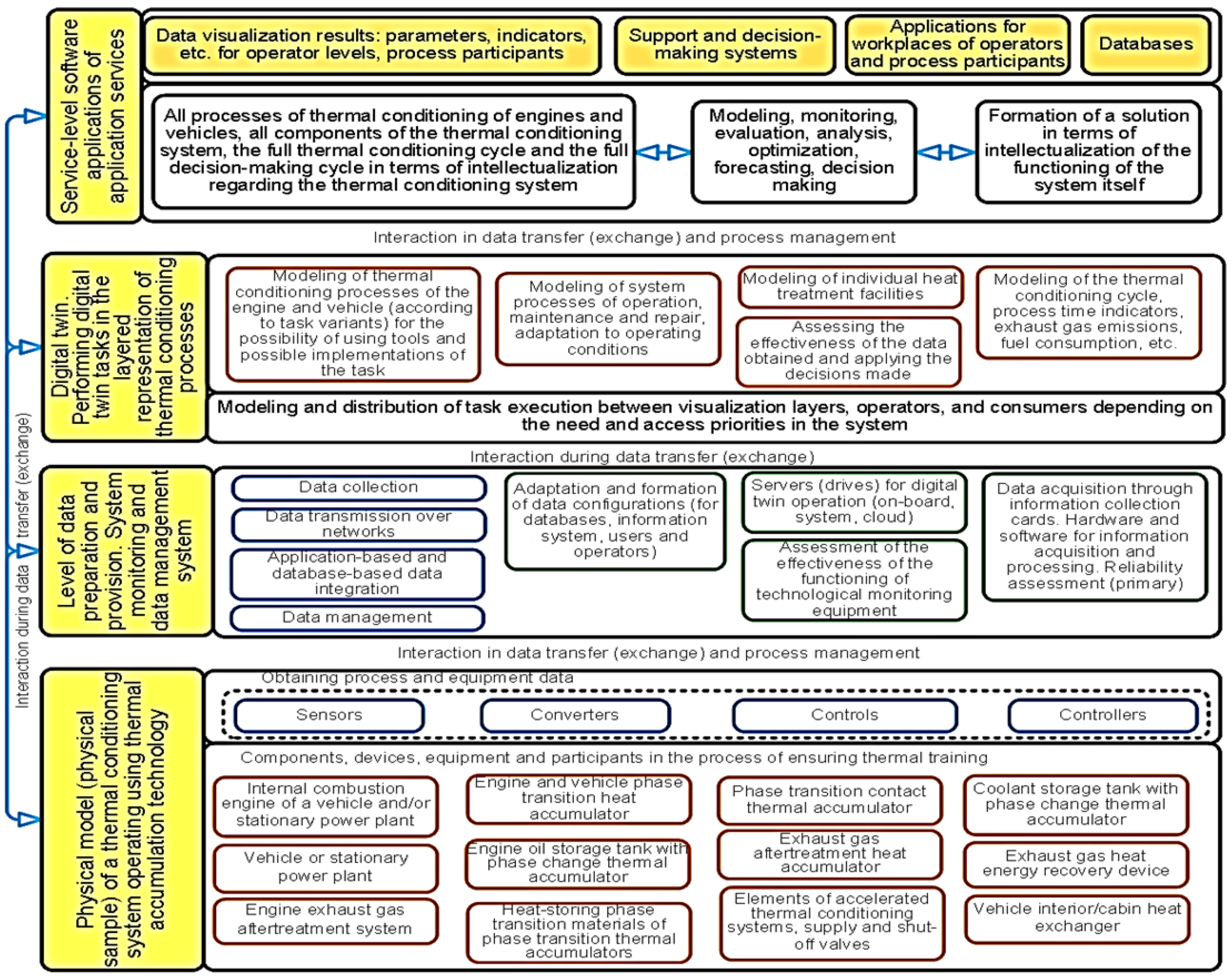
- Physical layer, including the real thermal conditioning system, its equipment, sensors, actuators, controllers, and data acquisition interfaces.
- Data preparation and management layer, ensuring the collection, transmission, storage, integration, visualization, and analytical processing of information.
- Digital twin layer, where thermal process modeling, system state analysis, operational scenario evaluation, diagnostics, and prediction are performed.
- Application service layer, implementing user interfaces, decision-support systems, databases, and tools for optimization, monitoring, and remote control.
3.3. Mathematical and Information Descriptions of the Problem and the Digital Twin Model
- -
- Engine warm-up processes without engine start during pre-start thermal conditioning (Q1): transformation of thermal energy accumulated in the thermal energy storage material and in the elements of the thermal conditioning system during the preparation of the engine and the vehicle for operation without starting the engine.
- -
- Engine warm-up processes during post-start thermal conditioning (Q2): conversion of fuel energy into thermal and mechanical energy of the engine; transformation of the latent heat of phase transition in the system elements into thermal energy for additional heating of the engine heat-transfer media. In parallel, heating of the vehicle passenger compartment is carried out through the engine cooling system, and accelerated heating of the catalytic converter is provided by the corresponding thermal energy storage unit of the exhaust gas aftertreatment system.
- -
- Processes of heat accumulation in the phase change thermal energy storage units of the system during the charging mode (Q3): conversion of fuel energy into thermal and mechanical energy of the engine, as well as accumulation of thermal energy from exhaust gases and the operating engine in the heat storage material of the system components (charging processes of the thermal energy storage units).
- -
- Processes of cooling of the heat storage substances in the thermal energy storage units of the system during the storage mode together with the engine and the vehicle in the surrounding environment (Q4): dissipation of thermal energy accumulated in the heat storage material through the system components during vehicle parking (storage). This stage characterizes the processes of preserving the thermal energy of the engine.
3.4. Implementation, Data, and Verification
3.5. Influence of Modeling Assumptions on Model Accuracy
- The assumption of constant heat transfer coefficients;
- Neglecting heat losses in connecting pipelines;
- One-dimensional representation of the phase transition front in the phase change thermal energy storage unit.
3.5.1. Assumption of Constant Heat Transfer Coefficients
3.5.2. Neglecting Heat Losses in Pipelines
3.5.3. One-Dimensional Representation of the Phase Change Process
3.5.4. Overall Assessment of Assumptions Impact
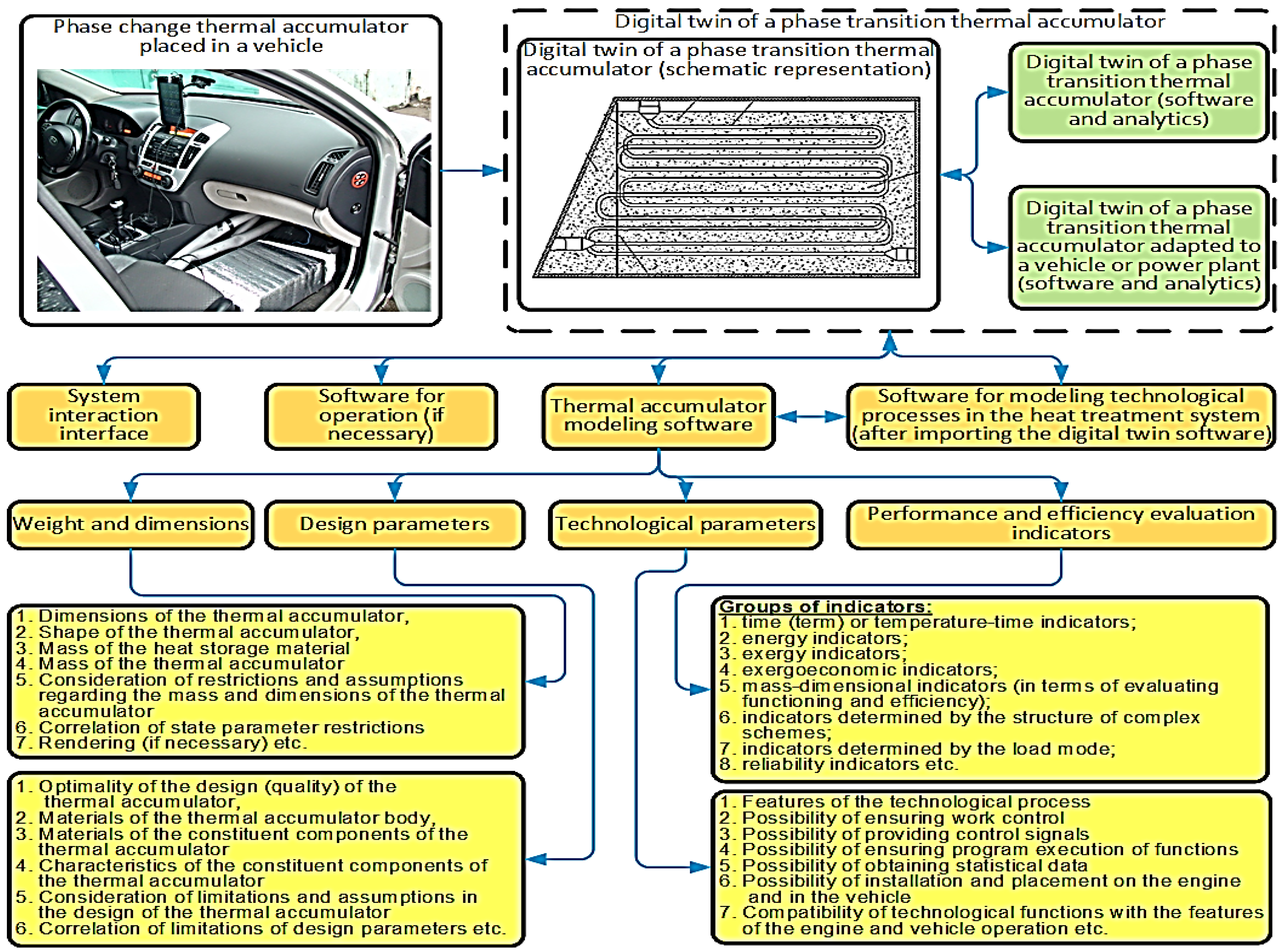
3.6. Construction of a DT of Individual Components of the Thermal Conditioning System for Engines and Vehicles Operating on Thermal Storage Technology
- -
- The formation and refinement of the system structure;
- -
- The selection and justification of the parameters of PCM materials and thermal energy storage units;
- -
- The evaluation of the efficiency of various thermal conditioning schemes;
- -
- The synchronization of the physical object and the digital model in real time within remote monitoring processes;
- -
- The implementation of intelligent control of thermal regimes.
4. Results of the Study
4.1. General Characteristics of the Developed Thermal Conditioning System
- -
- A subsystem for the accumulation and storage of waste thermal energy using thermal energy storage units based on phase change materials;
- -
- A subsystem for the recovery of waste heat from engine exhaust gases;
- -
- A subsystem for accelerated warm-up of the engine and its functional components;
- -
- A subsystem for remote monitoring, analysis of the technical condition parameters and the thermal state of the vehicle engine, as well as its parametric diagnostics;
- -
- An intelligent subsystem for the control of thermal regimes implemented based on a digital twin.
- -
- Modeling of engine thermal processes;
- -
- Prediction of temperature regimes of the engine and its subsystems;
- -
- Optimization of thermal flow control;
- -
- Analysis of the operational efficiency of the thermal conditioning system.
4.2. Formation of the Energy Structure of the Thermal Conditioning System
- -
- A heat exchanger for the recovery of exhaust gas heat;
- -
- A phase change thermal energy storage unit;
- -
- A contact thermal energy storage unit of the engine;
- -
- A storage-type coolant accumulator;
- -
- A storage-type engine oil accumulator;
- -
- A subsystem for accelerated heating of the vehicle catalytic converter.
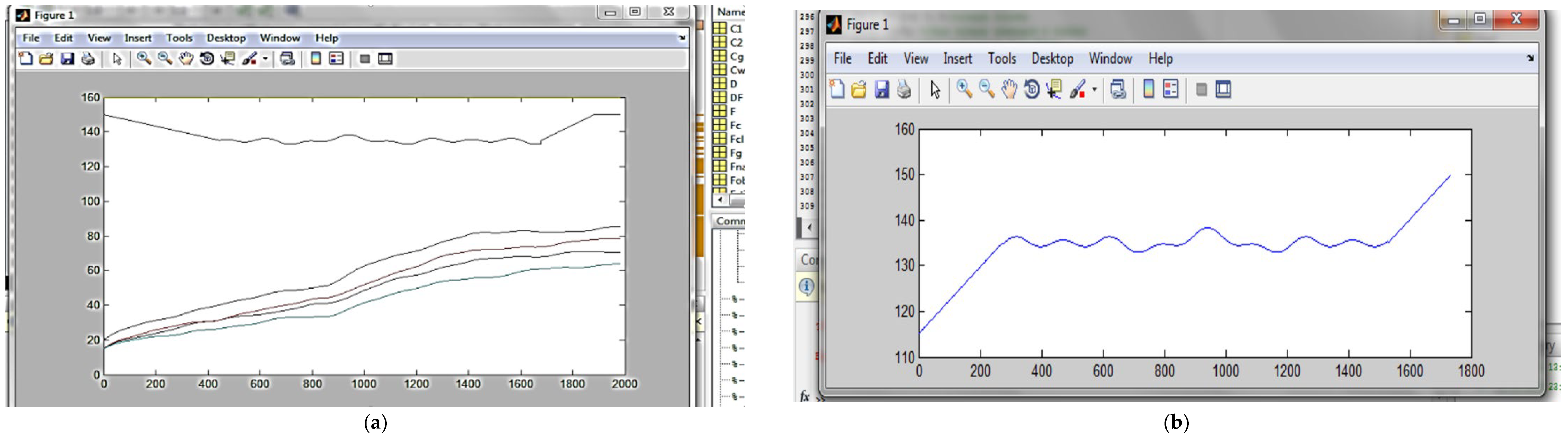
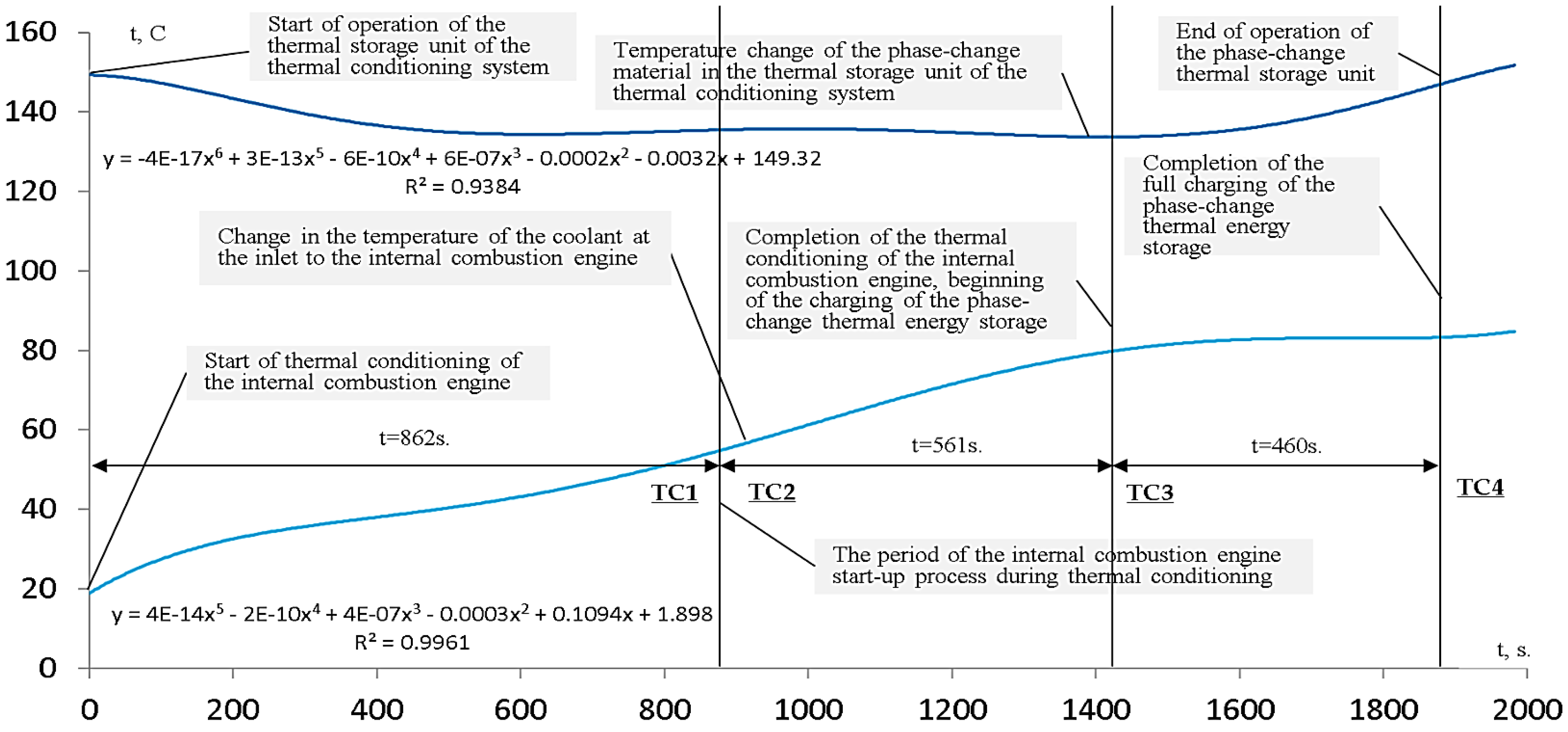
4.3. Results of the Simulation of Thermal Conditioning Processes
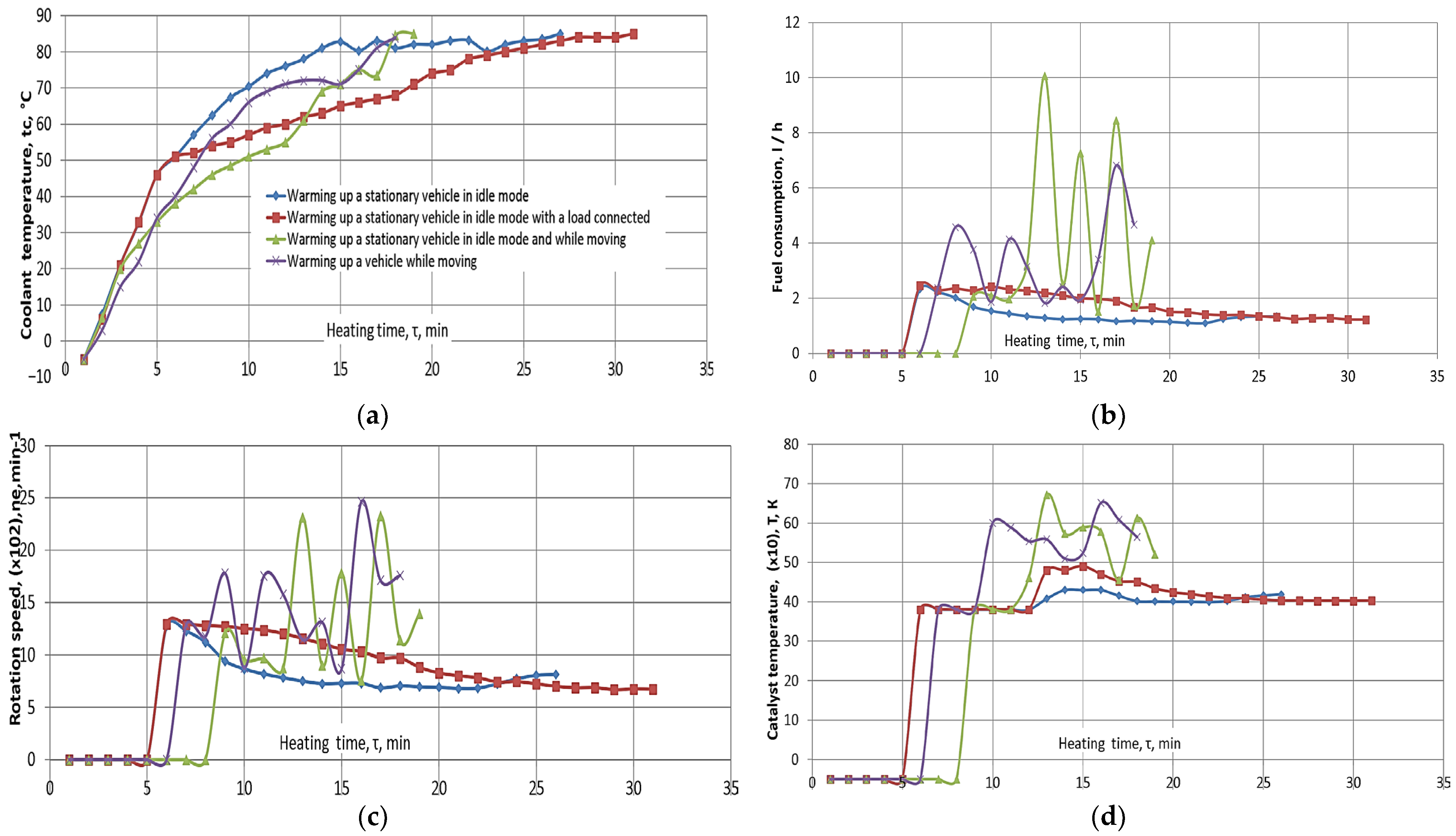
4.4. Experimental Verification of the System Efficiency
- -
- Reduction of engine warm-up time by 17.8–68.4%;
- -
- Reduction of fuel consumption during the warm-up period by 19–56.25%;
- -
- Reduction of harmful emissions.
4.5. Analysis of Thermal Energy Storage Processes
4.6. Efficiency of the Thermal Conditioning System Control Algorithm
4.7. Assessment of the Adequacy of the Developed Model
4.8. Practical Efficiency of the Proposed System
- -
- For engine warm-up from ambient temperature to 50 °C and from 50 °C to 85 °C within the cooling system—the following configuration: the standard system + an accelerated warm-up subsystem + a phase change thermal energy storage unit;
- -
- To maintain the temperature of the coolant and engine oil of the vehicle engine at approximately 50 °C when the vehicle is stopped under ambient environmental conditions—a thermal energy storage unit + a contact thermal energy storage unit + coolant and engine oil storage units and a separate phase change thermal energy storage unit.
4.9. Features of Experimental Studies and Obtained Results for the Thermal Conditioning System Based on Phase Change Thermal Energy Storage
5. Discussion
- Studies on the application of phase change materials for thermal energy storage;
- Studies on the application of digital twins in transport and energy systems.
6. Conclusions
- Reducing engine warm-up time by approximately 17.8–68.4%;
- Decreasing fuel consumption during the warm-up phase by 19.5–56.25%;
- Reducing harmful emissions during the cold-start period of the engine.
7. Patents
- Igor Gritsuk et al. System for ensuring optimal coolant temperatures in an internal combustion engine. UA 103729
- Igor Gritsuk et al. System for ensuring optimal coolant temperatures in an internal combustion engine. UA 106525
Author Contributions
Funding
Institutional Review Board Statement
Informed Consent Statement
Data Availability Statement
Acknowledgments
Conflicts of Interest
Abbreviations
| DTs | digital twins |
| IIoT | Internet of Things |
| Ft | information on the parameters of the technical condition of engines and vehicles at a given moment in time during the process of ensuring the optimal temperature state. |
| control input vector (setpoint coordinate(s) of the control actuator(s)) at time t. t—current time. | |
| Δt | time interval between measurements |
| n | number of previous intervals |
| for i = 1, …, m | characteristics of the technical condition measured during the process of ensuring the optimal thermal state of engines and vehicles and included in the set of retrospective influencing factors (excluding the values of the coolant and engine oil temperatures of the engines themselves, such as fuel consumption, air flow rate, ambient air temperature at the engine inlet of the vehicle, etc.). |
| m | number of measured parameters |
| results of monitoring and determination of the vehicle fault status | |
| Ω | display operator |
| SQopt | Energy supply system for ensuring the optimal thermal state of engines and vehicles (in the present case, the system represents a mapping of the properties of the sub-objects and their relations for over in ). |
| mi | number of observation (information acquisition) devices |
| l | relationships between observation devices and sub-objects ensuring the optimal thermal state |
| eQ | set of sub-objects ensuring the optimal thermal state |
| r | set of relations between them |
| J | task |
| F(t + kΔt) | Predicted information on the technical condition of engines and vehicles at a given moment in time during the process of ensuring the optimal thermal state in the future over a prediction interval of length depending on known past values, within a specified forecasting interval with a given confidence probability |
| k | number of future intervals determining the type of forecast (e.g., short-term, etc.) |
| STPEV | thermal conditioning systems for engines and vehicles operating on the basis of heat accumulation technology |
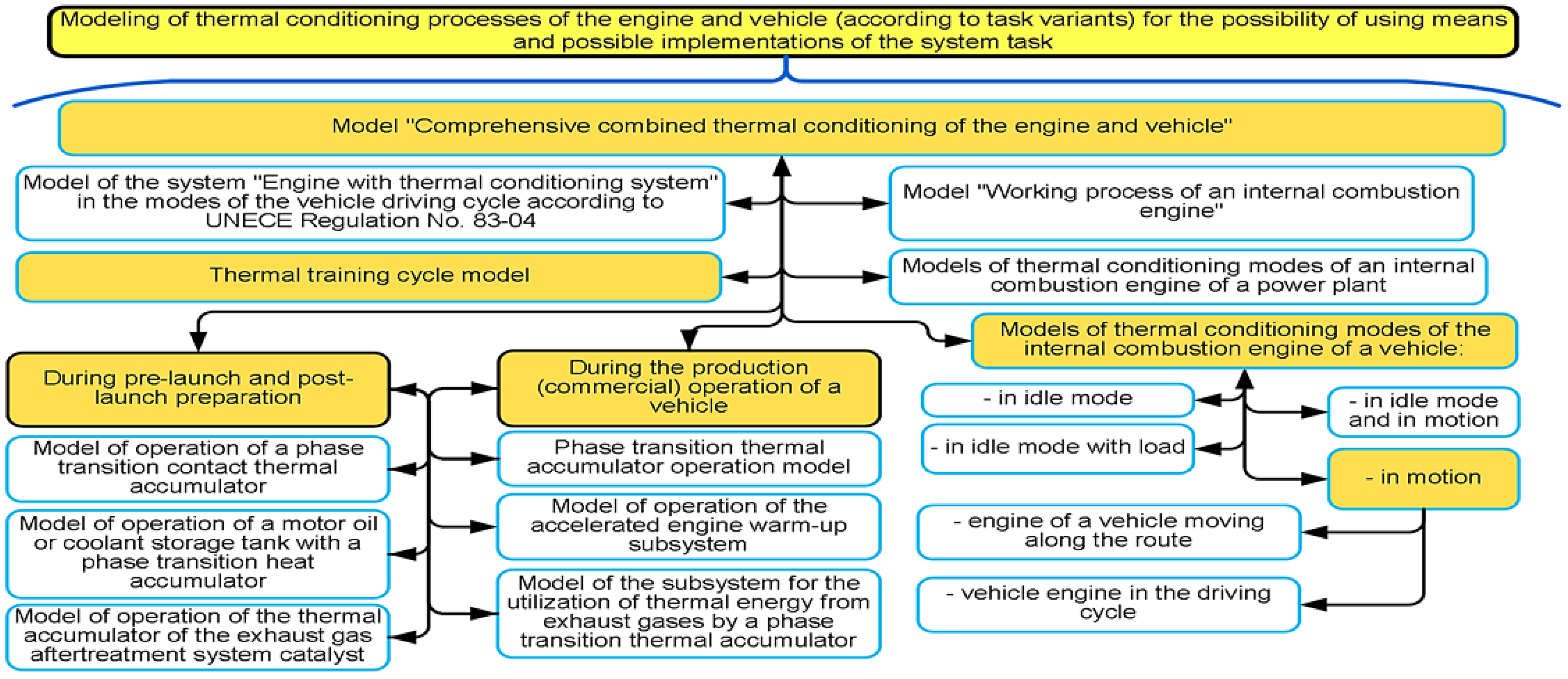
| EVTCP | models of thermal conditioning processes for engines and vehicles |
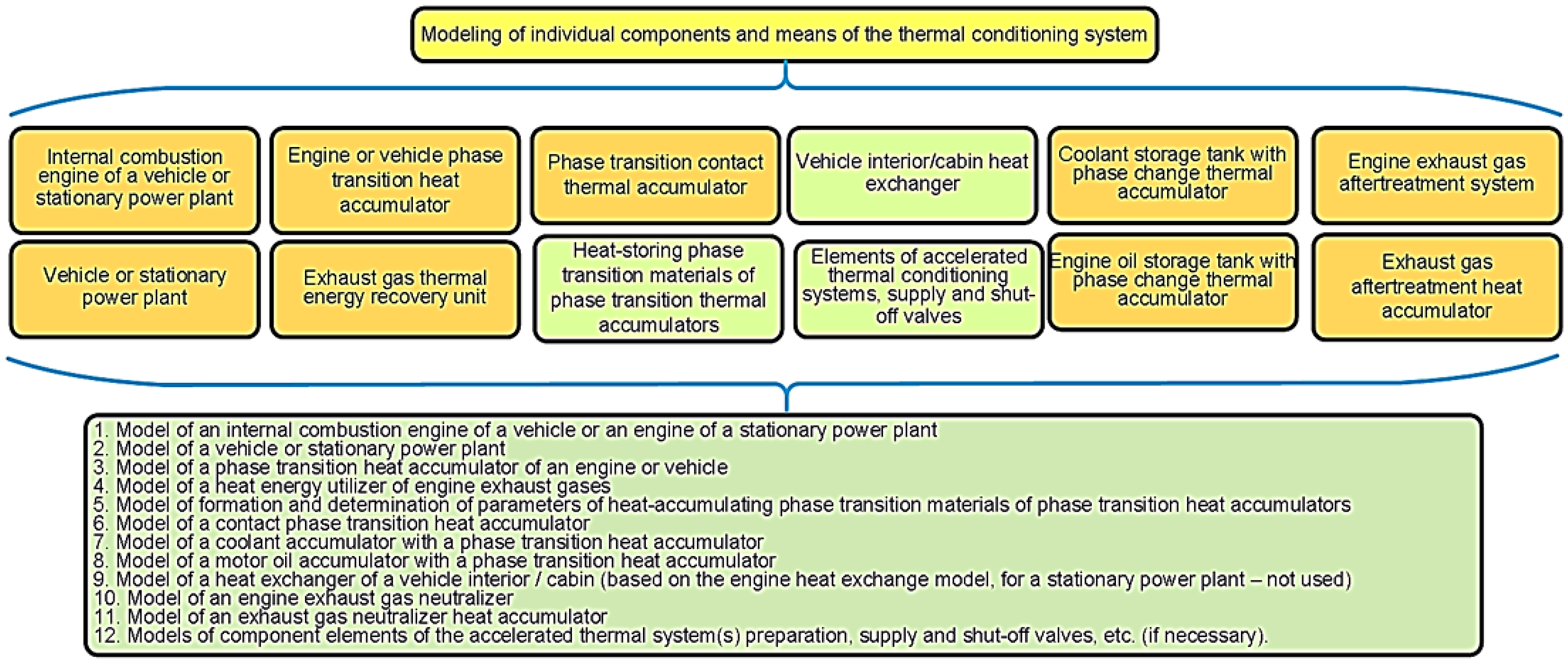
| ICE | model of an internal combustion engine of a vehicle or an engine of a stationary power plant |
| VEH | model of a vehicle or a stationary power plant |
| PCTA | model of a phase change thermal accumulator for an engine or vehicle |
| EGHRU | model of an engine exhaust gas heat recovery unit |
| PCHSM | model for forming and determining the parameters of heat-accumulating phase-change materials for phase-change heat accumulators |
| CTPCTA | model of a contact phase-change heat accumulator |
| CRA | model of a coolant accumulator with a phase change heat accumulator |
| EORA | model of an engine oil accumulator with a phase change heat accumulator |
| PCVC | model of a vehicle interior/cabin heat exchanger (based on the engine heat exchange model, not used for stationary power plants) |
| EEGCC | model of an engine exhaust gas neutralizer |
| TAEGCC | model of an exhaust gas neutralizer heat accumulator |
| CEATP | models of component elements of accelerated thermal conditioning systems, supply and shut-off valves, etc. (as necessary) |
| ETCS | model of the “Engine with thermal conditioning system” in vehicle driving cycle modes in accordance with UNECE Regulations No. 83-04 |
| ICEWP | “Internal combustion engine working process” model |
| TCMPP | models of internal combustion engine thermal conditioning modes of a power plant |
| TCC | thermal conditioning cycle model |
| TCMV | models of internal combustion engine thermal conditioning modes of a vehicle. For vehicle thermal conditioning modes: in idle mode; in idle mode with load; in idle mode and in motion; in motion (for a vehicle traveling on a route and for a vehicle in a driving cycle) |
| TCDE | thermal conditioning models in the pre-start and post-start conditioning processes of the engine and vehicle |
| TCDO | thermal conditioning models in the process of production (commercial) operation of the vehicle; |
| OCTPCTA | model of the operation of a contact phase change thermal accumulator (To models TCDE and TCDO) |
| OPCTA | model of the operation of a phase change thermal accumulator (To models TCDE and TCDO) |
| OEOCR | model of the operation of an engine oil and/or coolant accumulator with a phase change heat accumulator (To models TCDE and TCDO) |
| OEAWS | model of the operation of the engine accelerated warm-up subsystem (To models TCDE and TCDO) |
| OCCTAO | model of the operation of the heat accumulator of the exhaust gas neutralization system catalyst (To models TCDE and TCDO) |
| OEGHRS | model of the operation of the exhaust gas heat energy utilization subsystem with a phase transition heat accumulator (To models TCDE and TCDO) |
Appendix A

| Reference/Research Focus | Digital Twin/Digital Prototype | PCM/Thermal Energy Storage | Experimental Validation | Limitations Relative to the Proposed Study |
|---|---|---|---|---|
| [19]/Review of PCM applications for vehicle thermal buffering | No | Yes | No (review) | No digital twin architecture and no intelligent control of engine thermal conditioning |
| [20]/PCM-based preheating of LPG evaporator and regulator | No | Yes | Yes | Local thermal solution for a single component without system-level integration |
| [21]/PCM heat storage system for diesel engine warm-up | No | Yes | Yes | Experimental PCM system without predictive digital modelling |
| [22]/Vehicle warm-up improvement using PCM thermal storage | No | Yes | Yes | No digital twin integration and no predictive thermal control |
| [23]/PCM heat storage for hybrid engine warm-up | No | Yes | Yes | PCM-based thermal storage studied separately from digital twin architecture |
| [24]/Battery digital twin for smart battery management | Yes | No | Conceptual/analytical | Digital twin applied to batteries, not to engine thermal conditioning |
| [25]/Cloud-based digital twin battery management system | Yes | No | Yes | Focus on battery systems rather than vehicle thermal conditioning |
| [15]/Review of digital twin applications in engineering | Yes (review) | No | No | No focus on thermal conditioning or transport energy systems |
| [26]/Digital twin for EV thermal conditioning | Yes | No | Yes | Focus on electric vehicles without PCM thermal storage |
| [27]/Digital prototype for EV thermal system design | Partial | No | Conceptual | Concept-phase modelling without real-time digital twin architecture |
| [28]/Digital twin for cooling system condition monitoring | Yes | No | Yes | Focus on monitoring rather than intelligent thermal conditioning |
| [29]/Multiphysics digital twin for electric motor thermal analysis | Yes | No | Yes | Motor-focused system without integration with engine thermal conditioning |
| [30]/Predictive digital twins for thermal systems | Yes | No | Simulation | Does not consider PCM-based thermal storage for engine systems |
Appendix B
Appendix B.1
- Pre-start thermal conditioning of the engine begins with the discharge of the phase change thermal storage unit. At this stage, the thermal storage material has fully accumulated heat at temperature T_PCM, which is defined by the initial material parameters.
- The internal combustion engine is automatically started when the coolant temperature in the cooling system and the engine oil temperature in the lubrication system reach the specified threshold. At this temperature, load acceptance becomes possible in accordance with the manufacturer’s specifications and initial operating parameters.
- The engine is started and operates in steady idle mode. Idle operation occurs at n_idle = 700–800 min−1 under a specified ambient temperature, which is defined by the initial conditions of the digital twin simulation.
- Idle operation continues until complete charging of the phase change thermal storage unit is achieved. At this stage, the required temperature T_PCM is reached and defined as an output parameter of the thermal storage material in the digital twin model.
- Based on monitoring results of coolant and engine oil thermal parameters, the operation of the internal combustion engine with the thermal conditioning system under various ambient temperature conditions is assumed to follow the measured thermal behavior.
Appendix B.2
- The thermal state of the engine with the thermal conditioning system is evaluated based on the time-dependent temperature of components in contact with coolant and engine oil.
- Operation of the phase change thermal storage unit and the heat recovery system under different ambient temperatures is assumed to be identical when internal system parameters are constant and depends only on thermal insulation.
- Heat losses from pipelines to the environment during charging and discharging are considered negligible. Therefore, coolant and oil temperatures at the inlet of the thermal storage unit are assumed equal to their outlet temperatures from the engine, and vice versa.
- Similarly to Assumption 3, heat losses from the thermal storage unit during discharge and heat losses to adjacent engine components are neglected.
- Heat transfer coefficients (convection, conduction, heat transfer) and specific heat capacities in the thermal storage unit and thermal conditioning system are assumed constant and independent of temperature. Heat transfer coefficients in all heat exchanger circuits are considered equal.
- At the initial time τ = 0 during discharge, the thermal storage material is assumed to be in a liquid state with uniform temperature T_PCM throughout the storage volume. During charging, it is assumed to be in a solid state.
- During forward and reverse phase transitions, the material undergoes crystallization–melting–crystallization and melting–crystallization–melting processes. Phase boundaries are well-defined, the temperature field in the growing phase is linear, and the temperature of the disappearing phase equals the phase transition temperature. Longitudinal thermal conductivity is neglected.
- The phase transition process is considered one-dimensional. Phase boundaries retain cylindrical geometry and remain concentrically aligned with heat exchanger walls.
- Each heat exchanger circuit is modeled as a thin wall with thickness much smaller than its diameter. Heat transfer is therefore approximated using a flat-wall model, with wall thermal resistance taken into account.
- All heat exchanger elements are arranged as series-parallel cylindrical surfaces with identical radial thickness. Heat transfer coefficients are assumed equal in all circuits. Phase transition processes are assumed to occur synchronously in all circuits, resulting in identical temperature fields, wall temperatures, and heat flux densities at any time τ.
- Heat exchange between the thermal storage material and its encapsulation is assumed uniform over the entire surface. The same applies to external insulation and the surrounding environment. Heat losses through joints are considered negligible.
Appendix C. Main Technical Specifications
Appendix C.1
- Diesel type—K-461M1
- Number of cylinders—6
- Piston diameter, mm—120
- Piston stroke, mm—140
- Firing order—1-5-3-6-2-4
- Direction of crankshaft rotation—Counter-clockwise,as viewed from the flywheel side
- Power, kW (hp): rated—84.5 (115)maximum for one hour—93 (126)
- Crankshaft speed at rated power, min−1—1500
- Minimum stable idle speed, min−1—700
- Valve timing phases, deg (crankshaft rotation):intake valve opening before TDC—45 ± 8intake valve closing after BDC—45 ± 8exhaust valve opening after TDC—45 ± 8exhaust valve closing after BDC—45 ± 8
- Fuel injection advance angle before TDCduring compression stroke, deg (crankshaft rotation)—17–20
Appendix C.2
- Weight of the vehicle with a driver, kg—1500
- Maximum speed, km/h—205
- Fuel type—petrol
- Number/arrangement of engine cylinders—4/inline
- Engine displacement, l—1.975
- Diameter of cylinder/piston stroke, mm—82/93.5
- Compression ratio—10.1
- Engine power, kW/crankshaft rotation speed, min−1—105/6000
- Torque, N·m/crankshaft rotation speed, min−1—186/4600
- Number of inlet/exhaust valves per cylinder—2/2
- Exhaust gases cleaning system—three-component catalytic converter
- Gearbox ratios—3.308, 1.962, 1.257, 0.976, 0.778
- Final drive ratio—4.188
- Wheel rolling radius, m—0.285
Appendix C.3
- Type—Two-axle cargo vehicle (truck)
- Payload capacity—4000 kg
- Gross Vehicle Weight (GVW)—5940 kg
- Length—5806 mm (with winch)
- Width—2322 mm
- Height over canopy (unladen)—2520 mm
- Height over cab (at gross weight)—2490 mm
- Wheelbase—3300 mm
- Ground clearance—315 mm
- Front wheel track—1800 mm
- Rear wheel track—1750 mm
- Turning radius—9.5 m
- Fording depth (at bottom)—0.8 m
- Engine—ZMZ-66-06, eight-cylinder, four-stroke, liquid-cooled
- Displacement—4254 cm3
- Power—120 hp
- Transmission (Gearbox)—4-speed manual with synchronizers on 3rd and 4th gears
- Transfer case—With reduction gear and disconnectable front axle
- Drive—Rear-wheel or All-wheel drive
- Wheels—Special with split rim and side ring 8.00–18; tires 12.00–18
- Tire pressure—0.5–3 kg/cm2
- Maximum speed (at gross weight)—90 km/h
- Fuel tank capacity—210 L
- Control fuel consumption, L/100 km (at 60 km/h)—20
- Fuel grade—Petrol A-72, A-76, AI-80
- Battery capacity—75 Ah
- Maximum alternator current—85 A
References
- Heywood, J.B. Internal Combustion Engine Fundamentals, 2nd ed.; McGraw-Hill: New York, NY, USA, 2018. [Google Scholar]
- Reitz, R.D.; Duraisamy, G. Review of high-efficiency and clean combustion strategies for internal combustion engines. Prog. Energy Combust. Sci. 2015, 46, 12–71. [Google Scholar] [CrossRef]
- Guzzella, L.; Onder, C. Introduction to Modeling and Control of Internal Combustion Engine Systems; Springer: Berlin/Heidelberg, Germany, 2010. [Google Scholar] [CrossRef]
- Previati, G.; Mastinu, G.; Gobbi, M. Thermal conditioning of Electrified Vehicles—A Review. Energies 2022, 15, 1326. [Google Scholar] [CrossRef]
- Dan, D.; Zhao, Y.; Wei, M.; Wang, X. Review of Thermal conditioning Technology for Electric Vehicles. Energies 2023, 16, 4693. [Google Scholar] [CrossRef]
- Suzuki, T.; Oguri, Y.; Yoshida, M. Heat Transfer in the Internal Combustion Engines. In Proceedings of the SAE 2000 World Congress; SAE Technical Paper 2000-01-0300; SAE International: Warrendale, PA, USA, 2000. [Google Scholar] [CrossRef]
- Stone, R. Introduction to Internal Combustion Engines, 4th ed.; Palgrave Macmillan: London, UK, 2012. [Google Scholar]
- Hagena, J.; Filipi, Z.; Assanis, D. Transient Diesel Emissions: Analysis of Engine Operation During a Tip-In. In Proceedings of the SAE 2006 World Congress & Exhibition; SAE Technical Paper 2006-01-1151; SAE International: Warrendale, PA, USA, 2006. [Google Scholar] [CrossRef]
- Moradi, J.; Andwari, A.M.; Könnö, J.; Gharehghani, A.; Pesyridis, A. Waste Heat Recovery Technologies in Modern Internal Combustion Engines. Future Energy 2024, 3, 49–54. Available online: https://fupubco.com/fuen/article/view/177 (accessed on 21 March 2026). [CrossRef]
- Philippine, J.; Des Buttes, A.G.; Jeanneret, B.; Trigui, R.; Deneve, F.; Pereyron, F. Engine Cooling System Optimization for Fuel Consumption Reduction. In Proceedings of the 2019 IEEE Vehicle Power and Propulsion Conference (VPPC), Hanoi, Vietnam, 14–17 October 2019; IEEE: New York, NY, USA, 2019; pp. 1–6. [Google Scholar] [CrossRef]
- Farid, M.M.; Khudhair, A.M.; Razack, S.A.K.; Al-Hallaj, S. A review on phase change energy storage: Materials and applications. Energy Convers. Manag. 2004, 45, 1597–1615. [Google Scholar] [CrossRef]
- Zhou, D.; Zhao, C.Y.; Tian, Y. Review on thermal energy storage with phase change materials. Appl. Energy 2012, 92, 593–605. [Google Scholar] [CrossRef]
- Muzhanje, A.T.; Hassan, M.A.; Hassan, H. Phase change material based thermal energy storage applications for air conditioning: Review. Appl. Therm. Eng. 2022, 214, 118832. [Google Scholar] [CrossRef]
- Tao, F.; Qi, Q.; Wang, L.; Nee, A.Y.C. Digital twins and cyber-physical systems toward smart manufacturing. Engineering 2019, 5, 653–661. [Google Scholar] [CrossRef]
- Jones, D.; Snider, C.; Nassehi, A.; Yon, J.; Hicks, B. Characterising the Digital Twin: A Systematic Literature Review. CIRP J. Manuf. Sci. Technol. 2020, 29, 36–52. [Google Scholar] [CrossRef]
- Fuller, A.; Fan, Z.; Day, C.; Barlow, C. Digital twin: Enabling technologies and applications, challenges and open research. IEEE Access 2020, 8, 108952–108971. [Google Scholar] [CrossRef]
- Govorushchenko, N.Y.; Turenko, A.N. System Engineering of Transport Vehicle Design: [Tutorial]; KHNAHU: Kharkiv, Ukraine, 2002; 166p. [Google Scholar]
- Kuznetsov, N.; Petukhov, M.; Khaziev, A.A.; Laushkin, A.V. Problem of Accumulation and Freezing of Condensate in the Exhaust Gases of Cars at Low Temperatures. Appl. Mech. Mater. 2016, 838, 47–55. [Google Scholar] [CrossRef]
- Jankowski, N.R.; McCluskey, F.P. A review of phase change materials for vehicle component thermal buffering. Appl. Energy 2014, 113, 1525–1561. [Google Scholar] [CrossRef]
- Gumus, M.; Ugurlu, A. Application of phase change materials to pre-heating of evaporator and pressure regulator of a gaseous sequential injection system. Appl. Energy 2011, 88, 4803–4810. [Google Scholar] [CrossRef]
- Park, S.; Woo, S.; Shon, J.; Lee, K. Experimental study on heat storage system using phase-change material in a diesel engine. Energy 2017, 119, 1108–1118. [Google Scholar] [CrossRef]
- Lee, J.; Lee, J.; Lee, K. Improving Vehicle Warm-Up Performance Using Phase-Change Materials and Thermal Storage Methods. Energies 2024, 17, 4556. [Google Scholar] [CrossRef]
- Kosztyła, T.; Muniak, D.P. Application of a phase-change heat storage for warming-up the internal combustion engine in a hybrid drive system: Simulations and experiment. Energy 2025, 332, 137065. [Google Scholar] [CrossRef]
- Wu, B.; Widanage, W.D.; Yang, S.; Liu, X. Battery digital twins: Perspectives on the fusion of models, data and artificial intelligence for smart battery management systems. Energy AI 2020, 1, 100016. [Google Scholar] [CrossRef]
- Li, W.; Rentemeister, M.; Badeda, J.; Jöst, D.; Schulte, D.; Sauer, D.U. Digital twin for battery systems: Cloud battery management system with online state-of-charge and state-of-health estimation. J. Energy Storage 2020, 30, 101557. [Google Scholar] [CrossRef]
- Shi, J.; Wang, X.; Zhang, Z.; Zhang, C.; Chen, J. Optimization of energy flow in thermal management of electric vehicles based on real vehicle testing and digital twin simulation. Case Stud. Therm. Eng. 2024, 60, 104607. [Google Scholar] [CrossRef]
- Bilal, M.; Petrovich, S.; Ebrahimi, K. Electric Vehicle Thermal System Concept Development for Multiple Variants Using Digital Prototype and AI. Processes 2024, 12, 2314. [Google Scholar] [CrossRef]
- Wang, J.; Huang, Y.; Wei, L.; Wang, X. Research on engine cooling system condition monitoring based on deep digital twin. Proc. Inst. Mech. Eng. Part D J. Automob. Eng. 2026, 240, 1400–1416. [Google Scholar] [CrossRef]
- Wang, Y.; Cheng, Y.; Huang, W.; Li, W.; Cui, S. Dynamic electromagnetic-thermal mapping in motor digital twins: A real-time multiphysics framework. Digit. Eng. 2026, 8, 100082. [Google Scholar] [CrossRef]
- Subramani, T.; Bartscher, S. Predictive Digital Twins for Thermal conditioning Using Machine Learning and Reduced-Order Models. arXiv 2025, arXiv:2505.06849. [Google Scholar] [CrossRef]
- Oró, E.; de Gracia, A.; Castell, A.; Farid, M.M.; Cabeza, L.F. Review on phase change materials (PCMs) for cold thermal energy storage applications. Appl. Energy 2012, 99, 513–533. [Google Scholar] [CrossRef]
- Tao, F.; Liu, W.; Liu, J.; Liu, X.; Liu, Q.; Qu, T.; Hu, T.; Zhang, Z.; Xiang, F.; Xu, W. Digital twin and its potential application exploration. Comput. Integr. Manuf. Syst. 2018, 24, 1–18. [Google Scholar]
- Gritsuk, I.V.; Volkov, V.; Mateichyk, V.; Grytsuk, Y.; Nikitchenko, Y.; Klets, D.; Smieszek, M.; Volkov, Y.; Symonenko, R.; Grytsuk, A. Information Model of V2I System of the Vehicle Technical Condition Remote Monitoring and Control in Operation Conditions. In Proceedings of the WCX World Congress Experience; SAE Technical Paper 2018-01-0024; SAE International: Warrendale, PA, USA, 2018. [Google Scholar] [CrossRef]
- Gritsuk, I.; Volkov, V.; Gutarevych, Y.; Mateichyk, V.; Verbovskiy, V. Improving Engine Pre-Start And After-Start Heating by Using the Combined Heating System. In Proceedings of the SAE 2016 Commercial Vehicle Engineering Congress; SAE Technical Paper 2016-01-8071; SAE International: Warrendale, PA, USA, 2016. [Google Scholar] [CrossRef]
- Gritsuk, I.V.; Mateichyk, V.; Tsiuman, M.; Gutarevych, Y.; Smieszek, M.; Goridko, N. Reducing Harmful Emissions of the Vehicular Engine by Rapid After-Start Heating of the Catalytic Converter Using Thermal Accumulator. In Proceedings of the WCX World Congress Experience; SAE Technical Paper 2018-01-0784; SAE International: Warrendale, PA, USA, 2018. [Google Scholar] [CrossRef]
- Gritsuk, I.; Pohorletskyi, D.; Mateichyk, V.; Symonenko, R.; Tsiuman, M.; Volodarets, M.; Bulgakov, N.; Volkov, V.; Vychuzhanin, V.; Grytsuk, Y.; et al. Improving the Processes of Thermal Conditioning of an Automobile Engine with Petrol and Gas Supply Systems (Vehicle Engine with Petrol and LPG Supplying Systems). In Proceedings of the SAE Powertrains, Fuels & Lubricants Meeting; SAE Technical Paper 2020-01-2031; SAE International: Warrendale, PA, USA, 2020. [Google Scholar] [CrossRef]
- Mateichyk, V.; Saga, M.; Smieszek, M.; Tsiuman, M.; Goridko, N.; Gritsuk, I.; Symonenko, R. Information and analytical system to monitor operating processes and environmental performance of vehicle propulsion systems. IOP Conf. Ser. Mater. Sci. Eng. 2020, 776, 012064. [Google Scholar] [CrossRef]
- Dmytrychenko, M.F.; Mateichyk, V.P.; Gryschuk, O.K.; Tsyuman, M.P. Systems Analysis Techniques for Automotive Engineering; NTU: Kyiv, Ukraine, 2014; 168p. [Google Scholar]
- Aleksandrov, V.D. The Kinetics of Nucleation and Mass Crystallization of Supercooled Liquids and Amorphous Media; Donbass: Donetsk, Ukraine, 2011; 580p. [Google Scholar]
- Karnauhov, N.N.; Pustovalov, I.A.; Yarkin, A.V. Thermal accumulator for maintaining ICE start temperature of construction machinery in winter. Mot. Transp. Enterp. 2010, 11, 45–48. [Google Scholar]
- Kuric, I.; Gorobchenko, O.; Litikova, O.; Gritsuk, I.; Mateichyk, V.; Bulgakov, M.; Klackova, I. Research of vehicle control informative functioning capacity. IOP Conf. Ser. Mater. Sci. Eng. 2020, 776, 012036. [Google Scholar] [CrossRef]
- Parsadanov, I.; Marchenko, A.; Tkachuk, M.; Kravchenko, S.; Polyvianchuk, A.; Strokov, A.; Gritsuk, I.V.; Rykova, I.; Savchenko, A.; Smirnov, O.; et al. Complex Assessment of Fuel Efficiency and Diesel Exhaust Toxicity. In Proceedings of the SAE Powertrains, Fuels & Lubricants Meeting; SAE Technical Paper 2020-01-2182; SAE International: Warrendale, PA, USA, 2020. [Google Scholar] [CrossRef]
- Podrigalo, M.; Klets, D.; Sergiyenko, O.; Gritsuk, I.V.; Soloviov, O.; Tarasov, Y.; Baitsur, M.; Bulgakov, N.; Hatsko, V.; Golovan, A.; et al. Improvement of the Assessment Methods for the Braking Dynamics with ABS Malfunction. In Proceedings of the Brake Colloquium & Exhibition-36th Annual; SAE Technical Paper 2018-01-1881; SAE International: Warrendale, PA, USA, 2018. [Google Scholar] [CrossRef]
- Mills, A.; Farid, M.; Selman, J.R.; Al-Hallaj, S. Thermal conductivity enhancement of phase change materials using a graphite matrix. Appl. Therm. Eng. 2006, 26, 1652–1661. [Google Scholar] [CrossRef]
- Rabczak, S. Free-cooling in seasonal cold accumulator. Int. J. New Technol. Res. 2015, 1, 49–52. [Google Scholar]
- Belik, S.; Dreißigacker, V.; Dieterich, M.; Kraft, W. Thermal Energy Storage Systems: Power-to-Heat Concepts in Solid Media Storage for High Storage Densities. J. Traffic Transp. Eng. 2017, 5, 285–294. [Google Scholar] [CrossRef][Green Version]
- Pyhtya, V.A. Experimental studies of the engine preheating system with a thermal battery. Visnyk SNU im. Volodymyra Dalia [Bull. Volodymyr Dahl SNU] 2010, 6, 246–251. [Google Scholar]
- Liu, X. A New Perspective on Digital Twin-Based Mechanical Design in Industrial Engineering. Innov. Appl. Eng. Technol. 2023, 2. [Google Scholar] [CrossRef]
- Moghtadaei, A. Aircraft Engine Maintenance and Digital Twin Technology in Aircraft Engines. J. Data Anal. Eng. Decis. Mak. 2024, 1, 1–5. [Google Scholar] [CrossRef]
- Gritsuk, I.; Žaglinskis, J. Features of the Data Collection and Transmission Technology in an Intelligent Thermal Conditioning System for Engines and Vehicles Operating on Thermal Energy Storage Technology Based on a Digital Twin. Machines 2026, 14, 130. [Google Scholar] [CrossRef]
- Chen, Y.; Zhou, M.; Zhang, M.; Zha, M. Research on the Construction of Automobile Wheel Hub Intelligent Production Line Based on Digital Twin. Appl. Sci. 2025, 15, 5871. [Google Scholar] [CrossRef]





| Component Identifier | Functional Purpose |
|---|---|
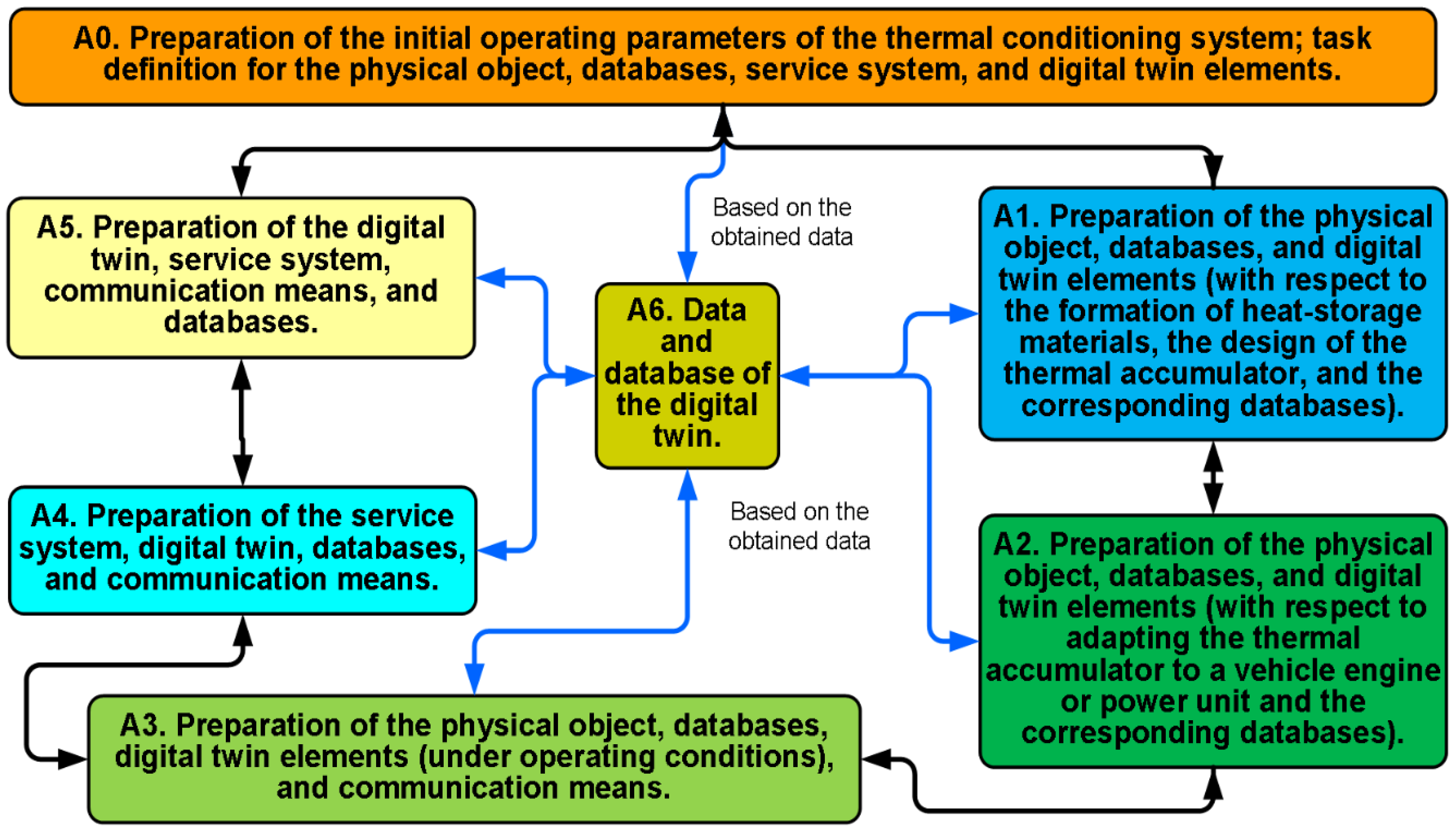
| A0 | Generation of Initial Data and Evaluation of the Operational Efficiency of an Intelligent Thermal conditioning System for Engines and Vehicles Based on a Digital Twin and Thermal Energy Storage Technologies. |
| A1 | Selection and integration of thermal energy storage materials; design of phase-change thermal energy storage units for specified engine and vehicle operating conditions; experimental investigation of materials and system components using laboratory test benches; calculation of PCM mass and structural parameters of the storage units; development of a digital twin database. |
| A2 | Arrangement and installation of thermal energy storage units and components of the thermal conditioning system directly on the engine and vehicle; experimental investigation of the system on power units; updating the digital twin database. |
| A3 | Development of a physical prototype of the thermal conditioning system and its adaptation to real operating conditions of the engine and vehicle. |
| A4 | Development of subsystems for monitoring, diagnostics, and prediction of operating parameters of engines and vehicles equipped with a thermal conditioning system; development and adaptation of virtual software platforms for integration into a digital production environment; organization of continuous condition monitoring of the system. |
| A5 | Development of computational algorithms and software tools; systematization of thermal conditioning system configurations; modeling and analysis based on mathematical models; development of the digital twin database. |
| A6 | Systematization of databases and verification of compliance with design, technological, and operational requirements imposed on the thermal conditioning system, the engine, and the vehicle; implementation of step-by-step interactive optimization procedures. |
| Digital Twin Component | Main Interactions with the Functional Modules of the System | Purpose of the Interaction |
|---|---|---|
| V1—Physical object (engine and thermal conditioning system) | A1, A2, A3, A0 | Development of the physical system configuration, integration of thermal energy storage units, and experimental validation of operating parameters. |
| V2—Digital Twin Model | A5, A4, A1, A2, A3, A0 | Modeling of thermal processes, integration of experimental data and computational algorithms for the analysis and prediction of thermal operating conditions. |
| V3—Digital Twin Data Layer | A6, A4, A5, A1, A2, A3, A0 | Development, organization, and continuous updating of databases containing experimental data, system parameters, and simulation results. |
| V4—Service Layer and Decision Support System | A4, A5, A0 | Data analysis, system condition diagnostics, prediction of operating parameters, and generation of control decisions. |
| V5—Communication Infrastructure | A4, A5, A3, A0 | Data exchange between the physical system, the digital twin, and user interfaces; ensuring synchronization between models and monitoring data. |
| Substance | Melting Temperature, °C | Latent Heat of Fusion, kJ/kg | Thermal Conductivity, W/(m·K) |
|---|---|---|---|
| High-density polyethylene (HDPE), grade T-3 | 130–135 | 200–230 | 0.40–0.50 |
| Paraffin wax (a mixture of alkanes CnH2n+2) | 47–65 (depending on the composition) | 180–220 | 0.20–0.30 |
| Hydroquinone C6H4(OH)2 | 170–173 | 140–160 | 0.20–0.30 |
| Sodium hydroxide (caustic soda, NaOH) | 318–323 | 160–180 | 0.50–0.60 |
| Indicator | Conventional System | Proposed System | Improvement |
|---|---|---|---|
| Engine warm-up time to 85 °C | 9.42–21.89 min | 8–13 min | 17.8–68.4% |
| Fuel consumption during warm-up | 0.16–1.42 kg | 0.135–0.99 kg | 19.5–56.25% |
| Coolant temperature at engine start (at 0 °C ambient temperature) | 0 °C | 50 °C | +50 °C |
| Time required for the catalytic converter to reach operating temperature | 7.3–12.3 min | 5.8–6.13 min | 20.8–50.2% |
| Heating Modes | Savings | From 40 °C to 85 °C | From 50 °C to 85 °C | From 60 °C to 85 °C | |||||||
|---|---|---|---|---|---|---|---|---|---|---|---|
| −5 °C | −10 °C | −20 °C | −5 °C | −10 °C | −20 °C | −5 °C | −10 °C | −20 °C | |||
| 1—idle warm-up | Time saving, | min. | 6 | 8 | 15 | 7 | 12 | 20 | 9 | 15 | 23 |
| % | 22.2 | 17.8 | 24.2 | 25.9 | 26.7 | 32.3 | 33.3 | 33.3 | 37.1 | ||
| Fuel saving, | kg | 0.134 | 0.25 | 0.46 | 0.189 | 0.366 | 0.55 | 0.21 | 0.41 | 0.596 | |
| % | 27.3 | 29.3 | 39.66 | 38.6 | 42.9 | 47.4 | 42.86 | 48.1 | 51.4 | ||
| 2—idle warm-up with activated electrical consumers | Time saving, | min. | 6 | 10 | 17 | 8 | 13 | 21 | 12 | 17 | 29 |
| % | 19.35 | 19.23 | 25.37 | 25.81 | 25 | 31.3 | 38.71 | 32.69 | 43.28 | ||
| Fuel saving, | kg | 0.135 | 0.277 | 0.49 | 0.22 | 0.359 | 0.586 | 0.333 | 0.48 | 0.75 | |
| % | 19.5 | 25.45 | 34.75 | 31.9 | 32.99 | 41.56 | 48.3 | 44.12 | 53.2 | ||
| 3—idle warm-up followed by gradual driving | Time saving, | min. | 7 | 13 | 21 | 10 | 15 | 25 | 13 | 17 | 27 |
| % | 25.9 | 43.3 | 45.65 | 52.6 | 50 | 54.35 | 68.4 | 56.67 | 58.69 | ||
| Fuel saving, | kg | 0.155 | 0.368 | 0.61 | 0.257 | 0.485 | 0.91 | 0.44 | 0.617 | 0.959 | |
| % | 20.75 | 31.2 | 31.9 | 34.4 | 41.2 | 47.6 | 58.9 | 52.38 | 50.21 | ||
| 4—warm-up during driving | Time saving, | min. | 6 | 10 | 17 | 8 | 13 | 22 | 9 | 16 | 25 |
| % | 33.3 | 34.48 | 38.64 | 44.4 | 44.8 | 50 | 50 | 55.17 | 56.8 | ||
| Fuel saving, | kg | 0.192 | 0.369 | 0.66 | 0.247 | 0.478 | 0.81 | 0.347 | 0.53 | 0.99 | |
| % | 27.08 | 32.37 | 37.5 | 34.84 | 41.9 | 46.02 | 48.9 | 46.49 | 56.25 | ||
Disclaimer/Publisher’s Note: The statements, opinions and data contained in all publications are solely those of the individual author(s) and contributor(s) and not of MDPI and/or the editor(s). MDPI and/or the editor(s) disclaim responsibility for any injury to people or property resulting from any ideas, methods, instructions or products referred to in the content. |
© 2026 by the authors. Licensee MDPI, Basel, Switzerland. This article is an open access article distributed under the terms and conditions of the Creative Commons Attribution (CC BY) license.
Share and Cite
Gritsuk, I.; Žaglinskis, J. Digital Twin-Based Intelligent System for Thermal Conditioning of Engines and Vehicles with Phase Change Thermal Energy Storage. Appl. Sci. 2026, 16, 3439. https://doi.org/10.3390/app16073439
Gritsuk I, Žaglinskis J. Digital Twin-Based Intelligent System for Thermal Conditioning of Engines and Vehicles with Phase Change Thermal Energy Storage. Applied Sciences. 2026; 16(7):3439. https://doi.org/10.3390/app16073439
Chicago/Turabian StyleGritsuk, Igor, and Justas Žaglinskis. 2026. "Digital Twin-Based Intelligent System for Thermal Conditioning of Engines and Vehicles with Phase Change Thermal Energy Storage" Applied Sciences 16, no. 7: 3439. https://doi.org/10.3390/app16073439
APA StyleGritsuk, I., & Žaglinskis, J. (2026). Digital Twin-Based Intelligent System for Thermal Conditioning of Engines and Vehicles with Phase Change Thermal Energy Storage. Applied Sciences, 16(7), 3439. https://doi.org/10.3390/app16073439