Article

Inland Water Body Detection Using GNSS-R Observations from FY-3 Satellites

1
College of Geological Engineering and Geomatics, Chang’an University, Xi’an 710054, China
2
State Key Laboratory of Loess Science, Chang’an University, Xi’an 710054, China
3
Key Laboratory of Ecological Geology and Disaster Prevention, Ministry of Natural Resources, Xi’an 710054, China
4
Key Laboratory of Western China’s Mineral Resources and Geological Engineering, Ministry of Education, Xi’an 710054, China
*
Author to whom correspondence should be addressed.
Appl. Sci. 2026, 16(7), 3374; https://doi.org/10.3390/app16073374
Submission received: 11 March 2026 / Revised: 28 March 2026 / Accepted: 29 March 2026 / Published: 31 March 2026
(This article belongs to the Section Earth Sciences)

Abstract

Inland water bodies are vital to the Earth’s ecosystem, global water cycles, and climate regulation. Global Navigation Satellite System Reflectometry (GNSS-R) has emerged as a powerful tool for water detection, particularly with the deployment of the Fengyun-3 (FY-3) E, F, and G satellites. This study proposes an inland water body detection method by integrating the Z-score algorithm with specular point land surface reflectivity (SRsp) derived from FY-3 Level-1 GNSS-R data. Using 2024 observations, the method was validated in the Amazon and Congo basins against optical water body products. The results demonstrate high detection performance, achieving overall accuracies of 95.39% and 97.38% in the two regions, respectively. Analysis of reflectivity expressed in decibels (dB) reveals that while dB-units enhance the detection of small tributaries, they are more susceptible to noise-induced misclassification compared to linear units. Furthermore, a comparative assessment of GNSS constellations shows that multi-system combination significantly reduces noise compared to single-system approaches. Notably, the Galileo system exhibited limited sensitivity to small tributaries due to lower observational density. Sensitivity analyses further reveal that interpolation methods and Z-score threshold selection are important factors influencing detection accuracy. As the first systematic evaluation of FY-3 GNSS-R data for inland water detection, this research provides a critical benchmark for future multi-platform and multi-constellation land surface retrieval studies.

1. Introduction

With the increasing seriousness of global climate change, the monitoring of water resources and water bodies has become an important issue in response to climate change and the protection of the ecological environment [1]. The frequent occurrence of extreme weather events, especially the increase in natural disasters such as heavy rains, floods, and droughts, directly affects the distribution and sustainable use of global water resources. Phenomena such as changes in water levels, melting glaciers, and evaporation of water bodies in arid regions caused by global warming have had a profound impact on the stability of ecosystems and human lives [2,3]. As an important part of the earth’s ecosystem, water bodies affect the global water cycle, climate regulation, and the conservation of species biodiversity. As the impact of climate change on water resources intensifies, monitoring and assessment of water changes has become increasingly important. Traditional water monitoring methods rely on high-precision optical remote sensing images and microwave satellite data [4,5]. However, optical remote sensing data have certain limitations in cloudy and rainy weather and complex surface coverage. Synthetic aperture radar (SAR) can be monitored at all times, but it usually has a long revisit period [6]. In recent years, with the development of remote sensing technology, global navigation satellite system reflectometry (GNSS-R) as a new remote sensing technology has gradually attracted widespread attention.
GNSS-R technology collects L-band signals transmitted by global navigation satellite systems and analyzes the signals reflected from the Earth’s surface to retrieve information such as sea surface wind speed, surface water distribution, and soil moisture [7,8,9,10,11,12,13,14,15]. This technology offers several advantages, including low cost, high spatiotemporal resolution, and all-weather observation capability [16], making it an ideal choice for monitoring water bodies compared with traditional remote sensing techniques. To date, several satellites equipped with GNSS-R receivers have been launched worldwide for scientific research. Among them, the Cyclone Global Navigation Satellite System (CYGNSS) constellation launched by National Aeronautics and Space Administration (NASA) is currently the most widely used spaceborne GNSS-R data source. In 2018, Chew et al. [17] generated flood distribution maps based on CYGNSS data, providing clearer representations of surface saturation and flood inundation with higher spatiotemporal resolution compared with the Soil Moisture Active Passive (SMAP) data. In 2019, Gerlein-Safdi et al. [14] proposed a threshold-based method for detecting water distribution using CYGNSS data and verified its feasibility using Moderate Resolution Imaging Spectroradiometer water products. In the same year, Wan et al. [18] utilized CYGNSS data to monitor flooding during typhoons in southeastern China in 2017, further demonstrating the capability of CYGNSS for surface hydrological monitoring. In 2020, Ghasemigoudarzi et al. [19] investigated flood detection using CYGNSS data combined with six different machine learning algorithms for Hurricanes Harvey and Irma, finding that the method integrated with the RUSBoost algorithm achieved the best overall performance. In 2021, Al-Khaldi et al. [15] proposed a coherent detection algorithm based on delay-Doppler maps (DDMs) from CYGNSS satellites and applied it to inland water detection, achieving a water body recognition rate of over 80% compared with optical data. In the same year, Liu et al. [13] applied this coherent detection method to flood detection in South Asia, with results largely consistent with those obtained from SMAP observations. In 2022, Wang et al. [20] proposed an improved coherent detection method and compared it with optical water products, achieving an accuracy exceeding 90%. For large-scale lake detection, Chang et al. [21] proposed an SNR correction and area-filling method requiring prior boundary information in 2024, achieving an accuracy of approximately 88% in applications over Lake Victoria. In the same year, Zhang et al. [22] proposed using CYGNSS intermediate frequency data to accurately distinguish complex boundaries such as lake–ice and lake–land interfaces. The method was successfully applied to Qinghai Lake detection, improving boundary resolution to 0.7 km with an inversion error of approximately 0.5 km.
The Fengyun-3 (FY-3) satellite series, independently developed by China, is designed for weather forecasting, natural disaster monitoring, and global meteorological services [23,24]. Compared with the commonly used CYGNSS constellation, FY-3 satellites can simultaneously receive reflected signals from the BeiDou System (BDS), Global Positioning System (GPS), and Galileo system. Research on GNSS-R data from FY-3 satellites began with the FY-3E mission, and previous studies have verified the feasibility of using a single FY-3 satellite for soil moisture inversion [25,26,27]. Yang et al. [28] reported that soil moisture retrieved from FY-3 satellite observations improved accuracy by 17.1% compared with the official CYGNSS soil moisture product.
Although GNSS-R data from the FY-3 satellites have been gradually applied to the retrieval of surface parameters, studies using FY-3 GNSS-R data for inland water detection remain lacking. To address this gap, this study proposes, for the first time, the use of GNSS-R data from the FY-3E, FY-3F, and FY-3G satellites to detect inland water bodies using the Z-score method. The proposed approach is applied to detect water bodies in the Amazon Basin and Congo Basin during 2024. In addition, the effectiveness of water body detection using GNSS-R data expressed in both linear and dB units is analyzed and compared. The performance of water body detection based on signals from the GPS, BDS, and Galileo is also evaluated. These analyses provide a useful reference for future research on multi-system and multi-constellation GNSS-R–based water body detection.
The remainder of this paper is organized as follows. Section 2 introduces the datasets and study areas, with an emphasis on the FY-3 GNSS-R observations, while Section 3 presents the Z-score–based inland water detection methodology. Section 4 reports the experimental results and analyzes the impacts of reflectivity representations and GNSS constellations on detection performance, followed by a discussion in Section 5 on influencing factors, methodological strengths and limitations, and future research directions. Section 6 concludes the paper.

2. Materials

2.1. Data

2.1.1. FY-3 Satellites Reflection Data

FY-3 satellites are the second generation of polar-orbiting sun-synchronous meteorological satellites independently developed by China. The primary mission of the FY-3 satellites is to conduct global navigation satellite occultation observations and ocean surface reflection measurements, providing atmospheric and ionospheric parameter profiles, sea surface wind speed products, and high-quality datasets for numerical weather prediction, climate change research, and space weather monitoring [26]. FY-3 satellites are equipped with the Global Navigation Satellite System Occultation Detector II (GNOS-II) instrument, which integrates both GNSS radio occultation and GNSS reflectometry measurements. GNOS-II includes eight reflection channels, enabling simultaneous tracking of L1-band signals from up to eight navigation satellites, including those from the BDS, GPS, and Galileo.
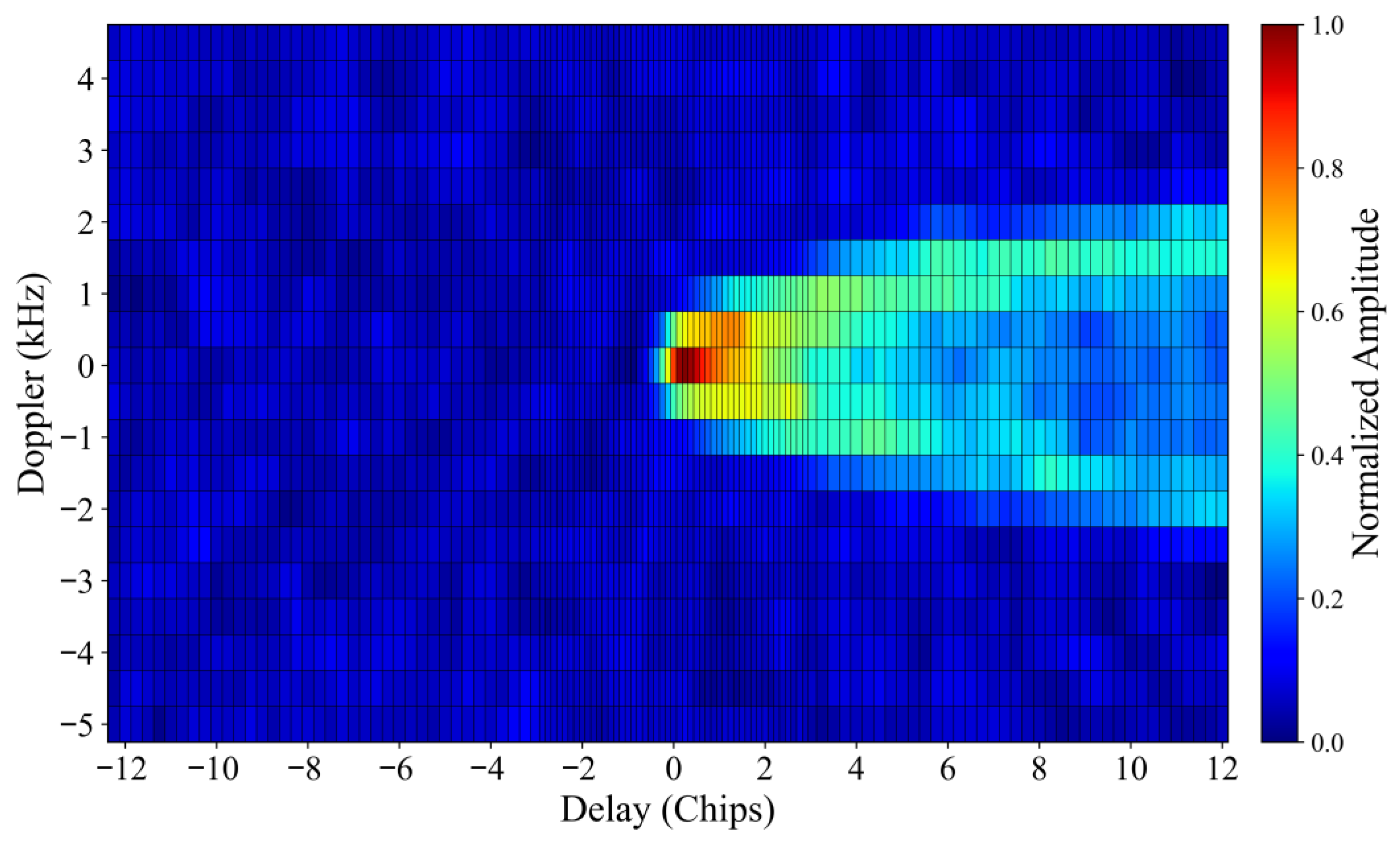
The fundamental measurement of FY-3 L1 data is the raw count DDM, which differs significantly from the uniformly gridded DDMs used in previous GNSS-R missions such as CYGNSS. As illustrated in Figure 1, the FY-3 DDM exhibits a non-uniform structure with dimensions of 122 delay bins × 20 Doppler bins. The Doppler dimension has a resolution of 0.5 kHz, covering a frequency range from −5 kHz to 4.5 kHz. In contrast, the delay dimension features a non-uniform resolution distribution: within the range of −2.875 to 2.875 chips around the specular point, the resolution is 1/8 chip, whereas in the outer regions (−12.25 to 12.125 chips), the resolution decreases to 1/4 chip.
Currently, FY-3 satellites capable of GNSS-R reflectometry measurements have been successfully launched, and their detailed parameters are summarized in Table 1. Among them, FY-3E is the world’s first civilian meteorological satellite operating in a dawn–dusk orbit, primarily designed to fill observational gaps during these periods and equipped with capabilities for low-light imaging and solar activity monitoring. FY-3F continues the morning-orbit mission of FY-3C, enabling refined monitoring of global atmospheric composition and climate change. Fengyun-3G carries China’s first spaceborne dual-frequency precipitation radar, which can detect the three-dimensional structure of precipitation within typhoons and rainstorms in mid- to low-latitude regions. FY-3 satellites operate at different orbital configurations, forming a coordinated observation network that provides near-global coverage and functionally complementary capabilities [29]. The China National Satellite Meteorological Center (NSMC) has publicly released Level-1 reflection data from the FY-3E, FY-3F, and FY-3G satellites. In this study, the reflection data from 2024 are utilized for inland water body identification.

2.1.2. Environmental Systems Research Institute (Esri) Land Cover Data

The Esri 10-m land cover dataset is a global land cover product with a spatial resolution of 10 m, generated using Sentinel-2 imagery and deep learning techniques. The dataset is updated annually and classifies the Earth’s surface into ten basic categories, including water bodies, trees, grasslands, croplands, and built areas. It is openly available to users worldwide [30]. The Esri global land cover product has been validated in previous studies, demonstrating an overall accuracy of approximately 92% for water body classification [31]. Therefore, it is considered a reliable reference dataset for water body detection in this study. To ensure temporal consistency with the FY-3 observations, the 2024 annual dataset was selected. In addition, all non-water land cover types in our two study areas were aggregated into a single “land” category. The data were then resampled to a 0.01° × 0.01° grid to generate a reference water–non-water classification grid with the same spatial resolution.

2.2. Study Areas

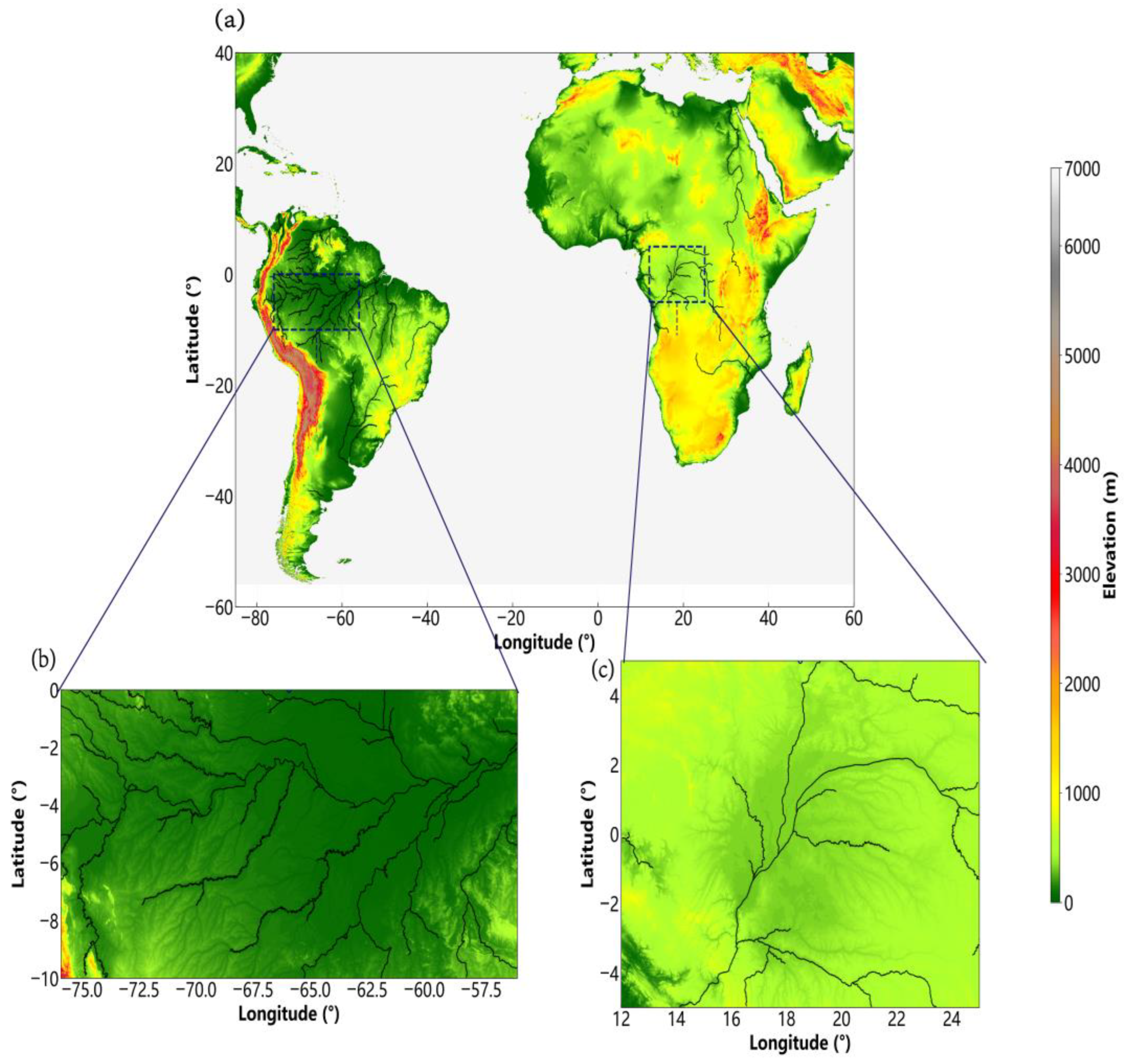
The study areas selected in this research are the Amazon Basin and the Congo Basin, as shown in Figure 2.
The Amazon Basin is the largest watershed system in the world and contains the largest extent of tropical rainforest. Its hydrological system is dominated by the Amazon River and more than 1100 tributaries [32]. The basin accounts for approximately 15–20% of the total global freshwater discharge into the oceans, with a drainage area of about 7.05 million km2 [33]. Due to the vast water coverage, the difficulty of field measurements, and strong evapotranspiration processes in tropical regions, the surface is frequently obscured by persistent cloud cover. These characteristics make the Amazon Basin an ideal experimental region for water body detection using spaceborne GNSS-R technology [34,35]. In this study, the selected region of the Amazon Basin extends from 10 ° S to 0 ° N in latitude and from 76 ° W to 56 ° W in longitude. The topographic distribution of the study area is shown in Figure 2b.
The Congo Basin is the second-largest river basin in the world after the Amazon Basin, covering an area of approximately 3.7 million km2 [36]. The basin drains nearly half of Africa’s freshwater into the Atlantic Ocean through the Congo River. Owing to its symmetrical basin structure across the equator, the Congo River maintains a large and relatively stable discharge, ranking second globally after the Amazon River [37]. In addition, the basin hosts the largest forest ecosystem in Africa and the second-largest tropical rainforest in the world, making its monitoring crucial for maintaining regional and global ecological cycles [38]. The study region of the Congo Basin extends from 5° S to 5° N in latitude and from 12° E to 25° E in longitude. Its topographic distribution is illustrated in Figure 2c.

3. Methods

3.1. Land Surface Reflectivity Derived from GNSS-R Data

Existing studies have shown that the significant difference in GNSS reflected signals between coherent and incoherent scattering can enable the distinction of water bodies from the land surface [14]. Currently, GNSS-R reflectivity is usually calculated using the bistatic radar equation as follows [39]:
P R L coh = P t G t G r R t + R r 2 λ 4 π 2 Γ θ
In the above equation, P R L coh is the coherent scattering received power; R represents right-hand circular polarization (RHCP); L represents left-hand circular polarization (LHCP); P t   represents the signal transmit power; G t represents the transmitter antenna gain; G r represents receiver antenna gain; R t and R r   represent the distance from the transmitter and receiver to the specular reflection point, respectively; λ represents the GNSS signal wavelength; and Γ θ represents the surface reflectivity.
The FY-3 L1 product provides a DDM bistatic radar cross-section (BRCS) factor, expressed as [40]:
F = λ 2 P t G t G r 4 π 3 R t 2 R r 2
Substituting Equation (2) into Equation (1) can obtain the GNSS-R surface reflectivity of the FY-3 satellites:
Γ θ = R r + R t 2 P R L coh F R t 2 R r 2 4 π
At present, the FY-3 L1 product directly provides the reflectivity calculated by the power value of the specular reflection point, which is expressed by the variable “DDM/ddm_sp_reflectivity”. For simplicity, in the following context we use SRsp to refer to it. Previous GNSS-R studies mostly used the reflectivity calculated by peak point power value, so we also extracted the peak reflectivity for study, and SRpeak is used hereinafter to refer to it. It should be noted that we used all the GNSS-R data from BDS, GPS and Galileo systems for reflectivity calculation and inland water body detection.
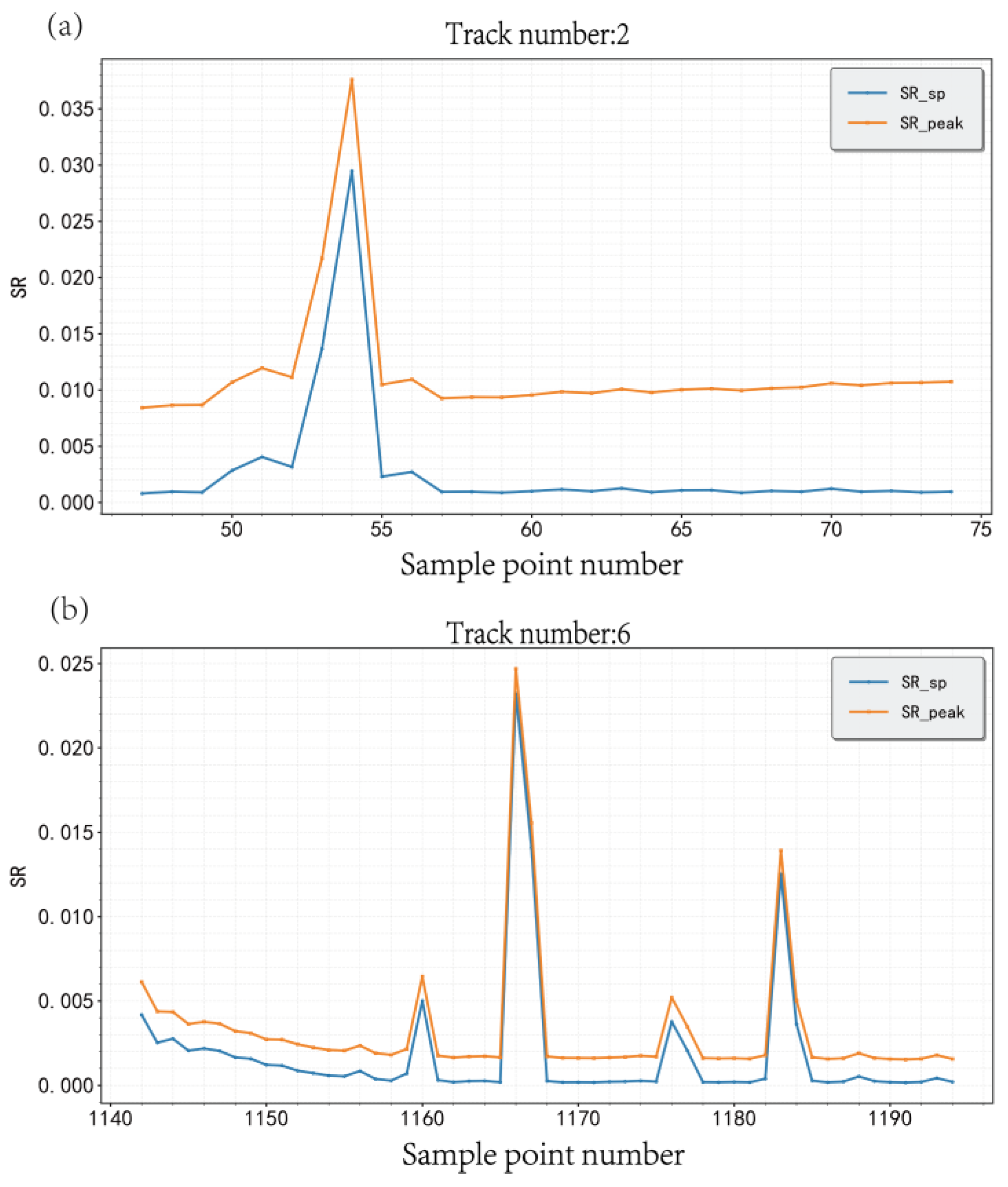
We used two trajectories of the FY-3E L1 product in the 2024 as examples, and extracted the reflectivity of the corresponding sample points for comparison. As shown in Figure 3, the SRpeak is slightly higher than the SRsp across all sample points. This is because, during GNSS-R data sampling, the peak power in the DDM typically does not coincide exactly with the specular point. Instead, the peak power generally represents the synthetic signal from a specific scattering region as measured by the receiver. Consequently, the peak power tends to exceed the power at the specular point, leading to higher SRpeak values compared to SRsp. Our results indicate that water detection based on SRpeak and SRsp achieves nearly identical performance, with differences in overall accuracy of less than 0.1%, suggesting no substantial advantage of SRpeak over SRsp. From a physical perspective, SRsp more directly represents the reflection characteristics at the specular point and thus has clearer physical interpretability in characterizing GNSS-R surface scattering properties. Therefore, subsequent analyses in this study are conducted using only SRsp derived from the FY-3E, FY-3F, and FY-3G L1 products in 2024 for water detection in the Amazon and Congo basins.

3.2. Reflectivity Gridding

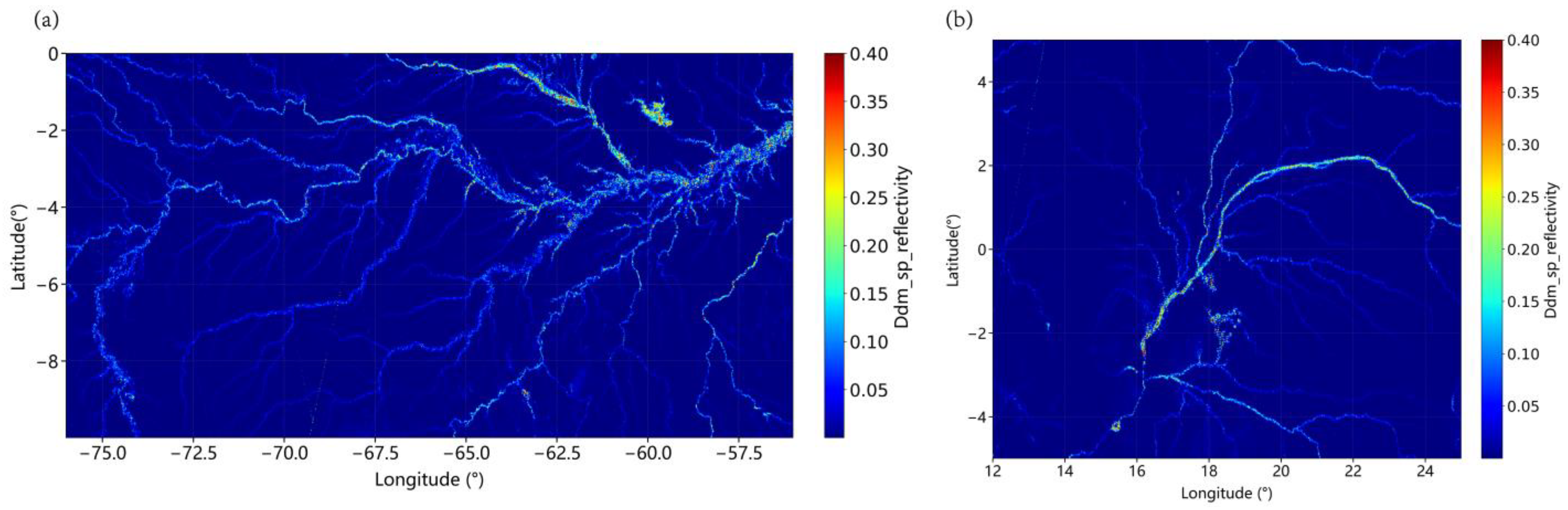
Since the FY-3 satellites record discrete reflection point information, it is necessary to grid the point data to facilitate subsequent water body detection. We used a grid size of 0.01°, and took the mean value of multiple GNSS-R reflectivity falling within the same grid over a period of one year as the reflectivity of that grid. The gridding results indicate that approximately 30% of the grid cells in the two study areas lack specular reflection points; however, these gaps are spatially dispersed and do not form large continuous regions. To ensure spatial continuity, a nearest-neighbor interpolation method was applied to fill the missing grid cells. Specifically, for each target grid without valid observations, the reflectivity value of the nearest grid cell with available data was assigned based on spatial proximity. This approach preserves the overall spatial patterns of the reflectivity in study areas to the greatest extent. Figure 4 shows the surface reflectivity map of SRsp after gridding and nearest-neighbor interpolation, and it can be seen that the reflectivity of the main stream and tributary water bodies is significantly higher than the land in both the Amazon and Congo basins. The significant difference between the two is the basis for water detection using GNSS-R surface reflectivity.

3.3. Z-Score Method

In this paper, the Z-score method is used for water body identification. The Z-score method is used to measure the degree of deviation between a single data point and the mean of the dataset, measured in standard deviations, using the formula [41]:
z = x μ σ
μ = 1 N i = 1 N x i
σ = 1 N i = 1 N ( x i μ ) 2
where x is the reflectivity value of a single pixel grid, μ is the mean value of the grid data, σ is the standard deviation of the grid reflectivity and N denotes the total number of grids.
Given a predefined threshold for the Z value, if the Z-score of the reflectivity within a grid cell exceeds the threshold, the cell is classified as water; otherwise, it is classified as non-water. The Z-score has been widely applied in remote sensing-based flood mapping, and its feasibility has been validated in previous studies [42,43]. In Z-score-based flood mapping approaches, the selection of the detection threshold directly affects the accuracy of water body identification. The threshold used in this study is informed by the core findings of Swetnam et al. [44] and Ta et al. [42]. Swetnam et al. [44] developed the Ecosystem Moisture Stress Index (EMSI) and defined |z| = 1.0 as the baseline threshold indicating deviation from the normal surface state. Similarly, Ta et al. [42] applied the Z-score method for flood mapping and evaluated three candidate thresholds (−1.50, −1.00, and −0.50). Using overall accuracy as the evaluation metric, they empirically determined −1.00 to be the optimal threshold, achieving the best balance between false positives and missed detections during the transition from “non-water” to “water”. Therefore, this study adopts z = 1.0 as the threshold for distinguishing water from non-water surfaces. In this study, SRsp are combined with Z-score method to perform water-land classification.

3.4. Accuracy Assessment

Using Esri land cover data as a reference, the confusion matrix (Table 2) is used to evaluate the water identification results. In addition, the ratio of correctly identified samples to the total number of samples, namely the overall accuracy, is used to evaluate the accuracy of the overall identification:
A c c u r a c y = TP + TN TP + FN + FP + TN

3.5. Inland Water Identification Steps

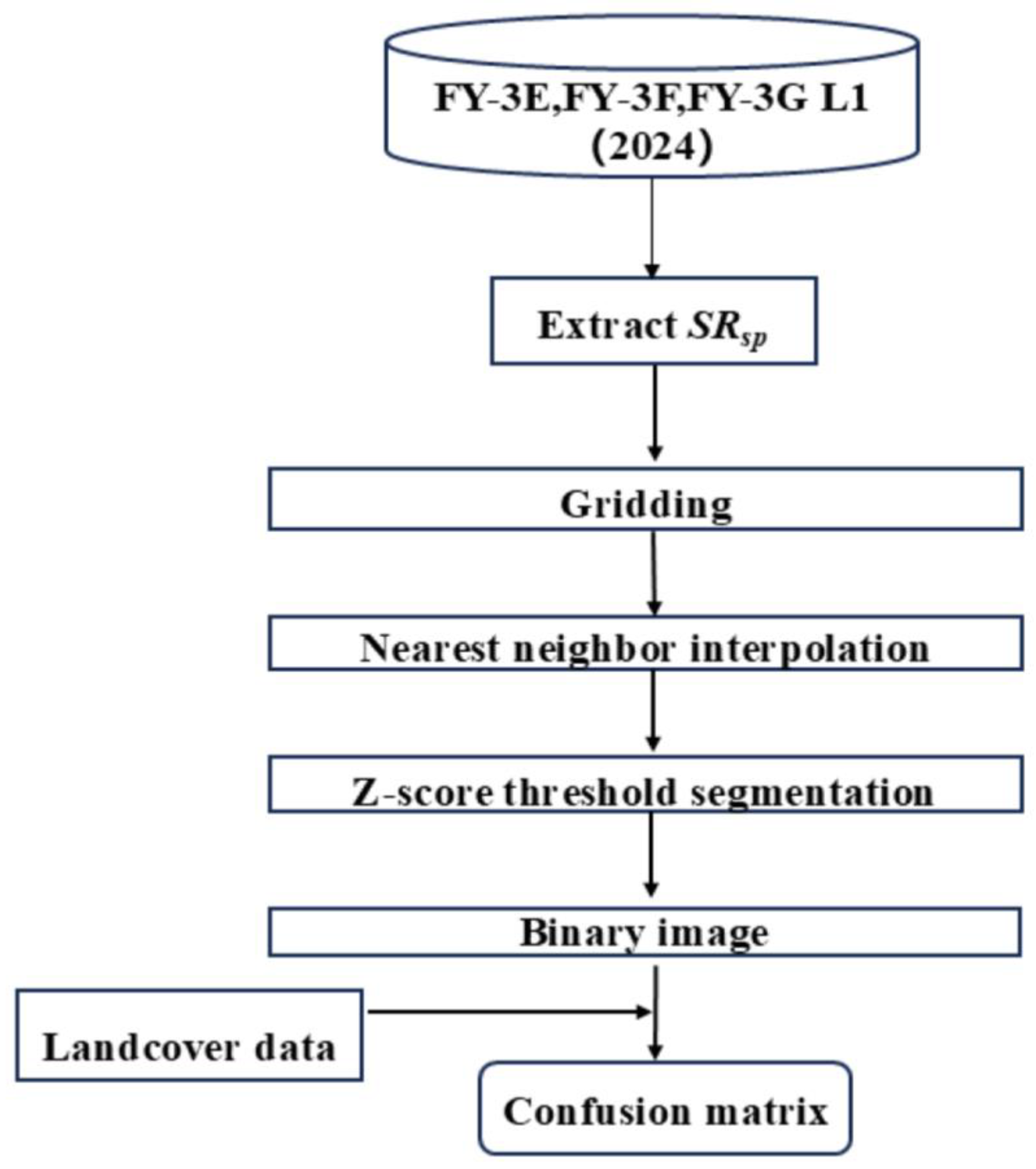
Based on the Z-score method combined with the reflectivity derived from FY-3 GNSS-R data, this paper verifies its ability in water detection, and generates binary images of water bodies with spatial resolution grids of 0.01° × 0.01° respectively using SRsp as water indicators. The process steps of water body detection are shown in Figure 5, and the main steps are divided into: 1. surface reflectivity extraction, 2. reflectivity gridding, 3. nearest interpolation of no data grid, 4. binary segmentation by Z-score method combined with two water indicators, and 5. accuracy evaluation compared with reference data.

4. Results

4.1. Water Body Detection Results in the Amazon Basin and the Congo Basin

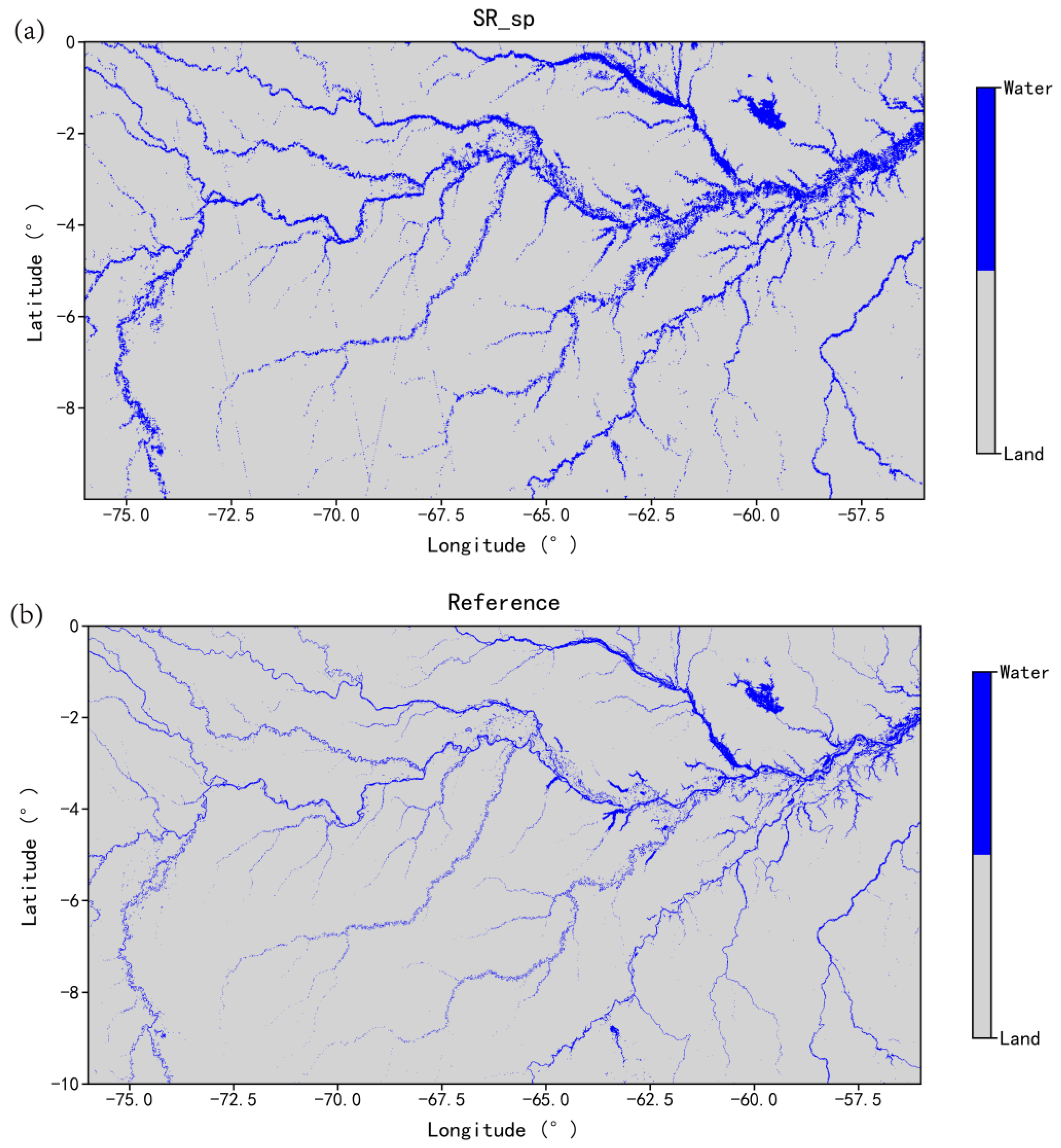
Using the gridded SRsp from 2024, the Z-score method was applied to detect water bodies in the Amazon Basin. The confusion matrix and overall accuracy were then calculated using the Esri land cover data in 2024 as a reference. The results are shown in Table 3. As can be seen from Table 3, the overall accuracy of the water detection results is 95.39%. Specifically, the false positive rate (land misclassified as water) is relatively low, while the false negative rate (water misclassified as land) is slightly higher. Figure 6 presents the water distribution in the Amazon Basin derived using SRsp, along with the reference water bodies based on Esri land cover data. As shown in Figure 6, SRsp effectively captures the main stream and main tributaries within the basin, although the detected water bodies appear wider than the reference water bodies. The main reason is possibly that the reflected GNSS signal is in the L-band, which has strong penetration capability. Compared with the optical imagery-based Esri land cover data, the GNSS-R data can detect rivers beneath the rainforest canopy. On the other hand, the continuity of small tributaries identified is poor. This may be due to insufficient FY data at present, resulting in many empty grids during gridding, which makes some river segments unrecognizable. This could also be the reason for the relatively high false negative rate in the results of this study. As interpolation methods and threshold selection are key steps in data processing, their impacts on water detection results warrant further quantitative analysis, which are analyzed in the Discussion section.
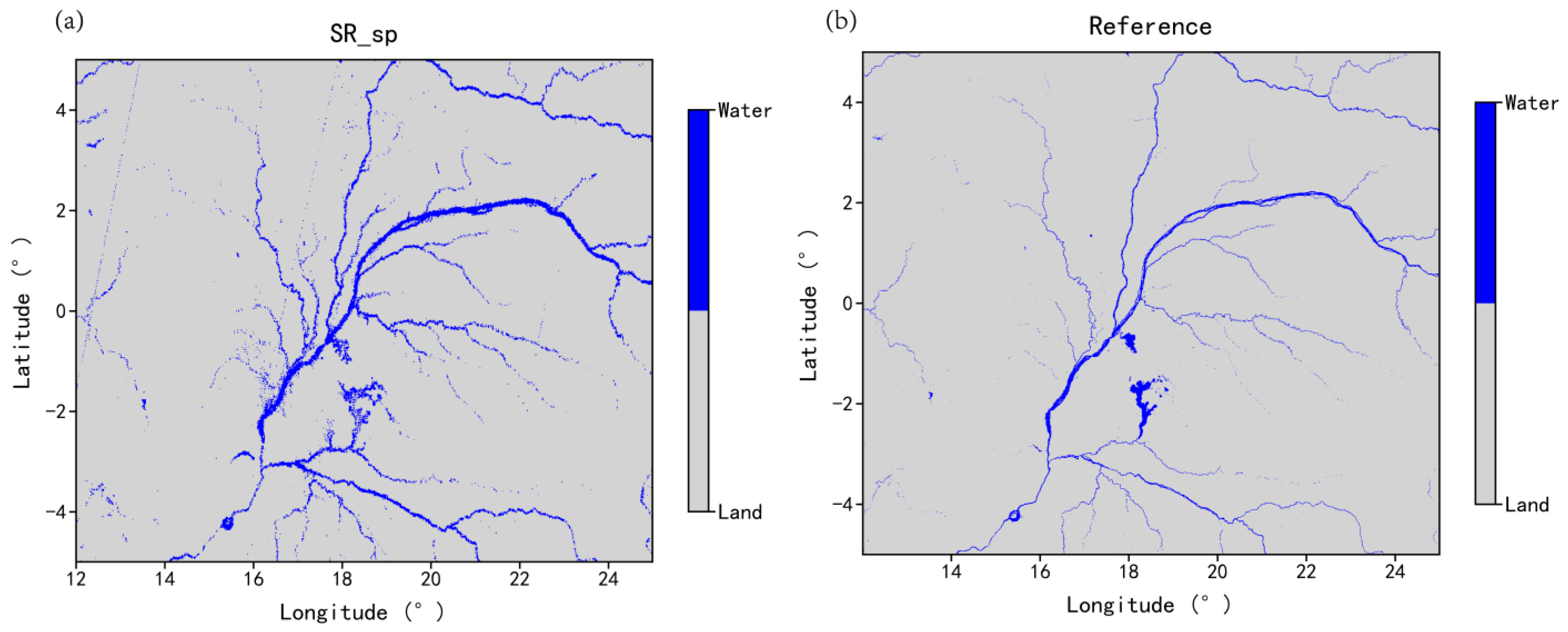
Similarly, in the Congo Basin, the gridded SRsp reflectivity from 2024 were used to detect water bodies using the Z-score method. The confusion matrix and overall accuracy were then calculated using the Esri land cover data as a reference. As shown in Table 3, the overall accuracy of the SRsp detection results reaches 97.38%. It is worth noting that the water body detection performance in the Congo Basin is better than that of the Amazon Basin. The probable reason is that the terrain of the Congo Basin is flatter and the small tributaries are less disturbed than the Amazon Basin, and the reflected signal is less disturbed. Figure 7 shows the detection results and the reference water bodies derived from the land cover data in the Congo Basin. Similar to the results of the Amazon Basin, mainstream and large tributaries are correctly identified but rivers are wider, while smaller tributaries have breakpoints. In general, the GNSS-R reflectivity combined with Z-score method has achieved good water body detection results in both the Amazon Basin and the Congo Basin, indicating the good ability of FY-3 satellites for inland water detection.

4.2. Inland Water Body Detection Using Reflectivity in dB Units

The reflectivity SRsp used for above water detection are expressed in linear units. The reflectivity can be converted to dB units from Equation (3) as follows:
Γ θ = P R L coh F 20 log 10 R r 20 log 10 R t 10 log 10 4 π + 20 log 10 R t + R r
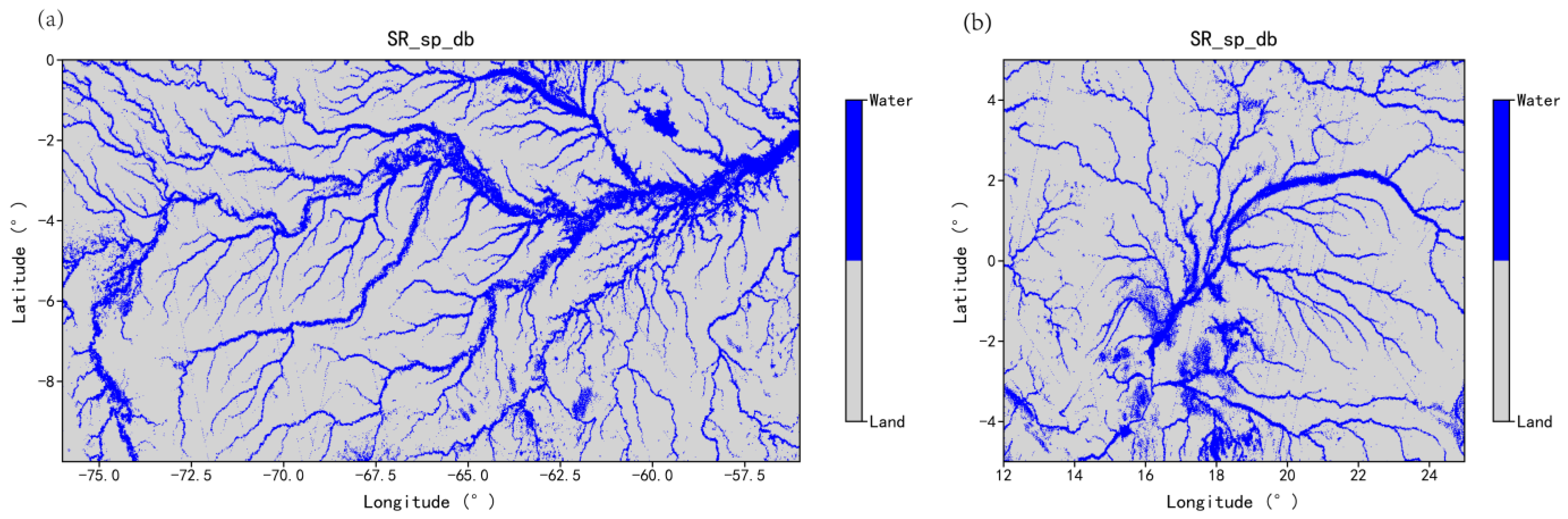
We converted the specular point reflectivity SRsp expressed in linear units to decibel (dB) units, after which the Z-score method was applied for water body detection. The statistical results are summarized in Table 4. In the Amazon Basin and the Congo Basin, the overall accuracy of water body detection using SRsp_db (dB units) reached 86.72% and 88.14%, respectively. Compared with the detection results obtained using reflectivity in linear units (Table 3), the overall accuracy decreased by 8.67% in the Amazon Basin and by 9.24% in the Congo Basin. Notably, although water detection based on SRsp_db has a lower false negative rate, it results in a higher false positive rate. As illustrated in Figure 8, reflectivity expressed in dB units can identify more tributary details within the watershed than reflectivity in linear units, thereby reducing omission errors for small water bodies. This phenomenon can be explained by the characteristics of the unit conversion. When reflectivity is transformed from linear to dB units, the relative differences in reflectivity values are amplified. However, this transformation also makes noise located between different surface categories more difficult to distinguish. As a result, a considerable amount of land adjacent to river channels is incorrectly classified as water. This occurs because SRsp_db is more sensitive to variations in terrestrial soil moisture. In addition, the gridded data exhibit spatial continuity, meaning that water grids along rivers create spatial correlations with surrounding land grids within a certain neighborhood. This effect becomes particularly pronounced in areas with complex river morphology, such as tributaries and meanders, where neighborhood influences are further amplified.
Overall, although reflectivity expressed in both linear and dB units can be used with the Z-score method to distinguish water from non-water surfaces, the SRsp_db results exhibit significant false positives, whereas the detection results obtained using SRsp in linear units tend to omit smaller tributaries.

4.3. Water Body Detection for Different GNSS Systems

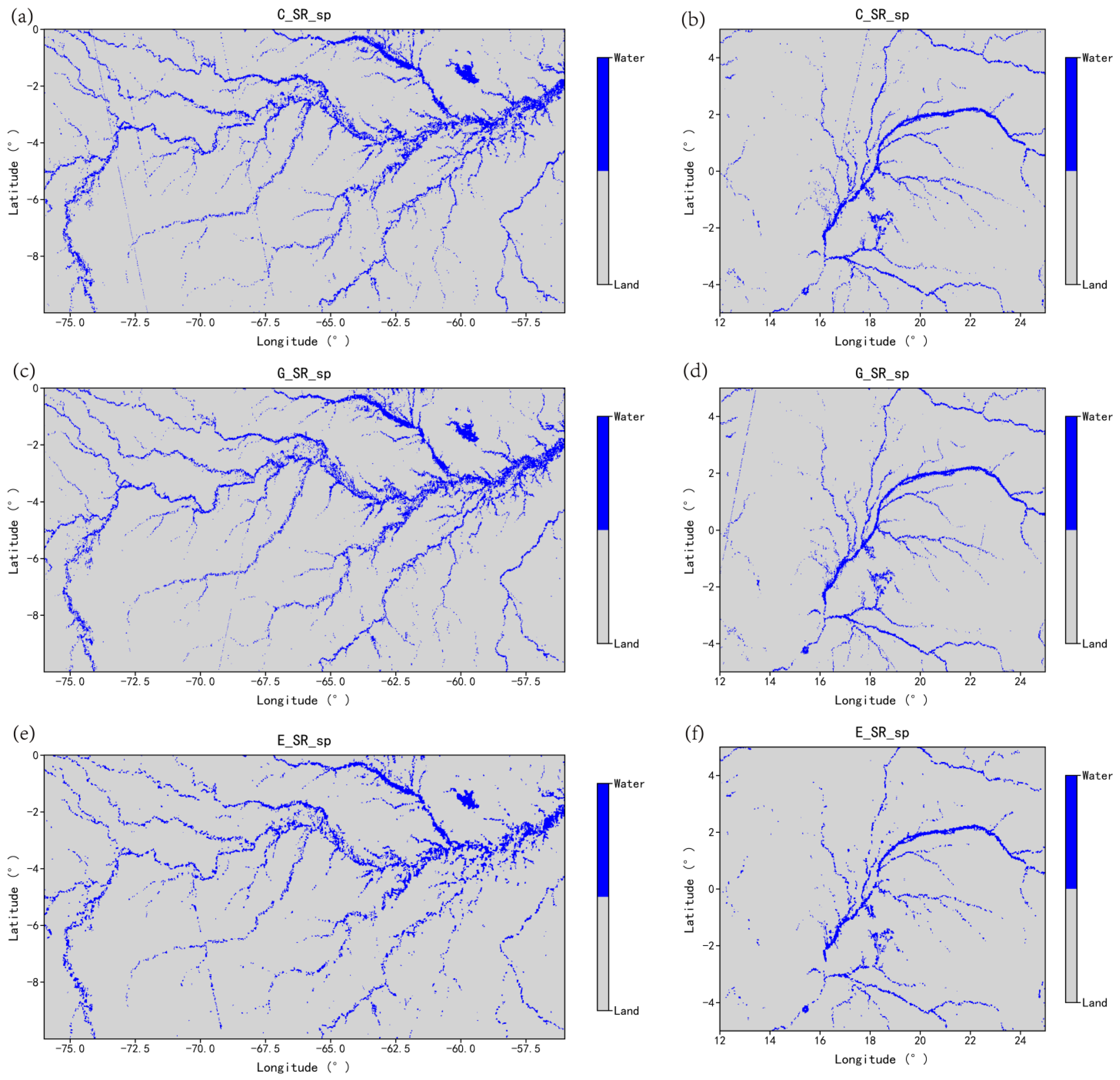
The FY-3 satellites receive reflected signals at L1 frequency band from three GNSS constellations: BDS, GPS, and Galileo. The detection results presented above are derived from the combined observations of these multiple GNSS constellations. To evaluate the detection performance of individual systems, the specular point reflectivity from each GNSS constellation was separately used for water body detection based on the Z-score method. Detection results for the three systems were obtained for the Amazon Basin and the Congo Basin, and the corresponding accuracy statistics are summarized in Table 5. The results indicate that the overall detection accuracies of the BDS, GPS, and Galileo systems reach approximately 95% in the Amazon Basin and 97% in the Congo Basin. However, compared with the multi-system detection results (Table 3), the false positive and false negative rates of the single-system results are higher. Figure 9 illustrates the water body detection results for each system in the Amazon Basin and the Congo Basin. The three systems demonstrate good detection performance along the main river channels; however, the results contain more noise compared with the multi-system results shown in Figure 6 and Figure 7.
Among the three systems, the Galileo-based detection results show relatively poor performance in identifying water tributaries, which is mainly manifested as discontinuous water body delineation. This limitation is primarily attributed to the significantly lower data acquisition capability of the Galileo constellation compared with the other two systems. Statistical analysis indicates that the GNSS-R observations in 2024 are contributed by BDS, GPS, and Galileo at proportions of 47.25%, 36.91%, and 15.84%, respectively. Consequently, the gridded Galileo reflectivity contains a larger number of missing values. During spatial interpolation, these missing values must be filled using the nearest neighboring grid cells, which introduces additional errors into the detection results. These findings indicate that high-precision water body detection strongly depends on the availability of sufficient observation data. The results therefore provide a useful reference for future multi-constellation (such as CYGNSS and Tianmu-1) and multi-system GNSS-R data fusion for water body detection.

5. Discussion

5.1. Influencing Factors on Water Body Detection Accuracy

The water detection results in both study areas exhibit two prominent characteristics: (1) discontinuities in small tributaries, and (2) overestimation of widths for major rivers compared with the reference dataset. While the penetration capability of L-band GNSS reflected signals has been regarded as a primary factor contributing to the overestimation of river widths in the previous section, additional factors also influence detection accuracy. These include the inherent physical characteristics of GNSS-R signals, interpolation strategies, Z-score threshold selection, and uncertainties in the reference data.
From a physical perspective, GNSS reflectometry primarily captures surface scattering properties near the specular reflection point. Smooth water surfaces produce strong coherent reflections, whereas land surfaces generally exhibit weaker and more diffuse scattering. However, in regions with high soil moisture or dense vegetation—typical of tropical basins such as the Amazon Basin and Congo Basin—land surfaces can exhibit reflectivity characteristics similar to water bodies. This effect increases the likelihood of false positives, particularly along riverbanks. In addition, the spatial footprint of GNSS-R observations introduces a smoothing effect, which contributes to the apparent widening of river channels.
To quantify the impact of interpolation methods, other two approaches (linear and cubic spline) were compared to the nearest-neighbor method (Table 3). Table 6 summarizes the detection accuracies obtained using linear and cubic spline interpolation methods. In the Amazon Basin, nearest-neighbor interpolation achieves an overall accuracy of 95.39%, slightly outperforming linear (95.10%) and cubic spline interpolation (95.25%). In terms of classification performance, linear interpolation reduces the false negative rate to 18.09%, but at the cost of an increased false positive rate (4.41%), resulting in a slight decline in overall accuracy. The performance of cubic spline interpolation lies between these two methods. A similar pattern is observed in the Congo Basin: compared with nearest-neighbor interpolation, linear interpolation decreases the false negative rate but significantly increases the false positive rate, leading to an artificial expansion of water boundaries. Overall, nearest-neighbor interpolation is more effective in avoiding smoothing effects and boundary over-expansion associated with other interpolation methods.
To quantify the impact of Z-score threshold, we performed the inland water detection using other three Z-score thresholds (Table 7). In the Amazon Basin, lowering the threshold from 1 to 0.5 reduces the false negative rate to 14.01%; however, the overall accuracy decreases to 93.72%, while the false positive rate increases markedly to 5.99%. This indicates that an excessively low threshold leads to substantial misclassification of land pixels as water, resulting in significant boundary expansion. Conversely, increasing the threshold to Z = 2.0 improves the overall accuracy to 96.60%, but causes a sharp rise in the false negative rate (46.70%), indicating that a large proportion of actual water bodies is omitted. When the threshold is further increased to Z = 3.0, the false negative rate reaches 61.96%, severely compromising detection completeness. The Congo Basin exhibits a consistent pattern: lower thresholds increase false positives and boundary expansion, whereas higher thresholds lead to elevated false negatives and reduced sensitivity to small water bodies. This finding is consistent across both study areas, indicating that Z = 1.0 represents an optimal compromise between detection completeness and accuracy.
Finally, uncertainties in the reference dataset may also influence the evaluation results. Although the Esri land cover dataset has been widely validated with high accuracy for water classification, discrepancies may still exist due to mixed pixels and classification errors. Nevertheless, the strong spatial agreement between the detected water bodies and the reference data further supports the reliability and applicability of the proposed method.

5.2. Advantages and Limitations

This study provides the first systematic evaluation of GNSS-R observations from the FY-3 satellites for inland water detection, offering valuable insights for future applications of FY-3 satellite data. Compared with previous studies based on CYGNSS reflectivity, this work introduces a Z-score-based thresholding approach, which avoids the complex parameter tuning typically required by machine learning methods (e.g., Gerlein-Safdi et al. [14]). In addition, compared with coherent detection approaches developed for CYGNSS data [15], the proposed method demonstrates a lower false positive rate, indicating reduced misclassification of land as water, while maintaining a comparable level of overall accuracy [20]. These results highlight the effectiveness and robustness of the proposed method for large-scale inland water detection.
Despite these advantages, several limitations remain. First, the GNSS-R data used in this study are limited to observations from FY-3E, FY-3F, and FY-3G satellites. FY-3H, the fourth satellite in the series equipped with a GNSS-R payload, launched in September 2025, is not yet supported by publicly available data products. Consequently, gaps in spatiotemporal coverage may exist, potentially affecting detection performance. Future studies will incorporate FY-3H observations to further enhance coverage and improve detection accuracy. Second, the delay–Doppler map (DDM) characteristics of FY-3 GNSS-R data differ substantially from those of conventional GNSS-R missions. As a result, widely used coherent detection algorithms developed for CYGNSS are not directly applicable. Future work should focus on investigating the coherence properties of FY-3 GNSS-R signals and developing dedicated coherent detection methods tailored to these data.

6. Conclusions

Based on GNSS-R observations from the FY-3 satellites, this study proposes an inland water detection approach combined with the Z-score algorithm. The method was experimentally validated in the Amazon Basin and the Congo Basin using the Esri 10 m Land Cover dataset as reference data. The results demonstrate that specular point reflectivity (SRsp) achieves overall detection accuracies of 95.39% and 97.38% in the two study areas, respectively, confirming the strong capability of FY-3 GNSS-R observations for inland water detection. Further analysis of different reflectivity representations indicates that reflectivity expressed in decibel (dB) units can detect more small tributaries than reflectivity in linear units when combined with the Z-score algorithm. However, reflectivity in dB units is also more sensitive to noise, which leads to a higher rate of false positives. The comparison among different GNSS constellations shows that the BDS, GPS, and Galileo can all effectively detect the main river channels, although their results contain more noise than those derived from multi-constellation observations. In particular, the significantly smaller amount of reflectometry data from the Galileo constellation limits its capability to detect smaller tributaries. In addition, factors influencing detection performance, including interpolation methods and Z-score threshold selection, are systematically analyzed.
This study provides the first systematic assessment of the capability of FY-3 GNSS-R data for inland water body detection. The proposed method does not require auxiliary datasets and relies solely on the reflectivity differences between water and non-water surfaces. In future work, the integration of multi-constellation and multi-system GNSS-R observations, such as those from the CYGNSS and Tianmu-1, is expected to further improve the accuracy and robustness of inland water body detection.

Author Contributions

Conceptualization, Y.H.; methodology and software, Y.H. and Y.Y.; validation and formal analysis, Y.H. and Y.Y.; data curation, Y.Y.; writing—original draft preparation, Y.Y.; writing—review and editing, Y.H.; visualization, Y.Y.; supervision, Y.H.; funding acquisition, Y.H. All authors have read and agreed to the published version of the manuscript.

Funding

This research was funded by the National Natural Science Foundation of China, grant number 42041006; the Natural Science Research Project of Shaanxi Province, grant number 2024JC-YBMS-197; the Fundamental Research Funds for the Central Universities, CHD, grant number 300102263203.

Institutional Review Board Statement

Not applicable.

Informed Consent Statement

Not applicable.

Data Availability Statement

FY-3 satellite Level-1 reflection data are publicly available here: https://data.nsmc.org.cn/DataPortal/cn/home/index.html (accessed on 4 January 2026). Esri Land cover data are publicly available here: https://livingatlas.arcgis.com/landcover/ (accessed on 4 January 2026).

Conflicts of Interest

The authors declare no conflicts of interest.

References

  1. Woolway, R.I.; Kraemer, B.M.; Lenters, J.D.; Merchant, C.J.; O’Reilly, C.M.; Sharma, S. Global Lake Responses to Climate Change. Nat. Rev. Earth Environ. 2020, 1, 388–403. [Google Scholar] [CrossRef]
  2. Woolway, R.I.; Jennings, E.; Shatwell, T.; Golub, M.; Pierson, D.C.; Maberly, S.C. Lake Heatwaves under Climate Change. Nature 2021, 589, 402–407. [Google Scholar] [CrossRef] [PubMed]
  3. Arnell, N.W.; Van Vuuren, D.P.; Isaac, M. The Implications of Climate Policy for the Impacts of Climate Change on Global Water Resources. Glob. Environ. Change 2011, 21, 592–603. [Google Scholar] [CrossRef]
  4. Feyisa, G.L.; Meilby, H.; Fensholt, R.; Proud, S.R. Automated Water Extraction Index: A New Technique for Surface Water Mapping Using Landsat Imagery. Remote Sens. Environ. 2014, 140, 23–35. [Google Scholar] [CrossRef]
  5. Zeng, F.; Song, C.; Cao, Z.; Xue, K.; Lu, S.; Chen, T.; Liu, K. Monitoring Inland Water via Sentinel Satellite Constellation: A Review and Perspective. ISPRS J. Photogramm. Remote Sens. 2023, 204, 340–361. [Google Scholar] [CrossRef]
  6. Yan, Q.; Liu, S.; Chen, T.; Jin, S.; Xie, T.; Huang, W. Mapping Surface Water Fraction Over the Pan-Tropical Region Using CYGNSS Data. IEEE Trans. Geosci. Remote Sens. 2024, 62, 1–14. [Google Scholar] [CrossRef]
  7. Wang, F.; Li, J.; Yang, D.; Zheng, Q.; Li, F. Wind Speed Retrieval Using GNSS-R Data from “Jilin-1”Kuanfu01B Satellite. Geomat. Inf. Sci. Wuhan Univ. 2024, 49, 56–67. [Google Scholar] [CrossRef]
  8. Zhou, Z.; Fu, Y. Bohai GNSS-R Aircraft Experiment and the Retrieve of Sea Surface Wind. Geomat. Inf. Sci. Wuhan Univ. 2008, 33, 241–244. [Google Scholar]
  9. Du, H.; Guo, W.; Guo, C.; Lu, P.; Ye, S. Adaptively CDF Matching Method in GNSS-R Wind Speed Retrieval. Geomat. Inf. Sci. Wuhan Univ. 2021, 46, 1924–1931. [Google Scholar] [CrossRef]
  10. Guo, F.; Dong, G.; Zhu, Y.; Zhang, X. A Refined Land Type Digitization Method of GNSS-R Soil Moisture Inversion. Geomat. Inf. Sci. Wuhan Univ. 2024, 49, 47–55. [Google Scholar] [CrossRef]
  11. Wu, X.; Song, S.; Ma, W.; Guo, P.; Hu, X.; Yan, Z. A Review of GNSS-R/SoOP-R for Essential Hydrological Climate Variables Detection. Geomat. Inf. Sci. Wuhan Univ. 2024, 49, 1–14. [Google Scholar] [CrossRef]
  12. Liang, Y.; Yang, L.; Wu, Q.; Hong, X.; Han, M.; Yang, D. Simulation of Soil Roughness Impact in GNSS-R Soil Moisture Retrieval. Geomat. Inf. Sci. Wuhan Univ. 2018, 43, 1546–1552. [Google Scholar] [CrossRef]
  13. Liu, Q.; Zhang, S.; Nan, Y.; Ma, Z. Flood Detection of South Asia Using Spaceborne GNSS-R Coherent Signals. Geomat. Inf. Sci. Wuhan Univ. 2021, 46, 1641–1648. [Google Scholar] [CrossRef]
  14. Gerlein-Safdi, C.; Ruf, C.S. A CYGNSS-Based Algorithm for the Detection of Inland Waterbodies. Geophys. Res. Lett. 2019, 46, 12065–12072. [Google Scholar] [CrossRef]
  15. Al-Khaldi, M.M.; Johnson, J.T.; Gleason, S.; Chew, C.C.; Gerlein-Safdi, C.; Shah, R.; Zuffada, C. Inland Water Body Mapping Using CYGNSS Coherence Detection. IEEE Trans. Geosci. Remote Sens. 2021, 59, 7385–7394. [Google Scholar] [CrossRef]
  16. Jin, S.; Feng, G.P.; Gleason, S. Remote Sensing Using GNSS Signals: Current Status and Future Directions. Adv. Space Res. 2011, 47, 1645–1653. [Google Scholar] [CrossRef]
  17. Chew, C.; Reager, J.T.; Small, E. CYGNSS Data Map Flood Inundation during the 2017 Atlantic Hurricane Season. Sci. Rep. 2018, 8, 9336. [Google Scholar] [CrossRef]
  18. Wan, W.; Liu, B.; Zeng, Z.; Chen, X.; Wu, G.; Xu, L.; Chen, X.; Hong, Y. Using CYGNSS Data to Monitor China’s Flood Inundation during Typhoon and Extreme Precipitation Events in 2017. Remote Sens. 2019, 11, 854. [Google Scholar] [CrossRef]
  19. Ghasemigoudarzi, P.; Huang, W.; De Silva, O.; Yan, Q.; Power, D. A Machine Learning Method for Inland Water Detection Using CYGNSS Data. IEEE Geosci. Remote Sens. Lett. 2022, 19, 1–5. [Google Scholar] [CrossRef]
  20. Wang, J.; Hu, Y.; Li, Z. A New Coherence Detection Method for Mapping Inland Water Bodies Using CYGNSS Data. Remote Sens. 2022, 14, 3195. [Google Scholar] [CrossRef]
  21. Chang, M.; Li, P.; Hu, Y.; Sun, Y.; Wang, H.; Li, Z. A New Algorithm for Mapping Large Inland Water Bodies Using CYGNSS. Int. J. Remote Sens. 2024, 45, 1522–1538. [Google Scholar] [CrossRef]
  22. Zhang, Y.; Yan, Z.; Yang, S.; Meng, W.; Han, Y.; Hong, Z. Feasibility Study on Qinghai Lake Boundary Detection Using CYGNSS Raw IF Data. IEEE J. Sel. Top. Appl. Earth Observ. Remote Sens. 2024, 17, 8397–8408. [Google Scholar] [CrossRef]
  23. Li, H.; Li, R.; Tu, H.; Cao, B.; Liu, F.; Bian, Z.; Hu, T.; Du, Y.; Sun, L.; Liu, Q. An Operational Split-Window Algorithm for Generating Long-Term Land Surface Temperature Products From Chinese Fengyun-3 Series Satellite Data. IEEE Trans. Geosci. Remote Sens. 2023, 61, 1–14. [Google Scholar] [CrossRef]
  24. Liu, Y.; Zhou, Y.; Lu, N.; Tang, R.; Liu, N.; Li, Y.; Yang, J.; Jing, W.; Zhou, C. Comprehensive Assessment of Fengyun-3 Satellites Derived Soil Moisture with in-Situ Measurements across the Globe. J. Hydrol. 2021, 594, 125949. [Google Scholar] [CrossRef]
  25. Yang, G.; Du, X.; Huang, L.; Wu, X.; Sun, L.; Qi, C.; Zhang, X.; Wang, J.; Song, S. An Illustration of FY-3E GNOS-R for Global Soil Moisture Monitoring. Sensors 2023, 23, 5825. [Google Scholar] [CrossRef] [PubMed]
  26. Yang, G.; Bai, W.; Wang, J.; Hu, X.; Zhang, P.; Sun, Y.; Xu, N.; Zhai, X.; Xiao, X.; Xia, J.; et al. FY3E GNOS II GNSS Reflectometry: Mission Review and First Results. Remote Sens. 2022, 14, 988. [Google Scholar] [CrossRef]
  27. Yin, C.; Huang, F.; Xia, J.; Bai, W.; Sun, Y.; Yang, G.; Zhai, X.; Xu, N.; Hu, X.; Zhang, P.; et al. Soil Moisture Retrieval from Multi-GNSS Reflectometry on FY-3E GNOS-II by Land Cover Classification. Remote Sens. 2023, 15, 1097. [Google Scholar] [CrossRef]
  28. Yang, W.; Guo, F.; Zhang, X.; Zhu, Y.; Li, Z.; Zhang, Z. First Quasi-Global Soil Moisture Retrieval Using Fengyun-3 GNSS-R Constellation Observations. Remote Sens. Environ. 2025, 321, 114653. [Google Scholar] [CrossRef]
  29. Sun, Y.; Huang, F.; Xia, J.; Yin, C.; Bai, W.; Du, Q.; Wang, X.; Cai, Y.; Li, W.; Yang, G.; et al. GNOS-II on Fengyun-3 Satellite Series: Exploration of Multi-GNSS Reflection Signals for Operational Applications. Remote Sens. 2023, 15, 5756. [Google Scholar] [CrossRef]
  30. Karra, K.; Kontgis, C.; Statman-Weil, Z.; Mazzariello, J.C.; Mathis, M.; Brumby, S.P. Global Land Use / Land Cover with Sentinel 2 and Deep Learning. In Proceedings of the 2021 IEEE International Geoscience and Remote Sensing Symposium IGARSS, Brussels, Belgium, 11 July 2021; pp. 4704–4707. [Google Scholar]
  31. Venter, Z.S.; Barton, D.N.; Chakraborty, T.; Simensen, T.; Singh, G. Global 10 m Land Use Land Cover Datasets: A Comparison of Dynamic World, World Cover and Esri Land Cover. Remote Sens. 2022, 14, 4101. [Google Scholar] [CrossRef]
  32. Sorribas, M.V.; Paiva, R.C.D.; Melack, J.M.; Bravo, J.M.; Jones, C.; Carvalho, L.; Beighley, E.; Forsberg, B.; Costa, M.H. Projections of Climate Change Effects on Discharge and Inundation in the Amazon Basin. Clim. Change 2016, 136, 555–570. [Google Scholar] [CrossRef]
  33. Richey, J.E.; Meade, R.H.; Salati, E.; Devol, A.H.; Nordin, C.F.; Santos, U.D. Water Discharge and Suspended Sediment Concentrations in the Amazon River: 1982 1984. Water Resour. Res. 1986, 22, 756–764. [Google Scholar] [CrossRef]
  34. Chew, C.; Small, E. Estimating Inundation Extent Using CYGNSS Data: A Conceptual Modeling Study. Remote Sens. Environ. 2020, 246, 111869. [Google Scholar] [CrossRef]
  35. Loria, E.; O’Brien, A.; Zavorotny, V.; Downs, B.; Zuffada, C. Analysis of Scattering Characteristics from Inland Bodies of Water Observed by CYGNSS. Remote Sens. Environ. 2020, 245, 111825. [Google Scholar] [CrossRef]
  36. Nicholson, S.E. A Revised Picture of the Structure of the “Monsoon” and Land ITCZ over West Africa. Clim. Dyn. 2009, 32, 1155–1171. [Google Scholar] [CrossRef]
  37. Laraque, A.; Castellanos, B.; Steiger, J.; Lòpez, J.L.; Pandi, A.; Rodriguez, M.; Rosales, J.; Adèle, G.; Perez, J.; Lagane, C. A Comparison of the Suspended and Dissolved Matter Dynamics of Two Large Inter-Tropical Rivers Draining into the Atlantic Ocean: The Congo and the Orinoco. Hydrol. Process. 2013, 27, 2153–2170. [Google Scholar] [CrossRef]
  38. Hansen, M.C.; Roy, D.P.; Lindquist, E.; Adusei, B.; Justice, C.O.; Altstatt, A. A Method for Integrating MODIS and Landsat Data for Systematic Monitoring of Forest Cover and Change in the Congo Basin. Remote Sens. Environ. 2008, 112, 2495–2513. [Google Scholar] [CrossRef]
  39. Zavorotny, V.U.; Gleason, S.; Cardellach, E.; Camps, A. Tutorial on Remote Sensing Using GNSS Bistatic Radar of Opportunity. IEEE Geosci. Remote Sens. Mag. 2014, 2, 8–45. [Google Scholar] [CrossRef]
  40. Wu, X.; Ouyang, X.; Wu, S.; Wang, F.; Duan, Z. Assessing the Freeze/Thaw States in Arctic Circle Using FengYun-3E GNOS-R: An Initial Demonstration and Analysis. IEEE J. Sel. Top. Appl. Earth Observ. Remote Sens. 2024, 17, 274–281. [Google Scholar] [CrossRef]
  41. Curtis, A.; Smith, T.; Ziganshin, B.; Elefteriades, J. The Mystery of the Z-Score. AORTA 2016, 04, 124–130. [Google Scholar] [CrossRef]
  42. Ta, L.; Yu, C.; Li, Z.; Hu, X.; Song, C.; Huang, W.; Zhou, M. Dynamic Flood Mapping by a Normalized Probabilistic Classification Method Using Satellite Radar Amplitude Time Series. Gisci. Remote Sens. 2024, 61, 2380125. [Google Scholar] [CrossRef]
  43. Tripathy, P.; Malladi, T. Global Flood Mapper: A Novel Google Earth Engine Application for Rapid Flood Mapping Using Sentinel-1 SAR. Nat. Hazards 2022, 114, 1341–1363. [Google Scholar] [CrossRef]
  44. Swetnam, T.L.; Yool, S.R.; Roy, S.; Falk, D.A. On the Use of Standardized Multi-Temporal Indices for Monitoring Disturbance and Ecosystem Moisture Stress across Multiple Earth Observation Systems in the Google Earth Engine. Remote Sens. 2021, 13, 1448. [Google Scholar] [CrossRef]
Figure 1. Example of an FY-3 DDM.
Applsci 16 03374 g001
Figure 2. Overview map of the study areas. (a) Global relief map showing South America and Africa, with the study areas indicated by dashed boxes. (b) The Amazon Basin. (c) The Congo Basin.
Applsci 16 03374 g002
Figure 3. Example series of SRsp and SRpeak from track 2 (a) and track 6 (b) of FY-3E data on 1 June 2024.
Applsci 16 03374 g003
Figure 4. Gridded reflectivity maps. (a) Gridding results of the Amazon Basin. (b) Gridding results of the Congo Basin.
Applsci 16 03374 g004
Figure 5. Workflow of inland water body detection using FY-3 GNSS-R data.
Applsci 16 03374 g005
Figure 6. Water body detection results in the Amazon Basin. (a) Water bodies detected by SRsp. (b) Reference water bodies derived from Esri land cover data.
Applsci 16 03374 g006
Figure 7. Water Body Detection Results in the Congo Basin. (a) Water bodies detected by SRsp. (b) Reference water bodies derived from Esri land cover data.
Applsci 16 03374 g007
Figure 8. Water bodies detected using SRsp_db in the Amazon Basin (a) and the Congo Basin (b).
Applsci 16 03374 g008
Figure 9. Water bodies detected in the study areas using GNSS-R data from individual GNSS system. (a) BDS results in the Amazon Basin. (b) BDS results in the Congo Basin. (c) GPS results in the Amazon Basin. (d) GPS results in the Congo Basin. (e) Galileo results in the Amazon Basin. (f) Galileo results in the Congo Basin.
Applsci 16 03374 g009
Table 1. Orbital parameters of the FY-3E, FY-3F, and FY-3G.
Satellite NameLaunch DateOrbit TypeOrbital AltitudeOrbital
Inclination
Orbital
Period
FY-3E5 July 2021Sun-synchronous Orbit (Dawn-Dusk Orbit)Approx. 836 km98.75°Approx. 101.5 min
FY-3F3 August 2023Sun-synchronous Orbit (Morning Orbit)Approx. 836 km98.75°Approx. 101.5 min
FY-3G16 April 2023Non-Sun-synchronous Inclined OrbitApprox. 407 km50°Approx. 93 min
Table 2. Confusion matrix for water body detection.
Actual CategoryPredicted as Non-Water Predicted as Water
Non-waterTNFP
waterFNTP
Notes: TP (True Positive), FN (False Negative), FP (False Positive), TN (True Negative).
Table 3. Confusion matrices and overall accuracies of the water body detection results in the Amazon Basin and the Congo Basin.
Study AreaReferenceDetectionOverall
Accuracy
LandWater
Amazon BasinLand96.13% (1,854,779)3.87% (73,846)95.39%
Water25.68% (18,300)74.32% (53,075)
Congo BasinLand97.66% (1,247,633)2.34% (29,818)97.38%
Water18.98% (4277)81.02% (18,272)
Note: The numbers in parentheses indicate the grid count for the corresponding category.
Table 4. Confusion matrices and overall accuracies of the water body detection results in the Amazon Basin and the Congo Basin using specular point reflectivity in dB units.
Study AreaReferenceDetectionOverall Accuracy
LandWater
Amazon BasinLand86.32% (1,664,777)13.68% (263,848)86.72%
Water2.49% (1776)97.51% (69,599)
Congo BasinLand87.96% (1,123,684)12.04% (153,767)88.14%
Water1.72% (387)98.28% (22,162)
Note: The numbers in parentheses indicate the grid count for the corresponding category.
Table 5. Confusion matrices and overall accuracies for the Amazon Basin and the Congo Basin for different systems.
SystemStudy AreaReferenceDetectionOverall
Accuracy
LandWater
BDSAmazon BasinLand95.81% (1,847,783)4.19% (80,842)94.86%
Water31.72% (21,928)68.28% (49,447)
Congo BasinLand97.53% (1,245,889)2.47% (31,562)97.16%
Water24.00% (5413)76.00% (17,136)
GalileoAmazon BasinLand96.45% (1,860,116)3.55% (68,509)95.17%
Water39.37% (28,101)60.63% (43,274)
Congo BasinLand97.90% (1,250,599)2.10% (26,852)97.38%
Water32.14% (7249)67.86% (15,300)
GPSAmazon BasinLand96.02% (1,851,865)3.98% (76,760)95.14%
Water28.74% (20,512)71.26% (50,863)
Congo BasinLand97.50% (1,245,459)2.50% (31,992)97.14%
Water23.11% (5211)76.89% (17,388)
Note: The numbers in parentheses indicate the grid count for the corresponding category.
Table 6. Confusion matrices and overall accuracies for the Amazon Basin and the Congo Basin for different Interpolation methods.
Interpolation Method Study AreaReferenceDetectionOverall
Accuracy
LandWater
LinearAmazon BasinLand95.59% (1,843,575)4.41% (85,050)95.10%
Water18.09% (12,911)81.91% (58,464)
Congo BasinLand97.16% (1,241,225)2.84% (36,226)96.99%
Water12.99% (2928)87.01% (19,621)
Cubic splineAmazon BasinLand96.39% (1,849,345)3.61% (79,280)95.25%
Water21.98% (15,690)78.02% (55,685)
Congo BasinLand97.33% (1,243,345)2.67% (34,106)97.11%
Water15.51% (3497)84.49% (19,052)
Note: The numbers in parentheses indicate the grid count for the corresponding category.
Table 7. Confusion matrices and overall accuracies for the Amazon Basin and the Congo Basin for different Z-value.
Z-Value Study AreaReferenceDetectionOverall
Accuracy
LandWater
0.5Amazon BasinLand94.01% (1,813,117)5.99% (115,508)93.72%
Water14.01% (10,000)85.99% (61,375)
Congo BasinLand96.30% (1,230,235)3.70% (47,216)96.18%
Water10.61% (2393)89.39% (20,156)
2.0Amazon BasinLand98.20% (1,893,922)1.8% (34,703)96.60%
Water46.70% (33,333)53.30% (38,042)
Congo BasinLand98.79% (1,262,007)1.21% (15,444)98.23%
Water33.66% (7590)66.34% (14,959)
3.0Amazon BasinLand99.07% (1,910,737)0.93% (17,888)95.14%
Water61.97% (44,229)39.03% (27,146)
Congo BasinLand99.28% (1,268,272)0.72% (9179)98.50%
Water89.97% (110,262)10.03% (12,287)
Note: The numbers in parentheses indicate the grid count for the corresponding category.
Disclaimer/Publisher’s Note: The statements, opinions and data contained in all publications are solely those of the individual author(s) and contributor(s) and not of MDPI and/or the editor(s). MDPI and/or the editor(s) disclaim responsibility for any injury to people or property resulting from any ideas, methods, instructions or products referred to in the content.