Article

Efficient Adsorption Removal of Trace PCl3 Impurities from an Organic System over Mo-Modified Al2O3 Material

State Key Laboratory of Chemical Engineering and Low-Carbon Technology, School of Chemical Engineering and Technology, Tianjin University, Tianjin 300072, China
*
Author to whom correspondence should be addressed.
Appl. Sci. 2026, 16(7), 3324; https://doi.org/10.3390/app16073324
Submission received: 1 March 2026 / Revised: 25 March 2026 / Accepted: 28 March 2026 / Published: 30 March 2026

Abstract

Polysilicon is widely used in the photovoltaic and semiconductor industries. The presence of trace phosphorus impurities in the trichlorosilane feedstock can severely degrade the quality of polysilicon products. To address the urgent need for complete phosphorus removal of trichlorosilane, in this work, on the basis of the reducing ability of PCl3 and the stronger Lewis base properties of its oxidation product, POCl3, we developed an efficient material, xMo/Al2O3[y], using Al2O3 as the support and Mo species as active substances through a simple and straightforward method. Under the optimized preparation conditions of 7.8% Mo loading and a calcination temperature of 450 °C, the adsorbent exhibited optimal performance in an organic system simulating a trichlorosilane system with a P adsorption capacity of 53.52 mg g−1, achieving near-complete elimination of phosphorus impurities. A series of characterization analyses suggested the following primary removal mechanism: initial oxidation of PCl3 to POCl3 by Mo6+ species, followed by its complexation with Mo sites via Lewis acid-base interactions. Furthermore, surface morphology damage during the removal process and the accumulation of reaction products on the spent adsorbent are the main factors contributing to its deactivation. This work presents an effective strategy for the deep dephosphorization of trichlorosilane.

1. Introduction

In recent decades, with the intensification of the global energy crisis and the rapid growth of the high-tech electronics sector, polysilicon, which is mainly used in the photovoltaic and semiconductor manufacturing industries, has experienced significant growth worldwide [1]. In terms of its purity, polysilicon can be categorized as metallurgical, solar or electronic grade. The standards for both solar and electronic grade polysilicon are very stringent, demanding high silicon purity with phosphorus impurities content at the parts-per-billion level [2]. Presently, the production of polysilicon mainly adopts the improved Siemens method. As shown below, its core principle involves the reduction of high-purity trichlorosilane gas by hydrogen at approximately 1100 °C, resulting in the production of solid-phase silicon, which is gradually deposited on the surface of silicon cores to ultimately form high-purity polysilicon rods [3].
S i H C l 3 ( g ) + H 2 ( g ) 1100   ° C S i ( s ) + 3 H C l ( g )
The raw material used to synthesize trichlorosilane is metallurgical-grade silicon powder, which contains various nonmetallic contaminants. Among these impurities, phosphorus is particularly challenging to remove. If the trace phosphorus impurities in trichlorosilane, mainly in the form of PCl3, are not thoroughly removed, they will accumulate in subsequent products. Exceeding the permissible level for phosphorus impurities, even by a trace amount, is sufficient to affect the resistivity of polysilicon products, leading to severe performance degradation [4]. Therefore, developing cost-effective methods to achieve deep dephosphorization of trichlorosilane represents an imperative priority.
To date, the sufficient removal of trace PCl3 from trichlorosilane remains a major challenge. Currently, the primary methods employed industrially to remove PCl3 include rectification and adsorption. Rectification uses the differences in relative volatility between components to achieve separation. However, the boiling point of PCl3 is close to that of trichlorosilane, such that multistage rectification columns and high reflux ratios are needed to meet stringent purification standards, which not only increase equipment investment but also consume a large amount of energy [5]. A promising solution is to convert phosphorus impurities to higher-boiling-point compounds by chemical reactions to facilitate their separation via rectification. One of these methods is known as partial hydrolysis. It operates through the hydrolysis of trichlorosilane to generate gel-like compounds, which then complex with PCl3 and are present in the form of solid particles. Consequently, the devices are easily clogged and corroded [6]. Another method, known as the complexing method, uses the Lewis base properties of PCl3 so that it can coordinate with Lewis acids to form high-boiling-point compounds [7,8]. However, the Lewis basicity of PCl3 is relatively weak, making it difficult to coordinate strongly with Lewis acids and ultimately leading to the formation of thermally unstable complexes, resulting in insufficient dephosphorization.
In recent years, adsorption has emerged as a promising technique for removing phosphorus impurities owing to its low energy consumption, high removal efficiency, and simple operation that avoids secondary impurities. Compared with trichlorosilane, PCl3 has stronger molecular polarity, allowing it to be more readily adsorbed and interact more strongly with functional groups on the adsorbent surface, which could be exploited for its removal [9]. Some transition metals and their oxides have been reported to catalyse the redox reaction of PCl3 [10]. Cu-MOFs featuring varying ligands were capable of removing trace amounts of PCl3; during this process, divalent copper was partially reduced to cuprous species by PCl3 [8]. A silicon dioxide carrier modified by copper could remove PCl3, but the phosphorus removal efficiency was only 50% after 20 h at 200 °C [11,12]. Thus, the reaction between PCl3 and copper species is relatively inefficient. Therefore, to achieve deeper purification, researchers have proposed a new strategy combining adsorption-oxidation and complexing methods, based on the reducing ability and the Lewis base properties of PCl3 [13]. Notably, compared with PCl3, its oxidation product POCl3 possess markedly stronger Lewis basicity and can form stable complexes with Lewis acids. Thus, exploring suitable materials capable of both oxidizing PCl3 to this pentavalent derivative and complexing with it represents a promising method for dephosphorization.
Molybdenum oxides and other Mo-containing compounds have been extensively applied because of their excellent catalytic oxidation activity and Lewis acid character as electron pair acceptors [14,15]. The reactions catalysed by molybdenum oxides occur through an oxidation—reduction process, during which the molybdenum oxides are partially reduced [16]. MoO3 could participate in a redox reaction with PCl5, wherein MoO3 was reduced to MoCl5, with the concomitant formation of POCl3 [17]. MoF6 can react with PCl3 to form MoCl5 and mixed halide species [18]. Regarding the Lewis acid properties of molybdenum-containing compounds, Farneth et al. [19] reported that MoO3 exhibits strong adsorption of Lewis base molecules, which is due to the abundant Lewis acid sites on its surface and the coordination of those molecules through their lone pair orbitals to surface-unsaturated molybdenum atoms. MoCl5 can react with POCl3 via Lewis acid-base complexation, resulting in the formation of a dark green complex identified as MoCl5·POCl3 [17]. MoO2Cl2 was reported to strongly coordinate with POCl3 and generate a green crystalline product with the composition of MoO2Cl2·POCl3 [20]. William et al. [21] utilized MoO2Cl2 as a complexing agent for the removal of phosphorus chloride impurities from chlorosilanes, resulting in a reduction in phosphorus content to less than one part per million.
The above literature consistently demonstrates that molybdenum-containing compounds could interact with phosphorus impurities through strong oxidation and complexation interactions, which could be leveraged for phosphorus removal and deserves further investigation. Herein, immobilizing these molybdenum species onto suitable carriers is a promising strategy to develop an integrated adsorption-oxidation-complexation system for efficient PCl3 removal. Among the various carriers, Al2O3, owing to its high specific surface area, well-developed porous structure, and abundant surface Lewis acid sites, exhibits good adsorption performance for PCl3 removal from trichlorosilane [22]. Therefore, in this study, molybdenum compounds were loaded onto the Al2O3 support via impregnation to prepare a phosphorus removal adsorbent, xMo/Al2O3[y]. The effects of different preparation and operating conditions of adsorbents on the removal performance of PCl3 were investigated to identify the optimal combination. Moreover, a series of characterization methods, including Raman spectroscopy, FTIR, TGA, XPS, SEM—EDS, and BET, were employed to elucidate the removal mechanism. The xMo/Al2O3[y] adsorbent developed in this work has promising prospects for industrial application because of its high removal efficiency and simple preparation process.

2. Materials and Methods

2.1. Adsorbent Preparation

Activated alumina Al2O3 (diameter: 1–2 mm) was acquired from Xinde Chemical, Taizhou, China. Sulfuric acid (H2SO4) was obtained from Jiangtian Chemical, Nantong, China. Ammonium molybdate tetrahydrate [(NH4)6Mo7O24·4H2O], n-hexane (C6H14), potassium persulfate (K2S2O8), vitamin C (C6H8O6), and potassium antimonyl tartrate [K2Sb2(C4H2O6)2)] were all purchased from Macklin Biochemical Tech, Shanghai, China. Phosphorus trichloride (PCl3) was provided by Adamas-Beta, Shanghai, China.
The adsorbent was prepared using an impregnation method. The original blank Al2O3 was initially washed twice with deionized water to remove possible impurities, followed by drying at 200 °C for 6 h in an air blast drying oven until it achieved a constant weight. Then 5 g dried Al2O3 was immersed in 100 mL aqueous (NH4)6Mo7O24 solution, with the (NH4)6Mo7O24 mass concentration ranging from 2 wt% to 12 wt%, at 90 °C for 12 h. The impregnated samples were then dried at 110 °C for 6 h in an air blast drying oven. Afterwards, the modified samples were calcined under air atmosphere for 6 h in a muffle furnace at different calcination temperatures of 300, 350, 400, 450, 500, and 550 °C, with a heating rate of 5 °C·min−1, before being weighed and stored in a sealed bag. The actual Mo content of the adsorbent was measured via inductively coupled plasma-mass spectrometry (ICP-MS). The prepared adsorbent is represented as xMo/Al2O3[y], where x is the mass fraction (wt%) of Mo on the Al2O3 support and y is the specific calcination temperature.

2.2. Adsorption Experiments

Owing to the flammability and explosion risks of trichlorosilane, the adsorption experiments were conducted in a low-risk organic system containing n-hexane and trace PCl3 to simulate the actual trichlorosilane system. n-Hexane was selected for its physical properties, which are similar to those of trichlorosilane, as both n-hexane and trichlorosilane are relatively nonpolar. Moreover, the substitution of n-hexane for trichlorosilane is a common practice in the literature under laboratory conditions and has been proven feasible [6,7].
The PCl3 adsorption experiments were carried out in a Teflon-lined autoclave. In a typical adsorption experiment, first, 50 mL of n-hexane was placed in the autoclave, and then, a trace amount of PCl3 was added to it to obtain the reaction liquid. Subsequently, a given amount of adsorbent was introduced into the autoclave swiftly. After the autoclave was placed in the drying oven at a specific reaction temperature for a certain duration, the reactor was cooled to room temperature. In this study, different adsorption process parameters were examined to thoroughly investigate the performance of the adsorbents. The temperature of adsorption ranged from 40–100 °C, the adsorbent dosage ranged from 0.10–0.40 g, the duration time ranged from 6–12 h, and the initial P content of the reaction liquid ranged from 100–500 ppm. After the adsorption process was complete, 1 mL of the reacted liquid was extracted with 100 mL of distilled water to form a phosphorous acid solution through the hydrolysis of PCl3. After a certain amount of the above phosphorous acid solution was oxidized with saturated potassium persulfate in a 50 mL colorimetric tube, a chromogenic reagent was added to this tube. The chromogenic reagent was prepared by sequentially mixing a sulfuric acid solution (5 mol L−1), 3 wt% ammonium molybdate solution, 5.4 wt% vitamin C solution, and 0.136 wt% potassium antimonyl tartrate solution at a volumetric ratio of 3:2:2:1. The concentration of phosphorus in this tube was detected by means of spectrophotometry at 891 nm on an ultraviolet spectrophotometer, with deionized water used as the reference [7]. According to the standard curve for concentration conversion, the P content in the system after the reaction was quantified and calculated. The P adsorption capacity and PCl3 removal efficiency were defined as follows:
PCl 3   removal   efficiency   =   C i n C o u t C i n × 100 %
P   adsorption   capacity = V ( C i n C o u t ) m ,   m g   g 1
where V is the volume of the reaction liquid, L; C i n and C o u t are the contents of P before and after the reaction, respectively, mg L−1; m is the adsorbent dosage, g.
After the adsorption experiment was complete, the adsorbent was quickly filtered and then heated in a vacuum drying oven at 110 °C for 1 h to evaporate the n-hexane solvent on the adsorbent before being preserved in a sealed bag.

2.3. Characterization

The specific surface area of the adsorbents was measured via the Brunauer–Emmett–Teller (BET) method using a Quantachrome IQ automated surface area and porosity analyser (Boynton Beach, FL, USA). All the samples were degassed under a nitrogen atmosphere at 300 °C for 6 h before adsorption and desorption. The N2 adsorption-desorption experiments were conducted at −196 °C. The surface morphology and EDS images of all the samples were observed through scanning electron microscopy–energy dispersive spectrometry (SEM—EDS) conducted on a ZEISS Sigma 300 instrument (Oberkochen, Germany). The surface chemistry, including the valence states and surface species, of all the samples was analysed using X-ray photoelectron spectroscopy (XPS) performed on a Thermo Scientific K-Alpha instrument (Waltham, MA, USA). All binding energies were calibrated using C1s at 284.8 eV as an internal reference. To characterize the composition and crystalline structure of the adsorbents, X-ray diffraction (XRD) analysis was performed on a Rigaku SmartLab SE (Tokyo, Japan) device with a scanning rate of 2° min−1 and a scanning range of 5–80°. The X-rays of the device were produced by Cu Kα. The functional groups on the adsorbents were identified via Fourier transform infrared (FT-IR) spectroscopy on a Thermo Fisher Scientific Nicolet iS20 (Waltham, MA, USA) apparatus. Thermogravimetric analysis (TGA) was carried out on a HITACHI STA200 (Tokyo, Japan) simultaneous thermal analyser at a heating rate of 5 °C min−1 from room temperature to 600 °C under an air atmosphere. Furthermore, to determine the types of Mo species on the surface, Raman spectra were recorded on a Horiba LabRAM HR Evolution (Kyoto, Japan) spectrometer using a 532 nm laser for excitation.

3. Results and Discussion

3.1. Characterization of Adsorbents

To elucidate the morphological characteristics of the adsorbents before and after Mo loading, SEM analysis was conducted on the blank Al2O3 support and the 7.8Mo/Al2O3[450] adsorbent. As shown in Figure 1, the blank Al2O3 exhibited rough surfaces and a loose porous structure owing to the disordered arrangement of uneven and irregular particles. The material possessed a worm-like pore structure, which is favorable for the loading of Mo species. However, after Mo loading, the surface morphology of the adsorbent was distinct from that of the unmodified Al2O3. The irregular particles displayed a significant decrease in size and a more uniform granulometric distribution. The SEM findings suggested that Mo modification may adversely affect the surface integrity and morphology of Al2O3, leading to a decrease in the pore volume and specific surface area of the material. The EDS images revealed that Mo and O were evenly distributed across the surface of the Mo-modified adsorbent (Figure S1). The similar distribution patterns of Mo and O further corroborated the successful loading of Mo onto the Al2O3 support.
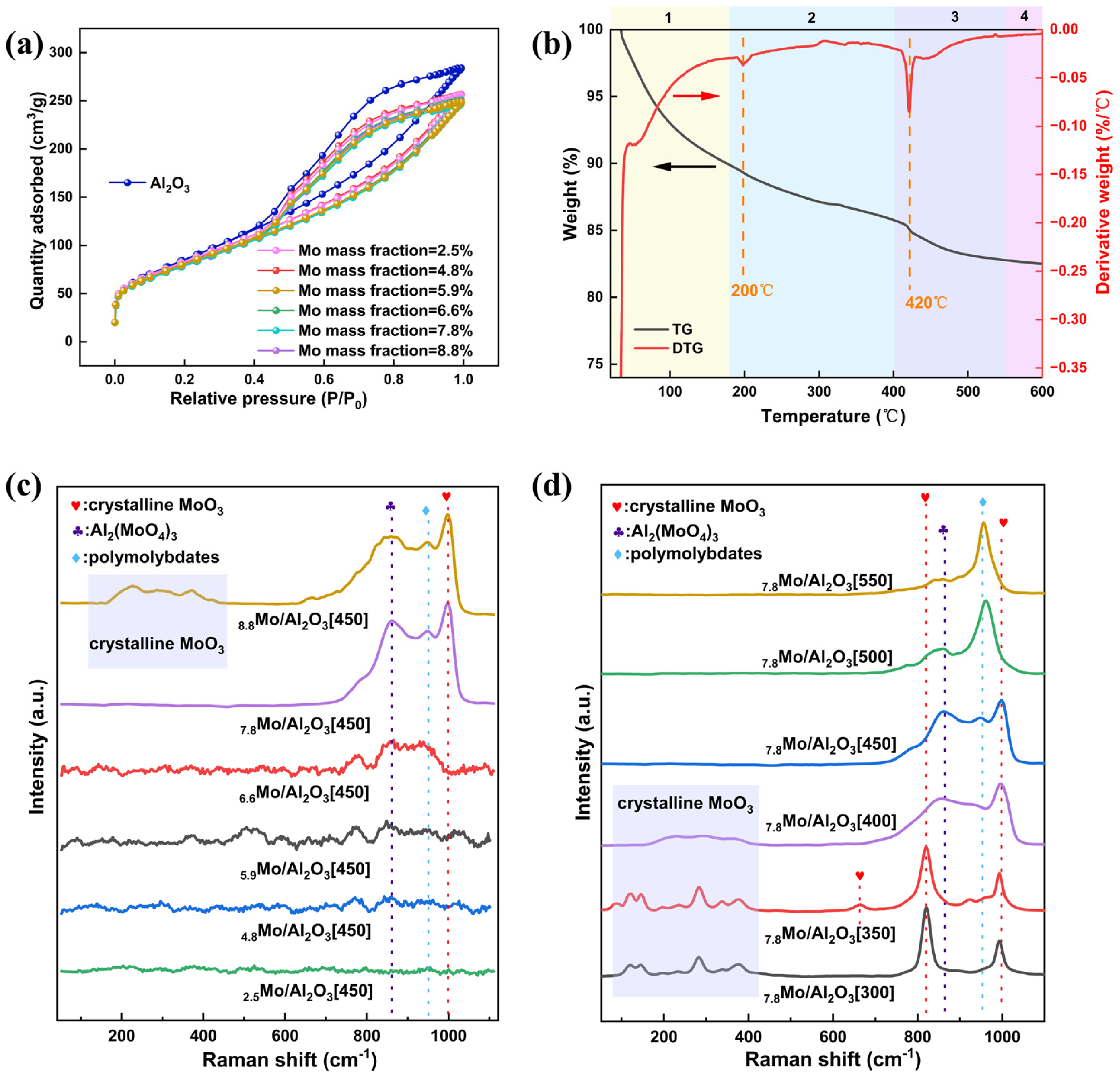
BET analyses were performed on the adsorbents calcined at 450 °C with different Mo loading amounts to further investigate the influence of Mo loading on the physical properties of Al2O3, and the results are depicted in Figure 2a and Figure S2. The N2 adsorption/desorption isotherms of all the samples exhibited similar patterns, with only differences in the volume of adsorbed N2. In accordance with the IUPAC definition, all the adsorbents exhibited a typical combination of Type I and Type IV isotherms along with H4-type hysteresis loops [23]. In addition, all the hysteresis loops for each adsorbent converged around a relative pressure (P/P0) range of 0.4–1.0, suggesting that no damage to the pore type of the Al2O3 support occurred after the Mo loading process. According to the pore size distribution diagram (Figure S2), as the amount of Mo loading increased, the primary peak shifted towards the left and showed a decrease in peak intensity, indicating a gradual decrease in pore size and the population of larger pores. This indicated that the mesoporous structure is conducive to the Mo loading process. Although the Mo species gradually permeated into the pore channels of the Al2O3 support during the impregnation procedure, causing pore blockage and resulting in a reduction in both the pore volume and the specific surface area, the pore texture of the adsorbent did not significantly change. The adsorbent still had a high specific surface area and a sufficiently porous texture, which effectively supported the adsorption of PCl3. When the loading amount was less than 5.9%, the decline in the pore size and specific surface area of the adsorbent was relatively modest (Table 1). However, when the loading amount exceeded 5.9%, a notable reduction in specific surface area was observed, and the average pore diameter increased slightly. These results suggested that excessive loading can result in the accumulation of Mo species, causing certain blockage of some pore structures, thus reducing the specific surface area and consequently affecting the adsorption performance of PCl3.
The combined results of SEM and BET analysis reveal that physical properties, such as specific surface area and pore volume, are not the decisive factors affecting the adsorption behavior. Therefore, the remarkable adsorption performance of the Mo-modified adsorbents compared with the blank Al2O3 support can be attributed to other factors.
To thoroughly identify the chemical changes during the calcination process, thermogravimetric analysis (TGA) was employed on the Mo-modified Al2O3 from ambient temperature to 600 °C under an air atmosphere with a heating rate of 5 °C min−1. As shown in Figure 2b, according to the TG and DTG curves, the calcination process could be divided into four phases. In the temperature range of 25–180 °C, a mass loss of 10.13% was observed, which is ascribed to the rapid evaporation of physically adsorbed water [24]. The second phase ranged from 180 to 400 °C and was accompanied by a mass loss of 4.11%. A small DTG peak centred at approximately 200 °C was recorded, which is assigned to the gradual decomposition of ammonium molybdate to MoO3 and the release of NH3 gas [25]. The third stage, which began at 400 °C and ended at 550 °C, involved a sharp DTG peak occurring at approximately 420 °C. This phenomenon can be associated with the interaction between MoO3 and the Al2O3 support at high temperature [26]. It has been reported in the literature that MoO3 interacts with the surface hydroxyl groups on the Al2O3 support at elevated temperatures, forming MoO2(OH)2 intermediates. These species could facilitate the diffusion of Mo species into the interstices of Al2O3, thereby promoting the formation of the Al2(MoO4)3 compound and the release of hydroxyl groups [27,28,29]. The mass loss during this stage was 2.98%. Furthermore, when the calcination temperature was above 550 °C, the mass loss was very marginal, which was caused by the gradual sublimation of the Mo species at this high temperature [30].
Previous literature has demonstrated that Al2O3 consists of irregularly stacked nanocrystals, and the small Raman scattering cross sections of high-surface-area Al2O3 typically do not generate strong Raman spectra to interfere with the characteristic peaks of Mo species [31,32]. Therefore, Raman spectral analysis was employed on the adsorbents with various Mo loading amounts, as shown in Figure 2c, to analyse the types of Mo species on the surface. No Raman bands corresponding to Al2O3 were observed in any of the spectra, as expected. At a Mo loading of 2.5%, no bands attributable to Mo species were detected, indicating that at such low loadings, the Mo species were well dispersed across the surface of the adsorbent, resulting in the formation of an amorphous phase. For the adsorbents with 4.8% and 5.9% Mo loading, a weak band at 860 cm−1, characteristic of bridging Mo–O–Al stretching, was recorded, attributed to the formation of the Al2(MoO4)3 compound [33]. When the Mo loading increased to 6.6%, a new weak band centred at approximately 950 cm−1 emerged, which was assigned to the Mo=O stretching mode of surface polymolybdates. This indicated that a small amount of polymolybdates appeared on the adsorbent surface [28,34]. At a higher loading of 7.8%, the intensity of the bands at 860 and 950 cm−1 significantly increased. Concurrently, a new strong band emerged at 999 cm−1, which is associated with the stretching vibrations of the terminal Mo=O of crystalline MoO3 [35,36]. This indicated an increase in the content of Mo6+ species on the adsorbent surface. With the further increase of Mo loading, a new set of low-intensity broad bands appeared in the characteristic wavenumber range of 150–400 cm−1, which are due to the Mo–O–Mo deformation and Mo=O bending modes of crystalline MoO3, suggesting that more crystalline MoO3 was generated on the adsorbent [37]. Meanwhile, the bands corresponding to Al2(MoO4)3 and polymolybdates exhibited no significant change. Therefore, it is reasonable to conclude that the Al2(MoO4)3, polymolybdates, and crystalline MoO3 coexisted on the adsorbent surface at high Mo loadings [38]. The Mo 3d spectra of all the samples exhibited the characteristic spin–orbit splitting corresponding to the Mo6+ oxidation state (Figure S3). The characteristic peak centred at 233.18 ± 0.2 eV is attributed to Mo 3d5/2, and the characteristic peak centred at 236.33 ± 0.2 eV is attributed to Mo 3d3/2 [39]. The binding energy of these peaks did not change regardless of the amount of Mo loading, confirming that all types of Mo species were present in the hexavalent state. In addition, with increasing Mo loading, the interaction between MoO3 and the Al2O3 support gradually increased, leading to a higher content of Al2(MoO4)3 on the adsorbent. During this process, more vacant sites were occupied, and polymolybdates gradually appeared through the linkage or combination of neighbouring monolayer Mo species [40]. A further increase in the Mo loading led to the formation of crystalline MoO3 because of the saturation of the surface anchoring sites. However, according to literature, the excess crystalline MoO3, compared with other well-dispersed Mo species, was less active in some oxidative reactions because of its lack of strong bonding to the support [41]. Moreover, the excessive formation and aggregation of crystalline MoO3 may cover some active sites. This might account for the decline in the adsorption performance when the amount of Mo loading exceeds 7.8%.
Figure 2d illustrates the Raman spectra of the 7.8Mo/Al2O3 adsorbents calcined at different temperatures. When the calcination temperature was below 350 °C, two sharp bands were identified at 820 and 999 cm−1, and low-frequency bands in the characteristic wavenumber range of 150–400 cm−1 were also detected. These were all characteristic bands of crystalline MoO3, and the peak at 820 cm−1 was characteristic of the asymmetric stretching mode of the Mo–O–Mo bridges [42]. Additionally, another new weak band that emerged at 662 cm−1 in the spectrum of the 7.8Mo/Al2O3[350] adsorbent was attributed to the vibrations of the Mo2O2 units formed by edge-shared MoO6 octahedra, which corresponded to the octahedrally coordinated crystalline MoO3 structure [42,43]. These results revealed that the ammonium molybdate precursor completely decomposed and formed crystalline MoO3 at calcination temperatures below 350 °C, which is consistent with the results of the thermogravimetric analysis. When the adsorbent was calcined at 400 °C, the bands in the 150–400 cm−1 region weakened, and the band at 820 cm−1 disappeared. In contrast, the intensity of the band located at 999 cm−1 increased significantly because of the increase in the Mo=O stretching frequency, indicating the formation of more oligomeric surface Mo species [43]. Furthermore, the emergence of new bands at 860 cm−1 and 950 cm−1, assigned to Al2(MoO4)3 and polymolybdates, respectively, demonstrated that MoO3 interacted with the Al2O3 support and formed interaction species at 400 °C. This inconsistency with the results of the TGA analysis can be rationalized by considering the kinetic effects of the calcination duration. Although 400 °C was below the MoO3–Al2O3 interaction temperature, as revealed by TGA, the selected calcination duration of 6 h provided sufficient thermal energy to drive solid-state interactions, leading to the formation of Al2(MoO4)3 [44]. The intensity of the band corresponding to Al2(MoO4)3 slightly increased when the adsorbent was calcined at 450 °C. Compared with crystalline MoO3, highly dispersed Mo species are relatively more easily transformed into active sites [43]. Therefore, it can be speculated that with increasing calcination temperature, crystalline MoO3 progressively interacts with Al2O3 to form the highly distributed Mo species Al2(MoO4)3, thereby enhancing the adsorption performance. However, a higher temperature exceeding 450 °C resulted in a significant weakening of the bands at 860 cm−1, along with a notable increase in the band at 950 cm−1 and the disappearance of the band at 999 cm−1. This observation implied that temperatures above 450 °C significantly promoted the combination or aggregation of Mo species into polymolybdates on the support surface [45]. This extensive aggregation may cover some active sites, ultimately leading to a decrease in the adsorption performance of PCl3.
Taken together, the results of the above analyses suggest that in addition to the loading amount, the calcination temperature is another critical factor affecting the MoO3–Al2O3 interaction, as well as the combination and aggregation of surface Mo species. Although crystalline MoO3 formed at 300 °C, the elevated temperatures further strengthened these interfacial reactions. At temperatures exceeding 500 °C, enhanced agglomeration caused the contents of Al2(MoO4)3 and crystalline MoO3 to decrease significantly.

3.2. Adsorbents Performance

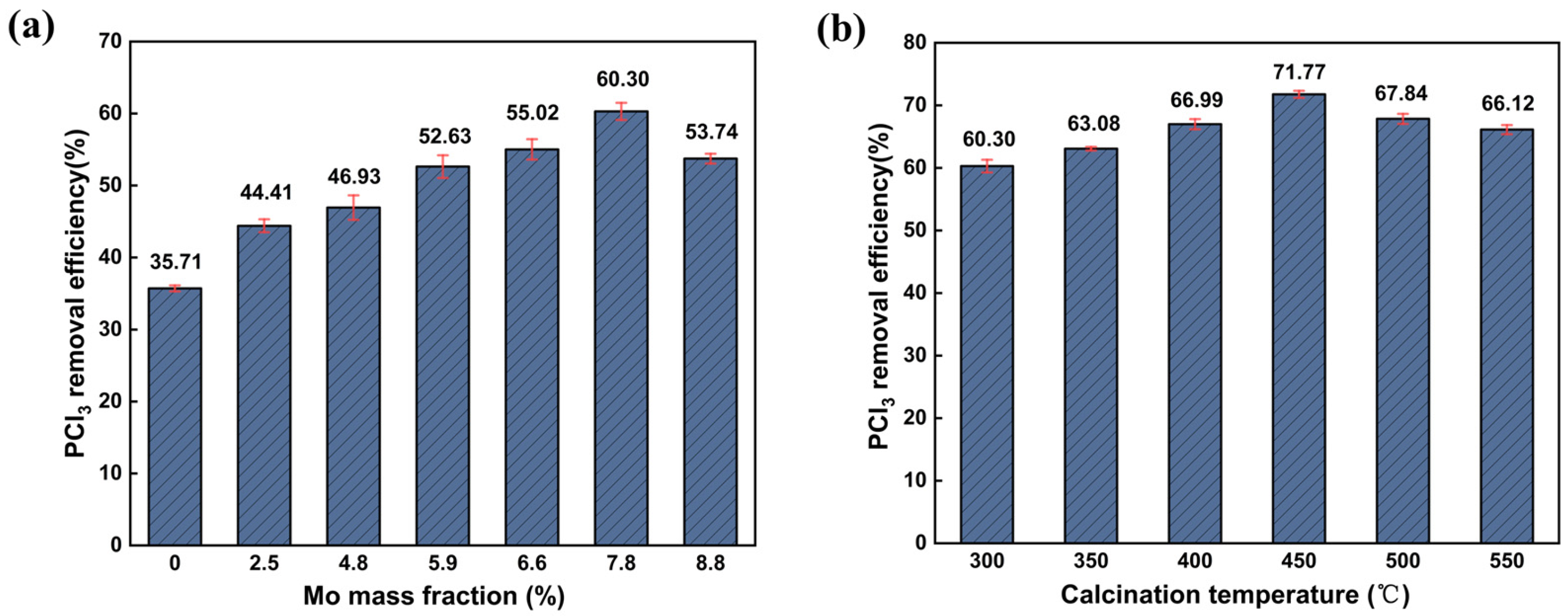
To determine the best preparation conditions for the adsorbents, the effects of different loading amounts and calcination temperatures on PCl3 adsorption performance were evaluated under specified operating conditions with an adsorption temperature of 60 °C and a duration of 8 h. The PCl3 removal efficiency results are shown as follows.
As shown in Figure 3a, as the amount of Mo loading increased, the PCl3 removal efficiency initially increased but subsequently decreased. The optimal PCl3 adsorption performance on modified Al2O3 was observed at a 7.8 wt% Mo mass fraction, reaching a removal efficiency of 60.30%, which was 68.86% greater than that of blank Al2O3. However, the PCl3 removal efficiency of the adsorbent decreased when the Mo mass fraction exceeded 7.8 wt%; although it was still superior to that of blank Al2O3. Therefore, adsorbents with a 7.8 wt% Mo mass fraction were selected for further investigation of the calcination temperature. As shown in Figure 3b, when the calcination temperature exceeded 300 °C, the PCl3 removal efficiency increased, reaching a maximum at 450 °C. However, a further increase to above 500 °C resulted in a slight decrease in the adsorption performance. Therefore, 450 °C was chosen as the optimal calcination temperature.
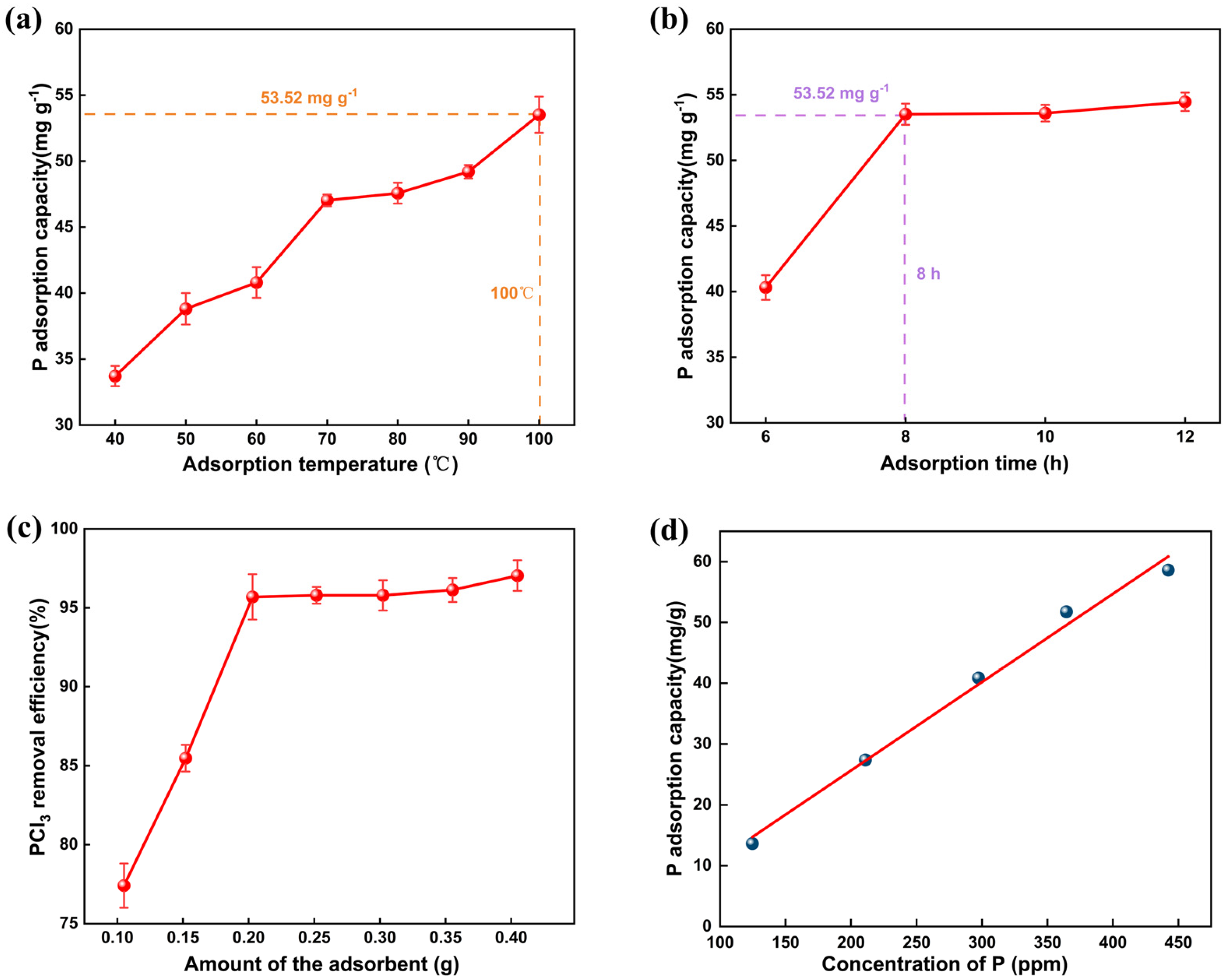
To assess the potential value of industrial application, four process parameters, namely, the adsorption temperature, adsorption time, adsorbent dosage and initial concentration of P in the reaction liquid, were subsequently systematically investigated to identify the optimal operating conditions for PCl3 removal performance of the 7.8Mo/Al2O3[450] adsorbent.
As shown in Figure 4a, the P adsorption capacity increased with increasing temperature, reaching a maximum of 53.52 mg g−1 at 100 °C. The fact that higher temperatures were favourable for the adsorption of PCl3 provided strong evidence that this process was typical chemisorption. As illustrated in Figure 4b, a significant increase in P adsorption capacity was observed as the reaction time increased from 6 to 8 h. However, with further prolonged adsorption time, the capacity remained stable, indicating that the adsorbent had reached saturation. Regarding the adsorbent dosage (Figure 4c), the PCl3 removal efficiency increased with the amount of adsorbent, reaching above 95% at a dosage of approximately 0.2 g. However, when the dosage was further increased, no significant changes in PCl3 removal efficiency were observed. As shown in Figure 4d, the P adsorption capacity of the 7.8Mo/Al2O3[450] adsorbent increased linearly with the initial concentration of P. This relationship revealed that across a wide range of P concentrations, 7.8Mo/Al2O3[450] remained a highly efficient adsorbent for PCl3 removal.

3.3. Adsorption Mechanism and Regeneration Performance of Adsorbents

3.3.1. Adsorption Mechanism

As demonstrated by previous investigations, the 7.8Mo/Al2O3[450] adsorbent has the best adsorption performance for PCl3. After the experiments were complete, the spent adsorbent was characterized by means of SEM, BET, FT-IR, XRD and XPS analyses to explore the possible adsorption mechanism for PCl3.
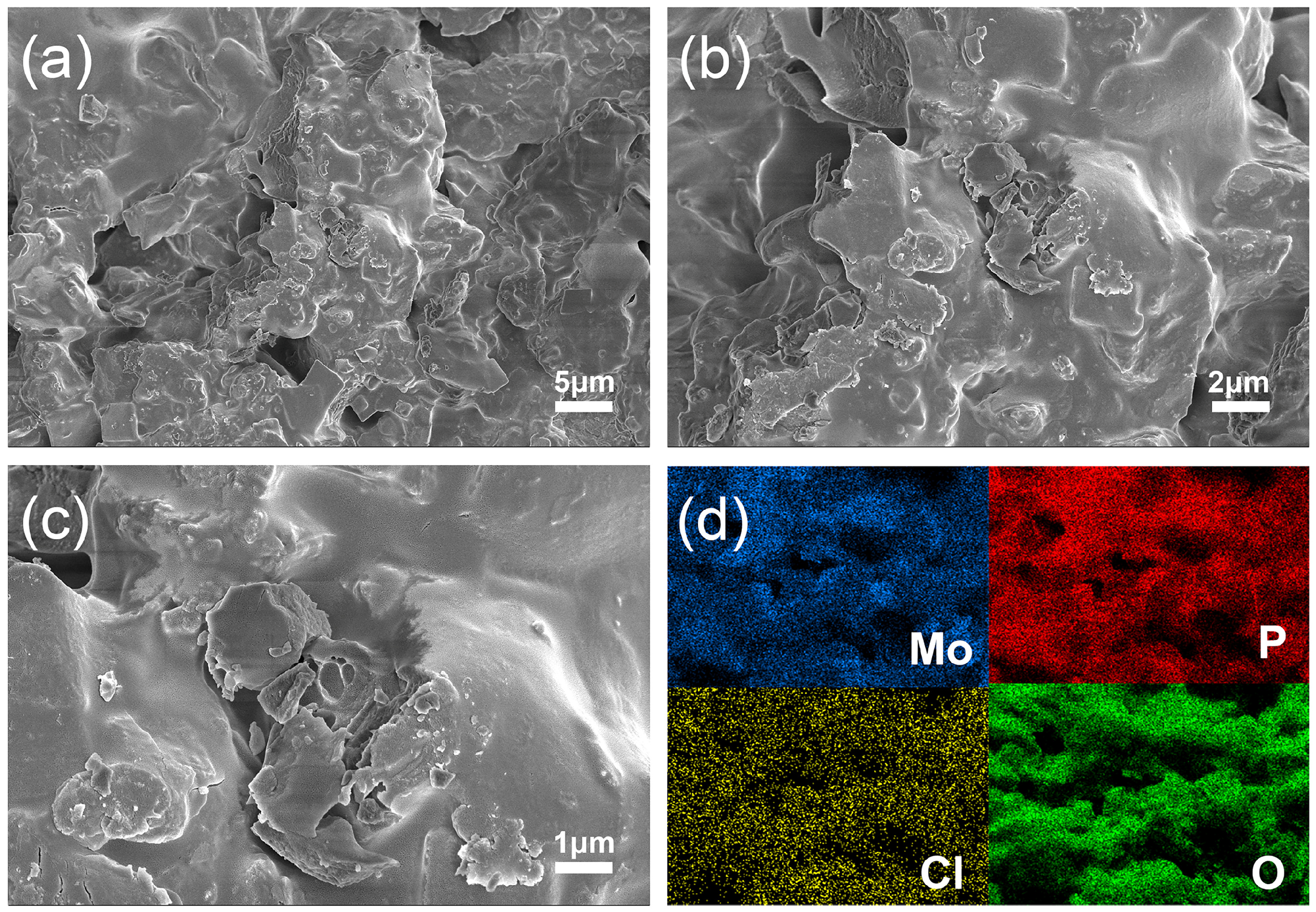
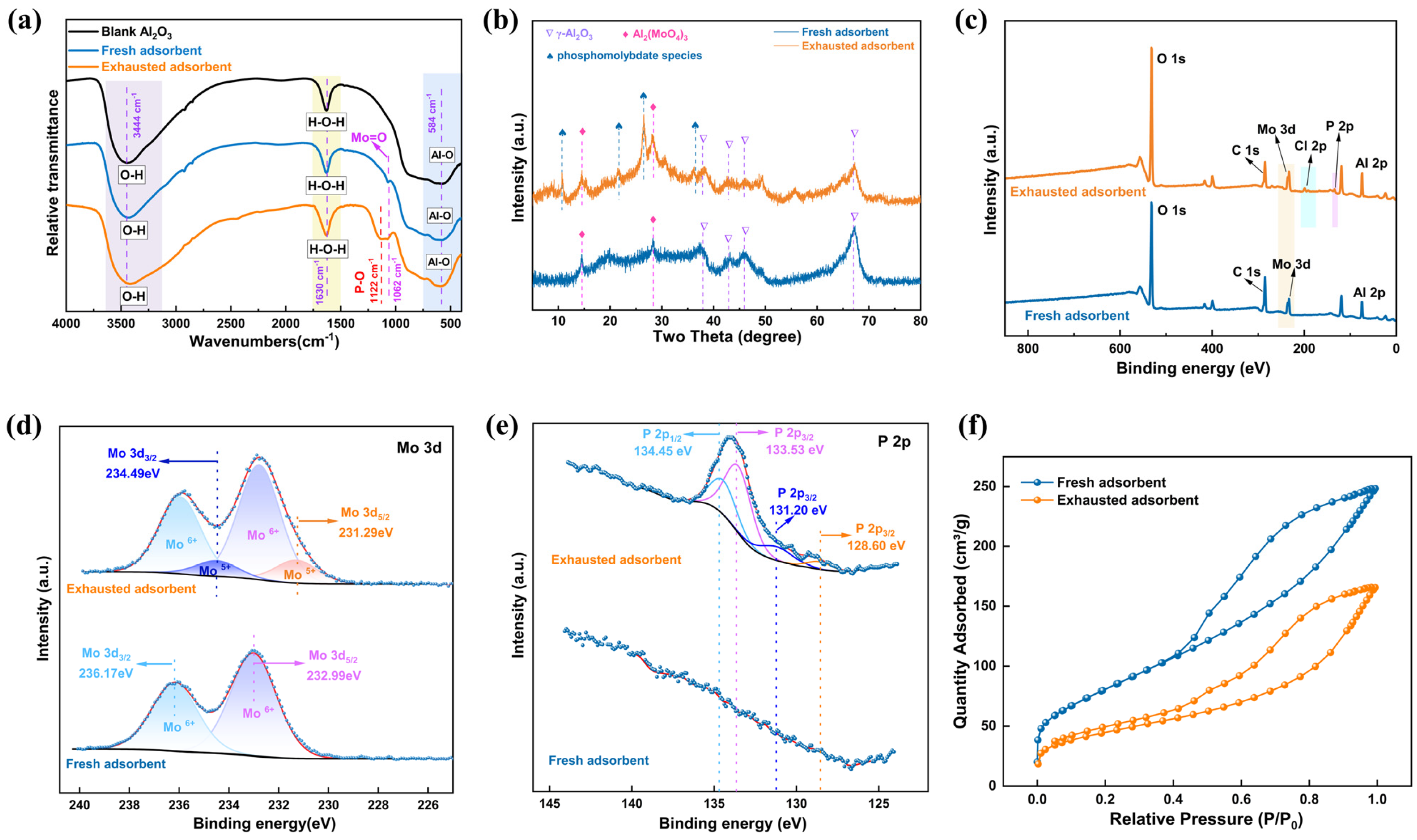
As illustrated in Figure 5a–c, compared with the fresh adsorbent, the spent adsorbent exhibited smoother surfaces and evident signs of sintering and agglomeration, resulting in the apparent disappearance of the original morphology. These morphological differences might result from the reaction of PCl3 on the adsorbent surface during the removal process. The EDS patterns of the spent material revealed an extensive distribution of P and Cl across its surface (Figure 5d). This homogeneous distribution of P and Cl indicated that the adsorbent effectively captured PCl3 and that the reaction products were uniformly dispersed on the surface of the adsorbent.
The FT-IR spectra for both the fresh and exhausted adsorbents, as well as the blank Al2O3, are depicted in Figure 6a. The bands centred at 584 cm−1, ascribed to the bending vibration of the Al–O bond, are detected in all the samples, indicating that the crystal structure of the Al2O3 support remained intact after adsorption [46]. The weak band located at 1062 cm−1 is associated with the terminal Mo=O stretching vibration of the Mo species [47]. Notably, a new band located at 1122 cm−1 emerged in the spectrum of the exhausted adsorbent, corresponding to the asymmetric P–O stretching vibration of the phosphate group, likely from phosphomolybdate species [48,49]. This finding suggests that pentavalent phosphorus species were generated during the adsorption process of PCl3. In addition, for the exhausted adsorbent, the bands observed at 3444 cm−1 and 1630 cm−1, assigned to the stretching and bending vibrations of surface hydroxyl groups, respectively, are slightly stronger than those of the fresh adsorbent. This suggests that the surface hydroxyl groups on the Al2O3 support may interact with PCl3 through the formation of hydrogen bonds [22,50].
Figure 6b shows the XRD patterns of the adsorbents before and after adsorption. The characteristic peaks of γ-Al2O3 (2θ = 37.9°, 42.8°, 45.9°, and 67°; PDF#29-0063) [51] and Al2(MoO4)3 (2θ = 14.5 and 28.2; PDF#84-1652) [52] were detected in all the samples. However, no discernible peaks corresponding to crystalline MoO3 or polymolybdates were observed. These findings are in disagreement with the Raman spectroscopy results, which may be attributed to the high dispersion of these Mo species on the Al2O3 surface, thus falling below the XRD detection threshold. Moreover, diffraction peaks associated with phosphomolybdate species (2θ = 10.7°, 21.7°, 26.5°, and 36.3°; PDF#38-0179) [53] appeared in the XRD patterns of the exhausted adsorbent, indicating that PCl3 underwent a chemisorption process on the adsorbent, leading to the formation of phosphomolybdate species as reaction products.
In the wide-survey XPS patterns (Figure 6c), Al, Mo, O, and C were detected in both samples. The small amount of C was attributed to adventitious hydrocarbon contamination because of the XPS apparatus itself [54]. P and Cl were detected only on the exhausted adsorbent. The Mo 3d XPS spectrum of the exhausted adsorbent, as shown in Figure 6d, revealed new spin–orbit splitting with binding energies of 231.29 ± 0.2 eV for Mo 3d5/2 and 234.49 ± 0.2 eV for Mo 3d3/2, which are characteristic of Mo5+ [55]. Notably, no characteristic peaks corresponding to Mo4+ were detected in the exhausted adsorbent. This indicates that a portion of the Mo6+ was certainly reduced to Mo5+ during the adsorption process. The unique orbital configuration of pentavalent molybdenum enables it to absorb energy in the visible region of electromagnetic radiation, resulting in its characteristic dark green colour, which was consistent with the colouration phenomenon observed in the spent adsorbent [56]. In the P 2p spectrum of the exhausted adsorbent (Figure 6e), the peaks at 133.53 ± 0.1 eV and 134.45 ± 0.1 eV are assigned to P 2p3/2 and P 2p1/2, respectively, both of which correspond to P5+, possibly from phosphate [57]. The peak at 132.12 ± 0.1 eV is assigned to the P=O bond of the surface-bound phosphoryl species, which was formed through the interaction of a small portion of the generated POCl3 molecules with the hydroxyl groups on the Al2O3 support [58,59,60]. These results suggest that the captured PCl3 was oxidized on the adsorbent surface during the process, which is consistent with the FT-IR findings. Moreover, another peak detected at 129.42 ± 0.1 eV is associated with P3+ [61]. This species may be generated from the reaction between PCl3 and the surface hydroxyl groups on the adsorbent, which is also in agreement with the results of the FT-IR analysis. These results demonstrate the successful adsorption of PCl3 and the subsequent deposition of its reaction products on the surface.
The BET data, N2 adsorption/desorption isotherms and pore size distributions for the fresh and spent adsorbents are presented in Table 2, Figure 6f and Figure S4. Compared with the fresh adsorbent, the exhausted sample exhibited a smaller hysteresis loop that converged at a lower relative pressure (Figure 6f), along with a remarkable decrease in the pore volume and specific surface area (Table 2). These changes were caused by the sintering and agglomeration of Mo species and the accumulation of reaction products on the surface. Meanwhile, the pore diameter of the exhausted adsorbent increased from 5.33 nm to 6.40 nm, which can be attributed to certain smaller pores being preferentially blocked or completely filled, leaving larger pores more accessible and thus contributing more to the calculated average pore diameter. Furthermore, the pore diameter distribution of the spent sample revealed that the peak intensity significantly decreased within the mesoporous region, which is consistent with pore blockage (Figure S4).
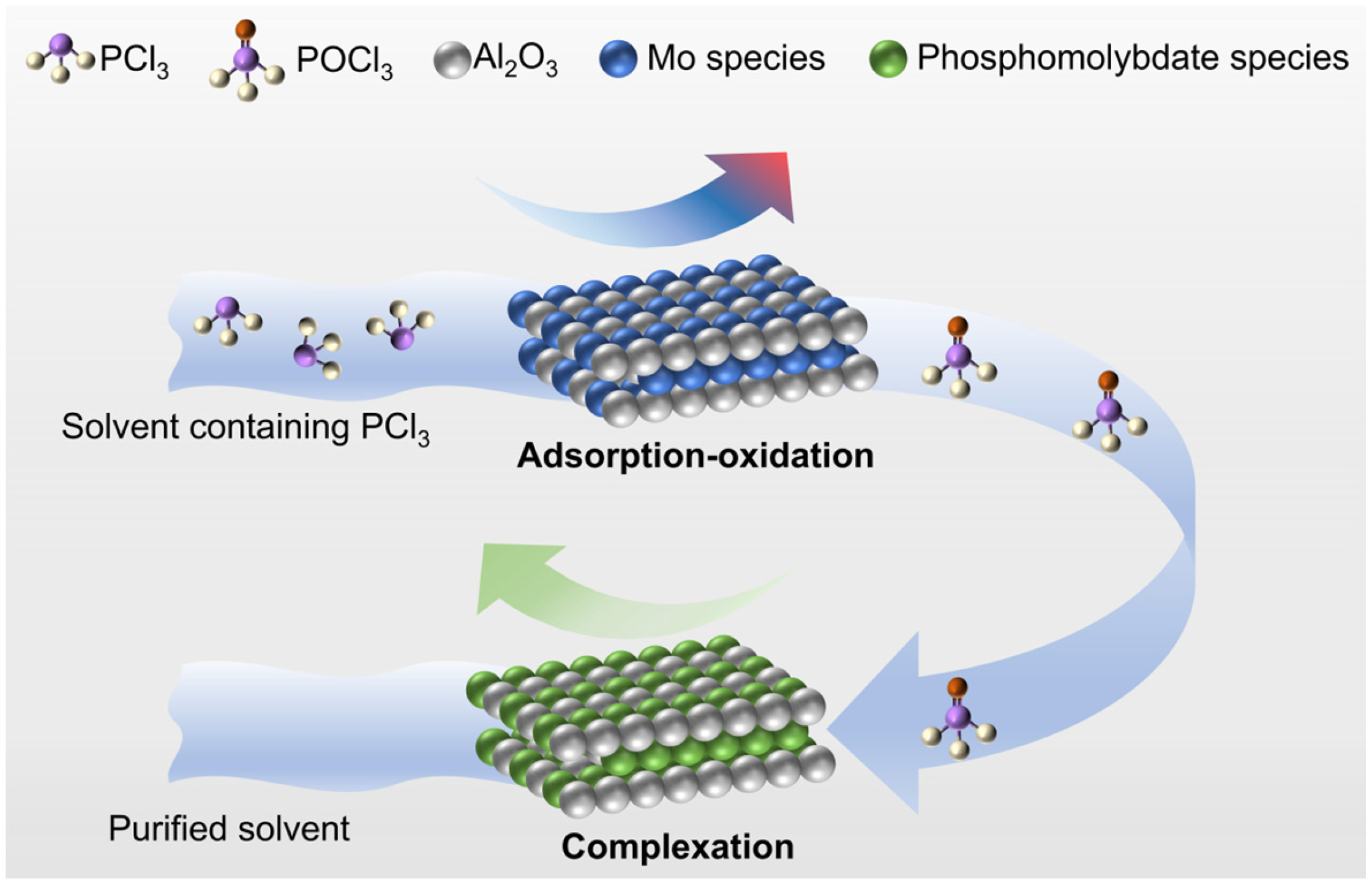
On the basis of the findings discussed above, PCl3 was clearly chemisorbed onto the adsorbent surface during adsorption. Hence, as illustrated in Figure 7, the possible PCl3 removal mechanism by the 7.8Mo/Al2O3[450] adsorbent is proposed to involve two aspects: (1) Upon being captured by the adsorbent, PCl3 is oxidized to POCl3 by surface Mo6+ species. Subsequently, the formed POCl3 molecules undergo a Lewis acid-base complexation reaction with the Mo species on the adsorbent, producing complicated phosphomolybdate species. (2) A small portion of the adsorbed PCl3 and generated POCl3 molecules interact with surface hydroxyl groups on the Al2O3 support. The oxygen atom of a hydroxyl group initiates a nucleophilic attack on the phosphorus atom, leading to the cleavage of a P–Cl bond. Simultaneously, the expelled proton combines with the chloride ion to form volatile hydrogen chloride [50]. This process is similar to the hydrolysis of PCl3 [62]. In addition, the first aspect involving oxidation and complexation is the primary reason for the excellent PCl3 removal performance of the adsorbent.

3.3.2. Regeneration of Exhausted Adsorbents

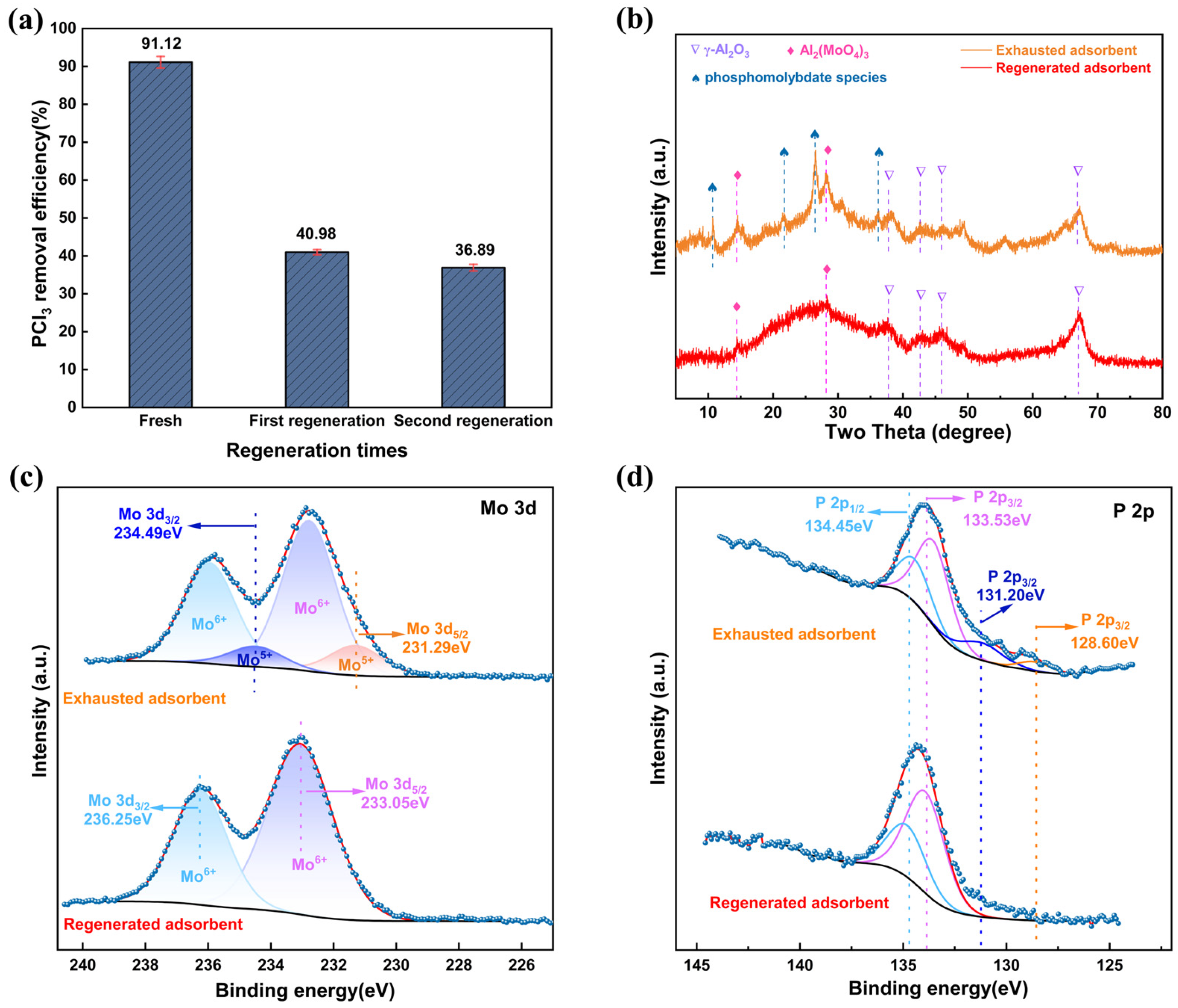
To thoroughly evaluate the industrial value and environmental impact of the adsorbents, in addition to their superior ability to adsorb impurities, regeneration stability is crucial and needs to be investigated. On the basis of the aforementioned results that the active Mo6+ species were reduced to Mo5+ during adsorption, hot-air calcination was conducted for adsorbent regeneration in this work to achieve the reoxidation of Mo5+ species without significant loss of active components. The exhausted adsorbent was placed in a muffle furnace and calcined for 2 h at 200 °C under an air atmosphere. In this study, three consecutive adsorption-regeneration cycles were carried out to examine the regeneration performance of the 7.8Mo/Al2O3[450] adsorbent. Under optimal operating conditions with an adsorption temperature of 100 °C and a duration of 8 h, the PCl3 removal performance of the adsorbent notably decreased with increasing regeneration frequency (Figure 8a). After two adsorption-regeneration experiments, the removal efficiency of PCl3 was only 36.89%, a significant reduction of 59.51% compared with that of the fresh adsorbent. These findings indicate that the exhausted adsorbent has limited regeneration stability and that hot-air calcination can only restore the activity of the spent adsorbent to some extent.
XRD and XPS analyses were carried out on the exhausted and regenerated adsorbents to investigate the regeneration mechanism, and the corresponding results are illustrated in Figure 8b–d.
In the XRD patterns for the regenerated adsorbent (Figure 8b), only peaks assignable to γ-Al2O3 and Al2(MoO4)3 were identified. In other words, no distinct peaks corresponding to phosphomolybdate species were observed, but a broad diffraction hump appeared in the range of 10–35°, indicating the formation of an amorphous phase on the adsorbent, which might have been induced by thermal treatment during the regeneration process.
In the wide-survey XPS patterns (Figure S5), P 2p and Cl 2p were detected in both samples. As shown in Figure 8c, no characteristic peaks of Mo5+ were observed in the regenerated adsorbent, indicating that hot-air calcination successfully reoxidized the Mo5+ species to Mo6+. However, Figure 8d shows the peaks located at 133.53 ± 0.1 eV and 134.45 ± 0.1 eV in the P 2p XPS spectra of the regenerated adsorbent, attributed to P5+. These results indicate that the phosphorus deposits on the adsorbent were not removed during the calcination process, which may account for the reduction in regeneration stability. Consequently, according to all the above research, the degradation of the surface morphology of the adsorbent resulting from the reaction and the accumulation of reaction products are the primary factors for the deactivation and poor regeneration ability of the adsorbent.
To address this regeneration problem, efficient removal of the phosphorus deposits accumulated on the adsorbent surface is an alternative research direction. Future work will be focused on identifying suitable methods, such as acid pickling, water washing, or combining acid pickling and calcination. Careful optimization of treatment conditions will be investigated to balance deposit removal and active component retention, thereby further enhancing the industrial applicability.

4. Conclusions

In this study, to develop an efficient strategy for removing trace PCl3 impurities from trichlorosilane for polysilicon production, an efficient adsorbent was successfully prepared via an impregnation method using activated alumina Al2O3 and ammonium molybdate as raw materials. Under optimal operating conditions, the 7.8Mo/Al2O3[450] adsorbent has the best removal performance, with a P adsorption capacity of 53.52 mg g−1, leading to the near-total removal of phosphorus impurities. The results of the Raman, XPS, TGA, and FTIR analyses demonstrated that Al2(MoO4)3, polymolybdates, and crystalline MoO3 coexist on the surface of the optimally synthesized adsorbent. Additionally, the adsorption mechanism of PCl3 was proposed according to the BET, XPS and FTIR results, which consists of two distinct aspects: (1) During the process, PCl3 undergoes a redox reaction with Mo6+ species to form POCl3. The produced POCl3 molecules subsequently participate in a Lewis acid-base complexation reaction with surface Mo species, resulting in the formation of complicated phosphomolybdate species. (2) A minor fraction of PCl3, along with the formed POCl3 molecules, is removed through interactions with surface hydroxyl groups on the alumina support. The first aspect of the reaction mechanism is the primary reason for the efficient removal of PCl3 on the adsorbent. The deactivation and poor regeneration performance of the adsorbent are caused primarily by damage to its surface morphology and the accumulation of reaction products. This study provides an effective approach and identifies the optimal operating parameters for the phosphorus removal of trichlorosilane in the polysilicon industry. Furthermore, future work is needed to enhance the regeneration performance of the adsorbent to further increase its potential in industrial applications.

Supplementary Materials

The following supporting information can be downloaded at: https://www.mdpi.com/article/10.3390/app16073324/s1, Figure S1. EDS mapping images of 7.8Mo/Al2O3[450] adsorbent; Figure S2. Pore diameter distributions of xMo/Al2O3[450] adsorbents; Figure S3. Mo 3d XPS spectra of xMo/Al2O3[450] adsorbents; Figure S4. Pore diameter distribution of fresh and exhausted adsorbents; Figure S5. Wide-survey XPS spectra of exhausted and regenerated adsorbents.

Author Contributions

Conceptualization, G.H.; Data curation, X.T.; Formal analysis, X.T. and G.H.; Investigation, X.T.; Methodology, G.H.; Supervision, G.H.; Writing—original draft, X.T.; Writing—review and editing, G.H. All authors have read and agreed to the published version of the manuscript.

Funding

This research received no external funding.

Institutional Review Board Statement

Not applicable.

Informed Consent Statement

Not applicable.

Data Availability Statement

Data is contained within the article or Supplementary Material.

Acknowledgments

This research was supported by Tianjin University.

Conflicts of Interest

The authors declare no conflicts of interest.

References

  1. Ballif, C.; Haug, F.-J.; Boccard, M.; Verlinden, P.J.; Hahn, G. Status and perspectives of crystalline silicon photovoltaics in research and industry. Nat. Rev. Mater. 2022, 7, 597–616. [Google Scholar] [CrossRef]
  2. Luceño-Sánchez, J.A.; Díez-Pascual, A.M.; Peña Capilla, R. Materials for Photovoltaics: State of Art and Recent Developments. Int. J. Mol. Sci. 2019, 20, 976. [Google Scholar] [CrossRef]
  3. Lv, Q.; Yuan, X.; Guo, L.; Zhao, D.; Ma, W.; Xie, G.; Hou, Y.; Shen, J.; Yang, N. Advances in production and optimization of electronic-grade polysilicon: A review of modified Siemens and silane methods. Sol. Energy Mater. Sol. Cells 2025, 283, 113446. [Google Scholar] [CrossRef]
  4. Zhou, Y.; He, T.; Liu, S.; Huang, G. Adsorption of Trace Phosphine in Circular Hydrogen of a Polysilicon Chemical Vapor Deposition Stove by Cu/γ-Al2O3. Ind. Eng. Chem. Res. 2018, 57, 15122–15131. [Google Scholar] [CrossRef]
  5. Díez, E.; Rodríguez, A.; Gómez, J.M.; Olmos, M. Distillation assisted heat pump in a trichlorosilane purification process. Chem. Eng. Process. 2013, 69, 70–76. [Google Scholar] [CrossRef]
  6. Zhang, M.; Liu, J.; Huang, G. Silicon Dioxide Functionalized with Oxygen-Containing Groups for Enhanced BCl3 Adsorption. Adsorpt. Sci. Technol. 2023, 2023, 7581943. [Google Scholar] [CrossRef]
  7. Zhao, Q.; Geng, Q.; Huang, G. Manganese-oxide-supported gold catalyst derived from metal–organic frameworks for trace PCl3 oxidation in an organic system. RSC Adv. 2024, 14, 4230–4243. [Google Scholar] [CrossRef]
  8. Ma, W.; Yuan, W.; Li, C.; Wang, X.; Cheng, X.; Zhang, J.; Guo, R. Efficient adsorption of trace PCl3 by Cu-MOFs featuring different ligands and DFT theoretical validation. Sep. Purif. Technol. 2025, 379, 135091. [Google Scholar] [CrossRef]
  9. Jia, Y.; Chen, D.; Li, Y.; Li, E.; Zhao, L.; Guo, L. Study on the adsorption mechanism of polar and non-polar VOCs by the activated carbon with surface oxygen. Chem. Eng. J. 2024, 490, 151907. [Google Scholar] [CrossRef]
  10. Bezgubenko, L.V.; Pipko, S.E.; Shalimov, A.A.; Sinitsa, A.D. Nucleophilic catalysis of phosphorus trichloride oxygen oxidation. Heteroat. Chem. 2008, 19, 408–411. [Google Scholar] [CrossRef]
  11. Nakagawa, M. Studies on the Reduction of Phosphorus Trichloride with Copper Powder in Non or Less Polar Solvents. Bull. Chem. Soc. Jpn. 2006, 35, 470–473. [Google Scholar] [CrossRef]
  12. Tzou, M.-S. Phosphorous Removal from Chlorosilane. EP0878477A1, 27 April 1998. [Google Scholar]
  13. Hao, Q.; Guoqiang, H. Progress in the Technology of High Efficient Removal of Trace Boron and Phosphorus from Trichlorosilane. Huaxue Gongye Yu Gongcheng 2018, 35, 42–48. (In Chinese) [Google Scholar] [CrossRef]
  14. Yu, H.; Liu, Y.; Cong, S.; Xia, S.; Zou, D. Review of Mo-based materials in heterogeneous catalytic oxidation for wastewater purification. Sep. Purif. Technol. 2023, 312, 123345. [Google Scholar] [CrossRef]
  15. da Silva Júnior, M.G.; Arzuza, L.C.C.; Sales, H.B.; Farias, R.M.d.C.; Neves, G.d.A.; Lira, H.d.L.; Menezes, R.R. A Brief Review of MoO3 and MoO3-Based Materials and Recent Technological Applications in Gas Sensors, Lithium-Ion Batteries, Adsorption, and Photocatalysis. Materials 2023, 16, 7657. [Google Scholar] [CrossRef]
  16. Shaikh, A.A.; Bhattacharjee, J.; Datta, P.; Roy, S. A comprehensive review of the oxidation states of molybdenum oxides and their diverse applications. Sust. Chem. Environ. 2024, 7, 100125. [Google Scholar] [CrossRef]
  17. Kepert, D.L.; Mandyczewsky, R. The reactions of molybdenum pentachloride with oxygen-containing molecules. J. Chem. Soc. 1968, 1, 530–533. [Google Scholar] [CrossRef]
  18. Lunk, H.-J.; Hartl, H. Discovery, properties and applications of molybdenum and its compounds. ChemTexts 2017, 3, 13. [Google Scholar] [CrossRef]
  19. Farneth, S. A Comparison of the Surface Chemistry of Two Polymorphic Forms of Molybdenum Trioxide. Langmuir 1987, 3, 217–223. [Google Scholar] [CrossRef]
  20. Beyendorff-Gulba, G.; Strähle, J.; Liebelt, A.; Dehnicke, K. Crystal structure of the molybdenum dioxide dichloride-phosphorus oxide trichloride adduct MoO2Cl2.POCl3. Z. Anorg. Allg. Chem. 1981, 483, 26–32. [Google Scholar] [CrossRef]
  21. Kray, W.D. Purification of Chlorosilanes. US4481178A, 6 November 1984. [Google Scholar]
  22. Huang, P.; Yuan, W.; Wu, Y.; Wang, Y.; Zhang, H.; Deng, R.; Zhang, J. Al2O3-Encapsulated TiO2 flower-like spherical mesoporous material for efficient removal of PCl3 traces. Chem. Eng. Sci. 2024, 299, 120488. [Google Scholar] [CrossRef]
  23. Amaral, M.S.C.; da Silva, M.A.; Cidade, G.d.S.; Faria, D.N.; Cipriano, D.F.; Freitas, J.C.C.; dos Santos, F.S.; Pietre, M.K.; dos Santos, A.M. Enhanced Ammonium Removal from Wastewater Using FAU-Type and BEA-Type Zeolites and Potential Application on Seedling Growth: Towards Closing the Waste-to-Resource Cycle. Processes 2025, 13, 2426. [Google Scholar] [CrossRef]
  24. Boretskaya, A.; Il’yasov, I.d.; Lamberov, A.; Popov, A. Identification of amorphous and crystalline phases in alumina entity and their contribution to the properties of the palladium catalyst. Appl. Surf. Sci. 2019, 496, 143635. [Google Scholar] [CrossRef]
  25. Gervasini, A.; Wahba, L.; Finol, M.D.; Lamonier, J.-F. Property and Activity of Molybdates Dispersed on Silica Obtained from Various Synthetic Procedures. Mater. Sci. Appl. 2012, 3, 195–212. [Google Scholar] [CrossRef]
  26. Tang, Y.; Wei, K.; Wu, F.; Zhang, X.; Liang, S. Low-temperature preparation and structural-property characterization of Al2Mo3O12. Ceram. Int. 2025, 51, 29118–29125. [Google Scholar] [CrossRef]
  27. Reddy, B.M.; Chowdhury, B.; Reddy, E.P.; Fernández, A. An XPS study of dispersion and chemical state of MoO3 on Al2O3-TiO2 binary oxide support. Appl. Catal. A 2001, 213, 279–288. [Google Scholar] [CrossRef]
  28. Leyrer, J.; Mey, D.; Knözinger, H. Spreading behavior of molybdenum trioxide on alumina and silica: A Raman microscopy study. J. Catal. 1990, 124, 349–356. [Google Scholar] [CrossRef]
  29. Okonkwo, I.A.; Doff, J.; Baron-Wiecheć, A.; Jones, G.; Koroleva, E.V.; Skeldon, P.; Thompson, G.E. Oxidation states of molybdenum in oxide films formed in sulphuric acid and sodium hydroxide. Thin Solid Films 2012, 520, 6318–6327. [Google Scholar] [CrossRef]
  30. Liu, X.; Kong, L.-T.; Liu, C.-F.; Xu, S.-T.; Zhang, D.-D.; Ma, F.-Y.; Lu, Z.-P.; Sun, J.-G.; Chen, J. Study on the formation process of MoO3/Fe2(MoO4)3 by mechanochemical synthesis and their catalytic performance in methanol to formaldehyde. J. Therm. Anal. Calorim. 2020, 142, 1363–1376. [Google Scholar] [CrossRef]
  31. Prins, R. On the structure of γ-Al2O3. J. Catal. 2020, 392, 336–346. [Google Scholar] [CrossRef]
  32. Mestl, G.; Srinivasan, T.K.K. Raman Spectroscopy of Monolayer-Type Catalysts: Supported Molybdenum Oxides. Catal. Rev. 1998, 40, 451–570. [Google Scholar] [CrossRef]
  33. Chakrabarti, A.; Wachs, I.E. Molecular Structure–Reactivity Relationships for Olefin Metathesis by Al2O3-Supported Surface MoOx Sites. ACS Catal. 2018, 8, 949–959. [Google Scholar] [CrossRef]
  34. Payen, E.; Kasztelan, S.; Grimblot, J.; Bonnelle, J.P. Surface chemistry of MoO3/γ-Al2O3 catalysts studied by laser Raman spectroscopy: Hydration and dehydration reactions and generalization to other supported systems. J. Raman Spectrosc. 1986, 17, 233–241. [Google Scholar] [CrossRef]
  35. Zhang, B.; Xiang, S.; Frenkel, A.I.; Wachs, I.E. Molecular Design of Supported MoOX Catalysts with Surface TaOX Promotion for Olefin Metathesis. ACS Catal. 2022, 12, 3226–3237. [Google Scholar] [CrossRef]
  36. Zhang, B.; Ford, M.E.; Ream, E.; Wachs, I.E. Olefin metathesis over supported MoOX catalysts: Influence of the oxide supports. Catal. Sci. Technol. 2023, 13, 217–225. [Google Scholar] [CrossRef]
  37. Tian, H.; Roberts, C.A.; Wachs, I.E. Molecular Structural Determination of Molybdena in Different Environments: Aqueous Solutions, Bulk Mixed Oxides, and Supported MoO3 Catalysts. J. Phys. Chem. C 2010, 114, 14110–14120. [Google Scholar] [CrossRef]
  38. Handzlik, J.; Sautet, P. Structure of Isolated Molybdenum(VI) Oxide Species on γ-Alumina: A Periodic Density Functional Theory Study. J. Phys. Chem. C 2008, 112, 14456–14463. [Google Scholar] [CrossRef]
  39. Zhu, Y.; Yu, B.; Liu, X.; Zhang, J.; Shi, Z.; Hu, Z.; Bu, S.; Li, C.; Zhang, X.; Lin, L. Synthesis of Large-Sized van der Waals Layered MoO3 Single Crystals with Improved Dielectric Performance. Precis. Chem. 2024, 2, 406–413. [Google Scholar] [CrossRef]
  40. Chary, K.V.R.; Reddy, K.R.; Kishan, G.; Niemantsverdriet, J.W.; Mestl, G. Structure and catalytic properties of molybdenum oxide catalysts supported on zirconia. J. Catal. 2004, 226, 283–291. [Google Scholar] [CrossRef]
  41. Baltrusaitis, J.; Mendoza-Sanchez, B.; Fernandez, V.; Veenstra, R.; Dukstiene, N.; Roberts, A.; Fairley, N. Generalized molybdenum oxide surface chemical state XPS determination via informed amorphous sample model. Appl. Surf. Sci. 2015, 326, 151–161. [Google Scholar] [CrossRef]
  42. Pham, T.T.P.; Nguyen, P.H.D.; Vo, T.T.; Nguyen, H.H.P.; Luu, C.L. Facile method for synthesis of nanosized β–MoO3 and their catalytic behavior for selective oxidation of methanol to formaldehyde. Adv. Nat. Sci. Nanosci. Nanotechnol. 2015, 6, 045010. [Google Scholar] [CrossRef]
  43. Nikiforov, A.I.; Popov, A.G.; Chesnokov, E.A.; Ivanova, I.I. Promoting effect of MoO3/Al2O3 catalysts fluorination on their reactivity in propylene metathesis. J. Catal. 2022, 415, 58–62. [Google Scholar] [CrossRef]
  44. Kumar, S.; Hussain, A.; Siddiqui, A.M.; Khan, Z.H.; Abdullah, M.M.; Ashraf, M.T. Synthesis and study of the impact of calcination duration on the properties of Al4(ZnO)96 nanoparticles. Nano-Struct. Nano-Objects 2024, 39, 101250. [Google Scholar] [CrossRef]
  45. Kitano, T.; Okazaki, S.; Shishido, T.; Teramura, K.; Tanaka, T. Brønsted acid generation of alumina-supported molybdenum oxide calcined at high temperatures: Characterization by acid-catalyzed reactions and spectroscopic methods. J. Mol. Catal. A Chem. 2013, 371, 21–28. [Google Scholar] [CrossRef]
  46. Rahman, M.L.; Islam, M.S.; Ahmed, M.F.; Biswas, B.; Sharmin, N.; Neger, A.J.M.T. Extraction and characterization of highly pure alumina (α, γ, and θ) polymorphs from waste beverage cans: A viable waste management approach. Arab. J. Chem. 2023, 16, 104518. [Google Scholar] [CrossRef]
  47. Al-Alotaibi, A.L.; Altamimi, N.; Howsawi, E.; Elsayed, K.A.; Massoudi, I.; Ramadan, A.E. Synthesis and Characterization of MoO3 for Photocatalytic Applications. J. Inorg. Organomet. Polym. Mater. 2021, 31, 2017–2029. [Google Scholar] [CrossRef]
  48. Rodrigues, A.A.; da Silva, M.J.; Ferreira, S.O.; da Silva, R.C.; Silva, T.A.; de Araújo, E.N.D. Assessment of the metal exchanged phosphomolybdic acid salt-catalyzed nerol oxidation reactions with hydrogen peroxide. Mol. Catal. 2023, 545, 113221. [Google Scholar] [CrossRef]
  49. Ivanova, Y.; Almeida, C.; Ivanou, D.; Mendes, A. Uncovering multielectron transfer in phosphomolybdate cluster electrolytes for redox flow battery application. Chem. Eng. J. 2025, 522, 166948. [Google Scholar] [CrossRef]
  50. Joshi, P.R.; Ramanathan, N.; Sundararajan, K.; Sankaran, K. Gas phase reaction of phosphorus trichloride and methanol: Matrix isolation infrared and DFT studies. J. Mol. Struct. 2015, 1100, 80–87. [Google Scholar] [CrossRef]
  51. Pakharukova, V.P.; Yatsenko, D.A.; Gerasimov, E.Y.; Shalygin, A.S.; Martyanov, O.N.; Tsybulya, S.V. Coherent 3D nanostructure of γ-Al2O3: Simulation of whole X-ray powder diffraction pattern. J. Solid State Chem. 2017, 246, 284–292. [Google Scholar] [CrossRef]
  52. Setnička, M.; Tišler, Z.; Kubička, D.; Bulánek, R. Activity of Molybdenum Oxide Catalyst Supported on Al2O3, TiO2, and SiO2 Matrix in the Oxidative Dehydrogenation of n-Butane. Top. Catal. 2015, 58, 866–876. [Google Scholar] [CrossRef]
  53. Vilanculo, C.B.; da Silva, M.J.; Rodrigues, A.A.; Ferreira, S.O.; da Silva, R.C. Vanadium-doped sodium phosphomolybdate salts as catalysts in the terpene alcohols oxidation with hydrogen peroxide. RSC Adv. 2021, 11, 24072–24085. [Google Scholar] [CrossRef]
  54. Liu, B.; Mu, L.; Han, B.; Zhang, J.; Shi, H. Fabrication of TiO2/Ag2O heterostructure with enhanced photocatalytic and antibacterial activities under visible light irradiation. Appl. Surf. Sci. 2017, 396, 1596–1603. [Google Scholar] [CrossRef]
  55. Jeong, M.; Park, J.; Cho, Y.J.; Chang, H.S. Improved passivation performance of Al2O3 interlayer/MoOX thin films continuously grown via atomic layer deposition. Thin Solid Films 2023, 766, 139667. [Google Scholar] [CrossRef]
  56. Černošek, Z.; Chládková, M.; Holubová, J. Chemical model of binary molybdenum phosphate glasses. J. Solid State Chem. 2021, 303, 122522. [Google Scholar] [CrossRef]
  57. Luo, Z.; Liang, Q.; Qi, Y.; Huang, G. The Cu/TiO2 adsorbent modified by Ce-doping removes trace phosphorus impurities from circular hydrogen of a polysilicon chemical vapor deposition furnace. Sep. Purif. Technol. 2024, 344, 127148. [Google Scholar] [CrossRef]
  58. Muleja, A.A.; Mbianda, X.Y.; Krause, R.W.; Pillay, K. Synthesis, characterization and thermal decomposition behaviour of triphenylphosphine-linked multiwalled carbon nanotubes. Carbon 2012, 50, 2741–2751. [Google Scholar] [CrossRef]
  59. Grutsch, P.A.; Zeller, M.V.; Fehlner, T.P. Photoelectron spectroscopy of tin compounds. Inorg. Chem. 1973, 12, 1431–1433. [Google Scholar] [CrossRef]
  60. Blackburn, J.R.; Nordberg, R.; Stevie, F.; Albridge, R.G.; Jones, M.M. Photoelectron spectroscopy of coordination compounds. Triphenylphosphine and its complexes. Inorg. Chem. 1970, 9, 2374–2376. [Google Scholar] [CrossRef]
  61. Zhang, L.; Wang, G.; Hao, X.; Jin, Z.; Wang, Y. MOFs-derived Cu3P@CoP p-n heterojunction for enhanced photocatalytic hydrogen evolution. Chem. Eng. J. 2020, 395, 125113. [Google Scholar] [CrossRef]
  62. Jung, H.; Kang, J.; Chun, H.; Han, B. First principles computational study on hydrolysis of hazardous chemicals phosphorus trichloride and oxychloride (PCl3 and POCl3) catalyzed by molecular water clusters. J. Hazard. Mater. 2018, 341, 457–463. [Google Scholar] [CrossRef]
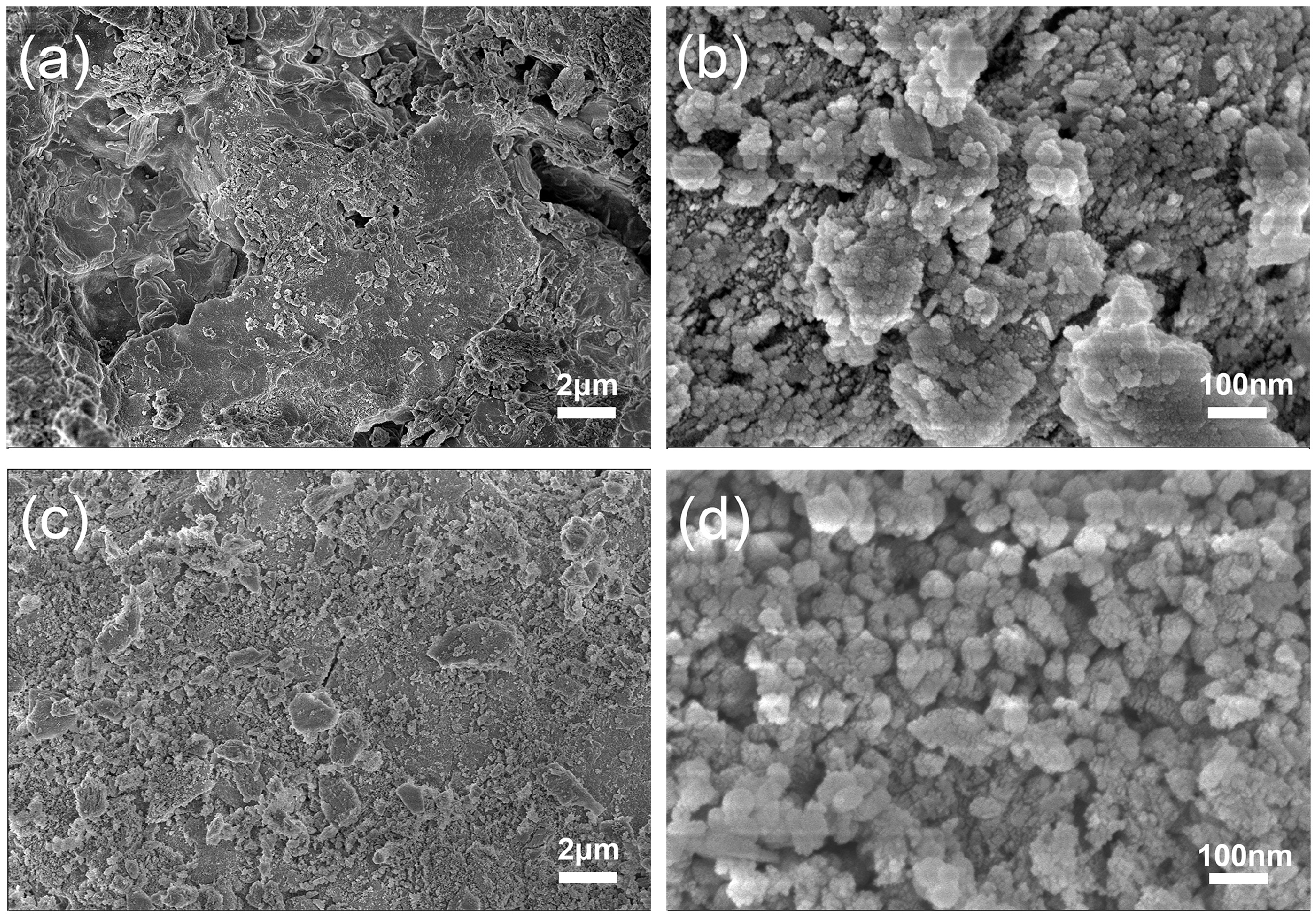
Figure 1. SEM micrographs of blank Al2O3 carrier (a,b) and 7.8Mo/Al2O3[450] adsorbent (c,d).
Applsci 16 03324 g001
Figure 2. N2 adsorption/desorption isotherms of xMo/Al2O3[450] adsorbents (a), and TG and DTG curves of 7.8Mo/Al2O3 calcined under air atmosphere (b), and Raman spectra of xMo/Al2O3[450] (c) and 7.8Mo/Al2O3[y] (d).
Applsci 16 03324 g002
Figure 3. PCl3 removal efficiency of xMo/Al2O3[450] adsorbents with different Mo mass fractions (a) and 7.8Mo/Al2O3[y] adsorbents with different calcination temperatures (b).
Applsci 16 03324 g003
Figure 4. Effects of (a) adsorption temperature, (b) adsorption time, (c) adsorbent dosage, and (d) concentration of P on PCl3 adsorption performance by 7.8Mo/Al2O3[450].
Applsci 16 03324 g004
Figure 5. SEM micrographs (ac) and EDS mapping image (d) displaying the elemental distribution of Mo, P, Cl, and O of the exhausted 7.8Mo/Al2O3[450] adsorbent.
Applsci 16 03324 g005
Figure 6. FT-IR spectra (a), XRD patterns (b), wide-survey XPS spectra (c), Mo 3d XPS spectra (d), P 2p XPS spectra (e), and N2 adsorption/desorption isotherms (f) of fresh and exhausted adsorbents.
Applsci 16 03324 g006
Figure 7. Possible primary chemisorption mechanism of PCl3.
Applsci 16 03324 g007
Figure 8. PCl3 removal efficiency of fresh and regenerated adsorbents (a); XRD patterns (b), Mo 3d XPS spectra (c), and P 2p XPS spectra (d) of exhausted and regenerated adsorbents.
Applsci 16 03324 g008
Table 1. Specific surface areas, pore diameters and total pore volumes of adsorbents with different Mo loading amounts.
Loading AmountSBET (m2/g)Dp (nm)Vtotal (cm3g−1)
0%3135.600.428
2.5%3015.260.376
4.8%3005.300.379
5.9%2995.150.364
6.6%2875.410.370
7.8%2865.330.362
8.8%2855.400.365
Table 2. Specific surface areas, pore diameters and total pore volumes of fresh and exhausted adsorbents.
SamplesSBET (m2/g)Dp (nm)Vtotal (cm3g−1)
Fresh adsorbent2865.330.362
Exhausted adsorbent1606.400.237
Disclaimer/Publisher’s Note: The statements, opinions and data contained in all publications are solely those of the individual author(s) and contributor(s) and not of MDPI and/or the editor(s). MDPI and/or the editor(s) disclaim responsibility for any injury to people or property resulting from any ideas, methods, instructions or products referred to in the content.