Next Article in Journal
Thermal Analysis of Selected Rennet Cheeses and Fats Extracted from These Cheeses
Previous Article in Journal
Forest Road Extraction via Optimized DeepLabv3+ and Multi-Temporal Remote Sensing for Wildfire Emergency Response
 
 
Due to scheduled maintenance work on our servers, there may be short service disruptions on this website between 11:00 and 12:00 CEST on March 28th.
Article

Association Between Tibial Torsion, ACL Injury, and Functional Biomechanics in Elite Alpine Skiers

by
Sae Young Park
*,
Jinwook Song
and
Junggi Hong
*
Graduate School of Sports Medicine, CHA University, Seongnam 13496, Republic of Korea
*
Authors to whom correspondence should be addressed.
Appl. Sci. 2026, 16(7), 3229; https://doi.org/10.3390/app16073229 (registering DOI)
Submission received: 14 February 2026 / Revised: 21 March 2026 / Accepted: 25 March 2026 / Published: 26 March 2026
(This article belongs to the Section Applied Biosciences and Bioengineering)

Abstract

Tibial torsion significantly influences knee biomechanics, yet its interaction with ACL reconstruction history in elite alpine skiers remains under-investigated. In this cross-sectional observational study, we analyzed 20 elite alpine skiers (7 ACL-reconstructed, 13 non-injured) using a markerless motion capture system during dynamic tasks (Squat, Single-Leg Squat, Lunge). Static tibial torsion was assessed via the Transmalleolar Axis and Thigh–Foot Angle. The results revealed a critical divergence in biomechanical strategies based on tibial alignment (p < 0.05). Skiers with rotational deformity adopted a pattern we describe as a “Stiffness Strategy”, characterized by suppressed knee valgus and hip rotation, but relied on excessive ankle dorsiflexion (39.5°)—a compensatory mechanism that may become limited when constrained by rigid ski boots. In contrast, ACL-reconstructed skiers with normal alignment exhibited what we term an “Instability Strategy”, showing dynamic valgus collapse and persistent asymmetry. These findings suggest that “one-size-fits-all” rehabilitation may be insufficient. We propose that injury prevention protocols may benefit from incorporating anatomical screening, focusing on decoupling mobility for skiers with tibial torsion and enhancing dynamic stability for those with normal alignment.

1. Introduction

Tibial torsion (TT) refers to the physiological angle of twist of the tibia along its longitudinal axis, representing a unique lower limb alignment element that exhibits significant individual variation. In healthy adults, the tibia is typically externally rotated by approximately 15° to 20° (external tibial torsion), which contributes to efficient biomechanical function during daily activities such as gait [1]. However, tibial rotational malalignment outside the normal range can lead to various clinical problems. Excessive external tibial torsion (TT), for instance, reportedly increases patellofemoral joint (PFJ) pressure, potentially causing anterior knee pain (AKP) or patellar instability (PI) [2]. Conversely, internal tibial torsion (ITT) may cause abnormal knee joint contact and load distribution, potentially accelerating long-term degenerative changes. Indeed, studies have reported abnormal tibial torsion (TT) angles in adult patients with osteoarthritis (OA) [3].
Such static malalignment directly increases injury risk via the kinetic chain during dynamic movements. For instance, excessive external tibial torsion (ETT) tends to increase dynamic knee valgus (DKV) during actions such as jump landings or cutting, subsequently increasing tension on the anterior cruciate ligament (ACL) [4].
Supporting this association, Chizewski’s study reported that the tibial torsion (TT) angle in female athletes with anterior cruciate ligament (ACL) tears (mean 19°) was significantly greater than in the uninjured control group (mean 12°) [5]. Similarly, excessive internal tibial torsion (ITT) has also been suggested to increase knee rotational instability during jump landings, potentially contributing to anterior cruciate ligament (ACL) injury [6]. Clearly, tibial torsion (TT) is an important anatomical variable influencing knee joint stability and injury risk, even during general sporting activities.
Alpine skiing imposes specific loads on the knee joint due to the combination of equipment characteristics and the kinetic demands of the sport. Consequently, it is recognized as having one of the highest rates of anterior cruciate ligament (ACL) injuries among all sporting activities [7]. Central to this phenomenon is the role of the alpine ski boot. Characterized by a rigid plastic exoskeleton, the ski boot nearly immobilizes the ankle and subtalar joints [8]. As a result, the boot–ski system functions as a single, elongated, rigid lever arm extending from the foot to the proximal tibia [9]. This structural configuration amplifies forces generated at the snow–edge interface during turns or loss of balance, transmitting them directly to the tibia as unfiltered rotational load, or torque. Since the ankle joint is unable to dissipate these forces, the entire load is concentrated on the knee, the subsequent joint in the kinetic chain [8]. For instance, a backward-leaning posture shifts the application point of the ground reaction force away from the tibial axis, thereby exponentially increasing the internal rotation torque on the tibia [8].
Thus, the alpine skiing environment constitutes a unique condition of “forced rotation” wherein substantial external rotational forces are forcibly applied to the knee [8,10]. In this context, where ankle function is restricted and rotational forces are amplified by a powerful lever arm, the athlete’s anatomical tibial rotational alignment may be considered a potential contributing factor to the risk of knee injuries, particularly those affecting the ACL [4].
The primary non-contact knee injury mechanisms in alpine skiing clearly illustrate how the aforementioned “amplified tibial rotational load” may lead to injury. A common characteristic of these mechanisms is that rapid and forceful internal or external tibial rotation, occurring beyond the skier’s volition or control, acts as a significant contributing factor [10]. The “slip-catch” mechanism, a representative internal rotation etiology predominantly affecting elite athletes, involves a sequence where the tibia undergoes abrupt internal rotation of up to 9–12° within tens of milliseconds of the ski edge catching the snow surface. Biomechanical analyses indicate that this rotation, accompanied by a simultaneous valgus moment, results in ACL rupture [8]. Another internal rotation mechanism, the “phantom foot”, occurs during a backward fall. In this scenario, the tail of the ski engages the snow while weight is loaded onto the inner edge; the ski functions as a lever, forcing the tibia into internal rotation and causing ACL injury [11]. Regarding external rotation, the “forward twisting fall” has become the most prevalent injury mechanism following the introduction of carving skis in the 2000s. This injury occurs when the ski tip becomes embedded in the snow, forcing the tibia into external rotation while a valgus force is simultaneously applied to the knee, resulting in combined injury to the ACL and medial collateral ligament (MCL) [12]. This “valgus–external rotation” mechanism represents a typical scenario wherein the skier falls forward and the inner edge of the ski tip catches the snow, inducing abduction and external rotation of the tibia [4].
Consequently, ACL injury mechanisms in alpine skiing are fundamentally governed by uncontrollable tibial rotational movements. In an environment where potent rotational loads are forcibly applied externally, the athlete’s innate static rotational alignment—specifically, the tibial torsion angle—may function as a critical intrinsic factor modulating injury risk. For instance, if an athlete with internal tibial torsion (e.g., −5°) experiences a slip-catch fall resulting in 12° of forced internal rotation and rapid knee flexion from 26° to 63°, the tibia would be displaced significantly beyond its physiological range of motion, imposing a catastrophic load on the ACL [13]. In essence, the athlete’s inherent tibial torsion angle may conceptually serve as a “set point”—a theoretical framing suggesting that baseline rotational alignment determines the proximity of the knee to its physiological limits prior to the application of injurious external forces [14].
Synthesizing the preceding discussion, alpine skiing presents a unique biomechanical environment wherein the rigid ski boot and ski form an elongated lever arm. This configuration negates the shock-absorbing function of the ankle and concentrates amplified rotational forces directly onto the knee joint. The primary mechanism underlying major knee injuries in this context involves uncontrollable internal or external tibial rotation. Consequently, an athlete’s innate tibial rotational alignment (i.e., tibial torsion) is postulated to be a critical intrinsic risk factor determining the knee’s susceptibility to these external rotational loads.
However, research investigating the interaction between external rotational loads and individual intrinsic rotational alignment—specifically regarding its impact on knee injuries within the specialized environment of alpine skiing—remains largely unexplored. As previous studies on tibial torsion have predominantly focused on the general population or athletes from other disciplines [5], there are limitations in directly generalizing these findings to alpine skiers. Therefore, from the perspectives of injury prevention and performance enhancement, it is imperative to elucidate the association between tibial torsion, knee injury, and functional decline specifically within the alpine skier population, thereby establishing a scientific basis for intervention.
Accordingly, the primary objective of this study is to elucidate the relationship between tibial torsion angles and both potential risk factors for ACL injury and motor function in alpine skiers. Through a comprehensive analysis of the impact of tibial torsion on knee health and athletic performance, this study aims to provide foundational data for the development of personalized injury prevention programs and medical screening protocols that account for individual anatomical characteristics.

2. Materials and Methods

2.1. Participants

The participants in this study consisted of 20 alpine skiers (n = 20) affiliated with the Korea Ski Association, comprising both national team members and elite collegiate athletes. The inclusion criteria required participants to be actively engaged in competitive alpine skiing. Exclusion criteria were defined as the presence of any medical conditions or musculoskeletal injuries capable of affecting lower extremity biomechanics, particularly the knee. The participants ranged in age from 15 to 37 years, and the cohort included both males and females (Table 1 and Table 2).
Prior to participation, the objectives and procedures of this study were fully explained to all subjects, and voluntary written informed consent was obtained. For participants who were minors, additional written consent was secured from their legal guardians. This study was approved by the Institutional Review Board (IRB) of CHA University, Pocheon-si, Gyeonggi-do, Republic of Korea (IRB No. 1044308-202509-HR-289-02).

2.2. Clinical Assessment

To assess participants’ history of ACL reconstruction, subjective knee status, and functional levels, specific survey instruments were utilized. The Knee Injury and Osteoarthritis Outcome Score (KOOS) is a self-administered instrument developed to evaluate functional status, symptoms, and quality of life in individuals with knee injuries or osteoarthritis. It is a globally recognized tool within the field of sports medicine [15]. The KOOS provides a comprehensive assessment of knee status across five subscales: Pain, Other Symptoms, Activities of Daily Living (ADL), Sport and Recreation Function (Sport/Rec), and Knee-related Quality of Life (QoL) [16]. Additionally, the International Knee Documentation Committee (IKDC) Subjective Knee Evaluation Form was employed. The IKDC form is a self-report measure designed to allow patients to evaluate their overall functional status, current symptom severity, and sports participation capabilities. It is widely utilized as a standard instrument for assessing function in patients with knee disorders or injuries [16]. In this study, the validated Korean versions of both questionnaires were administered to document injury history, subjective knee function scores, and pain levels. These data were subsequently used for comparative analyses between groups stratified by tibial torsion angle and injury history.

2.3. Experimental Design and Procedure

This study employed a cross-sectional observational analytical design combining static measurements with dynamic motion analysis. The protocol involved initially measuring the tibial torsion angle of each participant in a static position, followed by the collection of lower extremity biomechanical parameters during the performance of various specific motor tasks. In this study, ‘Tibial Torsion’ refers to the static anatomical twist of the tibia, while ‘Tibial Rotation’ describes the dynamic kinematic movement of the shank relative to the femur. Additionally, to ensure statistical power, participants with tibial torsion outside the normal range (both internal and external) were grouped as ‘Rotational Malalignment (ROT)’.
Upon visiting the laboratory, each athlete completed the questionnaires and a standardized warm-up routine. Subsequently, static tibial torsion assessments were conducted, followed by the motion analysis tests. Static assessments were performed with the participant in either a supine or prone position on an examination table. Two clinically validated metrics were evaluated: the Transmalleolar Axis Angle (TMA) [17] and the Thigh–Foot Angle (TFA) [18].
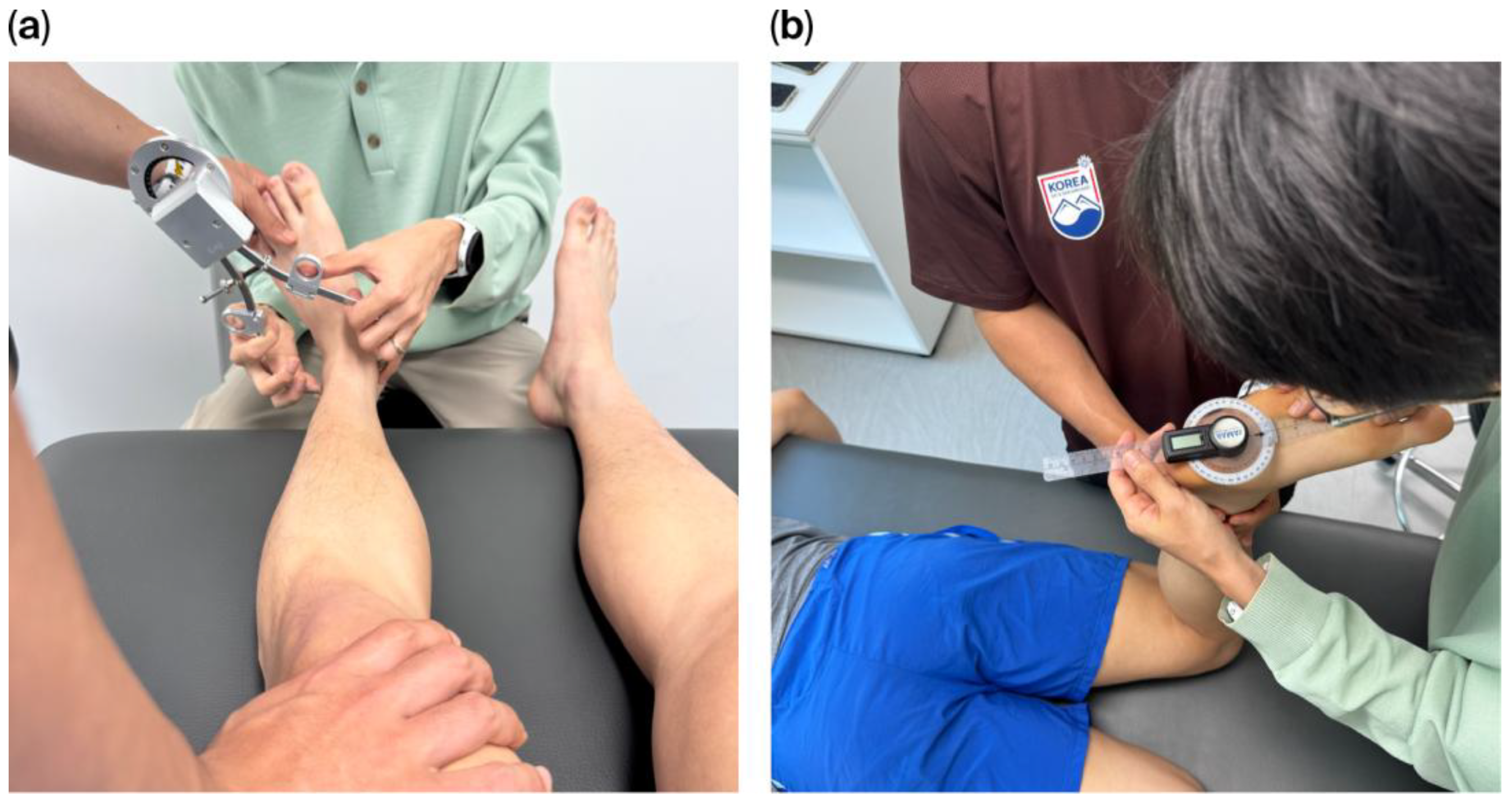
The TMA was defined as the angle formed between the knee joint axis and an imaginary line connecting the medial and lateral malleoli [19] (Figure 1a). The TFA was assessed in a prone position with the knee flexed to 90°, measuring the angle formed by the alignment of the foot and shank relative to the longitudinal axis of the thigh [17] (Figure 1b). These two indices were utilized to quantify the magnitude of internal or external tibial torsion for each athlete, and all measurements were obtained using a standard goniometer. While computed tomography (CT) is considered the gold standard for tibial torsion measurement, clinical goniometry was selected for its feasibility in an athletic screening context. The limitations of this approach, including potential measurement error compared to CT-based assessment, should be noted.
To minimize measurement error and ensure consistency, all static assessments (TMA and TFA) were performed by a single experienced medical doctor (J.S.) who is a co-author of this study. Given the examiner’s extensive clinical expertise in diagnosing musculoskeletal deformities, inter-rater variability was eliminated. The measurements were conducted strictly following the standardized protocols established in previous studies [17,18].
Prior to measurement, a warm-up consisting of light jogging was performed for approximately 3 min. The motion capture system was calibrated according to the manufacturer’s standardized protocol before each participant’s session to ensure consistent data acquisition. Following calibration and the input of each participant’s demographic data, a demonstration and practice session were conducted. The research team demonstrated the correct execution of each motor task (Squat, Single-Leg Squat, and Lunge) [20] and provided instructions to ensure participants fully understood the protocols. Participants were required to practice each movement several times to familiarize themselves with proper form and balance maintenance before proceeding to the actual measurement.
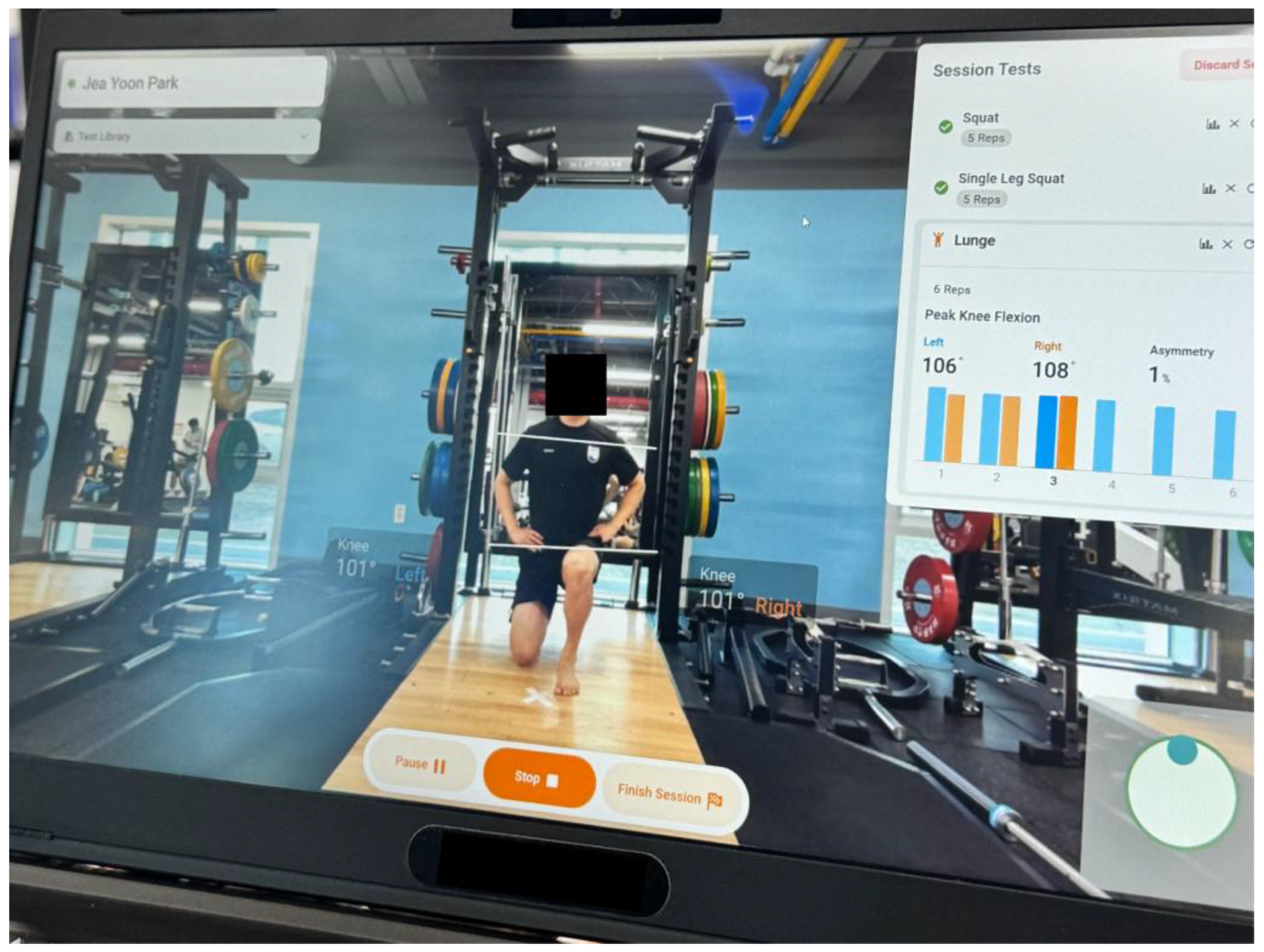
Subsequently, the dynamic motion assessment was initiated. The protocol consisted of three tasks: (1) Bodyweight Squat (performed bilaterally in place), (2) Single-Leg Squat (sitting and standing on one leg), and (3) Lunge (stepping forward with one foot) [20] (Figure 2). Each task was performed for five consecutive repetitions, followed by a rest period of approximately one minute before transitioning to the next task [21]. During all trials, participants wore comfortable athletic attire and performed the tasks barefoot. The research team observed the posture in real time and provided safety assistance as necessary.
Joint angles and alignment data during the tasks were analyzed using a three-dimensional markerless motion capture system (HumanTrak; Vald Performance, Brisbane, Australia) to ensure high ecological validity and replicability in a clinical setting and minimize the interference caused by attached markers. This system incorporates a Kinect v2 camera (Microsoft, Redmond, WA, USA) and utilizes artificial intelligence algorithms to track movement trajectories. It is a sensor-based 3D analysis tool capable of capturing human movement and calculating kinematic variables, such as joint angles, without the need for attaching markers to the body [22]. The rationale for utilizing this triad of tasks is to encompass diverse knee stability conditions (symmetrical/asymmetrical, static/dynamic) that cannot be evaluated based on a single movement. Specifically, the Squat represents “baseline loading” [23], the Single-Leg Squat assesses “unilateral control” [24,25,26], and the Lunge evaluates “dynamic transition” [27,28]. Together, these tasks allow for a comprehensive analysis covering the entire spectrum of ACL injury mechanisms and rehabilitation/prevention training strategies.
The 3D motion capture system acquired joint angle data for each repetition. The representative value for each participant’s specific motor task was defined as either the mean or peak value derived from the five trials. Upon completion of all measurements, participants performed a cool-down routine to conclude the experimental session. The total duration of the measurement protocol was approximately 20 min per participant. During the performance of each task, specific kinematic variables were collected, including knee joint alignment and motion (e.g., knee valgus angle, knee flexion angle), hip joint motion (e.g., hip adduction/abduction angle, rotation angle), and trunk and pelvic posture (e.g., trunk lateral tilt angle). These parameters were computed for each repetition using the 3D analysis system’s algorithms and were quantified in formats such as peak angles for each movement.

2.4. Data Acquisition and Analysis

Five kinematic parameters—Knee Valgus (KV), Ankle Dorsiflexion (AD), Hip Internal Rotation (HIR), Hip Flexion (HF), and Peak Knee Flexion (KF)—were measured during three functional movements: Squat, Single-Leg Squat, and Lunge.
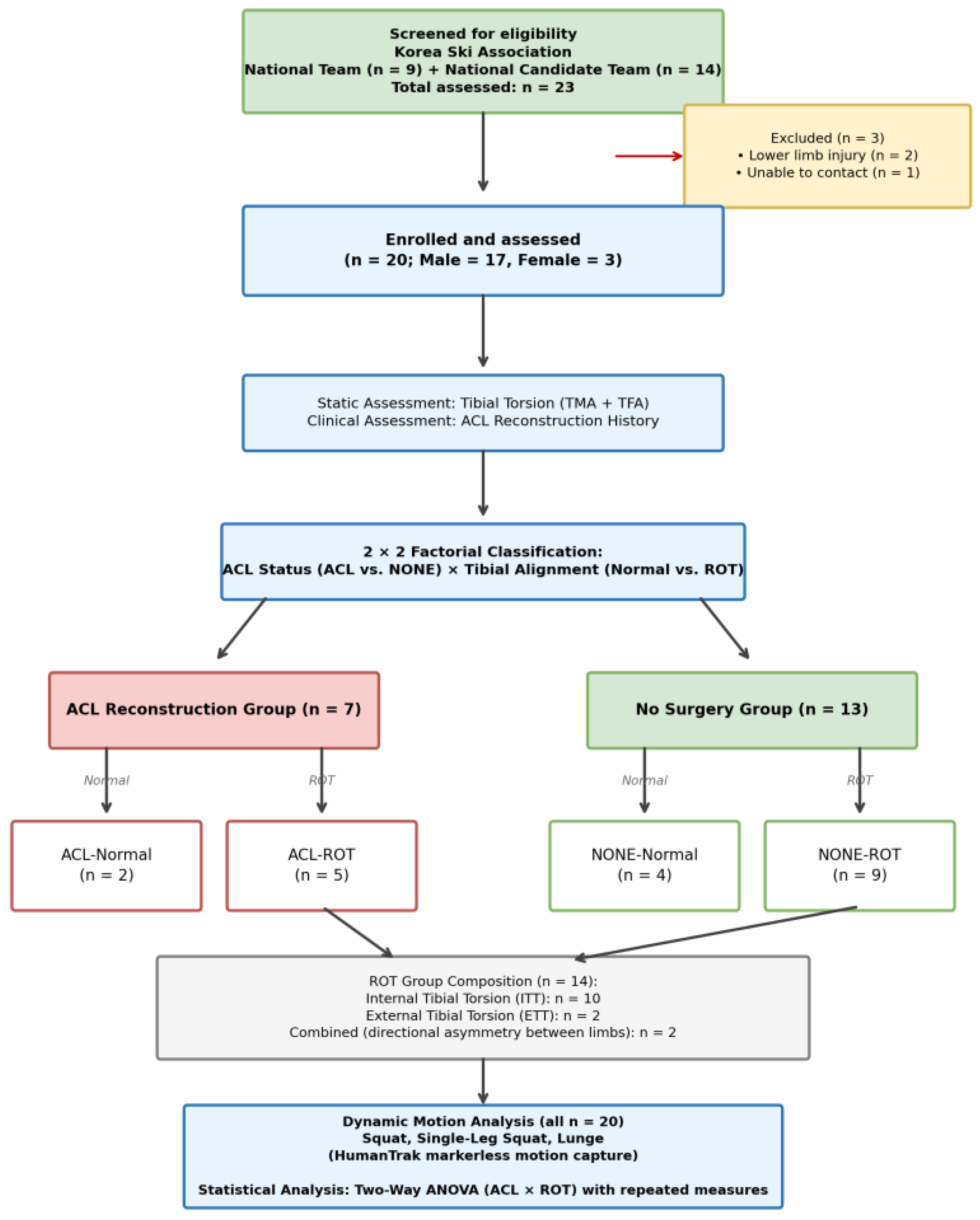
To account for the repeated measures design, a two-way analysis of variance (ANOVA) was employed. The model included the movement task as the within-subject factor, while ACL reconstruction status and tibial torsion alignment served as between-subject factors. This 2 × 2 factorial design resulted in four subgroups: ACL-Normal (n = 2), ACL-ROT (n = 5), NONE-Normal (n = 4), and NONE-ROT (n = 9) (Figure 3). Main and interaction effects were evaluated for each dependent variable. Where significant effects were observed, Bonferroni post hoc tests were conducted to identify specific group or task differences. Effect sizes were reported as partial eta squared (η2p) to facilitate interpretation beyond p-values. Given the small subgroup sizes, statistical power was limited, and no formal correction for multiple comparisons across dependent variables was applied. All statistical analyses were performed using IBM SPSS Statistics (Version 28.0; IBM Corp., Armonk, NY, USA) with the significance level set at p < 0.05. Age was not included as a covariate, as no significant between-group differences were observed; however, the broad age range (15–37 years) is acknowledged as a limitation. Potential outliers were evaluated using the interquartile range (IQR) method (1.5 × IQR criterion). Isolated observations exceeding this threshold were identified for KV_R and HIR_L; however, given the small sample size and the absence of measurement errors or protocol deviations, these values were retained in the analysis. To enhance statistical transparency, 95% confidence intervals (CIs) are reported alongside estimated marginal means for statistically significant findings.

3. Results

3.1. Demographic and Anatomical Characteristics of Participants

Analysis of the 20 participants revealed that the ACL reconstruction group consisted of 7 athletes (35.0%), while the non-surgical group (NONE) comprised 13 athletes (65.0%). Notably, regarding the prevalence of tibial rotational deformity, 70.0% (n = 14) of the cohort exhibited rotational deformity, whereas only 30.0% (n = 6) presented with normal alignment (Table 3). This suggests that anatomical deformities are not rare exceptions but rather frequently observed characteristics within the elite alpine skier population.

3.2. Analysis of Biomechanical Variables (Two-Way ANOVA)

Table 3 presents the comparison of biomechanical variables based on ACL reconstruction status and tibial rotational alignment.

3.2.1. Knee Valgus at Peak Knee Flexion (KV)

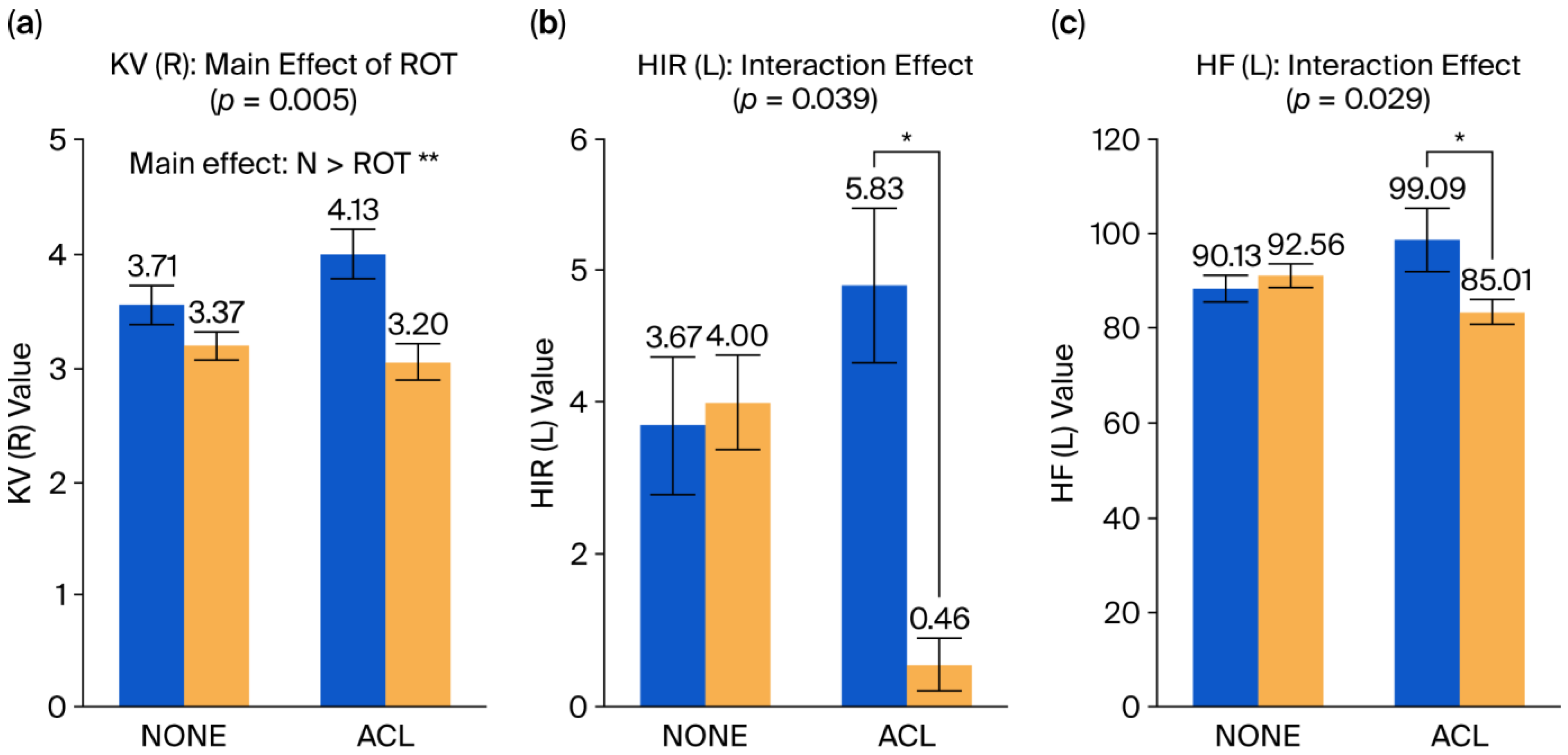
Analysis of Main Effects on the Right Knee (KV_R): Regarding the right knee, a statistically significant main effect of tibial rotation (ROT) was observed (F = 8.465, p = 0.005). The group with normal alignment (N) exhibited a mean valgus angle of 3.92° (±0.25; 95% CI [3.41, 4.14]), whereas the rotational deformity (ROT) group recorded a significantly lower value of 3.29° (±0.17; 95% CI [2.96, 3.48]) (Figure 4a). This disparity was particularly pronounced within the ACL reconstruction cohort. The ACL-Normal subgroup demonstrated a high valgus angle of 4.13° (±0.30; 95% CI [3.34, 4.66]), while the ACL-ROT subgroup presented a suppressed pattern with an angle of 3.20° (±0.20; 95% CI [2.50, 3.65]). This statistical difference suggests that skiers with tibial torsion may employ a stiffening strategy at the knee joint to limit rotational stress.
Left Knee (KV_L) and Asymmetry (ASYM): No statistically significant differences or interaction effects were found between groups for the left knee or the asymmetry index (p > 0.05). However, descriptive analysis of the standard deviation (SD) for the asymmetry index revealed that the ACL group (3.95 ± 2.86) exhibited greater variability compared to the non-injured group (0.73 ± 2.02). Although this observation did not reach statistical significance, it may suggest heterogeneous asymmetry patterns within the ACL reconstruction group, potentially related to factors such as the surgical site and degree of recovery. This exploratory finding warrants confirmation in larger samples.
Statistical Interpretation: Although the interaction effect did not reach statistical significance (p > 0.05), the data for the right knee suggest that athletes with tibial rotational deformity may be limiting knee valgus movement through structural or neurological compensatory mechanisms. Conversely, anatomically normal ACL patients exhibited higher valgus values (4.13°), which may reflect deficits in proprioception and neuromuscular control. However, given the small sample size and limited statistical power, these observations should be considered exploratory and hypothesis-generating rather than confirmatory [13].

3.2.2. Ankle Dorsiflexion at Peak Knee Flexion (AD)

Ankle dorsiflexion (AD) serves as a representative metric for distal strategies employed to compensate for movement restrictions in adjacent proximal joints.
Compensatory Mechanisms: The main effect of tibial rotation on ankle dorsiflexion did not reach statistical significance (p = 0.051). Nevertheless, a non-significant trend toward elevated AD values was observed in the ROT group, which may suggest a compensatory pattern wherein the ankle joint is utilized to lower the center of mass when mobility in the proximal joints (knee and hip) is restricted due to tibial torsion. However, this observation should be interpreted cautiously as an exploratory, hypothesis-generating finding, given the limited statistical power of the current study [29].

3.2.3. Hip Internal Rotation at Peak Knee Flexion (HIR)

Hip Internal Rotation (HIR) reflects the capacity for femoral rotational control and is closely associated with the pivot shift mechanism, a primary etiology of ACL injury. Interaction Effect on the Left Hip (HIR_L): A significant interaction effect between ACL reconstruction status and tibial rotational deformity was observed (F = 4.534, p = 0.039).
  • ACL Group: The Normal alignment (N) subgroup exhibited 5.83° (±1.83; 95% CI [1.83, 9.84]) of internal rotation, whereas the Rotational Deformity (ROT) subgroup maintained a state of near-suppression or neutrality, recording only 0.46° (±1.19; 95% CI [−1.03, 4.32]) (Figure 4b). This difference within the ACL group was large in magnitude (Cohen’s d = 0.95), indicating that among ACL-reconstructed skiers, those with rotational deformity substantially suppressed hip internal rotation compared to those with normal alignment.
  • Non-Injured Group (NONE): No significant difference was found between the N (3.67°) and ROT (4.00°) subgroups (Cohen’s d = 0.01), confirming that this divergence was specific to the ACL reconstruction group (Figure 4b).
This suggests that patients with tibial torsion who have undergone ACL reconstruction employ a “locking strategy” of the hip joint to modulate instability (Figure 4b).
Bilateral Asymmetry (HIR_ASYM): A significant main effect of the ACL group was identified in the asymmetry index (F = 4.073, p = 0.049). The ACL group showed a mean asymmetry value of 15.26 (95% CI [−19.24, 49.77]), whereas the NONE group recorded −37.82 (95% CI [−60.30, −15.33]). The standard deviation was notably high in both groups, indicating substantial inter-subject variability. No outliers were detected using the IQR criterion. This finding suggests that functional symmetry may not be fully restored following ACL reconstruction, though the high variability and wide confidence intervals indicate considerable individual differences in recovery outcomes [30].

3.2.4. Hip Flexion at Peak Knee Flexion (HF)

Hip Flexion (HF) serves as a core mechanism for shock absorption during landing. Interaction Effect on the Left Hip (HF_L): Consistent with the HIR results, a significant interaction effect was confirmed (F = 5.108, p = 0.029).
  • ACL-Normal Subgroup: Demonstrated a deep flexion angle of 99.09° (±4.96; 95% CI [90.68, 107.32]), utilizing an effective “soft landing” strategy.
  • ACL-ROT Subgroup: Exhibited a flexion angle of 85.01° (±3.31; 95% CI [79.62, 97.81]), representing a reduction of approximately 14° (Cohen’s d = 0.73) (Figure 4c). In contrast, no meaningful difference was observed between the NONE-Normal (93.25°) and NONE-ROT (95.19°) subgroups (Cohen’s d = 0.13), indicating that the interaction was driven primarily by the ACL reconstruction group.

3.2.5. Peak Knee Flexion (KF)

Peak Knee Flexion (KF) showed less distinct between-group differences compared to other variables. No significant main or interaction effects were observed across any conditions (p > 0.05). This suggests that athletes tend to maintain a consistent knee flexion angle or predominantly utilize the hip and ankle joints as primary modulators for shock absorption.

4. Discussion

This study demonstrated that the biomechanical adaptation strategies of elite alpine skiers following ACL reconstruction are not uniform but appear to diverge based on individual tibial torsion alignment. The primary finding was that the interaction between ACL injury history and tibial torsion was associated with two distinct motor control patterns. Skiers with tibial rotational deformity exhibited a pattern we describe as a “Stiffness Strategy”, characterized by a restricted range of motion in the knee and hip joints to secure static stability. In contrast, skiers with normal alignment exhibited what we term an “Instability Strategy”, showing elevated dynamic valgus and persistent asymmetry. These results suggest that anatomical tibial torsion may act as an intrinsic factor associated with how the kinetic chain compensates for ACL deficiency, and that standardized rehabilitation protocols may not fully address these differing biomechanical patterns.

4.1. “Stiffness” Versus “Instability”: Anatomical Individuality

The most pivotal finding of this study is that athletes who have undergone ACL reconstruction adopt diametrically opposed adaptive strategies depending on their skeletal anatomy—specifically, the presence or absence of tibial torsion.
Stiffness Strategy (ACL-ROT Group): ACL patients with tibial rotational deformity adopted a “stiffness strategy”, characterized by suppressed knee valgus (3.20°), blocked hip internal rotation (0.46°), and limited hip flexion (85.01°). This pattern can be interpreted as a defensive adaptation by the nervous system aimed at minimizing shear forces on intra-articular structures, which would otherwise be exacerbated by excessive movement in the presence of osseous malalignment [31]. However, this stiffness may act as a potential vulnerability in high-impact sports such as alpine skiing. A relatively rigid motor control pattern, less capable of flexibly dissipating impact forces, may cause shocks from sudden external loads or irregular snow surfaces to be transmitted more directly to joint structures (bones, ligaments, cartilage) rather than being absorbed by the musculature [32]. Consequently, for this subgroup, reduced flexibility may represent a potential contributing factor to re-injury risk [33].
Instability Strategy (ACL-Normal Group): ACL patients with normal skeletal alignment exhibited elevated knee valgus (4.13°) and greater hip flexion (99.09°). This pattern suggests that while joint mobility is preserved, dynamic control within that range of motion may be compromised. Notably, the elevated knee valgus angle is consistent with the “dynamic valgus collapse” pattern, which has been associated with ACL injury mechanisms. This finding may indicate persistent deficits in proprioception and neuromuscular control following reconstruction [13]. For this group, a deficit in motor control may represent a key factor associated with injury vulnerability [8].

4.2. “False Safety Net”: Discrepancy Between Laboratory and On-Snow Environments

The excessive ankle dorsiflexion (39.5°, p = 0.051) observed in the ACL-ROT group may represent a compensatory strategy that we hypothesize could function as a “false safety net”. In the laboratory setting (barefoot or athletic shoes), these athletes utilized deep ankle dorsiflexion to lower their center of mass, presumably because their knee and hip mobility was restricted by tibial torsion. Based on biomechanical reasoning, we hypothesize that this compensation would be substantially constrained in the actual skiing environment. Alpine ski boots are structural devices designed to rigidly restrict ankle motion [32]. Consequently, upon donning boots (particularly racing boots with a Flex index ≥ 130), the ankle motion—the compensatory mechanism relied on by these athletes—would theoretically become blocked [32]. However, it is important to note that no booted or on-snow condition was experimentally evaluated in the present study; this inference remains a theoretical extrapolation that warrants future investigation.
If this compensatory mechanism were to be constrained by ski boots, athletes attempting to lower their center of mass may be forced to shift their hips posteriorly, potentially inducing a “backseat” posture [32]. This posture could place increased pressure on the ski tail. During a turn, if the ski edge catches the snow (“slip-catch”), the tail may act as a lever arm, generating a force that pulls the tibia anteriorly. This sequence is consistent with the classic “Phantom Foot” mechanism, which involves anterior shear forces on the ACL [7,10,13]. Thus, the elevated ankle dorsiflexion values observed in the ROT group may represent a potential warning signal of a biomechanical mismatch that could increase injury risk on the slope. However, this proposed pathway remains a theoretical hypothesis derived from biomechanical reasoning and has not been directly tested under skiing conditions.

4.3. Indelible Traces: Hip Internal Rotation Asymmetry and Pivot Shift Avoidance

The notable asymmetry in hip internal rotation (ASYM, p = 0.049) observed in the ACL group suggests that, while surgery may have achieved structural reconstruction, functional symmetry may not have been fully restored. This finding is consistent with a persistent imbalance in bilateral limb usage within the ACL group. Statistically, the ACL group showed a mean ASYM of −6.33 with a substantial standard deviation (SD) of 28.57, whereas the NONE group recorded −16.47 (SD 20.2). The significance lies in the statistical test (F-test) identifying this variability as meaningful heterogeneity.
Hip Internal Rotation (HIR) is a critical component of the ascending kinetic chain that induces knee valgus. Internal rotation of the femur creates a relative valgus torque on the tibia, transmitting load directly to the ACL. Furthermore, HIR is essential for steering and edging the ski. Our findings suggest that ACL reconstruction may leave a persistent functional asymmetry in this capability.
  • Pivot Shift Avoidance Gait: The suppression of left hip internal rotation (0.46°) in the ROT group may represent a learned response by the central nervous system (CNS) to avoid knee instability. Since ACL injuries predominantly occur during knee internal rotation and valgus, the CNS may develop an avoidance pattern for this motion [34]. This may not be merely muscle weakness but rather an active defensive mechanism wherein the gluteus maximus and deep rotators may be recruited to fix the femur in external rotation. However, this interpretation is theoretical, as no electromyographic (EMG) data were collected in this study [35,36].
  • Turn Asymmetry and Secondary Injury: Alpine skiing demands symmetrical turning ability. A deficit in internal rotation on one side may compromise “turn initiation” capability in that direction, potentially contributing to technical imbalance. This may not only impair performance but also increase “limb reliance” on the unaffected leg (contralateral side), which has been associated with an elevated risk of overload and subsequent ACL injury to the healthy knee [30,37]. Supporting this interpretation, a recent computational study using OpenSim demonstrated that lower limb asymmetries produce compounded biomechanical effects at the joint and muscle levels, with peak knee joint moments increasing by up to 20% under pronounced asymmetry conditions [38].

4.4. The Trade-Off Between Shock Absorption and Rotational Control

The findings of this study highlight a biomechanical dilemma existing between hip flexion (HF) and internal rotation (HIR). The ROT group suppressed internal rotation to avoid rotational stress; however, due to the anatomically coupled nature of internal rotation and flexion, this inevitably led to a reduction in the flexion angle (85°). This results in a reduced capacity to absorb impact via eccentric muscle contraction, potentially increasing the load borne directly by the joint surfaces. Long-term exposure to such mechanics may be associated with an increased risk for the early onset of osteoarthritis (OA) [39,40].

4.5. Clinical Implications and Field Application

The data presented in this study suggest concrete improvements for athlete management systems.
  • Recommended Anatomical Screening: Beyond simple strength measurements, pre-identification of tibial torsional deformities via “Transmalleolar Axis (TMA) Angle” or “Thigh-Foot Angle (TFA)” measurements may be beneficial [41]. Athletes presenting with deformities exceeding the normal range or significant asymmetry may benefit from being identified as a higher-risk subgroup for targeted monitoring and individualized management [42].
  • Tailored Training Based on Subtype:
  • 1. Rotation Group: Training focused on “decoupling” flexion from rotation may be beneficial to improve hip mobility. Additionally, correction of the tibial axis through ski boot tuning (e.g., canting adjustment, shell modification) or custom footbeds (orthoses) may be considered [36,43].
  • 2. Normal-ACL Group: Dynamic stability may be enhanced through “end-range control” and perturbation training. Furthermore, unilateral rotation exercise programs may be prioritized to address hip internal rotation asymmetry [44].
  • Re-education of Pivot Shift Avoidance Patterns: If tibial rotational deformity is identified via TMA or TFA assessment, athletes may benefit from training to actively engage the hip joint before and after ski training to improve bilateral symmetry. This may be important not only for improving lower limb alignment but also for addressing turn asymmetry, which may impact performance.

4.6. Limitations

This study provides valuable insights into the interaction between anatomical characteristics and ACL injury history in elite alpine skiers; however, several limitations should be noted.
  • First, this study categorized both internal (ITT) and external tibial torsion (ETT) into a single “Rotational Deformity (ROT)” group without distinguishing between the directions of rotation. While the initial study design aimed to analyze these subgroups separately, recruiting a sufficient sample size for each specific deformity within a limited population of active national team and elite athletes proved challenging. The primary objective of this study was to investigate the biomechanics of the most elite alpine skiers in Korea (National Team and National Candidate Team members), and balancing ITT and ETT subgroup sizes would have required the inclusion of non-elite athletes, thereby compromising the homogeneity and specificity of the target population. Consequently, to ensure statistical power while maintaining population specificity, participants falling outside the normal alignment range were integrated into the ROT group. Importantly, internal and external tibial torsion may impose biomechanically distinct, and potentially opposing, rotational biases on the knee and hip. Internal torsion may predispose the limb to different compensatory patterns compared to external torsion. Therefore, the kinematic patterns reported in this study reflect the pooled effect of any rotational deviation from normal alignment, rather than direction-specific torsional effects. Within the ROT group (n = 14), 10 participants exhibited internal tibial torsion, 2 exhibited external tibial torsion, and 2 presented with combined internal and external torsion (i.e., directional asymmetry between limbs). Although the broader finding that structural malalignment is associated with altered neuromuscular control strategies remains relevant, future studies with larger sample sizes are necessary to elucidate direction-specific kinematic differences between internal and external torsion.
  • Second, the cohort consisted predominantly of male participants (17 males, 3 females), and the ACL reconstruction group also exhibited a marked sex imbalance. Although the prevalence of ACL injuries is generally higher in female athletes, the ACL group in this study consisted predominantly of males. This discrepancy arose from the screening process, which was restricted to currently active, top-tier elite skiers, resulting in a limited pool of available female participants with a history of ACL reconstruction who were fit for testing. Given established sex-based differences in ACL injury risk and lower limb biomechanics, sex-specific analyses were not performed due to sample size constraints. Therefore, caution should be exercised when generalizing these findings, particularly to female elite skiers. Future studies with larger, sex-balanced cohorts are warranted to investigate potential sex-related biomechanical differences.
  • Third, the dynamic motion analysis was conducted in a laboratory setting with participants performing tasks barefoot. This condition differs significantly from the on-snow environment, where skiers wear rigid ski boots that severely restrict ankle dorsiflexion [8,32]. In this study, the ROT group exhibited elevated ankle dorsiflexion as a potential compensatory mechanism for restricted knee and hip mobility. We hypothesize that in an actual skiing scenario, the rigid boot would constrain this ankle motion, potentially altering the biomechanical strategy. However, the ski-boot-related injury pathway discussed in this study (including the proposed progression toward the “Phantom Foot” mechanism) is a hypothesis derived from biomechanical reasoning rather than directly tested evidence, as no booted or on-snow condition was experimentally evaluated [7,10,13]. While the barefoot assessment effectively revealed the athletes’ intrinsic compensatory strategies, it does not replicate the kinematic constraints imposed by ski equipment.
  • Finally, this study utilized a markerless motion capture system. While this system offers high field applicability and has been validated in previous studies [22], it may possess lower precision in tracking minute rotational angles of the hip and ankle compared to traditional marker-based optical systems. Notably, several key findings in this study—particularly hip internal rotation (HIR)—involve small angular differences (e.g., values near 0–5°) that may approach the known measurement error range of depth-camera-based systems. No reliability metrics (e.g., ICC, SEM, minimal detectable change) were calculated for the current dataset, and the reported between-group differences may not exceed the expected measurement error. Conclusions based on these small angular differences should therefore be interpreted with caution.
  • Fifth, the cross-sectional design of this study precludes causal inference. The identified associations between tibial torsion, ACL reconstruction history, and kinematic patterns do not establish temporal or causal relationships. Prospective or longitudinal studies are required to determine whether the identified biomechanical patterns predict actual ACL injury or reinjury risk.
  • Sixth, multiple dependent variables were analyzed without formal correction for multiple comparisons (e.g., Bonferroni), which increases the risk of Type I error. Although effect sizes (partial eta squared) are reported alongside p-values to facilitate interpretation, findings—particularly those with borderline significance—should be interpreted with appropriate caution.
  • Seventh, potential confounding variables such as years of skiing experience, weekly training volume, and other training-related factors were not included as covariates in the statistical model. Although no significant between-group differences were observed in BMI, height, or weight, the influence of training-related confounders on the observed biomechanical patterns cannot be excluded.
  • Eighth, limb dominance and technical preference in competitive skiing may influence lower-limb asymmetry patterns. This factor was not systematically assessed in the current study and represents an additional limitation that should be addressed in future research.

5. Conclusions

This study showed that the interaction between tibial torsion and ACL injury history was associated with distinct biomechanical strategy patterns in elite alpine skiers. The results suggest that athletes with tibial rotational deformity adopt a pattern consistent with a “Stiffness Strategy”, limiting proximal joint motion to secure static stability. While laboratory analysis revealed a reliance on elevated ankle dorsiflexion to compensate for this restriction, based on biomechanical reasoning, this mechanism may be substantially constrained by rigid ski boots in the on-snow environment, which could be associated with increased susceptibility to injury mechanisms such as the “Phantom Foot”—a hypothesis requiring prospective validation.
Conversely, ACL-reconstructed skiers with normal alignment exhibited an “Instability Strategy”, characterized by dynamic valgus collapse and persistent bilateral asymmetry in hip rotation, reflecting a lingering pivot shift avoidance response even after surgery. These findings underscore that standard “one-size-fits-all” rehabilitation protocols may fail to address the specific mechanical mismatches introduced by anatomical variations.
Consequently, injury prevention paradigms may benefit from evolving beyond generic strengthening toward anatomically specific interventions. Screening for tibial torsion may help practitioners identify athletes who could benefit from individualized preventive strategies—distinguishing those who may need mobility “decoupling” (ROT group) from those who may benefit from dynamic stability training (Normal group). Such a targeted approach may contribute to more effective injury prevention in elite alpine skiing, though prospective and longitudinal studies are needed to confirm whether the identified biomechanical patterns predict actual ACL injury or reinjury risk.

Author Contributions

Conceptualization, S.Y.P. and J.H.; methodology, S.Y.P. and J.S.; software, S.Y.P.; validation, J.S. and J.H.; formal analysis, S.Y.P.; investigation, S.Y.P.; resources, J.H.; data curation, S.Y.P.; writing—original draft preparation, S.Y.P.; writing—review and editing, J.S. and J.H.; visualization, S.Y.P.; supervision, J.H. and J.S.; project administration, J.H. All authors have read and agreed to the published version of the manuscript.

Funding

This research received no external funding.

Institutional Review Board Statement

This study was approved by the Institutional Review Board of CHA University, Pocheon-si, Gyeonggi-do, Republic of Korea (Approval Number 1044308-202509-HR-289-02, 12 November 2025) for studies involving humans. It was conducted in accordance with the latest revision of the Declaration of Helsinki.

Informed Consent Statement

Informed consent was obtained from all subjects involved in this study, and from the legal guardians of minor participants.

Data Availability Statement

The original data presented in this study are available on request from the corresponding author.

Conflicts of Interest

The authors declare no conflicts of interest.

Abbreviations

The following abbreviations are used in this manuscript:
ACLAnterior Cruciate Ligament
ADAnkle Dorsiflexion (at Peak Knee Flexion)
ANOVAAnalysis of Variance
ASYMAsymmetry Index
HFHip Flexion (at Peak Knee Flexion)
HIRHip Internal Rotation (at Peak Knee Flexion)
IKDCInternational Knee Documentation Committee
KFPeak Knee Flexion
KOOSKnee Injury and Osteoarthritis Outcome Score
KVKnee Valgus (at Peak Knee Flexion)
ROTRotational Deformity Group
TFAThigh–Foot Angle
TMATransmalleolar Axis Angle
TTTibial Torsion

References

  1. Kim, Y. Tibial Torsion and Knee Varus Angle: Are These Aetiologies of Hallux Valgus? Soonchunhyang Med. Sci. 2018, 24, 170–174. [Google Scholar] [CrossRef]
  2. Noyes, F.R.; Barber-Westin, S.D. Operative Options for Extensor Mechanism Malalignment and Patellar Dislocation. In Noyes’ Knee Disorders: Surgery, Rehabilitation, Clinical Outcomes, 2nd ed.; Noyes, F.R., Barber-Westin, S.D., Eds.; Elsevier: Amsterdam, The Netherlands, 2017; pp. 970–1013. [Google Scholar]
  3. Song, D.H.; Lee, Y.; Eun, B.-L.; Lee, K.J.; Kang, S.K.; Vaq, S.G.; You, S.; Shin, J.B.; Kim, B.O. Usefulness of tibia counter rotator (TCR) for treatment of tibial internal torsion in children. Korean J. Pediatr. 2007, 50, 79–84. [Google Scholar] [CrossRef]
  4. Shea, K.G.; Archibald-Seiffer, N.; Murdock, E.; Grimm, N.L.; Jacobs, J.C., Jr.; Willick, S.; Van Houten, H. Knee injuries in downhill skiers: A 6-year survey study. Orthop. J. Sports Med. 2014, 2, 2325967113519741. [Google Scholar] [CrossRef] [PubMed]
  5. Chizewski, M.G. Tibial Torsion Influences Lower Body Joint Kinematics and Kinetics in Women with Anterior Cruciate Ligament Injury During Squatting and Landing. Ph.D. Thesis, University of Alberta, Edmonton, AB, Canada, 2016. [Google Scholar]
  6. Senter, C.; Hame, S.L. Biomechanical analysis of tibial torque and knee flexion angle: Implications for understanding knee injury. Sports Med. 2006, 36, 635–641. [Google Scholar] [CrossRef]
  7. Rossi, M.J.; Lubowitz, J.H.; Guttmann, D. The skier’s knee. Arthrosc. J. Arthrosc. Relat. Surg. 2003, 19, 75–84. [Google Scholar] [CrossRef]
  8. Bere, T.; Mok, K.-M.; Koga, H.; Krosshaug, T.; Nordsletten, L.; Bahr, R. Kinematics of Anterior Cruciate Ligament Ruptures in World Cup Alpine Skiing 2 Case Reports of the Slip-Catch Mechanism. Am. J. Sports Med. 2013, 41, 1067–1073. [Google Scholar] [CrossRef]
  9. Smith, C.; Grooms, D.R.; Bradley, H. Enhancing Return to Alpine Skiing: Integrating Perceptual-Motor-Cognitive Considerations in Testing and Progressions: A Clinical Commentary. Int. J. Sports Phys. Ther. 2024, 19, 923. [Google Scholar] [CrossRef]
  10. Hame, S.L.; Oakes, D.A.; Markolf, K.L. Injury to the Anterior Cruciate Ligament during Alpine Skiing:A Biomechanical Analysis of Tibial Torque and Knee Flexion Angle. Am. J. Sports Med. 2002, 30, 537–540. [Google Scholar] [CrossRef]
  11. St-Onge, N.; Chevalier, Y.; Hagemeister, N.; Putte, M.; de Guise, J. Effect of Ski Binding Parameters on Knee Biomechanics: A Three-Dimensional Computational Study. Med. Sci. Sports Exerc. 2004, 36, 1218–1225. [Google Scholar] [CrossRef]
  12. Posch, M.; Schranz, A.; Lener, M.; Tecklenburg, K.; Burtscher, M.; Ruedl, G. In recreational alpine skiing, the ACL is predominantly injured in all knee injuries needing hospitalisation. Knee Surg. Sports Traumatol. Arthrosc. 2021, 29, 1795. [Google Scholar] [CrossRef]
  13. Jordan, M.J.; Aagaard, P.; Herzog, W. Anterior cruciate ligament injury/reinjury in alpine ski racing: A narrative review. Open Access J. Sports Med. 2017, 8, 71–83. [Google Scholar] [CrossRef] [PubMed]
  14. Winter, W.G., Jr.; Lafferty, J.F. The skiing sequelae of tibial torsion. Orthop. Clin. N. Am. 1976, 7, 231–240. [Google Scholar] [CrossRef]
  15. Roos, E.M.; Lohmander, L.S. The Knee injury and Osteoarthritis Outcome Score (KOOS): From joint injury to osteoarthritis. Health Qual. Life Outcomes 2003, 1, 64. [Google Scholar] [CrossRef] [PubMed]
  16. Collins, N.J.; Misra, D.; Felson, D.T.; Crossley, K.M.; Roos, E.M. Measures of knee function: International Knee Documentation Committee (IKDC) Subjective Knee Evaluation Form, Knee Injury and Osteoarthritis Outcome Score (KOOS), Knee Injury and Osteoarthritis Outcome Score Physical Function Short Form (KOOS-PS), Knee Outcome Survey Activities of Daily Living Scale (KOS-ADL), Lysholm Knee Scoring Scale, Oxford Knee Score (OKS), Western Ontario and McMaster Universities Osteoarthritis Index (WOMAC), Activity Rating Scale (ARS), and Tegner Activity Score (TAS). Arthritis Care Res. 2011, 63, S208–S228. [Google Scholar]
  17. Singh, H.; Gupta, P.; Kaur, R.; Sharma, C. Comparison of clinical with CT based evaluation for tibial torsion. J. Clin. Orthop. Trauma 2022, 29, 101875. [Google Scholar] [CrossRef]
  18. Borish, C.N.; Mueske, N.M.; Wren, T.A.L. A comparison of three methods of measuring tibial torsion in children with myelomeningocele and normally developing children. Clin. Anat. 2017, 30, 1043–1048. [Google Scholar] [CrossRef]
  19. Hawi, H.; Kaireit, T.F.; Krettek, C.; Liodakis, E. Clinical assessment of tibial torsion differences. Do we always need a computed tomography? Eur. J. Trauma Emerg. Surg. 2022, 48, 3229–3235. [Google Scholar] [CrossRef]
  20. Trulsson, A.; Garwicz, M.; Ageberg, E. Postural orientation in subjects with anterior cruciate ligament injury: Development and first evaluation of a new observational test battery. Knee Surg. Sports Traumatol. Arthrosc. 2010, 18, 98. [Google Scholar] [CrossRef]
  21. Comfort, P.; Jones, P.A.; Smith, L.C.; Herrington, L. Joint kinetics and kinematics during common lower limb rehabilitation exercises. J. Athl. Train. 2015, 50, 1011–1018. [Google Scholar] [CrossRef]
  22. Collings, T.J.; Devaprakash, D.; Pizzolato, C.; Lloyd, D.G.; Barrett, R.S.; Lenton, G.K.; Thomeer, L.T.; Bourne, M.N. Inclusion of a skeletal model partly improves the reliability of lower limb joint angles derived from a markerless depth camera. J. Biomech. 2024, 170, 112160. [Google Scholar] [CrossRef]
  23. Willing, R.; Moslemian, A.; Yamomo, G.; Wood, T.; Howard, J.; Lanting, B. Condylar-Stabilized TKR May Not Fully Compensate for PCL-Deficiency: An In Vitro Cadaver Study. J. Orthop. Res. 2019, 37, 2172–2181. [Google Scholar] [CrossRef]
  24. Shields, R.K.; Madhavan, S.; Gregg, E.; Leitch, J.; Petersen, B.; Salata, S.; Wallerich, S. Neuromuscular Control of the Knee during a Resisted Single-Limb Squat Exercise. Am. J. Sports Med. 2005, 33, 1520–1526. [Google Scholar] [CrossRef] [PubMed]
  25. Khuu, A.; Foch, E.; Lewis, C.L. Not All Single Leg Squats Are Equal: A Biomechanical Comparison of Three Variations. Int. J. Sports Phys. Ther. 2016, 11, 201–211. [Google Scholar] [PubMed]
  26. Ksoll, K.S.H.; Cotic, M.; Schmalzl, K.; Beitzel, K.; Achtnich, A.; Imhoff, A.; Schwirtz, A.; Kreuzpointner, F.; Seiberl, W. Movement Coordination during Functional Single-Leg Squat Tests in Healthy, Recreational Athletes. Symmetry 2022, 14, 388. [Google Scholar] [CrossRef]
  27. Hamai, S.; Moro-oka, T.-a.; Dunbar, N.J.; Miura, H.; Iwamoto, Y.; Banks, S.A. In Vivo Healthy Knee Kinematics during Dynamic Full Flexion. BioMed Res. Int. 2013, 2013, 717546. [Google Scholar] [CrossRef]
  28. Campardo, G.; Ricupito, R.; Vercesi, C.; Mourad, F.; Kakavas, G.; Forelli, F. Think Outside the Block: Rehabilitation Continuum After ACL Reconstruction with Adaptive Macro-Blocks—A Narrative Review. Healthcare 2025, 13, 2480. [Google Scholar] [CrossRef]
  29. Rao, Y.; Yang, N.; Gao, T.; Zhang, S.; Shi, H.; Lu, Y.; Ren, S.; Huang, H. Effects of peak ankle dorsiflexion angle on lower extremity biomechanics and pelvic motion during walking and jogging. Front. Neurol. 2023, 14, 1269061. [Google Scholar] [CrossRef]
  30. Hughes, G.; Musco, P.; Caine, S.; Howe, L. Lower Limb Asymmetry After Anterior Cruciate Ligament Reconstruction in Adolescent Athletes: A Systematic Review and Meta-Analysis. J. Athl. Train. 2020, 55, 811–825. [Google Scholar] [CrossRef]
  31. Defrate, L.; Papannagari, R.; Gill, T.; Moses, J.; Pathare, N.; Li, G. The 6 Degrees of Freedom Kinematics of the Knee After Anterior Cruciate Ligament Deficiency: An In Vivo Imaging Analysis. Am. J. Sports Med. 2006, 34, 1240–1246. [Google Scholar] [CrossRef]
  32. Eberle, R.; Heinrich, D.; Kaps, P.; Oberguggenberger, M.; Nachbauer, W. Effect of ski boot rear stiffness (SBRS) on maximal ACL force during injury prone landing movements in alpine ski racing: A study with a musculoskeletal simulation model. J. Sports Sci. 2017, 35, 1125–1133. [Google Scholar] [CrossRef]
  33. Hanimann, J.; Fitze, D.P.; Koller, T.; Schürmann, F.; Fröhlich, S.; Feuerriegel, G.C.; Stern, C.; Scherr, J.; de Bruin, E.D.; Sutter, R.; et al. Traumatic knee injuries and career drop-outs in adolescent competitive alpine skiers aged 15–19: A longitudinal 4-year follow-up study examining rates, biomechanical injury risk factors and potential reasons for quitting. Ann. Med. 2025, 57, 2532118. [Google Scholar] [CrossRef]
  34. Fuentes, A.; Hagemeister, N.; Ranger, P.; Heron, T.; de Guise, J. Gait adaptation in chronic anterior cruciate ligament-deficient patients: Pivot-shift avoidance gait. Clin. Biomech. 2010, 26, 181–187. [Google Scholar] [CrossRef] [PubMed]
  35. Bedi, A.; Warren, R.F.; Wojtys, E.M.; Oh, Y.K.; Ashton-Miller, J.A.; Oltean, H.; Kelly, B.T. Restriction in hip internal rotation is associated with an increased risk of ACL injury. Knee Surg. Sports Traumatol. Arthrosc. 2016, 24, 2024–2031. [Google Scholar] [CrossRef] [PubMed]
  36. Powers, C.M. The Influence of Abnormal Hip Mechanics on Knee Injury: A Biomechanical Perspective. J. Orthop. Sports Phys. Ther. 2010, 40, 42–51. [Google Scholar] [CrossRef] [PubMed]
  37. Renner, K.E.; Franck, C.T.; Miller, T.K.; Queen, R.M. Limb asymmetry during recovery from anterior cruciate ligament reconstruction. J. Orthop. Res. 2018, 36, 1887–1893. [Google Scholar] [CrossRef]
  38. Mănescu, A.M.; Grigoroiu, C.; Smîdu, N.; Dinciu, C.C.; Mărgărit, I.R.; Iacobini, A.; Mănescu, D.C. Biomechanical Effects of Lower Limb Asymmetry During Running: An OpenSim Computational Study. Symmetry 2025, 17, 1348. [Google Scholar] [CrossRef]
  39. Wellsandt, E.; Zeni, J.A.; Axe, M.J.; Snyder-Mackler, L. Hip joint biomechanics in those with and without post-traumatic knee osteoarthritis after anterior cruciate ligament injury. Clin. Biomech. 2017, 50, 63–69. [Google Scholar] [CrossRef]
  40. Noehren, B.; Wilson, H.; Miller, C.; Lattermann, C. Long-term gait deviations in anterior cruciate ligament-reconstructed females. Med. Sci. Sports Exerc. 2013, 45, 1340–1347. [Google Scholar] [CrossRef]
  41. Li, Y.; Leong, J. Intoeing gait in children. Hong Kong Med. J. 1999, 5, 360–366. [Google Scholar]
  42. Güven, M.; Akman, B.; Unay, K.; Ozturan, E.K.; Cakici, H.; Eren, A. A new radiographic measurement method for evaluation of tibial torsion: A pilot study in adults. Clin. Orthop. Relat. Res. 2009, 467, 1807–1812. [Google Scholar] [CrossRef]
  43. Bhatia, S.; Chahla, J.; Cinque, M.E.; Ellman, M.B. Recovery of Hip Muscle Strength After ACL Injury and Reconstruction: Implications for Reducing the Risk of Reinjury. In ACL Injuries in the Female Athlete: Causes, Impacts, and Conditioning Programs; Springer: Berlin/Heidelberg, Germany, 2018; pp. 225–238. [Google Scholar]
  44. Padua, D.A.; DiStefano, L.J.; Hewett, T.E.; Garrett, W.E.; Marshall, S.W.; Golden, G.M.; Shultz, S.J.; Sigward, S.M. National Athletic Trainers’ Association position statement: Prevention of anterior cruciate ligament injury. J. Athl. Train. 2018, 53, 5–19. [Google Scholar] [CrossRef]
Figure 1. Static assessment of tibial torsion using a goniometer: (a) Transmalleolar Axis Angle measurement; (b) Thigh–Foot Angle measurement.
Applsci 16 03229 g001
Figure 2. Experimental setup for dynamic motion analysis during Single-Leg Squat task using the markerless motion capture system. The system tracks joint trajectories in real time without physical markers. **”Image captured from HumanTrak software (v4.2.7) (Vald Performance)”**.
Applsci 16 03229 g002
Figure 3. CONSORT-style flow diagram of participant selection. A total of 23 alpine skiers from the Korea Ski Association (National Team: n = 9; National Candidate Team: n = 14) were screened. Three were excluded (lower limb injury: n = 2; unable to contact: n = 1), resulting in 20 participants classified into four subgroups based on ACL reconstruction status and tibial rotational alignment. Different colors and arrows are used solely to visually distinguish subgroups and selection pathways.
Applsci 16 03229 g003
Figure 4. Comparison of biomechanical variables showing significant main and interaction effects: (a) main effect of tibial rotation (ROT) on Knee Valgus (KV) in the right knee; (b) interaction effect between ACL status and tibial rotation on hip internal rotation (HIR) in the left knee; (c) interaction effect on Hip Flexion (HF) in the left knee. Blue bars represent the Normal tibial torsion group, and yellow bars represent the Rotational Deformity group. Values are expressed as mean ± standard error. * p < 0.05, ** p < 0.01.
Applsci 16 03229 g004
Table 1. Demographic characteristics and skiing experience of the participants (n = 20).
Female (n = 3)Male (n = 17)Variables
Anthropometrics
24.0 ± 4.124.7 ± 5.4Age (years)
165.7 ± 4.1175.5 ± 5.8Height (cm)
63.0 ± 4.776.1 ± 8.1Weight (kg)
Skiing Experience
14.3 ± 4.313.8 ± 7.7Skiing Career (years)
6.1 ± 1.45.6 ± 1.1Annual Training (months/year)
4.4 ± 0.94.3 ± 1.4Daily Training Time (hours)
Table 2. Characteristics of the subjects.
Percentage (%)nDescriptionCategory
357Present (ACL)
6513Absent (None)
7014Present (ROT)
306Normal
Table 3. Results of the two-way ANOVA for biomechanical variables (unit: degrees °).
Post HocInteractionMain Effect: Condition (ROT)Main Effect: Group (ACL)ACL (Surgery)NONE (No Surgery)SideVariable
ESF (p)ESF (p)ESF (p)ROT (n = 5)N (n = 2)ROT (n = 9)N (n = 4)
-00.011 (0.918)0.0010.048 (0.828)0.0120.602 (0.442)3.28 (0.23)3.31 (0.35)3.45 (0.16)3.54 (0.24)L
N > ROT0.0371.854 (0.180)0.158.465 (0.005) **0.0070.328 (0.570)3.20 (0.20)4.13 (0.30)3.37 (0.14)3.71 (0.21)R
-0.0241.176 (0.290)0.0130.654 (0.427)0.0040.212 (0.649)0.00 (1.82)3.95 (2.86)1.30 (1.35)0.73 (2.02)ASYM
-0.0010.040 (0.843)0.0774.004 (0.051)0.0020.081 (0.777)39.50 (1.90)34.78 (2.94)38.46 (1.38)34.59 (2.08)L
-0.0030.159 (0.692)0.0522.617 (0.112)0.0040.181 (0.672)36.54 (1.90)32.21 (2.93)36.60 (1.38)33.98 (2.07)R
-0.0422.128 (0.155)00.021 (0.885)0.0020.076 (0.784)−1.74 (2.41)−5.34 (3.76)−6.49 (1.77)−2.09 (2.66)ASYM
(ACL) N > ROT0.0864.534 (0.039) *0.0683.540 (0.067)0.0060.268 (0.608)0.46 (1.19)5.83 (1.83)4.00 (0.86)3.67 (1.29)L
-0.0060.308 (0.582)0.0361.817 (0.185)0.0271.361 (0.250)1.95 (0.98)4.05 (1.51)1.27 (0.71)2.15 (1.07)R
ACL > NONE0.0462.352 (0.131)0.0010.033 (0.857)0.0784.073 (0.049) *29.54 (18.58)−6.33 (28.57)−44.77 (13.47)−16.47 (20.20)ASYM
(ACL) N > ROT0.0965.108 (0.029) *0.052.550 (0.118)0.0010.038 (0.847)85.01 (3.31)99.09 (4.96)92.56 (2.34)90.13 (3.51)L
-0.0623.217 (0.082)0.0170.837 (0.367)0.0040.197 (0.660)88.56 (2.93)97.22 (4.33)92.88 (2.04)90.07 (3.06)R
-00.001 (0.971)00.018 (0.895)0.0020.114 (0.738)0.73 (1.20)0.86 (1.88)0.21 (0.89)0.44 (1.33)ASYM
-0.0170.838 (0.368)0.0763.967 (0.057)0.0060.312 (0.581)113.08 (3.02)109.55 (4.44)114.25 (2.09)104.71 (3.14)L
-00.000 (0.996)0.0211.019 (0.319)00.009 (0.927)112.38 (3.64)108.36 (5.43)112.77 (2.56)108.71 (3.84)R
-0.0381.879 (0.185)0.0733.813 (0.064)0.0251.260 (0.274)−0.42 (0.68)0.03 (1.07)−0.61 (0.50)1.97 (0.75)ASYM
Values represent estimated marginal means (Standard Error). Abbreviations: KV, Knee Valgus; AD, Ankle Dorsiflexion; HIR, Hip Internal Rotation; HF, Hip Flexion; KF, Peak Knee Flexion; L, Left; R, Right; ASYM, Asymmetry; N, Normal tibial angle; ROT, Rotational deformity (internal or external); ES, Effect Size (Partial Eta Squared, ηp2). Degrees of freedom (d f) were (1, 18) for all analyses. * Indicates statistical significance (p < 0.05), ** Indicates statistical significance (p < 0.01).
Disclaimer/Publisher’s Note: The statements, opinions and data contained in all publications are solely those of the individual author(s) and contributor(s) and not of MDPI and/or the editor(s). MDPI and/or the editor(s) disclaim responsibility for any injury to people or property resulting from any ideas, methods, instructions or products referred to in the content.