1. Introduction
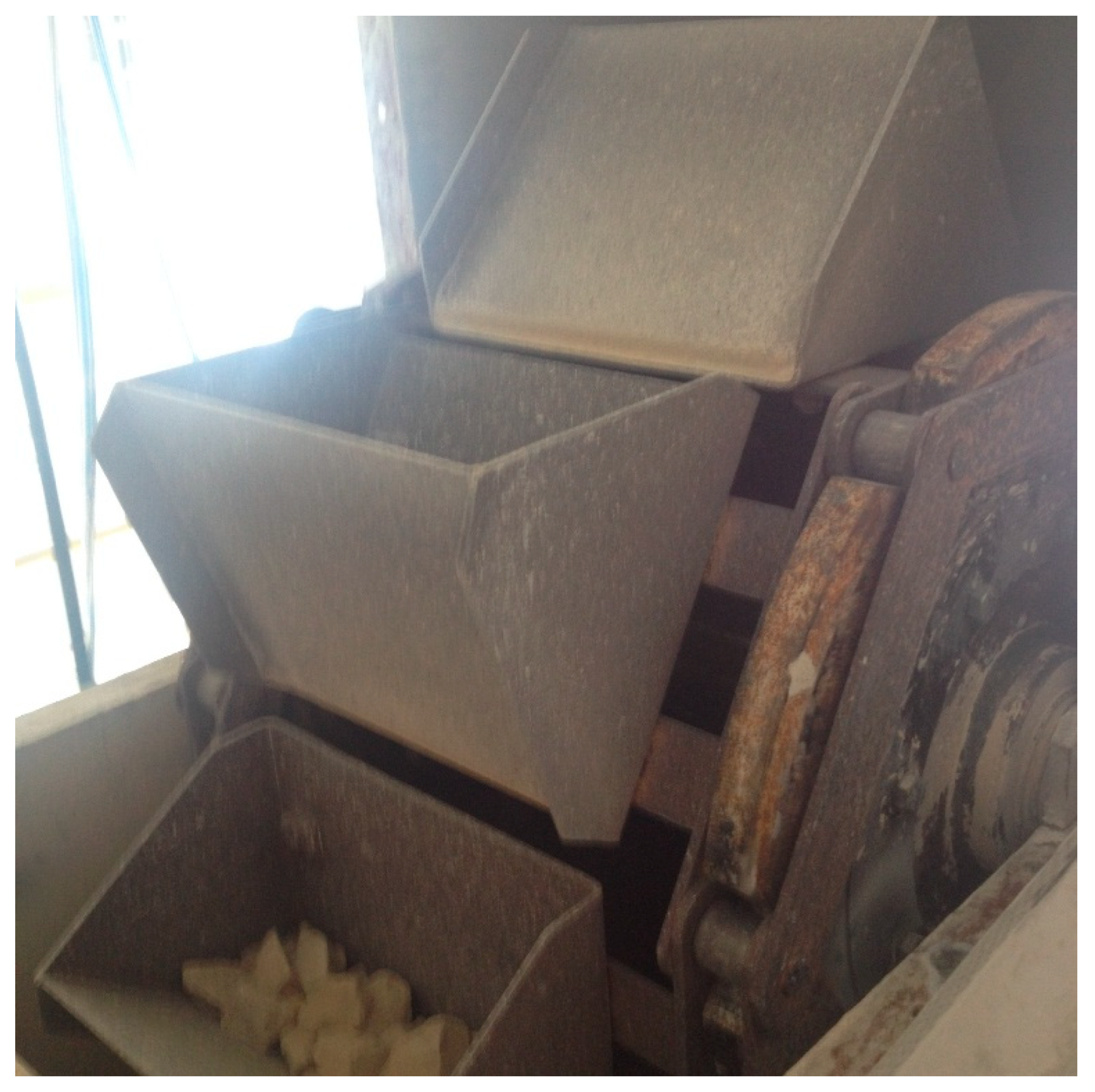
Chain elevators are often used for the vertical transport of bulk materials in the food and mining industries. One of the important problems during the operation of industrial elevators are noise and dust resulting from vibrations. Vibrations with an amplitude that is too large can also cause damage resulting from the impact of the elevator buckets on the housing. The main cause of these problems can be an incorrect initial chain tension.
In addition to chains, axially moving continuous structures are found in many machines and technological systems. These are mainly v-belt drives, band saws, and elevator and cable car wire ropes.
The first works dealing with the vibrations of moving structures concerned the strings performing axial motion [
1,
2,
3,
4,
5,
6,
7]. Subsequent papers dealt with the vibrations of moving beams and plates; both linear and nonlinear models were used for the physical description [
8,
9,
10,
11,
12,
13,
14,
15,
16,
17,
18,
19,
20].
In special cases of problems, mainly linear, it is possible to find analytical solutions of the equations of motion describing vibrations of the axially moving structures [
21,
22,
23,
24]. In most cases, especially nonlinear ones, solutions are obtained using the approximate analytical approach (asymptotic and small parameter analyses) and numerical methods, mainly Galerkin’s orthogonalization method and the finite element method [
25,
26,
27,
28,
29,
30,
31,
32,
33,
34,
35]. Comprehensive discussions of papers on the dynamics of moving systems, including constitutive models, are presented in review articles [
36,
37,
38,
39,
40,
41].
The present paper deals with the issue of transient transverse vibrations of the bucket elevator chain, occurring during the acceleration and braking of the drive sprocket. A model of a linear string was adopted, with a tension force taking into account gravity and a component resulting from axial acceleration. The equation of motion was written in a non-inertial coordinate system associated with the moving ends of the chain. The Galerkin method was used in numerical calculations. The results of the calculations of chain vibrations occurring during the acceleration and braking of the drive sprocket, at a given range of operating speed, are presented. The conditions to avoid exceeding the permissible values of transverse displacement are given.
Example calculations were performed using parameters from an existing device operating in an aggregate processing plant. During operation, housing damage occurred due to excessively large elevator chain vibration amplitudes.
2. Physical Model
A model of the axially moving string, which is often used to describe the vibrations of a moving chain, has been adopted [
42,
43,
44]. Such a continuous model is more suitable than a discrete model for analyzing vibrations in a general chain drive.
For the low speed range, longitudinal vibrations can be omitted and the non-deformability of the sprocket and chain links can be assumed [
45]. The equation of the transverse vibrations of a moving string, without external loading, is of the following form [
36,
38]:
where:
—transverse displacement;
—axial coordinate;
—time;
—volume density;
—cross-sectional area;
,
—axial velocity and acceleration (with respect to stationary ground);
—axial tension force.
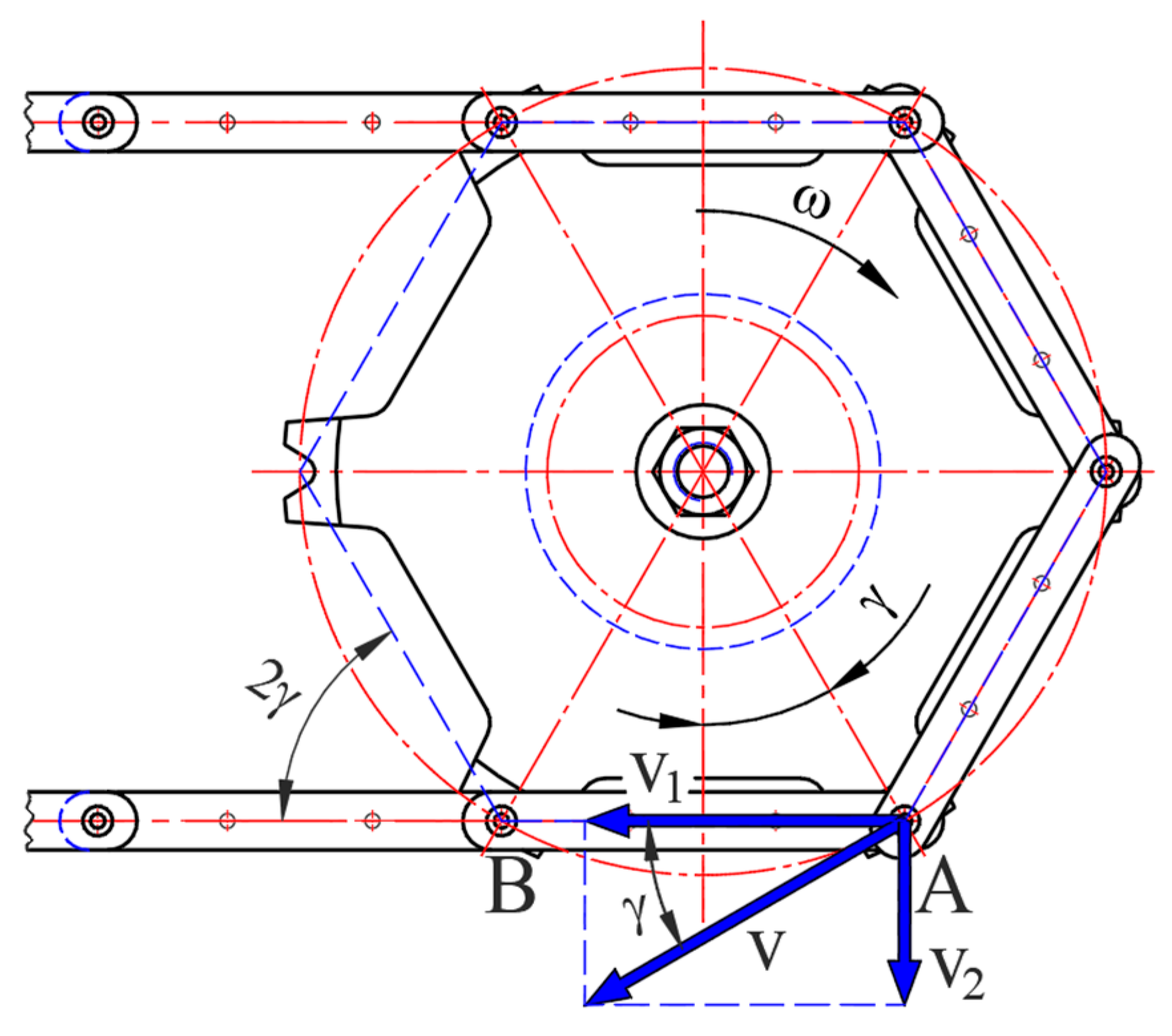
Regarding the elevator chain vibrations, the basic problem is that the ends of the chain perform motion, both in the longitudinal and transverse directions. This is related to the so-called polygon effect (
Figure 1), which results from the fact that the chain on the sprocket forms a polygon rather than a circle. The movement of the last link to engage with the drive sprocket determines the chain movement. At the moment of meshing, the tooth velocity component
is perpendicular to the chain velocity
. It follows that, even at a constant angular velocity of a sprocket, the ends of the chain have an axial velocity that varies over time.
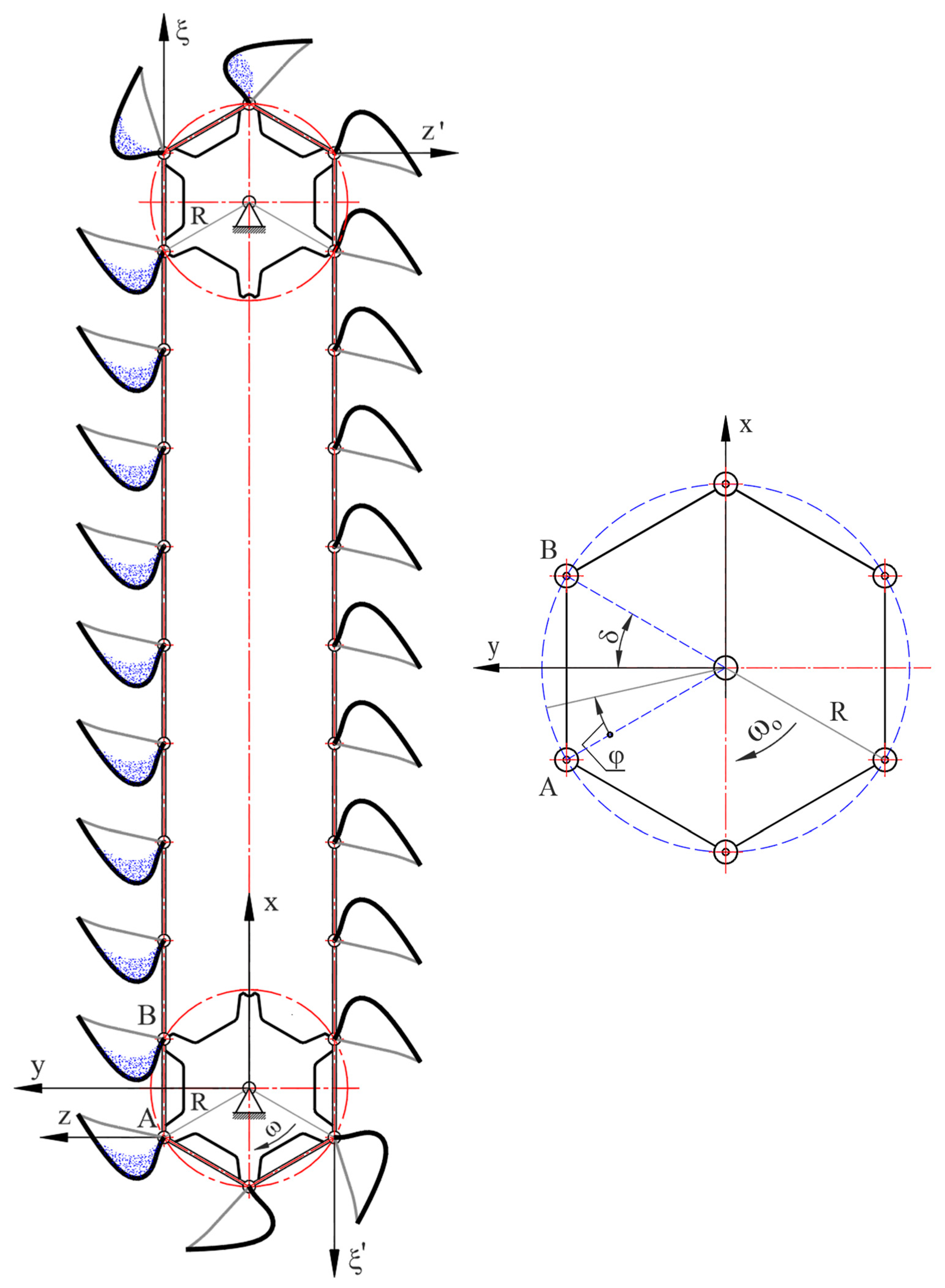
The paper discusses the problem of vibrations of the bucket elevator chain, the diagram of which is presented in
Figure 2. The source of vibrations is kinematic excitation resulting from the rotational motion of the sprockets. The number of teeth of the gear is assumed to be six. Drive systems with such a number of teeth are often used in practice; the polygon effect then gives significant dynamic effects.
For the considered problem, it is convenient to write the equation of motion in a non-inertial coordinate system related to the moving ends of the chain (
Figure 2). The equation of motion is then analogous to the equation of a stationary string, except that the changes in axial force and the distributed transverse force resulting from the components of the transport acceleration must be taken into account. The frame of reference performs flat motion with no rotation, so the Coriolis acceleration is zero. In the non-inertial system of coordinates (
) (
Figure 2), the equation describing the vibrations of the chain is of the following form:
where the following notations are introduced:
z—transverse displacement,
—axial coordinate, and
—external transverse load per unit length.
The expression describing the axial tension force
can be given in an explicit form; it can also depend on the coupling of chain vibrations with drive sprocket vibrations [
44]. In the case under consideration, the influcence of gravity and axial acceleration are taken into account [
27,
46].
The chain tension forces on the left (index
L) and right (index R) side of the elevator (
Figure 2) are given by the following formulae:
where the following is denoted:
—initial tension of the chain,
—gravitational constant, and
—length of the vibrating chain section. The linear density of the chain on the right side of the elevator is denoted by
. The linear density
on the left accounts for the weight of the buckets with links and the transported bulk material. The linear density
on the right corresponds to empty buckets.
The subsequent part of the considerations concerns the chain on the left side of the elevator (
Figure 2). Substituting the Expression (3) to Equation (2) yields the following:
where:
—transverse acceleration of the chain ends with respect to stationary ground. To account for energy dissipation, a component responsible for linear viscous damping (coefficient
) is included in Equation (5).
Due to the discrete nature of the chain, the linear density is not constant along its length. The product represents the average linear density value. The assumption becomes increasingly justified as more links constitute a chain section.
The coefficient can be treated as an equivalent internal damping coefficient, describing the energy dissipation effects in the chain element connections. External damping is disregarded. Numerical calculations will be performed for a system in which neglecting this component is justified due to the velocity range and high linear density of the chain.
In the movable coordinate system (
), the boundary conditions are of the following form:
In the coordinate system related to the moving ends, the chain is stationary in the axial direction. In subsequent cycles, the different links participate in vibrations in the transverse direction, because, at the end of each cycle, one link runs onto the rack at one end and one link runs off the rack at the other end. Nevertheless, it was assumed in the calculation model that the final conditions of one cycle are, at the same time, the initial conditions of the next cycle. The above is all the more justified the more links the moving chain is built of.
The expressions for
and
can be obtained on the basis of
Figure 2. These are the components of the acceleration vector (in the
and
directions associated with the ground) of a point moving along a circle with radius
:
Formula (7) applies to
;
. For any value
, the expressions presented by Equation (7) take the following form:
where the following notations are introduced:
and
. The function
denotes the largest integer less than or equal to the real number
. The values of accelerations
and
depend on the assumed function
.
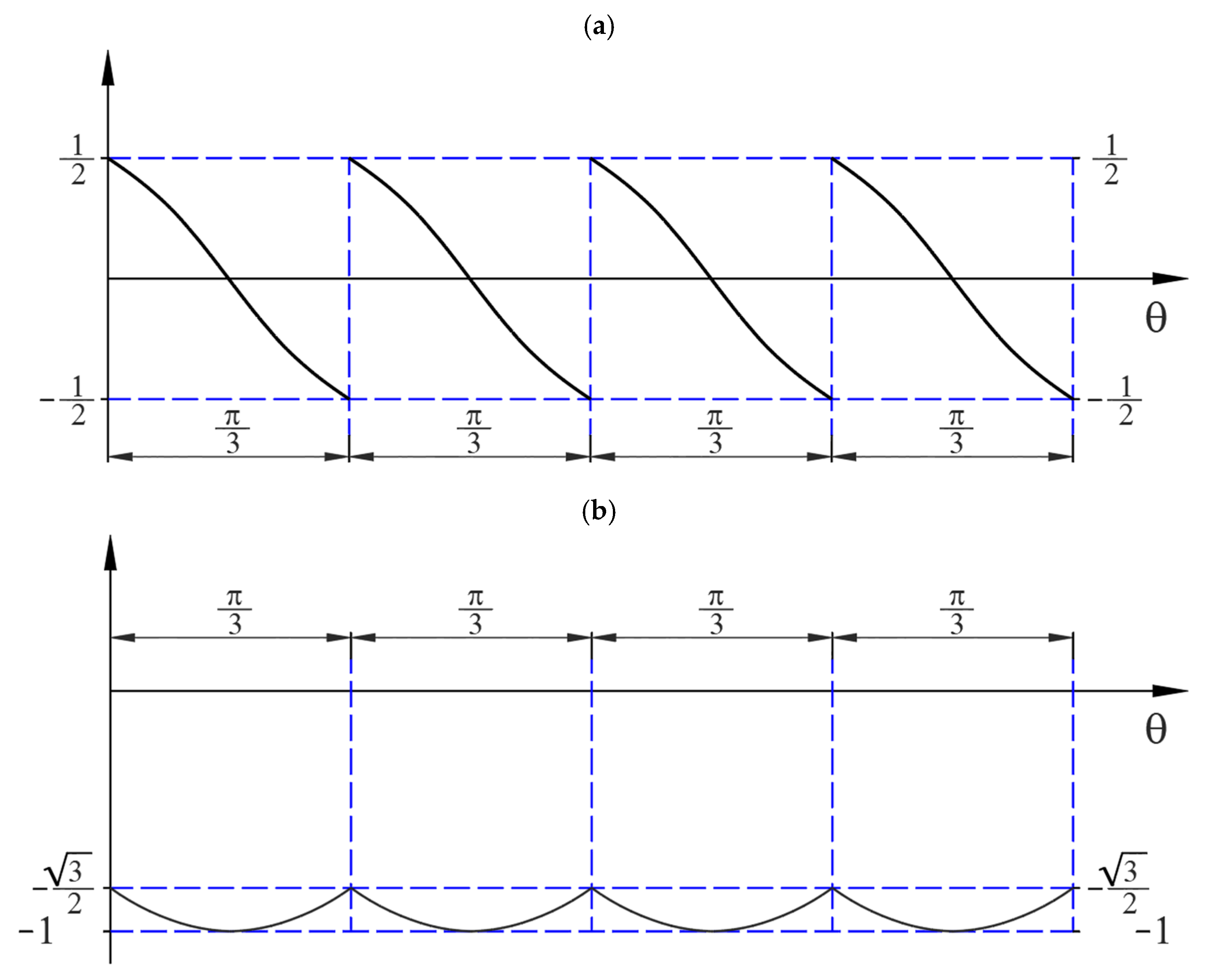
Figure 3 shows the periodic functions in Equation (8).
The velocity vector components (in the
and
directions associated with the ground) of a point moving along a circle with radius
are (
Figure 2)
and
. For the constant angular velocity
, these velocity components are periodic functions with period
(for a six-tooth sprocket,
). The nature of the variability of these periodic functions is shown in the plots in
Figure 3.
3. Computational Model
The computational model uses the Galerkin method; the solution of Equation (5) is assumed to be in the following form:
The following expansion functions taken meet the boundary conditions (6):
The standard orthogonalization procedure leads to a system of
nonhomogeneous ordinary linear differential equations with variable coefficients:
The numerical coefficients found in the above equations are given by the following formulae:
The generalized coordinates
must be determined. The system of
differential equations of the second order can be written in the form of a system of
differential equations of the first order. After this conversion, the numerical integration is performed using the algorithms from the IMSL C [
47] package.
The calculation program was created for any given number of expansion functions. It was verified that, for the uniform transverse excitation occurring in the case under study (there is for even in Equation (11)), sufficient accuracy can be obtained for , which was assumed in the sample numerical simulations.
To describe vibrations of the system, a measure of displacement is introduced:
The application of the above norm is justified by the fact that, during the operation of an elevator, the chain links should not exceed a certain maximum displacement, due to the risk of impact on the housing.
Definition 1. The symbol indicates the displacement of this particular point of the chain, which, at a given moment, determines the norm defined by Formula (12).
It should be emphasized that does not have to be a displacement of the same point. Usually, is a displacement of the center of the chain, but it does not have to be that way.
4. Numerical Calculations
The purpose of the numerical calculations is to determine the vibrations of the elevator chain that occur during the acceleration and braking of the drive sprocket. Acceleration and braking that are too fast can lead to too much lateral displacement of the chain elements, which can lead to impacts on the housing leading to damage to the structural components.
Numerical calculations will be performed for a chain with the parameters shown in
Table 1. These parameters describe the industrial bucket elevator operating in the aggregate processing plant. For technological and strength reasons, a six-tooth sprocket was used, for which the kinematic excitation caused by the movement of the chain ends is significant.
At a given moment, a section of 33 links participates in vibrations; thus, for such a number of links, the assumption of a constant linear density along the chain length is justified.
The linear density of the chain is assumed to be constant in time. This means that either the chain is accelerated on the left side without the buckets filled, or the chain is accelerated with all the buckets filled (the given density
in
Table 1 applies to this case)—for example, when the drive wheel is stopped and restarted. On the right side, the linear density of the chain is invariant. The case of the chain acceleration and gradual filling of conveyor buckets is not investigated in this work. This would be a system with the linear density as a function of position and time.
During the acceleration of the drive sprocket, the chain (the ends of which are stationary in a non-inertial system ()) passes through successive resonant frequencies. Due to the uniform inertial excitation and its specific time course, determining the first natural frequency of the chain is of primary importance. Accounting for gravitational force and assuming zero damping, the first natural angular frequency for the case under study is . This value was determined based on the system of Equation (11). Excluding gravitational force, the first angular frequency obtained from the theoretical formula for a stationary homogeneous string would be .
It is convenient to describe damping by the dimensionless coefficient, which is introduced here on the basis of the equation of the motion of a discrete substitute system of one degree of freedom, associated with the first vibration mode of a stationary string with a linearly variable tension force.
The following expression relates the damping coefficient
, present in Equation (5), to the dimensionless damping coefficient
[
Appendix A]:
where
and
; for data in
Table 1,
.
In the calculations, it was assumed that the acceleration and braking processes occur with constant acceleration and constant deceleration. For the given final angular velocity, which yields the average velocity of material transport (determined due to the necessary operating conditions), the acceleration and braking time will depend on the assumed acceleration and deceleration values.
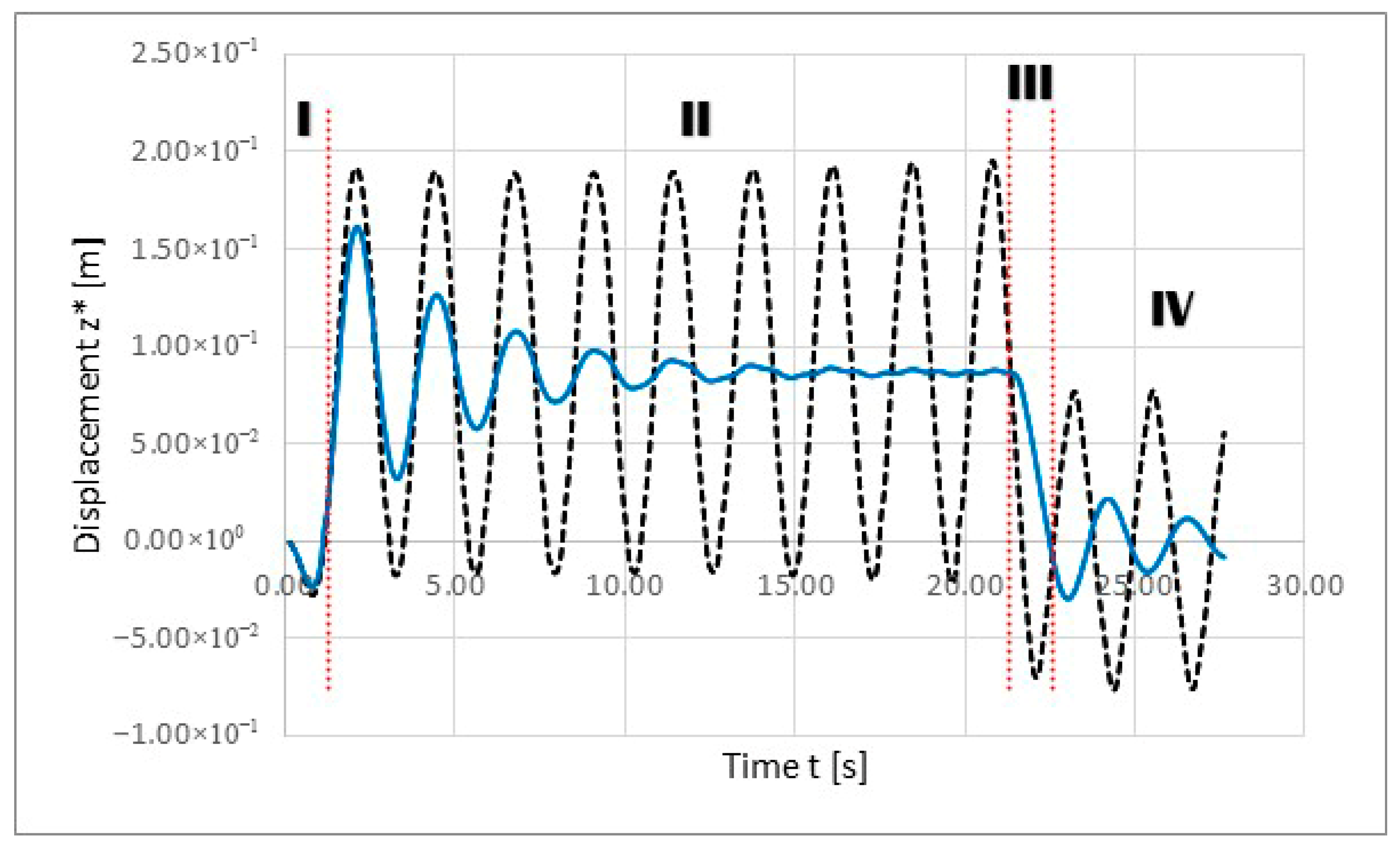
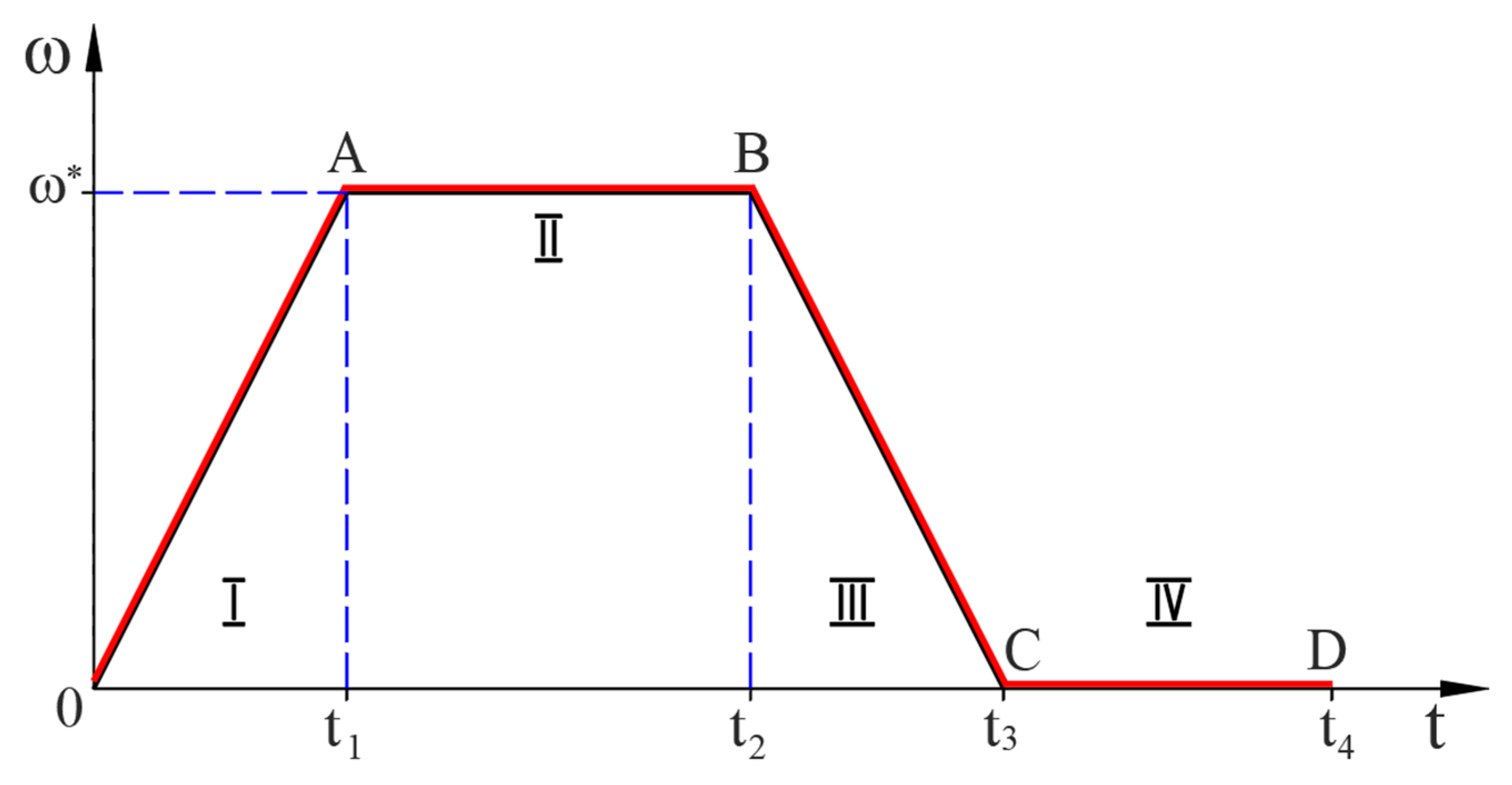
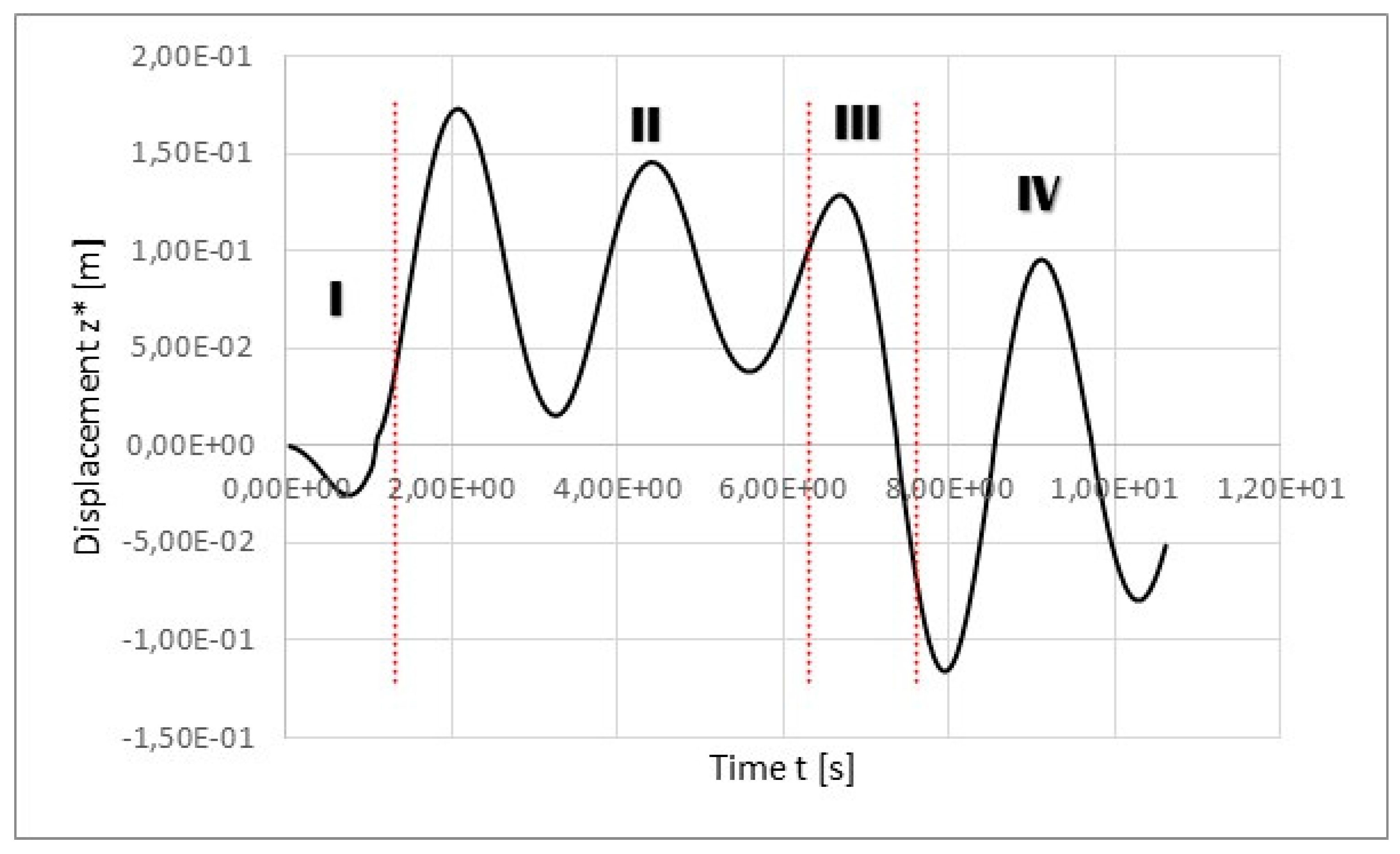
In order to study the vibrations occurring during acceleration and braking, the simulation time was divided into four periods: Period I—acceleration with constant value,
; Period II—constant angular velocity of the sprocket,
; Period III—braking with constant deceleration to a stop of the chain,
; and Period IV—free vibrations of the stopped chain,
(
Figure 4). These periods differ in the course of the function
, which determines the axial acceleration
and the transverse acceleration
. The individual periods are described as follows:
It is assumed that ; .
It is taken that .
The symbol
denotes the final angular velocity of the drive sprocket, resulting from the assumed average transport velocity
of the elevator chain. For the considered elevator, operating in an aggregate processing plant, with the key parameters presented in
Table 1, the average transport chain velocity was in the range of
. In numerical calculations, it was assumed that
; therefore,
. The value
(i.e., the angular frequency of the first harmonic of the periodic excitation) is almost three times higher than
.
4.1. Example Calculations Results—1
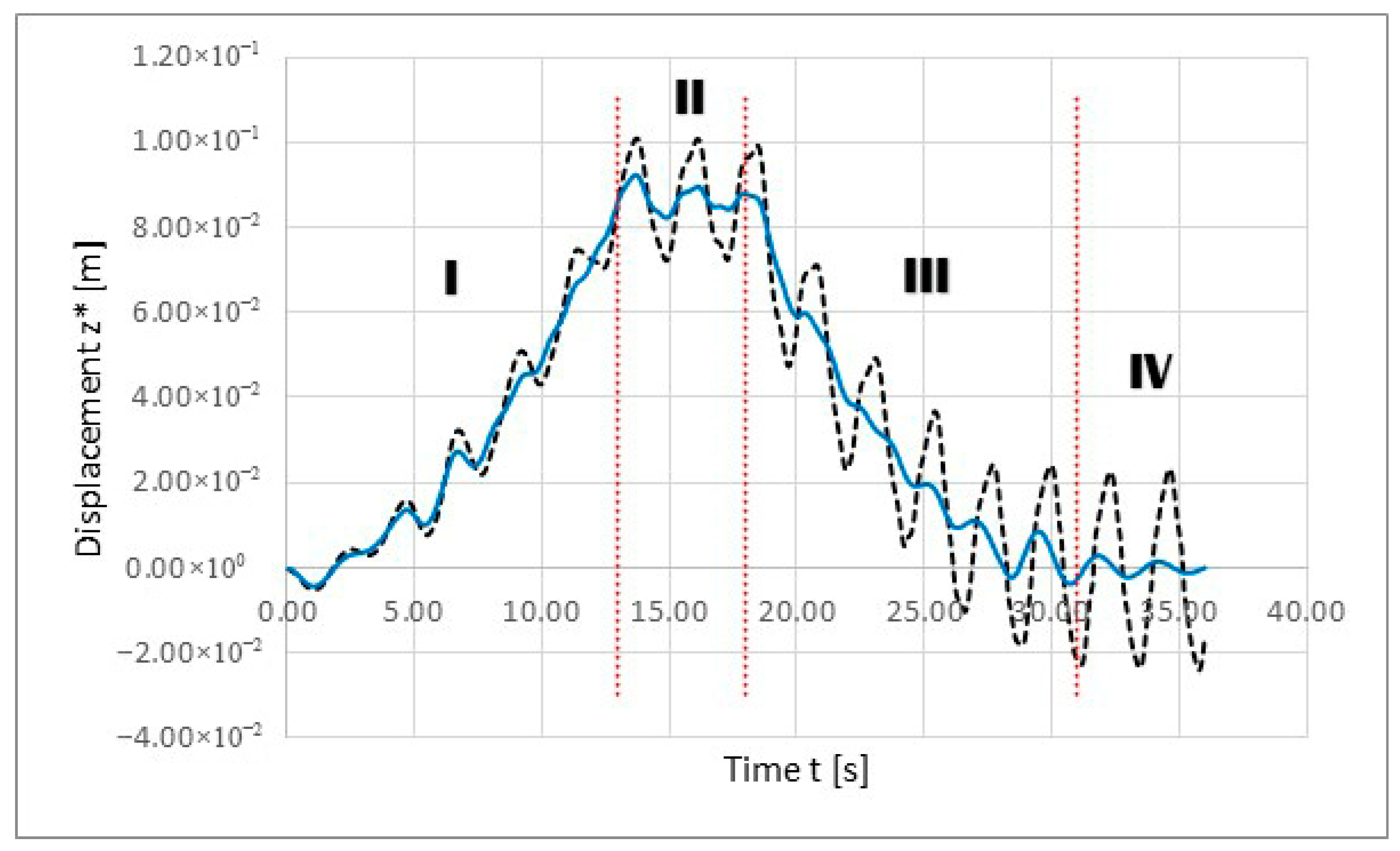
Figure 5 shows the vibration waveforms (values of the function
) for the parameters
,
(
),
,
, and
(
), and for two values of the damping coefficient,
and
(
). The waveforms were determined for zero initial conditions for the string.
The acceleration and braking phases here are relatively short. When the angular velocity
is reached, the chain vibrations occur under the influence of a periodic (in a given cross-section) tension force (Formula (3)), and a uniform periodic transverse excitation. These forces result from the components of the transport acceleration in a non-inertial system; the nature of the variation in time of these forces can be obtained by substituting
and
in Formula (8). Since, for a constant angular velocity, the angle
(Equation (8)) is a linear function of time, the accelerations
and
are periodic functions of time. For a 6-tooth sprocket, this period is
. The nature of the acceleration waveform
and
are shown in the plots of the functions in
Figure 3.
Numerical simulations showed that, in the studied ranges of angular velocity and angular acceleration of the drive sprocket, the influence of the -dependent component of the tension force (Formula (3)) on the calculation results is small compared to the influence of the component determining the uniform distributed transverse loading.
The course of the vibrations depends on the spatial characteristic of the transverse excitation (because, for a uniform distributed loading,
for even
; Equation (11)), and on the time characteristics determined by the acceleration
(Formula (8);
Figure 3).
At a constant angular velocity (Period II), the constant component of the inertial force causes a shift in the center of vibration. Together with the effect of the dynamic component of periodic excitation, this gives a total offset of about 87 mm.
In the absence of damping, the resultant vibrations, i.e., the sum of the forced, free, and associated vibrations, are, with a very good approximation, the harmonic vibrations with the period of the first natural mode:
. This is due to the temporal course type of the periodic excitation. For the problem with damping, the forced vibrations with a period of excitation become apparent only after the disappearance of the free and associated vibrations. These are steady vibrations of a small amplitude (
Figure 5) around a shifted center of vibration.
4.2. Example Calculations Results—2
Case 1 presented in
Section 4.1 is characterized by a short acceleration time and a short braking time. For comparison, the results of the calculations of the problem in which the acceleration and braking times are ten times longer will be presented.
Figure 6 shows the vibration waveforms (values of the function
) for the parameters
,
(
),
,
, and
(
), and for two values of the damping coefficient,
and
(
).
Lower angular acceleration absolute values during acceleration and braking result in smaller maximum displacement absolute values. Higher excited harmonic vibration components can also be observed.
With rapid acceleration, the maximum inertia force that is quickly reached causes large displacements even before vibrations begin to occur in the system. For slow acceleration, energy-dissipating vibrations appear in the system during the acceleration phase (a system with damping is considered), reducing the maximum displacement achieved. A similar observation applies to the braking process. For low deceleration values, energy-dissipating vibrations occur during braking.
4.3. Example Calculations Results—3
The higher the angular acceleration, the greater the maximum value of displacements. While braking, the displacements also depend on the moment of initiation of braking.
Obviously, the maximal displacements obtained also formally depend on the initial conditions. For initial conditions other than zero, the displacement values could be even greater than those presented. However, it has been assumed that acceleration begins with the string in a stationary state.
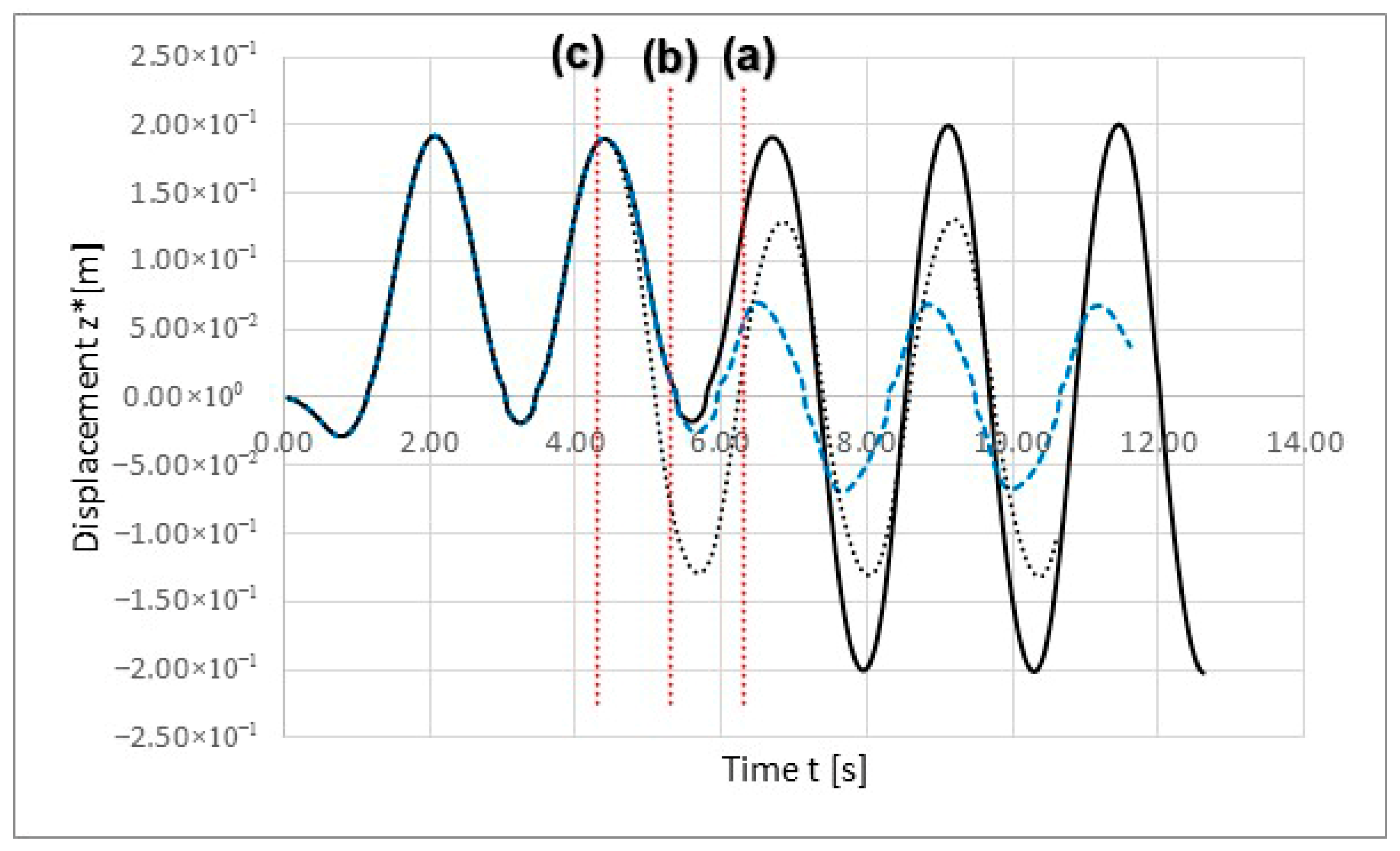
Figure 7 shows example vibration waveforms (for the parameters given in the figure description) which reveal significant differences in the displacement values depending on the moment of braking initiation (given by the time moment
). This is because, at different times, the chain, when subjected to inertia forces, has a different total energy that must be reduced.
In a real system, in which damping always occurs, steady forced vibrations have a relatively small amplitude of vibrations around the center of vibrations (
Figure 5). In this case, the moment of braking will no longer have a significant effect on the resulting vibrations. The situations shown in
Figure 7 could occur if there is a need for sudden braking after a very short period of operation of the drive at a constant angular velocity.
4.4. Example Calculations Results—4
When accelerating and braking the elevator chain, the maximum absolute values of displacements are important from a practical point of view. Too much displacement can cause impacts on the housing and spillage of the transported material.
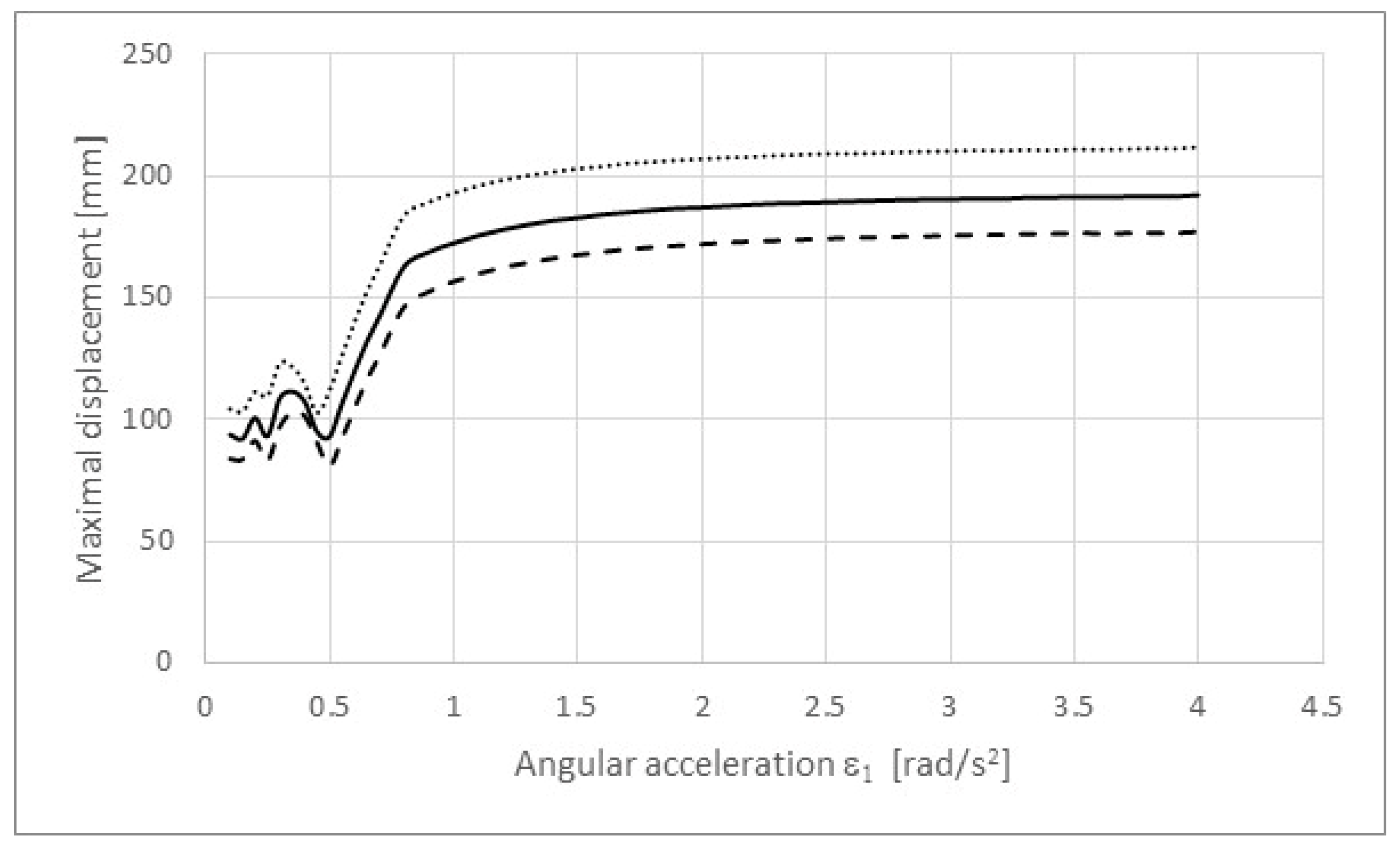
Figure 8 shows the plots of the maximum displacement (i.e., maximum of
) achieved, depending on the angular acceleration of the drive sprocket
, for a fixed final angular velocity:
. The calculations were performed for three different initial tension force values,
,
, and
, and the damping coefficient,
. The curves shown in the figure allows us to determine, for the set maximum allowable displacement value, the range of allowable accelerations. As the acceleration increases, the maximum displacement moves towards the limit reached for the impulse case, an infinitely short excitation time.
For small angular acceleration values, the time of speeding up can be so high that chain vibrations already occur during this process. If the acceleration lasts for a short time, then vibrations occur only after the end of this process, when movement at a constant angular velocity of the drive sprocket begins.
The plots presented in
Figure 8 show that an increase in the tension force reduces the maximum displacements obtained during chain acceleration. Of course, for the proper operation of the chain drive, this tension must not be too high.
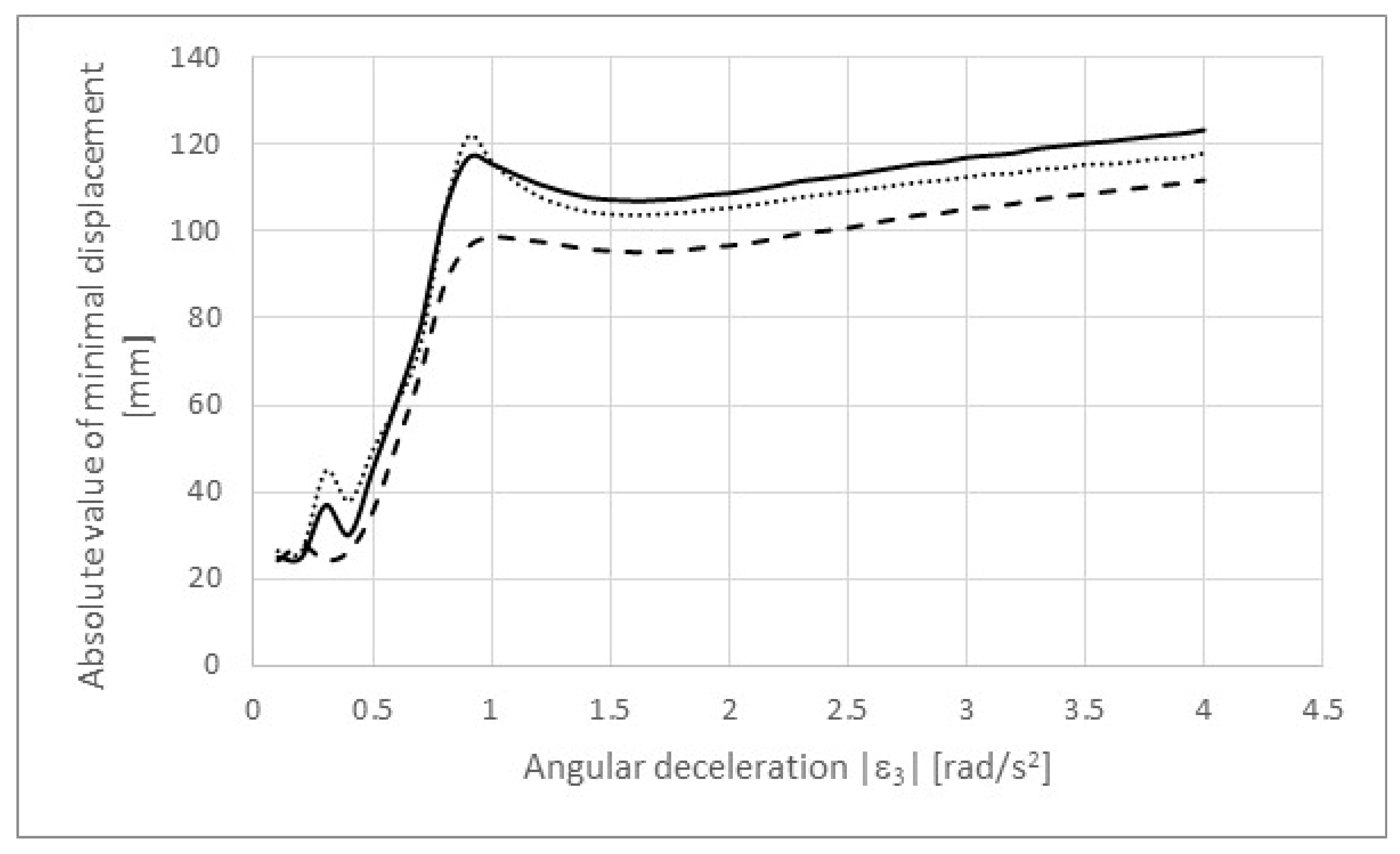
Figure 9 shows the plots of the maximum absolute value of negative displacements (i.e., absolute value of minimum of
) for the braking process, depending on the deceleration value
, for three different initial tension force values,
,
, and
, and the damping coefficient,
. Braking begins 5.0 s after reaching the final angular velocity
. It can be assumed that, after such a period of time, the chain vibrations are already shortly before reaching the steady state. An example of the course is shown in
Figure 10. For all deceleration values, braking starts at the same dynamic state of the chain.
The plots presented in
Figure 9 show that increasing the tension above a certain value reduces the maximum absolute values of displacements obtained during the chain braking process. However, a bigger tension force does not always mean less absolute displacement when braking.
Determining the maximum values of the chain transverse displacements can be helpful at the stage of designing the elevator, when it is necessary to install the housing due to the possible exposure to dust.
It should be emphasized that any increase in the elevator height requires a greater pre-tension to reduce the maximum displacements. Increasing the chain length while keeping other system parameters constant reduces the natural frequencies. Calculations show that doubling the chain length, for the parameters given in the caption of
Figure 10, increases the maximum displacement during acceleration to 502 mm (compared to 173 mm in
Figure 10) and the maximum absolute displacement during braking to 441 mm (compared to 115 mm in
Figure 10). In such a case, the values presented in graphs analogous to those in
Figure 8 and
Figure 9 would be several times higher, which is not acceptable from a technological standpoint.
5. Conclusions
The paper deals with the problem of transient vibrations occurring during the acceleration and braking of the bucket elevator chain. The cause of the analyzed vibrations was the movement of the ends of the chain, which is associated with the so-called polygon effect.
A linear approach was used in the modeling of the string, with a tension force dependent on gravity and axial acceleration. The equation of motion was written in a non-inertial coordinate system associated with the moving ends, in which the string (modeling the chain) is stationary in the axial direction. This made the equation of motion analogous to the equation for a stationary string in an inertial system. In numerical calculations, Galerkin’s orthogonalization method was used.
Given its widespread application, a vibration analysis of a chain driven by a six-tooth sprocket was carried out. The numerical calculations were carried out using the data of a real elevator operating in an industrial aggregate mining plant.
A vibration analysis was performed for different values of constant acceleration during acceleration, and constant deceleration during braking. The conditions imposed on the acceleration and deceleration values have been determined, ensuring that the permissible displacement values are not exceeded. The influence of the initial chain tension force values on the of maximal displacements obtained during the acceleration and braking of the drive wheel was investigated. Adequate chain pre-tension is crucial for proper elevator operation. If the pre-tension is too low, displacement values become excessive during acceleration and braking, and the center of vibration shifts too much in the steady state. Conversely, for the chain link to mesh properly with the drive sprocket tooth, the tension must not be too high.
In the analyzed case, the elevator drive system uses a six-tooth sprocket [
Appendix B]. Increasing the number of teeth would reduce the excitation forces (for the same drive wheel radius) but would simultaneously reduce the chain element size. First, this reduces the elevator’s capacity (necessitating the use of smaller buckets). Second, the device under consideration is used in a stone processing plant where the transported material (after crushing) has relatively large dimensions. Falling between the chain elements, it can become lodged, altering the working conditions. The large size of the chain elements facilitates self-cleaning.
Changing from a pin chain (used in the device) to a roller chain would reduce the resistance associated with the meshing process itself. However, in this case, it is not advisable, as damp rock dust can adhere to the chain bearings.
The linear model used in the paper is an approximate approach justified for small-amplitude motion (in relation to the chain length). Large-amplitude motion requires the coupling of the transverse vibrations with the longitudinal vibrations. In the calculation results presented, the maximum displacements obtained for the chain elements are of the order of 2% of the length; therefore, the linearity assumption is justified.
In the problem considered in this paper, for the technologically determined operating conditions of the bucket elevator (angular velocity of the drive wheel), the additional nonlinear elastic component in the equation of motion—which stiffens the system in the axial direction—appears unlikely to increase the maximum amplitudes compared to those obtained for the linear model. Nevertheless, accounting for nonlinearity can reveal many phenomena that do not occur in linear systems (frequency drift, response jumps, and chaotic behavior).
The next stage of the research will be to allow for geometric nonlinearities, which require the longitudinal vibrations of the chain to be taken into account. In addition to nonlinearity, the effects resulting from the gradual filling of the elevator buckets during acceleration will also be investigated. Therefore, the problem will be described by nonlinear equations with time-varying coefficients (linear density and tension force).