1. Introduction
Seismic risk assessment of building stock evolved from deterministic life safety verification toward probabilistic performance-based evaluation frameworks. Although modern seismic codes primarily target collapse prevention and life safety, recent earthquakes have demonstrated that non-collapse damage and prolonged downtime can generate severe economic and social disruption [
1]. Consequently, performance-based earthquake engineering (PBEE) approaches have gained prominence by enabling explicit quantification of repair cost, functional recovery time, and long-term economic risk.
A major milestone in this evolution is the FEMA P-58 methodology [
2], which provides a component-based probabilistic framework for translating seismic demand into decision variables, such as repair cost, repair time, and safety consequences, through the propagation of uncertainties in demand, fragility, and consequence models [
3]. Implementations such as SP3 [
4] employ Monte Carlo simulation to generate statistically consistent loss and downtime estimates. More recently, PBEE methodologies have been extended toward portfolio-scale resilience assessments, supporting investment prioritization and risk-informed decision-making beyond individual building design [
5,
6].
Formally, PBEE propagates uncertainty from seismic intensity measures (IM) to engineering demand parameters (EDP), damage measures (DM), and ultimately, to decision variables (DV) such as repair cost, downtime, and casualties [
7]. Within this probabilistic structure, economic indicators including expected annual loss (EAL) and probable maximum loss (PML) translate structural performance into financial risk metrics [
8,
9]. EAL represents the long-term annualized consequence of seismic hazard, while PML captures high-percentile event-based losses derived from exceedance probability functions [
10]. These measures are widely used in investment evaluation, catastrophe modeling, and insurance pricing.
In parallel, resilience-oriented research has demonstrated that compliance with life safety objectives does not guarantee rapid restoration of functionality. Functional recovery frameworks distinguish between reoccupancy, functional operation, and full repair states, emphasizing that downtime is governed not only by structural damage but also by nonstructural components and post-earthquake impeding factors such as inspections, contractor mobilization, financing, and utility disruption [
11,
12,
13]. Empirical studies further show that recovery trajectories cannot be inferred solely from repair cost ratios [
14], and resilience quantification methods integrating recovery sequencing and system interaction highlight the importance of coupling structural response with downtime modeling [
15].
Despite these advances, several limitations remain. Most PBEE applications focus on individual buildings or specific structural systems at the design stage [
12,
13,
15], while systematic comparative assessments across heterogeneous residential typologies are less common. Furthermore, most of the studies are conducted in shallow crustal seismic environments typical of North America or East Asia, with limited applications to regions characterized by intermediate-depth seismicity and long-period spectral amplification, such as the Vrancea seismic region affecting Bucharest. Finally, although repair cost and downtime metrics are increasingly quantified, explicit translation of engineering performance differences into resilience-oriented risk differentiation frameworks remains limited. Regional validation studies comparing FEMA P-58 outputs with observed earthquake consequences confirm the robustness of the probabilistic framework while underscoring the need for contextual adaptation to local building stocks [
16].
Recent advances in seismic risk assessment have increasingly focused on probabilistic, portfolio-based frameworks that integrate hazard, exposure, fragility, and consequence modeling within a unified computational workflow. In particular, recent studies have emphasized the importance of representing the multidimensional nature of building stock characteristics and their variability when deriving fragility and loss functions at regional scale. For example, Ref. [
17] proposes a discrete sampling methodology to preserve multimodality and interdependence in exposure data, enabling more representative archetype generation and loss estimation. Similarly, Ref. [
1] highlights the need for multiscale and multiresolution frameworks capable of bridging typology-based approaches with detailed numerical simulations, while explicitly accounting for uncertainties and system-level interactions. At the same time, recent developments in PBEE-based modeling have extended beyond damage and direct losses to include recovery processes and socio-economic constraints, as illustrated by the authors of [
18], who integrate fragility functions, Monte Carlo simulation, and recovery modeling within a probabilistic framework.
Within this evolving landscape, the present study adopts a PBEE-consistent approach using standardized archetypes and consequence models while addressing the specific challenges associated with adapting such frameworks to the Romanian building stock and the Bucharest seismic context.
Bucharest is one of the most seismically exposed capital cities in Europe due to the Vrancea intermediate-depth seismic source. Vrancea earthquakes originate at depths of approximately 60–170 km and have historically produced significant damage at large distances from the epicentral region, particularly in Bucharest [
19,
20]. The 4 March 1977 earthquake (Mw 7.4–7.5) resulted in 1574–1578 fatalities nationwide, of which approximately 1424 (about 90%) occurred in Bucharest alone, and caused more than 11,300 injuries [
21]. In the capital, 32 tall, reinforced concrete (RC) buildings collapsed, and the total reported losses reached approximately US
$ 2.05 billion, with over two-thirds (around US
$ 1.4 billion) concentrated in Bucharest [
22]. Nationwide, about 32,900 dwelling units were destroyed or heavily damaged, while broader assessments indicate that over 660,000 housing units (around 11% of the national dwelling stock) required repair or suffered serious damage [
23]. These figures highlight the extreme vulnerability of the existing reinforced concrete residential stock in Bucharest, particularly mid- and high-rise buildings designed prior to the 1978 seismic code revision [
23].
Probabilistic seismic hazard assessments for Romania have incorporated region-specific ground motion models to capture the characteristics of intermediate-depth seismicity [
24]. In parallel, several studies have investigated the vulnerability and expected losses of Bucharest buildings using fragility-based and scenario-based approaches [
22,
25,
26]. These efforts document the significant differentiation in seismic performance between construction eras and structural systems and confirm the high risk associated with pre-1977 reinforced concrete buildings.
In addition to loss estimation, community-level seismic resilience metrics have been explored for Bucharest by evaluating post-earthquake housing recovery functions under deterministic Vrancea scenarios [
26]. These approaches quantify resilience in terms of recovery of housing capacity over time, incorporating inspection, repair, and restoration phases. However, such assessments are typically based on capacity-spectrum methods and class-based vulnerability functions rather than component-level probabilistic performance frameworks.
However, most existing assessments rely on deterministic scenarios, macroseismic methods, or class-based vulnerability functions. Comprehensive application of a component-based probabilistic performance framework such as FEMA P-58, capable of consistently quantifying repair cost, downtime, and annualized seismic loss across representative residential typologies, remains limited in the Romanian context, particularly with explicit linkage to resilience-oriented risk differentiation.
To address these gaps, the present study employs the FEMA P-58 methodology, implemented through the SP3 computational platform, to evaluate seismic repair cost, functional recovery time, and annualized seismic loss for a set of representative residential building typologies in Bucharest. A total of 65 typologies is defined, covering dominant structural systems, construction eras corresponding to Romanian code evolution, and multiple height regimes. However, due to methodological constraints of the SP3 framework, not all typologies were included in the probabilistic analysis. In particular, pre-code typologies dominated by unreinforced masonry and the most recent code generation were excluded from the numerical simulations. Consequently, the PBEE analysis focuses on a subset of 39 representative typologies corresponding to the principal Romanian seismic design eras for which compatible SP3 archetypes are available. Site-specific seismic hazard derived from recent probabilistic assessments for Bucharest is explicitly incorporated to ensure regional relevance.
The objectives of this study are to:
Quantify seismic repair costs and functional recovery times for representative Bucharest residential building typologies using a probabilistic performance-based framework.
Investigate the relative influence of structural system, construction era, and building height on loss and recovery performance under Vrancea-specific hazard conditions.
Evaluate expected annual seismic loss as a measure of long-term financial exposure.
Demonstrate how engineering-based performance metrics can support resilience-informed seismic risk differentiation.
To the authors’ knowledge, this study represents one of the first applications of the FEMA P-58 methodology to representative residential building typologies in Bucharest.
By systematically linking structural configuration to probabilistic loss and recovery outcomes, this study provides a quantitative basis for translating seismic performance into financially relevant risk metrics within an Eastern European context characterized by intermediate-depth seismicity.
2. Methodology
2.1. Performance-Based Seismic Assessment Framework
The seismic performance of the selected building typologies was evaluated using the SP3-RiskModel software (v1.2.0), which implements the FEMA P-58 performance-based earthquake engineering (PBEE) methodology. For each typology, the SP3 engine internally performs:
Structural response prediction based on multimode elastic modal analysis combined with empirically calibrated elastic and inelastic response modifiers;
Component-level damage assessment using FEMA P-58 fragility functions;
Consequence estimation including repair cost, collapse probability, and downtime;
Functional recovery time estimations.
Uncertainty propagation was performed through Monte Carlo simulation (2500 realizations per building model), accounting for variability in structural response, component fragility, and consequence functions.
Structural response was generated using the SP3 Structural Response Prediction Engine (v1.2.0), calibrated through a database of nonlinear response simulations used to derive demand amplification and ductility modifiers across structural archetypes.
Within this framework, seismic hazard is propagated through structural response (EDPs), damage (fragility functions), and consequences (repair cost and time), enabling consistent estimation of performance metrics across typologies.
The analysis is based on a typology-driven representation of the Bucharest residential building stock rather than a spatially explicit inventory. Each typology represents a class of buildings defined by structural system, construction period, and height regime and is intended to provide comparative insights into seismic performance rather than site-specific portfolio estimates.
Default structural modeling parameters associated with each selected SP3 archetype were adopted. No user-defined nonlinear backbone curves, hysteretic parameters, or custom nonlinear analyses were introduced. Consequently, response estimates reflect the calibrated SP3 archetype representations corresponding to the selected structural system and equivalent design-code era.
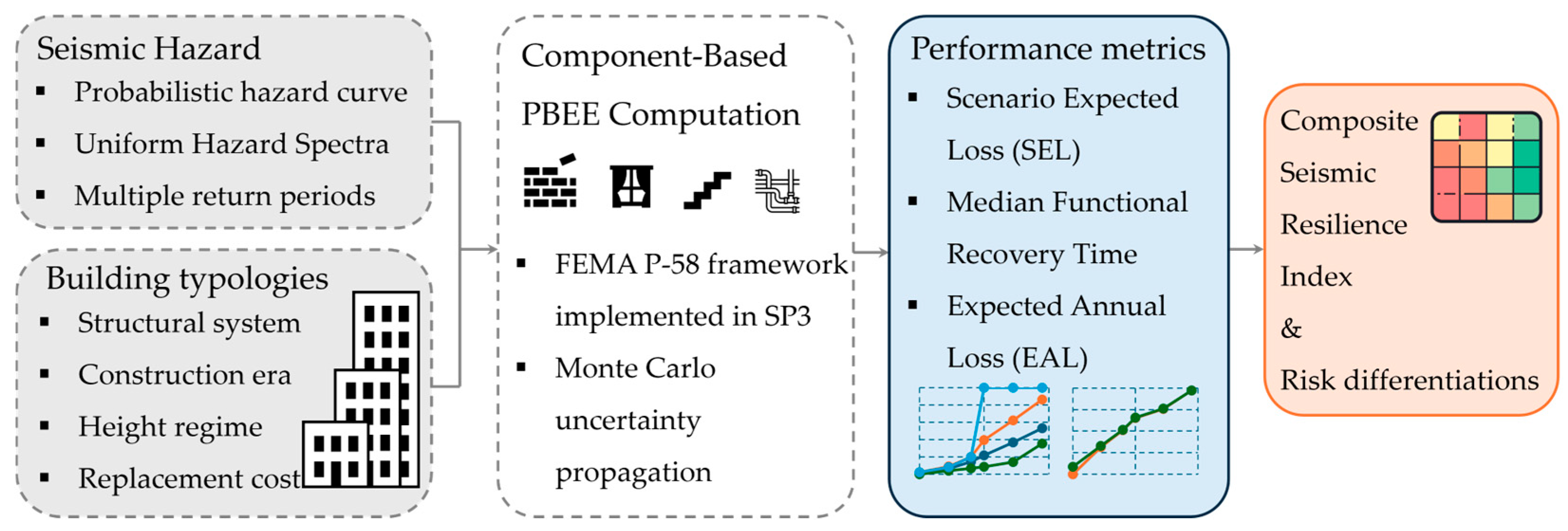
Figure 1 illustrates the overall workflow of the adopted loss and recovery assessment framework.
This standardized modeling approach ensures methodological consistency across typologies and supports robust comparative assessment.
2.2. Seismic Hazard Definition for Bucharest
The seismic hazard representation adopted in this study is based on the design spectral shape defined in the Romanian seismic design code P100-1/2013 [
27], which reflects the characteristic long-period amplification associated with the Vrancea intermediate-depth seismic source affecting Bucharest.
In this work, the spectral shape of the P100 design spectrum was scaled to peak ground acceleration (PGA) levels corresponding to the selected return periods, generating a set of hazard-consistent intensity levels for use within the FEMA P-58/SP3 probabilistic loss framework.
It should be noted that the resulting spectra do not represent fully hazard-consistent uniform hazard spectra derived directly from probabilistic seismic hazard analysis (PSHA). Instead, they constitute a code-based approximation of the expected spectral demand, consistent with Romanian seismic design practice. While Vrancea earthquakes exhibit distinctive spectral characteristics, including significant long-period amplification and long-duration ground motions, the adopted approach provides a practical representation of seismic demand suitable for comparative vulnerability assessment across building typologies.
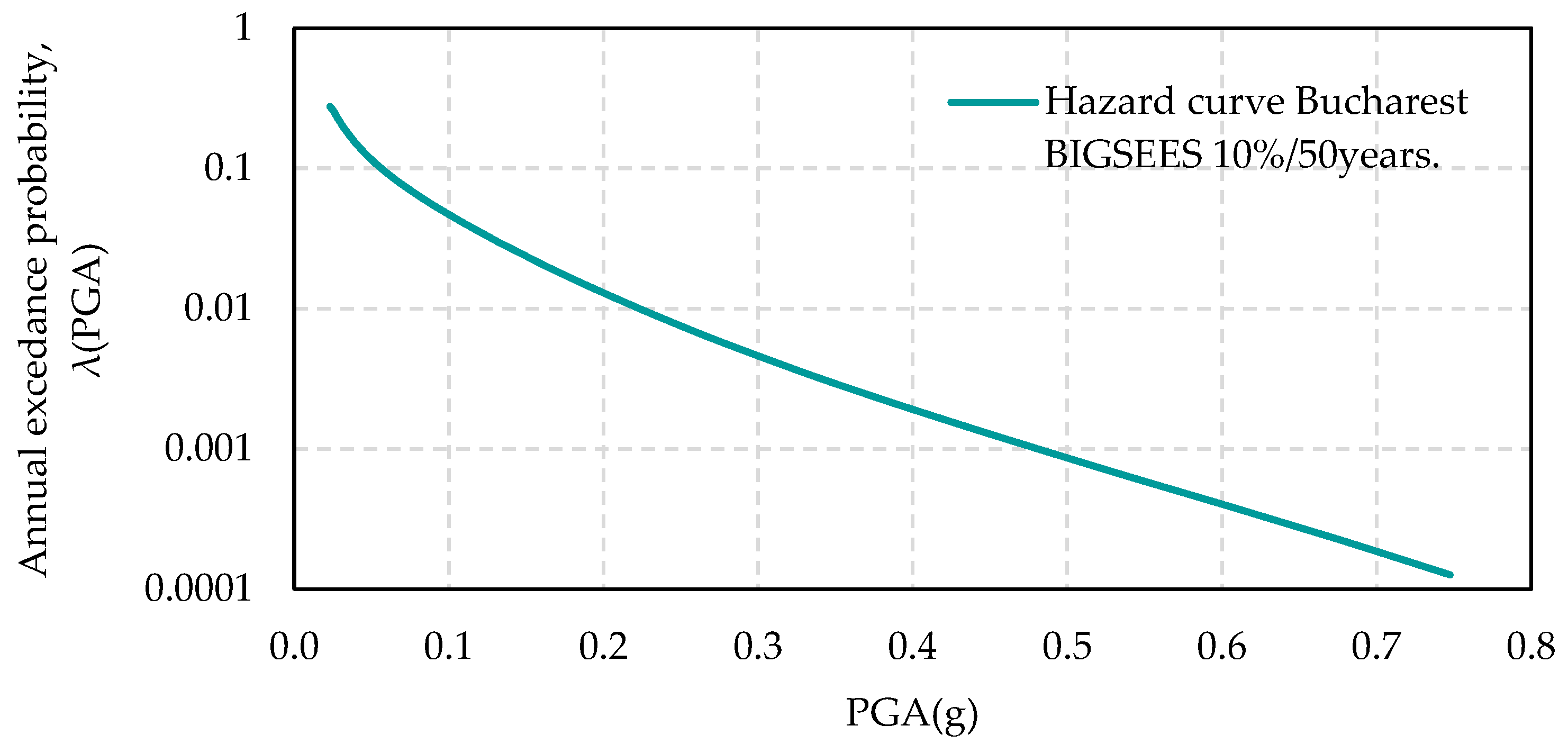
The site-specific seismic hazard adopted in the analysis is shown in
Figure 2.
The seismic hazard for Bucharest was defined using a hybrid probabilistic–code-based approach. Peak ground acceleration values (ag) corresponding to multiple return periods (22, 72, 144, 225, 475, and 975 years) were derived from the site-specific full probabilistic seismic hazard curve, derived from the BIGSEES project [
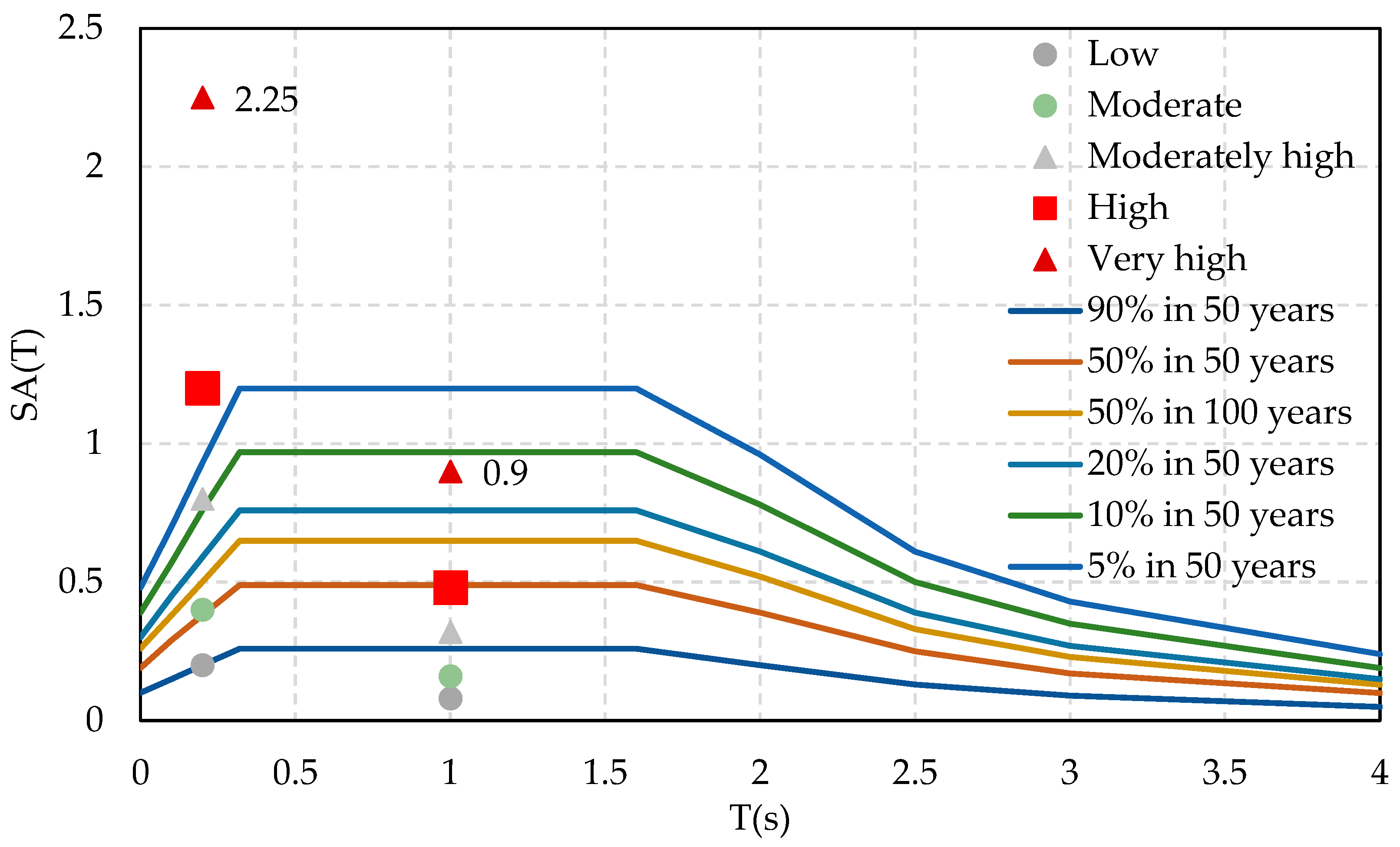
20]. Elastic response spectra were constructed for each return period using the P100-1/2013 spectral formulation, scaled by the corresponding PGA values. Spectral accelerations were defined at multiple vibration periods (PGA and T = 0.10 s, 0.20 s, 0.32 s, 1.60 s, 2.00 s, 2.50 s, 3.00 s, and 4.00 s), thereby defining multiperiod response spectra rather than single-intensity measures. A comparison between the Bucharest code-based hazard spectra and standard SP3 seismicity categories is presented in
Figure 3.
These spectra were implemented in SP3 as user-defined hazard inputs. Expected annual loss (EAL) was computed internally by the SP3 engine through numerical integration of loss across the discrete hazard levels.
Site conditions were assumed to be representative of typical Bucharest soil profiles, consistent with national seismic zoning and site classification practices. The analysis adopted a site class C/D, corresponding to a shear wave velocity range of approximately 315–460 m/s, as representative of central Bucharest, following Eurocode 8 site classification [
28].
2.3. Building Typologies and Exposure Modeling
A total of 65 residential building typologies were initially defined to represent the diversity of the Bucharest residential building stock in terms of structural system, design-code era, and height category (
Appendix A,
Table A1 and
Table A2). Each typology corresponds to a unique combination of structural system, seismic design period, and height regime.
However, not all defined typologies were included in the paper. The pre-code typology group (<1963) is dominated by unreinforced masonry buildings, which are not directly represented in the FEMA P-58/SP3 structural archetype library. For this reason, the 13 pre-code typologies were excluded from the analysis and are reported only for completeness in the typology framework. Similarly, the most recent design-code group (>2006) was not simulated separately because its structural characteristics and design philosophy are largely consistent with those of the immediately preceding code era (1991–2006). To avoid redundancy in the comparative analysis, the 13 typologies of this most recent code class were not included in the analysis. Consequently, the PBEE analysis presented in this study focuses on 39 representative typologies corresponding to the three principal Romanian seismic design eras (1963–1977, 1978–1990, and 1991–2006).
The representative building heights selected for each category (e.g., seven stories for the four-to-seven-story class and nine stories for buildings above eight stories) are intended as consistent analytical reference cases rather than statistically representative averages of the Bucharest building stock. No exposure-weighted aggregation is performed. The selected heights should therefore be interpreted as archetypal models used to explore relative performance trends across structural systems and code levels.
Structural systems considered include reinforced masonry (RM), reinforced concrete (RC) moment frames, RC moment frames with masonry infill, RC shear wall systems, and low-rise timber construction. Construction eras were grouped into low-code, moderate-code, and high-code categories, corresponding to major changes in Romanian seismic design provisions. Building height regimes were classified as low-rise, mid-rise, and high-rise based on the number of stories (
Table 1).
The FEMA P-58/SP3 framework relies on predefined structural archetypes developed primarily for U.S. construction practice. To enable its application to the Bucharest residential building stock, Romanian typologies were mapped to the closest corresponding SP3 archetypes based on structural system equivalence.
The mapping between Romanian seismic design-code eras and U.S. code levels (UBC/ASCE) was established through a comparative assessment of seismic hazard representation, design philosophy, and relative seismic demand. Romanian seismic design evolved from macroseismic intensity-based approaches and limited seismic provisions (pre-1977) to acceleration-based and performance-oriented design in modern codes. A similar progression is observed in U.S. codes. The adopted mapping therefore reflects equivalence in relative seismic demand and design philosophy rather than direct parameter matching (
Table 2).
The mapping between Romanian structural typologies and SP3 archetypes was established based on the Romanian rapid visual screening methodology (RTC-10), which provides a standardized classification of structural systems representative of local construction practice. Romanian building types—including reinforced masonry, reinforced concrete frames, reinforced concrete frames with masonry infill (included for comparative purposes), reinforced concrete shear wall systems, and timber structures—were associated with the closest SP3 archetypes based on the primary lateral load-resisting system and expected seismic response (
Table 3). This mapping is based on structural system equivalence and expected seismic behavior rather than direct equivalence between Romanian and U.S. design codes.
For reinforced concrete frame buildings with masonry infill, the SP3 archetype corresponding to “RC frame with masonry infill” was adopted. In this formulation, infill panels are incorporated implicitly within the structural system and influence global response by modifying stiffness, strength, interstory drift, and collapse probability. Masonry infill was not modeled as a separate damageable component in the consequence model, thereby avoiding double counting. Consequently, the elevated losses observed for these typologies arise from their structural response characteristics rather than explicit infill repair costs.
It is acknowledged that certain features specific to Romanian construction practice—such as detailing deficiencies in pre-1977 reinforced concrete frames, frame–infill interaction effects, and the long-period amplification associated with Vrancea earthquakes—are only partially captured by the generic SP3 archetypes. Bare RC frame typologies without masonry infill are included as analytical reference cases; however, they are not representative of typical low-code and moderate-code Romanian residential construction, where masonry infill is prevalent.
Accordingly, bare RC frame typologies from the 1963–1977 and 1978–1990 code eras are included to isolate the influence of masonry infill, but they are not intended to represent the predominant configuration of the older Bucharest residential stock and should not be interpreted with equal weight in stock-oriented conclusions.
In the Romanian building stock, masonry structures are classified into three main categories [
29]:
unreinforced masonry with flexible diaphragms,
unreinforced masonry with rigid diaphragms, and
reinforced or confined masonry.
Due to the absence of unreinforced masonry archetypes in SP3, typologies corresponding to unreinforced masonry (both flexible and rigid diaphragm configurations) were not included in the analytical set.
Only reinforced masonry systems (corresponding to confined or reinforced masonry) were modeled in this study. For clarity, all masonry systems included in the results are referred to as reinforced masonry (RM). No proxy representation of unreinforced masonry systems was used in this study.
Representative replacement cost values [
30] were assigned based on typical construction practice and recent market estimates in Bucharest (
Table 4).
In addition, component-level assumptions were defined to generate consistent nonstructural and building system inventories within SP3. These assumptions reflect typical residential configurations and are intended to represent common practice rather than building-specific detailing (
Table 5). The selected parameters are based on typical construction practice and engineering judgment for residential buildings in Bucharest. Where SP3 default options were not directly compatible with local practice, and conservative or representative selections were made to maintain consistency across typologies.
Interior partition systems in Romanian residential buildings frequently consist of masonry units, whereas the FEMA P-58/SP3 database primarily includes lightweight metal stud partitions. Due to the absence of masonry partition components, metal stud partitions were used as a proxy. This substitution does not fully reflect Romanian construction practice, as masonry partitions typically exhibit higher stiffness, lower deformation capacity, and more brittle damage behavior. As a result, the adopted modeling approach may underestimate nonstructural repair costs and recovery times, particularly for older buildings. However, since both partition types are drift-sensitive, the relative performance trends across typologies are expected to remain consistent.
The consequence models used in this study—including repair costs, repair times, and impeding factors—are based on FEMA P-58, SP3, and ATC-138 methodologies, which rely primarily on U.S.-based data. Only building replacement costs were localized to Romanian conditions. Other aspects, such as labor productivity, contractor mobilization, permitting, inspections, financing delays, and utility restoration, were not explicitly localized. Consequently, the results should be interpreted as internally consistent comparative estimates across typologies rather than exact predictions of repair cost and recovery time for Bucharest.
A full validation against observed damage data is beyond the scope of this study; however, results are qualitatively compared with prior Bucharest-specific risk assessments to ensure consistency in trends and loss magnitudes.
2.4. Performance Metrics and Assumptions
Seismic performance of the analyzed building typologies was evaluated using three primary metrics derived from the FEMA P-58/SP3 probabilistic framework: scenario expected loss (SEL), functional recovery time, and expected annual loss (EAL). These metrics provide complementary perspectives on seismic performance, capturing economic loss, recovery capacity, and long-term risk exposure.
Scenario expected loss (SEL) represents the mean repair cost normalized by total building replacement value for a given seismic intensity level. In this study, SEL values are reported for the 475-year return period event (10% probability of exceedance in 50 years), which is commonly adopted as a reference design-level earthquake. Loss estimates include both repairable damage and collapse-related losses, as implemented within the SP3 framework.
Functional recovery time is defined as the time required for a building to regain habitable occupancy conditions following an earthquake. Recovery time is computed using the ATC-138 functional recovery methodology implemented in SP3, which accounts for both physical repair processes and impeding factors. These include post-earthquake inspection, engineering mobilization, financing, permitting, and contractor mobilization delays. For residential buildings, functional recovery is interpreted as the restoration of safe and usable living conditions, including structural safety, essential utilities (e.g., electricity and water), and access to residential units. This definition does not imply full repair completion and excludes non-critical damage.
Expected annual loss (EAL) represents the long-term average annual economic loss due to seismic events. EAL is computed internally within the SP3 framework through numerical integration of mean losses across discrete hazard levels, using the site-specific seismic hazard curve. Losses are expressed as a fraction of total building replacement value and subsequently converted to monetary values using typology-specific replacement costs. As such, EAL reflects the combined influence of hazard frequency, structural vulnerability, and consequence modeling assumptions.
Together, these metrics provide a comprehensive description of seismic performance, enabling consistent comparison of vulnerability and recovery characteristics across building typologies.
2.5. Comparative Seismic Performance Score
To facilitate comparison of seismic performance across building typologies, a composite indicator termed the comparative seismic performance score (CSPS) was defined. This indicator combines the three primary performance metrics—SEL, functional recovery time, and EAL—into a single normalized score.
Each metric was first normalized within each structural system group to allow comparison across typologies with different absolute performance ranges.
where:
Xi represents the value of the performance metric (SEL, recovery time, or EAL) for typology i;
Xmax is the maximum value of the same metric observed within the corresponding structural family.
This transformation assigns a normalized value of zero to the worst-performing typology within each structural family, while better-performing typologies obtain values approaching one. Since all three performance indicators (loss, recovery time, and EAL) increase monotonically with vulnerability, this normalization ensures that higher normalized values correspond to improved relative performance.
Normalization was performed independently within each structural system family (e.g., reinforced masonry, RC moment frames, RC frames with infill, shear walls, timber). The comparative seismic performance score is then computed as a weighted combination of the normalized metrics:
where:
= normalized scenario expected loss;
= normalized recovery time;
= normalized expected annual loss.
Weights were assigned as:
;
.
A slightly higher weight was assigned to recovery time to reflect the central role of recovery capacity (resourcefulness and rapidity) in resilience theory and its strong socio-economic relevance.
Higher score values correspond to better overall seismic performance, indicating lower losses, shorter recovery times, and reduced long-term risk. Conversely, lower values indicate poorer performance.
It is emphasized that the comparative seismic performance score is a comparative indicator intended to support relative ranking of typologies within the analyzed set. It does not represent an absolute measure of resilience, as it depends on normalization choices, weighting assumptions, and the underlying modeling framework. The score is therefore best interpreted as a heuristic tool for identifying relative performance differences and prioritizing building typologies for further analysis or risk mitigation strategies.
3. Results
Results presented in
Section 4 and
Section 5 correspond to the 39 typologies included in the probabilistic simulations, while the complete typology framework (65 types) is provided in
Appendix A.
3.1. Seismic Loss Assessment
The seismic loss results highlight a strong dependence of expected repair costs on both construction era and structural system. At the design-level hazard corresponding to a 10% probability of exceedance in 50 years, losses normalized by replacement cost vary widely across the analyzed residential building typologies (
Table 6). A pronounced differentiation is observed across both structural systems and construction eras. Across nearly all typologies, seismic code evolution leads to marked reductions in expected loss. For example, in nine-story RC moment-frame buildings, SEL decreases from 66% for low-code buildings to 39% for high-code buildings, representing a reduction of approximately 41%. A similar trend is observed in mid-rise (seven-story) RC frames, where loss reduces from 53% (low-code) to 25% (high-code), corresponding to a reduction of more than 50%. Reinforced masonry (RM) buildings also show improvement with code advancement. For mid-rise RM (four stories), SEL decreases from 41% (low-code) to 22% (high-code), reflecting a nearly 46% reduction. These results confirm the effectiveness of successive Romanian seismic code revisions in reducing economic vulnerability at the design-level hazard.
Structural configuration plays a decisive role in loss control. For comparable height regimes, RC shear wall systems consistently exhibit lower losses than RC moment-frame systems. At nine stories, low-code RC moment frames experience an SEL of 66%, whereas comparable shear wall systems exhibit 39%, corresponding to a reduction of approximately 40%. The contrast becomes even more pronounced in high-code buildings, where nine-story shear walls show only 4% expected loss compared to 39% for RC moment frames. Similarly, for seven-story buildings under moderate-code provisions, SEL equals 38% for RC frames, compared to 9% for shear walls, representing nearly a fourfold reduction. These differences reflect the enhanced lateral stiffness and reduced interstory drift demands associated with shear wall systems, which limit both structural and nonstructural damage.
Building height influences loss differently depending on structural system. For RC moment frames, loss increases significantly with height. Under low-code conditions, SEL rises from 22% (three stories) to 66% (nine stories), indicating a threefold increase. Even in high-code frames, loss increases from 5% (three stories) to 39% (nine stories). In contrast, shear wall systems show more moderate height sensitivity. For low-code buildings, SEL increases from 12% (three stories) to 39% (nine stories), while in high-code configurations, it increases only from 1% to 4%, remaining comparatively low.
The moment frames with masonry infill show highly variable behavior. While low-rise infilled frames under low-code design exhibit relatively modest losses (11%), mid- and high-rise infilled frames display some of the highest losses in the dataset, reaching 57% (seven stories) and 72% (nine stories) under low-code conditions. This behavior suggests that unintended frame–infill interaction and brittle infill damage significantly amplify economic losses in older buildings, particularly for taller typologies.
Low-rise timber buildings demonstrate the lowest loss levels overall, with SEL values of 3% (low-code and moderate-code) and 1% (high-code). Their favorable seismic performance is primarily attributed to low mass and ductile response mechanisms.
It should be noted that masonry infill is represented through its influence on structural response rather than as an explicit repair component, and the observed loss patterns reflect its impact on drift demand and damage propagation.
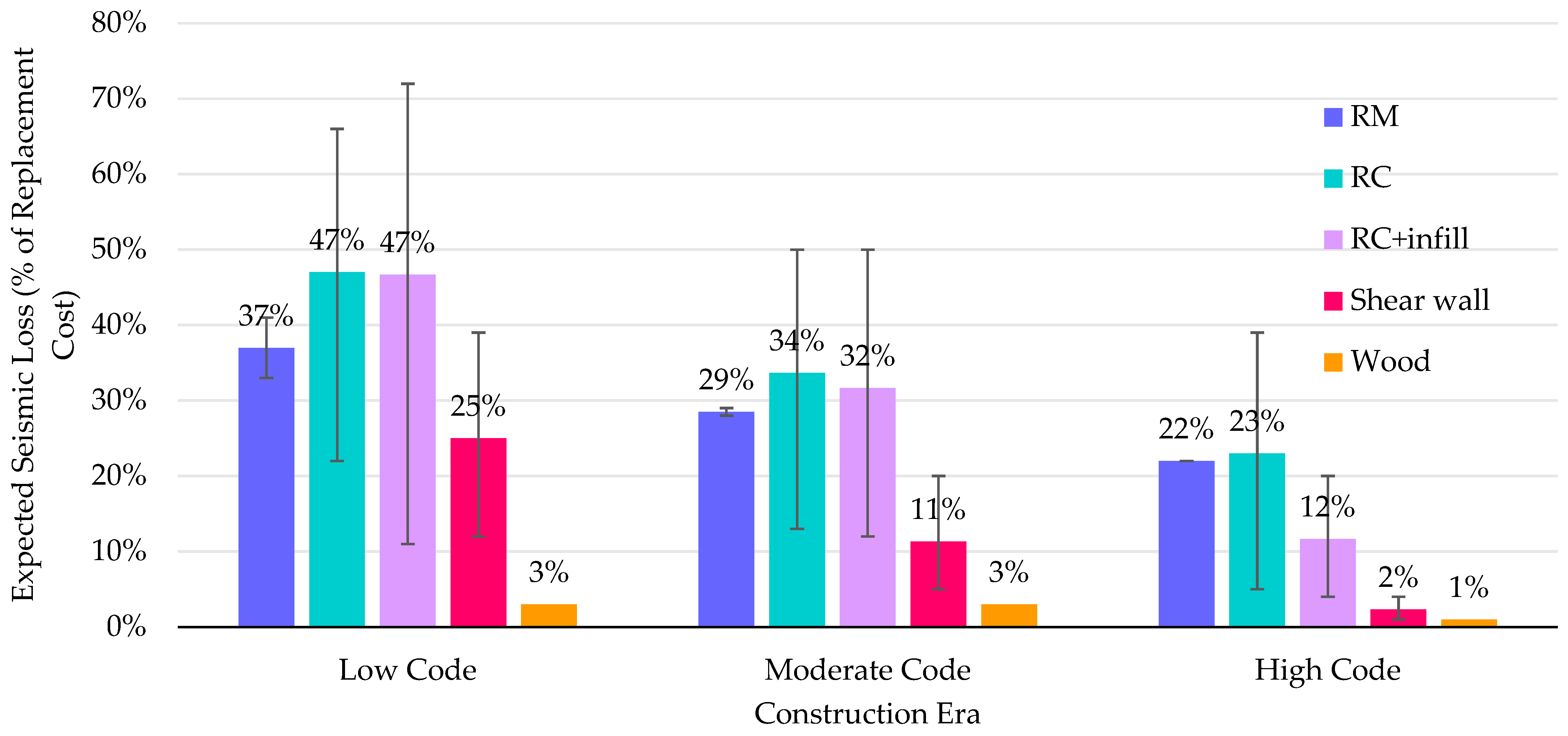
Figure 4 synthesizes the expected seismic loss at the design-level hazard by presenting mean values across low-, mid-, and high-rise configurations for each structural system and construction era. Error bars represent the range of loss values associated with height variability.
For low-code buildings, RC moment frames and RC frames with infill exhibit the highest average loss levels, both reaching approximately 47% of replacement cost. Reinforced masonry (RM) buildings show a lower mean loss of approximately 37%, while shear wall systems exhibit significantly lower mean loss of 25%. Low-rise timber buildings demonstrate minimal loss, approximately 3%. Under moderate-code provisions, the mean loss for RC frames decreases to 34% and, for RC frames with infill, to 32%, while shear wall systems drop substantially to 11%. Reinforced masonry buildings reduce to 29%, reflecting noticeable improvement but still remaining above shear wall performance. For high-code buildings, the differentiation becomes more pronounced. RC frames exhibit an average loss of approximately 23% and reinforced masonry of approximately 22%, while RC frames with infill decrease to 12%. Shear wall systems demonstrate very low mean loss levels of 2%, and timber remains at approximately 1%. These results confirm that structural configuration significantly influences economic performance at the design-level hazard, particularly in high-code buildings where system efficiency becomes more evident.
The error bars in
Figure 4 highlight the pronounced variability associated with building height. For RC moment-frame systems under low-code design, loss ranges from approximately 22% (low-rise) to 66% (high-rise), resulting in a variability band exceeding 40 percentage points. A similarly wide range is observed for infilled frames, where loss varies from 11% to 72%, indicating strong height sensitivity. In contrast, shear wall systems show narrower variability bands. Under high-code conditions, loss ranges only from 1% (three stories) to 4% (nine stories), indicating limited height sensitivity and robust drift control. The dispersion patterns confirm that height is a critical vulnerability amplifier in frame-dominated systems, while shear wall systems maintain more stable performance across building scales.
In
Figure 4, mean loss values are presented as simple averages across typologies within each height category. These averages are not weighted by the actual distribution of building stock in Bucharest and, therefore, should be interpreted as illustrative comparisons between archetypes rather than as stock-level estimates.
3.2. Expected Annual Loss (EAL)
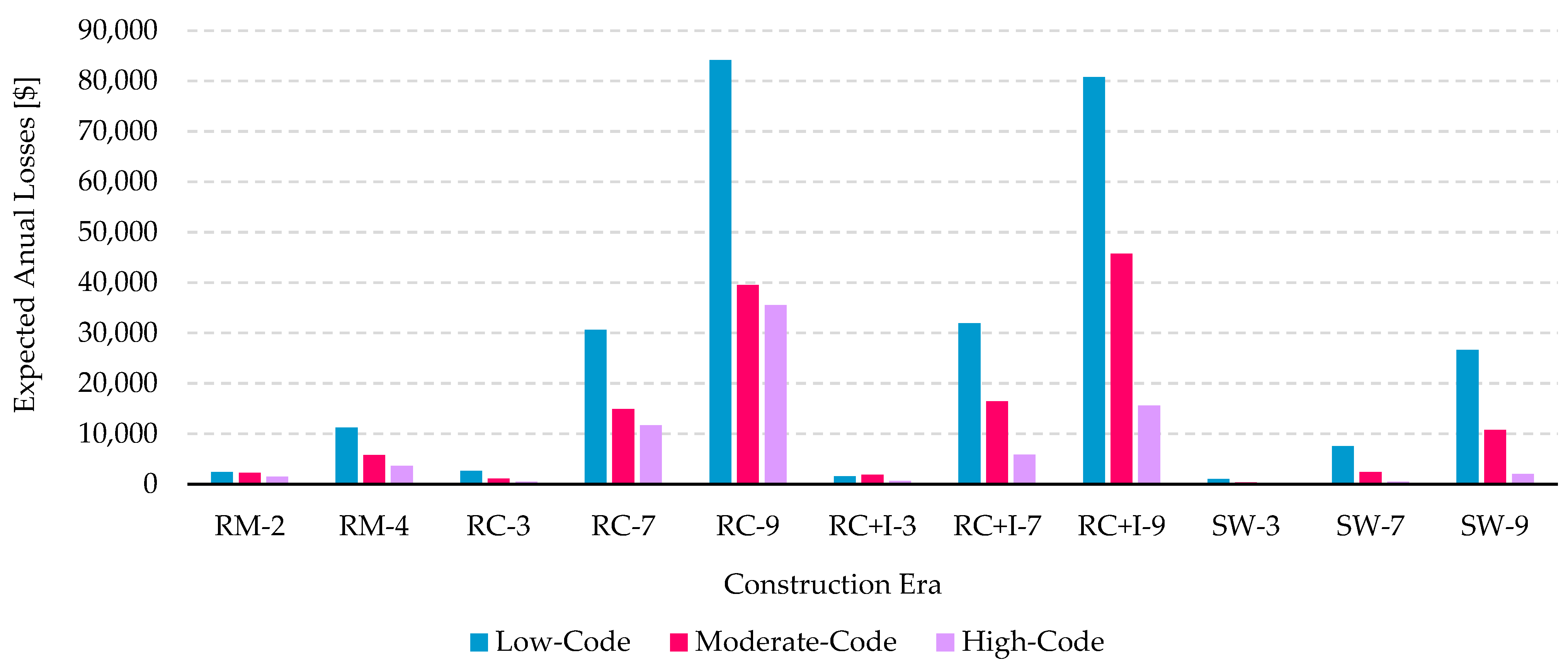
EAL values vary significantly across structural systems, height classes, and code levels. For example, low-code high-rise RC moment frames exhibit the highest annualized losses (up to approximately
$84,000 per building), whereas modern RC shear wall systems show substantially lower values (on the order of
$2000–
$10,000).
Figure 5 presents the expected annual loss (EAL) for all analyzed typologies, expressed in absolute monetary values per building.
A strong dependence on building height is observed, particularly for RC moment-frame systems, where EAL increases by more than an order of magnitude between low-rise and high-rise configurations. Across all typologies, RC moment frames exhibit the highest EAL values, followed by RC frames with masonry infill and reinforced masonry systems, while RC shear wall systems consistently show the lowest losses. Buildings designed according to more recent seismic codes exhibit reduced EAL; however, differences between structural systems remain significant.
EAL is influenced by the upper bound of the hazard curve, particularly for vulnerable typologies where collapse contributes significantly to losses at high intensity levels. For pre-1977 high-rise RC frame buildings, a substantial portion of total loss at large return periods is associated with collapse. As a result, rare but high-consequence events contribute disproportionately to annualized losses, highlighting the sensitivity of EAL to the representation of high-intensity, low-probability seismic events.
Overall, the results indicate that expected annual loss is primarily governed by structural system and building height, with code level providing a secondary but consistent reduction in seismic risk.
3.3. Comparison of Structural Systems at Design-Level Hazard
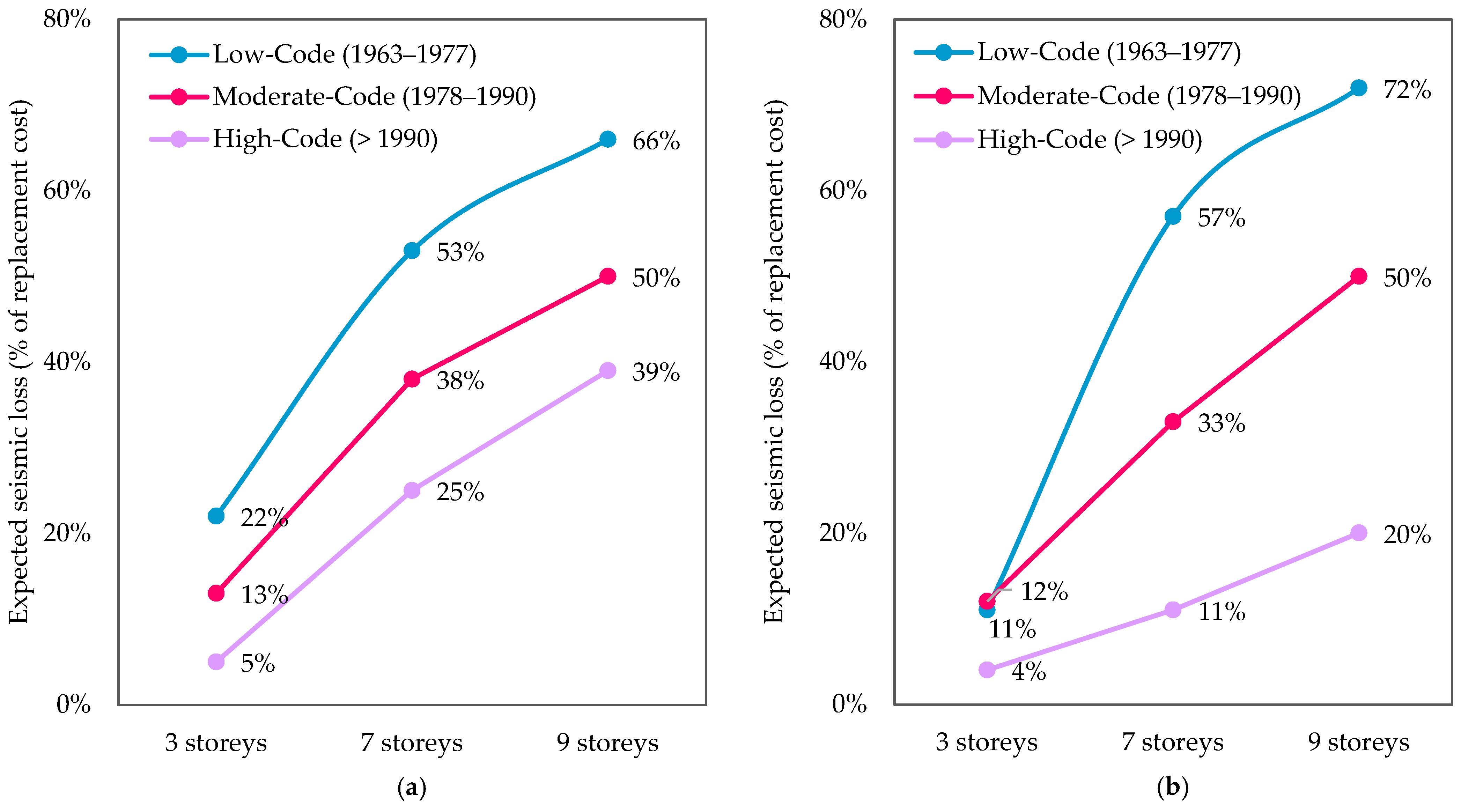
Figure 6 isolates the influence of building height on scenario expected loss for reinforced concrete (RC) moment-frame systems (
Figure 6a) and RC moment frames with masonry infill (
Figure 6b), at the design-level hazard (10% probability of exceedance in 50 years).
It is important to contextualize these comparisons with respect to historical construction practice in Romania. For low-code (1963–1977) and moderate-code (1978–1990) buildings, fully bare reinforced concrete frames without masonry infills were extremely rare in practice, as infilled masonry was routinely used as exterior and interior partitions. Therefore, the “bare frame” results for these construction eras should be interpreted primarily as analytical reference cases. In contrast, post-1990 high-code buildings increasingly employ lightweight drywall partitions rather than structural masonry infills, making the bare-frame configuration more representative of contemporary construction practice.
For bare RC moment frames (
Figure 6a), loss increases systematically with height across all construction eras. Under low-code design, SEL rises from 22% for three-story buildings to 53% for seven-story buildings and reaches 66% for nine-story buildings. This represents a threefold increase in loss between low-rise and high-rise configurations. A similar trend is observed for moderate-code buildings, where SEL increases from 13% (three stories) to 38% (seven stories) and 50% (nine stories). Even under high-code design, loss increases from 5% (three stories) to 25% (seven stories) and 39% (nine stories). These results indicate that height remains a dominant vulnerability amplifier in frame-dominated systems, even when modern detailing provisions are implemented. Increased drift demands and accumulation of nonstructural damage in taller configurations contribute significantly to the observed escalation in economic loss.
Regarding the infilled-frame systems (
Figure 6b), height sensitivity is even more pronounced, particularly in older code eras. Under low-code design, SEL increases dramatically from 11% (three stories) to 57% (seven stories) and 72% (nine stories). This represents more than a sixfold increase between low-rise and high-rise configurations. Moderate-code infilled frames show loss values of 12%, 33%, and 50% for three-, seven-, and nine-story buildings, respectively. Even high-code infilled frames exhibit increasing loss with height, rising from 4% (three stories) to 11% (seven stories) and 20% (nine stories). The amplified height effect in infilled frames reflects the interaction between frame deformation and brittle infill panel damage, which becomes increasingly severe as global drift demand increases in taller buildings.
Comparing
Figure 6a and
Figure 6b reveals that infilled frames generally experience higher loss escalation with height than bare frames, particularly under low-code conditions. For nine-story buildings, low-code infilled frames reach 72% loss compared to 66% for bare frames. However, the difference narrows in high-code buildings, where improved detailing reduces frame–infill interaction effects.
Height significantly increases economic vulnerability in frame systems.
Code evolution mitigates but does not eliminate height-related amplification.
Infilled frames are particularly sensitive to height under older design provisions.
These findings further reinforce the importance of structural configuration and detailing in controlling economic loss at the design-level hazard.
For low-code and moderate-code construction eras, the infilled-frame results are considered more representative of Romanian residential practice than the corresponding bare-frame results. The bare-frame cases are therefore used primarily to illustrate the role of infill on structural response and loss rather than to characterize the dominant vulnerability of the older Bucharest RC residential stock.
3.4. Uncertainty and Collapse Contribution in Seismic Loss Estimates
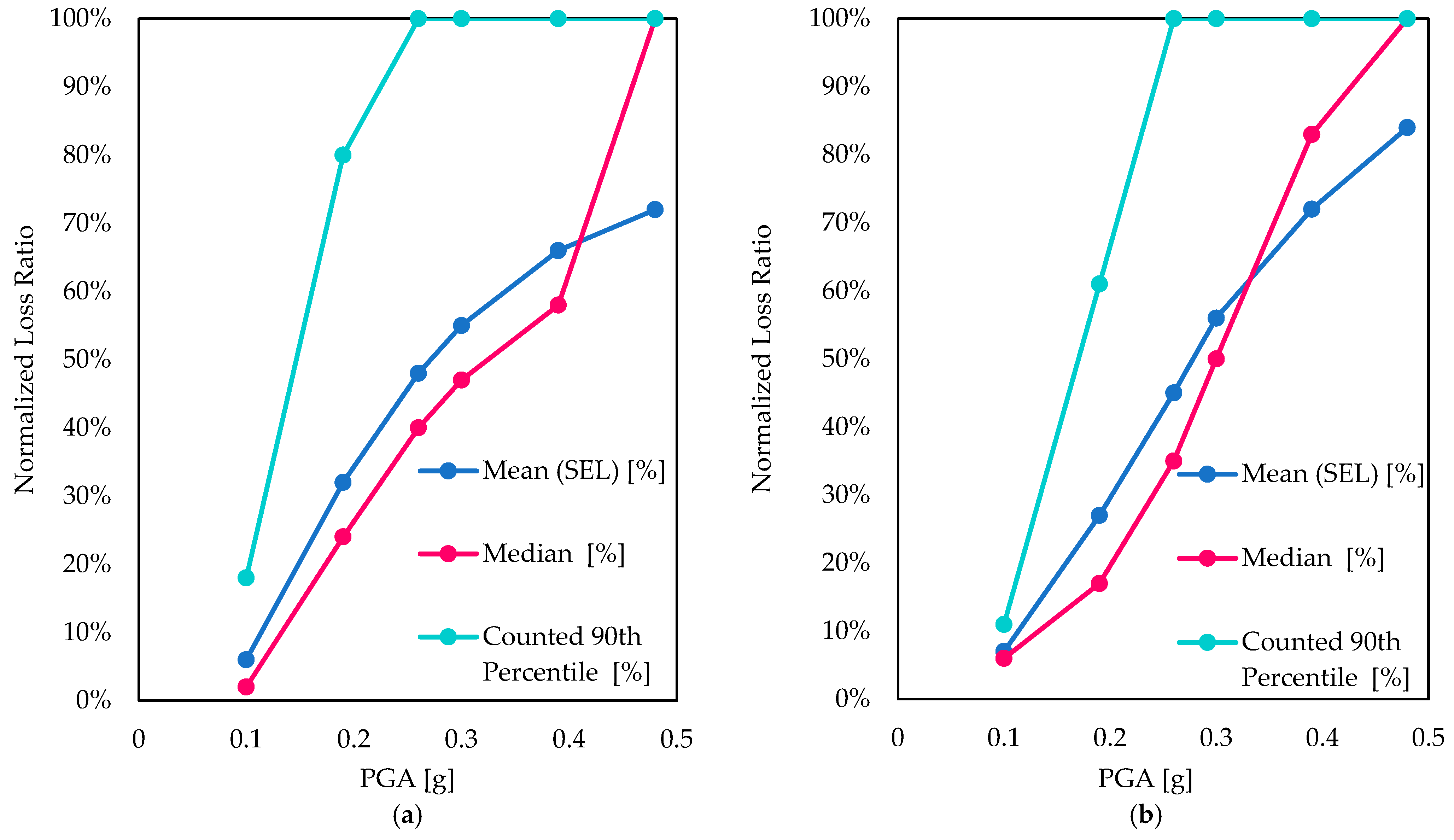
The probabilistic loss results exhibit significant variability across building typologies, as reflected by the differences between median, mean, and 90th percentile loss ratios (
Table 7).
In frame-dominated systems, particularly pre-1977 and moderate-code RC frame buildings, the 90th percentile loss approaches or reaches total replacement cost, indicating a strong contribution from collapse or near-collapse scenarios. The divergence between median and mean loss values reflects the right-skewed nature of seismic loss distributions, where relatively low-probability but high-consequence events significantly influence expected losses. In contrast, shear wall systems exhibit both lower mean losses and reduced dispersion, indicating more stable and predictable seismic performance.
Figure 7 illustrates the evolution of probabilistic loss metrics as a function of ground motion intensity (PGA) for low-code high-rise reinforced concrete (RC) frame systems. Mean (SEL), median, and 90th percentile loss ratios are presented to capture both the central tendency and dispersion of seismic losses across increasing intensity levels. The divergence between these statistical measures highlights the strongly skewed nature of the loss distribution and the growing influence of high-damage and collapse states at higher seismic intensities.
Table 8 presents the evolution of probabilistic loss metrics for low-code high-rise reinforced concrete (RC) moment-frame buildings across multiple seismic intensity levels. Mean (SEL), median, and 90th percentile loss ratios are reported as a function of peak ground acceleration (PGA) and return period.
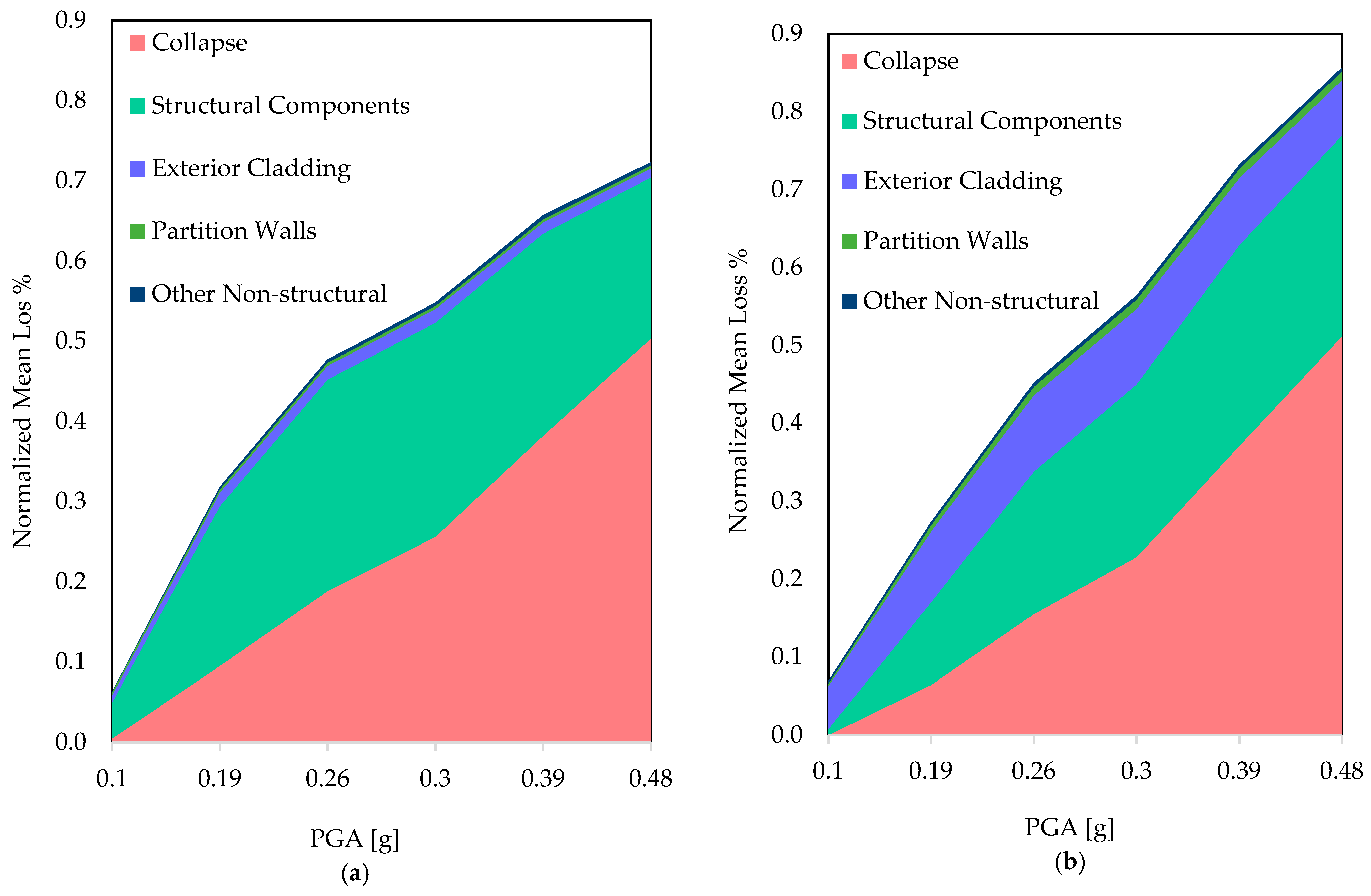
To further investigate the role of collapse in loss estimation, the contribution of different damage components to the total scenario expected loss (SEL) was examined for representative pre-1977 tall RC buildings and RC with masonry infill buildings. The evolution of loss components with increasing ground motion intensity is illustrated in
Figure 8, which shows the normalized contribution of collapse and repairable damage for pre-1977 tall RC buildings. For both bare- and infilled-frame systems, collapse becomes the dominant contributor at higher intensity levels.
At the 475-year return period, collapse accounts for approximately 38% of total loss in bare RC frame systems, corresponding to nearly 60% of the total SEL. For RC frames with masonry infill, collapse contributes approximately 37% of total loss, or about 50% of the SEL, with the remaining losses associated with structural and nonstructural damage.
It should be noted that bare RC frame systems are included primarily as analytical reference cases to isolate the influence of masonry infill on structural response and loss.
3.5. Functional Recovery and Downtime
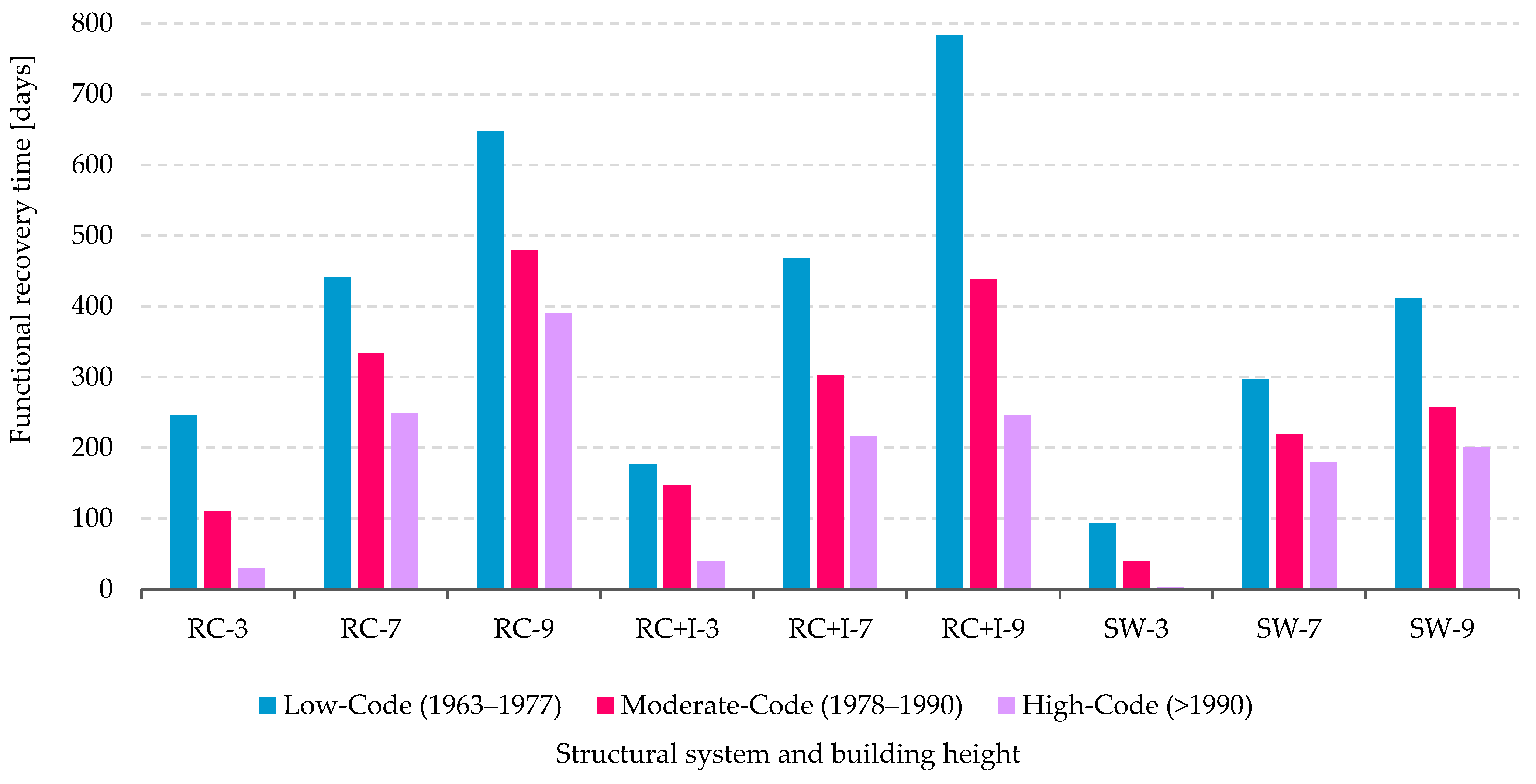
Figure 9 presents the median functional recovery time at the design-level hazard (10% probability of exceedance in 50 years) for reinforced concrete (RC) moment-frame buildings, reinforced concrete frames with masonry infill (RC + I), and reinforced concrete shear wall (SW) systems considering different construction eras and height categories.
For RC moment-frame buildings, recovery time increases significantly with height and decreases systematically with code advancement. Under low-code design, median functional recovery increases from 246 days (three stories) to 441 days (seven stories) and reaches 648 days for nine-story buildings. This corresponds to nearly 1.8 years of downtime for high-rise configurations. Moderate-code RC frames show considerable improvement, with recovery times of 111 days, 333 days, and 480 days for three-, seven-, and nine-story buildings, respectively. High-code RC frames demonstrate further reduction, with recovery times of approximately 30 days (three stories), 249 days (seven stories), and 390 days (nine stories). Despite improvements in detailing, height remains a dominant factor influencing recovery in frame-dominated systems. Even high-code nine-story RC frames require more than one year to achieve functional recovery.
Infilled frames exhibit even greater sensitivity to height, particularly under low-code provisions. For low-code RC + I buildings, recovery time increases from 177 days (three stories) to 468 days (seven stories) and reaches 783 days (nine stories), corresponding to more than two years of median functional recovery. Moderate-code infilled frames show improved performance but still significant downtime: 147 days (three stories), 303 days (seven stories), and 438 days (nine stories). High-code infilled frames reduce recovery time to 40 days, 216 days, and 246 days, respectively, but height-related escalation remains evident. The particularly high recovery durations in taller infilled frames reflect extensive nonstructural damage and repair sequencing complexity associated with frame–infill interaction.
Shear wall systems demonstrate comparatively shorter recovery times across all heights and code eras. For low-code shear wall buildings, recovery time ranges from 93 days (three stories) to 297 days (seven stories) and 411 days (nine stories). Under moderate-code provisions, recovery reduces to 39 days, 219 days, and 258 days, respectively. High-code shear wall systems achieve the shortest recovery times overall, with values of 3 days (three stories), 180 days (seven stories), and 201 days (nine stories). Notably, even for nine-story buildings, high-code shear walls recover in approximately 200 days compared to 390 days for high-code RC frames and 246 days for high-code infilled frames.
Across all structural systems, code advancement produces substantial recovery improvement.
For nine-story buildings:
RC frames reduce recovery from 648 days (low-code) to 390 days (high-code), representing a 40% reduction.
RC + I buildings reduce recovery from 783 days to 246 days, corresponding to a nearly 70% reduction.
Shear wall systems reduce recovery from 411 days to 201 days, representing approximately a 50% reduction.
These results demonstrate that code improvements influence not only economic loss but also post-earthquake functionality and recovery capacity.
Recovery time introduces a critical resilience dimension that is not fully captured by loss ratios alone. While some typologies may exhibit moderate loss percentages, their recovery durations extend beyond one year, indicating prolonged functional disruption. Height emerges as a strong amplifier of downtime in frame-based systems, whereas shear wall systems exhibit more stable recovery behavior. These findings confirm that functional recovery constitutes a decisive component of seismic resilience assessment and justifies its higher weight in the comparative score formulation.
3.6. Computation of Comparative Seismic Performance Score
To facilitate a compact comparison of seismic performance across building typologies, the normalized performance metrics were combined into a comparative seismic performance score (CSPS). This score integrates scenario expected loss (SEL), functional recovery time, and expected annual loss (EAL) into a single indicator, as described in
Section 2.5. The CSPS is intended as a comparative screening metric and should be interpreted as a relative ranking within the analyzed typologies rather than an absolute measure of seismic resilience.
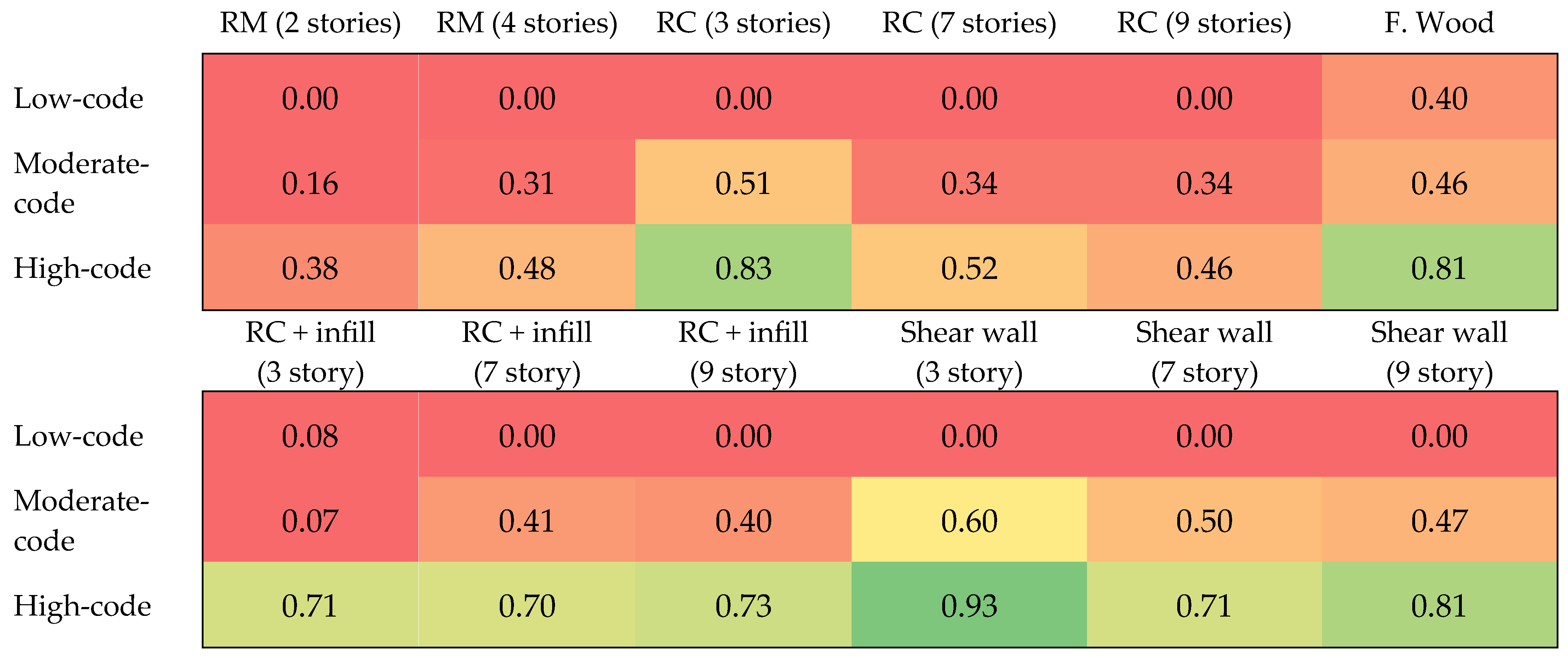
Figure 10 presents the CSPS values for all building typologies across structural systems, height classes, and code levels.
Frame-dominated systems, particularly low-code and moderate-code reinforced concrete (RC) moment frames, exhibit the lowest performance scores, reflecting the combined effect of high losses, long recovery times, and elevated annualized risk. This effect is most pronounced in high-rise configurations, where increased drift demand and collapse susceptibility significantly amplify both economic loss and recovery duration.
In contrast, reinforced concrete shear wall systems consistently achieve the highest CSPS values across all height and code categories. This reflects their lower deformation demands, reduced damage propagation, and more stable recovery behavior. A systematic improvement in performance is also observed with increasing code level across all structural systems, indicating the effectiveness of modern seismic design provisions in reducing both loss and downtime.
For RC frame systems with masonry infill, performance is generally comparable to or slightly improved relative to bare frames. This reflects the dual influence of infill panels, which can reduce drift at lower intensities but may contribute to brittle damage mechanisms at higher demand levels.
Overall, the results indicate that structural system and building height are the primary drivers of seismic performance, while code level provides a consistent but secondary improvement. The CSPS provides a consistent comparative representation of these effects, enabling a clear differentiation of typologies in terms of relative seismic performance.
To illustrate the calculation procedure, a representative example is provided for the typology of RC frame buildings of moderate-code and low height. For this case, the performance metrics are SEL (475-year) = 0.13, RT (recovery time) = 111 days, and EAL = 1128 €. The corresponding normalized values are SELnorm = 0.59, RTnorm = 0.45, and EALnorm = 0.43, obtained using the maximum values within the corresponding structural system group. The composite score is then computed as:
It should be emphasized that the CSPS is sensitive to the adopted normalization procedure and weighting scheme. Consequently, the score should be interpreted as a heuristic tool for relative comparison rather than a definitive measure of seismic resilience. While absolute values are subject to uncertainty due to modeling assumptions, the observed ranking of typologies is consistent with expected structural behavior and with the trends identified in the individual performance metrics. Alternative normalization schemes and weighting strategies may lead to different absolute values but are not expected to significantly alter the relative ranking observed across typologies
4. Discussion and Implications
The primary objective of this study is to compare typology-level performance rather than to estimate aggregate losses for the entire building stock.
The results obtained in this study are broadly consistent with previous seismic risk assessments for Bucharest. For example, Ref. [
26] reported direct economic losses in the range of approximately 5–13 billion € for Vrancea earthquake scenarios of comparable magnitude. These values are of similar order to those historically observed during the 1977 earthquake and to other scenario-based studies. In addition, prior studies consistently identify pre-1977 reinforced concrete buildings and masonry structures as the most vulnerable components of the Bucharest building stock, with damage and losses strongly dependent on structural system and code level. The typology-based trends observed in the present study—particularly the high vulnerability of older RC frame systems and the improved performance of wall-dominated systems—are therefore consistent with established findings in the literature. While the modeling approaches differ, this qualitative agreement provides confidence that the SP3-based framework captures the relative vulnerability patterns of the Bucharest residential building stock.
4.1. Structural System Performance and Code Evolution
The results demonstrate that structural configuration and design code evolution are the primary determinants of seismic economic performance in Bucharest residential buildings. Reinforced concrete moment-frame systems exhibit pronounced sensitivity to building height, with loss and recovery time increasing considerably in mid- and high-rise configurations. In contrast, reinforced concrete shear wall systems consistently demonstrate lower drift-sensitive damage and shorter recovery durations, particularly in post-1990 code generations.
These findings are mechanically coherent with expected structural behavior, as shear wall systems are known to reduce interstory drift demand and nonstructural damage accumulation under lateral loading [
31,
32]. Frame-based systems, particularly those interacting with brittle masonry infill, exhibit amplified drift concentration and more extensive nonstructural damage accumulation, explaining the elevated loss and downtime observed in taller configurations.
The systematic reduction in both scenario loss and recovery time across successive code eras confirms the effectiveness of Romanian seismic code modernization, particularly following the 1977 Vrancea earthquake. However, the persistence of significant vulnerability in taller frame systems, even under modern code provision, highlights that drift-controlled damage and repair sequencing complexity remain dominant drivers of post-earthquake impact.
It is important to note that, for the low-code (1963–1977) and moderate-code (1978–1990) periods, reinforced concrete moment frames without masonry infill were relatively uncommon in Romanian residential construction. In this study, these bare-frame configurations are included primarily as analytical reference cases to isolate the influence of masonry infill on structural response and loss.
Accordingly, for interpretation of the vulnerability of the older Bucharest residential stock, greater emphasis should be placed on reinforced concrete frames with masonry infill, which more accurately reflect prevailing construction practice. The corresponding bare-frame results should therefore be interpreted in a comparative and mechanistic sense rather than as representative of the dominant building configurations.
4.2. Height as a Vulnerability Amplifier
Height-related amplification of loss and downtime has been observed in previous PBEE-based assessments of multistory RC frame systems [
33]. For nine-story RC moment-frame buildings, both SEL and functional recovery time increase dramatically relative to low-rise configurations. In several low-code typologies, recovery durations exceed one year, indicating prolonged service interruption even in the absence of collapse.
This height sensitivity has direct implications for urban resilience planning in Bucharest, where mid- and high-rise residential blocks constitute a significant portion of the housing stock. Although collapse risk reduction remains a primary objective of seismic design, the results show that downtime-related impacts may govern socio-economic disruption in taller typologies.
Shear wall systems, by contrast, exhibit more stable behavior with respect to height, particularly in high-code buildings. This stability suggests that structural stiffness and drift control play a central role not only in life safety but also in economic resilience.
4.3. Regional and Methodological Implications
This study indicates the applicability of a component-based PBEE framework to a seismic environment characterized by intermediate-depth Vrancea earthquakes. While previous Bucharest assessments have relied primarily on deterministic scenarios or class-based vulnerability curves [
25,
26], the present analysis provides a consistent probabilistic linkage between structural configuration, economic consequence, and recovery performance.
The divergence between repair cost and functional recovery time has been highlighted in recent resilience-oriented seismic performance frameworks [
34,
35]. Several building typologies exhibit moderate loss percentages but extended recovery times exceeding 12–24 months under design-level hazard conditions. This divergence indicates that downtime is influenced not only by direct repair cost but also by component fragility dispersion, repair sequencing, and impeding factors
The mapping of Romanian structural typologies to SP3 archetype representations introduces necessary methodological approximations but preserves comparative integrity across typologies. The results should therefore be interpreted as representative typology-level performance indicators rather than building-specific predictions.
Although this study does not explicitly model insurance mechanisms such as loss exceedance curves, PML, or portfolio aggregation, the presented EAL and loss distributions provide a quantitative basis that could support future risk-transfer analyses. In particular, the differentiation of vulnerability across typologies may be useful for exposure classification and risk pricing in subsequent studies.
The present study does not explicitly account for indirect economic losses, including temporary relocation costs, business interruption, or broader socio-economic impacts associated with post-earthquake recovery. Such effects may be significant, particularly for building typologies exhibiting prolonged recovery times. The integration of indirect loss modeling represents an important direction for future research.
Future extensions could incorporate:
Region-specific fragility calibration;
Sensitivity analysis of impeding factor variability;
Extension of component-based PBEE modeling to unreinforced masonry systems.
5. Limitations and Future Research
The analysis presented in this study is subject to several methodological and contextual limitations.
Structural response predictions were based on SP3 archetype representations calibrated using databases of nonlinear simulations. No building-specific nonlinear backbone curves or user-defined hysteretic models were introduced. Consequently, the results should be interpreted as representative of typology-level performance rather than building-specific predictions.
Collapse probability was estimated using the FEMA P-154 methodology [
36] as implemented within SP3 rather than through explicitly calibrated collapse fragility functions for Romanian buildings. While appropriate for comparative analysis, this simplified approach may influence tail-loss estimates under high-intensity seismic scenarios, particularly for vulnerable typologies.
Default impeding factor distributions and recovery sequencing parameters embedded in the SP3/ATC-138 framework were adopted. No formal sensitivity analysis was conducted on structural response modifiers, nonstructural fragility dispersion, or recovery-related parameters. As a result, the analysis captures comparative trends but does not quantify uncertainty bounds associated with input variability.
Seismic demand was represented using code-shaped spectra scaled to multiple hazard levels rather than uniform hazard spectra derived directly from probabilistic seismic hazard analysis (PSHA). This approximation may not fully capture the period-dependent characteristics of Vrancea ground motions.
The mapping between Romanian building typologies and SP3 archetypes is based on structural system equivalence and national classification methodologies. However, uncertainties remain regarding the representation of local detailing practices, material properties, and region-specific seismic response characteristics.
Consequence models, including repair costs and recovery times, are derived from U.S.-based datasets within FEMA P-58, SP3, and ATC-138. Only replacement costs were localized. Other aspects—such as labor productivity, contractor availability, permitting procedures, financing mechanisms, and infrastructure restoration—were not explicitly adapted to Romanian conditions. As a result, absolute estimates of cost and recovery time may differ from real-world outcomes.
The representation of interior partitions using metal stud systems instead of masonry partitions introduces additional uncertainty in nonstructural damage estimation. Given the higher stiffness and brittleness of masonry partitions, actual losses and recovery times may be underestimated.
Masonry infill is not explicitly modeled as a repairable component. Its influence is captured indirectly through structural response, but associated repair costs are not separately quantified.
Unreinforced masonry buildings, which represent a significant portion of the Romanian building stock, were not included due to the absence of fully implemented component-based PBEE archetypes within SP3. Extending probabilistic assessment to these systems remains an important direction for future research.
The study does not incorporate exposure-weighted aggregation of building typologies. Therefore, the results do not represent the actual distribution of buildings in Bucharest but, rather, comparative performance across representative typologies.
Finally, the study does not include insurance-oriented risk metrics such as loss exceedance curves, probable maximum loss (PML), or portfolio-level aggregation. The results should therefore be interpreted as typology-level vulnerability assessments rather than a complete risk-transfer analysis.
Overall, the findings are most robust in a comparative sense, highlighting relative differences between structural systems, height regimes, and design-code eras, while absolute values remain subject to the assumptions of the adopted modeling framework.