1. Introduction
Gearbox housings play a decisive role in vehicle noise, vibration and harshness (NVH) behaviour. In electric drivetrains, the absence of engine masking makes tonal gear excitations clearly audible. Structural stiffness variations can therefore directly influence radiated sound pressure levels. For lightweight electric vehicle applications, housing mass reduction must therefore be balanced against acoustic performance. Recent design-oriented studies have demonstrated that housing geometry optimization can significantly reduce radiated noise while maintaining structural integrity [
1].
High-fidelity finite-element (FE) and coupled vibro-acoustic simulations remain the standard tools for predicting gearbox radiation behaviour [
2,
3,
4]. While these approaches provide detailed physical insight, they are computationally intensive and not well suited for rapid screening of multiple early-stage design variants. When numerous rib layouts or stiffness concepts must be compared during concept development, full simulation workflows can become a bottleneck.
Data-driven approaches have recently gained attention as complementary tools for NVH prediction. Machine learning methods have been applied to radiated noise modelling and vibration–acoustic coupling problems [
3,
5], and deep learning approaches have also been explored for spectral-based NVH performance prediction [
6].
These studies demonstrate promising predictive capability; however, they typically rely on larger datasets or high-dimensional spectral inputs. The statistical behaviour of extremely compact spectral representations under small-sample conditions has received far less attention.
Several studies report that mid-frequency spectral content, typically between 2 and 4 kHz, is particularly sensitive to gearbox housing stiffness [
1,
4]. Rib reinforcement modifies wall-panel dynamics in this region, shifting or attenuating structural–acoustic coupling peaks. Nevertheless, most published works focus on detailed modal analysis, optimization workflows, or full-scale predictive modelling, while systematic assessment of minimal spectral descriptors remains limited.
The present work investigates a different question: can extremely compact spectral summaries—specifically, five 1 kHz band-averaged sound pressure levels—already encode stiffness-related information in a way that is interpretable and statistically assessable? In this study, these band-averaged quantities are referred to as spectral band descriptors.
The aim is not to introduce a new machine learning architecture. Instead, this study evaluates the diagnostic value and the statistical limits of minimal frequency-band descriptors when only a very small dataset is available. The analysis is based on an open simulation-derived dataset [
7] of twelve spectra representing three ribbing configurations of a single gearbox housing geometry The study should be interpreted as a controlled benchmark analysis designed to evaluate how much stiffness-related information can still be retained when the spectral representation and dataset size are both deliberately reduced.
Standard dimensionality-reduction and classification tools are used as analytical instruments. These include PCA, k-means clustering, and Random Forest. The focus lies on identifying frequency regions that consistently separate stiffness levels and on quantifying the uncertainty associated with such separation under extreme small-N conditions.
The main contributions of this study can be summarized as follows:
A compact frequency-band representation of gearbox acoustic spectra is evaluated for stiffness discrimination under extreme small-sample conditions.
The study provides a quantitative assessment of the statistical limits of such minimal descriptors using LOOCV classification and permutation-based robustness analysis.
The results identify the 2–4 kHz range as the most stiffness-sensitive spectral region, providing a physically interpretable indicator for early-stage NVH screening.
Unlike most existing NVH studies, which rely on larger datasets, full spectra, or computationally intensive simulation workflows, the present work focuses on the minimum spectral representation required to retain stiffness-related information in a statistically interpretable form.
Literature Review
Lightweight gearbox housings have become a central topic in electric-vehicle (EV) NVH research, as the absence of combustion-engine masking makes gear-mesh excitations more perceptible. Experimental investigations using laser Doppler vibrometry and microphone measurements show that structural wall vibration dominates radiated acoustic power in compact electric drivetrains. In some cases, it exceeds 80% of the total radiation. This effect is particularly pronounced in the 2–4 kHz range, where structural modes couple efficiently with the surrounding air [
8,
9].
To address this sensitivity, rib-based stiffening strategies are widely employed. Parametric finite-element studies indicate that longitudinal ribs shift dominant wall modes upward by several hundred hertz. At the same time, radiated sound levels can decrease by up to 10 dB, usually with only a modest mass increase [
10,
11]. Classical analyses of gearbox acoustics similarly emphasize that mid-frequency radiation efficiency can approach unity, meaning that even moderate stiffness reductions may translate directly into increased sound pressure levels in the vehicle interior [
12].
In addition to structural design parameters, tribological conditions inside the gearbox can also influence vibro-acoustic behaviour. Lubricant viscosity and material interactions affect frictional losses, damping characteristics, and the dynamic response of the gear mesh, which may indirectly modify vibration transmission to the gearbox housing and the resulting acoustic radiation. Experimental studies have demonstrated that lubricant properties can significantly influence gearbox efficiency and mechanical behaviour under operating conditions [
13].
High-fidelity prediction tools remain the industrial reference for analyzing such behaviour. Coupled elastic multibody simulation (eMBS) and FE/MBD-based structural–acoustic models implemented in commercial platforms such as Romax Spectrum and COMSOL allow simultaneous modelling of gear-mesh excitation, housing dynamics, and near-field acoustic radiation [
14,
15]. However, these workflows are computationally demanding. Individual simulation runs may require several CPU-hours, and systematic screening of dozens of rib configurations can rapidly accumulate significant computational cost. Published numerical benchmarks report that evaluating on the order of fifty gearbox configurations with full structural–acoustic coupling can exceed 200 core-hours, motivating the search for simplified surrogate descriptors suitable for early-stage design assessment [
8].
A growing body of work therefore investigates the sources and mitigation strategies of vehicle noise, vibration and harshness in modern powertrains. Recent review studies highlight that electric drivetrains expose tonal excitation sources such as gear transmissions and power-coupling devices more clearly due to the absence of combustion-engine masking [
16]. Subsequent studies on agricultural EV gearboxes and wind-turbine main gearboxes confirmed that the 2–4 kHz window remains the most discriminative range when rib geometry changes, owing to the clustering of wall and gear-mesh modes [
1,
4].
In parallel with rib-based stiffening, alternative concepts such as metamaterial-inspired gearbox housings have been proposed to modify structural wave propagation and improve vibro-acoustic behaviour without a proportional mass increase [
17].
Machine learning methods are often used to compress spectra into a small set of features and to support classification tasks in condition monitoring. However, with very small sample sizes, supervised models can easily overfit and provide unreliable estimates of predictive performance. In this work, supervised classification is therefore not treated as a primary objective; emphasis is placed on interpretable spectral-band sensitivity and exploratory separation in reduced-dimensional space.
In related condition-monitoring applications, Random Forest-based fusion of acoustic and vibration features has been successfully used for gearbox fault classification, while nonlinear descriptors such as Poincaré-plot features extracted from acoustic emission signals have shown high sensitivity to fault severity [
18,
19,
20].
Surrogate workflows have already migrated to production quality control. At several EV driveline plants, end-of-line (EOL) testers use structure-borne microphones or accelerometers to capture 0.5 s coast-down signatures. Autoencoder-based anomaly detectors trained on large sets of “good” traces have been reported to flag outliers reliably in production-oriented NVH quality assurance despite domain shifts [
21]. These systems build upon research showing that Poincaré-plot features extracted from acoustic emission (AE) signals can distinguish gearbox fault severities with high classification performance [
19]. Although fault detection differs from parametric stiffness ranking, both tasks exploit mid-frequency spectral fingerprints. From this perspective, housing-stiffness classifiers could potentially be integrated into existing NVH end-of-line (EOL) testing pipelines [
20].
Despite progress, three limitations hinder broader adoption. First, the empirical foundation is narrow: nearly all mid-frequency studies rely on laboratory rigs or FE simulations; road data under varying torque, temperature and manufacturing scatter remain scarce [
16]. Second, band partitioning is fixed a priori at 1 kHz, yet adaptive frequency segmentation driven by mutual information could reveal sharper modal fingerprints and boost ML sensitivity [
9]. Third, statistical reliability often goes unreported. Published RF accuracies typically omit bootstrap or Bayesian intervals; re-analyses show that 12-sample models can fluctuate ±20 points, raising questions about generalization [
11].
Emerging hybrid frameworks promise to close these gaps. Physics-informed neural networks (PINNs) embed governing equations—such as plate bending or gear-mesh stiffness—into the loss function, enforcing boundary-condition consistency while learning residual mappings from measurement to radiation [
21]. Others fuse coarse CAE outputs (e.g., modal participation factors) with RF meta-models, reducing the number of expensive simulations without sacrificing ranking fidelity. Digital-twin infrastructures already stream operating loads from fleet vehicles into surrogate models, allowing engineers to replay “virtual durability drives” and evaluate gearbox design variants more efficiently [
22].
2. Materials and Methods
This section describes the dataset used in the present study, the extraction of compact spectral descriptors, the classification framework, and the permutation-based robustness assessment. Since the work is based on a previously published open simulation dataset, the methodological focus is placed on descriptor reduction and classification rather than on the generation of new simulation or measurement data.
2.1. Dataset and Study Scope
The present work is a secondary analysis of a published open dataset and does not include a new measurement campaign or new structural–acoustic simulations performed by the authors. The analyzed data originate from a previously published simulation-based gearbox housing study. Accordingly, the methodological contribution of the present paper lies in the extraction, reduction, and classification of spectral descriptors rather than in the generation of new vibration or acoustic measurements.
This study is based exclusively on a simulation-derived acoustic dataset obtained from a parametric structural–acoustic model of a gearbox housing. No experimental measurements were performed by the authors.
The dataset consists of 12 sound pressure spectra corresponding to three housing stiffness concepts:
SSC = 0: flexible housing without ribs;
SSC = 1: intermediate housing with local rib reinforcement;
SSC = 2: rigid housing with full ribbing.
Each concept contains four spatial sampling nodes (A–D), resulting in a total of 12 spectra.
The structural–acoustic simulations were performed in the source study using Simcenter 3D (version v2312) [
7,
8]. The present manuscript does not reproduce these simulations. Instead, it performs a secondary analysis of the published acoustic spectra. The housing geometry remained identical across all cases; only the ribbing configuration was modified to represent stiffness variation. Because the source data are simulation-derived, the present study does not involve direct vibration or acoustic measurements, dedicated test rigs, microphones, accelerometers, or measurement hardware settings defined by the authors. This distinction is important for interpreting the scope of the study: the present work evaluates descriptor sensitivity and classification behaviour on an existing NVH dataset rather than validating a new experimental setup.
2.2. Acoustic Descriptor Extraction
Each spectrum covers the frequency range 100–6000 Hz.
To reduce dimensionality while preserving frequency localization, the 1–6 kHz region was divided into five contiguous 1 kHz bands:
1000–2000 Hz;
2000–3000 Hz;
3000–4000 Hz;
4000–5000 Hz;
5000–6000 Hz.
For each band, the arithmetic mean of the sound pressure magnitude values was computed.
The 1 kHz bandwidth was selected as a pragmatic compromise between frequency localization and statistical stability under N = 12. Narrower bands would increase feature variance and overfitting risk, whereas broader bands would smear stiffness-sensitive mid-frequency effects. This procedure resulted in a five-dimensional feature vector for each spectrum. These five band-averaged values form the spectral descriptors used as input features for the classification analysis.
2.3. Classification Model and Feature Importance Analysis
The Random Forest classifier was implemented in Python 3.13.5 using the scikit-learn library version 1.8.0. The five band-averaged features were used as input variables, while the structural stiffness classes (SSC ∈ {0,1,2}) were used as class labels. The classifier was trained with n_estimators = 100 and a fixed random_state for reproducibility. No hyperparameter optimization was performed, as the model was used here as an exploratory analytical tool rather than as a fully optimized predictive model.
Given the limited dataset size, leave-one-out cross-validation (LOOCV) was applied to evaluate classification performance. This approach is appropriate for extreme small-sample conditions because it allows each available spectrum to contribute to both training and validation while preserving strict sample-wise separation.
Feature importance values were also extracted from the trained Random Forest model. These values quantify the relative contribution of each frequency band to stiffness discrimination and support the interpretation of frequency-sensitive behaviour.
2.4. Permutation Testing
To assess whether the observed classification accuracy exceeded chance level, a permutation test was performed. Class labels were randomly shuffled, and the LOOCV procedure was repeated multiple times. The resulting distribution of classification accuracies was then compared with the observed value.
This approach provides a non-parametric robustness assessment without assuming normality or large-sample properties. Because only 15 permutations were used in the present study, the permutation analysis should be interpreted as an illustrative robustness check rather than as a formal significance test.
3. Results
This section summarizes the main findings obtained from the reduced spectral descriptor set. The results are organized to first examine frequency-band sensitivity, then assess classification performance and robustness, and finally interpret the relative importance of the individual frequency bands. In this way, the section moves from descriptive spectral trends toward model-based discrimination and physical interpretation.
3.1. Frequency-Band Sensitivity
Five 1 kHz band-averaged sound pressure features were extracted from the 1–6 kHz range to evaluate stiffness-related spectral differences. The strongest differences occur in the mid-frequency bands (2–4 kHz).
These observations suggest that stiffness-induced structural effects are frequency-localized rather than broadband.
The lower 1–2 kHz band showed only limited separation between the housing concepts, suggesting that this range is less sensitive to stiffness variation in the present dataset. By contrast, the 2–4 kHz region exhibited clearer inter-class differences, while the higher bands above 4 kHz contributed less consistently to class separation. This supports the view that stiffness-related effects are concentrated in a limited mid-frequency window rather than being uniformly distributed across the spectrum.
3.2. Classification Performance Under LOOCV
A Random Forest classifier was trained using the five band-averaged features and evaluated via LOOCV.
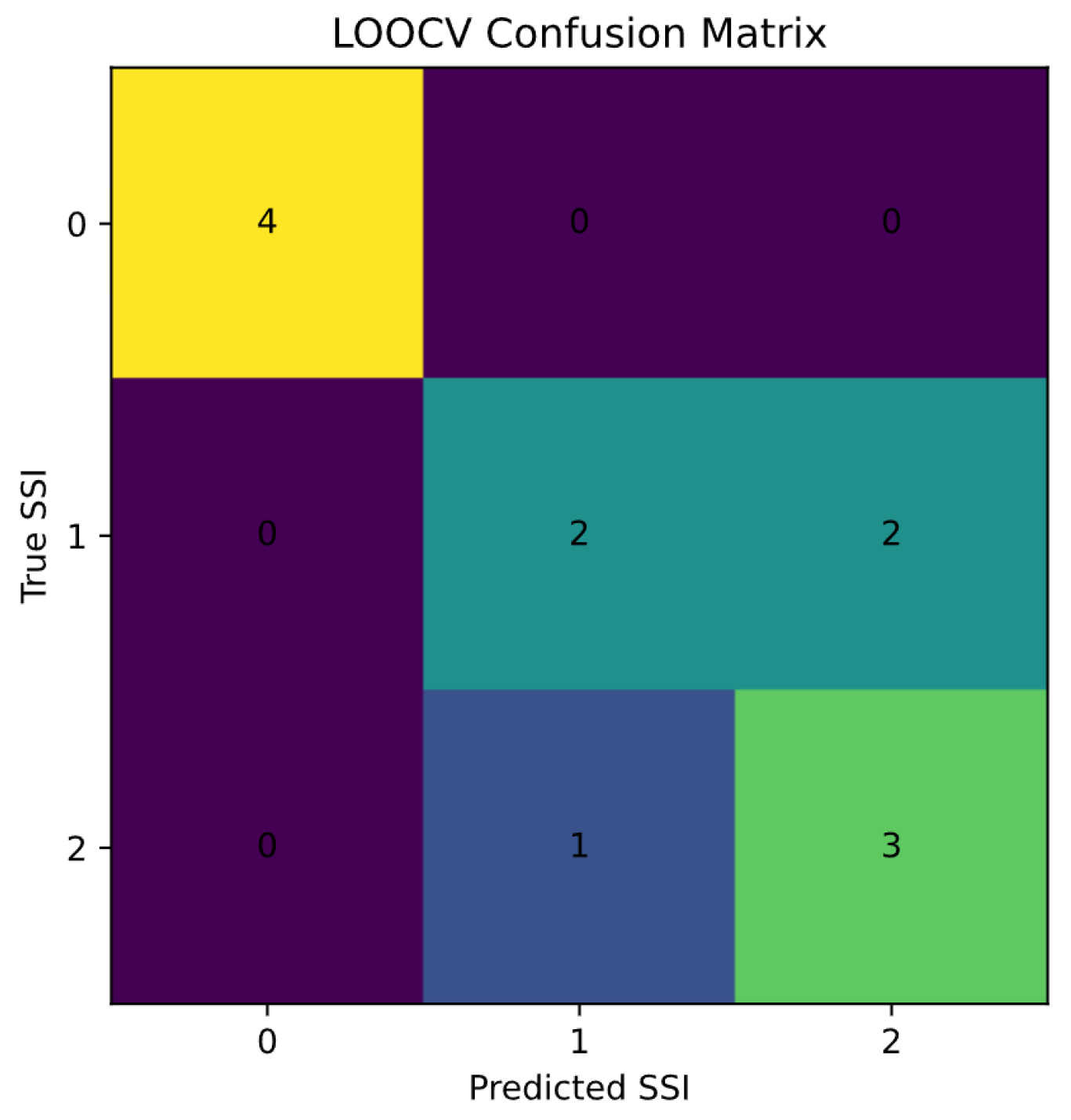
The overall classification accuracy was 0.75 (9 correct classifications out of 12 samples).
The confusion matrix is shown in
Figure 1. Correct classification is achieved for all flexible concepts (SSC = 0), while misclassifications occur primarily between intermediate (SSC = 1) and rigid (SSC = 2) configurations. This indicates partial overlap in their spectral signatures, especially in the mid-frequency bands.
The result confirms that compact frequency-band descriptors retain sufficient structural information for stiffness discrimination in this dataset. From an engineering perspective, this means that even a highly reduced spectral representation can still distinguish clearly flexible housing behaviour from stiffer ribbed configurations. At the same time, the overlap between the intermediate and rigid classes indicates that the descriptor set captures the dominant trend, but not all finer structural differences.
3.3. Permutation-Based Robustness Assessment
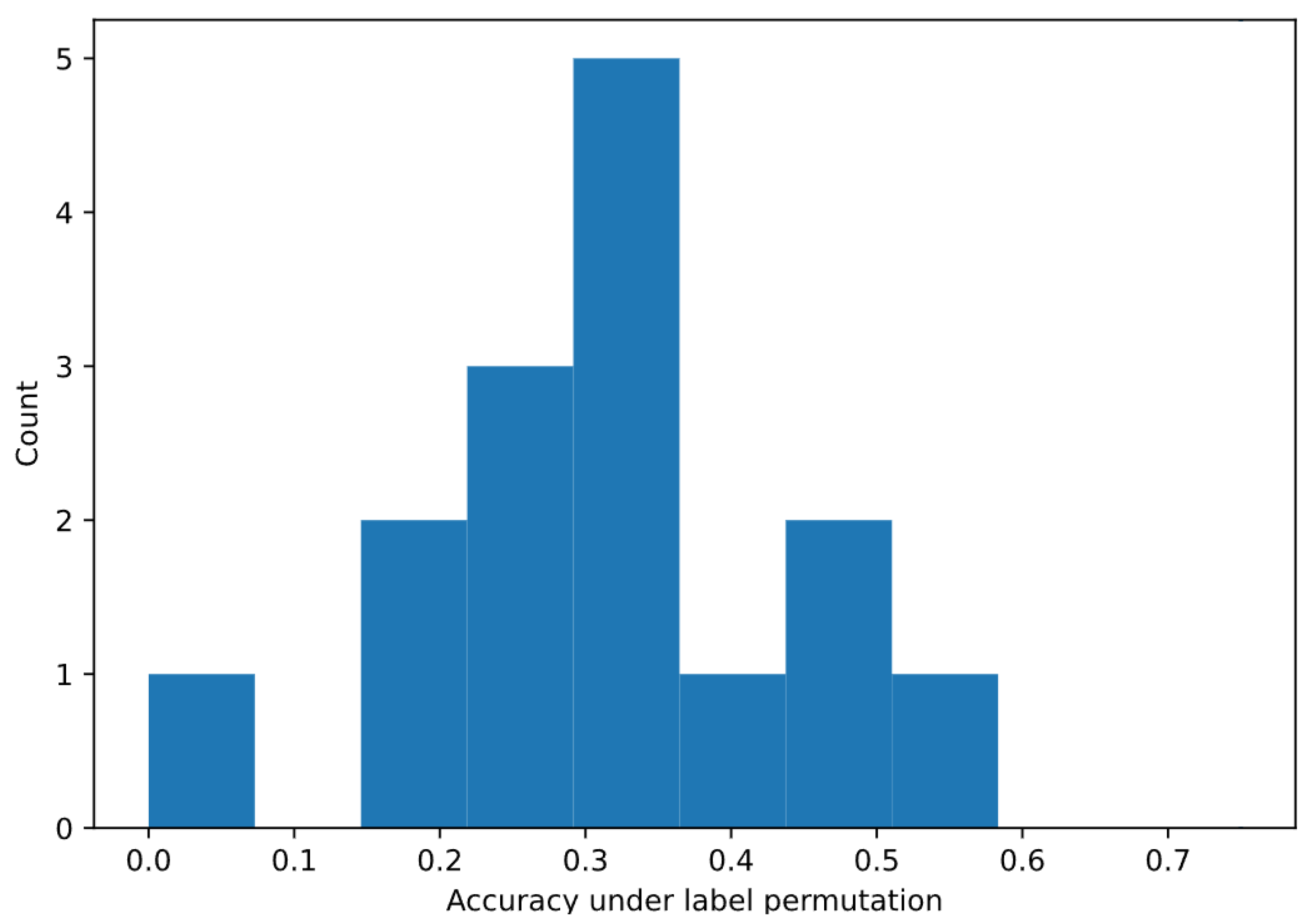
To determine whether the observed accuracy exceeds chance level, a permutation test was performed by randomly shuffling class labels and repeating the LOOCV procedure.
As shown in
Figure 2, most permutation accuracies remain below the observed value. The original classification result lies outside the bulk of the permutation distribution, suggesting that the detected structure is not purely random despite the limited dataset size.
Because only 15 permutations were used, this analysis should be interpreted as an illustrative robustness check rather than a formal significance test.
3.4. Feature Importance Analysis
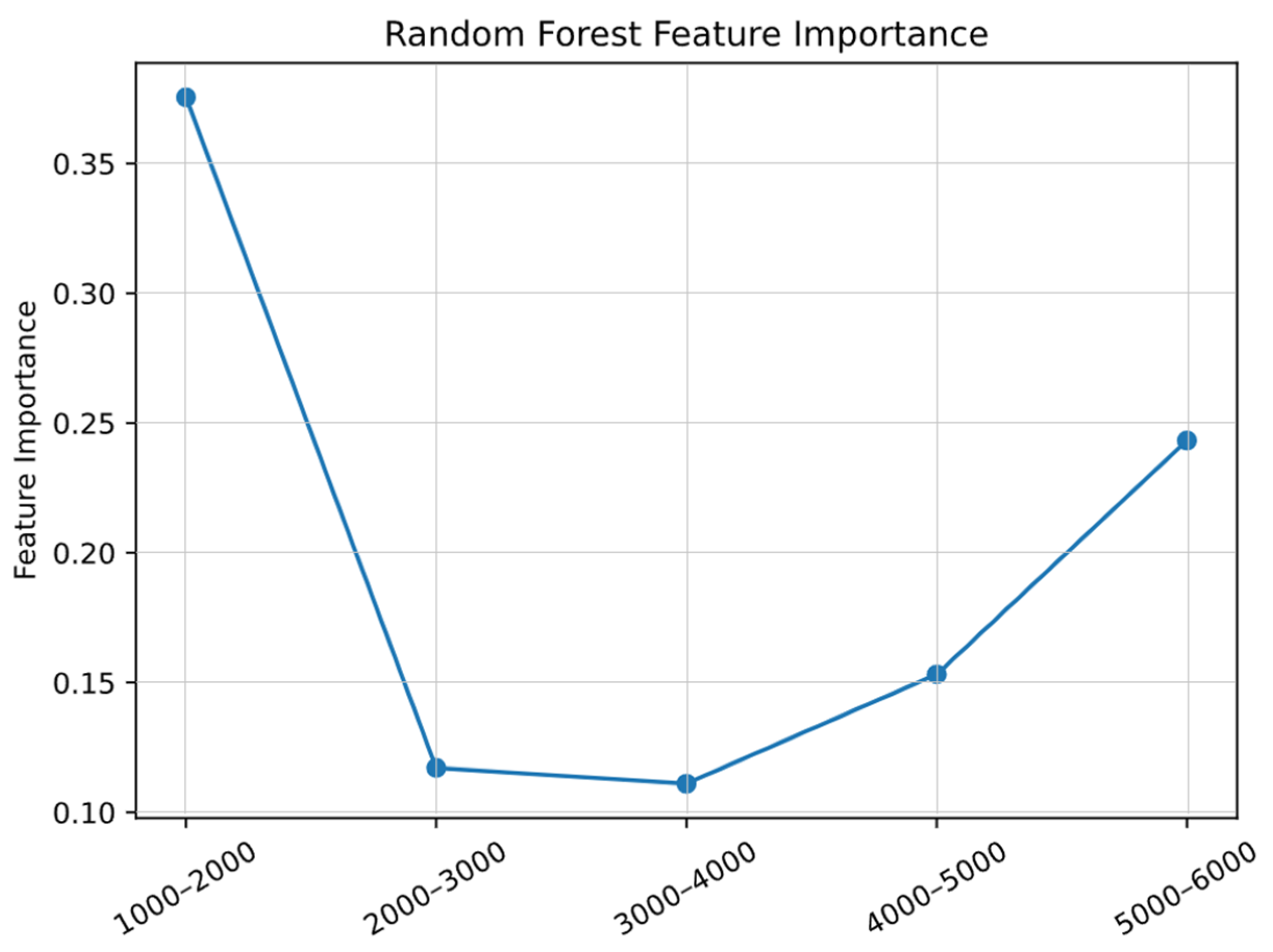
Feature importance values obtained from the Random Forest model are presented in
Figure 3.
The 2–4 kHz bands exhibit consistently higher importance than other frequency ranges. This supports the physical interpretation that mid-frequency spectral content is more sensitive to stiffness-induced structural changes than broadband energy measures.
In contrast, aggregated full-band descriptors tend to mask these localized variations, reducing discriminatory power. This finding is consistent with the literature suggesting that gearbox housing radiation is especially sensitive in the mid-frequency range, where structural modes and acoustic radiation efficiency interact strongly. In practical terms, the 2–4 kHz region appears to be the most informative candidate range for compact screening-oriented NVH descriptors.
4. Discussion
The results indicate that compact frequency-band acoustic descriptors can retain stiffness-related structural information even when dimensionality is strongly reduced. The classification performance (0.75 under LOOCV) suggests that mid-frequency spectral regions carry discriminative content that reflects housing rigidity differences.
However, the confusion matrix reveals partial overlap between the intermediate (SSC = 1) and rigid (SSC = 2) concepts in feature space. This overlap is physically plausible, as both configurations include ribbed structures, leading to similar stiffness-induced modal shifts in certain frequency ranges. The flexible concept (SSC = 0), by contrast, remains clearly separable.
The permutation analysis provides additional evidence that the detected structure is unlikely to arise purely from random label assignment. The present findings should therefore be interpreted as exploratory rather than generalizable.
From a physical perspective, the dominance of the 2–4 kHz bands is notable. It suggests that stiffness modifications influence structural–acoustic coupling most strongly in the mid-frequency range. Full-band integrated measures fail to capture this localized behaviour because they collapse frequency-specific changes into a single scalar quantity. Bands with limited stiffness sensitivity dilute the effect of more informative frequency regions. In practical terms, this indicates that compact mid-frequency descriptors may be more useful for early-stage NVH screening than globally aggregated spectral indicators.
Limitations and Future Work
The most significant limitation of this study is the small and homogeneous dataset. Only twelve simulated spectra were available, all derived from a single gearbox housing geometry. This prevents reliable estimation of generalization performance and restricts statistical inference. The reported classification accuracy should therefore be interpreted as an exploratory indicator rather than as a validated predictive metric.
A second limitation is that the analysis is based solely on simulation-derived acoustic spectra. Manufacturing tolerances, wall-thickness variability, material damping differences, and lubricant effects were not included in the model, although these factors may influence modal behaviour and radiated sound levels in practical applications. In addition, only the 1–6 kHz frequency range was examined using fixed 1 kHz band segmentation. While mid-frequency sensitivity (2–4 kHz) was consistently observed, lower structural bands or adaptive frequency segmentation may reveal additional stiffness-related mechanisms.
Finally, the present workflow relies on standard machine learning tools without algorithmic modification and should therefore be regarded as a baseline analytical framework rather than as a methodological innovation. Future work should extend the present benchmark analysis toward larger and more heterogeneous datasets, experimental validation under controlled operating conditions, and direct comparison between simulation-derived spectra and measured vibration or sound pressure responses. Additional improvements may include the inclusion of tribological and material effects, detailed reporting of test-rig and sensor configurations, and the use of physics-informed or uncertainty-aware modelling approaches.
Until such validation is performed, the findings should be interpreted as exploratory evidence of stiffness-sensitive spectral regions suitable for rapid early-phase NVH screening.
5. Conclusions
This study examined whether minimal frequency-band acoustic descriptors can encode gearbox housing stiffness differences in a statistically interpretable way. Five 1 kHz band-averaged sound pressure features were extracted from simulation-derived spectra. Using these features, a Random Forest classifier achieved 0.75 accuracy under LOOCV. The confusion matrix indicates clear separation of the flexible housing configuration, while intermediate and rigid concepts show partial overlap, reflecting physically plausible spectral similarity.
Permutation testing suggests that the observed classification performance exceeds random chance, despite the limited dataset size. Feature-importance analysis confirms that the 2–4 kHz range is highly sensitive to stiffness variations. This supports the premise that mid-frequency structural–acoustic coupling dominates housing radiation behaviour.
The contribution of this work lies not in algorithmic innovation, but in demonstrating both the potential and the statistical limits of extremely compact spectral descriptors for early-phase NVH screening.
Because the dataset is small and homogeneous, the results should be interpreted as exploratory rather than generalizable. Future studies should validate the approach using larger and more diverse datasets, experimental measurements, and physics-informed feature design.
These findings suggest that even highly compressed spectral representations may provide useful engineering indicators for early-stage NVH screening, where rapid comparison of design variants is required before detailed simulation workflows are performed.
In its present form, the proposed workflow can serve as a rapid comparative screening tool during concept development, provided that its exploratory scope and uncertainty bounds are clearly acknowledged.